



Abstract
Background
Limited evidence exists on how people living with dementia and their family/unpaid carers navigate care and support in India.
Aim
This study used case vignettes to illustrate likely pathways to care for dementia, from receiving a diagnosis to long-term support, in India and to highlight gaps and challenges associated with current care provision for persons living with dementia.
Methods
As part of the Strengthening Responses to Dementia in Developing Countries (STRiDE) project, and to contribute to an analysis of dementia care policies and systems in India, case vignettes were used to illustrate the diverse situations that people with dementia and their families may experience when seeking care in the Indian context. Eight hypothetical, but realistic cases of people with dementia were created by a multi-disciplinary team with experience in dementia care in India, to map out the likely care journeys of each case.
Results
Investigating eight diverse care trajectories of people living with dementia highlighted important patterns relevant to the Indian context. We identified delays in dementia diagnosis to be attributed to low awareness of dementia among the general public and medical professionals in addition to a critical shortage of specialist services involved in facilitating dementia diagnosis. Post-diagnosis, support was recognized as limited and associated with considerable out-of-pocket (OOP) costs. Families primarily provide long-term care for people with dementia till end of life.
Conclusions and Recommendations
Several steps need to be taken in order to improve dementia care in India. Increasing dementia awareness among both medical professionals and general public is essential. Shortages in dementia specialists can be addressed in part through appropriate task shifting. Lastly, more research is needed to develop evidence-based community interventions to support informal care provision for persons with dementia in India.
Introduction
Globally, the numbers of persons living with dementia is projected to increase from 58 million in 2020 to 152 million in 2050 (Alzheimer’s Disease International [ADI], 2017). Much of this increase is expected to occur in low-and middle-income countries (LMIC) (ADI, 2017). In India, approximately 3.8 million people were estimated to be living with dementia in 2019. (Nichols et al., 2022). However, despite this relatively high burden, only 1 in 10 persons with dementia receive any diagnosis, treatment or care in the country (Dias and Patel, 2009; Nulkar et al., 2019). This considerable treatment gap can be attributed to low awareness of the condition, poor accessibility to health care services, shortage of specialists to diagnose and manage dementia, out-of-pocket [OOP] costs associated with care seeking, the absence of both a strong referral system (Alladi and Rajagopalan, 2021) and a formal long term care system, which are vital to the effective management of dementia.
The Indian healthcare system is complex, comprising a mixture of public, private and informal providers that vary substantially across areas of the country (Chokshi et al., 2016; Gautham et al., 2014). Partly as a result of this heterogeneity in service availability, health seeking behaviors are also considerably diverse. In comparison to rural areas, urban areas have a large concentration of private care providers (Chokshi et al., 2016), which allows for more choice with respect to care services. Decisions regarding utilization of type of healthcare services are influenced considerably by socioeconomic factors (Chatterjee et al., 2019). OOP expenditures are a major contributor to total health expenditure in India (National Health Systems Resource Centre [NHSRC], 2018a, 2021). However, the government is working towards providing greater social protection for the socioeconomically disadvantaged in addition to improved accessibility to essential services ( e.g., maternal health, child health, elderly services etc.) through the Ayushman Bharat [AB] programme (Ayushman Bharat-Pradhan Mantri Jan Arogya Yojana (AB-PMJAY) and Ayushman Bharat- Health and Wellness Centres (AB-HWCs) (National Health Authority [NHA], 2022; NHSRC, 2018b). While these are positive steps, formal long-term care support services for dementia continue to remain minimal or absent. A few day-care centres and residential care facilities exist only in metropolitan cities and are associated with significant OOP costs (Alzheimer’s and Related Disorders Society of India [ARDSI], 2010). As a result, care provided by families in their own homes remains the cornerstone of dementia care in India.
The study reported here was conducted as part of the wider Strengthening Responses to Dementia in Developing Countries (STRiDE) international project led by the London School of Economics and Political Science. STRiDE has been conducted across seven middle-income countries (India, Brazil, Kenya, Indonesia, South Africa, Jamaica, and Mexico) with the aim of building research capacity and bridging gaps in evidence with respect to dementia. In the first phase of the project, we drafted an in-depth desk review of the dementia care landscape in India (which is now published on the STRiDE website (Alladi et al., 2022)), which provided us with an understanding of the diversity in support for people with dementia and their families in the Indian context. Informed by this desk review, we attempted to take a systems wide approach by compiling relevant aspects of the Indian system for dementia. We utilized professional experiences of the multi-disciplinary team to highlight the complexity and differences in care experiences of people with dementia and their families in India.
Very few studies have examined pathways to care for people with dementia (Hossien et al., 2017) in India and none (to our knowledge) has specifically examined pathways to care from receiving a diagnosis to long-term support. This paper aims to fill this gap. It contributes to generating evidence on how people with dementia and families currently navigate care and support services, understanding what factors shape care access and use, and investigating the current treatment gap for dementia by highlighting existing challenges that need to be addressed.
The paper uses a case vignette approach that gathers inputs from a multi-disciplinary group of professionals with expertise in dementia and is informed by knowledge gathered through the in-depth review of available evidence on the dementia care landscape in India (Alladi et al., 2022).
Methods
We used a case vignette approach to illustrate pathways to care for people with dementia. Case vignettes are short stories based on hypothetical persons or scenarios, often used to support data collection in qualitative research (Gourlay et al., 2014; Lorenz-Dant et al., 2021; Mah et el., 2014). In vignette-based studies, participants are asked to draw upon their own experience to predict how the characters will behave or feel, or how the scenario will evolve (Gourlay et al., 2014; Mah et al., 2014). As a result, vignettes represent a structured tool to elicit participant’s reasoning and to gather participant’s experiential evidence and tacit knowledge, which can then be utilized to complement formal evidence (Gourlay et al., 2014; Mah et al., 2014). This approach has been used to determine pathways to care for people with dementia (Bieber et al., 2018) and found to be particularly effective in facilitating comparisons in care systems across countries (Bieber et al., 2015; Muir et al., 2017).
Prior to developing the India specific case vignettes, a comprehensive desk review of the dementia care landscape (Alladi et al., 2022) was drafted involving answering series of questions related to the health system, long-term care system, dementia policy context, social protection schemes and diversity in services or support available for people with dementia and their families in India. This in-depth desk review and expert inputs gathered from a multidisciplinary group of professionals that comprised the STRiDE India team (i.e., a neurologist, psychologist, psychiatric social worker, leads of an NGO focusing on supporting people with dementia and their caregivers and a health and long-term care policy researcher) contributed to the development of the case vignettes. It is important to highlight that as part of the wider STRiDE project primary research interviews with various stakeholders on topic areas such as stigma and awareness of dementia had also been conducted (Hurzuk et al., 2022) and this further informed expert input in the vignette development. The case vignettes were validated by six members of the project’s national advisory group and analysed using an approach that builds on framework analysis (Gale et al., 2013) to develop scenarios that 1) identify how people living with dementia and their caregivers navigate care and support by accounting for the diverse and heterogeneous factors that influence care; 2) highlight gaps and challenges associated with existing models of dementia care services in the country; 3) provide recommendations to overcome challenges identified.
Ethical approval was not required as only the research team was involved in this study. The overall project received ethical clearance from the institutes involved in the study.
Approach
As part of the STRiDE project, base case vignette scenarios were developed collaboratively by researchers and NGO partners from the seven STRiDE country teams and facilitated by the UK based LSE team during a workshop in March 2019. As part of the workshop, the STRiDE team worked in small groups and identified and ranked a set of variables likely affecting care and support people with dementia and their caregivers receive (Lorenz-Dant et al., 2021). Focusing on these variables, five core scenarios were developed, that briefly introduce people with dementia and their families across different socio-economic groups and living environments (Lorenz-Dant et al., 2021). Each STRiDE country team then provided feedback as to whether these scenarios were applicable in their country and suggestions about how the vignettes could be improved (Lorenz-Dant et al., 2021). The base vignettes were finalised once no further feedback was received. A detailed description of the different steps involved in completing and validating the base vignettes can be found in the STRiDE vignette guidance document (Lorenz-Dant et al., 2021).
Development of India specific vignettes
The five base case vignettes were initially reviewed by the STRiDE India country team. The majority of the team had been working in service provision for people with dementia and their families for over 10+ years in India. Based on individual expertise of the team and the STRiDE India desk review of the dementia care landscape (Alladi et al., 2022) the country team identified gaps in these five vignettes that were pertinent to the Indian context. Group consensus on modifications and addition of new vignettes were achieved over multiple meetings through which team members shared their insights and comments until a collective decision was reached. Taking into consideration the heterogenous situations that people with dementia and their families find themselves in India, the country team modified one base case vignette and further developed three additional case vignette scenarios. One base case vignette was revised to include a case of vascular dementia, as stroke has been identified to be a leading cause of non-communicable neurological disease burden in India (Singh et al., 2021) and a major cause of dementia in LMICs including India (Kalaria et al., 2008; Shaji et al., 1996). Three additional vignettes were subsequently developed to capture specific features of the Indian context. Firstly, approximately 90% of families receive no diagnosis, treatment or care (Dias and Patel, 2009) and a case vignette representing undiagnosed dementia was included. Secondly, the proportion of young-onset dementia has been found to be higher in India than in developed countries, which may be due to the younger age of the Indian population (Das et al., 2012). Young onset dementia is accompanied with significant economic burden and is often associated with delays in diagnosis or even misdiagnosis (Mukku et al., 2019). To reflect this, a case vignette on young-onset dementia was developed. Lastly, there was a need for the vignettes to highlight health insurance in the Indian context. About 41% of households have “any usual member” covered by a health insurance scheme (primarily hospitalization related) (Ministry of Health and Family Welfare (MoHFW), 2021, pp.3). We however attempted to reflect the substantially smaller proportion of households covered by health insurance schemes that cover some outpatient expenses, a case vignette representing a government health insurance scheme was included and a private health insurance scheme was added to the young onset dementia vignette. Therefore, a total of eight case vignettes were created to represent the dementia care context in India.
For each vignette, the team then articulated how the socio-demographic characteristics and personal and family circumstances of each character were likely to shape aspects such as health-seeking behaviors, time to diagnosis, stigma experienced, and costs associated with care. These aspects were identified in the STRiDE guidance document (Lorenz-Dant et al., 2021) and also by expert inputs from country team. Comments shared by the team members about individual case vignette scenarios were consolidated and subsequent discussions involved listing of ideas and seeking clarifications on how each vignette scenario would evolve until consensus was achieved. Hypothetical names were added to the vignettes to make them more personable; they do not refer to any existing people with dementia or caregivers. These vignettes are published and freely available for viewing on the STRiDE website (STRiDE India, 2022). After exploring the individual care pathways via the case vignette approach, we then used a framework approach to identify patterns as well as differences.
Validation of vignettes
Our study is reflective of the professional experiences and expertise of team members. We attempted to ensure that we are not portraying just our professional views by having our vignettes critically reviewed by experts from the STRiDE India National Advisory Group (INAG). The INAG was formulated at the beginning of the STRiDE project and comprises of 21 members whose role was developed to hold the research team accountable for the activities of the project and included professionals with diverse experience in health and/or long-term care in India in addition to members of the general public such as former carers. The INAG was invited via email to validate the vignettes considering whether the vignettes represented the diverse situations that people with dementia and their families find themselves in and accurately described health seeking behaviors and care trajectories. They were also asked to suggest any other scenarios for inclusion. Six INAG members (including healthcare professionals, non-governmental organization representatives, a former caregiver, and a health economist) provided feedback on the vignettes via email. This was consolidated and discussed by the core team.
Analysis of vignettes
An approach based on the framework method (Gale et al., 2013) was used for to look across the individual vignette scenarios for common elements, differences, and barriers to dementia care services across the country. Utilizing a framework template provided by STRiDE (Lorenz-Dant et al., 2021), the country team charted data manually for each vignette on the Excel spreadsheet based on questions prevalent in the guidance document for each of the columns (main carers, support available to carers/people with dementia, where would a family go for memory concerns/behavioral symptoms, ongoing health and medical support.) (Lorenz-Dant et al., 2021). The India team also added a section on pre-diagnosis and awareness to a column as this was an important topic in the Indian context. Subsequently, we charted data on gaps and challenges to be overcome for each vignette scenario by reflecting on the data captured for each of the previously highlighted questions. Using these pre-determined categories, the country team grouped them together to form three major topic areas. Pre-diagnosis and awareness were grouped together to form
Results
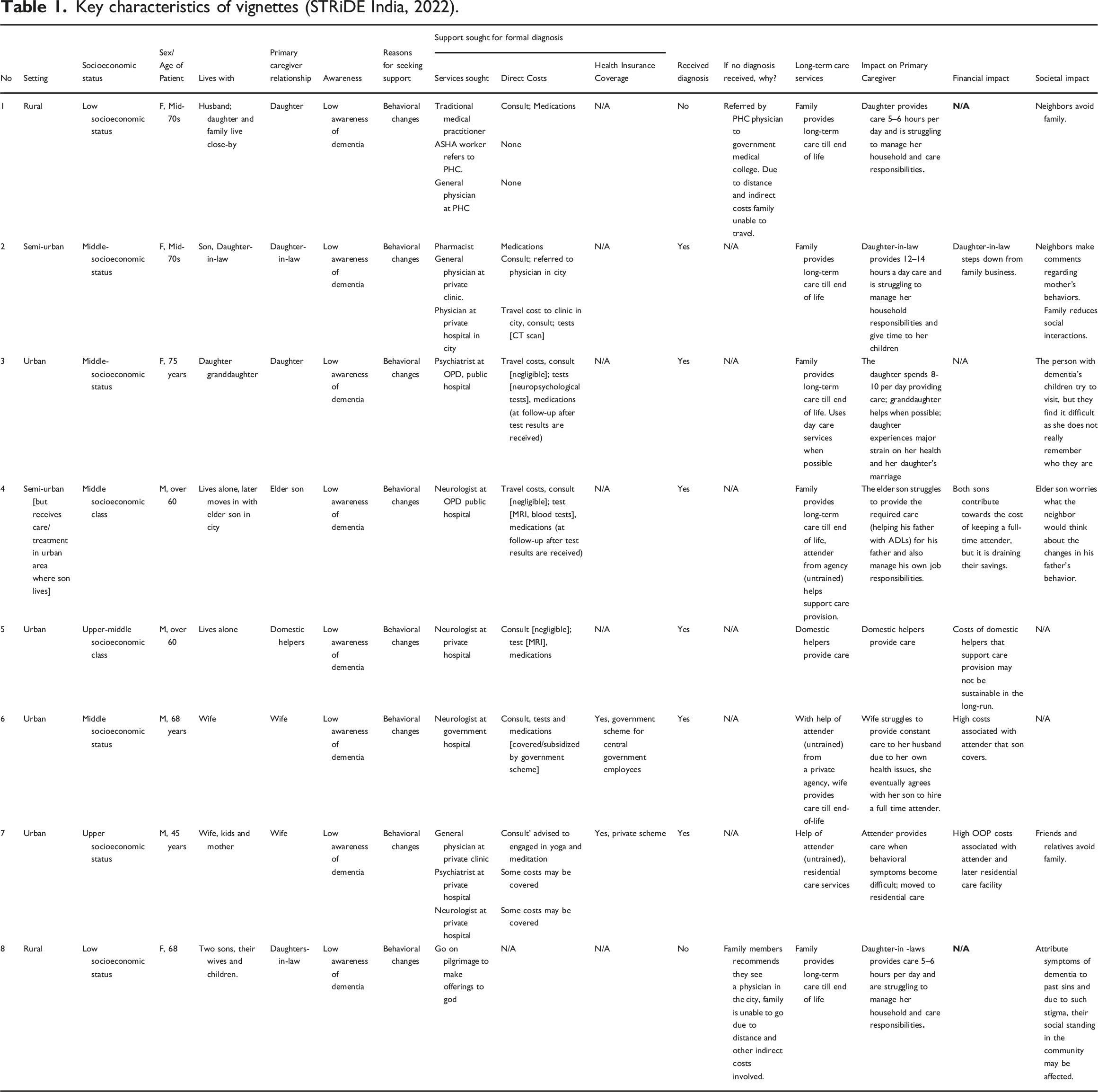
Key characteristics of vignettes (STRiDE India, 2022).
Pre-diagnosis
Irrespective of socioeconomic status or geographical area (rural versus urban), awareness of dementia was typically low among the general public and medical professionals. People with dementia and their families do not recognize symptoms of dementia, associating signs such as memory disturbances to be a result of old age. It is only when significant behavioral symptoms emerge that families may seek professional help. When behavioral symptoms occur families isolate themselves or the person with dementia from the community; often arising due to misunderstandings or incorrect beliefs regarding cause (e.g., Mrs Hari vignette [STRiDE India, 2022]). Such beliefs have been demonstrated in the vignettes to influence type of support sought, if any (e.g., Mrs Hari vignette [STRiDE India, 2022]). However, even if support is sought from non-specialist medical professionals such as general physicians (GPs), they have been described in the vignettes to have limited understanding or awareness of dementia often attributing symptoms to natural signs of ageing in older people (e.g., Mrs Bhatt vignette [STRiDE India, 2022]) or stress in younger persons displaying early symptoms of young-onset dementia (e.g., Mr Gautam vignette scenario [STRiDE India, 2022]). The phase before reaching a diagnosis is highlighted as turbulent in several of the vignettes suggesting that receiving a diagnosis is an issue that people with a range of characteristics share.
Diagnosis
The diagnosis seeking phase is likely to vary substantially based on availability of services within a given area and individual socioeconomic status. Accessing a specialist is often key in receiving a diagnosis for dementia across the case vignettes. In rural areas, families from a lower-socioeconomic group have been shown to have heterogenous pathways to care (e.g., Mrs Anand vignette, Mrs Hari vignette [STRiDE India, 2022]). People with dementia or their families may seek a traditional medical practitioner, or directly communicate concerns to a community health worker who may direct them to a primary health centre (PHC), or the family may not seek any formal care services at all. Even if a person with dementia or their family sought a GP at a PHC, it was established in the vignettes that the GP would be unlikely to recognize symptoms of dementia; possibly recommending a visit to a specialist in the city. In both rural and semi-urban areas (e.g. Mrs Anand vignette, Mrs Bhatt vignette, Mr D’Souza vignette [STRiDE India, 2022]), families are likely to have to travel significant distances to seek a specialist, as such services are concentrated in urban areas. As a result, the person with dementia or their family may or may not choose to seek a specialist due to direct [e.g., travelling costs] and indirect costs [e.g., opportunity costs due to travel] incurred. Whereas, in urban areas, people with dementia and/or their families typically directly seek a specialist (e.g., Mrs Chatterjee vignette, Mr Ebrahim vignette [STRiDE India, 2022]).
The type of specialist sought (psychiatrist or a neurologist) is likely to be influenced by certain beliefs, for example, societal stigma associated with the term ‘psychiatrist’ has been illustrated as a possible deterrent to initial help-seeking (e.g.Mrs Chatterjee vignette [STRiDE India, 2022]). In addition, time to receive a diagnosis and associated costs was further determined to be dependent on whether the specialist is sought in a public or private healthcare service setting. In public hospital settings, the vignettes highlight that OOP costs associated with tests and consultations are subsidized (based on socioeconomic status assessment), however the waiting times are recognized to be long (e.g., Mrs Chatterjee vignette, Mr D’Souza vignette [STRiDE India, 2022]). In contrast, vignettes illustrate private health services to have shorter waiting times, but more considerable OOP costs (e.g., Mr Ebrahim vignette [STRiDE India, 2022]). In a very small proportion of the population, the costs of seeking medical care may fully or partially be covered by a public (e.g., scheme for government/retired employees) or private (very few schemes have recently began offering some coverage for outpatient expenses at an additional premium [Gambhir et al., 2019]) health insurance scheme (e.g., Mr Fawaz vignette, Mr Gautam vignette; [STRiDE India, 2022]).
Post-diagnostic support services and long-term care
After receiving a diagnosis from a specialist, the vignettes highlight the absence of a system to provide coordinated care and support services for people with dementia or their families. Day care centres, residential care centres, paid attender agencies (often employing staff who are not familiar with dementia) and psychosocial support services for caregiving are discerned to be few in the entire country; primarily concentrated in metropolitan cities (e.g. Mrs Chatterjee vignette, Mr Gautam vignette [STRiDE India, 2022]). These services were depicted to be associated with substantial OOP costs thereby more affordable to those from a higher socioeconomic group. Although even among higher socioeconomic groups, stigma associated with the utilization of institutional services such as residential care may possibly influence service uptake or sustained use.
Notably, while the vignettes indicate that domestic helpers may aid in caregiving among more middle and higher socioeconomic groups (e.g. Mrs Chatterjee vignette [STRiDE India, 2022]), their role was highlighted as particularly relevant in situations where there is no family support available (e.g. Mr Ebrahim vignette [STRiDE India, 2022]). Overall, within families the vignettes have emphasized that it is the women who primarily provide care with respect to activities of daily living for people with dementia with limited or no psychosocial support and while managing multiple households and/or professional responsibilities in addition to their caregiving responsibilities (e.g. Mrs Anand vignette, Mrs Bhatt vignette [STRiDE India, 2022]). As a result, they have been shown to experience emotional distress and negative consequences for their physical health (e.g. Mrs Chatterjee vignette [STRiDE India, 2022]). Certain exceptions (e.g. Mr Gautam vignette [STRiDE India, 2022]) have also been highlighted in the vignettes with respect to access to post-diagnostic support, such as paid attenders/residential care centres, among high socioeconomic groups residing in metropolitan areas.
Discussion
Overview of challenges identified across specific phases of the dementia care journey from the vignette scenarios.

Prior to dementia diagnosis, awareness of dementia among the general population and medical professionals are illustrated as a crucial factor influencing whether, when and how a family receives a formal diagnosis, if at all. Awareness of dementia as a medical condition is low in the Indian context. Studies have found that memory problems are often thought of as part of natural ageing and that the behavioral symptoms associated with the condition are stigmatized, perceived in certain communities to be deliberate (Shaji et al., 2003). However, this lack of awareness is not limited to general public. A study conducted in a medical college in the state of Gujarat reported that only 49% of undergraduate medical students were aware of dementia symptoms (Patel et al., 2021). This is more concerning as the mean age at presentation of dementia is also lower in the Indian context (Das et al., 2012) and young-onset dementia in particular is more likely to be associated with delays in diagnosis (Mukku et al., 2019) as also demonstrated in one vignette scenario (e.g. Mr Gautam vignette (STRiDE India, 2022)) . Therefore, poor awareness among GPs further contributes to diagnostic delays as highlighted in several case vignettes; this can be attributed to the significant lack of emphasis of dementia in the undergraduate medical curriculum (Patel et al., 2021).
Outside of seeking a GP, in the diagnosis phase people with dementia and their families may access several other services as well. Differing beliefs and variability in availability of services are likely to influence care services sought; studies have found utilization of services from non-registered practitioner (Narapureddy et al., 2012), unqualified medical practitioners medical practitioners (Qadri et al., 2013) to be prevalent among elderly residing in rural India. Seeking such services can contribute to further diagnostic delays. It is important to recognize that India has a strong traditional system of medicine (e.g., Mrs Anand’s vignette illustrates how traditional medical practitioners may be commonly approached in rural areas) and efforts have been made by the government through the Ministry of AYUSH (Ayurveda, Yoga and Naturopathy, Unani, Siddha and Homeopathy) to support and promote traditional medicine systems (Sen and Chakraborty, 2016). There are opportunities to integrate traditional medical practitioners into models of dementia care service delivery possibly through collaboration with trained general practitioners or dementia specialized professionals.
Currently, diagnosis of dementia is primarily provided by specialists (neurologists or psychiatrists [Alladi and Rajagopalan, 2021]). This is problematic because the number of neurologists and psychiatrists available in the country to meet population needs is grossly inadequate (Garg et al., 2019; Singh et al., 2020); with a particularly high shortage experienced in rural areas where about 70% of the population resides (Chandramouli, 2011). This was also highlighted in the case vignettes, which further emphasized the challenges experienced by persons living in rural or semi-urban areas, who have limited access to specialists and have to travel significant distances to seek care often incurring multiple direct and indirect costs (Rao & Bharath, 2013).
Household OOP expenditure was identified as the main way to access services during the diagnosis phase and for ongoing post-diagnostic support. OOP expenditure by households has been identified as a major contributor towards total health expenditure in India (NHSRC, 2018a, 2021). As a result, socioeconomic status plays a crucial role in determining access to care in the Indian context. Studies have demonstrated that persons from higher income groups are more likely to choose private hospitals associated with more costly care (Chatterjee et al., 2019) compared to persons below poverty line who are likely to choose government services (Bhojani et al., 2013). However, this varies, and public health infrastructure of individual states greatly influences choices in care services (Chatterjee et al., 2019). Coverage by a health insurance scheme in association with other factors (e.g., caste, distance from facility, number of empaneled hospitals in an area (Prinja et al., 2017)) also influences healthcare utilization. The vignettes depict a very small proportion of the population (e.g., government employees under scheme that cover outpatient expenses, high income groups that can afford or are aware of the very few private insurance schemes with additional outpatient coverage) covered by health insurance schemes with some outpatient coverage, but importantly highlight that predominantly these schemes do not provide coverage for long-term care services such as day care, residential care and paid attender services for dementia.
Long term care irrespective of a diagnosis is primarily provided by families in their own homes with limited psychosocial support as emphasized by the vignettes. A gender disparity with respect to this family-based care provision however exists, with women predominantly providing care, as highlighted in the vignettes. This has been consistently reported by studies on unpaid care for elderly in India, with women experiencing worsening mental health as a result of their caring role (Brinda et al., 2014; Prince et al., 2012). While families have had to take on this caregiving role with limited support as a result of societal norms (Gupta, 2009) and the absence of a system or services to provide continuity in care (Dias and Patel, 2009), there are a few long-term care services that are available in the country to select groups (ARDSI, 2010). These services are predominantly in large metropolitan cities and associated with high OOP costs that make such services inaccessible to the majority of the population (ARDSI, 2010; Dias and Patel, 2009;). In addition, there is inadequate regulation or monitoring of services such as paid attender agencies, residential care centres (Harbishettar et al., 2021) or day care centres, so the quality and costs of these care services are highly variable (ARDSI, 2010). However, well-developed states such as Kerala have a larger number of old age homes as well as a palliative care facilities to support those with terminal illnesses, the latter, however, primarily for persons with cancer (Kumar, 2007).
The strengths of this study are that we relied on the considerable direct professional experiences of the research team. The majority of the team members were providing actual care services to people with dementia and their caregivers in India. Our methodological approach can further be considered as an innovative way to illustrate pathways to care for people living with dementia in the Indian context and doing so in a cost-effective way. The developed vignettes help to provide information about the support available to people with dementia and their families in the light of limited published evidence in this area. In addition, we also ensured that our results were checked for face validity with key stakeholders in the field of dementia in the country.
While this work provides an important first step towards a more systematic illustration of dementia care pathways in India, we nevertheless acknowledge several limitations . The case vignette approach while useful in describing a general overview of pathways to care for people with dementia in India, could not account for the substantial state-wide differences that are likely to influence these care pathways. Also, we are aware that the vignettes may be shaped by the experiences of the team. We aimed to mitigate this risk of providing a biased or partial account of dementia care in India by working as an interprofessional and multi-disciplinary team, constantly discussing and challenging the results of our own work among us. We also sought feedback from stakeholders as well as anchored the vignettes in the existing literature about dementia in India. In addition, we acknowledge that people living with dementia and their caregivers did not contribute to the development of the vignettes. While the professional inputs of majority of team members are informed from their day-to-day work with people with dementia and/or their families as well as other aspects of the STRiDE project including some empirical work (Hurzuk et al., 2022), we recognize the urgent need for primary research on pathways to care for dementia care in India.
Conclusion and Recommendations
This paper has highlighted that low awareness, stigma, heterogeneity in health seeking behaviors, poor infrastructure and human resource availability, costs associated with seeking care and an absence of a formal long term care system considerably influence care journeys of people with dementia and their families in the Indian context. A number of recommendations have been recognized as crucial to address these challenges and have been identified in part through the in-depth desk review (Alladi et al., 2022): • Raising awareness among the general public in order to reduce stigma and so that people with dementia are able to recognize symptoms early on and seek the appropriate help is critical. Development and implementation of awareness programmes that take into consideration context specific factors influencing perceptions of dementia, with a strong focus as well on prevention through behavioral change communication strategies is essential (Kalkonde et al., 2020). • Placing greater emphasis on dementia in the undergraduate medical curriculum in order to raise awareness among primary care physicians to recognize, diagnose and appropriately refer people with the condition. Community health workers such as Accredited Social Health Activists (ASHA) workers should also be trained to identify dementia. Such task shifting interventions are vital in settings wherein specialist shortages exist. Such interventions have been trialed and found to be effective for mental health conditions in rural areas of India (Nimgaonkar and Menon, 2015). • Improving financial protection, with programmes such as Ayushman Bharat having considerable scope of reducing OOP expenditure. It is critical that dementia stakeholders actively engage in continued operationalization of the programme to ensure services for people with dementia are well integrated with efficient delivery. In addition, development of schemes that cover costs associated with informal care provision is critical. For example, the state of Kerala provides a nominal remuneration per month to female unpaid carers of persons with mental or physical illness (D’Cruz and Banerjee, 2020). • Developing evidence-based community interventions to support informal care provision. For example, a randomized controlled trial in Goa utilized home care advisors, recruited locally and trained for a week on dementia, to support caregivers at their homes through fortnightly visits for a period of 6 months, supervised by specialists (Dias et al., 2008). The authors found that this intervention led to improvements in caregiver mental health. There is a need for larger studies that trial such community-based interventions in different parts of the country using locally available resources.
Next Steps
To our knowledge this is the first study in India to systematically illustrate care scenarios for people with dementia and their families from pre-diagnosis to post-diagnostic and long-term care support utilizing a case vignette approach. It has highlighted situations that people with dementia and their families may experience and provided possible recommendations to address challenges informed by an in-depth desk review of the dementia care landscape (Alladi et al., 2022). By describing potential care situations of people with dementia and their families, this paper provides a base for future larger empirical work with persons with dementia and their families that examine care pathways for dementia in the Indian context. This could include primary qualitative research with people with dementia and/or carers wherein the vignettes may be used to elicit their responses on pathways to care for dementia in the Indian context.
Footnotes
Acknowledgements
The authors would like to thank the experts who aided in validating our vignettes and the wider STRiDE team.
Declaration of conflicting interests
The author(s) declared no potential conflicts of interest with respect to the research, authorship, and/or publication of this article.
Funding
The author(s) disclosed receipt of the following financial support for the research, authorship, and/or publication of this article: This work was supported by the UK Research and Innovation Global Challenges Research Fund, ES/P010938/1.
