



Abstract
Dynamic pricing is a hotel approach that adjusts room pricing each week or even daily based on real-time marketplace circumstances, consider, and insist. This adaptive pricing strategy maximizes the hotel’s revenue potential. This study aims to optimize hotel revenue management through dynamic pricing algorithms and data analysis models, analyze factors to regulate room prices dynamically, and maximize revenue based on insisting and marketplace environment. The Kaggle hotel expenses dataset provides an inclusive advance to consider the impact of variables on online room pricing. The dataset includes fields resembling index, name, place, type, price, reviews count, rating, city, and state, which assist examine the general pricing performance and precise hotel category. Utilizing advanced statistical methodologies such as SPSS-stimulated ANOVA, correlation analysis, chi-square tests, and multiple linear regressions enables a comprehensive examination of the key controlling elements in hotel pricing strategies; hotels can discover the most impactful variables and employ pricing strategies that improve effectiveness and competitiveness. The findings of this investigation highlight that hotel type, rating, and location (both place and city) are the predominant factors influencing room pricing, providing actionable insights for hotel managers looking to optimize revenue strategies. Reviews count moreover plays a vital role, distressing pricing during its impact on a supposed eminence, guiding hotels in implementing effectual pricing strategies to develop productivity.
Introduction
Managing consumable assets like airline seats, cruise line berths, hotel rooms, rental cars, and broadcast advertising slots to improve a company’s profits over a short period, provided that expenditures are virtually fixed over that time, is the essence of revenue management (RM). These resources can be used either exclusively through implied expense optimization or in conjunction with precise price optimization regularly as a preprocessor for implicit price optimization (IPO). 1 Using a range of examination package combinations of room expense, entranceway, length of stay, facilities, and limits on earlier purchases to cater to a specific type of physical room is known as implicit price optimization in the hotel sector. Recall that an expense is a combination of superior purchase constraint, room pricing, and amenities. 2 When only specific service packages are dynamically made available for purchase at a given moment, for example, only the more expensive packages are made available during anticipated periods of high demand, implicit price optimization is the outcome. 3 As a result, price manipulation occurs indirectly yet effectively to increase income during a brief period, explicit price optimization dynamically modifies service package prices. The pricing for the next IPO is set by this. Determining the overall effective capacity levels for perishable assets for each service package that pertains to a particular class of physical asset (such as a single hotel room configuration) is a step in both explicit and implicit price optimization. 4 When everything else is equal, the hotel wants no unsold rooms; thus, occasionally the effective capacity used as a parameter in the IPO is bigger than the actual capacity to allow for cancellations and no-shows. 5
The process of determining efficient capability level is often known as overbooking, with the underlying pricing optimization process of allocating the effective capacity among various service packages commonly referred to as allocation. 6 Modern RM assessment maintains system carries out allocation, overbooking, and clear pricing optimization; overbooking is the second module to be completed after explicit price optimization. Older systems only handled allocation and overbooking, with overbooking taking precedence. 7 For the adopting company, these decision support technologies typically result in a 6% boost in revenue. These methods have been adjusted for rental properties, resulting in an 8.7% rise in income. Therefore, there is a significant chance that enhancing an RM decision support system will have a positive financial impact. 8
Allocation and overbooking are often done; overbooking is achieved by a stochastic dynamic program. Generally, an optimization network’s average selling price for a sweep serves as the anchor for the undersell cost (such as a single leg in an airline flight network or a stay overnight at a hotel) and the oversell cost is determined as a user-specified ratio.
9
Subjective in nature, the discounted future lost profits as a result of the overbooking occurrence are mostly reflected in the oversell cost.
10
As a result, the dynamic software uses this judgmental ratio as its goal function to calculate how many possessions to keep for sale above substantial ability for the next arc.
11
How many resources should be allotted over a planned horizon to each service package of numerous stay overnights is the decision variable for hotels. Allocation is often carried out by a statistical course, with the present performing individual in a nonlinear program.
12
The intention is to exploit estimated progress over the given possibility, where the expectation is determined by insistent prediction inaccuracy supply regarding point estimations. The constraint places a limit on the allocations made on each network arc (such as a hotel stayover). Bid prices, or the total of the two variables for all requested stay overnights, are used for the final allocation. This resource, which is a hesitation-demand, is barely permitted if the entire proceeds from the accommodation book exceed the offer price.
13
The purpose of this analysis is to maximize revenue based on requirements and market environment by optimizing hotel revenue management (HRM) through the employment of a data analysis model and dynamic price algorithms. The main contributions of this study are: 1. The study determined the majority of significant variables that impact hotel room charges, with hotel type, location, rating, and number of reviews. This information helps hotels build data-driven pricing decisions that optimize proceeds and assure consumer requirements. 2. By utilizing MLR, correlation analysis, chi-square tests, and SPSS-stimulated ANOVA, the study provides a methodological structure for analyzing the possessions of numerous factors on the room price, therefore enhancing the precision and reliability of pricing strategy. 3. This study aids hotels in implementing adaptive dynamic pricing strategies, aligned with current market conditions, thereby enhancing their competitiveness and operational efficiency in the hospitality sector.
Related literature
One of the problems faced by the industry was price personalization, or the capacity to modify prices at the client stage. By a qualitative approach, research 14 investigated the current purpose of dynamic price in lodge RM. In doing so, it highlighted the benefits and drawbacks of a customer-centric approach to pricing and provided factual support for the application of contemporary business concepts like open pricing. The reliability of 22 different approaches to instant hotel forecasting for direct periods up to 14 days in advance was compared by Pereira and Cerqueira. 15 Seasonally naive and exponential smoothing approaches for double seasonality were evaluated with ML models. Among the ML techniques examined was a novel strategy based on arbitrating, which generated forecasts by dynamically combining many forecasting models. Using a meta-learning technique called arbitrating, experts’ output was combined based on their estimates of potential losses. Specifically, the dynamic ensemble approach was applied. Research 16 provided an optimization technique to examine a merchant under monopolistic conditions’ simultaneous judgments scheduled changeable price with order quantity for cyclic yield. It was considered that customers are shrewd and might wait to purchase to receive a better deal later. The issue has been looked into about several alternative items. To estimate client demand, it has created a system based on deep neural networks. Due to its complexity, the difficulty cannot be resolved by conventional enhancing techniques. To address this, it has created the deep Q-learning algorithm (DQL), a reinforcement learning technique.
The RM challenges of dynamically allocating capacity to various client segments in a chain of low-cost hotels were discussed by Chen et al. 17 It addressed an industrial-scale issue that practitioners were facing, and the practicality of putting our solution into practice inspired us to create a customized reinforcement learning strategy. It is installed in two stages; initially, a reinforcement learning method is used to calculate a suggested average discount. Next, using a linear program, the suggested average discount was converted into a capacity allocation. By boosting profits and enhancing customer experiences, dynamic pricing powered by AI and ML algorithms was transforming several sectors, including transportation and e-commerce. Although personalization was one of its advantages, there were drawbacks such as implementation costs, ethical issues, and dissatisfied customers. To stabilize revenue, user satisfaction, and principles, Kopalle et al. 18 examined the complicated relevance of dynamic pricing emphasized its flexibility along with effectiveness in increasing profitable price schemes, and advocated for more research on the focus. Expertise in AI and resourceful data organization were important, excluding authoritarian monitors and additional hazards that should besides be in use in explanation. Research 19 developed a novel framework to investigate how hotel operators use expense inequities with supply management while accounting for seasonality. It developed a time-varying model that associates the premature book with hurried pricing decisions using data that is readily available to the public. By responsibility, it took into consideration the register placed on sale; the desperate insist shock, and the predicted size and price elasticity of the demand.
An examination of 100 hotels during the COVID-19 pandemic reveals that while prior booking plays a lesser role as an RM lever, last-minute reductions and surcharges were constant for extended periods. A novel process for anticipating daily hotel requirements for utilizing a reside appointment cluster created from the preceding book information was recommended by Viverit et al. 20 It used an auto-regressive ML system to gather historical book curves, and it predicted each day’s possession for up to 8 weeks by a preservative spontaneous representation. Research 21 provided a novel insist forecasting representation for the hospitality regions with Attention-Long Short Term Memory that project once a week hotel insist 4 weeks in proceed of schedule. In comparison to the common in-progress method, through employ of the time series requires data in addition to other features related to the 10 Hotel Amenities or Hotel Furnishings found by K-Means Clustering discovery utilizing neural networks (NNs). Exclusive of assuming any assumption on the impending assortment structure, research 22 used the multinomial logic selection advance to examine the large-scale collection optimization concern. To accelerate the assessment phase, it takes improvement of advancement in model investigation contained by the in-sequence ML segment. For each compilation of assortment, as well as for the additional uncomplicated condition concerning cardinality limitations, its algorithms are capable of discovering a resolution time-dependently by a sub-linear in the entire extent of assortment.
While analysts evaluate the pricing and projections to approve or make arbitrary modifications, RMS offers recommendations. The suggestions were frequently a black box, with little information available about their methodology. The k-nearest neighbor (k-NN) algorithm was presented in the article 23 as a predicting method that can convert the dark box to a glass box. The advantages of k-NNs are thoroughly examined with contrasted and those of neural networks. In collaboration and a top RM examination contributor, 35 hotels are the subject of the investigation. Processes that exclusively use past booking data to produce bid pricing were proposed in the article. 24 It employed a neural network technique to forecast future bid price estimates and a comprehensive simulation analysis that evaluates the performance of the technique with an ideally produced bid cost by dynamic programming (DP) to evaluate the outcomes in provisions of load factor and proceeds.
To investigate the advantages of data transformation in predicting daily hotel room demand for a hotel under investigation were analyzed by research. 25 Other hotels with comparable demand patterns could be able to use the suggested results as a forecasting framework. Two distinct datasets of daily demand pre-processed data and data altered using smoothing techniques were utilized for room demand forecasting. To investigate the factors that influence the pricing of budget hotels, the article 26 used both linear and nonlinear machine-learning techniques based on big data. 81 possible elements were taken into consideration based on the geographical perspective. Recursive feature elimination, a feature extraction methodology, was used to further select it and was the six machine-learning methods that were assessed and contrasted. The feature significance was subsequently computed using the optimum value. It anticipated the hotel pricing’s spatial distribution and revealed 40 significant influence factors.
Materials and methods
In this investigation, data analysis methods and dynamic pricing algorithms are used to investigate. To examine pricing patterns, a database of hotel price data was gathered, covering essentials such as hotel type, location, price, reviews, and ratings. The study employs statistical techniques such as multiple linear regressions (MLRs) to determine the production of independent variables on room rates, CA to establish associations involving variables, ANOVA and chi-square test to discover considerable differences and relations with definite variables, and conceptual framework exactness to the hypothetical underpinnings and study proposition.
Data collection
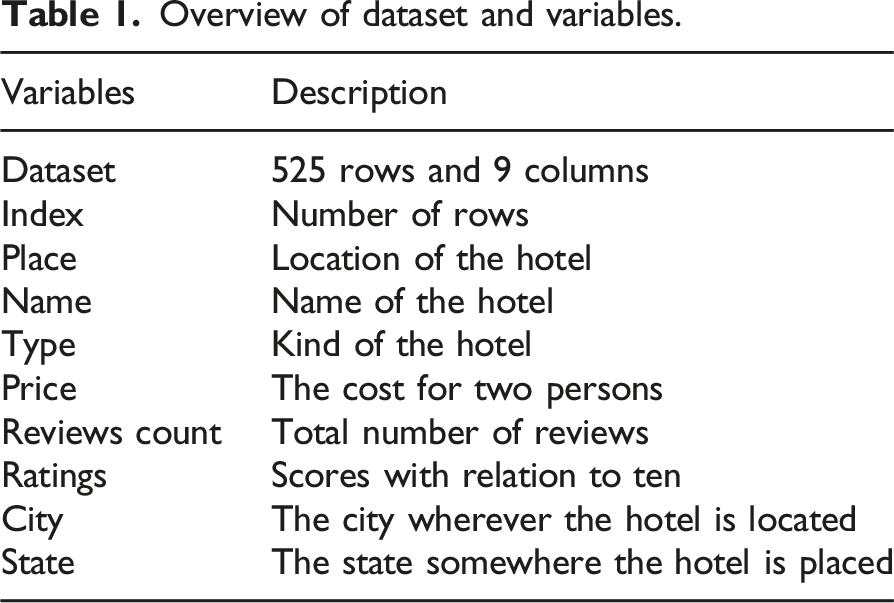
To enhance HRM by using data analysis models and dynamic pricing algorithms, using thorough and pertinent datasets that cover a range of hotel operations, market conditions, and customer behavior is important. In this study, the analysis is conducted by using a dataset from Kaggle (https://www.kaggle.com/datasets/mukuldeshantri/hotels-netherlands). This dataset offers a wealth of information for comprehending how various factors impact demand and pricing trends for hotel rooms.
Overview of dataset and variables.
Hypothesis analysis
To ascertain which variables have a substantial impact on hotel room costs, this study’s hypothesis analysis employs a variety of statistical techniques to assess the influence of independent variables such as location, city, state, kind of hotel, number of reviews, and rating on pricing strategies. To determine whether geographic variables and hotel categories have an impact on pricing decisions, it is used to conclude whether present are any important differences in room costs across various regions and hotel kinds. The associations between review count, rating, and room costs are examined using CA and MLR. Figure 1 represents the conceptual or hypothesis framework. H0, H1, H2, H3, H4, and H5 denote the independent variables such as place, type, review, rating, city, and state, and these variables are associated with the dependent variable of price. Conceptual framework.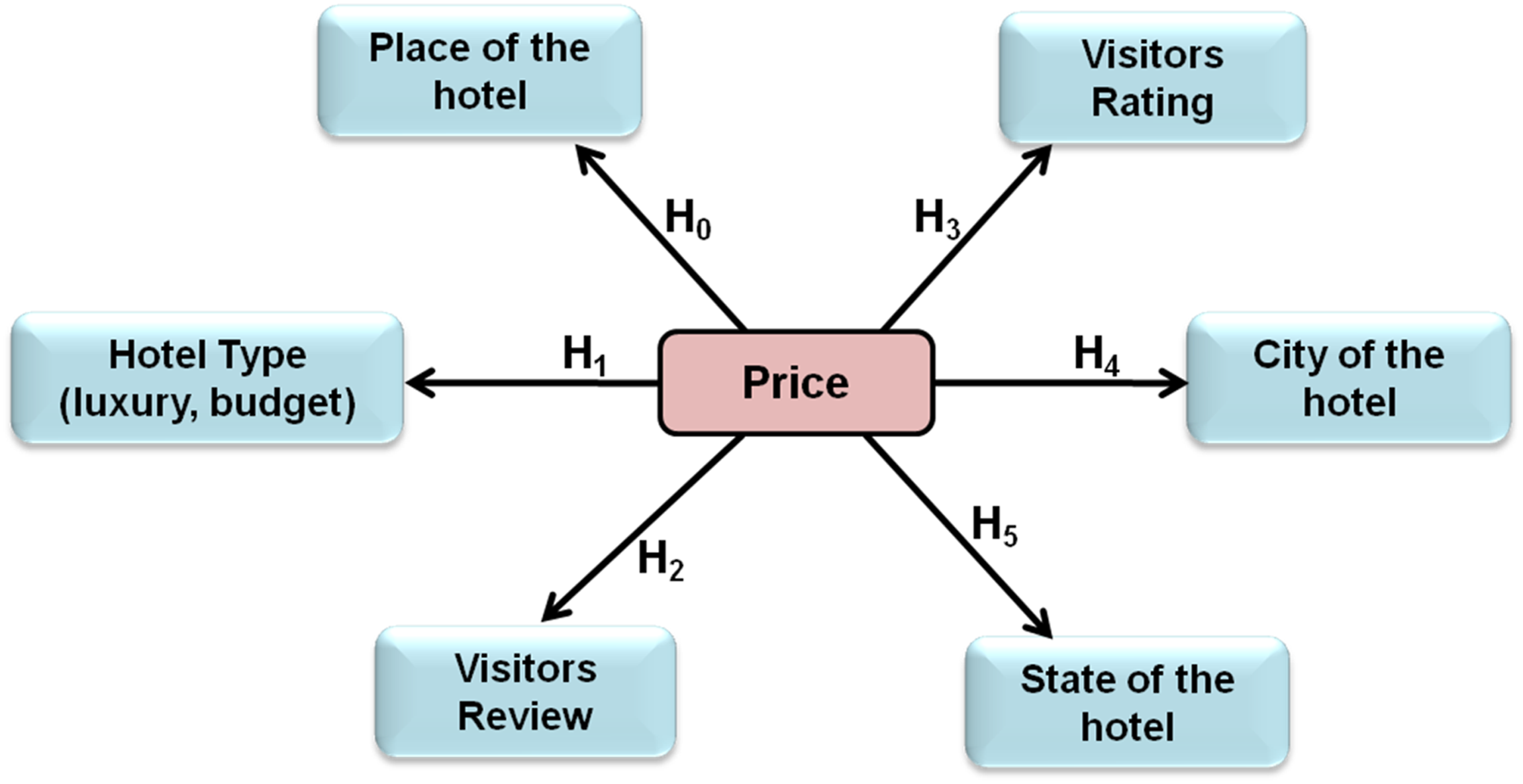
Statistical analysis
To identify the most influential variables and implement price strategies that increase efficacy and competitiveness, hotels can analyze the control parts of their pricing approach utilizing SPSS-stimulated ANOVA, correlation analysis, chi-square test, and MLR.
Correlation analysis
For hotels to exploit RM throughout dynamic pricing, CA is implemented. By considering hotel type, rating, location, and number of reviews, this approach looks at the correlations involving these variables and how they concern room rates. This study finds the essentials that are considerably related to price variation by the hotel prices dataset, which include parameters similar to name, place, kind, price, reviews count, rating, city, and state. Hotel location, kind, and rating were exposed to include a strong association through room prices by this analysis; suggesting that these variables have an immense influence on pricing strategy. A room’s supposed eminence is partial by the number of reviews, which affects the price of the adjustment. Comprehending these relations enables motels to optimize their price strategy to optimize income and maintain their competitiveness inside the industry.
Multiple linear regression (MLR) analysis
The study uses MLR to inspect the customs in which diverse individuality impacts hotel room pricing. The model looks at the relation involving dissimilar independent variables, such as hotel type, rating, location, and number of reviews, and the dependent variable, room costs. It calculates the production of every variable on price by a proper linear equation to the data. This procedure helps identify the factors that have the biggest impact on hotel prices. For example, it can estimate the impact of diverse locations or superior ratings on expenses. Regression examination gives hotels a functional sequence to alter their pricing policy. By recognizing these relations, hotels can regulate prices to reproduce present marketplace circumstances and customer views and maximize revenue (see equation (1)).
In this case, the dependent variable that represents room pricing is price. The effect of each independent variable (type, rating, location, and reviews Count) on room rates is indicated by the
Chi-square test analysis
This analysis is utilized in the study on developing to examine correlations involving definite factors including hotel type, location, and room rates. This analysis assists in ascertaining whether these factors and variations in hotel rates have a significant relation. The potency of this correlation is assessed by the chi-square test, which involves an investigative possibility table using experimental and predictable frequencies. It evaluates, for occurrence, whether price decisions are considerably partial by the type or locations of hotels. Imperative findings discover significant variables that involve hotel rates and enable accommodations to adjust their pricing procedure properly. This strategy helps to maximize income by focusing on the most decisive elements. It presents practical suggestions for optimizing pricing procedures to elevate productivity and competitiveness.
Analysis of variance (ANOVA) analysis
This analysis was used in the study on hotel revenue optimization with dynamic pricing to examine how definite variables similar to hotel type, rating, and location influence room pricing. This examination is functional in identifying statistically important variations in room pricing with these variables’ diverse groups. It compares the regular room expense with numerous groups to conclude whether the experimental differences are superior to what would be predicted from indiscriminate instability alone. It is used to conclude whether there are important differences in regular room pricing connecting categories of hotels (luxury vs affordable), ratings, or locations. Hotels will have an improved consideration of how every constituent affects expense if there are evident variances experiential. With this acquaintance, it can adjust its pricing strategy to focus on the exacting factor that has the major coefficient on hotel expenses. All effects considered, ANOVA offers a statistical framework for deciding which variables manipulate pricing fluctuations; serving hotels enhance their dynamic pricing model to enlarge revenue and increase market competitiveness.
Result
The major purpose of this investigation is to maximize revenue based on demand and market conditions by optimizing HRM through the use of data analysis models and dynamic pricing algorithms. Through the utilization of SPSS-stimulated ANOVA, correlation analysis, chi-square test, and multiple linear regressions, hotels can examine the variables that significantly impact their pricing strategies. By identifying the most influential variables, they can then implement optimizations that improve profitability and competitiveness.
Experimental results of correlation analysis
Correlation analysis.

The correlation matrix shows how different hotel pricing parameters and room prices are related to one another. With values ranging from −1 to 1, each cell displays the magnitude with the path of the linear correlation involving two variables. Price shows substantial positive relationships with hotel type (0.72), reviews count (0.62), and rating (0.56) in this matrix, suggesting that these characteristics have a considerable impact on hotel costs. The strongest correlations between price and hotel type and number of reviews indicate that higher-rated and more review-rich hotels typically charge more for rooms. The moderate correlations between price and place (0.55) and city (0.48) show that location has a noticeable but less significant impact on pricing. This thorough perspective aids in determining the elements that have the biggest influence on hotel rates. It provides an in-depth analysis of how several factors can impact pricing strategies by including price and demonstrating how each component corresponds with room prices.
Experimental results of MLR analysis
MLR analysis.

The regression results show strong associations (p-values all less than 0.01) between hotel type, rating, location, and room costs. According to the hotel type coefficient (15.60), premium hotels tend to command higher rates, and different hotel types have a significant impact on pricing. As indicated by the rating coefficient (8.20), which reflects perceived quality and desirability, higher ratings are linked to higher room rates. Hotel rates in more desirable areas are much higher, as indicated by the location coefficient (22.30). With a coefficient of 0.12, review count has a smaller but statistically significant effect on price, indicating that, in comparison to other variables, their influence is not as strong. Hotels can improve revenue and profitability by utilizing these insights to customize their dynamic pricing strategies to consumer preferences and market conditions.
Experimental results of chi-square test analysis
Chi-square test analysis.
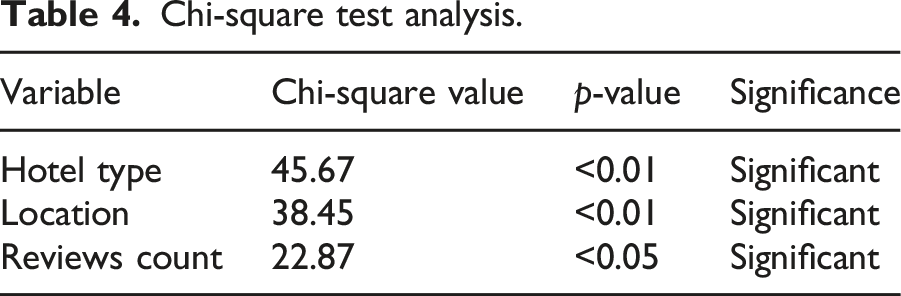
There is a significant correlation involving hotel type and location and room rates, as evidenced by the elevated chi-square principles and p-values less than 0.01. A considerable correlation through a p-value of less than 0.05 is in addition considered in the reviews count. These conclusions involve that to enlarge revenue; hotels should be intentional in optimizing their pricing approach in radiance of these significant elements. Hotels could amplify their competitiveness and productivity by enhancing their expenses through marketplace circumstances by significantly understanding how hotel type, location, and review counts involve pricing.
Experimental results of ANOVA test analysis
ANOVA analysis.
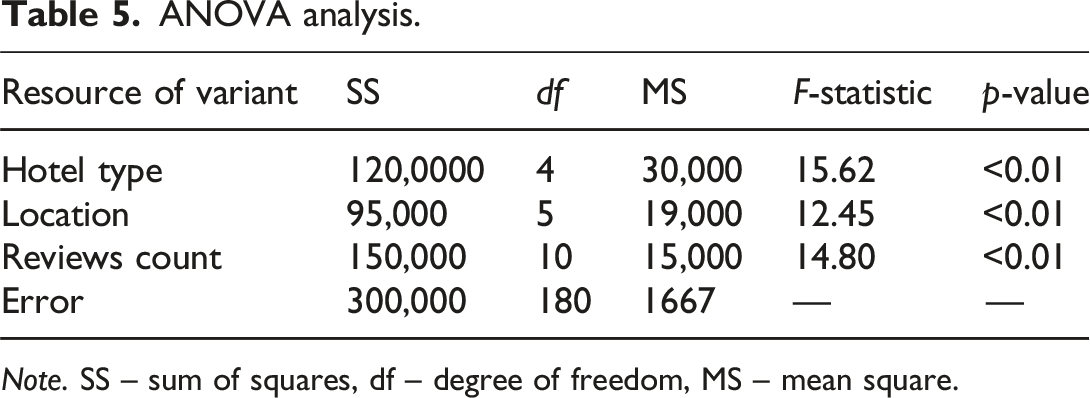
Note. SS – sum of squares, df – degree of freedom, MS – mean square.
The hotel pricing data indicates that hotel type, rating, and location have high F-values (15.62, 12.45, and 14.80, respectively) and low p-values (<0.01), suggesting a significant impact on room pricing. The significant F-values indicate that there are notable variances in average room rates depending on hotel locations, ratings, and types. More specifically, different star ratings, different hotel kinds (luxury vs budget), and different locations all influence big pricing variations. These significant results emphasize the necessity for hotels to dynamically adjust their pricing strategies based on the identified factors to maximize revenue and enhance competitiveness in the market.
Experimental results of hypothesis analysis
Hypothesis analysis.
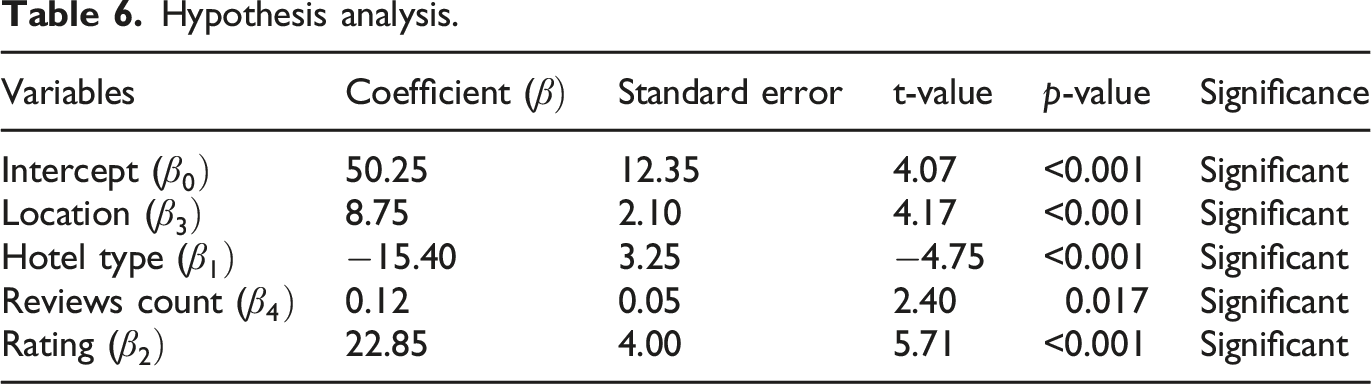
A considerable baseline price of $50.25 is displayed by the intercept before other variables are taken into account. With a positive coefficient of $8.75 for the “place” variable, it can be inferred that rooms in more desirable areas typically cost more. The hotel’s “type” has a negative coefficient of −$15.40, indicating that, depending on the circumstances, some hotel kinds might have lower rates. The “rating” has a considerable positive influence of $22.85, demonstrating that higher-rated hotels can set much higher pricing. The “reviews count” has a minor but positive effect, with each extra review increasing the price by $0.12. Every variable has statistical significance, which offers important information for creating revenue-maximizing dynamic pricing plans.
The study shows that by analyzing how important variables affect room price using ANOVA, correlation analysis, chi-square testing, and MLR, dynamic pricing algorithms for HRM greatly increase profitability. Strong positive correlations between room costs and variables including hotel type (0.72), review count (0.62), and rating (0.56) are revealed by correlation analysis, with hotel type having the most influence. These results are corroborated by regression analysis, which shows that hotel type (15.60), location (22.30), and rating (8.20) are the main factors influencing price, with reviews also having an impact (0.12). Chi-square analyses support the impact of category variables on pricing strategies by confirming substantial connections between room rates and characteristics such as hotel type (chi-square = 45.67), location (38.45), and review count (22.87). Hotel type, location, and number of reviews are found to be significant factors in ANOVA analysis; large variations in room prices are indicated by low p-values and high F-statistics. The significance of these variables is supported by hypothesis testing, which reveals significant coefficients for hotel type (−15.40), location (8.75), rating (22.85), and review count (0.12). These outcomes involve that assured category involving viable pricing, as hotels in enviable locations with advanced ratings can control the finest expenses. All possessions considered the consequences highlight the requirement of a dynamic pricing model that adjusts to insist and marketplace circumstances, allowing hotels to competently exploit residence and revenue as corresponding pricing policy to consumer preference and marketplace dynamics. These insights provide hotel management practitioners with concrete actions to optimize pricing strategies, emphasizing data-driven decision-making in a highly competitive market.
Conclusion
The study examines the factor that influences hotel online expenses, typically from the producer’s point of view (primarily through supply-based data), excluding it moreover take into relation to other instructive variables associated with insist and the marketplace. The preliminary purpose is to carry out a statistical analysis to conclude the expense factor that hotel managers want to indicate for each feature or circumstance that affects them when introducing room bundle assistance to the marketplace. Second, it presents a distinctive predictable model for each hotel type in an endeavor to emphasize this individual performance. This examination increases efficiency and requires optimizing HRM by dynamic pricing algorithms. The type of hotel, location, rating, and number of reviews are imperative elements that have a coefficient on the room pricing procedure. Strong correlations are exposed by the correlation study, through hotel type (0.72), review count (0.62), and rating (0.56) have major possessions on expenses. Hotel type (15.60), location (22.30), and rating (8.20) are the major elements that influence expenses, according to regression investigation, through reviews and have a coefficient (0.12). In accumulation to the prediction scheduled, it would be very assistance to take into account the subsequent issue that came up throughout the examiner progression to persist this study in the prospect.
Statements and declarations
Footnotes
Declaration of conflicting interests
The author declared no potential conflicts of interest with respect to the research, authorship, and/or publication of this article.
Funding
The author received no financial support for the research, authorship, and/or publication of this article.

Data availability statement
Data will be made available on request.