



Abstract
This study addresses the problem of pattern recognition and correction in English oral learning using deep learning techniques. English oral errors hinder effective expression and communication among learners. To tackle this issue, a large dataset of English oral data was collected and preprocessed using Hamming window and Fourier transform techniques. A long short-term memory (LSTM) network was then employed to construct an English oral error recognition model. After training, the model demonstrated high accuracy in recognizing various oral error patterns. To evaluate the effectiveness of the proposed correction method, comparative experiments were conducted with two classes. The results showed that the LSTM-based model achieved an error recognition accuracy of over 95.39%, with an average accuracy of 97% for five common oral errors. Additionally, Class 1, using the correction method proposed in this study, showed an average score increase to 75.2, while Class 2, using traditional correction methods, only increased to 64.5. The average score difference of 10.7 points between the two classes was statistically significant (t-value = 4.217, p-value = 0.016, p < .05). The findings demonstrate that the LSTM-based oral error recognition model is both practical and effective, offering a precise method for recognizing and correcting oral errors, thereby improving the overall effectiveness of English oral learning.
Keywords
Introduction
Deep learning, as a leader in the field of artificial intelligence, demonstrates its extraordinary ability to deeply understand knowledge by mining deep patterns and connections in massive amounts of data. In the field of natural language processing, the progress of deep learning is particularly prominent, providing a new path for recognizing and correcting English oral errors, such as machine translation, text generation, and sentiment analysis. Traditional English oral teaching relies on teacher experience and suffers from subjectivity and low efficiency. In addition, there are also problems in oral English learning, such as lack of real language environment and difficult to meet the needs of personalized learning. With the growth and diversification of learning needs, traditional methods have become inadequate. The emergence of deep learning has brought innovation to English oral learning. By training neural networks, it is possible to automatically and precisely recognize and correct students’ English oral errors, which not only greatly improves the accuracy and efficiency of correction, but also provides personalized correction suggestions for each student.
With the continuous acceleration of globalization, the importance of oral English in daily life and professional communication is constantly increasing. However, when it comes to oral practice, learners often encounter problems such as poor vocabulary selection, improper grammar usage, and pronunciation errors. Traditional learning methods mainly rely on manual correction, but this approach is not only inefficient, but also limited by teacher resources. The rise of deep learning technology has brought new opportunities for automatic recognition and correction of English oral errors. Deep learning is an important branch in the field of artificial intelligence. By learning the complex patterns and associations of a large amount of data, it provides strong support for the error pattern recognition and correction in oral English learning. This article uses deep learning combined with massive English oral data to automatically recognize and correct oral errors, thereby improving learning efficiency and helping students master standard English oral skills faster. Through efficient deep learning models, it is expected to provide precise and personalized correction services for English oral learners, in order to promote the development of English oral learning.
Related work
English oral error recognition refers to the ability to identify and understand the mistakes made by the other party in oral expression during language learning or communication.1,2 Language proficiency tests have been used since the development of bilingual education. Osorio Sandra Lucia showed a child how to enter a bilingual course, which is an English and Spanish proficiency test, in order to study the child’s proficiency in different languages. 3 Jingwen Huang used a research method combining qualitative research and questionnaire survey, using artificial intelligence speech recognition software as a testing tool, to conduct empirical research on the English oral pronunciation of college students. After tool recognition, she found problems in the English oral pronunciation of the test group. 4 Adult second language learners often exhibit significant individual differences when learning vocabulary tones. Lameris Tim Joris used pre-word intonation classification and word recognition tasks to evaluate the effects of different tone states and working memory on English and Mandarin adult learners, and found that tone perception and word learning were mainly promoted by extralinguistic factors. 5 With the advancement of automatic speech recognition (ASR) technology, ASR-based pronunciation assessment can diagnose learners’ pronunciation problems. Wenqi Xiao explored the effectiveness of ASR technology in diagnosing English pronunciation errors and explored the attitudes of teachers and learners toward using ASR technology as a pronunciation assessment and learning tool. 6 Rehman Ivana analyzed the sentence readings of Arabic speakers, which were annotated as pronunciation deviations from typical American English in daily life, and provided a description of the persistent pronunciation errors among English Arabic learners. 7 Cao Haiyang proposed an English pronunciation error detection system based on an improved random forest, which input rare erroneous pronunciation data into a neural network to generate new class samples and improve the uneven distribution of erroneous pronunciation data in the sample set. 8 In summary, research on English oral error recognition has achieved some results, but there are still shortcomings in detection speed. Therefore, this article used deep learning to study it, hoping to achieve recognition speed.
The English correction technology based on deep learning mainly utilizes error detection and correction methods in natural language processing. Deep learning imitates the neural network working mode of the human brain, which can extract key features from massive data, thereby achieving high-precision prediction and recognition. This advantage has shown great application prospects in correcting English oral errors. 9 English, as one of the most widely used languages in the world, plays a crucial role in communication between China and the world. Cheng Lanzhi developed a model for correcting various writing errors in English writing, which can not only be used for automatic checking and proofreading of English texts, but also enable students to achieve the goal of independent practice. 10 In order to address and solve the problem of loss assessment mismatch in current mainstream machine translation, Zhong Yanghui proposed applying deep learning methods to construct algorithm models with high error correction performance. 11 Grammar correction is an important element in language learning. Qin Mengyang briefly introduced the application of Transformer models in syntax correction based on deep learning. In order to improve the performance of the model in syntax correction, it was optimized using generative adversarial networks. 12 In order to explore the application of deep learning technology in English grammar correction algorithms, Zhang Yang established an English grammar correction model based on Sequence to Sequence, thereby improving its ability to be applied in English teaching. 13 In response to the complexity of grammar correction, Wang Hong proposed a long short-term memory (LSTM) - Convolutional Neural Network (CNN) model for fault detection in the grammar correction process. This model effectively combined the global feature extraction ability of LSTM for time series data and the local feature extraction ability of CNN model, reducing the loss of feature information and achieving a higher fault detection rate. 14 Aytan Burak proposed a Turkish spelling error word detection model based on two-step deep learning, and the system integrated a false positive reduction model to reduce false positive predictions caused by the use of foreign words and abbreviations commonly used in the Internet sharing platform. 15 Overall, the content of using deep learning for research is relatively rich, laying a theoretical foundation for the following research in this article.
This article proposed a set of error pattern recognition and correction methods based on deep learning for the common problems of inaccurate pronunciation, grammar misuse and improper vocabulary selection in oral English learning. This method used advanced deep learning algorithms to learn the characteristics and patterns of oral errors from massive speech data, realizing efficient automatic recognition and feedback. This study not only significantly improved the accuracy and speed of oral English correction but also provided a new technical support for the personalization and intelligence of oral English education.
Data collection and preprocessing
Corpus data collection
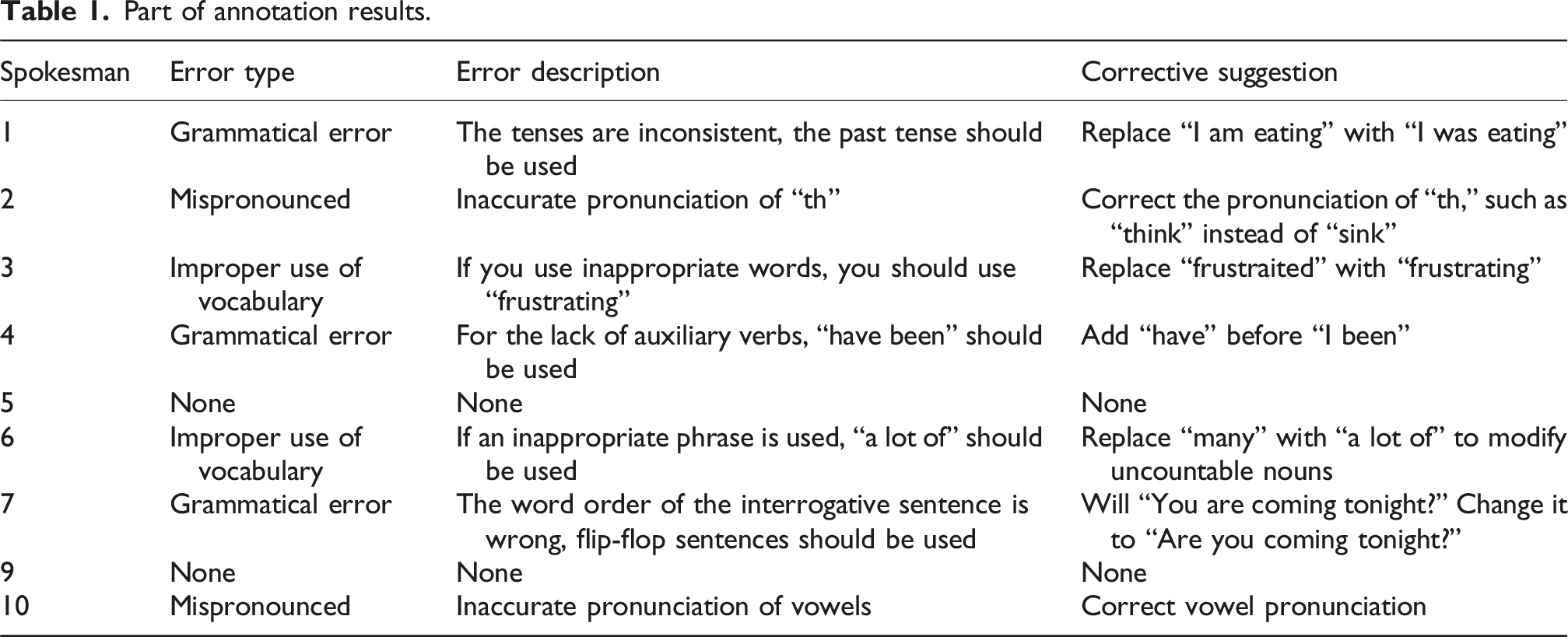
Part of annotation results.
Data preprocessing
Some audio datasets may experience stuttering or unclear sound due to recording or saving issues. To ensure the accuracy of the test results, it is necessary to screen and remove these unqualified audio files one by one. At the same time, it is also necessary to standardize the format of all audio datasets, convert them to the same file format, set the sampling rate to 50 kHz, and configure the channels as dual channels. In the preprocessing stage, the key step is to highlight the features of the audio signal and remove redundant parts, in order to extract audio features more efficiently in the future. Due to the fact that the collected dataset contains audio and text information and lacks other annotations, it increases the difficulty of acoustic feature extraction. Therefore, the temporal boundary information of the sound level in the audio is obtained through forced alignment.16,17 Forced alignment is a process of matching an audio signal with its corresponding text information, aiming to establish the correspondence between audio and text at the time node. In this article, the MFA (Montreal-Forced-Aligner) toolkit is directly used to achieve phoneme level alignment. 18 When performing short-term speech processing, it is usually necessary to add windows to the audio. This article uses the Hamming window method for windowing, which has the advantage of effectively reducing the occurrence of frequency leakage.19,20 Hamming Window is a kind of window function widely used in signal processing, which effectively reduces the frequency leakage phenomenon caused by the limited signal length in the frequency spectrum analysis process such as the fast Fourier transform.
The window function expression of Hamming window is:
Among them, N represents the window width. In order to compensate for high-frequency losses, a specific filter is used for high-frequency enhancement processing
In the process of oral pronunciation, sound is emitted through the mouth and suppressed by lip radiation, resulting in significant attenuation of high-frequency components compared to low-frequency components. The low-frequency component can propagate well due to the high-frequency component and is more susceptible to scattering and absorption of lip radiation, resulting in significant attenuation compared with the low-frequency component. The purpose of audio signal pre-emphasis is to compensate for the loss of high-frequency components through high pass filters,21,22 and the specific effect is shown in Figure 1. Speech signal preprocessed based on high pass filter.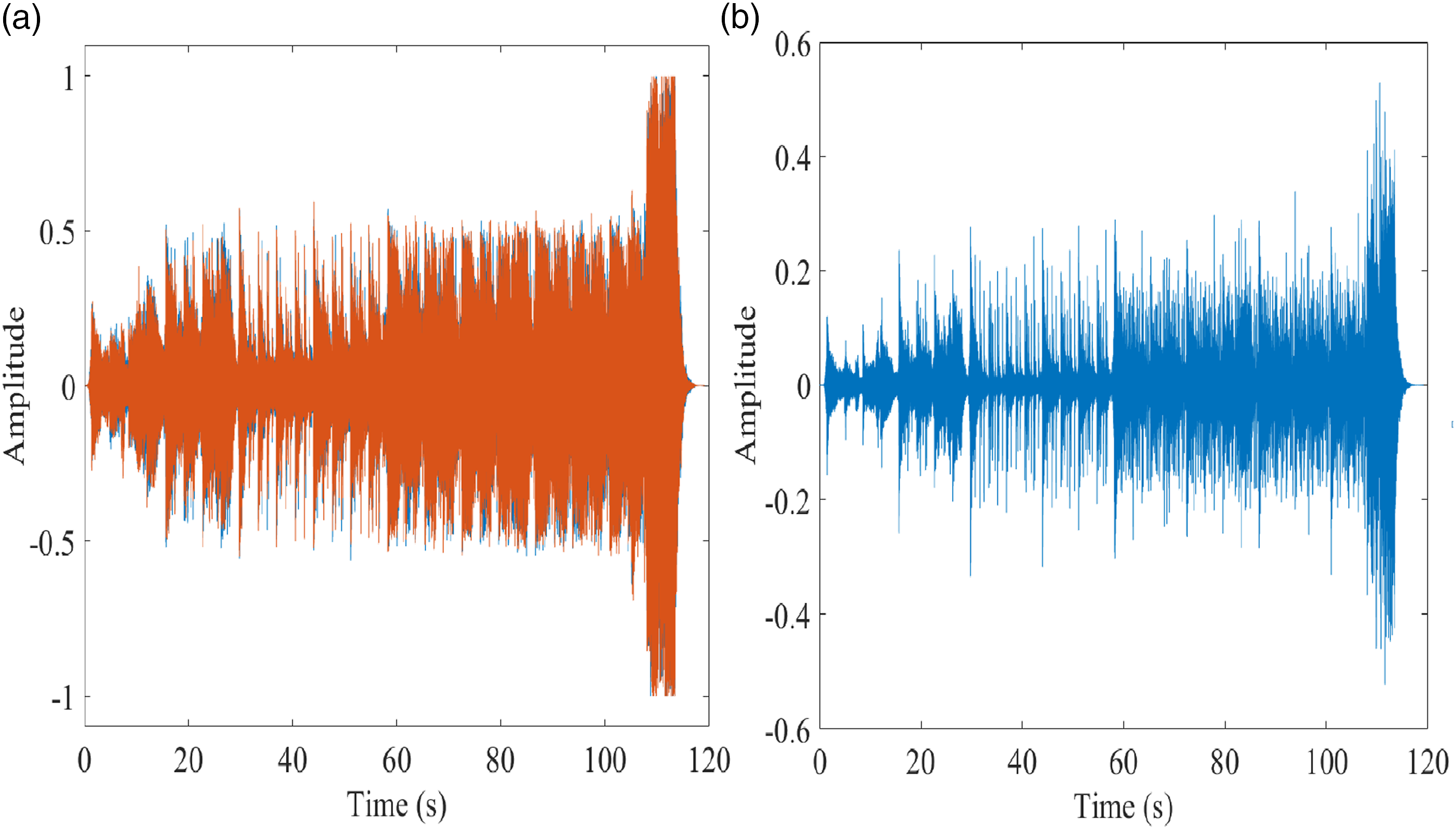
As shown in Figure 1(a) is the original signal, and Figure 1(b) represents the signal processed using a high pass filter. After pre-emphasis processing through a high pass filter, the distribution of the original sound signal becomes denser and the fluctuations are reduced. In the frequency domain, the high-frequency part of the sound signal is significantly improved.
The primary task of oral recognition is to convert speech signals into simpler and more easily processed forms, which requires the study of feature vectors. Feature extraction and selection are extremely crucial steps in the process of oral recognition. Feature extraction is responsible for transforming the speech signal of the time domain into a digital representation, while feature selection is to extract effective features from it and provide data support for the subsequent pattern division. The quality of feature extraction and selection directly determines the accuracy of oral recognition. This article uses Fourier transform to extract speech signals.23,24 Figure 2 shows the signal preprocessing effect based on Fourier transform. Signal preprocessing effect based on Fourier transform.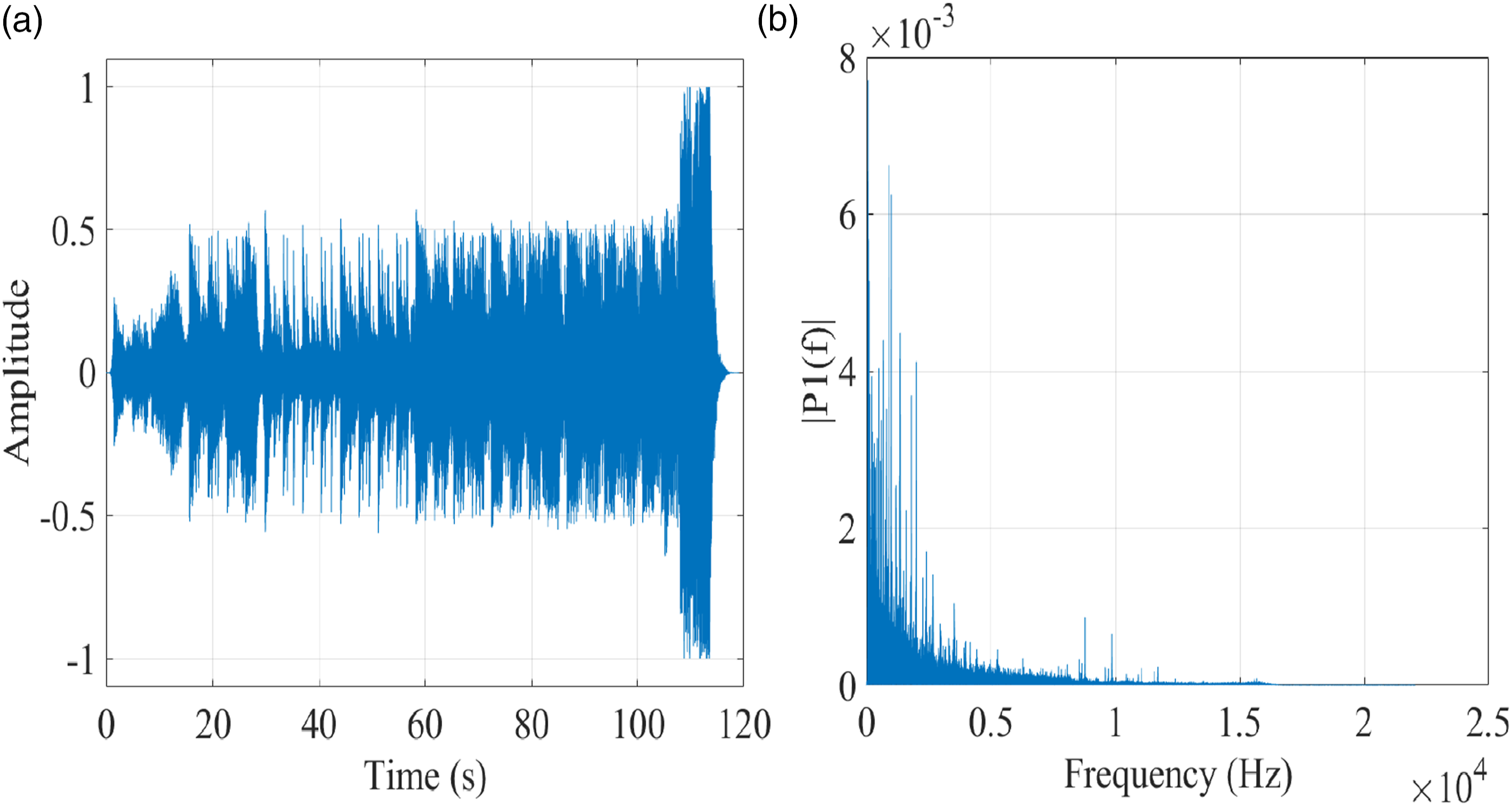
As shown in Figure 2(a) represents the original signal, and Figure 2(b) represents the signal processed using Fourier transform. By performing Fourier transform on the preprocessed audio signal, it is found that the features in the original signal can be well extracted.
After Fourier transform, the audio signal needs to be further processed through a Mel-filter bank. There is a clear overlap between adjacent triangular filters in the Mel-filter bank, which increases the correlation between signal features. These features include the energy distribution within different frequency bands, the shape of the spectrum, and resonance ts, which together depict the uniqueness and identifiability of the audio signals. Through Fourier transform, multidimensional Mel-Frequency Cepstral Coefficients (MFCC) can be obtained.25,26 Subsequently, through the calculation of first-order and second-order differences, multidimensional MFCC eigenvectors can be obtained. The energy distribution spectrum of MFCC is shown in Figure 3. Energy distribution spectrum based on MFCC.
As shown in Figure 3, it indicates the multidimensional MFCC energy distribution, where colors represent power, and the closer the color is to yellow, the higher the energy.
Construction of English oral error pattern recognition model based on LSTM
Model design
In the process of learning oral English, error pattern recognition and correction are particularly important.27,28 It not only involves simple error checking, but also includes a series of in-depth analyses and meticulous adjustments to help learners make changes in various aspects such as pronunciation, grammar, and vocabulary usage. Adjustment includes personalized pronunciation correction, customized training for personal accent problems, thorough analysis of grammar errors, understanding rules and applying to actual context, vocabulary misuse correction, expanding vocabulary, and learning to express properly. In recent years, the rise of deep learning technology, especially long short-term memory networks, has brought significant changes to the field of English oral learning. LSTM, as a type of recurrent neural network, is specifically designed for processing sequential data. Its uniqueness lies in its ability to efficiently capture long-term dependencies in sequences, which is crucial for improving English oral skills.29,30 Because language itself is a highly serialized and a system full of context dependence, both the order of words within the sentence and the logical connection between sentences contain a deep semantic and grammatical structure. By deeply analyzing learners’ speech signals and capturing key pronunciation features, such as the duration of the vowel, the clarity of the consonant, and the placement of the stress, LSTM can greatly enhance the comprehensibility and naturalness of speech. After training with a large number of annotated speech samples, LSTM can precisely recognize various common pronunciation error patterns and gain insight into the performance of these errors in different contexts. Due to its long-term memory capability, LSTM can recognize the coherence of error patterns across long speech passages, which in turn provides a more accurate diagnosis.31,32 The overall design diagram of English oral error recognition based on LSTM is shown in Figure 4. Overall design diagram of English oral error recognition based on LSTM.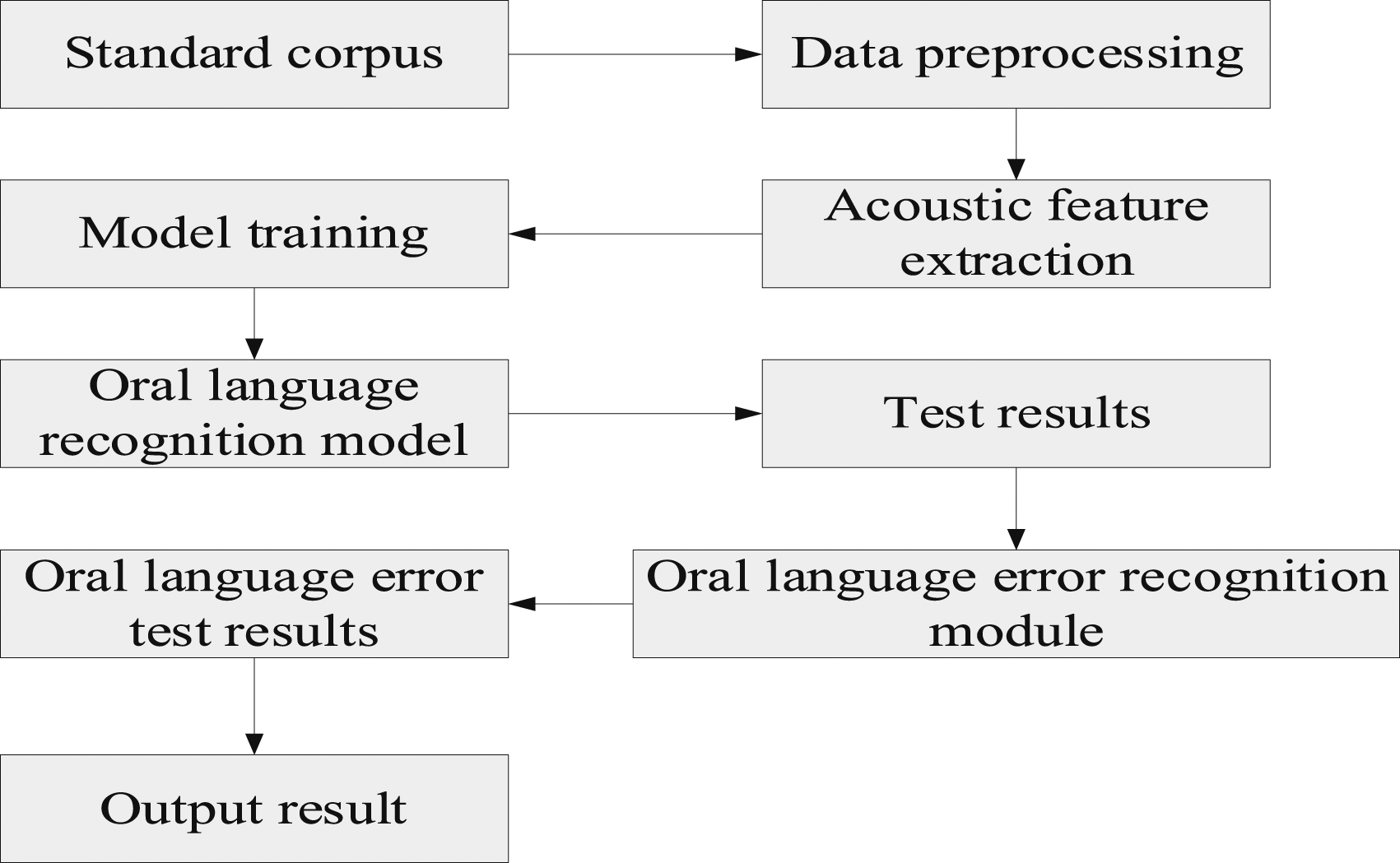
In the model design phase, the multi-layer LSTM unit structure is the core of constructing an oral error recognition model. Each layer of LSTM is responsible for specific tasks, gradually extracting different features from the bottom to the top. The underlying LSTM unit mainly captures fundamental acoustic features, which are the basic elements that make up speech signals. As the signal is transmitted to higher-level LSTM units, the model begins to focus on more complex language structures, allowing the error patterns recognized by the model to extend beyond isolated phonemes or vocabulary to larger language units, such as the rules of lexism and grammar. In order to improve the generalization ability of the model and prevent fitting phenomena on the training data, dropout technique is used for adjustment. During training, the dropout layer randomly shuts down a portion of neurons to prevent them from acting on the input, forcing other parts of the model to learn to operate independently and avoid excessive dependence on any neuron. When the model is faced with unseen data for prediction, this mechanism can also ensure that the model makes more accurate judgments and reduce performance losses caused by overfitting. By accurately calculating the weight coefficient of the output sequence at each time, and weighted summing it with the output vector at the corresponding time, a more comprehensive and differentiated input feature vector is obtained, which provides a more robust and effective decision basis for the classification layer. By adjusting the dropout ratio reasonably, the complexity and generalization ability of the model can be effectively balanced, making it highly sensitive in recognizing error patterns of English oral learners without being overly sensitive to specific training samples. In the pre-training stage, the model learns the representation of speech and audio by solving the contrastive task 
After training, the model demonstrates strong ability in extracting universal speech features, which can be widely applied to various downstream tasks related to speech and achieve significant results. This includes but is not limited to: speech recognition, achieving efficient and accurate text transcription; speech synthesis, generating natural and smooth speech; emotion recognition, analyzing emotional tendencies in speech; and voice translation, enabling cross-language communication. At the same time, it also eliminates the complex feature extraction process, thereby simplifying the data processing flow. After processing the standard corpus, training samples containing acoustic features and tone labels are obtained. These samples are inputted into the model in sentence units, and the expression is as follows:
Oral error recognition can be seen as a classification problem. Specifically, when faced with a specific text w and its corresponding pronunciation observation vector t, if the recognition result is consistent with w, it is judged as correct pronunciation; on the contrary, it is considered an error. To improve the accuracy of recognition, adjustments can be made under the discriminative criteria in oral recognition, aiming to construct a targeted oral error recognition objective function, and then conduct discriminative training on the model parameters to enhance the consistency between the acoustic model and the oral error recognition model based on LSTM. In addition, the LSTM model in this article cleverly incorporates attention mechanism into the output classification layer. This measure enables the output of the classification layer to no longer rely solely on the hidden layer output at the current time, but to comprehensively consider the hidden layer information at all previous times. The expression is as follows:
Among them, 
The tone labels of the input samples in the training set can be represented by 
step is the time step of the model, and its value depends on the specific study.
Through all the calculations above, the loss function for the output of 
Experiments
Dataset description.

As shown in Table 2, this article divides the training set, test set, and experimental set in a ratio of 7:2:1. Among them, the training set contains 2800 pieces of data, mainly used to train the constructed model, enabling the model to learn error patterns in English oral and improve recognition ability. The test set contains 800 pieces of data to evaluate the performance of the trained model in recognizing new data. Finally, the experimental set consists of 400 pieces of data for further validation and comparison of the effectiveness of different correction strategies or models. The entire dataset contains a total of 4000 data points, providing sufficient materials for the subsequent experimental research.
In the process of learning oral English, there are many oral errors, which can be mainly classified into five types: pronunciation errors, intonation errors, grammar errors, vocabulary errors, and pragmatic expression errors. The collected data includes these five oral error patterns and correct oral expressions. This article uses LSTM in deep learning algorithms to construct an English oral error recognition model, which can accurately recognize oral errors. In order to further demonstrate the advantages of the research method in recognition accuracy, the experimental results are compared with the accuracy of oral recognition models constructed based on Self-Supervised Learning (SSL), Hidden Markov Model (HMM), Transformer model, deep neural network (DNN), and Convolution Neural Network (CNN) algorithms. The comparison results are shown in Figure 5. Comparison of accuracy of English oral error recognition by different models.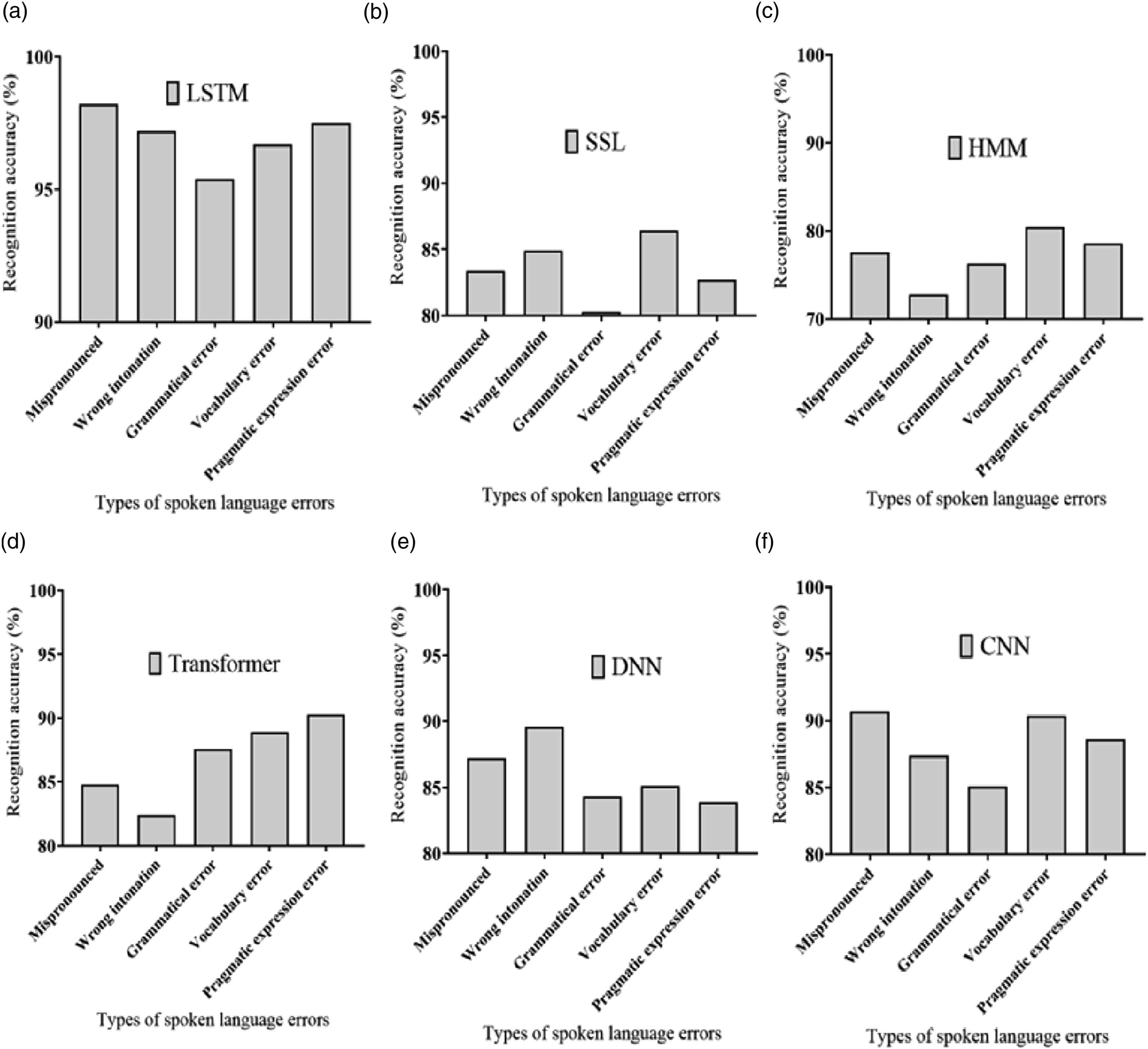
In Figure 5(a)–(f) represent the recognition accuracy results of the models constructed by LSTM, SSL, HMM, Transformer, DNN, and CNN algorithms, respectively. All x-axis values in (a)–(f) represent types of oral errors, while y-axis values represent recognition accuracy. As shown in Figure 5, in the process of learning oral English, many oral errors are encountered. However, this article uses LSTM to construct an English oral error recognition model, which has a much higher accuracy for oral error recognition than models constructed by other algorithms. Specifically, the LSTM model has an accuracy rate of over 95.39% for recognizing extracted oral errors, while models built based on SSL, HMM, Transformer, DNN, and CNN algorithms have recognition accuracies below 86.41%, 80.51%, 90.31%, 89.61%, and 90.71%, respectively. At the same time, the average accuracy of the model studied in this article for recognizing 5 types of oral errors extracted is 97%, which is 13.46%, 19.84%, 10.2%, 10.98%, and 8.56% higher than the average of models constructed based on SSL, HMM, Transformer, DNN, and CNN algorithms, respectively. The experimental results show that the model constructed in this article has a high accuracy rate for oral error recognition. This not only reflects the good predictive ability of the LSTM model for English oral error recognition, but also fully utilizes the advantages of LSTM for temporal data, especially for oral recognition tasks with strong semantic differences. Compared with other models, it has better performance.
The constructed English oral error recognition model continuously achieves high accuracy and very fast recognition speed for oral errors. In order to further demonstrate the superiority of the recognition speed of the research model in this article, the data in Table 2 is used for recognition, and the required time for recognition is obtained. The shorter the time, the faster the recognition speed. At the same time, in order to ensure the scientificity of the experiment, 10 experiments are conducted, and the experimental results are compared with models constructed based on SSL, HMM, Transformer, DNN, and CNN algorithms. The comparison results are shown in Figure 6. Comparison of English oral error recognition time among different models.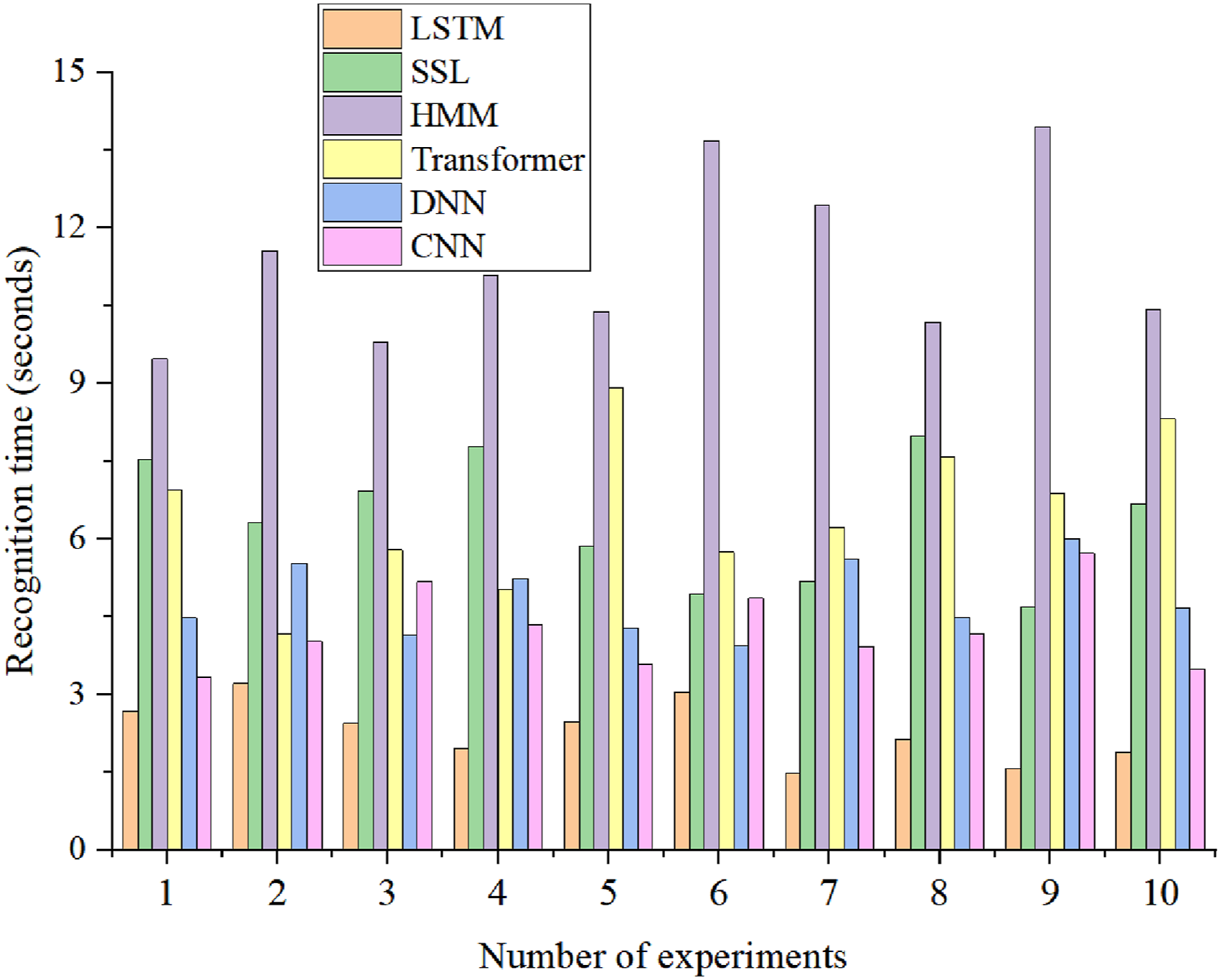
As shown in Figure 6, the English oral error recognition model constructed in this article significantly outperforms models constructed by other algorithms in terms of recognition speed of oral errors. Among them, the model studied in this article requires less than 3.22 seconds for 10 experiments, while models constructed based on SSL, HMM, Transformer, DNN, and CNN algorithms require more than 4.68 seconds, 9.46 seconds, 4.17 seconds, 3.93 seconds, and 3.33 seconds, respectively. At the same time, 10 experiments are conducted, and the average time required for the model studied in this article is 2.29 seconds, which is 4.1 seconds, 9.01 seconds, 4.27 seconds, 2.55 seconds, and 1.97 seconds lower than the average time required for models constructed based on SSL, HMM, Transformer, DNN, and CNN algorithms, respectively. LSTM demonstrates excellent recognition speed in English oral error recognition models, which is due to the unique network architecture and implementation of LSTM. It can efficiently process sequential data and cleverly manage information flow through gating mechanisms, effectively preserving long-term dependency information. Compared with SSL, HMM, DNN, and CNN, LSTM has more advantages in processing sequence data and its long-term dependencies. Although SSL excels in unsupervised learning, it falls short in real-time task processing; although DNN and CNN perform outstandingly in non-sequential data processing, they are not as good at handling long-term dependencies of sequential data as LSTM. Therefore, LSTM stands out.
English oral extraction and correction
Using LSTM model to recognize English oral errors can help improve the accuracy of recognizing students’ English oral errors. The improvement of accuracy is beneficial for teachers to better understand the errors in students’ oral communication, thereby helping students effectively correct their oral errors. It is important to be able to quickly respond to new oral samples through this model. In order to ensure that learners discover oral errors from the LSTM model and improve their oral skills, precise and effective corrective measures need to be developed. These measures should be comprehensive to ensure that learners can accurately and fluently express themselves orally. These measures can cover pronunciation, grammar, vocabulary and many other aspects. In terms of pronunciation, errors can be corrected and communication barriers can be avoided through demonstration methods. For grammar errors, such as tense or word order issues, specific modification suggestions should be provided, such as changing “I eat an apple yesterday” to “I ate an apple yesterday.” In terms of vocabulary usage, inappropriate words not only affect the accuracy of expression, but may also lead to misunderstandings. Therefore, it is recommended to use appropriate words for replacement, such as changing “boring” to “bored” in “I am boring.” For example, when the model detects that the learner sends “th” into “s” or “z,” in addition to pointing out errors, it can provide a demonstration of correct pronunciation, which can be achieved in the form of audio or video, allowing the learner to intuitively hear and see the correct pronunciation and imitate the practice.
When implementing corrective strategies, it is important to ensure the accuracy and feasibility of recommendations and avoid vague guidance. At the same time, attention should be paid to timeliness and effectiveness, and errors should be corrected in a timely manner to prevent them from developing into habits. In addition, strategies need to be flexibly adjusted based on learners’ feedback and needs to achieve optimal learning outcomes. In summary, this article proposes diverse correction plans and specific suggestions for the various errors recognized by the model, aiming to assist learners in achieving significant progress in pronunciation, grammar, vocabulary, and other aspects, thereby improving their accuracy and fluency in language use. The corpus studied in this article is sourced from first-year students of a certain experimental middle school in A city. Two classes are studied, with Class 1 being the experimental class and Class 2 being the control class. 25 students are selected from each class, for a total of 50 students. These students learn English since the third grade of elementary school. The selection and allocation of research subjects for two classes are mainly based on their grades. After the experiment, classroom recordings are conducted for the English teachers in the first grade of the school, whose teaching experience ranges from 10 to 33 years.
The control group adopts traditional correction strategies. In self-study class, 25 randomly selected students from Class 2 are provided with oral test questions, which are designed based on the common oral question types in the middle school entrance examination. Before the experiment, in order to ensure a comprehensive assessment of students’ oral proficiency at different levels, the oral test is set with a 3-minute expression time and a 60 second preparation time. During the testing period, students are not allowed to use any auxiliary tools or communicate with others. After the test, teachers immediately point out the students’ mistakes and guide them to correct the incorrect sentences while reflecting. Subsequently, the number of various errors is counted. After a period of time, the process becomes similar to before the experiment. Students also receive oral test questions during self-study classes, with a preparation time of 60 seconds and a response time of 3 minutes. After the test is completed, teachers correct the errors again and count them for comparison and analysis with the number of errors before the experiment. In order to improve the accuracy and efficiency of oral error recognition, the experimental Class 1 decides to combine the LSTM-based oral error recognition model with heuristic suggestion correction method. The LSTM model, due to its excellent sequence data processing ability, can accurately capture contextual information in oral language, thereby more effectively recognizing students’ oral errors. At the same time, by combining the correction methods of inspiration and suggestion, teachers can more targetedly guide students to correct and deeply reflect on their own after recognizing errors in the model. This comprehensive approach aims to comprehensively enhance students’ oral expression ability and self-learning ability. The testing process of this method is the same as that of the control Class 2.
Both teachers and students generally believe that correcting students’ typical oral errors in English classrooms is necessary, and students’ pursuit of correct language forms even exceeds that of teachers. Especially in terms of grammar errors, students expect timely correction. Therefore, adopting effective correction strategies for grammar errors is likely to bring positive teaching outcomes. In the oral test, students are required to express themselves orally on two topics: my family and my ideal career. Each student is required to express at least six sentences, with each expression lasting no more than 1 minute, in order to identify common types of oral errors among students. Among them, word order errors are a prominent problem, that is, students fail to follow the conventional word order in English expression, or confuse the word order of declarative and interrogative sentences. For example, in the sentence “I don’t know what can I do,” the subordinate clause after “what” should use declarative sentence order, and the correct expression should be “I don’t know what I can do.” Another noteworthy mistake is Chinglish error, which refers to the appearance of sentences in students’ oral output that are directly translated from Chinese and do not conform to English conventions.
Comparison of average oral scores between two classes before and after the experiment.

As shown in Table 3, before the experiment began, the average scores of Class 1 and Class 2 are very close, at 62.7 and 62.9 points, respectively. The t-value of 0.681 and p-value of 0.823 (
In order to investigate the impact of two correction methods on students with different English proficiency levels, students from two classes are divided into three levels based on their test scores: high-level, medium level, and low-level. The distribution of personnel at different levels before and after the experiment in two classes is shown in Figure 7. Distribution of personnel at different levels before and after the experiment in two classes.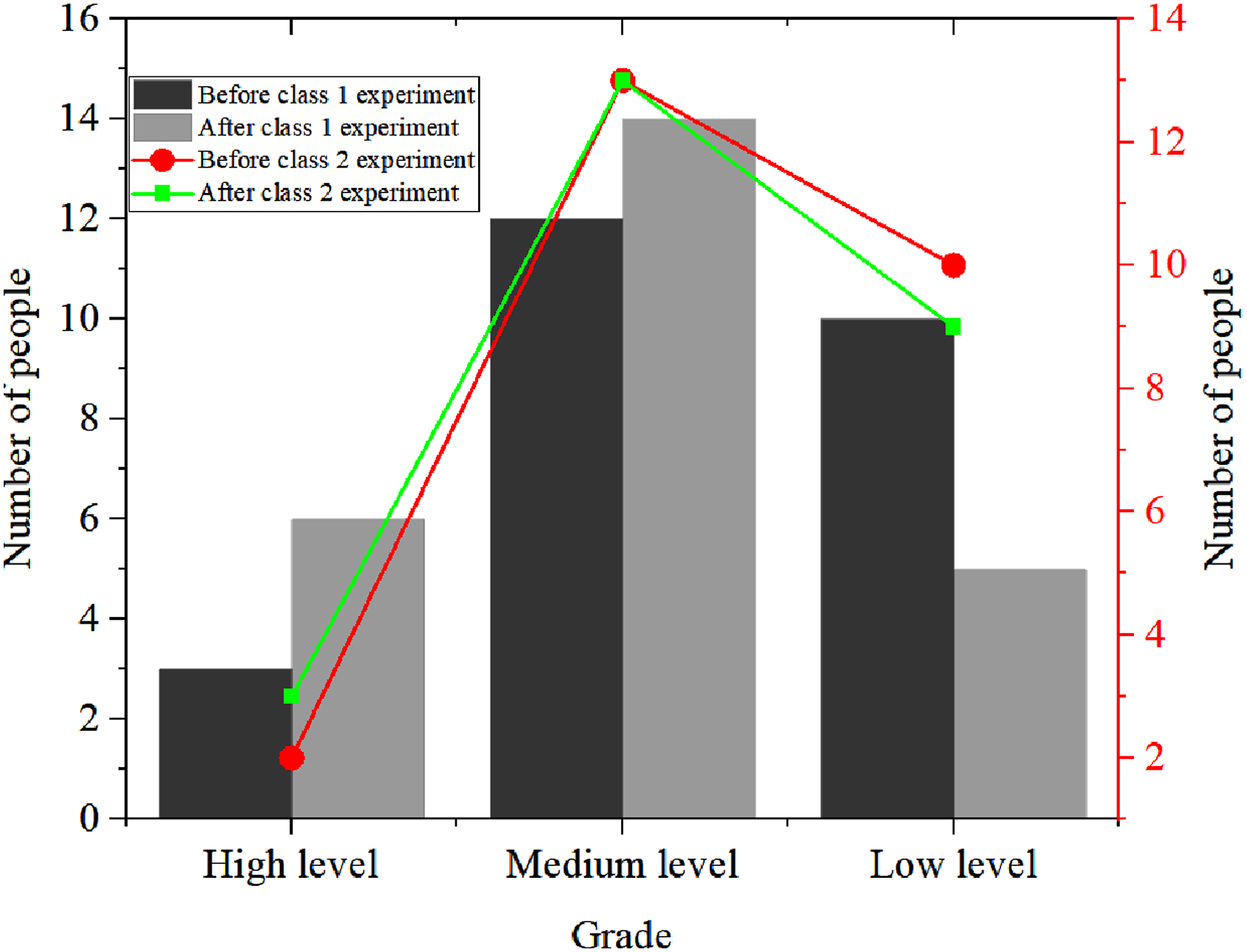
In Figure 7, the x-axis represents the level, and the left and right y-axis represents the number of people. Before the experiment, Class 1 has 3, 12, and 10 students in the high-level, medium level, and low-level, respectively, while Class 2 has 2, 13, and 10 students, respectively. The differences in each level are not significant, indicating that the starting conditions of the two classes are similar. After the experiment, the correction method used in Class 1 significantly changes the distribution of students’ oral proficiency, especially with an increase of 3 high-level students, which is also 3 more than Class 2. The most significant change in Class 1 is the significant decrease in the number of low-level students, from 10 before the experiment to 5 after the experiment, which is 4 fewer than Class 2 after the experiment. This indicates that the correction method used in Class 1 is particularly effective in improving the oral expression ability of low-level learners. In contrast, the changes after the experiment in Class 2 are relatively limited, with only one more high-level student, no change in medium level students, and a decrease of one low-level student. This shows that traditional methods are not particularly effective in improving oral expression, especially for low-level students. In summary, the use of modern technology inspired suggestive correction strategies has shown greater effectiveness in correcting incomplete sentence errors among English learners of different levels, especially in helping low-level learners improve their language expression abilities.
Conclusions
This article used LSTM in deep learning technology to construct an English oral error recognition model. This model could automatically recognize various errors in oral English, and methods for correcting oral errors were also studied. After training and validation on online English test data, the accuracy of this model in recognizing various error patterns was higher than that of recognition models constructed by other methods. The recognition accuracy of LSTM model for pronunciation and intonation errors was as high as 98.2% and 97.2%, respectively, far exceeding other methods. Further comparison was made on the impact of different correction methods on learners with different English proficiency levels, and experiments showed that the correction method studied in this article can significantly improve oral expression ability, especially for low-level learners. The LSTM-based English oral error recognition model is practical and powerful, which can assist learners in improving their oral skills and provide technical support for teaching. Despite the important results of this study, there are still some shortcomings. The current study relies on relatively limited annotation data, leading to some improvement in the generalization ability and adaptability of the model. Secondly, deep learning models are often regarded as “black boxes,” and it is difficult to explain their internal decision-making mechanism, which is a big obstacle to understanding and trusting the output of the model.
Future research can be focused on in the following directions. One is to expand the data source and use cross-language and multi-scene data to enhance the robustness and versatility of the model. The second is to explore the integration and application of multimodal information in oral English error correction to improve the error correction accuracy and user experience.
Statements and declarations
Footnotes
Declaration of conflicting interests
The author(s) declared no potential conflicts of interest with respect to the research, authorship, and/or publication of this article.
Funding
The author(s) received no financial support for the research, authorship, and/or publication of this article.
