




Abstract
To organize new governance arrangements and to restore trust in spatial planning, contracts are often seen as vital policy instruments. The relations between contracts and trust are regularly studied from various perspectives. In this article, we add to the existing knowledge by exploring a dynamic perspective on the use of contracts over time and the influence thereof on trust dynamics. We conclude that, longitudinally, the use of contracts can play a pivotal role in trust dynamics by influencing the construction of, and actors’ perspective on, the common history of the parties involved and their future expectations in close relation to the changing context. This perspective might help planners to deal with the inevitable dynamics of planning processes and trust.
Introduction
Because of changes in social, economic, cultural and political contexts, traditional planning models have been increasingly criticized (Van Woerkum et al., 2011). These critiques focus on traditional planning approaches which have often failed to deliver required and requested services (Hajer, 2003; Van Dijk et al., 2011). This inability has resulted in a decreasing feeling of trust towards planning institutions among citizens and organizations (Swain and Tait, 2007; Tait, 2011). In response to this decrease in trust, new planning approaches have been developed and explored (Albrechts, 2005; Allmendinger, 2002). Examples of these approaches can be found in communicative planning (Healey, 1997), consensus building (Innes, 2004) and public–private partnerships (PPPs). At their core, these approaches search for new ways to deal with the growing complexity of planning processes (Edelenbos and Klijn, 2007; Van Kersbergen and Van Waarden, 2004). This complexity results from the growing number of participants involved in planning processes, and the unpredictability and uncertainty that are inherent in the future-oriented character of spatial planning. To deal with this new situation, the approaches share a search for new arrangements to facilitate collaboration between different parties. To organize or consolidate these new forms of collaboration, contracts are often seen as vital instruments (Albrechts, 2004).
Contracts have long been used in many ways and have played an important role in the organization of today’s complex European society (Greif, 2007). In the last decades, contracts have attracted renewed attention in various fields and are often seen as instruments to coordinate negotiations between actors in complex situations (Das and Teng, 1998; Djanibekov et al., 2013; Salet and Woltjer, 2009). An essential concept – with relevance for the use of contracts – in these negotiations is mutual trust between the actors involved (Van Ark and Edelenbos, 2005). In both planning practice and scientific debates, the introduction of contracts is explained as a way to build or restore the dwindling trust in planning institutions (Lorenz, 1999; O’Neill, 2002). These ideas are partly based upon normative theories supporting the use of contracts to create transparency and trust (Edelenbos and Klijn, 2007). However, not all planning processes in which contracts are used are considered successful or transparent.
Trust and contracts are strongly related to each other (Möllering, 2005; Talvitie, 2011; Van der Veen and Korthals Altes, 2009). One might expect a rather simple linear relation: when trust is low, contracts are used extensively; and when trust is high, there is no need to use contracts. However, a rich line of studies in this area has resulted in various perspectives on the trust–contract relation. These perspectives focus mainly on the form and content of the contract and the influence of these aspects on trust. However, by doing so, they fail to take into account the actual use of contracts over time and the influence thereof on trust (Klein Woolthuis et al., 2005). Consequently, they omit the dynamics that characterize the interaction in planning processes. In order to gain a deeper understanding of the relation between trust and contracts, we therefore explore the longitudinal relation between the use of contracts and trust dynamics in planning practices. In doing so, we triangulate a historical, a contextual and a comparative perspective, taking into account how things have become, what happened simultaneously and what patterns emerge from case comparisons (Blok, 1978).
The outline of the article is as follows: we first give a theoretical overview of contracts and trust dynamics. Then, we analyze their interrelation and present our analytical focus. Using this focus, we analyze three examples of Dutch spatial planning. We conclude by discussing the core aspects of the interrelation between trust and the use of contracts over time.
Theoretical considerations
Contracts
In the last decades, the use of contracts has especially been advocated and discussed in economics (transaction cost economics, TCE, Williamson, 1985) and in relation to new arrangements for the implementation of public services, such as Public Private Partnerships (PPPs) (Edelenbos and Teisman, 2008) and new public management (NPM) (Lane, 1998). Within spatial planning, contracts are used in the coordination of practices and policies affecting spatial organization or to increase the efficiency of planning institutions (Van Ark, 2005; Van Assche and Verschraegen, 2008).
Contracts are used for numerous reasons, varying from arranging simple financial transactions to organizing new and complex intergovernmental forms of cooperation. However, an important reason for the use of contracts in general is the formalization of existing informal rules (Ellickson, 1991). Both informal and formal rules play an important organizing and regulating role in society (Van Assche and Djanibekov, 2011). Formal institutions such as laws influence informal networks, just as informal rules influence formal institutions (North, 2005; Van Assche and Djanibekov, 2011). Through the use of contracts, informal norms can be consolidated and therefore become formal rules within a certain institutional context (Buitelaar and Sorel, 2010; North, 2005). In this situation, contracts can be seen as a specific set of rules that two or more parties have negotiated in order to establish variations or specializations for further cooperation within a wider web of rules (Ellickson, 1991).
To support various ways of cooperating, contracts exist in different forms. The majority of the literature focuses on the content and level of detail of contracts. NPM scholars, for instance, argue that contracts should be complete or as specific as possible in order to enforce them in court (Lane, 2000). In the NPM view, complete contracts are seen as a vital mechanism for high performance and efficient management (Bevir et al., 2003; Noordegraaf, 2000). Others, focusing on the transaction costs that come with the design, use and enforcement of contracts, argue that contracts are by definition incomplete. Consequently, contracts should be more general and take into account uncertainty and other social mechanisms in order to be truly useful (Williamson, 2000). This perspective is further developed by scholars of relational contracting and governance. This group argues for more general forms of contracts taking into account trust relations (MacNeil, 1985; Zaheer and Venkatraman, 1995). However, far from complete, this overview shows that contracts can vary from a set of strategic agreements consolidating common ideas about future development (Van Ark and Edelenbos, 2005) to complex and detailed agreements arranging the implementation of policies (Lane, 2000).
Trust and trust dynamics
The focus on trust originates from organization studies and adjacent fields in the 1970s (Tyler and Kramer, 1996). Since then, trust has been conceptualized in different ways. Broadly, there are two dominant conceptualizations. The first is the behavioural tradition focusing on the relation between trust and choices or actions in cooperative settings. These studies focus, for example, on trust as the basis for choosing to cooperate (e.g. Hardin, 1993). The second tradition is more cognitive, focusing on interpersonal characteristics associated with trust such as expectations, intentions and uncertainties (Mayer et al., 1995; Rousseau et al., 1998). The distinction between the two is highly analytic, and the two are interrelated. However, in trust studies, the behavioural tradition is often explained as ‘thin trust’ (Williams, 1988) or generalized trust (Uslaner, 2004; Uslaner and Conley, 2003), meaning the willingness to trust strangers for cooperation based on assumed common values (Uslaner and Conley, 2003). On the contrary, the cognitive tradition is often explained as ‘thick trust’ (Williams, 1988) or particularized trust (Uslaner and Conley, 2003). Particularized trust is then explained as trust between people based on common characteristics and identities (Uslaner and Conley, 2003).
Although these conceptualizations give interesting insights into the nature of trust, most of these studies take a static perspective on trust, paying limited attention to the evolution of trust through interaction (Idrissou, 2011, 2012; Lewicki et al., 2006). Consequently, these studies fail to include the dynamics that come with interaction in planning practices. In order to gain a better understanding of trust in planning practices, we wish to adopt a dynamic perspective on trust in this article. Therefore, we follow Lewicki and Bunker (1996) and Lewicki et al. (2006) who move away from these two traditions and define trust as a dynamic concept that develops in interaction. From their work, we distinguish two main aspects of trust.
The first aspect concerns trust as individuals’ expectations about the others’ thoughts, behaviour and decisions (Idrissou, 2012; Lewicki and Bunker, 1996). These expectations are often based on what we know of the other through patterns of cooperation (Lewicki et al., 2006; O’Brien, 2001). This knowledge is based on a set of accumulating events and the interpretation of these events. These interpretations provide information ranging from specific knowledge about the characteristics and identities to more general information about common values and norms (Uslaner and Conley, 2003). Under the influence of new events, behaviour and interaction, this interpretation is constantly constructed and reconstructed over time. This common history forms a dynamic basis for expectations and trust. In addition, on the basis of the interpretation of common history and present-day events, individuals experience uncertainty, risks, control and vulnerability. These experiences influence the construction of expectations over time as well. As such, these experiences influence trust. In this process, new interactions result in new experiences, a reconstruction of the past, adjusted expectations and a rebalancing of trust.
The second dimension of trust is the context in which it is performed (Kadefors, 2004; Mayer et al., 1995). Trust is always expressed in a specific situation of interaction. In such interaction, people give meaning to the context through interpretation and consequent actions. Thus, these interpretations result in new and terminating opportunities to trust or not. However, the interpretation can also result in feelings like risk, (un)certainty, vulnerability or flexibility. Experiencing such feelings influences trust dynamics as well.
When considered in these two dimensions, trust reveals itself as a concept that is constantly balanced in interaction. Figure 1 illustrates trust constantly balanced over time around the question of whether to trust or not, built upon the image of past and future expectations (horizontal lines) and influenced by feelings of uncertainty, vulnerability and risk (little arrows). It also shows the context (vertical line) creating new opportunities and terminating existing ones.
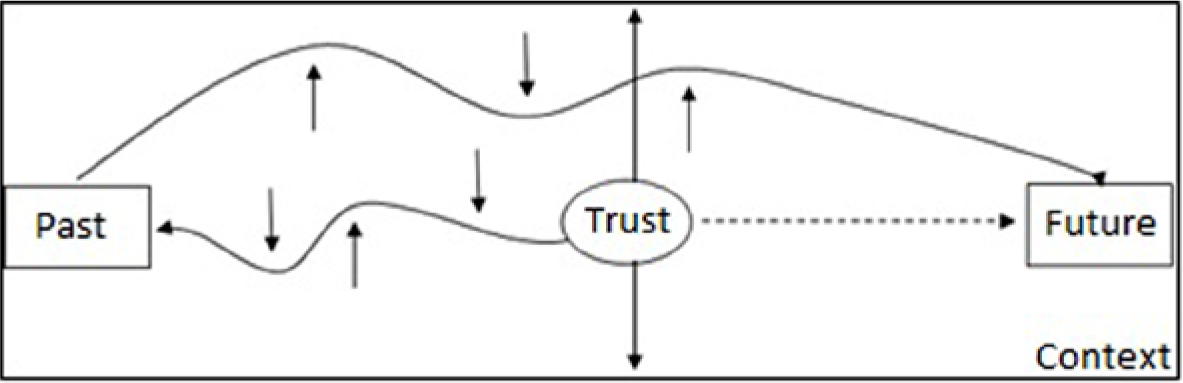
Longitudinal trust dynamics in context.
Trust and contracts
The literature about the relation between trust and contracts is extensive, especially in the field of economics (Möllering, 2006). However, studies reveal diverging views (Fulmer and Gelfand, 2012). A first group of scholars argues that contracts and trust are opposite to each other (Rousseau et al., 1998). They contend that contracts reduce effective exchange in relationships as a result of too much structure and control. According to them, detailed contracts rule out the flexibility that is needed to deal with trust and even reduce the development of positive expectations. Moreover, they argue that the level of control is seen as a sign of distrust. A second group argues that trust is a stronger and more preferred control mechanism. Trust makes contracts and control unnecessary (Poppo and Zenger, 2002). The last group sees contracts and trust as complementary to each other, arguing that a contract does not imply a lack of trust (Van Ark and Edelenbos, 2005). They argue that contracts and trust are two different approaches which can be used alongside each other (Das and Teng, 1998; Eshuis, 2006; Mellewigt et al., 2007), or are a duality, such that they refer to each other (Möllering, 2005). In this perspective, contracts are the basis for trust and limit the chances and incentives for opportunism.
Closer examination of these different perspectives reveals that they all share a focus on the level of detail of contracts in relation to trust. Relating this to the dynamic nature of trust, we conclude that the interplay between trust and contracts can thus have various forms and that the relation between trust and contracts is far from static (Das and Teng, 2001; Edelenbos and Eshuis, 2012). However, how trust and contracts relate over time has hardly been studied (Klein Woolthuis et al., 2005). Taking this dynamic relation as a starting point, in the current article, we focus on the longitudinal use of contracts and the influence thereof on trust dynamics. In doing so, we concentrate on the instances when contracts are discussed or used in interaction. We chose this focus because the meaning of policy instruments such as contracts is constructed in interaction, through interpretation and the actors’ subsequent actions (Rap, 2006; Van Herzele and Aarts, 2013). We assume that contracts influence trust dynamics every time they are discussed, altered or broken. In order to understand how this occurs, we analyze the use of contracts and the consequences thereof over time in three Dutch cases of spatial planning practice.
For each case, we identified and analyzed a series of events to explore longitudinally the dynamic perspective on trust and contracts. During these events, contracts were discussed, altered or adjusted. Following our theoretical discussion on two dimensions of trust dynamics and the use of contracts, we focus in these events on the following:
The role of the contracts;
The common history and the subsequent expectations, among the parties involved;
The role of the context.
For our exploration, we draw upon three earlier studies on planning practice, namely, the Maurik Dijkzone case, the Teylingen Pact case (Van Ark, 2005) and the Investment Fund for Rural Areas case (De Vries et al., 2014). The secondary analysis aimed to explore the use of contracts and the influence thereof on trust dynamics. The data from the three case studies were suited to that purpose because the initial studies aimed to study trust in planning practice in which contracts played an important role (the Maurik Dijkzone case and the Investment Fund for Rural Areas case) and the use of contracts in planning practice in which trust played an important role (the Teylingen Pact case). The data for these studies were collected through semi-structured interviews in order to explore the various events in the processes and the perspectives on these events. For the Maurik Dijkzone case, eight landowners were interviewed. In the study of the Teylingen Pact case, data were collected through nine interviews with politicians, civil servants, non-governmental organizations (NGOs) and interest groups. For the Investment Fund for Rural Areas case, 25 interviews were conducted with civil servants from the national government and the provinces. All interviews were audiotaped and transcribed. In addition, all studies contain a document study in which policy documents relating to the planning processes were collected.
Our secondary analysis concentrates on the longitudinal use of contracts and the influence thereof on trust dynamics in interactions. In doing so, we took a interpretative analyses perspective as this enabled us to focus on the interaction and the ‘different ways of seeing, understanding, and doing, based on different prior experiences’ (Yanow, 2000: 8). For this analysis, we draw upon the transcribed interview data and earlier publications of the three cases. Processing these data, we coded the parts about trust, distrust, contracts, agreements and trust-related concepts, namely, uncertainty, control and risk. These coded elements were then used to construct the use of contracts and the influence thereof on trust dynamics over time. These findings were then combined in three timelines and case descriptions.
Three examples from Dutch spatial planning
The Maurik Dijkzone case
Our first example is from the municipality of Buren. The municipality signed a contract with a group of landowners in order to build several houses on their private land (for the timeline of this project, see Figure 2). This project was initiated when a group of five landowners in Maurik village (4000 inhabitants) had the idea of jointly building new houses on their land. They presented their ideas to the local municipality, who invited the landowners to come up with a concrete development plan. Together, the landowners negotiated over several months and eventually signed a contract. They signed the contract as a basis for commonly building houses on their land. This contract stated that they would hire a spatial consultant to draw up the plan, develop the houses together and share the basic costs of plan development. In this contract, the municipality was not yet involved. The development plan – the product of the contract – was, however, rejected by the municipality as it did not fit into the municipality’s recently presented spatial strategy. The contract between the landowners was, therefore, rendered useless. A few years later, the municipality developed the land allocation plan for the village. In this process, the municipality invited the five landowners to draw up a new plan, called Dijkzone, together with their neighbours as part of the allocation plan. The project was now directed by the municipality, and the total area included 11 landowners and 7.5 ha of land.

Timeline of the Maurik Dijkzone case.
As project leader, the municipality presented a time planning, with the various phases of the process such as initiation phase and design phase. On their initiative, the landowners and the municipality came together to discuss the wishes and demands of the landowners. Based on these discussions and a generalized feeling of trust, the new group (of 11) and the municipality signed a contract for the development of the Maurik Dijkzone. The contract included clauses about cost sharing, required studies and research, preconditions for development, legal requirements and detailed agreements about the process. If the process did not lead to the expected housing plan with the landowners’ consent, the process would be terminated until further notice. Some of the landowners signed the contract as they had the intention of selling their land, whereas others intended to build houses in the Dijkzone. For the municipality, the main reason for joining the process was that this project would lead to relatively cost-efficient small-scale housing suited to the local situation. The contract was designed under the direction of the municipality. Because the various landowners had different reasons for signing it, the contract became very detailed. After signing the contract, the municipality was still in charge but delegated the project to two external planning professionals. They acted as project managers for the municipality. The contact between municipality and the landowners was mainly through public meetings and the project managers. During the process, the contract was used by the municipality for keeping to the time schedule and controlling the various steps in the planning procedure.
After some time, the municipality changed the proposed financial clauses in the contract as they feared exposure to significant financial risk. The landowners were surprised about these changes. Subsequently, other actions taken by the municipality were not greatly appreciated either. For instance, some landowners raised the issues of the constant change of project leaders and of a confidential memo accidentally send to all participants. Moreover, the changes resulted in higher financial risk for the landowners. This risk was perceived as stronger in the context of the ongoing economic decline. Consequently, initial expectations from the time the contract was signed regarding profit were sharply reduced. Discussing these issues with the municipality did not help, according to the landowners. In their view, the municipality turned a deaf ear to their questions. These lowered expectations resulted in landowners starting to lose trust in the municipality, thus making cooperation more difficult. The perception of risk increased as well, because it was felt that the contract limited the landowners’ personal ability to deal with future developments; for instance, their ability to deal with the consequences of economic decline. However, as the municipality was not open for discussions, the contract was not discussed either. In other words, in the perspective of the landowners, the municipality did what they wanted after signing the contract while the risk was mostly experienced by the landowners. Consequently, the contract was perceived more and more as restrictive and a risk factor. These perceived limitations resulted in decreasing trust in the municipality and the project on the part of the landowners. In addition, landowners started to search for more information, and research delayed the process.
Especially in the group of five, the changes by the municipality were viewed negatively as the initial idea and subsequent expectation of building houses together came under pressure. However, as the municipality delegated the project management to the external planners, the ministry was not involved directly. Consequently, the landowners started to develop depersonalized trust based on discussions with each other as there was hardly any personal contact with the municipality (Kramer, 1999). Although the participants started to lose their trust in the municipality, the general feeling was that the contract was signed and therefore most of them were still cooperating. In other words, they had trust in the working of the contact.
In the process of declining trust in the municipality, the first contract – between the landowners – started to play a role again. This first contract had become void because the municipality rejected the first development plan. At that juncture, it did not seem to play a very important role, but in the process of declining trust, this ‘historical event’ was reframed as an argument to underpin the feeling of distrust and uncertainty in relation to the municipality. This process of resemiotization shows that it is not only the way contracts are used in interaction that plays a role, but that in this interaction, mutual history also can be reframed over time (Iedema, 2003). As such, the use of contracts forms the basis for the argument of trust or distrust. A consequence of the declining trust was that some of the landowners signed a new contract, without terminating the other. This contract was signed by a small group of actors. In the new contract, they formulated agreements for the future development of the project in order to consolidate the feeling of trust among themselves, in the face of distrust towards the municipality. The contract consisted of agreements consolidating the trust relation between the landowners, and agreements about the way they would team up in future negotiations with the municipality. They felt this was necessary since so much had changed and happened in their mutual relation. Thus, the new context resulted in a new contract. This contract functioned as the specification of the context to foster further cooperation (Ellickson, 1991).
The Maurik Dijkzone case shows how the use of contracts influences expectations although it was not regularly discussed among the various parties involved. The main contract between the municipality and the landowners was designed to specify and clarify the relation for future cooperation within the existing context. However, as the context changed over time, the contract became oppressive for the landowners. This resulted in two developments. First, over time, various negative events relating to the contract occurred and became part of the parties’ common history. Second, landowners started to reframe the rejection of the first plan and expressed this as an argument for distrust. On the basis of these various and accumulating events and on the agreements in the contract, landowners developed negative expectations and distrust towards the course of the project and the municipality. The last can mainly be characterized as depersonalized trust. In addition, a group of landowners signed a new contract to specify their mutual relation in order to consolidate their personal trust in the new context and in the face of unknown future developments. In a way, this can be viewed as the consolidation of a ‘gentlemen’s agreement’ and the consolidation of trust and goodwill.
The Teylingen Pact case
The second example deals with the use of an agreement made by a large number of public and private parties about spatial developments in the Bulb district (Province of Zuid-Holland, the Netherlands) (for the timeline of this project, see Figure 3). This agreement, called the Teylingen Pact, is the more or less spontaneous outcome of a joint effort by local governmental organizations and NGOs to prevent further urbanization of the area (Duineveld and Van Assche, 2011; Van Assche et al., 2012). Prior to the cooperation in the Pact, the different parties (particularly the farmers on the one side and the nature conservationists on the other) clashed with one another for a long time over various issues in different projects and contexts. Consequently, large gaps existed in the relations between people, and great distrust was experienced among representatives.

Timeline of the Pact van Teylingen.
Although plans for further urbanization of the district were launched before, the actual start of the Pact followed the province’s presentation of the plan for ‘Bulb city’. This would mean the expansion of the urban areas and was a threat for both the flower industry and the nature areas in the region. The local governments, NGOs and other actors came together in common resistance against this plan as they valued the flower industry and the dune nature areas greatly. The Teylingen Pact was initiated because of a strong feeling of distrust towards a common enemy, emanating from discussions in which opinions were shared. As a result of the discussions, people started to understand one another’s perspectives, and mutual distrust started to decrease. The discussions resulted in an agreement on a set of strategic actions to keep the Bulb district open: the Teylingen Pact, an informal agreement and not part of formal policies. The Pact contains agreements about spatial development but also about strategic decision-making. The discussions, resulting in the Pact, led to a feeling of trust between the actors involved. Thus, the contracting process functioned as a consolidation of trust. This trust was based on the renegotiation of actors’ common history and the consolidation of future interdependencies.
These discussions included a great deal of reflexivity, a process in which actors and their interaction influences trust development and trust concurrently influences interaction between the actors (Möllering, 2006).
According to several interviewees, the parties involved in the Teylingen Pact would not have reached an agreement without the intervention of a civil servant from the province. He inspired the parties to cooperate by translating the parties’ specific problems in order to come to a joint perspective on the region and thus creating a moral binding between the parties involved.
From the time the Teylingen Pact came into being (1996), the agreements were incorporated in different spatial plans. This was seen as a sign of success and strengthened the trust in the Pact. Although the Pact was seen as very positive and as a sign of trust, it did not lead to blind trust. Representatives remained critical of one another and the implementation of the agreements in the Pact. For instance, when discussions about spatial developments or mutual cooperation became deadlocked, the representatives often referred back to the agreements. However, discussing the Pact and using it successfully made the agreement stronger over time. The Pact was seen as a framework giving the flexibility to develop relations and spatial plans within the context of the agreements made. In addition, to a certain extent, the agreements themselves could be questioned during preset evaluation periods. This then resulted in discussions in which spatial challenges, ambitions and ideas were balanced. Based on these discussions, new agreements could be made fitting the new context.
Because trust was the basis of the cooperation in the Pact, breaking the agreement could only happen at great personal expense, especially as the representatives committed to the Pact would meet and need one another in various future projects. This feeling grew as the Pact was successful and became stronger every time it was referred to. As the Teylingen Pact was mainly based on personal commitment, it gradually became difficult to deviate from the Pact. Breaking the contract would mean great personal damage to one’s reputations as the Pact became functional as a dominant tool in the network of organizations dealing with spatial development in the area (Ter Haar et al., 2010).
Moreover, the personal commitment resulted from the fact that the Pact is not legally binding. Therefore, (new) representatives need to feel committed to carry out the agreements within their own organizations. This needs active contract management. An important manner to keep the Pact alive is to periodically evaluate the Pact and its outcome. The evaluations furthermore showed to serve another purpose: straightening out conflicts by naming and discussing them.
The Teylingen Pact case shows how a common history is reconstructed between various parties. The outcome of this reconstruction was the basis for mutual trust. This trust was consolidated in an informal contract in which parties agreed upon future interdependencies for the development of the Bulb district. The ‘successful’ use of the Pact over time added to the positive perspective on the common history among the parties involved. Through this process, the common history became stronger, as also the expectations about future development and mutual trust. Over time, the parties developed more positive expectations about future development and mutual trust. In this process, these successes resulted in a form of groupthink in which the success of the group, for example, the contract, influenced individual decisions (Haslam, 2004). This is exemplified by the idea that the Pact itself was seen as a sign of trust by the group, from which people could only deviate without good reason with great damage to their reputation.
Furthermore, the Teylingen Pact shows the importance of contract management not only in the process of coming to a mutual agreement (the role of the civil servant) but also in the process of cooperating in the context of a contract (the role of periodically evaluating the contract and its outcome).
Investment Fund for Rural Areas
The third example is the Investment Fund for Rural Areas (ILG), a series of contracts used by the Ministry of Agriculture, Nature and Food Quality to make agreements with provincial authorities (for the timeline of this project, see Figure 4).

Timeline of the Investment Fund for Rural Areas.
To respond to the growing multi-functionality of the Dutch countryside, the Ministry of Agriculture, Nature and Food Quality initiated this investment fund in 2004. The aim of the ILG was to enable regional and local authorities to effectively realize national objectives for the development of rural areas as it was believed that the provinces were better informed about local and regional demands and wishes. Therefore, the national government and provinces signed contracts on initiative of the national government, in which they agreed which part of national policy would be implemented by the provinces. The contract did not explicitly contain agreements on how these objectives should be reached. Consequently, cooperation between the governments was based on trust (as stated in one of the first policy documents), and the focus in the contracts was to be on national objectives. The philosophy behind this approach, and the reason to sign, was that both governmental tiers would work together in a horizontal manner. In this structure, the central government would function as principal, and the provinces as directors of the implementation. All parties expected that this would lead to better context specific plans for the provinces.
In the process of designing the contracts, discussions were held about the budgets, autonomy of the provinces, control by central government and monitoring. As a result, the design process took a very long time, and although not intended at the start of the ILG, it resulted in very detailed performance contracts. Moreover, it was intended that the contracts would be tailor-made. However, in the end, the contracts were standardized forms which could be filled out. These contracts were completely focused on output in order to ensure accountability to the national government and to make it easy to execute yearly monitoring rounds. In the first years of the ILG, it became clear that the national government perceived the contracts as a detailed way of consolidating cooperation. As initiator, the national government used the contract as a way to control the provinces in the various discussions about the progress of the ILG, in and outside national parliament. The provinces, on their turn, perceived the contracts as control mechanisms.
Until the midterm review (MTR), many discussions were held between the different governments. The discussions focused mainly on the correctness of the numbers reported and the accountability of the various provinces in relation to the agreements in the contracts. Although not agreed upon, the first annual reports were discussed in parliament. In these discussions, the content and form of the contracts were often mentioned. These discussions kept on going as both parties needed each other, and due to the horizontal organization structure of the ILG, there was not one leading actor who could make the decisions. As a result of these discussions, the relation between the governmental tiers worsened. More specific, the provinces saw the contracts as control mechanisms, limiting their flexibility to deal with future developments. However, the discussions themselves were also seen by the provinces as a sign of distrust. These feelings of control, lack of flexibility and distrust built upon one another. Consequently, these experiences became part of the common history of the cooperating governmental tiers. In addition, under the influence of these experiences, the provinces also reframed their mutual history (Iedema, 2003). This resulted in a growing negative feeling over time. Because of this perspective, combined with the detailed contracts, the provinces developed low expectations about the future of the ILG and lost trust in the central government and the ILG. Under these circumstances, both the provinces and the central government argued that the long duration of discussions in the process towards signing the contracts was already a sign of distrust. Moreover, intergovernmental cooperation regarding the ILG became harder by the day.
As the MTR came nearer, it could be observed that the discussions focused even more on numbers agreed upon in the contracts. Under the influence of these discussions, the control aspects of the contracts were more strongly felt, and trust between the parties declined further. The declining trust went hand in hand with debates about the future of the provinces. The future of the provinces was an important topic in the national elections, taking place at the time of writing the MTR. In election debates, many politicians wanted to cut back on the provincial budgets and the ILG. In heated debates, provinces felt that they were fighting for their future existence. Here, the provinces saw the ILG as an instrument to show their importance in the web of governments and governmental tasks. After the elections, a new government took office with new ideas about the rural areas. The new national government saw itself still as initiator or leader of the ILG. In their very first months, the national government started new negotiations because they wanted new agreements with the provinces and to stop most of the funds for the ILG projects. Consequently, the provinces judged the ministry as an unreliable partner in long-term policies.
The ILG case shows how the contracts were perceived differently over time. Under the influence of discussions about the contracts, and in relation to accountability, the provinces started to perceive the contracts more and more as a control mechanism. These perceptions influenced their perspective on the common history. On the basis of this reconstructed perspective and the different accumulating discussions, distrust grew between the parties. In other words, the contracts which were mend as auditing mechanisms and to create openness resulted in growing distrust when they were used during the process (O’Neill, 2002). At election time, the ILG and consequently the contracts were seen as a last straw to vindicate the provinces’ right to exist.
Comparing the cases
Our analysis of the three cases shows how contracts are used in various spatial planning contexts in the Netherlands. The cases vary greatly in relation to how the contracts were used, the context, the relation between the parties involved, the course of the projects and trust dynamics. However, comparing the cases, we found several patterns in how the use of contracts over time related to trust dynamics. In discussing these findings, we follow our analytical points and focus on how trust dynamics are influenced by, and influence, the role of the contract; the common history and subsequent expectations among the parties involved; and the role of the context.
Building upon the dynamic relation between contracts and trust (Das and Teng, 2001; Edelenbos and Eshuis, 2012), the cases show that the role of the contracts is not fixed and was perceived differently over time, resulting in different consequences for trust dynamics. More specifically, the cases show how the perceptions about contracts changed over time under the influence of the use of the contracts. Despite the differences in the form of the contracts, the Maurik case and the ILG, for instance, show that every time the contracts were discussed or used, they were more and more perceived as control mechanisms. On the basis of their image of past interactions and influenced by the perceived role of contracts, actors expected that this control function would restrict their freedom to deal with future developments. This increased their feelings of risk and uncertainty, and consequently lowered their positive expectation about the outcome of the project. This lowered expectation negatively influenced the feeling of trust towards the municipality (Maurik) and the central government (ILG).
All three cases showed that, longitudinally, the use of contracts contributes to the common history among the parties involved, one of the dimensions of trust dynamics (Lewicki et al., 2006; O’Brien, 2001). Therewith, the use of contracts shaped the parties’ image of history, the contract, the other parties and mutual relations. Every time the contract is used, discussed or altered, it became part of the common history as the planning process continues. In the Teylingen case, for instance, every time parts of the agreements were incorporated in spatial plans and policies, this contributed to the success of the contract. Over time, these successes accumulated and contributed to a positive image of the historical interactions and the contract that was signed. A negative loop is also possible as the ILG case shows. The repeating emphasis on contracts as a means for control strengthened the image of a difficult relation between the parties and therewith distrust between the parties involved.
A common history, and the image thereof, is not a fixed image consisting of a series of events. Every new event influences the image of that same history. Consequently, these images are constantly constructed and reconstructed and can vary from person to person, therewith forming a dynamic basis for expectations and trust. In the Maurik case, for instance, the municipality’s changes to the contract altered the landowners’ perception of history. In their view, new light was shed upon earlier events, for example, the rejection of the first spatial plan. This perception was constructed in relation to the contract, resulted in lower expectations about the outcome of the project and the agreements in the contract and gave raise to distrust. In the ILG case, the contract negotiations were seen more and more as a sign of distrust under the influence of the ongoing new discussions about control and accountability. The reframed distrust and the accountability discussions in combination with the perceived control function of the contract resulted in lower expectations and distrust. In the Teylingen case, the contract was agreed upon after a renegotiation of the actors’ images of history. In this renegotiation, trust was established and consolidated through reflexivity (Möllering, 2006). Subsequently, every time the contract was used successfully and expectations were met, the functioning of the contract was confirmed and so was trust. This strengthened the images of successful interactions between the parties, resulting in more positive expectations and a stronger bond of trust. In this case, the perspective on the contract also changed. Here, the contract became a sign of trust from which it was hard to deviate from.
In addition, focusing on the context as an important dimension of trust dynamics (Kadefors, 2004; Mayer et al., 1995), we see that perceptions on the role of the contract were influenced by the changing images about the context in which parties had to interact and deal with each other. In the Maurik case, we saw, for instance, that the landowners perceived economic decline as a risk factor affecting the amount of profit they would make from the project. Consequently, their perspective on the contract changed, and they perceived the contract as restrictive in dealing with future developments. In the ILG case, the interplay between the context and the contract was also evident. Here, the contracts were more and more perceived as controlling, thus negatively influencing the provinces’ perception of the central government and resulting in distrust, whereas with the upcoming elections and the debates about the end of the provinces, the ILG and therewith the contracts were seen by the provinces as their ticket to future existence. Although this did not change the provinces’ distrust of the central government, it resulted in a more positive perspective on the functioning of the contracts.
Comparing the cases shows that the images of history are an important dimension for trust dynamics (Lewicki et al., 2006; O’Brien, 2001). These images are continuously constructed and reconstructed in interrelation with the use of a contract and the specific circumstances in which a party has to deal with another party. These dynamic images influence expectations about future developments and trust dynamics. Here, contracts play a key role by the way they are used and consequently perceived as these shape the room, the expectations and consequent possibilities to deal with future developments, uncertainties and risks (cf. Domingo and Beunen, 2013).
Conclusion: pivotal points in planning
By analyzing the three cases, we explored our perspective on trust and contracts further by focusing on how, longitudinally, the use of contracts influences trust dynamics. From this analysis, we conclude that the use of contracts over time influences trust dynamics and vice versa every time contracts are used, discussed or altered, through different patterns relating to the construction of the common history, and the (re)interpretation thereof, expectations and the context. In doing so, we took the discussion about trust and contracts a step further and away from the often discussed dualism of trust and contracts (Klein Woolthuis et al. 2005; Möllering, 2005).
The use of contracts, their role and the consequent influence on trust dynamics do not stand alone (Möllering, 2005). We conclude that contracts are a specification of the context at a certain juncture. However, planned and unplanned changes are inevitable parts of planning processes, resulting in a continuously changing context (Van Woerkum et al., 2011). People frame or reframe their perspective on the role of the contract every time they experience changes in their context (cf. Djanibekov et al., 2013). Therefore, new perceptions of the ‘old’ contract result in the terminating of existing opportunities, the development of new ones and altered expectations about the course of the project and mutual relationships. Thus, these changing perceptions lead to dynamic trust relations. Moreover, new perspectives on the role of the contract then also influence the way the specific circumstances of interaction and negotiation are perceived. Therefore, we conclude that the role of a contract has a dynamic interrelation with the context, under the influence of the use of the contract over time.
In addition, we conclude that the use of contracts at different junctures should be viewed as series of events. These series become part of the common history of the parties involved. These series of events, build upon one another, contradict or slightly change perspectives with every new event or use of the contract. The common history should thus not be viewed as a factual reality but as particular images constructed and reconstructed over time under the influence of the use of the contract itself. As such, we conclude that the common history, as a basis for trust dynamics, is not only constructed in interaction between actors as often advocated (O’Brien, 2001; Rousseau et al., 1998). More precisely the common history is constructed and constantly reframed under the influence of new events, interactions and the use of policy instruments. This dynamic perspective results in certainties/uncertainties, growing or declining risks and expectations about the course of the project and mutual relations. In addition, based on a dynamic image of the past, the perspective on the role of the contract is thus constantly (re-)constructed as well. The role then functions as a pivotal point on which expectations based on the image of the past are rebalanced in relation to the contract – especially as expectations about, and trust towards, persons or the project, based on the image of the past, will always be rebalanced in the face of the perceived future possibilities and restrictions of a contract.
Hence, our dynamic perspective on the use of contracts in relation to trust shows that the use of contracts over time plays a pivotal role in trust dynamics and the other way around, reinforcing each other in positive or negative ways. As pivotal points, both contracts and trust dynamics are central mechanisms in the construction and reconstruction of common histories and in rebalancing specific expectations in interrelation with dynamic contexts by creating new and terminating opportunities.
By studying trust and contracts from a dynamic perspective, we have attempted to provide new input into the ongoing debate about the relation between these two highly interesting concepts. However, our exploration is only a first step in studying the use of contracts and policy instruments in general in relation to trust dynamics. This leaves us open to more explorative theories, taking into account the dynamics of everyday life and planning.
Implications for planners
A dynamic perspective on the interplay between trust and contracts has different implications. Under the reform towards governance and neo-liberal ideas, spatial planning practitioners and authorities regularly use contracts and other policy instruments to guide interaction or to (re-)establish trust (Bevir et al., 2003; Edelenbos and Klijn, 2007; Lane, 1998; Noordegraaf, 2000). In these settings, planners and others should be aware that the meaning and role of contracts are constructed based upon their use at specific junctures. Consequently, contracts are neither value free nor unambiguous policy instruments and should therefore not be viewed as the final step in a planning process. Rather, contracts should be used with a certain degree of precaution as formalization of relations may deepen the distrust they seek to dissolve (O’Neill, 2002). Therefore, it is important to constantly take into account both the images of history that the different parties have and the way they perceive the specific context at hand while using a contract or while trying to understand its (potential) role.
This precaution may start with the notion that contracts should include clauses which arrange junctures or events which give cause to change the contract in response to the state of the art or expected situations and ideas. This will enable planners, local people, governments and other groups to adapt to changing circumstances and unforeseen changes, as things will happen differently than planned anyway (Dörner, 1990). Changing the contract then constitutes a juncture at which the common history is discussed and reconstructed, expectations are managed and trust is influenced. Although this is by no means a new key to success, it may prevent situations in which contracts are outdated but still in place, leading to uncertainties and unrestrained development of distrust.
Footnotes
Acknowledgements
The authors would like to thank Bram van Oers for his terrific work in collecting the data for the Maurik Dijkzone case.