




Abstract
At a time where neighbourhood ties seem to be declining, society’s expectations remain high that such local relations can be mobilized to manage a range of social issues. From a policy perspective, can the neighbourhood do more? Analyzing five waves of pooled cross-sectional data from Singapore between 2001 and 2009, we observe significant variations in neighbouring activity across residential contexts (e.g. public vs. private) as well as across time. By using the exceptional case of Singapore (small country, strong administrative capacity and high levels of public housing ownership), our study highlights the importance of public housing allocation and provision policies in fostering higher rates of neighbouring and neighbourly sentiments (compared to private housing estates); the positive connection between neighbourhood sentiment and national sentiment; and the sustainability of such effects over time.
Introduction
Neighbourhood relations in contemporary society occupy a rather awkward position. At a time when such relationships, seem to be declining in importance, they are expected to do more. A study of some 15 GSS surveys between 1974 and 1996, found that people were less likely to ‘spend a social evening’ with someone from the neighbourhood (Guest and Wierzbicki, 1999). Post-1996, with the rise of the Internet and mobile phone, neighbouring remains a relatively minor part of personal communities, making up only 7% of all close ties, according to the Pew Internet and American Life Project (Rainie and Wellman, 2012). Yet, neighbourhoods and localities hold continued fascination for policy makers, in the hope that these relationships can be mobilized to help in a variety of issues including the strengthening of social identity and social cohesion (Kennett and Forrest, 2006; Zhu and Fu, 2017). There is an ongoing concern with ‘transforming governance’ (Healey, 2006: 301), which entails the shift in attention to “the territory as a new focus in public policy”, producing what Meegan and Mitchell (2001: 2177) term as ‘areal targetting of policy’. There is also the idea of social mixing in neighbourhoods defined broadly in terms of income, age and ethnicity (Bolt and van Kempen, 2013; Cole and Goodchild, 2001; Smets, 2011); this literature includes more specific issues with poor areas and the micro economy of such deprived areas (Kährik, 2006; Meegan and Mitchell, 2001); of the elderly, and aging in place (Phillipson et al., 1999; Young et al., 2004).
As conventional models of provision have proven inadequate for the tasks at hand, interest has shifted to new approaches to social issues. Henning and Lieberg (1996: 21) for example, points to the necessity of public–private partnerships in the wake of the retreat of the welfare state and the inability of markets to provide adequate alternatives. Working within a similar argument, Beaumont (2008) suggests that the cutbacks on welfare provisions without a corresponding decline in social problems require new partners at the social policy front. Fallov (2010: 790) points out that working at the level of the neighbourhood and building its capacity for action represents a third way as an alternative to ‘state-centered’ Keynesian universalism and to ‘market-centered’ neo-liberal strategies.
If the neighbourhood is expected to help mitigate some of the issues arising in cities and societies, then more attention must be directed at the nature of the neighbourhood, in particular the nature of neighbourly relations. In describing neighbouring as an occasioned activity, Laurier et al. (2002) point out that what is generally expected and accepted as being a good neighbour includes the capacity for non-action – to be civil is to be considerate, not to intrude and to avoid confrontation and conflict. This is an important factor to note for we mistakenly point to the demise of the neighbourhood as a community when our measures of neighbourliness are low when in fact neighbours are behaving as neighbours ought to behave – by not intruding. And in other situations where help is needed (like finding a lost cat), neighbours respond accordingly.
Laurier et al.s’ (2002) description relates back to an older, helpful distinction made by Mann (1954) regarding manifest and latent neighbourliness. While manifest neighbouring involves the type of observable activities neighbours are often associated with, latent neighbourliness involves a positive attitude towards neighbours and a predisposition to act if and when the occasion requires it. Thus, Mann (1954: 164) makes the point that ‘a high degree of latent neighbourliness suggests reliability coupled with respect for the privacy of other people’s lives and therefore appears more likely to be generally acceptable’. Another usual distinction is made by Henning and Lieberg (1996: 8, 17) about weak ties, where they move away from Granovetter’s (1973) notion of weak ties serving as important informational links, and closer to Granovetter’s notion of absent ties, as relations which are casual and sustained by nodding or greeting in our everyday lives. Significantly, Henning and Liebergs’ (1996: 20, 22–23) findings from Sweden suggest that such superficial forms of weak ties are easy to maintain at the neighbourhood level, and in everyday life. These encounters allow for the conversation that flows within such relationships to maintain a life of its own and, in the process, create feelings of home and security among neighbours. Moreover, aside from neighbouring activity, the neighbourhood contains a set of place elements which over time, serve as symbols of residents memories and serve to make the neighbourhood more intimate and working to create belonging and identity (Hull et al., 1994).
From Mann (1954) we appreciate that manifest forms of neighbouring may be minimal but this can be supported by a positive latent neighbourliness. And from Henning and Lieberg (1996), even minimum manifest forms of neighbouring yields important social benefits. This suggests that most of the time, in everyday routines and encounters, a minimal form of neighbouring such as a casual greeting is expected and performed. We should not discount such minimal forms, for such everyday forms of encounters make for a sociable environment. A smaller set of deeper relations occurs among some neighbours but these take the form of personal friendship relations as Rainie and Wellman (2012) suggest. If active neighbourhoods are important for society and if the neighbourly relations needed to make active neighbourhoods are weak, then the focus must shift to the role of government in mobilizing and sustaining neighbourly relations.
Our paper will demonstrate for the national context of Singapore being an exceptional case where 82% of the population stays in public housing, how public housing and neighbourhood policies work to not only strengthen neighbouring, but also nationalist sentiments and how compared to private housing estates both neighbouring and nationalist sentiments in public housing estates are stable over time. Therefore in this is paper, we make the case that the neighbourhood is an important starting point, an occasioned site of neighbourly interactions that produces among residents an increased sense of identification with the neighbourhood, and beyond that, an increased sense of identification with the nation. The translation of neighbourhood sentiment to national sentiment forms our central argument, and we say that this is possible in Singapore’s context for a variety of reasons we will raise in our paper.
Introducing Singapore as an exceptional case
The Netherlands, Hong Kong and Singapore have three of the highest rates of public housing provision in the world and so it is useful to see where Singapore stands with regard to housing provision. In 2012, 40% of the housing market in the Netherlands is rental, and within the rental market, 80% is rented social housing (Aedes, 2013). An estimated 31% of Dutch households rent social housing units (The Guardian, 2013). Hong Kong has a population of 7.25 million in 2015 and a public housing stock of 1,178,000 units, effectively housing 45.7% of its residents in public housing (Hong Kong Housing Authority, 2015). Rental forms 63.7% of public housing and the household income limit is HKD $25,250 (Hong Kong Housing Authority, 2015). In terms of comparable statistics, Singapore’s public housing system in 2013 accommodates 82% of its residents, and 93% of residents living in public housing units own their apartments (Singapore yearbook of statistics, 2014: 14, Table 1.15).
From this set of comparative statistics, we can build an exceptional case for Singapore around the first issue of the very high levels of residents housed in public housing estates (31% for the Netherlands, and 45.7% for Hong Kong) and more significantly that the Singapore model is based on home ownership with only 7% in rental units compared to Dutch social rental housing owned either by local governments or housing cooperatives (Scanlon et al., 2015: 4), and Hong Kong where rental forms the majority (63.7%) of the public housing units (Hong Kong Housing Authority, 2015). Several important implications stem from these statistics. With 93% of the residents who live in public housing being homeowners rather than renters, there is a stronger stakeholding mentality which comes from ownership and a permanence of stay in the neighbourhood. As Tan (1975: 198) points out, the home ownership scheme in public housing was developed with the expressed purpose of creating ‘a greater stake in the country and provide social stability to an essentially migrant and multi-racial population’.
And as 82% of the residential population of Singapore is in public housing estates, the social diversity of the public housing estates approximates the social diversity of the country, with the exception of the very rich and foreigners who do not have opportunities to buy into this segment of the housing market. This also means that many of the key social issues which a society faces can be managed by policies which are introduced at public housing estates, policies such as social mixing, community development and welfare supports. By the same token, successful new initiatives which have been trailed in a particular public housing estate can be replicated in other estates because these present similar environments. Thus local initiatives are scalable to the national level.
Singapore’s city-state feature along with a high administrative capacity creates high levels of public housing ownership and a planned urban residential environment that influences local relations and sentiments. The global city status combined with a city-state feature creates a yearning at the level of society and interest at the level of the state for national identity. These features, unlikely to be reproduced elsewhere in the world, allows us to make an extreme case argument (Seawright and Gerring, 2008: 301–302) where the contextual conditions enable a set of interesting conceptual propositions to be suggested than would otherwise be possible.
If active neighbourhoods are important for society, then focus should be on governmental efforts and the role of policy in strengthening the neighbourhood. To show the role of such areal policies in Singapore, we organize our argument in the following way: first we suggest that in efforts to develop high quality living environments throughout Singapore, government planners have created public housing estates with fairly homogenous environments (including social amenities), resulting in a set of shared micro, everyday routines, interactions and experiences among its residents when contrasted with the experiences for private housing residents. Second, because local experiences for residents living in public housing estates are shared in all other public housing estates, this commonality, which is a unique feature of the exceptional case of Singapore have macro outcomes at the societal level. And lastly in order to evaluate a policy’s sustainability, we want to look at how these processes change over time for private and public housing estates.
The social organization of the neighbourhood in Singapore
By the late 1960s and throughout the 1970s, Singapore’s public housing authority – the Housing Development Board (HDB) – has gained significant strides in its building programme and this period coincided with the massive population shift from ‘kampongs’ (village-like dwellings) to public housing. A new housing system was created, where eligibility was based on citizenship, public housing ownership was encouraged as a way to foster stakeholding, social mixing by race and class was built into the allocation process, and community building was encouraged through use of common spaces and amenities and reinforced by community organizations. We will demonstrate how neighbourhood life in the public housing system is different from private housing.
Public and private housing systems in Singapore
The neighbourhood comes with it an assembly of elements that go into the making of the built environment, housing type, amenities and facilities, as well as community organizations. Two major types of housing characterize the Singapore housing landscape: public and private housing. The former are high-rise apartments sold to residents by the government’s HDB. HDB living is high-density living; 82% of Singaporeans live in one of these and therefore the public housing residential population is more multi-racial and income diverse. Yet standardization in architectural design and service provision are characteristic of the HDB estates: up to the 1980s, the blocks were marked by a numbing regularity of form belonging to the modernist style (Chua, 1997); by the 1990s, the HDB allowed private architectural and construction firms to bid for contracts to build apartment blocks, but the standardization has remained salient (Goh, 2005: 65).
By contrast, 19.5% of Singaporean citizens and permanent resident households are in private housing, and within this system condominiums and private apartments are the dominant form, comprising 71.3% of the private housing system (Singapore General Household Survey, 2015: 29). This segment of the market houses the upper middle class and elite members of Singapore society along with well to do foreigners and transnational professionals working in multinational companies located in Singapore. This local-foreign residential mix in condominiums point to the rise of the urban middle class, which along with private housing as an investment commodity, have generated the rapid growth of gated condominium developments not just in Singapore but in other key cities in Asia (Pow, 2009: 217, 225). Wu’s (2010: 386–387, 395) review of the gated community literature highlights fear and consumption opportunities as two major factors behind the rise of gated communities and suggests that in lower crime contexts and a rapidly growing middle class situation in China, lifestyle and consumption factors play a stronger role. This view echoed by other studies point to exclusivity and the associated higher status and presence of amenities which come with such housing types, and the desire for privacy ensured by gates are major driving forces for gated community living (Cséfalvay and Webster, 2012: 296; Grant and Mittelsteadt, 2004: 914–916; Ruiu, 2014: 317–318, 320). And in the East Asian context, at the higher income end of gated community housing, there is a stronger presence of transnational elite residents and an associated devolvement from local national politics (Pow, 2011: 392). This suggests that the transnational nature of the residents, their higher status and an accompanying desire for privacy means that the idea of community in such residential arrangements reflects a community of preferences and practice in terms of similar lifestyles rather than a community bounded by a sense of localized identity and shared purpose. This point is made clearer by Ruiu (2014) in a comparison between gated communities and cohousing communities which are formed by residents sharing similar goals and often participate in common work arrangements (see also Boonstra, 2016; Ruiu, 2016). Thus, the residential mix along with associated lifestyle pursuits and preferences enabled by the market exists in contrast to a state enabled residential environment with community amenities and organizations to foster a local community and national identity.
With these contextual differences in mind, we state our first hypothesis: H1: The public housing environment with its standardized provisions (e.g., playgrounds and markets), the common spaces, the ubiquity of state efforts in facilitating neighbouring through state-affiliated local agencies (e.g., community centres and resident committees) produce higher rates of neighbouring and stronger neighbourly sentiments as compared to the private housing environment whose smaller number and more affluent residents form gated communities and a stronger preference for privacy.
Further, we study how residential contexts (e.g. public versus private housing) may affect neighbouring sentiment over time. We propose that the role of public housing in facilitating greater neighbourliness is a durable sustained one. The current government has the same since 1959 and has had a strong hand in the implementation and everyday organization of the public housing system in Singapore. Moreover, in a cosmopolitan world where the transnational elite is increasingly mobile, the gap between public and private housing dwellers in their neighbouring practices, and specifically, the former’s attachment to locality (vis-à-vis the global and vice versa) may be expected to widen. Thus, we predict that the role of public housing in fostering neighbourly sentiment will probably strengthen with time, relative to private housing.
As a follow up to H1, we propose: H2: The salient role of public housing in fostering neighbourly sentiment is a durable one, sustained over time, especially when compared with private housing.
Neighbourly sentiment and national sentiment
Several themes from the discussion in section ‘Introduction’ of our paper inform our selection of variables representing neighbourhood sentiments. We had earlier noted how manifest neighbouring may be low out of concern for the neighbour’s privacy but latent neighbouring, which is the predisposition to help when the occasion requires it may be positive (Laurier et al., 2002; Mann, 1954). On the propensity to help, we have included the variable ‘social trust’ measured in terms of a perceived willingness of neighbours to help as a variable. Secondly, from Hull et al. (1994) and Henning and Lieberg (1996), a sense of belonging is an important second variable. Thirdly, the social mixing literature is useful for turning our attention to the role of areal policies in creating good outcomes, specifically how having a more diverse set of residents may create the conditions for inter-cultural interaction and the associated effects of social cohesion (Bolt and van Kempen, 2013: 391, 394). Although a policy of social mixing does not automatically lead to the anticipated outcomes (Cole and Goodchild, 2001), Smets’ (2011) research in the Netherlands show the importance of positive encounters in creating social trust and of the role of local initiatives in facilitating such interactions. Following Smets’ (2011) work and in keeping with the goals of social mixing, we include support for multi-ethnic neighbouring as a third variable, along with social trust and a sense of belonging.
Next we ask if sentiment at the neighbourhood level also produces sentiment at the national level. The European situation is marked by pockets of marginalized minority communities in neighbourhoods set against the context of a global city, accompanied by sheer diversity of neighbourhoods in terms of scale, spatial organization of public service delivery, differences in housing system, tenure form, ease of mobility, building density and affordability (Kennett and Forrest, 2006). By contrast, Singapore is a small state with high urban planning and large public housing capacity, where the national often is imprinted seamlessly on the local. This scalability from the local to the national is enabled in exceptional context of Singapore due to a range of factors: (1) The housing allocation system within the small city size prevents the formation of social areas with distinct ethnic and cultural differences; (2) the absence of locality-based political opposition parties imply that local-national interest tensions are largely missing in Singapore; (3) Singapore’s small geographical area also means an effective absence of a multi-level system of government, which means that a national policy is translated to the local level without significant variation in capacity (in terms of planning, financing and staffing), although there may be differences in implementation (in terms of how local offices carry out these policies); (4) thus public housing estates in Singapore have very similar amenities (playgrounds, markets) in accordance to planning guidelines – the neighbourhoods in Singapore are characterized by standardized provisions and programmes, particularly in public housing, where there is ‘homogenization in the routines of the everyday life of the overwhelming majority’ (Chua and Tan, 1999: 139). Together, homogeneity of the built environment, localized social amenities and everyday life, combine to create a set of sentiments at the local level all throughout the nation; (5) similar to Read’s (2012) description of the local agencies as the roots of the state for China and Taiwan, state-affiliated local agencies such as community centers and resident committees work to mobilize residents and create a local identity which significantly complements the national identity. The link between local involvement and a national civic consciousness and identity is also the result of the cultivation neighbourhood ties by state-affiliated agencies; (6) the high levels of ownership (versus rental) in public housing has a stakeholding effect on residents, fostering among residents a sense of place permanence and having a stake in the nation. All these factors make possible the relatively seamless translation of neighbourhood sentiment into national sentiment without too much interception or interference from countervailing forces.
Thus conceived, we state our third hypothesis as follows: H3: Neighbourhood sentiments (such as social trust between neighbours, sense of belonging toward the neighbourhood and support for multi-ethnic neighbouring) are positively correlated with sense of national identity.
Finally, we also argue (similar to H2) that the translation of neighbourly sentiment to national sentiment is has been sustained over time, i.e. durable. Again the state figures prominently here as an explanation; the connection between community and society is facilitated by the ubiquitous role of a long-standing government using the local to achieve national belongingness and other larger-scale objectives. H4: Neighbourhood sentiments (such as social trust between neighbours, sense of belonging toward the neighbourhood and support for multi-ethnic neighbouring) are positively correlated with sense of national identity – an effect that is durable and stable with time.
Data and method
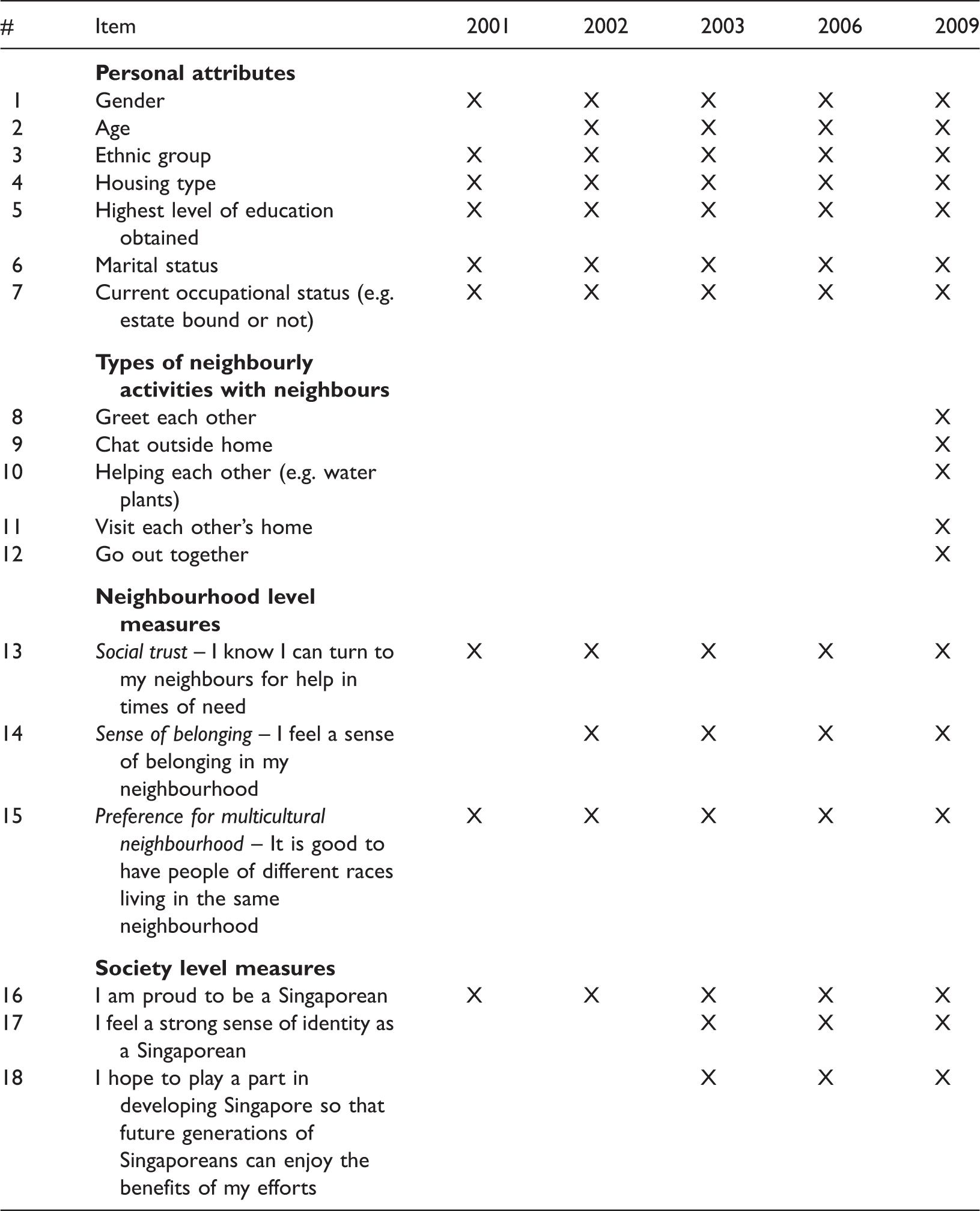
List of variables and the years of their availability.
Measures of neighbourhood level variables
The measure of neighbouring activities comprises five types of interactions: Respondents were asked to report whether they had done the following activities with neighbours in the past one year: (a) greet, (b) chat, (c) visit, (d) help (e.g. by watering plants, keeping keys, running errands etc.), and (e) go out together. The measures take a binary form: 1 for ‘yes’; 0 for ‘no’.
Thus we measure neighbourhood sentiment using three indicators: (1) social trust is measured by the statement: ‘I know I can turn to my neighbours for help in times of need.’ The measure is binary: again 1 for ‘yes’; 0 for ‘no’; (2) sense of belonging is measured by the statement: ‘I feel a sense of belonging in my neighbourhood’, again 1 for ‘yes’; 0 for ‘no’; (3) support for multi-ethnic neighbouring is measured by the statement: ‘It is good to have people of different races living in the same neighbourhood.’ This is a Likert scale item, converted subsequently to a binary form: 1 for ‘strongly agree’ or ‘agree’; 0 for ‘disagree’ or ‘strongly disagree’.
Measures of society level variables
Likewise, we measure national sentiment using three indicators: (1) proud to be a Singaporean, (2) strong sense of identity as a Singaporean and (3) willingness to play a part in developing Singapore for future generations. The original variables all take the form of four-point Likert scales, which we subsequently convert to a binary form: 1 for ‘strongly agree’ or ‘agree’; 0 for ‘disagree’ or ‘strongly disagree’.
Measurement of demographic characteristics
Gender is represented by the dummy variable: ‘female’ (assigned ‘1’), while ‘male’ is assigned as the reference category. Ethnicity is represented by two dummy variables: ‘Malay’ and ‘Indian’, with ‘Chinese’ assigned as the reference category. Age is measured at the interval level. Marital status enters the models as two dummy variables: ‘single’ and ‘married’. The disrupted family, comprising ‘divorced’, ‘separated’ and ‘widowed’ respondents, is assigned as the reference category. Housing type is represented by the dummy variable: ‘public’ (assigned ‘1’), while ‘private’ is assigned as the reference category. Public housing comprises ‘HDB (1–3 rooms)’, ‘HDB (4-rooms) and ‘HDB (5 rooms)’, while private housing comprises ‘executive condominium and HUDC’, ‘private apartment’, and ‘landed property’. Current occupational status is represented by one dummy variable: ‘estate-bound’ (assigned ‘1’). The estate-bound refers to homemakers, the unemployed, and retirees. The non-estate-bound (assigned ‘0’) refers to those who are currently employed, students, and those serving national (military) service (mandatory for all Singaporean males). Education enters the models as a dummy variable: ‘1’ for access to tertiary education (i.e. a polytechnic and university education), and ‘0’ for having less than tertiary education.
Multivariate analysis
Since many of our dependent variables are in the binary form, we relied extensively on binary logistic regression. In addition, given the multiple year structure of the dataset, we made sure to include the time dimension in our models; this would add to our understanding of how temporal changes have modified the relationship between neighbourhood and society characteristics. We do this by including interaction terms in our regression models with year as a factor in the multiplication of factors and estimating difference-in-difference coefficients for pooled cross-sectional data (Wooldridge, 2013).
Results
Neighbourly activities
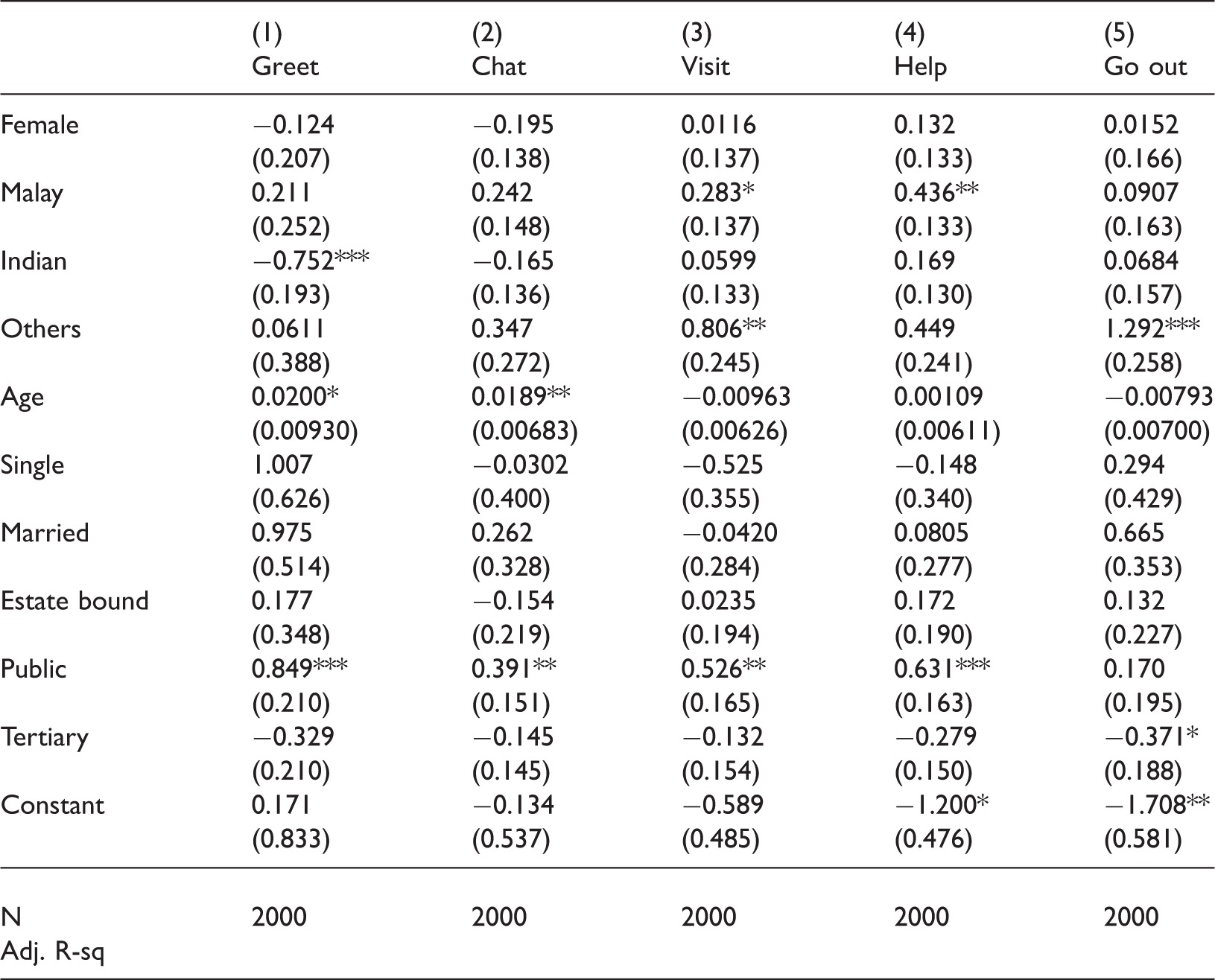
The most prevalent neighbouring activities are greeting and chatting, with 91% and 72% of the 2009 sample indicating them respectively (we do not have the equivalent data for the other years, only 2009). By contrast, helping (37%), visiting (32%) and going out (19%) were much rarer occurrences. As the five items represent a progression of tie strength, it is clear that most neighbouring activity remains as ‘neighbourly’. Specifically, the superficial form that these neighbourly relations take – casual but respectful – may also have to do with the understanding that a good neighbour also requires one to be considerate and not intrusive, but also helpful when the occasion calls for it (Laurier et al., 2002).
More neighbouring in public housing than in private housing
Predictors of the logged odds of neighbouring activities (greet, chat, visit, help, go out) (2009).
Standard errors in parentheses.
Reference categories: Male, Chinese, Disrupted family: Divorced, Separated or Widowed, Non-estate bound (comprising those currently employed, students, and those serving national service), Private housing, Non-tertiary educated (comprising residents with less than polytechnic or university education).
p < 0.05.
p < 0.01.
p < 0.001.
Growing neighbouring sentiments among public housing residents
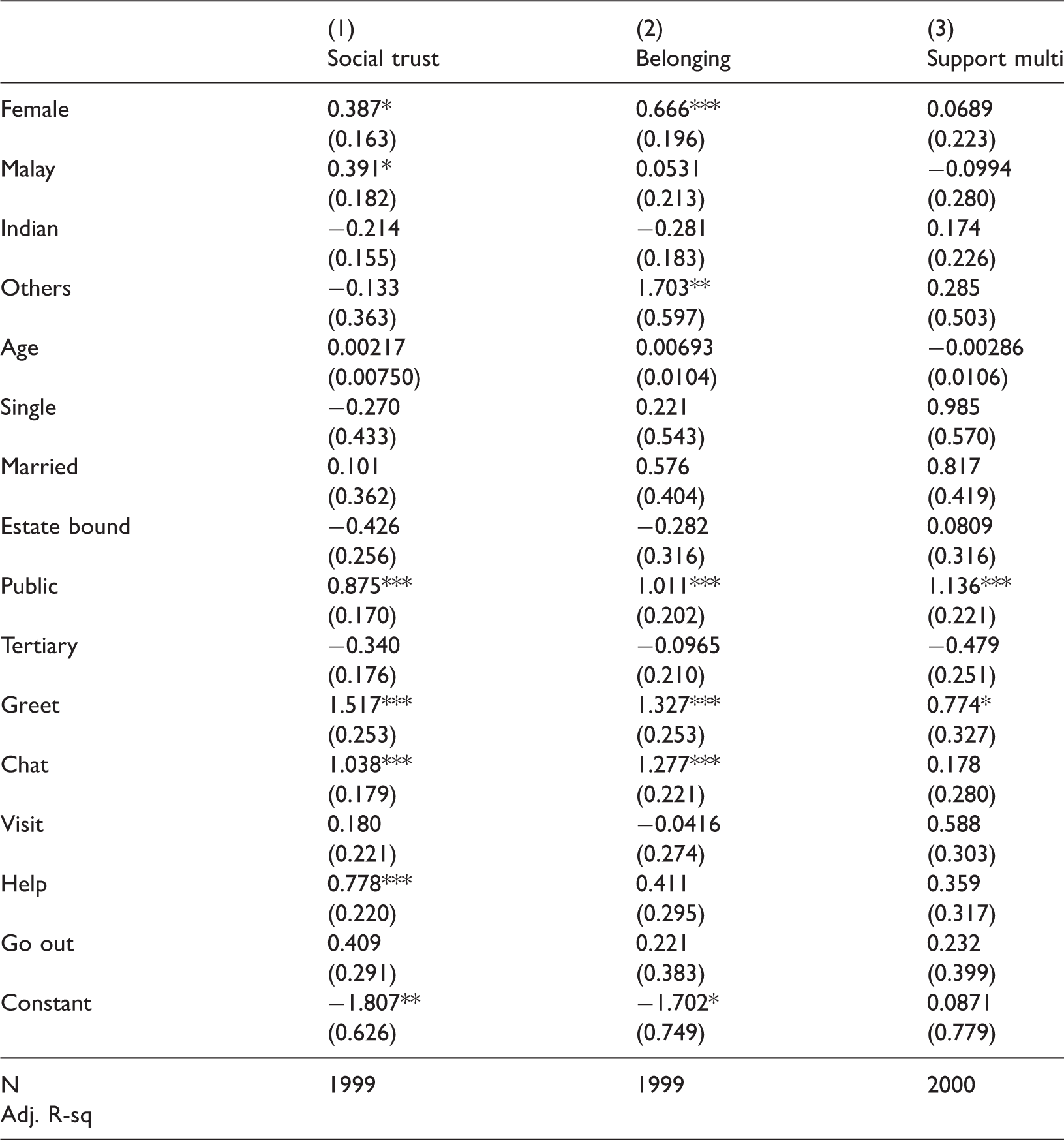
Predictors of the logged odds of neighbourhood sentiment (social trust, sense of belonging, and support of multi-ethnic neighbouring) (2009).
Standard errors in parentheses.
Reference categories: Male, Chinese, Disrupted family: Divorced, Separated or Widowed, Non-estate bound (comprising those currently employed, students, and those serving national service), Non-tertiary educated (comprising residents with less than polytechnic or university education), do not greet, do not chat, do not visit, do not help, do not go out (with neighbours).
p < 0.05.
p < 0.01.
p < 0.001.
Predictors of the logged odds of neighbourhood sentiment (social trust, sense of belonging, and support of multi-ethnic neighbouring) (over time).

Standard errors in parentheses.
Note: We do not have over-time data for greeting, chatting, visiting, helping and going out among neighbours hence the omission.
Reference categories: Year 2001 (model 1 and 3), Year 2002 (model 2), Private housing, Male, Chinese, Disrupted family: Divorced, Separated or Widowed, Non-estate bound (comprising those currently employed, students, and those serving national service), Non-tertiary educated (comprising residents with less than polytechnic or university education).
p < 0.05.
p < 0.01.
p < 0.001.
Neighbourhood sentiments and national sentiments
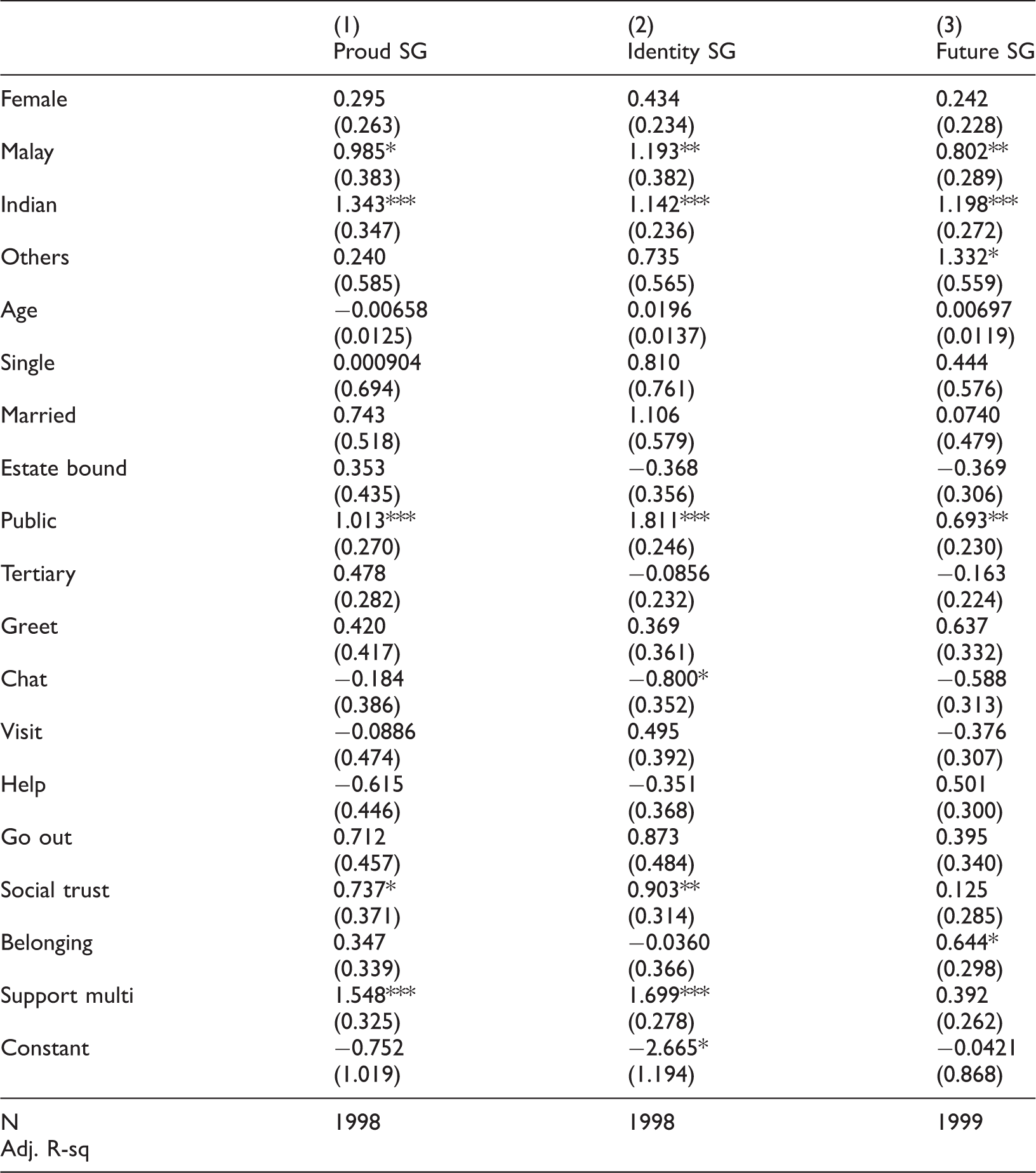
Predictors of the logged odds of national sentiment (national pride, identity as a Singaporean and play a part in developing Singapore for future generations) (2009).
Standard errors in parentheses.
Reference categories: Male, Chinese, Disrupted family: Divorced, Separated or Widowed, Non-estate bound (comprising those currently employed, students, and those serving national service), Non-tertiary educated (comprising residents with less than polytechnic or university education), do not greet, do not chat, do not visit, do not help, do not go out (with neighbours). Answered ‘no’ to the statement ‘I know I can turn to my neighbours for help in times of need’, Answered ‘no’ to the statement ‘I feel a sense of belonging in my neighbourhood’, Answered ‘disagree’ or ‘strongly disagree’ to the statement ‘It is good to have people of different races living in the same neighbourhood’.
p < 0.05.
p < 0.01.
p < 0.001.
Predictors of the logged odds of national sentiment (national pride, identity as a Singaporean and play a part in developing Singapore for future generations) (over time).

Standard errors in parentheses.
Year availability:
Model 1: Between years 2001 to 2009 (i.e. 2001, 2002, 2003, 2006, 2009).
Model 2: Between years 2003 to 2009 (i.e. 2003, 2006, 2009).
Model 3: Between years 2003 to 2009 (i.e. 2003, 2006, 2009).
Notes: We do not have over-time data for greeting, chatting, visiting, helping and going out among neighbours hence the omission. Also, we do not include the IV ‘sense of belonging’ in model 1 (DV = ‘proud to be Singaporean’) because we do not have 2001 data for ‘sense of belonging’ whereas we have the full set of data for ‘support for multiethnic neighbouring’.
Reference categories: Year 2001 (model 1), Year 2003 (model 2 and 3), Answered ‘no’ to the statement ‘I know I can turn to my neighbours for help in times of need’, Male, Chinese, Disrupted family: Divorced, Separated or Widowed, Non-estate bound (comprising those currently employed, students, and those serving national service), Private housing, Non-tertiary educated (comprising residents with less than polytechnic or university education), Answered ‘disagree’ or ‘strongly disagree’ to the statement ‘It is good to have people of different races living in the same neighbourhood’, Answered ‘no’ to the statement ‘I feel a sense of belonging in my neighbourhood’.
p < 0.05.
p < 0.01.
p < 0.001.
Predictors of the logged odds of the logged odds of national sentiment (national pride, identity as a Singaporean and play a part in developing Singapore for future generations) (over time).
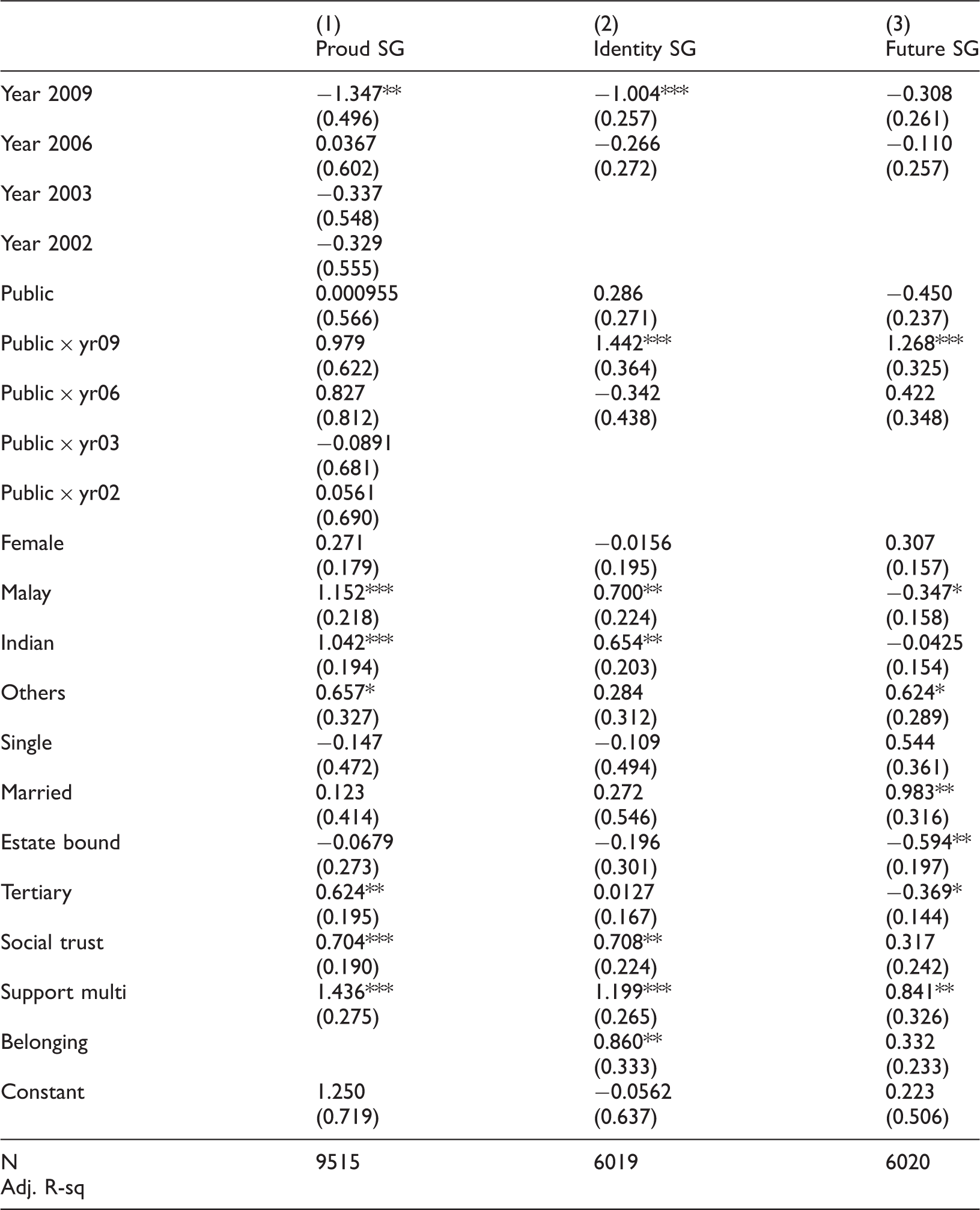
Standard errors in parentheses.
Reference categories: Year 2001 (model 1), Year 2003 (model 2 and 3), Private housing, Male, Chinese, Disrupted family: Divorced, Separated or Widowed, Non-estate bound (comprising those currently employed, students, and those serving national service), Non-tertiary educated (comprising residents with less than polytechnic or university education), Answered ‘no’ to the statement ‘I know I can turn to my neighbours for help in times of need’, Answered ‘disagree’ or ‘strongly disagree’ to the statement ‘It is good to have people of different races living in the same neighbourhood’, Answered ‘no’ to the statement ‘I feel a sense of belonging in my neighbourhood’.
p < 0.05.
p < 0.01.
p < 0.001.
The statistical data and analysis we have just presented show how a state-enabled social mixing public housing allocation policy has created increase opportunities at neighbouring. Neighbourly interactions in turn shape sentiments towards the community and nation. In order to develop a more elaborate explanation of how this process works, we re-examine a set of arguments Lai (1995) made about the state and the cultivation of a multiethnic identity in Singapore, using the focus group portion of a mixed-method public housing study conducted by the first author in 2013.
Lai’s (1995) argument starts with the public housing allocation policy which creates a multi-ethnic composition in public housing estates. This composition in turn, enables more opportunities in social mixing among neighbours in their everyday routines. Our focus group in Bukit Panjang (July 17, 2013) illustrates a South Asian mother mentioning her interaction with other mothers while waiting their children at a neighbourhood pre-school and ends with the respondent mentioning that her immediate neighbours are Chinese.
Tasmeen: During the weekdays when the pre-school is in operation, the parents who live in the nearby apartment blocks, greeting each other talking about various topics, while waiting for the kids…. Yeah, Chinese friends also. Moderator: Nice. Tasmeen: Both of my immediate neighbours are Chinese, so we chat every day. Even our kids are talking to each other, very nice.
This passage points to two policy interventions in the HDB neighbourhood: the housing allocation policy of social mixing which results in the mix between Non-Chinese and Chinese neighbours (the last remark from Tasmeen), and the pre-school in the neighbourhood which also creates opportunities for social mixing when mothers are waiting to pick up their children.
Lai’s (1995) second point is that in Singapore’s public housing estates, neighbourly relations are not left to chance but carefully nurtured by housing and maintenance inspectors. Just who are these ‘inspectors’? Residents Committees in Singapore’s public housing estates are so called because its members live in the neighbourhood. We show from the Yishun Focus Group Discussion (May 3, 2013) how two members (Whye Kit and Desmond) not only actively cultivate neighbourly relations through a variety of programmes and activities, but also work to prevent local tensions from boiling over.
Whye Kit: since I moved here I think almost a year after settling down, I approach Madam Lee when I walked into the RC, hoping to see how I can be involved and do something because I feel it is taking the initiative, to get in touch with your neighbourhood, rather than waiting for your neighbours to approach you. The other thing that I try to do is to organize a block party, we had one at my house. Desmond We put more chairs (to encourage neighbours to sit and interact)… the problem is that when it comes to the evening, the youngsters come, then the noise comes and then we always receive police complaints and then we get involved.
So residents like Whye Kit and Desmond are critical mediators of neighbourly relations. And because Resident Committees are set up by the government, these volunteers function as the state’s agents who ensure that multicultural norms (and mores) are adhered to, thus setting the stage for the successful translation of local relations to a wider national identification and consensus.
Thirdly, the ethnic mixing in public housing fosters a wider consciousness (and consensus) built around the tenets of multiculturalism among residents. We show from our Bukit Panjang focus group a discussion among four resident participants about a neighbourhood open area just how such sites can enable neighbourly relations to scale to the community and to the nation.
Mr Prakash: I like this place (Senia square) because when I shifted to this place, my daughter was only 2 years old. She started playing here like cycling, scooter & everything she learn in this place. Even nowadays, she plays a lot in the place. During our festival like Deepavali (Diwali), all of our family members will come & gather in this place [This square is]Outside my block, this place is a very nice place, big & spacious. Madam Chan: Yes, it is very big & spacious and where the Resident Committee will organize events. The committee will organize events like children day down there. Mr Prakash: So this place I like a lot and has a lot of memories for me. Mr Shiva: It’s very windy & spacious over there. Moderator: Yeah. Right it is very windy & open around here. Do we have our National Day celebration over there too? Mr Chan: Yes
Overall, these various pieces of qualitative data illustrate how state initiated spatial policies and amenities create the opportunities for the cultivation of neighbourly relations and social mixing in everyday life and how the interactions and sentiments work towards creating a sense of multicultural understanding at the level of the neighbourhood and the nation.
Discussion: Neighbourhood roots of social cohesion
Our societies are becoming more urban as more people are living in cities today than ever before. The diversity of peoples, opinions and life-styles which globalization brings to cities suggests an important role of nationalism as a form of identity and security. This link between locality and society is exemplified by Skey’s (2013: 82) work on everyday routines and the possibility that these generate “an ongoing, and consistent, sense of ‘social reality’, which, in turn, may underpin a more secure sense of identity, place and community”. Likewise, Fox and Miller-Idriss (2008: 536), in suggesting the term ‘everyday nationhood’, make an important conceptual shift from the state to the people and open the possibility that ‘to make the nation is to make people national’. As Skey (2013) suggests, increasing insecurity in the world creates a new propensity for nationalism, with its associated notions of identity and belonging, as a new cherished goal, and a rethinking of the roots of such an orientation. In this retracing of nationhood to its micro level foundations, we suggest that the neighbourhood can be one important source of everyday nationalism.
With 82% of the residential population living in public housing estates, Singapore’s housing policy also represents a fertile case (Walton, 1992) where a consistent set of policies (housing, social mixing, community building) has been in place to allow for a more elaborate analysis of the outcomes of state intervention on the Singapore public housing neighbourhood. Singapore’s public housing neighbourhoods are more homogeneous because the national urban planning practices embedded in these places ensure uniformity in experience in terms of the neighbourhood parks, markets, local eateries and even convenience stores. These amenities encourage encounters among neighbours through shared use of local spaces. At the local neighbourhood level, government sponsored community clubs also work to connect neighbours through shared activities. These sustained policy initiatives rooted at the grassroots over several decades have been able to homogenize the residential environment for the majority of Singaporeans, enabling the micro-processes of everyday life to have significant macro outcomes. Specifically the habits and routines of place and to the extent resultant attitudes are shared, we have a common understanding of who we are by what we do and what we like. This creates an identity spine, which stands amidst an increasing diversity that defines urban society.
The suggestion of everyday routines of nationalism originating within locales does not in any way discount the effects of external actors and processes operating in the neighbourhood. Indeed, as Smith (2001: 110) points out, there are a ‘variety of boundary-penetrating social actors and processes now very much a part of the transnational world in which we live’. As Skey (2013) suggests, we think these are the very processes which also trigger a new revaluation of localisms and nationalisms.
The focus of this essay has been on assessing the social impacts of housing and neighbourhood amenity provisions without addressing the issue of participation. What, from a policy framework, may be usefully seen as place-based provision attempts, also comes with the development of government managed organizations at the level of the neighbourhood, or what Read (2012) terms as ‘the roots of the state’. Read (2012) cautions against one-way top-down interpretations of such organizations for administrative interventions at the neighbourhood level work both ways. While they officially work as channels for the state to communicate and mobilize local communities, these very mechanisms are also ways in which participation and the voicing of local demands can be made. If we cast our attention to the local scale, and reconsider state apparatus at the grassroots as a two way channel as Read (2012) suggests, the existing state structure established at the level of the neighbourhood will enable the surfacing of local voices. Our data analysis shows that the enabled neighbouring in public housing estates does nurture a civic attitude among its residents. When neighbours relate to each other in everyday life, they are more likely to see through their relations with neighbours, the neighbourhood as a social life. This becomes an important basis to act for the well being of the neighbourhood, and becomes a vital ingredient of engaged citizenship (Heinelt and Kübler, 2005: 12) and governmental belonging (Hage, 1996: 468) Thus, the homogeneous built environment of public housing estates allow for the creation of everyday nationalisms and a shared imaginary among the majority of Singaporeans. This imagination may create the plank for an emerging version of governmental belonging in the form of voice and action. This emerging form sits in between the two models of state led and state enabled forms of participation suggested by Bailey and Pill (2015); historically closer to the state led end of the spectrum but moving towards the state enabled direction as new locally formed initiatives take root in different Singaporean public housing neighbourhoods. This creates a real possibility of what Allen and Cars (2001: 2207) term as the social infrastructure of cohesion where local efforts are embedded in wider mainstream and national goals.
The role of public housing in building a national identity emerges as a consistent theme throughout our analysis. We begin with the neighbourhood, neighbours engaging in neighbourly activities: greeting and chatting, small activities, but with very consequential effects. Activities beginning in the neighbourhood then translate to positive feelings and identification with the neighbourhood in the form of social trust, belonging and support for cultural diversity between neighbours. In turn, these neighbourly sentiments snowball to something even bigger, ultimately the creation of national identity. This transition from local to national occurs most seamlessly in the public housing domain in particular as the state is able to influence the activities and attitudes of residents through grassroots organizations and various programs in the public domain. The specific organization of the small state – e.g. the homogeneity of experience in public housing, the lack of opposition to state goals, the stakeholding principle (giving rise to a sense of place permanence), all have contributed to the neighbourhood–society relationship (see Table 7 which hones in the point that public housing has generated national identity consistently with time).
Conclusion
Madanipour (2001: 182) in looking at the practice of planning by neighbourhoods addresses the question of social cohesion and asks ‘how can modern anxieties can be treated with… old remedies’? This is a good question to address in closing, that with globalization and its associated effects of social fragmentation, can we look to the neighbourhood as the ‘old remedy’? An attempt at a reformulated remedy will have to begin by the acceptance that our neighbourhoods are less likely to be traditional communities bound by dense inter-dependent linkages and a shared local culture. In the contemporary city, our relationships with those who live closest to us are likely to be casual and occasioned and there is room for government and housing authorities to develop and sustain a more positive sense of place, place relations and identity as these do matter in shaping cohesive effects that reach beyond the home and neighbourhood. And the neighbourhoods which bring about these sentiments are those which bring us out of our homes, into our neighbourhoods and beyond.
Footnotes
Declaration of conflicting interests
The author(s) declared no potential conflicts of interest with respect to the research, authorship, and/or publication of this article.
Funding
The author(s) disclosed receipt of the following financial support for the research, authorship, and/or publication of this article: K.C. Ho (NUS-HDB Research Collaboration Grant Number: R-111-000-126-490: ‘Study on Impact of Built Environment on Community’).