



Abstract
Public planners are increasingly recruited to manage collaborative innovation processes, but there is hardly any research on how they deal with the tensions they encounter in managing collaborative innovation in the institutional context of a public bureaucracy. Drawing on emerging theories of collaborative planning, network management and public innovation, the article develops a taxonomy of tasks related to managing collaborative innovation, identifies potential tensions between these tasks and the institutional logic of public bureaucracies and investigates how these tensions are experienced by frontline planners who remain involved in face-to-face interaction with citizens while managing collaborative innovation processes within urban regeneration projects in Copenhagen.
Keywords
Introduction
Western governments increasingly seek to enhance public innovation in urban planning as well as in other policy areas (Eu-Comission, 2015; US-Government, 2015). An emerging research on public innovation provides important insights that resonates well with collaborative planning approaches and can as such inform current aspirations to understand how collaboration can make urban planning more innovative (Forester, 1999; Healey, 1997, 2003; Innes, 1998; Innes and Booher, 2004). While the scholarly debate on collaborative planning has mainly focused on how collaboration can promote shared agreement/action, citizen empowerment and democracy, new theories of public innovation view collaboration as a productive force in creating innovation (Bommert, 2010; Hartley, 2005; Osborne, 2010). Bringing actors with different world views, experiences and innovation assets together can potentially create productive destructions of existing mindsets and perceptions and trigger the formulation of new creative ideas, pool the resources and capacities needed to transform these ideas into innovative products, organizational designs and procedures and promote innovation diffusion to relevant audiences. This potential is already recognized in recent developments in urban planning research (Ahern et al., 2014; Atkinson, 2008; Schetke et al., 2012; Tazan-Kok and Vranken, 2011; Zygiaris, 2012).
As evident from numerous studies, frontline planners, that is, planners who on a daily basis are involved in face-to-face interaction with citizens and other stakeholders, play a key role in promoting collaborative planning (Clifford and Tewdwr-Jones, 2013; Grange, 2013; Pløger, 2001) and public value (Horner and Hutton, 2011; Vigar et al., 2014) in urban neighbourhoods (Durose et al., 2016; Hambleton, 2014; Sirianni, 2007). However, the existing research mainly focuses on the challenges related to promoting collaboration in multi-actor processes involving different stakeholders and citizens. There is less attention on the tensions that may occur between the institutional logics characterizing public bureaucracies and the dynamics of collaborative planning (few studies that raise this issue include Agger, 2015; Allegra and Rokem, 2015; Laws and Forester, 2015). Moreover, only few studies analyze the tensions that arise when the goal pursued by public managers is urban innovation. This article aims to fill this void by studying how frontline planners experience and cope with tensions between what it requires to manage collaborative innovation in urban planning and the context of a bureaucratic public planning system. First step is to integrate insights from emerging theories of public innovation, network governance research and collaborative planning theory into a taxonomy of how frontline planners can manage collaborative processes. Next, we identify a number of tensions that public planners may potentially face when seeking to serve these tasks. This theoretical framework is then applied in a case study to examine how and to what extent frontline planners managing collaborative innovation processes within urban regeneration projects in Copenhagen experience and deal with such tensions.
Collaborative innovation in the public sector: why, what and how?
Governments all over the Western world (European Union (EU)-Commission, 2013; Organisation for Economic Co-operation and Development (OECD), 2010) increasingly view innovation as a means to overcome wicked and unruly policy problems resulting from cognitive restraints, conflicts and uncertainties regarding how to solve them (Macmillan and Cain, 2010; Rittel and Webber, 1973). Such problems are in plenty in urban areas, for example, flooding resulting from cloud bursts, traffic congestion, gang-related violence and housing shortage. Traditional strategies and tools have proven insufficient, and innovation appears as both a necessary and promising way forward. As such, innovation has become a ‘magic concept’ that provides hope of a better future (Pollitt and Hupe, 2011). The concept of innovation is also becoming extremely popular in inner city planning, as being an innovative city adds another crucial competition parameter (Forbes, 2013) for further development.
Taking departure in recent theories of private and public innovation, public innovation can be defined as a more or less intentional formulation, realization and diffusion of new public policies and services and new ways of organizing and processing policy making and service provision. Hence, public innovations can both take the form of new understanding of governments’ goals and tasks and new ways of realizing them. Moreover, the definition indicates that public innovations involve different phases that analytically, although not necessarily in practice, emerge in a certain order. The first phase consists of a critical assessment and reformulation of the problem at hand. Then follow the development of new and creative ideas regarding how to deal with this task in the form of new policies and services. Next phase is the actual implementation of these policies and services, and in the final phase, the new innovations are diffused to relevant audiences (Eggers et al., 2009; Sørensen and Torfing, 2016).
Following Jean Hartley (2005) and Everett Rogers (1995), a phenomenon does not have to be completely ‘new’ to count as an innovation. Most innovations are inspired by innovations made elsewhere or result from a creative reassembling of different existing elements. A phenomenon needs only to be new in the context in which it is implemented in order to count as an innovation. It should be emphasized that innovation is not always a good thing. The value depends on the eyes of the beholder. From this recognition follows that innovation is not a goal in itself but a means to an end (Torfing, 2016). Finally, an innovation is more than an incremental improvement. It is a change that breaks away from common wisdom and established practices. As such, innovating is often painful for those involved because it is destructive as well as productive. Creating something new involves breaking some eggs, for example, destroying existing things, practices and ways of thinking in order to make room for the new (Schumpeter, 1975). Innovation comes at a cost and what is gained should be measured against the costs involved as well as the risks related to moving into the unknown. In a public planning context, assessments of the impact of an innovation are not only important but also a highly complex task because innovations potentially influence a broad range of aspects related to public value creation in the narrow as well as in its broadest sense and because their short-term and long-term impacts may vary substantially.
If creating innovation is full of challenges then and interesting question is, what drives public innovation? The first theories of public sector innovation dating back to the early 1990s saw strategic entrepreneurial leadership and competition as important mechanisms for promoting public innovation (Hood, 1991; Osborne and Gaebler, 1993). Finding inspiration in traditional private sector innovation theory, entrepreneurial political leaders and managers were seen as key initiators of innovation in public organizations, and competition between public service providers creates a strong incentive for them to innovate. The new public innovation theories recognize the importance of leadership and competition for promoting public innovation but emphasize that collaboration is yet another important driver of public innovation (Newman et al., 2001; Osborne, 2010). While recognizing the importance of strategic leadership for placing innovation on the agenda and the need for competition to motivate actors to take the trouble to innovate, collaboration is viewed as the force that produces public innovations. Why is that? Drawing on the insights from many fields of research including social innovation theory (Nicholls et al., 2015), theories of collaborative planning (Healey, 1997; Innes and Booher, 2010; Sirianni, 2007) and governance network theory (Sørensen and Torfing, 2007), public innovation research argues that collaboration is both valuable for destabilizing existing policies, services and ways of working in the public sector and for formulating, realizing and diffusing new ones. Hence, collaboration between public employees from different public agencies and levels of governance as well as between public actors and private firms, civil society actors and citizens with different mindsets, experiences, ideas, knowledge and skills can reveal the deficiencies of existing policies, services and governance practices and inspire the development, realization and diffusion of new ones (Bommert, 2010; Mintrom and Vergari, 1998; Powell and Grodal, 2005). The potential benefits of collaboration in promoting public innovation are scrutinized in a number of empirical studies, including studies of urban innovation. A seminal study of successful city development in Turin in Italy shows that this was largely a result of collaborative innovation networks (Dente et al., 2005), and a large-scale study of revitalization initiatives in Atlanta and Baltimore points to the importance of partnerships in achieving success (Rich and Stoker, 2014). A study of regional planning projects in Sweden reaches the same conclusion (Montin et al., 2014).
Managing collaborative innovation in the public sector
Although collaboration can be an important driver of public innovation, it is widely recognized in planning research, as well as in governance network research and theories of public innovation, that collaboration needs to be stimulated, monitored and facilitated in order to produce desired outcomes (Ansell and Gash, 2008; Marcussen and Torfing, 2007). Planning research points out that collaborative planning processes call for forms of management that differ from management in bureaucracies. Those involved in this form of management are called ‘hybrid planners’ (Crawford, 2009), ‘meta-governors’ (Sehested, 2009), ‘deliberative practitioners’ (Forester, 1999) or ‘collaborating planners’ (Clifford and Tewdwr-Jones, 2013; Vigar et al., 2014). The names capture the fact that what is taking place is a form of interactive management of participatory processes where the task is to bring together a variety of relevant and affected stakeholders and support their ability to work and act together with the purpose of shaping the environment they live in.
An increasingly debated question in the planning literature is how to address the practical challenges and dilemmas that confront planners who aim to promote multi-actor collaboration in a context ridden by different institutional logics and modes of governance. The focus in this debate has not the least been on how planners handle conflicts between the involved participants (Björkdahl and Strömbom, 2015; Gualini, 2015; Laws and Forester, 2015). Some views conflict resolution as a key task for collaborative planners (Forester, 1999; Healey, 2010), while others point to the productive force in such conflicts and discuss how planner can turn destructive conflicts into conflicts that accommodate change (Sørensen, 2014). Moreover, some planning theories are mostly interested in conflicts in bottom-up planning processes, while others are interested in the management of conflicts arising in the interface between collaborative bottom-up and top-down planning. 1 The question of how to deal with conflicts in collaborative planning has recently received broad scholarly attention among planning researchers (Forester, 2009; Van de Wijdeven and Hendriks, 2009). Those who are particularly keen to reconcile conflicts and promote shared action are mainly pointing to the need for facilitative management that supports deliberative processes, promotes communication between actors with different perspectives and experiences and contributes to the production of shared meaning (Agger, 2015; Crosby and Bryson, 2010; Healey, 1997). Those who view conflicts as productive are focusing on the importance of designing and staging conflicts and dynamics that contribute to stimulate change and innovations in the pursuit of efficient and effective public governance (Healey, 1997; Montin et al., 2014; Sørensen, 2014).
Governance network research is an important source of inspiration for planning researchers who seek to clarify how planners can motivate actors to collaborate and to do so in ways that align with general governance objectives of and aspirations for change in public bureaucracies. As argued by Karina Sehested (2009), theories on network governance are informative in pointing out how planners can motivate actors to engage in a shared effort to realize public governance objectives through the construction of interdependencies. At the heart of this endeavour is the term metagovernance that signifies the many ways in which planners can connect top-down planning and bottom-up planning processes. Metagovernance involves an extensive use of soft forms of power that commit actors to engage in collaborative innovation processes without directly forcing them to do so and to align collaborative governance with large-scale governance aspirations (Nye, 2004; Sehested, 2008). Among soft forms of power are the construction of interdependencies that motivate actors to collaborate when dialogue and community sentiments fall short and reward and punishment systems in the form of ‘sticks and carrots’ that are closely related to performance. However, different forms of narration and persuasion can be equally effective. As such, the concept of metagovernance points out that planning benefit from a combination of process facilitation and strategic framing in accommodating collaboration and aligning such collaboration with overall governance objectives (Koppenjan and Klijn, 2004; Sørensen and Torfing, 2009).
The particular contribution of theories of public innovation is to clarify how collaborative planning processes can contribute to promote innovation. While collaborative planning approaches tend to be mostly focusing on how planners can get actors to collaborate and gain influence, and governance network theory suggests how managers can link and align collaborative processes and the larger governance system, innovation theory is interested in how collaboration can be managed in ways that promote innovation. When the purpose is innovation, the task of the planner is to accommodate creative destructions and the production of new problem definitions and ideas, support the testing of prototypes and encourage the implementation and diffusion of new innovations (Ansell and Gash, 2012; Eggers et al., 2009; Hartley, 2005). Moreover, theories of public innovation stress the importance of bringing the collaboration process through all the different phases in the innovation process. Finally, planners managing collaborative innovation should seek to develop a strong innovation culture that encourage and reward risk-taking and experimental behaviour (Dobni, 2008).
Drawing on the many valuable insights from theories of collaborative planning, governance network research and public innovation theory, we have developed a taxonomy of different management tasks to be performed by collaborative planners who seek to promote collaborative innovation in urban planning. As shown in Table 1, we have condensed these tasks in four management roles: the pilot, the whip, the culture-maker and the communicator. Collaborative planning theory highlights the importance of facilitating dialogue and communication, accommodating shared meaning and exploiting the productive force in conflicts to create change and have inspired the construction of the role of the communicator. Theories of network governance stress the importance of soft forms of power for creating interdependencies through the design of incentives as well as the need to align goals defined at the top of the public bureaucracy with goals formulated through collaboration and have inspired the pilot and the whip. Finally, public innovation theory points to the need to develop a culture that celebrates creativity and experimentation and focus on the production of innovative outcomes and this is what the culture-maker does. All four roles have an important function to fulfil at the different states in the collaborative innovation process. It is not sufficient for urban planners to see to it that collaborative innovation processes lead to the development of new ideas. Collaboration is also important for promoting the realization and diffusion of new innovations, and, as shown in Table 1, this calls for management.
Taxonomy of tasks for collaborative planners managing collaborative innovation.
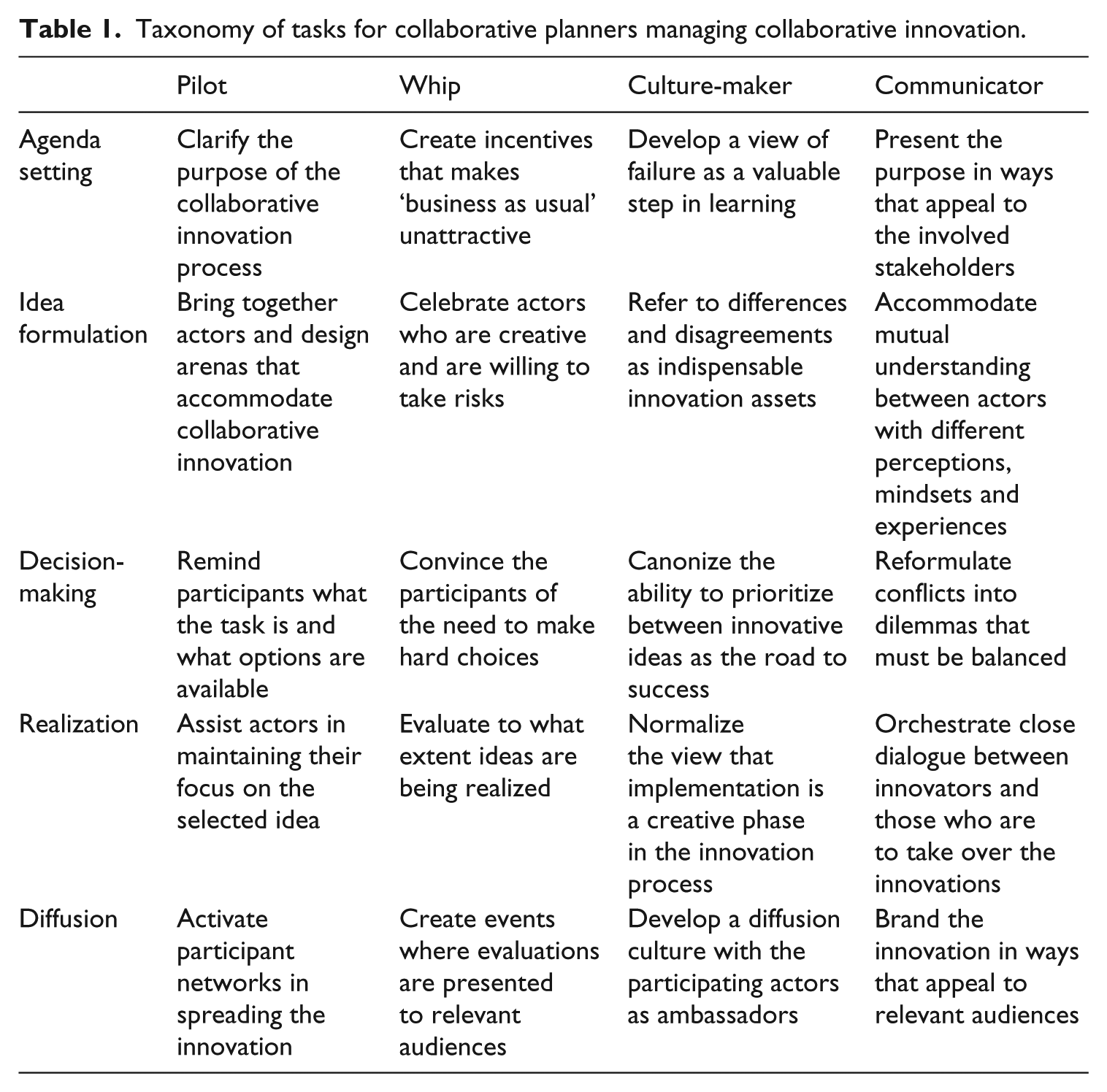
Being a pilot means to monitor the overall direction of the innovation process by setting the agenda for the collaborative innovation process, convening relevant stakeholders, organizing the activities, keeping focus on outcomes and seeking to mobilize all available resources in diffusing successful innovations and learning of relevance to others. A whip who employs soft forms of power is important when actors are reluctant to participate in or contribute to the collaborative endeavours at different stages in the innovation process. The culture-maker normalizes collaborative and innovative behaviour and rewards experimentation and risk-taking. Culture is not only changed through talk but involves walking the walk (Lockwood et al., 2002). Finally, the communicator accommodates mutual understanding with the purpose of transforming destructive conflicts and misunderstandings into productive processes of creative learning and innovation. Each of the four roles in the taxonomy highlights management tasks that may or may not be needed to promote collaborative innovation in concrete planning processes. Sometimes a collaboration process runs smoothly by itself, but at other times, it is necessary to perform one or all of these roles.
Tensions between public bureaucracy and collaborative innovation
There are huge differences between the institutional logics of public bureaucracy and the dynamics driving collaborative innovation processes. Public bureaucracies are hierarchical authorization systems that valorize order, control and stability, define good governance with reference to procedure and process criteria and are intra-organizational in perspective. In contrast, collaborative innovation arenas distribute authority horizontally, valorize creativity, experimentation and change, define good governance in light of outcome and problem-solving capacity and are inter-organizational in perspective. As also pointed out by Michael Lipsky (1980) in his famous study of frontline employees in public bureaucracies, frontline planners are likely to encounter tensions that origin from conflicting institutional logics. The tensions between the logic of management in public bureaucracies and the logic of managing collaborative innovation are summarized in Table 2.
Tensions between the logic of public bureaucracies and collaborative innovation.
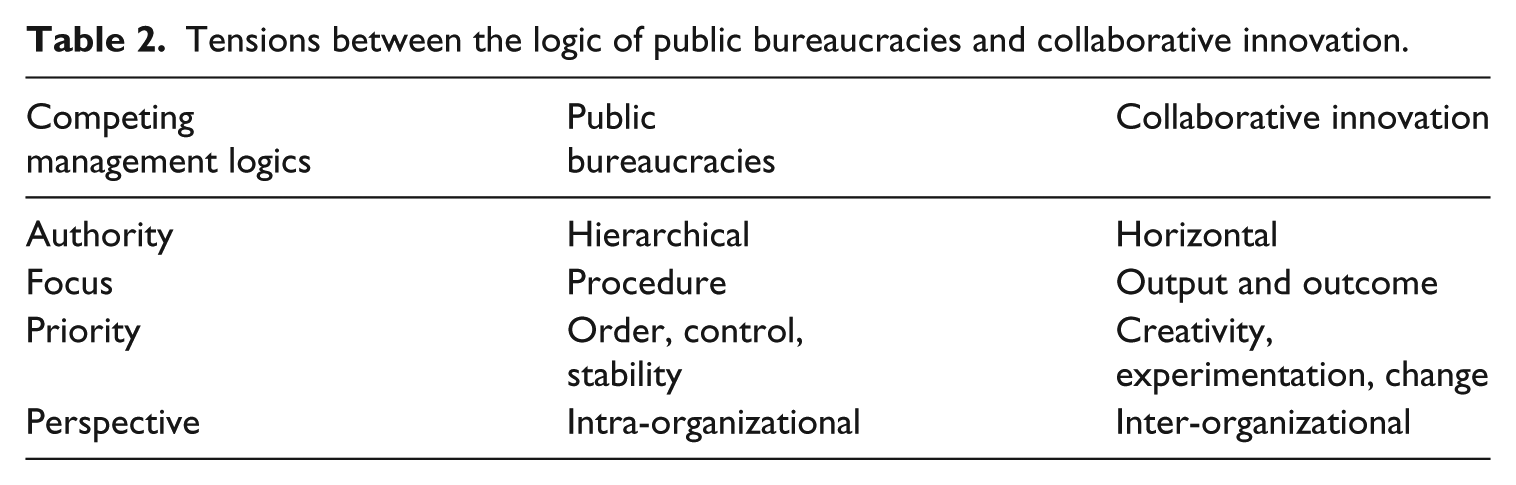
First of all, there is a tension between hierarchical and horizontal forms of authorization. Who is to decide the goal and purpose of the innovation process – the public authorities or the stakeholders taking part in the collaboration? This tension is likely to be experienced when performing the role of the pilot. A second tension may occur between the strict focus on procedure in public bureaucracies and the situated processing and strong attention to what is achieved in terms of new things that work in collaborative innovation. The whip is prone to encounter a tension between getting people to collaborate according to procedure and urging them to develop something new. A third tension may occur between the bureaucratic prioritization of order, control and stability over the pursuit of creativity, experimentation and change in innovation processes, and the culture-maker may be the first to experience such tensions. Finally, both the culture-maker and the communicator may on occasions face a tension between an intra-organizational bureaucratic task perspective and an inter-organizational innovation task perspective.
The assumption driving the empirical analysis below is that collaborative planners who are responsible for managing collaborative innovation processes are likely to face one or more of these tensions, and, consequently, that the innovation capacity of the public sector depends on how frontline planners and other public administrators cope with these tensions in ways that do not prevent them from performing the role as pilot, whip, culture-maker and communicator as presented in Table 1.
Case study selection and method
There are very few empirical studies of how frontline planners manage collaborative innovation processes in practice and how they cope with the tensions related to being part of a public bureaucracy. In what follows we present the results of an explorative case study of the management practices of eight frontline planners who were hired by the municipality of Copenhagen to manage Area-Based Initiatives (ABIs). The purpose of the study is to fill a void in the literature by exploring how frontline planners in practice experience and cope with the institutional tensions listed in Table 2. This explorative endeavour is meant to inspire and inform future theory building and research.
A study of ABI managers is well suited for illuminating tensions that frontline planners may experience when managing collaborative innovation from their position within a public bureaucracy. Hence, their explicit mission was to engage local citizens and stakeholders in collaborative innovation projects in areas as diverse as local housing, recreation, poverty, culture and environment, and the source of inspiration was among other things in new integrative urban regeneration approaches and public innovation theory (Atkinson, 2008; Eggers et al., 2009; Skifter Andersen and Leather, 1999). The purpose of the ABI initiatives was not only to involve local actors in idea development but also in implementing promising ideas and diffusing successful innovation as broadly as possible in the local community as well as to other neighbourhoods (Agger and Jensen, 2015). The study scrutinizes how the eight planners responsible for the ABI’s experienced and dealt with the tensions described in Table 2.
The eight planners had diverse professional backgrounds: three had a background in urban geography, one came from landscape planning, one from environmental planning and three had a social science and public administration background. Their age span from the mid-30s to the mid-50s, and they were at different stages in their carrier. All of them were assigned for a 5-year period to run a small secretariat with 6–12 employees with the responsibility of promoting neighbourhood renewal in one particular part of Copenhagen. Three were recruited from the central coordination section of ABIs within the City Hall, while the rest were recruited in open competition and came from various backgrounds such as private consultancy, cultural organizations or other municipal departments. Formally, the ABIs were placed under the authority of, and received their funding from, the Department of Technique and Environment in the municipality of Copenhagen and the Ministry for Immigration, Integration and Housing. At the same time, however, the ABI planners reported directly to a steering committee in each of the neighbourhoods composed of representatives from local resident networks, non-governmental organizations (NGOs), sports and culture associations. All activities had to pass through this steering committee, before they were passed on for approval, first by the administrative staff at the City Hall and finally by the municipal council.
The empirical data were collected through a comprehensive case study of how the planners experienced their job over a period from September 2012 to April 2014. The data collection methods are listed in the table below.
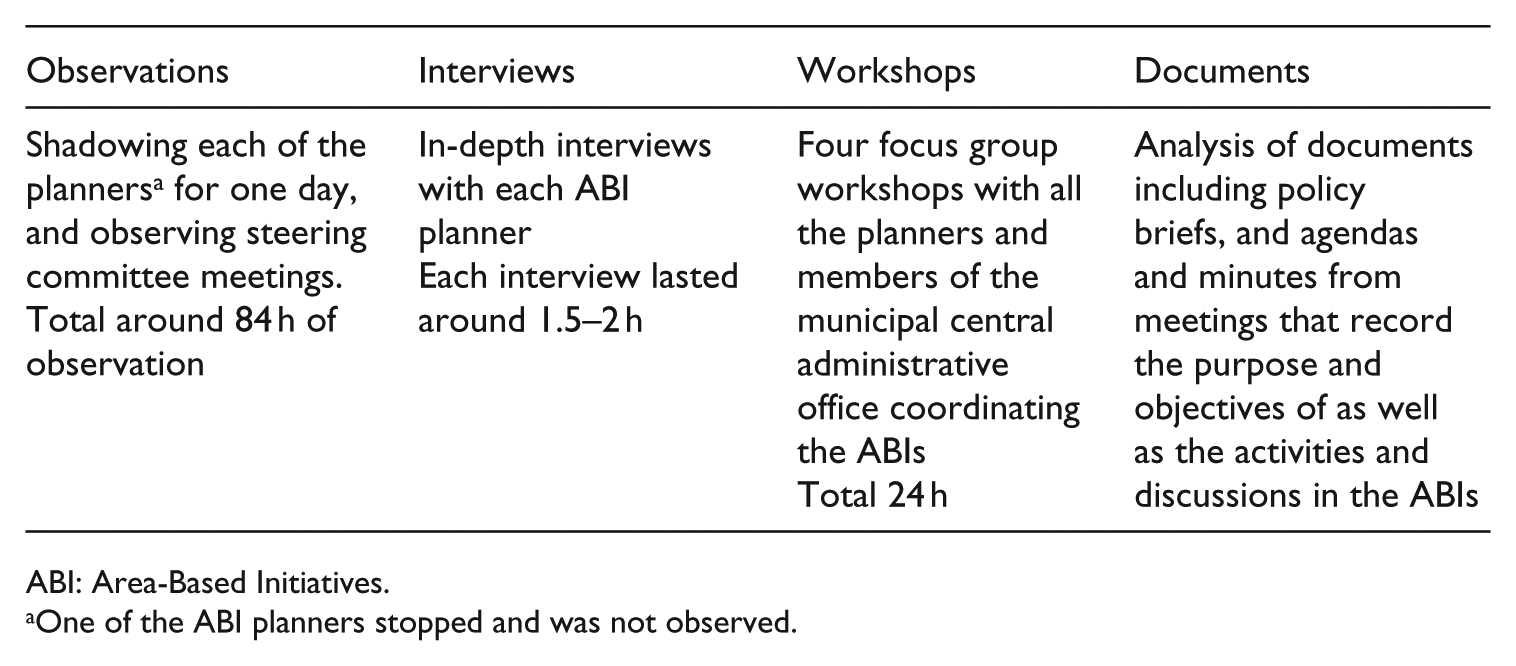
ABI: Area-Based Initiatives.
One of the ABI planners stopped and was not observed.
Triangulation of data from observations, document analyses, interviews and workshop events with the ABI planners has provided a multi-faceted insight into the life and challenges of the ABI planners and the tensions they experience along the way. While each of these data sources is insufficient, they provide a deep insight into complex social processes when used in combination.
Each of the ABI planners was shadowed in order to collect knowledge about their formal and informal interplay with citizens and stakeholders in different ABI projects. Moreover, we observed steering committee meetings in order to examine how they negotiated their mandate with City Hall and local actors. Different forms of observation are common in sociology and organizational studies (Czarniawska, 2007), but less widespread in public administration studies (Rhodes et al., 2007; Van Hulst et al., 2012). For our purpose, it was well suited for collecting data about how the planners dealt with institutional pressures and demand in a variety of concrete situations. Interviews supplement observations well as they provide insights about how actors perceive the observed situations. In this case, the interviews gave us insights into how the eight planners perceived their role as managers of the collaboration processes and how they interpreted the tensions they encountered along the way. The workshops allowed us to stage debates among the planners around issues related to managing collaborative innovations, for example, facilitation of collaboration, conflict resolution, promotion of innovation and diffusion of results. One of the workshops was specifically assigned to discussing tensions between bureaucratic governance and management of collaborative innovation at different stages in the collaboration process. Finally, the document studies provided insights into the formal tasks and objectives of the ABI projects and the ambiguities and inconsistencies in this task descriptions. All empirical data have been coded with the purpose of identifying management tasks, role perceptions, management styles, tensions and coping strategies. We looked for common patterns and differences between the planners, and in the analysis, we describe the general findings regarding how they performed the different roles and dealt with institutional tensions they encountered along the way. Quotes are used to illustrate general findings or incidents where one particular statement stands out.
Managing collaborative innovation in practice
In this section, we will discuss how the ABI planners performed the management roles described in Table 1 and how they dealt with the tensions listed in Table 2. Let us start by looking at how they performed the role as pilot, before we move on to analyzing how they perform the other management roles.
The pilot
Being a pilot of collaborative innovation processes implies the task of aligning collaborative innovation activities with the overall policy objective of the municipality. In order to clarify to what extent and how the eight planners functioned as pilots and coped with the potential tensions between vertical and horizontal management dynamics, we analyzed the interactions between the ABI planners and the local steering committees and examined the interplay between the individual ABI planners and different municipal departments. We also studied the way they designed the arenas for deliberation and how they guided the local collaborative innovation processes.
The study shows that the role as pilot was important for all eight ABI planners, but that they performed and understood the role differently. Some chose the role as ‘top-down pilot’, while others took on the role as ‘bottom-up pilot’. The former role perception particularly seemed to appeal to those ABI planners who were recruited from the City Hall. They viewed the ABIs as the lowest link in a hierarchical implementation chain and articulated their management role as that of being a local ambassador for the City Hall. As one of them stated, they were ‘the prolonged arm of the municipality’, and they saw it as their key objective to ensure that all phases in the collaborative innovation processes were in line with municipal policies and guidelines. Their task was to ensure that the staff ‘stand for and represent the same attitudes as our municipal department. That is the frame we operate within!’ (Workshop, 29 May 2013). The choice of which actors to invite into the processes was guided by this concern. Some of the other planners, and particularly those with other professional backgrounds than the municipal bureaucracy, saw themselves as bottom-up pilots on a mission defined by the local community. They were ‘ambassadors for the neighbourhood’ as one of them phrased it, and what they did involved fostering a kind of ‘place-based’ or ‘bottom-up’ leadership. Seen from this perspective, being a pilot meant, to promote a situation where it was local residents who set the agenda and prioritized between projects (Workshop, 10 September, 2012).
The role as pilot is highlighted both in the official job descriptions for the ABI planners as well as in the description of the aims of the ABIs. In these documents, it is clearly stated that the ABI planners must ensure that the different local projects are in line with the other municipal policies. At the same time, however, it is pointed out that the ABIs must support and help the local actors and, in particular, the local steering committee in realizing their ideas for improving their neighbourhood through concrete projects. As such, both groups of ABI planners, that is, the top-down and bottom-up pilots, can justify their interpretation of being a pilot with reference to their formal task description. The tension related to being a pilot of collaborative innovation in a public bureaucracy is evident in various contexts. It was visible in the heated debates among the ABI planners as well as in confrontations within their steering committees and elsewhere between actors from City Hall and the local community when their objectives differed. One of the ABI planners with a background in City Hall refers to such a situation in an interview:
We had a project regarding parking spaces and there was a huge debate. As ABI-staff we are placed under Technical Department and therefore have to work in relation to certain political decisions. Then there were some local persons in the steering committee that were against these decisions and wanted us to go against it and work for their decision. But in such a situation I represent the ‘bureaucracy’! I play that card- maybe it is a bit rigid – and there I played the role of the municipal public administrator!
‘Playing the municipal card’, when this kind of tensions over purpose arose was a frequently used strategy among the pilots with a background in the bureaucracy. However, as reiterated in many of the interviews, the price of this strategy was high, as it often affected the link to local actors negatively. In order to strengthen and secure local ties, all eight planners and their secretariats worked intensively to involve relevant local stakeholders in ABI projects and in a wide variety of formal and informal networks that were motivated by local agendas, which were not in direct conflict with those defined by City Hall, but were sometimes close to being so. In this work, they accepted being sometimes ‘to the border in interpreting municipal law’. This coping strategy could, on one hand, lead to innovative procedures and, on the other hand, result in lots of tensions between local actors and municipal policies that in one case, one of the ABI planners ended up being fired.
Summing up, all the ABI planners took on the role as pilot, but some of them tended to choose a top-down approach, while others applied a bottom-up pilot approach. Both roles were legitimized by the formal work description, but for all planners, the double purpose and two masters resulted in tensions that proved difficult to resolve. When the purposes collided and the ABI planners had to choose sides, their ability to manage the collaborative innovation processes tended to be undermined. Success hinged to a considerable extent on their ability to avoid such collisions by speaking to two audiences and serving both masters at the same time. The tensions between vertical/hierarchic and horizontal dynamics are apparent in serving the role as pilot.
The whip
The whip motivates and encourages actors to collaborate in a shared effort to develop, realize and diffuse new innovative ideas and projects. This is done by putting a persistent although soft pressure on reluctant actors to work together and by creating incentives such as strategic funding schemes and rewarding and celebrating successful innovation projects. Playing this role involves a keen focus on the creation of interdependencies that accommodate collaboration and the evaluation of innovative outcomes.
The role as the whip was not widely used by the ABI planners. They rarely used their project funds strategically to create interdependencies that would promote collaboration between otherwise reluctant actors. Also, it was considered difficult to evaluate project outcomes in the restricted time frame of 5 years that could contribute to visualizing and celebrating successful innovations. However, some of the ABI planners did sometimes take on the role as the whip. Those who did were all recruited from outside the City Hall and used their experience from earlier entrepreneurial jobs to adopt different subtle ways of mobilizing and inspiring actors to engage and spur collaboration, to motivate actors to get something done and to deliver results. Their goal was ‘less talk, more action’ and to secure ‘progression’. This role could be difficult, however, not least because it involved two difficult tasks: getting people to work together and getting them to innovate.
Getting people to work together proved to be difficult when the actors involved did not trust each other, were in conflict or held grudges against each other. In these cases, the ABI planners agreed that the strongest weapon was ‘the coffee cup’, meaning that they often resorted to organizing face-to-face meetings meant to overcome reluctance to collaborate resulting from distrust. One of the ABI planners recollect how he managed to overcome a long-lasting conflict among actors involved in establishing a park by making it clear to the involved actors that none of them could reach their goals alone. Then, dialogue was established between the conflicting parties in a context specifically designed for that purpose. The ABI planner explains,
We had to begin with the housing association and we deliberately involved them in all the processes. This was crucial. And then were we able to begin to involve other stakeholders. The ABI contributed to make a physical space- where we could create more comprehensive and solid solutions than the single actors would be able to if they acted alone. The ABI was the local driver that insisted on and continued to create relations and dialogue. The lesson learned is that a single meeting with few (relevant) people can be very important to accelerate more value and innovation in the solutions. (Meeting for all the ABI staff, 7 June 2013)
This strategy proved to be successful in getting the actors to collaborate. The ABI planners agree that engaging in conflict resolution is easier when you come from ‘outside the neighbourhood’ because it gives you a neutral position when it comes to promoting collaboration in the face of conflict.
Next task was to make sure that the collaboration led to innovation. This effort to promote change sometimes created resistance because change is risky and creates uncertainly, reshuffles existing power positions and undermines well-established routines. An ABI planner experienced the tensions involved in pushing for change in this way: ‘How can we as ABIs on the one hand respect and be oriented at meeting the local needs as well as the municipal policies for the neighbourhoods and on the other hand challenge these’ by pushing actors to innovate their ideas, perceptions and practices? He found that it was unproblematic to push for concrete changes when the changes were widely supported and largely uncontroversial; but in the case of conflict and somebody had something to lose, it was difficult to take the collaboration process to the step of producing innovative outputs and outcomes. This meant that the ABIs sometimes chose the safe strategy of supporting collaboration while refraining from pressing for innovative outputs and outcomes.
Summing up, the ABI planners proved to be reluctant to take on the role as whip, although some of them did so to a moderate degree and mainly with a focus on managing procedures accommodating collaboration while doing little to press for change and innovative outcomes. The fusion of two institutional logics may have affected this way of dealing with management tensions related to being a whip: the inherent tendency to focus on procedure rather than output and outcome in public bureaucracies and a negative perception of conflict in collaborative planning, and the cost is a failure to produce innovation in local neighbourhoods.
The culture-maker
The task of the culture-maker is to develop a collaborative and innovative culture among those involved in urban regeneration. Important tools include serving as role models and storytelling that create a positive image of risk-taking and experimentation, putting in focussed effort to diffuse successful examples of collaborative innovation among those involved in collaborative innovation processes and documenting the positive impact of the innovations on the neighbourhood in question.
All the ABI planners proved to be dedicated culture-makers who worked tirelessly to promote a collaborative innovation culture. However, some were mainly seeking to develop a collaborative innovation culture within the municipality itself, while others aimed to change the culture among the local actors. The first group, which mainly counted those recruited from the City Hall, took departure in the cross-departmental focus in the ABIs and found that their ability to solve their mission as ABI planners depended on their ability to get the municipal departments to work together in a shared effort to promote urban regeneration in the different neighbourhoods. One of them explained, ‘Our way of working is integrated and goes across the municipal vertical silos. We work horizontally!’ However, a precondition of this approach was that the municipal departments were willing and able to work more horizontally. Inter-departmental collaboration was accommodated by the fact that they all held a seat in the steering committees, but the ABI planners agreed that this did not produce the necessary commitment to work together to spur innovation. The barrier was a very strong intra-organizational and bureaucratic culture in the departments. To exemplify, an ABI director mentions a debate over the establishment of a youth centre proposed by the local residents in one of the neighbourhoods. The response from the Technical & Environmental Department (technical, managerial and financial (TMF)) was ‘What does this have to do with our department’s agenda?’ (Meeting, 10 January 2013). With this problem in mind, some of the ABI planners viewed it as a main objective to create a collaborative culture among the municipal departments while granting less attention to transforming the culture among the actors in the local neighbourhoods. One of them explains, ‘It is not about citizen involvement – but about “involvement of the municipal departments”’ (Seminar, 28 January 2014).
In contrast, another group of ABI planners saw it as an important task for them to develop a strong collaborative innovation culture among the local actors. They invested considerable time and energy in developing practices and norms that strengthened the inclusion of new voices in the collaboration processes including hard-to-reach groups such as the homeless, ethnic minorities and other socially vulnerable groups in relevant projects. Empowerment of the involved actors was a corner stone in creating this culture. One of the ABI planners described her role as culture-maker in the following way: ‘The most important for me is the aspect of empowerment – that the local actors learn and get a platform to raise their voice! It is an education in trust – because democracy is a complex matter in this setting’. Another way of seeking to promote a collaborative innovation culture in the local communities consisted of hosting a wide array of events for generating, selecting, testing and diffusing new innovative ideas. A main challenge in achieving this goal was to legitimize the selection of participants with innovation assets overlooking the issue of representativeness. What emerged was a clash between a traditional participatory democratic culture aiming to empower the weak and an innovation culture representing and mobilizing certain groups of local actors thought to be capable of acting as agents of change. This clash seemed to be well recognized by the members of this latter group of ABI planners working to develop innovative culture within local communities.
In sum, all the ABI planners took on the role as culture-makers and worked deliberately to change the culture in the municipality or in the local community. In doing so, they encountered strong tensions between an intra-departmental bureaucratic organizational culture and a collaborative innovation culture that takes departure in a holistic approach to public governance or between the norms of inclusion and purpose associated with participatory democracy and those related to collaborative innovation. The ABI planners had a hard time coping with these tensions regardless of the strategy they applied.
The communicator
The communicator is a storyteller and translator who provides creates shared purpose and mutual understanding between actors with different experiences, mindsets and perspectives on a given matter, and to do so in ways that paves the way for productive dialogue and the advancement of new innovative initiatives. Moreover, the communicator brand the collaborative innovation process in ways that generates support from important actors an accommodate diffusion of outputs and outcomes of collaborative innovation process.
The ABI planners in this study did not spend very much time as communicators. They found it difficult to translate between actors with radically different world views and ideas and, therefore, sometimes ended up bringing together actors with a relatively similar background and view of the world. Moreover, they generally felt that they lacked the competencies needed to brand the ABI activities in the eyes of the municipality and other influential external actors. In recognition of the importance of this task, most of them hired staff with a background in communication, but, in practice, the branding activities tended to fall victim to the busy schedule of everyday administrative life. The branding and diffusion activities that did take place included were newspaper articles in the local media, Facebook platforms, festivals, exhibitions and social gatherings. All these activities contributed to making the ABI visible for the residents and the municipality. Some of the events were both spectacular and innovative, for example, girls’ drummer majorette parade through the community was organized to call attention to a summer feast arranged by the ABI that was meant to be a first step to raise awareness about the different possibilities for local action that the ABI supported. Focus was on projects with successful outcomes, while very limited attention was given to the communication of failures and problems that would produce negative rather than positive branding and, therefore, would do little to legitimize the ABIs in the eyes of municipal authorities and local community actors. The interpretation of communication in the narrow sense of branding was evident at one of the workshops where ABI planners agreed that more needed to be done to brand the ABIs. As such planners commented, ‘We have to think in terms of “story telling”’ and ‘We need to be better at telling about what we do and how we do it –we should make some exemplary projects that cut across the municipal departments’ (Workshop, 8 October 2012). The latter quote also signals that the ABI planners are reluctant to highlight some projects over others in ways that might create competition between the ABIs in a context where they aim to enhance intra-municipal collaboration. This reluctance to showing-off at the cost of the other ABIs is apparent in the collective approach to strengthen the ability of the ABIs. It was ‘all for one’ as it was expressed in two national conferences with the titles ‘Storytelling from the ABI’ (Workshop, 7 June 2013), and ‘Anchoring the activities of ABIs’ (April 2015). The tensions between inter-organizational competition and collaboration as well as between positive and negative branding may contribute to explaining why the ABI planners did not prioritize the role as communicator very much.
In conclusion, it can be said that although the ABI planners fully acknowledge the importance of stepping into the communicator role, their main focus was on enhancing the legitimacy of the ABI activities in the eyes of the municipality as and among the local residents. In consequence of this narrow interpretation of what it means to be a communicator, what is communicated tends to produce a fairy tale image rather than a convincing platform for bridging different mindsets and perceptions. It glosses over innovation failures that may contain important information about what not to do and which can serve as a common ground for new collaborative innovation endeavours. Failure is dangerous in public bureaucracies, but is a central fuel in innovation processes.
Discussion and conclusion
Governments all over the Western world want to make the public sector more innovative, and the promotion of urban innovation is high on the political agenda. Research increasingly view collaboration as a forceful driver of public innovation and highlight the importance of management for promoting collaborative innovation processes. As such, the result of the current endeavours to promote urban innovation hinges on the ability of planners in general and frontline planners in particular, to manage collaborative innovation. If frontline planners fail, it is harmful for the bold ambition of advancing public innovation and creating urban innovation. In light of the little, we know about what it takes for frontline planners to manage collaborative innovation processes, how they seek to do so in practice and what tensions they encounter along the way. For this purpose, we have developed a taxonomy of tasks that are condensed in four management roles. The taxonomy was formed through a synthesis of collaborative planning theory, theories of network governance and public innovation. Moreover, we have identified a number of tensions that frontline planners are likely to face when managing collaborative innovation within the context of a public bureaucracy.
The study reveal that all the eight ABI planners under scrutiny experienced the tensions listed in Table 2 and that they chose different coping strategies in dealing with them. The coping strategies were to a considerable extent influenced by their professional background. This was particularly clear in their performance of the role as pilot and culture-maker, where those with a background in the City Hall mainly chose a top-down approach to being a pilot and focussed on transforming the intra-organizational culture in the municipality while giving less attention to the collaborative innovation processes among the local actors. Those who were hired elsewhere did the opposite. Moreover, there was a strong tendency among all ABI planners to attend to process management rather than to promoting performance and outcomes. This tendency could be seen as an expression of the dominance of a bureaucratic institutional logic as well as of a similar tendency in collaborative planning approaches to focus on the process of rather than on the (innovative) outcome of collaboration and on the diffusion of these outcomes to other actors than public authorities.
The process perspective was particularly evident in the reluctance among most of the planners to take on the role as whip, pushing for change, and as communicator, branding achievements. Using incentives to promote performance and celebrating achievements to wide audiences appeared as foreign both for those who identified with City Hall and those who associated themselves with the local residents. Those who did attempt to take on the role as whips experienced a strong tension between a traditional process and procedure perspective and an effort to push actors to produce innovative outcomes, and they often ended up facilitating collaboration while toning down the pressure on actors to produce innovations. In the same vein, the communicators ended up spending very little time on managing internal and external communication streams because they felt uncomfortable with competing for attention.
The empirical analysis indicates that the tensions described in Table 2 make it difficult for frontline planners to invest full attention to the promotion of collaborative innovation in urban neighbourhood renewal and that they are left more or less alone with the task of dealing with these tensions. This is disturbing in light of the general agreement in relevant literature that frontline planners play a key role for promoting collaborative innovation. Of particular, relevance to collaborative planning research is the challenge that frontline planners encounter when the purpose is not only to promote collaboration in order to secure democratic participation among local actors but is also to secure the promotion of innovation that may call for the involvement of other types of actors and the employment of soft forms of governance in order to secure performance through the promotion and diffusion of innovative solutions.
The results of this explorative study raises a number of questions to be addressed in future studies of the role of frontline planners in promoting urban innovation and the conditions for taking on this role in public bureaucracies. Some of these questions are as follows: (1) How does the professional background of planners affect their ability to cope with the institutional tensions they encounter in the process? (2) How does the bureaucratic logic in public institutions influence management strategies among frontline planners? (3) How do different management strategies affect not only collaborative processes but also outcomes in terms of innovative solutions to wicked and unruly problems in urban neighbourhoods? These are important questions, as the bold ambition of spurring public innovation hinges to a large extent on the ability of public frontline planners to cope productively with the tensions involved in managing collaborative innovation processes.
Footnotes
Acknowledgements
We want to thank the reviewers for their valuable comments that helped us improve the article.
Funding
The author(s) received no financial support for the research, authorship and/or publication of this article.
