



Abstract
To resolve conflicts and disagreements in planning, a compromise is often necessary. Where immediate consensus is unlikely and where antagonistic conflicts can lead to worse outcomes, a compromise is especially valued. Yet a compromise is also likely the least desired resolution, except for failure to reach a resolution. In this way, a compromise educes a mixed morality: A compromise has to presume some cooperative goodwill, yet forging a compromise often means violating important principles or abandoning some desired goods. If planners compromise, then this compromise ought to be an ethical one. But what is an ethical compromise in planning? In this article, we examine three cases of planning conflict: namely, the case of the Storm Surge Barriers in the Eastern Scheldt, the Netherlands; the case of the Cross Island Line in Singapore; and, finally, the case of the Calamity Polders, the Netherlands. Through these case studies, we draw out and illustrate three different ideal types of compromises important to planning and further describe the practical and ethical implications of a compromise.
Introduction: situating the ethical compromise amid urban planning conflicts
Many urban planning projects today are characterized by controversies, conflicts, and even intractable deadlocks (Allain, 2015). Despite significant variations in project types, planning polities, and geographical locations, deep and often intransigent conflicts have become the common reality. From projects like the Stuttgart 21 (Gualini, 2015; Novy and Peters, 2012) to the Third Runway at the Hong Kong International Airport (Lee, 2016), to architectural icons such as the Elbphilharmonie Hamburg (Fiedler and Schuster, 2016), to designing flood control infrastructures in the Netherlands (Neuvel and van der Knaap, 2010; Roth and Warner, 2009; Van de Poel, 2015) and planning for resilience in post-Katrina New Orleans (Campanella, 2006; Campanella, 2007), to building roads across conserved areas in Tanzania (Caro et al., 2014), and finally to the tunneling of the Central Catchment Nature Reserve for a new Mass Rapid Transit (MRT) rail line in Singapore (Goh, 2016)—this list can go on—all go to suggest the prevalence of deep disharmonies and conflicts in urban planning.
But in urban planning, disharmonies and conflicts are nothing new (see Hall, 1980). In fact, disharmonies and conflicts are the immutable features of an unrepressed pluralist polity (Brand and Gaffikin, 2007: 292), that when properly harnessed can confer positive frictions, induce provocation, and catalyze dissent against superficial consensus (Brand and Gaffikin, 2007: 304). Yet disharmonies and conflicts today are distinguished by their extensive fracturedness and radical discontent. In the face of such conflicts, forging an immediate consensus is neither likely nor tractable. Beyond coming to terms with the expectation that desirable values or ideals can be incompatible (Berlin, 2002: 22), planners today also have to contend with ineradicable differences tantamount to an anticipation that there is no rational solution to certain conflicts (Mouffe, 2013: 130). And where such incompatibilities and differences exist, conflicts are further exacerbated when spatial planning translates into actual gains and losses (Pacchi and Pasqui, 2015). Where immediate consensus is unlikely and where antagonistic conflicts can lead to worse outcomes, a compromise is often necessary. But what is necessary need not be ethical. Clearly, if planners compromise, they should not settle for just any compromise but for at least an ethical compromise (Campbell, 2012; Sanyal, 2002).
The aims of this article, research questions, and conceptual assumptions
Despite the perception that compromises are prevalent—perhaps even inevitable—in planning (see Mandelbaum, 2003; Sanyal, 2002), little work has been done on compromise in planning theory. A huge gap therefore exists between the little that is known about compromise in planning theory and what compromise ought to be in planning practice. Specifically then, what is a compromise and what is an ethical compromise? And in what ways, or by which moral framework, and to what extent can one determine that a compromise is ethical? Moreover, what are the stakes when planners do not settle for an ethical compromise? The aim of this article was to first illustrate the different kinds of compromises in planning and, subsequently, to explore and examine their corresponding ethical realities and challenges. From this discussion grounded in the context of urban planning conflicts, the notion of what an ethical compromise entails may become clearer.
But because an ethical compromise is a complex form of conflict resolution, to mount even a limited but cogent discussion on this subject implies making certain conceptual assumptions that otherwise would likely render the discussion intractable. We will further clarify these assumptions and extend a discussion on their implications in the conclusion of the article. But for now, the ensuing discussion assumes that (1) a compromise is possible and also preferable in planning conflicts; (2) different organizational or institutional norms, ethical affiliations or moral inclinations of planners have negligible effects on the discretion to compromise; and (3) the process of compromise once precipitated is invariable or unchanging until the compromise as settlement is found.
A working definition of compromise and the ethical compromise
As a working definition, a compromise can be considered a settlement of conflict (Goodin, 2012), commonly characterized by mutual concessions made by conflicting parties to secure this settlement. Integral to the compromise is a form of morality that prefers a non-violent resolution with others rather than a settlement by force (Menkel-Meadow, 2006), further characterized by a mutual willingness to sacrifice something to resolve this conflict (Gutmann and Thompson, 2012). A compromise therefore suggests a simultaneous commitment to non-violence and sanguine cooperation: values that are able to prevent the worst in any conflict. And a compromise is especially justified when none of the more aspiring conflict resolution approaches—for instance, transformative dialogues, “win-win agreements” or consensus-building—appear feasible. Conversely, to stand resolutely against a compromise even when no better option exists—fiat justitia ruat caelum or in any case to let the conflict fester—may suggest either imprudent steadfastness or irresponsibility merely clothed in principled loftiness (see Weber, 1981: 116).
Yet in planning theory, a compromise has been simultaneously argued as “poor” (Forester, 1999: 490): that is, to compromise is no different than to “cave-in” or to “sell-out” (Forester, 1999: 488). A compromise is perceived to be less than a true consensus (Hughes et al., 1999: 1024): It is a “lose-lose agreement” (Forester, 2009: 40), the outcome of logrolling and bargaining behind closed doors (Innes and Booher, 2010: 97), and the “lowest common denominator solutions … reached through peer pressure” (Innes, 2004: 13). Truly, a compromise is an outcome “that just barely meets everyone’s acceptable minimum” (Susskind and Cruikshank, 1987: 9) and often a last resort placation employed to ensure further planning stability (Pucci, 2015: 240). And this is even before one factors in the meaning of compromise as a verb, which is to “risk having a harmful effect on something” (Cambridge Dictionary). In reading a compromise this way, to compromise then is likely to mean betraying important principles and abandoning goods deemed valuable (Benjamin, 1990), which furthermore can impose risks and harms on the parties involved. According to these views then, if there is such a thing as an ethical compromise, then it may be at best qualified by an ambivalent morality underscored by the conviction that on balance a compromise is the right thing to do even when there is something wrong about it (Lepora and Goodin, 2013: 18). Furthermore, this ambivalent morality is often complicated by the recognition that a planner’s role ethics can change in different institutional settings (Healey, 1991; Howe and Kaufman, 1979; Innes, 1995: 187; Upton, 2002: 256).
Even so, we suggest that an ethical compromise is a compromise that not only can exceed how it has been ignominiously characterized by Forester (1999), or Innes and Booher (2010) in planning theory, but is further defined by an unambiguous commitment to include ethical values and reasoning in both the process and outcomes of the compromise. Substantively and also at the very least, an ethical compromise must reject either concessions or outcomes that undermine human dignity and rights, or which are deemed to be inhumane. And procedurally, an ethical compromise has to include ethical values and a process to reason through these values despite aiming to fulfill its categorical purpose, which is to resolve the conflict. In this way, the ethical compromise makes as much a substantive advance over its perceived reputation as an unprincipled, result-centred process, as it also makes a procedural advance on the moral quality of how a compromise can be forged.
But because a compromise is a complex form of conflict resolution and settlement, it is not possible, in the limited scope of this article, to delineate all its plausible forms. Instead, we highlight three ideal types of compromise here, namely, (1) integrative compromise (Carens, 1979), (2) distributive compromise (Carens, 1979), and (3) finally, compromises that are defined as “to risk having a harmful effect on something” (Cambridge Dictionary). While limited, these three ideal types, however, adequately capture the major forms of planning compromises. If an integrative compromise is a settlement by “narrowing the difference,” a distributive compromise is one which “splits the difference” (Benjamin, 1990; Besson, 2005). And whether one narrows or splits the difference, the outcome of a compromise is often characterized by either a risky concession or even an outright harm. Following these distinctions, we also expect that these three different ideal types embody different ethical issues for planning, which subsequently can lead to different kinds of planning challenges. In first recognizing and then clarifying these ethical issues before discussing their corresponding challenges, we offer a focused and systematic approach to think about the ethical compromise in planning.
Three cases to illustrate different planning compromises
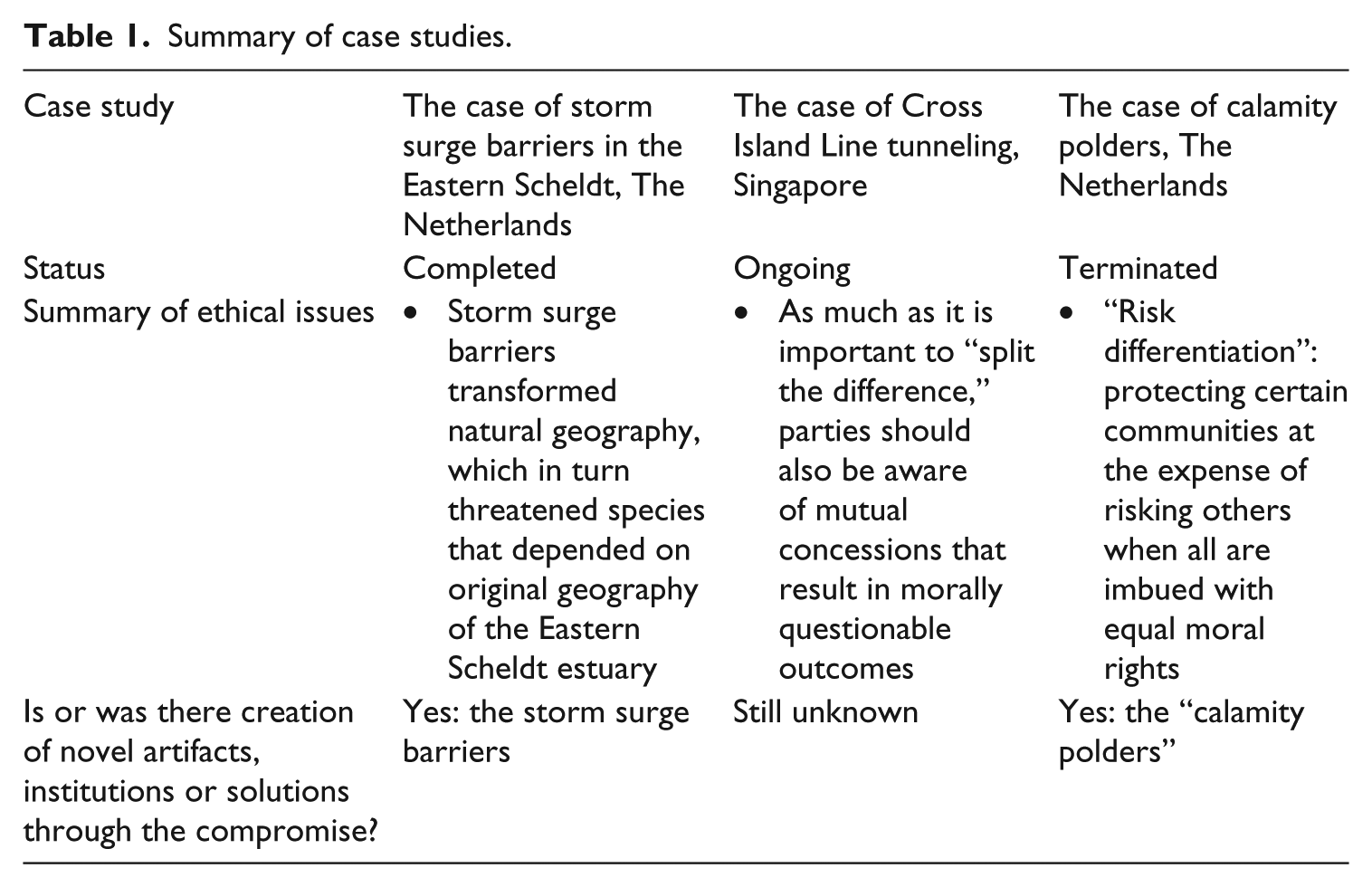
To do this, we will draw out instances of compromise in planning by examining three concise but concrete case studies in urban planning (see Table 1).
Summary of case studies.
But because these case studies are more like maieutic illustrations that can help us to better describe and then draw out the implications of a compromise, none will be rendered comprehensively or replete with fine-grained details usually found in other planning case studies. Instead, these cases are more like detailed illustrations that were carefully selected and strategically sequenced to facilitate a discussion on the ethical compromise. For these reasons, we have selected these specific cases not only based on the extent of how each is able to inform the overall discussion on the ethical compromise but also how, as the sum of three cases taken together, they further illustrate a spectrum of possible compromises found in planning conflicts.
Storm surge barriers in the Eastern Scheldt, The Netherlands: a case on the integrative compromise
Following Follett (1973), Carens (1979), and more recently Besson (2005), we suggest that there are two broad ideal types of compromises. The first type is the integrative compromise, and the second is the distributive compromise. While the latter could be considered as the proverbial compromise—where conflicting parties share in some gains and losses by “splitting the difference” (Benjamin, 1990; Besson, 2005)—the former aims at “narrowing the difference.” In an integrative compromise, conflicting parties are characterized more by a cooperative rather than by a competitive spirit. Instead of solely focusing on their differences, conflicting parties also search for what is in their common interest. In this way, conflicting parties tend to adopt a problem-solving disposition instead of an exploitative one (Carens, 1979: 127). And the integrative compromise, once attained, tends to result in either a new understanding of an issue (Besson, 2005: 261) or the invention of a new option (Follett, 1973: 3). Theoretically at its most successful, an integrative compromise should not be regarded as a compromise at all—only because all differences have been integrated and no concession has been demanded on any one party (Follett, 1973). And at its most perfect, such an integration is akin to a “win-win” solution and can further produce a common good (Mansbridge, 2006: 121). But empirically, new options, plans or artifacts created in the form of an integrative compromise tend to also bring about unanticipated and often undesirable consequences (Beck, 1992), which, in turn, can open up new frontiers of conflict. Admittedly, an integrative compromise is valuable. Nonetheless, it is still subjected to the realities of the “wicked problem” (Rittel and Webber, 1973) found in many urban planning issues and, therefore, vulnerable to further uncertainties and unpredictable side- and after-effects.
To further visualize these characteristics and implications of the integrative compromise, we now review the case of the storm surge barriers in the Eastern Scheldt (henceforth referred to as E.S.) in the Netherlands (see Van de Poel, 1998, 2015). The E.S. is an estuary in the delta area in the southwest of the Netherlands. A calamitous flood in 1953, which killed more than 1800 people, resulted in the drawing up of the Delta plan to prevent future recurrence of such a disaster. Essentially a flood disaster plan, the Delta plan then entailed either reinforcing the dikes in the area or to close off several main tidal inlets using coastal barriers (Van de Poel, 1998: 182). In terms of the costs and the required time for construction, reinforcing dikes and closing off the E.S. by coastal barriers were essentially comparable options.
However, each option entailed very different side- and after-effects. On one hand, because the key planning criterion was safety (Van de Poel, 1998: 183–184), and because dikes could neither be raised forever (Roth and Warner, 2009: 548) nor represented the safest option (Van de Poel, 2015: 94), reinforcing dikes was not seriously entertained. On the other hand, building a coastal barrier across the E.S. was technically more difficult and riskier—it was after all nearly 8 km in length—but once built, it would be considered the safest option (Van de Poel, 2015: 94), and also easier to maintain and strengthen (Van de Poel, 1998). Furthermore, this barrier has the added benefit of stopping erosion and desalinating the E.S., which then conferred a further advantage for agricultural production in the area (Van de Poel, 1998: 182). However, the same desalination would impact the livelihoods of fishermen and the nearby mussel and oyster production (Van de Poel, 1998: 184). Subsequently, it was also recognized that closing the E.S was essentially symmetrical to damming up this estuary and would lead to “the loss of a piece of ecologically unique nature” (Van de Poel, 1998: 184). This recognition of potential and great ecological loss then became the focal point of conflict against closing off the E.S. using a coastal barrier. From this point onwards, the conflict intensified between the planners, who largely advocated for the closure of E.S., and the fishermen, the environmentalists and their advocates, who argued against this closure.
In June 1972, a plan for an innovative storm surge barrier was proposed by a group of students from Civil Engineering and Architecture of the Technical University of Delft and students from Landscape Architecture at the Agricultural University of Wageningen, which was also later adopted (Van de Poel, 2015: 93–94). This storm surge barrier is essentially a semipermeable barrier (Van de Poel, 1998: 186), which normally would be opened to allow water flow but could be closed if a flood threatened the hinterland (Van de Poel, 2015: 94). Because of this “creative compromise” (Van de Poel, 2015: 94), differences between those who opposed the closure of the E.S. and those who proposed the coastal barrier were resolved. Specifically, the storm surge barrier as the new option “integrated” the differences between those who required an open E.S. for their livelihoods and those committed to environmental values (i.e. fishermen and stakeholders in the mussel and oyster production, and environmentalists and their supporters) with those who preferred closing the E.S. as a means to safety (i.e. planners and engineers). It is also possible to say that this new option resolved the conflict because it was depicted as the most moderate option in terms of safety and ecological impact when measured against the low safety and low ecological impact of the dike systems and the high safety and high ecological impact of the coastal barrier system (Van de Poel, 2015: 94).
Do the storm surge barriers for the E.S. then represent a case of an integrative compromise? To the extent that the most significant differences between the proponents and the opponents on the closure of the E.S. were resolved, this is in our estimation an indisputable case of “integrated differences.” But to the extent that the storm surge barriers were the most moderate trade-off between safety and ecological impact, on one hand, and also transformed the original geography from a turbid estuary into a tidal bay, on the other hand (Van de Poel, 1998: 195)—which entailed unknowable ecological losses—the storm surge barriers have to be seen as a compromise. For instance, because of these storm surge barriers, it is anticipated that the intertidal flats in the E.S. will continue to decline by more than 45% in the next 30 years (Van de Poel, 1998: 195). Intertidal flats are highly productive ecosystems; not only are they integral to the complex estuarine food webs, they are also habitats for large numbers of invertebrates and fish (see Smithsonian Marine Station at Fort Pierce, 2016). A significant 45% decline in the intertidal flats then is very likely to result in substantial losses of the complex ecosystems associated with the intertidal habitats. In other words, while the original conflict was resolved, this resolution came at the expense of exacting an eventual and not insignificant ecological toll on the overall ecology of the E.S. For this reason, the case of the storm surge barriers ought to be more than just a “creative compromise”; it is, following this recognition of a likely ecological toll, also an integrative compromise.
Even so, the efficacy of this integrative compromise is unmistakable. As discussed earlier, an integrative compromise could be considered as the most positive form of compromise. If so, then planners who deem an integrative compromise feasible in an institutional context that further defines it as legal may want to ask, “How ought planners structure the process of conflict resolution such that it is more likely—rather than less likely—to result in an integrative compromise?” Or in other words, what are the planning circumstances highly correlated to the emergence of an integrative compromise? To say the least, these are two important questions for any discourse on the ethical compromise. Where an integrative compromise not only fulfills the basic criteria of legality but also matches the aspirations found in the planner’s own code of ethics (see Brooks, 2002: 76; Weitz, 2015: 113), there is no immediate reason for an ethical planner to refuse this compromise.
To address these questions, evidence shows that the pivotal point in the conflict resolution was contingent on the emergence of the new option (i.e. the storm surge barrier). But this new option, which emerged in 1972—nearly 20 years after the calamitous flood of 1953—could not have emerged if not for this long germination period, which allowed for evolutionary ideas to permeate the debate on what ought to be done. Based on this line of reasoning, one could conclude that time, which increased the probability for creative stakeholders to integrate differences, might at least be a plausible factor for the emergence of this integrative compromise. Yet recent cases also characterized by protracted conflicts—for instance, the Stuttgart 21 project (Gualini, 2015; Novy and Peters, 2012)—demonstrated that when unchecked, conflict can take on a life of its own, becoming a centrifugal force that then distorts the process of giving and testing reasons vital to conflict resolution (Aragaki, 2009: 433–434).
Here, in addition to the factor of time, we suggest that the protracted conflict on the E.S. was, however, moderated by the common interest already cemented after the calamitous flood of 1953. Despite diverging interests and value differences, all the stakeholders shared a common interest—tantamount to a form of solidarity—in ensuring that such a calamitous flood would never happen again. Evidence from the Netherlands indicates that people in a flood-threatened polder experience togetherness and solidarity (Baan and Klijn, 2004: 115). In other words, despite different positions on the means to attain safety (i.e. dike systems or coastal barriers), the paramount goal of safety was never a point of debate. This solidarity that prefaced the search for the most appropriate solution to safety then moderated a protracted conflict on what ought to be done. Incidentally, this protraction then afforded the necessary time for the germination of a good idea, which resulted in the bridging of major differences in this conflict. Based on this conjecture, we project that an integrative compromise is more plausible rather than less, when the planning conflict in question is highly correlated with cooperative goodwill and a willingness to seek out the common good. And thus insofar as fostering the conducive conditions for an integrative compromise is concerned, the ethical planner’s role may reside in deepening understanding, encouraging mutual learning and defining common grounds as much as possible in order to develop the necessary cooperative goodwill necessary for an integrative compromise.
Cross island line tunneling, Singapore: a (likely) case on the distributive compromise
In contrast to the integrative compromise, the distributive compromise is the proverbial compromise where conflicting parties, in order to resolve the conflict, share in some gains and losses or where they “split the difference” (Benjamin, 1990; Besson, 2005). To “split the difference” then presumes that irreducible differences remain in the conflict. Finding no way to resolve these differences, and rather than risking failure to reach an agreement, conflicting parties each take a share in some gains and losses by splitting the remaining differences. As expected, this outcome is hardly ideal and is only slightly more satisfactory than a failure to reach an agreement (Besson, 2005: 261). And because a distributive compromise operates by dividing up some share of gains and losses, it is more amenable to settle a conflict of interests rather than a conflict of principles (Bellamy, 1999: 103; Benjamin, 1990: 13; Gutmann and Thompson, 2012: 72).
But here, the ambivalence of the distributive compromise (Day, 1989: 471) cannot be more certain. On one hand, a distributive compromise has to presume the mutual willingness to sacrifice something in order to resolve the conflict. Yet because what was forsaken in the process is as important as what was gained (Goodin, 2012: 53), this willingness is never innocent—but tinged with a suspicion that …the conflict will come up again and again in some other form, for in compromise we give up part of our desire, and because we shall not be content to rest there, sometime we shall try to get the whole of our desire. (Follett, 1973: 6)
On the other hand, despite a distributive compromise, conflicting parties can continue to disagree on the reasonableness of this compromise and also on what constitutes the right compromise (Besson, 2005: 262–263). This intrinsic unsettledness behind what appears to be an ostensible settlement then begins to unravel the ambivalence of a distributive compromise.
To further discuss the distributive compromise, we situate this compromise in the case of the Cross Island Line (henceforth referred to as C.I.L.) project in Singapore. The C.I.L. represents a typical case of land-use dilemma commonly encountered in urban planning today, where developmental and conservation interests conflict. How should stakeholders define the balance between development and environmental conservation (Beatley, 1994)? And if neither extreme is plausible—and it usually is (Boyle, 1992)—then where should planners and stakeholders draw the balance, or a distributive compromise, between these extremes? Although both extremes are desired, it is usually not possible to have the best of both worlds—and a “balance or compromise” (Wang et al., 2016: 102) has to be sought. And as Beatley (1994: 261) suggests, the exact allocation of land to different uses and activities is fundamentally and inextricably a matter of ethics. Therefore, where the distributive compromise is forged between urban development and environmental conservation not only concerns an outcome of practical importance, but it is ineluctably also a decision imbued with moral significance.
The C.I.L. is a new MRT (Mass Rapid Transit) train line proposed in the small city-state of Singapore. Spanning from the western edge to the eastern tip of the city-state, the C.I.L. is the eighth line in the network of public rail transportation system. The C.I.L. is proposed to be about 50 km long and is expected to be completed in 2030 (LTA, 2016). And when completed, this new line will not only share the ridership load with the existing East–West Line but will also cut down traveling time for residents residing in major suburban towns of Ang Mo Kio and Pasir Ris (LTA, 2016).
However, for the C.I.L to span from the western edge to the eastern tip of the city-state, the line has few feasible options but to cut across—that is, going underneath in a straight line—the Central Catchment Natural Reserve (CCNR), which is located at the center of Singapore. Presently, gazetted natural reserves occupy a total of 3318 ha, which is slightly less than 5% of the land area of Singapore (Chandramohan, 2014). At about 2800 ha then, the CCNR represents the largest tract of natural reserves comprising both primary and secondary forests (Chandramohan, 2014); it also provides important ecosystem services such as water catchment and clean air (The Nature Society, 2013) and is home to an unparalleled range of biodiversity and habitats that cannot be found elsewhere (Goh, 2016). Because of the potential environmental impacts of this project, an Environmental Impact Assessment (EIA) report was prepared, which was also subsequently shared with the public in February 2016.
This EIA report indicates that there will be moderate impacts caused by the soil samples testing in the CCNR (Tan, 2016a). Because the C.I.L. will be built nearly 40 m underground, soil sample tests comprising a number of 10 cm wide boreholes up to 70 m deep have to be drilled every 15–20 m along the anticipated line of construction (Chandramohan, 2014). Beyond this immediate impact, the anticipated line where this testing will be conducted—that is also the planned trajectory of the C.I.L.—bisects the CCNR, which then can cause a continuous linear fragmentation of the forest that will likely lead to habitat losses and further forest fragmentation (The Nature Society, 2013: 5). Conceding to these possibilities, planners compromised by reducing the number of boreholes from 72 to 16 and also establishing 30 m of buffer zones around streams and marshes, which are deemed sensitive to anthropogenic impacts (Tan, 2016a). Despite these concessions, opponents of the original plan, which comprised members of the public as well as environmental groups, argued that the diminishment of impact does not equate to “zero-impact.” Furthermore, negative externalities—such as the discharge from drilling—can potentially pollute and harm the immediate environment and beyond (Tan, 2016a).
For these reasons, opponents of the original plan insisted on the stance of “zero-impact” on the CCNR (Tan, 2016a). In view of the risks of irreversible harm on an invaluable tract of natural heritage in Singapore, they instead advocated for a “skirting” plan (Goh, 2016): Instead of the C.I.L. cutting across underneath the CCNR in the original plan, it now skirts around the fringe of the CCNR. This “skirting” plan not only has the advantage of “zero-impact” on the CCNR, but the new rail line can also serve more people living near the CCNR, who otherwise would have limited access to the MRT system. Responding to this counter-proposal, planners, however, suggest that relative to the original plan, the “skirting” plan will cost $2B (Singapore dollars) more, add five more kilometers of rail tunneling and entail an additional 4 min of commuting time for the riders (Lim, 2016)—hardly insignificant costs to an already costly infrastructural project. And most drastic of all, because the “skirting” plan will interface with the urban fabric, land acquisition for this plan and disruption of nearby lives and businesses during construction will likely become inevitable (Goh, 2016). In light of this deadlock, no decision has yet been made for either plan, and a new EIA report is in the works (Tan, 2016b).
In our estimation, the case of C.I.L. represents a potential case of distributive compromise. Assuming that the C.I.L. will go ahead as planned, conflicting parties only have two stark options: a mitigated version of the original plan, where the environmental impacts are diminished as discussed, or the “skirting” plan, where “zero-impact” on the CCNR is presumed at the expense of incurring higher project cost and complications. On one hand, if conflicting parties go with the original plan, then moderate and potential harm to the CCNR has to be conceded. While this may appear only as a direct harm imposed on the non-human species and ecosystems within the CCNR, this harm in reality is likely to translate into some form of compromised ecosystem services, and the potential and irreversible loss of precious natural heritage—a hard-to-determined but probable cost to be exacted on every stakeholder in Singapore. On the other hand, if conflicting parties go with the “skirting” plan, then planners will face a no less daunting reality—one characterized by more complex engineering, coupled with a complicated process of land acquisitions, which in turn would entail new and protracted conflicts with home and business owners whose properties are being acquired for the project. This “skirting” plan will also likely impose increased taxation of some form on every stakeholder in Singapore in order to compensate for the additional project costs. Either way, certain concessions will be unavoidable. Short of dismissing the entire C.I.L. project, some kind of distributive compromises will have to be made.
And unlike the previous case where integrative compromise could be found, no foreseeable technological innovation is anticipated to integrate the pronounced differences here. This anticipation is cast into sharper relief by the realization that the natural environment and the ecologies embodied in the CCNR are indivisible entities—compromising one part is likely as good as harming the whole. While the definition of environmental harm is admittedly often ambiguous (Beatley, 1994: 56–57), certain ecological harms, once imposed, are, however, also irreversible (e.g. the decline of the intertidal flats in the previous case). Therefore, opponents of the original plan are not likely to view the CCNR as interests where compromises can be found; rather, they would view any risks and threats to the CCNR as an impossible compromise of their principles. Hence, if there are any compromises to be found, then they have to be found in some version of the “skirting” plan. Where a conflict of principles is concerned, but where a compromise has to be found to resolve the conflict, conflicting parties tend to look for other interests where compromises could be found (Benjamin, 1990). As discussed, such interests tend to reside in clearly calculable and readily monetized considerations, such as additional project costs, increased commuting time, reduced transportation efficiencies or contentious land acquisitions. While these interests are hardly uncomplicated ones, they are at least amenable to some kind of compromise.
Specifically then, how should one think about the ethical compromise here? As much as this case contextualizes the distributive compromise, it also reveals that no “win-win” settlement is possible for certain conflicts. To force a “win-win” settlement here by giving one party a less fragmented forest and the other party a less skirting line (or fewer land acquisitions) may be as good as a “lose-lose” settlement. As argued, there are certain entities in planning that are indivisible: They cannot be divided up in order to satisfy the distributive logic of a compromise. Just as there is no clear midpoint between the choice for a hydroelectric plant and a nuclear power plant (Susskind and Cruikshank, 1987), it is also not possible to “split the difference” here on the C.I.L. To do so would simultaneously contradict environmental ethics and possibly also developmental logic—resulting in a “lose-lose” settlement, where neither interest has been effectively served and where both parties lose their quintessential outcome just to make a perfunctory gain. Therefore, it is reasonable to suggest that any ethical compromise ought to first look out for the possibilities of planning tragedies embodied in these “lose-lose” settlements.
To say the least, this kind of “lose-lose” settlement violates the very consequentialist ethics that has to preface every compromise, especially when a compromise is seen as the only practical option left to resolve the conflict. In view of this pitfall, making an ethical compromise here also means agreeing to a deontological recognition and definition on what should not be compromised (Margalit, 2010)—in this case, the CCNR. And from here, to seek out areas or interests where compromises could be found. On this point, all fruitful negotiations begin by highlighting what is possible and fencing off what cannot be consensually dealt with (Gualini, 2015: 190). Therefore, there is no contradiction between establishing what is non-negotiable first and trying to attain a fruitful and constructive negotiation. But how would one know what these deontological principles are pertaining to what should not be compromised? Specifically in this case, what cannot be amended by either reparation or restitution (Schweitzer, 2016)—assuming that ecological restoration is not a real option (see Katz, 2012)—ought to be considered principles that indicate what should not be compromised.
Calamity polders, The Netherlands: a case of compromise as exposing others to harm and risk
Existing discussions on the integrative compromise and the distributive compromise rarely invoke the other meaning of compromise as “to risk having a harmful effect on something.” This is because it is possible to forge a compromise—integrative or distributive—without necessarily compromising the safety or well-being of people and non-human species. While this is true, the aforementioned cases, however, suggest that a compromise can lead to planning outcomes that are either undesired or wholly undesirable. Insofar as the case of the storm surge barriers is concerned, the conflict was resolved by an integrative compromise; yet what emerged was not merely a resolution but also a transformed geography characterized by certain losses. And while the actual outcomes for the C.I.L. remain uncertain, it is, however, certain that short of dismissing the entire project, either the CCNR will be compromised or the immediate welfare of the home and business owners threatened for some version of the “skirting” plan. In these instances, a compromise as “to risk having a harmful effect on something” becomes salient: What if, to resolve a conflict, some people or entities have to be unwittingly harmed? Because subjecting someone or something—expectedly but unwittingly—to potential harm in order to attain certain planning outcomes is a perennial issue in planning ethics (Bolan, 1983), a careful study on this third notion of “compromise” is warranted.
We suggest that this third notion of “compromise” comes close to what Margalit (2010) refers to as “rotten compromises”: compromises that are used to maintain or establish an inhuman regime, a regime of cruelty and humiliation, or a regime that does not treat humans as humans (Margalit, 2010: 2). While we will not go as far as Margalit (2010) in referring to “rotten compromises” this way, there are, however, planning compromises that would risk the safety or well-being of human beings imbue with equal moral rights, in order to attain certain planning outcomes. As a matter of fact, all urban planning projects are unavoidably characterized by some degree of “distributive asymmetry” (Pucci, 2015: 238). For instance, a shopping mall, or a courthouse complex for that matter, tends to benefit a larger group of constituents, while the most proximate group—those who live or work nearby—tends to bear the costs in the form of crowding, pollution or risks associated with securitized facilities (see Pacchi and Pasqui, 2015). And no matter how resourceful a planner is, spatial adjacencies of the project to neighboring properties tend to be also asymmetrical. Using the same example again, being greeted by the open entrance of a shopping mall or a courthouse complex is diametrically different from being saddled against their service or securitized backlots. And so where planning projects subject certain groups to the less desirable end of any distributive asymmetry, it is also possible to perceive planning approximating a compromise as “to risk having a harmful effect on something.”
To cast this notion into sharper relief, we rely on the more drastic case of calamity polders in the Netherlands (Baan and Klijn, 2004; Neuvel and van der Knaap, 2010; Roth and Warner, 2009). The idea for the calamity polders surfaced in 2000 as an option for emergency-controlled flooding (Roth and Warner, 2009: 546). Essentially, calamity polders are basin-scale, spatial measures for flood risk management (Neuvel and van der Knaap, 2010). Usually found upstream in low-lying land adjacent to major rivers, calamity polders are engineered for controlled flooding to protect downstream polders from accidental or uncontrolled flooding (Baan and Klijn, 2004). Essentially justified on the grounds of climate change and also the physical limitations of flood control infrastructures (e.g. diking), flood risk can neither be reduced to zero nor all residual risk eliminated (Roth and Warner, 2009). In the event of a larger-than-anticipated flooding, the calamity polders will then serve the role of a “safety valve” (Roth and Warner, 2009: 546), akin to an engineering redundancy (Landau, 1969), offering planners still some recourse to limit the risks of uncontrolled flooding in downstream, densely populated communities with high economic value such as Rotterdam. In other words, the idea of the calamity polders is one predicated on “risk differentiation” (Roth and Warner, 2009: 557)—where the welfare of people in Rotterdam can be justifiably protected at the expense of those living in the assigned calamity polders when once, all enjoyed equal protection. In the context of our discussion, the calamity polders therefore are intentional plans to compromise—that is, “to risk having a harmful effect on something”—the welfare of certain groups in order to attain the planning outcome of risk reduction for others.
Expectedly, this idea was not warmly received especially by stakeholders living in, or near to, the proposed calamity polders (see Baan and Klijn, 2004; Roth and Warner, 2009). Immediately, affected stakeholders wondered if their lives and goods are worth less than those living in Rotterdam (Roth and Warner, 2009: 560). In a study of Ooijpolder, an assigned calamity polder, residents were documented as showing signs of worry, suspicion, and fear—finding the very idea of a controlled and deliberate inundation by human hands more disquieting than uncontrolled and “natural” flooding (Baan and Klijn, 2004: 118). Beyond these immediate impacts on their psychology, there are also anticipated but undesirable socio-spatial consequences of being assigned as a calamity polder. Neighbors and friends, propelled by fear and expected changes in the landscape (e.g. high dikes and civil construction work), may move away; this may then lead to a dive in property values, which in turn will drive away future development or investments in the area (Baan and Klijn, 2004: 118). And all these are even before one considers the aftermath of a controlled flooding, which is expectedly more probable for calamity polders than other polders (Baan and Klijn, 2004: 118). From nuisances of mud to polluted sediments and many other social disruptions, stakeholders of an assigned calamity polder will face daunting challenges not faced by residents in other communities. Furthermore, recent research indicates that basin-scale management, such as the calamity polders, addresses neither pluvial flooding nor the eventuality of fluvial flooding in downstream urban areas (Liao et al., 2016). If so, then all these beg the question if the calamity polders—despite its status as a compromise that at least attains certain planning outcomes—can even work in light of the many moral and scientific doubts raised by this idea.
On this, one then wonders what ethics could justify the compromise of the calamity polders. As discussed, the calamity polders were justified on the logic of risk differentiation, which assigned different risk values to different communities. Communities that are deemed exposed to higher risk would then be protected at the expense of communities assigned a lower risk. Not incidentally however, communities exposed to higher risk are also densely populated urban centers with higher economic value (e.g. Rotterdam). Therefore, is this then merely a calculus predicated on a utilitarian approach to justice (Sandel, 2009)—where people with more ought to be protected at the expense of those with less? Or to put this in another way, that the compromise could be justified by maximizing welfare (i.e. measured in monetary terms), and hence also the just thing to do? Or ought the compromise be justified by the principle of double effect, where foreseen but unintended evil or harm in the pursuit of a good end is permissible (Dundon, 2010)? But can public planners in this case, who are ultimately responsible for flood safety for everyone in the Netherlands, ever—conscientiously—concede to the principle of double effect in their professional standing? Does this not then undermine the goal of flood protection for all by presuming the precondition of first compromising others?
Because not everything that is right is just and not everything that is wrong is unjust (Frankena, 1973: 46), doing the right thing here cannot solely rely on an appeal to justice. Where a planning decision immediately involves the welfare or well-being of people, the good has to be considered prior to the right. To first conceive a plan that presumes an unequivocal compromise on the welfare of a certain group and then subsequently to justify the legitimacy of this compromise on justice is committing two errors in ethical judgement at once: Not only do the calamity polders offend moral intuitions pertaining to human rights, but more so to the point, some actions, despite being just, are plainly wrong (e.g. the apocryphal story of cutting a baby into two equal parts to satisfy a pair of contesting mothers). In this case of calamity polders, we therefore find little support for justifying this plan as an “ethical compromise.” By the same token, an ethical compromise must reject certain concessions deemed to be inhumane—which in this case is exposing a certain population to foreseen harm.
Conclusion: limitations and future work
In this article, we offered a focused but systematic discussion on the ethical compromise by relying on three concise cases. Specifically, each case illustrated one ideal type of compromise and its ethical implications for planning. And when taken together, these three cases not only provide a spectrum of compromises found in planning conflicts but also paint a higher resolution picture of compromise as a form of conflict resolution. In doing so, this begins to address the knowledge gap on compromise in planning theory.
Importantly, our study also establishes the primacy of ethics in planning compromises. If our arguments are sound, then the ethical disposition is in fact pivotal to a systemic reconsideration and reintegration of compromise in planning theory. And if these three cases are any indication of the precarious stakes and moral oversights (and pitfalls) present in any compromise, then they also reveal the urgent need for theorists and practitioners alike to further study compromise as a frequently invoked settlement in planning, and simultaneously, to reinvigorate the anemic state of planning ethics today.
Nonetheless, our account in this article remains limited due to the small sample of ideal-type compromises examined. Even so, this limited study suggests that different types of compromise appear to engender different ethical issues and prospects, which in turn behooves different planning responses. Specifically, special care and scrutiny are necessary for the novel artifact or institution invented as the integrative compromise. In turn, a distributive compromise necessitates a cautious avoidance of “lose-lose,” tragic settlements, which may satisfy the fair principle of “splitting the difference” but, however, expose all parties to real losses. And in contradistinction to these two types of compromise, the type of compromise that “risked having a harmful effect on something” is most insidious: not ostensibly because this compromise tends to sanction foreseeable but unwitting harm, but primarily also because it is able to justify this harm based on some anticipated, but ultimately uncertain, good outcomes.
Here, we return to discuss the conceptual assumptions made in pursuing this study on compromise. Importantly, we refer to these assumptions as “situational factors” of compromise that we have either ignored or have held constant. In other words, these “situational factors” are also variables and hypotheses that are better specified and studied in empirical research rather than through our analytical case study method. In all, they also suggest directions for further work in this subject area. They are, namely, (1) complexity of a compromise, (2) personal and institutional role ethics of planners, (3) possibility of no compromise, and, finally, (4) changefulness of a compromise. We will, in turn, discuss each briefly.
First, while our case studies appear to present a compromise—or the ethical compromise for that matter—as a rather straightforward affair, we acknowledge that like any other form of planning settlements, a compromise is a complex settlement hardly innocent of the Realrationalität found in the Realpolitik (Flyvbjerg, 2002) of planning. Planners often have to work out deals with private and commercial interests when they deem the benefits conferred by these deals to be greater than stodgy adherence to principles (Margalit, 2009: 52). And like the artificial consensus (Brand and Gaffikin, 2007: 304), compromises can be similarly invoked for the pragmatic purpose of presenting an accord to the public when there is in fact none in place.
Beyond the realities of power or Realrationalität, a compromise is likely the outcome of negotiation with many different parties all armed with their own varying bargaining powers. In our account, we have at most depicted a process comprising of two major conflicting parties. We suggest that this complexity of many actors, each armed with varying power all enmeshed within the Realpolitik of planning do complicate, if not directly obfuscate, the ethics of compromise. For example, the question of responsibility becomes highly attenuated by the reality of “many hands” (Thompson, 2004)—where it becomes challenging, if not implausible, to locate the burden of responsibility in any sufficiently complex compromise. This said, we do not think that this acknowledgment on complexity, while true, completely invalidates our study. After all and despite complexity, the ethical compromise has been argued as a kind of compromise that is unwilling to violate certain moral precepts integral to the planning institution in any liberal democracy.
Second, a planner’s own ethical leanings, as the institutions planners work in, can moderate the planner’s own role ethics (Healey, 1991; Howe and Kaufman, 1979; Innes, 1995; Upton, 2002). These factors are likely to moderate the decision to compromise and also the nature of the compromise. This is because ethics and institutions are inseparable (Innes, 1995: 187). All three of our case studies involve planners working in the public sector and who have to concede to some form of public interest—however, broadly this is defined (see Howe, 1994: 320). In our study, we neither probe into the different specific roles that planners can take on in practice, for example, as a bureaucrat, reformer or analyst (see Healey, 1991), nor the different ethical values that planners subscribe to in each role on different issues (Howe and Kaufman, 1979, 1981). Future work in this area may then comprise of studying the correlation of a planner’s moderated ethical position to the type of compromise this position can elicit.
Clearly, the planner’s moderated ethical position matters. For example, on the issue of siting a new hazardous waste plant, a planner inclined to probabilistic thinking and who is further sanctioned by a utilitarian institutional climate is more likely to establish a level where certain risks could be neglected relative to the probability of sacrificing human lives (Basta, 2014)—effectively a risk compromise between probable human lives lost and the expected benefits reaped by this plant. Conversely, a planner inclined to thinking that no benefit is worth losses in human lives and who is further encouraged by an organization that prizes ethical reasoning is less likely to admit to a compromise on this same issue. However, we suggest that the planner’s moderated ethical position is an important variable better addressed by empirical research rather than for our conceptual analysis to second guess. Nevertheless, our case studies do reveal that despite the ambivalence of ethics in a compromise, there are certain compromises that should not be made in spite of any moderation on the part of either the planner’s own ethical leanings or her institutional norms.
Third, while our case studies appear to argue that there is some traction toward a compromise, however in practice, conflicting parties frequently do not come to any compromise for several reasons. A common reason is the rationalization that the longer one defers from forging a compromise, the greater the plausible gains (Gutmann and Thompson, 2012). Another reason is due to the fear of making a compromise (Gutmann and Thompson, 2012): believing that one compromise would uncontrollably slide into successive ones. These two insights appear to converge well with the status of the C.I.L. at the time of writing. Furthermore, there are conflicts that are not amenable to a compromise. Rapoport (1974) suggests that the conflict between slaves and institutions of slavery cannot be resolved by a compromise, where making the lives of slaves better would not only make matters worse but also quite beside the point. In the end, it took the complete abolishment of these institutions to resolve the conflict. In the case studies on C.I.L. and the calamity polders, we demonstrate that there are contentions not amenable to a compromise. Neither the CCNR could be “cut-up” nor should the welfare of those living in these calamity polders be compromised. Following this, we suggest that to force a compromise on these issues—either by dividing up the gains and losses or to concede to something akin to a “rotten compromise”—implies the likelihood of a “lose-lose” settlement and inhumane consequences, respectively. For these reasons, it is therefore important neither to assume that a compromise is always possible nor that it is the panacea applicable for all types of conflict.
Finally, the process of any sufficiently complex conflict resolution is changefully dynamic. But to discuss compromise as we have done, we had to arrest the phenomenon and assume some constancy in this process. On this, Besson (2005) offers an account of how conflicting parties that started on the process of seeking a compromise ended up being dissatisfied with just a compromise. Through mutual learning and the rapport that ensued, conflicting parties ended up agreeing that a compromise was sub-optimal for their conflict, and this in turn spurred organized efforts to seek out something better. In other words, what started out as seeking a compromise ended up closer to an aspiring consensus process. In our case study on the storm surge barriers in E.S., we acknowledged this possibility in the process of conflict resolution. But what we did not notice, at least from this case, is how an initial agreement for a compromise ended up exceeding itself in ways that could not be anticipated beforehand. Even here, we suggest that a commitment to an ethical compromise rather than a morally ambiguous one—or worse, one that is only about deal-making—has all the likely bearings of becoming something greater.
Despite these limitations, the ethical compromise is important in planning not only because it represents a practical recourse of the last resort but also because of what an ethical compromise can reveal. In this article, we have shown a limited glimpse of how a discourse on the ethical compromise could add to planning theory and planning ethics. Sanyal (2002) suggests that in compromising, moral boundaries are revealed. Similarly, Margalit (2010) argues that one is judged by the compromises made rather than by ideals kept, only if because compromises reveal who the person actually is. In these ways, knowing more about an ethical compromise in planning is fundamentally also a way of reflecting on what planning is willing to commit to and what planning is unwilling to do.
Footnotes
Acknowledgements
We thank the anonymous reviewers for their many valuable comments and suggestions that have greatly helped us in the writing of this paper.
Funding
The author(s) received no financial support for the research, authorship, and/or publication of this article.