



Abstract
Urban regeneration and its implications for issues such as housing, gentrification, and homeownership have been researched by numerous theorists, practitioners, and policy makers. However, this article challenges the perception that urban regeneration is primarily a policy driver that leads to the displacement of residents, and by proposing an investigation of how urban regeneration also constitutes an opportunity for homeowners to achieve ‘In-Place Social Mobility’ (IPSM) – that is, social mobility without leaving their homes and neighborhoods. At a time when the welfare and social service system is weakening, residential property values are increasing, and wages remain stagnant, individuals must turn their homes into investment assets in order to increase their social opportunities. Following the Planning Deal and the Regeneration Deal, the interpretative scheme of the ‘Social Deal’ incorporates two fields: the city as a growth machine, and the social mobility of the homeowners. Through the theoretical demonstration of the notion of IPSM through urban regeneration in Israel, we propose the Social Deal as a new way of understanding the rent gap discussion – i.e., not only as a result of the cultural preferences of consumers on the one hand, or of real estate developers and market supply on the other hand, but also as a means to the self-profit of the residents.
Introduction
It is a fundamental sociological insight that class structure is a product of the market situation (Weber, 2018 [1946]: 40). Because we live in an era in which markets, more than anything else, shape cities (Bertaud, 2018), we propose examining how the market’s functioning in the city serves to re-shape class structure. From the perspective of urban sociology, the moment that housing became real estate – that is, a consumer product traded on the market (Allen, 2008) – class situation (also) became a function of the housing market. The present study addresses the sociological implications of urban regeneration programs, primarily when aimed at the renewal of housing, as a specific mechanism within the contemporary urban housing market. The research literature tends to view the social effects of urban regeneration as negative and to highlight two interrelated phenomena: displacement and gentrification (Hirsh, Eizenberg, & Jabareen, 2020). In contrast, we propose understanding the advancement of urban regeneration programs in countries with high apartment-ownership rates, where regeneration is synonymous with housing renewal, such as Israel, as a new stage of the Social Deal and show how it can be understood as an opportunity for In-Place Social Mobility (IPSM).
The study of urban regeneration in the realm of housing can be read using the genealogy of the concept of ‘the deal’– from the Planning Deal to the Regeneration Deal, to what we refer to as the Social Deal. We propose viewing the genealogical development of the concept of the ‘deal’ as a means of understanding the role of the actors within the system of urban regeneration. This concept focuses discussion on the written and unwritten contracts that emerge between the forces on the ground. Every stage of this research history highlights an aspect of the relations among local governments, developers, and homeowners (Figure 1). Theoretical route to urban regeneration using the concept of the ‘deal’.
The notion of the Social Deal reflects the negotiation between the power structure (local governments) and active agents (homeowners). The power structure is addressed in the discussion of the city ‘as a growth machine’ (Logan & Molotch, 2007) and the social arrangements that lead to housing commodification. The active aspect of homeowners as agents is addressed in the discussion on social mobility, a dynamic that could lead to class-related change on the individual level. The Social Deal allows for further elaboration of the rent gap discussion by linking both the explanation of the costumer’s preferences in urban demographic trends (Ley, 1986) and the concept of market supply and profit seeking by real estate developers (Smith, 1979) to the resident’s self-profit, with the private domicile functioning as an economic investment.
Several socioeconomic developments over the past decade have intensified the phenomenon of the Social Deal. On the one hand, longer life expectancies impact pensions and public welfare resources, as governments cut expenditures on public social services. On the other hand, we note a steady increase in the value of residential properties in developing economies in terms of income generation (Chapple, 2017), as well as a drop in housing ownership rates, especially among the younger generation (Lindley & McIntosh, 2019). Consequently, the urban regeneration of the twenty-first century takes place within the framework of the asset-based welfare system (Doling & Ronald, 2010; Kemeny, 2005), in which a home is not only a home but also an economic project (Forrest & Hirayama, 2015; Smith, 2015) that can constitute a pension, a source of income, or a future inheritance.
Social mobility is a familiar sociological concept pertaining to movement within a system of social stratification. The research reflects an abundance of empirical evidence documenting the intergenerational transmission of movable assets such as income, social class, and educational qualifications (Blanden, 2013). However, we focus on the relationship between social mobility and residential real estate – that is to say, on the phenomenon of home ownership (Hochstenbach, 2018; Lindley & McIntosh, 2019). We claim that for owners, urban regeneration offers the opportunity to achieve social mobility while remaining in their own homes. In this case, we consider the possibility of IPSM – social mobility that is achieved by apartment residents who retain possession of their existing apartment as opposed to moving elsewhere. Such a situation, in which one can both ‘advance’ and stay in place, constitutes a fascinating topic of research in the dynamics of urban class structure. We lay out this view in the context of theoretical observation of urban regeneration in Israel.
In recent years in Israel, urban regeneration has been promoted as a way of dealing with expected population growth and the shortage of land by destroying old buildings in old neighborhoods (Hananel, 2010). Government programs assign planning rights to attract private developers, enlarge the buildings, and provide new apartments while avoiding the need to allocate public funds (Geva & Rosen, 2018). Since urban regeneration is geared primarily toward housing renewal, it is based on private contractual agreements between homeowners and developers. The owners decide whether or not to move forward with the regeneration of their property and to sign a deal with a developer, with the aim of receiving new and larger housing units at a developed site at no extra cost (Geva & Rosen, 2021). As a result, they are party to upgrading their apartment and its surroundings and to its increase in value. They use the rent gap of their own homes to improve their opportunities for upward social mobility without relocating. Our study directed our attention to the theoretical research to understand how it could be significant, especially for homeowners in disadvantaged neighborhoods with few other options for improving their living conditions.
Before continuing, we offer two comments. The first pertains to the gap between apartment owners and renters (Kainer Persov & Carmon, 2020). The academic research indicates that it is renters who suffer immediate harm during urban regeneration. However, the context requires research within a ‘split housing market’ characterized by a fundamental class division between owners and renters (Swirski & Hoffmann-Dishon, 2016), which dictates the need for separate and distinct studies on these two groups. Therefore, although the present study concentrates on homeowners, we note that we are aware of the different outcome experienced by renters. The second comment pertains to the gap between periphery and center. A coalition of private-sector-based urban regeneration development creates a situation in which urban regeneration constitutes an effective tool for continued development in metropolitan cores but fails to do so in the periphery (Margalit & Mualam, 2020). Although our research question does not deny this gap, we choose not to focus on it here.
With this in mind, the following section presents a conceptualization of a theoretical trajectory for urban redevelopment using the concept of ‘the deal’, showing how the Social Deal builds on previous conceptions (or ‘deals’) of urban regeneration and using this notion to examine the relationship between the housing market and class structure as manifested on two scales: that of the urban growth machine and that of residential mobility. We then advance the contention that IPSM is occurring during housing regeneration in an Israeli city near Tel Aviv and highlight its contribution to the theoretical discussion of the rent gap. Finally, we conclude by summarizing the argument and discussing the theoretical framework’s potential to influence policy and practice in the field.
The concept of the Social Deal
The Planning Deal
Urban regeneration as a product of government policy and intervention has been a familiar practice in the past century. Its roots lie in European countries, where it functioned as a means of contending with the destruction caused by World War II (Kainer Persov, 2017). In cities in the United States, its use began in the 1940s as part of the urban renewal project, which included the demolition of residential areas. The project was heavily criticized for frequently displacing disadvantaged communities (Goetz, 2013). In light of this criticism, the urban regeneration of the 1960s and 1970s consisted of neighborhood rehabilitation based on an inclusive approach, with an emphasis on social problems (Carmon, 1999).
However, from the 1980s onward, a neoliberal slant began to take hold in urban regeneration policies, with an approach similar to that of business management. This approach emerged from a conviction that the private sector would provide a better solution for the needs of housing and development in cities than government plans. Urban economic development was advanced through Public-Private Partnership (PPP) (McCarthy, 2007). In this way, the market assumed responsibility for the planning, financing, and implementation of renewal on urban land with the potential for high profit, which is typically inhabited by disadvantaged residents. In other words, the task of dealing with long-standing social and physical problems in enclaves of urban neglect (Harvey, 2005; Lord & Tewdwr-Jones, 2014; Sager, 2011) and at public housing sites (August & Walks, 2017; Elliott-Cooper, Hubbard, & Lees, 2020) was entrusted to the private market (August & Walks, 2017; Carmon, 1999). This was done by maximizing the market value of lower-value neighborhoods and attracting private investments and homeowners (Verhage, 2005).
In the absence of proven demand for new expensive buildings and the involvement of many different actors (De Sousa, 2000), private sector elements regard urban regeneration sites in the centers of derelict cities as areas of risk and uncertainty. Therefore, regeneration in city centers typically requires some kind of government involvement intended to stimulate market activity through incentives (Adair, Berry, & McGreal, 2003). Public planning policy that promotes urban regeneration therefore deals primarily with overcoming supply limitations in the local economies, increasing the efficiency of the planning system, accelerating land acquisition processes, and using planning as a lever for restoring neglected sites to the land market (Healey, 1991; Imrie & Thomas, 1993).
This trend has accelerated since the 2008 mortgage crisis in the United States and the intensified financialization of complex real estate investments (Aalbers, 2017). Today, urban regeneration is considered to be a standard means of producing a new housing stock in city centers, while also improving public areas and infrastructure (Zheng, Shen, & Wang, 2014). The assumption fueling the public system is that the development of private property will lead to the revitalization of urban spaces (Hyra, 2012; Levine-Schnur & Ferdman, 2015; Rosen & Walks, 2015) and to increased demand for sites in the city center, and in so doing will improve the appearance of the city and the economic activity that occurs within it (Singhal, Berry, & McGreal, 2009).
The contractual framework that regulates PPP has been referred to as the ‘Planning Deal’ (Margalit & Alfasi, 2016; Rosen & Walks, 2015). This refers to the agreement between the local authority and developers, in which developers take upon themselves planning obligations – known also as linked development or community benefit agreements (Geva & Rosen, 2018) – such as expanded public planning or taxation undertakings in exchange for building rights. The architectural model used in these deals is meant to attract a wealthy population and encourage investments and is therefore typically directed at prestigious and exceptionally tall high-rise apartment buildings through the relaxation of provisions of the overall plans (Levine-Schnur & Ferdman, 2015; Margalit, 2013).
Development based on urban regeneration plans as part of Planning Deals has been a subject of substantial criticism. Numerous researchers have portrayed it as fragmented planning that does not effectively incorporate public needs (Alfasi, 2018), arguing that specific plans have become a common expression of neoliberal urban policy based on separate and individual decisions (Alfasi, 2006). Others have argued that such development does not amount to urban regeneration, which is supposed to include strategies for the development and creation of infrastructure in urban areas, as it results only in the regeneration of isolated residential sites and a hollowing of the goals of urban planning (Alexander, 2016; Margalit, 2014; Purcell, 2013). Others have considered the ethical and fair-minded aspects of this mode of allocation of land use rights as public goods (Levine-Schnur, 2018; Levine-Schnur & Ferdman, 2015).
The research has emphasized the disparity between the profit of developers and advantaged populations on the one hand, and the injury to disadvantaged low-income populations (De Oliver, 2016) on the other hand. Gentrification is understood as part of urban development, which aims to bring capital investment and members of the middle class back to the central parts of the city (Butler, 2007; Hackworth, 2002; Harris, 2008; Smith, 2002), through ‘creative destruction’ (Weber, 2002).
Smith (1979) holds that the important point for understanding gentrification is the mobility of capital and investments, not the mobility of people (Cocola-Gant, 2019). In this context, he proposed the ‘rent gap theory’, which maintains that the degree of attractiveness of investing capital in the development or redevelopment of a specific site depends on the depth of the gap between the potential land value and its current value. The moment that the rent gap is wide enough, urban regeneration begins and capital flows into the city centers (Mendes, 2018). Ley (Ley, 1986), on the other hand, argues that emphasis must be placed on the social and cultural processes in urban regeneration, including the decisive role of the needs of the individual, consumption, and demand (Liu, Chen, & Gu, 2019). Following him, theories pertaining to consumption have focused on the creation and the behavior of the middle classes and have asked questions such as: Who are the gentrifiers, and why are they focusing on central areas of the city (Cocola-Gant, 2019)?
From the perspective of the original resident, broad discussions has revolved around the wide-ranging elements of state-led gentrification (Aalbers, 2019; Lees & Ferreri, 2016) and the displacement caused by urban regeneration (Aalbers, 2017; Davidson, 2008; Ding, Hwang, & Divringi, 2016; Freeman & Braconi, 2004). While denouncing the negative impacts of displacement (Freeman & Braconi, 2004), some have called for caution and for using the neutral term ‘relocation’, in order to also examine positive effects of the government-assisted movement of population to residential neighborhoods that are not as poor (Carmon, 2013). Studies on gentrification show that this phenomenon assumes many different forms – direct and indirect, physical and economic (Zuk et al., 2015). Therefore, some scholars have emphasized the differences among the complex narratives stemming from different local contexts around the world (Ghertner, 2015; Maloutas, 2017; Mosselson, 2016).
The Regeneration Deal
In addition to the broad criticism of the social implications of urban regeneration, other voices raised in recent years have pointed to the relationship between the social aspects of urban regeneration and apartment ownership. This discourse can be found, for example, in the study of urban plans in East Asia, which are based on incentives to the residents holding formal possession (Sim, Lum, & Malone-Lee, 2002; Yang & Ley, 2019). Karaman (2014) refers to cost-benefit calculations in Turkey as a grassroots reaction to state-directed urban regeneration, while Roy calls it the ‘politics of compensation’ (Roy, 2009). In Israel, as well as in several other countries such as Singapore, Taiwan, and Chile, urban regeneration is geared toward large numbers of homeowners whose property rights are protected (Geva & Rosen, 2021). That is not to say that the studies on these sites ignore forced displacement and the injury suffered by the long-time population, but rather that they are focused on the unequal relationship between tenants and developers. This inequality, however, is related to the potential for economic gain from urban regeneration (Jou, Clark, & Chen, 2016; La Grange & Pretorius, 2016; Lai, Chau, & Cheung, 2018).
In the 1990s, the Israeli planning paradigm began to change as a result of the growing recognition of a shortage of land, population growth, and the impact of globalization and the structural change of the economy. The new doctrine gave priority to principles based on the market as metropolitan-focused growth over the old geopolitics, which focused on territorial control and a policy of population distribution (Charney, 2017). At the end of the 1990s, the government began to employ tracks to offer incentives and encouragement for entrepreneurial developers at declared sites through the addition of building rights (Kainer Persov & Carmon, 2020). This process marked the shift from state involvement to the neoliberal reliance on developers and market forces in urban regeneration (Charney, 2017; Feitelson, 2018; Friedman & Rosen, 2020). Added to the statutory toolbox in 2004 was a national outline plan (#38) for the protection of structures against earthquakes, which focuses on micro-entrepreneurial projects to strengthen and enlarge individual buildings that were built prior to 1980 (Margalit & Mualam, 2020).
Today, urban regeneration in Israel is conducted as a financial transaction between the developer and the private property owner (Kainer-Persov, 2021; Shamai & Hananel, 2021). In Israel, unlike other countries in which urban regeneration projects involve the collective sale of apartment rights to the developer, ownership remains in the hands of the private owners, and the added stories and residential units serve as a funding tool to incentivize regeneration for developers (Golan, 2019). A group of residents can enter into a contractual relationship with an entrepreneurial developer and together submit plans to demolish the old building and to replace it with a new, larger building, or to add additional stories to the existing building (Eizenberg, 2019). As a condition for submitting the plan during this process, the developers must reach a contractual agreement with the majority of the apartment owners, and ultimately with all of them, in order to begin construction (Geva & Rosen, 2018).
In this context, after examining the effects of urban regeneration plans on social fabric, Geva and Rosen (2019) conclude that the displacement of veteran residents does not occur with the same intensity at all sites, but rather depends on the site’s location in the real estate market and the property’s potential profitability. They (Geva & Rosen, 2018) conceptualize the term Regeneration Deal, which serves to examine the essence of the contractual agreement concluded between developers, who seek to minimize and manage the risks of a complex deal, and the many homeowners who take part in the project. The agreement, which exists only in the realm of private property, determines the conditions under which the developer acquires the land and the associated development rights from the current property owners. Prawer and Aharon-Gutman (2018) also propose a new usage of the term Planning Deal to better understand the economic nature of urban regeneration in the eyes of homeowners. They argue that homeowners and developers alike are using the national outline plan (#38) as an economic lever. According to their findings, the common interest underlying residents’ decision to reinforce their buildings against earthquakes is not the shared concern for safety, but rather the financial potential of the building’s renovation.
The Social Deal
As we have shown, the Planning Deal pertains to the system of remuneration between the municipality and the developers, whereas the Regeneration Deal, which suits the framework of urban regeneration in Israel and several other countries, focuses on contractual agreements and negotiation between developers and homeowners. As the next phase of the genealogical development of the concept of the ‘deal’, we highlight the changes in the relationship between the municipality and the homeowners.
The past few decades have witnessed a gradual erosion of the safety nets of the welfare state, and the accrual of private property has been given precedent (Aalbers & Christophers, 2014). The reduction of pensions and budget cuts in the funding of public needs have led to a system of asset-based welfare (Malpass, 2008) that has influenced both municipal governments and private individuals. From the perspective of the municipality, the absence of central government funding means that each city must tend to its own economic strength, and it does so by adopting a strategy of growth. From its perspective, private individuals are compelled to function within these power systems as active agents and to achieve social mobility using their residential property.
Instead of a welfare policy administered by the state as a safety net to contend with poverty, people today are, more than ever, being forced to assume responsibility for their own welfare needs; they do so by investing in financial products and real estate assets (Doling & Ronald, 2010; Malpass, 2008). In this light, the private asset has received new global meaning (Doling & Ronald, 2010) and is perceived as a commodification and framed in financial terms (Forrest & Hirayama, 2015; Madden & Marcuse, 2016).
In a period of global housing crisis and escalating social inequality in wealth and income (Savage et al., 2013), all parties have an interest in enacting the Social Deal, which therefore possesses broad sociological explanatory power that is characteristic of the issue of housing in many cities around the world. From this perspective, housing regeneration is a particular case of IPSM that reflects a strategy of action of homeowners in cities (Figure 2). From the concept of the Deal to IPSM.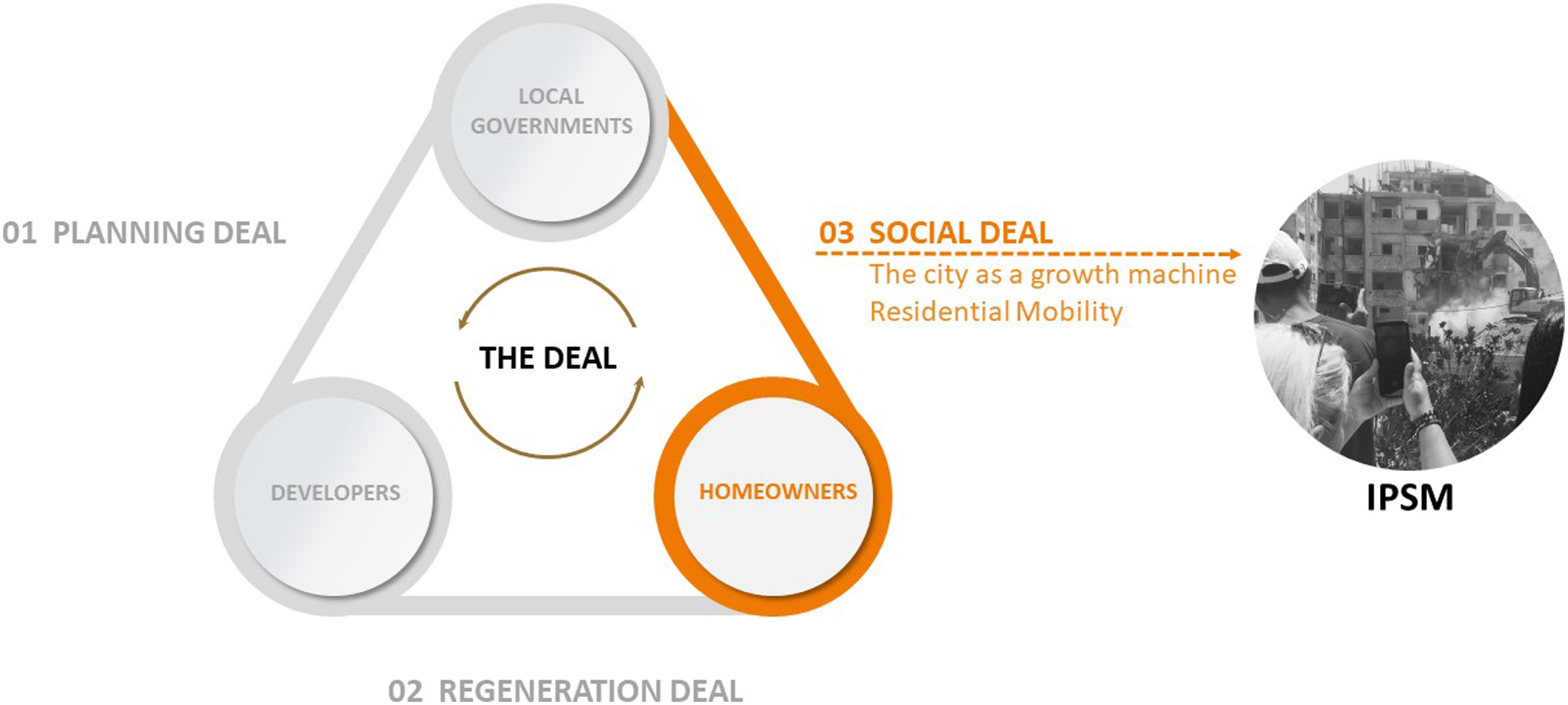
The city as a growth machine
Logan and Molotch’s (2007) familiar thesis regarding the ‘urban growth machine’ can explain urban governance in terms of land commodification. To this end, it puts those who aspire to maintain or increase their asset’s use value into inherent conflict with those with an interest in increasing its exchange value (Kim, 2018). The residents are defined as dealing with use values, which link together their non-economic needs, their desires, and their sense of connection to place and community (Harvey, 2006). On the other hand, entrepreneurs focus on the exchange value of the land and take action to encourage urban growth through intervention in the decision-making process (Rodgers, 2009), whereas the residents, who are interested in use value, are left with less influence. Ultimately, the motivations and the actions of the coalitions of growth shape the city in a manner that decreases use value and brings about growth that does not serve the public interest (Logan & Molotch, 2007).
In accordance with this dichotomous structural division, some scholars argue that the desire for apartment ownership, which involves taking out a mortgage, helps perpetuate the status quo. Apartment owners faithfully play their role in strengthening the housing market, whereas the economic and political forces receive much more of the profit from urban growth (Smith, 2015). To obscure this, the mechanisms of urban growth market redevelopment as a collective benefit and conceal the profit that accumulates in the hands of the few (Farahani, 2017; Smith & Floyd, 2013).
Jessop (2004) explains how capitalism, despite its many crises, regularly presents and defines itself anew as a hegemonic social system through social arrangements. In this way, the non-egalitarian models of urban development produce meaningful justification for their own existence by offering effective tools of compensation to relatively broad social layers (in parallel to the promotion of the elite’’s interests in its economic assets): ideological compensation (e.g., building preservation), spatial compensation (e.g., public areas or attainable housing), and economic compensation (e.g., high taxation funneled into the treasury) (Margalit, 2009).
However, urban regeneration involving multi-owner sites may suggest a dismantling of the dichotomy between use value and exchange value for homeowners, who can be found on both sides of the divide. If they live in their own apartment, they are interested in the use value and in increasing the quality of the apartment and the quality of the surroundings but are also motivated by a desire for increased value and maximized profit. In the same way, we can say that the apartment owners are the consumers of urban space but also take part in its production in order generate self-profit from the rent gap.
According to this line of thinking, urban regeneration makes ‘use’ of the belief that private property is a means of providing for welfare needs, a source of income, and a magnet for investment (Forrest & Hirayama, 2015). The ‘compensation’ or ‘arrangement’ stemming from urban regeneration – the Social Deal – lies in the private economic profit and the structure of opportunities for social mobility it ostensibly creates for apartment owners.
Residential Mobility
Social mobility pertains to the movement of an individual or a group from one level of resource control to another. It reflects the dynamic aspect of the stratified structure at the level of the individual. Intergenerational mobility compares the situation of the individual and that of his or her parents, and the range of mobility measures how far the individual has moved from the stratified location of his or her family of origin (Levin Epstein, 2006). In this context, it is customary to distinguish between horizontal mobility and vertical mobility. Horizontal mobility refers to a change of resources within the same class group, without change to the overall social value – as in the case of an individual’s physical relocation from one region to another (Miller, 1960). Vertical social mobility, on the other hand, is reflected in an upward or downward change in an individual’s location in the social pyramid, which may find expression in income level, among other things (Sánchez Flores, Maycotte Pansza, & Chávez, 2016).
Many social studies have dealt with the relationship between the mobile income of parents and the income of their children, which finds expression on the job market and in education (Blanden, 2013; Corak, 2013). However, a recent study has focused on intergenerational wealth correlation, which is manifested primarily in residential properties. This study indicates that home ownership, which is linked to intergenerational family background, constitutes a better assurance of advancement and social success than higher education (Blanden & Machin, 2017). In other words, the best chances of home ownership lie with those whose parents owned a home, and this measure is more influential than any other measure of mobility (Lindley & McIntosh, 2019).
In contending with the increasingly expensive housing market of recent years, housing reform, and the strict mortgage practices that have been in place since the global financial crisis of 2008, parental support has come to play an increasingly important role in providing the possibility of secure housing or homeownership for young adults (Arundel & Doling, 2017; Lennartz, Arundel, & Ronald, 2016). Moreover, as shown by Hochstenbach (2018), the intergenerational transmission of inequalities has become more prominent with regard to housing. Parental wealth has implications for spatial segregation, deepens existing spatial and social disparities, and establishes new disparities, with young adults from wealthy backgrounds concentrating in expensive neighborhoods and young adults from poor backgrounds finding greater representation in lower class areas.
On this basis, housing must be understood as both a source of financial profit and a major element of the lifestyle of consumerism and wealth-accumulation that is typical of the middle class (Savage et al., 2013). Allen (2008) argues that we can no longer refer to class as a category of employment structure – that is to say, as a productive category within the logic of capitalist production or with regard to the collective interest of the labor movement. On the contrary, social class today is based on the systems of consumption that are unique to members of a specific social class. For example, the flocking of the new middle class to the central city, as reflected in the literature on gentrification, creates for its members a package of aesthetics, an object of desire, and economic profits on the housing market as well as in other realms of consumption (Allen, 2008).
Considering this, the horizontal meaning of social mobility has recently undergone a paradigm shift known as the ‘‘mobility turn’’ (Sánchez Flores et al., 2016). The mobility turn seeks to understand the considerations, patterns, and expressions of spatial mobility as a framework for analyzing phenomena such as ‘residential mobility’ (Faist, 2013). From this perspective, housing-based social mobility combines the horizontal and vertical aspects of mobility. Today, from a vertical perspective, the dynamic nature of the stratified social structure is contingent upon ownership of a residential property (Adkins, Cooper, & Konings, 2019; Savage et al., 2013). The property is improved as a result of movement toward a residential environment that is considered to be higher on the social ladder, which of course also produces horizontal movement on the ground. For example, while much work has been invested in gentrification studies to examine the consequences of social division or mixing for poor neighborhoods (Davidson, 2008; Lees, Slater, & Wyly, 2008; Slater, 2006), Pawson and Herath’s (2017) study examines the possibility of disadvantaged neighborhoods serving as springboards in the ‘housing career’ trajectory of young couples.
This kind of mobility is also referred to as spatial mobility and is considered an essential aspect of the fundamental dynamic of change in urban spaces (Faist, 2013). According to this approach, the socio-economic attributes of the household, in conjunction with the location of the residence, impact migration, shape the housing market, and define urban spaces (Bacqué et al., 2015). The opposite is also true: the relationship between urban territory and class identity is highly interactive, and transactional residential routes into and out of the neighborhood have impact on class identity. Bacqué et al. (2015) refer to this as ‘localization effects’ that are seen in practices of social reproduction.
IPSM: The Case of Bat Yam, Israel
Between 2007 and 2017, apartment prices in Israel experienced a cumulative increase of approximately 90% due to erosion of the housing supply per household and a drop in mortgage interest rates (Eckstein, Kogot, & Somkin, 2018). During the same period, the average and median wage increased by only a few percentage points (Rabinowitz & Ziv, 2021). In terms of average wages, there was a sharp increase in the number of salaries required to buy an apartment, indicating a further distancing of the ability to purchase an apartment (Ben-Shahar & Meni, 2021; Shraberman, 2018). Although more than 70% of the middle class households today reside in an apartment they own (Dagan-Buzaglo & Konor-Attias, 2013), their children’s inability to buy an apartment at current prices impacts their capacity for social mobility, and especially that of the classes beneath them (Swirski & Hoffmann-Dishon, 2016).
Against this background, we seek to theoretically claim the options of homeowners today in urban regeneration in Israel. This attribute of this social-physical event, to which we refer as IPSM, constitutes a new configuration of social mobility and of the relationship between the class and its urban space within the framework of a social agreement. For the sake of illustration, we chose the city of Bat Yam, located in the first ring of the Tel Aviv Metropolitan Area. Bat Yam is characterized by a lack of land reserves, old and in some cases run-down buildings, residents from low and middle socioeconomic strata, and an impoverished city treasury in desperate need of income (Levine, Sussman, & Aharon-Gutman, 2021). At the same time, however, the city’s strategic location near Tel Aviv, its Mediterranean coastline, and its relatively low land values together create real estate profit potential.
Bat Yam was founded in the 1920s as a Garden City on the Mediterranean Coast. However, in the initial decades of Israeli statehood, entire neighborhoods were planned and built in the city using state funding to house new Jewish immigrants (Levine, 2018). The 1980s witnessed a reduction in the share of income transferred from the central government to municipal governments, and Bat Yam was forced to base its budget on self-income and to find other sources of funding. The Planning Deal appears to have been Bat Yam’s way to develop in the conditions of no government support. During these years, the city grew to be one of the most densely populated working-class cities in Israel, earning it the dubious title ‘the City of Contractors’ (Cohen, 2011). However, despite the development efforts, the municipality suffered from an inability to function due to budgetary imbalance. The housing density, along with a shortage of municipal tax revenues on profit-earning uses such as commerce, offices, hotels and industry, brought the city to a state of spatial and social neglect (Cohen, 2013; Eizenberg & Cohen, 2015). As noted by Blank (Blank, 2003), the creation of a competitive market among Israeli municipalities did not contribute to equality among municipalities but actually exacerbated the situation.
Over the years Bat Yam’s wealthier residents have left the city, leaving mainly low-income population. Today, Bat Yam is ranked last in the Quality of Urban Life index among Israeli cities and highest in terms of population density (CBS, 2019), with 129,000 residents living on an area of 8.16 square kilometers (CBS, 2020) and leading the poverty indices vis-à-vis the metropolitan and national averages. Most of the city’s population receives support, and the percentage of immigrants among its residents is double that of the national average. Bat Yam is also home to the highest concentration of elderly people in the country (Shnoor & Be’er, 2019). Most of the city’s buildings are old and poorly maintained, and hundreds have been declared hazardous.
In this situation, the municipal management of the past decade has viewed entrepreneurial urban regeneration as the only outlet for improving the built environment, attracting a medium and high-income population, and generating income for the municipal treasury. Consequently, Bat Yam has been the leading city in Israel with regard to the approval and building of urban regeneration projects (Zeon, 2020). The municipality is advancing hundreds of urban regeneration projects using all the statutory tools at its disposal. Overall, the addition of 26,000 housing units to be added to the existing 50,000 units has been planned within the borders of the city (Levine et al., 2021).
The cost of the central government’s failure to invest in protecting residents from the possibility of an earthquake has been borne by the municipal treasury, which has been compelled to provide the city’s increased population with infrastructure and to meet public needs without the ability to tax capital gains, from which the outline plan (#38) was exempted (Mualam, Salinger, & Goldberg, 2020). With regard to the Raze and Rebuild projects, although capital gains taxes are levied, the density and the burden on the infrastructure has been much greater, as the new units have taken the form of high rises replacing buildings of 3-4 stories (Levine et al., 2021). The municipality, one might say, sacrificed itself for private profits, without being compensated by the central government and sometimes without being able to bear the burden of the required investments in practice.
However, the intensive urban regeneration that is underway in the city holds meaningful potential as a Social Deal. With the scaling back of the welfare system and the sharp rise in housing prices in Israel, apartment improvement enables the older population to bequeath a higher-value apartment to the next generation. At the same time, it allows a younger population to exercise intra-generational social mobility toward ownership of a prestigious asset that corresponds to the deciles above them. For the long-time population, paying the maintenance fees in the new buildings is likely to pose difficulty (Mualam, 2018; Shamai & Hananel, 2021), although government policy charges the developers with paying the difference in expenditures during the first few years of occupation.
On the level of individual profit, apartment owners who take part in regeneration projects enjoy a new or renovated reinforced building with an elevator, as well as a roomier apartment. The estimated value increase in comparison to the original apartment is 16% in reinforcement and addition projects, and 35% in Raze and Rebuild projects (Mualam et al., 2020). Neighbors living in nearby buildings can also expect a 6% value increase in their own properties due to the nearby regeneration project (Golan, 2019). In such cases, the neglected neighborhood on the edges of the area of demand constitutes a springboard for homeowners. Collapsing buildings are replaced, living conditions are improved, and the apartment value increases, all without moving out of the neighborhood. IPSM, therefore, constitutes a phenomenon through which the members of the lower and middle classes in disadvantaged areas can tilt the commodification of housing in their favor, giving them the ability to at least remain afloat in the prevailing neoliberal current.
Conclusion
Overall, whereas the Planning Deal stresses the public cost or profit of urban regeneration decided upon by the municipality and the developers, the Regeneration Deal revolves around the negotiation between developers and apartment owners. Understanding urban redevelopment through a contractual prism has resulted in the conceptualization of urban regeneration as a Social Deal. In the Social Deal, the private apartment is an arrangement for social compensation within the mechanism of the urban growth machine. However, it is also an opportunity for IPSM on the level of the private individual.
Urban regeneration is a critical issue at the core of urban studies and urban planning. As opposed to the approach that regards urban regeneration primarily as a policy that leads to the displacement of residents due to the rise in rental costs and the resulting gentrification, this article proposes considering how urban regeneration also presents an opportunity for the IPSM of homeowners. Although the term Social Deal may suggest equal power relations among homeowners, developers, and the municipality, we fully recognize the inequality of these relations but at the same time emphasize the opportunities (albeit also unequal) they present for all parties. The core of the Social Deal lies in the opportunity for IPSM it creates for homeowners, even – or especially – when they are living in disadvantaged urban environments in the age of the contraction of the welfare state, increasing pressure on urban land, asset price inflation, and wage disinflation.
The conceptualization of the Social Deal contributes to discussions in planning theory. Hamnett (1991) argues that the theory of the production of space and the theory of consumers of space are partial simplifications of the phenomenon as a whole, and proposes combining both theories as complementary interpretations. Today, research accepts the assumption that neither side can be understood without the other (Lees et al., 2008) and that a suitable explanation of gentrification needs to cover both aspects of the process: the production of urban space and the consumption of an urban lifestyle (Cocola-Gant, 2019). At the intersection of these two theories, we also find the explanation for the Social Deal, by which residents can take advantage of the rent gap generated in their own apartments through the regeneration of their residences. In the case of IPSM, the self-profit is exploited without geographical movement.
The theoretical framework proposed above is located at the point of meeting between sociological approaches and the understanding of urban dynamics – or in other words, between the structure of the opportunities that urban regeneration in the built environment produces on the one hand, and the capacity for the upward social mobility of homeowners on the other hand. The combination of the two content worlds involved here is meant to highlight the complex event in which homeowners are subject to social circumstances on the national and the urban level and simultaneously play an active role in them.
In other words, at least in the context of Israeli urban regeneration, we suggest viewing homeowners as agents – not as subjects. It is true that they can experience different types of displacement, for example, if they are elderly or not interested in regeneration but are subject to the decision of the majority of homeowners in the building, or if they are forced to sell the regenerated apartment and to leave due to higher maintenance costs (Geva & Rosen, 2021). Nonetheless, in light of the complexity described above, it is no longer appropriate to relate to them as ‘‘victims’’ of the economic and regulatory changes of the built environment; instead, in accordance with the well-known image of Bourdieu, they should be viewed as people holding cards with which to play a strategic game. In this case, the strategic game, in the form of urban regeneration, is coming to rely increasingly on apartment ownership and has a decisive influence on urban stratification. From the perspective of planning theory, understanding the sociological and economic framework in which the homeowners who are party to urban regeneration operate can help understand the connection between the class structure and the market that Weber pointed out decades ago. We suggest asking what other manifestations this phenomenon has around the world.
We believe that an empirical follow-up study that tracks the ways in which homeowners navigate and leverage urban regeneration to achieve social mobility can deepen the theoretical understanding proposed in this article. Future research could crosscheck the socioeconomic status of the subjects with other dimensions of class difference, such as gender, age, and ethnicity, in order to move past the criterion of income to discover the opportunities offered by the Social Deal. It should also be considered whether the mobility of homeowners can be isolated from that of renters, or whether the mutual relations between these two groups in regeneration processes require deeper investigation.
Such future findings could contribute to urban planning, as well as to the decision-making structures of related public policies. Therefore, the theoretical framework of the Social Deal and the conceptual formulation of IPSM through follow-up studies could have potential applications in investment planning, policy making, and government-related matters in projects of urban regeneration.
Footnotes
Acknowledgments
Daphna Levine is grateful to the Azrieli Foundation for awarding her an Azrieli Fellowship.
Author biographies
