



Abstract
Spatial planning is inherently oriented towards the future. However, the future cannot be explained, but can only be anticipated through understanding. Therefore, understanding is identified as the central epistemic orientation in planning practice, which enables planners to anticipate the future in the first place. The article aims to (1) distinguish between explaining and understanding, (2) give an outlook on why the often cited gap between theory and practice can be traced back to these two basic epistemic orientations and (3) develop new concepts that enable understanding processes in planning practice to be studied from a research perspective.
Keywords
Introduction
Spatial planning aims at the future (Campbell et al., 2014). Moreover, spatial planning aims to steer and shape this future, as it not only focuses on the future itself, but also tries to actively mold it in cooperation with other stakeholders and political decision-makers. To do so, planners draw on existing knowledge, legal instruments and their personal as well as social values and ideas of a good future (Hofer and Kaufmann, 2023). However, spatial planning is not an endeavour that takes place in contextless and empty spaces. It is always in tension with past developments and ideas as well as current demands and needs in local contexts with regard to the future (Boamah, 2022; Hytönen, 2014). Meanwhile, the future can only be anticipated (Gadamer, 1960) and not definitively predicted, planned or explained. This raises the question: How do planners arrive at their anticipation of the future in a planning process?
I argue that verstehen [understanding] is the central epistemic orientation in planning practice and at the core of this anticipation of the future. Drawing on Gadamer (1960), I view understanding according to his hermeneutic approach as a dialogical process in which the prejudices and preconceptions of the understanding person play an essential role. Understanding is not an objective act; rather an active process that is characterized by the hermeneutic circle (Gadamer, 1960: 270ff). The interpreter's (i.e. planners) presuppositions enter into a continuous dialog with what is to be understood. Through this dialog, a deeper and more nuanced understanding is achieved, whereby understanding is constantly evolving and never completed. Above all, understanding means translating an experience, an object or a phenomenon into words that are accessible to the person who understands. Therefore, understanding involves making the counterpart one's own (Grondin, 2016).
Erklären [explaining] is not sufficient to realize the future-oriented aspect of planning. Satisfactory explanations are only ever possible in relation to the past or the present moment (Scriven, 1959). It should be noted that I am not using ordinary speech when I´m referring to explaining and explanations. For example, it's not about how to convey information or ideas in an understandable way, how to explain the meaning of a word to someone (Woodward, 2017: 9) – or to explain the 50 ways to leave your lover. I use explaining in the scientific sense. Explaining as a process that aims to convey complex phenomena, theories or experiments in a methodical and precise way; in scientific explanations (Woodward, 2017: 9f.). This often requires the use of technical terminology, logic, the inclusion of evidence or proof or is highlighted through cause-and-effect relationship. The deductive-nomological model is a classic example of how scientific explanations can look like (Psillos, 2007: 123ff). The aim is not only to convey understanding, but also to provide a sound insight into the underlying principles or mechanisms (Woodward, 2017: 9f.). Therefore, more emphasis is placed on the methodology, precision and verifiability of explanations than in common parlance.
In spatial planning we are usually dealing with explanations based on empirical observations (i.e. Fang et al., 2021) and/or statistics (i.e. Harris et al., 2014). However, explanations based on the results derived from these methods only partially form the foundation for planning decisions. They are often just the visible tip of the iceberg. Evidence-based planning is an example of an approach that relies heavily on explanations to justify decisions. The less visible reasons underneath might include values (Campbell, 2002), norms (Savini, 2018), ideologies (Shepherd et al., 2020), political or even personal motivations (Moroni, 2020). All of these share the characteristic that they are usually not explainable in a scientific sense, but can only be understood. In these cases, we also speak of being able to comprehend a decision. A formulation that clarifies the personal involvement in the process of understanding.
A result of the lack of differentiation and consideration of understanding and explaining in the realm of planning practice and research is, in my opinion, the often cited gap between theory and practice (i.e. Alexander, 1997, 2022; Hall, 1989; Pissourios, 2013; Tewdwr-Jones, 1996). This gap can be traced to the difference between understanding (practical activity) and explaining (the aim of theory) in spatial planning. The fact that explanations also presuppose the necessity of processes of understanding (Gadamer, 1960) is of secondary importance, since the gap manifests itself in the primary aim of the respective epistemic project. However, this shows that understanding and explaining are not fundamentally separate, but belong closely together. Recently, there have been debates about whether explanations represent the ideal of understanding (Khalifa, 2013). Based on this assumption, the aforementioned distinction remains and only underlines the fact that understanding processes are also present in planning research. Meanwhile, the understanding processes in planning research have explanations as their aim and therefore represent an idealized form of understanding. This appears convincing, as science aims to go beyond everyday understanding.
In order to confront the power of explaining, I regard a consideration of planning practice as a process of understanding in the sense of Gadamer's hermeneutics (1960) as a useful perspective. In this perception of planning practice I recognize a difference to the objectives of (planning) researchers who, due to the demands of being a scientific discipline, are primarily concerned with the search for explanations (Behrend and Levin-Keitel, 2020). Instead of transferring the scientific ideal – an explanation – to planning practice or only looking at planning practice with the aim of finding explanations, in the following I propose an approach towards the epistemic orientation of planners themselves: understanding. Drawing on Alexander's (2022) citation of Vickers (1968), I argue: To anticipate the future, understanding is what planners do.
Based on these considerations, the article aims to look at the significance of understanding for planning practice and research. The guiding question of the article is: What is the significance of understanding as opposed to explaining in planning practice and research and what does this mean for the relationship between planning practice and theory? I argue with Gadamer (1960) and many other renowned authors (i.e. Heidegger, 1927; Giddens, 1986; Rorty, 1989; Grondin, 2005, Ricoeur, 2007), that understanding is a basic human intention and of particular importance in disciplines that do not deal with scientific objects, but ultimately with human beings. A perspective from hermeneutics can be a means of re-centering the human dimension in planning. Since hermeneutics adopts a perspective that focuses mainly on language, the article aims lastly to develop a vocabulary that provides terms for understanding – planning constellation, planning situation and research into planning. The need to take up this question and place explanation and understanding at the forefront of the debate stems from the circumstance that I believe that discussing a perceived gap between theory and practice can lead (and perhaps has already led) to an alienation of the two. I consider the development of an awareness of the discrepancy between the epistemic orientations of researchers and planning practitioners to be an important building block for meaningful dialog between them. This enables a better understanding of the different expectations that are placed on each other.
Following the perceived gap between theory and practice, I will first look at understanding. Three different forms of understanding are identified, the extent to which planning is a practice of understanding is shown and it is explained how understanding takes place in Gadamer's sense (Chapter 2). Subsequently, the extent to which a distinction can be made between understanding in planning practice and explaining in science is considered and what conclusions can be drawn from this for the perceived gap between theory and practice (Chapter 3). Based on these considerations, new terms are developed in order to come closer to understanding in planning practice (Chapter 4) before a concluding summary and outlook are provided (Chapter 5).
Understanding as the central epistemic orientation in planning practice
The planning literature contains a large number of articles dealing with a potential gap between theory and practice (Alexander, 1997, 2022; Hall, 1989; Pissourios, 2013; Tewdwr-Jones, 1996). The gap is attributed to several factors that challenge the direct application of theoretical models and has been considered in different ways by various authors. Some view the gap as arising from the complexity and dynamism of real-world environments, which often exceed the simplified assumptions of theories and fail to integrate local knowledge and community input, resulting in plans that do not adequately address specific needs (Healey, 1992; Jacobs, 1961). Others see a gap between theory and practice as a consequence of the static nature of theories, which are slow to adapt to changing conditions (Schön, 1983). I argue that this perceived gap is not a gap per se; rather it is a result of the different epistemic orientations of theory and practice. In practice, the epistemic orientation is understanding
Understanding is an active process which every individual experiences. First and foremost, it is a cognitive activity (Grondin, 2002: 37). It is also referred to as grasping something (“I get it” (Grondin, 2002: 37)) or recognizing the connections between things. Understanding thus has this active component, as an individual makes something one’s own in the sense of cognitive penetration. For Wilhelm Dilthey, one of the central representatives of hermeneutic thinking in the 19th century, the cognitive process of understanding constitutes the basis of the epistemic processes in the humanities (Gadamer, 1960: 222ff). From antiquity to the 19th century, hermeneutics was primarily the art of interpreting and understanding fundamental texts (e.g., religious writings, but also laws or literary works) (Grondin, 2005: 982). With authors such as Gustav Droysen and Wilhelm Dilthey, not only did the historical bond between human thought and understanding come to the fore (historicism), but also the aim of delimiting the humanities from the natural sciences and defining their own area of responsibility.
At the beginning of the 20th century, Martin Heidegger added a practical reading to the primarily epistemological orientation of understanding until then (Grondin, 2002). In Sein und Zeit [Being and Time] (1927), he conceives understanding in terms of „sich auf etwas verstehen“ [“to be capable of something”] (Heidegger, 1927). Understanding in this case is no longer a methodological term in the way it was for Dilthey and Droysen. Heidegger regards understanding as a fundamental condition of existence of Dasein (Dasein is a German term for existence, used by Heidegger for the experience of being inherent to human beings). In this way, he aims at the fact that Dasein is inherently oriented toward understanding the world and finding meaning in it. Dasein interprets the world by existing in it, and understanding is the essential dimension of this existential interpretation (Heidegger, 1927). Dasein’s understanding of itself is intrinsically linked to its interaction with the world. This means that the self comes to understand itself through its engagements and activities in the world; consequently, the self's potentiality and identity are revealed through these interactions (Escudero, 2014: 10f.). This contrasts a more traditional notion that posits we have a pre-existing self, equipped with ideas and will, which then goes out to shape and interact with the world. Instead, Heidegger argues that our very being and identity are formed and revealed through our active participation in the world. Thus, the self is not a detached entity that imposes itself on the world but is fundamentally constituted by its being-in-the-world (Heidegger, 1927). Heidegger's concept of understanding is therefore more about a practical skill – understanding how to prepare a delicious meal or how to skate. Similar to Michael Polanyi's (1966) tacit knowledge, it is not relevant whether the person can teach and explain this skill to someone else.
This existential interpretation of the term is not found in such radicality by Gadamer, even if he also ascribes a practical component to understanding (Gadamer, 1960: 312ff.). Rather, his practical dimension of understanding is to be perceived in demarcation to Dilthey and resists the latter's attempt to secure for the humanities an equivalent epistemological-methodological basis to the natural sciences (Gadamer, 1960: 222ff). For Gadamer, it is an individual's understanding of something – that is, my capacity to give meaning to a given situation (Grondin, 2002: 39). This practical dimension of understanding is reminiscent of Aristotle's term phronesis, which denotes a type of wisdom or knowledge with reference to practical actions (Dottori, 2009). This Aristotelian form of practical knowledge, which is directed toward good action, has already been related to planning by Davoudi (2015).
In addition to the purely epistemological meaning (Dilthey) and the practical reading of understanding (Heidegger), Gadamer considers the term in a third way, namely in the sense of „sich verstehen” [“to understand each other”] (Grondin, 2002: 41ff). In this case, agreement is in the foreground, which can occur between two actors during a conversation – for example, one agrees on how to evaluate a certain state of affairs. Accordingly, language and conversation in particular play a central role for Gadamer, since understanding and agreement are articulated only through the use of language, namely through one´s own words (Grondin, 2002).
These three building blocks, the cognitive, the practical and the linguistic, are found in Gadamer's concept of understanding and are central to his notion of Anwendung [application] (Gadamer, 1960: 270ff.). Application has to be understood in terms of translation – insofar as I want to understand something, be it an event, a person, or a monument, I must make it accessible to me; translate it for me (Grondin, 2002). I have to interpret what is initially foreign to me with the help of language that is accessible and understandable for myself.
In spatial planning, this process of application takes place constantly. In their practical work, planners are always confronted with positions and contexts that are foreign to them (Othengrafen and Reimer, 2013). They have to translate these for themselves to make them understandable for themselves. Be it concerns of citizens (Inch, 2015) that have to be put in relation to the specific planning project, guidelines from politics about the goals to be achieved (Albrechts, 2003) or the intentions of legal texts that have to be applied to the respective case (Moroni et al., 2020). In all these and many other situations, planners must find appropriate applications in the respective understanding/planning process. I understand planning here not as the production of a single plan, but as the interaction of diverse actors (private and public) in formal and informal planning processes, which in their entirety bring about the production of complex urban systems (Portugali et al., 2012). These are not linear and, in this sense, plannable and therefore explainable processes, but rather an interplay of very different perceptions, goals and motivations, which can only be understood in terms of the application of the three types of understanding.
The application of understanding in Gadamer's sense is what enables planners to carry out their future-oriented activities in the first place. Planning for the future, designing spaces and places for the future, is only made possible by understanding. It cannot be brought about by explaining. This is due to the fact that explaining is inherently only possible with regard to the past or the present, but not with regard to the future. By definition, the future has not yet occurred and is therefore unknown; accordingly, scientific explanations based on observations, evidence and logical conclusions are inconceivable. This does not mean that the explanations of past phenomena will no longer be true in the future. But it does mean that we cannot be completely sure that they hold true, even if it is likely that they will continue to be true (i.e. laws of nature). Understanding enables the anticipation of the future in the first place, even if these anticipations are based on scientific explanations of past or current events. The resulting anticipations may be more or less accurate, but due to the uncertainty of everything future, an exact prediction is simply not possible.
Planners understand in planning processes in three respects: Understanding in the sense of (1) grasping the situation and the various interests (cognitive), (2) understanding how to carry out the planning process (practical) and (3) understanding as reaching an agreement between the stakeholders (linguistic) (see Figure 1). The starting point for all three modes of understanding is language, as we as humans are all affected by it (Gadamer, 2019). We are in it and we cannot escape it, nor can our linguistic experience ever cease (Gadamer, 1972: 258). Language in this context does not mean English, French or Chinese, but the terms to which an individual has access. Three forms of understanding and their application (own illustration).
Gadamer argues that we are always productively involved in understanding (Grondin, 2005). In this sense, hermeneutics is not primarily concerned with finding the correct or objective meaning, but with understanding in the context of the interpreter's subjective experiences and preunderstandings (Alvesson and Sandberg, 2022: 395). Hermeneutics emphasizes the role of language, tradition and preconceptions in the interpretation of texts or phenomena. Therefore, understanding is not to be seen as a method, for example, in the sense of understanding which type of urban development is appropriate for a particular location, but as an experience that an individual undergoes (Malpas, 2010: 261). Understanding is an existential interpretative act that is constantly performed by every individual, subconsciously or consciously, drawing on their own experiences, known explanations and values through the hermeneutic circle.
How understanding takes place in spatial planning
The hermeneutic circle constitutes the central moment of understanding in Gadamer's theory (1960: 296ff). Understanding unfolds as an iterative process in which the interpreter successively gains deeper insights through the ongoing interaction between the parts and the whole and constantly modifies one´s pre-understandings in the light of new findings. It is a groping back and forth movement of understanding which undertakes constant revision processes of what has been known so far via the circular movement and thus approaches the coherence of the whole and its parts (see Figure 2). The understanding person is not a blank slate in a process of understanding, but brings a multitude of views, backgrounds, values and perspectives with regard to what is to be understood (Gadamer, 1960: 281ff). Heidegger (1927: 152), foreshadowing Gadamer, makes this all too clear: „Alle Auslegung, die Verständnis beistellen soll, muß schon das Auszulegende verstanden haben.” [“Any interpretation which is to contribute understanding, must already have understood what is to be interpreted.”] The hermeneutic circle (own illustration).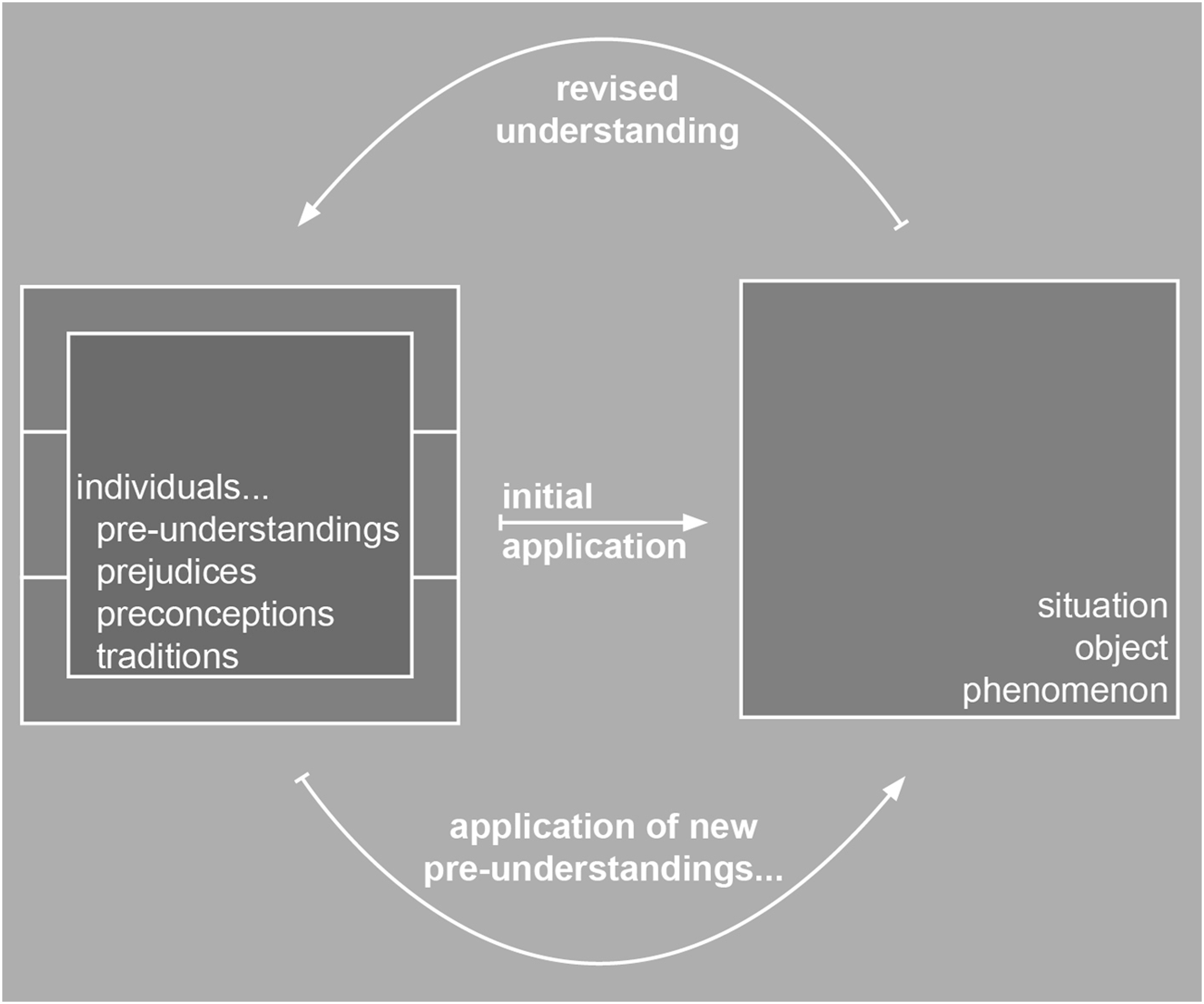
The hermeneutic circle is not a method of understanding, a methodological circle, but „ein ontologisches Strukturmoment des Verstehens“ [“an element of ontological structure of understanding”] (Gadamer, 1960: 299). It is not about an epistemological perspective in which understanding progresses linearly from evidence to evidence like an ideal explanation. Rather the circle and hermeneutics as a whole has a holistic view in which understanding is always conceived as participation and the understanding person is always part of understanding itself (Grondin, 2000: 131).
Grondin (2000: 131) speaks with regard to the circle of a “constellation of understanding”. Every understanding takes place in a constellation that is mostly unconscious to the person understanding and only in this way gives meaning to what is understood. The prejudices of the individual and the traditions in which one stands play a central role (Gadamer, 1960: 281ff). For example, someone who has been socialized with Jane Jacobs understands a city differently than someone who has read mostly Le Corbusier; someone from the 21st century differently than someone from the 18th century; someone from Cameroon differently than someone from China. Each understanding has a unique constellation that varies according to the person's background and prejudices and the phenomenon to be understood. Prejudices are necessary in order to be able to understand at all. Prejudice ultimately means only pre-judgment, i.e. a judgment before all the evidence necessary for an assessment has been obtained (Warnke, 1994: 76). Accordingly, prejudices can turn out to be confirmed or refuted as a result of new findings and further experience, but they are not necessarily false from the outset.
In planning practice as well as in research, which ideally attempts to go beyond understanding through subsequent explanations, the hermeneutic circle forms the fundamental moment of understanding processes with language as the medium. Planners are always in dialogical exchange with other planners, politicians, public agencies, stakeholders, phaenomena, objects and, last but not least, with themselves. Like the hermeneutic circle, a planning process is basically a constant back and forth between the concerns and arguments of different actors as well as legal restrictions. The aim of the planning process is to create a common understanding of the basic facts as well as the goal of the planning process and the means to achieve this goal. These processes do not take place in a vacuum, but are always embedded in a historical context – the Wirkungsgeschichte [effective history].
Understanding is subject to the Wirkungsgeschichte [effective history], a tension between past and present (Gadamer, 1960: 305). We are always in a given situation determined by the effective history; we are in the context of history. Despite all considerations, we cannot place ourselves in an external relationship to history. In addition to the influence of the effective history, the interpreter's horizon comes into play when interpreting phenomena and events. An individual's horizon consists of the sum of their personal experiences, prejudices, cultural backgrounds and historical contexts, which together form the lens through the individual perceives and interprets the world. „Horizont ist der Gesichtskreis, der all das umfaßt und umschließt, was von einem Punkt aus sichtbar ist.“ [“The horizon is the range of vision that includes everything that can be seen from a particular vantage.”] (Gadamer, 1960: 307) It is not an immovable vantage point, but the individuals horizon is constantly changing with the new experiences and impressions that one encounters: „Es macht die geschichtliche Bewegtheit des menschlichen Dasein aus, daß es keine schlechthinnige Standortgebundenheit besitzt und daher auch niemals einen wahrhaft geschlossenen Horizont. Der Horizont ist vielmehr etwas, in das wir hineinwandern und das mit uns mitwandert. Dem Beweglichen verschieben sich die Horizonte. [“The historical movement of human life consists in the fact that it is never absolutely bound to any one standpoint, and hence can never have a truly closed horizon. The horizon is, rather, something into which we move and that moves with us. Horizons change for a person who is movin.“] (Gadamer, 1960: 309)
A fusion of horizons (see Figure 3) occurs when there is an interaction between the horizon of an interpreter and the horizon of an object, phenomenon or another person. In this process, the interpreter's own horizon is expanded and modified (hermeneutic circle), and a new, shared horizon is created (fusion of horizons). This does not mean that the former horizon of the interpreter or the phenomenon disappears, but that there is a mutual influence. Accordingly, an understanding of phenomena in the past, a historical horizon such as a city in the 19th century is only possible to the extent that it merges with my present horizon (Grondin, 2000: 151). I refer to the total sum of the horizons of the subjects and objects involved in a particular situation as the meta-horizon. Understanding is only ever possible with the participation of one's own horizon, but is always in dialog with the past in its formation and is framed by the meta-horizon involved in the specific situation: „Der Horizont der Gegenwart bildet sich also gar nicht ohne die Vergangenheit. Es gibt so wenig einen Gegenwartshorizont für sich, wie es historische Horizonte gibt, die man zu gewinnen hätte. Vielmehr ist Verstehen immer der Vorgang der Verschmelzung solcher vermeintlich für sich seiender Horizonte.“ [“Hence the horizon of the present cannot be formed without the past. There is no more an isolated horizon of the present in itself than there are historical horizons which have to be acquired. Rather, understanding is always the fusion of these horizons supposedly existing by themselves.”] (Gadamer, 1960: 311). Effective history and the fusion of horizons (own illustration).
Distinguishing between understanding and explaining in spatial planning
So far, I have shown that understanding has different modes that can be identified in planning practice. I have also outlined the main features of understanding processes in Gadamer's sense. In order to show why I believe that a distinction between understanding and explaining can shed new light on the debate about a potential gap between theory and practice, the following question needs to be answered: How does the process of understanding outlined differ from scientific explanations?
Understanding is practice-oriented, while explaining is theory-oriented
Understanding is an active process in which the interpreter and the thing to be understood enter into a dialogical exchange. The person who understands actively involves oneself in the process of understanding, in that their background and prejudices play a decisive role and make understanding possible in the first place. Understanding is not necessarily aimed at clear communication to the outside world. It can be a personal, subjective and often unconscious process of collecting and interpreting information, which is conducive to practical orientation in one's own lifeworld.
Scientific explaining is a primarily theoretical process, which, in the sense of the scientific understanding of the (natural) sciences, attempts to explain something by logical conclusions, laws or cause-effect relationships. The primary aim is to give a reasoned answer, an explanation, to a specific question (Woodward, 2017: 9). Scientific explanations can also be distinguished from other scientific endeavours, such as descriptions, and represent the primary goal of science (Woodward, 2017: 9). However, explanations can be seen as the ideal of processes of understanding (Khalifa, 2013). They contain the practical component of these processes of understanding, but attempt to go beyond the given situation. This is done by explaining the why – the reasons for the respective phenomenon. In my opinion, scientific explanations should also be understood as an active process, in the sense that the scientists themselves are involved in their research. The selection of topics, methods, research objects etc. always includes the personal interests and previous experiences of the scientists. Viewing explanations as the results of ideal processes of understanding makes this even clearer, because in my view, processes of understanding are inherently active. However, individual experiences, and thus what I mean here by active participation, should be largely excluded from scientific work in the sense of the (natural) sciences in the search for scientific explanations (Woodward, 2017: 9).
The increasingly strong focus on data and facts in planning decisions and planning processes (Davoudi, 2015) is an indication of the emphasis on trying to explain the causes of grievances and to develop appropriate countermeasures. Be it in traffic planning, which is primarily based on the calculation of traffic flows, the attempt in urban land use planning to establish the desired density, which is considered good, through figures such as FAR (floor area ratio) or plot ratio, or the setting of indicators for noise emissions or air pollution. This is understandable insofar as the assumption that the world/physical space can be planned presupposes fundamental mechanisms that make this possible in the first place. At the same time, explanations are appealing as a selected means of communicating planning results because they can or should be used to justify and legitimize the selected measures and results. This claim is reflected, for example, in the approach of evidence-based planning, in the rational planning approach (the assumption of having access to fundamental and explainable facts), but also resonates in the collaborative planning approach (in particular with regard to the legitimization and traceability of planning results and processes).
Understanding refers to the entirety of what is conceived, while explaining focuses on partial aspects
In understanding, an individual tries to grasp a situation, a phenomenon or an object in a holistic way. Consideration of the historical, cultural, and linguistic context plays an important role. As shown, the hermeneutic circle is central to this, as it assumes that understanding a part (e.g., a single section of a text or an experience) is always related to understanding the whole (the entire text or the entirety of experiences in a given situation) and vice versa. In other words, to understand a part, one must understand the whole, and to understand the whole, one must understand the parts (Gadamer, 1960: 296). This process is circular and iterative. Here I would like to briefly mention that Gallagher’s (2005) concept of 4e cognition (based on Maurice Merleau-Ponty) opens an exciting dimension (especially embodied cognition) that is missing in Gadamer and Heidegger: the importance of the body and bodily experience for the understanding of human consciousness and perception. Particularly regarding the built environment, this model offers an interesting starting point in terms of how knowledge and perception arise through the body and are not conceptualized purely in the mind. However, this takes a slightly different direction than I would like to pursue in this article, but it is worth mentioning, as the significance for planning that designs living spaces is obvious.
Explaining can tend to look at things in isolation and to break them down into individual parts in order to get to the respective core in an analytical way. The focus on logical conclusions and cause-effect relationships fuels this tendency, since only the cutting out and delimiting of the smallest possible phenomena potentially increases the degree of possible exactness of the explanation. Hayek (1967) made an important distinction with regard to explanations in the social sciences, which has already been transferred to planning by Moroni (2015): The distinction between explanations of detail and explanation of the principle. Explanations of detail can only be achieved when individual events are concerned, while explanations of the principle are made when we cannot explain specific individual events, but only “typical kinds of events and processes” (Moroni, 2015: 250). Following Hayek (1967), explanations of the principle can explain the basic rules and functions, but can never provide exact explanations in a concrete situation. With reference to “the city as a complex system” (Moroni, 2015: 253), this form of explanation can soften the classical scientific concept of explanation and make it more applicable. However, I will not elaborate on this here, as Moroni (2015) has already provided a corresponding illustration as I will concentrate here on understanding and its meaning for planning practice and research.
In spatial planning the division into sub-disciplines might be a result of the increasingly differentiated knowledge in the first place. However, I think that this is also based on the striving for better explanations, which in turn presuppose an increasingly profound analysis through more specialized sub-disciplines. If we limit ourselves to explaining or at least ascribe a very special status to these explanations, we end up with a lot of data, facts and descriptive and analytical knowledge, but no statement about how to deal with it or how it fits together in relation to a planning project in a given context. This is a point that has already been made in various publications on the question of differentiating between types of knowledge in planning: In these, a distinction is usually made to a greater or lesser extent between empirical and descriptive knowledge on the one hand and predictive and normative knowledge on the other (Rydin, 2007; Campbell, 2012; Davoudi, 2015). I argue that explanations are possible with regard to empirical and descriptive knowledge, as these are aimed at the past and present, but predictive and normative knowledge is based on processes of understanding, as these are aimed at the future and statements are to be made about what is considered desirable and good.
Understanding is based on preconceptions, prejudices and traditions, whereas explaining attempts to eliminate these
Preconceptions, prejudices and traditions have negative connotations, but in Gadamer’s (1960, 281ff.) sense they play a central role in understanding and forming the pre-understanding. Without them, there can be no access to what is understood, as they significantly imprint our way of thinking and the way we interpret something. They form the individual's prior knowledge, experiences and assumptions and are the starting point for the process of understanding.
Explaining involves trying to minimize or eliminate preconceptions and prejudices in order to derive universally valid rules. Accordingly, they are perceived in this context as obstacles that can jeopardize the process of explaining and have a negative influence on it. A problematic perspective as it is unrealistic for people to shed their prejudices and values (Elliott, 2017: 10).
Planners, in every sub-discipline of spatial planning, approach the respective subject matter with their own convictions, assumptions and experiences. This in itself is not a problem, but a necessity of being human. It even can be fruitful when, for example, people with different cultural backgrounds work together (Maher, 2014). This only becomes problematic if the people involved are not aware of the circumstance that they have prejudices and are bringing along a pre-understanding or if they even deny having one.
Understanding is situational and context-dependent, whereas explaining attempts to derive abstract, universally valid rules
Understanding is a situational and context-dependent process insofar as it involves grasping the meaning of a specific text, experience or phenomenon within its respective context. It requires empathy with the specific circumstances and conditions that have led to the emergence of what is understood. This is also reflected in Gadamer's essay The Enigma of Health (2021), in which he emphasizes the need for a holistic understanding of health which should also take into account individual experiences and social dimensions and thus go beyond the mere absence of illness. For planning, this could mean taking into account not only the physical infrastructure but also psychological and social factors as well as the individual life situations of those affected (as is often tried in planning processes); good urban planning contains more than just the absence of obvious deficiencies. In this sense, too, the special role of understanding (also in the physical sense of Gallagher (2005)) comes to the fore in planning practice.
In contrast, explaining aims to derive abstract and generally valid rules or universal laws that can be applied to different situations without going into the specific context. Gadamer (1960: 1f.) emphasizes that in the humanities and in the interpretation of texts, but also in most activities that directly affect people, understanding is often at least as important than explaining, as it enables a deeper insight into meaning and human experience than explanations.
Understanding and explaining (own presentation based on Gadamer (1960)).
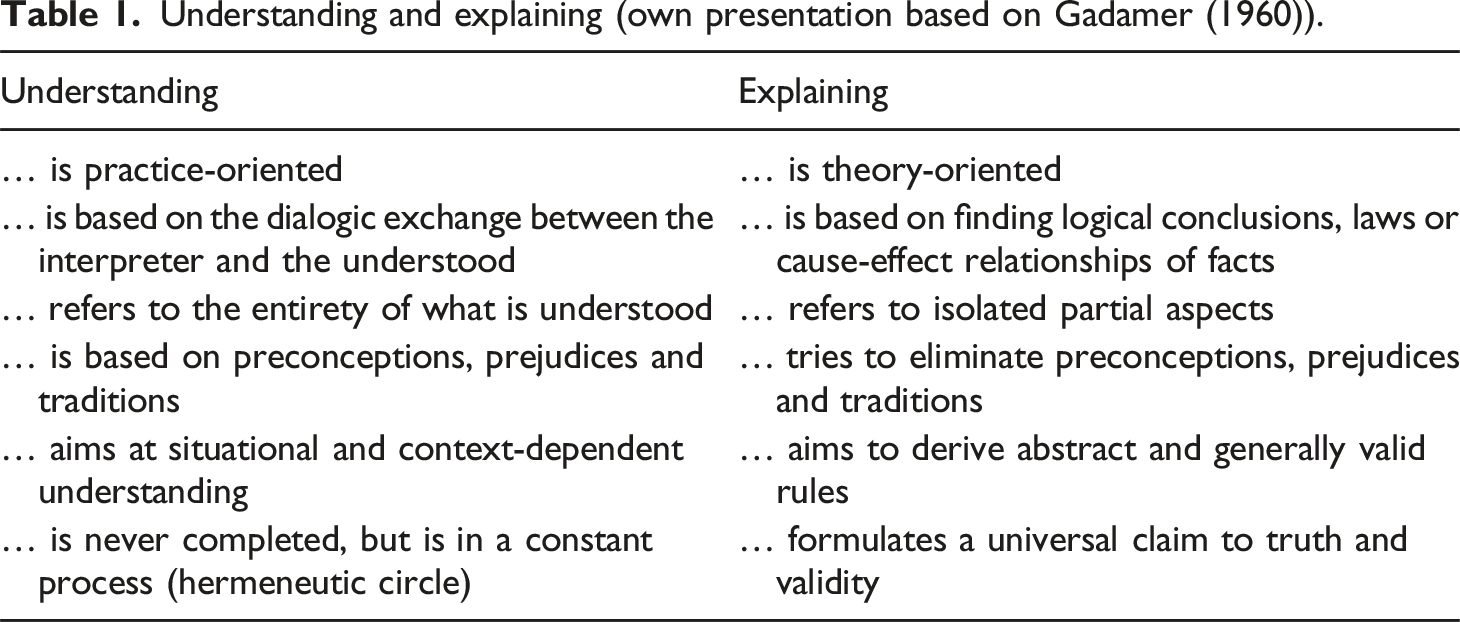
I am not disputing the usefulness and necessity of the disciplinary differentiations described here, nor do I wish to degrade explaining as such. On the contrary, I am convinced of the importance of these well-founded scientific explanations for planning practice. At the same time, I am of the opinion that the boundary between explanation and understanding is often blurred in planning theories and research. Thus, most theories of and in planning do not openly aim at scientific explanations (equivalent to those in the natural sciences) but are rather oriented towards understanding or even express this as a goal (Abbott, 2005). However, the underlying notion of understanding within planning theories or theories of planning is usually still oriented towards the scientific ideal of explaining. At least regarding the particular quality of scientific work and the therefore often special emphasis on the chosen methodology. In this way, the comprehensibility and transferability of the argumentation, theory or results of studies and projects should be guaranteed. Planning research thus involves processes of understanding that strive towards explanations, even if this cannot be achieved in the same way as in the (natural) sciences. Presumably, this is also one reason why a lot of planning theories, like the incremental planning approach, the rational planning approach or the communicative planning approach, focus on processes. Processes are in the context of planning the easiest to represent in the sense of a scientific ideal of explanation. Substance and actors are even less abstractly comprehensible or even transferable than theories about processes. Accordingly, I see the described discrepancy between theory (explaining) and practice (understanding) as also fully valid in planning, as research in this domain also aims to go beyond everyday knowledge and strives towards the ideal of explanation.
What kind of gap are we talking about?
The perceived gap between theory and practice in planning is often attested as a lack of transferability of general and abstract theories, which do not develop any specific instructions for action or analyses for concrete phenomena and situations in planning practice (Alexander, 1997: 5). Moreover, the degree of abstraction of different definitions and theories of and in planning means that they are not transferable to individual cases. Alexander (2022: 183) therefore suggests using Vickers' (1968) definition: “Planning is what planners do”, in order to understand the different practices and to establish a link to the abstract theories on this basis.
I would like to follow Alexander's suggestion and at the same time add an extension by stating: Understanding is what planners do. I assume that the difference between understanding and explaining is responsible for the perceived gap between theory and practice in planning. This is not to be understood in the sense of a dichotomy, i.e. either explaining or understanding, as explaining is perceived as an ideal of understanding processes (Khalifa, 2013)), but they are different in their intention and aspiration (Gadamer, 1960). Therefore, the gap itself is not about the aspects mentioned, such as the inadequate transferability of theories or the lack of recipes for practice. Rather these can be identified as symptoms of these different epistemic orientations: understanding and explaining. Primarily the former on the part of practitioners, who are confronted with different contexts, the demands of those involved, political objectives and legal requirements while always involving themselves in the respective situation. Primarily the latter on the part of researchers, who necessarily also go through processes of understanding, but who (must) remain bound by the principles and rules of scientific work. With their debate of planning theories, researchers in the field of planning often find themselves in a field of tension between the scientific aspiration to explain and the difficulty of providing the demanded applicable knowledge in relation to planning practice. No universally valid principles or patterns can be presented and justified, nor can general rules and mechanisms in planning practice be researched. Planning researchers are usually left with an approximation, the interpretation of the respective planning process or actor under certain questions – a process of understanding that is guided by the ideal of explanation.
The planning constellation and the planning situation – new terms for framing and researching understanding in planning practice
In order to approach the epistemic orientation – understanding – in planning practice from a research perspective, I first see the need to find a new vocabulary. Language is central to understanding, or as Wittgenstein (1921: TLP 5.6) puts it: “Die Grenzen meiner Sprache bedeuten die Grenzen meiner Welt.” [“The limits of my language mean the limits of my world.”] (locking font and italic characters according to original).
Planners always experience constellations of understanding, but in different ways in each planning process, as planning areas, actors and concerns differ from one another. However, the underlying mechanisms are the same (hermeneutic circle, effective history, fusion of horizons), which involve cognitive, practical and linguistic understanding. Language plays the role of mediator in all of this cases, enabling or opening up understanding in the first place. However, language can also conceal, for example, when we “do not speak the same language” – in other words, when we cannot or do not want to understand each other.
Application is the practical use of our own language and refers to the process of understanding in which an individual develops the meaning of a given situation within, as in this case, a planning constellation in relation to his or her own horizon and the given meta-horizon. I deliberately avoid the term planning process in the following, as I believe it overemphasizes the procedural dimension and neglects the dimension of Dasein of the individual subject in the sense of Heideggers ontic dimension (the individual) and ontological dimension (the individual embedded in place and community). These two dimensions are closely knit and not easily distinguishable. The term planning constellation, by contrast, includes both potential substance as well as the process and emphasizes the individuals involved in their respective unique constellations during a planning project. Planning practice is thus fundamentally a form of application of the three types of understanding and ideally results in a fusion of horizons – the common understanding of the means to be chosen and the goal of the planning project – of those involved in the planning constellation. These applications of understanding take place in a variety of planning situations, which in their entirety make up the planning constellation (see Figure 4). Planning constellation and planning situation (own illustration).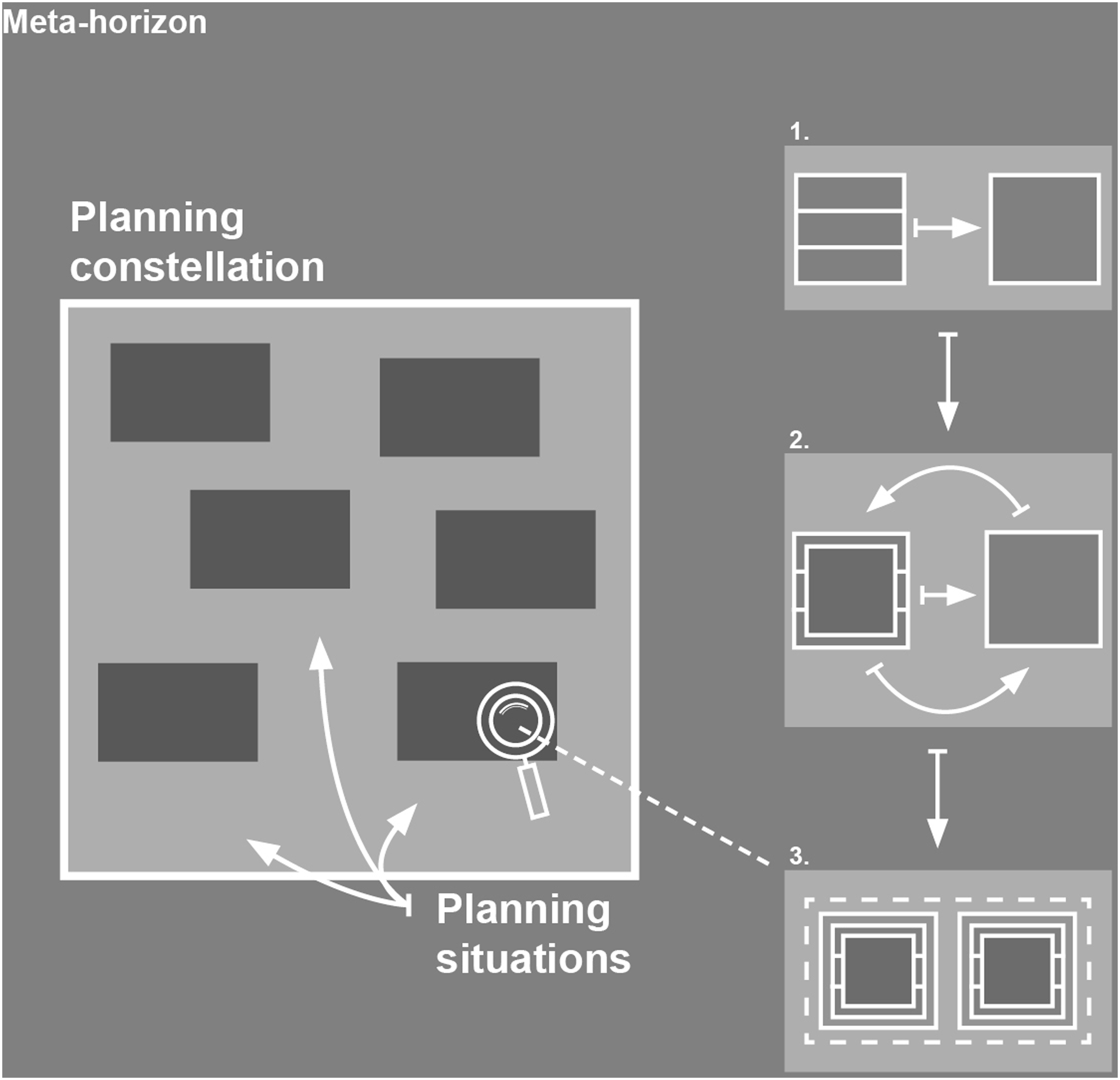
With the term planning situation, I am aiming at the many small moments in the planning constellation. These situations, for example specific discussions with stakeholders, the many steps of analysing the area to be planned, etc., make up the constellation in their multiplicity. However, these notions are not intended to undermine the many insights and importance of i.e. organizational (Filion and Sanderson, 2011), institutional (Kim, 2012), or governance (McCann, 2017) focused approaches to planning. Instead, I propose that research into (not about) planning practices (in addition to existing approaches) should be more closely aligned with the fundamental epistemic orientation of planners: understanding. It is important to show how understanding in its various forms (cognitive, practical, linguistic) takes place in planning practices. In addition to other substantive focuses, this requires the increased use and associated adaptation of qualitative methods. Recently, there has been a trend in this direction – be it the proliferation and application of ethnographic methods (Mattila et al. 2022), approaches to narrative research (Ameel, 2017) or participatory research approaches (Bergold and Thomas, 2012), which are already more common in other human focused disciplines.
Methodological approaches of this kind can help researchers to find new access to local knowledge. Hayek (1945) used the term dispersed knowledge, which he developed in his economic theories. This is characterized by dynamic and continuous changes and is often heavily dependent on the local context or only has special significance in certain contexts. Hayek's term is close to Polanyi's tacit knowledge. However, dispersed knowledge refers to the fact that groups of people share a certain knowledge. For example, how the relevant actors in a planning process can be networked in a particular city. According to Hayek (1945), individuals possess limited knowledge, i.e. only a part of the total knowledge of society, and their knowledge is usually difficult to communicate in the sense of Polanyi's tacit knowledge. The methodological approaches and methods mentioned can shed light on this specific local group knowledge of planners (dispersed knowledge), which is so central to the success of planning projects (e.g. knowledge about how a planning process can involve as many people affected by it as possible, how planners can coordinate their planning objectives with the other actors involved from administration, politics and the public or about what is a suitable planning objective in the first place, etc.).
Does this mean we should push for a purely new direction in planning research? I don't think so. Rather, we need to be aware of the motivation behind our research – do we really want to explain, or do we actually want to understand? The (often unconscious) quest for explanations when researching planning practices is problematic as soon as the focus is on individual actors or questions about the future. Moreover, the orientation of the definition “Planning is what planners do” (which is understanding), is based on the planners and their activities. Accordingly, research should once again be geared more towards planners and their activities. To do so, we do not only need to focus on planners as a grey mass, i.e. a concept, a role or a term of the planner (Clifford and Twedwr-Jones, 2013; Fox-Rogers and Murphy, 2015), but on the planners as individuals themselves: Behind every planner is a human being – with their own history, their values, their character, their will, their agency, their horizon. Explanations fail in relation to the human being and therefore, if we want to research planning as an activity of human beings, we must try to understand them in their individuality.
To this end, I see the focus of research into planning as opposed to research about planning as central. Researchers should always be aware that they themselves are part of their research. Their background, their horizon, always resonates and massively influences what questions they ask, what they observe, which conclusions and interpretations they consider. Research into planning is intended to draw attention to precisely this involvement of the researchers in(to) their research. Research about planning suggests a distance to the object or subject of research, which in my opinion is not given and can quickly lead to generalized statements based on individual cases.
In Gadamer’s sense, understanding also means the willingness to listen or the willingness to be told something. Being open to what others have to say, allowing yourself to be changed by them and constantly questioning your own prejudices and opinions. This constitutes an open dialogical exchange. Explaining could mean telling the other person something and not necessarily letting them have their say. A dialog is not necessary for an explanation. I think that researchers are well advised to practice this virtue of understanding: The willingness to listen to individuals in planning constellations and to be open to allowing themselves and their research to be inspired and perhaps even altered by this exchange.
Conclusion
Let us recall the underlying question of the article: What is the significance of understanding as opposed to explaining in planning practice and research and what does this mean for the relationship between planning practice and theory? Hopefully I have been able to demonstrate that there are good reasons to assume that understanding is one, if not the central epistemic orientation in planning practice. This manifests itself in the three modes of understanding – cognitive, practical, linguistic – which planning is all about. I also attribute the occasionally mentioned gap between theory and practice to these fundamentally different epistemic orientations between explaining (aim of theory) and understanding (practical activity).
Planning is inherently an interpretative activity that necessarily involves planners with their own horizons (preconceptions, assumptions and cultural contexts) as it is based on understanding. Planning constantly takes place in the field of tension between different horizons of actors within a given planning constellation. Planners are required to understand the underlying initial situation, interpret it and then translate it into a future vision. Planning is therefore always a fusion of the horizons of the various individuals, but also of the physical and abstract structures underlying and shaping the given planning constellation.
In order to come closer to understanding in planning I propose an orientation which is oriented more strongly towards the planners and the planning constellations in which they find themselves through research into planning. A planning constellation is characterized by its uniqueness, as each planning project has its own constellation – be it different actors, the area to be planned, the objectives of the planning project, the means to achieve them or different content-related topics. Various planning situations can be depicted in a planning constellation. Planning situations are the day-to-day activities of planners within a planning constellation. At the same time, I want to highlight that referring to the planner(s) is a term which runs risk to take away the individuality of the people behind the term. The planner might suggest, especially when the term planning process is used as well, that the planner is only a necessary means in the planning process. The individuals possibility of massively influencing a given planning constellation (e.g. through communication with the actors or the selection of methods and instruments) is pushed into the background by a generalization of planners – even if that is not the intention of these terms.
Moreover, research into planning that focuses on understanding can also open up new perspectives for existing debates, especially in relation to planning in the Global South. Explanations from a Western perspective often fail here, both in terms of the transferability of concepts and in comprehending the way in which planning and similar activities take place in a wide variety of contexts. Therefore, contexts that are unknown to us (regardless of whether it is the global South from a Western perspective or a neighboring place in the home country – only the degree of unfamiliarity varies) are in some ways the ideal places for the application of hermeneutic perspectives, because this is where the importance of good questions becomes most apparent. The experience of the self in unfamiliar contexts leads to a questioning of familiar processes and knowledge and, in particular, of the explanations that we have previously taken for granted.
To anticipate the future, understanding is what planners do. Planning researchers and practitioners should be aware of this circumstance so that the dialog between them does not end in misunderstandings due to their different epistemic orientations, but leads to a deeper understanding between them.
Footnotes
Declaration of conflicting interests
The author(s) declared no potential conflicts of interest with respect to the research, authorship, and/or publication of this article.
Funding
The author(s) received no financial support for the research, authorship, and/or publication of this article.
