




Abstract
When experiencing domestic and family violence (DFV) in Australia, Aboriginal and non-Aboriginal women seek help for diverse needs. In response, women’s specialist DFV services provide a range of programmes. Given this diversity and programme range, evaluating impact and outcome is challenging. A deeper challenge rests on who decides what to measure and how. This article describes a multi-site research collaboration between women’s specialist services and researchers. Part of the project aimed to identify the perspectives and priorities of Aboriginal women users of three specialist services: one each in an urban, regional and remote location. In a series of iterative steps, Aboriginal women, service workers and researchers explored what was valued in interactions with crisis programmes. Each collaboration then moved to identify ways to measure the items and to determine when and how other service users might be asked to respond. Aboriginal women participated primarily as service users but in overlapping capacities as victims of DFV, as community members, as local researchers and service workers. The underlying principle that guided the research was to respect and acknowledge Aboriginal women as knowledge holders, producers and translators. However, clear limits to ideas of ‘co-research’ are identified.
Women’s specialist domestic and family violence (DFV) service providers have long worked against the positioning of service users as passive and powerless, and have used various approaches to document and project empowered voices (Riger et al., 2002; Weeks, 1994). These efforts have wrestled with concern about revictimizing women who have more pressing concerns than answering evaluation questions, and about imposing funders’ priorities on the complex responses that specialist providers have developed to meet women’s needs (Wathen et al., 2015). Generally, however, overworked providers have relied on client surveys, on feedback forms, or in consultations of varying depth and quality to obtain service user views (Holder et al., 2015). Most of these methods categorise women who access crisis services when they experience DFV as ‘clients’, ‘users’ or ‘consumers’. The descriptors risk emphasising separation between women as inexpert and practitioners as expert. For Aboriginal scholars and activists, the expert stance is another example of ‘white privilege’ – an unearned authority to name, know and represent ‘Others’ (Moreton-Robinson, 2000). It is imperative therefore that women’s specialist services find ways to amplify the lived expertise of Aboriginal women as service users and to centre this within service frameworks.
In this article, we discuss collaborative research with three Australian women’s specialist DFV services and the Aboriginal women 1 with whom they work. We focus on the processes involved to enable the services to explore and identify collaborative ways of accessing the views of Aboriginal women who use their services. Together, we sought to build knowledge from the ‘ground-up’ and to measure what mattered so that it was relevant and useful to services and the women who accessed them (Putt et al., 2017). We describe the overall research collaboration and specifically those processes involving Aboriginal women as service users and co-researchers, and outline some limits to the latter concept. We argue that collaborative research is best understood and practiced as iterative between participants, as phased over time, layered at different levels of enquiry, and more or less practically collaborative in these phases and levels.
This article is in four main parts. It first situates the ground-up perspective of the research within three intersecting bodies of literature. It then provides an overview of the service partners and the context to the larger research programme in which the Aboriginal service user collaboration was a part. A third section sets out a selection of methods as ‘multiple collaborations’ employed with Aboriginal women service users. Finally, the article offers critical reflection on the conduct and claims of collaborative research.
Three bodies of literature
The ground-up perspective of the research is informed by three overlapping literatures. One considers the involvement of service users in research and evaluation. A second and related literature critiques dominating worldviews and epistemologies. Finally, the research also drew upon Australian and overseas participatory research methodology and contemporary attention to co-research. Within each of these literature are debates that cannot be explored here. Shared between each body of work, and by us as university-based researchers and the research partners, is a concern with meaning-making, its complexity and control.
While research into Aboriginal women’s experience of DFV services has sought the views of service users (for a review see Holder et al., 2015), there has been reluctance to actively involve Aboriginal women service users in design and conduct of research activities. Service providers are protective of women’s privacy and safety (Laing, 2003), and researchers and university human research ethics committees have been cautious about doing further harm to vulnerable women (Bender, 2016; Downes et al., 2014). For these and other reasons, the voices of Aboriginal women victimised by violence are ‘habitually silenced’ (Smallacombe, 2004: 47).
These concerns for service-users – encompassing research ethics, access and representation – are found in other sensitive service areas. For example, in work with children and young people, ethical questions arose concerning decisions about what source of research funding was appropriate, in stringent provisions for the protection of rights and dignity, and strict approaches to informed consent, even before navigating bureaucratic and familial gatekeepers (McLaughlin, 2009). Service users can be stereotyped in research as found in a review of service user involvement in peer-reviewed mental health services research. This noted a tendency to position service users as ‘mentally ill’ or ‘irrational’ constrained seeing them as ‘whole persons’ with something to contribute to research. The review found that grey or advocacy sources differently highlighted service users’ capacities and strengths. It emphasised ‘expertise by experience’ and users’ intrinsic interest in practice (Telford and Faulkner, 2004: 552). Overall, service-user involvement in research emphasises careful and thoughtfully constructed inclusion.
The second body of literature critiques the dominance of scientific rationalism in much empirical research. The approach has been shown to undermine the perceived value of service user involvement in or control of, amongst others, psychosis research (Neil et al., 2013), child co-researcher activity (Willumsen et al., 2014) and domestic violence programme evaluation (Goodman et al., 2018a). Indigenous scholars have been trenchantly critical of this dismissal of other ways of knowing (Tuhiwai Smith, 2012). They place self and community as both subject and object and argue against a dominant or single ‘truth’. Feminist researchers have also struggled against dominant worldviews and understood the importance of standpoint where interpretation is ‘power-sensitive’ (Fine, 1992: 220). 2 They have argued for broad conceptualisations of ‘evidence’ (Goodman et al., 2018a). In violence against women research, Aboriginal scholars have pointed to feminists’ ‘white privilege’ that can cloud representations of all women experiencing violence as a white women’s normal. This blindness is located within unspoken conventions about ‘control and ownership of knowledge’ (Moreton-Robinson, 2000: 59, 115). The scholarship argues for self-definition and self-representation for Aboriginal women, and for a critical self-evaluation by non-Aboriginal women of power and access to resources.
The possibility of participatory research methodologies, with its huge variety of activities, to respond practically to these criticisms is long standing (Chambers, 1994; Hope and Timmel, 1984). The active participation of individuals, groups and communities in research and evaluation is argued to break down differential power between researchers and those researched, to make room for more complex and messy pictures of social and political worlds, and to enable construction of tools for emancipatory change. Local researchers and local partners can provide access to pre-existing knowledges, stories, histories, perceptions and contestations around problems (Foster et al., 2006; Miller et al., 2015). However, subjects’ voices can be both tokenistic and over-valorised, and participatory methods can smudge specificity (Campbell, 2002). The implications of participation properly and fully applied are ‘about shifting power to those with less power’ (Rawsthorne, 2014: 9) and needs to be considered within contexts of colonisation and contemporary unequal power relations. This suggests caution when weighing claims made about equal contributions to input and output in co-research (McLaughlin, 2010). At their best, the methods calibrate with Indigenous ways of learning and knowing (Tuhiwai Smith, 2012), and the emancipatory power of user inclusion (Beresford, 2002). At worst, participatory processes are simply another way of the powerful coming and taking from the less powerful.
There is much overlap in and resonance between the three literatures. While each has distinctive features, it is possible to situate the descriptions, concepts and methodologies of the literature along different continua (Figure 1). While it may be tempting to situate a particular research project on one or other end in each of the continua, this misunderstands the complexity of social inquiry. The specifics of any given research collaboration may mean a mix of dimensions.

Continua of descriptions, concepts and methodologies within service user and participatory literatures.
In summary, Indigenous and service user literatures critique the ‘othering’ of vulnerable or less powerful groups, and subvert the expert stance. The literatures argue for greater engagement with ‘expertise by experience’ (Telford and Faulkner, 2004: 552), with women victimised by violence as ‘active agents’ (Downes et al., 2014: 10), and greater equality between service users, services and researchers (Fleming et al., 2013).
The research we describe in this article drew from these critical traditions. In addition, as university-based researchers, we (the authors) shared other principles that were central to our research practice. We mention two here. One was to maximise collaboration at each stage and level of the research while, at the same time, not over-burdening the day-to-day services nor over-claiming the extent of collaboration. A second principle was to actively work with different types of expertise brought to the research and to make their use as open to discussion as possible at all stages of the research. For ourselves and the partner services, the point of the collaborative research activities with Aboriginal service users was to be open to learning and for the learning to inform shared commitments to ‘deep and respectful listening’ (Tucci et al., 2017: 7). Our listening and learning were particularly focused on what Aboriginal women as service users had to say, but we actively incorporated and engaged with the multiple capacities and roles that Aboriginal women brought to responses to DFV. Through these principles, the collaboration we describe was both a set of jointly devised exploratory and developmental activities, as well as a ‘formal relationship’ based on written agreement with the partner services (Fleming et al., 2013: 708).
Research contexts and overall research programme
The research contexts
The research partnership involved three services: the Alice Springs Women’s Shelter (ASWS) (Northern Territory, NT), the Domestic Violence Crisis Service (DVCS) (Australian Capital Territory, ACT) and the Ngaanyatjarra Pitjantjatjara Yankunytjatjara Women’s Council (NPYWC) (tri-state NT/SA/WA). Each is strongly independent in their governance, and upholds principles of empowerment and self-determination in their work with women. Each prides itself on being client centred and responsive. As such, they are ideal partners in a search for better ways to understand what matters to women as a precursor to examining what was ‘effective’ or what ‘worked’.
Each service works with an understanding of DFV that encompasses physical, sexual, emotional, spiritual and financial dimensions, plus an understanding that the women are more than a victim of DFV. This grounded perspective necessarily means that each service assists women in a range of different ways. It is the single function of the ASWS and the DVCS to respond to women and children facing DFV. They do so by providing, amongst others, accommodation, outreach, court advocacy, practical assistance or crisis support. The NPYWC is a multi-programme organisation, one of which is its DFV Service (DFVS). This service provides outreach, crisis support and justice advocacy. Multi-faceted social programmes such as the partner services raise challenges to ‘what works’ approaches in research and evaluation (Goodman et al., 2018a). They ask at what level are they to be assessed – the level of ‘case’ or contact method or discrete programme or whole service or as an interaction of multiples? Further, the partner services are independent but are also embedded within local, regional and national service and intervention systems in which they have varying levels of influence. As such, outcomes of interest (for example, being re-housed or the arrest of an alleged perpetrator) are largely outside the direct control of women’s specialist services. Thus, the weight of expectation can be heavy on specialist services that are under-funded and stretched by demand (AVAWA, 2016). Nonetheless, in our experience of this and other community-based research, services find quantitative results useful and also value highly work that is critical, mixed methods and which engages with the complexity of their working environments.
Women service users themselves have complex needs that rarely fit single criteria, and which shift over time and in differing contexts. For ASWS and NPYWC, Aboriginal women are most or all of the clients. The organisations serve very wide regions and multiple small communities. For DVCS, operating in an urban/regional context, Aboriginal women are a very small proportion of their clients. Working with three different organisations allowed the research to engage Aboriginal women service users as heterogeneous and having multiple identities. In addition, each organisation has a variety of formal and informal ways in which Aboriginal women are involved (as clients, workers, Board members and community members). The NPYWC is an Aboriginal-controlled organisation with an Aboriginal Board. Over the life of the ASWS and DVCS, each has or has had Aboriginal Board members. The staffs in each organisation are primarily but not exclusively non-Aboriginal. The three services have several decades experience serving their local communities. Given the multi-site nature of the research, the project relied on advice and guidance of these existing Aboriginal authority structures and networks. 3
Overall research programme
The researchers 4 had extensive prior histories with one or other of the partner services and their operating environments. We believe this trust is essential for effective researcher–service collaborations (Sullivan et al., 2017). The overall research programme explored ‘lessons learned’ in working with and for Aboriginal women facing DFV over the past 30 years. It explored the services’ evolution and examined three key areas of contemporary practice: advocacy, safety planning and outreach. How the learning shaped the services and these practices we discuss elsewhere (Putt et al., 2017). However, it is important to understand that the subject of the research were services' practices and knowledge acquired through past and contemporary interactions with Aboriginal women, not Aboriginal women service users and the violence and abuse they experienced. Aboriginal women were involved in the collaborations as leaders and staff in the partner services, as women who were clients or former clients of the services, as researchers, and as stakeholders. Across these multiple roles in the overall research programme, 42% of participants were Aboriginal (where known).
As a large multi-site programme, the research comprised different stages and levels, different components and different methods. Initiation of the research idea from us as researchers took place in telephone conversations with decision-makers within the three partner services. Further conceptualisation, overall research design and budget were jointly developed over a number of months through phone and email conversations. Formal aspects including funding application and contracting and ethics approvals were done by us, while recruitment of research assistants and more detailed local planning were done together. Most of the data collection (interviews, focus groups and surveys) and analysis were done by researchers. Detailed planning and execution of some of the research components (described below as ‘service partner projects’) and the co-research with service-users were primarily led by the service partners.
These various research components led to different outputs that were largely drafted by us but edited and agreed with service partners. The research was developed in 2014 and conducted over 24 months in 2015–2016. Over this time and through the different levels, collaboration intensity fluctuated. Over the life of the research, multiple multi-party engagements encouraged iterative discussion on focus and methods, and responses to implementation issues. These were critical for dialogue and debate about what was and was not important as lines of enquiry and for navigating questions of interpretation.
Multiple collaborations
The term ‘research collaboration’ can disguise the component parts and levels of activity. Rather than a ‘consortium’ (Fleming et al., 2013: 710), ours was both a formal and a developmental partnership with different leads at different times. The collaboration involved organisations in written agreements, and multiple collaborations with senior managers and leaders, frontline practitioners, community members and service-users. Some of these groupings were active at all stages of the overall collaboration, and others for only parts of it. It is more accurate, therefore, to talk of collaborations.
Service partners and Aboriginal service-user research projects
The collaborative components that were most intense for the service partners were those activities which sought to engage critically with questions about ‘what works’ in service delivery to Aboriginal women victims of DFV. Initially, service partners sought to review, develop and trial ways to capture Aboriginal women’s assessments of their priorities, safety and well-being. Ultimately, the question shifted to a more foundational one about what women valued in their interactions with the service. This framing of the question proved to be less instrumental and less directive, and more generative of perspectives. A portion of the overall research budget was delegated to the partner services to fund these user-focused projects. The partner projects were led and implemented by them using experienced staff nominated by them to be worker–researchers with the assistance of local and university-based researchers. These participant groupings comprised an iteration of co-research in which contributions were joint and several (Sullivan et al., 2017). Rather than the groupings being solely ‘outsiders’ or ‘insiders’ (Hartley and Benington, 2000: 463), they were both at different occasions and in different activities. These user-focussed projects are the focus of the remainder of this article.
To develop the localised and service-specific projects, three two-day workshops were held involving the researchers, service managers and nominated workers. In the first workshop, the services described their work and shared previous attempts to define and evaluate ‘good practice’. Each had long struggled to delimit feasible service objectives within overall policy and funding environments that were changeable and sometimes unrealistic. Instead, each service wanted markers of change that could indicate whether and how women clients’ situations were improving. The second workshop engaged with questions about the purpose of each service, questions designed to be both visionary and grounded. It asked ‘what “changes in women” are you looking for?’ and asked what levers or resources the service partners used or had influence over to encourage or facilitate such change. At this point, bureaucratic language (for example, ‘the service purpose is homicide prevention’) shifted to words that women may use themselves (for example, ‘we help women feel stronger’). A programme logic was developed for each service (Pawson and Tilley, 1997) but with an agreed focus on crisis responses. Each identified key priorities, scoped realisable methods and possible measures they believed would work for the Aboriginal women service users in their particular environment and within regular service demands. The third workshop, held towards the end of the research programme after most activities were completed, discussed what had been done, what adjustments had been made to the plans and methods over the course of the work and what had been learnt. There was extensive discussion on interpretation and representation of the research findings for the research outputs and on what could be realistically embedded in practice in the future.
The service partners’ projects, developed through the workshops, encompassed case file review and activities with service users (Table 1). These latter comprised intense engagements designed to bring forward women’s expertise-by-experience and were, in large part, driven by the nature of service relationships with women. The NPYWC has long term and one-to-one relationships with women, often over multiple programme areas and individual issues. The ASWS similarly has returning or regular users, but contact can be fleeting and fraught with many practical matters. The relationship of DVCS with most of its crisis clients is telephone-based, but with the possibility of longer relationships through several of its programmes. However, goals shared between the three were that, as a result of interaction with the service, women and children are safer and women are stronger. Table 1 shows that there were similar client-centred expected short-term outcomes desired for women from service contact. However, each partner service used different terms and emphasised different aspects of the service relationship. These led to differences in area of research focus.
Summary of partner projects: service goal, expected short-term crisis outcomes, research focus, methods (Putt et al., 2017).
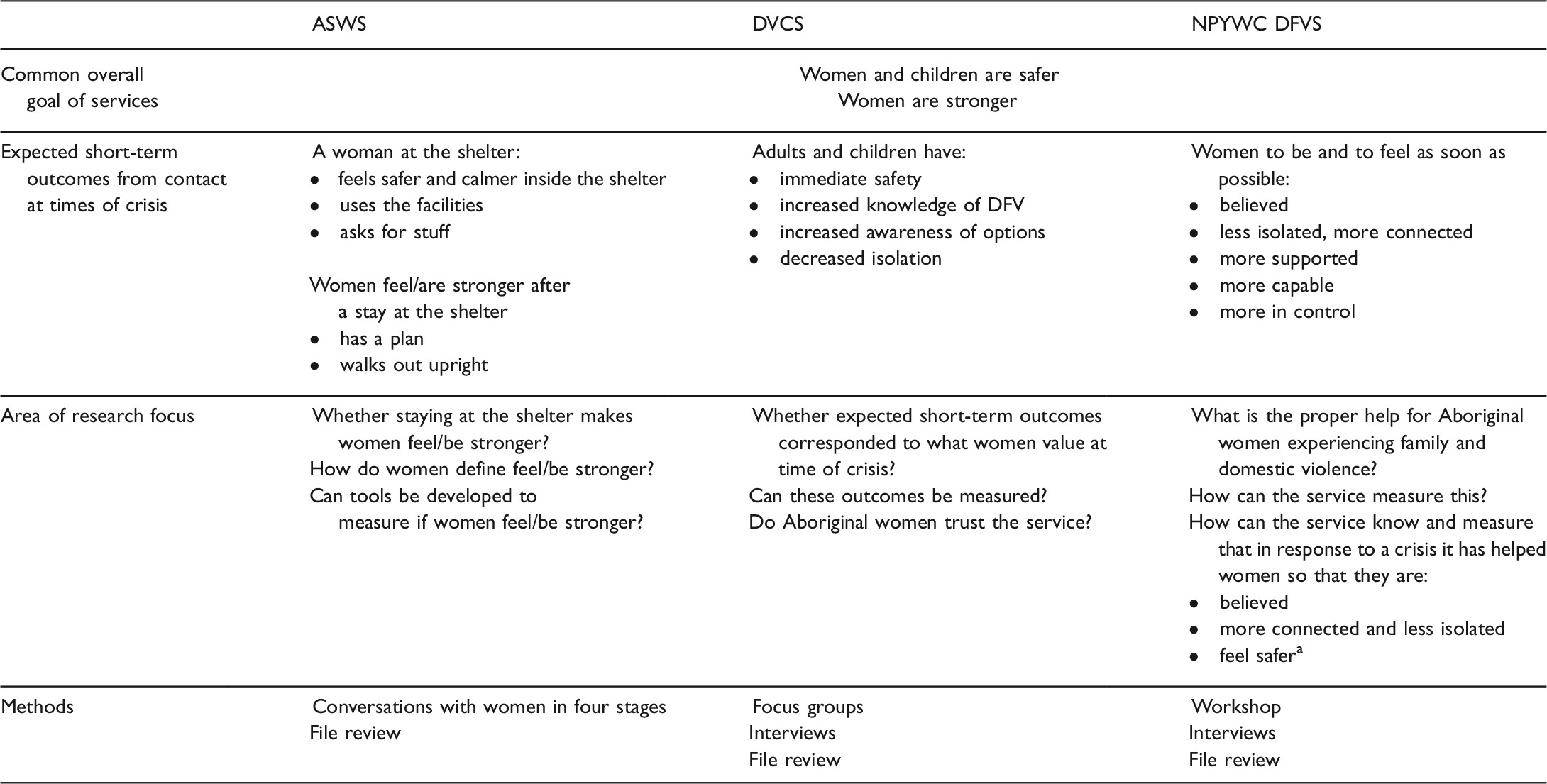
ASWS: Alice Springs Women’s Shelter; DVCS: Domestic Violence Crisis Service; NPYWC DFVS: Ngaanyatjarra Pitjantjatjara Yankunytjatjara Women’s Council Domestic and Family Violence Service.
aThis question was added during the analysis of the client file reviews.
Listening and learning in crisis settings
The shift of research focus to explore service users’ definitions of what they valued comprised a next step after the initial partners’ research plans. In this iteration the co-researching relationships multiplied. The decision to focus on what Aboriginal women as service users valued in crisis responses did not involve women in crisis. Rather, it involved women who had previously used crisis services but who were assessed as safe and no longer in crisis. By its very nature, DFV creates and maintains states of crisis. At the same time, crisis can mean different things depending on perspective. A crisis can be an event, a situation or a way of responding to something. It can be time or situation specific. Viewed from the service user’s perspective, a crisis may stimulate a request for outside help, guidance or something more directive. All three services were demand led in this manner.
Each of the partners’ user-focused projects was designed with clear-eyed appreciation of the demands on staff and the multiple pressures on Aboriginal women service users. At the same time, each of the designs was a step in the dark. Letting go control (sometimes called ‘handing over the stick’ in the participatory research literature) of what was to happen and what might happen was something the services and worker–researchers had to engage with, as did the researchers. Although each of the service partners could call on the assistance of the local and university-based researchers, the design and conduct of the activities with Aboriginal women service users were in their hands. While some argue that using service staff to collect data can generate bias in responses, is protective of existing practice, and raises ethical questions about consent (Dominelli, 2005; Downes et al., 2014; Zimmerman et al., 2016), our collective view was that these problems were outweighed by workers’ greater knowledge and understanding of women’s situations and their accessibility to women.
Following discussion with the service partners, guidance on ‘Ethical Interactions with Service Clients and Staff’ was produced. 5 The document, located within the ‘social relations of research production’ (Oliver, 1992: 102), acknowledged that methods of engaging with women would be ‘less formal and more opportunistic’ than is usual in much research practice. The guide stressed that, when engaged in research activity with service users, the worker–researcher was to make it plain she was not performing her usual work role and, where possible, to follow an introductory text and set aside specific times for research conversations. The guide suggested ways in which the worker–researcher might ask a woman if she could ‘come back’ to check meaning and/or invite further participation. It also provided a script to invite the woman to consider some acknowledgment of her contribution into the process.
Investing time, people and resources
Each worker–researcher was bought time off her usual duties, was allocated additional hours to conduct the research activities or conducted them within her usual work programme. Each was guided both by a senior manager (and member of the larger research team) and one of the university-based researchers. The worker–researchers were, in effect, leading action learning in a series of micro-collaborations (Schön, 2016). Each of the three projects used similar methods and some distinct elements (summarised below) to engage collaboratively with Aboriginal women service users. 6
ASWS
The worker–researcher invited individuals who had been residing in the shelter for two or more nights to have conversations (to ‘yarn’). The worker–researcher made it clear that she was asking the woman’s help to create better research, to know better. After the initial yarns and in later conversations/stages, she asked each woman’s view about possible ‘tools’ that could be developed to enable feedback discussions with residents, and to measure changes. In this process, the worker–researcher offered women use of picture cards, paper-based scale measures, and a sandbox for drawing. The ASWS Aboriginal staff mentors provided interpretive guidance at a number of critical moments. Over a six-month period and during the four stages of the project, at least 20 Aboriginal women shelter residents contributed (some on more than one occasion) through yarning and feedback.
NPYWC DFVS
Fifteen senior women from the NPY lands and an experienced ex-manager (here as a worker–researcher) held a day workshop to explore language, concepts and priorities. The women form a body of community researchers for the NPYWC called Uti Kulintjaku. 7 Their role is, in part, to ‘get the words clear’ and, as a result, to shape and guide direction. For this project, they brainstormed words associated with DFV and discussed different scenarios using Pitjantjatjara and Ngaayatjarra languages. Then all words were translated into English. An important part of this process involved the women and the interpreters/translators jointly exploring and working on the translations to find the best and shared meanings and understandings. The worker–researcher also had one-to-one discussions and interviews of varying length and depth with nine women with whom she had a prior relationship or contact.
DVCS
Women who were assessed as currently safe and who had contact with the service in the preceding six months were invited to participate in focus groups and one-on-one interviews. They were contacted firstly via text messages; secondly, through an Aboriginal community organisation and thirdly, by invitation to Aboriginal women detained in the local prison. Involved in these activities were a local Koori researcher, several staff and a university-based researcher. One group used picture cards to describe what they felt like before contact with the service and what they felt like after. Another also used cards to explore what was a ‘good’ or a ‘bad’ service as a lead in to examining in more detail how a service could be ‘trusted’. Other groups met to find out what women believe is most important and valued by women in contact with a service at times of DFV crisis. The groups were asked to work together to design a service for a friend experiencing DFV that was ‘spot-on’. Some groups, comprising all or mostly Aboriginal women, met on more than one occasion.
The activities in each location were spread over 10 months and involved a total of 68 Aboriginal women service users or ex-users and community members. As a result of these micro-collaborations with Aboriginal service users, all three partners were enabled to identify what mattered, to get the words clear, to return to service users to clarify meanings in context and to begin testing ways to measure what was valued or to pursue these in other ways.
Reflections on collaborative research with Aboriginal service users
Research legacy and unfinished business
In concluding discussions with and between the partner services, the costs and benefits of their involvement were explored. On their own initiative, the partner services had invested time greater than the allocated budget. While some reservations were expressed about the processes and the resources required, for the most part, the three partners saw clear benefits. One service further used the methods trialled with service users; another incorporated several key findings from the research in their staff induction and new practice guides were taken up in staff training. 8 All valued the practical opportunity to ‘properly listen’ to the perspectives and priorities that Aboriginal service users said, and to take the extra step of working with them to incorporate these into service planning.
Overall, our collaboration showed that linearity in design and implementation is insupportable when attempting more inclusive research. The process comprised recursive and dialectical loops through different activities between the women service users and the worker–researchers; between worker–researcher and other workers, from the worker–researchers to service managers; 9 from all to the researchers and from researchers to all. Therefore, if we are to take the idea of co-research seriously, then the time taken in conceptualisation, priority setting, definition and getting to shared understanding of meaning needs to be bounded as a specific research stage. A second stage would then be testing and deliberation with users on results. After refinement, a next stage would be more substantial testing of the items and the measures. Partners’ plans to pilot the items and the processes with a test population of users could not be achieved within the time and funding of the overall collaboration. Thus, a key learning is to plan collaborative research with service users in deliberative phases, that is, as a series of collaborations.
Multiple and uneven collaborations
Dividing collaborative research with service users more carefully into substantially different phases may then provide clearer opportunities for users to assert a greater degree of influence. For example, a proposal for funding may be first developed in dialogue sessions with service users. A step like this will attract its own demands for specification and planning. But, in essence, collaborative service user research becomes a series of discrete projects that are linked but can be separated, and can be later integrated.
Understanding that collaborative research involves multiple collaborations enables us to get beyond simple notions of research that is ‘fully collaborative’ (Goldstein, 2000: 519) or ‘authentic’ (Goodman et al., 2018b: 104), and may make participatory research more feasible to service providers. Furthermore, the micro-processes of research then emerge strongly. It is to these smaller activities and engagements that the co-research label may be more honestly attached – or not. In the latter, an example would be that, at the stage of data analysis, the sharing confidential data from service users with other users working as co-researchers would require careful delineation. A couple of key points follow from these particular reflections. One is that service user involvement, even control, is uneven and may be more or less at any of these stages and in any of the smaller research activities (Carey, 2011); and second, that collaborative research with service users can be both ground-up and top-down at any stage and in any activity. Co-research is not a single encounter.
Taking collaborative research with service users seriously also means taking service users seriously. This point focuses on the knowledge in knowledge production. Aboriginal women generously gave their time as participants. The women all lead busy lives, have views that are both individual and shared and have unique and common experiences. They are not only Aboriginal in their identity, nor just a victim in their engagements with their environments. It was also, we believe, less stressful on the women to consider their experiences of services than their experiences of abuse; an observation that is also relevant to non-Aboriginal women participants. Women’s capability and multiple selves must be foundational. But, as in research more generally, accessing women and working with them on processes to bring forth knowledge was demanding. It was equally demanding of the worker–researchers, the partners and the researchers. None of the participants were fixed to a single role – service user, researcher, worker, for example – though these certainly were primary. Co-researching required mutual respect and careful listening all round. But the ‘co’ is limited. Power and privilege is not evenly distributed, and different forms of power are exercised in different domains or fields. At a fundamental level, it is neither desirable nor possible for researchers to go into collaboration with service users ‘not knowing’. 10 University-based researchers are obliged to submit detailed plans on human research ethics and approaches, and preparing to enter the lives of real people demands pre-planning. We also came with decisions made about topic, objectives and process albeit developed in agreement with the partner services. Their pivotal role as brokers and translators cannot be underestimated. We would say, however, it is unethical and misleading for researchers to present as ‘inexpert’ in the same way that it is wrong to disregard service users’ lived expertise. At the same time, being humble with that expertise and curious in finding out the expertise of others is precisely what is required in co-researching.
Conclusion
This article does not offer a blue-print for ‘best practice’ nor does it make a claim to realisation of the perspectives of Aboriginal women victims of DFV as service users and knowledge producers. Rather, it is a reflective account that accentuates aspects of knowledge-producing processes rather than knowledges produced. Our detailed description is intended to encourage researchers, service providers and funders to pursue collaborative research and evaluation of what matters with service users.
In this enterprise, collaborative research and co-research are mostly presented as distinct. We brought the concepts together to highlight their generative potential in foregrounding ‘other’ knowledge and expertise. At their core, the concepts ‘involve’ a range of participants. In emphasising the range of participants, the levels to and different types of involvement, and the varying degrees of intensity to involvement over time, we have attempted to show possibilities as well as constraints. Although we argue for modesty in the claims for collaboration and co-research, we also urge more boldness in researchers and service providers to grow relationships and opportunities between Aboriginal and non-Aboriginal women, and between service users and service providers in DFV to make greater space for knowledges that have been submerged and unheralded.
Footnotes
Acknowledgements
The authors acknowledge the contribution of the research partners, the Alice Springs Women’s Shelter (NT), the Domestic Violence Crisis Service (ACT) and the Ngaanyatjarra Pitjantjatjara Yankunytjatjara (NPY) Women’s Council (NT/SA/WA), and the Aboriginal and non-Aboriginal women who participated. The findings and views reported in this article are those of the authors and cannot be attributed to ANROWS or to the Australian Government, or any Australian state or territory government.
Declaration of conflicting interests
The author(s) declared no potential conflicts of interest with respect to the research, authorship, and/or publication of this article.
Funding
The author(s) disclosed receipt of the following financial support for the research, authorship, and/or publication of this article: The authors gratefully acknowledge the financial and other support received from Australia’s National Research Organisation for Women’s Safety (ANROWS) towards this research and, through it, the Australian Government and Australian state and territory governments.