



Abstract
Despite reading being recognized as a core academic skill, surprisingly little research has been undertaken into university lecture reading requirements. This article reports on the trial and evaluation of a minimalist reading model developed for students in arts and education subjects. Comprising annotated extracts from full texts ‘linked’ wherever possible via hypertext mark-up language to glossaries, e-dictionaries and online translation services, the minimalist model was intended to rethink pre-lecture reading requirements and conventional approaches to designing reading lists at the tertiary level. Findings indicate that while students are generally receptive to the redesign of conventional approaches to pre-lecture reading in the disciplines sampled, several participants expressed reservations about the model. The research provides insights into the study mores of the contemporary university student and re-emphasizes the need to ensure the diversity and complexity of the student cohort is catered for by educators and university managers as far as practicable.
Introduction
Despite reading being recognized as a core academic skill (Fairburn and Fairburn, 2001; Mann, 2000; Stokes and Martin, 2008), little research – recent or otherwise – has been undertaken into university lecture reading requirements, undergraduate or postgraduate. One notable exception is Stokes and Martin’s (2008) article, ‘Reading lists: A study of tutor and student perceptions, expectations and realities’. Stokes and Martin’s recognition of ‘the paucity of literature on reading lists’ (2008: 116) supports the assessment made by the authors of a lacuna in the literature of higher education (HE) pedagogy in relation to reading requirements and the design of reading lists. It would seem the function and the design of reading lists have for too long been taken as relatively unproblematic features of teaching and learning (T/L) in HE (Swain, 2006).
The present article reports on the findings of a study conducted in the Faculty of Arts and the Faculty of Education at a large Australian university (The full report of the study can be downloaded from www.olt.gov.au/system/files/resources/CG7-489_Monash_Peterson_FinalReport_Aug09.pdf). The study was funded by the Carrick Institute, now the Australian Learning and Teaching Council. Its main aim was to investigate student preferences relating to the mode of delivery (online, physical digital, hardcopy) of their T/L resources (study guides, readings, supplementary study skill resources). Alongside the major component of the research, we also trialled and evaluated what was designated the minimalist reading model (MiRM). The MiRM comprises annotated extracts from full texts linked wherever possible via hypertext mark-up language (HTML) to glossaries, e-dictionaries and online translation services. The present article outlines the rationale for developing the MiRM and provides examples of prototypes. It reports on student responses to the model and offers discussion of these findings in relation to the design of reading lists and reading requirements at university.
Background
… In our view reading lists are often a waste of time
Issues related to students reading at university can be approached from at least three angles. As one might expect, instructional study skill texts such as A Guide to Learning Independently (Marshall and Rowland, 1995) or Kate Chanock’s (2004) Introducing Students to the Culture of Enquiry in an Arts Degree locate the ‘problem’ or issue of student reading at university almost entirely within a skill development framework. It is an approach continued in a number of other recent instructional guides to effective tertiary study techniques (Bates and Matthewman, 2009; Brick, 2006). Useful reading strategies (skimming, scanning, questioning the text, summarizing and mark-up techniques) are discussed. Understandably in these contexts less attention is paid to the pedagogical issues embedded in the presentation of texts or the quantity of required reading expected of transitioning students in particular.
Research of a more pedagogical nature in this area tends to focus on the reading/learning nexus. This approach frequently investigates student approaches to reading at university, thereby overlooking issues of doubtful and/or entrenched pedagogical practice. Ramsden (1992: 39), for example, places his discussion of reading at university within the broader context of learning theory, specifically ‘the concept of approach to learning’. Prosser and Trigwell (1999: 83) continue Ramsden’s emphasis on ‘students’ approaches to learning’. Perhaps not surprisingly, as the authors’ survey on the literature revealed, most research into the nexus between reading and learning has been conducted on primary school age children and adolescents.
Another approach to tertiary level reading issues is what might be termed the curriculum development perspective. Thirty years ago, the University Teaching Methods Unit (UTMU) at the University of London advised lecturers/tutors against excessively long reading lists. According to UTMU, this maximalist approach to reading lists runs the risk of confusing students, especially at early stages of their academic journey (UTMU, 1976). It is a point also emphasized by Stubley (2002). While it is difficult to find in-depth discussion in the literature of tertiary curriculum design of the pedagogy of tertiary reading requirements, or a range of practical suggestions to improve the design of reading lists, a number of authors do touch on the subject. For example, Butcher et al. (2006: 140) advise: ‘it is good practice to annotate reading lists, particularly early on in a course’. Stokes and Martin (2008), who draw on the work of Miller (1999) and Stubley (2002), also reiterate Butcher et al.’s advice.
Miller’s discussion places great emphasis on the advantages of designing reading lists that recognize the diverse range of reading skills (amongst an increasingly diverse student cohort in the contemporary academy). It points to the option of customizing ‘the learning materials presented to the students’ reading abilities’ (Miller, 1999: 314). Stubley (2002: 54) also urges tutors/lecturers to be more forthcoming as to the learning objective of setting a particular text on a reading list. According to Stubley, an effective reading list is one augmented by expert explanation of why a particular item has been chosen and ‘how it fits into the students’ overall learning experience’. From another angle, in discussion of how best to facilitate the transition of international non-English-speaking background tertiary students, Jude Carroll (2005: 42) sagely advises lecturers to carefully manage both the amount of reading expected of this cohort of students and to assist in their difficult transition by providing glossaries and annotations.
In general, each of these authors suggests more careful attention be given to the way readings are presented and to the overall design of a unit’s reading list. Also, a number of the authors surveyed above clearly feel the annotation of core texts on a reading list is helpful. Similar concerns and methods lie at the basis of the conception, design and trial of a minimalist reading model. The minimalist reading model we trialled went several steps further than the very good suggestions surveyed above. For example, wherever possible the model utilized HTML to link annotated extracts of key texts to glossaries. We also sought feedback from students on the perceived benefits of ‘right click’ access to thesaurus and translation services when reading their annotated texts online.
In the research on which this article reports, the minimalist reading model was intended not simply to draw attention to the range of under-discussed issues connected to reading and reading lists at the university level. In very practical terms, we wanted to test out prototypes of alternatives to conventional approaches to reading lists and reading requirements at university. Following Ramsden and Trigwell, we continued to base our research on a student-centred approach to reading within the broader context of learning theory. The model emphasizes active reading and ideally is designed to stimulate students’ curiosity, helping students to contextualize a text’s main themes and treating knowledge as something open to ongoing investigation and even contestation. In this way, we also understand the guiding principles of the MiRM to fall within the general framework of the constructivist paradigm in contemporary teaching and learning theory. In particular, the MiRM sits well with the situated learning theory of Lave and Wenger (1991). Successful learning, according to Lave and Wenger, resembles a process of ‘apprenticeship’, of learning a craft which suggests a gradual, calibrated enrolment and enculturation not simply into the factual-technical aspects of a knowledge domain but also into the culture of the enquiry. In other words, successful learning is not simply about learning ‘stuff’. The implementation of a minimalist reading model provides an opportunity to make a contribution to a more discerning, targeted, quality-focused approach to novice students’ transition into a particular culture and community of enquiry.
Our guiding principle has been that, especially for transitioning students (for example, novice undergraduate or Masters coursework candidates), students’ enrolment into a specific discourse community should be calibrated and gradual. We view the optimal learning curve as being a series of cumulative stages, each subsequent stage building on the prior step in a process of acclimatization whereby students steadily engage more holistically with not only subject-specific terminology and content but also the supporting study skills, skills of analysis and evaluation and the requisite communication skills (Miller, 1999). This approach reflects core elements of situated learning theory, promoting what Brown et al. described as a form of ‘cognitive apprenticeship’ (1989: 34, cited in McLellan, 1995: 9) and coincides with Dreyfus’s (2004) sequential model of the cumulative transition from novice to expert in generic processes of skill acquisition. Based on these principles, we viewed a more minimalist approach, especially to requirements for pre-lecture reading, as beneficial. We anticipated that such an approach would be welcomed by transition-level students and especially by students either from cultures that may present different teaching and learning styles or for whom their language of instruction, in this case English, was a second language. To our surprise, and as the data samples below show, the reaction of students to the minimalist model was not always positive.
As introduced above, the MiRM mainly consists of short extracts from the reading list sources that support lecture content. These extracts have been annotated by the unit lecturers, providing questions designed to stimulate better understanding and to establish linkages with other key concepts in the particular discourse. In the annotated extracts, key terms are also highlighted and supported by glossaries. Where possible, the glossary terms would be hyperlinked to thesaurus and translation resources. In contrast, the maximalist reading model (MaRM), the prevalent model in arts and education subjects, is based on the provision of reading lists that often reference entire books, complete book chapters, lengthy sections of chapters, or several full-length journal articles as essential or required pre-lecture reading. This model is usually provided without explanatory annotations that indicate ideas development. We conjectured prior to the trial that, when presented with an alternative, student responses would highlight the inflexibility and perhaps even counter-productive features of this model.
The MaRM we thought of as a legacy from the days of ‘horses for courses’ when an elite and ‘time-rich’ student group could be set reading lists and be left to read steadily through them. It is important to stress that the MiRM was not intended or presented as a wholesale replacement for conventional reading list models. Instead it was proposed as a complement to the conventional and prevalent maximalist approach to reading and reading lists. However, a criticism of the MiRM we received from a number of informants, as well as from conference participants in Vietnam and China where we presented the model for discussion, was that the MiRM represents a truncated and simplified or ‘dumbed down’ version of the curriculum (Peterson et al., 2009). We feel this type of response is based mainly on misunderstanding the function of a minimalist reading model and misunderstanding the intended relation between the minimalist and maximalist models (one of complementarity and not substitution). To try to dispel such misunderstanding we can only reiterate here that the minimalist model is suggested as a complement to pre-lecture reading lists and probably not to reading lists that support assessable research essay tasks. In the Discussion section of this article, a more extensive examination of these issues is presented.
Methodology and data collection
The trial and evaluation of the minimalist reading model took place within the framework of a broader research project, ‘Evaluating teaching and learning delivery in Arts and Education subjects’ (Peterson et al., 2009). Initially, it is useful to briefly overview the broader research effort to provide the context for the development, implementation and evaluation of the MiRM. In general, the main research enquired into student preferences for the mode of delivery of their T/L resources in arts and education subjects. It was anticipated that the major research would act as an up-to-date, comparative analysis of current T/L delivery modes, particularly the role and functionality of information communication technology (ICT), in university teaching and learning. The increasingly prevalent application of ICT in higher education teaching and learning and in the delivery of information and resources for students in both face-to-face (F2F) and distance/flexible delivery (DE) T/L contexts has brought greater contestation rather than resolution to a range of debates concerning ICT in higher education teaching and learning. These include discussion of pedagogical effectiveness (Rosenberg, 2006; Salmon, 2005; van den Eynde et al., 2007), cost effectiveness (Bonk, 2004; Young, 2002), provider and/or client receptiveness (Bennett et al., 2008; Price and Richardson, 2007) as well as issues connected with optimal practice (Jones and Muldoon, 2007; Oliver, 2002). Several studies have emphasized the generic and somewhat under-encouraging nature of the employment of ICT facilitated resources in tertiary level T/L delivery (Ellis et al., 2006; McLoughlin and McCartney, 2000; Son, 2007). Another set of commentators are more positive about the benefits ICTs can offer T/L at the tertiary level (Bonk, 2004; Salmon, 2005). In general, scholarly debate over the place and effectiveness of ICT in HE remains very much alive at present and shows no sign of abating.
In the major component of our research project, three modes of T/L resources delivery were tested. These included hardcopy (textbooks, coursework books, lecture notes and handouts), physical digital media (DVDs) and online digital media (Blackboard, library-based online reading lists and tutorials, online language and learning resources). All T/L resources were provided free of charge to all students at a large Australian university in three units from the Faculty of Arts (PHL1010: Introduction to Philosophy; EIL1010: English as an International Language; LIN1010: The Language Game: Why do we talk the way we do?) and one in the Faculty of Education (EDF6236: Language, Society and Cultural Difference). The sample data are coded as follows: informant number and subject area (e.g.: Inf. 4 EDF) meaning ‘informant 4 in the subject Language Society and Cultural Difference’.
From these units, in the first round of data collection 160 students were recruited as informants who provided responses by way of electronic or paper copy questionnaire. Nineteen of the informants were interviewed individually, providing qualitative data to augment the findings from the larger quantitative sample. Units were chosen mainly on the basis of accessibility and the researchers’ ability to prepare and deliver resources beyond the standard resources offered to students for these units, in this case supplementary language and academic skills development materials. In an attempt to ensure a suitable mix of potential participants, the subject areas included a Masters level coursework subject, two first-year subjects with large enrolments (>150), and a first-year subject comprised entirely of international students, mainly from non-English-speaking backgrounds.
In brief, the findings of the main research showed that in these units, which were designated primarily as F2F, a clear majority of the respondents (in most cases more than 80% of participants across the range of the separate groups) preferred receiving their T/L resources as hardcopy, printed materials. Figure 1 illustrates these findings.
Preferences between traditional and electronic resources.
From the interviews a fairly standard set of reasons for students’ preferences for paper-based, hardcopy resources began to emerge, mostly centred on issues related to motivation or circumstance. For example, a number of respondents drew attention to both the relative ease and the mobility of accessing their T/L resources as hardcopy as well as to issues of physical discomfort when reading on the screen (Peterson et al., 2009).
On reflection, these responses posed a very interesting question in terms of how the MiRM might practically be received. Put simply, if students’ preferences are so strongly in favour of hardcopy delivery, would this limit the reception of the online MiRM? Yes, it probably would if the MiRM is not made available in a variety of different modes, as it was in this study. However, we had always envisaged a range of preferences for different delivery modes of T/L resources and materials (including the MiRM) that might even shift according to ‘time and place’ factors. We also considered this diversity as a very positive value. In a report to the study’s funding body we argued strongly for universities to maintain a multi-modal approach to the delivery of tertiary students’ T/L resources and materials (Peterson et al., 2009), thereby lending support to Kennedy et al.’s (2008) and Bennet et al.’s (2008) recent findings that not all of ‘Net.Gen’ is enamoured with all ICT and, as our results suggest, certainly not always as the primary mode for the delivery of their learning resources. Unfortunately, as the diversity of the student population in our universities continues to increase, tendencies towards the top-down imposition of a mono-modal, online form of T/L resource delivery appear to gather strength.
If an online (or a DVD version) MiRM only had been offered to students, we are confident they would have made use of the extra features (HTML links to onboard/online language resources) this MiRM model offered, in spite of the preference for hardcopy delivery. In other words, it is clear that students ‘cut their cloaks’ according to the available cloth. If hardcopy is not made available, students adjust. As it was, presented with the choice of the MiRM in all three modes (hardcopy, DVD and online), given the obvious preferences for hardcopy delivery (reading paper versus reading onscreen), students strongly tended to use the hardcopy MiRM version; and often, it appears, without even investigating the range of extras available through the other modes. Again, on reflection, more comprehensively orientating participants in the various instruments in the study could have altered the uptake of each component. However, we wanted to observe as far as possible just what the participating students’ ‘natural’ preferences were. Moreover, we felt that the brief orientation participants received in the study’s tools also resembled the minimal orientation students tend to receive in terms of how to use their learning management systems on transition to university. Too much training could have suggested too much of the researchers’ own preferences and even expectations, and led to skewed results. For all these sorts of reasons, the apparent contradiction between the provision of the MiRM online and the stated preference of students for hardcopy is muted. It does of course suggest a number of very interesting future research initiatives.
The minimalist reading model: Prototypes and feedback
The minimalist reading model was originally intended to investigate whether redesigning the presentation of pre-lecture readings might generate better learning outcomes. The plan was to conduct pre-commencement and post-completion testing of two groups of students in the same subject, one that had access to the MiRM and one that did not. However, because of ethical considerations as well as considerable practical limitations (such as effective and regular access to large enough groups of the target participants), we were not in a position to research the possible relationship between the minimalist model and student results as a possible quantifiable measure of the impact on students’ learning outcomes of providing a minimalist reading complement to pre-lecture reading requirements. This opportunity awaits further research, probably of a more longitudinal nature.
Prototype and trial MiRMs
This section presents a selection of the prototypes of the minimalist reading model developed in the research program. These prototypes stand in contrast to the more conventional and widespread approaches to the presentation of required reading texts and the design of reading lists in arts and education subjects. In one example of a maximalist reading model drawn to the researchers’ attention, approximately 1,000 pages of reading were prescribed as essential in a first-year subject. This reading load was suggested even prior to the start of lectures. In another subject area we observed a reading list comprising more than 40 items with no attempt to differentiate sources into essential/recommended/secondary categories. Admittedly, these are extreme cases. Nevertheless, in the researchers’ work as learning support mentors to students in a Faculty of Arts, the authors can confirm that a problem frequently identified by a wide variety of students (transition level, local and international, mature age) is not only how to read but what to read and how deeply to read.
Reassuringly, the researchers also identified several examples of very well designed approaches to exposing the relevant literature and ideas in a subject area to students. The best extant models we could locate presented texts (in this case specific extracts) closely related to the overall themes to be explored in lectures. This is a very different approach to presenting reading resources than the conventional (and certainly less time-consuming) approach of simply providing one or more scholarly articles or book chapters, each of several thousand words, what are basically blocks of undifferentiated text without any reference point from which the student, especially at transition level, can begin to effectively navigate an often entirely new and expert discourse. When viewed thus, such an approach to managing the presentation of reading to students, especially at the transition level, appears to be singularly lacking in any well-considered pedagogical rationale. Rather it appears more as Swain (2006: 17) suggests: ‘lecturers who [rely] on blowing the dust off the same old lists for each fresh intake of students’.
The first ‘good’ example of a prototype MiRM is taken from the reading for a first-year Philosophy subject (Figure 2). In this case (introducing a range of approaches to moral decision-making, that is, commencing the enculturation or apprenticeship of novices into a new discourse community), the lecturers directly ‘speak to the reader’ via a set of thought-provoking questions that address the central themes of the discussion.
The Best Consequence Principle (a sample of a prototype minimalist reading model 1).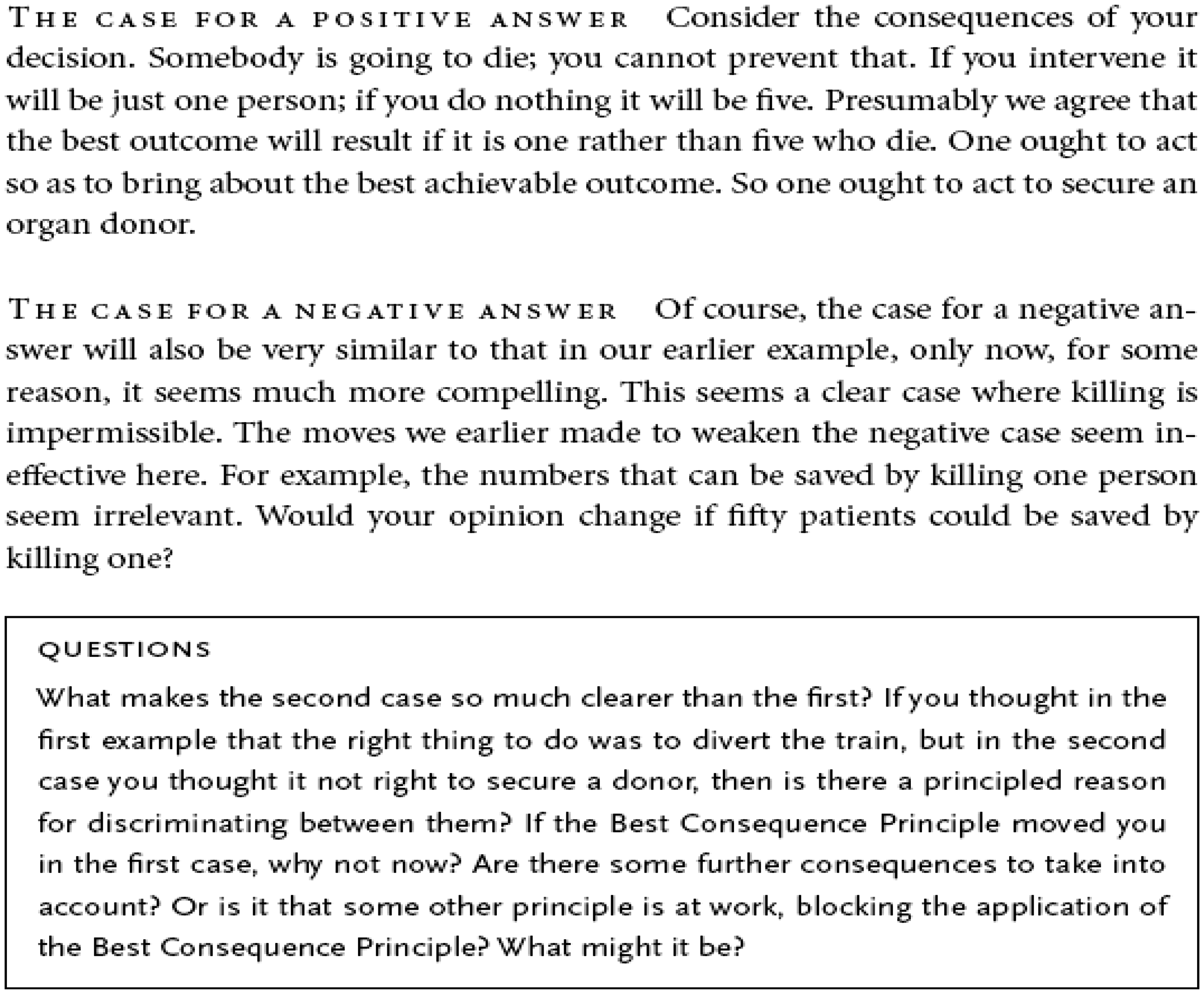
The model suggested in Figure 2 is one alternative approach to presenting reading materials to first-year students. In effect, in this subject, the pre-lecture readings are textbook-like. In designing a prototype MiRM to display to prospective participating lecturers, from this model we appropriated the ‘question box’ idea, but reduced the overall quantity of text to several key extracts and annotations.
The theme of the imaginary lecture on which we based our first prototype was Cosmopolitanism. In the proposed ‘ideal’ model, short but highly illustrative extracts from fuller texts are presented and annotated. Each of the extracts selected for this topic’s reading highlighted a particular theme in the week’s lecture. Either the full texts of the articles would be included in the subject handbook or references/links would be made available for students to undertake follow-up reading. The prototype MiRM we developed looked like the one shown in Figure 3; in the DVD and online versions, the underlined terms/phrases were linked via HTML to glossaries.
A sample of a prototype minimalist reading model 2. A sample of an implemented minimalist reading model 1.

As we hope is obvious from this example, instead of ‘drowning’ students in prescribed reading – in what might be called the ‘sink or swim’ methodology of conventional approaches to tertiary reading requirements – our version of the ideal MiRM would seek to gradually enrol students into their new discourse community by focusing on differentiated quality rather than undifferentiated quantity.
This approach could also have the added bonus of helping students learn how to read texts, that is, to read actively, to recognize, for example, the importance in their reading practice of taking questions to a text. However, while a good start, it is clear that lecturers annotating texts and posing questions of the extracted passages in and of itself will not necessarily lead to enhanced critical reading skills. More would need to be done. For example, it would be beneficial for lecturers to explain to students the rationale for the choices of the MiRM extracts, which would at least model for students the analytical processes that underpin expert critical dissection and assessment of a text. In addition, making explicit the pedagogy underlying the MiRM scaffolding could also engage students in reflection on the meta-processes of their learning, in general, and of their reading, in particular. Students learning about their learning is helpful, we believe, in encouraging the transition from surface to deeper learning outcomes (Marton and Säljö, 2004). A further teaching opportunity, an opportunity that might even comprise part of assessment, could be to encourage students to develop their own MiRMs and to construe the questions to complement the passages selected by the lecturer. This type of task could assist students compiling an annotated bibliography. Thus, the remaining passive learning/transmission model features of the MiRM could be reduced. In these ways, we understand the MiRM as another step in the direction of energizing discussion of the function of reading lists and their design rather than a comprehensive solution or alternative to conventional models.
The minimalist model is also intended to introduce new and sometimes expert vocabulary and to highlight major themes in a subject that could then be more productively elaborated on in lectures and later made open to more fruitful discussion in tutorials. The basic principle of the proposed minimalist reading model is that of quality over quantity. As the extract from the prototype model in Figure 3 shows, the initial emphasis is on developing students’ engagement with a subject area. Stokes and Martin (2008: 118) make the point that ‘tutors [lecturers] had put into reading lists those texts which had influenced and engaged them significantly’. These tutors, according to Stokes and Martin, anticipated ‘students too would discover similar excitement from these works’. Ironically, the absence of pedagogical finesse in the conventional maximalist approach to the presentation of pre-lecture readings might just be more dissuasive of engagement than encouraging. As seen in the next example (Figure 4), in this case from the subject English as an International Language, the models realized in the trials of the minimalist model remained quite faithful to the original prototype.
The next example (Figure 5) reaffirms the basic design features of the minimalist approach to presenting reading texts for novice and/or transition students. Key ‘chunks’ of targeted information or theoretical discussion are elaborated on or ‘unpacked’ by the lecturer.
A sample of an implemented minimalist reading model 2.
As is clear from these samples, each lecturer participating in the study approached the design of his or her MiRM in slightly different ways. Time did not permit us to survey participating lecturers as to their reactions to the model or to establish what practical difficulties or drawbacks they had encountered. However, from our own experience in designing the ‘ideal’ version sampled above, the process was relatively time-efficient. More recently, the authors have developed MiRMs over one semester of teaching for use in subsequent teaching periods. This process is a very effective technique in progressively building and trialling a MiRM in tutorials and enrolling students in its development. Overall, the model is intended to be flexible and we would not wish to be too prescriptive about its design. As far as we are concerned, the key point of proposing the MiRM is to encourage lecturers to reconsider how they present readings, especially to transition-level students. As far as we are concerned, some effort to add value to the readings by annotation can only be beneficial. As students are gradually enculturated into a new and often quite challenging community of enquirers, we contend a more minimalist approach to reading requirements, together with glosses and annotations, should provide a starting point from which students can more certainly commence the journey of their cognitive apprenticeship at the tertiary level.
We also considered that re-thinking conventional approaches to the presentation of reading texts (annotated extracts plus glossaries) and a more thoughtful approach to the design of reading lists could even address one of the perennial problems of tertiary teaching, not just in arts and education subjects but in other Faculties as well: low participation in tutorials. In agreement with Habib (2007: 205) we would also argue, ‘to participate effectively students need to be familiar with key concepts from the topic reading material’. Carroll (2005: 42) argues something similar for lectures. She proposes that teachers can assist by offering ‘a glossary of terms provided the week before, or a list of key topics, or a suggestion of a relatively small amount of introductory reading’. Achieving this sense of familiarity with a topic in tutorials and lectures might be compromised by poorly designed reading lists and perhaps even too much reading, too soon.
In spite of the mixed reception to the MiRM, we continue to contend that a more careful, more pedagogically informed approach to these under-attended-to areas of the teaching and learning matrix could offer up surprising and productive outcomes, especially in terms of student engagement, participation and finally attainment of a well-rounded comprehension indicative of what Marton and Säljö (1984: 42) described as ‘deep learning’. The minimalist reading model we have trialled and evaluated should be understood as one step in reducing the obstacles to fuller student engagement with, and understanding of, their new discourse. Yet, as the following data samples from our trial show, our best intentions were not entirely commensurate with our participants’ reception of the model.
Data and discussion
It is important to note again at this stage that the MiRM was not intended to replace conventional reading list models. It was proposed as a complement to conventional maximalist models and is perhaps not appropriate (or necessary?) for those reading lists that support assessable research task assignments. Despite the results of research in the field of second-language acquisition that suggested glosses and electronic linkage to synonyms and translation did not impact significantly on learners’ comprehension of text (Ariew and Ercetin, 2004; Sankó, 2006; see also Lomicka, 1998 for an alternative, albeit earlier, perspective on this question), we presented the MiRM in all three delivery modes to students in four units in arts and education subjects. Data were collected in two phases. The first occurred towards the end of the first semester. 160 participating informants completed either paper-based or online questionnaires; 19 made themselves available for individual interviews; two focus groups were also sampled for qualitative data.
Responses from this first round of data collection are indicated by the appellation ‘P1’ (e.g. Inf.19 EDF P1 refers to informant 19 from the Education unit from phase 1 of testing). In the following semester, all participants were again invited to take part in an online survey, this time with a slightly different set of questions that focused more on informants’ responses to the minimalist reading model. Responses from the second phase of data collection are indicated by the appellation ‘P2’. It was anticipated that the second testing would confirm the validity of the data collected in phase 1. Also, we were interested to see if informants would offer comparisons between their semester 1 and semester 2 units in terms of the multi/mono modes of delivery of their T/L resources and the perceived usefulness or otherwise of the MiRM.
In both phases mainly qualitative data were sourced from study participants regarding their responses to the MiRM. Pleasingly, a number of responses highlighted positive features of the model. Several respondents, for example, commented favourably on the presence of a glossary: ‘Glossary is very useful.’ (Inf.6 EDF P2) ‘Especially the glossary, it provides me with some terms frequently used in this unit and those are quite new terms for me.’ (Inf.9 PHL P2)
A number of participants made direct connections between the presentation of annotated extracts from primary texts and a deeper understanding of the issues in their readings: ‘It [the MiRM] summarizes the articles for each chapter which makes it easier for me to understand the article.’ (Inf.7 PHL P2) ‘In my opinion, overall is useful for me to understand each topic main points.’ (Inf.8 LIN P2) ‘It assists more to understand the lecture readings by having summarizing the main ideas and important issues discussing by the authors.’ (Inf.12 LIN P2)
These views supported our hypothesis that annotation and/or the selection of key extracts from readings serves to guide students into the readings and towards a deeper understanding of the issues discussed therein: ‘They give more explanations toward the issue of the subjects, quoting important views from different scholars which guides me to search for further readings.’ (Inf.13 PHL P2) ‘Very useful for review.’ (Inf.10 EDF P2) ‘Sometimes it provides some background information.’ (Inf.11 EIL P1)
The MiRM, according to a number of other respondents, was perceived as useful in pragmatic terms, to reduce the time spent reading: ‘… [MiRM] have some key points and some important parts of the reader and if … we just read about the original readings, it’s too long and we can’t have the patience to finish all that … so that will help us understand about the reading.’ (Inf.6 EDF P1) ‘Oh, I think it’s [MiRM] very helpful … the um … it’s very clear, the information in it very clear and sometimes the reader is too long to read.’ (Inf.3 EDF P1)
However, in one focus group, an interesting exchange occurred relating to the MiRM. One informant admits to the usefulness of the minimalist reading model but is critical of its impact on students’ learning discipline: ‘… but the orange one [the MiRM booklet] … sorry I don’t like that … it makes us lazy you know if you gave us that thing, I don’t want to read the thick article instead of that just two pages, but I believe Master course students have to read at least one or two articles for one lecture, so I don’t need, so you should not organize such that. Of course it’s useful to understand but it’s not good for students.’ (Inf.14 EDF P1)
In response, in the focus group a classmate immediately challenged this perspective, even expressing disappointment that the MiRM had not been offered for all the lectures in the unit: ‘I’m sorry but the orange one is helpful for me (laughing) … it’s from week 8, it’s a bit strange. If it starts in week 1, it’s really helpful … For me, I will read it and it’s a good summary.’ (Inf.15 EDF P1)
In the trial, only a handful of lecture readings were ‘converted’ into a minimalist reading model. We anticipated this would encourage students to compare the advantages and disadvantages of the model from week to week. The most trenchant criticism of the MiRM was offered by a mature-age returning student. It is useful to provide an extended sample from the interview because a range of issues is highlighted by the informant’s strongly felt response to the minimalist reading model: ‘What about the orange supplementary materials that [the lecturer] gave out to you about three or four weeks ago?’ (Interviewer) ‘Diametrically opposed to that, I thought that was terrible. I thought that to even contemplate trying to collapse … however I can understand that some people whose language of learning isn’t English may well have found that useful. I actually thought it was an affront.’ ‘An affront in the sense that it was below the standard you’d expect from a Masters student?’ ‘Yes, absolutely, absolutely. In fact it was below the standard that I would expect at year 8 or something.’ ‘So the actual register or the level of language used in the glossaries?’ ‘The register was fine. It was the very notion of the collapse, collapsing the article into … I think I checked one, I was so angry, I checked one, I think it was something like 13 pages down to 4 paragraphs. I mean, lazy …’ ‘Mmhmm.’ ‘That’s just so lazy if you can’t read 13 pages … at Masters level.’ (Inf.18 EDF P1)
As the informant’s comments suggest, the MiRM is believed to represent the ‘dumbing down’ of the curriculum, as well as being counter-productive for students’ study discipline (‘lazy’). It might be that the informant misunderstands the function of the MiRM, seeing it as a proposed replacement for full-length texts. The informant does, however, recognize its potential usefulness for non-English-speaking background (NESB) students. Overall, positive responses to the MiRM were fairly evenly balanced between English-speaking background and NESB informants.
Misunderstanding of the MiRM’s intended purpose has been very difficult to counter. In conference presentations, for example, as much as we have tried to specify the MiRM as a complement to full-length reading lists, still concern over its potentially detrimental effect on academic standards, on the quality of learning, persists. The authors have at times been surprised by the strength of some negative responses to the proposed rethinking of conventional approaches to the design of reading lists. As the mature-age student’s response well suggests above, especially at the postgraduate level, there is an almost non-negotiable expectation that students read extensively, in breadth and in depth. Indeed, this reading requirement is seen to constitute a fundamental component of the higher education enterprise. It is not, we hope, a requirement that is in any way undermined by the MiRM. Instead, we would like the MiRM to be considered as a smart ‘add on’, especially in undergraduate units and especially for very new entrants to the academy. It is an innovation that should see students manage complex readings more successfully. But, how to successfully convince others of this? It may depend on generating a type of ‘critical mass’ effect. The authors anticipate that the generally positive responses from the study’s participants might at least encourage some lecturers to experiment with their own versions of the MiRM and report on these experiments to the broader academic community.
To sum up discussion of our findings, while not all informants were positive in their response to the minimalist reading model, those who were acknowledged it mainly as an aid to greater comprehension of the issues in the readings and of the lecture themes. To this extent we feel the trial of the MiRM supported our views on the benefits of reconfiguring the presentation of required readings and the design of reading lists. Finally, a number of limitations need to be clarified. First, in terms of respondents’ gender, there was a significant imbalance: more than 80% were female. We are unsure how, if at all, this might have affected the quality of the data we collected; it certainly encourages retesting of the model with a better gender mix in the research sample. In addition, the trial took place in just four subject areas in just two faculties. On this basis, we would be cautious in generalizing our findings too broadly, or concluding results too strongly. Again, what is made manifest is the need for ongoing research into these issues. In particular, it would be useful to clarify which specific techniques in the design and application of the MiRM actually contributed to enhancing critical reading skills. Equally useful research could focus more on lecturers’ attitudes to reading lists and their responses to the minimalist reading model.
Conclusion
As university student populations become more diverse, especially given the rapid internationalization of universities in countries such as Australia, teaching academics and managers need to respond to the challenges these changes bring with innovation as well as sensitivity (Marginson, 2004). Clearly, a wide range of personal as well more pragmatic external factors impact on students’ study programmes. These external factors include time and access limitations as well as financial factors that all contribute to a student’s overall capacity to engage successfully with his or her learning. Perhaps the central issue raised in this paper relates to the need to design, as far as is practical, for diversity in the provision of tertiary education (Collins, 2001). Designing for diversity, however, must also negotiate the provision of adequate levels of teacher and student training in adapting to innovative teaching and learning approaches (Aronowitz, 2000). The adoption of a minimalist reading model, while representing an initial additional time cost to teachers, might also generate considerable benefits to students and in the long run perhaps even greater satisfaction for teachers. In our experience, most university students are not ‘lazy’, nor are lecturers apathetic about higher education. In this respect, we reject the idea that the minimalist reading model we have proposed suggests or represents a move towards the ‘dumbing down’ of the curriculum. Indeed, by fine tuning the pedagogical focus of approaches to students’ reading at university, it more represents a ‘smartening up’ of a core process of tertiary teaching and learning, one which for too long appears to have been taken for granted.
Footnotes
Acknowledgements and dedication
The authors would like to thank the Australian Learning and Teaching Council, an initiative of the Australian Government Department of Education, Employment and Workplace Relations, for funding this project, ‘Evaluation of teaching and learning resource delivery modes in Arts’. We would also like to acknowledge the very insightful advice provided by two anonymous peer reviewers.
The article is dedicated to Associate Professor Jim Peterson (1939–2012), who acted as Chief Investigator in the project on which this article reports and who contributed much to the writing of this article. Dear colleague, friend and mentor, you will be well missed.