




Abstract
In this article, I explore the history of a higher education writing community from its establishment in 2005 to the present day. In order to provide a model of community development which may be generalizable, this inherently ‘partial’ and ‘prejudiced’ autoenthnographic account is framed by themes taken from three of the novels of Jane Austen (1775–1817) which mirror the transitions in the community’s development. These transitions, ‘Pride and Prejudice’, ‘Sense and Sensibility’ and ‘Persuasion’, enhance an existing three-phase model of research group impact which comprised ‘Awareness’, ‘Exploring wider effects’ and ‘Adaptation and extension’ by articulating the social and cultural means through which we evolved from one phase to the next. My reflections lead me to make three recommendations for community survival. These are to create alliances with external researchers, to balance collegiality and strategic research endeavour, and to recruit and nurture doctoral students.
N.B. There will be very few Dates in this History. (Austen, 1791: 2)
Introduction
This is the history of a higher education research community which was bonded by, and defined through, academic writing. Lest any Janeite be disappointed, let me explain that the ignorance referred to in this article’s title concerns my intimacy with recent Austen criticism. While Jane Austen (1775–1817) is important to me and to my story, my article claims no importance for Austen scholars. Established in 2005 to strengthen interdisciplinary research capacity within a British teaching-led university, our community used one-to-one support, friendly critique, writing retreats, writing workshops and peer review to develop colleagues’ writing skills. Our purpose was to reinforce our host institution’s research standing through the production of journal papers and successful funding bids. As a founder member of this community, I observed it develop over six years to achieve widespread recognition and an international membership of hundreds. I therefore acknowledge the possibility of partiality and prejudice. However, while our experiences are highly contextualized, the patterns of group interaction, the social norms established within the group, and the social selves identifiable amongst group members provide a personal narrative which may resonate with others (Ellis and Bochner, 2000). For the purposes of anonymity, I shall call this peer-led community ‘Meriton’. 2
Autoethnographic analysis (Denzin, 2006; Ellis and Bochner, 2000; Hammersley and Atkinson, 2007) of the phases through which Meriton has evolved led me to adopt three of Jane Austen’s novels as a conceit, that is an extended metaphor, through which to deconstruct and interpret my community’s development. The analysis grounding this study draws on my own day-to-day experience, as well as on the scholarly outputs of group members, providing insights into the group’s evolving weltanschauung. Through this study, and through comparison with existing models of group and community development, I have arrived at a new composite model which conceptualizes a community’s evolution as a series of phases and transitions. The transitions supply the means by which a community may evolve. For Meriton, this meant to become increasingly effective in demonstrating research impact through our writing. The novels representing these transitions (Pride and Prejudice, Sense and Sensibility and Persuasion) provide a possible ‘typolog[y] that hold[s] out the prospect of application to data from other situations’ (Hammersley and Atkinson, 2007: 172). Thus I offer an understanding of the evolution of an academic community which others within the arts and humanities may find applicable to their own research or writing communities. The three key recommendations I draw from this study are to create alliances with established external researchers, to balance collegiality and strategic research endeavour – perhaps by framing the former in terms of the latter – and to ensure sustainability through the recruitment and nurture of doctoral students.
Metaphorical insights through Austen
Two hundred years after the publication of her first novel, Jane Austen’s influence on western society remains significant, through film, television and radio adaptations; through studies, parodies, prequels and sequels; and perhaps most tellingly through journalistic play on the titles of her novels. My lifelong love of Austen persists because I find the writing both reassuring and incisive. As Tanner (1969: 10) contends, she ‘helps us appreciate the value of the real thing by juxtaposing a travesty or parodic version of it’. On similar lines, I have come to appreciate a real thing by juxtaposing a metaphorical version of itself. The universality of Austen’s writing, its ‘imaginative leaps’ (Evans, 2010: 14), and its representation through key phrases and themes, provide my means of conceptualizing Meriton and of making sense of its members’ stories (Hammersley and Atkinson, 2007).
I use Pride and Prejudice, Sense and Sensibility and Persuasion, the only three Austen novels that ‘set up intellectual and moral debate in their titles’ (Beer, 1998: xv), to frame the analysis, leading to a new conceptualization of community evolution which I explore in the next section. It is not that the particular stories themselves are relevant here, but that some essence encapsulated by each is apposite and provides insight into the development of Meriton and its members’ personal growth. This approach is not original. Glaser and Strauss (1967) suggest using relevant fiction to find ideas for the qualitative analysis of grounded research, while Hammersley and Atkinson (2007: 125) note that popular fiction may ‘suggest themes, images and metaphors’. Alvesson and Sköldberg (2000: 89) suggest that ‘the better the metaphor, the more striking and surprising the correspondence’. The use of the three Austen novels as metaphors for the phases of Meriton’s evolution struck me this way. The idea came to me, almost fully formed, when considering how to present my work to a conference concerned with higher education communities which by chance was to hold its conference dinner at Chatsworth House, the location for the palatial Pemberley in the 2005 film of Pride and Prejudice. My train of thought began with the opening sentence of Austen’s novel – ‘It is a truth universally acknowledged, that a single man in possession of a good fortune, must be in want of a wife’ – which captures the assumption that ‘we all’ know what other people want or need, better than they do themselves; the naïvety and humorous potential of this misplaced assumption; and the social divisions implicit in such a statement. For me, this exposed uncomfortable parallels with Meriton’s first months when we assumed that the obvious benefits of our research support would attract our colleagues and when our internal divisions distracted us from our common goals. The extent to which my approach is found to be valid will depend on the degree to which it fits the reader’s experience (Lakoff and Johnson, 1980). The novels each provide themes which emerged heuristically through reflection on the experience, and reflection on the related novel. These themes scaffold my analysis and are accompanied by quotations from the novels which complement my reflections.
Methodology
Since the evolution of this academic writing community is also my own story, I have adopted an autoethnographic approach to explore the experience through my own contemporary writings and memories, focusing on social action and interaction (Denzin, 2006). Like an all-seeing narrator, I have also drawn on colleagues’ reflections at least as far as they are documented in their publications. Yet, unlike a narrator, as an autoethnographer I am a ‘complete-member’ of the community I depict (Ellis and Bochner, 2000: 740), aware of the aspects which allowed the academic writing community to develop as well as those which have frustrated its development. My approach allows me to interpret the theoretical, cultural and political aspects of the narrative which emerge (Hammersley and Atkinson, 2007). This is helpful in understanding our diverse motivations and in connecting these experiences to the wider culture (Ellis and Bochner, 2000). However, in order to draw out the generalizable nature of these experiences, I have backgrounded many of the historical specifics of the context. This is a history that, like an Austen novel, apparently ignores history (Musselwhite, 1987). My analysis of the development of the Meriton community also draws on the Austen novels themselves, with a section dedicated to each of Pride and Prejudice, Sense and Sensibility, and Persuasion. For each novel, limited critical insights are taken from two contrasting editorial introductions. The first from the dog-eared copies that lay by my bed as a student of English and Linguistics in the 1970s; the second from replacement copies bought as these events unfolded. Regarding my ethical stance: the publications on which I draw were all developed under the relevant ethical frameworks of the host institution. In adopting the perspective of autoethnography, I acknowledge the ethical issues relating to interpretation of others’ writings and actions: that is, this is my personal interpretation of this experience.
Conceptualizations of community development
In creating the Meriton community, I and my two co-founders, ‘Ellen’ and ‘Emma’, recognized that academic writing skills are vital to academic careers (Antoniou and Moriarty, 2008; Murray and Newton, 2009), and that their effective use would be crucial in advancing the institution’s existing piecemeal interdisciplinary research into a critical mass of academic writers. We visualized a community of practice (CoP) (Brown and Duguid, 1991; Lave and Wenger, 1991; Wenger, 1998) in which novice writers would learn from more experienced colleagues, drawing on a shared repertoire of research methodologies and undertaking the mutual endeavour of collaborative authorship. In Wenger’s terms, Meriton could be defined as a CoP because it would be a grouping of professionals – higher education practitioners from across the institution – who were to work actively on a shared interest in academic research, solving shared problems through friendly critique of each other’s work, sharing and constructing knowledge over time through our academic writing. As I will show, this was not a straightforward undertaking.
Our community’s membership was informal. It fluctuated as individuals joined and left the institution, expanding as face-to-face contact and virtual activity reached interested colleagues around the world. Meriton also seemed to mature over time as it became more embedded in our host institution and more widely recognized in the external research world. Dubé, Bourhis and Jacob (2006: 76) suggest that the identification of the current developmental phase of a CoP ‘may help explain its specific challenges and issues, and the decisions and actions that are needed to lead it to success’. Similarly, conceptualizing the evolutionary phases of a writing community may be helpful in effecting interventions in its establishment or development. But which model and which phases are most appropriate?
Wenger et al. (2002) proposed a maturation process for communities of practice which is divided into ‘potential’ (the phase of possibilities), ‘coalescing’ (the CoP begins its work), ‘maturing’ (the CoP’s visibility rises), ‘stewardship’ (the CoP nurtures the knowledge it has built) and ‘transformation’ (an event creates a need for renewal, change or closure). Widely debated, the model was expanded by Hara et al. (2009) with two further phases, ‘stability’ and ‘disband’. This observational model of community development follows the maturation phases from the outside, looking in. It effectively describes the functions of a CoP but is little concerned with the internal life of those involved. While focusing on the relationships in and between a CoP and its environment, it ignores cultural aspects, and is therefore of limited value to those wishing to understand or intervene in a community’s social evolution.
In a review of almost 100 articles representing research into group development of the past fifty years, Arrow et al. (2004: 75) found six thematic strands. I find three of them pertinent here:
‘Groups change systematically over time; they develop’; ‘Group processes have temporal patterns’; ‘Groups are complex systems characterized by nonlinear dynamics’.
Thus, firstly, the systematic changes identified by the various models of group development reflect internal adjustments within a group as it sets about its focus of activity. The particular phases of developmental change are disputed, but they broadly concern patterns of behaviour which represent ‘change, stability, and continuity’ (Arrow et al., 2004: 80). Secondly, group processes within a given phase (for example, the adoption of roles) may proceed more or less quickly, for complex reasons which again are disputed. Thirdly, the internal heterogeneity of groups, their intricate organizational structures and their multiple relationships with the societies within which they are embedded have led to a range of characterizations of groups as complex systems.
To characterize a group as a complex system is almost tautologous since, according to Connor (2010), society itself is a complex system. While accepting that Meriton could be conceptualized as a complex system, I present it here simply as a community – a subset of society – and must look beyond group theory for a useful framework with which to explore its evolution. Like the town of Meryton in Pride and Prejudice, Meriton could be defined by the co-location of key members, by the co-dependence of its people and by their social interaction resulting in ‘a shared understanding that the group is a group from the perspective of its members’ (Reynolds, 2011: 361, italics as in the original). However, the activities of the group and its unifying purpose of creating research impact through academic writing are important for its external recognition and may therefore hold the key to its evolution. For this, I turn to the three-phase strategy which Saunders et al. (2008) suggested as the model against which to evaluate the success of the English Centres for Excellence in Teaching and Learning
3
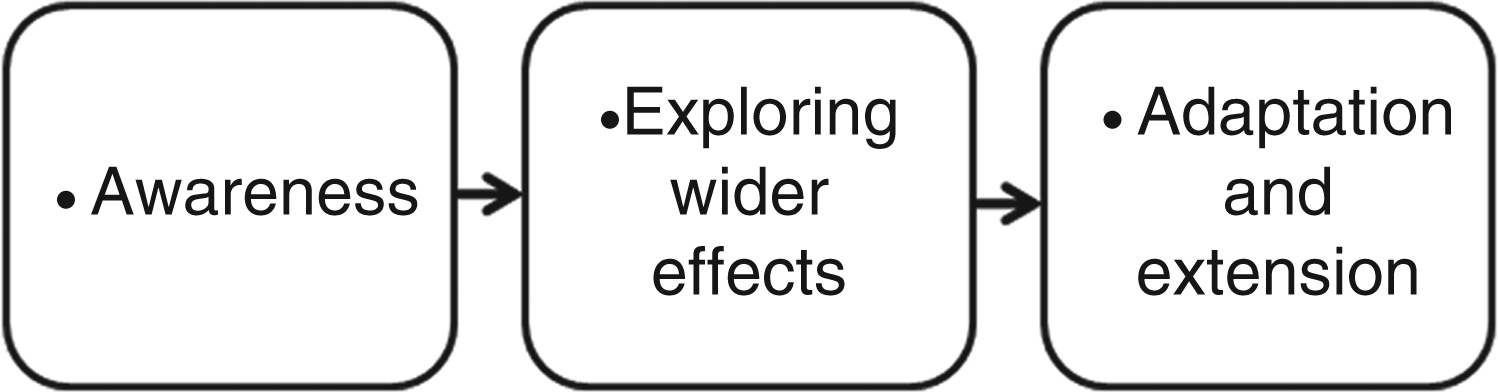
(CETLs) in embedding their innovative practices. Like Meriton, each CETL was established as a research group, and like Meriton, they set out to have impact through collaborative research and dissemination. The CETL evaluation model is depicted in Figure 1 and comprises:
‘Awareness’ (largely local impact and some external engagement); ‘Exploring wider effects’ (focus beyond the local network to the wider discipline and new work); ‘Adaptation and extension’ with its attendant ‘increased coordinating and cooperating with other stakeholders in using new practices, systems and processes’ (Saunders et al., 2008: 7). Awareness: we established a ‘brand’ for the community with a logo, website and local launch event. We set up one-to-one support and special interest groups, held our first writing retreat for colleagues and disseminated our strategy at external conferences. Exploring wider effects: we launched a series of annual international conferences, held writing workshops and national research seminars. We published widely and involved our global network in the creation of an edited book and special issues of an international journal. Adaptation and extension: we regrouped under new organizational structures to continue our work from within administrative, research and teaching departments, each working in partnership with external organizations. Our stakeholders include publishers, funding bodies, students and institution management as well as local colleagues and virtual network members. CETL change model depicting the phases of embeddedness, derived from Saunders et al. (2008).
The CETL change model emphasizes the importance of collaboration, and presents its phases as developmental, their outcomes increasing in impact and embeddedness. This approach has been seen as a framework for sustaining innovation in teaching and learning projects (Joyes et al., 2009) but has been criticized as a post hoc and imposed means of evaluating the impact of the CETLs (King, 2010). However, it reflects my experience of our academic writing community’s development as follows:
The CETL change model usefully conceptualizes the developing impact of Meriton over a six-year period. However, it omits the means by which we evolved from one phase to the next. These are social and cultural transitions, as shown in Figure 2:
‘Pride and Prejudice’ to be overcome in order to move from an ‘Awareness’ phase to that of ‘Exploring wider effects’; ‘Sense and Sensibility’ to be balanced so as to move from ‘Exploring wider effects’ to ‘Adaptation and extension’; ‘Persuasion’ required fully to embed our work of ‘Adaptation and extension’. Composite model depicting the phases and transitions in the community’s evolution.
I now analyse each of these transitions autoethnographically, using metaphorical themes arrived at through reflection.

Pride and Prejudice
Newcomers
He was the proudest, most disagreeable man in the world, and every body hoped that he would never come there again.
Pride and Prejudice (Austen, 2003: 13)
When ‘Ellen’, ‘Emma’ and I first arrived in our host department we were treated like visitors. Seconded as research fellows and preceded by our reputations, we were expected to bring in thousands of pounds in research income but could not authorize our own spending. Our ambivalent position was soon resolved but Meriton’s social divisions remained. Our members came from many disciplinary tribes (Becher and Trowler, 2001) whose different social interaction norms created barriers. Over the years I had learnt to collaborate with mathematicians and engineers, as well as with colleagues from the arts and humanities. However, I initially doubted the sincerity of colleagues from health science. Their cheerful and friendly ways rang false with me, while they had difficulties with some other collaborators and say they found me terse and over-technical at first. Words like ‘balkanisation’, ‘brinks’ and ‘borderlands’ appeared in our early writings as we tackled our uncomfortable and competitive research world. In Meriton, as in the novel, we pre-judged and re-judged each other (Tanner, 1972), perhaps because we were collaborators who vied for research grants. According to Jones (2003: xxv), Pride and Prejudice highlights the dangers of over-reliance on one’s own insightfulness and requires that ‘Elizabeth’s prejudice fall with Darcy’s pride’. So, in a way, was it with us. But, as we began to share our insights and overcome our prejudices, we realized that ‘Emma’ had ambitions beyond Meriton. She advanced her career elsewhere and, like a married daughter, she now lives apart but retains links with us which have proved mutually valuable. Her leaving also strengthened the bonds between those who remained, making it easier for us to evolve together.
Accomplishments
“All this she must possess,” added Darcy, “and to all this she must add something substantial, in the improvement of her mind through extensive reading.”
Pride and Prejudice (Austen, 2003: 39)
Meriton’s members varied in expertise as researchers and academic writers, but through working and writing together we came to appreciate one another's abilities and to identify the gaps in our own skill sets. We, too, found that ‘for some academics, writing and becoming a writer is a constant source of disjunction’ (Wisker and Savin-Baden, 2009: 243–4). In retrospect, it would have been wise to enrol some colleagues onto research modules or doctorate studies, but local policy thwarted this. Instead, we adopted an autodidactic approach, supplemented by collegial support. Our most productive writers suggested writing for an hour or two very early every morning, reading ‘everything’ and developing a wide repertoire of research methods so that the right choices could be made for any study. Above all, as Elizabeth Bennet is advised, and Antoniou and Moriarty (2008) assert: practice. Writing retreats structured along similar lines to the Murray and Newton (2009) retreat model aided the production of publishable outputs by colleagues from across the institution. However, we found, as did Gourlay (2011), that it was difficult for those with heavy teaching and administrative loads to commit time to our collaborations. Although the support we offered was widely taken up, individuals found it difficult once back in their own departments to complete their writing tasks. Furthermore, we had no overarching theme. Like the collected letters of any community, our publications represented individual and small-group interests. The tribalism and territoriality of the different disciplines represented in Meriton created some of these divisions. Seen by some as less important than single disciplinary research, our focus on interdisciplinary research caused several potential collaborators to withdraw. Such prejudice is not easily overcome and in order to evolve, our response was to work with those who were willing to work with us.
Rank
What a fine thing for our girls!
Pride and Prejudice (Austen, 2003: 6)
Pride and Prejudice offers ‘the stuff of wish-fulfilment’ (Jones, 2003: xi) as a gentleman’s daughter marries a man of large fortune and high social rank. Meriton’s long-term objective was to break the barriers of the research hierarchy through collaboration with established researchers nationally and internationally, and the winning of funding riches. We found this to be partially dependent on our access to professorial role models and mentors (Macfarlane, 2011). Through personal contacts, we booked keynote speakers for our first international conference; they helped to establish our validity both internally and externally. The influence of such powerful players within the wider research community brought opportunities for local colleagues whose ‘want of connection’ (Austen, 2003: 192) could be enhanced by Meriton’s growing network of contacts. We explored this in a conference symposium which addressed the role of the individual within a research community. In considering Becher and Trowler’s (2001) observation that academic life is more competitive in contexts where the gaining of an academic reputation is more valued, I discussed the need I was beginning to see to work ‘selfishly’: that is, for Meriton to prioritize publication and research over other distractions. It had taken time for me to appreciate the political aspects of our social context, but the process of writing my symposium paper had helped me to see things less naïvely. Indeed, we could not ignore internal politics and hierarchy: during a meeting at which we debated options for software to support our work, the chair ruled that this was not the forum for ‘arcane’ technical details. Arcane? We were dumbfounded. How could anyone believe that such matters were anything other than central to our existence? For me, this was the turning point when the differences within Meriton were subsumed into our joint distinctiveness. Over this first year, our sense of group identity, reinforced by external recognition of Meriton as a new player in our field, enabled us to move from the ‘Awareness’ phase to ‘Exploring wider effects’.
Sense and Sensibility
Reflection
Reflection had given calmness to her judgment, and sobered her own opinion … she wished, therefore, to declare only the simple truth.
Sense and Sensibility (Austen, 1995: 325)
Meriton’s collaborative deliberations continued to improve the quality of our research and writing, echoing experiences of characters in the novel as we benefited from others’ ‘understandings, insights and avenues for improvement’ (Ghaye and Ghaye, 1998: 11). I remember a conference symposium we gave in which three viewpoints were drawn together by a narrative thread. After the first two presentations, an audience member observed that he had never seen such different research approaches: mine so grounded, my colleague’s so theoretical. Our narrator managed to present this as a strength, but I was unsettled by the validity of the comment and adopted more balanced and reflective approaches in future work. Ballaster (1995: xv) comments that narrative distance in Sense and Sensibility allows events to ‘acquire the sort of perspective which can promote judgement rather than identification on the part of a reader’. One of our subsequent publications which benefited from this kind of distancing was also influenced by our contemporary experiences: we highlighted the problem of conflict within academic groupings and promoted compromise as the solution, echoing Tanner’s (1969) call for sense and sensibility to work together. During this second phase, Meriton acted with more conscious tactfulness. We developed the scale of our network in a variety of pragmatic ways, complementing our international conferences with local and national events. This ‘sense’ was balanced by the ‘sensibility’ of a growing ethical and moral sensitivity, exemplified by a concern for colleagues who might be excluded from participation. We aired this issue in a collaboratively written review of our first international conference which noted economic, geographic and linguistic barriers to participation, and our intention to seek funding to help overcome them.
Income
A present of fifty pounds, now and then, will prevent their ever being distressed for money.
Sense and Sensibility (Austen, 1995: 13)
Austen explores the extent to which one’s income may be subject to the whim of others. We found that we had to be part of the conversation to influence our funders, and realized that ‘Emma’ had understood this much earlier. Like us, characters in the novel take part in a ‘more-or-less delicate jostling for partners, property and power’ (Tanner, 1969: 7). Research groups within our home institution were judged on their success in ‘jostling for partners’, that is, winning external funding and collaboration. This was an area in which Meriton had only partial success, with several of our bids judged favourably but failing to be awarded. Having recognized the economic barriers to conference participation, we set fees low for students and for colleagues from countries classified by the World Bank as lower income, balancing the books by charging higher standard fees. It is clear in retrospect that our concerns over our network colleagues distracted us from a necessary focus on income generation. As a funded research group we had a responsibility to align our strategy with that of our institution. Our altruism should have been underpinned by coordinated efforts to make our group profitable in other ways and, eventually, we realized this. This transition required our concern for less privileged network members to be balanced by a strategic focus on the measures of success set by our home institution for us. This was not a docile assimilation of the ‘discourse of the market and the private sector’ (Looseley, 2011: 14); rather we saw our chosen course as one of ethical pragmatism.
Kindness
His kindness was not confined to words.
Sense and Sensibility (Austen, 1995: 32)
Tanner (1969: 34) argues that Austen’s novel shows that balancing sense and sensibility ‘is not easy and there is the chance of pain at every step of the way’. One of our co-authored book chapters looked more deeply at the ‘pain’ our academic colleagues had revealed in a survey we had undertaken. We noted how the altruism many perceived as key to their academic role in their desire to support students and colleagues was in conflict with their increasing tendency to operate ‘sensibly’, that is, strategically and alone. This resonates with the findings of Clegg and Rowland (2010) in relation to kindness in the academy. Perhaps unsurprisingly, they identify a gendered aspect to the tensions between kindness and unkindness, with kindness largely being seen as feminine. In our community, the majority of collegial acts and altruistic critiques of others’ writing were carried out by women, suggesting a focus for future enquiry into the balancing of ‘sense and sensibility’ amongst male and female researchers. Over time, we developed trust with colleagues internationally through generous give and grateful take. Just as Austen’s novel portrays the eventual reward of dogged kindness and constancy, so this transition was characterized by steadiness of purpose in building our community network rather than moments of epiphany. Thus sense and sensibility were balanced as we moved from ‘Exploring wider effects’ to ‘Adaptation and extension’.
Persuasion
The critical friend
Mrs Smith had been able to tell her what no one else could have done.
Persuasion (Austen, 1998: 199)
Through our earlier activities Meriton has developed an international network of critical friends: scholars who are willing to contribute to our work by offering useful feedback on scholarly outputs. We provide similar support to a writing group (Rickard et al., 2009) in that all of our papers undergo detailed critique by colleagues before submission. Additionally, where we are the editors (for books, conference proceedings and journal special issues), we arrange for anonymous but supportive peer review. This friendly critique reduces the difficulties in exposing ‘one’s ideas and identity to public scrutiny’ (Antoniou and Moriarty, 2008: 165). More formally, critical friends from another institution or discipline are paid to provide an independent voice in research projects, or, unpaid, supply critique which becomes part of a publication. We piloted this model of internal critique in our first jointly edited book to good effect, and have used it subsequently in a second edited book to ensure the rigour and international relevance of contributions. However, as one of our original authors noted rather bitterly, the weakness in giving one academic a platform to publicly critique another’s writing is the opportunity some take to promote their own work. I had tried to avert this by encouraging each author to select their own ‘friend’ and by offering the opportunity to revise the chapter once the critique had been written. In the end, I placed the critiques at the end of each chapter rather than at the start as previously planned, giving command of the platform back to the author.
Admiration
At Lyme, he had received lessons of more than one sort. The passing admiration of Mr Elliott had at least roused him, and the scenes on the Cobb, and at Captain Harville’s, had fixed her superiority.
Persuasion (Austen, 1998: 226)
This quotation highlights others’ influence on our valuation of those we think we know. While researching the notion of academic impact we began to recognize a parallel between what was happening to Meriton and what had happened to another research community with which we were involved. In a conference poster we explored how such groups gain status in their home institutions from the appreciation they attract externally, mirroring this theme in Persuasion (Beer, 1998). We observed that it should be easier to raise awareness, influence and instigate changes in thinking locally amongst colleagues than externally, yet our experience suggested that the converse is common. Our own management were, to an extent, persuaded of our worth because of our value in the wider academy, acknowledging this in awarding ‘Ellen’ her professorship in 2011.
Commonwealths
Every little social commonwealth should dictate its own matters of discourse.
Persuasion (Austen, 1998: 41)
Structural reorganizations within our home institution finally separated Meriton’s core team physically, leading to the purposeful creation of new research groups. Our role is now to bond these communities as they undertake research that is strategically beneficial to our institution. We span these different discourses and, like Anne Elliot in Persuasion, we benefit from moving amongst and between them (Harding, 1965) as evidenced in our many collaborative publications. As an audience member suggested to me at a conference, ‘Meriton’ is a meta-community: what Brown and Duguid (1991: 53) would call a ‘community-of-communities’. We encourage debate and exchange between adherents of the different methodological or disciplinary ‘social commonwealths’, and our impact continues to be adapted and extended through the work of a growing number of doctoral students with the ‘new pluralistic models of thinking’ suited to interdisciplinary research (Looseley, 2011: 17). Rather late in our development, we have recognized that nurturing these new research ‘residents’ is the key to sustaining our community.
Discussion
Introducing three new transitionary phases to the Saunders et al. (2008) change model addresses the social, cultural and political aspects at play in the evolution of an academic writing community seeking to have significant research impact. Since an ethnographer’s ‘writing is shaped by what they have read’ (Hammersley and Atkinson, 2007: 192), my adoption of Austen novels as metaphors provides a lens through which to analyse this community, which both magnifies and clarifies my data. While characters in novels reveal their innermost thoughts and insights to the reader, a narrator can reveal what the characters hide even from themselves. My analysis delves into our collected publications and contemporaneous notes to reveal our history. As with any ethnographic study, issues of authenticity, authority and interpretation are all key (Alvesson and Sköldberg, 2000).
Authenticity: I recognize that this article and those of its sources that have been published inevitably present selves which have been mediated by the process of making them public. The metaphorical alignment with Austen’s novels helps to overcome any inauthenticity in these accounts. Lakoff and Johnson (1980: 235) claim that ‘new metaphors are capable of creating new understandings and, therefore, new realities’. My intention in using this approach to explore the culture of an evolving community is to provide a model for others to consider.
Authority: When we were too busy ‘doing’ to reflect, our critical friends – as in the novels – made us stop and think: the results often serving as input to subsequent research publications enhancing our standing as academic writers and our understanding of our own experiences and socially constructed selves (Alvesson and Sköldberg, 2000). Having undertaken ‘the arduous task of opening it up to inquiry’ (Schön, 1983: 289), this analysis reveals ‘those conditions of “reality” which are too often overlooked’ (Evans, 2010: 21) and thereby highlights aspects of our experience which may inform policy concerned with the development of academic writing skills to enhance research impact.
Interpretation: This article has taken two years to write. Jane Austen could have written a novel on her knee in half the time. Just as there are temporal aspects to group development and reflection, I find there is a temporal aspect to the interpretation of personal ethnography since time helps to provide the necessary distance through which to understand an experience. This has enabled me to reconceptualize group development, and, perhaps, to challenge what is universally acknowledged.
Conclusion
This autoethnographic analysis has followed Meriton through the metaphorical transitions of ‘Pride and Prejudice’, ‘Sense and Sensibility’ and ‘Persuasion’, highlighting themes in each which are reflected in our behaviour and experience. While each transition had beneficial and troublesome aspects, together they represent a growing maturity and subtlety in the core members’ understandings of our purpose and place in the wider higher education community and in our home institution. The first transition, ‘Pride and Prejudice’, was characterized by misreadings and naïve expectations, requiring members’ preconceptions to be discarded and our insights to be shared. My key recommendation is to create alliances with powerful players within the wider research community in order to harness their influence to establish the validity of a new research group. The next transition, ‘Sense and Sensibility’, involved a period of tactful diplomacy and network building, as pragmatism was both complemented and contrasted by ethical and moral sensitivity. My key recommendation is to balance collegiality and strategic activity, perhaps by framing collegial support within the terms of the host institution’s strategy. The third and current transition, ‘Persuasion’, enables Meriton to achieve influence by focusing on institutionally strategic research activity. My key recommendation is to ensure the sustainability of a community through the nurture of doctoral students who will enrich and extend the work of the core team.
Footnotes
Acknowledgements
Thanks are due to colleagues from Meriton who have critiqued developing versions of this article.