




Abstract
The status of photography within medical arts or humanities is still insecure. Despite a growing number of published photographic essays that disclose illness experience of an individual and how illness affects close relatives, these works have received relatively little scholarly attention. Through analysis of Joshua Lutz’s Hesitating Beauty (2012) which documents his mother who was suffering from schizophrenia, this article will explore how the photographic essay attempts to reconstruct a dialogue between mother and son out of fragmented, broken and undeveloped communications, and in the process how it challenges representation itself, on which it is dependent. The focus of the analysis is on identifying and illuminating the intimate space that opens between the photographer and the photographed person and that provides new forms of communication as well as uncovers existing forms of knowledge that is shared between them. This paper will also assess the political and cultural significance of such representation.
Keywords
Introduction
In the introduction to Scenes of Intimacy: Reading, Writing and Theorizing Contemporary Literature, Jennifer Cooke writes that despite the impression of public openness on matters of intimacy, there are still things that remain unspoken: ‘the intimacies we find deeply uncomfortable, sometimes chaotic and that we prefer not to articulate or perhaps even to think about too closely or too frequently’ (2013: 5). One reason for this silence might be a lack of existing vocabulary to express certain ‘abnormal’ intimacies that are recognised as such through a given class system, morality, taste and etiquette. Illness, strong emotional reactions and bodily functions are some of the themes that are rarely discussed or shown in public and these remain within the strictly private, domestic sphere. Similarly, narratives of devastating effects of illness on a family, a family’s hardship and failure are often disregarded in our society which prefers to see and hear what Kathlyn Conway describes as ‘the triumph story’ (2013: 13). New York-based photographer Joshua Lutz in his photographic essay which documents his mother who was suffering from schizophrenia explicitly confront the idea of failure and exemplify how mental illness ‘reverberates’ throughout the lives of the ill as well as the lives of close family members. The portraits of his mother create a visual dialogue between them. Using some of the writing of Michel Foucault, Vilém Flusser and Jean Baudrillard as conceptual framework, I explore ways in which these photographs can be approached and interpreted. At the end of this article I will engage with what Lisa Diedrich calls the ‘ethic of failure’: ‘an ethics that emerges out of, or along with, an experience of failure, be it of the body, of (conventional and alternative) medicine, or of language’ (2007: 149). I will explore how embracing failure can potentially be constructive and creative, and also question what kind of ethics emerges from the viewing and reading of such visual representations.
Hesitating Beauty
Lutz’s project Hesitating Beauty was published in 2012. The title of the book is borrowed from American singer and songwriter Woody Guthrie. 1 Woodrow Wilson (Woody) Guthrie (1912–1967) is one of the most famous American folk singers of the twentieth century; his ‘cult status’ in American culture was dependent on his controversial character that embodies ‘gritty American authenticity’ (Hajdu, 2009: 170) and his poems that resonate with American sensibilities. Through his songs, Guthrie exposed his own discontent with authorities and existing rules and standards and expressed his generation’s resentment towards inequality. Lutz describes that he started using Guthrie’s poems as an inspiration for his images (Danilovich, 2013). Initially the project Hesitating Beauty was meant to commemorate the centenary of Guthrie’s birth. However, the similarities between his life story and Lutz’s experience transferred the main focus back onto Lutz’s own life (Bloch, 2013). Lutz was familiar with Guthrie’s biography: there were certain similarities between the songwriter’s life and Lutz’s mother, for example they both had spent time in the same mental institutions, only 50 years apart (Bloch, 2013). Promises, unfulfilled dreams, the question of authenticity and resentment are themes that appear in Woody Guthrie’s poems as well as in Lutz’s photographic essay. The idea of the American dream and freedom here is juxtaposed with deterioration, mental illness and collapse. A personal and intimate story here also acts as a social commentary and protest against existing norms.
Lutz’s mother, Jinne Lutz, was diagnosed with schizophrenia and bipolar disease when Lutz was young (Bloch, 2013). She died in 2011 at the age of 63. The causes of schizophrenia are still unknown and there also does not appear to be a clear consensus on a definition of the disease (NHS Choices, 2014).
2
It is a debilitating mental health disorder that affects general health and functioning, but most significantly it breaks down the possibility of communication. Even though the ill can still express their voices and verbalise their thoughts and feelings in a more or less coherent way, the stories and messages are often listened to through a veil of suspicion and mistrust. Michel Foucault in Madness and Civilization states: This dialogue itself was now disengaged; silence was absolute; there was no longer any common language between madness and reason; the language of delirium can be answered only by an absence of language, for delirium is not a fragment of dialogue with reason, it is not language at all; it refers, in an ultimate silent awareness, only to transgression. (1993: 262)
Lutz started taking photographs and recordings of his mother when he was in his teenage years (Danilovich, 2013). Lutz’s mother was mostly aware of her photographs being taken and was a willing participant in this process. In Hesitating Beauty Lutz performs what Hydén calls ‘vicarious’ voice (2008: 37). He reconstructs a narrative out of his own and his mother’s fragmented, broken and undeveloped communications. This narrative stands in for Lutz’s mother’s lack of voice or rather lack of words, due to the illness. The authorial 3 voice that Lutz perhaps aims to restore in the project is built on gestures, intentions, memories and associations exchanged between them. Lutz’s own experience here is positioned against his mother’s reality. His involvement, mixed with the viewer’s observations, creates a multitude of reflections. Instead of gazing at the image’s ostensible subject, it throws the emphasis back on the photographer as well as the viewer. The observer of the images becomes involved and forced to encounter the memories, illusions and delusions experienced by his mother and by Lutz himself and in the process to create their own stories. Lars-Christer Hydén and Jens Brockmeier write: ‘The embodying of one narrative reality may at the same time question another version of reality, that is, challenge another’s version of reality’ (2008: 7 [original emphasis]). Where the I begins and ends and where that of the other begins and ends is unclear, the personal here becomes collective.
The photo essay is a collection of found images, digitally altered compositions and Lutz’s own photographs with accompanying text. Hesitating Beauty consists of 41 photographs, two of which are in black and white. The storytelling here has a performative aspect (Hydén, 2008). Photographs from his family archive that recollect past events, his own staged images of the present and fantastical apparition-like images follow one another with no apparent narrative or recognisable timeline. The visually abstract aesthetic here allows Lutz to foreground the disintegration of social structures. Memories of past events interrupt the flow of the illness: the forwards and backwards movement (the photographs of his mother show her as a young woman before Lutz’s birth and after when she is much older) imitates a searching and looking for clues. The past seems glaringly clear and ‘real’ in contrast to the illusionary images and incomprehensible present. In a certain way this resembles a short-term memory loss in which reasoning and forming new impressions are impaired, the immediate past has been lost and the information that joins past and present is no longer accessible (Aleman et al., 1999). Lutz here creates an unsettling atmosphere that mirrors his mother’s mental state. By manipulating time and space, the photographic essay creates an anxiety for the observers and a desperate urge to make sense, piece together a story and distinguish reality from illusion.
The cover photograph of the book (Figure 1) shows Lutz’s mother Jinne in a formal and ceremonial setting, a photograph which could be taken either for a high school graduation, a college yearbook or a debutante’s party. A sepia-toned portrait discloses her face and shoulders. Her head is turned towards the photographer; she is wearing a dress that exposes her shoulders and a pearl necklace. The setting is arranged for the occasion and a finely tailored dress, perfectly groomed hair and make-up have been chosen to leave an impression. As Pierre Bourdieu describes: ‘[s]triking a pose means respecting oneself and demanding respect’ (1996: 80). Yet the photographer has caught her in an off-guard moment – her mouth is ajar as if smiling or saying something, her eyes are almost closed. This image would be considered a failed photograph that needs to be redone and replaced with a ‘conventional’ portrait. The woman’s gaze does not meet ours, the image has captured and immobilised an appearance that is not pre-defined, but rather could be ridiculed for its gaucherie (Bourdieu, 1996: 83).
‘Hesitating Beauty’.
The title of the book is written in an old typewriter font across Lutz’s mother’s face and covers her eyes. This verbal overlay simultaneously hides and draws our attention to the failure. W. J. T Mitchell’s concept of ‘image-text’ is particularly relevant here. He notes that ‘image-text’ composites are ambiguous and ‘nearly unreadable’ and even after close examination and analysis ‘everything revealed will remain concealed’ (1994: 275 [original emphasis]). Imperfections of the typeface and the fuzzy outline of the letters communicate another form of failure: in this digital age, typefaces are made clean and sharp. Each letter would have been created by an effort to slam the type bar against the ribbon, almost embossing the photographic image in the process. The act itself recreates a tactile sensation, a connection and protection as well as violence.
In contrast to the minimalistic plain cover, the endpapers disclose Lutz’s mother in another formal setting, what seems to be either a graduation, a garden party or a birthday image (Figure 2). The conventional photograph of a smiling, attractive young woman communicates 1960s orthodoxy (Slade, 2013). She is standing on a lawn, with a mansion and a car in the background, wearing a red gown embellished with white lace flowers and holding a cascading bouquet in her hands. The image conveys dignity, respectability and conformity, values that are important in a suburban middle-class context. Lutz’s mother’s decorative appearance, beauty and passive pose adheres to 1960s ideals of femininity. The youth, wealth and success that this image portrays embody the American dream and communicate a promise; however, through manipulations, the image is multiplied 38 times. In some of the images his mother’s head is missing, a dark cloud obscures her head or a building emerges from her neck. Several verbal expressions here come to mind – ‘to lose one’s head’, or in another instance where her head is covered by her own heels – to be ‘heels over head’. The image seems like something from a bad dream, superimposition here creates confusion and uncertainty. The aesthetics, the layout of isolated, multiple prints and repetitions recall Eadweard Muybridge’s chronophotographs (Doane, 2003: 78). An obsessive desire to suspend time and analyse the instant, by cutting into and slicing it, resonates between both photographers. However, in Lutz’s image there is no aim to analyse movement in a linear time and there is no logic sequence from one image to the next. If Muybridge in his photographic studies of movement exposed the mechanical, repetitive and automatic nature of human motion, then Lutz goes even further and shows an automatic process within each frame. An endless multiplication of the same image creates a nightmarish quality of non-linear time, stuck in a ceaseless loop of repetition. Lutz’s manipulation of the photographic image describes a crisis in which existing fears and concerns are entwined within new forms of fragmented consciousness. The image implies a realistic representation of Lutz’s mother, yet the mechanical process of capturing the image and its manipulation creates a situation in which the imaginary and real collapse into each other. The kaleidoscopic display of the image suggests a fragmentation of his mother’s personality, her fading in and out of presence and Lutz’s own shattered view.
‘Wallpaper’.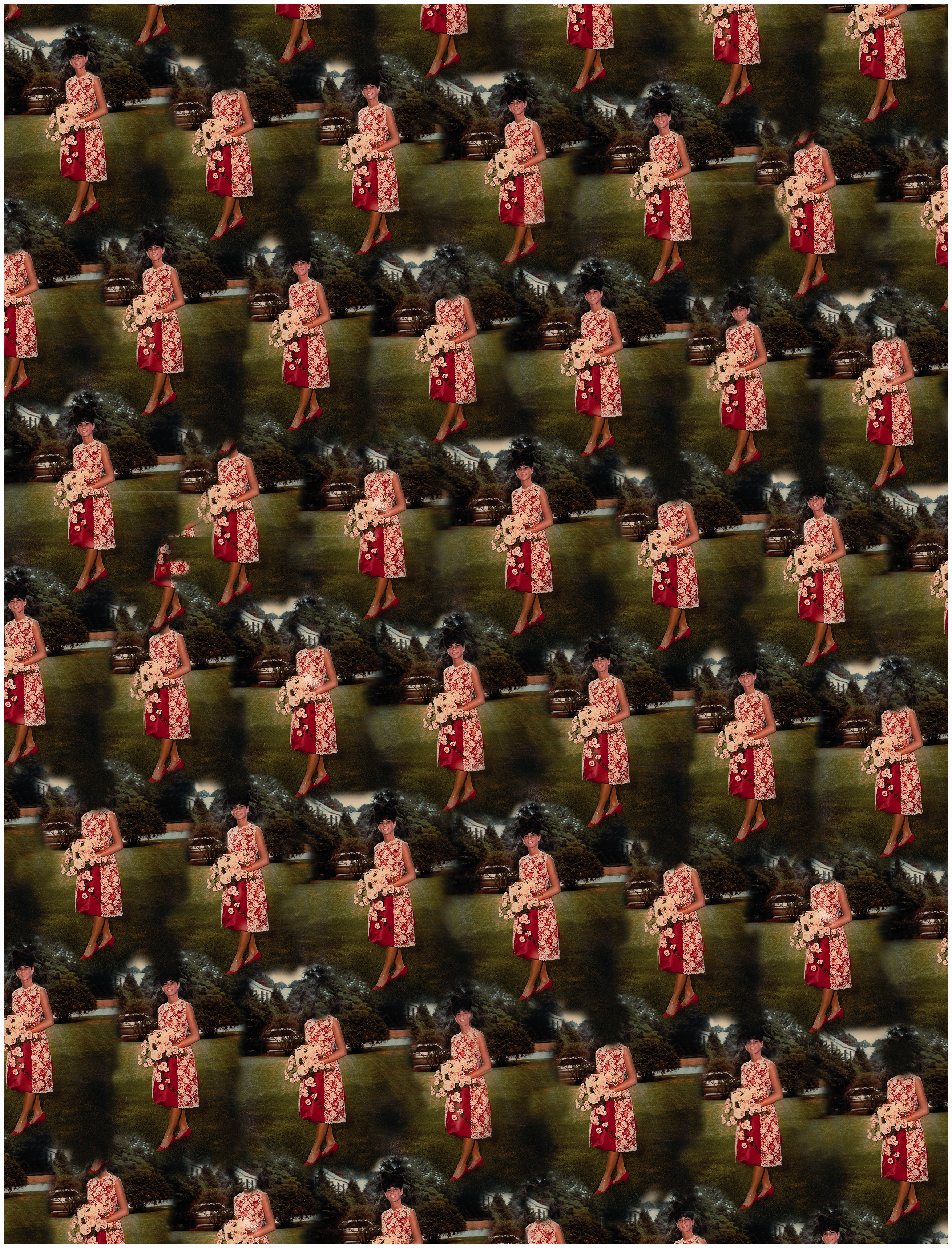
An image that follows the title page is a collage (it also appears on the back cover of the book) (Figure 3). In the centre there is an old photograph that depicts a young woman, holding bicycle handlebars, her head thrown back in laughter. In contrast to the cover image and endpapers, the image is not staged for a formal occasion; it is a snapshot of an intimate moment. The image encapsulates in a certain way the ‘Kodak moment’ which discloses happiness, beauty, spontaneity and freedom. It is liberated from theatricality and pre-defined respectability; it portrays his mother as a whole person: independent, free, of sound body and mind, an American dream. The centred image with rounded edges evokes a nostalgic feeling, which is emphasised by other images in the background of books with typical twentieth-century graphics and fonts. A fabric-bound book that says ‘invisible Co’ and another ‘Book of Photo’ are placed underneath, and the image of Lutz’s mother is casting a shadow, giving an impression that the image is floating in mid-air. An illustration of a small boy peeks from behind the image and he is closely and attentively looking from the corner of the image. Is this a representation of Lutz in the future? The deep etched lines across the boy’s forehead and lettering ‘invisible’ somehow feel ominous. Curiously, the image is called ‘The Coming Insurrection’. Is the young woman in the image rising against her past or family? The title asks us to doubt and question the authenticity of photography itself and its relation to the real. As Jean Baudrillard in The Illusion of the End writes: ‘If something does not exist, you have to believe in it. Belief is not the reflection of existence, it is there for existence, just as language is not reflection of meaning, it is there in place of meaning’ (1994: 92 [original emphasis]). A sense of meaning, belief and faith here rises from an absence. Lutz’s mother is the origin of the work and the beginning but she is also a construct and a fleeting memory: ‘When the real is no longer what it was, nostalgia assumes its full meaning’ (Baudrillard, 1994: 6). Like the story of Orpheus and Eurydice, a figure of feminine absence, the narrative of the son and his mother describes loss. When Orpheus gazes back to assure himself that Eurydice is following him, she is gone forever. Before the most convincing masterpiece, where the brilliance and resolution of the beginning shine, it can also happen that we confront something extinguished: a work suddenly become invisible again, which is no longer there, has never been there. This sudden eclipse is the distant memory of Orpheus’s gaze; it is the nostalgic return to the uncertainty of origin. (Blanchot, 1989: 174)
‘The Coming Insurrection’.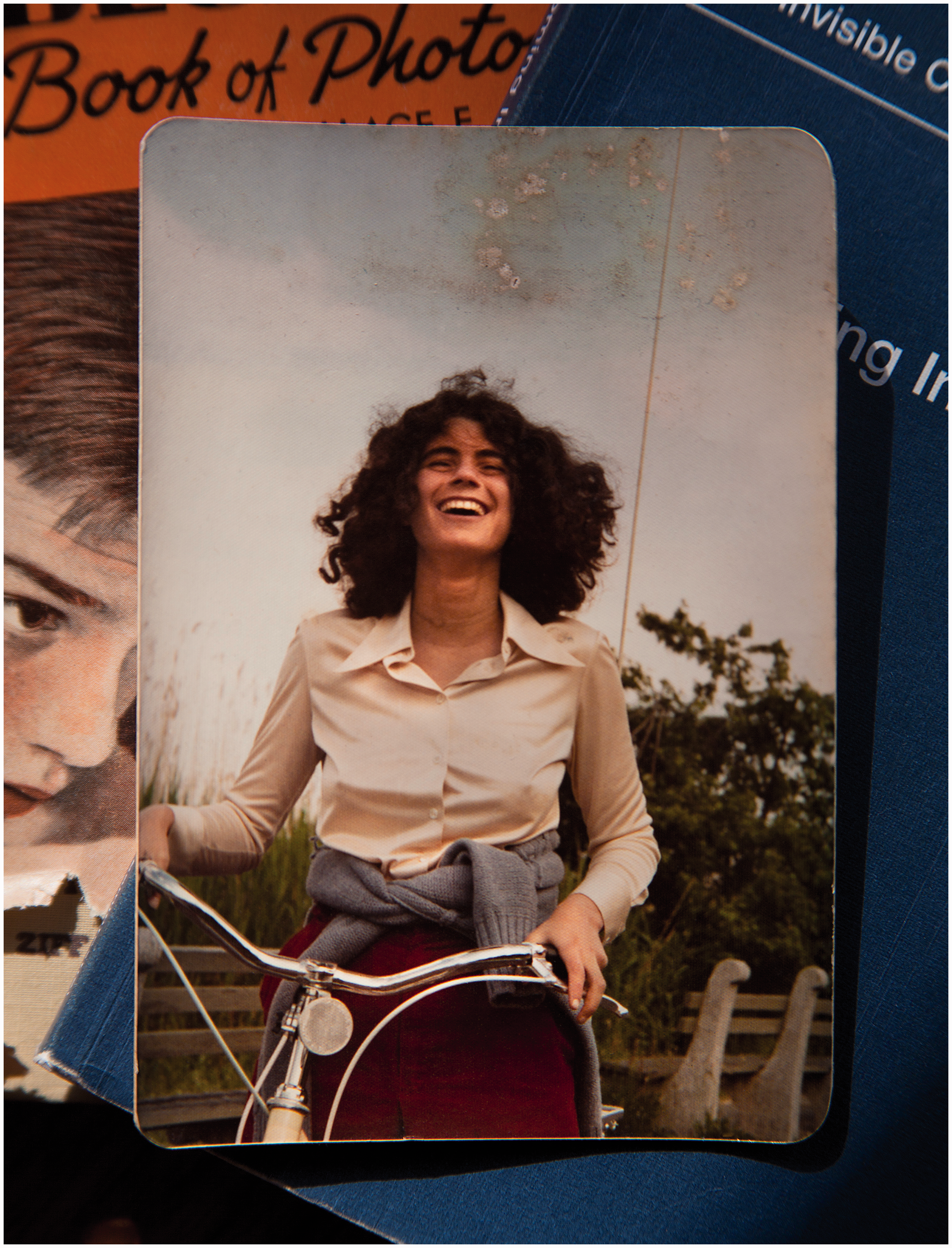
Performativity
Lutz is not aestheticising his mother’s illness, nor turning it into a spectacle, there is no temptation to represent her illness externally. There are no peculiar or dramatic facial expressions, passive or aggressive poses, nor harrowing scenes which serve as a way to distance the onlooker, as present in Jean-Martin Charcot’s volumes of the Iconographie photographique de la Salpêtrière (1876–1880) and traditional representations in Western Classical art (Gilman, 1988). Rather the photographs question the boundaries of representation and try to depict the mother and son relationship, and the attachment and detachment caused by illness. Vilém Flusser writes: The object reacts to the manipulation, for it isn’t a real object but someone sharing the same situation with the photographer. A complex mesh of actions and reaction (of dialogue) is established between the photographer and his pictorial motif, although the initiative rests with the photographer, and the person photographed is the one who waits patiently (or impatiently). (2014: 82) ‘Quiet Room’.
In a review of Hesitating Beauty Raphael Shammaa writes: ‘We know it’s about a woman, a young mother – and mental disease; about the precarious state of life and of happiness, but not much else’ (2013). In Lutz’s foreword, he addresses his mother in the third person, as her. His mother’s name appears in the book only once, in a photograph of what looks like an upside-down close-up of an arm holding a rail of a hospital bed (Figure 5). In between colour-coded wristbands, denoting his mother’s condition and signalling several warnings: ‘Fall risk’, ‘Haldol’, there is a narrow one with her name handwritten and below a broader one with typed letters ‘Lutz, Jinne DOB: 05/24/1947’ followed by her patient’s record number, partly visible admissions date and FIN number. A person’s identity here is represented as pieces of information and data. The white space, the blurred image of the hand and the hospital clothing render the body almost invisible, unrecognisable, isolated and distant.
‘Fall Risk, Haldol’.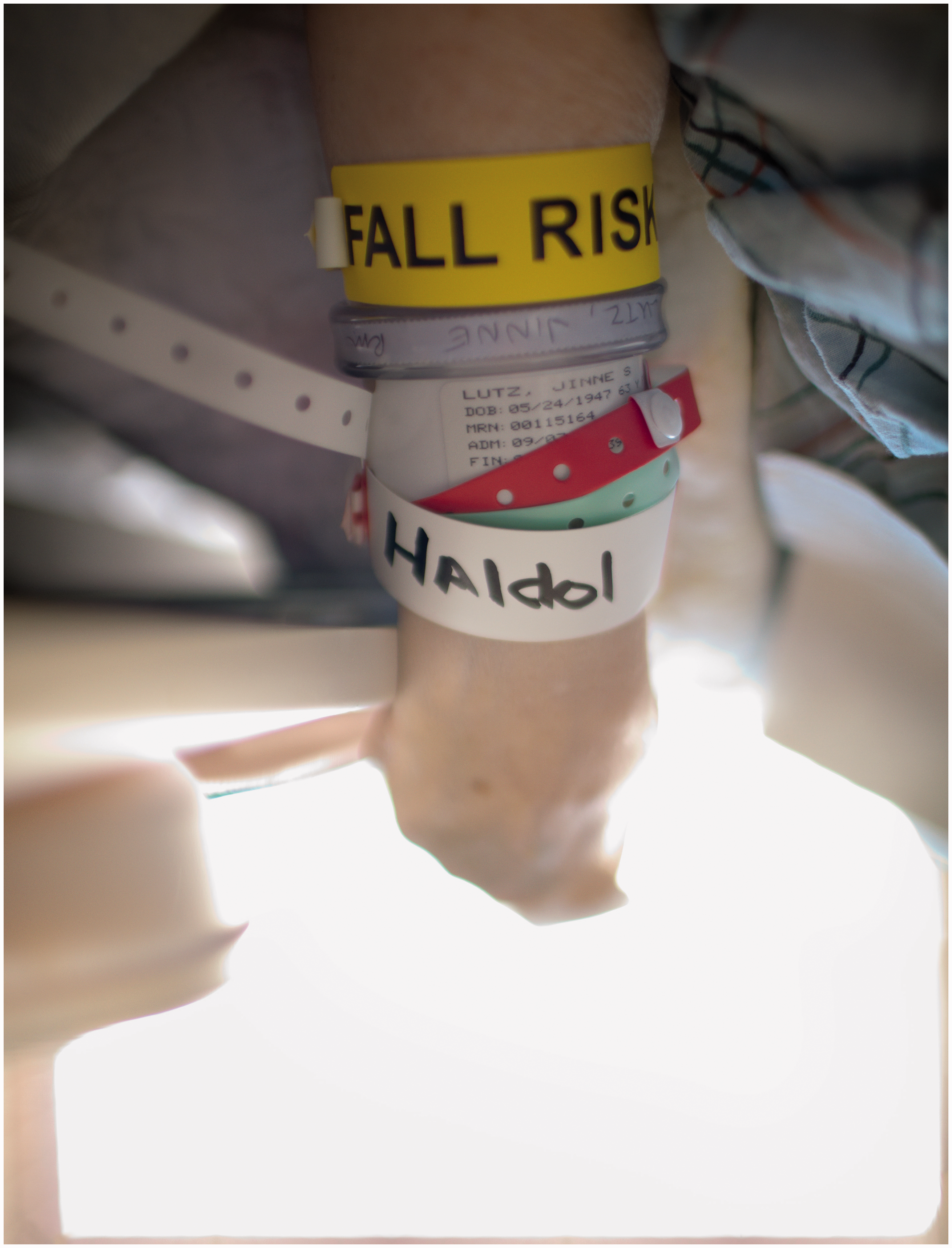
Another image in hospital shows his mother sleeping (Figure 6). Compositionally she is placed on the far right corner of the image. She seems almost to be slipping away or falling out of the frame. Tape across her mouth signals ‘Do Not Wake’. The text on tape is clearly written, almost etched into the tape and into the photographic image, it stands out from the rest of the image that is mutely coloured and blurry. Is the text on the tape Lutz’s own? In a hospital environment one would expect to have such a message communicated in some other way. As Arthur W. Frank points out, care in hospitals is not articulated as would be expected from an ‘uninstitutionalised’ person’s view. Loud messages, noises in corridor quite often disturb and distress, and ‘hospitals consider it good care to wake patients up for all manner of purposes, however difficult sleep has been to achieve and however much it is needed’ (2011: 3). Is it Lutz’s way of protecting her, letting her sleep and escape into a dream world like a ‘sleeping beauty’? Is it his wish for her to never wake up? Pipes and tubes attached to medical equipment are connected to her mouth. In the background a note identifying the equipment as SOLO POWERPICC (a catheter for IV fluid and blood administration, infection and saline care) is visible. Deprived of agency, she is reduced to silence, beyond self-sufficiency, vegetating in idleness and completely in the power of machinery. ‘The heart of the illness’, Laing writes ‘all that is the outcome of process, then resides outside the agency of the person’ (1964: 4). Similarly Gilman points out that the images of the mad ‘show isolated portraits - they are isolated since they no longer can function in it’ (Gilman, 1988: 115). His mother’s story here is dormant; she is an inverted image of that self that was once holding bicycle handles and laughing with her head thrown back.
‘Do Not Wake’.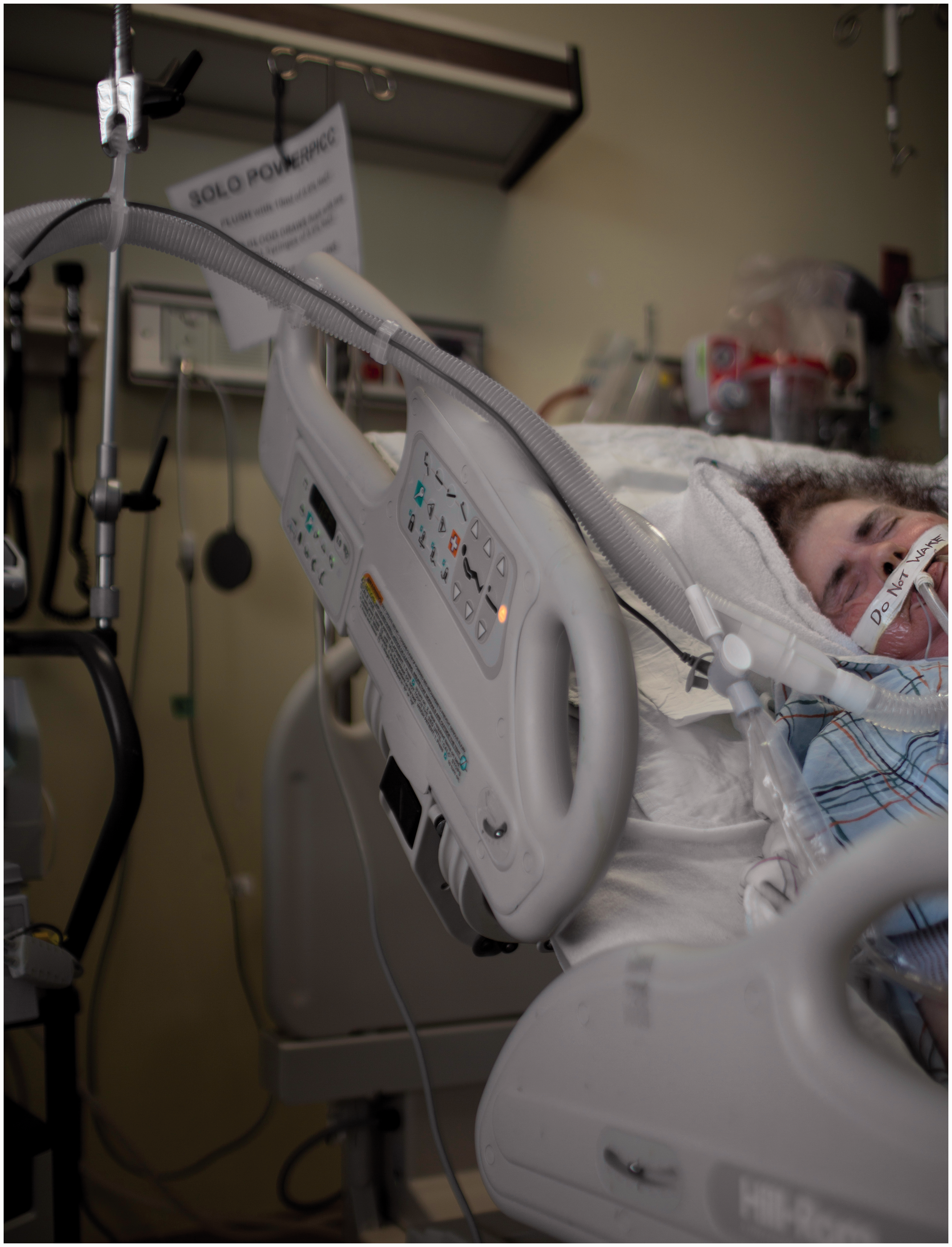
An image entitled ‘Screaming ocean’ portrays two figures standing in a stormy sea (Figure 7). A shadowy person behind a darker body seems to be holding the other one’s arms, so she/he could not fall or run away. The blurriness of the water and the dark clouds above bring an analogy of drifting in and out of the waves, in and out of consciousness and reality. As Foucault notes, there is a strong connection between madness and water in Western reason and thought: among the mystics in the fifteenth century, it has become the motif of the soul as a skiff, abandoned on the infinite sea of desires, in the sterile field of cares and ignorance, among the mirages of knowledge, amid the unreason of the world - a craft at the mercy of the sea’sgreat madness, unless it throws out a solid anchor, faith, or raises its spiritual sails so that the breath of God may bring it to port. (1993: 12)
‘Screaming Ocean’.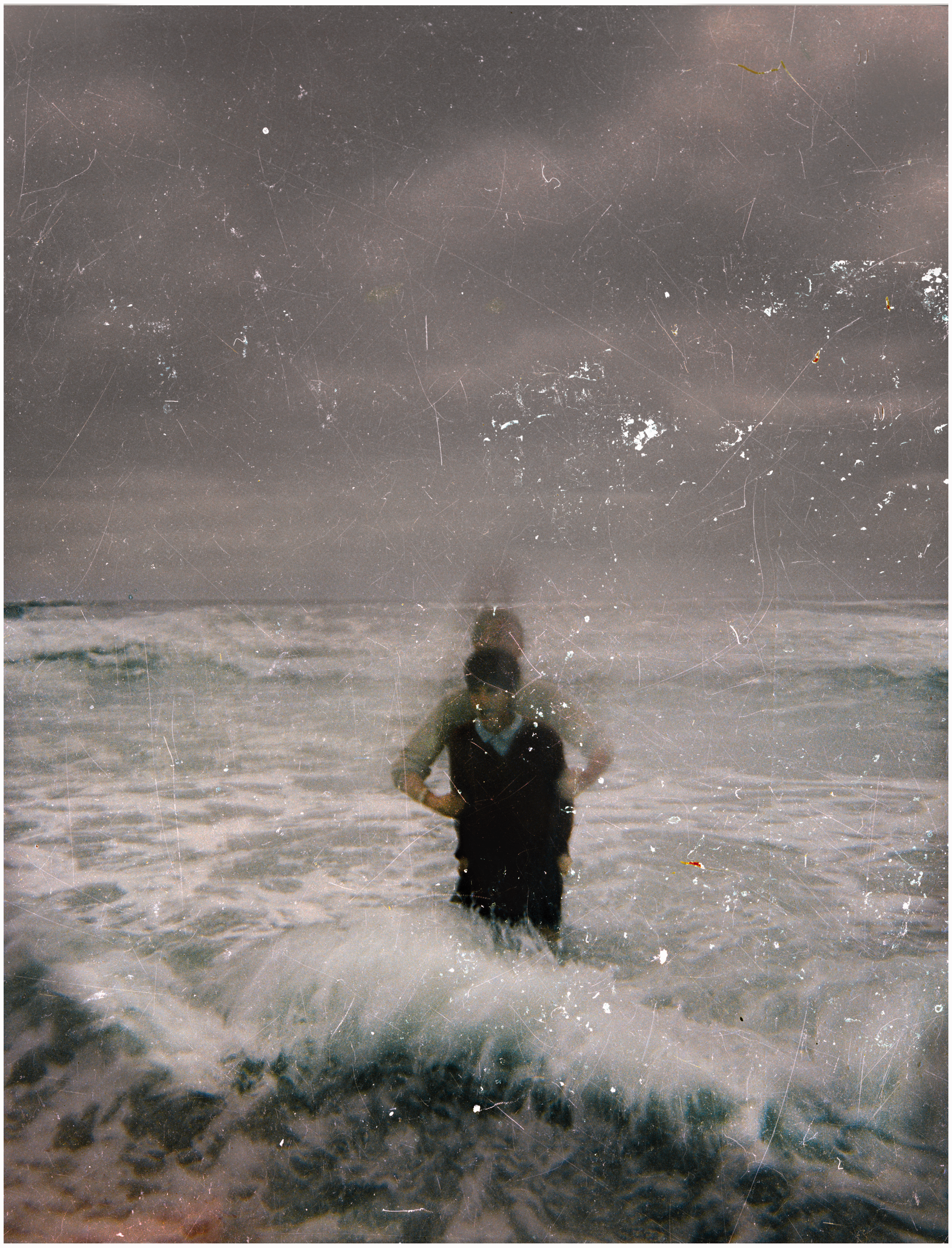
Through the textures of dust and scratches on the image, Lutz reflects on the materiality of the image and its composition. The bodies seem to be suspended in space, resisting the passing of time. The lines and dots of scratches across the image point towards the medium’s deficiencies and failures. The scratches made digitally or manually also echo a sense of violence, the image in these areas is erased from the physical surface and potentially from memory. Scratches also suggest a wound or wounding. The sharpness of lines, cutting and piercing through the image, evokes a noise, shrieks and hisses. The sonority of the image and the ominous backdrop in a way resembles Edward Munch’s painting The Scream, without its explicitly horrified features.
Where is the photographer in relation to the image? Is he standing and watching from a distance? Is it an imaginary self-portrait of himself holding his mother? Luce Irigaray in her imaginary dialogue with Nietzsche writes: Why leave the sea? To carry a gift - of life. But it is to the earth that you preach fidelity. And forgetfulness of your birth. Not knowing if you descend from a monkey or a worm or if you might even be some cross between plant and ghost. (1993: 12)
Failure of recovery
Remarkably, the project does not invoke any release or recovery. In an interview Lutz discloses ‘I don’t have any sense of any conclusion or understanding, if anything I feel more comfortable in not having any sort of conclusion’ (cited in Risch: 2013). It is rather an ongoing process without a final destination and a cathartic release. It is a story in the making.
The digital manipulations mixed with archival images in Lutz’s work in a way attempt to communicate and mimic the symptoms that are associated with mental illness. However, I would like to argue that the relationship to the real in these photographs extends that of a representation of mental illness: it also reflects how the photographer sees himself within society. Lutz in his photographic essay merges boundaries between the photographic practice, personal experiences and politics. The effects of illness ‘reverberate’ throughout his mother’s and his own life. The photographic essay critiques the so-called American dream and the success, wealth and triumph that it stands for. Hesitating Beauty exposes ultimate failures, failure of the body, communication and medicine, failure of the traditional model of family. The philosopher William Desmond divides failure, or what he also refers to as ‘breakdown’, into three dimensions: ‘physical breakdown, psychical failure, and failure of purpose’ (1988: 291). Mental illness seems to occupy all three of these dimensions. Western society with its ‘modern cult of success’ (Desmond, 1988: 295) tends to silence failure and push it away from its focus. Ageing, illness, poverty and death are unmentioned, ignored and erased from the public consciousness. Desmond claims that failure is reduced to ‘unrealness’. Success in this functional sense comes to serve as a standard of reality, of realness itself. Something is real if, as the phrase has it, ‘it works.’ Realness becomes correlative to pragmatic function. Since failure is the breakdown of what works, it is the intrusion of the unreal. (Desmond, 1988: 296)
Conclusion
Fear of inheritance, lingering doubts about his own sanity and ‘tremendous anger and panic’ (2012: 5) cast shadows and obscure Lutz’s and his mother’s shared existence. Lutz writes: ‘Holding on so tightly to what I believed was sanity while consumed by fear of depression and schizophrenia prevented me from being fully present to her reality’ (2012: 5). The photographic act is a way for Lutz to distance himself from his mother’s disease, a means to reach out and reaffirm his own voice. In an interview Lutz discloses, ‘I think it was in some way to prove that I wasn’t crazy. As long as I was on one side of the lens and not the other, then my proof would be the photographs’ (Danilovich, 2013). Here the photographic process aims, in a way, to differentiate and draw a line between unreason and the reliable world in order to eliminate fears. The purpose of photographing intimately his mother perhaps allows him not ‘to collapse into the annihilation and consumption of One’ (Allen and Smith, 2013: 74). Here the photographic act describes movement as well as distance. Shifting between moments, closeness and distance, reflections, imagined and real representations allows Lutz to regain his own sense of identity. Intimacy here means being in relation, which already marks separation and distance.
Photographic essays of illness have the ability to enrich understandings of illness experience through visual articulations. I would like to argue that photographic act provides an intimate encounter that creates a resonant dialogue between self and the other which can bring forth new communication with potential for transformation and transgression. The photographic act here performs functions, such as ‘watching over’ or being vigilant, ‘not the vigilance of a self-possessed watchfulness but the vigilance of a self opened onto otherness itself’ (Oliver, 2001: 134), caring, building a dialogue, reconstructing a voice, gesturing love and exploring the resonance in between the relation with the other. The photographic space is ‘a space for the weaving of me and other-than-me’ (Wilson, 2012: 52). It is a space for self-reflection and exploration of the self in relation to the other. As Rita Charon writes: ‘Telling stories, listening to them, being moved by them to act are recognized to be at the heart of many of our efforts to find, make, and honor meaning in our lives and the lives of others’ (2006: 11). Photographic images have significant power to touch and to address the reader and the observer and disclose knowledge and intimacy in a way that extends oral and written expressions.
Declaration of conflicting interests
The author declared no potential conflicts of interest with respect to the research, authorship, and/or publication of this article.
Funding
The author received no financial support for the research, authorship, and/or publication of this article.