



Abstract
This article investigates the under-addressed topic of audiencing in relation to art in landscape, considering the ways in which this study can enliven cultural geography. Exploring how issues of interpretation and reception have been approached in the past, it tailors mixed methods to trace audience practices using the case study of James Turrell’s Skyspace at Yorkshire Sculpture Park, England. Turrell’s site art is installed in a remodelled deershelter within the Bretton Estate, bringing together contemporary art, heritage and working landscape. This research contributes to recent debate on post-phenomenological work by representing multiple subjects’ engagements with site art. Vignettes of audiencing are presented that challenge authorial control and curatorial interpretation in specific ways pointing toward the open-endedness of the production and reception of cultural forms. Developing cultural geography’s engagement with art, the article challenges geographers to consider how the meaning of works and sites can be renegotiated according to the specialisms of others, and the social dimensions of audience experience. By showing how critical enquiry can become more democratized through the inclusion of different subjects, it reveals the important theoretical, methodological and empirical contributions the study of audiencing can make to the geographies of art.
I’m always puzzled by audiences. I really don’t know who they are or why they’re there or what they’re thinking.
1
In the above quote, lauded contemporary dance choreographer Paul Taylor describes his interest in the audiences to his shows. For Taylor, audiences are a curiosity that he is ‘always puzzled by’. The success of a performance is entwined with the role of the audience; however, as Taylor indicates, their identities, sense of purpose and thoughts often remain obscure. Post-structuralist theory has emphasized the active role of the audience in negotiating the meaning of art. In particular, significant texts including Umberto Eco’s The Poetics of the Open Work 2 and Roland Barthes’ later text Death of the Author 3 foregrounded the interpretative role of the viewer, listener or reader in opening up fields of possibility in the meaning of a piece of artwork, music or text. In the arts, the notion of the audience has been widely mobilized to embrace the range of positions and participatory dimensions of audience encounters. 4 ‘To audience’ describes an exchange between the subjects and medium or form. 5 Yet, in geographical research on art there remains a paucity of research into what audiences ‘really think and do’. 6 In the following section I outline the theoretical, methodological and empirical aims of this article, which are intended to address in part the lacuna in research on audiencing art, and its implications for geographical enquiry.
By performing qualitative research into audiencing, an understanding of the spatial and social dimensions of arts engagement can be enriched, empirically broadening existing research on art and the role of the audience. With emphasis on the contingency of art experience, this article questions whether constructing and designating the ‘meaning’ of art should be the preserve of critics and arts professionals who represent only a proportion of the audience who engage with art. Instead, by tracing the audiencing of art in landscape, this article makes the contribution of recognizing how audiences are not a separate moment in the meaningful biography of an artwork but enmeshed within circuits of exchange that mediate cultural forms. The case study of this article is a work of site art by artist James Turrell entitled Skyspace (2006), which is installed in the picturesque landscape of Yorkshire Sculpture Park, England. Yorkshire Sculpture Park is situated in the Bretton Estate and was opened to the public in 1977, creating an open air gallery in the landscape of an historic estate.
I first introduce the artwork and biography of Turrell, with attention to Skyspace at Yorkshire Sculpture Park, which forms the empirical focus of this article. I then review the literature on audiencing itself, before moving on to literatures in other key areas. Developing from the projects of Nina Morris, Venda Pollock and Joanne Sharp, and Dydia DeLyser, among others, research into reception can uncover how actual audiences engage with creative forms and produce meaningful relationships between site and art. The methods I use to explore audiencing site art at Yorkshire Sculpture Park are discussed, which offers alternative challenges to advancing an auto-ethnographic interpretation or tracing the audiencing of an ephemeral art work. Writing by Stephen Daniels and Yve-Alain Bois on the picturesque landscape and Miwon Kwon’s three strand exploration of the relationship between site, art and audience are then engaged to open up discussion on the specificity of site art experience. I follow these theoretical engagements with vignettes of audiencing Skyspace drawn from empirical findings obtained over 10 months at Yorkshire Sculpture Park.
James Turrell at Yorkshire Sculpture Park
James Turrell is an artist who has gained international recognition for site art installations that focus on light and space. Most renowned is Turrell’s magnum opus, Roden Crater, an extinct volcano transformed into a ‘naked eye observatory’ near Arizona’s Painted Desert. 7 His work has been commissioned by private collections and museums across the US and Europe, with a further concentration of works in Argentina and Japan. While the installations are situated in different countries and across distinctive cultural and material locales, the meaning of the art has often been located in critical literatures by recourse to the artist’s biography. Concerns with light and perception, for instance, have been related to his Quaker upbringing, his training as a pilot in Nevada, and undergraduate degree in maths and psychology. 8 Notably, critical interpretations of Turrell’s light and space works have also tended to situate his art within a 20th-century project that interconnects with phenomenological theory. 9 Combining these approaches, the originatory source of the artist is emphasized by William Banks, who guides the reader/viewer on a behind-the-scenes tour of Turrell’s Second Wind 2005, presenting the conception to the realization of the installation by text and photography. 10 Taking the interpretation of Turrell’s work in a new direction, I use audiencing as a method to open up the alternative ways in which the meaning of art can be framed with focus on Turrell’s Skyspace at Yorkshire Sculpture Park. By addressing the social and spatial dimensions of encounters with Skyspace, this article responds instead to the cultural geographies of site art, and in particular the spatial practices of its audiencing.
Turrell’s Skyspace was adapted from an early deershelter that formed part of the Bretton Estate, which in the 18th-century extended between Barnsley and Wakefield, West Yorkshire. Once a private country estate made wealthy from lead and iron interests, Bretton was part sold in 1948 following occupation by the War Office during the Second World War. Since 1977, under the management of Yorkshire Sculpture Park, over 500 acres of the estate has gradually been reunified. In the summer of 1993 Turrell stayed for several weeks at the sculpture park while working on a project for the Henry Moore Sculpture Trust at Dean Clough, Halifax. Fascinated by the history of the Bretton Estate, Turrell developed a proposal to transform the deershelter into a Skyspace. The project was eventually realized 13 years later through a £800,000 grant from The Art Fund. Clare Lilley, Director of Programme at Yorkshire Sculpture Park, emphasized the vital connection between landscape heritage and art in the project: ‘As well as making a contemporary art work, the Turrell Skyspace has facilitated the restoration and conservation of this historic structure.’ 11
Critical engagements with audiencing
The theory and methods that underpin the findings in this article shift the usage of the static noun ‘audience’ to the active verb ‘audiencing’. The term audiencing is indebted to the work of cultural theorist John Fiske. 12 Fiske emphasizes the process by which the mass media is engaged with by the viewer configured as the active audience. He advances the argument that culture is a continuous process of the social circulation of meanings and that ‘audiencing’ is part of that process. Sites of analysis are used where this circulation becomes accessible, such as participant observation of teenagers watching a television show, which reveal ‘glimpses of culture in practice’. 13 With focus on visual images, Gillian Rose also defines audiencing as a ‘process’ whereby an image has ‘its meanings renegotiated, or even rejected, by particular audiences watching in specific circumstances’. 14 Privileging the visual over other sensory responses, Rose, using a combination of one-to-one and group interviews, builds on the work of Shaun Moores, David Morley and Ien Ang, to propose that, as a method, audiencing can reveal multiple meanings of a particular form or medium, as well as informing us of ‘the complexity of the decoding process’. 15 Audiencing can therefore be understood as the ‘process of producing through lived experience’ 16 insights into the audience and their social relations, combined with the active inscription of meaning into a particular medium or form by different audiences. Using grounded empirical research, recent work on audiencing has explored audience responses to television, film, comic books and the internet to inform understanding on nationalism, identity, fan-bases and emotion. 17
Tracing the audiencing of art in landscape has not been addressed directly in cultural geography; however, geographers have considered complimentary issues of audience reception and place-making through a variety of artistic mediums. In her article on the landscape-installation art, The Storr, Morris develops a methodology that engages a range of experiences beyond her self-perspective. 18 The notion of audiencing is not specifically mobilized by Morris, yet a combination of semi-structured interviews with the audience and organizers, participant observation, and an online feedback form were tailored to write about ‘multiple/collective experiences’ of art in landscape. 19 This approach can be seen to enliven certain post-phenomenological theorizing about landscape, such as John Wylie and Mitch Rose’s work where personal experiences are represented in narrative-based writing developing ‘a more relational understanding of landscape with a stress on process, movement and becoming’. 20 As Morris notes, the subjective focus of this strand of post-phenomenology has subsequently been criticized for ‘being solipsistic, introverted and hermeneutically sealed’. The decision not to preclude the thoughts, feelings and experiences of the other participants was configured by Morris as responding to a theme of The Storr installation, ‘one walk, many journeys’. 21
In work that also explores reception and interpretation, rather than presentation, DeLyser investigates the active participation of tourists in the creation of attractions relating to the 1884 US novel Ramona. 22 Instead of concentrating on the real-estate hype and the ‘boosterist promotion of place’ that followed the novel’s success, DeLyser recovered traces of tourist responses to Ramona-related attractions in newspaper articles, inscribed postcards and personal memory albums. While ‘none speaks loudly’ together, these traces demonstrate the ‘roles of individual tourists in the creation of tourist sites’. 23 This offers a subtle methodological approach for engaging with audiencing practices in historical geography that also has pertinence for analysing different forms of reception in contemporary arts practice. Other methods used to gain insight into the role of audiences and art in place-making activities are Sharp and Pollock’s postcard feedback questionnaires for local residents on Stephen Hurrel’s Constellation, in Ayr, West Scotland. 24
In these articles the agencies of different kinds of audience, traced through interviews, participant observation, archival practices and questionnaires, are central to the production of meaning at each site and artwork under discussion. In part informed by Morris, DeLyser, and Sharp and Pollock’s various engagements with issues of reception, this article sets out to illuminate audience engagements that usually remain unrecorded or disregarded, and that can give new insights into the meaning of art within different people’s lives. By expanding understanding of critical spatial sensibilities, tracing the audiencing of site art can enliven cultural geography’s engagement with the geographies of art. In the next section I outline the methods used in this research, which complicate the agency of site art beyond authorial intention and curatorial directives. The work advances debate on the role of the audience with emphasis on different forms of expertise and social relations that engage the ‘transient encounters, states of flux and open-endedness’ of art in landscape. 25
Tracing the audiencing of Turrell’s Skyspace
The empirical findings in this article are drawn from fieldwork undertaken at Yorkshire Sculpture Park from September 2009 to July 2010. The fieldwork extended over a longer period than other geographical studies on art interpretation and reception partly to gain insights into ways in which a permanent piece of site art adapts to the changing spatial environment of the sculpture park. 26 Furthermore, bringing a range of audience practices to the analysis of art is central to the theoretical concerns of the research, hence the timeline allowed for observing initial encounters, repeat visiting and conducting follow-up interviews. The research extended upon the findings recovered by archival and questionnaire-based studies by gaining insights into the active and physical dimensions of audience negotiations with site art. 27 Interview material, participant observation and photographic diaries provided vignettes of audience engagements with art and landscape, alongside more focused detailed responses to the Skyspace from which the material in this article is selected.
In order to understand the audiencing of Turrell’s Skyspace within the wider context of the sculpture park, non-directive, semi-structured interviews were conducted with 60 audience members on their visits. 28 Responding to fluxes in visitation, opportunistic sampling was used as a method to follow the phenomenon of audiencing with the location of the interviews varied accordingly. 29 The majority of interviews were conducted in the Visitor Centre café, which is a meeting and resting point for many visitors, offering a sheltered and warm space to recruit participants. Other ‘on-the-spot’ interviews took place outdoors in the parklands and at special ticketed events where bodily interactions with the artwork could be observed, including three Sunrise in the Skyspace events. 30 A further stage of in-depth follow-up interviews was conducted with 11 audience members. These took place variously by telephone, in public places such as a coffee shop, or on a repeat visit to the park.
The combination of methods revealed how these audiences physically engaged with the art, how they culturally framed their experiences and how they ‘recoded as well as decoded’ the exhibition, rather than whether they ‘had got or not got the messages intended’. 31 The contention that methods can turn the audience into the object of study and therefore fail to capture the meaningful exchange between the medium and members of the audience is pertinent. In reference to television, Ang enforces this point, disputing whether the audience can be regarded as ‘a proper object of study whose characteristics can be ever more accurately observed, described, categorised, systematised and explained until the whole picture is “filled in.”’ 32 Learning from these and other insights, it was important to make clear that, as literary and cultural theorist Mieke Bal recognizes in her analysis of exhibition displays from the American Museum of Natural History, New York, ‘the things that happen in cultural practices cannot be fully mastered, predicted, and programmed’. 33
The tailoring of mixed methods combined with different interview sites was adopted not to presume a complete perspective, but to show how they can be used together to create multi-faceted and attentive insights into audiencing art in landscape. 34 Observed encounters with Skyspace were often brief, as audiences moved from artwork to artwork, point to point, mapping their own itineraries across the spaces of the sculpture park. Interviews conducted apart from the Skyspace, such as in the Visitor Centre café, offered reflections and contextualized the work in relation to the wider experience of visiting the park. Each of the vignettes of audience practices differs from the directives of Turrell and curatorial mediation outlined later in the article, offering their own critical corrective that demonstrates the gap between artistic intentionality and the intended audience through the spatial practices of audiencing.
Notably, there are comparisons between the role of the ethnographer and the role of the audience when considering the experience of site art. In the same way that ethnographers ‘become part of the fabric of the context they are researching’ 35 on entering the art installation ‘the whole audience were in the field, ensconced in the richness and complexity of the experience’. 36 The comparison Carl Bagley draws between the role of the ethnographer and the audience is particularly enabling for he recognizes subjective responses of audience members as sophisticated and specialized. By considering the audience as individual experts, differential knowledges can be brought to an understanding of Skyspace; in particular, experiences that challenge how we categorize Turrell’s works.
The picturesque landscape and Yorkshire Sculpture Park
Before turning to the empirical findings of the research, in this section I consider theoretical work on the picturesque that elucidates the relationship between art, landscape and the implied audience. Writing by Daniels and Bois provides points of comparison with Kwon’s work on site art. Read together, Daniels, Bois and Kwon offer an analytic grounding for the empirical findings of audiencing Turrell’s Skyspace that follow.
Yorkshire Sculpture Park is comprised of four internal white-cube gallery spaces along with expansive parklands designed in the 18th-century by Robert Woods in the picturesque style closely associated with renowned landscape gardeners Lancelot ‘Capability’ Brown and Humpry Repton (Figure 1). 37 As Daniels’ study of Brown’s drawings and Repton’s ‘Red Book’ watercolours with overlays has shown, the connection between landscape, art and audience was presented in the careful artistry of the plans for the improvement of country estates: when examined in detail the social and cultural layering of meaning could be ‘read’ in the drawings’ symbolic visual imagery. 38
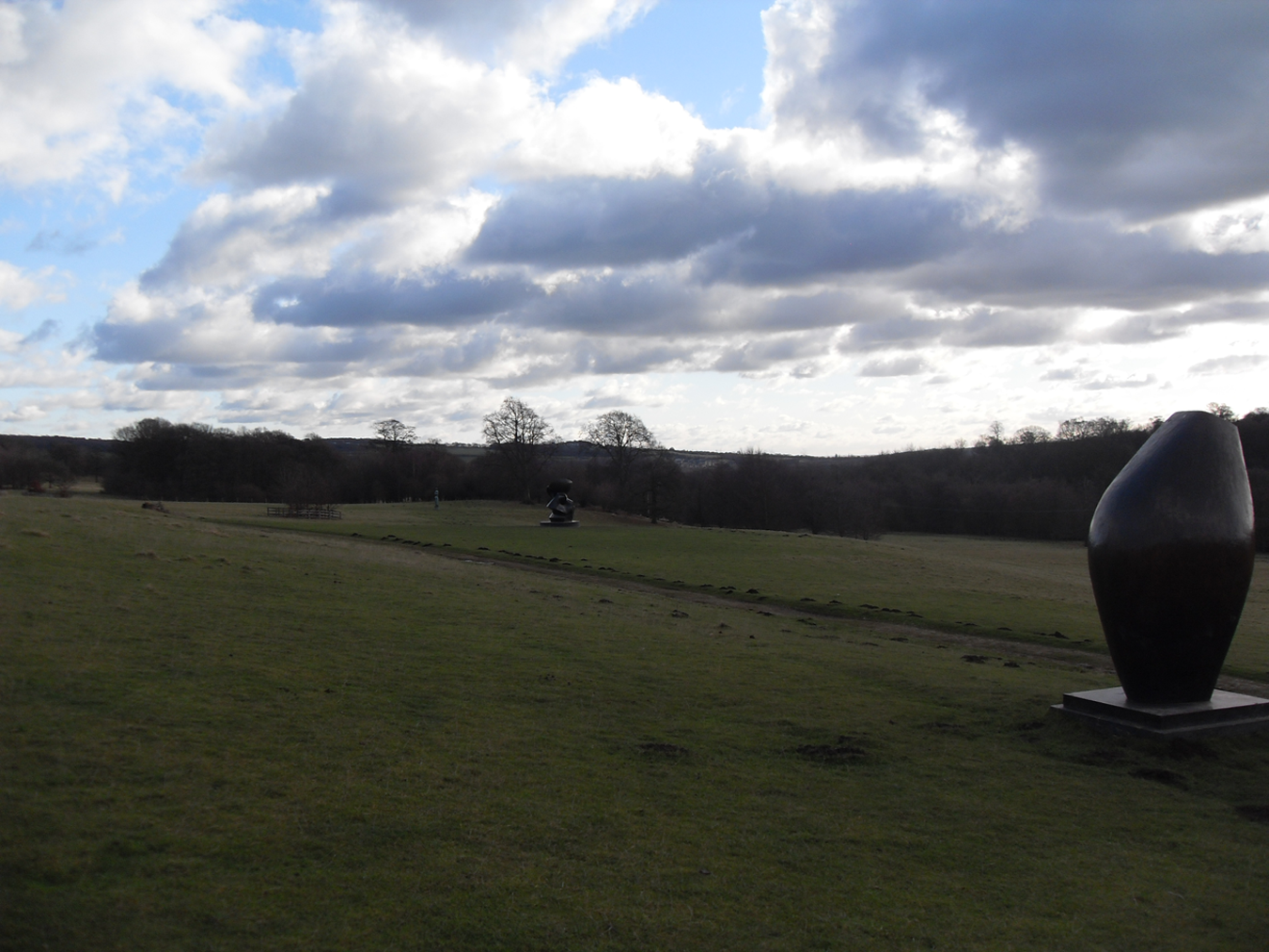
View across Country Park with Henry Moore sculptures, YSP. Photograph by the author, 2010.
Brown and Repton’s pictures worked as artistic models to be scaled up for the finished object. However, as Bois contends, there is a contradiction when Brown, Repton and their peers treat the scenic garden with its ‘promenade, temporal experience’ and landscape painting ‘as though they were one and the same thing’. 39 Vital to the dynamics of the picturesque is that the landscape is not simply a picture. Aristocratic amateur gardener and writer on the picturesque, Uvedale Price, describes how the garden ‘excites and nourishes curiosity’ by a ‘partial and uncertain concealment’. 40 As Bois and Price illustrate, the picturesque garden is an escape from the pictorial and the visual into the embodied experience of a person moving through the physical landscape.
The English garden heritage interrogates the distinction between nature and art in the landscape of historic estates, which was further emphasized with the founding of a sculpture park within the Bretton Estate. Importantly, the physicality of the bronze Henry Moore sculptures and Antony Caro’s Promenade 41 assert their monumental scale and dimensions in dialogue with the park’s picturesque landscape (Figure 2). Turrell’s Skyspace is installed more subtly with the deershelter embedded into the hillside of the Country Park, originally designed to protect the deer from the elements. Standing within the Country Park the deershelter is apparent from a south facing perspective but almost obscured from view from other vantage points. As one participant observed, ‘from the outside it is very discrete, it blends into nature, but when you enter it makes this real statement’. 42 The Skyspace, sculptures and landscape at Yorkshire Sculpture Park are designed to be discovered by audience navigation with the appearance and visibility of ‘nature’ and ‘art’ altering depending upon the season, weather conditions and physical approach.
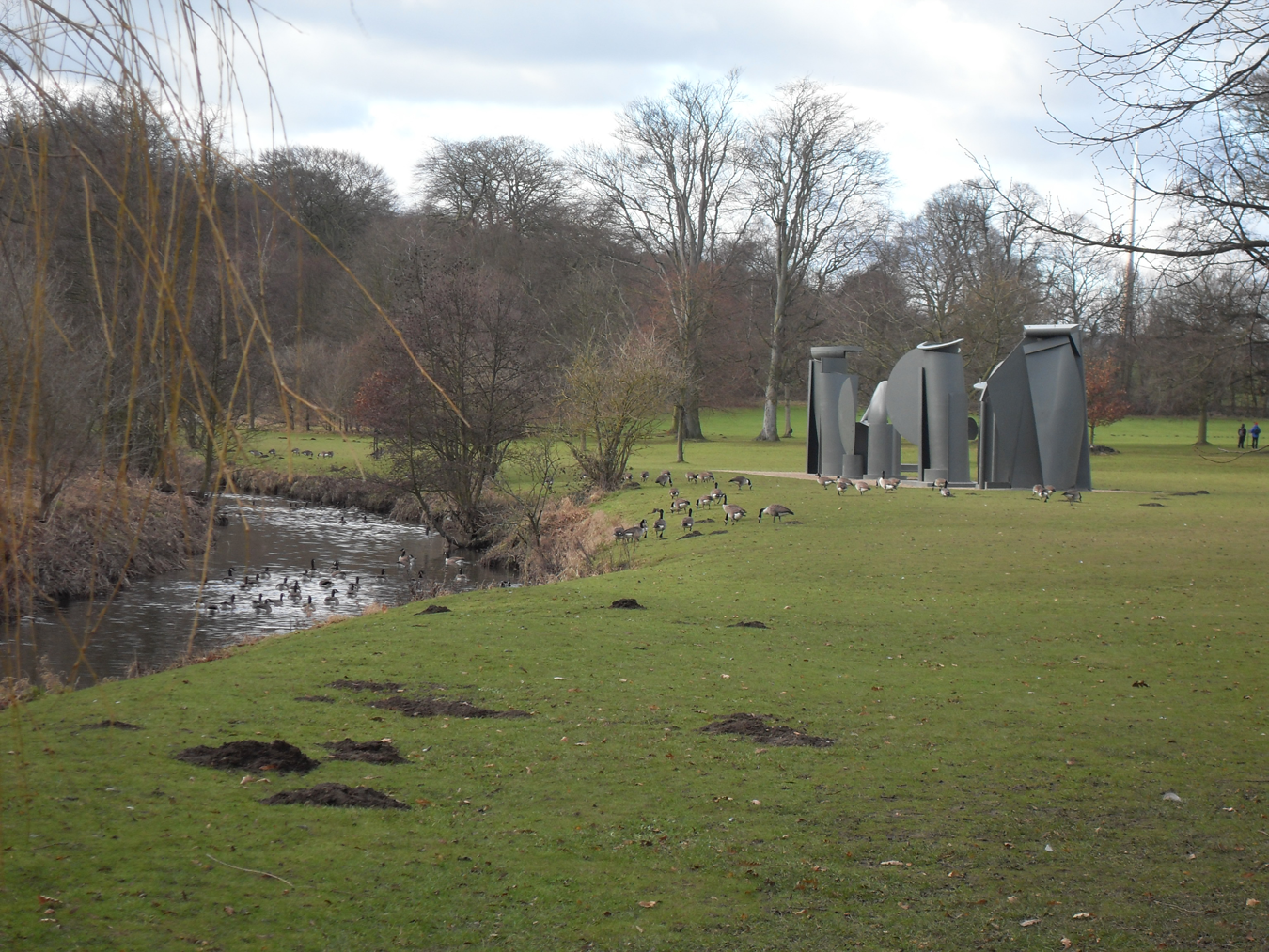
View across Lower Lake with Antony Caro’s Promenade, YSP. Photograph by the author, 2010.
The exceptional opportunity to bring designed landscape and sculpture into concert was recognized by the Founding Director Peter Murray, ex-lecturer at Bretton Hall College, who was awarded Commander of the Order of British Empire in 2010. Reflecting on the distinctive spatial capabilities of the site, Murray states: One thing which is particular to this landscape is as you walk through it the experiences change and that is to do with the quality of the landscape. It is designed in that way. Sometimes to artists it is a challenge to take on that landscape, that scale of it. But if you walk around the landscape and get to know it, there are lots of intimate areas too … I think the variety, the beauty, the range of different spaces make it one of the best sites for sculpture in the country.
43
The spatial capabilities outlined by Murray are captured in the title of Yorkshire Sculpture Park’s 30th anniversary publication Landscape for Art. 44 Essential to the dynamics of the sculpture park are the active and generative relationship between art, landscape and audience. Bois has noted, ‘[t]he dialectic of walking and looking into the landscape establishes the sculptural experience’. 45 In the next section I develop this discussion using the work of art historian Miwon Kwon, to emphasize how the physicality of site art demands the presence of the audience. Continuing with Kwon’s argument on the cultural and discursive framework of site art, I outline an analytical approach for understanding the negotiated relationship between site art and audience that underpins the empirical findings of this research.
Miwon Kwon: site, art and audience
The critical relationship between site, art and audience is explored in detail by Kwon. Outlining the genealogy of site art, Kwon examines site specificity not exclusively as an artistic genre but as a ‘peculiar cipher of art and spatial politics’. 46 She traces key stages of site-specific theory and practice since the late 1960s with recognition that ‘the paradigms are outlined as competing definitions that operate in overlapping ways in past and current site-orientated art’. 47 Emerging from the lessons of Minimalism, site-specific art was initially informed by a phenomenological or experiential understanding of site that took the site as a tangible reality and ‘whether interruptive or assimilative’ the work ‘gave itself up to its environmental context, being formally determined or directed by it’. 48 Drawing parallels with minimalism and conceptual art, the site-specific turn is associated by Kwon with a move from the ‘disembodied eye’ to ‘an inextricable, indivisible relationship between the work and its site, [which] demanded the physical presence of the viewer for the work’s completion’. 49 The phenomenological understanding of the roots of site art described by Kwon can be seen to place the audience and the experiential dimensions of audiencing at the core of the works.
Kwon also identifies a second strand, represented by artists including Daniel Buren, Hans Haacke and Robert Smithson, which variously conceived the site ‘not only in physical and spatial terms but as a cultural framework defined by the institutions of art’. 50 The epistemological challenge created by emphasis on the cultural framework in site-specific art not only shifts meaning from ‘within the art object to the contingencies of its context’, but acts to ‘challenge the “innocence” of space’. 51 By drawing attention to the space(s) of presentation, the art institution is shown to be a controlled environment that can serve an ideological function through shaping how audiences perceive art. 52
The third strand Kwon draws is site as a discursive vector. This site is not a ‘precondition’ rather, ‘it is generated by the work … and then verified by its convergence with existing formations’. 53 The discursively determined site is delineated as a field of knowledge, intellectual exchange, or cultural debate. Expanding upon Kwon’s reading of the physical, cultural and discursive framework of site art, audiencing can empirically open up new avenues for understanding the agency of the audience and cultural geographies of site art experience.
Kwon places into a trinity the presence of the viewer, the art work and the site, in order to draw out the importance of context in reading art’s meaning. A student of Rosalyn Deutsche, Kwon conceives of site-specificity in Deutsche’s terms, as ‘urban-aesthetic’ or ‘spatial-discourse’. 54 That is, her work seeks to frame site specificity as the cultural mediation of broader social, economic and political processes that organize urban life and public space. Notably, although Kwon situates the application of her ‘spatio-political’ work on site specificity in the urban domain, she nevertheless acknowledges a shared critical heritage in site specific work created in non-urban contexts: ‘whether inside the white cube or out in the Nevada desert, whether architectural or landscape-orientated, site specific art initially took the site as the actual location’. 55 Morris and Cant have recognized that site art beyond towns and cities is prominent in UK public-art commissions; however, these works continue to be under-represented in spatial discourse and critical writing on public art. 56 By using the case study of Turrell’s Skyspace at Yorkshire Sculpture Park, I attend to this tension by focusing on audiencing site art in a rural environment. In the section that follows I describe the physical and cultural context of what guides the audience experience of Turrell’s Skyspace in the ‘outdoor gallery’ of Yorkshire Sculpture Park.
Curating Turrell’s Skyspace
The Skyspace is a short 10 minute walk from the Visitor Centre on undulating terrain part way down the Country Park (Figure 3). To access the Skyspace audiences are required to enter the gate that is closed to keep the grazing sheep outside of the deershelter structure. Signs notify that the Skyspace is open from ‘10–4 pm. in Winter’ and ‘10–5 pm in Summer’. Outside the Skyspace, an interpretation panel written by the curatorial team reads: James Turrell is one of the world’s leading artists. Working with natural or man-made light, he makes thought-provoking and beautiful works which often have a profound effect on the viewer.
Another panel outside the Skyspace explains the rules for visitors: Timed viewings may be allocated to avoid over-crowding. Please respect the experience of other visitors. Do not be noisy or use mobile phones. Do not picnic or smoke. Allow yourself time, space and silence.
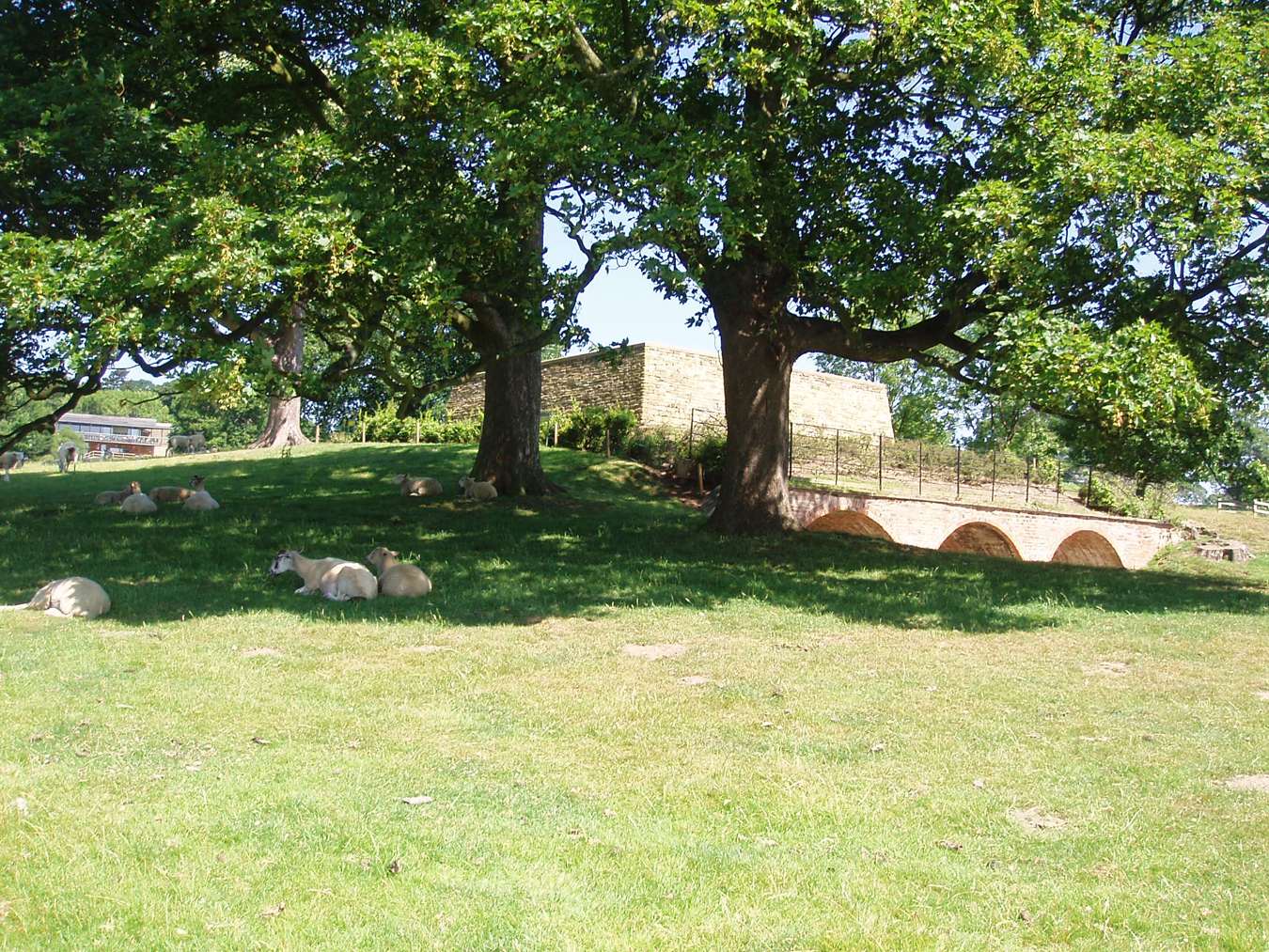
Deershelter with Visitor Centre in background, YSP. Photograph by the author, 2010.
The curatorial interpretation firmly emphasizes the creative act of the artist: Turrell ‘makes thought-provoking and beautiful works’. 57 The structures that enshroud the artwork are decisive both foregrounding the importance of the artist and the rules by which the artwork is to be engaged. The authority of the artist and the institution are reinforced despite the rhetoric drawn by the mediation of an open ‘thought-provoking’ work that often has a ‘profound effect’ on the viewer. 58 To see the Skyspace, audiences must walk through the subtly-lit brick arches of the 18th century deershelter and into the remodelled concrete and stone central chamber. Benches line the edges of the chamber with inclined walls that guide the audience to look upwards toward the ceiling. Cut into the ceiling is a square aperture that opens out onto the sky (Figure 4). Through a trick of perspective affected by the soft, yellow lighting of the bulbs that line the top of the seating, the colour intensity and physicality of the light from the sky appears to materialize more fully within the aperture. While interpretation of the Skyspace remains open to the audience, as is ultimately the case with any artwork, 59 a framework for engaging with the installation is inscribed through the signage and architecture, which directs behaviour and understanding.
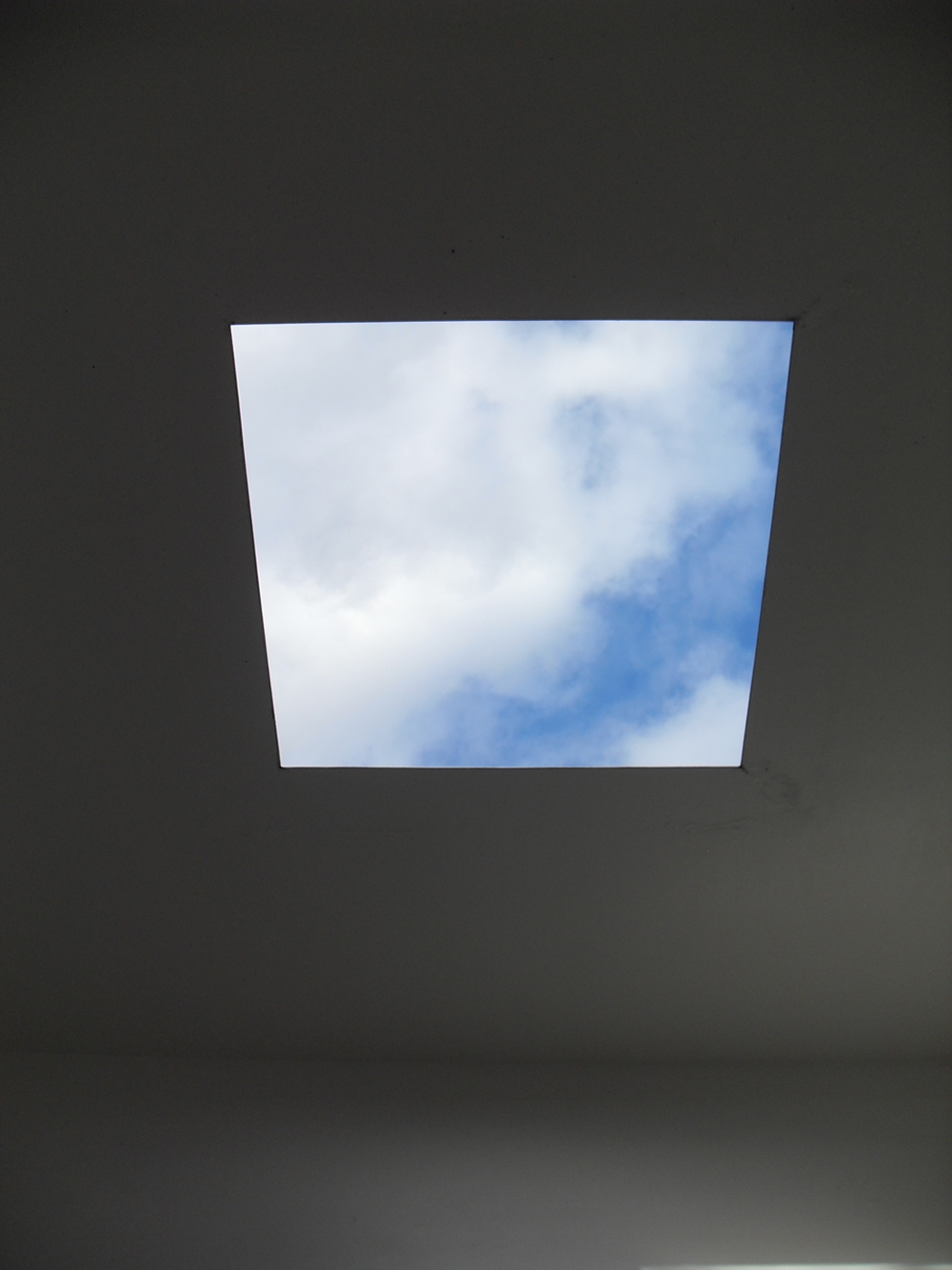
Deershelter, Skyspace, James Turrell, 2006. Installation at Yorkshire Sculpture Park © 2006 YSP and James Turrell. Photograph by the author, 2010.
Published on the website and interpretative material are quotations of Turrell discussing his design for the Skyspace: My work is not so much about my seeing as about your seeing. There is no one between you and your experience.
60
My desire is to set up a situation to which I can take you and let you see … My art deals with light itself, not as the bearer of revelation, but as the revelation itself.
61
In Turrell’s formulations the audiences’ perception of light entwines the concept and material of the art. The artist is the agent who enables the right conditions, yet it is the audience member who perceives the light, processing her or his experience. Interestingly, Turrell is rarely present for the making of his exhibitions or Skyspaces. Instead, a manual is sent with one or two of his assistants to oversee the installation of the work. Therefore, despite the sculpture park’s website and interpretative material foregrounding the role of artist, the conventional notion of the artist’s hand in the process of making is removed. 62 The artist as the creative source is troubled, placing further strain on the efficacy of the notion that the artist has authorial control over the artwork and its meaning. Alternative ways in which the meaning of the artwork can be interpreted are opened up in the section that follows with audience practices of Turrell’s Skyspace. This frames the meaning of art empirically, offering new avenues to the compelling yet problematic narrative of the artist that is widely circulated in critical literatures and replicated in the curatorial mediation above. 63
Vignettes of audiencing Turrell’s Skyspace
Audiences map meaning in multifarious ways from encounters with Skyspace; therefore, the vignettes selected in this section are significant because they challenge authorial control and curatorial interpretation in specific ways. The following interviews and analysis aim to create the important recognition that audiences are specialists who ‘use’ art according to their own knowledges, interests and social relations. However, the experience of art is not singularly based on where audiences come from, but who and what they meet with during their encounters. Instead of residing unreservedly with the artist or arts professionals, the cultural meaning of art exists in exchanges between very different and power-differentiated communities of audiences, the artwork and the changing environment of the artspace.
In these opening vignettes, participants Maria and Jeremy
64
drew upon their different trainings, respectively an amateur choralist and undergraduate student in architecture, to inform the meaning of Skyspace: I’m actually a tenor … did you hear us singing in there? Well, we were singing because it has the most beautiful acoustics and we were just saying that we want to bring back our quartet and sing in here … In music there’s this return to communal singing and I wonder if there could be something like this for art. Communal art. It’s about bringing people to the artwork and seeing what they make of it. It’s coming from the inside and sharing.
65
With the architecture course [we’ve] been doing the tutors have been trying to get us away from what you think architecture is and [the course has] been a lot more expressive this year. We’ve been looking at a lot of sculpture and trying to be more creative … One of the things they told us was to look at the Skyspace in the deershelter.
66
In the first extract Maria established that she is a choral singer, and then described how she practiced singing in the Skyspace. Later on in the same interview Maria introduced her occupation as a homeopath, relating her work to ‘this cerebral feeling of everything slowing down, of calming down’. The sensorial ‘very therapeutic’ qualities of the Skyspace that Maria described can be seen to engage the language of her homeopathy. The installation is described by Maria through physical registers rather than visual description, with the reflection that Skyspace ‘slows you right down, I can actually feel my blood pressure dropping’. 67
Interpreting the Skyspace through the sensual physicality of singing and her homeopathy, this audiencing vignette reopens the question of whether the experience of installation work is ever purely centred on optics, 68 with the relationship between visual and other sensory modalities vital to the subject’s self-reflexive understanding of the artwork. 69 Turrell’s work was also conceptualized by Maria as a productive place that brings people together creatively; a space for ‘communal art’. 70 This interest in communalism draws a direct connection between Maria’s interests in life outside the spaces of the park with how she performs within the Skyspace, through choral singing with a friend.
The vignette provides a powerful example of audiencing site art, emphasizing the active role of the audience in an art encounter. In particular, the act of singing in an artspace intended for quiet contemplation is indicative of the non-uniformity of audience experience. Insights from this vignette reach beyond description of the material, formal qualities of the artwork, to elucidate the social, performative and affective capabilities of Skyspace. It also signals the potential for creative reimaginings of established and already ‘located’ site art according to different specialisms and passions.
In the case of Jeremy, the organized visit to Skyspace was creatively directed by guidance from tutors on his university course. Visiting the deershelter Skyspace was intended to push the students’ conceptions of architecture through its intersections with sculpture. The architectural design of the inner chamber was Jeremy’s primary focus: I think you can look at the sky anytime you want but to walk into that environment and to put a frame around the sky suddenly makes it more interesting … It took me a few minutes to know what I was looking at … Because when I went it was such a cloudy day and it just looked like a fluorescent day [in the chamber] … I found it interesting that just by having a frame around the sky, it becomes art.
71
Jeremy refers to the framing device of the aperture, suggesting a distinction between subject and object, rather than collapsing the two into one another. This vignette therefore works as a critical corrective to the account of Turrell: ‘[m]y art deals with light itself, not as the bearer of revelation, but as the revelation itself’. 72 Instead, Jeremy proposes that the architecture of display forms the most engaging aspect of the work: ‘I found it interesting that just by having a frame around the sky, it becomes art’. 73
In the vignettes taken from the interview with Jeremy, the architecture of the Skyspace forms the point of interest rather than the light itself. Or, indeed, the way in which the architecture and internal lighting makes and transforms celestial light. Extending understanding of the dynamics of the picturesque landscape, this example attends to the relationships between sculpture and landscape with architecture and the sky that gives rise to the sculptural experience in Skyspace. The experiential connection between these elements is magnified in intensity by the aperture. The structure of Skyspace therefore frames the sky as another kind of site for the audience; 74 however, in doing so it simultaneously draws attention to the technologies of its design. Throwing into relief the mechanisms of the artwork, Jeremy’s insights point toward a rupture between Turrell’s and the curator’s design with the audience response. Jeremy’s specialized response to the Skyspace resists dematerializing the art and, by foregrounding the architecture, he also challenges where the artwork resides. 75 Underscoring the importance of context in the determination of the artwork, the case can be seen to intersect with Kwon’s account of the cultural framework in site art. In this vignette, it is not the perceptual power of the light that holds value, but the contingencies of the architectural structures, meaning the whole arena of the deershelter Skyspace becomes the artwork.
Maria and Jeremy are distinct in how they analyse their experiences, with terms including interest, expressiveness and sharing employed to communicate the meaning of each encounter. These terms bear similarities, however, in owing a relationship to registers of critical and affective engagement. In both cases the installation acts as a creative catalyst in the geographical spaces of the sculpture park and beyond. The encounter with the Skyspace was neither a singular nor contained experience. Follow-up interviews with Maria and Jeremy revealed that both had revisited Yorkshire Sculpture Park and the Skyspace. Further, they had reproduced their engagements with Skyspace in representational spaces beyond the park.
Maria, marking the commemorative occasion of her retirement as an occupational therapist, returned with other choir members and recorded their communal singing in the Skyspace on videotape. Recordings of the tape were then distributed to the homes of all those who had participated in the singing. Meanwhile, Jeremy revisited with his partner where he developed sketch book drawings from his first visit that were revised and submitted as part of an assessed component of his undergraduate course. Jeremy also visited Turrell’s Skyspace in Kielder Park, Northumberland, on ‘another trip with the uni’ in the same academic year, articulating connections between the two site works: There were three different trips you could choose between … and I specifically chose the one with the Turrell so I could get to see [ Skyspace in Kielder Park] and compare it to the one at the Yorkshire Sculpture Park … I think this one [he points to the image of the Skyspace in Kielder Park] is a lot more successful than the one at the sculpture park because of the round shape of it. It looks like a planet which is orbiting.
76
The vignettes of Maria and Jeremy show certain ways in which the site art at Yorkshire Sculpture Park hosts creative and educational exchanges, and exists in representational and ‘more-than-representational’ spaces beyond the geographical boundaries of the park. 77 Together, they also point toward new areas of critical investigation, such as where site and site art meets with the geographies of mobility. 78
Meanwhile vignettes that draw out embodied issues of (im)mobility in the research can be used to inform the on-site geography of Yorkshire Sculpture Park. The built environment has been shown to discriminate against certain bodies in the geographies of disability 79 and feminist geographies of maternity and obesity. 80 Sue and her husband David pointed out to me on a map the route they took around the park on their visit: ‘We went through this park – across the bridge – up and over to Longside – then to Oxley Wood – and then to the café’. 81 After completing their journey of the sculpture park, Sue and David told me that they came ‘to rest’ because they ‘were absolutely knackered’. Sue detailed the demands of the landscape as the reason for why the married couple did not experience Skyspace despite considering themselves ‘keen walkers’. ‘I’ve been ill and I’m still not very well so that affects my mobility’, said Sue. ‘We did well but that gradient is too difficult.’
Two other participants also highlighted how mobility issues negated a visit to Skyspace: ‘mum’s hurt her leg and so we couldn’t walk that far’. 82 The attention drawn to mobility by these participants recalls Harriet Hawkins’s critical spatial sensibilities, where the embodied experience of travelling through installation art is informed by landscape practices. 83 In fact, in the context of the sculpture park the embodied experience of being in landscape directly informs the quality of art engagement. Landscape is not described in terms of visuality and aesthetics; instead, the gradient is referred to in bodily registers of (im)mobility. For Sue, the incline of the Country Park leading to the deershelter is ‘too difficult’ to access. 84
Contributing to research on the geographies of the built environment and bodies, the environment of Skyspace shifts the focus from within the art object to the contingencies of its context, undermining any notions of the neutrality or innocence of the artspace in relation to audiencing. This vignette shows how the landscape of the sculpture park can create restrictions and barriers beyond the perceptual, which can be obstructive as well as generative depending upon the embodied mobilities of different audiences. In this instance, art and landscape are considered in degrees of tension that offers a different story from the phenomenological theorizing of Bois on the picturesque landscape. Instead of perceptually enmeshing art and landscape, the geographies of (dis)ability can necessitate degrees of separation between the two. The journey through a varied picturesque landscape to access an artwork may discriminate against certain bodies, such as Sue’s, meaning that the ‘dialectic of walking and looking into the landscape’ actually has the potential to disrupt rather than establish the sculptural experience. 85
In the final vignette, audiencing by visitors Lizzie and Kevin develops the reflection on the agency of the landscape by attending to non-human dynamisms and Skyspace:
It feels very spiritual. In fact I was thinking it was somewhere I could come once a week and spend time … Just watching the clouds. And birds. You see them occasionally. They appear from nowhere [in the aperture].
We had to chase some sheep out today.
Not from right in [the Skyspace] but from the grass bit. We had to chase them out. 86
The birds and sheep that enter Lizzie and Kevin’s experience of Skyspace at first appear to interrupt the direct relationship between the couple and the artwork. Yet, by facilitating ‘experience of the sky and celestial phenomena’ the work can instead be seen to stage a heightened awareness of the relationship between inside and outside space. 87 The agency of creatures in the sky and landscape are an indivisible part of the connectedness of Skyspace with other functions of the site(s) beyond. The installation of Skyspace in the restored and remodelled deershelter created a purpose-built artspace, yet the Country Park is also a working landscape used by local farmer, Phillip Platt, to graze his sheep.
Through this vignette Skyspace can usefully be observed as a prism where art, landscape, sky, and its human and non-human inhabitants act upon each other. The intervention of architecture and site art within the working landscape is emphasized in the vignette with the chasing of errant sheep from the entry to the artwork. Challenging the received notion that the aperture in Turrell’s site art ‘forces us to attend to the sky as the main focus’, 88 this vignette uncovers the important recognition of the multiple uses of Yorkshire Sculpture Park with its relational and contrasting qualities as working landscape, heritage site and artspace. 89
Lizzie and Kevin’s account indicates the competing functionalities of the landscape that Yorkshire Sculpture Park now manages, which are historically layered and overlap in the park’s geography. Material markers remain as testament to each of the changing land uses of the Bretton Estate, from the private historic estate, to War Office, educational college, and sculpture park. The dominant institution on the Bretton Estate has changed, yet certain continuities from these different eras have stayed in place. Lizzie and Kevin uncover the usage of the Country Park by the local farmer in a shared agreement with the management of the sculpture park that remained when the organization gained control of that area of the estate. The functions of the landscape coalesce in this vignette of audiencing Skyspace, providing insights into the competing ways in which the park and its artworks can be conceptualized and practiced in the present day. By attending to the wider dynamisms of Skyspace within its spatial environment, the definition of art, and specifically sculpture, is brought into question; a point to which I turn to in the final section.
Expanding the meaning of sculpture
With the recognition that deershelter Skyspace can be multiply categorized, the definition of sculpture is opened, which intersects with the work of art critic and theorist Rosalind Krauss in her essay ‘Sculpture in the Expanded Sphere’. 90 In part of this essay, Krauss specifically considers sculpture for the open air, and the transition from the style of commemorative statuary sculpture to modernism. Krauss documents the transition in the 19th century made from ‘commemorative representation’ that ‘speaks in a symbolical tongue about the meaning and use of that place’ to ‘its negative condition, a kind of sitelessness, or homelessness, an absolute loss of place. Which is to say one enters modernism’. 91 I propose that encounters with the deershelter Skyspace can be characterized in the ‘expanded sphere’ as a return to the contextual contingencies of sitedness and situation.
While Turrell and curators may accord that the artist’s main material is the light itself, it is clear that for a proportion of the audience the structural complexities of the deershelter, the technologies of the space and human and non-human inhabitants of the landscape provoke equal contemplation. By extension, the bodily experience of being in the designed landscape with the sensuous dimensions of site art engagement brings richness to an appreciation of the various ways in which the work functions for different audiences. Audiences are revealed to be individual specialists with experiences informed by different bodies and bodily capabilities, recreational interests and social relations on visits. Tracing the audiencing of deershelter Skyspace also points toward the relationality of art and audience with other kinds of site, drawing connection between the sky, the working landscape and other Skyspaces. Together, the vignettes show that through attention to audiencing site art the geographies of art are informed by changing dynamics of the social and spatial environment, emphasizing the contingency of embodied experience and knowledge production in documenting the meaning of art.
Conclusion
Audiencing as a method contributes to Morris’ recent writing on post-phenomenology by representing multiple subjects’ engagements with site art. By developing the argument that individual experience is tied to the perceptual environment, along with ‘the actions and expressions of others’, this article emphasizes that art encounters are rarely autonomous or isolated experiences. 92 By drawing out the geographies of audiencing site art, the accounts of audience members work together to critically interrogate the authorial control of the artist, challenging the efficacy of Turrell’s statement that, ‘[t]here is no one between you and your experience’. Through following processes including interviewing and participant observation, artistic intentionality is disputed as determining the meaning of artwork, with the creative role of the artist and audience brought into greater parity. Instead of a regressive linear process that emphasizes the originatory source of the artist and locates the meaning of art according to statements attributed to the artist, audiencing reveals the continuous and socially contingent production of site art’s meaning.
By attending to each of these audience vignettes drawn from interviews and participant observation, and in particular those of Jeremy, Lizzie and Kevin, different kinds of ‘site’ are mobilized that expand understanding of the dynamics of site and site art by highlighting the sky, the landscape and relational sites of arts practice and arts audiencing. Further, the vignette of Sue interrogates critical spatial sensibilities through the embodied registers of (dis)ability and illness. In the case study of Turrell’s Skyspace, (im)mobility can be seen to unbalance the ‘configuration of bodies, spaces and objects’ in installation art where ‘you take your whole body’. 93 Emphasizing again the ways in which subjective encounters can collide with the design of the artist or author writing on behalf of audiences, this experiential account also serves to critically challenge the phenomenological theorizing of Bois, and to some extent, Kwon. The vignettes open up the question of how we categorize site art, and according to which type of audience.
Together, the empirical findings argue for the non-uniformity and creative potential of site art audiencing. Tracing the audiencing of deershelter Skyspace reveals that meaning is not the preserve of the disinterested, trained eye. Intentionality and curatorial directives are challenged by recovering the practices of audiences that offer different perspectives on the meaning of art, which is pertinent whether in the context of the gallery or landscape. Developing cultural geography’s engagement with art, the article challenges geographers to consider how the meaning of works and sites can be renegotiated according to the specialisms of others, and the social dimensions of audience experience. Audiencing as an approach makes theoretical, methodological and empirical contributions to the geographies of art by showing how critical enquiry can become more democratized to include different and power-differentiated subjects. In order to acknowledge the dynamic processes through which art gains meaning as a cultural and aesthetic object, installation or performance, audience engagements ought to be made visible through more attentive and considered investigation. By providing insights into the ways in which different audiences practice Turrell’s Skyspace, this article goes some way toward advancing the recognition that audiences are central to creating and reworking the meaning of cultural forms.
Footnotes
Funding
This work was supported by the Arts and Humanities Research Council with & Co.TM The cultural marketing house [grant number CDA143432].
Notes
Biographical note
Saskia Warren is a research student at the Department of Geography, University of Sheffield. Her current research interests include: place, space and landscape; consumption/audiencing; legacy of conceptualism and site art; creative industries and cultural policy; and intersections of art theory and cultural geography.