



Abstract
This paper examines how the changing intensities of habit alter the way that places are inhabited and experienced. Developing a virtual and distributed understanding of habit that underscores its transformative powers, the paper demonstrates how habit can be understood as an important virtual infrastructure in the way that it provides a charged, dynamic background that entrains and supports movement. Based on reflections on long-duration airline travel, the paper describes how the intensity of habit’s operation changes over the course of a journey, and is revealed through different qualities of bodily movement. Gracefulness, restlessness and clumsiness are presented as three movement transitions that demonstrate how practical competencies are fragile and contingent on milieu. Where much geographical inquiry has examined disruptions to physical infrastructures, this paper shows how the virtual infrastructures of habit are susceptible to different kinds of transformation, which changes bodily capacities for moving, sensing, perceiving and attending, and, thus, the lived experience of place.
Introduction
Habit has been an important trope for cultural geographical thought on mobility for some time now. Cultural geographers have shown how habit is a force that helps to develop practical competencies. They have shown how, through repeated movement, habit helps to constitute meaningful places. They have also shown how habit is an important mode of social reproduction. However, much less has been said about how the force of habit can wax and wane. Sometimes practices can feel graceful and easy because they are supported by habit. But sometimes these very same practices can feel clumsy and tiring, showing how habit can subside. Vital questions therefore remain concerning how the changing intensities of habit alter the way that places are inhabited and experienced. Whilst much is known about how habit helps to develop and refine practical competencies, much less is known about how habits can attenuate and decay, thereby changing the lived experience of place as a result. Rather than focusing on the way that habit assists in the development and refinement of practical competencies, this paper develops cultural geographical debates on habit by demonstrating how the practical competencies generated by habit are fragile and are prone to different kinds of modulation.
As a form of mobility that is apt for reflecting on the changing intensities of habit, the empirical focus of the paper is long-duration airline travel. The paper shows how practical competencies formed through habit are transformed over the course of a long-duration airline journey, and that these transformations reveal themselves through different qualities of bodily movement. At different stages of the journey, the qualities of movement can be characterized by gracefulness, restlessness and clumsiness − each revealing different intensities of habit and, thus, distinctly different modes of inhabiting place. Habitual competencies can support graceful, comfortable and easy movement through the spaces of the airport at the start of the journey. Yet, further into the flight, these habitual competencies can become attenuated and give way to restless insomnia, a distinctly different quality of movement. At the end of the journey, in jet-lagged exhaustion, the intensity of habitual competencies can be reduced so much that movement is clumsy and uncomfortable.
Developing cultural geographical understandings of mobility practices and the ongoing ethics of our embodied capture within travel, this paper’s contribution to debates on habit and mobility can be summarized in four main ways. First, it shows how habit can be understood by cultural geographers as a transformative force, rather than a force of stability, regularity or repetition of the same. Second, it develops our understanding of what a habitual mobility competency actually is by arguing for a much less individualistic and a more virtual and distributed, and therefore fragile, notion of habit that acknowledges how the intensity of habit’s operation is irreducibly contingent on milieu. Third, in emphasizing the significance of milieu, it expands our understanding of mobility infrastructures to account for the entraining effect of habit through the notion of ‘virtual infrastructure’. Fourth, it shows how this virtual infrastructure is susceptible to different kinds of transformation, which changes bodily capacities for moving, sensing, perceiving and attending, and, thus, the lived experience of place.
Structurally, the paper is split into two main parts. The first part outlines the conceptual context of the paper in three ways. It begins by summarizing some of the key humanist cultural geographical research on habit and mobility that draws attention to habit’s formative role in the generation of practical competencies and sense of place. It moves forward to show how a more virtual apprehension of habit better attends to habit’s distributed nature across bodies and environments. This section concludes by outlining how this virtual and distributed understanding of habit can be put to work through the concept of ‘virtual infrastructure’. The second part of the paper comprises three vignettes, charting three transitions on a long-duration airline journey during which these virtual infrastructures of habit become differently configured. In each of these transitions, the differing intensities of habit show how bodies become differently susceptible and receptive through travel.
In addition to cultural geographers concerned with mobility, this paper draws inspiration from a range of other thinkers for whom habit has been an important preoccupation. Key to the virtual, distributed understanding of habit foregrounded in this paper is the 19th century French thinker Félix Ravaisson. But, as the paper demonstrates, Ravaisson’s writings say little about how habits can attenuate by becoming less intense. Therefore, through the three empirical transitions, the paper draws succour from Paul Ricoeur, Jean-Luc Nancy and Emmanuel Levinas since their writings on bodily vulnerability help to conceptualize precisely these attenuations.
Human habits, productive competencies and place-making
In the context of debates on stimulating lower-carbon mobilities, habit is often invoked as an explanation for why certain forms of moving about seem to have become unflinchingly obdurate. 1 Yet, this understanding is wedded to a negative evaluation of habit as mechanistic and automatic repetition of the same, which veils us from the world, inhibiting self-knowledge and understanding. This understanding still casts a long shadow over contemporary apprehensions of habit, particularly where it becomes objectified as a target of biopolitical social regulation. 2 Often taken to be a chastening resistance that stagnates life and limits freedom, the relentless seriality of habit is still frequently held to be a central obstacle to our thriving, locking us into patterns of life that are difficult to escape from.
Through the characteristic relation that modernity has to the routinization of movement, revealed perhaps most forcefully through the intensification of industrial routines and the forms of alienation that can result, 3 it is perhaps not surprising that negative apprehensions of habit endure. These characterizations of habit are, however, relieved by a rich seam of cultural geographical thought on mobility that accords it a much more positive role in the constitution of lifeworlds. Humanist geographical scholarship, in particular, provides some of the richest understandings of how our lived apprehension of the world emerges through the development of different forms of habitual consciousness. Influenced by Merleau-Ponty’s phenomenology, David Seamon’s path breaking writings on bodily movement puts habit to centre stage. 4 Seamon is interested in understanding how the habitual ‘body ballets’ of individuals give rise to regular ‘time-space routines’. Here, it is the collective aspects of habit that become important, since these time-space routines coalesce to form ‘place ballets’. Thus, for Seamon, habit is vital to the generation of meaningful places. A productive apprehension of habit is also important to Yi-Fu Tuan’s theorizations of place. For Tuan, the habits of routine are at the heart of how the home, for example, becomes experienced as a meaningful place, since it is through repetition that paths ‘acquire a density of meaning and stability’. 5 This is certainly not automatic repetition of the same, since whilst ‘spatial skill lies in performing ordinary daily tasks’, 6 Tuan also draws attention to the ‘small adventures’ 7 that creative variations in habit give rise to.
Through repeated movement, habit is not only key to understanding how places are made meaningful but, relatedly, it is also a vital dynamic of social reproduction. Drawing inspiration in part from Hägerstrand’s time geography, a key preoccupation of Allan Pred’s writings on the contingency of everyday place formation is the dialectical interplay between everyday habitual practices and powerful structures. Echoing this duality, Pred is particularly interested in how the specificity of place emerges through intersections of ‘individual paths’ and ‘institutional projects’. Here, habit plays an important role in the self-development of individuals, since: the ordinary individual is not only created by society, or socialized, but creates herself, purposively or habitually adding action elements to her path by internally reflecting upon or in other ways drawing upon what she has been externally exposed to, thereby contributing (usually unknowingly) to social reproduction and the perpetuation or transformation of society’s structural relationships.
8
Cultural geographical research has, then, for some time, underscored the centrality of habit to the generation and cementing of suites of practical competencies for getting by in everyday life and making place meaningful. However, whilst habit is accorded a positive and productive role in this work, what this research tends to emphasize is how habit produces consistencies and regularities in everyday life. This emphasis downplays the transformative aspects of habit. In response, this body of cultural geographical research can be augmented by turning to a different way of thinking about habit that understands it less as a human resource and more as a virtual, distributed dynamic.
Virtual habits and distributed competencies
In contrast to humanist cultural geographical work on habit that emphasizes its socio-cultural role, Félix Ravaisson’s writing on habit emphasizes its transformative nature by providing us with a more ontological and material understanding. 9 For Ravaisson, habit is not just a way of thinking about the development of practical competencies, but it is a much more fundamental dynamic to life. Ravaisson’s understanding of habit, like humanist geographical work, concerns bodies. But his account is much more concerned with how bodies materially and affectively change over time in formative relation with their milieu. As such, this understanding of habit is less about consistencies and competencies, and more about change and transformation. As a way of understanding the material folds that mutually shape bodies and environments, for Ravaisson habit is nothing less than the general movement of life itself. Therefore, rather than conceptualized in terms of social and cultural dynamics, Ravaisson is concerned with the affective forces that habit demonstrates. These affective forces emphasize how repetition changes the capacities of bodies to move, sense, perceive and attend.
Ravaisson conceptualizes these transformative dimensions of habit in terms of changes to active and passive affects. On the one hand, repetition or continuity of a movement, an active affection that is willed by the body, strengthens that movement. On the other hand, the repetition or continuity of a sensation, a passive affection that is at first felt as an impression on the body, weakens that sensation. As such, active movements become more automatic as they become removed from the sphere of conscious willing, thereby becoming more passive. Accordingly, passive impressions are incorporated into the body, becoming desires, thereby becoming more active and willed. This processual understanding of habit’s dual logic not only spotlights the material transformations that it gives rise to, but, in doing so, it challenges the rather stronger notions of subjective agency that can be seen in more humanist apprehensions of habit. 10 It does this by emphasizing the virtual forces that are at work through habit.
Where humanist cultural geographical work on mobility tends to focus on the actuality of practices, Ravaisson’s account draws attention to the virtuality of practices, a dimension that is vital for understanding how habit transforms bodies and milieus. The virtual here concerns the formation of propensities and dispositions. These are the key dimensions of practical competencies that are real, but not actual. In Ravaisson’s words, through repetition, from this torsion of activity and passivity emerges an ‘obscure activity’ that ‘increasingly anticipates the impression of external objects in sensibility and the will in activity’. 11 What this means is that repeated or continued movement gives rise to a permanent change in disposition. This is not a ductile body that snaps back to an original shape, but a plastic body whose permanent disposition is changed. What were once movements requiring effort and will to steer them become incipient tendencies that increasingly anticipate what is required of a situation, thereby freeing up energy for other things. Through their repetition, movements become expressed with greater ease, exactitude and finesse. Indeed, observable changes in the actual shape of a practice are only a partial expression of habit. As Lalande points out, ‘one must not confuse the manifestation of habit which renders it sensible to us, with the biological modification that constitutes it’. 12 This understanding of habit involves intensive transformations that signal not only how bodies on the move adapt to, become attuned to, and transform their milieu, but how these milieus shape those bodies and bring them into being in irreducibly contingent ways. In short, this understanding of habit sutures environment and living beings through their co-evolution.
There are some points of overlap with Seamon, Tuan and Pred’s writings on habit here, especially concerning the formation of practical competencies. However, what Ravaisson’s writing highlights is how, alongside the socio-cultural forces that have been key to thinking about the constitution of mobilities, are another set of affective forces that work on mobile bodies in ways that are perhaps less immediately apparent, given that they work incrementally in slow-creep ways over time, but have effects that are no less material. Foregrounding the virtual forces of habit, the tendencies and dispositions that emerge through repetition, draws attention to how specialist practical competencies are born and sculpted, where, for example, over time, commuters, business elites and delivery drivers each develop their own suite of practical competencies for moving about. The key difference is that Ravaisson’s understanding of habit provides a much more virtual apprehension of what, exactly, constitutes these practical competencies. The practical competencies normally understood to be know-how possessed by a body, what are often referred to as ‘embodied knowledges’, 13 can instead be understood as the incipient movement tendencies that possess bodies. Crucially, these are tendencies that, in their virtuality, are distributed across mobility assemblages that are formed of ‘lived-body-environment circuits’, 14 to use Evan Thompson’s phrase. This understanding of habit therefore apprehends bodies on the move in terms of the virtual forces that constitute them.
It is the development of virtual tendencies that transforms capacities for moving, sensing, perceiving and attending since it is these virtual tendencies that ensure that bodily movements become increasingly removed from the realm of cognitive effort, and initially-painful sensations become attenuated and woven into the task in hand. Furthermore, in the absence of certain stimuli that we have become habituated to, we might miss their presence such that those sensations become a desire in and of themselves. Thus, where cultural geographers have often focused on the phenomenal aspects of habit for understanding its lived bodily manifestation, Ravaisson’s writing underscores the impersonality of habit. In contrast to more humanist apprehensions of habit, this virtual understanding of habit is not coincident with individual bodies, but part of the movement of life that brings living beings into existence in formative relation to their milieu. This virtual, distributed apprehension of habit therefore provides an important way of thinking about the creative and adaptive syntheses that mutually constitute mobile bodies and their travelling environments.
Habit as virtual infrastructure
Apprehending habit as something that is less individual, less human and something that is much more distributed across bodies and environments clearly has significant implications for cultural geographies of mobility, since it puts a much greater emphasis on milieu for understanding the efficacy of practical competencies for moving about. In particular, a virtual, distributed understanding of habit can develop our understanding of how mobility infrastructures work. Within studies of mobilities, infrastructures are often understood to be the relatively immobile ‘moorings’ that are required to enable the mobility of technologies of transit. 15 They organize, limit, channel and regulate the intermittent flow of people, information and images. 16 Drawing succour from the wider body of geographical research on infrastructure, much thinking has focused on the physical materialities of infrastructure to highlight its centrality to processes of urban politics. 17 Infrastructures both facilitate and restrict the movement of people, things and ideas through mobility systems through the powerful logics of sorting that they employ. 18 They entrain by channelling and directing movement through symbolic and affective logics. 19
If habits are apprehended as virtual and distributed, rather than internal to individual bodies, habit becomes a key part of this infrastructure. This is significant because how moving through mobility infrastructures is affected by habit has not received attention. Research on the speed and ease through which the ‘kinetic elite’ move through spaces of the airport, for example, has focused on the privileges that socio-economic status affords in terms of access protocols. 20 Yet how habit affects the quality and experience of movement has not been sufficiently addressed. 21 Since a virtual understanding of habit emphasizes how habits are distributed across bodies and environments through the emergence of incipient tendencies, rather than being attributes of individual bodies, a virtual understanding of habit is apt for examining how habit affects movement through these spaces. Since these incipient tendencies entrain bodies by both carrying and cocooning, habit can be understood as a virtual infrastructure that augments the carrying work that physical infrastructures do. Understanding habit as a virtual infrastructure emphasizes how all movements stretch beyond themselves to condition future movements.
Habit understood as a virtual infrastructure provides a protective ‘guarantee’ for the body. 22 But what the remainder of this paper shows is that the strength of this guarantee − the intensity of this virtual infrastructure − is changeable. Subsequently, these changing intensities of habit affect the lived experience of place because bodily capacities for moving, sensing, perceiving and attending are transformed. 23 This is significant because whilst much has been said about the transformations that physical infrastructures undergo through different durations, 24 transformations of habit have received little attention. For humanist cultural geographies, habit is broadly conceptualized as a to-hand bodily resource that is always present and ever more refined. Whilst Pierre Bourdieu’s notion of ‘habitus’ comes a little closer to the idea of a virtual infrastructure, where particular environments produce ‘systems of durable, transposable dispositions…principles of the generation and structuring of practices and representations,’ 25 Bourdieu is mainly concerned with the stabilities and regularities that sustain over time. 26 In contrast, drawing on Ravaisson’s virtual, distributed understanding of habit is a vital way of examining the transformations that happen to these virtual infrastructures.
In a very material and biological sense, habit is a transformation of lived-body-environment relations. The strengthening of activity and weakening of passivity that habit gives rise to constitute permanent transformations of body and world, 27 creating an ‘entubulated’ form of agency, as Gillian Fuller and I have described elsewhere. 28 Ravaisson’s writings on habit, however, stop short of examining changes to the intensity of habit’s operation. This is a significant absence because vital questions remain about how the changing intensities of habit alter the way that places are inhabited and experienced. Whilst much writing on the relationship between habit and mobility has tended to focus on the development and refinement of practical competencies over time, much less is known about how these competencies, or ‘virtual infrastructures’, might be intensified or diminished in different ways in different places. Whilst much is known about the relationship between physical mobility infrastructures and particularly disruptive transformations, 29 much less is understood about how the emergent practical competencies generated by habit might be equally fragile and susceptible to different kinds of modulation.
What the second part of this paper shows is how virtual infrastructures of habit are fragile and susceptible to different kinds of modulation. It does this by describing three ‘movement transitions’ of a long-duration airline journey, based on autoethnographic reflections of quite a few years of international travel. 30 These transformations reveal themselves through different qualities of bodily movement. At different stages of the journey, the qualities of movement are characterized by gracefulness, restlessness and clumsiness, each revealing different intensities of habit, and thus distinctly different modes of inhabiting place.
Transition one.
Transition one: somnolent gracefulness
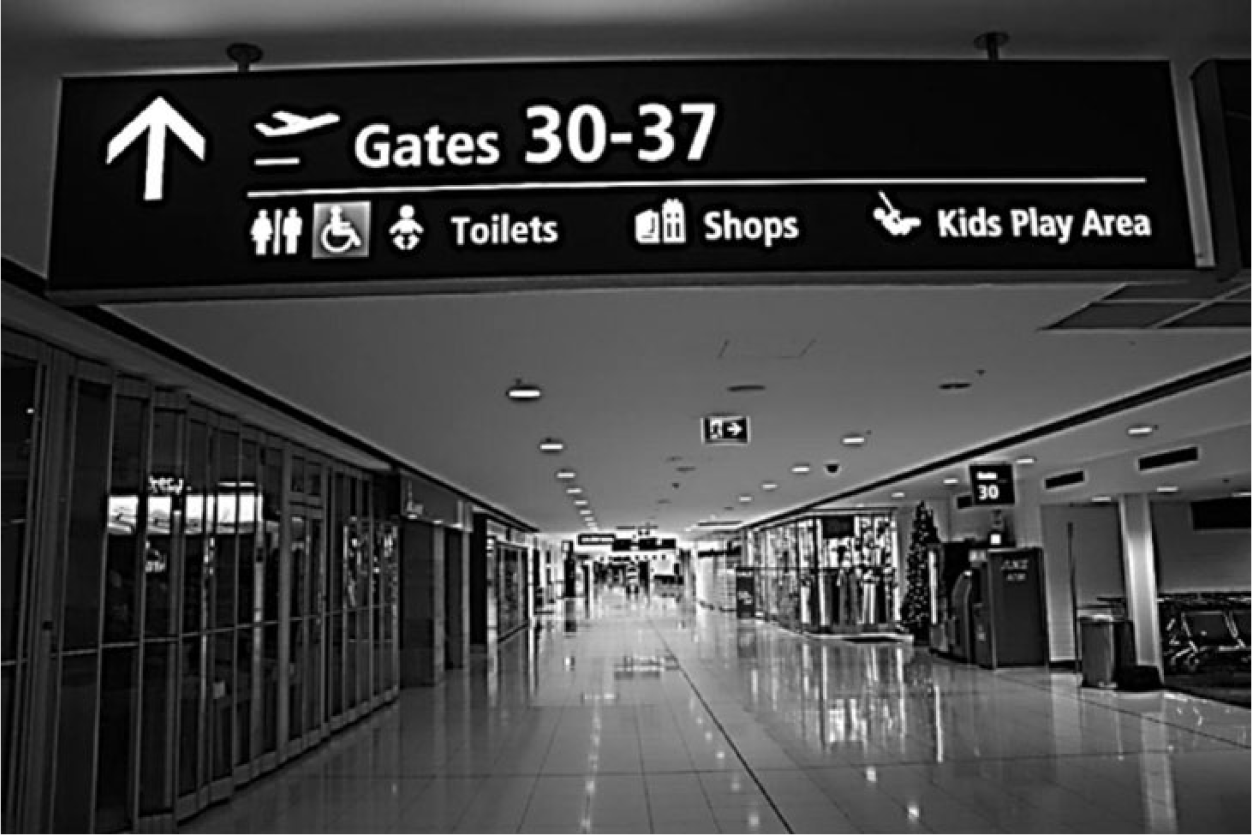
Movement through the airport is entubulated. Walking through Sydney airport, from security to gate 32 a Monday evening. This is a routine that has been done many times before. There is a pleasurability in this movement. Moving without thinking, being carried and cared for, gliding through the marble passageways. A familiar choreography of small suitcase pulled by right hand and passport and tickets held in left hand; boarding card is sandwiched in the passport. Small details pierce attention: the clock on the departure screen is centre-justified rather than left on the screen as it usually is.
This passenger glides through the rectangular passages of the airport with ease and finesse. This is not just because of his relatively privileged relationship to track and trace protocols that permit him passage, as has often been the emphasis in literature at the intersection of mobilities and securitization; 31 or the efficacy of perceptual signals that are built into this space to create signs and surfaces that impel the body forward in increasingly sophisticated ways. 32 This ease of movement for this passenger is also generated by the virtual infrastructures of habit. The repetition of movement through repeated journeying carves out passages that are as much habitual as they are architectural and can be inhabited with ease. 33 For this passenger, the airport at this time becomes less the oppressive, confusing labyrinth that might confront and confound the more occasional flyer, and much more a space through which the body is sheltered and cocooned by the virtual infrastructures of habit.
Over time, through repeated journeying, an intensive transformation in the relationship between the body and environment takes place, which reflects Ravaisson’s description of the material transitions implicated in habit. Through the continuity or repetition of an action, movement becomes increasingly effortless, such that ‘in movement itself, fatigue and struggle recede along with effort’. 34 For Ravaisson, the power that habit gives to life is an ‘immediate intelligence’ through which a kind of ‘obscure activity’ develops. This obscure activity describes the virtual potentialities that repeated activity generates, propelling the body forward into a future that is anticipated by these tendencies. The powers of habit that entrain the body through the space of the terminal are these anticipatory propensities for movement that, over time and through repetition, anticipate what is required for the body to do in a familiar situation.
The emergence of these habitual movement competencies reinforces the significance of how ‘one’s lived body is a developmental being thick with its own history and sedimented ways of feeling, perceiving, acting and imagining’ 35 that significantly tempers the lived experience of moving through these spaces. Whilst much geographical work on mobility emphasizes how our past experiences condition how we are propelled into a future, foregrounding a virtual, distributed understanding of habit is important because it acknowledges how habit is not something that is contained within a body, but instead is a much more virtual power that is dispersed across multiple sites. Evan Thomson’s description of habit is particularly useful in this regard. He argues that ‘these sedimented patterns are not limited to the space enclosed by the body’s membrane; they span and interweave the lived body and its environment, thereby forming a unitary circuit of lived-body-environment’. 36 This is significant because whilst habit competencies are materially manifested through individual bodies, they have a much more virtual, distributed existence and express themselves through the strengthening of these unitary circuits of lived-body-environment. This means that these habitual competencies are inextricably contingent on milieu.
Whilst habit excites spontaneity, or action, at the same time, habit decreases passivity, or sensation. In the space of the terminal, for this passenger, ‘in movement itself, fatigue and struggle recede along with effort’. 37 In other words, the effort of moving is registered in sensation much less than previously, making moving about a less fatiguing experience. But whilst the virtual infrastructures of habit serve this passenger well by decreasing fatigue, it also brings about a parallel sedative effect. It is this pacifying power of habit that, for Foucault, lends it to powerful disciplinary apparatuses. 38 The tendency to repeat actions previously undertaken, to follow the conduit of least resistance carved out by habit 39 renders other ways of moving about (initially) more uncomfortable and therefore potentially less appealing. As Ricoeur states, ‘habit functions through its activities of attrition in all senses, through muscular exercises, through its regulatory action, and finally and especially through its close alliance with effort itself in the form of discipline’. 40 For Ricoeur, ‘it is habit in all its forms which from infancy calms the muscular storm and diminishes the body’s susceptibility to wonder and shock’. 41 As such, habit understood as a virtual infrastructure serves to insulate and cocoon the body, diminishing bodily receptivity to shocks to thought, and thus intensifying habit’s infrastructural support, expressed here through graceful movement.
The intensity of the virtual infrastructures of habit through these spaces of the airport gives this graceful movement a somnambulant quality that prompts reflection on how receptive and susceptible the passenger is at this point in the journey. It is precisely these somnambulant qualities that have contributed to habit’s more negative evaluations, where bodies are more entrained by habit than self-possession. Where the recession of effort and sensation contributes to the comfort that habit affords, unease with any less-than-conscious actions is expressed by many thinkers. Both Descartes and Kant are highly suspicious of any actions driven by habit since, for them, habit does not stem from the deliberative cogitation necessary for actions to express the authenticity of the individual and, therefore, moral virtuosity. A similarly anxious anticipation of habit is reflected in more contemporary writings on the nature of crowds. Le Bon’s writings on the crowd’s highly suggestible nature follows this seam of thought, where an individual’s capacity for deliberative thought is suspended and replaced with the hypnotic impulses of contagion. 42 For Le Bon, the crowd poses a threat because, in the absence of cognate sobriety, it possesses highly destructive tendencies. Yet the crowd, in spite of its somnambulism, is also a body that is receptive enough to be captivated and lured with relative ease. This echoes Tarde’s writings on suggestibility and the affinity that sedation has with seduction. 43 That affective relations are being engineered in particularly accomplished ways, and through all kinds of captivations, lures and enchantments, becomes clearer to see as this passenger traverses duty-free.
But if we take it, as Tarde does, that ‘society is imitation and imitation is a kind of somnambulism’, 44 then the virtual infrastructures of habit can be understood as a somnolent source of invention and transformation. The sedative effect of virtual infrastructures of habit can expand the body’s receptivity to be affected by certain stimuli in a way that might otherwise overwhelm. Ricoeur argues that it is actually intense emotion rather than sedation that decreases the body’s capacity to be affected. He says that since ‘emotion is a convulsion, knotting the muscles; systematic muscular exercise has an anti-emotive effect which is slow but sure . . . In unknotting my muscles, gymnastic habituates the body to respond in a docile way to differentiated, impelling ideas. It makes the body better known and more available’. 45 Indeed, withdrawal to achieve a certain virtuosity or dexterity of movement can be witnessed in the performance of music, or certain sports, as Ricoeur’s example attests to, where ‘zoning-out’ is imperative to the accomplishment of these practical competencies.
For this passenger, the virtual infrastructures of habit are intense moving through this space, revealed through a graceful quality of bodily movement. 46 These virtual infrastructures induce a kind of somnolence, but this is a somnolence where capacities for moving and perceiving are high. Ricoeur’s assertion that habit makes the body ‘better available’ underscores this expansion of capacities where energy is available for other things. Similarly for Ravaisson, whilst passivity, or sensation, decreases through repetition, there is a parallel increase in perception. 47 At this point in the journey ‘auto-pilot’ is fully operational. 48 Habit creates an intense virtual infrastructural effect through the way in which it protects this passenger from phenomena that might baffle or alarm the first-time passenger. Here the virtual infrastructures of habit are fully synchronized with and augment the symbolic and affective strategies of entrainment that the airport achieves through its physical infrastructures such as signage and surfaces. This virtual infrastructure provides a protective ‘guarantee’ for the body, but in such a way that minute variations in the lived-body-environment circuit can make themselves known, but not so much that they intrude upon and disable action.
Transition two: insomniac restlessness
Another tube but this time seated on the plane. This is a body being moved by the passage itself rather than its own locomotion. A body that has been granted consent to withdrawal. Already eight hours of being carried and constrained by the seat, and the route map promises five more to go. Food has been served and now the lights have been faded and blinds pulled down to conjure a night: an affective atmosphere conducive to sleep. But sleep is not forthcoming.
The virtual infrastructures of habit provide us with the comfort and grace that enables us to move with ease, whilst at the same time moulding our temperament and shaping our tastes. Habit is apprehended as positive when it is coincident with our aspirations and goals, such as getting to the airport gate on time. But mid-way through the journey, the virtual infrastructures of habit that had supported movement through the airport terminal have changed in their intensity. Going to sleep is usually quite an easy transition for this passenger. But in this space, this habitual action is not quick to unfold.
Transition two.
Ravaisson’s account of habit points out that not every movement is susceptible to the powers of habit in the same way where, over time and through repetition, action becomes strengthened and sensation is weakened. Some practices such as sleep simply do not demonstrate these incremental creative transitions. Ravaisson insists that ‘the most involuntary functions of our life [such as sleeping and eating] . . . are not old habits transformed into instincts’ 49 because they have never depended on being willed in the first place. Sleep is therefore an inextinguishable involuntary bodily necessity because it has never had to depend on conscious, willed effort.
This does not mean, however, that the virtual infrastructures of habit are insignificant in this space. Attending to the distributed lived-body-environment circuits of habit reminds us of the importance of environmental contingencies that are required for certain involuntary processes to take place. Indeed, this passenger is painfully aware of the necessity of habit for sleep, where changes in the lived-body-environment circuit that habit forms can prevent sleep from taking place. 50 There might be specific patterned rituals that must be performed in order to withdraw effectively and comfortably. 51 But these antecedent habits that call sleep forward cannot be done in the airline cabin. Jean-Luc Nancy’s writing on sleep gestures to the significance of virtual infrastructures through the notion of an ‘access road’. He says that ‘no one puts himself to sleep: sleep comes from elsewhere. It falls onto us and makes us fall into it. So we have to have been put to sleep . . . by the sleep of exhaustion or the sleep of pleasure, by the sleep of boredom − or else by some other access road to its realm’. 52 Whilst the molecular affects of hot food and alcohol, and the suggestible power of blankets, eye-masks and earplugs swaddle the body, willing it to sleep in this simulated night by creating an ‘access road’ for it, sleep here is still not successful. If, as Nancy says, ‘what leads to sleep has the shape of a rhythm’, 53 it is possible that this transition is too fast, lacking the habitual speeds of bedtime habits that prepare a body to sleep. The fast-fade of cabin lights is not so much a calm rocking-to-sleep as a sharp command-to-sleep. The eye-brain is still excited. The retinas still reflect the dazzles and flashes of the seatback screen. 54 Still lured by the promise of more flashes, more excitement, and taunted by the wakeful vigilance of neighbouring passengers.
Underscoring the importance of considering virtual infrastructures of habit in terms of distributed lived-body-environment circuits, rather than just a mechanism internal to individual bodies, is how the design of the physical infrastructure of the airline cabin might be holding off sleep, since it lacks the material grips that would permit familiar habits to take hold. Milieu does not merely mediate habit, but it is an integral part of its very dynamic. Indeed, Ravaisson chooses sleep to emphasize the significance of this dynamic, describing how if we are used to sleeping in a particular place, perhaps with a specific background noise, then the absence of the noise ‘destroys sensation, but at the same time creates a need for it. As soon as the cause of the sensation disappears, this need manifests itself in worry and wakefulness’. 55
Whilst the design of the cabin space might be conceptually familiar in terms of the layout, it is unfamiliar to certain habits that require rather different milieus, thereby weakening their intensity. As such, the barely-reclined seated body occupies a confused liminal place, caught between the vertical plane of wakefulness and the horizontal plane of sleep. Where the cabin milieu dampens the propensity for certain habits to take hold that would make this space more comfortable to inhabit, a different relation of lived-body-environment emerges. Bodily attention becomes more agitated, manifesting itself through a vigilance that, to draw on Levinas, ‘keeps our eyes open [but] has no subject’. 56 Nancy captures this shift in lived-body-environment relations beautifully, remarking how in insomnia ‘the figures that day arranges for recognition rise up again from the darkness disguised in evil masks, the thoughts we know how to manage carefully burst into anxieties, suffocations, aporias that close over and over onto themselves as long as day has not dissolved them’. 57
The significance of milieu for considering the changing intensities of habit also needs to take into account the temporal aspects of milieu. At this point in the flight where multiple time zones have been travelled through in quick succession, the violence of longitude slices the tendencies of habit from their actualization in practical activity. The temporalities of circadian bodily rhythms are at odds with the strange new temporality that the cabin is simulating. 58 But this temporal dissonance is exacerbated by the pressing incipiencies of other habitual anticipations that are related to the capacity to work or to socialize tomorrow. Indeed, that sleep is willed, but the form does not arise for this passenger might be symptomatic of over-willing where ‘somatic feelings actually interfere with that action’. 59 William James’s writing on habit lends support to this argument by suggesting that to intensify the efficacy of habit requires a suppression in consciousness. He says that ‘we pitch or catch, we shoot or chop the better the less tactile and muscular (the less resident), and the more exclusively optical (the more remote) our consciousness is’. 60 The more effort put into trying to sleep, the further away sleep seems to be. Furthermore, the worry of wakefulness might be intensified by the anticipation that if sleep does not happen now, tomorrow’s body will be more fatigued. It is the productivist work-oriented drive that wants to sleep, but this drive might be subordinate to the drives that come from the other habitual tendencies of the hour that are still reaching out to entertain thoughts, words and sensations.
There are clearly a multiplicity of habits that compose this transition. There are habits implicated in sleeping, habits of thinking, and habits of comportment. When compared with the movement through the terminal, the ostensibly greater diversity of habits at play here extends and complicates our understanding of habit’s infrastructural capacities. Whilst there might be habits that generate comfort in this space, habits that lend support to dwelling in transit, other less desirable habits that might descend in insomnia, such as the neuroses and anxieties described by Nancy, reveal habit’s complex pharmacological topology as both remedy and poison. 61 What is witnessed here is how the attenuation of certain habits opens up a space for other habits to live. We might equally be carried away by them, and in this sense these habits have similarly infrastructural capacities. But they might be at odds with what we currently desire.
Transition three.
The intense virtual infrastructures of habit responded with ease to subtle invitations and cues in the corridors of the airport terminal such that this passenger was able to glide through the terminal effortlessly. Conscious control was devolved to the anticipatory intelligences of habit so that the feeling of moving was one of autopilot: a graceful somnambulism. But here, eight hours into the flight, the invitations and cues designed into the physical infrastructure have much less potency. The simulated transitions from day to night in the airline cabin jar with circadian habits. Instead of responding with ease, these invitations and cues induce a much more fretful, fidgety restlessness that points to the impossibility of withdrawal, setting in motion restless habits in response. Rather than making a body better known and more available, this is a resistant somnolence. It is a surfeit of autoaffective activity of self-touching-self, where resistance does not fade, but where restlessness fans the flames of consciousness, intensifying capacities for sensing.
Transition three: exhausted clumsiness
Arrival in a new land marks the end of the passage. The countdown is over. Chronos has come to an end, opening out onto a limitless, undifferentiated duration where the horizon is blunted and attenuated. It is simultaneously evening, morning and night. Another set of tubes before I am demanded to carry myself. But the affective signals carved into this space seem less effective. This is a different passenger to the one that boarded the flight. Dazzled, dazed and disorientated; mixed with a quiet relief of waking from insomnia whose anxiety ‘quickly breaks apart in the acidity of the day’. 62
The arrival airport is another world of passageways and processing that this passenger is required to traverse. It is rather similar in design and layout to the airport that he took off from. He has been here many times before and knows where to go and what to do. But although he is armed with these conceptual knowledges, the lived experience of movement here is not second nature. As Maxine Sheets-Johnstone describes, we come to know the world through movement . . . precisely in the way we intuitively know as infants on the basis of our tactile-kinesthetic experiences . . . Such knowing is a manner − or perhaps better, a style − of cognition that . . . is non-linguistic and non-propositional and, just as significantly, has no solid object on which it fastens.
63
Whilst the world of this airport is known to this passenger conceptually, it is experienced through a very different quality of movement. The sleep that was so stubbornly distant on the plane has finally caught up with him and walking, which is usually such a to-hand pleasure, has become a chore fraught with difficulty.
At the start of the journey, the experience of moving through the departure airport was ‘not that of relating to a distinct intentional object, but of being engaged and immersed in fluid activity’. 64 Thompson reminds us that ‘such experience takes on a subject-object structure only during moments of breakdown and disruption’. 65 In exhaustion the virtual infrastructures that are created by a unitary circuit of lived-body-environment become undone. The supportive relationship of body and environment becomes disrupted. Exhaustion induces a very different quality of movement where tactile-kinaesthetic experiences are transformed. Habits of movement are called for in these airport passages, but they are no longer so keen to respond. At this point in the journey, the virtual infrastructures of habit are diminished and bodies are more vulnerable and exposed. Rather than driving the passenger forward and assisting with its movement, these once-smooth passages of the airport terminal have turned into a knotty, challenging terrain. The dazzling, achromatic, snapped-to-grid floor tiles that usually permit such smooth, graceful movement are felt in a way that is disconcertingly spongy, betraying their high-gloss appearance. Arriving early in the morning, this insidious welling-up of the night into the day redraws the visceral perceptual experience of familiar objects that make their presence felt in strange ways. As Levinas puts it, ‘like the unreal and invented city we find after an exhausting trip, things and beings strike us as though they no longer composed a world, and were swimming in the chaos of their existence’. 66
Where the virtual infrastructures of habit provide a devolution of control, exhaustion is a devolution of control of a rather different kind. For this exhausted body, enrolled into but disintegrated from the demands of the day, walking feels clumsy. This is not the clumsiness of an early phase of learning a new skill that the synthetic work of habit eventually overcomes. Instead, this is a clumsiness that is coincident with the attenuation of the intensity of habit’s infrastructural capacities. Indeed, this is a body that can still ‘distinguish kinetic bodily feelings as smoothness and clumsiness, swiftness and slowness; brusqueness and gentleness’. 67 This registration of clumsiness is itself frustrating as it is a reminder of the desertion of habits that are usually so coincident with movement. Exhaustion in Nancy’s words ‘lowers our defences’ 68 and ‘disarms the systems of activation’ 69 that the virtual infrastructures of habit usually provide. Accordingly, as the insulatory and entubulating capacities of habit wane, the passive sensations that habit usually anaesthetizes become intensified. The physical materiality of the airport presses against the body in ways that are uncomfortable. These are intensities of feeling that serve to only increase clumsiness and demonstrate the tearing of a body away from the placating unity of habit. 70
In clumsiness, capacities for sensing are intensified. The sense of a body being a body comes to the fore because, as Morris notes, ‘something has disrupted smooth functioning and demands our attention’. 71 But, as Nancy reminds us, in fatigue, the capacity to attend has weakened, where ‘keenness becomes dull, momentum is lost, an alertness falls asleep’. 72 Exhaustion describes this slackening of tension, in both senses of a narrowly psychological attention and a more biological attention. As such, whilst certain susceptibilities to the milieu of the airport might be aggravated by exhaustion, sleepiness also points to a diminution of the habitual capacities required for moving, perceiving and attending: changed capacities that signal the presence of a very different body. Whilst Ravaisson does not talk about exhaustion, he does describe how different forms of life have very different capacities to contract and develop habits. If we take the sleepiness of exhaustion to be a kind of ‘vegetative functioning’, 73 that, in Nancy’s words, points to a body ‘only traversed by the slow processes of respiration and other metabolic processes with which organs that take their ease in the relaxation of sleep are occupied’, 74 then the fatigued body and its attenuated capacities might better resemble forms of life that Ravaisson places beneath the human. Indeed, if we take Ravaisson’s charge that the formation of complex habits requires particular capacities that are special to the human, then exhaustion induces a different form of insulation that is insufficiently free to develop new habits. 75
Moving through the airport terminal when the virtual infrastructures of habit are diminished can be uncomfortably alien. The exhaustion experienced at the end of a long-duration airline journey demonstrates how familiar habits of moving and thinking that are relied upon to move through the world with ease and finesse can attenuate and withdraw. Under these diminished conditions, clear and loud instructions for direction in the terminal are required: Passport Check, Baggage Claim, Arrivals, Train Station. Running through such diminished conditions might be a hope that exhaustion will suppress any affective signals given to airport authorities that would prompt suspicion. 76
In exhaustion, the virtual infrastructures of habit are diminished and a different relation of body and world emerges, where talking, thinking, moving are not second nature. Ricoeur captures the essence of this exhaustion well when he says ‘far from suffering pointing out my end to me, it presents me at once with a sense of diminution and with the blinding experience of still being here to suffer’. 77 In the absence of the virtual infrastructures of habit that usually sustain and orient, these are durations that must be simply endured. Succour might be drawn from Levinas’s description of this ontological slippage of body and world as ‘a constant and increasing lag between being and what it remains attached to, like a hand little by little letting slip what it is trying to hold onto, letting go even while it tightens its grip’. 78 The withdrawal of habits might be mourned. But the waning of these virtual infrastructures might be experienced as a different kind of freedom: a freedom that, to return to Nancy’s description of sleepiness, comes from a more ‘fragile reverie [which] bleaches the real and paints over it, washed out, without depth in thin, contiguous layers, a somnolent world in which the dreamer sinks and is lost’. 79 Suffering exhaustion might, then, give the body over to worlds that are much more expansive. Indeed, ‘it might be that my presence in the world and especially in myself is never as vivid as in suffering’. 80
Conclusion
As cultural geographers have demonstrated, habit needs to be understood as a central dimension of the constitution of mobile lives. Habit is key to understanding how bodies develop and retain practical competencies for moving about with relative ease and comfort. Through the retention of these practical competencies, habit is key to understanding how particular ways of moving about become sedimented and get reproduced. These habits of moving about are, then, also key to understanding how places become familiar and meaningful. The implication of cultural geographical writings on bodily competencies is that, once developed, these competencies are presumed to be ready to respond as and when a situation requires them. Habit provides a guarantee in that, in the words of Ricoeur, ‘we only will the presence and, in a general way, the bearing of the useful gesture; the form arises as if of itself’. 81 Sometimes habits do indeed seem to come easily and freely. But, as the latter two transitions in this paper have shown, there are times when these same habits that we rely on being so to-hand do not seem so present. In response, this paper has developed cultural geographical thought on habit and mobility by arguing that habits need to be understood in terms of the changing intensity of their operation.
The paper has argued that to examine these changing intensities of habit, a more virtual and distributed understanding of habit needs to be foregrounded. Ravaisson’s writing on habit provides a useful starting point in this regard because he emphasizes how the efficacy of habit is irreducibly contingent on milieu. This not only provides an important riposte to understandings of habitual competencies that have apprehended them as human resources, but, in emphasizing milieu, his writing also underscores the necessity for a cultural geographical perspective on habit. Importantly, what Ravaisson’s writing also highlights is the virtual dimension of habit that has been less apparent in cultural geographical work on mobility. This relates to how habits comprise not just the actual movement or practice that can be empirically seen or experienced, but the potential for that movement to happen. The repetition of a movement generates propensities and tendencies, and these are virtual forces that entrain and carry, providing a guarantee for the body. Developing this point, the paper has argued that habit can be understood as a virtual infrastructure, in the way that the incipiencies of futurity and pastness condition movement, providing ‘passageways’ that can be inhabited with ease. Most significantly, the paper has demonstrated how the intensity of the guarantee provided by the virtual infrastructures of habit is changeable. The key implication for this observation is that in the waxing and waning of habit’s intensity, bodily capacities for moving, sensing, perceiving and attending are changed.
Long-duration airline travel provides a fertile illustrative site for thinking through transformations in habit’s intensity. Through transition one the intensity of habit’s operation in the airport at the start of the journey is strong, revealed in graceful, easy movement. The strength of habit at this point in the journey is demonstrated by the juxtaposition of the somnolence of moving on autopilot with the capacity to perceive and attend to things without feeling overwhelmed. By contrast, transition two suspended mid-way on the journey reveals the difficulty of being able to activate something that usually takes place so habitually. This transition where sleep is willed but its form does not emerge automatically draws attention to the significance of milieu to the intensity of habit. Rather than bodily movements being characterized by a graceful quality, insomnia exemplifies an erratic restlessness. Finally, at the end of a long-duration airline journey, transition three reveals a more explicit withdrawal of habit. In the absence of the strong cocooning and carrying capacities of virtual infrastructures of habit, the body is left exposed and prone. This is revealed in the difficult, clumsy quality of movement, and the intensification of the capacity to feel things that would normally not impress themselves. Instead of replicating the problems associated with invoking the ‘frequent flyer’ that is the subject of considerable critique, 82 and thus rather than being tethered to the identity politics of the singular male ‘ego-ideal’, 83 attending to the modulating intensities of habit fractures this figure by emphasizing the ontological mutability of bodies on the move.
The mobility transitions described here are more commonly expressed through the moniker ‘jet lag’. Where cultural geographers have sought to grapple with the differentiated experience of passage and the contingency of identity politics to this experience, jet lag has a strangely democratizing effect. Indeed, there is possibly something rather equitable about the transitions that take place over the course of journeys, where the modulations of habit might be experienced communally. Whilst jet lag might be differently lived − tempered by past experience, or possibly investment in the lucrative businesses that promise to alleviate jet lag; together with the wealth of online comment and opinion from travellers wanting to share their remedies and workarounds, not to mention the effect of different tiers of comfort provided according to class of travel − these ‘violences of longitude’ have the power to transcend the splintered identity politics of the cabin. Even for the most frequent of flyers, jet lag is still a problem that is resistant to being ‘engineered out’.
Whilst the paper has focused on the changing intensities of habit through a long-duration airline journey, it opens up some important avenues of investigation for future cultural geographical research on the resilience and durability of practical competencies underpinned by habit. Disruptions to habitual competencies brought about by changing patterns of shift work are a prime site of investigation. How the intensity of certain habits might wane because of illness or old age transposes the debates in this paper across longer durations. Recognizing the fragility of practical competencies, rather than their omnipresence also raises important questions about the retention and maintenance of specialist competencies required for certain professions. Where specialist competencies are required for many jobs, the efficacy of the habits that form them might only be guaranteed through forms of fatigue management or retraining.
Finally, in showing that bodies are differently receptive as habits wax and wane, the paper raises some important questions about when habits are available to be worked on. As these transitions show, there might be times where we cannot expect to intervene on our habits of living, where we must simply endure existence without being in a position to transform it. But even if there are times where we cannot work on habits, there might still be means by which we can orientate ourselves differently to these durations. It might be our attitude to the waning of habit that provides a possible site for inhabiting it differently.
84
Merleau-Ponty describes how: Tiredness does not halt my companion, because he likes the clamminess of his body, the heat of the road and sun, in short because he likes to feel himself in the midst of thing, to feel their rays converging upon him, to be the cynosure of all this light, and an object of touch for the earth’s crust. My own fatigue brings me to a halt because I dislike it, because I have chosen differently my manner of being in the world.
85
Of course our attitudes to these experiences − how we affirm or denounce them − are often themselves embedded within the logic of habit since they constitute powerful ideas-in-action that live though an iterative logic. But whilst the attenuations of habit in this paper are radically unwilled, we might consider the small freedoms of orientation that attitudes permit that might change our evaluation of jet lag as joyful or painful.
Footnotes
Acknowledgements
This paper was first presented at the ‘Uses of Affect’ workshop at the University of Western Sydney in June 2011. I am grateful to Gerda Roelvink and Magdalena Zolkos for the invitation to present. The way the paper has developed over the past few years owes much to J.D. Dewsbury, Maria Hynes and Peter Thomas. Sincere thanks to Dydia DeLyser for such a close reading of the paper and for providing very generous editorial comments. The paper has also benefitted from the very useful and insightful comments provided by three referees.
Funding
This research received no specific grant from any funding agency in the public, commercial, or not-for-profit sectors.