



Abstract
The article engages with and extends emergent debates regarding the envelopment of affective life in practices of security through research into the design of shared situational awareness protocols used in emergency response. Crafted to address what are commonly called ‘multi-agency’ incidents, shared situational awareness protocols aim to generate real time, dynamic understandings of emergency situations that can be held consensually among different authorities in order to facilitate coordinated modes of intervention. I draw on recent conceptualisations in cultural geography of the notion of habit in two ways to explore how such protocols enrol, regulate and mobilise the affective capacities of responder bodies to orchestrate emergency response. Habit first opens up to consideration the complex temporality that protocols may inscribe into the embodied performance of emergency response. Read in relation to habit, protocols appear as security techniques that simultaneously formulate response into a sequence of actions in anticipation of emergencies whilst enabling responders to adapt to emergencies as volatile situations unfolding in an indeterminate, real-time present. Second, habit orients exploration towards the modes of affect-based sense-making practices that protocols seek to integrate into this performance. On one hand, protocols have been designed with the goal of affording responder bodies the capacity to enact what Brian Massumi refers to as affective attunement as a means to render emergencies intelligible. On the other, protocol design seeks to inculcate responder bodies with the capacity to execute what I call ‘empathic sense-making’ whereby authorities are able to coordinate with one another by operating with a perception of the emergency that traverses the confines of their immediate spatial and temporal embodied encounter with it. Synthesising protocol design with habit ultimately reveals much about how emergency planners consider bodily capacity an active agent that both guides the structure of intervention and enrols particular modes of cognition into emergency response and security.
Shared situational awareness protocols: affect, design and emergency response habits
Recent literature has begun to unpack the myriad ways that security operates by mobilising the affective capacities of its executors. Among others, geographers have shown here how human bodies, in their complex sensorial encounter with wider material circumstances, form a crucial plane upon which security practices are planned, rendered legitimate and performed. 1 The article contributes to and extends these debates through research into shared situational awareness (SSA) protocols used in emergency response. Akin to all protocols, emergency planners design SSA protocols to structure the actions responders adopt to attend to emergencies. But more specifically, they are crafted to ensure that different authorities (such as the Police, Ambulance services, the Environment Agency and Fire and Rescue Services) can coordinate with one another in the midst of response.
Using material generated by textual analysis of training manuals and policy documents that instruct responders about how to achieve SSA, 2 the article considers specifically how emergency planners design these protocols. Methodologically, a focus on design reveals much about the embodied actions and forms of sense-making that planners seek to integrate into emergency governance. In other words, how emergency planners attempt to construct response as a series of performances, coextensive to which are particular modes of cognition used by responders to render emergencies intelligible as they unfold. An emerging point of debate in the literature concerning the governance of complexity more generally 3 is that design also indicates how affects are mobilised as part of the security apparatus according to nuanced temporal dynamics. Considering design extends our scope, in other words, to consider how security protocols are crafted to draw on a body’s past experience, to shape a body’s enactment in the present moment and to mediate a body’s encounter with potential but uncertain futures.
In outlining how SSA protocol design mobilises affect within security practices, I argue that emergency planners design protocols to develop what I call emergency response habits. These habits encapsulate routinised forms of action that are prescribed but also adapt to the indeterminacy of the event encountered. Such habits, furthermore, instantiate distinct modes of sense-making that allow different authorities, often unaccustomed to one another’s general mode of operation and possesssive of spatially distinct perspectives on the event, to coordinate their response to emergencies. The article makes this argument through five sections. I first stage a dialogue between formative work on affect and security and recent elaborations on the notion of habit in geography. I then describe and contextualise the problem of emergency response coordination that SSA protocols address. The following two sections afford an empirical account of SSA protocol design. The conclusion summarises the article’s main arguments before turning to outline future research trajectories it opens up for thinking affect in relation to security and habit.
Positioning habit where affect and security intersect
Serious attention has been afforded in recent years to the active role that human bodies and their capacities play in the world of security, developing substantially our understanding of the affect-based character of security practices. Work has proliferated on how bodily compulsions mobilise as processes that forge relations with dangerous and risk-laden futures. Ben Anderson, for instance, has elaborated on how affects such as hope and anxiety play an increasingly prominent role in rendering legitimate the intensification of anticipatory modes of governance that intervene within present social configurations on the grounds of the potential disruption that imagined futures might usher in. 4 Anderson’s observations elaborate in important ways those of Brian Massumi who, in the years following 9/11 and during the US-led invasion of Iraq, documented the efficacy of fear for managing populations in a world characterised by future threats, the uncertainty around which only intensified their perceived catastrophic nature. 5 Significantly, the bodies of those responsible for governing emergencies have featured as sites for the induction of such affects too. Pete Adey and Ben Anderson thus demonstrate how the invocation of a range of embodied, sensorial outputs, from bursting laughter to jerking panic, become crucial components of training exercises that prepare authorities for future emergencies. 6 In work that has elaborated on the development of protocols in particular, the complex sensory-based relationality between human and non-human forces in such training exercises allows imagined future scenarios to be felt in the present. 7 The dynamism of affects have additionally been situated by their influence within broader power relations that live between populations and governments. Kevin Grove has described how the anger that victims feel in the aftermath of catastrophes is curtailed and dispossessed of its potential to motivate forms of resistance through education programmes that bring about resilient subjects for whom insecurity is a normalised aspect of daily existence, making those governing immune to criticism. 8
As a device that has proven pivotal for elaborating on affective life more generally, the notion of habit can extend these debates significantly. But how has cultural geography and cognate disciplines conceptualised habit? How, furthermore, does habit direct inquiry into the relations between security protocol design and affect? Habits encapsulate initially the routines that accumulate to form an individual’s repertoire of embodied performances. Rather than being acted out in isolation, habits document the iterative connection between bodies and the wider spatially and temporally inflected surroundings to which they are coextensive. This relationality figures not as the overwhelming, determinant force of surroundings upon an individual’s routine bodily performances and how, in fulfilling their routines, individuals reproduce broader power relations. 9 Instead, as Ruth Raynor argues, habits emerge through ‘encounters’ 10 between bodies and their surroundings. David Bissell and John-David Dewsbury thus describe habit as a ‘compromise effected between the individual and his environment’. 11 The word compromise is pivotal here, as it draws attention to how habits are co-constituted between bodies and their surroundings. Both bodies and the surroundings they operate within are active forces in shaping habits. Bodies may perform habits, but habits also bear the trace of that body’s assimilation with, and partial acquiescence to, their surroundings.
Like the actions proposed through protocol design investigated in this article, a particular dynamic underpins habits. Habits are not simply the repetition of the same act over and again. Instead, they reassemble at the interface between bodies and their surroundings over time. 12 Habits are embodied performances that accrue gradually and, if observed with patience, change. ‘Each rendition’ 13 of a habit, for Bissell and Dewsbury, ‘is accretive, building on the last and oriented towards the next. Each rendition similar to the former but with new acquisitions introduced each time, however minute or imperceptible’. 14 Bissell and Dewsbury’s argument is informed by Gilles Deleuze’s understanding of habit in Difference and Repetition where he argues that ‘habit never gives rise to true repetition: sometimes the action changes . . . while the intention remains constant, sometimes the action remains the same in a different context with different intentions’. 15 For Deleuze, ‘Habit draws something new from repetition, difference’. 16 Each performance of a habit diverges from its last. Although premised on routine re-enactment, habits embody difference in each recurrence.
The entanglement between difference and repetition complicates habit’s position amid the temporal domains of past, present and future. Habits are built up (and build) over time. For Deleuze, habits embody ‘the life of the passing present’. 17 In their manifestation at any moment, they represent the infusion of a body’s past into its present. Habits bear the linear trace of routine embodied performances that accumulate sequentially. But they are also volatile, shifting in their performance over time. Returning to her work on habits in local community theatre groups, Raynor argues that ‘habit is a mechanism whereby things endure but also a site and source of change’. 18 Tracing the continual permutations that bodies experience during inter-continental flights, Bissell describes similarly how ‘habit can be understood by cultural geographers as a transformative force, rather than a force of stability, regularity or repetition of the same’. 19 ‘Nothing, then’ according to Felix Ravaisson, ‘is capable of habit that is not capable of change’. 20 Along with articulating an embodied repertoire that develops as an accruing series from past to present, habits reflect and carry within them the potential for bodies to become other to what they were and, indeed, are.
But along with opening up to investigation the temporal dynamic protocols seek to instil, literature on habit directs consideration towards how protocols have been crafted to cultivate within the embodied performance of emergency response particular forms of sense-making that could be used to both render emergencies intelligible and, in turn, make informed interventions within them. Acknowledging their volatility, habits cannot be reduced to a thoughtless, non-reflexive set of exercises in which bodies engage.
21
Habits, instead, develop through, and in their re-making stimulate, forms of perception by which bodies continually render their surroundings intelligible.
22
Because habits are embodied, Elizabeth Grosz argues, the sense-making that they conduct and are conducted through is unbound to representational and linguistic regimes of expression. Habits do not embody modes of comprehension restricted to knowledge that has consolidated over time and around which language has grown. Habit, instead, signals the possibility of seeing a new kind of immersion of the forces of being in the forces of the real that is far richer and more complex than the immersion and transformation of the human accomplished through the eruption of language.
23
Habit reiterates a concern held across theories of affect by exemplifying how bodies operate to fathom, across potentially multitudinous registers of sensorial perception, the events they act out and are embedded within. In her take on a class of moment she describes as ‘the situation’, Lauren Berlant, for example, argues that embodied performances reveal much about ‘the activity of being reflexive about a contemporary historicity as one lives it’. 24 In other words, how the historical significance of a moment is embodied by the affective condition of its beholder. A situation, then, ‘is a state of animated or animating suspension that forces itself on consciousness, that produces a sense of emergence of something in the present that may become an event’. 25 Understood as ‘a genre of unforeclosed experience’, 26 a situation addresses a state of affairs perceived affectively, prior to and distinct from its positioning within the parameters of linguistic rationality.
Drawing on these debates, the article proceeds to show that the emergency response habits that may emanate from SSA protocol design profess a particular dynamic, embodying linear development through time but also adapting to the inchoateness of emergencies as they unfold in an indeterminate present. This dynamic is evident, furthermore, in the forms of sense-making that protocols encourage responder bodies to act out. Before presenting empirical material to substantiate and elaborate on this argument, I contextualise further the specific problem to which SSA protocols attend: how to coordinate different authorities so they can collectively respond to what might be called ‘multi-agency incidents’.
Multi-agency incidents, SSA protocols and coordinative emergency response in the United Kingdom
In recent times, the UK government has continually encouraged emergency response authorities 27 to design new protocols and concepts of operation 28 allowing them to coordinate with one another during emergencies. 29 These protocols are mobilised to respond to a category of emergency frequently referred to as a ‘multi-agency incident’ 30 a ‘multi-agency crisis’ 31 or a situation requiring ‘multi-agency coordination’. 32 Multi-agency incidents bear distinctive characteristics. They refer to emergencies whose consequences necessitate response informed by the expertise of different authorities. 33 A large-scale forest fire, to offer a hypothetical example, might be declared a multi-agency incident if the response required was not limited to the Fire Service extinguishing the flames but the Ambulance Service treating casualties, the Environment Agency testing for the release of toxic fumes and the Police investigating criminal motives. The term multi-agency incident also addresses events whose unravelling possesses particular spatial and temporal attributes. Spatially, they might take place, and thus require response across, disparately scattered sites. 34 Temporally, authorities conceive multi-agency incidents as bearing the potential to affect multiple consequences simultaneously throughout those spaces across which they unfold. 35
Together with central government policy makers, Local Resilience Forums (LRFs) play a crucial role in developing protocols for multi-agency incidents. Established in 2010, LRFs comprise emergency responders, local authorities and private infrastructure suppliers. Their main task is to ‘establish, test and review necessary plans and strategies’ 36 for dealing with different types of emergencies. Through the protocols and procedures they create, LRFs seek to embed a ‘multi-agency working environment’ 37 as the bedrock for emergency response. Protocols thus materialise the belief that collaboration will only work should all agencies involved bring their specific skills to the mutual labour of response. The goal of multi-agency response, as guidance notes state, ‘should be that members of these diverse agencies can work together more effectively, bring their own organisational assets to bear in a coordinated way and support the overall effort in a coherent, integrated manner’. 38
SSA protocols are one of many protocols developed in UK emergency response as part of this context of shifts towards greater coordination, the creation of LRFs and the emergence of the ‘multi-agency incident’ classification. Dating back to its inception in First World War German fighter pilot strategy and consequent but gradual interweaving into other forms of organisational management throughout the 20th century, 39 SSA protocols are designed primarily to aid in generating a ‘common operating picture’ or consensual understanding of a task to be undertaken through the coordination of people positioned across different sites. In the next two sections, I show how, through SSA protocol design, emergency planners seek to regulate the performance of responder bodies, creating emergency response habits generative of the common operating pictures that facilitate coordinative modes of governance.
SSA protocols as affective attunement devices
If followed, SSA protocols should initially aid authorities to familiarise themselves with an emergency upon first arrival at the scene. To some extent, SSA protocols have been formulated to interweave here what Brian Massumi refers to as affective attunement into the habits through which emergencies are responded to. 40 For Massumi, affective attunement refers to ontogenetic processes by which bodies integrate into a situation. This integration hinges on the capacity of bodies to draw upon multiple sensors to understand what is happening around them. Massumi writes in depth about affective attunement in relation to children’s development of sensorial connections with the wider world. For Massumi, a child’s affective attunement with the world and their capacity to make sense of it relies on their growing ability to differentiate between things. ‘The child’, for Massumi, ‘will eventually learn to separate out what it actually hears, touches and sees from what it perceptually feels amodally in the relational in-between of bodies’. 41 It is thus ‘the separation of forms that is learned’ in the process of affective attunement ‘not their dynamic relations’. 42
Affective attunement occupies a somewhat different position from those affective, non-representational modes of sensorial perception that Grosz develops in relation to habit. Whereas Grosz stresses affects operating as modes of intelligibility beyond representation, affective attunement instantiates lines of relationality between representational and embodied, affective sense-making. Through the lens of affective attunement, sensorial perception figures as a basis from which humans begin to align their immediate encounter with the world to received knowledge inscribed representationally. Sensorial perception provides the foundation for representational forms of knowledge to be generated and applied to surroundings. Exemplifying the infusion of these two forms of sense-making, emergency planners elaborate on SSA as a mixture of two discrete ways of thinking: ‘intuitive and deliberative’. 43 Intuitive thinking is ‘fast, effortless, implicit and maybe guided by emotion or affect. Most everyday activities such as driving a car are governed by our (intuitive) system and they are accordingly highly automatic and cognitively effortless’. 44 In contrast, deliberative thinking ‘is slower, conscious and deliberative. It may involve measurement, analysis or formal logic and it is simply not required for most decisions in life’. 45 SSA protocol designers rest on the belief that, in emergencies, ‘we are not either intuitive or deliberative, but rather we are both, and we are usually very adept at being able to switch’. 46
If SSA protocols guide the performance of response, it is in moments where authorities work to develop an initial common operating picture of the emergency that signs of the entanglement of these two forms of sense-making should be first evident. Arriving at the scene, the generation of a clear common operating picture will rely on responders’ capacity to sense and deconstruct the temporality of the event encountered. To do so, three prescribed questions should be asked straight away: ‘1) What has happened? 2) What is happening now? 3) On the basis of the facts and your assessment of impacts and risk, what might happen in the future?’ 47 A ‘desired end-state’, which ‘involves clarifying what a successful resolution of the emergency should look like’ 48 should also be applied by responders to dovetail these questions.
Despite seeking to prescribe the embodied performance of emergency response with the ability to decipher, and attune with, the temporality of the emergency through habitually asking these questions, those planning SSA protocols are cognisant that simply following procedures could simultaneously inhibit authorities’ capacity to perceive the emergency as a volatile, indeterminate situation. With ‘over-reliance on assumptions or established procedures’, what planners refer to as an ‘inflexibility of thought’ can take hold in the performance of responder bodies. 49 Elaborating further, guidance documents state that ‘Where organisations prioritise training and operate within clearly defined operating procedures’ they always run the risk of becoming vulnerable to ‘models of decision making behaviour’ that ‘impose some limitations on more creative and critical thinking’. 50
Caught in such an impasse, problems with responders’ awareness of the situation can rise to the fore. Different happenings characterising the event might be ‘mis-perceived’ because ‘the operator sees what they expected to see’ rather than opening up to the volatility encountered in that very moment. 51 Following pre-determined protocols is believed to narrow responders’ attention to specific elements of the emergency pre-ordained as necessarily significant, which might mean that other ‘information is not observed’. 52 Confronted by a wholly ‘novel situation’ overall, too much reliance on prescribed plans might lead to misguided decision making as ‘no appropriate mental model’ which could steer sense-making in the emergency ‘may be available’. 53 Summarising the issue, guidance documents claim that ‘Given that crises are typically novel, complex and possibly ambiguous then matching past experience to perceived events becomes distinctly hit-and-miss’. 54
Noted across literature, emergencies in their real-time unfolding frequently scupper the very plans developed to respond to them. 55 Habits, if considered fixed after building up over time, do not necessarily provide the conditions of possibility for action to address new situations. Acknowledging the indeterminacy that characterises the development of emergencies from one point to the next, designers do not deem the modes of sense-making that SSA seeks to instil as planned embodied performances that can be established and repeated ad infinitum whenever emergencies occur. Instead, the design of SSA seeks to ensure that responders can continue to make sense of the emergency as it unfolds. In line with the literature on habit, SSA protocols open up performances of response to re-making according to the volatility of the encounter between authorities and the surroundings they seek to govern. Aiming to ensure that they adapt to the lively contingency of the event, SSA protocols encourage responders to engage in ‘three mental processes’. Established before the event, these mental models are stratified, with responders supposedly engaging them in a series one to the next. For establishing ‘the facts of the situation’, ‘Level 1’ is ‘Perception’. Perception involves ‘building a picture of what is happening at the event level’. 56 Of primary importance here is the immediate situation as evoked by the affective encounter occurring in real time between responders and the emergency. Perception of the situation should be compiled in a way ‘mediated by sensors’ that responders have the capacity to engage. 57 This perceptive awareness should be followed by a second level referred to as ‘comprehension’ in which responders set about ‘understanding what this (the immediate sensorial encounter with the emergency) means and implies’. 58 If enacted, comprehension translates initial sensory perception into a linguistic articulation legible according to broader knowledge. Above all, comprehension involves drawing on sensorial perception to start ‘developing an understanding of the events, their causation if relevant and the consequences and potential wider impacts’. 59 The final mode of sense-making is projection. Projection involves responders ‘making judgements about potential outcomes and the future development of the emergency’. 60 Enacting projection rests on combining both the preceding perceptive and comprehensive sense-making processes. It thus entails enmeshing responders’ sense of the emergency couriered from their immediate, affective encounter with it and the semblance of this encounter with broader established forms of received knowledge concerning emergencies. Such a combination should pave the way for responders to start ‘formulating simulations and scenarios of what might happen in the future, and what the implications of these eventualities might be’. 61
Mapped onto those three questions outlined earlier in the section, the sequential enactment of these mental models, if followed, promises to help responders render the emergency intelligible by attuning to its temporal unfolding. They do so, however, in a way that professes to the dynamic of habit outlined in extant literature. These mental models are plotted into a series that planners determine in anticipation of emergencies. At the same time, there is an emphasis on the immediacy of the situation, of formulating protocols that seek to instantiate sense-making as a practice that can develop in a way that exhibits volatility and is open to the inchoate, real-time unravelling of the emergency. By combining perception and comprehension too, the mental models reiterate that sense-making does not rest exclusively on the cultivation of authorities’ capacities purely on affective registers. Rather, the sensorial capacities of responder bodies combine with representational forms of knowledge to comprehend the emergency as an event unfolding now and in the not so distant future.
SSA protocols and empathic sense-making
Although designed with ambitions to produce courses of action and sense-making that help authorities decipher the event they encounter, SSA heretofore depicted does not accommodate for fundamental problems associated with coordinating response to multi-agency incidents. In such incidents, authorities might occupy different sites from one another, meaning they possess different perspectives on the event, thus making it difficult to develop consensual understandings of the emergency collectively experienced. Responding to this problem, the task in the eyes of those designing SSA protocols becomes one of generating a consensual rendition of the emergency that is cognisant of the different sites across which it unfolds. Here, planners seek to use SSA to cultivate what I call empathic sense-making practices where responders develop understandings of the emergency from the perspective of other responders in other areas of the emergency.
The designers of SSA protocols recognise that embedding empathic sense-making into the habitual performance of emergency response is difficult. They figure those providing on the ground response as individuals who might sense their encounter with the emergency in various ways. Documents outlining the rationale behind SSA design state, then, that we as individuals make sense of information in ways that make sense to us. Most of the time this raises no difficulties, especially when faced with previously experienced and tightly bounded tasks within organisations that have clear norms . . . Where those conditions are not met (i.e. when we are faced with complex, novel and ambiguous tasks, and have to work across boundaries with conflicting norms and expectations, and interface with different cultures and ways of working) then the scope to achieve and maintain shared situational awareness is substantially complicated.
62
According to planners, obstacles to understanding events from another perspective derive from variations in the techniques different authorities use to make sense of emergencies. ‘Some common barriers to shared situational awareness’ include that ‘concepts’ (see Note 62) ‘terminology’, ‘baseline conditions or denominators for gauging the seriousness of the event’ (see Note 62) and ‘graphical representations (e.g. signs and symbols)’ deployed by one agency that ‘are not commonly understood’ (see Note 62) by all those involved in response. 63 Designers of SSA protocols wish additionally to avoid ‘groupthink’ which refers to ‘the tendency of teams to seek harmony and conformity – minimising conflict to reach a consensus by either avoiding critical analysis of alternatives or actively suppressing dissenting views’. 64 Groupthink might emerge where individuals take it upon themselves to lead response efforts instead of working in cooperation with others. Thus, the ‘dominance by one person/team’ in an emergency might mean that opportunities for ‘challenge and critique (of prevailing understandings of the emergency) is suppressed’ and that ‘leaders may not give the team space to think or to propose alternatives’. 65 Alongside concerns raised regarding differences existing between organisations, empathic sense-making may also become problematic if one person or group assumes too much authority while orchestrating response efforts.
In line with the complex temporality conceptualised through habit, empathic sense-making cannot simply be prescribed and seamlessly followed. Instead, emergency planners design SSA protocols in a bid to ensure that empathic sense-making prevails by incorporating the issues of responder individuality, the different terminologies used by authorities and groupthink. Compelled by the need to accommodate these myriad issues, SSA protocols have been designed to inculcate empathic sense-making into the embodied performance of emergency responders by reframing the spatial and temporal conditions that shape the encounter between bodies and their surroundings. This reframing allows responders to comprehend the emergency in a way informed by happenings beyond their immediate spatial and temporal encounter with it. Rather than actualising a form of attunement here, SSA has been crafted to entrain into responder bodies forms of sense-making that operate to traverse the immediate spatial-temporal conditions within which such bodies perform. This empathic sense-making resonates deeply with other literature addressing perceptive intelligence through theories of affect.
66
For Ben Anderson, affective states instigate and are conditioned by more or less clear feelings of a spatially imagined and temporally punctuated outside. This outside exists, of course, beyond one’s immediate experience of space–time. Nevertheless, because of its invoking in affects that spring forth from one’s encounter in the here and now, the outside has an active role in determining one’s perception of immediate surroundings. Discussing hope as an affective condition, Anderson writes that this calling forth of an outside, is an intensive colouring of ongoing experience that induces an escalation of the disposition of hopefulness, from which the naming of a hope emerges and into which such a naming of a hope feeds back.
67
If followed, SSA seeks to enable individual responders to make sense of their own spatial-temporal encounter with a situation in a way informed by how others perceive the same event elsewhere.
Establishing an encounter with the emergency premised on traversal involves creating for the responder a sense of the event’s temporal unfolding that stresses its occurrence not just as a present situation but its potential future; its capacity to exceed its present incarnation and change to another state. Constantly warned against in SSA documents, then, is the potential for the development of a situation that ‘may lead to what crisis managers sometimes call being “behind” the crisis – the unnerving sensation of a crisis moving so fast that one’s understanding of it and reaction to it are continuously overtaken by events and rendered obsolete’. 68 In an attempt to steer away from such complications, SSA is designed to ‘allow partners to move beyond knowing what is going on, towards an understanding of its significance and eventually to a mental model of how the situation is likely to develop’. 69 Other documents state that ‘The acquisition and maintenance of shared situational awareness can allow coordinating groups to “get ahead” of the crisis, exert more control over an unfolding and complex situation, and plan more coherently and purposefully’. 70
To understand the potential of an emergency from other’s perspectives, responders are encouraged to re-evaluate, on a continuing basis, their encounter with the emergency. To do so, SSA protocols have been designed to influence responders to undertake ‘Persistent Questioning’ during response. This ‘involves the repeated drill of probing one’s current understanding of the situation’. 71 Such probing can be achieved by ‘Deliberately Challenging the Assumptions’ embedded in responders’ understanding of the emergency. 72 For emergency planners, different types of assumptions are said to exist in emergencies. They can be distinguished from one another according to the stakes involved should they be left unquestioned: ‘Some (assumptions) may be safe and relatively reliable. Others may be more “load-bearing” in that if they are wrong then so will be the choices based on them’. 73 The latter assumptions are found ‘especially in the multi-agency context where they may be made about the capability, capacity and operational tempo of partner agencies’ 74 which responders may have less knowledge of and experience with. SSA protocols outline a number of ‘contrarian techniques and evidence testing tools’ 75 through which responders can challenge these assumptions. These techniques include dividing information about the event into distinct categories ‘of the known, from unknown/unclear and the presumed’ to distinguish between what is accepted as occurring in an emergency and what remains open to interpretation. To categorise information, one might simultaneously undertake actions amounting to ‘assessing source and credibility’ or seeking ‘validation by provenance or source authority’. 76 What is known as Devil’s Advocacy should be practised here too which ‘usually involves deliberately challenging any point or conclusion thought to be taken for granted or “generally accepted”’. 77 Seeking to inscribe the capacity for critical thinking into their performance, SSA protocols are an attempt to insert into the encounter between responders and the emergency an extended sense of the emergency’s indeterminacy, by emphasising the emergency’s contingency and existence as a phenomenon bearing the potential for continual change. Planners thus design SSA to establish and orchestrate a relation that stresses the emergency’s existence beyond a responder’s immediate encounter with it and towards future-oriented perspectives on its incidence.
While seeking to establish encounters characterised by a temporal traversal of their relation with the emergency, SSA protocols have also been designed to facilitate empathic sense-making through enabling responders to think of emergencies as events occurring in spaces beyond their immediate circumference. Sense-making postulated on spatial traversal is organised on the basis of how responders are themselves spatially arranged. As noted, in multi-agency incidents, authorities may find themselves spread across multiple sites. To develop a common operating picture, SSA protocols stipulate that one of the immediate tasks of the highest ranking officers upon arrival ‘is to articulate . . . a useful aim that guides other and subordinate decision-makers’ across the multiple spaces of the emergency. This aim should feature ‘objectives for different agencies to work towards (collectively)’. 78 If SSA protocols are followed, a strategic aim will be established that operates universally, indifferent to matters of distance.
SSA has also been designed to imbue flexibility across the different roles that make up collective response efforts. Beyond setting aims and objectives, planners craft SSA protocols so that groups in charge of different tasks understand the demands of one another. An important relationship facilitating SSA in emergencies exists between the tactical and strategic coordinating groups. The tactical group is responsible for decisions on resource deployment, while the strategic group aligns action on the ground to broader government strategy embedded in legislation. If they follow SSA protocols, the tactical group should be able to empathise with, and make decisions in consideration of, the demands faced by the strategic group. Furthermore, SSA protocols have been designed to engrain within those in the tactical group the capability to ‘think “one level up”’; 79 ‘That is to say they should be able to understand the workings of the strategic level, appreciate the sort of challenges they face and anticipate their requirements’. 80 ‘The result should be that members of these diverse agencies’ enrolled into response in multi-agency incidents ‘can work together more effectively’ so that each authority can ‘bring their own organisational assets to bear in a coordinated way and support the overall effort in a coherent, integrated manner’. 81
Beyond matters of organisational arrangement, SSA protocols have been formulated to actualise empathic sense-making by acting upon the encounter between responders and the physical space in which the emergency itself occurs. Through SSA protocols, emergency planners seek to inculcate within the habitual performance of response what is called ‘STEEPOLE analysis’. 82 STEEPOLE is an acronym that accounts for the wider criteria that responders should consider when assessing the consequences of emergencies. Figure 1 shows what these criteria are.
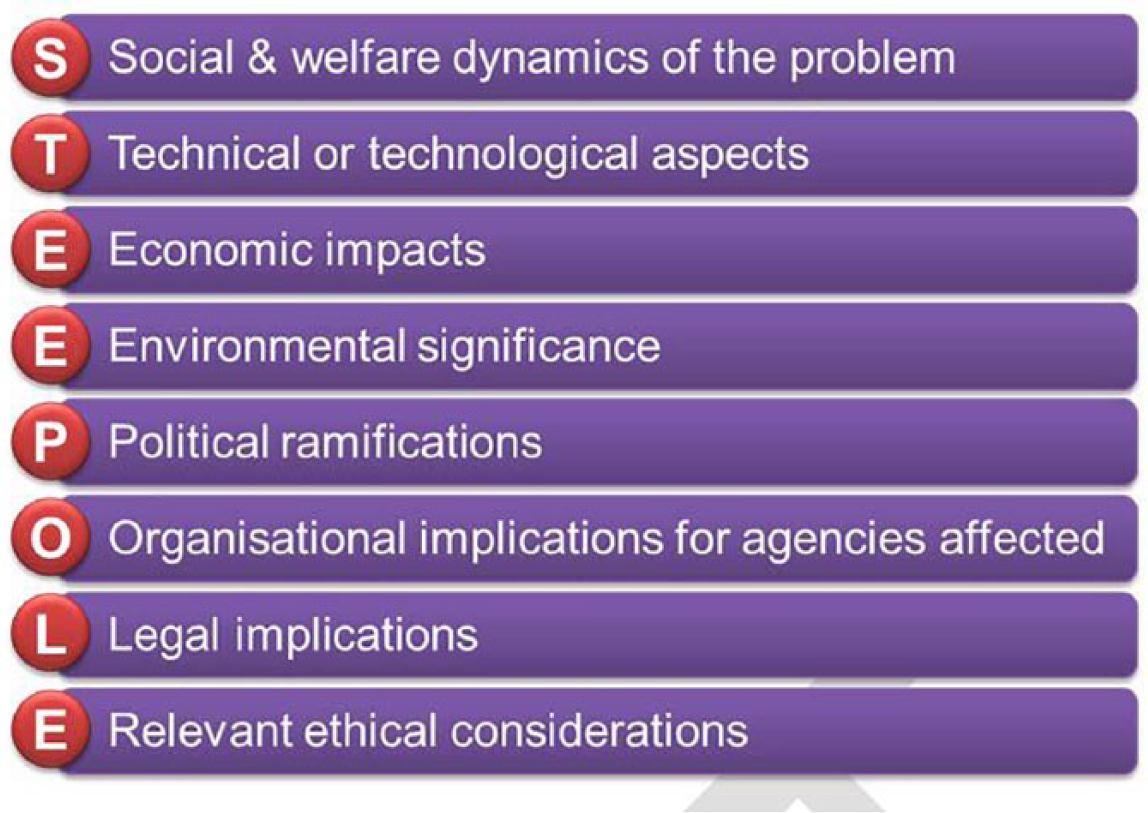
STEEPOLE analysis (2015).
The variables included in STEEPOLE analysis share a common quality. they are things upon which conclusions cannot be reached according to an individual responder’s immediate encounter with the emergency. Mediated by the criteria outlined, STEEPOLE involves tying a responder’s encounter with the emergency to the emergency’s possible effects beyond that encounter. To integrate STEEPOLE analysis into the embodied performance of response, SSA protocols have been designed to structure perception through what are called ‘impact trees’.
83
Shown in Figure 2, impact trees begin with a root: the emergency itself. From this root, sense-making through perception is oriented towards multiple, splintering branches which indicate the various impacts that an emergency might have and how these impacts might themselves produce subsequent impacts as they develop through the capillaries of the interdependent systems they effect. Impact trees help to structure, stratify and identify, in diagrammatical form, the related and interdependent impacts of an emergency. They are especially useful for capturing secondary and tertiary impacts, and help create a holistic understanding of the impacts of the emergency. They can also help reduce the capacity for surprise and identify interdependencies that might not be immediately visible.
84
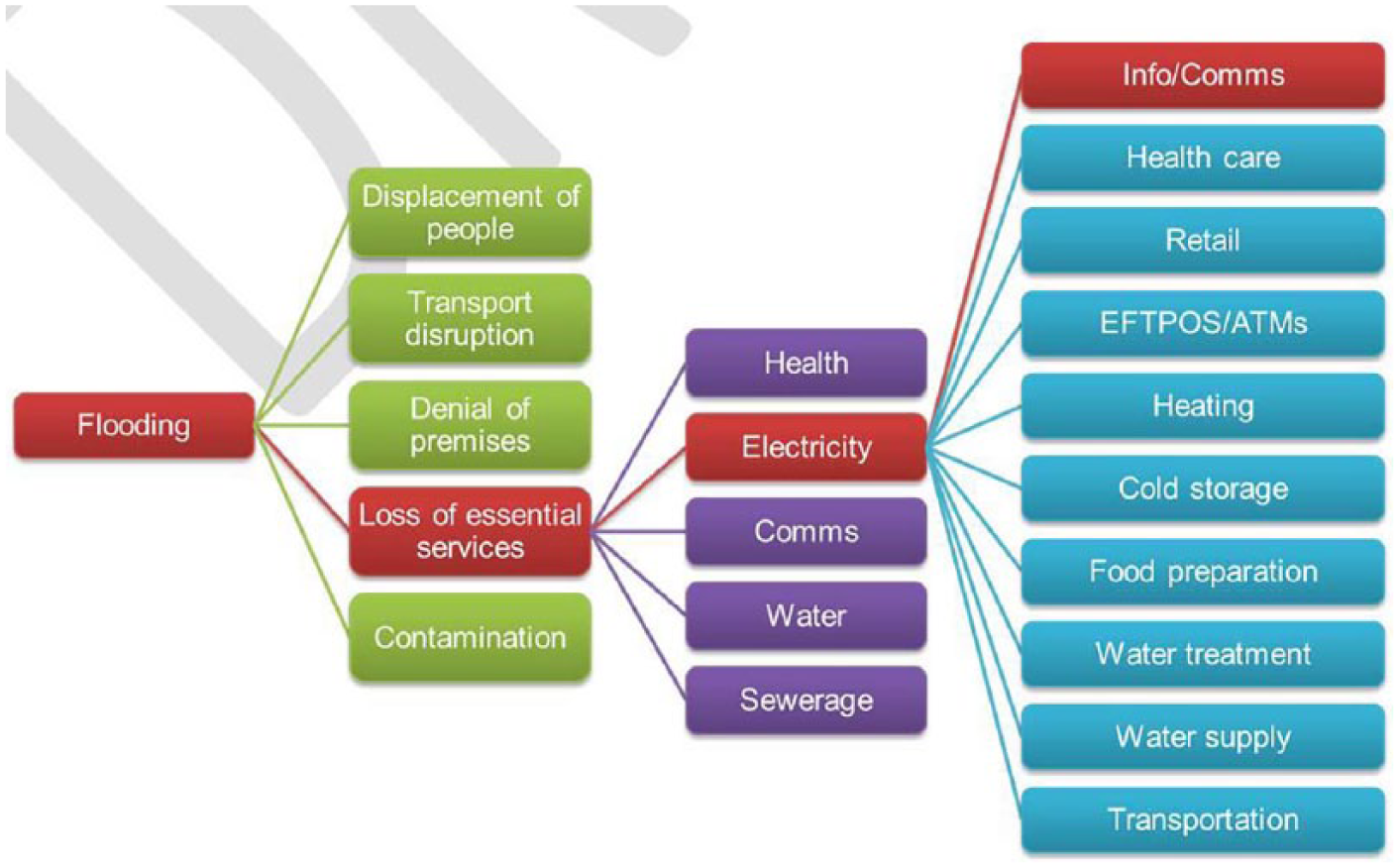
Example of an impact tree designed for flooding emergencies (2015).
If enacted as part of the broader adoption of SSA protocol, impact trees promise to orient the sense-making practices of responders beyond their immediate, sensorial encounter with the emergency to its array of complex impacts and thus towards understanding, and potentially governing, the emergency from perspectives wholly other than their own.
Conclusion: thinking affect and security further through habit
Concern with how affective life is conceptualised by, regulated through and actively enrolled within the techniques that secure the world, has arisen in recent times as a key point of debate. The article has contributed to and extended these debates through research into the design of SSA protocols whose purpose is to structure into a sequence the actions authorities take to coordinate their response to emergencies. I have critically evaluated the design of such protocols by drawing on recent geographical conceptualisations of habit. Construed as an embodied performance actively (re)assembled through the continual encounter taking place bodies, their surroundings and the events that erupt at the interstice, the notion of habit opens up to inquiry the complex temporality that protocols seek to inscribe into the performance of emergency response. Probed through habit, protocols appear designed to formulate response as a set of actions established before the events they address have actually occurred. But habit also emphasises reading protocols as crafted to cultivate the capacities of responder bodies to adapt to the volatility of emergency events as indeterminate situations that unravel in a real-time present. Furthermore, habit orients inquiry towards the affect-based modes of sense-making that protocols have been designed to inculcate within the performance of response. Planners formulate SSA protocols to instigate and guide forms of affective attunement whereby authorities integrate themselves into the unfolding of the situation to which they are responding. These protocols have also been shaped to engender modes of empathic sense-making that involve mobilising the bodily capacities of responders to perceive emergencies in a way informed by happenings beyond their immediate spatial-temporal encounter to facilitate coordination with other authorities.
Synchronising habit and protocol, the article outlines the dynamic with which planners hope to underpin the embodied performance of emergency response and how responder bodies are themselves understood as complex mechanisms through which emergencies might be rendered intelligible. However, these two observations also carve out pathways for further consideration regarding both the envelopment of affective life into security techniques and geographical conceptualisations of habit more broadly. Articulated as a technique established before the event but one that simultaneously seeks to ensure responders can adapt to the real-time unfolding of emergencies, protocols extend the temporal framing through which we might usually be tempted to comprehend the entanglement of affects and security. The literature has shown the relation between affects and the security apparatus to be mediated by understandings of the emergency as a future event. 85 In the other work, it is in the aftermath of disasters that the emergence of affects has been examined. 86 In addition to these temporal relations, the design of protocols suggests that security techniques also seek to address moments where bodies are caught in between preparedness for the emergency and the emergency as an inchoate event unravelling in the present. Through protocols, the imaginary of security planners is oriented towards and targets a temporal realm that blurs the distinction between anticipation of an event and that event’s actual unfolding. Through protocols, planners thus operationalise affect in anticipation of an event but also as a means by which to address the capacity of bodies and what they might be able to do when such events surface. To engage with these observations further, future work should explore in more depth the multiple temporal relations that exist between affect and security to conceptualise at length how bodily capacity is enrolled into modes of governance. Lines of inquiry here might, for instance, probe how the trace of past, embodied performances that have accrued over time feed into and overlap with responses that authorities undertake when attending to emergencies in real time. Alternately, research might pursue security techniques other than protocols that entrain modes of action whose deployment relies on the enmeshing of different temporal domains. By pursuing these questions, future literature could develop ways to think security techniques as practices that rely upon, and have inscribed within them, a sense of temporality that evades conventional past–present–future formulations altogether. 87
The article opens up new directions upon which to extend conceptualisations of habit in geography too. In particular, it has reappraised how geographies of habit understand sense-making as a practice. Habitual forms of sense-making are often said to belong principally to the domain of bodies’ complex sensorium, beyond their linguistically confined faculties. 88 With protocol, however, such non-representational modes of sense-making infuse with pre-existing knowledge consolidated through representational devices such as language. Apparent in protocol design, in other words, is how representational and non-representational forms of intelligibility infuse with one another in shaping how situations and events are known and, in turn, subjected to governance. Further work should be oriented towards considering in more depth the multitude of qualitatively distinct relations that prevail between these forms of sense-making. It would be beneficial for understandings of habit to be informed, for instance, by serious consideration of moments in which non-representational and representational sense-making present for the bodies enacting them contradictory accounts of the situations to which they are applied. Such a methodological foundation could lead to extensive exploration of how the tensions that surface between the different forms of sense-making bodies deploy result in an array of cultural and political implications. In the domain of security, questions might be directed as to which of these forms of sense-making dominate where interventions are made and what effect such power relations bear in terms of shaping how authorities construe the events they govern and the forms of action made legitimate. Applying to both security practices and more broadly, the relations between different forms of sense-making might be probed, alternately, to situate better the construction of subjectivity in relation to habits. Research might explore how moments of contradiction between representational and non-representational intelligence produce tensions between the body as an affectively sensitive beholder of situations, on one hand, and as an executor of established forms of knowledge, on the other. What would emerge in both cases are important questions concerning how complex sensorial encounters between bodies and material circumstances shape ways of both knowing, and acting within, the world and the events that punctuate its existence. At the same time, geography would be able to develop more nuanced understandings of how such events act back to shape the bodies whose responsibility it is to confront them.
Footnotes
Acknowledgements
Nathaniel would like to thank Harriet Hawkins and the three anonymous reviewers for taking time and effort in helping to craft this paper and developing its contribution.
Funding
The author(s) received no financial support for the research, authorship and/or publication of this article.
