



Abstract
The collective ‘Las Patronas’ is one of Mexico’s most famous and most decorated activist groups. For the past 20 years, they have given food, water, and clothing to migrants on moving freight trains, without reciprocation. This article considers the centrality of the kitchen and of kitchenspace to the group’s project, especially as part of their strategy for becoming and remaining ‘public’. In Mexico, ‘the kitchen’ may be two different kitchens and two types of kitchenspace, one for the everyday, the other for the singular and special. The ceremonial cocina de humo figures prominently in the Patronas’ day-to-day lives as well as media representations. It legitimates their public place and enacts a ritual importance to their provisioning. In tracing the importance of kitchenspace, how the Patronas’ project becomes translated in media accounts such as the documentary De Nadie and the television show Tiempo de Héroes, and how the Patronas perform maternal domesticity to take up a form of authority, this article argues that the Patronas spatially perform publicness and domesticity non-exclusively. The Patronas’ strategy produces a spatially expansive, rather than exclusive, domesticity, and in so doing, the group explodes the domestic–public binary.
Introduction
Norma Romero Vásquez is one of Mexico’s best-known migration activists. For the past 20 years, she and her collective ‘Las Patronas’ 1 have prepared food, bottled water, and delivered bundles of clothing to migrants passing by their community on moving freight trains (Figure 1). Romero Vásquez and the other ‘Patronas’ 2 labored anonymously for the group’s first 10 years, from 1994 to 2005. Their rise to fame was unlikely, given the group’s humble origins in an out-of-the-way town in rural Veracruz state (Figure 2).

Norma Romero Vásquez of the Patronas. The Patronas pass food and water to migrants riding on moving freight trains.

Map of Veracruz and the location of La Patrona.
But in 2005, the Patronas came to national prominence with the release of De Nadie, 3 director Tin Dirdamal’s documentary of Central American migration through Mexico. Although the group appears only in a single segment, De Nadie transformed the Patronas, and especially Romero Vásquez, into public figures. In the intervening years, the Patronas have featured at least 15 times on Televisa and TV Azteca, Mexico’s national television networks; Romero Vásquez was heralded as one of 2010’s ‘25 Reasons to Believe in Mexico’ in El Universal, a Mexico City newspaper; Selecciones-Readers Digest named another member a ‘2013 Super-Mamá’; and, most recently, the group features in the 2015 full-length documentary Llévate Mis Amores. 4 Among their many recognitions, perhaps the most prestigious is Romero Vásquez’s 2013 National Human Rights Prize, awarded by Enrique Peña Nieto, the president of Mexico.
This article places several media readings of the Patronas alongside ethnographic work based in participant observation to develop an account of the intersection between social activism, gender signification, 5 and spatializations of the domestic. I pursue two arguments here. First, I trace the Patronas’ use of a special kitchen, the cocina de humo, which activates a set of spatial and maternalist ideologies revolving around domesticity. As the traditional method of cooking for civic ceremonial events, the cocina de humo has long served as a hinge by which domesticized labor becomes public. Through the cocina de humo, the Patronas both emphatically fulfill gender roles and make an otherwise ‘hidden’ provisioning into public politics. 6 Moreover, as the Patronas’ kitchen labor gets signified and symbolically regenerated in media accounts, especially on television, the Patronas come to appropriate other spatializations. Because the Patronas perform as both public and domestic, they explode any binary that would claim, a priori, that publicness and domesticity exist as mutually exclusive and, therefore, that the public and the domestic are mutually exclusive spatial configurations. 7
My second argument reads the Patronas as active participants in media re-imaginings of their action, which facilitates an account of extensive domesticity both as a spatial strategy and as the product of a spatial analytic. Media accounts unfailingly circulate images of the cocina de humo and other forms of gendered domestic labor, and juxtapose those images with a careful explication of how they should be read. The Patronas participate in both aspects. They weaponize domesticity both to provide themselves a maternal authority but also to position the epistemic terrain. By fashioning of a media self-presentation that cannot be made sensible apart from domesticity, the Patronas make themselves into legitimate knowers because they are domestic. This move disarticulates the domestic from the private, which disables notions of gendered propriety that might otherwise sequester them within their homes and community. The Patronas’ characteristic respatialization thus enables scholars to refine our perspectives on (1) the limitations and paradoxes of gender-based activism in Latin America, especially in motherist movements where other women’s groups have been actively constrained by gender roles that limit their public visibility, 8 as well as (2) how women activists may find spatial productions a tool conducive to enacting intersectional social change.
In what follows, I outline the methodology, including its limitations, and highlight where the Patronas’ activism speaks to ongoing scholarly conversations. I then sketch the ordinary use of the cocina de humo. In the section ‘Broadcast performances of extraordinary domesticity’ and again in the section ‘Exploding the domestic–public binary’, I examine how the double-pivot of ‘kitchenspace’ 9 and media representation in De Nadie and on the 2013 television show Tiempo de Héroes (‘A Time for Heroes’) respatializes domesticity to make broad claims on a Mexican public. The media examples are given ample space to show how they operate within a deeply gendered social field, but one that is facilitative of certain forms of power. Finally, I conclude by considering the ‘place’ of domesticity, as well as with a caution that the Patronas’ strategy is not necessarily liberatory.
The cocina de humo and public domesticity: a research approach
One challenge for an argument about extensive domesticity lies in accounting for, first, the quotidian performances of domesticity and, second, how these performances are regenerated, reproduced, and ultimately received. The cocina de humo – an outdoor cooking place – acts as the nucleus from which the Patronas’ domesticity emanates, especially but not entirely as a symbol. The prominence of symbolic makes media re-imaginings of the Patronas critical to understanding the group because these re-imaginings are, after all, how most Mexicans are familiar with the group. Moreover, media accounts themselves instantiate moments where a presentation of domesticity has been understood and regenerated.
As an everyday practice, the Patronas cook for migrants in large pots, either on a woodstove in the kitchen area of the papeleria – the house with a ‘paper goods’ store in its front room, where the Patronas prepare their food – or on open wood fires, the pots propped up by cinderblocks (Figures 3 and 4). I treat the cultural significance of the cocina de humo below. Here, let me note that it was only during a return trip in January 2013, when I happened to be reading Maria Elisa Christie’s Kitchenspace, 10 that I began to attend to the Patronas’ production of domesticity. At that point I had known the group for almost 18 months, having lived in La Patrona, the collective’s hometown, in summer 2011. I have returned on multiple occasions, most recently in November 2015. What results, then, is a project that came to fruition after my personal relationships with the ‘respondents’ had already solidified. Most importantly, it is deeply informed by my relationships with the individuals who comprise the Patronas, and especially the several Patronas older than me who treat me as a sort of fictive son. I am particularly sensitive to the maternal performances that the Patronas take on – and sometimes lay down – because of my particular history with the group and the ways it has been informed by age and gender especially.
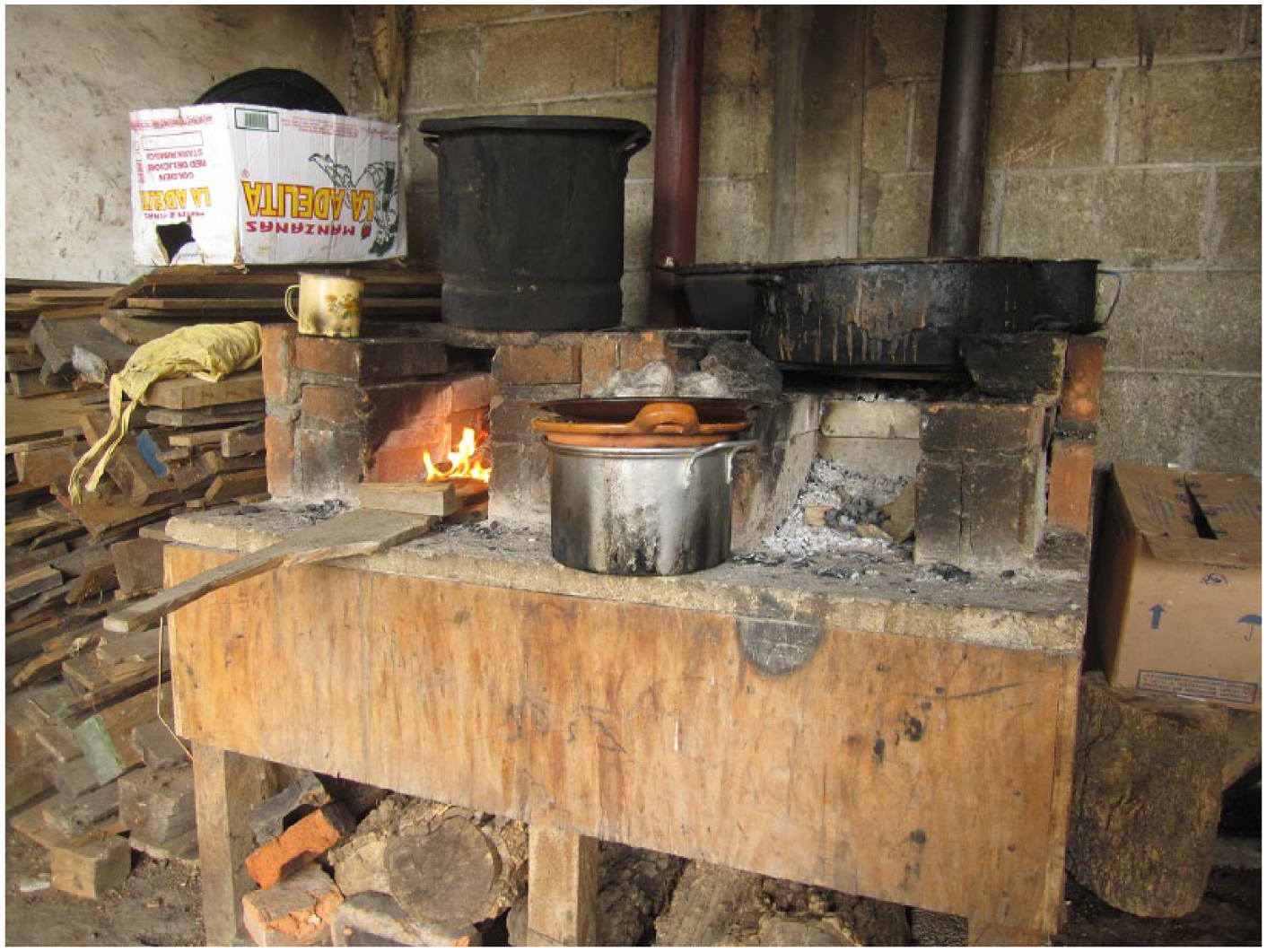
Wood-burning ovens in the Patronas’ kitchen.
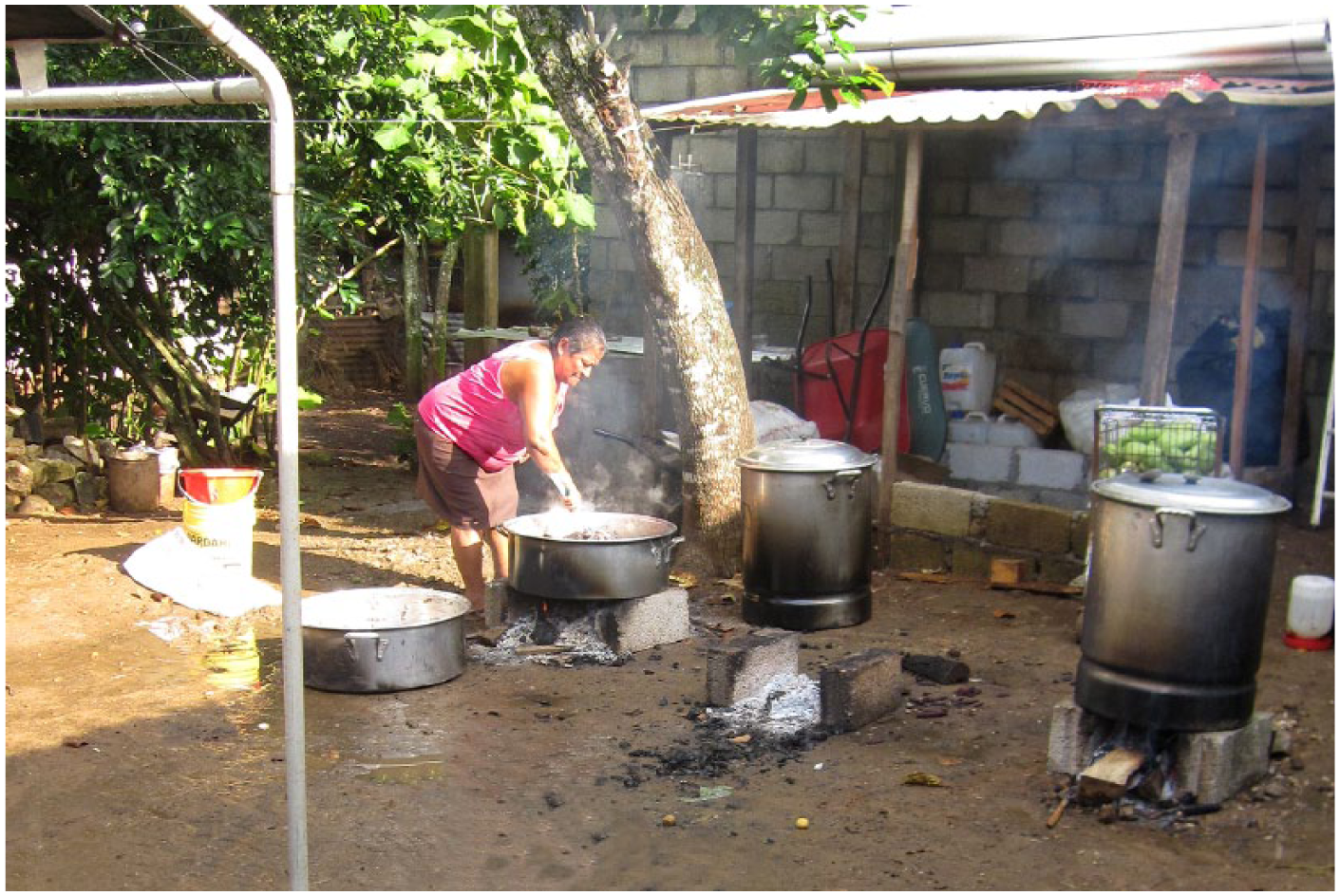
The cocina de humo in the outdoor courtyard space.
Since reading Kitchenspace, I have actively elicited the Patronas’ thoughts on the kitchen and domesticity, albeit in informal rather than recorded interviews. Unfortunately, the institutional review board (IRB) under which this project was conducted constrains individual identification in ethnographic components, which poses a risk of flattening a vibrant collection of personalities into a homogenized ‘Patronas’ collective. To the contrary, the members vary in temperament, comportment, and personal histories, as well as in terms of educational attainment, local class position, and access to forms of social and actual capital.
Even my media analysis is influenced by my time with the Patronas. During my initial stay in La Patrona, I was present for the preliminary shoot of Tiempo de Héroes, as well as the taping of a TV Azteca news segment and several visits of intrepid local and regional reporters. 11 While space precludes an in-depth discussion of these visits, they do corroborate the Patronas as active participants in their media representations, beyond as the passive ‘material’ for creation. Indeed, the visits have prompted my reading for the signs and traces of the Patronas’ fashioning of domesticity as it becomes absorbed and regenerated across media accounts and across a wide territory.
Kitchenspace and the place of activism
While Mexican women increasingly work outside the home – and as their contributions to labor, social movements, and formal politics are increasingly recognized – gendered divisions of labor and of space remain prevalent. 12 As in many other countries, both men and women enforce patriarchal divisions of space. 13 Women continue to be ‘in charge’ of domestic space and domestic responsibilities that tether them to the home, including the familiar double-burdens on women who work both within and outside the household. Women’s social roles are intimately tied to notions of propriety and mothering, especially in rural Mexico. Yet, traditional spaces within the home and household are often powerfully feminine, and men who intervene unadroitly are subject to social sanction, including husbands who are ostensibly heads-of-household. 14
The Patronas’ project, and their use of the cocina de humo, iterates many of these tensions. Both a physical place and a method of cooking – the name means ‘smoke kitchen’, presumably because it uses burning wood as fuel – the cocina de humo materializes by means of specific kitchen labor rather than within a fixed location. 15 Christie notes that it may show up in driveways, on public rights-of-way, in parks, or on tiled patios. Since the space itself characteristically signifies important events of public ceremony – such as Saints’ days, local fiestas, 16 and weddings – it is a place that is at once both domestic and matriarchally organized, 17 but also public, connected to community life.
The intertwining of activism and kitchenspace in the Patronas’ project opens space to consider how domesticity articulates to other forms of power. In many ways, the Patronas find legitimation and authority as activists within a set of maternalist coordinates shared across Latin America – that is, the performance of motherhood as express and discrete relation of power. 18 However, even when formulated in its positive form, what Roberta Flores Ángeles and Olivia Tena Guerrero call ‘maternity as a feminist political banner to achieve recognition and benefits for women’, 19 scholars have pointed to significant limitations. Motherist and maternalist movements may be underwritten by patriarchal power relations, often elide out women’s social roles as workers, and tend to efface differences between women in the name of speaking for them. 20
Within Mexican activism, the constitutive tensions of maternalism are omnipresent. Melissa Wright’s work with the ‘Mujeres de Negro’ activists is illustrative. 21 In the cities of Chihuahua and Juárez, local women struggle publicly against feminicide 22 and must assert their rights as women to be in public at all. 23 Mayors, socially conservative bureaucrats, and police officials contend that women’s public presence is ‘evidence of trouble’ and more precisely evidence that women lead ‘double lives’ as factory and sex workers, effectively legitimizing feminicide. 24 The demarcation between publicness and domesticity is constantly at issue and leads to women performing the very notions of ‘propriety’ that constrain their public participation.
By contrast, for another set of scholars, identity formations such as mothers, women workers, indigenous women, campesinas, or as mujeres fronterizas (‘borderland women’) enable women activists to engage in self-care practices and the cultivation of subjectivity. 25 That is, femininity establishes an imagined community both inside and outside domestic space, and politicization is made possible in part by collective identification with other Mexican women. In more hopeful moments, it has been argued that that Mexican women’s constant negotiation between ‘public’ and ‘domestic’ in the contemporary moment makes possible links across space. 26 As Michelle Téllez writes, ‘the spaces of women’s collective struggle . . . are not contained in either the public or the private sphere’, but rather ‘women’s activism challenges traditional gender roles in both spheres simultaneously’. 27
Critical geographers of home have long been interested in questions of Téllez’s ‘spheres’. One critical inroad to understanding the Patronas, then, is to examine how the cocina de humo signals a double-encroachment of domesticity and publicness on one another. 28 Three aspects of domestic politics assume special importance in such an examination. First, the extra-domestic always bears upon the domestic, and the domestic always bears upon other forms of space. Ostensibly ‘non-political’ domestic space is constituted with, by, and through relations of power, including gender, sexuality, race, and nation, that manifest in domestic practices and in constructions of domesticity. 29 Second, power in these spaces flows in multiple directions. While practices to elicit feelings of cultural belonging and gendered and raced ideologies – often state-led 30 – materialize in everyday actions, these practices also render the body and the domestic as sites where resistance can occur and/or alternatives may be enacted. 31 Third, the home, the domestic, and the kitchen are all spaces that are continually made, animated, and reinscribed. A performative logic constitutes them, and it intersects with (1) an ongoing negotiation of authority, gender roles, and gendered authority; (2) a political-economic regime in which labor roles are distributed and labor itself becomes gendered; and (3) heteronormative power structures that define and configure the ‘proper’ home and ‘proper’ practices within it. 32
Because the Patronas’ social context is so tightly structured by the secret knots of propriety, I want to use Natalie Oswin’s important intervention to dwell briefly on how propriety ties home to nation. 33 Oswin interrogates how heteronormative logics in Singapore housing policy queer not just gays and lesbians but also the unmarried, the divorced or widowed, single parents, and male migrant workers by denying state housing to those who do not satisfy the requirement of the ‘proper family nucleus’. Heteronormative discourse – manifesting as that which is ‘proper’ – makes domesticity operate even for those whose sexual identities, taken directly, would place them as normative or non-transgressive. Domesticity hails not only the relations of family life but also the imagined national community, labor, and migration. Simultaneously, this hailing opens opportunities for the deliberate queering of domestic and other forms of space, with consequences for that same imagined national community.
For the Patronas, whose struggle is ‘an extension and elevation of their traditional responsibilities as wives and mothers’, 34 domesticity intersects with national community, labor, and migration not from above – as in Singapore – but from below. They enact their domestic responsibilities through performances of caring for – of feeding and clothing – migrants. Reading the Patronas’ activism spatially emphasizes domesticity as a tactic and extends scholarship on kitchens and kitchenspace. However, as Angela Meah has recently argued specifically in regard to kitchens and kitchenspace, a disproportionate quantity of attention has accumulated to Global North spaces. 35 The same point holds for critical geographies of home and domesticity, even while recognizing that many groundbreaking works have looked outside the Anglosphere and Global North. In tracing how the Patronas contest migrant marginalization, this article gives an account of domesticity as mobile spatial production and simultaneously responds to Meah’s call to ‘decenter’ Global North kitchenspace.
Making use of the cocina de humo
I proceed with an ethnographic vignette. It is January 2013, and I am sorting dried beans at the papeleria with some of the Patronas (Figure 5). We chat, they tease me for not being married, and we put the beans into a blue plastic pail. At about 10:30 a.m., we get surprised by the arrival of a small class of sociology students from the Universidad Iberoamericana. After a bit of rearranging with chairs and cooking spaces – I am sent to a neighbor for more wood, we push the fires with pieces of an old wooden chair, Norma Romero Vásquez is summoned – the students are received with a short Q&A, a tour of the kitchen, a demonstration of the techniques of packing bundles of food, and an invitation to participate if a train happens to pass before they return home.
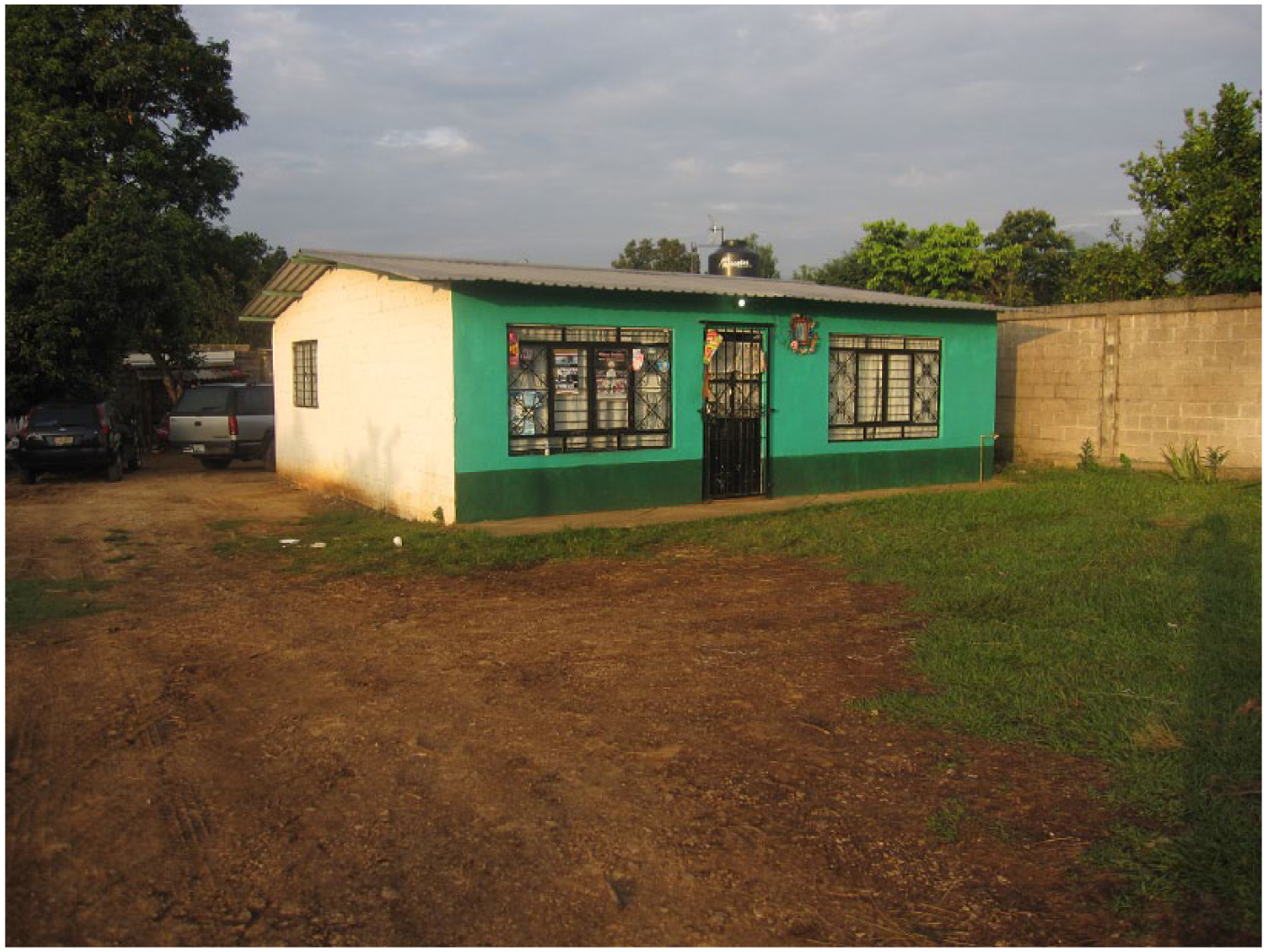
The Patronas’ papeleria in 2011.
The students pitch in to tie off small plastic bags of rice and beans, fill up bottles of water, and sweep. Then, they wait. By 3 p.m., although the students’ restlessness is palpable, the Patronas gently announce that they cannot leave until after the comida. 36 The Patronas pull some beans aside to make frijoles refritos, buy fresh tortillas, and slice mushrooms and bell peppers to mix with pork and beef for alambre. They cook on the gas stove under the corrugated metal roof in the back. The students eat, then depart, missing what the migrants would receive that evening: boiled beans and rice cooked over a wood fire; tortillas and sopa de pasta, and an easy-open can of tuna; various pastries and panes de dulce; and bottles of water mixed with oral rehydration salts.
With this vignette, I want to establish both the everyday use of the cocina de humo and the performative intersections of labor and signification. Even with enough food left in the morning’s pots, the Patronas cooked an entire second meal, segregating food by recipient, recipient by space of production. Providing food – to the students, and later, to the migrants – properly performed Mexican femininity while reworking that propriety of domestic labor and domesticity for representational ends. A very basic reversal of status was at work: the students, typically privileged, received the food signified as ‘everyday’ and the migrants, typically marginalized, were reserved the symbolically important food. At one level, the cocina de humo can be said to enact a politics of recognition that inducts migrants as community members or honored guests. The mechanism of this recognition is precisely that the food from the cocina de humo is reserved for them. At another level, the wager of this reversal, that it be taken as normal, is predicated on the Patronas’ ability to leverage their own statuses as women, ‘mothers’, and well-known figures to (re)signify their act of feeding migrants as a ceremonial practice. This signification is emphatically spatial, at once both public (ceremony) and domestic (foodwork).
Perhaps most importantly for the present argument, the cocina de humo bridges public–domestic spatiality as the effect of an everyday practice that is agnostic to media presence. Foodwork through the cocina de humo is constant and consistent. In my time with the group, I have perceived no clear or obvious distinctions between the Patronas’ comportment and presentations for media and those for groups like the Ibero students, nor on days when other visitors are not present. Any question of a separation in performance, or of dramaturgy, must be bracketed in favor of an argument for a situated, semireflexive but undoubtedly spatial strategy that the Patronas employ.
Broadcast performances of extraordinary domesticity
What follows explores the continuities and ruptures of depictions of the Patronas in De Nadie and again in Tiempo de Héroes. It sketches the formations of domesticity and maternal authority that media accounts regenerate, paying special attention to the words of Norma Romero Vásquez. Despite the many visitors who pass through, the Patronas’ audiences are primarily composed of those who know them only through the travel of forms of mass-media representation: newspaper articles, photos, films, television shows. What the group wants is not just that migrants be fed, but that the mostly non-Mexican migrants are recognized by Mexican society as ‘brothers’. 37 Their media strategy is therefore crucial.
Media accounts of the Patronas tend to produce the same story, told over and again: The Patronas are everyday, rural Mexican women at their exemplary best. They stand in for a vision of an ideal Mexico. Voice-overs may explicitly identify them as ‘poor’, 38 they are depicted as ordinary – either by direct attribution (Héroes Cotidianos) or by repeated images of the Patronas sweeping, cleaning, and making food – and the background music nearly always incorporates Mexican popular genres that stir up feelings of national belonging. 39 Considered within the context of media political economy, 40 the Patronas function as a medium by which ideological reproduction is attempted – metamorphosed into a parable that reinscribes, for example, the gendered division of labor, legitimizes class divisions, and/or props up nationalistic visions of Mexico.
However, when the Patronas are also seen as active fashioners of a group performative persona as well as of a self-presentation specific to media consumption, the focus shifts to how the Patronas repeat and rework a set of representational and identitarian tendencies. One can detect a growing sophistication of these techniques over time. In 2005’s De Nadie, speakers are unattributed, cameras look down from slight high-angle shots such everyone is seen from above, and sociality is depicted as ostensibly leaderless. The residents of the La Patrona shown are, save one older gentleman, all women, and the domestic labor of the action seems to be signified as faithful, as dependable, as out of time. In this continual present tense of De Nadie, labor is a pair of hands stirring a pot rather than a person sweating and joking and sometimes dropping a metal spool with a rattle. We see kitchen labor, the washing-up, the cooking, but with little agency: What appears is less collective project than cultural form.
In this context, Norma Romero Vásquez’s interview in De Nadie – one of her first – presents several opportunities for her and for the Patronas. She is asked why the Patronas do what they do; an earlier respondent has, with a shrug, identified ‘empathy’ (amor al prójimo). Romero Vásquez is more effusive:
Because I have a son and I don’t want my child to migrate in the future, and I don’t want him to suffer. On the train, there are children and one of those could have been mine, could be mine tomorrow. My son asks me: ‘Why do you cry?’ I cry because I have a son, I have you, and I don’t want you to suffer like they do. It feels really bad. [She starts crying.] You all [ustedes] don’t suffer, you all have everything. You all have food, a roof, a mother, a father. They don’t have anything.41,42
Throughout the interview, Romero Vásquez frequently finds herself in moments of affective excess where representation fails. Articulating her care for migrants within her love for her own son, she nominates the town as one of exemplary care and empathy. The incantation of ‘food, a roof, a mother, a father’ neatly links the action (food) to spatial domestic formations (a roof, a mother, a father). Yet, her transpositions between self and audience, the moments of ‘playing the positivity of difference’, 43 are not entirely successful. As an expositional account, the transitive moment of identification between herself as a mother and the mothers of migrants on the train never quite arrives. Co-feeling with mothers is introduced only by an uncompleted equivalence. The promising apostrophe – the moment of ‘you all’, simultaneously speaking to the crew and the audience – emphasizes her duties and power as a mother, but never completes its cross-reference of ‘you’ and the symbolic association with children. Instead, in asserting a sort of privilege on the part of the crew and audience, it evades its own emotional content. Such disjointed speech reveals missed opportunities: that of explaining the terms by which the action is to be read, but also to characterize the action as one performed by agents, and finally as a moment to respatialize the action, and domesticity, beyond her town.
By contrast, Tiempo de Héroes finds a more experienced group of Patronas in 2013 who are better aware of how to comport themselves in front of cameras. Presenting itself as an awards show hosted by telenovela star Edith González and broadcast live, Tiempo de Héroes positions the Patronas’ entire project as an accomplishment. The awardee is Leonila Vásquez Alvizar, the mother of Norma Romero Vásquez. Her encomium begins with a clip segment of the Patronas working in the kitchen. Sustained attention is given over to shots of the Patronas cooking over wood fires, stirring large pots with paddles, and sorting and cleaning bottles. The first didactic moment falls to Vásquez Alvizar, who rambles a bit but avers, ‘I say, just that we put ourselves to work . . . We’re some hard-working and humble women’.
González and the produced segments repeatedly emphasize two aspects of the Patronas’ action: labor and femininity. Host González says of Vásquez Alvizar,
Here we have a woman who is not only a source of pride for Mexico, but a source of pride for the world . . . You [ustedes] don’t receive money, you don’t receive financial assistance, and you are women – because women are warriors.
Thus, when Norma Romero Vásquez appears a few minutes in, she encounters an audience already steeped in gendered representation. In response to González, she says that her mother
has taught us our values, our love for our fellow human beings, to respect them, above all, not to discriminate against anyone. I believe that she has motivated us, made us ourselves grow as human beings. And she has told us that everything you do, every labor [obra] you undertake, to have it bring you one step closer to God . . . [To be a Patrona] is something to be proud of [un orgullo]. Our ‘Patrona’, the Virgin of Guadalupe – who is the patron saint of our pueblo – she’s the most exemplary woman we could have. And after her, well, [gesturing to Leonila Vásquez, her mother] there’s mom [pues, la mamá, no?]. They have told us and taught us our values, where poverty comes from, and that we have to be there. And to be a Patrona – we didn’t choose to be that. It was God who chose us, and for this we are in his service.
Romero Vásquez speaks both as a mother and as a daughter. In claiming that God chose the Patronas, she asks the audience to identify with her directly: God’s election comes not through direct command, but in the calling to be where ‘poverty’ is – and in contemporary Mexico, poverty is ubiquitous. ‘Mamá’, the Virgin of Guadalupe, and God all validate – if not mandate – a public politics. Moreover, Romero Vásquez is playing an important part in an emergent spatial performance. Where in De Nadie she failed to provide the terms of reference for the project, here she does so explicitly, with no less than 10 evocative reifications in a scanty eight sentences: love, respect, non-discrimination, motivation, growth, labor, pride, values, poverty, service (plus repeated invocations of righteousness and faith). Even more telling, however, are how these overlay domesticity and publicness. In these eight sentences, the domestic-tinged love, respect, and non-discrimination are followed by the publicly spatialized labor; pride and values are paired to poverty and service. As a discursive proposition, Romero Vásquez equates femininity to service, and to ‘public’ social issues such as poverty. As a citational practice, her words link to the multiple visual montages of domesticity in the show, to appropriate the physical set as simultaneously a public and a domestic location, one where moral and testimonial authority emanates from the Patronas’ roles as women and as ‘mothers’.
I analyze these two appearances in particular because they illustrate Patronas’ tactics to achieve self-representation. They likewise corroborate a few of the Patronas’ many changes over time. The kitchen in Tiempo de Héroes manifests as a crucial site of material and symbolic production. Leonila Vásquez Alvizar and the Patronas are not just ‘heroes’, but heroes who have cooked for hundreds of young men every day, in the cocina de humo, in precisely the manner that Mexican women traditionally cook for ceremonial events of great importance. The perverse fulfillment of assigned gender roles becomes a technique for broad public claims while the claims themselves validate the role of the Patronas as speakers. Theirs is not an identitarian struggle. Yet, given the ongoing conflicts over the place of migrants and migration throughout much of the world, the Patronas’ tactic of extraordinary and broadcast domesticity provides a complement to rights-based or identity-based struggles. The Patronas suggest that the domestic and the public operate in some circumstances as non-exclusive spatial imaginaries. It is not, for instance, that Norma Romero Vásquez or her mother remain ‘domestic bodies’ in the public space of Tiempo de Héroes, but that domesticity can be a spatial performance just as publicness is a spatial performance. And both may be performed simultaneously.
Exploding the domestic–public binary
The expansion of domesticity’s spatial scope invites further analysis of several questions. The first is how expansive domesticity might function as both a spatial strategy and be deployed analytically, especially in how extensive domesticity might allow an escape from that which might otherwise effect ‘paradoxes’ 44 and ‘coerced silencing’. 45 The second is the social process by which the Patronas (re)produce themselves within a wider social field as legitimate knowers and speakers, that is, the process of epistemic and testimonial legitimation. 46 And third, how the contingent characteristics of extensive domesticity might offer adjustments to outstanding problematics in geographical scholarship about domestic space(s), social change, and the gendering of everyday life.
Consider again the Patronas’ appearance on Tiempo de Héroes. If Romero Vásquez gets away with being domestic and public, viewing the problematic through a ‘domestic lens’ presents public domesticity as accomplishment. The structure of the segment presumes an audience already familiar with the forms of Mexican maternity, and the show hammers on femininity and labor, women and strength. Romero Vásquez maneuvers and negotiates a shared matrix of domesticity, maternalism, the public, and authority. In context of Tiempo de Héroes, an argument following Melissa Wright’s might argue that Romero Vásquez takes on maternal signifiers to register her appearance in public within the scope of ‘legitimate family reasons.’ 47 Certainly Romero Vásquez is acting within sanctioned gender norms. But to argue instead that the Patronas transpose domestic space onto the public is to not query whether Romero Vásquez performs as a ‘proper woman’ in public, but rather to look to how public domesticity both enables and materializes her activism on behalf of migrants.
Important consequences fall out of this shift in emphasis. First, we see Romero Vásquez exploiting certain features of the social field, namely, the presumed linkages between domestic space, maternalism, and domestic authority. Christie’s intervention in Kitchenspace serves as a reminder that if Mexican women are charged with the responsibilities of ordering the home and domestic space, then they must simultaneously be invested with a certain amount of power to do so. 48 Tiempo de Héroes instantiates a powerful space, not least through Edith González’s narration of women as ‘warriors’. Romero Vásquez is enlisted both to give the privileged exposition and to assist in establishing the show as a site of domesticity in public. Where her words evince a parental didacticism, a gendered maternalism, it is as if she were speaking to a child or a group of children. The choice of tone comes in context of powerful maternal femininity, yet also characterizes the site itself. That is to say, Romero Vásquez’s discursive-cum-narrative approach founds the site of Tiempo de Héroes as one in which motherhood is empowered and a position of authority, and simultaneously positions the multiple audiences as subject to, and the objects of, that maternal authority. This space of empowered femininity speaks to moral and ethical obligations outside of its own context yet does not preclude other forms of power from being enacted or interacting within the same stage. 49 The legitimation is tied to space and to content, as Romero Vásquez enjoins her audience less to celebrate the Patronas than to act themselves.
Authority in this field does not just apply to outward flows of power nor solely to injunctions of right action. It also positions the epistemic terrain. Witness Leonila Vásquez Alvizar’s position within the mini-documentary of the show, where she becomes the singularly privileged, knowledgeable subject, even as her identity (as matriarch, as Patrona, as grandmotherly, as feminine, as rural, etc.) is in many ways freighted on her through the representational codings of the scene and shot composition: narrated directly, standing in the rural house-lot, in front of a concrete-block building, in a definitively non-city space, and so on. Because of these positionings, and the use of the term of respect doña throughout, it becomes inconceivable to discount either Vásquez Alvizar or Romero Vásquez in the context of the show, since that would disable the show entirely. Vásquez Alvizar and Romero Vásquez must be privileged knowers.
The show nevertheless reproduces many traditional renderings of power, as images of neither Vásquez Alvizar nor Romero Vásquez do much work for subverting patriarchy in a Mexican context. For that reason, I want to return here to Wright’s article treating the Mujeres de Negro. Wright argues that the Mujeres de Negro’s tactic of conspicuous public presence – dressing in black mourning clothing with pink hats, interrupting government meetings, and putting up crosses for feminicide victims – in their specific social context produces and then must confront a paradox. The Mujeres’ entry into ‘public’ is performed as private women whose ‘proper’ place is in the private sphere but who have been called into the public by unresolved violence. Wright calls this ‘a politics of emasculation’, presumably to underscore the challenge to the paradigm of masculine public space. Yet, in context of ‘an environment where a woman’s legitimacy in the public sphere depends upon the strength of her domesticity’, 50 the performance comes to reiterate the spatial division that would exclude them from the public. In short, the Mujeres de Negro contest how an established ‘public’ space is gendered, policed, and produced, how women’s bodies and the feminine are spatially disciplined. But their very transgression reaffirms the public as both fundamentally and exclusively masculine.
Wright’s analytic takes the equivalences of domestic to private, masculine to public, and feminine to private–domestic as provisionally fixed and asks how transgression is punished. An alternative account might take those same equivalences as unfulfillable performative poles 51 and put them into question as they become queered Mexican spatial performances in everyday or spectacular ways. 52 Disarticulating the domestic from the private, as the Patronas accomplish, serves to disable sequestering femininity as a resource for their opponents and enables the Patronas to perform public and domestic roles simultaneously while exploding the public–domestic spatial binary. That is, where the Mujeres de Negro are ‘vulnerable’ since they are performing their ‘private convictions’ in public, 53 the Patronas are empowered by much the same process. The Patronas appear to refuse transgression, in some sense; instead, they respatialize locations in order to generate and then fulfill their ‘traditional responsibilities’ in new places. The praxical insight of the Patronas is that domesticity can order a social landscape.
Extensive domesticity likewise returns to the question of audience. Wright takes activists’ invocation of feminicide victims as ‘daughters’ to reiterate ‘the domestic domain as the proper place for women’. 54 The victims are rendered as victim-daughters such that ‘that this daughter was on the street, just like the Mujeres de Negro, for a legitimate family reason, and this reason makes her a legitimate and worthy victim’. 55 The proposition is that the audience interpret the victims as both behaviorally and spatially ‘proper,’ as domestic and grievable. The struggle contests both impunity and that which would make women socially ‘disposable’. By contrast, within the alternative reading deployed here, the ‘victim-daughter’ serves as yet another tactic, targeted not at socio-spatial exclusions but for audiences to reimagine where domesticity might extend. In recharacterizing the space rather than the subjects, it both imitates and displaces the usual spatial genderings. The proposition asks for an emotional and perhaps affective engagement of feminicide as crime, as violence, and as institution. Within a heteronormative and heteropatriarchal discourse of the proper home and proper family, the equivalence is suggestive, a proposal that the audience transpose the daughter-victim with one’s own family members. To make the victims ‘legible’ in this way renders the whole of the Mujeres’ action legible – because it is an affectively experienced event of familial and domestic love reaching out beyond the private, beyond the home.
The Patronas’ strategy suggests that in some circumstances domestic gender roles can hide within themselves a generative, even subversive potential. Romero Vásquez’s assertion on Tiempo de Héroes that ‘it was God who chose us, and for this we are in his service’ presents an important proposition about moral obligation and maternal authority. She draws on her authority to both insist that her audience inhabit a subjective space toward the treatment of migrants while narrating moral obligations as the constitutive factors of subjecthood, rather than simple burdens. The claim is catalyzed through her public domesticity. Indeed, in exploding the domestic–public spatial binary – in offering relational obligations emanating from but not localized to domestic space – the Patronas offer strategies that may be emulated elsewhere. Yet domesticity is more often oppressive than liberatory. For careful scholars, then, the Patronas provide a theoretical reminder that different constitutions of domesticity over space and time hold distinct relations to, and possibilities for, both ‘audiences’ and ‘publics’.
Conclusion: the places of domesticity
Attending to the Patronas and their action reveals the wide political significance of domesticity. Indeed, Latin America presents a rich and underutilized resource for scholars to examine how domesticity is practiced and spatialized. To the extent that ‘domesticity revolves around ideologies of family and gender’, 56 the Patronas offer a crucial reminder that such ideologies become concretized in performances that may be put to work by women on behalf of others, rather than simply conditioning and gendering experience in domestic space. Moreover, where often the domestic and public have been implicitly understood to be spatially exclusive, whether as ‘permeable’ 57 or as ‘partially fluid, but somewhat solidified’ and defined ‘objects’, 58 here the domestic is re-configured as non-exclusive with the public. Indeed, in both the everyday use of the cocina de humo and in media such as Tiempo de Héroes, the Patronas overlay the domestic and the public.
In a respatialized domesticity, the qualities of domesticity become a method for channeling power rather than reactive to it. In that sense, it offers one exit for activists from sequestering patriarchy, and, for scholars, less a resolution of longstanding questions about power and gendered space than an alternate formulation of the problematic. If certain spatial arrangements appear to distribute some subjects into separate ‘spheres’, that very act would appear to constitute those spheres as bearing some degree of power that might be appropriated. Moreover, one must recognize that all such ‘spheres’ are unfulfillable imaginaries, and the slippages that make them so both facilitate and limit activations of power that manifest through them. For the Patronas, extending domesticity is a collective rather than individual or subject-centered achievement, and yet even while they rework certain gendered tendencies in the social field, theirs is not a project that collapses patriarchal power per se.
My argument may extend to other maternalist movements, in Latin America and beyond. Yet, extensive domesticity may not be a universally liberatory strategy. The spatial ontology of the domestic, I caution, does not bear on qualities of the domestic, and further, if the Patronas have been able to ‘move out’ from the kitchen, it is only because they were supposed to be in the kitchen to begin with. What extensive domesticity can do, however, is reveal itself as a resource. For scholars, recognizing the variable spatial configurations of domesticity facilitates understandings of how any given domesticity is the result of particular set power geometries. It asks us not to take as given what kind of domesticity may be present at a site, but how that domesticity is spatialized and how even ‘traditional’ genderings of space may become implicated in social change.
Footnotes
Acknowledgements
I would like to thank the Patronas, especially Norma. I am additionally indebted in this project to Alfredo Atala Layún, Laura Espino, Heather Gilberds, Mariana Peláez, and Abril Rayas Paredes. Finally, this paper has benefited from the helpful feedback and criticism of Charis Boke, Erica Simmons, Keith Woodward, and Sharon Yam, as well as the anonymous reviewers and editor Dydia DeLyser. I sincerely thank all of you.
Funding
The author received no financial support for the research, authorship, and/or publication of this article.