



Abstract
This article centers Indigenous cultural geographies by highlighting the politics of usos y costumbres (Indigenous governance) as the binding force for the placed-based solidarity that emerged in the wake of the Nochixtlán Massacre of 2016 in Oaxaca. This organized spatial solidarity rooted in Mixteco politics transformed the site of a state-sanctioned massacre to a liberatory place. Through salient narratives of impacted teachers and Mixteco community members at the forefront of the assault, as well as photographic imagery of the remnants of the massacre enacted by the Mexican Federal Preventive Police (FPP), I demonstrate the transformations of place from a ‘geography of terror’ to a liberatory site informed by Indigenous desire. Specifically, a place where Mixtecos and Sección 22 teachers facilitated a spatialized solidarity through usos y costumbres to establish organized blockades and tactics of territorial defense. Mixtecos and Sección 22 now evoke sites of the Nochixtlán Massacre as places of liberation, where they overcame the FPP. This article extends discussions in Indigenous geographies and feminist theories of engagement of place, by specifically bringing into frame the placed-based solidarity through coalitional support between Sección 22 teacher syndicate and Indigenous Mixtecos. Through the temporal moments of abolishment of FPP from the landscape and the memorials and murals left across Nochixtlán, Mixtecos bring forth a transformation of place that center Indigenous livingness and desires for just futures.
Introduction
Every day I travel to Asunción Nochixtlán from my Mixteco municipality of Etlatongo, I pass by a dilapidated bridge with graffitied words painted at the entrance to Nochixtlán: ‘la Mixteca no se olvida’ and ‘Aquí vencimos la policia federal!’ In the Mixteca region of Oaxaca, Mexico to defeat state terror, is to live. These words, while haphazardly painted on an unmaintained federal road spotted with potholes that reveal fervent reminders of state abandonment, deliver a gesture of Native desires for sustaining livingness in our Indigenous Mixteco territory. This article concerns the Nochixtlán conflict of 2016 which involved the organizing efforts of Nochixtecos (citizens of Nochixtlán), Indigenous Mixtecos, and Sección 22 teacher union to establish the Nochixtlán Blockade from May to June of 2016. This blockade was eventually dislodged by Mexican Federal Preventive Police (FPP) forces on June 19, 2016, resulting in the Nochixtlán Massacre of 2016. In this article, I use salient testimonies to discuss how Mixteco Indigenous politics of usos y costumbres (Indigenous governance) was mobilized by Nochixtecos, Mixtecos, and Sección 22 to build the Nochixtlán Blockade. Following the Nochixtlán Massacre, I argue that the violence did not fixate a people or a landscape to a state of espanto (embodied petrifying fear). Rather, Mixtecos and their allies used their spatial solidarity informed by Mixteco politics during the Blockade and in the aftermath of the Massacre to transform places of fear into liberatory places that reaffirm Native desire for livingness in an Indigenous Mixteco territory.
It is a dim summer evening, in the outskirts of Asunción Nochixtlán, Oaxaca, where I and Gerónimo, a Mixteco schoolteacher, sit across from one another on frayed couches. Only the candle lights adorning the altar and one flickering lightbulb above us illuminate the adobe plastered room where we would begin the testimonio (testimonial narrative). After several years since the fateful morning of June 19, 2016 – the state sponsored assault conspired by the FPP – Gerónimo is finally sharing his testimonio. He details his defense of the Nochixtlán Blockade on the Superhighway Cuacnopalan-Oaxaca-Tehuacán, his witnessing of the militarized police forces launching clouds of smoke and rubber bullets, and his desperate rush to find his juvenile son shot by the FPP during the Nochixtlán Massacre of 2016. Gerónimo recalls an embodied feeling of fear as an all-encapsulating tremor that permeated across the landscape in the days leading up the massacre. In a soft tone he solemnly states, ‘Days before June 19th, you were already beginning to feel that atmosphere of extermination, because that was their [FPP] idea, to exterminate us’.
I position the Nochixtlán Massacre through theories of geographies of terror and elimination.1–3 I do so to extend discussions of Indigenous geographies as complex sites of overlapping violences, sovereignties, and spatial solidarities. I argue that at sites of state violence, there also exists Indigenous communities’ production of liberatory places to affirm sovereignty and mold desirable Native futures.4,5 To begin, I outline the importance of the Nochixtlán conflict in Oaxacan history, the establishment of the Nochixtlán Blockade, the Nochixtlán Massacre, and the post-Massacre community organizing efforts. As the Nochixtlán Blockade was defended, amounting in massive support from surrounding Mixteco pueblos (villages), suppression extended beyond this territory illuminating the past interconnected solidarities. I underpin these histories to bring attention to the transformation of place in Nochixtlán through ethnographic semi-structured interviews, participant observation, and the use of photographic imagery. I explicitly engage with Oaxacan Indigenous politics of usos y costumbres (Indigenous governance) to argue how Mixteco politics became unfurled throughout the Nochixtlán conflict by Sección 22 educators and Mixteco community members to garner collective solidarity amidst increasing repression. Tequio 6 (obligatory communal labor) and asamblea 7 (community assembly) were politics of usos y costumbres that were practiced outside of municipal spaces, and in the intimate spaces of the barricade as well as through the post-massacre response to provide regional mutual aid through spatial solidarity. Thus, successfully transforming Native space and place through Indigenous politics and place-based solidarity8–11 after the state sponsored massacre. While writing about a massacre and terror, I attend to the calls to refrain from situating our Native and Indigenous communities in colonial harm and trauma, 12 and push for a discussion on Native livingness and futures.13,14
Teachers in the struggle: Oaxaca teacher strike of 2006 and 2016
During 2016, Indigenous pueblos of Oaxaca, normalistas (education students), docentes (educators), and activists were aware of the possibility of police sanctioned violence that could be wielded across their tent encampments, blockades, and marches given previous actions in 2006. The Asamblea Popular de los Pueblos de Oaxaca (APPO) Teacher Strike of 2006 was copiously brought up in testimonies and human rights reports documenting the Nochixtlán Massacre. In 2006 teachers engaged in their yearly strike and plantón (tent encampment) at the Oaxaca city plaza with approximately 70,000 members across Oaxaca dividing up their stay at the encampment. On June 14th, 2006, they were violently attacked by the FPP who deployed teargas, gunfire, and other weapons to harshly remove the teachers. 15 Out of this initial attack, the APPO was formed by a coalition of Sección 22 and 300 other social organizations, as well as individual citizens and Indigenous municipalities to respond to the violent desalojo (forced removal).16,17 The terror enabled by the FPP endured from June to November of 2006 and resulted in the FPP killing 23 civilians, disappearing dozens, arresting hundreds, and committing acts of sexual torture.18,19 2006 signaled the rise of militarization in Oaxaca, as police checkpoints became more frequent, disappearances by plain clothed Mexican police forces became more common, and economic reforms continued to fuel inequality. 20 Instead of stifling citizen and teacher participation against injustice, the FPP surveillance was unable to squash teachers organizing efforts that continued in 2013, 2015, and importantly, into 2016. These instances of state violence haunted the docentes, individual citizens, and pueblos as they began planning for the 2016 Teacher Strike, bravely challenging federal and state government militarization.
The Nochixtlán Massacre revealed the marriage between colonial and capitalist interests in Mexico. The Mexican government’s attempt to privatize education extends to the acquisitions of territory, natural resources, and governing structure of Native communities across Oaxaca. The 2013 Education Reforms were at the center of the conflict. Originally part of an Organization for Economic Cooperation and Development (OECD) and World Bank-sponsored structural adjustment package, the reforms sought to privatize Mexico’s public education system. This occurred simultaneously to the National Institute for Educational Evaluation (INEE) and UNICEF’s reporting on Oaxaca’s rural Indigenous schools as in some of the worst conditions than the rest of the country. 21 At the core of the Reform conflict, there was a demand by Coordinadora Nacional de Trabajadores de la Educación (CNTE), Sección 22, and padres de familia (parents of schoolchildren) that Oaxaca embrace the collectively constructed Plan para la Transformación de Educación de Oaxaca (PTEO). 22 The PTEO was the antithesis to the 2013 OECD-backed Education Reforms, favoring tenets of usos y costumbres, Indigenous politics of land governance, and Indigenous pedagogy that directly countered neoliberal institutional reforms that centered individualism.
The Nochixtlán blockade on the federal superhighway and ‘Operativo Oaxaca’
The 2016 Teacher Strike followed by the Nochixtlán Massacre became another exemplification of state sanctioned violence, thus, becoming interwoven into the social and historical fabric of Mexican history. The annual May Day encampment at the Oaxaca city plaza in 2016 was followed by the CNTE’s call to establish a national strike starting 15 May 2016 23 and to counter the state-backed education reform with the PTEO. Through organized asambleas between pueblos originarios (Indigenous towns/people) and CNTE members, a decision was made to begin seizures of toll booths on Federal highways during the national strike. Sección 22 and their allies would further install satellite occupations at major centers, with 13 blockades throughout the 33 education sectors of the state. As teachers organized, so did the then governor of Oaxaca, Gabino Cué Monteagudo of political party Movimiento Ciudadano. The governor of Oaxaca deployed the FPP to execute their military strategy ‘Operativo Oaxaca’. On June 13th, 2016, two CNTE leaders, Ruben Nunez Gires and Francisco Villalobos Ricardez, were arrested serving as an attempt to stifle CNTE efforts. Sección 22 and their allies demonstrated that it was not single CNTE leaders that decided the coordinated organizing, rather it was through coalitional asamblea, and the blockades persisted. The FPP heavily armed and disguised in convoys of tourist buses were unable to enter Nochixtlán through the Superhighway Cuacnopalan-Oaxaca-Tehuacán given the Nochixtlán Blockade. They instead entered the Nochixtlán Valley through the Federal Highway 190, staging themselves in the Mixteco town of San Mateo Etlatongo on 13 June 2016.24,25
In the dawn of June 19, 2016, the FPP attacked the Nochixtlán Blockade beginning by launching tear gas, following with immediate gunfire as they advanced from the PEMEX gasoline station toward the Nochixtlán cemetery. Four Hundred state police, four Hundred federal police, three hundred twenty-one gendarmerie police, and thirty-two tactical units were deployed, along with a helicopter launching tear gas across the valley. 26 By 7:30 am Nochixtlán became engulfed in flames as FPP set fire to the automobiles used in the Nochixtlán blockade and encircled the cemetery to begin arrests. The FPP’s assault killed 8 civilians and wounded over 300 in Nochixtlán. Simultaneously, it reactivated the espanto felt across the landscape, especially by those who lived through the APPO Strike of 2006 or were of Indigenous pueblos who had experienced FPP violence previously. The Mixteca was not exempt from constant state police vigilance and repression. This was experienced through police checkpoints in Indigenous rural towns, police intimidation of union and political leaders, and police brutality. 27 By offering a discussion of Indigenous spatial resistance and resurgence, we can locate how Indigenous Mixteco customs and norms are leveraged to shape transformations of Native place despite ever-present ‘geographies of terror’. It is through the place that is the Nochixtlán cemetery, a site of a massacre, that there are also entryways through radical solidarity that transform places into sites of commemoration where liberation is demanded, molded, and desired.
Geographies of terror and elimination
In Oaxaca, federal and state governments have committed human rights violations against Indigenous communities as well as unions. 2016 carried with it a physiological and embodied feeling of espanto, that many teachers and Oaxacan communities had previously endured in 2006 during the months long APPO Teacher Strike. 28 Gerónimo knowingly used the term ‘extermination’ to describe the FPP’s actions. This alludes to the colonial legacies of violence perpetrated by settler institutions to squelch movements of Indigenous rebellion, resistance, and sovereignty in Mexico. I situate this within Sofia Zaragocin’s theorizations of ‘geographies of elimination’, which are the tactics used by settler-colonial dynamics to engage in place-based extermination that ensures an ‘elimination on both physical and cultural registrars and the implications for a body-territory experience of the collective processes of slow death’. 29 Furthermore, Ulrich Oslender’s ‘geographies of terror’ expands on how these geographies coalesce to create landscapes of fear, but also to describe the possibilities for spatial resistance and transformations of space. 30 Examples of geographies of terror and elimination have been examined in Epera, Ecuador, 31 the Colombian Pacific Coast, 32 and sites of forced displacement of migrant women and girls at the US-Mexico Border. 33 By applying ‘geographies of terror’ to the Mixteco highlands of Oaxaca and the Nochixtlán Massacre, I argue that the terror strategically used by the state to subdue Indigenous participation in movements for social justice and sovereignty did not suppress Indigenous politics, coalitional organizing, or memory, but instead emboldened solidarity efforts.
Current debates of ‘geographies of terror’ and ‘geographies of elimination’ capture the ways in which state-sponsored legal and militarized terror operate to control, displace, and eliminate Native and Afro-Indigenous subjects deemed as threats to national security.34–36 Oslender’s approach of ‘geographies of terror’ counters dominant state-condoned discourse on the use of state sponsored terror against national populations to squelch dissent and instead encourages a deeper analysis of manifestations of terror ordinary people experience in the quotidian. Instead, Oslender locates geographical phenomena associated with state sponsored terror and terrorism that is produced across landscapes. The framework of Oslender’s ‘geographies of terror’ encompasses seven key specifications of collective and embodied experience: the production of landscapes of fear; restricted mobility and routine spatial practices; dramatic transformation of the sense of place; deterritorialization; physical movements in space; rerritorialization; and spatial strategies of resistance. 37 ‘Terror’ becomes performed by a myriad of militarized actors depending on the political landscape of the region, such as by extra-legal paramilitary groups, federal or local police, or privatized security forces. Oslender goes beyond Yi Fu Tuan’s humanistic approach of a landscape of fear and transformation of sense of place as mental processes of fear in imagined geographies; rather, he identifies how bullet holes in buildings and dead bodies left on the landscape after a massacre are examples of ‘systematic relation that exists between fear and both mental and physical landscapes as they destabilize the existing social space and the embodied practices of everyday life’. 38 Further, this enables a dis/embodiment that causes groups or communities to restructure their experience with where they live or refuge at. Their homeplaces and original territories become geographies rendered uninhabitable, unlivable, and locations from where the state can extract life from. 39 Through deterritorialization communities are completely displaced, thus, fracturing their ‘sense of place’ and forced to experience a ‘terrorized sense of place’. 40 While territorial control by state-condoned armed groups is also followed by restricted mobility and a change to community’s spatial organization and physical movements, this framework has the bandwidth to examine the spatial strategies of resistance people individually or collectively engage in throughout their experience in a ‘geography of terror’.
I consider Sofia Zaragocin’s 41 theorization of ‘geographies of elimination’ and couple it with Oslender’s 42 framework to set the groundwork for understanding Gerónimo’s animations of experiencing a geography of ‘extermination’ enacted by the FPP. Zaragocin 43 focuses her work by attributing geographies of elimination as a process where cultural amalgamation and the re-scale of attrition produce an embodiment of elimination that force Indigenous peoples to live through different scales of place. These are most notably located as contemporary forms of slow death, slow violence, and Indigenous collective death. Indigenous territories in the Nochixtlán District experience both a hypervigilance by police forces such as by the Federal Preventive Police, Mexican National Guard, and the state police. Yet, they also experience organized abandonment, where sewage infects local riverways, continuous loss of power and electricity, and lack of medical or health infrastructure amalgamate to contribute to premature death. Feminist geographers posit these experiences of the ‘everyday’ to follow place-based quotidian experiences of violence, and how they contribute to the ever-slow manifestations of death 44 that Indigenous peoples experience in their territories. It is the everyday encounters with police checkpoints where intimidation and extortion are frequent, the proliferating debt in highly impoverished rural towns, and the precarious and unstable job opportunities that show how everyday slow violence is spatially shaped. 45 These everyday confrontations and oppressions illuminate how the massacres deployed by state and federal governments do not exist as lone or single special operatives against Indigenous peoples. Rather, they are interstitially woven into the fabric of the operatives for geographies of terror and elimination of the everyday.
While placed-based elimination is central to the argument of dispossession and massacres as extralegal forms subjugation and terror inflicted across Mixteco geographies, I pair this discussion in tandem with place-based solidarities. 46 It is precisely geographies of terror and elimination, with their sensibilities to spatialized resistance, that I engage with this framework to attend to the reemergence of spatialized solidarities at the places at which slow violence and collective death are imposed. In the Nochixtlán District of the region known as the Mixteca Alta, there are various intersections from where place-based elimination and cultural amalgamation fuse to disposes Mixteco’s relationalities to their geographies. I make this argument further in the article around the discussion on Mixteco governance of usos y costumbres. I explain how the state engages in systematized fracturing of this politic to damage the physical and cultural registrars of Mixteco peoples. Through the Nochixtlán Massacre of 2016, it is made evident how a geography of terror is wielded by the state government of Oaxaca to sabotage solidarities. However, by locating the Sección 22 union assembly decisions made in congruence with Mixteco peoples through reproduction of the politics of usos y costumbres, for example, how Mixtecos’ did not limit their politics to solely manage their municipal and village societies. Rather, they unfurled their politics through community assemblies for decision-making with Sección 22 regarding the strike, the blockade, and offered their tequio in the barricades. In the discussion, I engage with theorizations of spatial solidarity, specifically of place-based solidarity 47 to describe how Native desire informed transformation of place. In writing about Indigenous rights blockades from Standing Rock to Nishnaabeg territories, it is Leanne Betasamosake Simpson who notes that ‘blockades are rich sites of Indigenous life’, further explaining that ‘You will notice a mobilized network of support and solidarity extending well beyond the barricade’. 48 In the next section I further this argument, identifying these mobilized networks of support and solidarity, that extend beyond the site of the massacre in Asunción Nochixtlán, remaking and re-creating place through Native desire, toward life.
Witnessing the antecedents of the Nochixtlán Massacre through intimate methodologies
This research was carried out by both intimate experiences of the ‘geographies of terror’ I witnessed during my time in Nochixtlán in June 2016, as well as ethnographic fieldwork carried out on multiple visits to Asunción Nochixtlán from 2018 to 2022, and again in 2025. In June 2016 I visited my Mixteco pueblo of Etlatongo, just 7 km southwest of Nochixtlán. I became intimately bound to the Nochixtlán Blockade as various family and community members were on the frontlines of the defense. On 13 June 2016, I was traveling through my pueblo to a viko (party) at our neighboring municipal agency when the convoy of FPP disguised in tourist buses stopped us to question us about our mobility through the Mixteca. 49 While the FPP eventually allowed us to pass, the fear was surmounting given the encircling by hundreds of police forces. With powerlines intentionally shut down, 50 and unable to contact community members at the Blockade about the disguised occupation by the FPP, the fear I felt became all enthralling. It became a collective fear I would share with thousands of others in the Mixteca region. In 2018, I conducted semi-structured interviews with teachers of Sección 22 and Mixteco community members of the Mixteca Alta impacted by the Nochixtlán Massacre. Given the COVID-19 Pandemic in 2020, I interviewed survivors of the massacre via calls through WhatsApp, further returning to Nochixtlán in late July 2021 for further documentation through photography.
In addition to this, from 2022 to 2025, I visited the cemetery of Nochixtlán, the monument dedicated to ‘los caidos’ (the fallen) of the massacre, the abandoned Federal Police Station, and the several burned automobile carcasses and everchanging murals that community members left across the Nochixtlán roadway to commemorate the massacre. I continued relationships with educators of Sección 22 at elementary schools in Nochixtlán, who in 2022 and 2025 invited me to visit their classrooms to witness their pedagogies. It is through these interviews often conducted in the privy of a teacher’s classroom or a community member’s adobe home, photographic imagery of statues and murals across Nochixtlán, further coupled with content analysis of human rights and news reports that I draw out the ‘geographies of terror’ in the Nochixtlán region. I specifically engage with a spatial strategy of resistance that attends to the Indigenous politics of usos y costumbres to show how these Mixteco political practices were reproduced outside of municipal governments and used in the spaces of Sección 22 community assemblies, the defense of Nochixtlán Blockade, and the post- massacre immediacy. By weaving together discussions of ‘geographies of elimination’, 51 ‘geographies of terror’,52,53 and Indigenous politics of place-based solidarity, 54 I demonstrate how the Indigenous politic of tequio, was used as an active praxis to create liberatory sites in geographies deemed unlivable (Figure 1).
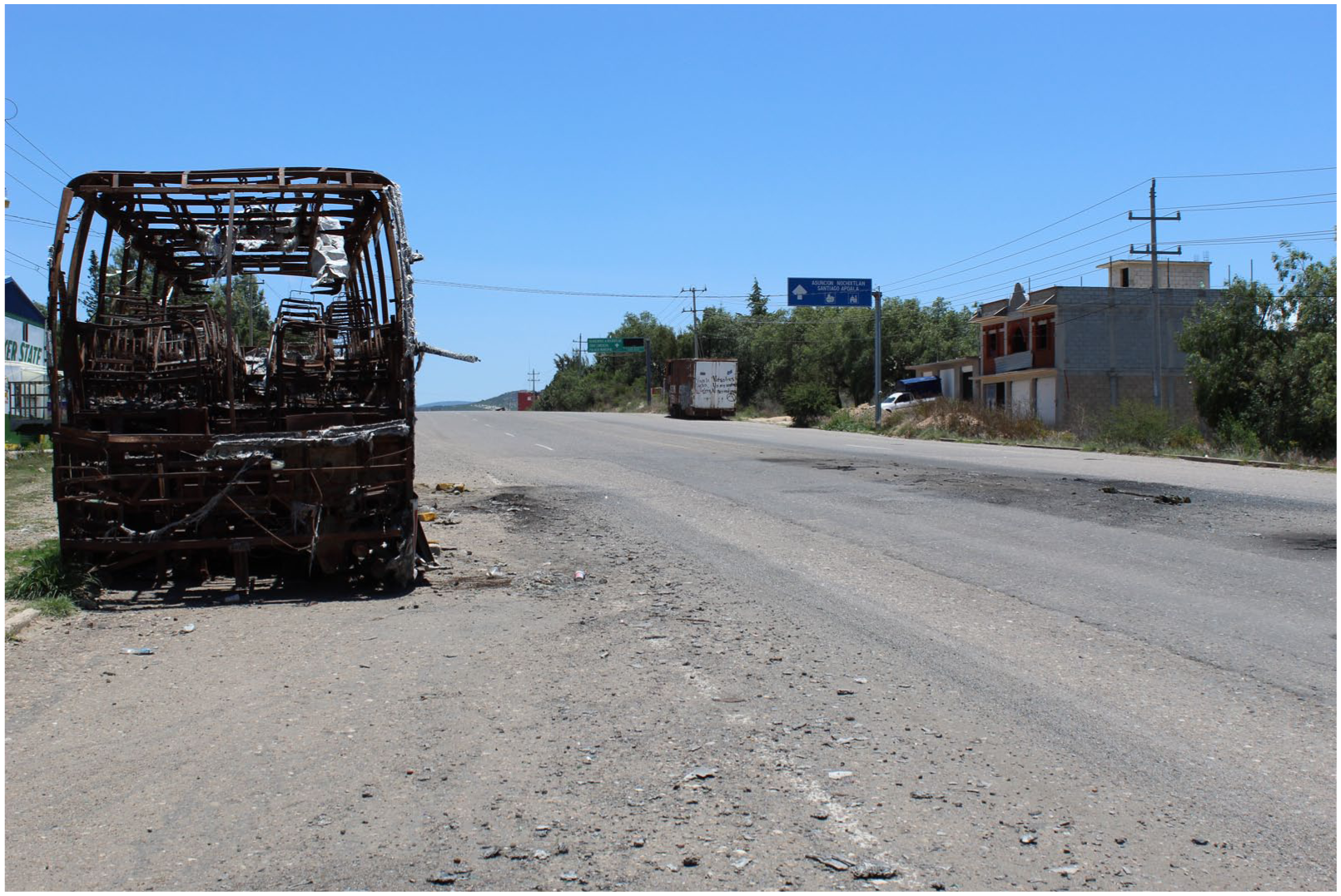
The carcass of a burned bus, torched by FPP during the massacre, is left on the road next to the Nochixtlán general cemetery. Photo by Elybeth Sofia Alcantar.
Landscapes of fear in the Nochixtlán valley
In Oaxaca, Indigenous Mixteco populations fall within a racialized and marginalized category of peoples who are in a continuous transaction of recognition with the federal and state government of Oaxaca, Mexico. 55 The ‘politics of recognition’ in Oaxaca, straddle a familiarity to what Glen Coulthard 56 describes as occurring in Canada with First Nation peoples, where institutions, for example the Mexican National Institute of Indigenous Peoples (INPI), exist to absorb an eschewed version of Indigenous plurinationalism to accommodate Indigenous peoples into a transactional relationship with the nation-sate. The Law of Indigenous Peoples, passed at the Oaxacan state level in 1995, provided Indigenous municipalities the legal right to govern with usos y costumbres, which was precedented through a combative political gestation in the wake of the Zapatista uprisings of 1994. 57 Rather than provide sovereignty and self-determination for Indigenous peoples and their territories, Oaxacan Indigenous municipalities experience hypervigilance, state abandonment, and territorial dispossession. Mixteco intellectual Francisco Lopez Barcenas 58 argues that in Mexico the new colonialism is territorial dispossession, by issuing new political agendas to limit sovereignty, natural resources (bien común) and through acquiring support from corporate enterprises to enforce such appropriation of resources and land from Indigenous municipalities. This can be seen in the territory of the District of Nochixtlán, where it is designated a territorio (territory) Mixteco.
Nochixtlán’s geography is a site of multiple social and ecological conflicts. The District of Nochixtlán is situated along the Superhighway Cuacnopalan-Oaxaca-Tehuacán that facilitates the transport of illegal and legal goods between Southern Mexico and the Federal District; the UNESCO Mixteca Alta Geopark that is a contested mining site 59 ; and the Nochixtlán Valley bioregion that suffers from drought, environmental degradation, and water contamination. 60 There has been a vast growth of informal settlements in Nochixtlán, such as the Colonia 20 de Noviembre, given the territorial disputes and forced displacement which cause whole communities from the Mixteca to refuge in the outskirts of the Nochixtlán city-center. The Rio Verde contamination, most vividly witnessed in Oaxaca City, begins its snaking of contaminated residual waste at the height of the Nochixtlán District, revealing gray polluted waters across the highlands. The Mexican Secretariat of Environment and Natural Resources (SEMARNAT) only conduct photo opportunities with the municipalities impacted, not following through with the multiagency plans for river clean up. Further, there exists another layer of state violence and hypervigilance to these interlocking mechanisms of territorial dispossession, colonial legacies of violence, and racialization that are ever present the lives of Indigenous communities of the Mixteca Oaxaqueña.
The FPP, originally established as a branch of the Mexican military and funded by the U.S. Drug Enforcement Agency, was created to stop drug smuggling between Mexico and the United States. 61 However, this military arm has been utilized to scrutinize Indigenous populations and squash their mobilizations for sovereignty which become demonized by the state. 62 Hypervigilance in the Mixteca by FPP existed as police stations, often enacting police checkpoints where extortion, brutality, and intimidation were the regular. While surrounding Indigenous municipalities assumed sovereignty in their pueblos according to the 1995 law, which allowed them to have their own topil (police), likened to tribal police, FPP often encroached in these jurisdictions as tactics of occupation and intimidation. In 2016, the Law of National Security was in process of becoming a law, virtually giving the FPP sanctioned protections. 63 Although the National Security Law later became declared unconstitutional by Mexico’s National Commission of Human Rights (CNDH) and repealed in 2018, 64 this law gave absolute discretion to the FPP to decide how they would ‘neutralize’ riots, uprisings, and mobilizations of dissatisfied citizens. In the case of the Nochixtlán Massacre of 2016, 400 FPP were ordered by Security commander Juan Peralta Alavez to terrorize Nochixtlán. This state sanction assault brought a nightmare to hundreds of Mixtecos, Sección 22 educators, and civilians as they fled their cargos [post] at the Blockade, the Sunday Plaza (market) and from their quotidian transit spaces to avoid the gunfire and tear gas. 65
The experience brought on by the massacre was an experience of disembodiment and the loss of sense of place at the individual corporal and collective scale. Sense of place in the Mixteca, albeit fractured by routine police checkpoints and FPP intimidation, is the familiarity and territorial attachment to place, specifically a Mixteco territory and the configurations of the routine spaces that make Asunción Nochixtlán. The loss of territorial safety through a ‘terrorized sense of place’ and temporal displacements of civilians are pertinent to understanding how geographies of terror and elimination intertwine to enforce an extermination of peoples across their traditional territories. Marta, a Sección 22 Mixteca teacher, who I interviewed in the patio of her great-aunt’s home outside of Nochixtlán, stated, ‘Days before June 19 it was heard saying “the police are coming, and they are going to hurt us” and all of us would run without a course, but no one would come. And in the evening again, “someone [FPP] is coming” and we would get close [to see] and everything and no one would come’. Marta explained how the rumors of police entering to dislodge the Blockade prior to June 19 caused panic and fear as they assumed state violence was imminent. Gerónimo, whose testimony opened this article, and Marta, both shared experiences of the creation of an ‘atmosphere’ of fear, which began even prior to the massacre. This fear effectively instilled these feelings in their everyday movements in spaces of Nochixtlán, the Blockade, and back home to their families. This atmosphere of fear is what produces a landscape of fear, as sense of safety becomes inextricably bound to how place is experienced by people in Nochixtlán. I underpin this further in the next section, attending to the production of landscapes of fear as more than emotional experiences of place, yet also the material and embodied etchings that it creates unto a people and territory.
Gerónimo characterized this fear as omnipresent: ‘And we were fearful. Yes, we had fear, yes. Fear because, from previous mobilizations, from when we would go to the plantones [tent encampments] in Mexico [CDMX], from the marches in Mexico [CDMX], they would throw grenades and all of that at us. And here in Oaxaca, the same’. The memories of previous clashes with federal police were well documented in the memories of CNTE educators, and they alluded to the fear imposed on them as meant to reverberate across other regions of the Nochixtlán District, not solely confined to Nochixtlán. Further, Marta explained, ‘In the night when we came back to our home after that day [the Nochixtlán Massacre] it was never-ending, it was a situation of feeling completely nude, I mean the doors of your home were not enough. We felt unprotected, we felt nude, we felt that at any moment they [FPP] would come’. Though the community of Marta and Gerónimo had local pueblo police through usos y costumbres, they felt in their community and in their territory, the extreme violence inflicted upon them by the FPP during the massacre left them feeling unprotected which caused them to be disembodied from their community, territory, and selves.66,67 Similarly, Andres, a Mixteco civilian wounded by FPP gunfire, alluded to the landscape of fear instilled in his memories before and in the wake of the assault. Andres maintained, ‘It ended very ugly not for just one person, but for a whole city, for so many communities. That is why they had the village, and other communities with fear. And isolated, more than anything, because no one wanted to come to the center of Nochixtlán because of fear that those actions [Nochixtlán Massacre] would recur’. Furthermore, fear was not only mental and embodied, but also material, and it forced Mixtecos, educators, and civilians alike to be hyperaware of their mobility through spaces in Nochixtlán.
On June 19, 2016, the Nochixtlán Valley was engulfed in flames. Between profound sighs, Gerónimo ended his testimony with a defining memory of the attack, more conspicuously, his experience at the frontlines of the massacre:
From the moment they got there, they came to attack us. They never asked for dialogue, never anything. As soon as they had, when they had us in their reach, they began attacking. A rain of tear gas and they began falling back on us. To burn everything that there was, the tarps, the cars of the compañeros [comrades], the cars that were there, they damaged them, they emptied them.
Gerónimo names the toxic gases and flames encompassing the Nochixtlán Valley on the fateful day as tactics of terror used to eliminate, exterminate, and confine certain populations, more specifically Mixtecos in the Nochixtlán Valley. He follows with his ability to explain the intimacy of state sanctioned police terror in Oaxaca:
How is it possible that the government, the one who is responsible for the village, sends people from the village to shoot their own people? . . . Very cruel to hear shots as if you were at the pyrotechnic fireworks . . . This is what the government does with its own people and to its own village? How awful a system of government we have.
While the massacre was framed as just another skirmish between teacher syndicates and the FPP, this was not the case. Gerónimo counters this by stating, ‘And the people of the town began coming. Not only those of Nochixtlán, but of the neighboring villages. That encouraged you, it gave you strength, well, to not desist . . . Many people came to support. Many people. Meanwhile we tried to defend our dignity and our people, they [FPP] came to kill’.
In the next section I explain this solidarity and organizing between Mixteco civilians, Sección 22 educators, and padres de familia during the duress of the Nochixtlán conflict (Blockade, Massacre, Post-Massacre), as guided by the Indigenous politics of usos y costumbres, most importantly, tequio. Although other police assaults did occur throughout this time in the Isthmus of Tehuantepec, Huitzo, Huajuapan de Leon, and different areas of Oaxaca, 68 I use this case of the Nochixtlán Massacre to draw out these landscapes of fear, without positioning Mixtecos and Sección 22 educators as perpetually bound to passivity amongst slow death and elimination. Rather, I used these landscapes of fear to also showcase how there are also moments of solidarity that create ruptures to state violence, and in turn lead to the transformation of place in Mixteco territories.
Spatial solidarity through tequio
In Nochixtlán, Indigenous Mixtecos lean on their Indigenous politics of usos y costumbres, tequio, and asamblea, to organize against oppression and to carefully craft spaces of liberation, abolition, and desirable futures across the landscape to refuse state terror. By invoking usos y costumbres in this section I analyze how the participation in the Nochixtlán Blockade through asambleas, cargos, comites, and tequio, was used to organize through state violence, while allowing this Indigenous politic to mold desirable futures. I refrain from assuming that usos y costumbres was only used to respond to state violence and instead engage in a discussion of how Indigenous ontologies of being and communality (comunalidad) offered Mixtecos and Sección 22 educators the ability to co-create efforts to sustain the Nochixtlán Blockade, those impacted by the assault on Nochixtlán, and even in the following events post-massacre. I draw on photographic imagery of murals on the Nochixtlán cemetery walls, a statue to the fallen and even the burned Mexican Federal Police station in Nochixtlán to demonstrate examples of the transformation of place guided by the desires of Mixtecos and those impacted. It is these mnemonic remnants on the landscape – often accompanied by graffitied slogans such as ‘Nochixtlán Resiste’ (Figure 2) – that are meant to instill pride and offer temporal moments of liberation from state violence. As I signal further, the burned FPP station brought with it a desire for abolition, informed by an imagined geography free from state terror. It is these precise arrangements and collective desires that give new meaning to place and allow such localities to hold overlapping memories and motivations for a different future.
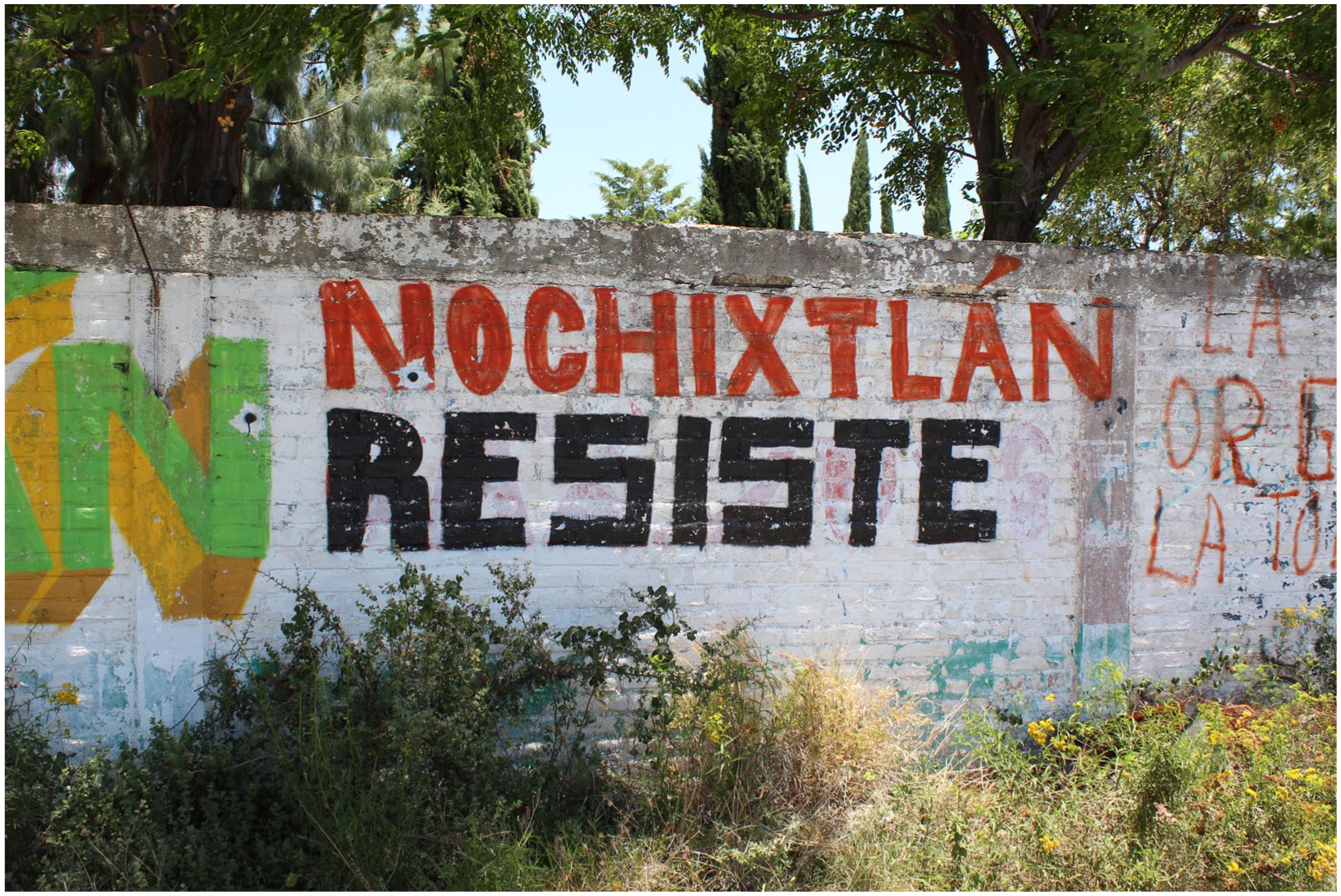
Nochixtlán Resists mural on the wall of the Nochixtlán general cemetery. Photo by Elybeth Sofia Alcantar.
Usos y costumbres became integral to the Nochixtlán uprising and blockade as Sección 22 and Mixteco civilians reproduced the politic to organize and strategize resistance efforts. Usos y costumbres is the supreme law of Indigenous pueblos in 418 of 570 municipalities of Oaxaca and is used at different scales
69
to garner organizational support at schools, syndicates, and even road blockades, as it is ‘vital to the functioning of the political economy and social reproduction’
70
of the collective. Sección 22 teachers are not a homogenous mestizo population as the union is composed by mestizo teachers from and outside of Oaxaca, as well as Indigenous schoolteachers from Oaxaca. Carmelia, a Sección 22 teacher and Mestiza from Campeche, lived in a Mixteco pueblo and recognized, ‘We [union] have been respectful of the usos y costumbres of each different village where I have had the pleasure and fortune to contribute to the development in where they have supported us, on some occasions with groceries or waiting for us to return to classrooms after a strike’. She continued with alluding to how this politic was understood by those who lived and taught in Indigenous pueblos, thus also embodying this system when in Mixteco territories. Further, the reproduction of usos y costumbres at the individual and communal scale become central to sustaining the communal and social fabric that protects Indigenous sovereignty.71,72 Tenets of usos y costumbres were used to coordinate asambleas between educators of Sección 22, civilians, and parents of schoolchildren to decide collectively in establishing the Nochixtlán Blockade. Given the cargo position common of usos y costumbres, teachers and padres de familia were administered cargos to support at the federal-highway blockade, in the school, or at another action. Eugenio, a Mixteco Sección 22 teacher I interviewed in Sinaxtla (Nochixtlán District) exemplifies this as:
We formed a statewide committee of parents. That committee convened all the parents of school children at the statewide level . . . Then, in all the highway blockades there were parents of children. Ready for all. And us, here in the Mixteca, there were padres de familia.
Asambleas give ways to comites, while in pueblo Mixtecos these may be committees for potable water or material infrastructure, in the Nochixtlán conflict Sección 22 and Nochixtecos were able to form comites for the Nochixtlán Blockade. Using the framework of usos y costumbres from a municipal scale to an organizational scale deemed familiar to Nochixtecos and Mixteco supporters.
Extending these practices that came to immerse more than the immediate pueblo became significant in this mobilization. As Eugenio expressed, the pueblos set up a system through committees and assemblies where educators would schedule shifts and exchange responsibility. While one teacher stayed behind to teach, the other would go to the blockades, then they would switch biweekly. Eugenio notes, ‘There were compañeros who were at the front, well, they would help us economically. About biweekly, our compañeros would split the amount of 50 percent’. The teachers ensured that although compañeros were losing their salaries due to leaving to the blockades, money and resources were pooled together to share monetarily. The Blockade and Teacher strike of 2016 were understood as a collectivized effort, not just from the standpoint of the teachers, but the parents of schoolchildren as well. Eugenio, noted how teachers would pool money to also get parents to the blockade: ‘If you are mother of the children, and you say, “teacher I want to accompany you,” we support the parents’. The Nochixtlán Blockade on the Federal Cuacnopalan-Oaxaca-Tehuacán freeway was thus a collective solidarity between educators and parents of schoolchildren built on communality, the supreme law of Indigenous pueblos.
Marta, who took on the role of assisting at the chapel where injured civilians were being taken to after the hospital was shot at by the Gendarmerie, insisted that the Mixteca’s territory and peoples was comprised of inherent solidarity. She begins:
My turn was to receive sick people in a chapel. The people opened the chapels to receive the sick, the wounded and the ambulances with wounded people came and they would give us supplies . . . Yes, I remember that the hospital was shot at . . . The nurses were dressed as civilians and went to help, but not as nurses. There were doctors in the same dressed as civilians and went to help . . . The surprising thing is that Nochixtlán has always been a town united in solidarity and as is the Mixteca Oaxaqueña is a solidary people . . .
The solidarity Marta spoke to was not simply one that formed from the obligation to assist the wounded during this perilous time. Rather her obligation came from her participation in tequio and community asambleas as a teacher and community member of the Mixteca. Tequio is communal obligation embodied to serve the collective. As such, tequio as an obligation for the good of others flourished and transformed as solidarity during the Blockade. It is within this context that Eugenio recalled the creation of a bunker and temporary community kitchen set up in the aftermath of the massacre through this solidarity:
They made, let us say, like a bunker at the primary school Abraham Castellanos . . . We made a kitchen . . . like a community kitchen so that our compañeros that were in the plantón. And so, they came and ate, whatever visitors that came by would at least be offered some rice and beans. So, there was endless support. Doctors, even, came by to see the injured. Or medications. Because that is the saddest part, that our own government closed the hospitals for the injured here in Nochixtlán.
It is these precise moments of networks of communal care that are delivered through the Indigenous politics of tequio, asamblea, and cargos. Whether it was a cargo to be at the Nochixtlán Blockade, or an asamblea to decide on next steps for organizing, inclusively, offering your tequio to care for wounded, these Indigenous politics of being in Mixteco geographies shaped the possibilities of solidarity that emerged during the Nochixtlán conflict of 2016. Tequio is multifaceted and expansive. It occupies an obligation to the pueblo, that extends itself to an obligation to community, territory, and futurity. Indigenous Mixteco futures here are informed by a desire that is also communal, collective, and necessary for social reproduction of usos y costumbres as the binding politic at the body, local, and regional scale. Similar to Mejerle Lister’s discussion on Diné development desire, he espouses, ‘Desires are always becoming; they are informed by the past, then disassembled and reassembled for the future continuously’. 73 The solidarity transpired in the Nochixtlán Blockade was anchored in the politic of tequio, and guided by a desire for life, an end to premature death, and for an educational reform that would affirm Mixteco livingness.
Statues, murals, and transformations of place
In 2022 I visited the abandoned FPP station in Nochixtlán, 6 years after it was burnt down by civilians, and 3 years after the institutionalized disbandment of the FPP at the federal level. I signal this act as a moment of Indigenous desire in action, even if temporal, of the abolishment of Federal Police from the landscape. This desire of abolition aligns with Daigle and Ramírez conceptual interweaving of decolonial abolition and geographies as ‘a diverse and interconnected landscape grounded in the particularities of each place, starting with the Indigenous lands/waters/peoples from which a geography emerges, and the ways these places are simultaneously sculpted by radical traditions of resistance and liberation embodied by Black, Latinx, Asian and other racialised communities’. 74 While momentarily suspended to the date the fire was set ablaze to the lot, it metaphorizes the desire to make state sanctioned police violence obsolete from the territory of the District of Nochixtlán. Andres, who actively participated in the Comité de Víctimas por Justicia y Verdad 19 de Junio (COVIC), finished his interview with his desire for regional justice across the Mixteca: ‘Well, my hope would be for there to be justice for all. Not just for us who experienced it, but for all the cases that have occurred in the Mixteca that have been silenced’. Andres recognized the regional terror that was produced by the FPP and governmental actors involved in the repression of June 19th, 2016. Andres, who received a bullet from FPP’s gunfire during the massacre while he was just 16 years of age, evokes his desire for justice as spatialized, informed by his Indigenous Mixteco politics of communality, toward a justice grounded in abolishment of state terror. A desire for justice, across the Mixteca Oaxaqueña shows how state terror is not limited to Nochixtlán, but other nodes of the Mixteca at differing sites. While COVIC continues toward judicial justice and monetary reparations for wounded civilians, 75 they also attempt to memorialize this massacre as part of Mexico’s long history of Dirty Wars.
In line with the discussion of geographies of terror and elimination and alongside a framework of Indigenous transformations of space, 76 I also bring forth grounded normativity/place- based solidarity 77 as it helps illuminate the ways Mixteco people reimagine their future. Moreover, Natchee Blu Barnd explains that ‘Although indigenous geographies, for example, must be fluent in the dominant spatial regimes and practices as a matter of survival (and result from assimilation violences), they can be sustained and produced only through normalizing practices’, further explaining that ‘Native space must be constantly recognized and made viable through daily practices’. 78 It is through these mediums, of murals, charred automobiles, statues, and everyday relationships between Sección 22 educators, Mixtecos and Nochxiteco civilians that space is transformed in Nochixtlán. Further the spatial solidarity practiced by Nochixtecos, Mixtecos, and Sección 22 reflected Coulthard and Simpson’s grounded normativity, or ‘What we are calling “grounded normativity” refers to the ethical frameworks provided by these Indigenous place-based practices and associated forms of knowledge’, which, ‘houses and reproduces the practices and procedures, based on deep reciprocity, that are inherently informed by an intimate relationship to place’. 79 It is the place-based Mixteco politics of tequio, asamblea, and comites that conceived the place-based solidarity during the Nochixtlán conflict of 2016. To exist in a Mixteco territory, and to organize in a Mixteco landscape, is to be cognizant of the everyday rehearsals Mixtecos engage in to survive through a geography made to be unlivable.
Figure 3 displays one of the murals on the Nochixtlán cemetery, where Federal Police units in tactical gear are beating a book named ‘Education’, with the sentence ‘If the press is for the powerful, then the walls are ours’ (translated by author). The 19th of June is scribbled on the wall to the right of the mural, with ‘Ni perdón, ni olvido’. ‘Neither forgiveness, nor forgetting’ is a slogan used across Latin America where state sanctioned repression, disappearances, and dirty wars on educators are part of the national history of the nation. This mural is a direct response to Mexico’s Commission of National Security’s public announcements that any photographs depicting the FPP in riot gear shooting at protestors were false. 80 This attempt to silence the injured and wounded compelled Nochixtlán actors to begin competing to transform this massacre into a regional cultural memory upon the landscape. The memories of the massacre aren’t passive or stagnant. Memories are actively used to garner the support and direct action of people to transform the future of a specific place. It is through these mediums of murals, statues, and the Indigenous politics of tequio, that Mixtecos, civilians, and Sección 22 educators transformed meaning to sites of a massacre, to sites of cultural landscapes that affirm Mixteco livingness. To defeat the FPP, is to survive, which is to give yourself to the struggle for the defense of education and the pueblo (people; Figures 4 and 5).
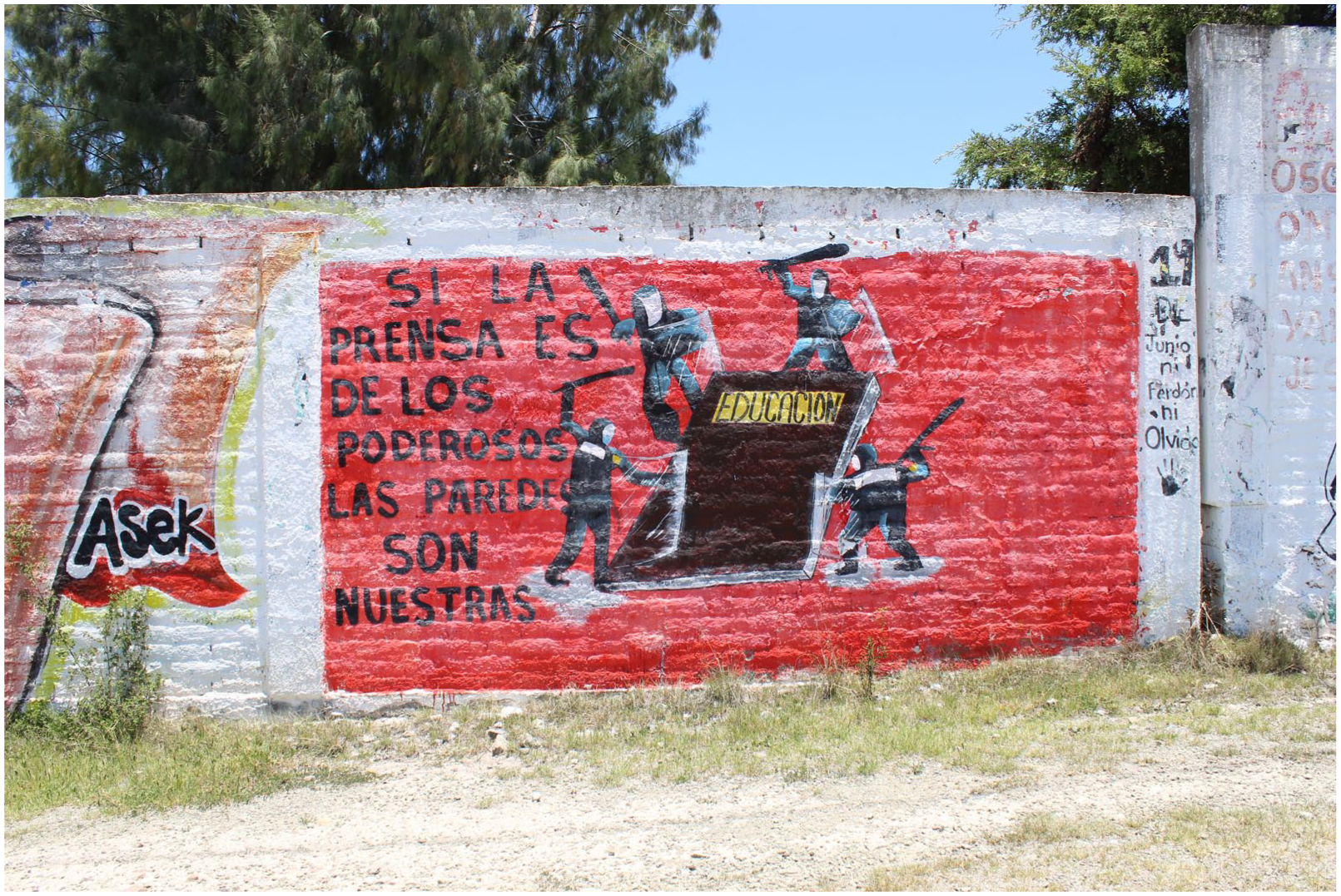
Mural on Nochixtlán general cemetery depicting FPP beating education. Photo by Elybeth Sofia Alcantar.
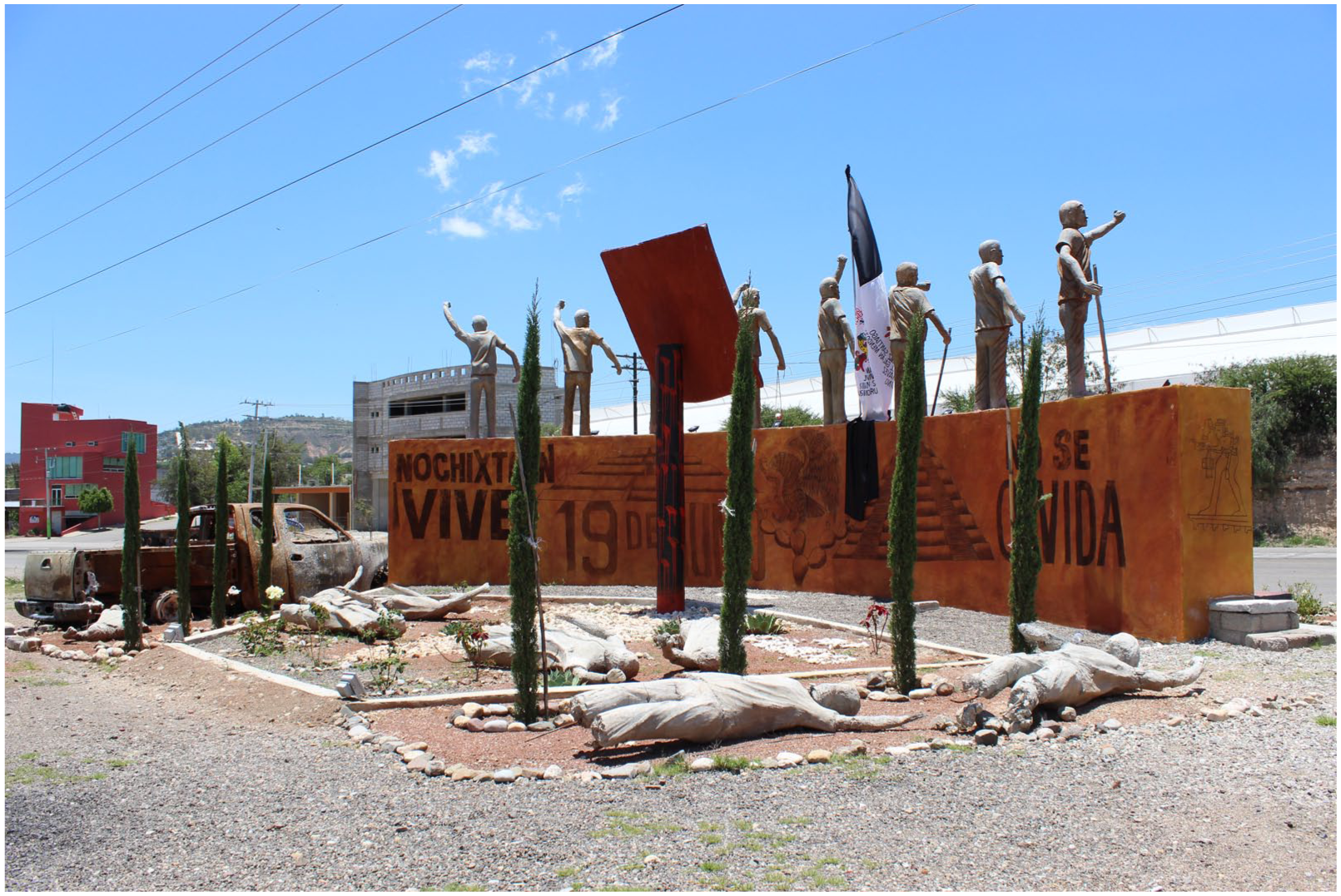
Monument to the fallen, with original statues toppled. Photo by Elybeth Sofia Alcantar.
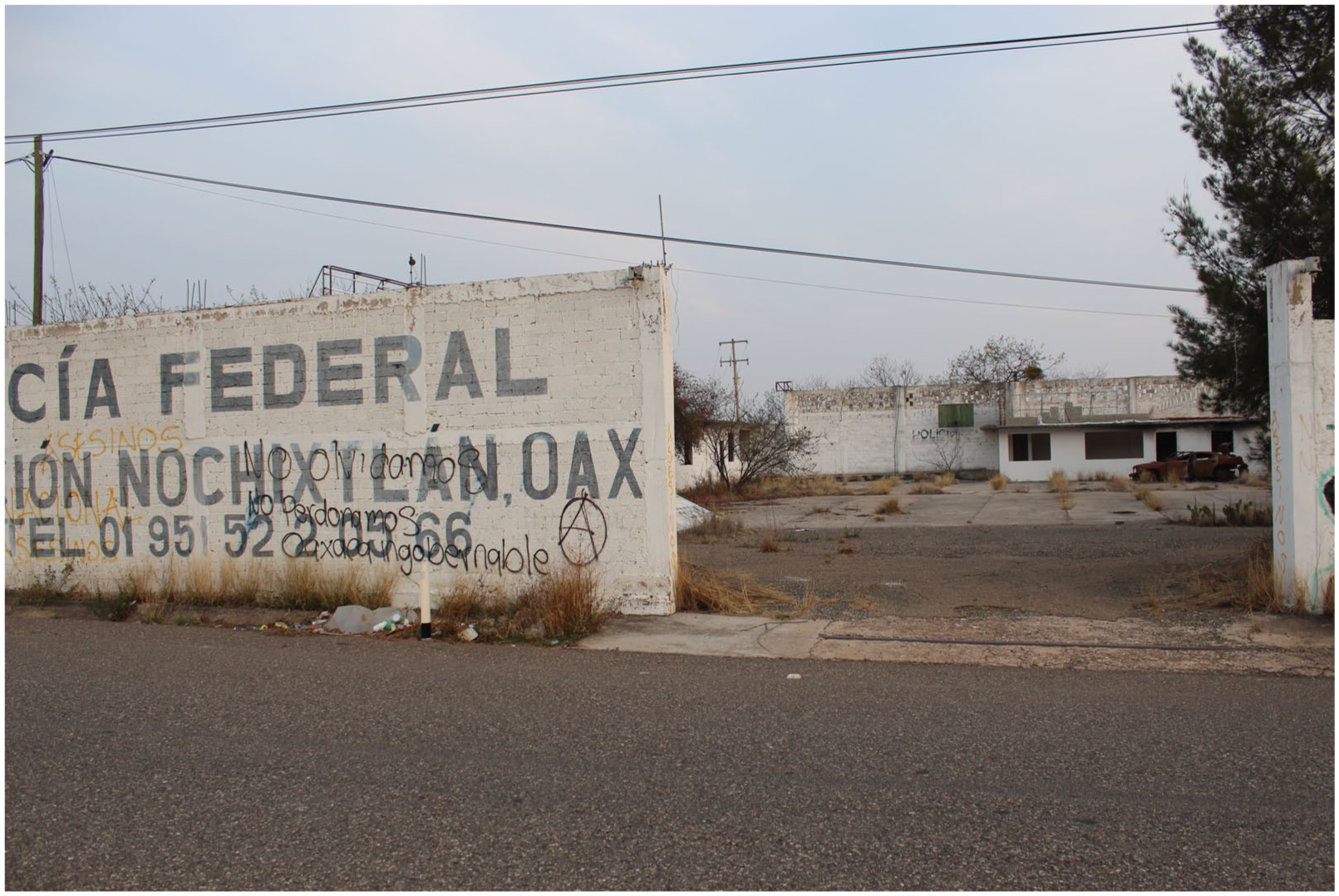
Deserted FPP station in Asunción Nochixtlán. Photo by Elybeth Sofia Alcantar.
In the years following the massacre, COVIC, Sección 22, and family members of los caidos erected a monument at the footsteps of the Nochixtlán cemetery to the eight civilians killed. The original broken statues on the floor reflect what Marta explained of Nochixtlán: ‘As of then, Nochixtlán divides in two parts, if not more, but two noticeable parts. The people who support and back the wounded. The people who give their trust to the wounded and on the other side the people who are with the president, the one who was acting as president at that time’. A community recovering from a massacre will be in constant turmoil as there are never finite sides between a shared landscape. Fernando Bosco 81 notes that depending on the space and monument, the site of such memorial becomes a contested space as more individuals problematize the site of memory. The first statues received vandalism, crude treatment, and were eventually toppled down by people who repudiated those impacted by the Nochixtlán Massacre. Once again Sección 22, COVIC, and family of the wounded remade the statues. Each bronze statue lifts their left fist in the air, standing in a perpetual position of solidarity. To enter Nochixtlán, one must bear witness to this statue, as well as the burned automobile carcasses still left across the wide paved road. These point to a process of reterritorialization and the capturing of a renewed sense of place for Nochxitecos and Mixtecos despite the massacre.
Conclusion
In the Nochixtlán District, to live is to transform an unlivable geography into one that is desired and produced through Indigenous politics of usos y costumbres. The transformation of geographies of terror during the Nochixtlán Conflict of 2016 was dependent on the ability to organize prior, throughout, and post-massacre with the Indigenous politic of tequio. On 27 July 2025, Sección 22 held their 8th Guelaguetza magisterial y popular in Asunción Nochixtlán, the counter to the state-sponsored Guelaguetza in Oaxaca City. On the banner both ‘Whoever governs, we defend our rights’ read alongside a commemoration to 19 June 2016. The Guelaguetza popular began at the Nochixtlán general cemetery, where 9 years prior, FPP rained their bullets against Sección 22, Nochixtecos, and Mixtecos. While fear and terror became central to the June 19th Nochixtlán Massacre, it did not fixate a people or a landscape to a state of espanto. This Guelaguetza revealed the longevity of place-based solidarity and the transformation of place, where a site of terror became a liberatory site where Sección 22, Mixtecos, and their allies from across the state met to parade their continuous demands for justice (Figure 6).
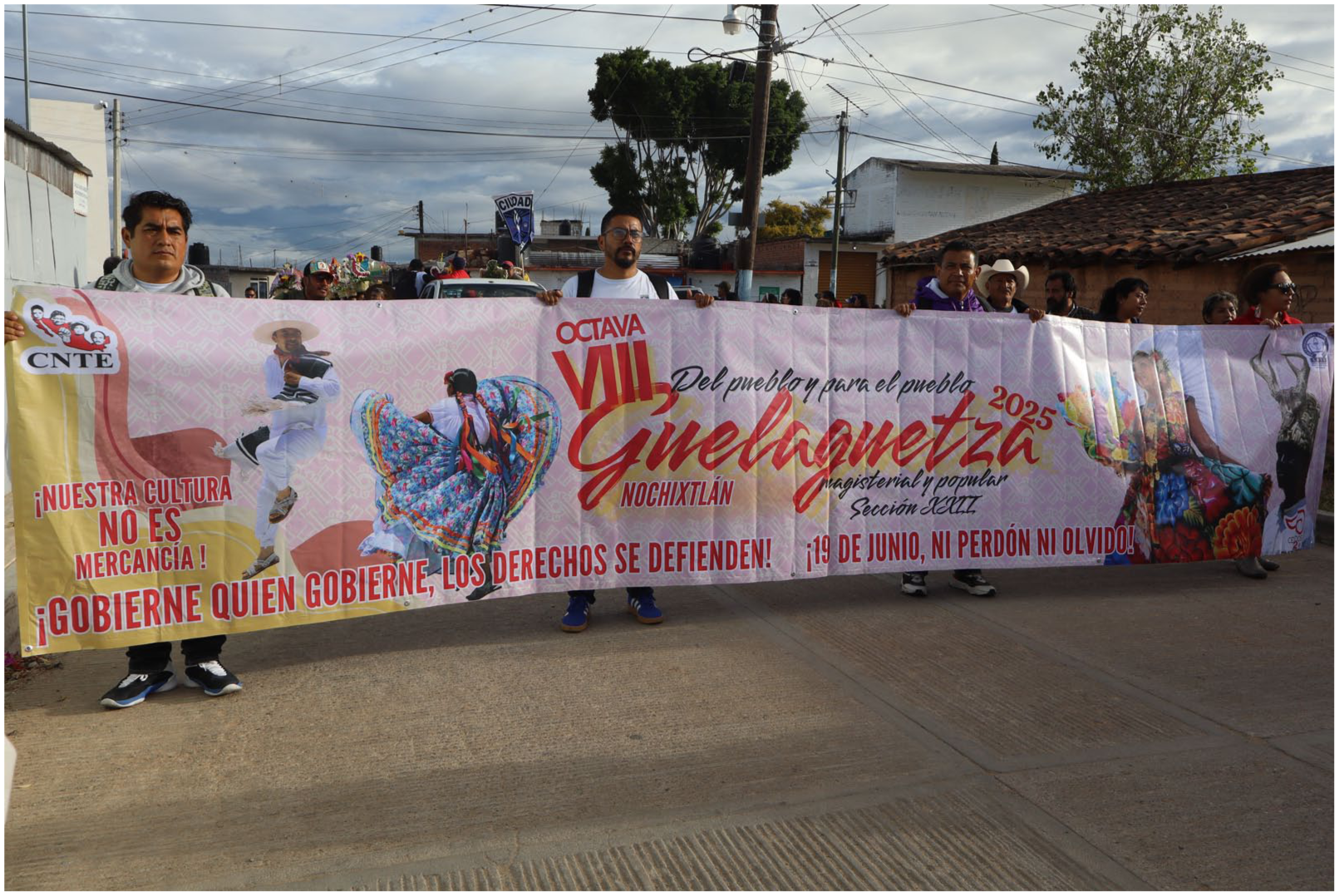
Participants of the Guelaguetza Popular hold up a banner at the forefront of the festivity. Photo by Elybeth Sofia Alcantar.
It is in this same site, the site of the Nochixtlán Massacre, where through Indigenous politics of usos y costumbres, Nochixtecos, Mixtecos, and Sección 22 built their own organizing infrastructure to build the Nochixtlán Blockade and defend Indigenous sovereignty. It is etched within the Indigenous politics of tequio, asamblea, cargos, and overall communality that is suspended on the defense of territoriality and Indigenous livingness. To transform Indigenous place is to engage in place-based solidarities 82 to counter geographies of terror and elimination, which requires a deep commitment to livingness, to craft such futures. To transform a Mexican Federal Police station into an empty lot with overgrown weeds and charred walls, or to transform a general cemetery as a preserver of murals and symbols recalling on Nochixteco resilience, demonstrates a desire for abolition informed by Mixteco politics of life. Indigenous desire83,84 informs grounded normativity 85 which create the impulses by which Mixtecos and their allies transform their landscapes from geographies of terror toward geographic abolitionist 86 possibilities.
Footnotes
Acknowledgements
I provide gratitude to teachers of Sección 22 and the pueblo Mixteco for their powerful testimonies and invitations into their homes and classrooms. I extend appreciation to the Latinx Geographies Specialty Group, and most especially to Dr. Alana de Hinojosa for their supportive mentorship on this article. I praise UT-Austin’s Feminist Geography Collective for editing support on this article. I offer special recognition to San Diego State University’s Latin American Studies Department, UT-Austin’s Rapoport Center for Human Rights, and UT-Austin’s Department of Geography.
Ethical considerations
A study of survey participants
The Institutional Ethics Review Committee at California State University, Chico approved our interviews April 12, 2018 (Protocol #: 14386). Respondents gave oral consent for review and consent before starting interviews. The Institutional Ethics Review Committee at San Diego State University approved our interviews on May 21, 2021 (Protocol #: HS-2021-0083). University of Texas at Austin’s Institutional Review Board approved my research on January 18, 2025 (STUDY #: 00006986).
Funding
The author disclosed receipt of the following financial support for the research, authorship, and/or publication of this article: Funding for initial research was acquired by San Diego State University’s Tinker Grant in 2021, University of Texas at Austin’s Rapoport Center for Human Rights Field Research Grant in 2022, and UT-Austin’s Geography Department Donald D Brand Research Award. With funding by Latinx Geographies Specialty Group, Commission on Gender and Geography of the International Geographical Union, and U.S. National Science Foundation (NSF) Human-Environment and Geographical Sciences Program (HEGS) (Award #1951772), I was able to workshop the paper in Mexico City in 2023. With funding through Fulbright Hays DDRA, I continued photographic and observational research in 2025.
Consent to participate
In 2018 and 2021, IRB approval only necessitated oral consent.
Consent for publication
Participants were informed that research carried out would be for publication. Given this, participants chose pseudonyms.

Data availability statement
Data is in author’s possession. Please email the author for data.*