



Abstract
This study examines whether changing educational tracks at the transition to upper secondary school affects the development of political interest among German adolescents. Using 5 years of panel data from the National Educational Panel Study (NEPS; N = 1578), we distinguish between academic tracks leading to higher education entrance qualifications and non-academic tracks leading to vocational qualifications. Linear panel models show that students in academic tracks display higher political interest and more favorable trajectories than those in non-academic tracks. However, these differences are fully explained by entry selection factors, especially prior political interest, cognitive competences, and social background, measured before the transition. Track changes, whether upward or downward, have no significant effect during upper secondary education. A small increase in political interest is observed among upward movers only after leaving school. This indicates education may influence political interest via status. The findings challenge earlier research suggesting direct track effects and compensatory benefits for less privileged students. Results underscore the importance of political socialization during lower secondary education and raise concerns about the ability of stratified school systems to provide equal opportunities for political learning, with implications for democratic resilience.
Keywords
Introduction
Democracies are particularly dependent on the support of their citizens (Easton, 1975). One central aspect of this support is the existence of a fundamental interest in politics (van Deth, 1990). Accordingly, other important aspects of political participation are linked to political interest (Brady et al., 1995; Delli Carpini and Keeter, 1996; Denny and Doyle, 2008; Hooghe and Dejaeghere, 2007; Kleer et al., 2023; Verba et al., 1995; Zukin et al., 2006). Political interest is a key driver of political participation, as interested individuals are more informed, more engaged, and more likely to develop firm political preferences (Prior, 2010, 2018).
A democratic society has therefore to ensure that such a central aspect for the functioning of the political system is not left to chance. “Good citizens are made, not born” is how Galston (2001) summarizes this civic demand for political socialization. Education is a central instrument available to societies for this purpose. This connection is largely established in political science and educational research (Emler and Frazer, 1999; Putnam, 1995). Despite this broad consensus, important gaps remain in our understanding of how school education shapes political interest over time. The present study addresses three interrelated research gaps in the literature on the relationship between educational trajectories and political interest.
While much of the existing literature examines the effects of education on political interest in rather general terms, we focus specifically on educational track changes at the transition to upper secondary education. In many European countries, lower secondary education is organized into non-academic tracks (leading to qualifications below the university entrance level) and academic tracks (leading to a university entrance qualification; Bol, 2014; Imdorf et al., 2025). At the transition to upper secondary education, students often change tracks: students from academic tracks may switch to vocational education, while students from non-academic tracks may enter pathways leading to a higher education entrance qualification. In Germany, for instance, around 30% of students move into an academic track in upper secondary education (MSB NRW, 2023). We examine how political interest develops following such track changes, taking into account students’ educational starting conditions. Unlike Zhang et al. (2025), who distinguish only between Gymnasien and vocational schools, we differentiate more precisely between educational pathways that do and do not lead to a higher education entrance qualification, including vocational routes to higher education.
However, empirical evidence on the effects of educational track changes remains limited by substantial methodological constraints. Most studies examining the association between school education and political interest rely on cross-sectional designs, which do not allow researchers to disentangle selection into different educational tracks from the effects of track attendance itself. Only a very small number of studies draw on genuine longitudinal data with more than two measurement occasions (Eckstein et al., 2012; Russo and Stattin, 2017; Zhang et al., 2025). While Eckstein et al. (2012) identify different developmental trajectories of political interest across school types during lower secondary education, Zhang et al. (2025), using representative longitudinal data from Germany (National Educational Panel Study (NEPS); Blossfeld et al., 2011), show that for the transition to upper secondary education apparent effects of track changes are fully explained by prior selection into educational pathways. Building on NEPS data as well, we ask whether effects of track changes in upper secondary education may primarily emerge within specific subpopulations rather than in the overall population of students who change tracks. In particular, we analyze whether track changes matter differently for low-achieving students or for students from socioeconomically disadvantaged families.
Third, we extend previous research by explicitly addressing the timing of educational effects on political interest. While numerous studies focus on the impact of school types or track changes during the school years (e.g. Zhang et al., 2025), there is also evidence suggesting that educational institutions matter less than the occupational positions individuals attain later in life. However, most studies supporting this claim are cross-sectional and rely on retrospective educational information (e.g. Campbell et al., 1980; Persson, 2013). Our longitudinal data allow us to trace the development of political interest both during and after upper secondary education, enabling us to disentangle direct educational effects from indirect effects mediated by subsequent occupational positioning.
The article begins with an overview of theoretical mechanisms linking education and political interest, followed by a description of the German school system. We then present our hypotheses and test them using random effects panel models. Results are discussed in light of prior research and summarized in the conclusion.
Theory and the state of research
Political interest can be divided into situational and dispositional interest and can be defined as an internal disposition (Prior, 2018: 4). This distinguishes it from political participation as behavior and political sophistication, which can be seen as the result of political learning (Prior, 2018). As a central political attitude, however, interest plays a decisive role in shaping (the intention to) participate in politics in particular (Bömmel et al., 2020: 6). For example, the increase in years of education caused by education reforms has a positive effect on the development of political interest across countries (Le and Nguyen, 2021). Various studies have shown that education has an effect on political interest particularly during adolescence (Wolak, 2020; Wray-Lake et al., 2020).
Our study contributes to providing precise knowledge of the effects and impact of academic and non-academic tracks on the political interest of different groups of students. A higher level of political interest and other characteristics such as political engagement, political competence, intention to vote, and voting behavior in the academic versus the non-academic track is shown by a number of studies (Hoskins and Janmaat, 2016; Janmaat et al., 2014; Janmaat and Mons, 2023; van de Werfhorst, 2017). A longitudinal study by Eckstein et al. (2012) finds that political engagement and willingness to participate increase among academic-track students, but decrease among those in non-academic tracks Witschge et al. (2019) show that switching from an academic to a vocational track in the Netherlands is associated with a decline in political interest, while the reverse direction shows no effect – likely due to the very small sample (N = 14). Given the sample’s heterogeneity and vague classification, the validity of these findings is limited. However, more recent evidence suggests that observed track effects should be interpreted with greater caution. In particular, Zhang et al. (2025), using German longitudinal data and explicitly modeling selection processes, show that differences in political interest after track changes in upper secondary education are largely driven by prior selection rather than by causal track effects. Students who change tracks already differ in political interest before the transition, and track changes themselves do not substantially alter political interest once pre-transition levels are taken into account.
For a better comprehension of track effects two approaches should be distinguished here. On the one hand, education can be assumed to have direct effects on political interest, so that following an academic track leads directly to skills and values that increase political interest more than following a non-academic track. However, two counterarguments can be put forward against this assumption: Firstly, a methodological argument, namely that track-specific entry selection is not sufficiently taken into account, as the findings by Zhang et al. (2025) suggests. Secondly, it can be argued that education has only an indirect effect on political interest, attitudes and behavior via the social status that is achieved after graduation (Hansen and Tyner, 2021). In the following, we describe these explanatory approaches in more detail and derive hypotheses for our analyses.
Selection into educational tracks
Students in different tracks differ from each other because selection into these tracks is based on performance, which is associated with other characteristics such as social background (Stubbe et al., 2023). Cognitive ability fosters political sophistication and facilitates understanding of political content, which is associated with increased turnout (Campbell et al., 1980; Denny and Doyle, 2008; Luskin, 1990).
Sociocultural family characteristics play a key role. In particular, European data have identified the family as a greater influencing factor than school for the development of political interest (Mutz and Nobis, 2024). Characteristics such as the social and economic status of the parents have a strong effect on a child’s political development (Denny and Doyle, 2008; Dostie-Goulet, 2009; Eichhorn, 2018; Frindte et al., 2019; Koskimaa and Rapeli, 2015; Neundorf et al., 2013; Shehata and Amnå, 2019; Wuttke, 2020). Particularly important is the parental education level, which has been shown to influence children’s political interest and attitudes (Janmaat et al., 2014; van de Werfhorst, 2017).
These factors are related to family socialization, which also includes political socialization (Abendschön, 2010; van Deth, 2007). In particular, political discussions at home can stimulate children’s interest in politics (Dostie-Goulet, 2009; Eichhorn, 2018). This is because well-educated or socioeconomically advantaged parents tend to provide more political stimulation and adopt less authoritarian parenting styles (Abendschön, 2010; Hainke, 1971; Oesterreich, 2002). However, while family background is important, its influence may be strongest in early childhood (Hoskins et al., 2017; Janmaat and Hoskins, 2022). During adolescence, school socialization may become increasingly relevant (Eichhorn, 2018; Prior, 2018).
Direct effects of education
In what follows, we examine the reasons why education may exert direct effects on political interest.
Curriculum
Several studies have shown that ceteris paribus academic tracks lead to a better development of skills – especially reading competences – than non-academic tracks (Retelsdorf et al., 2012; Strello et al., 2021). In particular, the acquisition of reading competences simplifies access to political information by making it easier to filter out what is relevant from the mass of information (Campbell et al., 1980; Delli Carpini and Keeter, 1996; Hillygus, 2005; Verba et al., 1995). This leads to a more structured and differentiated political interest and understanding (Campbell et al., 1980).
Academic-track students also have more opportunities to learn about politics, both formally (e.g. civic education) and informally (e.g. political discussions, school committees, co-determination; Quintelier, 2010). It is well documented that participation in politically themed lessons positively influences political attitudes and interest (Claes and Hooghe, 2017; Deimel et al., 2020; Schmid, 2003), especially when multiple perspectives are discussed (Levy et al., 2016). Evidence is not fully consistent across contexts (Ehman, 1980; Eichhorn, 2018). Nevertheless, formal civic education can compensate for socialization-related disadvantages in political engagement, including political interest (Neundorf et al., 2016). In Germany, it especially benefits socially disadvantaged students by offsetting limited political discussion at home (Deimel et al., 2020). Participation opportunities also foster political socialization and future political engagement (Ehman, 1980; Gainous and Martens, 2012; Hoskins et al., 2017; Keating and Janmaat, 2016). These are more common in socially privileged classrooms, typically in academic tracks. In such contexts, students experience more open classroom climates and are more likely to engage in participatory school structures (Deimel et al., 2020; Ichilov, 2002; Kahne and Middaugh, 2008).
Peer socialization
One important aspect in comparing education systems is the degree of social segregation among students. The more students with similar socio-cultural characteristics cluster within certain schools or tracks, the more pronounced the segregation. This segregation typically increases with the level of stratification in the system (Felouzis and Charmillot, 2013).
In segregated classrooms, peer socialization may transmit dominant social attitudes from the majority to the minority. The effects of track affiliation on political interest may thus be mediated by peer dynamics, which become especially influential during adolescence (Koskimaa and Rapeli, 2015; Shehata and Amnå, 2019). Multiple studies show a link between class’s social composition and students’ political attitudes. A more favorable socioeconomic class composition is associated with higher cognitive political skills (Janmaat, 2022). Teachers also appear to react to the social composition of their class in their lesson planning, for example by opening up opportunities for participation and discourse (Deimel et al., 2020; Janmaat and Mons, 2023), which in turn has an influence on the willingness of students to vote.
Indirect effects of education
While direct educational effects are expected to occur during schooling, indirect educational effects may materialize only after school-to-work transitions, via occupational status. Academic and vocational tracks typically lead to different qualifications and entitlements; vocational graduates attain lower average status, which correlates with lower political interest (Hansen and Tyner, 2021; Verba et al., 1995). Higher educational attainment – and the higher social status it enables (Becker, 2009) – grants access to social networks that foster political interest and engagement (Franklin et al., 2004; Hansen and Tyner, 2021; Verba et al., 1995). These effects operate through various mechanisms. For instance, Franklin et al. (2004) argue that in high-status networks, the benefits of participation are greater and the perceived costs of abstention are higher (see also Kühnel, 2001). Hansen and Tyner (2021) show that civic norms like “voting is a duty” are more widespread in these environments. For these reasons, political interest should be higher in high-status groups.
This argument is rooted in the relative education model, as it conceptualizes education primarily as a mechanism that allocates individuals to status positions and social networks, which then shape political interest. In contrast, the absolute education model would expect education to affect political interest directly through years of schooling (Hillygus, 2005; Verba et al., 1995); we treat this perspective as complementary but do not elaborate it here.
Educational tracks at upper secondary level in Germany
Structure
European countries such as Germany, Austria or the Czech Republic have very stratified education systems (Bol and van de Werfhorst, 2013). However, one aspect usually neglected is that after the transition to upper secondary education, new choices open up for all students. In this article, we distinguish between educational tracks according to whether they lead to a university entrance qualification (=academic) or not (=non-academic, including general and vocational education).
In the German school system, there are two relevant transition points – from primary school (years 1–4) to lower secondary level (years 5–10) and from lower secondary level to upper secondary level (years 11–12/13, see Figure 1). At the first transition point, early selection takes place based on performance in primary school into clearly distinct secondary school tracks. These are academic tracks that lead directly to a higher education entrance qualification (HEEQ), for example at a Gymnasium, and non-academic tracks, for example at a Sekundarschule, that lead to non-academic qualifications entitling students to enter a vocational training option. At the end of the lower secondary level, however, students can once again decide on their further educational pathway. The majority of students in an academic track simply remain in this track, which leads to a HEEQ at the end of the upper secondary level. However, students who do not fulfill the performance requirements or who for other reasons do not want to continue in an academic track at upper secondary level can enter a vocational track after year 10 that leads to a vocational training qualification. In this case, they switch from an academic to a non-academic educational track (see Figure 1).
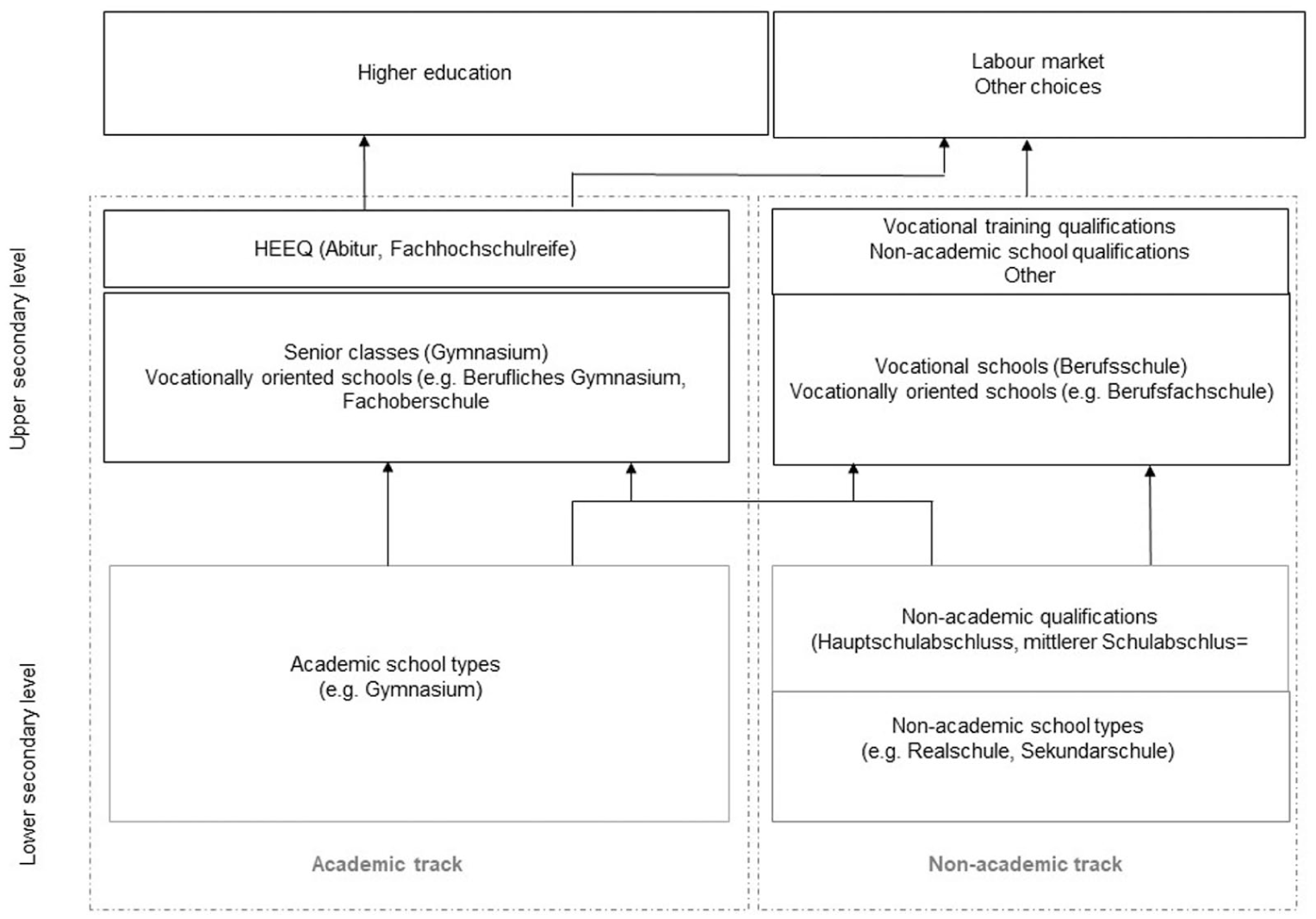
Systematization of the German school system.
Students who attended a non-academic type of school at lower secondary level and obtained an intermediate school-leaving qualification also have a choice. They can switch to an academic track at upper secondary level at a general or vocationally oriented school, a track that leads to a HEEQ. In addition to general education and basic vocational knowledge, students acquire the higher education entrance qualification for a university of applied sciences (Fachhochschulreife) in 2 years or the general HEEQ (Abitur) in 3 years. Both qualifications entitle the holder to enter higher education. Students who do not want to acquire a HEEQ can enter a vocational education and training (VET) programme. In this case, they remain in a non-academic (vocational) track.
Selection
Entry selection into an academic or a non-academic track at upper secondary level is based on performance-related requirements. For example, graduates of a non-academic track at lower secondary level can only switch to an academic track at upper secondary level if they have an intermediate school-leaving qualification, and if they want to switch to a 3-year track, they must also have a certain grade point average. Students who have been in an academic track at lower secondary level and have an unfavorable academic performance or have not passed the final examination in year 10 usually switch to the non-academic track at upper secondary level. Students from less privileged social backgrounds are less likely to opt for an academic track at upper secondary level (Buchholz and Schier, 2015; Schuchart and Schimke, 2022).
Curriculum
There are differences between the federal states with regard to the proportion of the curriculum that is relevant to politics. In the following, we give only general trends that apply in the majority of the federal states (Gökbudak et al., 2022). Overall, very little time is available for the subject of civic education (approx. 2.6%, with differences between the federal states ranging from 0.5% in Bavaria to 4.4% in Northrhine-Westphalia; Gökbudak et al., 2022: 21). With the transition from lower secondary level to upper secondary level, the proportion of civic education decreases in almost all the federal states (Gökbudak et al., 2022). This reduction is greater for those who switch from a non-academic track to an academic track than vice versa (Gökbudak et al., 2021: 6) as the overall proportion of civic education is slightly higher at lower and upper secondary levels in the non-academic track than in the academic track. This differs from the trends reported for other countries (cf. Quintelier, 2010 among others). However, it must be noted that, in the non-academic track at upper secondary level, there is not only a lack of trained teachers, but also that the content of the school subjects that are politically relevant is not very specific because economic and legal content dominates (Besand, 2014). In this respect, there are also indications that the quality of the content of political education in the non-academic track at upper secondary level could be lower than in the academic track despite the slightly higher proportion in the curriculum (see also Deimel et al., 2020), and this also corresponds to the findings of studies dealing with other countries (Ichilov, 2002; Ten Dam and Volman, 2003).
Social segregation
The composition of students in non-academic and academic tracks differs significantly in terms of social background. However, it must be noted that social heterogeneity in the academic track at upper secondary level increases in comparison to the lower secondary level as it is not only general education schools but also vocational schools that offer a track leading to a university entrance qualification at upper secondary level. Overall, around 30% of graduates of a non-academic track at lower secondary level follow an academic track at upper secondary level, and the fact that some of the graduates of an academic track switch to vocational training (Schuchart and Schimke, 2025) further increases the social heterogeneity of the non-academic track at upper secondary level. Track-specific segregation tendencies are therefore less pronounced at upper secondary level than at lower secondary level.
Track-specific qualifications and social status
Academic tracks lead to a university entrance qualification and thus to a career with higher social status and higher income opportunities. In contrast, non-academic tracks lead to a career with lower social status and lower income opportunities (Autor:innengruppe Bildungsberichterstattung, 2024; Rahn and Fuhrmann, 2023; Schuchart and Schimke, 2025).
Summary and hypotheses
Our study examines whether a change of educational track at upper secondary level affects the development of political interest. We derive five hypotheses based on previous research and theoretical considerations. In general, we assume that: (hypothesis 1): Students in an academic track have (a) a higher initial level and (b) a more favorable development of political interest than those in a non-academic track in upper secondary education.
While some studies interpret the apparent advantage of the academic track as a direct track effect, Zhang et al. (2025) have recently shown that this advantage is attributable to selection processes. However, their analysis does not adequately reflect the German upper secondary education system, as all forms of vocational education – regardless of whether they lead to a higher education entrance qualification (HEEQ) or not – are classified as non-academic (vocational) tracks. This simplification may have introduced bias into their results. We therefore formulate Hypothesis 2 more cautiously and assume only that (Hypothesis 2): Differences between students in an academic track and students in a non-academic track can be partly explained by cognitive abilities and social selection at the entry to upper secondary education.
In line with the theoretical considerations, we assume that, controlling for entry selection, track affiliation has a direct effect on the development of political interest during upper secondary education. Based on our theoretical considerations, we formulate hypothesis 3a: The political interest of students who switch from a non-academic track to an academic track at upper secondary level increases during upper secondary education compared to students who remain in the non-academic track. Hypothesis 3b is accordingly: The political interest of students who switch from an academic track to a non-academic track at upper secondary level decreases during upper secondary education compared to students who remain in the academic track.
However, it is possible that a track change does not affect all students equally, but only specific subgroups. Some studies have pointed out that students from less privileged homes benefit more from civic education programmes and a favorable class composition than students from privileged backgrounds (Deimel et al., 2020; Ehman, 1980; Hoskins et al., 2017; Jugert et al., 2018). Shehata and Amnå (2019) and Dostie-Goulet (2009) suggest that non-privileged students from a social environment in which few political discussions take place benefit more than privileged students from an academic track. Against this background, we formulate hypothesis 4a: Among students who switch from a non-academic to an academic track at upper secondary level, the political interest of those who have few discussions about politics in their social environments increases during upper secondary education more than the political interest of those who frequently discuss politics in their social environment. This aspect can also be applied to other prerequisites for political interest that we have discussed. Hypothesis 4b is therefore: Among students who switch from a non-academic track to an academic track at upper secondary level, the political interest of those with poor prior reading competences increases during upper secondary education more than the political interest of those with good prior reading competences.
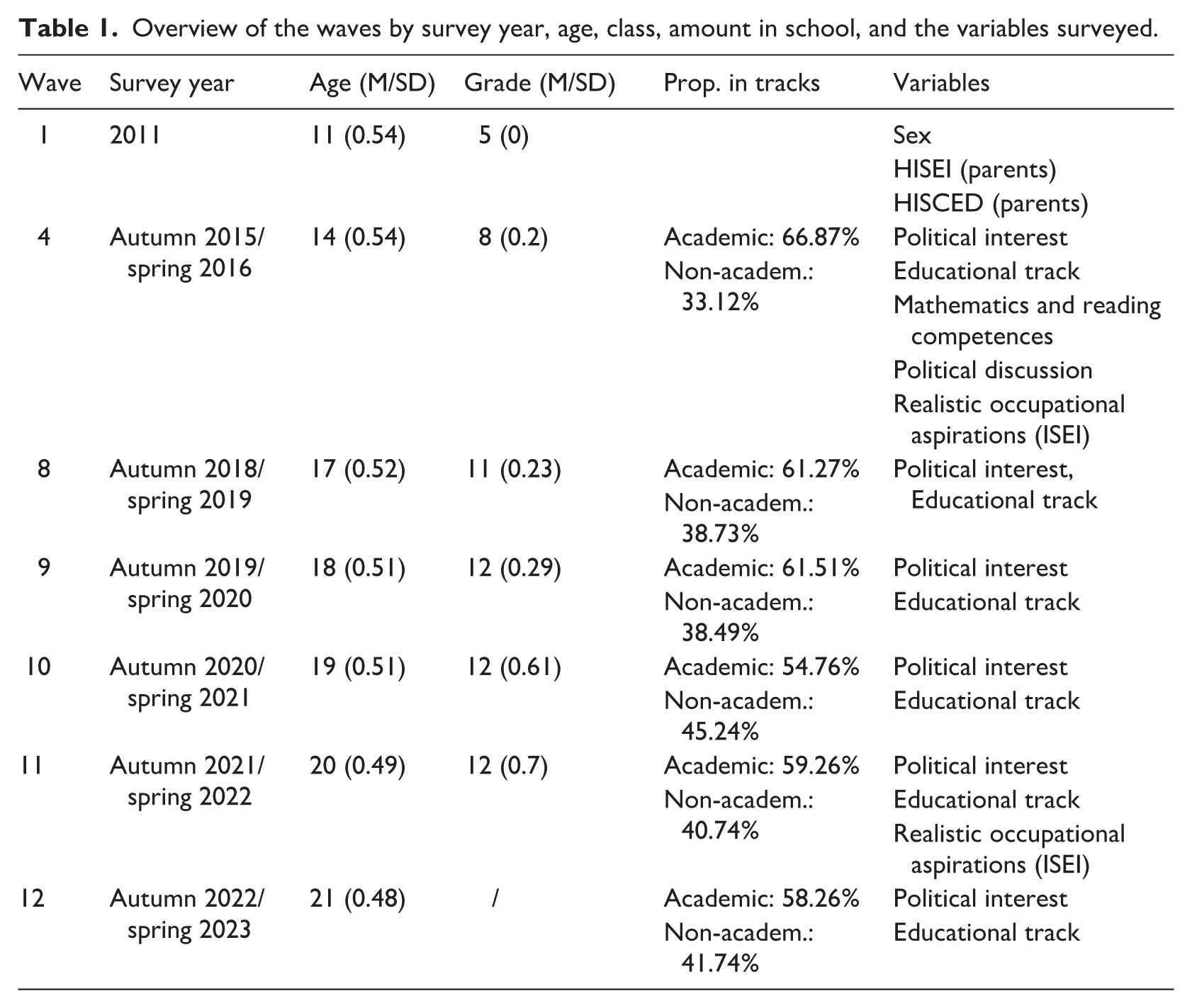
Finally, the effect of a track change can occur not only directly but also indirectly via the social status (Hansen and Tyner, 2021). We have shown that, in Germany, academic and non-academic tracks lead to different occupational positions (see Section 3.5). Our data allow us to examine students’ political interest up to 4 years after leaving school, when they have already entered vocational training, higher education, or the labor market. Because not all respondents have yet entered the labor market, but vocational training and higher education in Germany are closely linked to later occupational positions, we use realistic status aspirations measured at least 2 years after leaving school (waves 11, age about 20, see Table 1) as a proxy for occupational status. Against this background, we formulate hypothesis 5a: Compared to students who remain in a non-academic track, political interest among those who switch from a non-academic to an academic track at upper secondary education increases after leaving school due to their realistic status aspirations. Hypothesis 5b is accordingly: Compared to students who remain in an academic track, political interest among students who switch from an academic track to a non-academic track at upper secondary education decreases after leaving school due to their realistic status aspirations.
Overview of the waves by survey year, age, class, amount in school, and the variables surveyed.
Methods
Data
To test the hypotheses, we use data from the National Education Panel Study (NEPS; see Blossfeld and Roßbach, 2019). The NEPS is conducted by the Leibniz Institute for Educational Trajectories (LIfBi, Bamberg) in cooperation with a nationwide network. It is the “largest long-term educational study in Germany,” comprising a total of 7 parallel cohorts (LIfBi, n.d). As described in section 3, we focus on Starting Cohort 3 (SC3), which started in the fifth year in 2010 and now comprises 12 waves. This allows us to analyze both the transition from lower secondary level to upper secondary level and the transition to the labor market, vocational training or higher education. The sample was collected as stratified multistage sampling, with schools being randomly selected first and then classes within schools. In addition, teachers, head teachers and parents were asked to take part in supplementary surveys. In wave 1, data were collected on a total of 5778 students in 291 schools (Zinn, 2013). Data on these participants were collected annually in their classes or they were followed up individually as required (e.g. if they changed school).
For our analysis, we use waves 4 and 8–12, as political interest was measured only at these points. The resulting sample comprises 1578 students, of whom approx. 50% are female. The average age in wave 4 is about 14 years (SD = 0.54; see Table 1). Missing values were calculated using multiple imputations with fully conditional specifications (FCS), whereby all dependent and independent variables were taken into account according to their scale level (Rubin, 1987; Van Buuren, 2018). Thirty imputations and 500 burn-in cycles were calculated (von Hippel, 2020).
Variables
The time of measurement of the dependent and independent variables is presented in Table 1. The distribution of all the variables used for the analyses can be found in Table 2.
Descriptive overview of track changes.
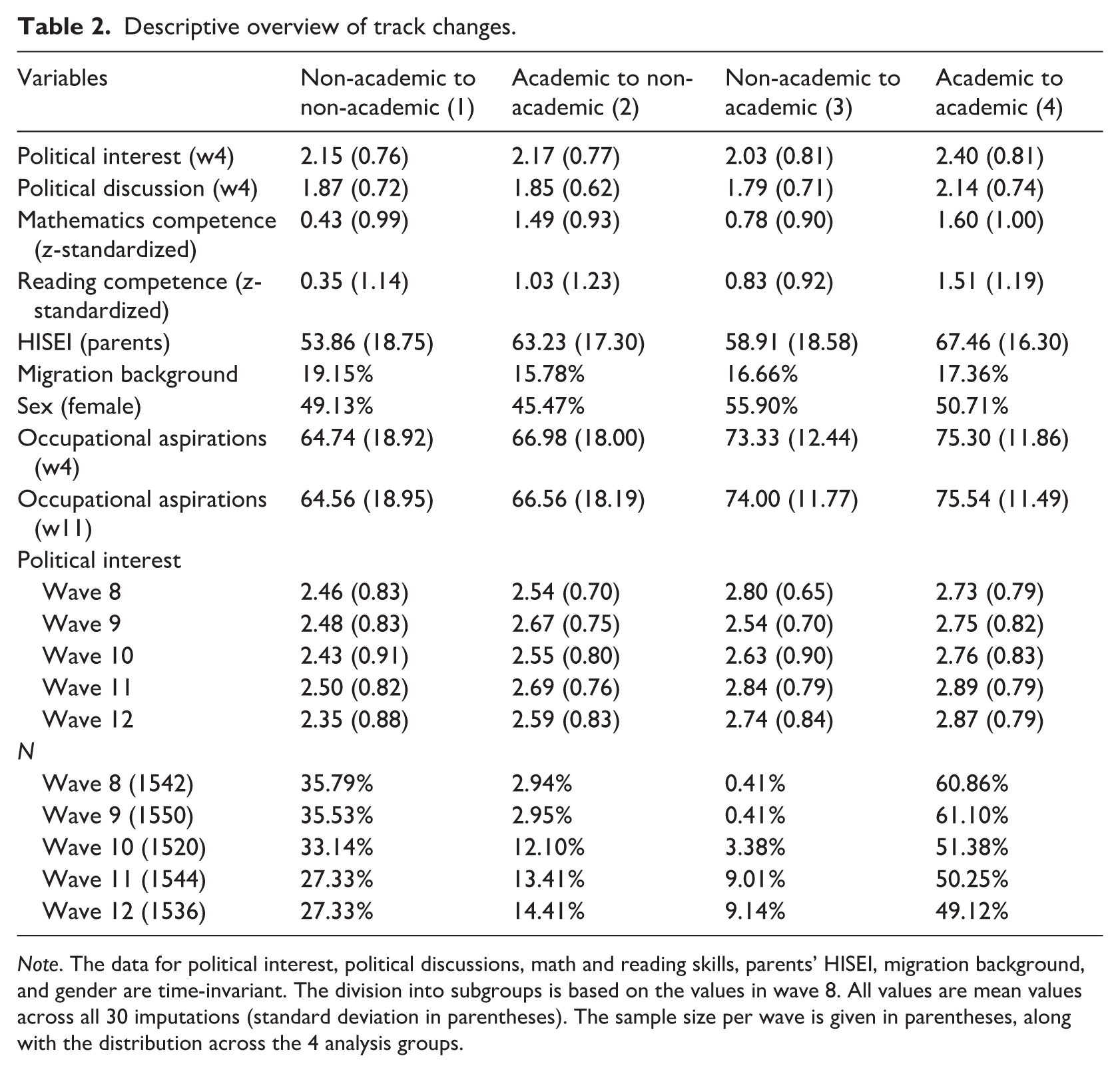
Note. The data for political interest, political discussions, math and reading skills, parents’ HISEI, migration background, and gender are time-invariant. The division into subgroups is based on the values in wave 8. All values are mean values across all 30 imputations (standard deviation in parentheses). The sample size per wave is given in parentheses, along with the distribution across the 4 analysis groups.
Political interest
This dependent variable is based on a single item with a 4-point response scale: “How interested are you in politics? Are you very interested, fairly interested, not very interested or not interested at all?” (Bömmel et al., 2020). This measure is widely used in international surveys (e.g. ESS, SOEP, Netherlands’ Life Course Survey). In NEPS, it was collected in waves 4 and 8–12, enabling a longitudinal analysis of political interest development during upper secondary education (waves 8–10), see Table 1).
Educational track
We differentiate between an academic (leading to a HEEQ) and a non-academic track (leading to VET; see 3.1 and Figure 1). At lower secondary level, the academic track is at a Gymnasium, and other school types (e.g. Realschule, Sekundarschule) are assigned to the non-academic track. Students attending comprehensive schools (Gesamtschulen) are excluded from the analytical sample, as this school type cannot be unambiguously assigned to either the academic or the non-academic track. At the upper secondary level, the academic track comprises school tracks that lead to a general HEEQ (Gymnasium Fachgymnasium, Berufliches Gymnasium) and tracks that lead to a HEEQ for a university of applied sciences (e.g. Fachoberschule). Vocational schools that lead to vocational qualifications or school qualifications below a HEEQ are assigned to the non-academic track.
Frequency of political discussions
Participants were asked how often they talk about politics outside the class, for example, with their parents and friends (1 (never) – 4 (very often)). To test hypothesis 4a, we use this characteristic measured in wave 4.
Mathematics and reading competences
A test with 22 items developed for the NEPS was used to measure mathematics competences (Neumann et al., 2013). Reading competence was assessed using specific reading and comprehension tasks (Gehrer et al., 2012). Both measurement instruments have proved to be reliable and valid in various studies (Bayer and Zinn, 2018). To test hypotheses 4b, we use competences measured in wave 4.
Realistic status aspirations
Respondents stated what kind of job they realistically expected to hold in the future. Responses were coded using the International Socio-Economic Index of Occupational Status (ISEI; Ganzeboom et al., 1992). Hypothesis 5 is tested using ISEI values from wave 11.
Entry selection
In wave 1 and wave 4, a number of individual and demographic characteristics were collected (Table 1). Since this occurred before the transition to upper secondary education, it enables us to control for entry selection (Hypothesis 2). We consider political interest, socioeconomic background (the highest ISEI of the father and the mother and the highest educational qualification according to the ISCED of the father and the mother), mathematics and reading competences and the political environment of the students (discussions of politics, gender and immigration background 1 ). To test hypothesis 5, we control for realistic status aspirations in wave 4 (same measurement as aforementioned).
Federal state
To account for structural differences in political education across Germany, we include a control variable for the federal state in which the students attended lower secondary school. This allows us to consider curricular differences in civic education between the states, as discussed in the theoretical section, and to control for institutional variation that may influence the development of political interest independently of individual characteristics or educational trajectories.
Identification strategy and statistic models
The panel structure of the NEPS makes it necessary to consider the two nested data levels of individuals (i) and measurement times (t) for the data analysis. Multilevel linear regression models with random intercepts at the individual level (μ i ) and cluster-robust standard errors are used for this purpose. First, we test in a model (1) whether there is evidence of greater political interest (yit) for students in academic tracks (xit = 1; Hypothesis 1a). In addition, we use a vector of dummy variables (wt) to estimate fixed effects for the development of political interest over the observation period of upper secondary school and beyond. At the same time, we use the interaction term (xitwt) to allow for a potentially heterogeneous development of the target variables among respondents in both tracks over the observed measurement points (Hypothesis 1b).

We assume that predictors of political interest are also related to selective transition to the academic track in upper secondary schools (Hypothesis 2). In a second step, we include these selection variables in our estimation (2). First, we include observed time-constant variables (pre-secondary track, gender, social and immigration background) and pre-secondary transition characteristics (measured at t − 1, reading and mathematics competences, political discussion in the social environment and realistic status aspirations), modeled as time-invariant variables, via the vector Zi. Second, we integrate the students’ political interest measured at lower secondary level as a time-invariant predictor (yi). Assuming a time-stable data-generating process, we thus simultaneously control for all time-constant unobserved heterogeneity. Model (2) thus follows a special form of a lagged dependent variable (LDV) approach, also known as baseline adjustment (Andersen and Mayerl, 2023).

Criticism regarding these models comes from various fields and focuses mainly on variations of the following argument: Including a LDV in regression analyses will lead to biased estimates for all the independent variables if the error term contains autocorrelation. This even holds true when the LDV is part of the real (and mostly unknown) data-generating process (Achen, 2000; Keele and Kelly, 2006; Wilkins, 2018). However, not including the LDV is also problematic because the analysis is likely to have omitted time-varying variables that can also bias the estimates. A recommendation on the issue of controlling for LDV versus not controlling is accurately summarized by “damned if you do, damned if you don’t” (Cinelli et al., 2024: 1076). We have provided theoretical arguments suggesting that current observations are most likely to depend on prior values for our variables, and therefore applying a regression based on equation (2) seems to be the most appropriate model. In order to navigate through the pitfall that LDV models produce biased coefficient estimates, we proceed by comparing different models that correct for residual autocorrelation as suggested by Wilkins (2018).
To test hypothesis 3a, we model the development of the political interest of students who were in a non-academic track in lower secondary education and switched to an academic track at upper secondary level (xit − xi = 1) compared to students who remain in a non-academic track in upper secondary education (xit − xi = 0). In doing so, we allow for a potentially heterogeneous development of the two groups of students via the interaction with the measurement points. Analogous to this procedure and in order to test hypothesis 3b, we compare the development of the political interest of students who switched from an academic track to a non-academic track at upper secondary level with the development of those students who remained in an academic track throughout their school career. The regression model (2) is extended to (3) to test both hypotheses, and the reference groups for the interpretation of β6 are the students without a track change in upper secondary education.

The final moderation analyses for testing hypotheses 4a and 4b as well as 5a and 5b make it possible to attribute a (potentially) differential development of political interest to mechanisms that are not based on track-specific influences (e.g. the curriculum). For this purpose, we extend (3) in each case by a further indicator of the political discussion culture in the social environment (di measured at t − 1) to test the context hypothesis 4a (4.1), and the reading competence (ri measured at t − 1) to test the competence hypothesis 4b (4.2). In our analyses, we consider only the change from a non-academic to an academic track.


Finally, we also test hypotheses 5a and 5b on the relative influence of education for both conceivable change scenarios by expanding the interaction term. For this purpose, the social status (si) – measured in wave 11 (at t + 3) – is added and (3) is extended to (5).

For reasons of interpretability, we present marginal effects for the specific results of models (3), (4.1), (4.2), and (5) graphically.
Results
Political interest slightly increases between wave 4 and wave 12. Students in academic tracks consistently show higher interest than those in non-academic tracks (see Figure 2). Among students who change tracks between lower and upper secondary education, those who remain in non-academic tracks show the lowest interest levels, while students who switch from academic to non-academic tracks show slightly higher values (see Table 2). The highest levels are found in both groups attending academic tracks in SL2. Notably, political interest in wave 4 is already lowest among students in non-academic tracks. This pattern also appears for key covariates such as reading and math competence or parental status (HISEI).
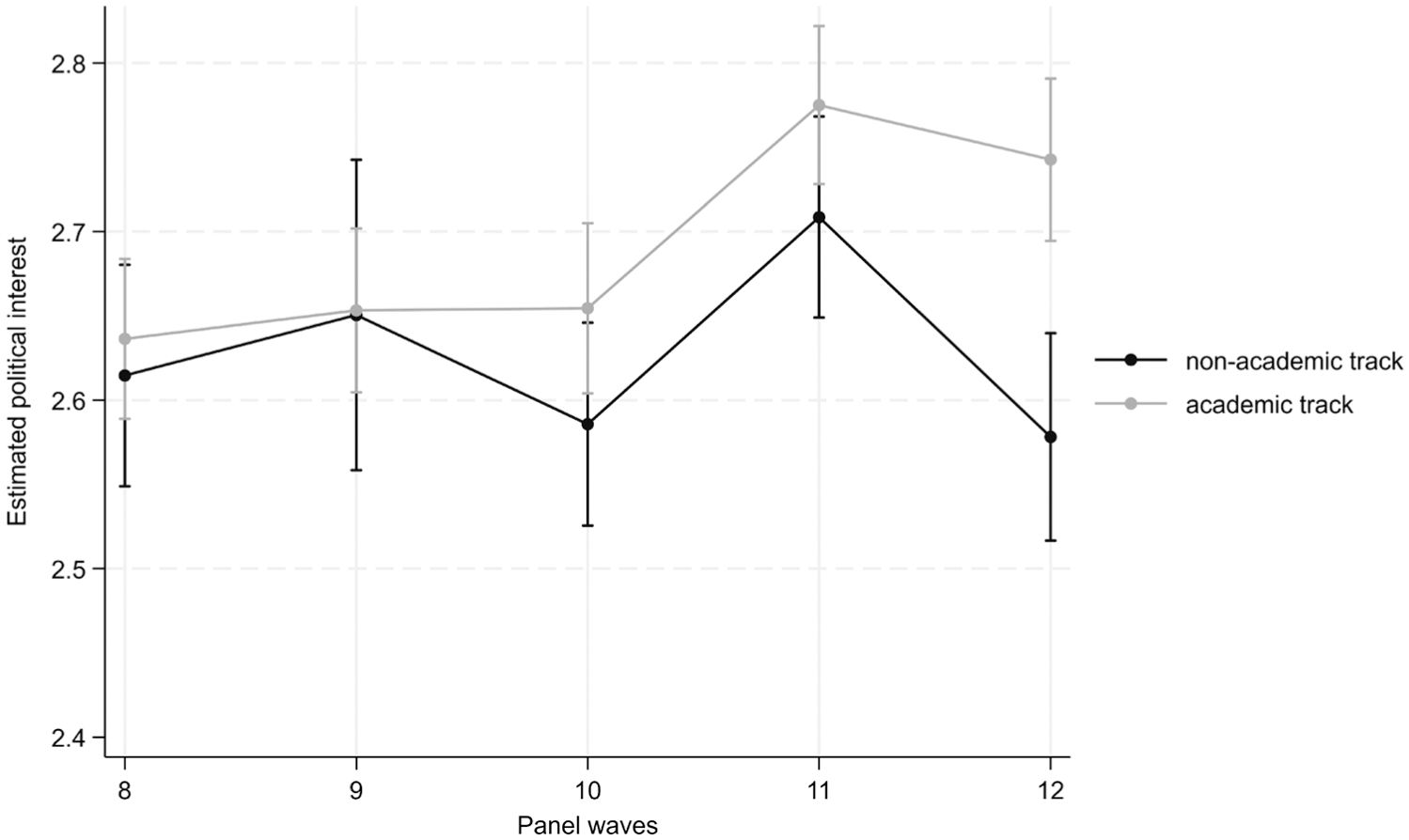
Predicted political interest (based on model 2).
To test Hypothesis 1, we estimated linear models with random intercepts at the individual level using track affiliation, panel waves and their interaction as predictors (Model 1, Table 3). Track affiliation has a significant positive effect on political interest at the beginning of upper secondary school (b = 0.14; p ⩽ 0.001), and a significant interaction at wave 12 (b = 0.14; p ⩽ 0.01), confirming both a higher initial level and a more favorable development of political interest among academic track students. Both coefficients correspond to approximately 0.17 standard deviations of the dependent variable, indicating small effects. In Model 2, we control for entry selection (Hypothesis 2) by including cognitive, social, and motivational factors measured before the transition. The track effect at the beginning of upper secondary school becomes non-significant (b = 0.02; p > 0.05), while the level of political interest (b = 0.25; p ⩽ 0.001), political discussion (b = 0.2; p ⩽ 0.001), a gender (b = −0.20; p ⩽ 0.001; all variables measured at wave 4) and status aspirations (0.00; p ⩽ 0.05; measured at wave 11) show significant effects. While the effects of prior political interest and political discussions are moderate in size (0.30 and 0.24 standard deviations, respectively), the effect associated with gender is small (0.17), and that of status aspirations is very small (0.07). As shown in Figure 2, political interest develops nearly parallel in both tracks during upper secondary education (waves 8–10), with a remaining difference at wave 12 (b = 0.14; p ⩽ 0.01). Thus, Hypothesis 2 is supported.
Multilevel linear random intercept models for panel data.
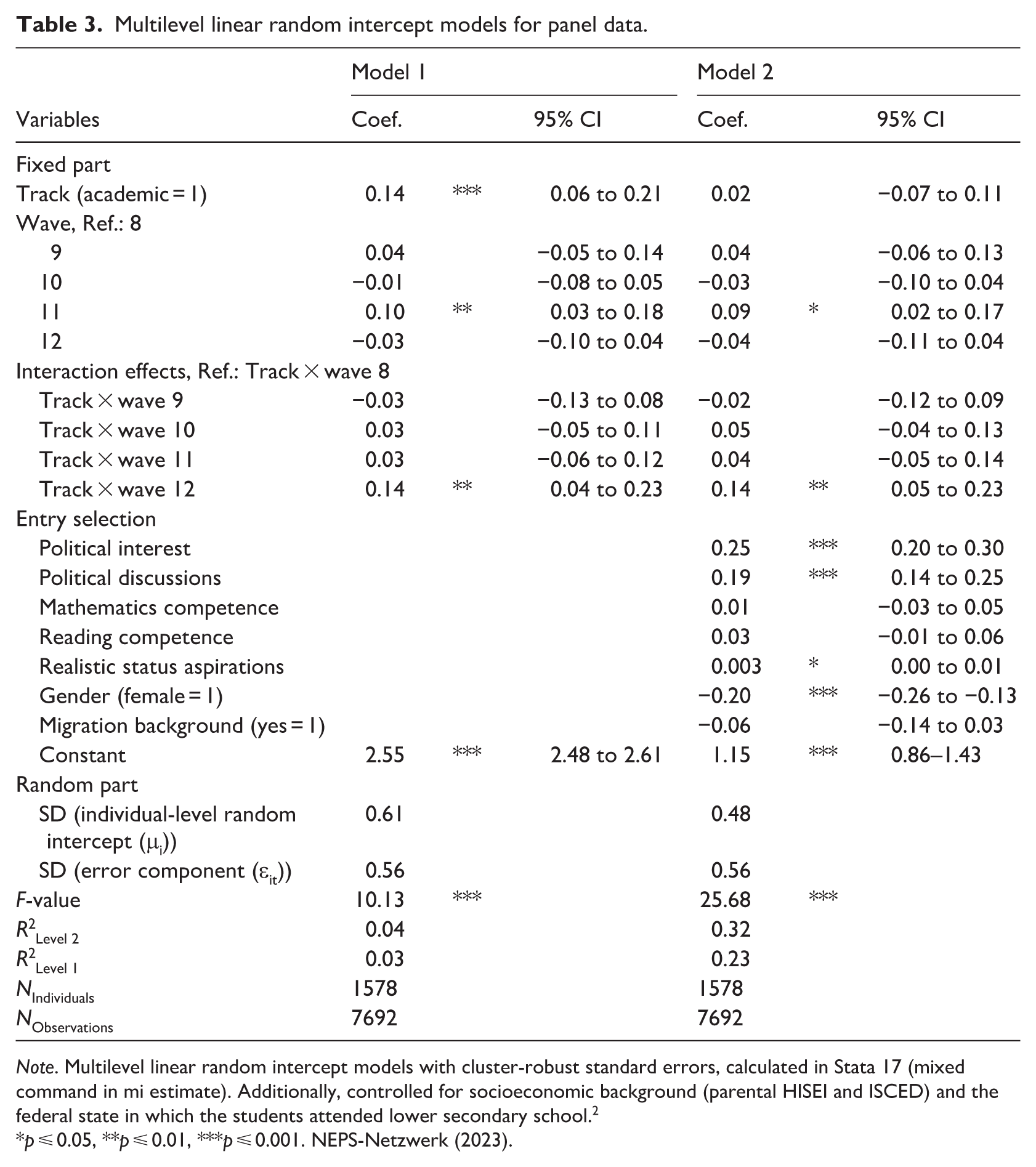
Note. Multilevel linear random intercept models with cluster-robust standard errors, calculated in Stata 17 (mixed command in mi estimate). Additionally, controlled for socioeconomic background (parental HISEI and ISCED) and the federal state in which the students attended lower secondary school. 2
p ⩽ 0.05, **p ⩽ 0.01, ***p ⩽ 0.001. NEPS-Netzwerk (2023).
For Hypotheses 3a and 3b, we examine students who changed tracks. Figure 3 shows no significant track-change effects on political interest during upper secondary education (waves 8–10). While upward movers show a steady increase, and downward movers a mild decline, interaction effects are only significant at wave 12 – when most respondents have already left school. Therefore, the hypotheses expecting effects during upper secondary education are not supported. Hypotheses 4a and 4b propose that track-change effects are stronger for students with low political discussion or poor reading skills. Figures 4 and 5 show no differential development during school years (waves 8–10). A divergence only appears at wave 11 and 12 for the effect of political discussions (figure 4a). Contrary to our expectations, students who discussed politics more frequently prior to switching show greater increases in interest (Figure 4a). Thus, both hypotheses are rejected.
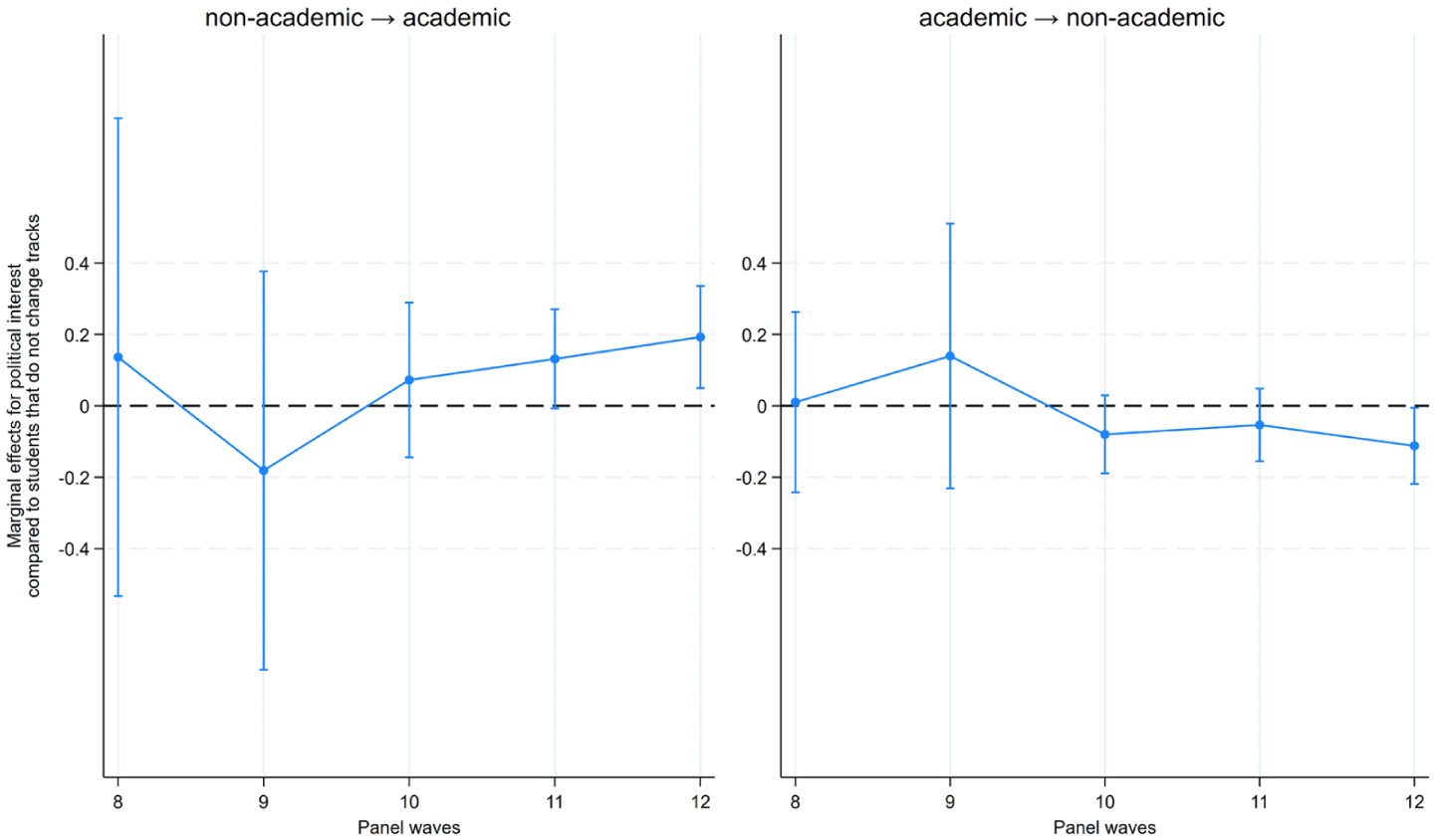
a) Estimatedeffects on political interest of transitioning from a non-academic to an academic track, relative to remaining in a non-academic track. b) Estimated effects onpolitical interest of transitioning from an academic to a non-academic track, relative to remaining in an academic track.
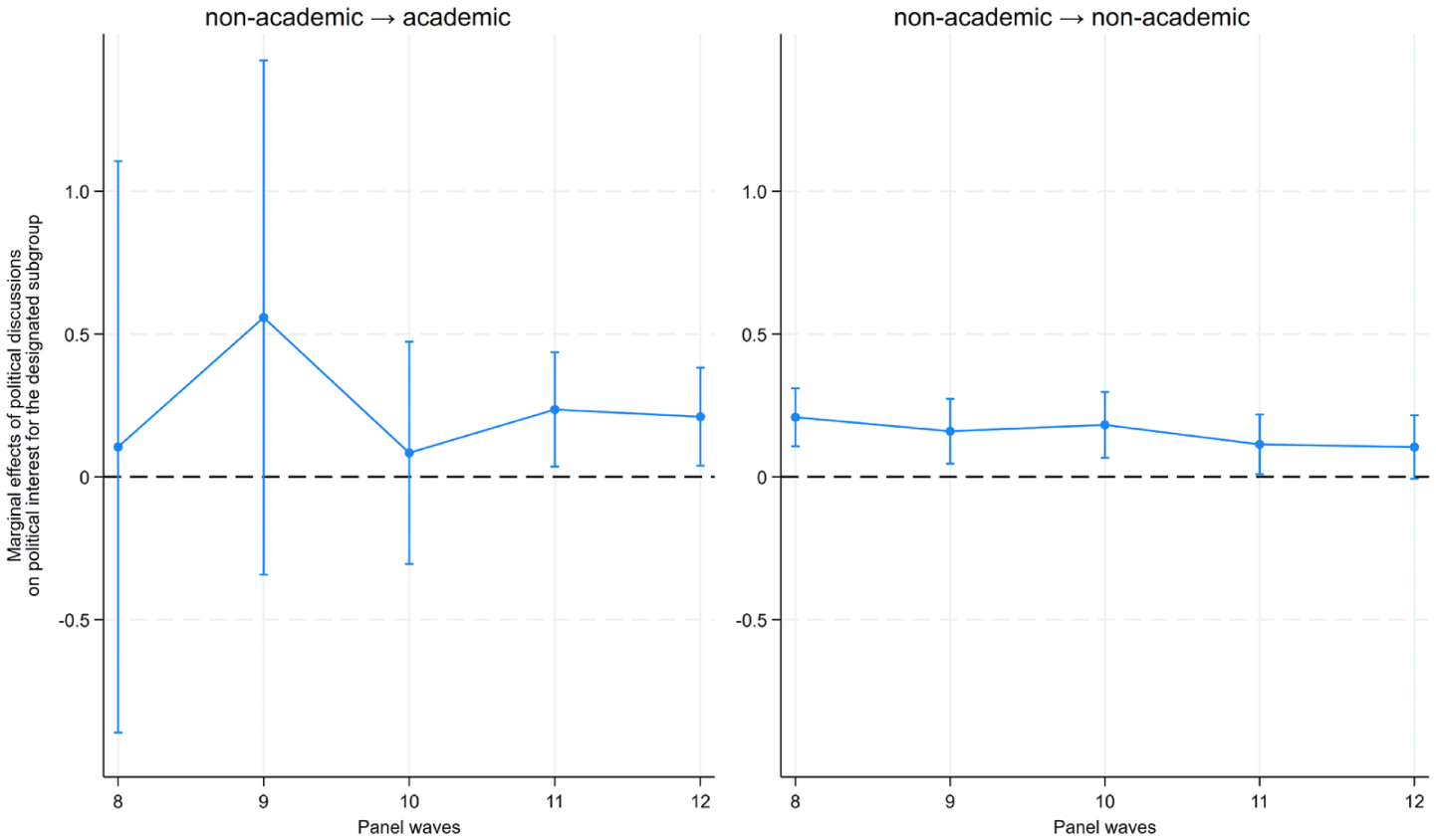
a) Marginal effects of the level of political discussion on the political interest of respondents who move from a non-academic to an academic track. b) Marginal effects of the level of political discussion on the political interest of respondents who remain in a non-academic track.
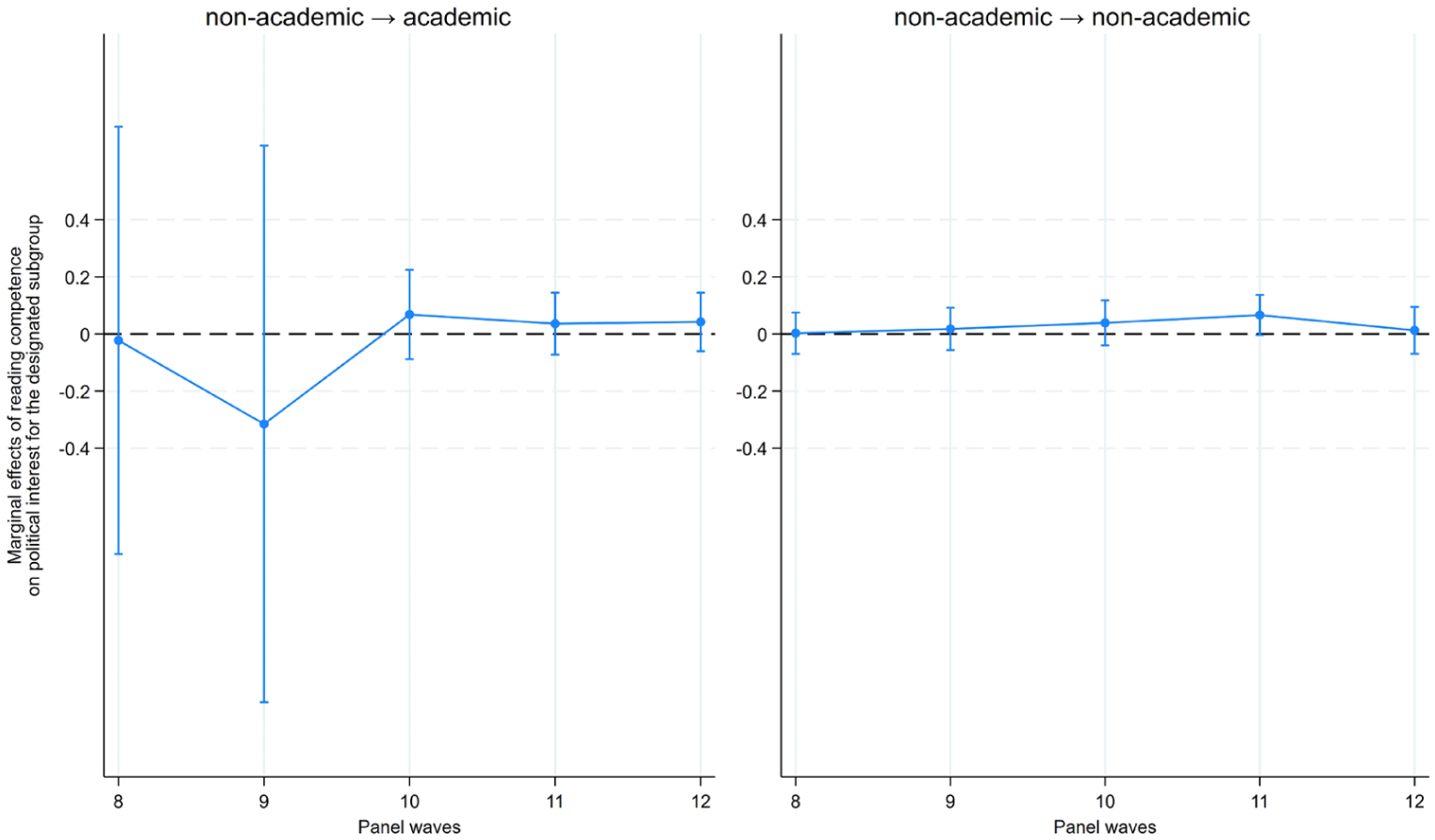
a) Marginal effects of the reading competence on the political interest of respondents who move from a non-academic to an academic track. b) Marginal effects of the reading competence on the political interest of respondents who remain in a non-academic track.
So far, our analysis has shown that no effects of a track change on political interest can be observed during upper secondary education. Such an effect could only be identified at wave 12 (and for a subgroup at wave 11), which means about 2 or more years after leaving school (students were about 20/21 years old). This indicates relative effects of schooling as assumed in hypotheses 5a and 5b. These are analyzed in more detail using the ISEI of realistic occupational aspirations in wave 11 as a mediating variable. However, as can clearly be seen in Figure 6, no significant effects of realistic status aspirations on political interest can be observed (controlling for selection effects, see Table 3) for those who switched from a non-academic to an academic track. This is the same for those who switched from an academic track to a non-academic track (not in Fig. 6). This is the same Hypotheses 5a and 5b must therefore be rejected. Expected future status does not explain the observed post-school changes in political interest.
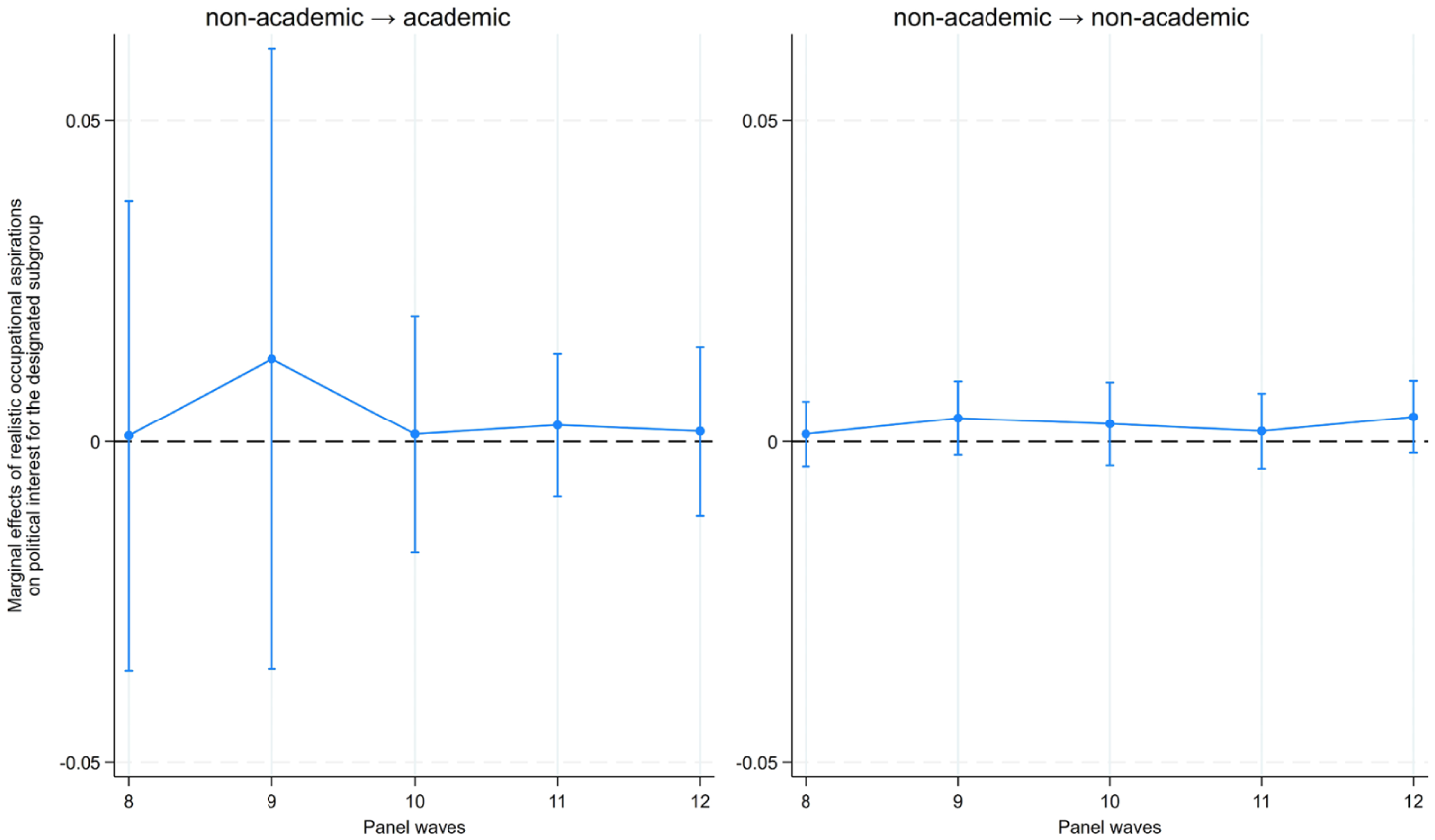
a) Marginal effects of the social status (ISEI) of the realistic occupational aspirations after school on the political interest of respondents who moved from a non-academic to an academic track. b) Marginal effects of the social status (ISEI) of the realistic occupational aspirations after school on the political interest of respondents who remained in a non-academic track.
Discussion
Our findings indicate that differences in political interest between students in academic and non-academic tracks can largely be explained by entry selection. Track affiliation itself has no significant effect once cognitive and social background are controlled for. Likewise, we find no evidence that switching tracks at the beginning of upper secondary education has direct effects on political interest development. This confirms the findings of Zhang et al. (2025) using a more precise definition of track change and challenges earlier studies for other countries including Germany that suggested positive effects of the academic track (van de Werfhorst, 2017; Witschge et al., 2019). However, no compensatory effects of a change to an academic track for less privileged students (Deimel et al., 2020; Jugert et al., 2018) could be confirmed either. Although (intended) political engagement measured in other studies is a different concept to political interest (Prior, 2018), the two concepts are highly correlated (for instance, Brady et al., 1995; Delli Carpini and Keeter, 1996; Denny and Doyle, 2008). Our results therefore also cast doubt on whether track changes have an influence on (in-tended) political engagement as has been found in other studies (Hoskins and Janmaat, 2016; Janmaat, 2022; Janmaat and Mons, 2023). These discrepancies may be due to methodological shortcomings in previous research such as cross-sectional designs and the lack of controls for intake selectivity.
Another plausible explanation lies in the age of the respondents: our study focuses on adolescents and young adults in upper secondary education, a period during which political interest may already have stabilized (Prior, 2018; Russo and Stattin, 2017). Other studies show a track-specific development of attitudes toward political engagement in lower secondary education (Eckstein et al., 2012), a result that could be transferable to political interest. This would mean that strong tracking in lower secondary education could lead to track-specific differences in political interest among adolescents that remain stable in upper secondary education. So, even if students move up to an academic track at upper secondary level, they do not benefit directly in terms of political interest. However, the change in educational context does not reduce the level of political interest among those who move from an academic to a non-academic track. Future studies on the influence of the educational context on political interest must start here and look at the whole period of school education, including track changes. Unfortunately, this was not possible with the NEPS data as political interest and other political variables were only measured at the end of lower secondary education.
Still, a delayed increase in political interest is observed around age 21 among upward movers, which supports the idea of indirect educational effects. This increase, however, cannot be explained by students’ realistic status aspirations as measured in wave 11. This may be due to timing: many students were still in training or higher education and had not yet reached a stable social position. The respondents are not yet able to predict the social norms that will affect them in the social networks associated with their future occupation (Hansen and Tyner, 2021). The economic effects of occupational status on political interest represent an alternative explanation, as those with a higher income also benefit more from political influence and are therefore more motivated to vote (Hoskins et al., 2008). In all these explanations, status characteristics could only explain the level of political interest once a certain occupational status has actually been reached. Further analyses with longitudinal data could shed light on these effects, provided that political attitudes continue to be recorded.
It has become clear that in particular students with favorable family backgrounds benefit from an upward change regarding their political interest at the age of 20. It is conceivable that this is a kind of lagged effect of family socialization that only becomes visible under certain conditions. Studies show that socially privileged students use an upward change to an academic track in upper secondary education to realize existing ambitious educational and career aspirations and want to enter higher education, while less privileged students aim for an upward change to improve their chances of having an occupation that does not require a university degree (Schuchart and Schimke, 2022). This would mean that status aspirations do not change as a result of a track change and therefore cannot be used to predict a change in the level of political interest among track changers. Further analyses show indeed that status aspirations at wave 11 are largely predicted by status aspirations at wave 4 (these are controlled for in the models). However, entering higher education, which is the reason why socially privileged respondents in particular move to the academic track, could explain the increased political interest, an assumption we have not tested. Some studies have shown that tertiary education in particular has a positive effect on the political attitudes of individuals via network formation and its influence on social norms (Hoskins et al., 2008; Lischewski et al., 2020; van de Werfhorst, 2017; Verba et al., 1995).
Our results therefore contradict the impressionable years hypothesis referred to above, according to which there are no further major changes in political interest after schooling (Prior, 2010). The results of Kuger and Gille (2020) indicate that changes in political interest occur over the whole of an individual’s lifetime. In contrast, Neundorf et al. (2016) identify a stabilization of political interest from the age of 25. Our results suggest that in particular upward movers who grew up under favorable socialization conditions continue to increase their level of political interest at the age of 20. Whether or not this development stabilizes could only be observable with NEPS data from wave 14 or 15, which is not yet available. One further limitation of the current NEPS data is the measurement of political interest using a single item, which means that the development of a differentiated understanding of politics, as described by Eichhorn (2018) for example, cannot be investigated. In general, it can be asked whether a single item adequately covers the individual political interest. At this point, however, it is worth the very frequent use of the item in empirical studies (Bömmel et al., 2020; Claes and Hooghe, 2017; Eichhorn, 2018; Fobel and Kolleck, 2021; Furnham and Cheng, 2019; Koskimaa and Rapeli, 2015; Kuger and Gille, 2020; Marien et al., 2010; Neundorf et al., 2016; Russo and Stattin, 2017; Shehata and Amnå, 2019; van de Werfhorst, 2017; Witschge et al., 2019). In addition, the item was validated in various tests, whereby it has been shown that the concept of political interest is adequately represented by this single item (for a detailed overview, see chapter 3 by Prior, 2018). Another limitation of the present study lies in the NEPS sample. Panel attrition in particular plays an important role in the evaluation of the present results. NEPS researchers invest a great deal of effort in, among other things, individually tracking participants. Nevertheless, systematic biases may occur in further participation. Of a total of 6112 participants in wave one, 2987 still participated in wave 12 (Würbach, 2022; for a detailed insight into the SC3 sample, see Steinhauer and Zinn, 2016).
Conclusion
Our results suggest that the disadvantages of stratified education systems for the track-specific development of political interest during lower secondary education (Eckstein et al., 2012) cannot be compensated for by a track change at upper secondary level. This article therefore supports a critical view of the effects of stratification on political interest and political engagement (Hoskins and Janmaat, 2016; Janmaat and Mons, 2023; van de Werfhorst, 2017; Zhang et al., 2025) and thus of the future development of democratic societies. The extent to which a qualitative improvement in the provision of political education in non-academic tracks during lower secondary education could prevent the development of a gap in the level of political interest between tracks must be the concern of future and methodologically demanding studies. While our findings are based on the German case, they speak to broader questions regarding the impact of educational stratification across Europe. Many European countries have stratified school systems (Bol and van De Werfhorst, 2013), and recent comparative studies (e.g. Janmaat, 2022; Witschge and van de Werfhorst, 2020) indicate that track-related inequalities in political interest may follow comparable patterns. Our results thus contribute to the growing body of evidence that stratification in education systems may pose a challenge to equal political socialization across Europe. In light of growing concerns about democratic resilience in Europe, ensuring equal opportunities for political learning across educational tracks is not only a matter of fairness, but also a fundamental condition for the long-term stability of democratic societies.
Footnotes
Acknowledgements
This paper uses data from the National Educational Panel Study (NEPS; see Blossfeld and Roßbach, 2019). The NEPS is carried out by the Leibniz Institute for Educational Trajectories (LIfBi, Germany) in cooperation with a nationwide network.

Ethical considerations
This study uses secondary data from the German National Educational Panel Study (NEPS). NEPS data collection procedures comply with all ethical standards.
Consent to participate
Informed consent was obtained by the NEPS team from all individual participants or their legal guardians at the time of original data collection.
Consent for publication
Not applicable, as the study uses anonymized secondary data.
Funding
The authors disclosed receipt of the following financial support for the research, authorship, and/or publication of this article: Open Access funding enabled and organized by Projekt DEAL.
Declaration of conflicting interests
The authors declared no potential conflicts of interest with respect to the research, authorship, and/or publication of this article.
AI statement
The authors used ChatGPT (OpenAI) to assist with language editing and improving clarity. All content, analyses, and interpretations were developed and verified by the authors.