



Abstract
The study described in this article highlights the complexity of service-learning efforts and community engagement pursuits. It is based on 6.5 months of qualitative fieldwork in International Baccalaureate international schools in Kenya, Ethiopia, and South Africa. The article unpacks the understandings and skills involved in service-learning efforts through a framework developed by the research. The framework includes six knowledge domains: service-learning pedagogy, global issues, school contexts, local contexts, leadership/organizations, and communication. The author argues that related competencies in these domains support efforts, whereas related knowledge gaps impede efforts. Such a framework allows teams to be self-reflective and intentional, justifies related resources, and explains the strain that educators involved in these pursuits can feel. The author argues that facilitators need to have deep knowledge in far more than service-learning pedagogy.
Keywords
Introduction
Three years prior to this study, a group of service-learning facilitators exchanged stories at the African Global Issues Service Summit, an annual gathering for service leaders. Facilitators shared success stories; steps they had taken towards sustainable and meaningful projects. At the same time, they commiserated over challenges and vented frustrations. They lamented that they could not spend more time learning from one another. The author of this article, at the time a fellow international educator and service-learning facilitator, heard in these discussions a collective craving: to better understand each other’s approaches. Inspired by these conversations, she decided to pursue her doctorate and investigate their expressed needs.
This article focuses on the dissertation study that evolved from these discussions. The researcher spent 6.5 months exploring the pragmatics of global citizenship and community engagement pursuits in three international schools in Africa. She focused on factors that supported or impeded the efforts of facilitators (who included student leaders, teachers, and service-learning coordinators). Ultimately, she found that supports and challenges were two sides of the same coin—related knowledge and skills supported efforts, while their underdevelopment negatively influenced efforts. The author developed a framework to categorize understandings, presented in this article, which demonstrates the complexity of efforts and offers a structure for systematic reflection on needs, resources, and strengths.
Terminology used within this study is purposefully open. As the literature review below demonstrates, there is little consensus in literature on definitions of global citizenship, community engagement, and service-learning; a similar lack of consensus in terminology was found among participants in the study. Consistent with the study’s standpoint methodological approach, which will be described in the methods section, the researcher allowed participants to define the often-intertwined buzzwords in their own terms. The author recognizes that the interwoven concepts of global citizenship, civic engagement, community engagement, service, and service learning are not one and the same. Yet the blurry lines between these concepts shifts depending on the theorist or participant.
To provide some positioning within this unclear context, this article looks at the pragmatics of what would often be classified as service or service-learning. Such efforts are often undertaken in pursuit of community or civic engagement aims, which fit into broader global citizenship goals. The literature review below further engages with these interrelated concepts.
Global citizenship and service-learning
While scholars agree that global citizenship is important (Cabrera & Unruh, 2012; Heater, 2002; Noddings, 2005a), there is less consensus about what it is or what civic involvement entails. Some emphasize that global citizens should focus on universal human rights (Cabrera, 2010; Ramirez, Suarez, & Meyer, 2007), transnational environmental concerns (Drennen, 2002), or peace education (Noddings, 2005b). Others emphasize the economic components of global connectedness and suggest that global citizens need understanding of these economic interdependencies (Cabrera & Unruh, 2012). Some place intercultural interactions at the center of global citizenship (Schattle, 2008; Suarez-Orozco, 2004).Yet others focus on the development of a global conscience (Roche, 2007) or a cosmopolitan morality with global empathy (Heater, 2002). With such divergent framings of global citizenship surrounding teachers’ pursuits, educators move towards hazy targets.
Schools have often been framed as key cultivators of students’ civic development. Prominent philosophers including Dewey (1990, 2012) and Wollstonecraft (2012) pointed to the pivotal role schools play in the development of a nation’s citizens. The catch-all term “civic education” describes everything from direct civic instruction to the fostering of civic behaviors in schools. In the past few decades, schools have been increasingly pressured to cultivate global citizens. Palmer (2016) noted that global citizenship education is even less well-defined than traditional citizenship education. Many agree that we need global civic education, but there is minimal consensus on what this looks like or how to teach it.
Many descriptions of engaged citizens cite community involvement as a key characteristic. In schools, service-learning is a teaching strategy used to pursue this aim. While “there is no one thing called service-learning,” (Butin, 2010, p. xiii), there are aspects of the pedagogy that most agree on. The roots of service-learning are consistently attributed to Dewey’s (1938) and Kolb’s (1984) theorizing around experiential education. Service-learning situates students’ learning in genuine community contexts. As the pedagogy’s name implies, students learn while pursuing solutions to community challenges (Jacoby, 2003a). This teaching approach has been associated with benefits including boosts in students’ tolerance (Eyler & Giles, 1999), community-mindedness (Eyler, Giles Jr, Stenson, & Gray, 2001), and awareness of human rights (Belisle & Sullivan, 2007). Jacoby (2003a) described the positive potential of school-community partnerships when service-learning is reciprocal and well designed. Longitudinal studies linked service-learning with students’ sustained involvement in the community (Astin, Vogelgesang, Ikeda, & Yee, 2000). With so many positive outcomes associated with it, service-learning is increasingly required in schools and advocated by groups such as Campus Compact (2014).
Yet there is still much lack of clarity surrounding service-learning as an approach that can lead to varied outcomes. As Butin (2010) described, teachers have varied understandings: “Service-learning is never a singular, stable, or ultimately controllable practice” (p. 4). While varied understandings or outcomes are not necessarily problematic, in some instances service-learning is conflated with traditional volunteerism, which lacks the same intentionality around learning. It occasionally lacks criticality (Wasner, 2016). Some suggest that when service-learning is not implemented well, it can reinforce privilege rather than helping communities (Butin, 2010; Sandmann, Moore, & Quinn, 2012; Stewart & Webster, 2011; Vaccaro, 2011). Butin (2010), an outspoken advocate for service-learning, still cautions that attention must be paid to rigor, reflection practices, preparation, and relationships between students and field partners. In short, much like the term global citizenship, service-learning is an ill-defined and contested buzzword. As such, teachers’ service-learning pursuits are surrounded by ambiguity. There is a recognition, including in the literature, that not all service-learning endeavors are the same or yield similar outcomes.
This study takes place in schools that offer International Baccalaureate (IB) programs. The IB is an ideologically-driven nonprofit organization that strives to “develop citizens of the world” (Drennen, 2002, p. 57). While the IB offers four programs (Primary Years Programme, Middle Years Programme, Diploma Programme and Career-related Programme), the schools included in this study only offered the Diploma Programme (DP) for upper secondary students. As of December 2018, there were 4,964 schools offering the DP in 153 countries (International Baccalaureate, 2018).
The IB emphasizes intercultural understanding and global awareness—it is “unapologetically idealistic in believing that education can foster understanding among young people around the world” (Drennen, 2002, p. 57). The IB’s Learner Profile (International Baccalaureate, 2014) articulates ten desired learner attributes of students of any IB programme: reflective, open-minded, risk-takers, caring, balanced, principled, knowledgeable, inquirers, communicators, thinkers. Many of these characteristics describe an engaged global citizen and align with service-learning aims. While the Learner Profile does not guarantee that students will embody these attributes, it does articulate a vision.
The IB integrates service-learning into all of its programs; at the DP level it is integrated through Creativity, Activity, Service (CAS) requirements. The CAS program asks students to cultivate skills in the creative arts through its creativity strand, to tackle physical challenges through its activity strand, and to engage in the community through its service strand. As a part of the service strand, students participate in “collaborative and reciprocal engagement with the community in response to an authentic need” (International Baccalaureate, 2015, p. 20). They engage in sustained community projects following a prescribed service-learning model, modified from Kaye’s (2010) approach. Involvements extend beyond the formal curriculum. CAS expectations are quite flexible, a flexibility that simultaneously accommodates a range of contexts, and creates ambiguity. The IB offers teachers and students support resources. However, implementation of CAS guidelines varies from school to school; the effectiveness of service-learning efforts depends largely on the way actions are interpreted by individuals (Hatziconstantis & Kolympari, 2016).
Given the lack of clarity surrounding concepts central to this study, it is perhaps not surprising that gaps can exist between vague ideals and their implementation in practice. For example, the ideologically-driven IB programs are offered in many international schools (Hill, 2002). Yet as Hayden (2006) noted, there are tensions between “pragmatism” and “idealism” in the growing numbers of increasingly diverse international schools worldwide. Catling (2001) described disconnects between intended and taught curriculum in such contexts, while Blandford and Shaw (2001) described gaps between schools’ missions and practices. The IB has commissioned studies to explore the implementation of concepts such as international-mindedness, including those by Castro, Lundgren, and Woodin (2015), Barratt Hacking et al. (2017, 2018), and Lillo (2018). While schools may have deep rhetorical commitments to ideals such as global citizenship or community engagement, it seems that gaps between ideals and practice exist. This study strives to minimize gaps by better understanding the pragmatics.
The guiding documents for all three schools in this study express overt commitments to community engagement ideals. All three schools also implicitly adopt IB aims. Yet many factors influence whether teachers are able to implement aims within their specific classrooms and schools (Priestley, 2011). The researcher in this study acknowledges that teachers must navigate many challenges as they pursue community engagement ideals. Teachers are engaged in perpetual balancing acts of demands.
From the conversation that inspired this project at the very beginning, the researcher was interested in service-learning facilitators feeling knowledgeable and supported. She wanted her work to support their sense of agency. Recent studies on curriculum implementation have recognized the prominent role that teachers play and have suggested that teacher agency influences teachers’ ability to advance prescribed curricular aims (Oolbekkink-Marchand, Hadar, Smith, Helleve, & Ulvik, 2017; Priestley, Biesta, & Robinson, 2015). As such, this study aimed to give teachers and facilitators agency. It adopted a theoretical frame that put teachers’ perspectives at the forefront and that centered on their experiences and needs.
Methodology
Standpoint theoretical approach: Elevating educators’ perspectives
Often, educational research focuses on student performances in relation to particular outcomes (van der Wateren & Amrein-Beardsley, 2015). When gaps between ideals and actualities are observed, teachers are implicitly blamed for disconnects (Farris-Berg & Dirkswager, 2015). Yet these sorts of outcomes-oriented studies that focus on product versus process can minimize the practical challenges that teachers face in their day-to-day work.
This study purposefully adopted a different approach—one that amplified teachers’ voices and considered process. Its methods drew on key tenets of feminist standpoint theory. In particular, three aspects of the “logic of a standpoint” (Harding, 2004, p. 216) shaped this study: 1) the socially situated nature of knowledge, 2) the value of bottom-up ways of knowing, and 3) its framing of the concept of “standpoint” as an achievement.
Standpoint theorists recognize that knowledge is constructed within social and political contexts. Typically, dominant ideology is privileged, while the perspectives of those with less power in particular institutions are buried (Collins, 2004; Narayan, 2004; Rose, 2004; Smith, 1972). Objectivity, or what Haraway (2004) famously termed the god trick, is impossible. This study adopted standpoint theory’s epistemological stance that knowledge is socially-situated and provides a partial picture of reality. Research design choices inevitably privilege someone’s perspectives. The researcher chose to elevate the perspectives of facilitators (teachers, student leaders, and service-learning coordinators)—those with responsibility for the administration of the IB Diploma’s CAS program, school-wide community engagement mission statements, and global citizenship aims.
The decision to look at service-learning efforts through facilitators’ perspectives was based in standpoint theory’s advocacy for bottom-up approaches to knowledge. Standpoint theorists argue that research should start from the lives of those who lack (relative) power within systems. Harding (2004) described their perspectives in this way: “The social order looks different from the perspectives of our lives and our struggles” (p.3). Much can be learned from these alternative views (Collins, 2004). The teachers involved in this study were not likely to be disempowered members of their broader communities. However, as those who work within IB-specific and school-specific institutional constraints, the researcher assumed they have unique insights into the process of translating aims into practice.
Finally, this study was shaped by the stance that a standpoint is an achievement. There is a critical and interpretive process involved (Harding, 2004; Jaggar, 2004); as Hartsock (2004) explains, a standpoint is “achieved rather than obvious, a mediated rather than immediate understanding” (p. 39). In other words, a successful standpoint theory-driven study highlights connective elements of narratives and articulates their collective understanding of reality. This key tenet of standpoint theory particularly influenced the analysis process, which involved frequent opportunities for participants to give feedback on the researcher’s interpretations, otherwise known as member checking. The framework that emerged from this process represents this sort of achievement.
Research questions
This article has a narrower focus than the scope of the original overall study, which was guided by the following research questions:
How do faculty and students perceive community engagement?
What are the perceived barriers to community engagement?
How do facilitators approach these barriers?
What are the perceived supports that enable or promote community engagement?
How do facilitators approach these supports?
This article focuses on adult facilitators’ perspectives on questions two and four: perceived barriers/obstacles and supports/resources. While facilitators expressed broader understandings of community engagement, this article will focus specifically on their experiences with service-learning and service endeavors.
Site and participant selection
The project used a two-tier sampling strategy (Merriam & Tisdell, 2016). Sites were purposefully selected according to criteria, after which participants within those sites were selected to provide maximum variation with regards to role. Three schools agreed to be named in this Institutional Review Board (IRB)-approved study: the International School of Kenya (ISK) in Nairobi, Kenya, the International Community School of Addis Ababa (ICS Addis) in Addis Ababa, Ethiopia, and the American International School of Johannesburg (AISJ) in Johannesburg, South Africa. They shared the following researcher-developed selection criteria:
Criterion 1: Private, fee-paying, English-medium international schools. As of 2017 there were over 4.85 million students in nearly 9,000 English medium schools worldwide (ISC Research, 2017).
Criterion 2: Type A/traditional international schools. The term “international school” is largely unregulated (Hayden & Thompson, 2013). To provide consistency, all three school were selected to be what Hayden and Thompson referred to as “type A/traditional” international schools. These schools, which were originally created to cater to globally mobile families, are marked by a high degree of transiency (McKillop-Ostrom, 2000), and most of the globally mobile students could be described as third culture kids (Pollock & Van Reken, 2009; Useem & Downie, 1976). Teachers (Hardman, 2001), administrators (Hawley, 1994), and even local faculty/staff (Oto, 2014) are highly transient in these sorts of schools. Schools filled with globally mobile populations who collaborate across borders seemed unique sites within which to consider global citizenship ideals. As such, these schools appeared to be what Patton (2015) refers to as information-rich.
Criterion 3: Diverse populations. All schools had faculty from at least ten nations and students from at least fifty nationalities.
Criterion 4: Explicit visions. All schools mentioned community engagement or global citizenship aims within their respective missions/ visions/ guiding documents. Furthermore, all were affiliated with the Association of International Schools in Africa (AISA), which established a service-learning working group to support efforts within its member schools. The researcher assumed that schools explicitly dedicated to global citizenship are invested in its cultivation.
Criterion 5: Regional recognition. The researcher assumed that educators in schools with developed programs would understand the strategies and skills involved in navigating challenges. To identify schools that met this criterion, the researcher consulted with prior regional Global Issues Service Summits attendees who identified especially developed programs, including these three. Furthermore, all schools also had teacher representation on AISA’s service-learning working group at the time of the study, indicating regional leadership roles.
The study focused on perceptions of students and teachers at each site generally, before exploring twenty two facilitators’ experiences in more depth. For the selection of “in depth” participants, the researcher adopted Patton’s (2015) maximum variation sampling approaches; in particular, she tried to create a sample that was diverse in both facilitator roles and cultural backgrounds. Identities of all in-depth participants have been masked by pseudonyms and demographic information is aggregated to protect identities.
The transiency of in-depth participants varied from context to context. In Kenya, they had spent an average of 5.0 years at the school and 5.0 years in the country. Meanwhile in Ethiopia, participants had been at the school on average 2.1 years and in the country 2.3 years. Participants in South Africa averaged 6.9 years in the school and 22.9 years in the country. Altogether there were eleven student leaders and eleven adult facilitators. Fourteen identified as female and seven as male.
Nationality varied considerably: two were Australian, two Canadian, two Ethiopian, one German, two Indian, one Kenyan, one Dutch, one New Zealander, one Nigerian, one Norwegian, seven South African, and five American (four of whom were dual citizens, with both countries of origin included in this tally). While these figures show some backgrounds more heavily represented than others, there was still considerable variation. Adults spoke 2.9 languages on average, while student leaders averaged 3.5 languages. All participants in these English-speaking schools were fluent in English.
Participants were involved in different roles within school efforts (not mutually exclusive categories): four were service-learning or CAS coordinators, ten were teachers who led individual service groups, three were members of the regional service-learning working group, eight had attended or spearheaded regional Global Issues Service Summits, and four taught courses focused on global issues or global citizenship. Four ran their own foundations or NGOs outside school. While roles were varied, all participants engaged voluntarily—an important factor in relation to their motivation to contribute to the study. The demographics of the sample highlight the international composition of these school populations, the varied cultural lenses of facilitators, and the range of roles.
Phase one of data collection
This qualitative study had a two-phase design. The researcher lived within school communities for 1-3 months per site, conducting six and a half months of fieldwork in total and spending 4-6 days per week engaged full-time in data collection.
During the first phase, the researcher conducted exploratory research using informal interviews, observations, and document analysis. Her goals were twofold: 1) to understand the range of community engagement efforts and 2) to identify/recruit 5-10 potential in-depth participants. During phase one, the researcher used what Richards and Morse (2013) describe as informal interviews with a wide range of stakeholders: community partners, parent chaperones, project leaders, service-learning coordinators, IB coordinators, students attending service trips, administrators, students taking related classes, etc. As per IRB guidelines, all participants were aware of the researcher’s status; conversations were documented via typed fieldnotes that omitted any personally identifiable information.
Participant observation was central to this phase. Participant observation can help researchers understand emic perspectives (Richards & Morse, 2013), or insider views. As often as schedules, participant willingness, and logistics allowed, the researcher observed everyday contexts and efforts. She attended planning meetings, service efforts, high school assemblies, classes with related content, leadership retreats, etc. The activities observed differed from site to site. Several facilitators allowed her to shadow them. At times, the researcher was an observer-participant (Merriam & Tisdell, 2016), largely uninvolved in the action and primarily involved in observing. At other times, she was a participant-observer (Merriam & Tisdell, 2016), working alongside students/faculty in their efforts, while still observing. Fieldnotes were used to document these observations. The researcher strove for what Geertz (2003) described as thick description. Though this study was not purely ethnographic as time on each site was limited to several months, its methods were consistent with many ethnographic approaches.
Documents were also analyzed, for as Merriam and Tisdell (2016) noted, documents can be mined for useful data. The researcher reviewed relevant publicly available information on each school’s website, the IB’s website, and AISA’s webpage. She also collected and analyzed pertinent documents. These included service-learning handbooks, club descriptions, school charters, five-year plans, unit plans, lesson plans, classroom worksheets, mission statements, etc. Detailed notes on these documents informed interviews and observations.
Phase two of data collection
After several weeks of exploratory research, the focus shifted to specific individuals’ experiences. While some elements of phase one research (observations and informal interviews) continued throughout the entire project as time allowed, phase two primarily focused on the perceptions of the 5-10 facilitators selected for maximum variation. Rapport had already been established with these participants, consistent with Standpoint approaches. Questionnaires, interviews, and observations were used.
After completing the informed consent process (Rubin & Rubin, 2012), participants completed an open-ended questionnaire that asked about their nationalities, language fluencies, experiences in IB/international schools, geographic histories, definitions of key concepts such as “community” and “global citizenship,” roles in school efforts, prior leadership experiences, and personal goals. Responses were primarily used to tailor interview talking points but were also analyzed for trends.
Participants were observed as often as they were willing and as logistics permitted. The researcher shadowed their daily activities to contextualize service-learning activities. She also observed their facilitation efforts (e.g. meetings with students and community partners, service-learning projects themselves, and preparation periods). Observations were documented in fieldnotes.
Most participants were involved in two audio-recorded interviews that followed a semi-structured format described by Merriam and Tisdell (2016). First interviews ranged between 45 and110 minutes. In most cases, the researcher had many hours of encounters with participants prior to interviews. Accordingly, she was well-equipped to tailor questions and explore the nuances of each individual’s perspective. While scheduling conflicts made second interviews impossible in some cases, most participated in a second interview. These interviews ranged from 30-65 minutes in length.
Analysis process
As Merriam and Tisdell (2016) noted, “Without ongoing analysis, the data can be unfocused, repetitious, and overwhelming” (p. 197). Throughout the analysis process, the researcher searched for “concrete universals” (Erickson, 1986, p. 130), or the connective concepts that spanned diverse participants’ experiences. While on each site, she conducted ongoing analysis using inductive and deductive methods and, after approximately three weeks on each site, the researcher created site-specific codes (approximately 100 per site) following an open coding process (Merriam & Tisdell, 2016). Topical and descriptive codes (Richards & Morse, 2013), including a combination of a priori and empirical codes, captured emerging themes and concepts from literature on global citizenship, international schools, and service-learning. While still on-site, she coded all fieldnotes, interview transcripts, and documents. As appropriate, additional codes were created to capture ideas that seemed to be missing in initial codebooks. In those cases, she returned to previously analyzed data and re-coded.
Throughout the process, the researcher maintained analytic memos and created graphic organizers to capture evolving understandings. She purposefully looked for “discrepant cases” (Merriam & Tisdell, 2016, p. 249) and maintained a codebook with fully articulated definitions, as encouraged by Miles, Huberman, and Saldaña (2014), to help ensure consistency in code application. Upon completion of data collection, the researcher explored patterns and themes through a clustering and meaning-making process described by Miles et al. (2014). As she did so, the framework presented in this article emerged. The researcher then conducted a second round of analysis to look specifically for examples and counterexamples of related axial codes, actively using the verification tactics articulated by Miles et al. (2014). This extensive coding process also helped to ensure that individual voices were not over-weighted and to identify patterns in participants’ backgrounds and contexts.
Member checks were important to the analytic process. Prior to leaving each site, the researcher synthesized emerging themes and observations into Keynote presentations that she shared with participants. Slide by slide they expressed views on her framing of emerging findings. After data collection was completed, a questionnaire was also distributed amongst other facilitators in the greater AISA region to seek a small sense of the consistency between this study’s participants’ sentiments and those of leaders in other international schools in the region. Deep into the analysis process, the researcher published a related column in a practitioner magazine (Lillo 2015a, 2015b, 2016a, 2016b) and a doctoral dissertation (Lillo, 2016c). She continually solicited participant feedback on her interpretations. This ongoing feedback helped the researcher ensure that she was accurately capturing participants’ perspectives and experiences, a key aim within a standpoint framework.
Findings
Community engagement practices at a glance
As all three schools offered the IB Diploma Programme, students were supported in meeting the Creativity, Activity, Service (CAS) requirements. Community engagement efforts were not, however, exclusively CAS-oriented. Some efforts, for example, included lower secondary students. As alluded to in the methods section above, facilitators included a wide range of activities under the umbrella ideal of community engagement. In general, facilitators described co-curricular efforts, though they also pointed to classes which oriented students towards community challenges. All three schools had facilitators with either part-time or full-time roles dedicated to service-learning coordination, though the titles and nature of these roles differed. All three schools brought teams of student leaders to African Global Issues Service Summits. A brief description of the service/service-learning efforts on each campus are described below.
In Kenya, at ISK, there was a vibrant co-curricular service-learning program. Many students participated in weekly projects in a protected after-school time slot. Projects ranged from forest clean ups, animal care, and orphanage visits to cultural exchanges with local teens through collaborative dance. Once a year, students also participated in week-long cultural trips around the country with a service-learning component. Teachers were encouraged to use service-learning approaches in their classrooms. While the researcher observed fewer curricular-based than co-curricular efforts, several courses seemed especially community-oriented. One was an elective Education for Sustainable Development course, where students learned about the twenty global issues identified by Rischard (2002). Several social science courses also had a strong local focus and helped students explore issues within their local community. ISK had an activity/service-learning coordinator who handled many of the logistical aspects of co-curricular projects across the entire secondary school, including but not limited to CAS coordination.
In Ethiopia, at ICS, some students engaged in weekly projects: reading at a nearby orphanage, coaching a youth soccer team, visiting burn victims at a hospital, or teaching English as a second language. Others were less involved in ongoing projects. As at ISK, ICS offered a Week Without Walls experience where students spent time in various parts of Ethiopia; all trips included a service component. The researcher observed one course with a clearly related focus: a Global Issues Leadership and Action elective. Students were involved in a deep study of homelessness at the time and were planning ways to directly support the large homeless population in Addis Ababa. ICS had a teacher who balanced CAS supervision with a teaching load. The service projects she helped facilitate were not exclusively CAS-driven.
In South Africa, at AISJ, most students were involved in weekly co-curricular projects ranging from tutoring to supporting equine therapy for children with disabilities, to community garden work, to using “theater versus oppression” (Hartley & Bond, 2012) techniques to discuss contemporary issues with local peers. Students at AISJ planned and hosted annual summits for South African service leaders. AISJ had a unique service-learning curricular approach: all ninth and tenth grade students took Global Citizens/Missions, a course that included formal study of service-learning pedagogy. Eleventh and twelfth graders took a similar class that was partially focused on monitoring and reflecting on CAS involvements. AISJ had a full-time service-learning coordinator who was dedicated to supporting both curricular and co-curricular efforts. She was in the process of helping teachers build school-developed service-learning standards into all pre k-12 classes at the time of the study.
Challenges and resources: Two sides of the same coin
While differences across the settings have been demonstrated above, the researcher observed many commonalities to facilitators’ perceptions. This article focuses specifically on the patterns related to service-learning supports/resources and challenges/obstacles. At all three schools, the researcher heard conversations that were reminiscent of the initial discussions that drove this study; facilitators spoke with pride about their programs, consistently noting that efforts were team endeavors with many stakeholders. As they did so, they described resources on which teams relied—resources that often took the form of skills or understandings. At the same time, facilitators consistently expressed frustrations with certain aspects of team efforts. The related challenges that they described often involved gaps in team members’ knowledge, skills, or understandings.
As the researcher traced participants’ descriptions of resources and obstacles, it became increasingly clear that these were two sides of the same coin. In other words, the “currency” in service-learning efforts was knowledge and skills. When facilitators or team members had requisite knowledge, it was a resource. Conversely, gaps in knowledge hampered efforts.
Domains of knowledge and related competencies
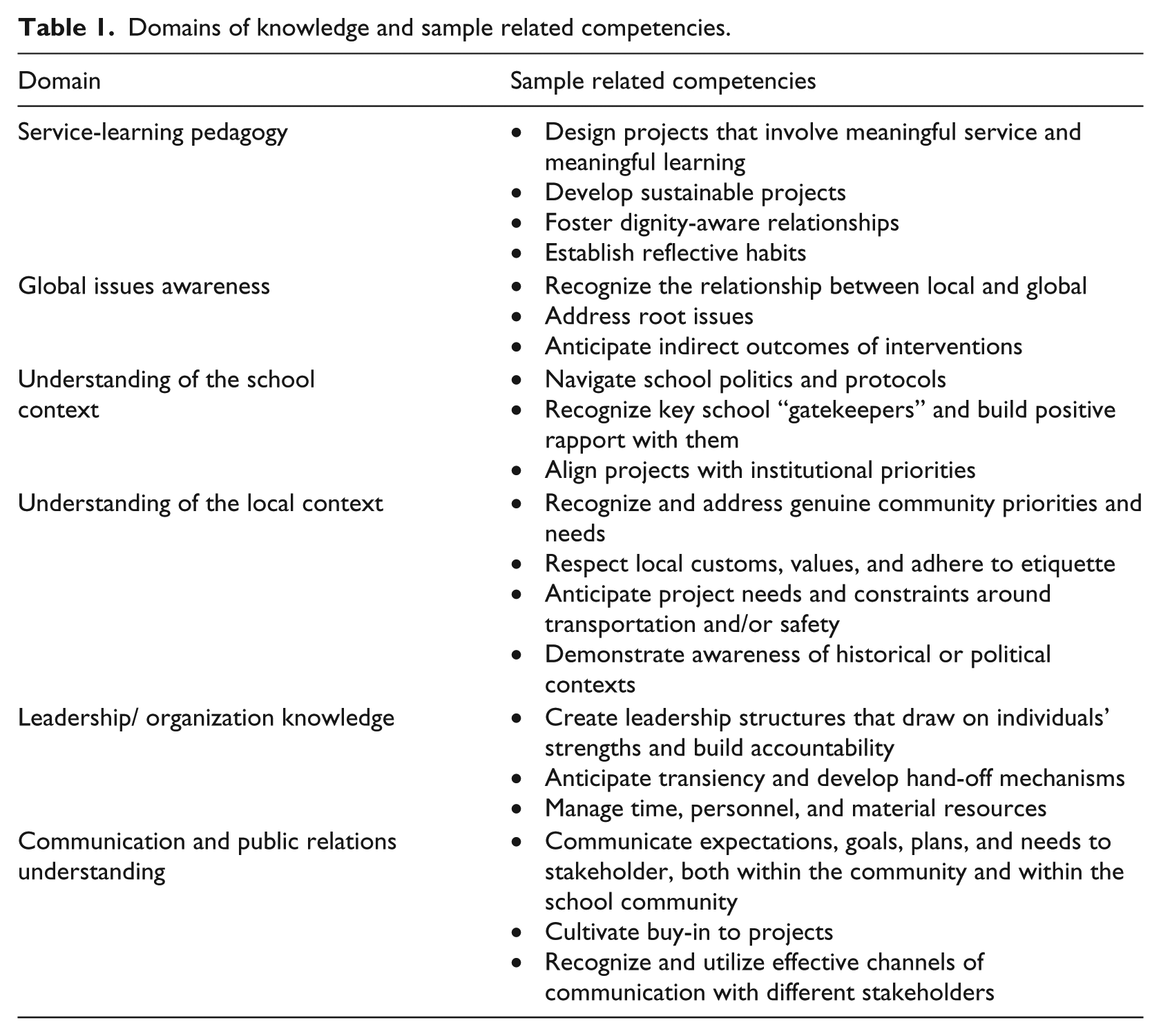
Collectively, facilitators alluded to hundreds of skills or areas of knowledge involved in their efforts. The researcher found that most of these discrete skills, which she described as competencies, could be categorized into six general domains of knowledge: service-learning pedagogy, global issues awareness, understanding of the school context, understanding of the local context, leadership/organizational knowledge, and communications/public relations understanding. Table 1, originally published by Lillo (2016c), shows sample competencies described by facilitators and classified by domain. While the scope of this article does not allow for detailed exploration of every competency, examples are provided for each domain to demonstrate related knowledge as an asset and a lack of related knowledge as detrimental to efforts. A more detailed discussion of each domain and related competencies can be found in Lillo’s (2016c) dissertation.
Domains of knowledge and sample related competencies.
Service-learning pedagogy
There were many instances where facilitators valued pedagogical knowledge. As noted in the introduction, service-learning is often divergently defined, with framings ranging from course-based service projects to more traditional service approaches. Facilitators on site varied in which definitions of the pedagogy they personally gravitated towards. Their definitions were rarely restricted to IB-framing. Despite these differences, there were certain things they agreed teams needed knowledge of, such as awareness of power and privilege issues. As one facilitator noted, “respecting the community you go into is paramount”. In an observed planning meeting, this facilitator had students spend 45 minutes participating in activities to reflect on their privilege. A student leader in this session reflected that they needed to have “dignity aware” interactions with community partners. Because of the facilitator’s knowledge of service-learning pedagogy, specifically the importance of respectful relationships with community partners, she could help students be more reflective and intentional in interactions.
Conversely, gaps in service-learning knowledge hindered some groups. Facilitators who were well-versed (e.g. understood differences between traditional volunteerism and service-learning) noticed challenges faced by less knowledgeable colleagues. As one facilitator pointed out, some peers were “behind service-learning as an educational buzzword, but they don’t really understand what that is”. This led to questionable decisions. For example, some newer service facilitators relied on “one-offs”, where students were “not committing to something long-term.” This seemed problematic, for as one knowledgeable facilitator put it, efforts are “all about sustainability. [Service-learning] doesn’t work if it isn’t sustainable”. This highlighted the challenge of pedagogical knowledge gaps.
Global issues awareness
There were also many examples where teams relied on understandings of the interconnectedness of issues or recognized the relationships between local and global challenges. For example, projects on two campuses indirectly tackled gender imbalances in secondary education settings. As facilitators explained, girls’ persistence in secondary education may be limited by their inability to access feminine hygiene products. Accordingly, students in Ethiopia prototyped and sewed reusable feminine pads that they then distributed. Likewise, students in South Africa distributed reusable feminine products through reproductive health workshops that IB Diploma Biology students facilitated. In both instances, students’ knowledge of root issues allowed them to tackle community challenges in nuanced ways.
However, there were also instances where gaps in global issues knowledge damaged efforts. For example, one teacher vented frustrations that in a class discussion of poverty in the immediate community, her students could not seem to identify anything other than fundraising that could influence the issue. As she attempted to help students brainstorm other factors or indirect ways to approach the topic, she realized that students had very superficial understandings of the complex issue of poverty. The teacher explained that she wanted students to recognize their own roles and identify root issues. However, students needed far more global issues awareness to be able to do so. While just one example, this highlights the sorts of knowledge gaps that can make it difficult for service-learning efforts to address root issues in meaningful ways.
School context
Facilitators frequently recognized that they needed familiarity with school-specific protocols, gatekeepers, values, and characteristics. One of the clearest acknowledgments of this was in the creation of related documentation on two campuses. In both Kenya and South Africa, extensive service-learning handbooks detailed procedures, roles, expectations, and school-specific definitions. Formal trainings for leaders helped them understand the particulars of service-learning policies and procedures on their respective campuses. Facilitators described how these documents and trainings allowed quick dissemination of school-specific policies and practices.
Facilitators also expressed how a lack of school contextual knowledge created problems in their efforts. Perhaps heightened by the transient nature of the lifestyle of students and teachers in many international schools, there were often gaps in facilitators’ knowledge of school culture and protocols. Two facilitators who were new to their school at the time of the study lamented this challenge together. As highly experienced service-learning educators, they had clear visions for ways to make community engagement efforts meaningful but were less clear on how to do this in their new setting. They could recognize certain politics at play within the community but were not yet deeply familiar with the school’s values or gatekeepers. A different facilitator described how when she first moved to the school, she had little knowledge about how to arrange things such as buses, permissions, etc. She was enthusiastic about getting students engaged in community projects, but the logistical aspects were difficult to anticipate and arrange as a new faculty member. These examples showcase how, especially in transient communities, gaps in knowledge of the school’s procedures, gatekeepers, and culture can impede efforts.
Local context
Service-learning efforts involved active engagement with the local community. In international schools filled with globally mobile populations, knowledge of the local community was especially important. On all campuses, there were insiders to the local community who helped others navigate the cultural nuances; these individuals understood things about the community’s history, customs, values, and norms. For example, one South African teacher shared that his experiences as a black man in the apartheid era made him hyper-aware of contemporary power dynamics lurking beneath interactions. He also pointed to subtle elements in the local context that might not be obvious to newer arrivals such as a large pipe along a major road that carries sewage from the rich suburbs (where many students lived) to the edge of a township. This leader’s insider knowledge helped his team reflect more deeply on their privilege, roles, and approaches. In a different instance, a student who had been educated in the local elementary school system was able to help her team develop appropriate tutoring materials that were aligned with local teaching approaches and resources.
Facilitators also pointed to instances where teams seemed out of touch with local community needs. For example, one teacher described a service project where students spent a week in a remote village teaching people how to use iPads. In her opinion, this project was short-sighted—community members participating in the training would very likely never have access to iPads again. Instead of engaging with community members in a meaningful way, she felt this project was condescending and out of touch. She explained that greater understanding of the local community context and the actual community needs was required. Another facilitator described a community clean-up project where students cleared a field of trash and were devastated to find it piled high again the very next week. The teacher explained that students did not understand the constraints of township living—the slum adjacent to the field had no trash collection. Because they did not have this knowledge, their course of action made little impact on the overall challenge. Gaps in local knowledge seemed accentuated by the transient nature of the international schools and economic gaps between fairly affluent students and the local community. Most of the facilitators interviewed had only been in the local context for several years, so lacked deep understanding of customs, values, etc. Many lived in communities that were different from the ones in which they served. These sorts of local knowledge gaps made it more difficult to cultivate meaningful and respectful projects.
Leadership/organizational knowledge
Participants described the importance of leadership and organizational knowledge. They had to effectively coordinate multicultural teams; manage personnel, financial, time, and physical resources; foster cooperation between a wide range of stakeholders; engage in short and long-term planning; and manage countless logistical challenges. In Kenya, an external organization was brought in to formally train student leaders. After this training, teams had clearly defined leadership structures. Student leaders intentionally trained rising leaders to gradually take over facilitation responsibilities. In South Africa, the researcher observed students planning a service summit for regional leaders. Sub-committees worked on specific tasks and reported back to the whole group on their progress. As the leader of that project explained, teams with clear organizational structures tackled complex tasks more efficiently.
Yet not all teachers felt they had expertise in group facilitation. One explained that she had no formal training in leadership and had had to learn “on the go.” After watching teams struggle to effectively plan and manage their time and human resources, she yearned for more leadership skills that she could in turn teach her students. Another leader spoke about how students seemed to lack planning knowledge: “There need to be short term goals, so kids can actually see what they’re doing. But you know, as much as we know the bigger picture, students don’t. Some of them lose their way along the way.” One facilitator described how a community garden project she was participating in completely dissolved when two main leaders moved at the end of a school year, leaving behind a team with little knowledge of the project’s structure. Anticipation of logistical needs seemed especially important in transient settings, where sustainability is particularly challenging. These three examples highlight the influence of leadership and organizational knowledge on efforts.
Communications/public relations understanding
Finally, many teachers valued communication knowledge. Service-learning projects often involved diverse stakeholders—community partners, students, parents, administrators, and teachers. Teams needed to address wide-ranging communication needs and preferences and needed intercultural communication proficiencies. For example, the researcher observed one team use Facebook to coordinate students, email and phone calls to communicate with community partners, newsletters to reach parents, and bulletin boards to showcase efforts to school administrators. As they drew on diverse means of communication, team members also had to agree on shared goals and cultivated buy-in to their projects.
While communication prowess aided efforts, communication disconnects occasionally impeded efforts. For example, at one school newsletters were intended to cultivate teacher enthusiasm for service-learning efforts. Yet teachers frequently said that as much as they wanted to see students’ articles, they were too busy to read the newsletters. With few opportunities to informally discuss projects in which their students were engaged, many teachers were unaware of service-learning efforts on campus. They thus missed opportunities to become involved or support students’ engagement. These examples show how knowledge of communication principles can influence efforts.
Discussion
Perspective
At the outset of this study, the researcher expected to hear primarily about service-learning focused competencies; the sorts of issues discussed in the literature introduced earlier in this article (Bringle & Hatcher, 2002; Butin, 2010; Cipolle, 2010; Giles & Eyler, 1998; Hatcher & Bringle, 2012; Jacoby, 2003b; Stewart, 2007). However, after observing facilitators’ efforts, she was struck that service-learning knowledge was only one small piece of the puzzle. Facilitators relied on a wide range of skills and understandings. In order to understand the pragmatics of facilitators’ service-learning efforts, they had to be kept in context. The framework presented in this article was developed to try to recognize this fuller picture of practical demands.
Legitimizing strain by recognizing complexity
As noted in the introduction, many facilitators were simultaneously proud of their efforts and frustrated. The researcher heard these conflicting emotions both from facilitators in the initial discussion that inspired this study and from study participants themselves. One key implication of the framework developed and presented above is that when this broader picture of demands is recognized, the strain facilitators face is better understood. A glance across the entire set of domains involved helps everyone understand the emotional toll of facilitators’ work. Facilitators were likely frustrated, in part, because their work was so complex.
Interestingly, facilitators themselves often did not recognize the impressive range of their own work, though they pointed to many areas in which they needed knowledge or skills. Yet a researcher through systematic analysis was able to see how facilitators were expected to be capable service-learning pedagogues, leadership experts, communication gurus, cultural navigators, global issues experts, and school politicians. When facilitators did not personally have these areas of expertise, they had to find other stakeholders who did. A framework view accentuates the complexity of demands that facilitators face. When curricular designers such as the IB, schools, and even educators themselves recognize the wide scope of requisite knowledge involved in these idealistic efforts, facilitator strain can be anticipated and more systematically addressed.
Targeted training
This study highlighted that there are many skills involved in community engagement efforts and service-learning endeavors. Facilitators included in this study work within teams that collectively need specialized knowledge spanning across multiple domains. When we recognize that there are specific competencies involved, we can move away from detrimental “anyone can do it” thinking that sends unequipped teams into communities to fumble through ill-thought-through service projects; the sort of projects that Butin (2010) cautioned against. Instead, a framework can help teams be intentional in their self-assessments. Facilitators can reflect on the domains in which students and faculty are currently knowledgeable and identify areas for development. Through targeted professional development or training sessions, related skills can be further cultivated.
Intentional team development
If efforts are as complex as this study suggests, one person alone cannot carry the burden of knowing all things. Instead, teams must be purposefully assembled with complementary skills and understandings. Consider a sports analogy: in soccer, teams must have offensive, defensive, communication, and fitness skills. They intentionally recruit players who balance each other’s strengths, recognizing that it is unlikely that any individual will possess all skills or will be able to fully carry a team to victory. Superstar forwards with amazing shooting skills are still reliant on a skilled defensive sweeper to stop the other team’s breaks. The fastest players may not have the best dribbling skills. In sports, everyone seems to understand that different players will be at different places along the continuum of development for the respective skills involved; accordingly, they recognize that teams rely on a collective set of abilities.
In much the same way, if one recognizes that there are at least six domains of knowledge involved in service-learning efforts, teams can be assembled with individuals skilled and knowledgeable across domains. Facilitators can reflect on strengths and needs and recruit accordingly. For example, if a team includes service-learning pedagogical experts but collectively lacks deep knowledge of the local context, they can intentionally seek out individuals with appropriate cultural understanding.
The framework offered above identifies six areas that individuals might have expertise in: service-learning pedagogy, global issues knowledge, understanding of local context, understanding of the school context, communication knowledge, and understanding of organization/leadership issues. While the researcher does not prescribe either particular approaches or a specific team structure within service-learning endeavors, she recognizes the potential for shared leadership models and diversely-skilled team members.
Providing resources
One final implication of the findings presented above is that it takes considerable time and energy to foster capable teams and develop wide-ranging competencies. Far too often teachers are already over-extended and are expected to squeeze service-learning oversight into packed co-curricular windows. If schools wish to support the sorts of deep engagement to which mission statements are rhetorically devoted, it seems they should recognize that complex efforts require resources. Resources including personnel, time, and training need to be invested. This seems to support a growing trend for schools to have full-time or part-time service-learning coordinators. All three schools in this study had made such appointments. Such personnel allocations acknowledge that community engagement efforts are challenging and time-consuming endeavors, rather than simple co-curricular extras. The framework articulated above helps justify the need for resources such as personnel and professional development that specifically target each domain.
Limitations and next steps
This study, as an exploratory multi-site case study, was designed to look deeply into the particularities of three contexts. As Merriam and Tisdell (2016) note, qualitative researchers should offer enough detail and context that readers can determine to what degree findings can be generalized to their own contexts. With that aim in mind, the author strives in this article to offer context-specific considerations. She recognizes that the sites chosen in this study were non-random and that the unique attributes of each school community necessarily influenced the findings.
While the researcher’s methodological and analytical choices should demonstrate the steps taken by the researcher to establish the sorts of validity and reliability that Merriam and Tisdell (2016) describe, there is still a recognition that the researcher influenced everything from the formation of research questions to the data collected to the analysis. Member checks, triangulation, audit trails, memos, and nuanced coding approaches were used to help safeguard against undue researcher bias.
This study highlights important areas for future study. Future studies could examine transferability of the framework, including an exploration of fit to national schools, to other geographic regions, to non-IB schools, or to IB schools that offer additional secondary programs. Additionally, further studies could explore the nuances of each domain, pinpointing specific skills that professional development could target.
Final thoughts
The framework developed through this study offers a promising way to conceptualize educators’ needs in service-learning pursuits. It provides a structure that teams can use to self-assess, reflect, intentionally recruit, train, and advocate for needed resources. By using standpoint approaches to find connective elements across facilitators’ experiences, the researcher discovered that efforts are more complex than either she or participants readily recognized at the outset of this study. The collective experiences of facilitators highlighted that there is far more to service-learning efforts than service-learning pedagogy itself—service-learning efforts are also impacted by global issues knowledge, school knowledge, understanding of the local context, understanding of leadership/ organizational elements, and communication skills. As such, those who want to pursue community engagement ideals and who aspire to sustainable and meaningful partnerships need to reflect on the wide range of competencies involved.
Footnotes
Funding
The data collection portion of this study was partially funded by the Norma and Seymour Feshbach Award and a UCLA Graduate Division Research Travel Grant. Data analysis was supported by a UCLA Dissertation Year Fellowship.