



Abstract
Despite being long-standing practice among schools across the world, most studies on international school partnerships focus on its benefits and challenges as perceived by teachers and students. Little emphasis has been given to parental perspectives and support, particularly among low-income families. With the increase of community involvement in education, how this partnership program may benefit the foreign language learning of millennials has become a matter of increasing concern among parents. This qualitative study explores Indonesian parents’ perspectives of international school partnerships between Indonesian and Australian schools, and how these partnerships support the learning of English as a foreign language and technology utilization. Results from questionnaires and semi-structured interviews indicate parental belief that the program reviewed is an authentic approach to foreign language learning and an appropriate mode of technology-based self-expression. To facilitate their children’s learning of English and development of cross-cultural understanding, most parents, despite economic limitations, are willing to support their children’s involvement in the international partnership that is the focus of this study.
Keywords
Introduction
As a means to improve the quality of education, international partnerships with schools from developed countries are a growing phenomenon among schools in developing countries such as Indonesia. Not only has this benchmarking for improving educational quality been growing among schools in developing countries; it has also become a main education agenda among European Union countries (EU, 2002). For the purpose of improvement, schools and universities adopt benchmarking with others in many aspects including curriculum, lesson plans, extra-curricular activities, and facilities (Shelly, 2000; Pidcock, 2006; Ossiannilsson & Landgren, 2012). International partnerships enable schools from developing countries to learn best practice in these areas of education. Since such programs often include international travel, however, they may pose financial challenges for middle to low income families.
International school partnerships (ISP) are not a new phenomenon. Their history dates back to the 1920s and prior to the Second World War (Pryor, 1992; Cucchiara, 2011). International partnerships for the purpose of benchmarking have now spread worldwide. Indonesia started participating in international benchmarking partnerships initiated by the South East Asian Ministry of Education Organization (SEAMEO) in 1997. In this program, Indonesia co-operated with Thailand. Beyond the ASEAN region, Indonesian schools have also been involved in other regional partnerships. For example, starting in 2005 and initiated by a non-profit organization, Ausindo Educational, several schools in Java were involved in partnerships with schools in Victoria, Australia. In 2010, under the Building Relationships through Intercultural Dialog and Growing Engagement (BRIDGE) scheme, funded by the Australian government, many schools across the country have been partnered with schools in Australia (Australia Department of Education, 2015). For instance, a school in Makassar is paired with an Australian school in Perth, Western Australia. Participating parents in the study upon which this article is based, mostly of Indonesian middle to low-income families, send children to schools involved in ISP activities sponsored by these two organizations.
Considered significant in global education, various studies addressing ISP have been carried out. Most scholars identify the benefits and challenges of school partnership from the perspectives of those directly involved in the program including teachers, principals, and students (Shelly, 2000; Pidcock, 2006; Ossiannilsson & Landgren, 2012; Muslim, 2020). However, another element less directly related to this program but notably important particularly in the Indonesian context, parental involvement, has received little research attention. Along with increasing social participation in education, parents play a significant role in determining the success of educational programs, including international partnerships. However, since international partnerships may be considered economically challenging for Indonesian parents of middle to low economic status, participation in such programs may be a financial burden. This study examines parental perspectives in supporting the practice of ISP among Indonesian and Australian schools, and how they may influence its successful implementation. Findings of the study are relevant for a more harmonious future in terms of English language learning, and quality global education and citizenship, particularly among children in developing countries.
Quality education as future investment for children
Education is an important future investment for children. Educational investment reduces social inequalities and is linked to social innovation (Parziale & Scotti, 2016). For this reason, many parents invest generously, expecting that their children will acquire strong educational outcomes, necessary life skills and later good jobs. Since parental investment is strongly linked to educational gain (Werum, Davis, Cheng, & Browne, 2018), parents believe that this educational expenditure will pay them back in terms of their children’s future life. Consequently, as many scholars have identified in previous studies, parents, particularly those of high economic status, invest all means possible to provide the best educational experience for their children (Lee, 2010).
Parental investment in education influences children’s learning. Strong parental support serves as an external motivation for learning success. Among Asian students, parental investment in schooling such as home support for learning, and parental donations to school, significantly increase students’ self-esteem (Ho, 2007). Learners who acknowledge the involvement of parents in their learning may feel grateful and so study harder in return for parental investment. This increases students’ achievement, developing their belief in their own ability.
Considering the importance of education as future investment, most parents attempt to provide the best for their children, striving to invest in their children’s education. This future investment in education may not pose problems for high economic status parents living in developed countries such as Japan (Lee, 2010), the United States (Cheadle, 2008), New Zealand (Stuart, 2018), and countries of Western Europe (Busemeyer, Garritzmann, Neimanns, & Nezi, 2018). It may, however, be more challenging for parents from underdeveloped and developing countries such as Ethiopia, Egypt and Pakistan, where poverty and limited public participation still serve as challenges for educational investment (Nassar & Biltagy, 2017; Woldehanna, 2016; Hunzai, 2006). It may also be challenging for the parents in a developing country such as Indonesia who participated in this study.
Social agency in educational programs
Bearing in mind the importance of social participation in education, it is important that parental voice in educational programs, including international school partnerships, be heard. Listening to the voices of parents is an effective way of examining and identifying the weakness and strength of educational programs (Martinez, Hetterschijt, & Iglesias, 2015). In addition, being ecologically and contextually situated, parental voices provide valuable and verifiable information (Calabrese, Drake, & Perez, 2004). As parents are key to the educational trajectory of their children, identifying the benefits and challenges of schooling activities in which their children are involved, including international school partnerships, is necessary. It serves as a basis to improve the quality of the program as well as to navigate its challenges.
Parental education background impacts on involvement in school activities. Highly educated parents tend to show strong participation in various decision-making activities (Pahic, Vidovic & Miljevic-Ridicki, 2011). They tend to be concerned with both the curricular and extra-curricular activities of their children. An extracurricular activity such as international school partnerships is an important means of providing children with skills necessary in their future global life. Involvement in this partnership enables children to learn a foreign language and engage in intercultural communication, thus strengthening their global competitiveness.
Finally, parental support has financial consequences. This is more relevant in ISP which involve significant geographical distance. Although the costs of technology-based partnership activities such as teleconference and email correspondence may be covered by schools, other activities such as language enrichment programs, airfare for student exchange, and host family costs may incur additional financial consequences for parents. This may not pose problems for parents of high income families (Kornrich & Furstenberg, 2012) but must surely do so for those of low socio-economic status. Such economic challenge, however, may not stop parents, such as those participating in this study, who believe in the importance of ISP.
Millennial learners and foreign language learning
In today’s digital era, technology influences learners. Reliance on Information, Communication and Technology (ICT) devices in learning is high. In the age of the internet, millennials are often described as the net generation (Tappscott, 2009) or digital natives (Prensky, 2001). Due to their extensive exposure to technology tools, the ways in which millennials think, behave, and learn is highly influenced by these ICT tools (Benett & Maton, 2010). Unlike so-called digital migrants, they also have specific learning characteristics such as quick information reception, capability for simultaneous multi-tasking, high reliance on websites as main sources of information, non-linear information processing, and a preference for visuals to texts in learning (Palfrey & Gasser, 2008; Rosen, 2010; Teo, 2013).
Some characteristics of millennial learning are also identified among English as a Foreign Language (EFL) learners. They consider themselves digital natives and share some of these learning characteristics, but still need guidance from teachers, especially young English learners (Kizil, 2017). As part of their extensive exposure to technology, English learners use various ICT tools such as YouTube videos for listening and writing exercises, video calls for speaking, and other online resources for reading practices. Among participants in international partnerships, e-mailing activities can improve reading and writing skills (Heany, 2012). As learners may have more exposure to technology-based activities out of school, Richards (2015) suggests English teachers need to make use of out-of-classroom learning resources and activities such as digital games, listening logs, social and other online learning resources. He also recommends that students can be involved in e-mediated tandem learning and the use of voice threads to support independent learning.
As digital natives have different levels of exposure to technology, their technological familiarity and literacy may vary. Consequently, teacher guidance has to respond to variety in learner needs since technology has little benefit without serious engagement between teachers and learners (Heany, 2012). Depending on learner need, teachers are required to shift their roles in technology-enhanced learning activities such as manager (vendor and motivator) and technology promoter (coach, operator and learning environment creator) (Karimah & Muslim, 2019). Sister school partnerships provide students with opportunities to be involved in activity-based communication through ICT tools (Edge & Khamsi, 2012). In the context of this study, Indonesian teachers involved in sister school partnerships (or international school partnerships) need to be able to provide guidelines for their students on how to use technology in communicating with their peers in Australia.
Foreign language teaching often creates tension between global and local perspectives. In those countries whose national language is not English, the teaching of English as a foreign/second language may be considered as linguistic and cultural imperialism (Canagarajah, 2003), challenging the maintenance of national language as local identity. Considered contradictory to the notion that international schooling develops global citizenship through the offering of a curriculum in English (Bates, 2012), this tension may be found at all educational levels, from primary to higher education, in which English serves as the lingua franca (Wilkins & Urbanovic, 2014; Boussebaa & Brown, 2016). In the Indonesian context, both those of low socio-cultural status and more highly-educated groups such as English teachers experience this tension (Manara, 2014). Such tension may be more significant in early exposure to English among young learners due to their stage in acquisition of the national language, Bahasa Indonesia, which may be different from their home language (Zein, 2018). Moreover, as a form of cultural imperialism, English language-focused culture may present different values, causing concern among educators and parents.
Methodology
This qualitative study explores Indonesian parental perspectives on international school partnerships as experienced by their children. Data in this article are part of a larger study on international school partnerships between Indonesian and Australian schools. The ISP activity was initiated by BRIDGE and Ausindo Educational. Two ISP activities were initiated: one in 2005 by Ausindo Educational, a non-profit organization initiative by a small number of Indonesian and Australian academics, and the other by BRIDGE, an activity established in 2012 and fully funded by the Australian government. The main purpose was to support the English language learning of Indonesian students and the Indonesian language learning of Australian students, as well as the development of cross-cultural understanding.
Data were derived from questionnaires and semi-structured interviews. Developed from theories of quality education, parental involvement, and English language learning for millennial learners, questionnaires on benefits, supports and challenges for international school partnerships were first distributed to 10 parents in Bandung for piloting purposes. After revision the questionnaires were then distributed to 70 parents (either mother or father) in seven large cities across Indonesia (Jakarta, Bandung, Surabaya, Pontianak, Makassar, Surabaya and Malang). Children were enrolled in public and private schools (junior and senior high, and vocational) that were involved in international school partnerships. Several participating parents had their children at primary schools, while most had children at junior, senior, and vocational schools. Of this number, more than half (46 parents) returned the completed questionnaires. 14 parents were interviewed on similar topics of international/sister school partnership. The interviews were conducted after classroom observations at schools participating in sister school partnerships. The questionnaire was administered before interviews in 2017-2018. Questionnaire and interview guides are available in Appendices 1 and 2.
Similarly, the questionnaires were distributed to 10 Australian parents whose children were involved in international partnerships at Australian schools and colleges. Three parents were interviewed on the same topics. Data from Australian parents are only used for comparison. Participation was voluntary. Prior to questionnaire and interview administration, consent forms were distributed to participating parents. Questionnaire data were first analysed before being compared with interview results. Findings were analysed on the basis of education as investment, sister schooling and foreign language learning and the digital world of millennial learners.
Findings and Discussion
Parents’ perspectives on international school partnerships
Results of questionnaires administered to 46 participating parents are shown in Table 1.
Benefits of ISP for children
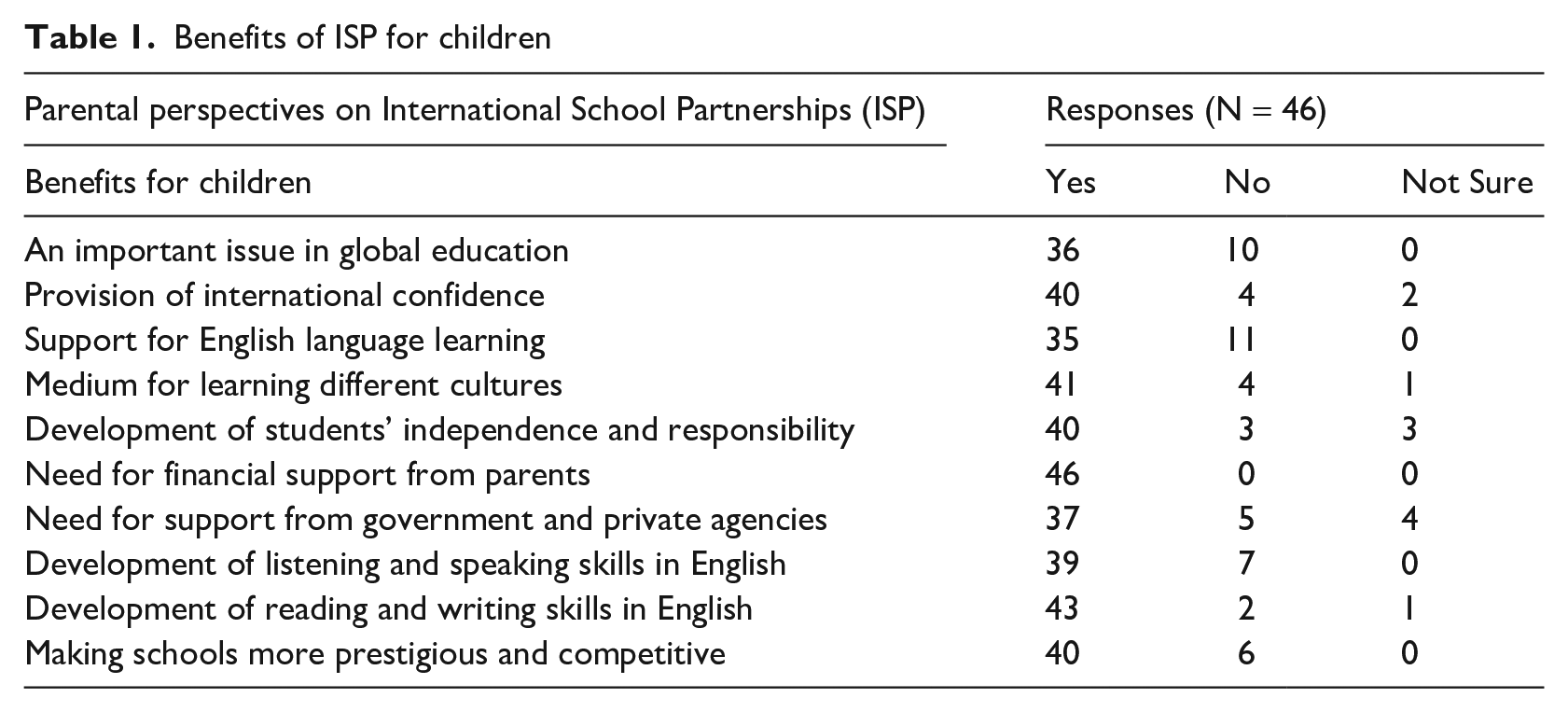
It seems that participating parents in general show positive perspectives towards participation in international school partnerships by their children. As Table 1 shows, the majority of parents acknowledge the benefits of such partnerships. Most parents believe that ISP are important in this global era in that they provide students with international confidence, help them to learn English and support them in developing understanding of different cultures. Despite these benefits, all 46 parents acknowledge the importance of financial support by parents for the success of the program.
Despite some benefits identified in Table 1, parents also acknowledge (see Table 2) the challenges ISP activities may pose for their children. More than half of participating parents (24) are concerned about their children’s safety when joining ISP activities. This doubt is particularly expressed by parents of primary school students, whereas parents of junior and senior high schools show less worry with this issue. 27 respondents also believe that ISP activities are not affordable, particularly for parents of low socio-economic status. Despite these challenges, most parents believe that ISP are not a waste of energy and time, not posing a financial burden, and are not relevant only for children of affluent backgrounds. Although most parents (34) argue that ISP do not decrease children’s nationalism, more than half of parents (26) believe that this program may have a negative cultural influence on their children.
Challenges of ISP

It is important to note that in the context of Indonesia, parental involvement differs between public and private schools. Parents of private schools tend to show higher involvement in their children’s school activities than do parents who send their children to public schools. Many factors contribute to this difference, including educational background and economic status. Supporting the findings of a previous study by Pahic et al (2011), parents with high education and economic status show higher involvement in the schooling activities of their children. They may have better understanding of the importance of education for children, thus, investing time and energy to involve themselves in school programs such as international school partnership activities. However, it is interesting that a number of parents of low economic status still show high levels of concern and involvement in international school partnership activities.
In contrast, economic status is not an issue in parental involvement among Australian families. Due to their middle to high economic status, overseas holidays - including participation in international school partnerships to Indonesia - are economically more feasible. One female Australian parent confirmed: Because my daughter learns the Indonesian language, we often visit Indonesia for family holidays. I myself spent my childhood in Indonesia several years back in in 1970s. So, participation in this program isn’t a big deal for us. I even took part in the program; I came to Bandung (Indonesia) together with my daughter.
Concern among Australian parents is more about safety and health than economic issues. After security incidents in Indonesia, for instance, several parents withdrew their children from the exchange program. Another female parent cancelled her daughter’s involvement because she herself experienced food poisoning during her holiday to Indonesia. In response to these concerns, teachers and schools provided comprehensive information about the sister school partnership, including pre-departure orientation on safety issues prior to the exchange program. Having been reassured about these issues, most parents confirmed their support for activities in the international school partnership.
Education as investment in the future
In general, despite the above-mentioned challenges, most Indonesian parents show strong support for international school partnerships. As the interviews show, having been briefed by school teachers and principals about this program, most parents fully support the involvement of their children in ISP activities. Similar to the findings of Kornrich and Furstenberg (2012) in their study on increasing parental investment in children’s education, most participating parents in this study show their full support for the international partnership as an important aspect of their children’s education. They argue that this program provides children with the international experience necessary for their future life as global citizens. Several affluent parents believe that this international experience may pave the way for their children’s international education in the future. One female parent confirms: I think it is good. We can learn many things like culture and some other aspects. Our children are also more motivated to pursue their education, even in Australia, to be a better citizen in the future.
Sending children overseas to learn in a developed country is both a pride and challenge for most parents. Most participating parents feel proud to see their children joining an exchange program to Australia. This trip is like an answer to their dream of overseas experience. Parents share the pride and excitement their children experience during the exchange program. However, for parents in developing countries such as Indonesia, sending children overseas may pose an enormous challenge. Due to low economic status, not many parents can afford to send their children abroad. If they manage to do so, they have to save for a long time or sell property such as jewelry. Some parents are even willing to borrow money from their neighbors or relatives to support this program. One female parent of an Islamic high school in Malang, East Java, said: I am not wealthy enough. We just have enough for eating daily. When I heard that my son is selected to join the student exchange, I feel very happy. My husband and I want to support him by all means. When he told us the amount of money he needed for ticket and accommodation, we were rather surprised. But, we promised to provide it. We decided to sell our necklace and borrow money from our relatives so that our son can join the program.
It seems that the participating parents consider education an important future investment. Despite their low economic status, parents are willing to spend a large amount of money to fund their children’s involvement in a sister school program. Most participating parents believe that this parental investment will result in educational gain for their children (Werum et al., 2018; Lee, 2010), thus, increasing social equality (Parziale & Scotti, 2016).
To show their support for ISP, some parents also offer to become host families. Homestay programs are a way of reducing cost in this international partnership. Although the offer has financial implications, they consider it a reciprocal gesture for their children who also need host families in Australia. To meet the requirements for host families set by Australian schools, parents do not mind spending extra to equip their houses with a new sitting toilet, a spare room for the visiting students, and extra food and drink. They also show willingness to take the guests to some interesting places during their stay in Indonesia. Despite these financial consequences, most participating Indonesian parents believe that being a homestay parent increases the number of family members and enables them to learn the habits of others, especially visiting children who have different cultural values. Supporting a study on parental investment among Asian students, home support for learning and parental donation can significantly increase the self-esteem of children (Ho, 2007) so that Indonesian children participating in this partnership feel more confident to interact with their counterparts from Australia.
Finally, the expense of ISP activities increases with the number of participating children. As most funding for the programs comes from parents, they have to prepare everything for their children’s involvement in this program. For instance, parents who send more than one child to join the program have to spend double the amount compared to those who send only one child. To prepare for this, they need more time. One male parent said: Last year in 2017, I sent two children to join the exchange program to Australia. My two children are happy but I have to spend extra funding for this activity. For the sake of my children, I have to save more money so that they can join the exchange program to Australia.
Despite this strong support and commitment to ISP activities, for this partnership to continue, non-parental support is still necessary. Support needed includes government policy and financial support from private sectors. Unlike their counterparts in some developed countries like Japan, the United States, New Zealand, and the countries of Western Europe (Lee, 2010; Cheadle, 2008; Stuart, 2018; Busemeyer et al., 2018), for many Indonesian parents social participation in schooling activities is difficult due to their low economic status. Similar to cases in other developing countries including Ethiopia, Egypt and Pakistan (Nassar & Biltagy, 2017; Woldehanna, 2016; Hunzai, 2006), public investment in education, which includes parental participation, is still low in Indonesia. Additional support is more essential for parents of public school students who do not come from affluent families. Due to their low socio-economic status, most parents agreed that additional financial support from, for instance, governmental institutions, private companies and other funding agencies would assist in enabling their children to participate fully in programs such as ISP.
International school partnership and foreign language learning
Parents believe in the importance of a sister school (international partner school) in improving foreign language skills. They believe that ISP provides children with authentic language learning; in this case, English. Indonesian students practise English language skills with their first language-speaking counterparts from Australia, and vice versa. Experiencing the use of English language in real contexts, they listen and speak to English first language speakers. Some technology-mediated learning activities such as teleconference, email, and regular correspondence provides Indonesian children with authentic use of English language with their Australian peers. During a teleconference, for instance, Indonesian children are required to be able to introduce themselves, describe their family members, their houses, and other relevant topics. In a mail correspondence activity, they have to describe themselves and families. They also need to find and write the mailing address of their peers in Australia. One female parent said: In the beginning, my daughter’s English was not really good. She was not confident to join exchange program. However, her English improved significantly upon returning from Melbourne. Her speaking and writing skills become better.
Besides authentic learning, student exchange to Australia provides Indonesian students with meaningful experiential learning. In their final years of primary school, some Indonesian children participating in ISP have to travel a long distance to Australia under the guidance of their teachers. They live in a foreign country without their parents. During this one-week homestay program, each child is assigned a host family. They have to practise speaking English and be exposed to Australian weather and culture, as well as introduce Indonesian culture to the host families.
ISP activities can build children’s self-efficacy. One male parent believed that, having joined the exchange program, his child now shows high self-confidence and has learnt many positive values during the program. The child feels more motivated, shows more independence and is able to accept different values experienced during his time in an Australian homestay. This confidence is an important aspect in learning English, developing friendships and accepting intercultural experience. The short homestay in Australia enables the participating Indonesian children to develop not only their listening and speaking of English, but also their English reading and writing skills. In the words of a female parent: My son’s English was not that good. He may have had a bit of a problem when joining the exchange program. After joining the exchange program, his English improved significantly. He speaks and writes in English better than before.
In short, various ISP activities have exposed students to authentic and experiential learning. These activities can develop children’s English language skills, build their self-confidence, expand their friendship group, and develop intercultural knowledge. Such qualities are necessary for the future life of the students as global citizens. Based on the views of the participating parents, the ISP is considered beneficial in supporting the English learning program of the students (Martinez, Hetterschijt & Iglesias, 2015). To prepare a more beneficial ISP for students, teachers and principals need to respond to this valuable parental voice (Calabrese, Drake & Perez, 2004) so that the children can make the best use of these ISP activities to develop the social and life skills necessary in their future.
Despite these benefits in foreign language learning, some parents also showed their concern with ISP. First, tension arises between early acquisition of English and Bahasa Indonesia as the national language. Influenced by this tension, some parents are worried that ISP activities may reduce children’s sense of nationalism due to early English language acquisition. Supporting Zein’s (2018) study, as the participating young children may have better English language skills than their country fellows, for instance, this competence may hamper their acquisition of Bahasa Indonesia. Some parents are anxious that their young children are more proud of their English than of their Bahasa Indonesia competency, thus restricting their national identity as Indonesian.
Secondly, parents are also worried that ISP activities, particularly as an exchange program, may pose another threat to children’s national pride. For example, as Indonesian children compare conditions in Indonesia with what they have seen in Australia during the homestay program, they may find that the latter has better facilities than the former. They may believe that Australia has more orderly traffic, fresher air, a cleaner environment, and better schooling facilities. This experience may make Indonesian children believe that Australia has more developed facilities and therefore feel less proud of being young Indonesians.
Finally, another concern relates to cultural influence. Some parents are anxious that the home-stay program may have negative influence on their children, particularly for students of primary schools. These young children may not have sufficient knowledge of their own culture. One essential cultural issue is, for instance, food and drink. As most participants of the exchange program are Muslims, parents are concerned with the provision of halal food and drink for their children during the homestay program. The children may also have problems finding space to observe their daily prayers. One female parent said: I am rather worried that my child will have negative experience during her home stay. She never goes overseas alone before. She wears hijab, and I am worried she will face troubles during her stay in Melbourne. I am afraid she will have difficulties in finding halal food and place for prayers. She also cannot consume alcoholic drinks.
These worries, though real for the parents, have little basis in reality. First, the participating children live in Indonesia permanently and only learn English as a foreign language in a schooling context. This permanent and massive exposure to the Bahasa Indonesia context will not be reduced by their limited time in learning English at school. Good competence in English will not hamper their acquisition of Bahasa Indonesia as a mother tongue. Second, to reduce the possibility of underestimating Indonesia as their home country after visiting Australia, the school also organizes pre-departure training. During the orientation, students are required to be cultural ambassadors who introduce the culture of Indonesia to public Australia, particularly homestay families. The participating students are prepared to perform Indonesia’s cultures such as dance and self-defense or martial arts. Instead of reducing their cultural pride, this assignment is expected to raise their pride as young Indonesians, rich in unique cultural artifacts.
Furthermore, to reduce parents’ worries about negative cultural influence, the Indonesian teachers have also taken some precautions. During pre-departure training, the participating children and their parents are advised that Australian people are in general open to religious practices such as wearing the hijab or head scarf and eating halal food for Muslims. During the homestay program in Melbourne, the participating female students are welcome to wear head scarfs and practise their beliefs. They were also informed that host families in Australia will provide them with halal food and space for prayers, and will not provide them with alcoholic drinks during the exchange program. (It should be noted that it would be illegal to provide any child with alcohol in Australia). These precautions are expected to reduce parental concern about any negative cultural influence the ISP activities may have on the participating children.
International school partnership and millennial learners
International school partnership activities support children as digital natives. ISP enables millennial learners to experience technology so that they can show increased engagement in learning. To compensate for geographical distance, for example, Indonesian and Australian students engage in telecommunication activities such as emailing, teleconferencing and use of social media like Instagram and Facebook. Although they have to spend extra money for their children’s use of the internet, parents consider it a positive way of using technology. This financial investment in support of ISP activities is recognised as more justifiable than other less productive and less beneficial activities such as online gaming. One male parent said: I don’t mind spending extra money on the internet if my children use it for communicating with their friends in Australia. It is much better than playing games and other negative activities.
Parents do not object to spending money to provide an internet connection so that their children can use it for educational purposes that support engagement in technology-mediated international school partnership activities such as emailing and teleconferencing. As identified in some previous studies, increased parental financial support is justified for the sake of the children’s future (Kornrich & Furstenberg, 2012). Despite their limited economic means, most participating parents do not mind providing additional financial support for the learning process of their net-generation children (Tappscott, 2009). They believe that digital native (Prensky, 2001) children have high reliance on websites as sources of information, can receive online information quickly, and prefer visual texts in learning (Palfrey & Gasser, 2008; Rosen, 2010; Teo, 2013). The provision of internet access can satisfactorily meet these characteristics of millennial learners. One male parent said: I think internet is important for our children. They learn information from internet using technology like gadgets. That’s why we have to provide them with internet connection. I have to . . . subscribe for internet service at home so that my children can use it for studying. In sister school, you know, they can send emails and teleconference with the help of internet.
Another internet-based activity of millennial learners is social media. The use of social media is particularly important for students of junior and senior high schools who use Facebook, Twitter, Instagram and Whatsapp to communicate with their counterparts overseas. One male parent does not mind sharing his Facebook account with his child to communicate with his friend in Melbourne, Australia. They share family photos and other daily activities while practising English and Indonesian language. In short, engagement with technology-mediated social media enables Indonesian students to make the best use of their digital native skills to learn English and make social relationships. For these millennials, ICT tools have significantly influenced how the participating students think, behave, and learn English as a foreign language (Benett & Maton, 2010). With limited internet-based facilities, they exchange emails to improve reading and writing skills (Heany, 2012). To encourage exposure to technology-based activities, teachers of these young learners need to expose them to out-of-classroom activities such as digital games, listening logs and social media (Richards, 2015). These extra-curricular activities may increase the engagement of millennial learners in learning English.
However, technology engagement among Indonesian young learners is not without obstacles. The biggest challenge for the majority of these young people is lack of support facilities. Not all Indonesian schools are equipped with an internet connection and computers to support ISP activities. If they are, as it is required by the organizer of international school partnerships, such as Ausindo Educational, the connection may not be as strong as expected. Sometimes, a teleconference and sharing of learning materials is disturbed by internet connection problems. Some Australian schools have difficulties in maintaining their international school partnership with Indonesian primary schools located in remote areas of the country where some schools do not even have electricity to help run the day-to-day routine of learning activities, let alone telecommunication devices to support an international school program such as emails and teleconference activities. One female parent said: My daughter once told me that her school has a partnership with an Australian school. They have planned to make contact with their friends in Australia. But, I said to her, how can you contact them when you don’t have electric power to do something with people far away?
Finally, different levels of exposure to digital technology requires instructional adjustment. In schools with limited technology support, Indonesian teachers find it difficult to meet the technology needs of their students. Without serious engagement with their students, technology use will not be beneficial for learners (Heany, 2012). As studies on technology-enhanced learning activities have shown, teachers may play their roles as managers or promoters (Karimah & Muslim, 2019). To promote technology-based English learning activities, teachers need to be able to create a learning environment as coach and operator. When facing very limited internet support, teachers should also serve in managerial roles by motivating students on the importance of internet-based activities despite all the limitations they experience. This restriction should not prevent millennial learners from being involved in ICT-based communication activities in English learning (Edge & Khamsi, 2012). In this context, with limited support facilities, Indonesian teachers of English need to find relevant roles in relation to ICT use among their millennial learners if they are to achieve better learning outcomes.
Conclusion
There are several conclusions to be drawn from this study. First, most participating Indonesian parents consider a sister school partnership an important initiative in improving the quality of their children’s schooling leading to improvements in curriculum, lesson plans, and learning facilities. Considering education as an important future investment, they are willing to support a sister school partnership, despite their low economic status. Second, parents also believe that sister schooling is an effective approach to foreign language learning such as English in which learners are immersed in authentic and meaningful communication. Furthermore, relying on technology utilization, this program is also considered relevant for millennial learners who are digital natives, providing increased engagement in foreign language learning. In addition, parents show concern that there may be possible negative cultural influences of the exchange programs on their young children. Parents also emphasize the importance of schools holding pre-departure training for participating students in order to reduce parental concern about possible negative cultural influence on their young children. Finally, bearing in mind the low economic status of many Indonesian parents, if schools can seek alternative funding resources besides that from parents, ISP activities would be able to continue within different levels of parental socio-economic status.
Footnotes
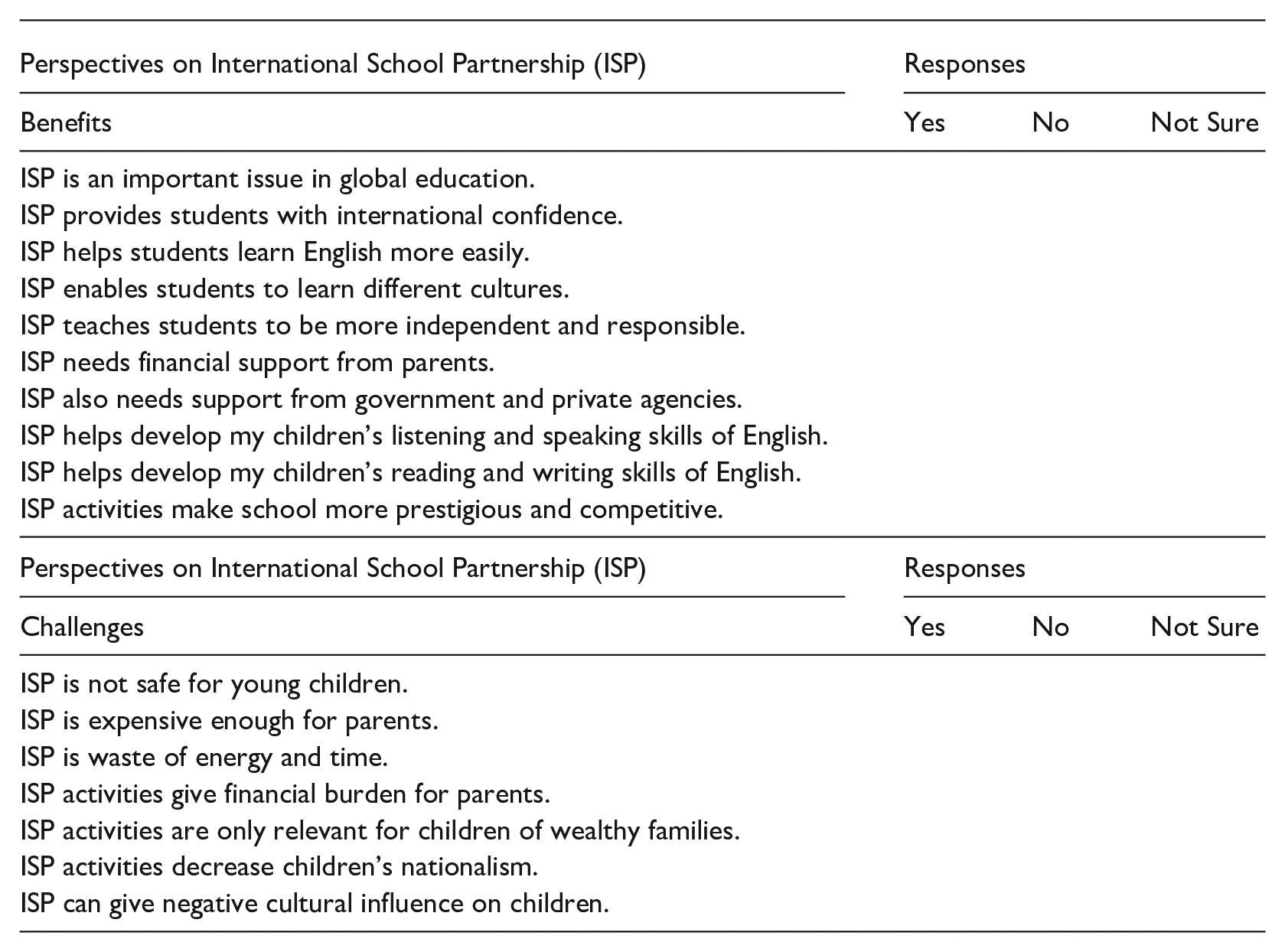
Appendix 1 Questionnaire
| Perspectives on International School Partnership (ISP) | Responses | ||
|---|---|---|---|
| Benefits | Yes | No | Not Sure |
| ISP is an important issue in global education. | |||
| ISP provides students with international confidence. | |||
| ISP helps students learn English more easily. | |||
| ISP enables students to learn different cultures. | |||
| ISP teaches students to be more independent and responsible. | |||
| ISP needs financial support from parents. | |||
| ISP also needs support from government and private agencies. | |||
| ISP helps develop my children’s listening and speaking skills of English. | |||
| ISP helps develop my children’s reading and writing skills of English. | |||
| ISP activities make school more prestigious and competitive. | |||
| Perspectives on International School Partnership (ISP) | Responses | ||
| Challenges | Yes | No | Not Sure |
| ISP is not safe for young children. | |||
| ISP is expensive enough for parents. | |||
| ISP is waste of energy and time. | |||
| ISP activities give financial burden for parents. | |||
| ISP activities are only relevant for children of wealthy families. | |||
| ISP activities decrease children’s nationalism. | |||
| ISP can give negative cultural influence on children. | |||
Appendix 2 Interview Guide
Acknowledgements
Our thanks go to Dr Jill Brown of Monash University, Australia for critically reading an earlier draft of this article.
Funding
The author(s) disclosed receipt of the following financial support for the research, authorship, and/or publication of this article: Funding for this research was provided by the Indonesian Ministry for Research, Technology and Higher Education, grant year 2017-2019.