




Abstract
Teacher leadership development receives considerable attention in many educational reforms across the globe. This article reports on a unique partnership in Jerusalem that brings Israeli and Palestinian educators together to cultivate teacher leaders who facilitate professional communities and support continual improvement in teaching and learning. The research design involves participatory action research and draws on theoretical frameworks of democratic education, productive professional discourse, and authentic intellectual work. Findings focus on the enhancement of multicultural training, increased depth of pedagogical discussions, and improvement in leading teacher learning communities. The conclusions consider the ways in which a few bridges are overcoming both real and perceived borders in a region of persisting cultural tension and conflict, as the teacher leaders and co-authors developed an emerging common understanding of a shared conception of professional practice across three languages, and a growing mutual respect for the ‘other’.
Keywords
Introduction
Bourdieu’s (2003, p. 14) argument for a “scholarship with commitment” is all the more pertinent today. He argued, “We must design new forms of organization capable of bringing together researchers and activists in a collective work of critique and proposition, leading to new forms of mobilization and action.” The authors of this article are university and institute researchers, teachers, coaches, and professional development facilitators who are Israeli Jew, Palestinian, and European-American. We are engaged in collective work, with each other and with diverse teacher leaders in Jerusalem, to improve teaching and learning in schools for both Arabs and Jews through teacher leadership and learning communities; educational reform efforts that receive considerable attention across the globe.
In this article, we (1) summarize a teacher leadership project in Israel, Hashkafa (meaning both vision and perspective in Hebrew), with a focus on one team of teacher leaders in Jerusalem that comprises both Israeli Jewish and Palestinian educators; (2) analyze the impacts and potentials of a specific instructional framework, Authentic Intellectual Work (AIW), introduced in 2018-19 to pilot communities in this project; and (3) explore the possibilities of teacher leader professional development in a cross-cultural context for contributing to (a) teacher leaders and learning communities, and (b) democratic schools.
Theoretical frameworks
There is a need for counter-narratives to the dominant neo-liberal, managerial imperatives of educational governance and policies that prioritize efficiency, quantitative outcome measurements, and market driven reforms. These diminish the emphasis on democratic schools. In a multicultural context, democratic education should include: concern for the dignity and rights of individuals and for the common good; belief in the collective capacity of people to identify, inquire into, and solve problems; cultivation of critical reflection and analysis to evaluate issues and policies; and structures and practices that promote and extend the democratic way of life inclusive of all (Apple, 2013; Beane and Apple, 2007; Freire, 1970/2011).
Our analysis also draws upon two education-specific frameworks that inform the work in Hashkafa: (1) productive professional discourse among teachers and (2) Authentic Intellectual Work. Segal, Lefstein, and Vedder-Weiss (2018) explain that productive professional discourse (a) is focused on problems of practice that teachers identify, (b) is anchored in rich representations of practice (e.g. samples of student work, teachers’ assessments or other learning tasks, videos of lessons), (c) includes diverse perspectives, (d) involves pedagogical reasoning to interpret practice and justify action steps, and (e) balances support and critique that builds both trust and critical inquiry.
Authentic Intellectual Work (Newmann and Associates, 1996; Newmann, Carmichael and King, 2016) is an instructional framework that articulates three criteria for rigorous intellectual work that is relevant to students: Construction of Knowledge, Disciplined Inquiry, and Value Beyond School. Numerous studies of diverse schools from the US and Australia have consistently demonstrated higher and more equitable achievement benefits of Authentic Pedagogy on both assessments of students’ intellectual performance and conventional standardized tests across all grades and all subjects studied (for a summary, see Newmann, Carmichael and King, 2016). Within learning communities, teachers utilize protocols that enable them to analyze artifacts and representations of instructional practice (e.g. lesson plans, student work samples). These protocols are designed to focus and deepen collaborative professional discourse around instruction and improve practice.
Research Context and Methods
The ongoing Israeli-Palestinian conflict is well documented. Educational attempts to work toward co-existence, anti-racism, and understanding have emerged through, for example, incorporating Arab language, religion, and culture into Jewish schools (Saada and Gross, 2019). The broad challenge for schools and educators in Israel is captured by Busharian (2016, p. 9), in noting that “The great difficulty is that the education system is expected to work toward the social goal of greater equality of opportunity while diverse social, political and economic entities labor to achieve other goals, sometimes even contrary ones . . . We need an education system that will implement the right social policy to reduce inequality.”
The teacher leadership development we consider here is part of a national project, Hashkafa (see Avidov-Ungar and Ezran, 2018). Hashkafa aims to cultivate teacher leaders who facilitate learning communities in their schools that build teacher capacity and support “continual improvement in teaching and learning” (Yad Hanadiv, 2019). During the 2018-2019 academic year, Hashkafa partnered with US-based researchers and coaches, co-authors Bruce and Laura, to introduce Authentic Intellectual Work (AIW) to pilot teams of teacher leaders and regional facilitators. This article reports on the results of this collaboration in one cross-cultural pilot team in Jerusalem, in its third year overall, facilitated by three other co-authors: Dua, Hila, and Yael. Our final co-author, Ariel, serves as advisor for the implementation of AIW in Israel, participates in the Jerusalem team’s meetings, and provides formative feedback to the team’s facilitators. This pilot team includes both Hebrew-speaking Jewish educators from West Jerusalem and Arabic-speaking Palestinian educators from East Jerusalem. The teacher leader training was especially designed to enable teachers to study in their own language, hence: (1) training is accompanied by bilingual simultaneous translation, (2) bilingual learning materials are developed, and (3) trainings are guided by both Jewish (Yael and Hila) and Palestinian (Dua) facilitators.
Consistent with our theoretical frameworks and given the current progress of the project in which all six authors are involved, we employ Participatory Action Research (PAR). PAR engages practitioners in dialogue and debate about the actions and practices under study, informs future actions and practices, and contributes to ongoing development of the learning community. Further, PAR seeks to advance critical consciousness within a community, problem posing, and social justice advocacy (Anderson, 2017). Sources of data include the participatory experiences of one leading teacher pilot team, including three of the facilitators and participants of the pilot team. We also draw on interviews, observations, and dialogue among the authors. More specifically, we analyze monthly video conferences among the authors and resulting collaborative notes, written questions generated by pilot team members and responses from different authors, video-taped recordings of pilot team meetings and transcripts of critical incidents from teacher leaders’ school communities, and meeting notes and reflections from in-person planning of onsite professional learning sessions in Israel that included all six authors.
Hashkafa and the Jerusalem Teacher Leader Program
In 2015, the Yad Hanadiv Foundation and Israel’s Ministry of Education launched Hashkafa, a joint initiative with the goal of “improving professional development by: working within schools; offering solutions to practical, everyday problems; working in teams of teachers that reflect on their work using data and evidence; sharing best practices; and developing and implementing techniques to teach more effectively” (Yad Hanadiv, 2019). The objective was to create “a new professional culture based on teachers’ learning communities led by leading teachers” (Hashkafa, 2019). These communities bring teachers together to connect theoretical knowledge with understanding from the field and encourage the development of a shared ‘teaching wisdom’. According to Israel’s Ministry of Education, a teacher leader should develop expertise in analyzing representations of teaching practice and inquire about their pedagogy with the intention of creating collective professional knowledge. The communities’ learning and insights will then be transferred to the whole teaching staff with the purpose of enhancing pedagogy, educational climate, and student achievement (National Authority for Measurement and Evaluation in Education, 2018). Districts were granted full autonomy to create and develop their model based on this vision and principles, in cooperation with an academic institute of their choice.
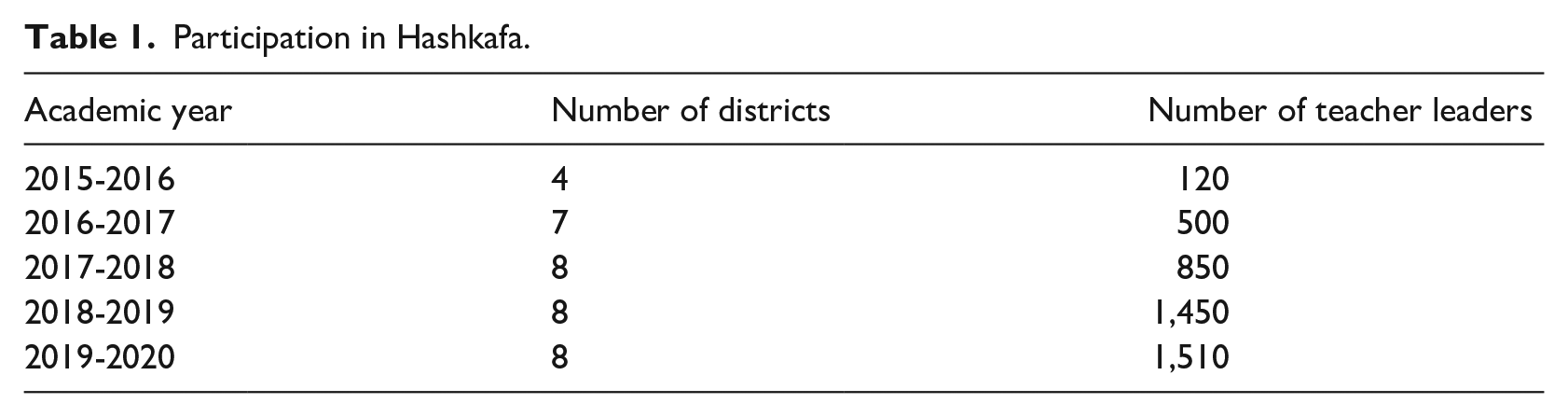
Table 1 shows the growth of participation in the program, from 120 teacher leaders in the first year to over 1500 in its fifth year.
Participation in Hashkafa.
In the Jerusalem context, teachers in West Jerusalem benefit from an abundance of attractive and varied professional development programs. Governmental support and civil society funding create expansive, perhaps even overwhelming, opportunities for principals and teachers. Yet, in the classrooms, meager change is noted. Many programs invest in the resources available for teaching, with the hope that improvement of the pedagogic environment and additional resources will encourage teachers to adopt innovative, stimulating pedagogy that addresses 21st century objectives.
On the other hand, the educational system in East Jerusalem has been neglected for many years, during which it has suffered from a severe lack of funds, the total absence of active inspection and supervision, teaching personnel lacking in sufficient training, and ongoing struggles over approved pedagogic programs. In the academic year of 2016-2017, as we started our involvement with the teacher leader program in Jerusalem, very few programs were offered to both Jewish and Palestinian teachers together, and those that did focused only on a Jewish-Arab dialogue aimed to foster joint living, e.g. learning the narrative and customs of the ‘other’, encouraging familiarity.
The district of Jerusalem joined Hashkafa in the academic year 2016-2017. Details of all cohorts are presented in Table 2. A call for candidacy in both Hebrew and Arabic languages was sent to all principals and teachers via ministry inspectors and pedagogical centers. The call for proposals sought teachers who had a minimum of 5 years’ teaching experience, were willing to learn from colleagues and work in a team, were open to change and development, and exhibited a desire to develop professionally and lead the professional development of their colleagues. There was no preference for teachers with an official leadership position (e.g. coordinators, or heads of departments). Candidates had to submit a request and formulate a question related to the development of the quality of education that they were interested in and wished to examine with a community of colleagues. Training in the first year included 70 hours of coursework and 20 hours of one-on-one coaching. In each of the following three years, teachers participated in 20-25 hours of coursework and 10 hours of personal coaching.
The number of schools and teacher leaders from all cohorts in Jerusalem by school sector.
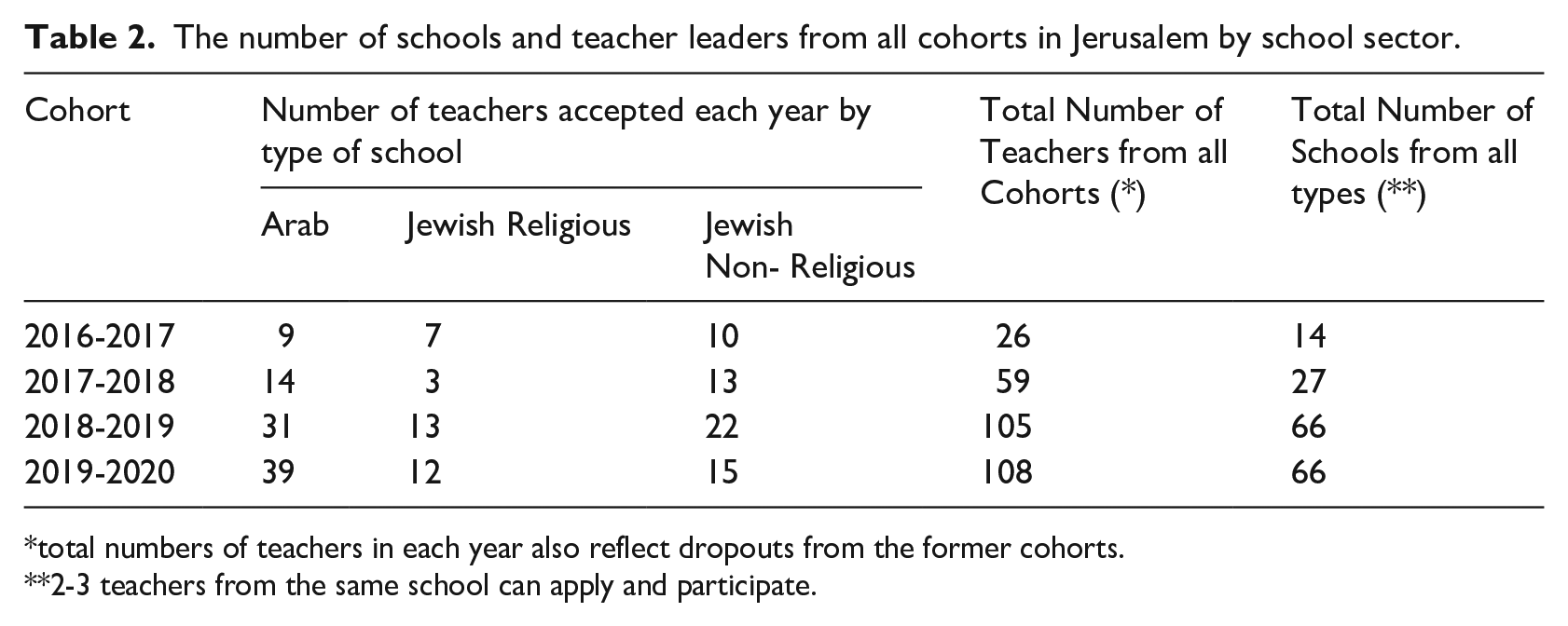
total numbers of teachers in each year also reflect dropouts from the former cohorts.
2-3 teachers from the same school can apply and participate.
Candidates who met the criteria were invited to participate in a selection workshop. Because of the language barrier, separate selection workshops were conducted for Arabic and Hebrew speakers in the two teacher development centers of the city. The purpose of the selection workshop was to assess the ability of prospective teacher leaders to inquire, learn, and lead colleagues, and to allow candidates to exhibit their interest and understanding in the topics they wanted to examine in their school-based professional learning communities (PLCs). After the selection workshops were over, a district committee discussed the recommended lists from both Jewish and Arab development centers of the city and made final decisions selecting the prospective teacher leaders.
The number of teacher leaders recruited from each sector was determined by the Ministry of Education each year, aspiring to balance the number of candidates between the Jewish religious, Jewish non-religious, and Arab sectors. The notion of ‘the good balance’ was challenged as the program advanced due to a higher demand in East Jerusalem. In addition, the district’s committee aspired to balance between elementary and high school teachers.
Teacher Leaders’ Model of Professional Development
In response to the vision articulated by Hashkafa, the Jerusalem district developed a new model for professional development based on three principles: (1) implementing a research-based theory and methodology for teachers’ professional development of inquiry on pedagogic practice, (2) establishing professional learning communities within schools based on teachers’ motivation and choice, and (3) designing bi-national professional training that aims to deepen inquiry into practice. Training was especially designed to enable teachers to study in their first language, hence: (1) training is accompanied by bilateral simultaneous translation, (2) learning materials are bilingual, and (3) trainings are guided by both Jewish and Palestinian facilitators.
Furthermore, while striving to develop a common, unified professional language, the model also needed to take into consideration the major differences between East and West Jerusalem – political, economic, and cultural. Between 1948 and 1967, Jerusalem was divided by a border into two parts, East and West, controlled by Jordan and Israel respectively. After 1967, Israel merged East and West Jerusalem by administratively extending the municipal boundary of the city. Yet, the terms East and West Jerusalem are still used to refer to Arab and Jewish areas. The educational system in East Jerusalem is a sub-system of the larger Israeli educational system with a majority of Jewish decision makers. Curriculum and related policies focus on the heritage and culture of the Jewish people, and downplay those of the Arabs. The Arab schooling in East Jerusalem serves a disadvantaged population of residents (after the 1967 war, Palestinian inhabitants of Jerusalem were granted residency, not citizenship) who suffer from poverty and inequality in public services. The traditional Arab culture respects hierarchy and power relations. Schools are gender-segregated and children are viewed as part of extended families; their individual interests and needs are not necessarily realized. There is no doubt that these differences affect every dimension of school culture, including leading teachers’ role and functioning in a school.
The Jerusalem team’s model for professional learning (Figure 1) focuses on a learning cycle designed in four phases to promote the study of representations of practice (Ball, Ben-Peretz and Cohen, 2014; Grossman, 2011; Grossman et al, 2009). The four phases are (1) defining the issue or question for joint study and learning, (2) selecting and creating the representations of practice for inquiry and study, (3) analyzing the representations of practice, and (4) drawing conclusions for implementations of practice, further study of the current issue and phrasing additional questions. Training also focused on equipping the teachers with coaching skills necessary for leading a PLC in their own school.

The Learning Cycle.
The novelty of the teacher leader role demanded learning how to lead the PLCs, which requires learning facilitation skills. Hence, we used the learning cycle in the training sessions to collectively study and improve the teacher leaders’ work with their PLCs. Accordingly, the authentic representations analyzed in the training sessions included transcripts, pictures and audio recordings from the PLC discussions that help the participants learn about a question related to leading the PLCs (e.g. how to handle resistance of PLC members, how to encourage multiple perspectives about an issue). While inquiring about teacher leaders’ practices in the PLC, we only briefly addressed critical issues of pedagogical practice.
The Jerusalem team began their work together at the end of yet another difficult and violent time, during the ‘Knife Intifada’ in which mainly Palestinian minors were involved, most of them pupils in the city’s educational system. For some of the Palestinian teachers who participated in the program, the first meeting was also their first professional visit to West Jerusalem. Jewish teachers were astounded to discover that there were ‘Arabs’ in the room, that earphones were provided so that they could understand ‘them’ (and not only for the Arab teachers to understand the Jewish teachers), and were surprised to meet a mixed team of instructors.
The group was led from year one by two instructors, Dua and Hila. It was their first time working together, and they had no previous experience in multicultural group instruction. They got to know each other through this project. During the first year, Yael, an experienced professional development facilitator, contributed to the design of the course and joined all meetings, facilitating some units that all three developed.
From the beginning of the training, the co-facilitators made deliberate choices in order to create a sense of equality and confidence among participants, including giving both Arabic and Hebrew languages an equal status in the meetings by using simultaneous two-way translation and bilingual materials, as well as including facilitators from both nationalities. However, the barriers were challenging. Initial meetings of the Jerusalem teacher leader team were characterized by uncertainty, with some tension and even subtle hostility. Members segregated themselves even when they expressed enthusiasm and curiosity regarding the Jewish-Arab encounter. Though initial hostility disappeared and some sense of belonging to a mutual group evolved, a professional appreciation, as well as mutual respect and understanding, were slow to develop.
The teacher leaders teach in schools that vary dramatically in socio-economic level, teaching methods, climate, and culture. Discussing issues related to leading PLCs in the multicultural group sometimes resulted in lack of interest or miscommunication. Some examples from the first two years will illustrate the point: some Jewish teachers did not listen to the Palestinian facilitator or teachers, and participants from both groups found it hard to remember the names of the ‘other’ group members. In the seventh meeting of the first year, while learning how to identify resistance within their PLCs and work with it, one Palestinian teacher said, “In our schools there is no resistance. What do you mean by ‘resistance’?” The comment seemed strange to the Jewish participants, who tried to convince her that resistance does not disappear once a decision is made and that an unexpressed resistance can be powerful, nonetheless. Probably what this teacher meant is that power relations in Arab schools do not allow clear expression of resistance and so she as a teacher leader cannot notice it in her community. However, this interpretation of her questions was not discussed as participants were unsure about how to relate to it.
Introduction of the AIW Framework and Professional Learning Processes
The training in the first two years helped teacher leaders to grow as PLC leaders, yet it did not provide participants with rich opportunities to collectively examine and transform the quality of students’ learning. To help teacher leaders have a better focus on teaching practices and the instructional core, Authentic Intellectual Work was introduced in 2018-19. More than 20 years of research, conducted in diverse school contexts, has consistently shown that students are more engaged, and learn more and more equitably, when teachers challenge them to think critically, to delve deeply into problems and concepts, and to make connections between their schoolwork and personal or real-world concerns (King, Newmann and Carmichael, 2009; Newmann, Carmichael and King, 2016). The AIW framework emphasizes criteria that are essential for helping teachers to develop and enact high quality learning experiences for all students: construction of knowledge, disciplined inquiry, and value beyond school. Construction of knowledge requires students to organize, interpret, evaluate, or synthesize knowledge to solve unique or novel problems. Disciplined inquiry requires teachers to help students develop in-depth, complex understanding of specific concepts and problems, and communicate that understanding in elaborated ways. Value beyond school insists that students apply their learning for utilitarian, aesthetic, or personal value and provides the emphasis for cultural relevance.
During AIW learning team meetings, teachers assess the quality of team members’ artifacts (‘representation’ in the Jerusalem team’s learning cycle) by using the rubrics for each of the criteria of the AIW framework. Every team meeting includes scoring and discussion of an artifact – either a teacher task, samples of student work, or observed or video-taped classroom instruction (see Figure 2) – and importantly, feedback to the presenting teacher to enhance one or more of the AIW criteria. The professional discourse in these team meetings is centered on a clear model of quality teaching and learning, generates shared understanding of the model, and contributes to teachers’ knowledge and skills for improved instructional practices, both individually and collectively.
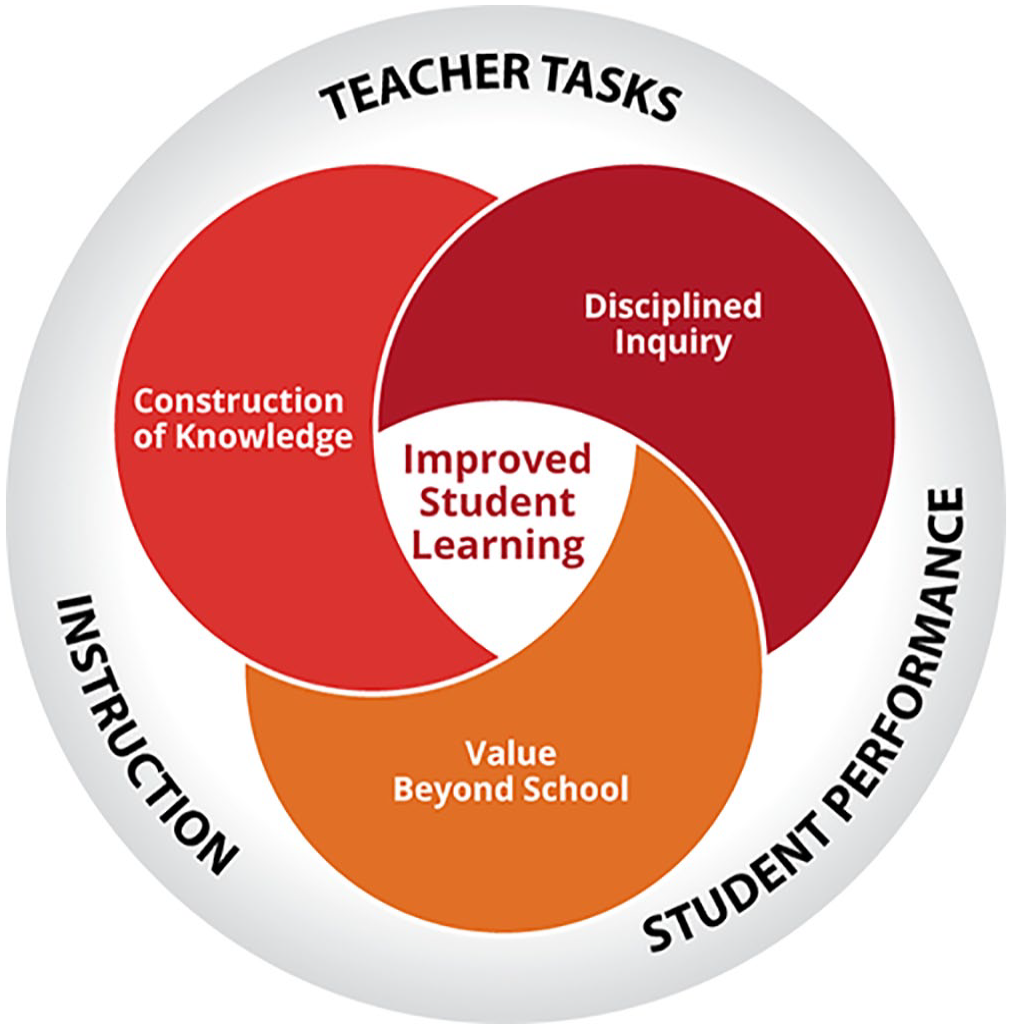
The Framework for Authentic Intellectual Work and Three Types of Artifacts.
AIW coaches from Wisconsin, USA (Laura and Bruce) worked directly with two Hashkafa teams and their facilitators, including the Jerusalem team, to pilot the integration of AIW into the teacher leadership work. We conducted eight days of workshops in Israel, over two different visits, and hosted monthly video conferences with the project planning team and with pilot team facilitators. Workshops and video conferences deepened understanding of both the AIW framework and the professional learning processes through modeling, simulations, and ongoing dialogue that was often based on issues and questions raised by the teacher leaders or by the facilitators during and after their team sessions.
Integrating the AIW framework into the Jerusalem Teacher Leader Program
Introduced to the AIW framework, the Jerusalem team facilitators found it to be a good match to their needs, particularly supporting collaborative teachers’ work to improve instructional practice and investigating representations of practice. Yet, the framework with its detailed criteria seemed to support focused pedagogical discussions and scaffold teachers as they negotiate and come to understand the meaning of pedagogical aims, concepts, perspectives, and practices. We thought that AIW’s explicit focus on teaching and learning could help us focus the teacher leaders who tended to select with their PLCs issues that were broader and with less direct influence on teaching and learning, and missed sometimes the obvious and direct ways in which they can affect their teaching as they elaborate on their beliefs and perspectives.
Though the Jerusalem facilitators were enthusiastic about experiencing AIW, we did have reservations: some related to important cultural differences. The detailed rubrics seemed ‘American’ for Israeli, or Mediterranean, eyes. The need to score artifacts and ‘work by the book’ seemed foreign and too formal for Israelis. In the Israeli-Jewish educational system, with a somewhat romantic perception of teaching, there is a tendency to emphasize teachers’ need to ‘follow their gut’ and sense of worthiness. In the Israeli-Arab educational system, especially where the Palestinian curriculum is studied, priority is given to factual knowledge acquisition and memorization, whereas AIW emphasizes the use of knowledge and subject matter content in more complex intellectual inquiries and problem solving.
An additional challenge related to the translation from English to both Hebrew and Arabic. Some concepts and terms central to AIW, such as ‘rigor’, are totally unfamiliar or rarely used by teachers in Israel. Even finding a proper and adequate translation for the framework title, Authentic Intellectual Work, was not an easy task.
For the pilot of AIW, participants were fourteen teachers from 10 schools who were starting their third year of working with the Teacher Leaders project. At the end of the previous year, the teacher leaders expressed a need for deepening and enlarging their understanding of pedagogy. They desired a broader understanding of pedagogy to nurture and steer their discussions in the school-based PLCs. In addition, judging from the discussions in the course and from teacher leader mentors’ reports, we understood that as teacher leaders, they needed a better understanding of pedagogy and a process to lead and support pedagogical discussions within their teams. As Horn and Kane (2015) stress, we found that in many cases their ability to identify opportunities for learning was restricted due to their own limited pedagogical knowledge and understanding.
For the Jerusalem team, five AIW group sessions of four hours each, and five personal coaching meetings per team member, were held during the pilot year. Interested teacher leaders could ask for more coaching time. We aspired to create a full cycle of AIW analysis, by studying in the training sessions teacher assignments, their corresponding student performances and the instruction of the relevant unit. As in prior years, teacher leaders brought their own authentic representations to the sessions, and to practice as teacher leaders in our sessions. Representations had to be sent in advance so that translation could be pre-arranged for the course session.
All group sessions had a similar structure: A modeling of AIW scoring, a scoring led by one of the participants, and an activity aimed at gaining a deeper understanding of the AIW criteria. The teacher leaders were encouraged to continue working according to the learning cycle they planned for the year, but at the third stage (see Figure 1) they were encouraged to analyze the representations according to AIW criteria. Teachers were also encouraged but not required to use AIW with their school-based PLCs, and could continue with their former planning as they learned the framework in our training and gained confidence in using it in the future.
Emerging Findings
Our work is ongoing. To date, the emerging findings reveal the complexities and possibilities of enacting professional discourse communities within an environment steeped in political, cultural, and social tensions. The local facilitators needed to develop a common, unified professional language while also taking into consideration the differences that exist within organizational cultures in East and West Jerusalem educational systems generally, as well as the diverse cultural contexts, professional needs, and experiences of participating teacher leaders. In what follows we describe three main findings regarding the incorporation of the AIW framework: (1) enhancement of the multicultural training, (2) increased depth of pedagogical discussions, and (3) improvement in leading the PLCs. Importantly, these findings are inter-related and mutually reinforcing. Multicultural training enhanced the dialogue among facilitators and teacher leaders, and the common instructional framework fostered deeper shared understanding of teacher leaders’ representations of pedagogy across the different cultural perspectives. Through these, in turn, teacher leaders modeled and enhanced important facilitating skills that helped them to work better with their school-based PLCs.
Enhancement of the Multicultural Training
Incorporating AIW into the work of teacher leaders, professional training helped to improve the training by supporting the multicultural discourse, and this enabled participants and facilitators to cherish the different professional perspectives participants hold.
The integration of AIW created common, explicit, and clear reference points for all teacher leaders that focused solely on teaching and learning, regardless of the level of their schools or their beliefs, thus promoting equality among the group members in the discussion. The AIW process insists that participants develop a joint understanding of the meaning of the framework, and this understanding evolved as participants were involved in the scoring discussions throughout the year. For example, negotiating the meaning of construction of knowledge in a specific team context is needed; however, this meaning emerges through a team’s interaction with the clear criteria offered in AIW rubrics. It cannot be solely based on individuals’ perspectives and beliefs. Thus, teacher leaders in the training session could relate to the importance they ascribe to memorizing or to the hurdles they face as they let students construct knowledge on their own and make mistakes on their way. Yet, they had to relate to specific teaching requirements as present or absent in the teaching assignment in front of them while they struggled with the meanings of the framework’s criteria. Indeed, as the sessions evolved, we found teacher leaders to be more open to seeing other perspectives and valuing the different professional experiences shared in the room.
For example, we scored and discussed in small groups a math teaching assignment brought by an elementary Jewish religious teacher, Keshet (all teacher leader names are pseudonyms). The assignment required students, in pairs, to create different five-digit numbers with a set of five raffled digits. This was the first teaching assignment brought by a team member to be scored and discussed in the teacher leader sessions after the introduction to AIW.
The participants scored the assignment low on construction of knowledge, elaborated communication, and value beyond school. However, the discussion was very cautious as teachers tried to mitigate the possibility of what Vedder-Weiss, Segal, and Lefstein (2019) term ‘face threat’: interaction that might negatively impact someone’s public image or self-esteem. They expressed creativity trying to find reasons for the design of the assignment, thereby undermining teachers’ critical colleagueship regarding this artifact. But Rawya, a Palestinian high school math teacher, expressed an explicit criticism of the assignment, ignoring the possibility of a face threat for the other participants. She explicitly said that the assignment should be actually scored zero on all three criteria and reasoned her scoring. Despite the initial shock, her statements moved the discussion forward and caused the Jewish teachers in the group to see Rawya as a professional for the first time. Actually, Rawya was the Palestinian teacher who two years earlier did not understand what resistance in a group was and hence was disregarded by the Jewish teachers. In this case her strong, though roughly expressed, opinion about Keshet’s assignment caused the Jewish teachers to see her in a different light and they explicitly said so to the Jewish facilitator.
Gradually we realized that the Jewish teachers began to listen more carefully to all participants and to the Palestinian facilitator. Participants tended to be less segregated and worked in heterogeneous groups spontaneously. By the end of the last year, in the last meeting of the AIW pilot year, three small groups naturally convened: a Palestinian facilitator with religious Jewish teachers discussing in Hebrew; a Jewish facilitator with Palestinian teachers and Jewish teachers discussing in Arabic, Hebrew, and English; and another Jewish facilitator with Palestinian teachers and a Jewish teacher discussing with simultaneous translation. Vibrant discussions occurred among the three groups, as they analyzed a bilingual transcription of an in-school PLC meeting presented by one of the participants. The discussions aimed to expose the challenges leading teachers encounter when leading AIW meetings in their school communities.
Another prominent example is drawn from the third session. A Palestinian elementary science teacher from a school in a refugee camp brought a teaching assignment to be scored and discussed. This teacher, Tahani, was considered by the group as an outsider. She rarely spoke in plenary sessions and was struggling to express herself clearly. Jewish participants and facilitators attributed it to the hurdles of working with simultaneous translation and/or to her incompetence and disregarded most of her sayings. For this meeting, Tahani specifically designed and implemented in her classroom a task that would meet the AIW criteria. Upon learning the framework in the first meeting, Tahani found it to be challenging and was intrigued by the framework. Bringing her task to the training session Tahani described her work and asked for help in improving the task on value beyond school. The discussion focused on specific suggestions for improving the task. All participants, Jewish teachers included, were extremely impressed by Tahani’s attempt to implement the framework to design a task and not solely to score a pre-designed task. Tahani’s assignment and the course of bringing it to the group were acknowledged by all as a catalyst for the whole group’s learning. Tahani had a sense of professional pride, for this time she did not apologize about the difficulties she faces in her school. AIW raised Tahani’s awareness of the characteristics of meaningful learning, and she moved from awareness to action. Jewish teachers from prestigious schools learned from Tahani’s attempt and her task, and from the joint discussion. In general, the improved focus on pedagogic practice impacted on the culture of the group and enhanced as a whole as well as a mutual professional respect across the diverse members.
Increased Depth of Pedagogical Discussions
Scoring and discussing the suggestions to improve teacher assignments and student performance led participants to reflect on the criteria of the framework and explore their assumptions of teaching, learning, and assessment. These assumptions were challenged in the team’s discussions. We now present three prominent examples to illustrate our findings.
Kashet’s case mentioned above regarding the math assignment elicited an in-depth discussion about the nature of assignments that require construction of knowledge, and therefore are worthy of analyzing in PLC’s meetings. After hearing the low scores on the task, Kashet asked to stop the scoring discussion and elaborate on the teaching context and her learning goals. Though it seemed at the beginning as if she was only experiencing face-threat and responding to it, following the discussion she could better explain her goals and give the appropriate context of the task at hand in her overall teaching move. At that point, she was struggling to determine which task she should bring to a scoring session, and also with the idea of a teaching move having a main learning target that is reflected in a specific task. Her explicit muddle steered a rich group discussion regarding the different goals of assignments and, accordingly, their different designs.
However, this episode helped us to recognize that the reason for bringing an assignment to an AIW scoring discussion was still unclear. After consulting with Laura and Bruce, we opened the next training session with a plenary discussion regarding the kinds of teaching assignments most suitable for an AIW team discussion. The facilitators clarified that not all tasks or learning opportunities need to meet criteria for high level authentic work, and that the teacher leaders (and their colleagues in the school-based PLCs) should examine artifacts of practice that should or might meet the criteria. The goal, especially for a teacher new to AIW, is to strive to offer more learning experiences that achieve the AIW criteria.
A second example illustrates how teacher leaders came to examine students’ work as opportunities to understand students’ thinking rather than as a means to assess and evaluate student learning. Sima, a Palestinian elementary science teacher, brought an artifact of student work—a model of the human urinary system created by a fourth grader upon learning the urinary system in the classroom. The participants asked for clarifications: What was actually required from the students? What did they previously learn in the classroom? It seemed from the way the model was produced that every picture of the urinary system elicited from the internet would produce more or less the same model. They were impressed by the choice of materials, thinking it manifested the student’s understanding of the different elements in the system, and they appreciated the aesthetic work of the student. However, looking at the model closely with the AIW criteria brought up second thoughts regarding the goal of the assignment and whether it could truly reflect a student’s understanding of the target concept. The specific discussion of Sima’s representation led to a general disillusionment. Teacher leaders came to acknowledge that projects that may encourage students’ engagement and a general enthusiasm in the classroom might enhance some creativity and knowledge acquisition, but not necessarily knowledge construction or in-depth understanding of scientific concepts such as systems. This discussion helped the teacher leaders to identify the difference between scoring a task low according to AIW criteria and at the same time grading it high as it matches the initial teacher’s goal and rubric.
In our third example, Shula, a Jewish religious elementary special education teacher leader, brought a domino game she designed to have students match proper nouns with the correct morphemes in Hebrew. Shula asked for the group’s help to decide on whether this game is more suitable for learning new knowledge or for assessing previously learned knowledge. Specifically, she was concerned whether she should first teach the desired Hebrew morphemes and then let the students rehearse by matching the domino’s options, or should she let the students match the words and reason their matching, and thus figure the morphemes. As the teacher leaders started to score the assignment, they realized that scoring depended on the exact context of using the assignment. As an exercise of prior knowledge, the assignment would be scored low in terms of AIW. However, it could also be used as a learning-new-material assignment and thus it would score high on AIW criteria since it would demand a higher intellectual effort from the students. These options of seeing the game cast doubt on many teachers’ entrenched beliefs regarding the ‘right order’ of learning, i.e. the need to start with explicit teaching and only then move to application or other types of higher order thinking.
Improvement in Leading the PLCs
Since our major goal is to support teacher leaders in their role of leading in-school, or school-based, learning communities, we were specifically pleased to learn of the value that the teacher leaders attributed to the AIW framework and process in their actual work. These findings rely on teacher leaders’ reflections in the course, in their summative tasks and on the reflections with their personal coaches. Although the initial introduction of AIW in the first session caused a lot of stress, uncertainty, and fear about implementing the framework, teacher leaders introduced it relatively fast within their PLCs and shared their experiences with us.
Shani, a Jewish special education elementary teacher, said, “At first, I was very tense to lead the AIW scoring, since I did not control either the method or the terminology. I felt that the discussions were superficial and quick, and that I’m treating the scoring as if it is a checklist. As I let go and was in the position of, I’m not an expert; I’m studying it with you, the discussions became slower and deeper.”
Similar insight was brought up as Keshet reflected with her coach on the progress she has made during the three years in her role:
It is the third year that I’ve been leading the same community. I don’t take it for granted. 15 meetings during every year for teachers to sit and learn together; it is something very unique in our crazy school life. And the teachers keep coming [. . .] Do you remember that last year we talked about the difference between a teacher leader that leads the learning of the community and a teacher leader that controls and does everything for the community? I still feel the need to bring new materials to the community and to make it more interesting, but I think that this year with AIW, I have made big progress in terms of letting go.
I felt you made a big step with letting things go this year. You gave the community members more opportunity to be proactive and to be in charge of the community learning. Regarding AIW, I appreciate what you have done. You took something you don’t thoroughly understand and brought it for a trial to your community.
Yes. It was something I have never done before. I’m supposed to be the one who has the knowledge, aren’t I? (laughing)
What enabled Keshet to release some of the control she applied over her community? Surely she was progressing as she worked hard with her coach on the issue that they identified as one of Keshet’s goals. However, we do assume that part of it relates to the AIW framework and the fact that although the framework was not completely understood, it structured equal participation of all the teachers in the discussion. The protocol forced Keshet to let the teachers express their understanding and to negotiate the meaning of the criteria and the representation at hand even when she was skeptical at the beginning. Through continuous scoring meetings, they did advance their shared understanding of their work and purposes.
Other teachers’ reflections demonstrate the ways they perceived AIW to be helpful in their work. Shula reported that as her PLC was struggling to promote gaming for learning new knowledge, they found the AIW framework helpful to identify what are the highlights that teachers should look for as they design the different tasks. She wrote: “AIW contributed to our learning cycle issue which was how gaming can serve in acquiring knowledge. During scoring we realized how we can improve knowledge acquisition through gaming, how students can elaborate on their understanding, and how this learning can be significant.”
Sima wrote in her reflections at the end of the course: “The AIW process of facilitating is more mindful because the teacher who brought the representation does not lead the discussion but another person is in charge of leading the group.” Many teacher leaders, like Sima, found that the protocol of leading the scoring discussion scaffolded their PLCs better than the more open model used previously; the teacher who brought the representation provided the context and clarified the need for improvement, while another teacher would lead the scoring process, the discussion and reaching the conclusions. At the end of the discussion, the teacher who brought the representation would clarify the take-aways from the discussion and explain how she would improve her practice. Sima added: “It is worth mentioning that many [PLC’s] discussions that do not integrate the authentic intellectual work end without suggesting improvements. But in the AIW discussions there is a commitment to reach the stage of proposing improvements [. . .] While seeking consensus regarding the scoring, differences can be very useful, as they provoke discussion, clarification of explanations and a reassessment of each participant’s understanding of the criteria.” Another teacher leader, Mika, added: “The clear criteria helped us to be clearer and more focused in our discussions, when we looked at representations of practice. The scoring method made it easier to assess and critique the teacher task rather than evaluate or be critical of the teacher themselves.”
Conclusion
Three important themes and implications have emerged from our joint inquiry. We discuss these in this concluding section. First, in both Israel and the United States, teacher professional development generally tends to adhere to more theoretical and didactic approaches. In contrast, professional learning of both the AIW pedagogical framework and teacher leadership skills were enhanced primarily by ‘learning by doing’ (Dewey, 1938; Elmore, 2008) in the Jerusalem Hashkafa team. Examining artifacts of student work is a good example. Teachers are used to examining students’ work mainly to evaluate and grade their learning. Teacher discussions about students’ work usually focus on widely varied subjective or inconsistent judgments, or on fairness especially when taking individual students into account or evaluating subtle differences of presentations and essays. This process has rarely affected the teaching process. The AIW framework required teachers to examine students’ work for purposes other than grading or evaluating right and wrong answers. Teachers’ examination and discussion concentrated on students’ ability to analyze, use and understand disciplinary concepts, and communicate in an elaborate manner. This intentional and thoughtful examination by teachers helped them to uncover students’ thinking with the aim of improving their teaching methods and students learning.
Second, it is clear for the Jerusalem team, and for the Hashkafa project in general, that embracing uncertainty and collective inquiry into pedagogy, supported by a framework for pedagogy with clear criteria (see Bowe and Gore, 2017, for the importance of a substantive focus on pedagogy for teachers’ professional learning), is critical to teacher learning and change in instructional practices. This contrasts with the common problem of expecting teacher leaders to be, and representing them as, experts in pedagogical content knowledge. In diverse cultural contexts, this problem is likely exacerbated. Theories about teaching and learning that guided this project from the start included respecting different perspectives, being willing to question and reconsider assumptions, and reflecting deeply on one’s own teaching. The teacher leadership group has facilitated that kind of non-judgmental reflection. Teacher leaders took up the ambiguity and the challenge, captured initially by one of them when she said “What is ‘authentic intellectual work’? What is ‘intellectual’? By definition, by work? What is the meaning of the concept? It is an unclear concept as the basis of what I will work on. And it is not in Hebrew and this affects my understanding and interpretation.” It is essential to embrace and tolerate uncertainty as a teacher leader, and this was made even more apparent during the work with AIW.
This theme relates to our third conclusion, that teacher leader self-perception and identity are continually constructed and reconstructed. Teacher leaders no longer viewed their role as primarily ‘being the expert’, but rather a coach, facilitator, and co-constructor of pedagogic knowledge and practice. Thus, the year’s work made a direct difference in teacher leaders’ work in their school-based PLCs. A specific instructional model with a straight-forward process for collegial dialogue and inquiry supported teacher leaders as instructional leaders. Even though an ‘import’, the AIW framework was closely related to Palestinian and Israeli teachers’ world, provided clear criteria, and promoted the exploration of pedagogy and changing pedagogic practice.
Importantly, evolving individual and collective identities among Israeli Jewish and Palestinian teacher leaders included enhanced respect for the other’s work, identity, and culture, both professionally and personally. Having facilitators from both backgrounds contributed to a sense of security and belonging among participants. Giving both Arabic and Hebrew languages an equal status in meetings and materials was critically important for creating a sense of equality and confidence among participants. The two Jewish facilitators learning and using Arabic was a powerful and effective symbol of inclusion and multicultural respect, especially with the recent ‘nation state law’ that established Hebrew as the official language of Israel and gave Arabic only ‘special status’. We have not considered the nature of the curriculum in any of the schools represented in this project, and this is crucial for future work. But importantly, a more positive cross-cultural, or multicultural, identity among diverse teachers can be nurtured through substantive collaborative work on pedagogy.
In a region of persisting cultural tension and conflict, this is a small but hopefully not insignificant experience for seeking more democratic schooling and a more democratic society. The Jerusalem team, including the teacher leaders and these co-authors, exhibited concern for the dignity and rights of individuals and for a common (pedagogical) good; belief in the collective capacity of people to identify, inquire into, and solve problems; and cultivated critical reflection and analysis to evaluate educational ideas and practices. We cannot speculate on its long-term or wider educational or social impacts, but we have at least experienced both structures and practices that enact and extend the democratic way of life, inclusive of all. For this diverse, urban group of leading teachers, proud of their individual and collective professional work, there is an emerging common understanding of a shared conception of professional practice (even across three languages) and a growing mutual respect for the ‘other’. A few bridges are overcoming both real and perceived borders.
Footnotes
Author’s Note
Ariel Levy is now affiliated with JDC (Joint Distribution Committee)-Ashalim, Israel.
Declaration of Conflicting Interests
The author(s) declared no potential conflicts of interest with respect to the research, authorship, and/or publication of this article.
Funding
The author(s) received no financial support for the research, authorship, and/or publication of this article.
