



Abstract
While scholars have explained how organizational imprints evolve, they have yet to explore how newcomers discern the meaning of existing imprints. Drawing on a field study of a home healthcare agency, we demonstrate how newcomers’ discovery of imprints spurs an assessment process through which they personalize the imprints before enacting them through task performance, affective commitment, and preferences for selection. We discuss the implications of our work for scholars seeking to better understand the cognitive and social-cognitive processes underlying newcomers’ experiences with organizational imprints and the ways in which such engagement might shape their persistence.
Keywords
In 2006, three nurses founded Fusion Nursing, a US-based home healthcare agency that has grown to serve over 500 patients. Fusion’s early years were marked by uncertainty as its founders operated without entrepreneurial experience in a community saturated by competing agencies. Facing these constraints, the founders designed flexible roles for themselves and other employees to juggle the competing, often-evolving responsibilities of operating the agency. They also targeted patients that other agencies largely avoided—including those from underserved ethnic groups or with psychological conditions—to establish a reliable patient population.
These practices have continued to characterize Fusion despite extended periods of successful growth that arguably tempered their importance as survival tactics (cf., Marquis and Tilcsik, 2013; Selznick, 1957). Their persistence thus suggests that they represent organizational imprints, or enduring features, beliefs, or practices that take root during environmentally susceptible periods (Simsek et al., 2015). For example, as was the case at Fusion, founders might respond to uncertainty during a business’s early years by designing flexible roles for themselves and their initial hires. The presence of organizational imprints thus “implies that firms have a history, and the shadow of history persists” (Levinthal, 2003: 102).
Imprinting scholars have increasingly adopted a longitudinal perspective to explain the emergence, development, and manifestation of these “shadows” (Baron et al., 1999; Johnson, 2007) as tacit fixtures of organizational life that shape cognition and behavior (Selznick, 1957). However, the organizational contexts in which imprints survive are not static; instead, they are marked by churn as members inevitably depart and join them. As a result, organizations often manage “at least four generations spanning more than 60 years” (Cogin, 2012: 2268), including those who were not privy to the genesis of imprints nor the meaning their predecessors ascribed to them (Marquis and Tilcsik, 2013; Selznick, 1957). Furthermore, given that imprints often arise during founding periods—a time marked by great uncertainty and reactivity (Oliver and Vough, 2019)—reasons given as to why imprints exist are unlikely to resonate with newcomers who encounter the organization in a different state than when those imprints took root. Should newcomers fail to discern meaning in these confusing practices it is likely that they will erode (Tilcsik, 2010) or inspire newcomers to leave the organization outright (cf., Schneider, 1987). However, while scholars have intimated a bottom-up dimension of the imprinting process (De Cuyper et al., 2020; Tilcsik, 2014), we have yet to theoretically explore how newcomers encounter, discern meaning in, and impact the persistence of organizational imprints.
The need to understand the character and outcomes of this discernment process is important because imprints embed themselves into organizational culture (e.g. Simsek et al., 2015; Zyglidopoulos, 1999). These “echoes of the past” (Greve and Rao, 2012: 635) are thus likely to be routinely encountered by a wide range of organization members. For instance, new hires might note the ubiquity of seemingly unexpected or anachronistic practices that drastically diverge from those enacted by other successful organizations in the industry (De Cuyper et al., 2020). However, despite the likelihood of these encounters spurring meaningful engagement with existing imprints, Simsek et al. (2015) note that “most accounts of imprinting processes are oversocialized, emphasizing the role of institutional and cultural embeddedness . . . without sufficient focus on the role of individual and collective agency” (p. 306). This focus also highlights a practical limitation, as an emphasis on institutional forces prevents scholars from giving managers the tools to reproduce valued organizational imprints. We thus developed a two-part research question: how do newcomers discern meaning in existing imprints in the organizations they join? and how does the discernment of meaning influence imprints themselves? To address these questions, we draw on a field study of a home healthcare agency in which we interviewed and observed its founders and employees.
Our resultant theory, which explains a three-stage process through which newcomers encounter, assess, and enact existing imprints, offers three contributions. First, imprinting scholarship has largely assumed that newcomers will be influenced by existing imprints (De Cuyper et al., 2020; Marquis and Huang, 2010) without exploring how this influence occurs. Examining how newcomers witness evidence of imprints before assessing and enacting them provides a more individual-centric take on the imprinting process whereby they, contrary to our expectations and extant perspectives, assign imprints personalized meanings long after they have formed. Second, scholars have drawn attention to the intergenerational transferability of imprints (Burton and Beckman, 2007; Tilcsik, 2014) without fully addressing its mechanisms. By exploring the experiences through which newcomers discover imprints and engage with veterans to assess them, our research more thoroughly explains how imprints are relayed interpersonally. Third, researchers have delineated a three-stage process through which imprints become embedded in organizations (Simsek et al., 2015), but have yet to explore how newcomers discerning meaning in existing imprints might influence their erosion or persistence. Drawing from extant theory on imprinting and sensemaking (Maitlis, 2005), we theorize ways in which the process we outline here—and particularly newcomers’ engagement with veterans during it—might influence the lifecycle of imprints as they are bolstered by the assignation of novel meaning(s) over time.
The cultural embeddedness of organizational imprints
Research on imprints argues that they reflect forces present during relatively short, susceptible periods in an organization’s history (Johnson, 2007; Marquis, 2003). While scholars long sought to understand their “stickiness” (Boeker, 1989), recent work suggests that imprints’ persistence owes to their embeddedness in organizational culture (Simsek et al., 2015). Much like Schein (1985), who posited that “a founder’s beliefs and values are taught to new members and, if validated by success . . . undergo cognitive transformation into assumptions” (Hatch, 1993: 659), imprinting scholars recognize how, should certain norms persist beyond their period of technical utility (Selznick, 1957), they become more difficult to alter than the majority of cultural features that are more susceptible to external and internal influence (Hatch and Schultz, 2002).
Much of this work concerns imprints formed during founding periods and suggests organizations are primarily imprinted by three forces (Marquis and Tilcsik, 2013). First, resource constraints may impel organizations to implement practices that enable their survival during founding periods yet remain in place following environmental shifts (Carrol and Hannan, 1989), leading them to become taken-for-granted features of organizational life. Second, pressures to conform to industry standards might give rise to imprints that continue constraining organizational actions long after they have subsided (Zyglidopoulos, 1999). For example, banks founded when statewide branching was discouraged were significantly less likely to pursue acquisitions following deregulation than those in states that once encouraged such activities (Marquis and Huang, 2010). Finally, founders can imprint organizations by adopting features and beliefs that reflect their backgrounds or perceived opportunities, a phenomenon seen in contexts ranging from the high-tech industry (Hannan et al., 1996) to the Paris Opera House (Johnson, 2007). Rank-and-file members might also imprint organizations by creating lasting norms regarding the performance of their roles (Burton and Beckman, 2007).
Organizational imprint dynamics
Imprint scholars tends to expect that, once embedded in culture, imprints will be accepted by those who subsequently encounter them. For instance, Marquis and Tilcsik (2013) held that inertia and institutionalization, or the tendency for perceptions of legitimacy to perpetuate organizational features or beliefs “beyond the technical requirements of the task at hand” (Selznick, 1957: 16–17), would cement imprints as taken-for-granted assumptions long after their period of utility had ended (e.g. Marquis and Huang, 2010). Indeed, while some early scholarship put forth population ecology explanations for the persistence of imprints (e.g. Carrol and Hannan, 1989), current scholarship has primarily adopted this institutional perspective.
However, scholars have more recently acknowledged that periods of significant change might influence imprints even after they become embedded as cultural norms (Simsek et al., 2015). For instance, societal shifts (Kriauciunas and Kale, 2006; Tilcsik, 2010), poor organizational performance (Boeker, 1989), or the desire of successive leadership teams to discourage imprints (Beckman et al., 2007) might degrade them. Others have examined phenomena, such as imprint amplification, whereby imprints “become increasingly ingrained or ‘inscribed’ within an organization” (Simsek et al., 2015: 300) or imprint sedimentation, a process through which subsequent leaders re-imprint organizations to create “a superposition of different layers of imprint” (De Cuyper et al., 2020: 1580). De Cuyper et al. (2020) further draw attention to the capacity for individuals to engage with organizational imprints in ways that materially alter them, a capacity theorized (e.g. Marquis and Huang, 2010; Tilcsik, 2014), though not empirically examined, to that point.
Newcomers and imprints
Despite recent acknowledgments that individuals can influence imprints (De Cuyper et al., 2020; Tilcsik, 2014), imprinting research has largely focused on their participation in imprints’ development or entrenchment. By contrast, scholars have yet to explore the distinct experiences of newcomers engaging with existing imprints in the organizations they join to discern their meaning. However, as intimated by prior work on value displacement (e.g. replacing values traditionally ascribed to a practice—Zilber, 2002) and secondhand imprinting (e.g. “the effect of imprints carried by one’s initial coworkers”—Tilcsik, 2014: 641), those who do not witness the genesis of an organizational practice are unlikely to simply accept it as it is presented to them. Rather, the drive to assign meaning is likely to impel newcomers to engage with existing imprints upon arrival and, potentially, extend the lifespan of an imprint that institutional forces alone could not retain (cf., De Cuyper et al., 2020). For example, Burton and Beckman (2007) theorize that position incumbents with non-traditional backgrounds might imprint similarly non-traditional expectations onto their roles for future position holders. Given the idiosyncratic nature of these roles—which may differ starkly from similarly titled roles in other organizations—newcomers assuming them will likely seek to understand why these norms exist. Indeed, the classification of imprints as features, beliefs or practices that outlive periods of technical utility (Marquis and Tilcsik, 2013; Selznick, 1957) implies that newcomers are likely to question why their organizations endorse norms that seem unrelated to—or perhaps in direct contrast with—perceptions of best practice (Simsek et al., 2015). Thus, rather than simply view imprints as cultural quirks, newcomers are likely to engage with them to discern their meaning.
While extant scholarship suggests that newcomers will engage with imprints, it says little of the nature of this meaning discernment process. For instance, veteran members, given their importance in socialization experiences (cf. Saks and Ashforth, 1997; Tilcsik, 2014), are well positioned to play a role. However, while we understand that those who witnessed an imprints’ genesis are likely to socially transmit them to newcomers (Tilcsik, 2014), we do not yet understand the nature of this transmission. Furthermore, it is possible that newcomers might discern meanings that resemble or depart from those proffered by veterans (cf., Zilber, 2002). However, as studies of engagement with imprints have tended to focus on organization members as a collective rather than parsing the experiences of newcomers (e.g. De Cuyper et al., 2020), prior research does not afford a means to credibly theorize the paths through which newcomers accept—or perhaps reshape—imprints. We thus set out to study how newcomers discern meaning in existing imprints in the organizations they join to begin theorizing these connections.
Methods
Given our desire to study organization members’ lived experiences, we adopted an inductive research approach (Corbin and Strauss, 2008) and gathered qualitative data to enable the development of novel theory (Eisenhardt and Graebner, 2007). We decided upon collecting data from a single organization to capitalize on rich data from an organization in which members appeared particularly attuned to organizational imprints (Yin, 2015) and attended to established conventions of qualitative research to understand their lived experiences.
Case overview
We chose to analyze the experiences of employees at Fusion Nursing due to initial evidence of two long-standing, idiosyncratic practices. The first was a norm surrounding flexible roles, as employees widely endorsed expectations that they would perform tasks outside the purview of their official positions. For example, a clinical director found herself “doing the referrals and intakes, ordering all the medical and office supplies, taking phone calls and doing triage, and talking to the air conditioning maintenance man” (30). The second centered on the targeting of higher-risk patients that other agencies largely overlooked, such as psychiatric or non-English-speaking patients, due to issues finding services and high-quality insurance for these populations. Members’ widespread endorsement of these practices during initial interviews and observations (2015) led to an initial research question regarding organizational culture dynamics.
However, conversations with founders during our primary data collection period (2015–2019) suggested that these practices were in fact organizational imprints. We learned how, during Fusion’s early years, employees handled multiple responsibilities to keep the agency functioning while targeting high-risk patients to secure a revenue stream in a saturated market. This approach helped Fusion become financially viable while serving the community’s perceived “psych niche” (13). These claims were further supported through conversations with the second author, who had served as a full-time business consultant for Fusion during its founding period. His work, which involved close contact with both the founding team and Fusion’s early employees developing strategies and ensuring compliance with HR standards, gave him unique insight into the genesis of these two imprints and, upon revisiting the organization as part of data collection in 2015, how they had changed in the intervening years. In this regard, Fusion’s role flexibility and primary strategy were initially designed as survival tactics. Furthermore, by the time of our arrival, Fusion had emerged from a period of susceptibility and grown into one of the premier home healthcare agencies in the region. The emergence of these practices during the founding period—and their widespread endorsement as cultural norms during data collection—were thus consistent with characterizations of the imprint development process (Simsek et al., 2015). We henceforth refer to these two imprints as the role flexibility imprint and strategy imprint.
As we began inquiring about these imprints during interviews, we learned how employees engaged with them as newcomers. For example, many employees related a feeling of shock when discovering the proliferation of flexible roles at Fusion and a need to understand why this well-established agency endorsed this seemingly idiosyncratic practice. Furthermore, over the course of our interviews and observations, we began to note changes in how employees discussed Fusion’s imprints; instead of being characterized as survival tactics, the role flexibility and strategy imprints were more commonly described as reflecting the importance Fusion placed on development and compassion, respectively. Our inquiries thus revealed the meaning discernment process that precipitated newcomers’ embracing of the imprints they encountered.
Data sources
Interviews
We interviewed 40 employees (including Fusion’s three founders), 26 of whom we classified as newcomers as they began working at Fusion within a year of our first round of data collection from June to September of 2015. 1 We conducted a second round of interviews with 16 newcomers from January to March of 2016 following an amendment to our research protocol and held three additional interviews with Fusion’s CEO, a member of the founding group, from 2016 to 2019 (59 interviews).Table 1 summarizes the numerical identifier, stated role, tenure and number of interviews conducted with each interviewee (cf. Cloutier and Ravasi, 2021).
Data source table.
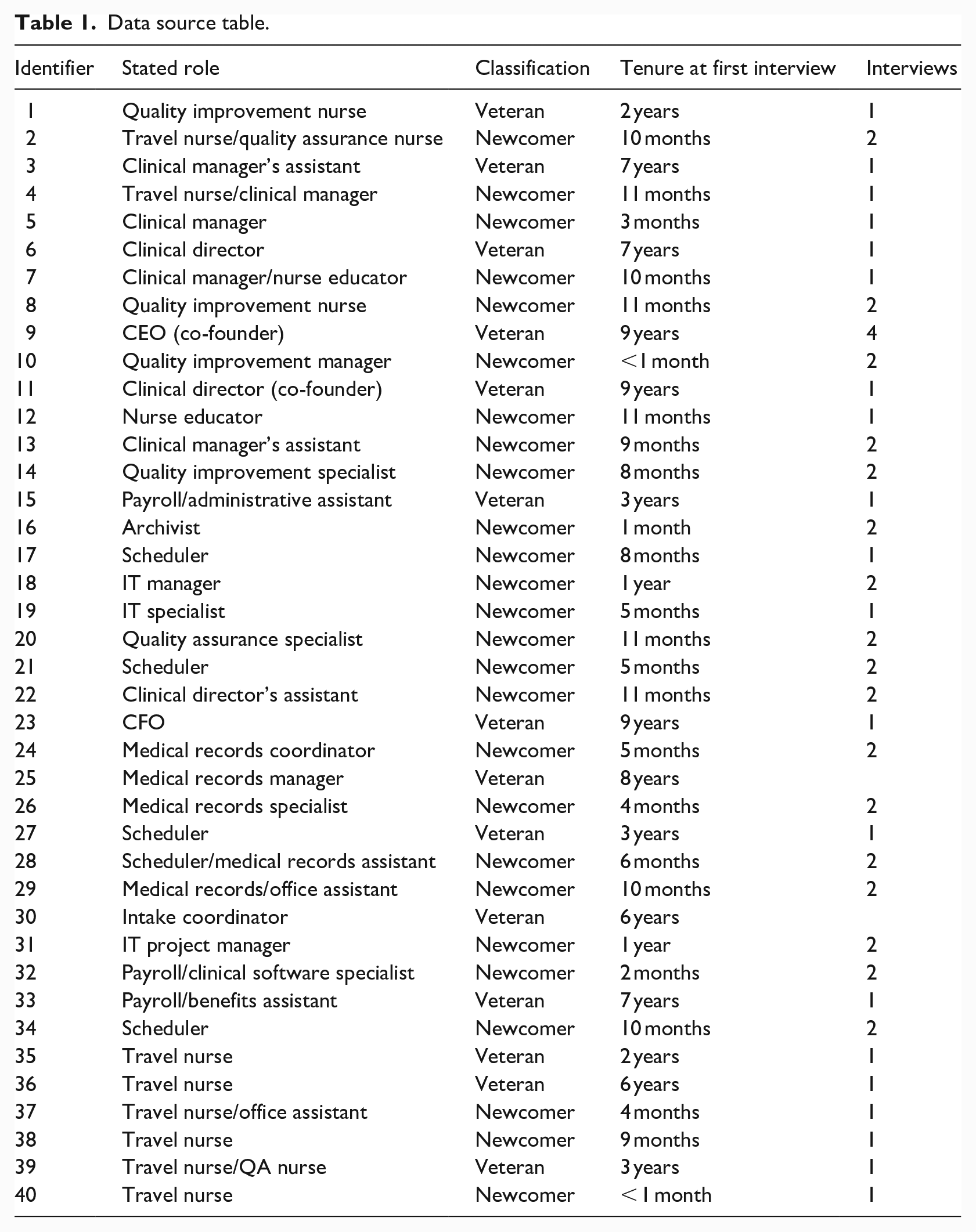
The dynamics of home healthcare, namely its largely decentralized nature, posed a potential challenge regarding data collection. Unlike traditional healthcare settings, medical staff at home healthcare agencies traditionally work in patients’ homes while making infrequent visits to office locations. Conversely, office staff generally work almost entirely at those offices and interact with nurses mainly through phone or email. For example, while a scheduler may distribute assignments to nursing staff, this communication will generally take place over email with nurses only visiting the office when concerns arise. This structure generally affords nurses a relatively high degree of control over their work and limits their exposure to the office environment.
However, our observations of and conversations with nurses revealed that, likely owing to Fusion’s role flexibility imprint, most employees were involved in some form of office work. For example, one nurse in the quality assurance team worked 24 hours a week in the office and dedicated the remaining 16 hours of his work week to seeing patients (2). Furthermore, even nurses who did not work in the office made regular visits to collect supplies and interact with fellow employees in the hallways and break rooms (OB7). We thus concluded that the idiosyncrasies of Fusion’s work design afforded most of its nurses rich exposure to imprints.
We followed a semi-structured research protocol consisting of both grand tour and mini tour questions. Grand tour questions from our initial interviews included items such as “Take me through a typical day at work,” which would be followed up with mini tour questions, such as “Can you explain that routine?” These questions allowed informants to speak at length about the issues they found relevant to their work. Follow-up interviews began with questions about experiences since our initial interviews before following an amended protocol to unpack emerging themes. For example, we asked, “Why do you believe these practices exist at Fusion?” to understand perceptions of Fusion’s imprints. Both protocols were designed in an open-ended manner so as not to lead employees into answering questions in particular ways while capturing experiences they disclosed themselves. We took notes after interviews to track their similarities and differences (Yin, 2015) and recorded all interviews for later transcription and analysis.
Informal conversations and unobtrusive observations
During our 12 full-day visits to the office, informal conversations and unobtrusive observations occurred in the break rooms, hallways, and work areas before, between, and after our more formal interviews. We also held 14 informal telephone conversations with the CEO and several assistants and schedulers over a 5-year period (2015–2019). We took detailed field notes based on these conversations and observations as soon as possible to avoid retrospective bias. We then triangulated data from observations, interviews and conversations to enrich our understanding of Fusion (Yin, 2015).
Data analysis
We sought to analyze written observations, interview transcripts, and notes without being constrained by our pre-existing knowledge of organizational imprints. We thus began with a process of open coding (Locke, 2001), searching for descriptive themes in interviews and field notes. For example, we read, “everyone’s job changes around here” (8) and applied the code “encountering evidence of imprinted practices” to it. This process produced 39 descriptive codes. We then compared and consolidated first-order codes to visualize patterns (Gioia et al., 2013) and discard others, such as “thoughts about retirement,” that did not relate to our research question. We ultimately retained 17 codes.
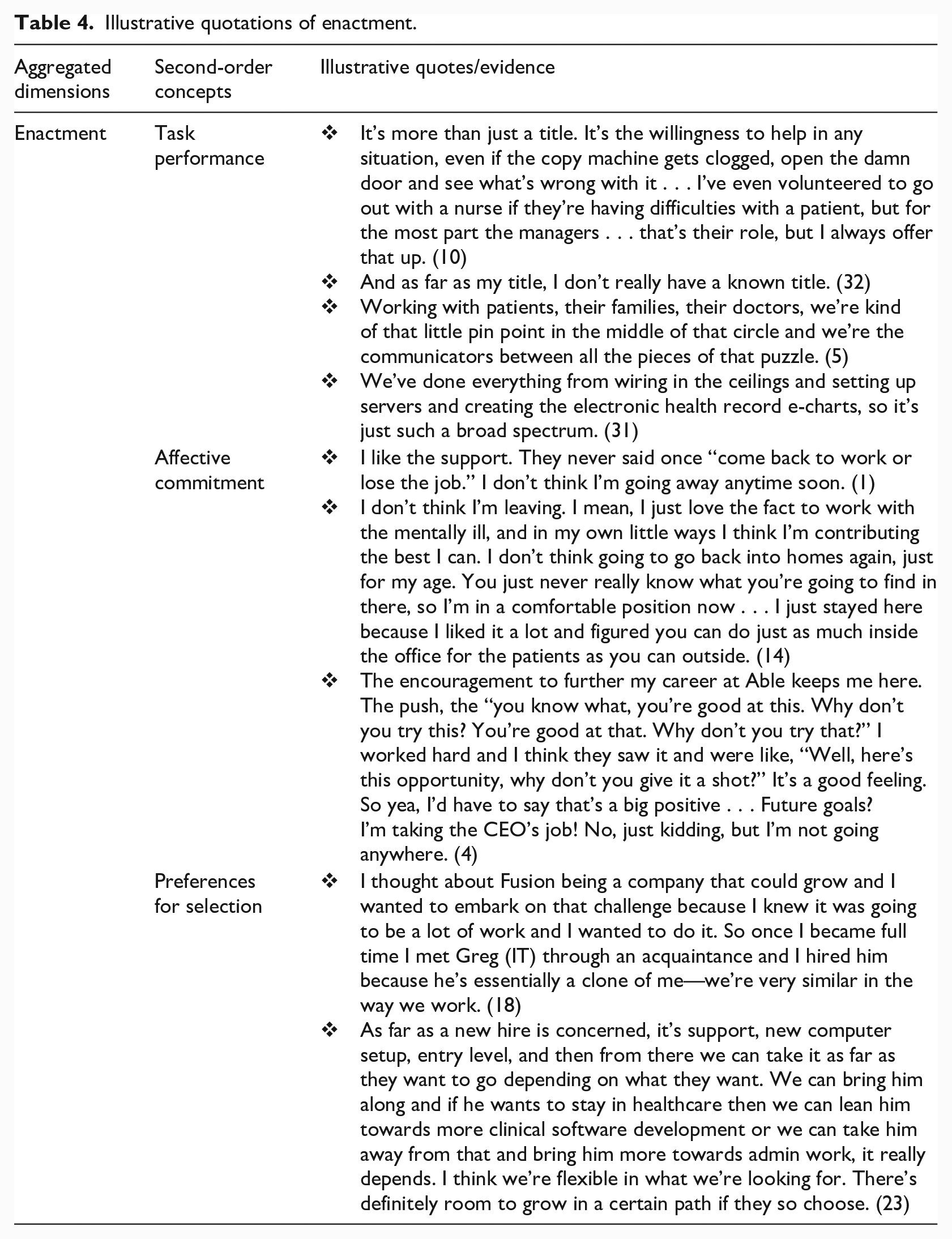
We then searched for theories to sharpen our analysis (Corbin and Strauss, 2008). For example, informants’ stated intentions to remain at Fusion due to an appreciation of its imprints led us to review the commitment literature (e.g. Allen and Meyer, 1990) and aggregate these experiences into the second-order code “affective commitment.” We then aggregated second-order codes into theoretical dimensions by combining them in theoretically meaningful ways. For example, two other second-order codes—task performance and preferences for selection—also described ways in which newcomers enacted Fusion’s imprints. We thus aggregated these codes into the dimension enactment. This cycle of deductive analysis also surfaced the aggregate dimensions discovery and assessment. Regrouping these dimensions according to newcomers’ experiences revealed a process through which they discovered, assessed, and enacted imprints. Table 2 visualizes our data structure, while Tables 3 and 4 provide illustrative quotations.
Data structure.

Illustrative quotations of discovery and assessment.

Illustrative quotations of enactment.
Findings
Our analysis suggests that newcomers’ discovery of imprints upon arrival lead to an assessment process of verifying their ubiquity, inquiring about them with other members, and personalizing their meaning. The personalized explanations newcomers formed ultimately conditioned their enactment of the imprints, shaping their approach to task performance as well as their affective commitment and preferences for selection. Figure 1 depicts our theorized process model.
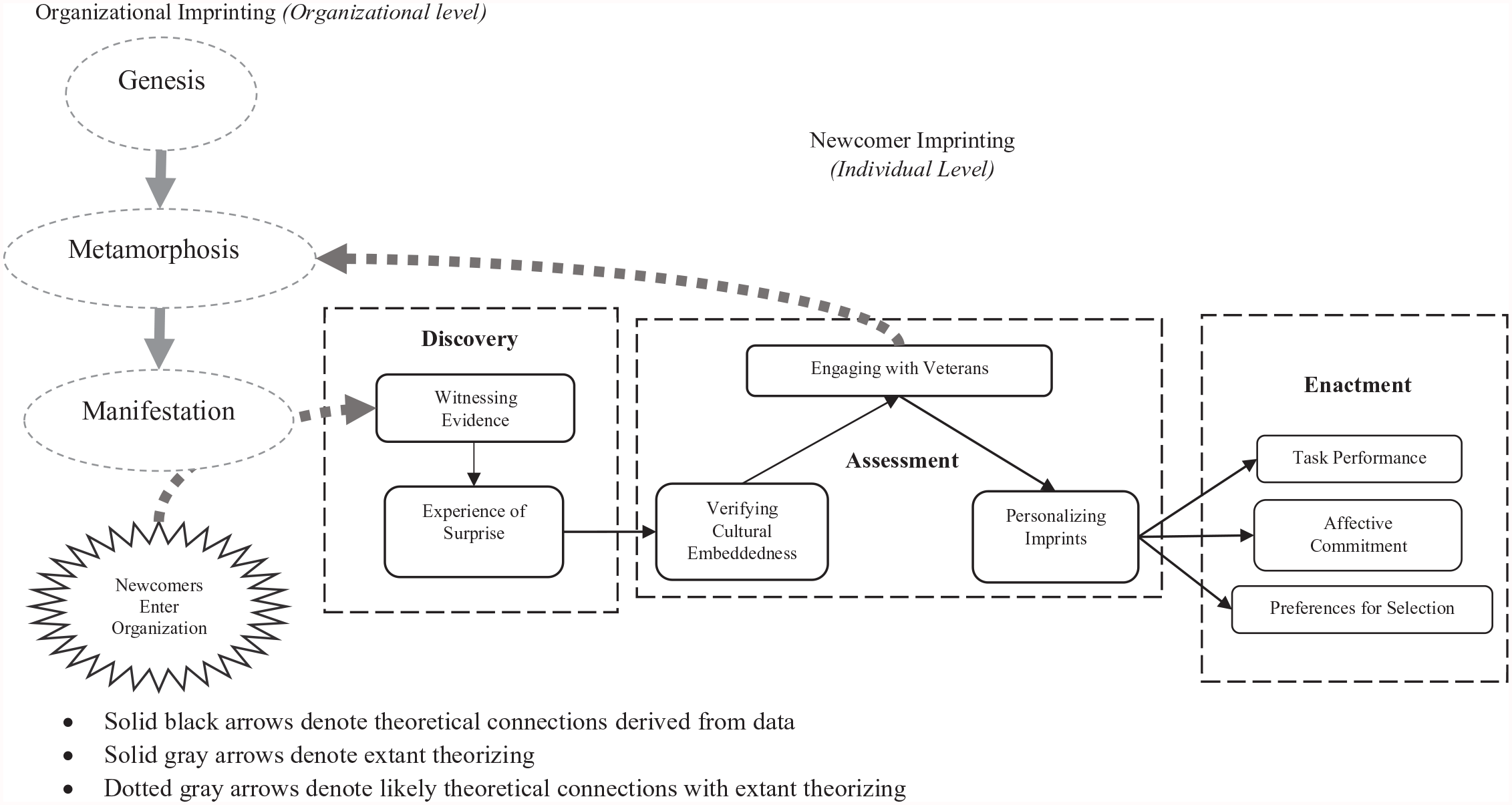
A model of discerning meaning for existing imprints.
While we provide evidence from several employees, we focus on the experiences of two individuals—Sarah (21) and Zach (26) 2 —to provide a richer appreciation of the processual dynamics we identified. Despite their official titles (scheduler and medical records specialist) both employees handled multiple, often-evolving responsibilities outside their purview. Furthermore, both individuals maintained contact with fellow office workers, nurses, and patients, and had joined Fusion within 6 months of our arrival. Initial and follow-up interviews, observations, and informal conversations with both employees revealed their engagement with imprints through their introduction to Fusion. We now recount the process we derived.
Discovery
When asked about their experiences at the agency, respondents often began by detailing their discovery of Fusion’s imprints. Of theoretical importance to the story of discerning meaning in existing imprints were two prime, sequential experiences associated with these discoveries. First, informants described their initial moments of witnessing evidence of the practices associated with the two imprints. Second, they recounted the surprise generated by these encounters and the confusion it surfaced for them.
Witnessing evidence
Many employees began their interviews by relating their first experiences with the agency’s imprints, describing encounters of evidence of them in the absence of any explanation. For example, when asked about her position as a scheduler, Sarah recounted her first encounter with the role flexibility imprint earlier in the week when she was tasked with proofreading nursing notes. She described,
get[ting] stressed because . . . of not knowing what to expect . . . not sure what they [bosses] are looking for . . . They [nurses] are overloaded trying to take care of patients but we also have tons of paperwork and other things we have to do. (21)
A lack of explanation for the role flexibility imprint proved common. For instance, Zach encountered similar evidence that working at Fusion would entail frequent changes to his role when he was asked to digitize patient files, something with which even his superiors seemed unfamiliar:
It’s tough—I started as filing, and then that quickly became medical records. And then they started to give me more jobs. More jobs. More jobs . . . It was a struggle though, to start with. Like, who the hell should I even approach about new things? Because half of the time I wasn’t sure. But then it seemed like when you asked someone, they are like “oh well maybe it’s this person.” Then you ask another person, they are like “no I’m not sure.” So some were helpful, some weren’t. (26)
Sarah and Zach further noted Fusion’s tendency to care for patients that other agencies largely avoided while reading through patients’ medical records as part of their actively expanding roles. Sarah, who had just begun reviewing patient notes within weeks of our interview, recounted a recent observation that “I will go through all the paperwork [and] we don’t seem to turn anybody down. We take the people that other companies aren’t willing to take” (21). Zach, in his new role putting together patient charts, frequently encountered evidence of the uniquely difficult nature of Fusion’s patients owing to the sheer amount of documentation required to keep track of their needs:
If we have a new patient I create the chart, making sure that we have everything we need. We print out every nursing note. Some patients are such high risk, have such high needs that we are seeing them twice a day. That’s a lot of notes. (26)
Other employees described similar, ongoing experiences witnessing evidence of Fusion’s imprints. For example, a billing specialist noted the demanding nature of his fluid role: “You are kind of just put in the middle of something you either need to absorb like a sponge or you won’t . . . it’s like sink or swim, quite frankly” (32). Another employee encountered evidence of Fusion’s non-traditional patient population days before our interview while scheduling nurses: “I think one of the major differences between us and other agencies would be that the types of patients we are seeing. For the most part we’re seeing the most behavioral health patients” (37). As with Sarah and Zach, what appeared lacking from these ongoing discoveries were explanations as to why Fusion endorsed these practices.
Experience of surprise
Follow-up questions about these experiences revealed that initial encounters with imprints inspired a sense of surprise marked by confusion about why these seemingly idiosyncratic processes were important to Fusion. For example, Sarah and Zach recounted being taken aback when first encountering the expectation that they would adopt flexible roles. Sarah noted, “when I first came here they’d have a conversation and they’d say, “‘Oh, can you do this and that’, and I’d think, ‘Why? What are they talking about?’” (21). Zach expanded on his experience of surprise:
Sometimes when they added on a job, I wouldn’t lose a job. It’s like, which one is the most important? When I came in to work, what is the most important thing to get done today? That happened to me a lot, and it was kind of overwhelming . . . If the owner was looking for something, you completely stop what you’re doing and you get whatever the hell she needs done. Like, why? Every day I came in like “alright, I have to do this, this, and this. What definitely needs to get done? That’s what I’ll do early.” My filing, what I was hired for, that’s the last thing on my mind. If it’s Friday, it’s two o’clock, I have two hours to kill, I’ll just go file. (26)
We also found evidence of newcomers being surprised when encountering Fusion’s strategy imprint as they began interacting with co-workers or, in some cases, patients themselves. For example, Sarah recalled early experiences answering the phone:
I started off as a receptionist here and we had a phone call, I had a lot of the phone calls actually, that I was surprised I couldn’t take because they were speaking another language or mentally impaired. Thank goodness we had a diverse office staff. (21)
Others demonstrated their sense of surprise by contrasting Fusion’s patient population with those of other agencies. A clinical assistant compared Fusion’s patients to those of a previous employer: “it’s not like there, where we deal with strictly elderly people with these wonderful children that live down the street or in the home. We deal with mentally ill people and they oftentimes don’t have anybody for whatever reason” (13). In sum, newcomers experienced a notable degree of confusion after discovering these unexpected practices, the pervasiveness and rootedness of which they were not yet aware.
Assessment
Newcomers’ initial encounters with imprints spurred an assessment process through which they verified their cultural embeddedness, engaged with veterans to gain an understanding of them, and ultimately developed explanations that personalized their meaning.
Verifying cultural embeddedness
While newcomers tended to discover imprints early in their tenures, the absence of explanations for them impelled searches to ascertain whether they were important to the wider organizational collective. In other words, newcomers sought to understand whether the adoption of flexible roles and the prioritization of underserved patient populations were common. Informants often described their efforts to verify their cultural embeddedness by watching others perform their roles. This approach was particularly common following discoveries of the role flexibility imprint. For example, Sarah recalled observations of her coworkers leading her to recognize that, “Everybody does multiple things and is kind of involved in everything, in every aspect of the company” (21). Zach’s monitoring of the work environment led him to note the tendency for employees with various titles to take on “red checks,” a process of verifying insurances:
Everyone in this office I feel has done red checks. It’s one of those jobs that everyone plays around with. We’re just throwing it at them. Maybe they’ve done it for like a week. But I feel like everyone kind of plays around with jobs. (26)
Newcomers similarly noted a tendency among veteran employees to support Fusion’s strategy of targeting underserved patient populations. For example, Sarah related overhearing frequent conversations in her department regarding patient outcomes:
They know that they [nurses] are overloaded trying to take care of difficult patients but they also have tons of paperwork to do. Our department discusses amongst each other because we’re all doing their paperwork and say, “Oh, so-and-so finally got out of the house. This person is going to feel so much better!” (21)
Zach mentioned how “they [his department] are all committed to helping patients who range from psychiatric patients to people who are extremely bipolar and need their meds pre-poured [to avoid overdose]” (26), intimating further assuredness that Fusion’s employees widely endorsed serving a population of which newcomers were initially skeptical.
Engaging with veterans
Having recognized the ubiquity of these practices, newcomers engaged in efforts to understand why they were so widespread. Our data indicate that newcomers frequently engaged with veteran employees to uncover their meaning. For example, Sarah overheard a conversation between the CEO and CFO (OB13) near her workspace about role flexibility. She concluded,
Everyone is willing to help with anything here because homecare is a complicated system. Everything changes constantly. One day it’s one thing, it could be something else the next. So, trying to keep up with all the rules and regulations, flexibility is key. (21)
We later observed Sarah speaking with the CEO about her difficulty informing employees of new responsibilities and was offered some insight:
Sarah: You ask someone to start filling out paperwork and they don’t quite understand. Communication is a little bit hard, especially when things change every day and we have to move and change things. Some people as just set in their ways. I mean, this is the way it needs to be done now, so that kind of communication can be a little bit hard and it takes time, but I guess you just keep being persistent. (OB21) CEO: I can’t operate with one person saying, “all I want to do is stuff envelopes” or “I don’t want to scan because I don’t want to do it.” Well guess what? You are going to do it or you’re going to have no job. You’ve got to step up or step out, and that’s how we have operated for almost 10 years now. Industry oversight is high, it’s going to be a lot higher, so our piece of it has to step up and the people that just don’t want to do this or don’t want to do that are going to have to do this or that or I’m going to have to let them go. (OB9)
Sarah’s conversation provided her with a survival-based justification, one that framed role flexibility as meaningful because it enabled Fusion’s continued operation. Other veterans provided Sarah with a similar rationale, as did a fellow scheduler when telling her,
you can’t be black and white, you need flexibility. You have a set of rules that you’re trying to follow, but then when you have eight types of situations in clinical care, you sometimes need to be able to be flexible with the ebb and flow of work. (OB34)
Other employees uncovered similar, survival-based explanations for Fusion’s strategy imprint when speaking with veterans, as did Zach when we witnessed him speaking with a quality improvement nurse about Fusion’s patient population:
Zach: We have a lot of foreign-born patients, too, and some women in the office that do speak their language. I don’t know why, but I think it’s really cool. I mean, you have people who come over to this country and they have a language barrier, it’s difficult to navigate anything, much less healthcare. (OB26) Nurse: Companies were going out of business and selling and things like that, because you have the hospital organizational chains and folks like Fusion that have to compete in a niche environment to stay afloat and to keep moving forward . . . It’s different here. All these other agencies don’t really take the psych unless they are a specialty psych agency, which Fusion is. (OB8)
This survival-based explanation was frequently echoed by veterans when speaking with newcomers. One nurse described Fusion’s patients to a newcomer as “almost like a niche, you know. You find your niche with anything” (OB38), while another said, “home care is very difficult because there’s too many large hospital affiliates so it’s very difficult to get referrals. So Fusion is a niche agency in terms of taking primarily psychiatric clientele” (OB7). One of Fusion’s co-founders transparently described this rationale to Zach, saying,
When we opened the company, I started to work in the field. And slowly we found the nurses, trained them, improved the communication, starting from zero. Teach and learn everything in one day. You do everything because you are the only one. I always tell this as a joke: For me to find patients, it was easier when they go to the local ethnic store, because when I meet people they would say, “We want to go to your company.” (11)
Personalizing imprints
While these survival-based justifications seemed to accurately reflect why imprinted practices were initially instituted (and were occasionally proffered by newcomers), evidence of Fusion’s growth and prolonged success likely tempered their appeal or credibility. Our data suggested that many newcomers, including Sarah and Zach, ultimately developed more contemporary rationales for their importance. More specifically, newcomers tended to assign additional explanations for imprints that were grounded in meanings besides “survival.” Many came to see role flexibility as evidence of the value Fusion placed on employee development and growth. They characterized Fusion as an agency that “recognizes the potential in people” (OB22) and “provides the opportunity to grow” (OB12). Sarah, who had started as a receptionist, detailed her appreciation for all she had learned and expanded on Fusion’s perceived commitment to employee growth and development:
I found it challenging. It was very challenging. You have your moments of “I’m never going to learn all this” but then it comes easy, little by little. It’s like I learned so much that I felt like I was almost in school. It’s been a great experience and one thing is they do give you that room to grow. I did an internship with [local hospital] and it didn’t seem like there was much room to grow. They [Fusion] recognize your potential right away and give you opportunities to grow more and more. (21b)
Zach similarly extolled a belief that Fusion’s role flexibility evidenced the value the agency placed on development in relating the importance of learning from co-workers:
No one is afraid to go up to someone and teach them, like, “listen, this is wrong, you have to do this this and this.” With nurses it was hard at first, when they came in and needed a suture or something like that. What’s involved in a suture? What do you need? So I learned more about needles and shots and things like that through the nurses because they are so helpful and know way more than I do. It’s nice to have them come in and sit with me because some of this stuff I don’t know. It’s nice. (26b)
Newcomers often went further in personalizing these explanations by drawing parallels between the meanings they ascribed to Fusion’s imprints and their personal values. For example, reflecting on role flexibility, Sarah said,
I like to be challenged and that’s one thing about this company that’s really good. They recognize the potential people have, so I went from answering phones to quality inspection to scheduling. They gave me that opportunity. Then I stepped into IT for a little bit and learned that I’ve grown and learned a lot whereas I probably wouldn’t have had that chance anywhere else. Sometimes I start surprising myself when I say things like “Wow, I know that!” (21b)
She further characterized her relationship with Fusion in the following terms: “I think me and Fusion coincide because the values are pretty similar” (21b). Zach shared an account of the compatibility between the perceived prioritization of employee development at Fusion and his own passion for new opportunities, saying,
it gets old, boring when you’re doing the same thing constantly every day. So, it’s nice to have something new. I mean I started out as a filer. I thought I was only going to work here for a month or so and find another job. But I kept going up and up, so it’s very nice working here. (26b)
Other employees noted similar compatibilities between imprint meanings and personal values. For example, an administrator said, “I’m a scheduler but I pick up whatever they need help. I’m the same way at home. If there’s something I don’t understand, I research it, I look it up” (28b), while an assistant noted, “the work is challenging, which is a good thing. You should do something that’s hard every day” (22b).
Newcomers also personalized meaning behind the strategy imprint and compared it to their own values. In particular, many employees viewed this imprint as reflecting an organizational value of compassion. Sarah noted,
Our work is important because these days people are so . . . they just don’t care anymore. They don’t. So, it’s nice to be in an environment where you know people are actually doing their job because they care about people. (21b)
Sarah reinforced her contention that the imprint reflected Fusion’s compassion by describing other organizational practices that she viewed as emblematic of it:
The CEO is willing to help me with my career, which I could honestly say she’s probably one of the best bosses I’ve had because she’s very open and willing to help me in any way. She’s like, “take a class. I’ll help you.” That’s great because how many people say that? So I’m just waiting until my daughter gets on her own feet, then I’ll jump in. (21b)
Sarah spoke specifically of the overlap she perceived between herself and the CEO:
Even though the CEO is older than me, I think we have common backgrounds and those backgrounds have given us almost the same type of values which she instills in her company. The value of making sure everybody is taken care of. She’s the type of person that I think I am now and could see myself being more like as I get older. She’s concerned with everyone in our company from patients to employees. She has a great concern. (21b)
Zach shared a similar conviction that compassion was of central importance at Fusion, underlying not only their strategy but also the supportive nature of his co-workers:
It’s nice. It’s also comforting too, to have people who know if you’re having any issues, personally or work related, that you can go and talk to. It’s not like talking to a wall, no, it’s someone who really cares about you outside of work. So, it’s nice. It’s comforting. (26b)
Zach likened Fusion’s compassion to his own professed love of helping others, saying,
I love helping people. I like the idea of helping. Some of the nurses come in and they’re like, “you know, I’m happy. I found a kitty for one of the patients—she’s lonely and she wanted a cat.” It’s like, I want to do these kinds of things! You know. Get out there and hug people. (26b)
A quality assurance specialist said,
They could not be more compassionate or kind. They give me opportunities here that I’m not sure I would be able to achieve maybe in a bigger company. I’m able to really learn a lot of things here. In all sincerity. I think they really care about their employees and the patient base they’re working with. And I believe that. (20b)
Enactment
Newcomers, having personalized imprints by identifying congruencies between perceived organizational and personal values, started to enthusiastically embrace them. Specifically, they incorporated imprints into their task performance, characterized it as a basis for their affective commitment, and advocated for it as a basis for selecting future hires.
Task performance
Personalizing imprints led newcomers to actively incorporate them into how they approached their roles. Sarah noted in her follow-up interview how she began asking for additional responsibilities that further diversified her role:
I want to be more involved in my department. I just started . . . this is a new step for me . . . what we call QI, going over the physician orders. I’m also monitoring all the nurses, contacting the managers, contacting the CEO, kind of being the police of the office. It’s kind of a multi-task thing. I also help with notes, make sure everything is correct in that department. I used to help a little with IT, so I’ll still get a lot of questions from nurses and managers, how to figure out our system. It’s a lot of people work. (21b)
We also noted behavioral evidence of this contention, as when Sarah sequentially resolved a scheduling conflict over the phone, stocked the medication closet and consulted a nurse on operating the agency’s new software in the span of 20 minutes (OB21). She described her experience later:
I have a hard time articulating my role, or about 40% of what I do. When people ask me what I do and I try to explain they get confused, like, “Oh, you do billing.” No, I don’t do that. It’s hard for me to articulate what it is I actually do because I have a couple of different roles and I try to be flexible in every area.
We also noted behavioral evidence of Zach’s embrace of role flexibility when we observed him offering help to a nurse looking through a file cabinet during a follow-up visit. The nurse related how “I can’t find this note for this new patient, I swear I wrote one” (OB40) before Zach spent the next hour helping her track it down and explaining the filing system. Zach later commented,
I had a nurse come in and we had to track down this form for Medicare. I helped her, showed her through it. Every day is kind of different—my main job is scanning, but I want to help out as much as I can. He went on to detail other actions he took to voluntarily broaden his role: To help them [QI department] out, this morning I wrote out a whole list of how to do an admission, how to format the document, and how to order it if you’re missing a document. Like, when you are missing stuff, what’s your next step? I did it just to help out when I’m not there. You don’t have to do it if you don’t want to, but it’s how I do it and it works pretty awesome and I want them to run smoothly. (26b)
Others detailed a similar embrace of flexible roles, including a member of the IT department: “I do certain things, go outside the realm of my job description. I want the extra responsibility” (18). We later observed him fixing a clock and vacuum cleaner (OB18), tasks unrelated to his primary responsibility of implementing a software system for nursing notes.
Informants also incorporated the strategy imprint into their task performance, often by describing their desire to do more to help Fusion’s patients. Sarah described her own dedication to the strategy imprint by intimating her career goal of gaining the necessary certifications to play a more central role in helping Fusion’s patients:
Even though we work in the office it’s almost like we’re in their lives. We see their day-to-day what they’re doing. The nurse has to write in their visit note, which is what they do for the day and how they’re doing. That’s a blessing because we can see what we’re doing is actually working and we’re there to help them and make sure their goals are achieved . . . I want to be more involved with patients in my department. There are limited things I can do because I’m not certified, nursing questions you have to answer, legally. Hopefully I’ll be able to further that and go all the way. (21b)
Others echoed their dedication to Fusion’s at-risk patients through sacrifices they made in their own lives to do so. For instance, a nurse who split his time between seeing patients and working in the Quality Assurance department described foregoing personal hobbies to be more emotionally available for patients both in the office and in their homes:
Staying fresh is a challenge. You have to be organized, you have to get your rest. I used to be really into fitness before coming here and you have to let a lot of that go because I believe the more I have the more I can bring to you, the more emotional satisfaction I can bring to you. I think that’s my job here, not just handing someone a pill and taking vital signs but bringing something to them with my presence. When I come in the office too, to bring that positive team player attitude. I think those are my two biggest challenges; to bring something to my clients of just holistic health in their homes and here, to come in and see the whole picture. (2b)
Affective commitment
Informants often conveyed intentions to remain at Fusion due to emotional attachments grounded in an appreciation of its imprints. For instance, Sarah shared how her commitment to Fusion owed to the organization’s prioritization of role flexibility:
I hope to stay here. I’ve been here a short time but I feel like I’ve been here longer. I hope I am able to stay and grow here with the company because I’m just beginning to see my progress . . . I hope to stay here, progress and move forward. I’ve learned a lot since I’ve been here. I came here and started off in the front just answering phones and worked my way up. I hope to go further and I think part of why I like this company is because they let me learn and let me move up and I think it’s just going to go further. I don’t see myself going anywhere. (21b)
Others also rooted their commitment to Fusion in an emotional attachment to role flexibility, as did one IT specialist:
We’ve done everything from wiring in the ceilings and setting up servers and creating the electronic charts, so it’s such a broad spectrum which is why me personally, I’ve stayed as long as I have because I’ve been able to learn such a wide array of knowledge. (31b)
Employees similarly cited Fusion’s dedication to its at-risk patients as a reason to stay. Zach intimated his own dedication to his co-workers and the underserved populations of patients they helped:
I love that I took the full time. Cause I love being here, it’s nice. It’s a nice work environment. I love what I do for our patients, so it’s nice to be here. This is a good job for me. I just love these patients and people. (26b)
Others spoke of Fusion’s compassionate care as a primary reason to stay, as did a member of the QI department:
When I left my job I realized that I’m getting too old for the nonsense in life. I really decided that I wanted somebody’s day to be a little bit better because I was there. Take the CEO; she will free-care a patient if it’s necessary and that patient needs something. Where else do you go to get that? You don’t. (20b)
Preferences for selection
Informants’ embrace of imprints was also evidenced by the criteria they advocated for selecting future hires. Specifically, they tended to argue that Fusion should select those who prioritized meanings they attributed to the imprints, namely development and compassion. One employee said to the CEO: “I’ve had such an opportunity for growth, and I would say that was such a positive experience that I would like to see that experience with other employees” (OB32), while Sarah said,
We had someone here, and mentality-wise they just weren’t right for this type of atmosphere. If you’re hired to answer the telephone, some people think “oh, I’m just going to be answering telephones.” No, I tell them it’s a lot more. Just like when I started answering telephones but it ended up as more work. We need to make sure they’re someone that’s willing to grow and not just answer the phones. (21b)
Others explained their expectation that new hires should be willing to go out of their way to help patients, as did a medical records specialist sharing her preference for compassionate individuals:
It can be kind of an education for new employees if they don’t know how we do things. It’s all about the patient care and wanting to do what’s best for them. Everyone gets bogged down in getting everyone paid and all that stuff, but it’s all about patient care. If patients lose their insurance, we don’t just say “Sorry, can’t see you anymore.” New people always have to make sure the patients end up OK. There’s a lot of people suffering in the world in their neighborhood, right in their town, singing their song in quiet desperation. They really are. It’s sad, and it should impact their [newcomers’] lives. (22b)
Zach spoke negatively of a newer hire that lacked the compassion to work at Fusion:
Working here, I love how helpful everyone is. I think this is the most positive thing, if you could pick something out of this whole crew here. I think just how we work together, and how well we flow [is important]. ’Cause I mean, you could work with people where it’s a mess, where no one helps . . . One person who didn’t share that is gone—they didn’t last. A lot of people didn’t get along with them, and it seems like they slowly fell apart and left. So, right now, I tell the office we are in a really good spot. (26b)
Newcomers, once confused by the organization’s imprints, came to perform their roles in ways that championed them, cite them as reasons to stay, and express desires to hire only those who would embrace them.
Discussion
Our analysis suggests that, when newcomers witnessed evidence of practices that exemplify an imprint, they experience a sense of surprise that triggers efforts to understand how widespread they are and why they exist. While their ensuing discussions of the practices with veterans may reveal organizationally sanctioned explanations grounded in outdated concerns over survival, newcomers’ ultimate embrace of imprints is likely brought about as they personalize their meanings. The construed symmetry between the meanings they ascribe to the imprints and their own personal values likely induces newcomers to exemplify their endorsement of them through task performance, affective commitment, and expressed preferences for selection.
Theoretical implications and future directions
Our findings offer an individual-centric process of newcomer encounters with organizational imprints that expands our understanding of the social dynamics by which imprints are propagated and suggests future directions for imprinting scholarship. First, while scholars have begun exploring the effect individuals might have on embedded imprints (De Cuyper et al., 2020), we suggest that newcomers not only encounter but also work to develop relationships with imprints. Rather than passively accept imprints as legitimate, newcomers instead sought to discern meanings for them that justified their existence in the present day. As visualized with the dotted gray arrow leading to “Witnessing Evidence” in Figure 1, newcomers likely enter organizations with expectations developed in prior jobs (i.e. “roles are clearly defined”) that are violated as they witness evidence of idiosyncratic imprints, a confusion heightened as they encounter a workforce that views these seemingly confusing practices as normal. Rooted in this sense of confusion, the culmination of this relationship appeared as newcomers identified complementarities between their own values and the meanings they assigned to Fusion’s imprints, thus transforming them from tolerated relics of organizational culture into meaningful vehicles for guiding their work. In this manner, rather than seek to actively decouple imprints from their previously ascribed meanings (e.g. Zilber, 2002), newcomers sought only to discern a contemporary understanding of them to make them personally relevant.
While ascribing meaning to imprints has been long recognized as a crucial condition for their entrenchment (e.g. Selznick, 1957), we add nuance to this line of thinking by exploring how newcomers’ embrace of imprints is conditioned on a process of identifying a personalized sense of their contemporary meaning. Organizational imprints often take root during founding periods marked by a high risk of failure (Stinchcombe, 1965), and it is thus likely that many of the practices they entail are designed to enable an organization’s survival. Organizational growth lessens these risks, and the entrenchment of imprints that ensues (Simsek et al., 2015) makes it increasingly likely that newcomers will encounter evidence of them with little explanation. Such meaning voids give rise to quests to rationalize the importance of practices that may lack a contemporary and compelling justification for those who choose to stay (Maitlis and Christianson, 2014). Survival-based rationales presented to newcomers by veteran members in contexts marked by success are unlikely to appear credible, impelling newcomers to reconcile the tacit expectation that they will embrace an imprint with its seemingly idiosyncratic and anachronistic nature. If newcomers are unable or unwilling to find personalized meaning in an imprint—or perhaps react negatively to their surprise encountering it—it is likely they would be inclined to leave (Schneider, 1987) and, over time, such churn would dampen an organization’s prospects. However, the discernment of personally relevant meaning for imprints offers a basis for those who are newly exposed to them to embrace them.
However, newcomers’ ascription of novel meaning to an imprint may prove less important when veterans provide relevant meanings for them. If newcomers are introduced to, rather than left to discover, imprints, they may amplify them through increased dedication to the meanings proffered by veterans. For example, Harrison et al. (2009) suggest that certain practices might become increasingly inscribed within an organization when members support meanings already ascribed to them: “When something is so deeply meaningful as to be seen as sacred—whether it be an ideal, behavior, or other target—then emotionally charged psychological and perhaps institutional borders are erected around it to protect it” (p. 227). As it applies to imprints, newcomers may discern similar (or identical) meanings for imprints as those provided by veterans, thus altering the nature of their assessment. This acceptance does not preclude the development of relationships with imprints. Rather, it augments our case-specific outcomes such that newcomers personalize imprints by discerning previously ascribed meanings before enacting them. Our framework thus accounts for variation in engagement with existing imprints and generalizes to explain newcomers’ experiences in a wider range of organizations.
Furthermore, this form of sacralization might account for important differences between more and less institutionalized imprints. For instance, certain practices—owing to the infusion of a deeply cherished value early in their existence—might be more resistant to change than those we observed at Fusion, which instead may require the discernment of novel meanings over time to survive. For example, Amway’s enduring Founders’ Fundamentals—practices deemed to reflect values such as family and personal freedom—were quickly sacralized by members who constructed what Pratt (2000) referred to as “ideological fortresses” around them. Conversely, imprints first valued as mere survival tactics seem less likely to be sacralized during their genesis, thus making them more open to the alterations to their meanings necessary to retain (or perhaps erode—Simsek et al., 2015) them over time. In the continued search to understand the stickiness of imprints (e.g. Boeker, 1989), parsing them into those that are more or less sacralized early in their history may be a fruitful place to start.
Our work also suggests that, while imprints may be tacitly enacted, their transmission involves a conscious, social process through which newcomers explore, evaluate, and personalize their meanings. Rather than demonstrating indifference or passively accepting imprints, newcomers intentionally took steps to understand why they were perpetuated by colleagues. Just as organizational imprints evolve through stages of genesis, metamorphosis and manifestation (Simsek et al., 2015), our research suggests that the imprinting of newcomers follows a trajectory in which relationships with imprints are formed, shaped, and ultimately solidified. For instance, just as imprints form during an environmentally susceptible genesis period, our process commences during periods of socialization often marked by high levels of uncertainty (Allen and Meyer, 1990). The assessment stage of this process involves tentative engagement with an imprint’s stated importance that might retain, amplify, or degrade its meaning, mirroring the nature of the metamorphosis period of imprint formation during which the substantive nature of the imprint itself is clarified (Simsek et al., 2015). Finally, newcomers’ ultimate acceptance of imprints becomes evident through a diverse range of behavioral enactments that are consistent with the allegiance to them reflected in the manifestation stage of imprint formation.
Finally, newcomers’ engagement with veterans hints at a potential connection between processes of imprint formation and newcomer imprinting, one visualized with the gray arrow connecting our theorizing to the “Metamorphosis” stage of the organizational imprinting process in Figure 1. Fusion’s newcomers often began discerning the meaning of imprints by not only listening to veterans but also sharing their own interpretations. This process could be credibly construed as guided sensemaking, a form of sensemaking marked by high engagement from sensegiver and sensemaker alike known to produce “unitary, rich accounts” (Maitlis, 2005: 32) that blend meanings. While we have focused on explicating the individual experiences of newcomers, the ability of this form of sensemaking to alter both parties’ interpretations suggests a kind of ripple effect through which veterans may weave meanings proffered by newcomers into their own explanations for these practices. In other words, newcomers’ attempts to make sense of imprints might re-subject an imprint to a period of metamorphosis as veterans contend with contemporary understandings of them. This engagement might even underlie the stickiness of imprints (Boeker, 1989) as these continuous discussions of them with subsequent hires, and the addition of meaning that accompanies them, maintain their relevance. The effect of these engagements on the imprint lifecycle, especially in contexts where interactions among veterans and newcomers are more frequent than in home healthcare settings, serve as fruitful areas for future research.
We view the development of this process as a step toward better understanding the interactive relationships between individuals and organizational imprints. Future research could build on our insights by studying differences in engagement with imprints across professions, an important line of inquiry given how professionals often attend less to organizational norms than professional ones. It might be expected that, in an organizational context that required less involvement in the office environment, nurses’ identification with their profession and its norms might temper their willingness to personalize organizational imprints (Croft et al., 2014). It is also likely that individuals will view some imprints as more central to their organizations than others in ways that lead them to be prioritized differently. For instance, while our data suggest that both imprints were widely embraced, some informants spoke in ways suggesting that one resonated with them more fully than the other. Furthermore, the personalized meanings that some newcomers create may not reveal congruencies between perceived organizational and personal values, and understanding the enactment of imprints (or possible lack thereof) in such situations requires study. For instance, we might have failed to surface certain imprints at Fusion during interviews due to their lack of personal relevance. Finally, discerning meaning in imprints might be a salient route to finding meaning at work more broadly (e.g. Lepisto and Pratt, 2017), thus suggesting that future scholars should consider how imprints factor into the experience of meaningful work. While imprinting scholars typically operationalize and measure imprints at discrete moments, implicit in each of these future directions is the merit of studying the ebb and flow of imprints and organization members’ relationships toward them.
Managerial implications
This research also has implications for managers, especially those seeking to maintain imprints. Socialization experiences may serve as a fertile opportunity for ensuring and expediting newcomers’ embrace of imprints. Managers can use this time to provide more contemporary explanations for imprints to frame key organizational practices as rooted in deliberate decisions rather than reactionary measures, thus enhancing the likelihood that newcomers will enact them through their actions (task performance), dedication (affective commitment), and recommendations for new hires (preferences for selection). Managers, especially those seeking to maintain the relevance of their organization’s imprints, should find intentional ways to make them personally relevant to new hires such that they do not quietly erode.
Perhaps most importantly, however, this work suggests that individual-level assessment of imprints can lead to generative outcomes, such as the development of personalized relationships with an imprint that foster organizationally desired behavior. Thus, while overburdened managers can certainly take steps to guide these processes, simply being available to answer questions and provide honest answers may prove sufficient in maintaining desired organizational imprints. The positive effect of newcomers discerning meaning in existing imprints might even be magnified as those meanings become ascribed to other organizational features. For instance, we encountered evidence of newcomers viewing compassion not only as an explanation for Fusion’s strategy but also a guiding principle for interacting with co-workers and a necessary pre-condition of hire. Our work thus suggests that individuals confronted with imprints tend to seek out positively valenced explanations for them and that managers do not always have to step outside of or enlarge their roles to influence these outcomes.
Footnotes
Acknowledgements
The authors would like to acknowledge the support and guidance they have received in the development of this manuscript. In particular, they are grateful to the organizers, presenters, and attendees of the Organizational Imprints panel at the 2021 Academy of Management Meeting for their support, insights, and suggestions.
Authors’ note
An earlier version of this manuscript appears in the 2020 Academy of Management Proceedings in a shortened, six-page version.
Funding
The author(s) received no financial support for the research, authorship, and/or publication of this article.
