




Abstract
This article reports on a deep investigation of five Australian Chinese families regarding their preschool-aged children’s bilingual experiences and development. Each family was visited 3 to 5 times by the first author. The mothers were interviewed about their attitudes toward their child’s bilingualism and their practices to promote it. A detailed observation lasting 4 to 5 hours was undertaken of each family to record the interaction between parents and children. The findings suggest that Chinese parents have positive attitudes toward bilingualism for pragmatic reasons, such as future career success and ease of communication with family members. Yet they also expressed concern that their child’s development of the home language would have a negative effect on their child’s English language development. Observations demonstrated that parents’ interactions with their children were frequently playful and informal, and English language was frequently used. Many of the materials parents provided to support their child’s home language, such as picture books and DVDs, were actually rooted in English culture. These findings suggest there is room for Chinese parents to increase their awareness of bilingual development in children, including the relationship between first and second language development and strategies for facilitating their children’s learning.
Keywords
Introduction
It is widely recognized that bilingualism is beneficial for individuals, families, and the wider community (Baker, 2001; Cummins, 1996; Dutcher, 1995; Henley and Jones, 2005; Makin and Diaz, 2003; Owens, 2001; Tse, 2001). Yet the potential for children to grow up bilingually in a monolingual English speaking country like Australia is not always realized. Many immigrant children whose families have recently arrived in Australia from a country where a language other than English is spoken have already developed proficiency in their home language before entering a prior-to-school early childhood service. 1 Whether or not such children will eventually develop into bilingual speakers, or whether they will lose their home language and become mainly English speakers, depends on a range of factors, including their parents’ attitudes toward bilingualism and their home language practices. There is little detailed research exploring how parents who have recently arrived in Australia feel about their child’s bilingualism and whether or not they attempt to promote their child’s knowledge of two or more languages in the home. This study has been designed to explore in detail the language attitudes and practices of a group of Chinese Australian parents, focusing on factors that may promote or inhibit their preschool-aged child’s bilingualism.
Chinese immigrants have become one of the largest ethnic groups in Australia. Over the last two decades, there has been a significant increase in the number of families from the Peoples’ Republic of China who have become permanent residents in Australia. Up to 2010, China-born Australians numbered approximately 379,800 people, making them the third largest group of Australians born overseas (Australian Government Department of Immigration and Border Protection, 2013). The impact of this increase in the size of the Australian Chinese community is evident in many Australian schools, where the number of children from a Chinese background has increased markedly (NSW Department of Education & Training, 2009). Many Chinese-background children enter school or a prior-to-school early childhood service with basic knowledge of their home language and then begin to learn English while at the same time adjusting to the new environment. How to promote the bilingual development of these children is an important issue for their parents, educators, and communities.
Bilingual development in immigrant children
The term “bilingual” is defined in various ways in the literature. For the purpose of this study, the term bilingual is used to refer to a person who has reasonable competence in two languages and who can use them both proficiently in a range of contexts, for instance, the situation where a child can understand the curriculum delivered in English in school and can operate during classroom activities in either language (Baker, 2001).
Research on bilingual development in children has identified two different contexts in which an additional language may be learnt: simultaneous acquisition or successive acquisition (Owens, 2001). Simultaneous acquisition occurs when children learn two or more languages naturally during the first 3 years of life. This situation usually occurs when each parent speaks a different home language and both parents decide to raise their child bilingually from the outset. Successive acquisition, on the other hand, refers to the situation where children who have already acquired their home language in the early years of life are subsequently exposed to an additional language after 3 years of age (Owens, 2001). Successive bilingual children’s language development is very different from their monolingual peers and from children who are developing two languages simultaneously (McLaughlin, 1978; Owens, 2001).
Researchers have shown that children who experience successive acquisition of a second language in a non-parental group care setting usually pass through a number of distinct stages. At first, they attempt to use their home language and realize that it is not understood by peers and adults. They may then enter a silent phase, during which they actively observe the new language and how it is used. They gradually begin to use individual words and phrases before finally comprehending and producing the new language (McLaughlin et al., 1995). In the process of learning an additional language, children also learn the cultural values and social behaviors that are characteristic of the communication patterns of the new language (Genesee and Nicoladis, 1995). This aspect of learning an additional language can be a challenging task for immigrant children if the cultural values and social behaviors of the new language conflict with the traditional values and behaviors associated with these children’s home language and culture (Grago, 1992).
Home language maintenance plays a vital role in immigrant children’s bilingual development. Home language closely connects with children’s sense of identity, cultural awareness, and feeling of belonging, all of which contribute to their overall development (Baker, 2001; Cummins, 1996, 1999; Fishman, 1991; Makin and Diaz, 2003; Tse, 2001). Cummins stresses that immigrant children’s home language should be encouraged and treated as a resource by educators, rather than being seen as a problem that interferes with their English language development (Cummins, 1996). Research on Canadian immersion programs and US dual language education programs, in which immigrant children interacted in both English and their home language in class, demonstrated that these children achieved better academic results and had higher self-esteem compared with children who attended English-only programs (Baker, 2001). Fillmore (1991) emphasizes the significance of home language maintenance by pointing out that it would be harmful if immigrant children acquired English at the cost of losing proficiency in their home language, resulting in the breakdown of communication with family members who are unable to speak English, as well as feelings of shame about their cultural identity, low self-esteem, and low performance in schools (Fillmore, 1991).
Chinese parents’ language attitudes and practices
Immigrant parents play a critical role in maintaining their children’s home language, because school-based programs alone are insufficient to maintain and develop a home language. Home support is one of the most important factors in maintaining a language across generations (Fishman, 1991). Parents’ attitudes and practices will significantly influence their children’s home language development (Fishman, 1991; Kouritzin, 1999; Li, 1999; Luo and Wiseman, 2000; Tannenbaum and Howie, 2002). In general, parents’ positive attitudes will lead to children’s positive perceptions and usage of their home language. This may also be mediated by other factors including peer influence, family cohesion, school culture, and teachers’ attitudes (Luo and Wiseman, 2000; Tannenbaum and Howie, 2002; Weisman and Garza, 2010).
Research about parents’ attitudes and practices regarding their children’s home language development is quite extensive, but much of it has been undertaken in the United States focusing on ethnic groups other than Chinese. Studies on Australian Chinese parents’ attitudes and practices relating to their preschool-aged children’s bilingual development are rare. The one study that directly addressed this topic was that undertaken by Tannenbaum and Howie (2002) focusing on how family relations could affect home language maintenance instead of reporting what attitudes that Chinese parents have and what practices they apply at home.
Research on American Chinese families has shown that Chinese parents highly value bilingualism. While they urge their children to shift to English as quickly as possible, they also have a strong desire for their children to maintain their home language (Lao, 2004; Wu, 2005; Yang, 2007; Zhang, 2004). However, despite the generally positive parental attitudes, parents’ expectations of their children’s proficiency in their home language, and the steps they take to support that proficiency, have been found to vary. Some researchers found that Chinese parents hold high expectations for their children’s home language development. They want their children to achieve a certain level of proficiency in Chinese in the future for practical reasons, including advantages in the job market and communication with other Chinese speakers (Lao, 2004; Yang, 2007; Zhang, 2004). Lao (2004) provides a detailed description of Chinese parental expectations for their children’s Chinese proficiency by surveying 86 Chinese families at an American bilingual preschool. She categorized the parents’ proficiency in Chinese into four levels: conversational fluency, elementary school-level literacy, middle school–level literacy, and high school–level literacy. She found that more than half of the Chinese dominant parents (who speak Chinese most of the time) expected their children to achieve middle school–level to high school–level literacy. Wu (2005), however, found that some Chinese parents’ expectations for their children’s home language skills are low. Some parents felt that it would be enough for their children to engage in basic conversation in Chinese and recognize their Chinese names. These parents thought the obstacles to achieving bilingualism, including the English-only education system and minimal school support for Chinese maintenance, were too large to overcome.
Regarding language practices, researchers found that Chinese parents in general provided opportunities for their children to learn Chinese, such as speaking in their home language most of the time, providing learning materials for their children in both languages, sending their children to weekend Chinese schools, or even assigning Chinese homework to their children (Li, 2006; Yang, 2007; Zhang, 2004). In contrast, some researchers found that Chinese parents’ practices sometimes did not support their attitudes. Wu (2005) found that some parents claimed that they do not do much to help their children to learn their home language, while maintaining that being bilingual would be better for their children. Lao (2004) also found that some parents admitted that they in fact spoke more English at home than they desired.
While previous research has provided some general understanding of the attitudes and practices of Chinese parents living in English speaking countries, most of this research has focused on parents of primary school–aged or high school–aged children who are already more proficient in English than in Chinese. It is not clear what Australian Chinese parents’ attitudes are toward their preschool-aged children’s bilingual development, nor what practices they engage in to promote bilingualism in the home. Lao (2004) undertook research focusing on parents of preschool-aged children, but these parents sent their children to a specialized bilingual preschool, so their attitudes and practices are unlikely to be typical of parents whose children attend English-dominant prior-to-school early childhood services. Furthermore, while previous research used interviews, surveys, and questionnaires to investigate parents’ attitudes and values, and to record what parents claimed they did in the home, such research did not actually observe and record their everyday spontaneous interactions with their children. This study has been designed to provide a richer account of parent–child interactions in real-life contexts.
To sum up, this case study aims to address the gaps in our understanding of Australian Chinese parents’ attitudes and practices relating to their young children’s bilingual language development. This study is guided by the following two research questions:
What are Australian Chinese parents’ attitudes toward their children’s bilingual development prior to school?
How do Australian Chinese parents support their children’s English and home language development?
Methodology
Participants
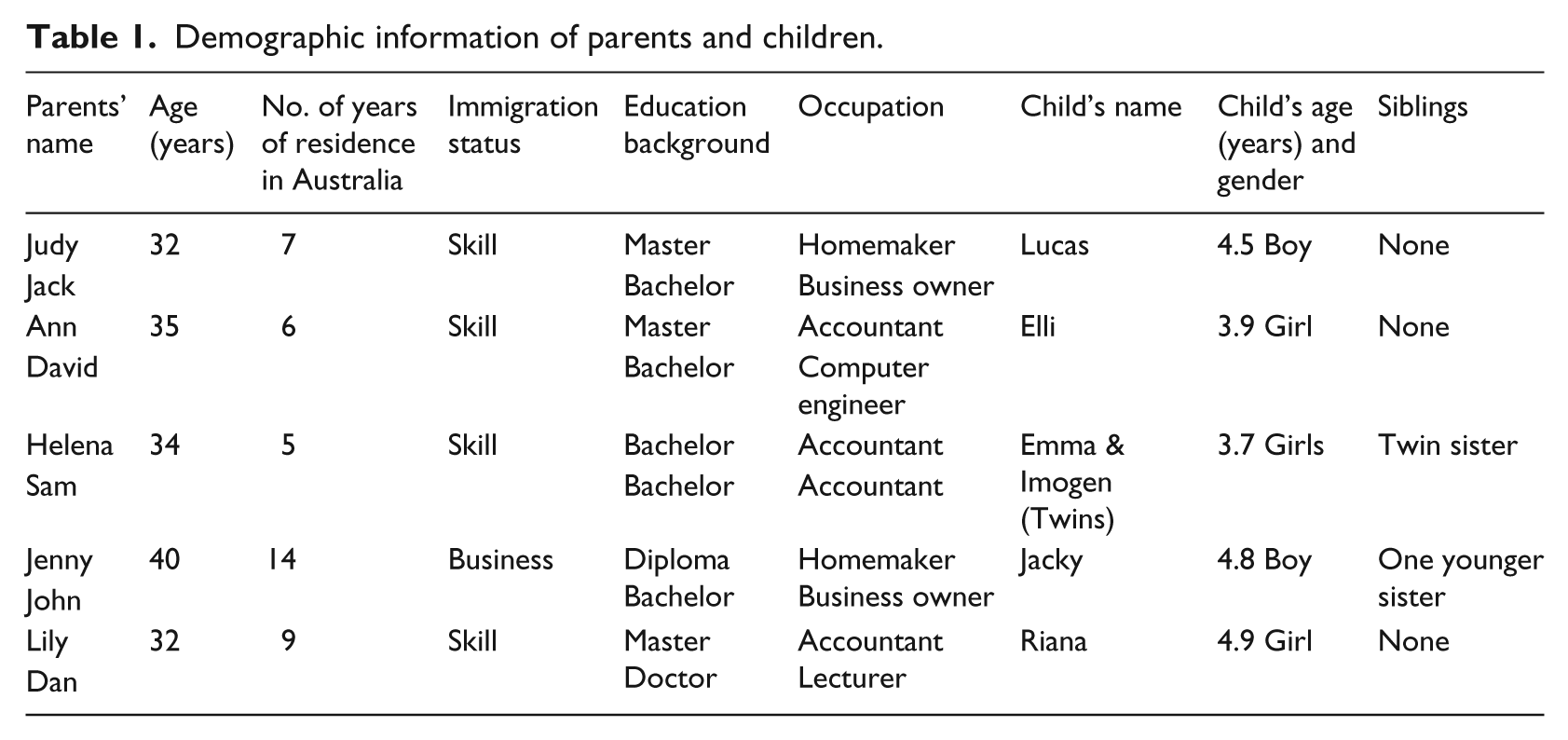
The participants were recruited by the first author who is Australian Chinese and has close links with the Australian Chinese community. Some early childhood services located in Chinese community areas in Sydney were identified and visited. Parents were provided with information about the study and the criteria for choosing participants through the directors of these services. Five families from five early childhood services participated in this case study. All parents are first generation from mainland China and have a 3- to 5-year-old child speaking Chinese most of the time before entering the services. As noted, this group of participants were chosen because immigration to Australia from mainland China has increased far more rapidly than from other Chinese regions since the mid-1990s and this group now constitutes the majority of Chinese people in Australia (Ip, 2001). All the families live in the Sydney region. Most parents have at least one university degree from China or Australia. Six of the parents are professionals working in Australian companies or universities. Two fathers are business owners and two mothers are homemakers and all have at least one child attending a prior-to-school early childhood service. These children spoke mostly Chinese before entering a prior-to-school early childhood service. More information about the parents and children including pseudonyms used in this study is shown in Table 1. Note that all parents’ and children’s names are in English because most Chinese immigrants take English names in their adopting countries for the convenience of communication.
Demographic information of parents and children.
Propositions
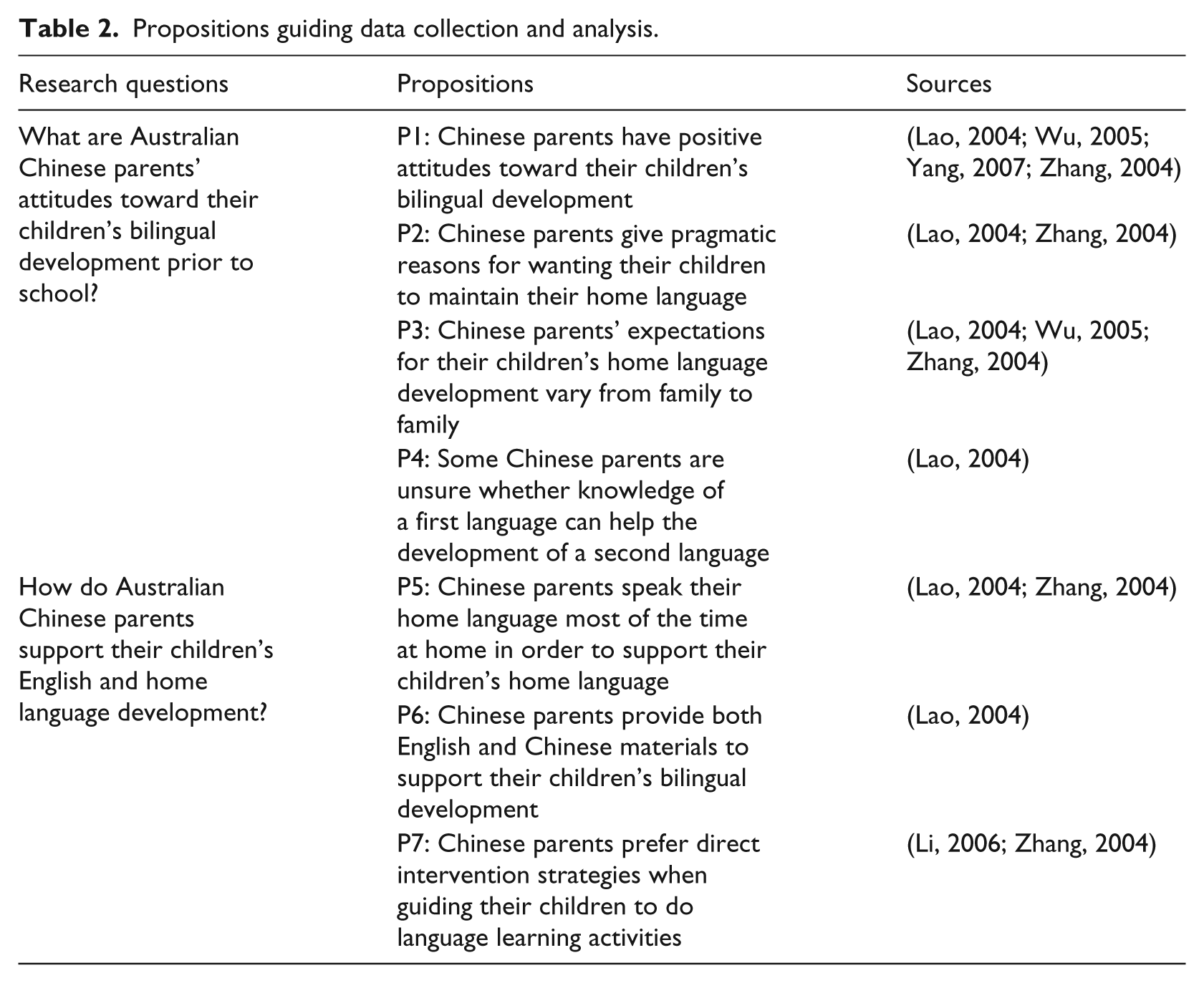
This multiple case study is underpinned by a number of propositions, or ideas for consideration, which have been derived from a close analysis of the research literature on Chinese parents’ language attitudes and practices and from the professional experience of the first author (Baxter and Jack, 2008). Propositions (Yin, 1990) may also be referred to as issues (Stake, 1995) or themes (Ryan, 2003). Yin (1990) states that propositions can serve as an organizing framework for case studies, as they focus attention on certain phenomena which are relevant for addressing the research questions. Questions such as “What are Chinese parents’ attitudes toward their children’s bilingual development prior to school?” are general and vague, until some propositions are advanced, for instance, the idea that Chinese parents have positive attitudes toward their children’s bilingual development, or that Chinese parents have pragmatic reasons for wanting their children to keep their home language. A proposition offers a point of departure for the investigation.
Propositions from previous research or theories can be used like hypotheses that are “examined” by the evidence from the case studies, thus providing a solid basis for generalizing findings from a few cases. When evidence from the analysis of the cases echoes the propositions, the findings and conclusions are strengthened. When evidence from the analysis conflicts with the propositions, then deep investigation is needed to find out the reasons, and during this process, the findings from the case study are actually enriching the theories or research findings in this area (Yin, 1990).
The propositions that guided the data collection and analysis are presented in Table 2.
Propositions guiding data collection and analysis.
Data collection
The data for this study were collected through semi-structured interviews with mothers and non-participant observations of parents, grandparents, and siblings interacting with the child in the home. The propositions listed above framed the interview questions and provided the focus of the observations.
The interviews consisted of two sections. The first section included questions about the parents’ general attitudes toward their children’s bilingual development; the second section asked questions about what parents did at home to support their children’s bilingual development. The interviews were conducted in Chinese language as parents requested. The interviews were transcribed in Chinese and then translated into English by the first author who is bilingual.
The observational data were collected during visits lasting from 3 to 4 hours in each family home. Data were recorded using a small unobtrusive video camera. The observations commenced just before the family’s evening meal and concluded after the children’s bedtime stories just before sleep. The contexts included mealtimes and snacks, free play watching DVDs, and shared reading or drawing. Handwritten field notes and observations were taken to supplement the video recordings and to note additional contextual details. The video recordings were imported into NVivo 8 software, and the conversations between parents and children were transcribed verbatim. Some aspects of the non-verbal interaction including actions and facial expression that provide contextual information were also noted.
Data analysis
All data (transcribed interviews and video recordings) were analyzed using NVivo 8 software. The seven propositions set out above guided the initial data analysis. It became clear, however, that the propositions alone could not fully account for the data. Two additional themes, which were not accounted for in the original formulation of the propositions, emerged from the analysis. Ryan (2003) discussed techniques for identifying themes in qualitative research and claimed that themes can be identified both from prior theoretical understanding (referred to as propositions in this study), while new themes may emerge in the process of data collection and analysis. These new themes may or may not relate to previous research. They can however become important topics of the research.
The following two themes were identified:
Theme 1: Chinese parents want their children to learn English during the years prior to school.
Theme 2: Children’s use of electronic resources (computer games, internet, and DVD) is strongly encouraged by Chinese parents in the belief that these resources will promote their children’s bilingualism.
The seven propositions and two themes were listed in separate nodes in NVivo 8. Data expressive of each proposition or theme were dropped in the relevant node. Then the coded evidence within each node was compared across the five cases to determine whether they supported, partially supported, or refuted each proposition or theme. In this way, data were analyzed using both deductive (propositions) and inductive (themes) processes.
This technique of data analysis is represented diagrammatically in Figure 1.
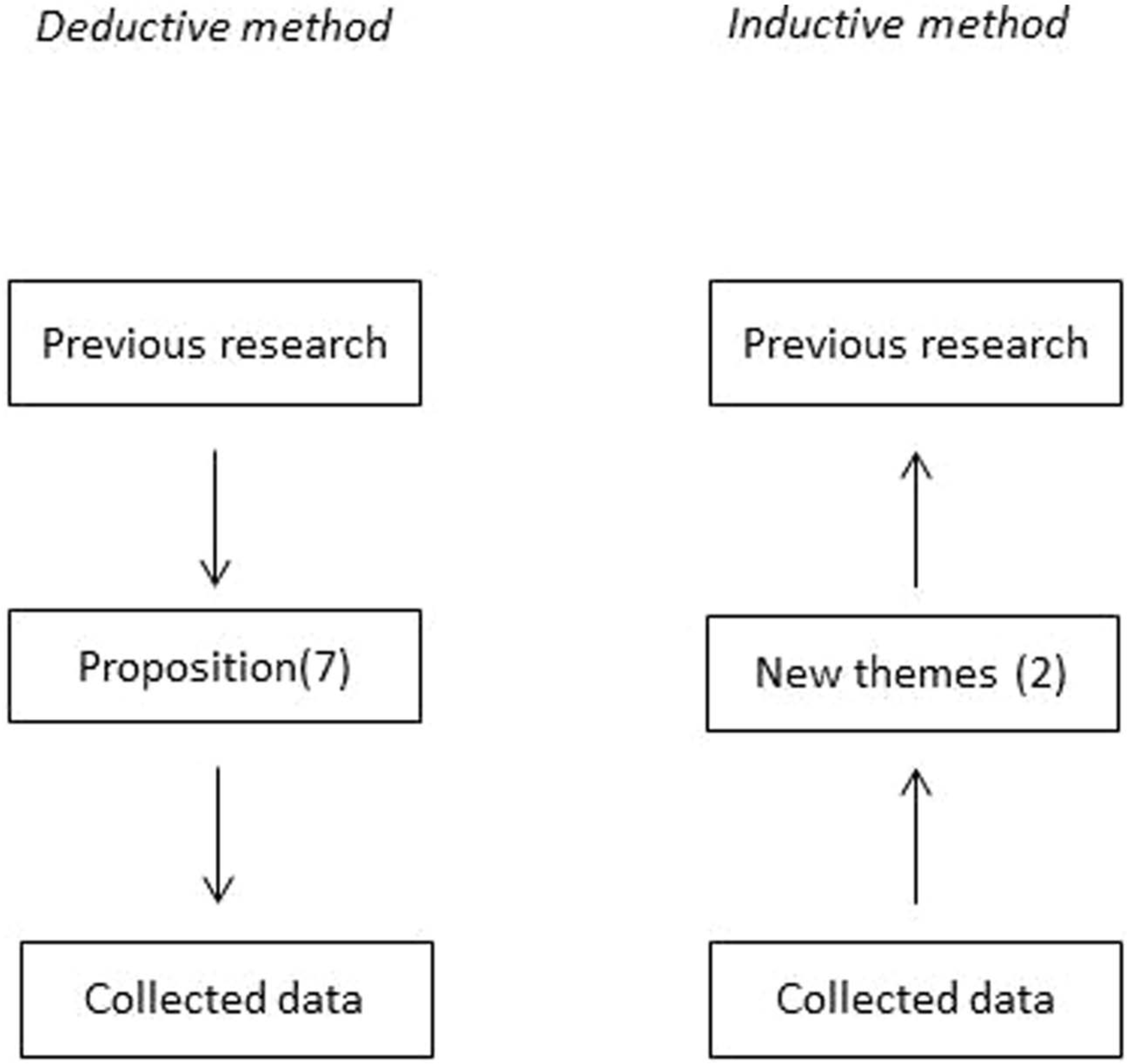
Overview of data analysis.
Findings
We present the findings in two sections. First, we discuss the parents’ attitudes toward their child’s bilingual development, addressing our first research question. Second, we discuss the parents’ home language practices, relating to our second research question.
Australian Chinese parents’ attitudes toward their child’s bilingualism
The findings presented here are based on our analysis of the interviews. The investigation of parents’ attitudes corresponds to four propositions and one theme (P1, P2, P3, P4, and Theme 1). We address each proposition and theme in turn.
Proposition 1. Chinese parents have positive attitudes toward their children’s bilingual development.
This proposition is supported by evidence across all the cases. All the mothers stated that they want their children to achieve proficiency in at least two languages, or in the case of Jenny, three languages. This suggests that the parents value bilingualism highly. The mothers all claim that helping their children develop bilingual skills in the years prior to school is one of the most important tasks they face in educating their children. For example, Judy stated that one of the main purposes for her to move to Australia was to help her child to develop English language. She specifically wanted her child to have knowledge of two languages at a young age.
Proposition 2. Chinese parents give pragmatic reasons for wanting their children to maintain their home language.
When asked why they want their children to be fluent in their home language, three mothers explained that proficiency in Chinese will be advantageous for their children’s future career opportunities:
Because there is a big Chinese market, so it would be disadvantageous if you only can speak English and have no basic Chinese skills. (Jenny) I think the Chinese economic situation is getting better and learning Chinese is a benefit for their career development in the future. (Helena) In the future, if he would like to look for opportunities in a Chinese environment, then Chinese is more important to him. (Judy)
All five mothers also considered communication with family members to be another important reason for maintaining Chinese language. One mother identified this reason as the most important one for her, explaining that she is not concerned about long-term career development:
Chinese is very important to our family. I don’t really care whether she goes back China to be a CEO when she grows up, I don’t have that expectation. It [child’s Chinese language] is just for my private desire. (Ann)
One mother mentioned that maintaining Chinese is necessary for her daughter to keep her cultural identity:
She is a Chinese although she is growing up here. I feel it would be sad if she goes back China and cannot recognize characters or understand Chinese. I mean when she goes back and visits China. (Lily)
Proposition 3. Chinese parents’ expectations for their children’s home language development vary from family to family.
In relation to their child’s ability to use their home language, all the parents said they were happy with their child’s current Chinese language skills at this age. They expressed the view that their child’s language is at a satisfactory level for their child to maintain everyday communication with other family members or Chinese peers. They did not have high expectations for literacy development in Chinese such as recognizing characters or learning Pinyin (the Chinese phonetic system) during their children’s preschool years. Three mothers stated that learning English is more important for their child at present. For instance, Judy claimed “Learning Chinese, right now, as long as he can communicate with family members and other Chinese background children, that’s enough. So first obtain good English skills, and then learn Chinese. At this age, he needs to develop English well.”
Three mothers said that they do have expectations of further development of their child’s Chinese reading and writing skills in the primary school years. They expect their children will have greater proficiency in Chinese language when they are older:
Regarding the issue about if he is going to learn Chinese, it’s up to his situation. I don’t feel he needs it now because he is speaking Chinese. When he is seven or eight years old and is ready to learn, I will teach him Chinese characters. (Jenny)
Two mothers stated that they will see if their children show interest in Chinese reading and writing, and then decide if they will encourage their children to learn these skills.
Proposition 4. Some Chinese parents are unsure whether knowledge of a first language can help the development of a second language.
The question of whether home language development will affect English learning seems to be most confusing for parents. Four mothers admitted that they are unsure about this issue.
Two mothers thought that home language will negatively affect their child’s English learning:
It will affect it because Chinese thinking is very different from English thinking. The arrangement of verbs in sentences is different, so it would be hard, I think. (Jenny) I’m scared that when he is learning English and Chinese together, he will mix the pronunciation of Pinyin and English letters, this is my worry. (Judy) Two mothers were uncertain as to whether there are positive or negative effects of maintaining the home language. “I don’t know exactly if it will benefit her or not, and I never think about it.” (Ann)
Only one mother, Lisa, who had had opportunities to read some articles about bilingualism, seemed to be confident with her answer:
I read some books about nurturing children. It says that before a certain age, children have strong language learning abilities. There is no problem for two or more languages. I don’t think it (learning Chinese) will affect English Language skills transfer in between. I think her Chinese skills will benefit English learning.
Theme 1. Chinese parents want their children to learn English during the years prior to school.
An unexpected finding was that four of the five mothers were worried about whether their children would be able to fully understand their teachers by the time they enter primary school. For this reason, they want their children to develop good English skills before entering primary school. Only one mother, Lisa, who believes that home language development will benefit English learning, is not worried about this issue:
To me, there’s nothing to worry about for her English. I think she will adapt to English environment without problems as soon as she goes to primary school. I don’t have any expectation for her English development in the preschool years.
Australian Chinese parents’ practices to support their child’s English and home language development
We now present the findings relating to our second research question. These findings are based on the analysis of the video recordings and handwritten observational records. The investigation of parents’ practices corresponds to three propositions and one theme (P5, P6, P7, and Theme 2). The findings indicated that there was often a discrepancy between what the parents claimed were their practices, and what the researcher actually observed during her time in the homes of the participants.
Proposition 5. Chinese parents speak their home language most of the time at home in order to support their children’s home language.
What they stated in the interview: All parents expressed a desire to talk with their children only in Chinese at home. They stated that it is a good way to help their children maintain Chinese language, while at the same time they felt comfortable talking in Chinese at home.
What was observed: Despite their intention to speak only Chinese at home, the parents all spoke using a combination of English and Chinese in their conversations with their children. Some parents talked more often in English when they discussed topics such as colors, numbers, cartoon characters, things relating to preschools, and so on. For example, when Judy watched her son drawing trains, she asked “Gordon shi ‘green color’ de ma (Is Gordon in a green color)?”
Proposition 6. Chinese parents provide both English and Chinese materials to support their children’s bilingual development.
What was stated in the interview: The parents explained that they provided a large number of books and audiovisual materials in their homes and that most of these resources are Chinese. They said that their children always read Chinese books and watch Chinese television programs.
What was observed: All the parents have a fixed time for story books every day, but many of these Chinese books are actually translated versions of English texts, rather than being authentic original Chinese children’s books. The characters are depicted as Chinese; however, the content is derived from western cultures. For instance, the story that Ann read to her daughter named “Fu luo ge qu lv xing (Frog goes travelling)” is actually from Holland. Many Chinese DVDs and other audio or video materials owned by the families are also translated western stories, such as “Thomas the tank engine,” “Snow white,” “Dora,” and so on. These books and materials were bought from China because the “translated version” is becoming very popular there. Many mainland Chinese children are exposed to these books and materials derived from western culture too. Most of these audio and video materials have both English and Chinese versions in the one copy and people can select the language they want to experience. Sometimes the children were observed watching the English versions.
Proposition 7. Chinese parents prefer direct intervention strategies when guiding their children to do language learning activities.
What was stated in the interview: All parents expressed the view that children learn through play, not through formal teaching. All parents stressed that they use random opportunities rather than structured activities to help their children develop language and literacy skills. Helena expressed her unhappy feelings about the traditional educational strategies that her parents employed when she was young. She wants to educate her children using different approaches:
When we were young, we were forced by our parents to do things like: how to read this character and that character? It is a way of “straight filling.” But I want them (her daughters) to learn happily, and learn through playing. They are willing to learn this way, and they still learn things, just with different approaches. It’s not about reciting some things mechanically, instead, it’s a spontaneous process. (Helena)
What was observed: Parents did indeed interact with children according to the children’s interests. No direct intervention was observed. Parents taught children some Chinese characters or English letters through random opportunities. For instance, when Judy’s 4-year-old son Lucas was drawing “Gordon train,” Judy asked if he would like to write down the word “Gordon” on the picture, and then she spelled the word and encouraged Lucas to write it down. When Ann read the title of the book “Fu luo ge qu lv xing (Frog goes travelling),” her daughter Elli was encouraged to repeat it by pointing to the Chinese characters one by one.
Theme 2. Children’s use of electronic resources (computer games, internet, and DVD) is strongly encouraged by Chinese parents in the belief that these resources will promote their children’s bilingualism.
What they claimed: All parents stated that electronic books and devices are important tools in supporting their children’s language development. Two mothers mentioned using “Dian Du Bi” (a pointing device for electronic books) to teach children Chinese. One mother claimed that DVDs are an effective way to learn English, and one mother said that the iPhone helped her daughter recognize the English alphabet.
What was observed: Computer programs, DVDs and “Dian Du Bi” in both English and Chinese language are used across all families. Children spent quite long periods watching DVDs, playing with computer programs, iPhones, and “Dian Du Bi” during free play time at night and they appeared to choose either language randomly.
Discussion
The purpose of this case study was to investigate the attitudes of Australian Chinese parents toward their preschool-aged child’s development of English and Chinese language, and to gain some insight into the home language practices of these families. Such research has not been undertaken previously, despite the fact that people from mainland China constitute the third largest group of immigrants currently arriving in Australia. The research is relevant and timely, as such information may inform language policies and pedagogical practices in early childhood services, provide the basis for parenting programs for Chinese parents, promote cross-cultural understanding, and potentially facilitate the bilingual development of children to the benefit of the wider Australian community.
The findings indicate that the parents have a strong desire for their children to become bilingual for practical reasons such as future career success and to enable basic communication between family members. This finding echoes conclusions from research in America (Lao, 2004; Yang, 2007; Zhang, 2004). Most parents did not refer to the less tangible benefits that bilingualism may offer their children, such as knowledge of and pride in their cultural heritage and a sense of belonging. Research has shown that developing children’s home language involves much more than simply developing a language skill among other skills. If parents believe that development of the home language is only one skill among many, they may focus only on the “technical” aspects of the language and ignore the cultural values, behaviors, and literary traditions embedded in the home language. Through close observations of the families, the findings from this study reveal aspects that were not reported in previous research about how the pragmatic attitudes may influence practices. For example, parents may prefer reading Chinese translations of English picture books to their children, rather than providing them with authentic Chinese literature, thus limiting the opportunities for children to gain a deeper understanding of their language and culture.
The parents’ expectations for their children’s Chinese language development differed according to the value they placed on bilingualism. The three mothers who stated that bilingualism is important for future career development expect their children to gain proficiency in both spoken and written Chinese. The two mothers who expressed the view that communicating with family members is the most important reason for becoming bilingual expect their children to develop skills in everyday spoken Chinese only.
Four out of the five participants expressed great concern about their children’s English language development during the preschool years. This is very different from some research where Chinese parents were reported to have concern for their children’s home language development (Li, 2004; Zhang, 2004). Most previous research focused on parents of primary or high school children who had already shifted to English. However, this study focuses on parents of preschool children who are at the beginning stage of their English learning. Parents worried about their children’s English language development. They felt that the development of the home language could negatively affect their child’s English language acquisition. Therefore, they aimed to support their child to develop English first during the preschool years and then encourage their child to develop Chinese after they commenced formal schooling. This approach raises issues about language maintenance and language shift, as addressed by Fishman (1991), as it suggests a pattern whereby children may gradually lose their home language after they are immersed in an English-mainly environment at school.
The findings suggest that parents’ practices at home are not always in line with their attitudes. While all the parents stated that they used only Chinese to communicate with their children at home, the observations revealed that in fact some of them actually used English frequently. One reason for this may be that this group of parents has good English skills and some of them may shift to English unconsciously in their conversation. Another possible reason is that they believe their children will be better equipped for success in school if they learn content in English, such as colors or numbers.
The materials that parents used to support their children’s Chinese language development also suggest that their practices may contradict their explicitly held views. The picture books, audio and video materials, and internet sites that they use to support their children’s Chinese language development are not rooted in Chinese culture. Rather, their children are exposed to western cultural values and attitudes when they use these materials, and may prefer the English version. For example, three of the children in this study demonstrated a preference for the English version when using English–Chinese audio and visual materials.
All the parents in the study expressed the belief that electronic tools are effective in supporting their children’s language development, and this was clearly evident in their practices. The children spent substantial periods of time using electronic materials. Yet there is substantial evidence indicating that children learn one or more languages through interaction with other, more proficient speakers, in genuine purposeful contexts (Clarie, 1999; Cummins, 2000; Hall, 2011; Owens, 2001). Electronic tools are heavily promoted by manufacturers although their effectiveness as a main learning and teaching resource is uncertain (Coverdail-Jones, 2000; Yang, 2007).
A related finding was that the parents all expressed the view that play-based learning is important, rather than the traditional skills-based adult-directed teaching which they experienced as young children. There were no formal teaching activities planned by the parents for their children to complete. This fact may indicate that highly educated Chinese immigrants are changing their approaches in educating their children. This finding contradicts some research that claims Chinese parents prefer formal and structured teaching strategies in educating their children (Anderson, 1995; Li, 2004, 2006; Zhang, 2004).
These findings indicate that while Australian Chinese families strongly desire their children to become bilingual, they are not always aware of the most beneficial ways to achieve this outcome. For example, if they are motivated mainly by functional reasons such as career advancement, they are less likely to appreciate the inextricable connection between learning language and learning culture. If learning Chinese and English become skills to be learnt among many others, there is increased risk that children will gradually lose their home language and become predominantly English speakers as they progress through the formal education system.
Implications and directions for future research
The findings suggest that Australian Chinese parents would benefit from educational materials informing them of the relationship between first and second language development, of the most effective ways to support their children’s bilingual development, and of the importance of interaction in their home language. Perhaps parenting and other initiatives undertaken in partnership with Chinese community organizations could form the ideal vehicle for the provision of such support.
Future research may explore in greater detail the types of language interactions which Australian Chinese families engage in, and their potential for promoting children’s emergent literacy understandings.
Footnotes
Acknowledgements
The authors thank the families for their participation in the research and for sharing their time and ideas so generously.
Funding
This research received no specific grant from any funding agency in the public, commercial, or not-for-profit sectors.