




Abstract
The current study examines how leadership in Norwegian Early Childhood Education and Care (ECEC) is discursively produced within policy documents and how these productions shape governance and everyday educational practice. We explore the ways leadership becomes entangled with national imperatives of quality, competence, and accountability, arguing for attention to the ethical-political dimensions of how policy frames and directs educator work. The research is situated within poststructural and postqualitative approaches that resist universal categories, attending instead to the situated, relational, and contingent nature of policy meanings. Drawing on white papers published between 2006 and 2019 and working with Bacchi’s What is the Problem Represented to Be? approach, we trace how leadership is repeatedly positioned as a solution to quality challenges, which are predominantly represented as problems of staff competence. Yet, despite its centrality to policy ambitions, leadership appears unevenly and often sparsely across the texts. Through this analysis, we offer three stories—leadership as a device for producing quality, as a mechanism for governing through competence, and as an absent-yet-prescriptive figure—that highlight the tensions produced when neoliberal governance logics emphasize efficiency and competence enhancement while systemic issues such as capacity and funding remain unaddressed. The article invites a rethinking of how leadership is conceptualized in policy and how these conceptualizations shape what becomes possible in ECEC practice. By attending to the discursive work that policy performs, we contribute to ongoing conversations about professional learning, governance, and the conditions under which educators and leaders navigate the complexities of their everyday worlds.
Keywords
Introduction
The Norwegian education sector, like other Scandinavian countries (Wiborg, 2013) and Europe more broadly (Verger and Curran, 2014), has undergone significant changes in the framing of educational policy texts over the past three decades, as neoliberal, market-oriented policies have been adopted. The governance model that embodies neoliberal ideology, often referred to as New Public Management (NPM), integrates private-sector leadership practices into the public sector. All though the Norwegian Early Childhood Education and Care (ECEC) institutions hold a distinctive role within the Scandinavian welfare state, guided by the principles of a social democratic governance model, the language used in policy regarding the ECEC sector reflects that privatized approaches to public sector management can enhance quality while reducing costs (Wiborg, 2013). The increased educational policy interest, with a particular focus on early childhood and kindergartens, makes Norway an interesting case to explore and could be a relevant case for international comparison. Quality is defined in white papers as process quality and structural quality (Ministry of Education and Research, 2013). While process quality is a subjective experience which refers to the quality of relationships between people, structural quality refers to measurable aspects of quality, such as facilities, staff education, and the size of child groups. The understanding of quality in a Norwegian ECEC context includes therefor the quality of children’s experiences, professional standards for educators, and broader structural and pedagogical elements.
In the following model the Norwegian ECEC system is visualized:

In the neoliberal management discourse that has shaped the govern of the public sector through NPM reforms in the whole of Europe, leadership represents a foundational element (Torfing et al., 2019). In Norway, this is expressed explicit in the goals outlined in the framework plan guide where ECEC leaders bearing primary responsibility for fostering quality within their organizations (Ministry of Education and Research, 2017). This establishes a clear link between the governance of the ECEC sector and the leadership practices within it and raises a pertinent question: How can the relationship between the governance of the sector and leadership in ECEC be understood?
The study this article is based upon (Janninger, 2020) investigating white papers in the period from 2006 to 2019. The year 2006 marks a significant turning point in the history of Norwegian ECEC sector due to key political changes, for example a shift in governmental focus from quantitative expansion of ECEC services to an emphasis on their content and quality (Granrusten, 2016b). Two thousand nineteen was chosen because it was the year of the latest published paper before the submission of Janninger’s (2020) master’s thesis. Since 2019, extensive government grant schemes for professional development in early childhood education have been rolled out. These confirm the political focus on quality through competence development, as shown in the study by Janninger (2020). A common feature of these grant schemes is the requirement that the early childhood education sector collaborates in partnership with universities and colleges. The competence development reform breaks with the previous tradition of course series and ordering of competence packages. The grant schemes require that competence development is based on the understanding of professional development as kindergarten-based competence development. This reinforces the demand on kindergarten leadership to be effective change leaders (Janninger, 2020).
The analytic approach is inspired by Bacchi’s discourse analytical framework, What is the problem represented to be? (WPR; Bacchi, 2009), and challenges the assumption that policy arises as a response to pre-existing societal problems. In a discursive mind set inspired by Foucault’s (2002) concept of governmentality, the WPR method looks at policy texts like they are producing or reproducing problems, through the way they are represented in the text. Discourse is a central concept within a governmentality perspective on governance and can be described as formative currents (Hammer, 2017) that create and recreate understandings of reality. Governance within a governmentality perspective is primarily carried out through frameworks and tools. In WPR a representation of a problem refers to the way a problem is ‘framed’ or presented in policy. Through a governmentality perspective, the study (Janninger, 2020) investigates how leadership is conceptualized in key documents such as white papers and the practical effects of these representations.
Theoretical and legal framework
Based on the development within governance in the Norwegian education sector, it is reasonable to assume that the Norwegian ECEC sector operate within multiple governance discourses simultaneously (Ljunggren and Lauritzen, 2018). This includes a welfare state discourse, a professional discourse, and a neoliberal governance discourse. The concept of governance discourse, or governance rationality, is closely linked to Foucault’s (2002) governmentality perspective, which combines external governance with the subject’s self-governance (Hammer, 2017). It is a framework for understanding how the state uses governance tools to get individuals to govern themselves. Both the welfare state discourse and the neoliberal discourse can be defined as governance discourses because both perspectives on governance appear to originate from state and political sources (Korsvold, 2008; Torfing et al., 2019; Verger and Curran, 2014). The professional discourse, on the other hand, has traditionally originated from professional communities (Sørhaug, 2003), but it is still important since the societal mandate is strongly based on a professional understanding of ECEC institutions as social institutions. Sørhaug (2003) uses Foucault’s (2002) concept of governmentality to describe how the transition from planned governance to reform governance has influenced the management of the public sector after World War II. Governmentality involves a governance mentality where the population, along with economic policy and social security, is the object of governance (Hammer, 2017). The goal is to shape, guide, and/or influence people’s behavior rather than sanction it. Discourse is a central concept within a governmentality perspective on governance and can be described as formative currents (Hammer, 2017) that create and recreate understandings of reality. Governance within a governmentality perspective is primarily carried out through frameworks and tools. Policy is an example of governance tools within the ECEC sector, and can be described as guidelines that both define problems and propose solutions. Policy is expressed in and articulates the government’s ambitions, analyses, and plans for the sector. White papers serve as visionary documents, outlining desired realities and acting as guidelines for the ECEC sector’s future development (Børhaug and Moen, 2014; Nygård, 2015; Ulserød, 2019). As such, white papers establish premises for ECEC policy and embody ‘soft governance’ – governance through terminology (Mausethagen, 2013; Nygård, 2015). From a poststructuralist perspective, soft governance can be seen as a form of management discourse expressed through subject positions and problem representations. Analyzing policy texts thus provides insight into leadership discourses within the sector.
Over the past two decades, the Norwegian ECEC sector has experienced significant political and structural transformations. Concurrently, research on ECEC leadership has expanded, reflecting these changes (Børhaug and Gotvassli, 2016; Granrusten, 2016a, 2016b; Moen, 2016). Traditionally, leadership in ECEC has been described through three primary functions: administrative leadership, educational leadership, and personnel leadership (Bølgan and Lysell, 1992; Gotvassli, 1990). However, Bleken (2005) introduced ‘strategic leadership’ as a fourth function, arguing that changing framework conditions necessitate a new type of leadership. Since then, strategic leadership has been highlighted as increasingly important in ECEC, particularly in relation to rising demands (Gotvassli, 2013, 2019; Gotvassli and Vannebo, 2016a, 2016b, 2016c, 2016d).
There appears to be a connection between the educational policies presented in white papers and the evolving understanding of ECEC leadership as reflected in research. This connection underscores the influence of policy on leadership discourses within the ECEC sector.
The current study
The study (Janninger, 2020) explores the connection between how leadership is articulated in both research and policy, with a particular focus on how leadership is framed within policy documents for Early Childhood Education and Care (ECEC) and the potential controlling effects of such framing. Positioned at the intersection of governance and management, the study examines the type of leadership promoted by policy and how it is represented in governing texts.
The analysis employs Bacchi’s discourse analytical approach, What is the problem represented to be? (WPR; Bacchi, 2009) and argues that policy itself constructs problems within the framework of a discourse. Policy texts are thus seen as producing or reproducing problems, with these issues articulated through the way they are represented. A representation of a problem refers to the way a problem is ‘framed’ or presented in policy. Inspired by Foucault’s (2002) concept of governmentality, Bacchi’s (2009) WPR method provides a means to critically reflect on how policy problems are constructed through representation, what is omitted in these representations, and the implications of these omissions. The study critiques power dynamics by examining how leadership is written into policy and the extent to which certain discourses are prioritized over others in governance documents. Through a governmentality perspective, the study investigates how leadership is conceptualized in key documents such as white papers and the practical effects of these representations. The study is guided by the following research questions, which are designed to interrogate the construction and representation of leadership in policy texts:
What problem is leadership presented as a solution to?
What assumptions underpin the representation of the problem?
What is left unproblematized or omitted in the representation of the problem? Where does silence occur?
What effects are produced by this representation of the ‘problem’?
These questions align closely with the WPR approach, focusing on how leadership discourses within policy construct realities and influence practice. By examining not only what is represented but also what is excluded or silenced, the study (Janninger, 2020) seeks to uncover the power dynamics embedded in policy and their practical implications for governance in the ECEC sector. Through this lens, the study critiques how certain discourses are given prominence over others, shaping leadership roles and their enactment in practice.
Method
Approach
Janninger (2020) adopts a poststructuralist perspective, rooted in the linguistic turn that marks the transition from modernism to postmodernism. Poststructuralism challenges the traditional view of knowledge and truth as objective and immutable. Instead, knowledge and truth are seen as constructed entities, shaped by power and social processes. It can, there for, be problematic for a discourse analysist to speak about discourse analysis as method used to ‘collect’ data (Neumann, 2001). This perspective implies that what we consider ‘true’, or ‘knowledge’ is not universal, but rather a result of historical, cultural, and political contexts. Language is no longer seen as a neutral medium that describes an objective reality but is instead understood as contextual and constitutive. Within this framework, leadership is conceptualized as a construction in a state of continuous transformation. Its meaning is shaped by the discourses that prevail in specific contexts. In a poststructuralist approach, discourse is understood not only as what is said and written but also as the meaning embedded in these expressions (Taguchi, 2004). Leadership, therefore, is not static, it is constantly fluid. Janninger (2020) employs a discourse analysis of policy documents, specifically white papers, using an exploratory research design. This approach seeks to provide insight into and an understanding of the discursive construction of leadership through the representation of problems in white papers published between 2006 and 2019. The research design aligns closely with the study’s epistemological stance and methodological choices, positioning it as process-oriented (Postholm and Jacobsen, 2011). From a poststructuralist perspective, discourse analysis takes language as its starting point for investigating reality and the knowledge constructed about it, emphasizing language’s role as a gateway to understanding.
Procedure
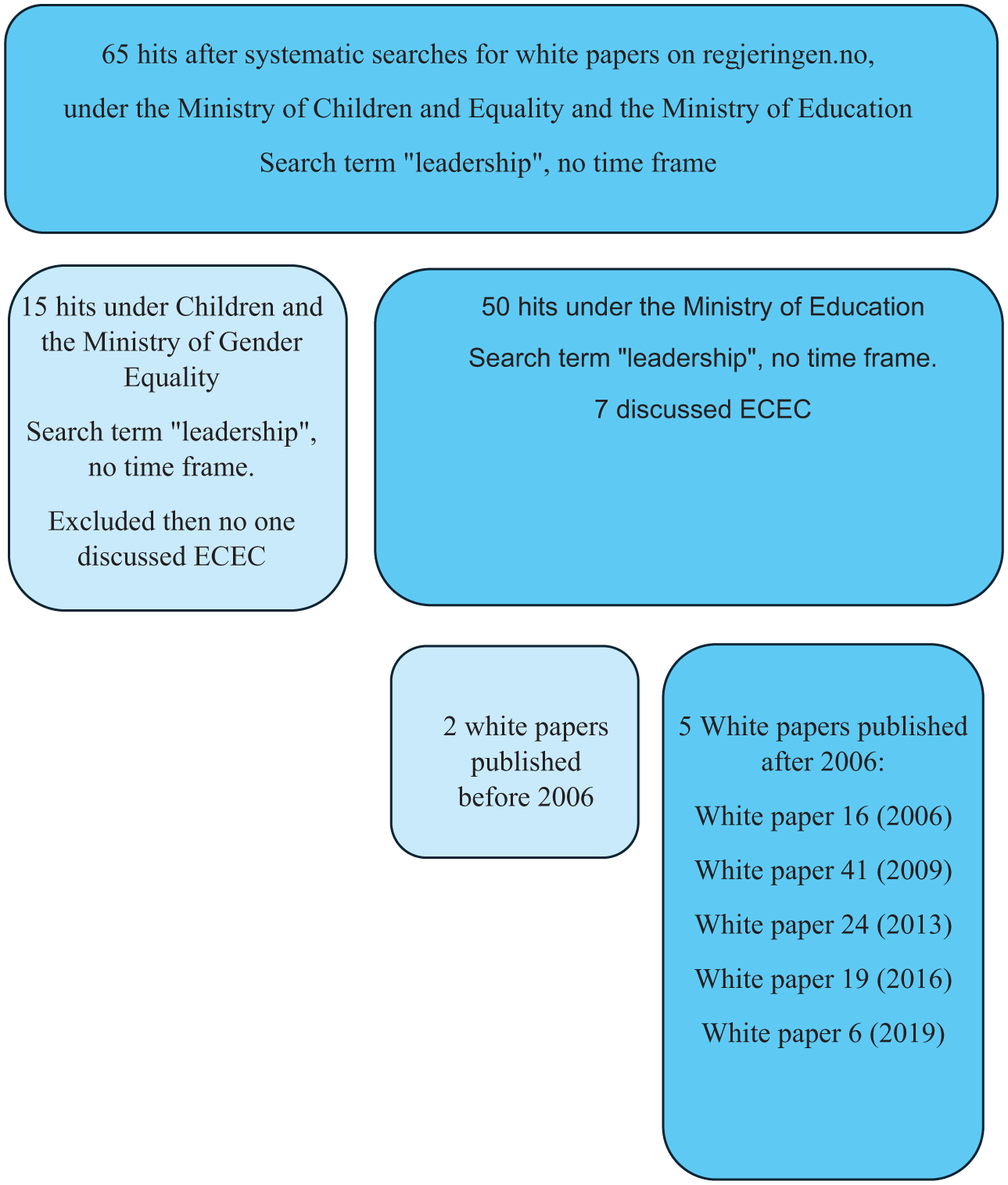
The data material for the study’s discourse analysis consists of white papers from 2006 to 2019 (Janninger, 2020). The selection process followed a systematic step-by-step approach using targeted searches on the government website (regjeringen.no). The selection criteria and process are outlined in Figure 1.
Step-by-step document selection of white papers.
To narrow the scope of the analysis, the time period from 2006 to 2019 was chosen, as this marks a significant turning point in the history of Early Childhood Education and Care (ECEC) in Norway due to key political changes. Specifically, 2006 represents a shift in governmental focus from quantitative expansion of ECEC services to an emphasis on their content and quality (Granrusten, 2016b). Two thousand nineteen was the year the latest white paper was released when the study (Janninger, 2020) was carried out. The quality discourse, as a dominant discourse, has a significant influence on today’s kindergarten policy (Gotvassli and Vannebo, 2016a). This makes it both academically interesting and socially relevant to examine this discourse through a discourse analysis of how leadership is expressed in policy. As depicted in Figure 1, the first search criterion was that the documents should be white papers published by either the Ministry of Children and Equality or the Ministry of Education and Research. The second criterion specified that the documents must pertain to ECEC, while the third required that they include the term ‘leadership’. Using these strategic criteria, the search yielded 65 results: 15 white papers published by the Ministry of Children and Equality and 50 parliamentary reports from the Ministry of Education and Research. Upon further review, no white papers from the Ministry of Children and Equality addressed ECEC, leading to the selection of documents from the Ministry of Education and Research. Of the 50 white papers from the Ministry of Education and Research, only seven were found to address ECEC. These were temporally distributed as follows: two white papers published before 2006 and five published after 2006. This distribution highlights the increased focus on leadership within ECEC following the 2006 policy shift, further justifying the study’s focus on this period.
Analysis
The overarching goal of qualitative analysis is to present insights into the research subject in a way that allows the reader to gain understanding without having to engage directly with the entire body of empirical material (Tjora, 2017). Janninger’s (2020) analysis aims to invite the reader to view ECEC policy documents, specifically white papers, from a new perspective. Discourse analysis represents a distinct analytical approach that begins with the assumption that language is structured in patterns, or discourses, that shape the way we speak about and understand phenomena. Language does not neutrally describe reality but actively constructs it, influencing our perceptions and interactions with the world (Winther Jørgensen and Phillips, 1999). Discourse analysis thus focuses on examining these linguistic patterns to reveal the ways in which they shape and construct reality.
Although discourse analysis can be conducted through a variety of approaches, its core involves identifying and analyzing patterns in language to understand how meaning is constructed. This flexibility allows researchers to explore the ways in which language organizes and limits our understanding of social phenomena, making it a powerful tool for interrogating policy texts and their broader implications.
WPR – What is the problem represented to be?
The foundation of Bacchi’s What is the problem represented to be? (WPR) approach lies in the assumption that governments actively shape societal understandings of problems through how these are referred to and articulated in policy documents. For instance, policies addressing societal challenges are not merely descriptive but serve as active creators of ‘problem representations’ (Bacchi, 2009, 2010). In this framework, policies are examined through a series of analytical questions designed to uncover underlying assumptions and implications (Bacchi, 2009: 3–4):
What is the problem represented to be?
What presuppositions or assumptions underlie this representation of the problem?
What remains unproblematic in this representation of the problem? Where are the silences?
What effects are produced by this representation of the problem?
The first two questions form the foundation of the analysis and presentation of findings, while the latter two guide the discussion and critical reflection. Policy documents, such as white papers, are coded using key concepts like quality, management, and competence development to identify how the ‘main problem’ is articulated and framed. Problem representation is discerned by examining how issues are formulated or represented in the text (Bacchi, 2009). For example, White Paper 41 states: ‘The overarching goal in the white paper is to contribute to good quality development in ECEC’ (Ministry of Education and Research, 2008: 9). Given the nature of white papers as policy instruments, this statement implies that quality in ECEC is a significant political issue. From Bacchi’s (2009) perspective on how problems are constructed in policy, this statement suggests that the government does not consider the current quality of ECEC to be satisfactory. If quality were deemed adequate, it would not feature as a central topic in policy texts. This interpretive process involves a form of deconstruction, wherein the wording of the text is examined critically to reveal its implicit meanings and assumptions. By ‘turning the wording around’, researchers illuminate the underlying problem representations and reflect on their implications within the policy context.
The discursive analytical method used in the study can be referred to as a Foucauldian discourse analysis, all though it is problematic to speak of discourse analysis as a method to ‘collect’ data, hence to the understanding of discourse as earlier mentioned. Another definition that may suit the analytical approach better is a policy narrative framework inspired by the Foucauldian term governmentality.
Findings and discussion
Findings
The analysis of five white papers reveals a consistent emphasis on the need to improve and equalize the quality of ECEC services in Norway (Janninger, 2020). Despite varying approaches, all documents converge on the notion that discrepancies in quality represent a significant and persistent problem. A recurring theme in these texts is the challenge posed by variations in staff competence, which is identified as a critical factor in achieving quality improvement. Competence development emerges as a central thread running through all the white papers, underscoring its importance for addressing quality-related issues. To avoid redundancy, the results are presented as a cohesive narrative, highlighting the evolution of problem representations over time.
How is the problem represented in ECEC policy?
An analysis of the policy documents 16, 41, 24, 19, and 6 (Ministry of Education and Research, 2006, 2009, 2013, 2016, 2019) reveals that the overarching policy problem is the perceived inadequate and inconsistent quality in ECEC services. While these documents address the issue from different perspectives and frames, they consistently point to staff competence as a central challenge. For instance, policy document 16 acknowledges the limited empirical knowledge about quality in Norwegian ECEC but assumes significant variation: ‘There is, however, little research-based empirical knowledge about the quality in Norwegian ECEC. There is reason to assume that the variations are large’ (Ministry of Education and Research, 2006: 26). In policy document 41, the government cites studies (TNS Gallup, 2008; Winsvold and Gulbrandsen, 2009; Østrem et al., 2009) commissioned by the ministry to assess quality, concluding that while there have been improvements, significant disparities remain: ‘There are many indications that there are sometimes large differences in quality between the nurseries, and that there is a lack of systematic knowledge about the state of the sector’ (Ministry of Education and Research, 2009: 7). Similarly, policy document 24 introduces the concepts of process and structural quality and references empirical studies to demonstrate variability in ECEC quality, linking this variability to structural factors such as staff competence and adult-child ratios (Ministry of Education and Research, 2013a: 19–20).
These texts demonstrate a reliance on research to substantiate claims about quality but also reveal contradictions between policy conclusions and research findings. For instance, while studies indicate improvement in some areas, policy texts continue to frame quality as inadequate, with staff competence frequently identified as the core issue.
Staff competence as a central problem representation
The quality problem is closely tied to the overarching welfare goal of social equalization and is represented primarily through staff competence (Janninger, 2020). The policy discourse positions staff competence as the most significant determinant of quality in ECEC, framing it as both a challenge and a solution for future improvement. This representation suggests that static competence levels among staff hinder quality development, implicitly attributing responsibility for quality issues to staff shortcomings. Leadership, in turn, is presented as a key mechanism for addressing these challenges through competence development and organizational change.
Leadership as a solution to quality issues
Leadership is consistently linked to organizational development and staff competence enhancement in the policy documents (Janninger, 2020). While leadership is not framed as a direct problem representation, it is depicted as a solution to the quality and competence challenges in ECEC. Leadership is discussed in relation to initiating and guiding change processes within learning organizations, positioning ECEC leaders as central to the sector’s transformation. For example, policy document 41 emphasizes the role of leadership in addressing competence development, stating that ECEC leaders are responsible for driving quality improvements through staff development and organizational learning (Ministry of Education and Research, 2009: 7).
Underlying assumptions behind problem representations
The analysis suggests that representations of quality as a problem are grounded in two distinct assumptions (Janninger, 2020). First, within a neoliberal governance framework, quality is linked to economic productivity and return on investment. This reflects the influence of New Public Management (NPM) reforms, where quality is conceptualized in terms of its ‘market value’ and the potential for efficiency gains. Terms like ‘return’ and ‘investment’ used in policy texts reinforce this business-oriented discourse, which frames ECEC as an institution that must produce measurable outcomes for societal benefit (Hujala, 2004; Seland, 2009).
Second, within a welfare state discourse, quality is associated with fostering democratic, self-sufficient citizens. This perspective emphasizes the societal role of ECEC in promoting equity and well-being, positioning leadership and competence development as essential for achieving these goals. The concept of ECEC as a learning organization embodies both discourses, integrating quality and competence development into a broader framework for organizational change.
Leadership as a response to policy challenges
The findings indicate that leadership is constructed as a solution to the challenges represented in policy texts (Janninger, 2020). Leadership is framed as essential for enabling competence development, driving change processes, and fostering quality improvement within ECEC organizations. Janninger (2020) highlights the ways in which leadership is linked to policy goals, suggesting that policy texts both shape and are shaped by broader governance discourses. Leadership thus emerges not only as a response to the challenges of quality and competence but also as a central element in achieving the sector’s broader objectives.
Discussion
What is left unproblematic in this representation of the problem? Where are the silences?
Janninger (2020) shows that the quality issue is not represented as a question of capacity where financial frameworks are presented as the most important factor for achieving quality in Early Childhood Education and Care (ECEC). Leadership on the other hand is consistently defined as critical for quality development in Early Childhood Education and Care and is predominantly discussed in the context of competence development. There it is presented as the solution to the quality problem, which is itself represented as an issue of staff competence. This creates a policy narrative that links quality, competence, and leadership as focal points for governance. However, this framing raises the question: what is obscured when quality, competence, and leadership are placed in the spotlight?
The framing of ECEC leaders as primarily responsible for quality improvement directs attention toward competence and competence development often conceptualized through the idea of ECEC as a learning organization (Janninger, 2020). For instance, policy document 24 (Ministry of Education and Research, 2013) defines quality as process and structural quality, emphasizing that staff competence and attitudes are central to process quality. This aligns with Bacchi’s (2009) observation who states that policy problems are often represented in ways that attribute responsibility to individuals or specific groups.
By attributing responsibility to individuals or specific groups, other systemic factors are pushed into the shadows (Bacchi, 2009). For example, had the quality problem been framed as a matter of capacity or funding, the proposed solution might have included increased teacher-child ratios or mandatory education for unskilled workers in ECEC. However, by framing the problem as an issue of staff competence, capacity issues are sidelined, reinforcing a neoliberal governance discourse. Neoliberalism emphasizes streamlining the public sector to achieve efficiency and cost reduction, which may explain why systemic challenges like capacity are overshadowed by an emphasis on staff competence. This framing effectively shifts responsibility for quality improvement downward, empowering leaders within the framework of New Public Management (NPM) while simultaneously reducing pressure on systemic investments.
Silences and leadership in policy texts
Leadership, though positioned as crucial for quality and competence development, is mentioned relatively infrequently in policy documents compared to terms like ‘quality’ and ‘competence’, as shown in Table 1 and Figure 2.
Table of occurrence of the terms ‘quality’, ‘competence’, and ‘management’ in white papers.
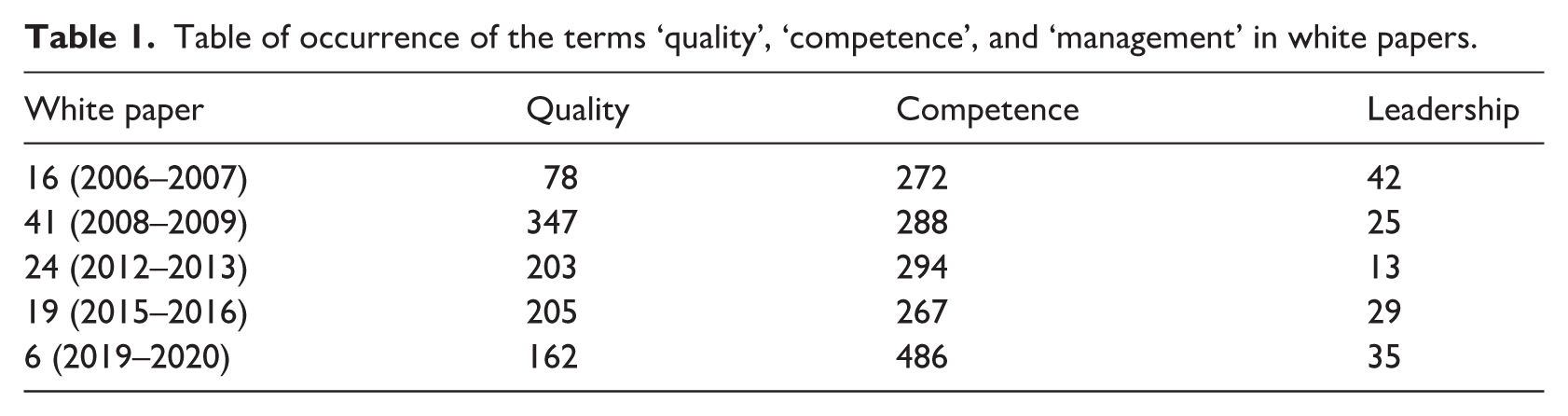
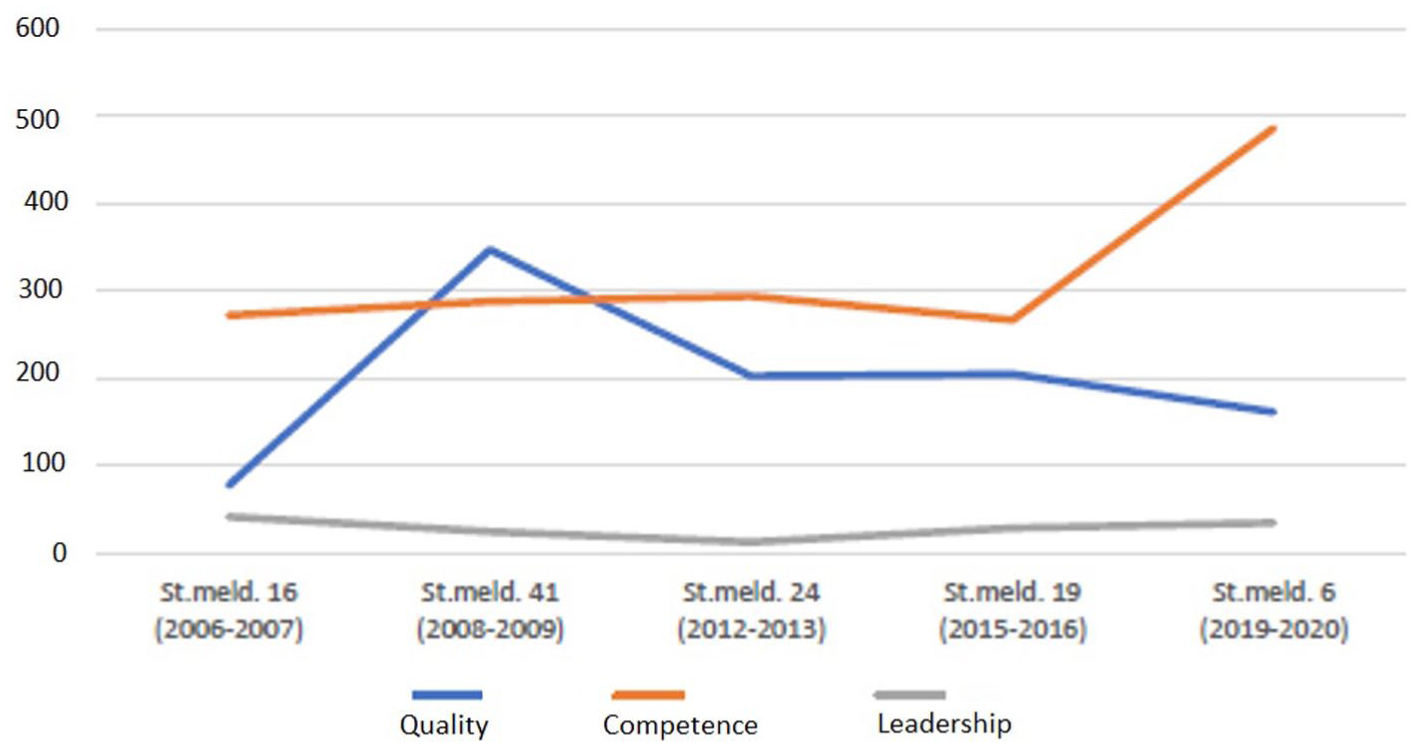
Diagram of concept development in the period 2006–2019.
The question of why leadership occupies such limited space in policy texts occurs, since leadership is presented as a solution especially given its significance within neoliberal governance discourses and NPM reforms.
Research suggests that ECEC professionals may resist the business-oriented rhetoric associated with NPM reforms, with many leaders reluctant to describe their roles using terms like ‘strategic leadership’ (Granrusten, 2016a; Hujala, 2004; Seland, 2009). This resistance highlights a tension between research, policy, and practice, as researchers often articulate leadership concepts in ways that are not fully embraced by practitioners. For example, strategic leadership is a term frequently employed in research to reflect the evolving managerial roles of leaders under changing framework conditions (Bleken, 2005), yet it is absent from policy texts. The apparent disconnect between research, policy, and practice suggests that research may be ‘ahead’ of policy and the field in framing leadership as central to quality improvement.
Elizabeth St. Pierre (2006, in Bacchi, 2010) describes how research can produce subjects that align with policy goals, functioning as a form of power that satisfies government aims. If research influences policy, the limited presence of leadership in policy texts is puzzling. However, leadership, even when sparsely discussed, is consistently framed as vital for achieving quality and competence goals in ECEC. This suggests that research-driven advocacy for leadership may reflect professional resistance to increased political demands and a desire to assert control over how leadership is defined within the ECEC profession (Børhaug et al., 2018).
The effects of this problem representation
The representation of quality as an issue of staff competence has specific effects on governance and practice in the ECEC sector. First, it necessitates demands for competence, enhancement and development, reinforcing the need for leadership to manage these change processes. In this way, the problem representation itself produces the solution: leadership. However, this is not leadership in a general sense but a specific form of change and development-oriented leadership. Through the series ‘quality – competence – leadership’, a policy discourse emerges in which ECEC leaders are positioned as the agents responsible for implementing quality improvement initiatives (Ball et al., 2011).
From a governmentality perspective, this representation shapes subjects within the policy discourse of quality and competence, aligning with broader frameworks of soft governance (Bacchi, 2009, 2010; Mausethagen, 2013; Nygård, 2015). By framing quality as dependent on process quality—largely provided by staff—structural quality issues, such as capacity and funding, are sidelined. This focus effectively shifts the burden of quality improvement onto individual staff members and leaders, emphasizing efficiency and self-management over systemic solutions. Moreover, the emphasis on leadership within ECEC teacher education can be understood through Foucault’s (2002) notion of power as a productive force. Research and policy intersect to construct leadership as a key factor in addressing quality issues, potentially reflecting resistance from the professional community to political pressures on the sector. By strengthening the leadership role, research positions ECEC teachers and leaders as active participants in governance processes, reinforcing their professional autonomy while aligning with broader governance objectives. To sum up, the framing of quality as an issue of competence not only shapes governance strategies but also reinforces specific leadership roles within the ECEC sector. While this discourse empowers leaders to drive change, it simultaneously obscures systemic challenges such as capacity and funding, illustrating the complex interplay of power, policy, and practice in shaping the ECEC field.
Conclusion
Policy as a governance tool in new public management reforms
In the context of the reform-oriented leadership represented by New Public Management (NPM), policy serves as a critical instrument for governing the ECEC sector (Mausethagen, 2013; Nygård, 2015). Concepts such as soft governance and governmentality provide valuable frameworks for understanding how policy exerts influence, shaping the positioning of individuals and groups within written discourses to direct them toward desired outcomes (Foucault, 2002). Bacchi (2009, 2010) asserts that policy does not respond to pre-existing problems but actively constructs problems through its representations of them. The issue of quality has been a recurring theme throughout the five analyzed white papers, consistently framed as a lack of or variation in staff competence (Janninger, 2020). This problem representation generates effects such as increased emphasis on competence enhancement and development. The goal of establishing ECEC as a learning organization necessitates ongoing competence development processes among staff. Beyond general development, this representation also demands raising overall competence levels. For years, competence and skill development have been the solutions presented in policy to address the quality problem within the ECEC sector. However, the analysis by Janninger (2020) reveals that the quality problem remains just as prominent in policy discussions in 2019 as it was in 2006. Additionally, research within professional communities has increasingly emphasized the importance of leadership in the ECEC sector, suggesting that the growing focus on leadership may reflect a form of professional resistance, understood through a Foucauldian lens as counter-power. Despite this, leadership remains central to the NPM framework, which interprets quality development as closely tied to leadership practices.
Why is the quality problem not solved?
In all the analyzed policy documents, in Janninger’s (2020) study, quality is presented as the central issue facing the ECEC sector. This problem is primarily framed as a lack of and variation in staff competence, showing that the concept of quality is rooted in both a welfare state governance rationality and a neoliberal governance discourse. Consequently, the quality problem is far more complex than merely addressing staff competence development. Leadership is highlighted as essential for quality improvement and is predominantly discussed in the context of competence and skills development. However, the presence of leadership in policy texts is less pronounced than might be expected, given its significance in NPM reforms (Sørhaug, 2003).
Notably, there is a relative silence in the policy documents regarding capacity and financial considerations tied to this problem representation. By framing the quality issue as a matter of staff competence, the emphasis shifts toward increasing requirements for competence enhancement and development. Leadership is subsequently positioned as responsible for driving these development processes, with change leadership emerging as a key focus. This emphasis on change leadership aligns with research findings that identify it as critical in contemporary ECEC practices. Leadership research also highlights the evolving framework conditions within the sector, which have necessitated the introduction of a fourth leadership function: strategic leadership. Unlike the traditional administrative, pedagogical, and personnel leadership functions, strategic leadership is more outward-facing, reflecting the tensions between broader societal expectations and local organizational needs (Bleken, 2005; Granrusten, 2016a). Strategic leadership as described in research corresponds closely to what policy identifies as change leadership.
Effects of the problem representation
One effect of this problem representation is that the professional discourse is marginalized in policy texts, as the focus on quality, competence, and leadership takes precedence. The spotlight is directed toward staff learning and development, while children’s learning and development are relegated to the background. This issue is also noted in research (Gotvassli and Vannebo, 2016d).
From a Bacchian perspective on policy analysis, the stability of the problem representation—framing quality as an issue of staff competence—leads to specific effects. These include an increased focus on change leadership and a diminished emphasis on professional discourse. This shift results in greater attention to staff-related issues at the expense of considerations related to children. From a governmentality perspective, these problem representations shape governance practices by creating a dynamic in which quality, competence, and leadership are intertwined, reinforcing specific solutions while sidelining others. The persistent framing of quality as a competence issue also contributes to systemic inertia, leaving the fundamental problem unresolved despite years of policy focus.
Final reflections
The analysis concludes that the quality problem remains as prominent in 2019 policy discussions as it was in 2006. Using Bacchi’s framework, the quality issue is consistently represented as a matter of staff competence, a framing that produces effects such as the increased emphasis on change leadership and the marginalization of professional discourse.
Ultimately, this leads to a stronger focus on staff-related processes and development rather than on capacity issues and financial problems. A key question remains: why has the quality problem persisted despite the stability of its representation? This highlights a critical tension in the policy discourse and raises important questions about the effectiveness of governance strategies under NPM-inspired reforms.
Footnotes
Acknowledgements
We extend our deepest gratitude to Associate Professor Elin Birgitte Ljunggren for her invaluable feedback and constructive critiques on this project. Her insightful suggestions have greatly enriched the study and strengthened its theoretical and methodological rigor.

Author contributions
Linda Janninger initiated the study and led selecting the policy documents, analysis and been the writing process. Sobh Chahboun (شهبون صبح) participated in discussion of all parts of the article and finalized the editorial work as our main language.
Funding
The authors received no financial support for the research, authorship, and/or publication of this article.
Declaration of conflicting interests
The authors declared no potential conflicts of interest with respect to the research, authorship, and/or publication of this article.