




Abstract
Many parents have concerns about young children’s digital media use, while often perceiving potential benefits for learning. In a multilingual environment, parents’ attitudes and practices are influenced by their language ideologies as well as perceptions regarding dangers to health and wellbeing. This study, set in a post-Soviet, Global South context and shaped by globalisation and neoliberal discourses, explores how diverse influences potentially clash and ultimately combine in parents’ complex decisions regarding young children’s use of digital media. The research was conducted with five families of five-year-old children in Baku, Azerbaijan, over 15 months through family visits and a digital participatory method, Living Journals. Parents enabled young children’s access to digital media primarily to support multilingual learning, in line with aspirations for their children’s multilingual futures, while also setting constraints they deemed beneficial for their children’s overall health and wellbeing.
Keywords
Introduction
This paper examines the ways in which parents’ attitudes and values influence their mediation of children’s use of digital media in their everyday lives. We explore how diverse influences potentially clash and ultimately combine in parents’ complex decisions regarding young children’s use of digital media. Following Buckingham (2007: 45), we refer to digital media as technologies that enable the creation, distribution, and consumption of interactive, multimedia content, going beyond mere ‘information technology’ to encompass ‘cultural forms’ used for communication, entertainment, self-expression, and social connection.
Research on young children’s digital media use in the Global North reveals that they are increasingly engaging with various digital media from infancy, for example, with respect to the USA (Mann et al., 2025), Europe (Chaudron et al., 2018), Australia (Green et al., 2024), and Turkey (Konca, 2022). A UK-wide project we participated in has revealed that babies are now born into media-rich homes and are immediately exposed to multiple types of digital media (Flewitt et al., 2024). Access to digital media by young children in their daily lives can vary based on several factors, including socio-economic status (SES), parental attitudes, parental mediation styles, and cultural contexts within which they live (Rideout and Robb, 2020). For example, parents with higher-income and education levels are more likely to provide greater access to a wider variety of digital media, supporting their children’s diverse interactions with digital media (Flewitt et al., 2024; Lauricella et al., 2022).
Yet at the same time, parents express concerns over possible negative effects of digital media use, particularly regarding physical and mental health. Common fears include potential detrimental effects on eyesight, bodily passivity leading to obesity, and social isolation (Lanca and Saw, 2020; Livingstone and Blum-Ross, 2020; Stiglic and Viner, 2019). Such fears are underlined by advice from many institutions, including international bodies, advocating against use of digital media by very young children. The World Health Organisation (WHO) advises no sedentary screen time for infants under 1 year and no more than 1 hour per day for ages 2–4, while the American Academy of Pediatrics recommends avoiding digital media (other than video-chatting) before 18–24 months and very careful, co-viewed use thereafter (American Academy of Pediatrics (AAP), 2016; World Health Organisation (WHO), 2019).
With respect to learning and education, discourses made available to parents tend to be relatively positive, including, or perhaps especially, with regard to multilingual countries. Early technology exposure is perceived as a foundation for equipping children with the skills important for schooling and even their future careers (Flewitt et al., 2024; Livingstone and Blum-Ross, 2020; Soyoof et al., 2024). Digital media can contribute to language development in early childhood, supporting vocabulary acquisition and early literacy skills when appropriately designed and mediated (Liu et al., 2024). Digital media offer advantages for learning foreign languages, enabling children to engage with diverse linguistic content that may not be readily available in their immediate environment (De Wilde et al., 2020; Kuppens, 2010). Various educational applications, video content, and interactive games in foreign languages support children’s bilingual development by offering rich linguistic input and opportunities for practice (De Wilde et al., 2020). In sum, parents’ aspirations for their children’s linguistic competence influence children’s exposure to foreign languages at home (Curdt-Christiansen, 2009), and digital media offer opportunities they might not themselves have encountered in childhood.
In this paper, we draw on a qualitative, multiple-case study in which we conducted Family Visits with five families with five-year-old children from Baku, Azerbaijan’s capital city, over 15 months (2018–2019), and used a new digital participatory research approach, Living Journals (2019–2020, repeated in 2023). We seek to respond to the following research question: How do Azerbaijani parents balance concerns for their children’s health with beliefs about the positive potential relating to learning and education to arrive at practices of mediation of their young children’s use of digital media?
This research question enables us to explore parental aspirations, set against the background of language ideologies in a neoliberal country with a distinct multilingual identity. We treat parental mediation as discourse practices through which macro language ideologies become consequential in family life (Guardado, 2018). Therefore, it is necessary to explore the wider context influencing these language ideologies. Before outlining our investigation, we provide a brief discussion on how neoliberalism and multilingualism coincide in contemporary language ideologies and then home in on our specific context, Azerbaijan.
Neoliberalism and multilingualism
Globalisation has brought enormous shifts in language ideologies in many areas across the world, although the diversity of these changes has prompted some resistance to the conceptualisation of ‘globalisation’ if implying homogenisation. The changes are not straightforward in nature due to the differences in globalisation depending on local economic, social, and cultural contexts (Blommaert, 2010).
Shifts in language ideologies have affected and often complicated people’s relationships with their own sense of identity and capacity for success in a highly competitive world. While increased dominance of certain global languages might offer opportunities, it may also marginalise local languages, creating a dichotomy between global integration and local authenticity (Heller, 2003). In the Global South, the inadequacy of linguistic resources to compete in globalised arenas might further intensify exclusion and foster a sense of alienation.
Language has always functioned as a symbolic and material resource contributing to a sense of identity; however the rise of globalised economies and the transnational spread of digital media have added new dimensions of commodification and ideological reshaping to linguistic values (Duchêne and Heller, 2012). Neoliberal discourses have influenced parents’ navigations of ever-changing multilingual societies (Rojo, 2019). Such discourses include an increased focus on the responsibility of parents for raising children, in comparison, for example, to the stronger focus on the state’s role in the former Soviet sphere. These parental responsibilities entail preparing children for academic and ultimately economic success and caring for their wellbeing in digital environments. Digital media play a part in all these spheres (OECD, 2022). We view these dynamics through a policy-in-action lens that emphasises how families interpret and operationalise policy discourses in everyday practice (Savski, 2024) alongside discourse-based accounts of how ideologies are reproduced and contested in home socialisation (Guardado, 2018). We now move to considering the context of Azerbaijan, the site for our research.
Multilingualism and language ideologies in Azerbaijan
The research was carried out in the Republic of Azerbaijan, a country with considerable linguistic and cultural diversity (Garibova, 2009). This is a particularly interesting location for researching children’s uses of digital media and parents’ language ideologies, from the vantage point of our current location in the UK, in which discourses of monolingualism are relatively dominant (Blackledge, 2001). The language policies of nation-states are complex, reflecting interplays of influences from within and beyond national boundaries (Savski, 2024). Azerbaijan has just one official language, Azerbaijani, but the country has a strong tradition of valuing multilingualism, in ways that go beyond links between particular communities and heritage languages, or connections with valued neighbouring countries (Mammadov and Mammadova, 2022). Russian, English, and Turkish are particularly significant, with distinct roles as we shall elucidate. This multilingual atmosphere contributes to the development of economic and social life as well as educational policies and practice, reflecting Azerbaijan’s historical and geopolitical position (Ibid). Another country-specific factor is that digital devices that are common in the Global North are not available in Azerbaijan, including internet-enabled toys, Amazon’s Fire tablets for children, Alexa voice assistants, Google Nest hubs, and Apple HomePods. We now turn to exploring the sociohistorical background relevant to this study.
In 1918, the Azerbaijan Democratic Republic proclaimed its independence as the first secular democratic Muslim-majority state. Twenty-three months later, the state succumbed to Soviet rule. For the next seven decades, the dominance of the Russian language, including in government and education, led to a steady rise in its use and, correspondingly, a decline in the number of Azerbaijani speakers (Lebedeva et al., 2018). Particularly for the first five decades, access to resources in education, career advancement, and professional success was heavily dependent on proficiency in Russian (Garibova and Asgarova, 2009).
Azerbaijan restored its independence for the second time in 1991, alongside its neighbours, Georgia and Armenia. Following this, the Azerbaijani language replaced Russian as the official language; nevertheless, historical and economic ties with the Russian language have contributed to its continued significance in the country (Garibova, 2019). Especially in urban areas, Russian remains prominent, serving as an important medium for both verbal and written communication (Kazimzade, 2024). Meanwhile, efforts to elevate the Azerbaijani language were intensified through language policies, including the 2001 Presidential Decree and the 2003 Language Law, which promoted Azerbaijani in public and professional domains. Such policies not only reinforced national identity but also motivated minorities and Russian-speaking elites to integrate linguistically into broader society (Garibova, 2009). We now provide an overview of the principal languages in use at present, drawing on scholarship and the personal and professional experiences of Savadova.
Russian is still commonly used in schools, media, and daily conversation, and thus maintains its relevance despite Azerbaijan’s linguistic independence. Russian continues to hold considerable influence in Azerbaijan, especially among older generations and in Baku (Mammadova, 2020). This familiarity with Russian often begins in early childhood, facilitated by Russian-speaking peers, media exposure, and bilingual educational institutions. While Russian predominated during the late Soviet period, since 1991 Azerbaijani has replaced Russian as the primary language of administration and schooling, and the use of Russian has declined (Lebedeva et al., 2018).
English, meanwhile, has gained increasing importance among younger generations and has become a compulsory subject at schools, driven by Azerbaijan’s integration into the global economy and the growing demand for English proficiency in sectors such as business, technology, and academia. English proficiency is not only a tool for accessing global information and resources but is also viewed as essential for career advancement in international fields (Kazimzade, 2024). On the other hand, young children encounter and practise informal learning of English beyond schooling through digital media use, including watching YouTube videos, gaming, and TV streaming (Sundqvist and Sylvén, 2016), which is also true in Azerbaijan.
Turkish is another language commonly spoken and understood by the majority of Azerbaijanis due to its close resemblance to the Azerbaijani language. Turkish television shows, music, and films are popular, further enhancing language acquisition and familiarity across generations. This exposure facilitates an informal learning environment where children and adults can differentiate minor linguistic distinctions between Turkish and Azerbaijani with ease (Garibova, 2019). The ready availability of Turkish-language content on TV platforms in Azerbaijan further normalises receptive bilingualism and translanguaging.
Azerbaijan’s multilingual ecology, shaped by Soviet legacies, post-independence policy, and the increasing spread of digital media, assigns distinct yet overlapping values to Azerbaijani, Russian, English, and Turkish. Within this ecology, Azerbaijani symbolises national belonging and formal education; Russian sustains intergenerational continuity and access to a regional media sphere; English operates as global cultural and economic capital; and Turkish circulates as a proximate language through popular entertainment. With children’s exposure to multiple languages concentrated on digital media use, language exposure is mediated by parents’ future aspirations in Azerbaijan. The intersection of this multilingual landscape with digital media creates particularly complex dynamics around language ideologies and digital media use (Pavlenko, 2008), making Azerbaijan an inviting site for examining how families navigate digital media use in alignment with their language ideologies and future aspirations. As a result, Azerbaijan is a fascinating example of how the demands and opportunities of late capitalism are associated with an intensification of competing languages in all spheres of life (Heller et al., 2024). We now turn to our empirical investigation of how families negotiate these dynamics in everyday practices and examine how parents navigate the complexity between health and wellbeing concerns and their beliefs about the positive educational potential of digital media, particularly in relation to language learning opportunities.
Research design
The paper draws on a qualitative, multiple-case study (Thomas, 2021) where each family with a five-year-old child constituted a separate case. We focused on five-year-old children because children typically begin formal preschool at this age, as preparation for primary schooling. Therefore, it was of interest to explore children’s uses of digital media during this transition period. The data generation included fieldwork, Family Visits (FV), and the use of a digital participatory research method, Living Journals (LJ), which will be briefly summarised below. All data generation was conducted in Azerbaijani, and all data were translated and transcribed by Savadova. Detailed procedures, including ethical implications of these steps, have been detailed elsewhere (Savadova, 2023).
Participants
Professional and personal networks in Azerbaijan were used to recruit participants through snowball sampling (Parker et al., 2019). The initial criterion was that families included a five-year-old child. Initial communications were conducted from Edinburgh with Azerbaijani mothers via email. Participant information sheets and consent forms were sent to them for family discussions, to include fathers. At introductory online meetings, additional study details were provided, and initial consent from children was obtained prior to in-person family visits. During the three months of fieldwork in Baku, mothers and children joined family visits, while fathers participated in the subsequent LJ discussions.
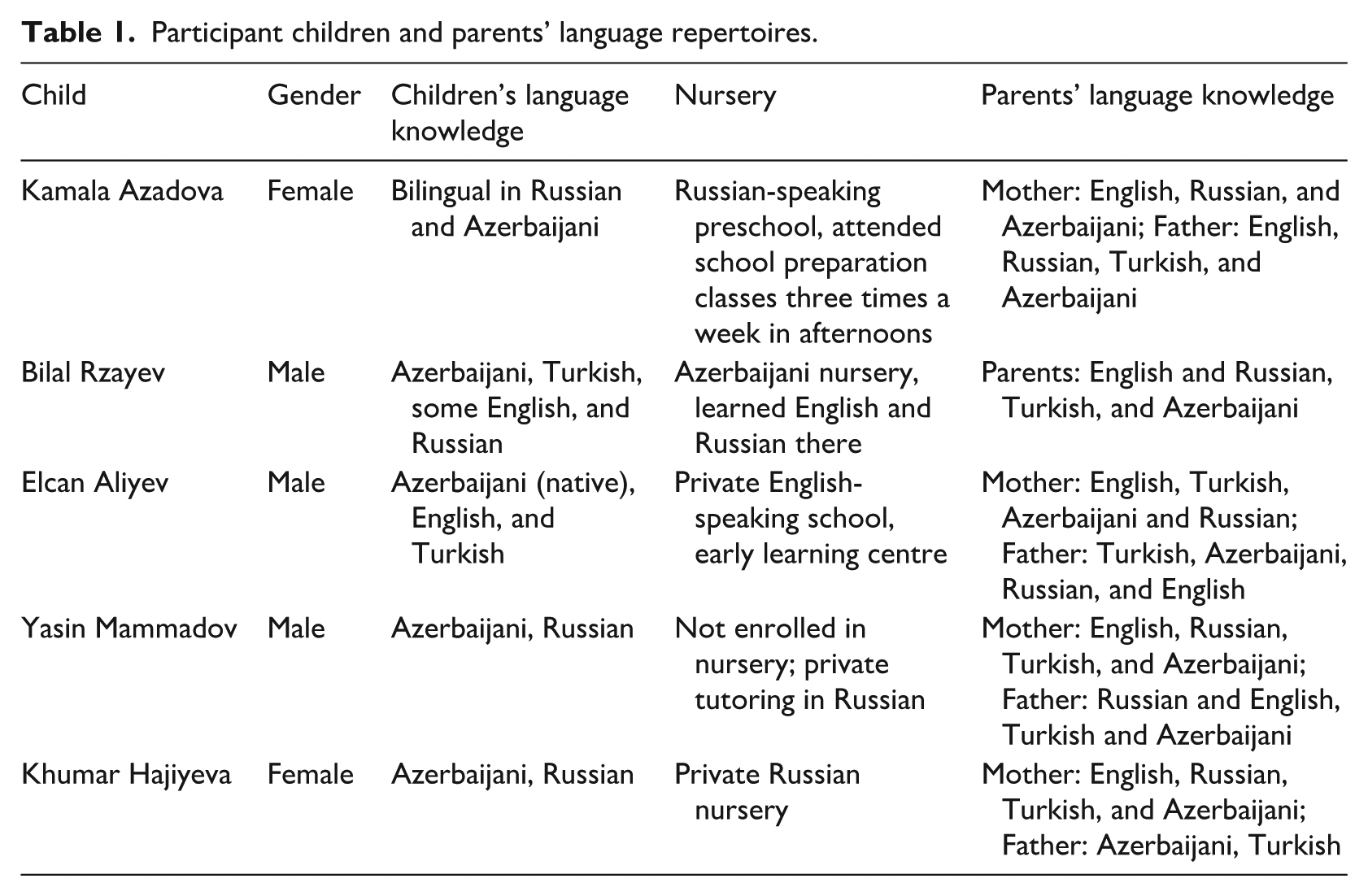
Five heterosexual families were invited: both parents and their five-year-old child participated in the study (Total: 15). (At the time of writing this paper, same-sex marriage is illegal in Azerbaijan.) In alignment with the purpose of this paper, in Table 1 below, we introduce the participant children, their parents, and their language repertoires, as well as information on the children’s preschool education, including language(s) used in these educational settings.
Participant children and parents’ language repertoires.
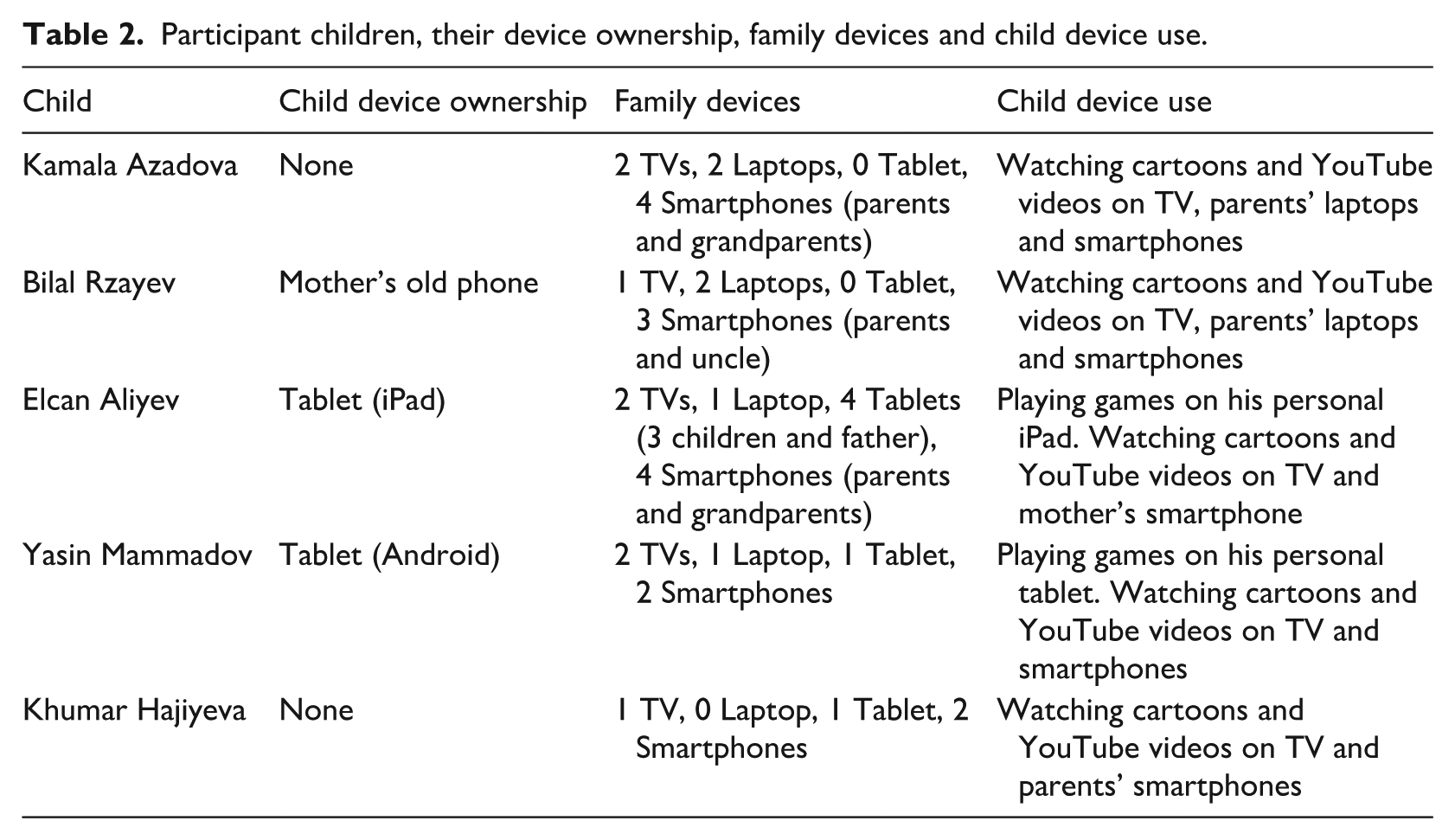
Similar to children’s language knowledge and learning, as described in Table 2 below, the digital inventories of the family homes varied in terms of children’s and families’ device ownership and children’s device use.
Participant children, their device ownership, family devices and child device use.
Family visits
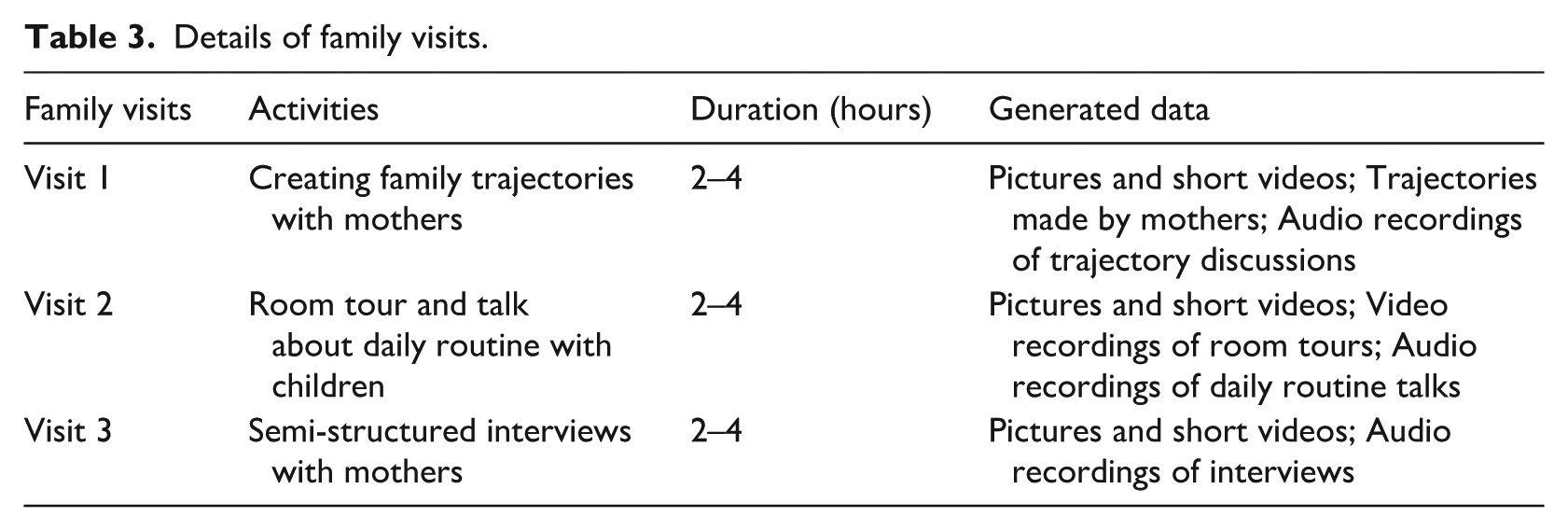
The fieldwork involved three visits to each of the five families in Baku from September to December 2018. During each visit, we used a variety of methods designed to gather data, incorporating varying procedures, durations, and participants (involving either mothers, children, or both). Table 3 details the activities for each family visit and summarises the gathered data below.
Details of family visits.
Family visits 1
Savadova met families in person in their homes and created family trajectories with mothers to learn about parents’ childhood experiences, their previous interactions with digital media, their values and beliefs about parenting, mediation of digital media, and their aspirations for their children’s futures (Neale, 2015). Mothers were invited to create personal and family trajectories in whatever visual form they preferred (lists, lines with high/low points), followed by audio-recorded discussions on the created trajectories. The trajectories and their discussions generated baseline timelines of significant events in families’ lives, including mothers’ beliefs about their children’s use of digital media, that informed subsequent visits.
Family visits 2
These visits focussed on engaging children through creative activities such as photo-elicitation to discuss daily routines (Harper, 2002) and room tours inspired by Plowman and Stevenson (2013), allowing children to share their lives and interactions with digital media in their own voices. These activities, conducted primarily with the children and occasionally involving mothers, were audio-recorded, translated into English, and transcribed to ensure the inclusion of children’s perspectives in the data analysis. These room tours were supplemented by pictures and short videos, following children’s leads. They yielded rich and detailed accounts of children’s everyday routines and digital media use within their family contexts.
Family visits 3
These visits featured semi-structured interviews conducted with mothers to explore their views on their children’s uses of digital media, their mediation strategies, their concerns about children’s digital media use, and how family context influenced these decisions. Although fathers were initially intended to participate, they declined, citing limited time at home and deferring to their spouses’ knowledge of their children’s daily activities. All interviews were audio-recorded and informed by preliminary analysis from earlier visits.
Living Journals approach
After completing the family home visits in Azerbaijan, Savadova developed a Living Journal approach to explore young children’s daily interactions with digital media while minimising physical intervention in their home settings (Savadova, 2023). Using the WhatsApp application, mothers were asked to capture and share pictures or short videos of their children during specific intervals over 2-week periods in both school term and holiday seasons. Implications of using the WhatsApp application have been discussed elsewhere, (Savadova, 2024). The generated data, combined into custom-designed paper and digital journals, were later used as prompts to gather family members’ reflections on their daily activities. Inspired by Tobin et al.’s (1989) Video-Cued Ethnography, Plowman and Stevenson’s (2012) mobile phone diaries and Gillen and Cameron’s (2010) A Day in the Life method, the approach allowed for a deeper exploration of children’s uses of digital media within their family contexts. Families embraced the method, especially the printed and digital journals, which were shared as keepsakes among relatives and neighbours. The LJ approach yielded multivocal, multimodal, metatextual, and multifunctional data as detailed elsewhere (Savadova, 2024). Below, we briefly summarise three phases of the approach.
In Phase 1, mothers were asked to share photos or 30-second video clips of their children via WhatsApp, accompanied by brief responses to questions about the child’s location, activity, companions, reasons for the activity, and feelings. This week-long data generation happened twice within a year—during the academic term in April (2019) and school holidays in August (2019)—and included visual, textual, and audio messages capturing children’s daily routines and digital interactions. All specific timings for sending prompts were agreed upon with mothers depending on their individual schedules. The main idea was to capture two to three weekdays and one weekend day, and three times during the day: morning, afternoon, and evening.
In Phase 2, journals combining pictures, texts, video stills, and transcribed audio responses were created in both digital and paper formats, with digital versions featuring playable videos. In this phase, mothers and children were consulted in deciding which pictures and videos to add to their journals and which ones to leave out. Physical copies of families’ own journals were shared with that family, and digital versions were used solely for online cross-family discussions. Consent was obtained from mothers and children before sharing journals with fathers or other participant families.
In Phase 3, online discussions involved mothers and children together and fathers separately, focusing on the created Living Journals to gain fresh perspectives on their children’s daily activities. This was especially important for fathers who did not want to participate in the initial data generation and had not seen their children’s visuals and mothers’ interpretations before. Sharing journals across families enriched the discussions as there was a diverse range of activities captured across the journals, enabling reflections on shared and diverse uses of digital media. This approach also facilitated richer insights and deeper engagement compared to traditional interviews. The main purpose of sharing the journals across families was similar to photo-elicitation (Harper, 2002), to invite families to look at uses of digital media and discuss their own approaches and experiences (Details of further ethical implications have been discussed elsewhere, Savadova, 2023.).
The Living Journal approach was first used from April 2019 to January 2020. Families were subsequently contacted in 2023 and participated in video-recorded discussions with Savadova. While those data are not the focus for this paper, we are therefore able to draw on them to assert that the findings reported in this paper remain relevant. As with so much social change, digital media, including devices and TV programmes, may change particularly rapidly, whereas parents’ language ideologies and future aspirations evolve more slowly.
Data analysis
A flexible and iterative approach was used for data analysis, integrating data generation and analysis stages (Miles et al., 2014). All data, including visuals and transcriptions of LJ discussions, were uploaded to Dedoose, a mixed-methods analysis platform, for coding and analysis within individual cases and across cases. Inductive thematic analysis was employed to explore participants’ perspectives systematically, ensuring that each step was iteratively revisited to align findings with the research question mentioned above (Braun and Clarke, 2021).
The coding process consisted of two phases: open and focused coding. During open coding, emergent codes were developed inductively and compared within and across cases to identify patterns and variations. In the focused coding phase, these codes were refined into coherent categories and themes (Thomas, 2006). This method highlighted both similarities and disparities across families, enabling a deeper understanding of how parents’ aspirations for their children’s multilingual futures influenced their mediation practices.
Ethical considerations, implications, and limitations
Ethical approval for the study was obtained from the University of Edinburgh in alignment with the British Educational Research Association guidelines (BERA, 2018). All participant names are anonymised, and pseudonyms are used. The study adhered to rigorous ethical guidelines throughout, obtaining ongoing consent from parents and children for the use of their images in publications or presentations. Recognising complex power dynamics within families, ethical considerations were approached as a continuous process within the studied context (Sun et al., 2023), with particular attention given to children’s rights, wishes, and non-verbal gestures.
Before online meetings with individual families, all mothers were sent a participant information sheet and an informed consent form by email. Once they discussed these with their families and returned them signed, oral consent from mothers and children was obtained in online meetings for their participation in the study. During the first family visits, a written child-friendly consent form was used, where children were invited to use stickers to indicate their participation in the study, as they were just learning how to read and write. Most children managed to write their names or initials and drew pictures on the consent papers. Prior to each family visit and LJ step, oral consent was renewed.
The LJ approach involved multiple stages of consent from mothers, fathers, and children. Mothers, as mediators, captured children’s visuals and sent them through WhatsApp, a common communication tool in Azerbaijan. Savadova used their personal phone and number for this purpose. However, the data, including visuals and mothers’ daily responses, were moved daily to a folder on a university-provided OneDrive platform and deleted from the phone. Further ethical implications of using WhatsApp in this study have been discussed elsewhere (Savadova, 2024). While most children relied on their mothers’ involvement, a few independently contributed visuals under their mothers’ supervision. This approach acknowledged family power dynamics while ensuring data generation minimally disrupted daily life.
Implications of the study arise for early childhood educators and policymakers. Effective strategies should be age-appropriate, tailored to developmental differences, and sensitive to disparities in access that stem from sociocultural and socioeconomic contexts (OECD, 2022). By understanding both the motivations and the approaches underpinning parents’ mediation strategies, educators can better support continuity between home and educational settings and strengthen children’s purposeful use of digital media across contexts.
This study has limitations as well. Expanding the sample and complementing qualitative insights with quantitative methods would clarify the broader implications of parental aspirations for young children’s digital media use. Further studies should examine how digital media, foreign-language learning, and parental mediation intersect across varied cultural settings, and how these dynamics can be leveraged to support parents and children’s use of digital media.
Findings and discussion
We have developed the following themes to be discussed in the respective subsections below. As will be seen, each theme offers an approach towards understanding the parents’ ultimate interplay between health-and wellbeing-related concerns and aspirations for learning.
Hierarchy of devices
Prosocial behaviour
Multilingual learning
Hierarchy of devices
Device selection was always an important factor through which parents navigated between their positive attitudes towards digital media and concern for their children’s welfare. Yasin’s father purchased a tablet for him, considering its larger screen to be less harmful to his eyes than a smartphone.
His [Yasin’s] father bought a tablet for him because its screen is bigger. (Mrs Mammadova, FV 3)
Khumar’s mother mentioned that Khumar was not allowed to watch YouTube videos on her parents’ phones, but she was allowed to watch on her grandparents’ laptops when she visited them. She explained it by saying that the laptops have bigger screens than phones.
We go to my family’s house and there she can watch on a laptop. Because its screen is a bit bigger. She watches a little bit there. (Mrs Hajiyeva, FV 1)
Across all families, televisions were prioritised by parents due to their larger screens, which parents perceived as less detrimental to children’s eyesight while being beneficial for children’s foreign language learning. Parents shared what we term a hierarchy of devices, a scale of preference informed primarily by their perceptions of the effects of screen size and the ease with which they could mediate their children’s digital media use. This hierarchy placed smartphones at the bottom due to their small screens and the difficulty of monitoring content, tablets in the middle, and TVs at the top due to their larger screens and easier content control. Parents prioritised devices that would best facilitate foreign language exposure. In Azerbaijan, television and satellite services also offer stable access to Russian and Turkish programmes, enabling parents to curate language-specific inputs aligned with their goals of preparing children for multilingual schooling and future career opportunities in a globalised world. The emphasis on larger screens and content control also reflected parents’ values of protecting children’s health and wellbeing.
The digital device hierarchy can be seen as part of policy-in-action and family language socialisation, because these devices afford the linguistic exposure and oversight that match parental language ideologies and goals (Guardado, 2018; Savski, 2024). Digital media choices are not neutral but part of a deliberate mediation strategy as to which languages young children engage with via digital media. Consistent with this perspective, parents in this study actively shaped their children’s use of digital media to achieve these linguistic and social goals. Behavioural considerations were important too, as we now discuss.
Prosocial behaviour
Parents also considered multilingual competencies to be associated with character development, such as greater independence and prosocial behaviours. Parents often expressed positive associations with Russian.
They [Russian-speaking children] are more independent. I remember my own childhood. I think they are more independent and different, and more sincere with one another. I think like that, maybe I am wrong. (Bilal’s mother, Mrs Rzayeva, FV1)
Kamala’s mother similarly mentioned the ‘good behaviour’ of Russian-speaking children and was proud that although Kamala had started school in Azerbaijani, she soon moved her to the Russian-speaking section.
In the LJ discussions, fathers sometimes offered their views on the impact of language on a child’s general social development. For example, Yasin’s father expressed curiosity about how his child would interact with classmates who came from Russian-speaking background.
We speak Azerbaijani at home, but in Russian schools, children mostly come from Russian families, so when Yasin starts interacting with them, it will be interesting. (Mr Mammadov, LJ discussion)
Elcan’s father also oriented towards the future in advocating for Russian use, including through media. He argued that Russian is not just a language but a gateway to understanding diverse cultures and accessing a wider range of opportunities in the global world. Again, reflecting on his own experiences, he regretted not knowing foreign languages himself. Here, he noted a current tension between Azerbaijani and Russian-speaking cultures, commenting that while his own community was often taught to value its own culture as supreme, Russian language and culture held considerable importance in a more global context.
When I look at Azerbaijani-speaking people, I see that they are more hardworking. But I think as there is more literature in the Russian language, of course it is better to study in Russian. It is also a great thing to know one more language and one more culture. If you know Russian, you are going to be able to see so many countries without any problem. . . (Mr Aliyev, LJ discussion)
Bilal’s father offered a contrasting perspective, one that downplayed the significance of the language spoken in schools. Out of five participant fathers, only Mr Rzayev argued that the most important factors in a child’s social and emotional development were their upbringing and the time they spent with their parents, not the language of instruction. He did not align with the idea that Russian-speaking children are inherently more independent. He proposed that independence and social confidence come from a supportive home environment and active parental engagement, regardless of the language spoken. Therefore, he argued, access to specific languages, whether or not mediated through digital media, did not affect children’s sociability and likelihood to succeed. ‘I support education in any language’, Mr Rzayev concluded, in the the LJ discussion. Curating multilingual exposure via digital media was a significant consideration for parents, and this is explored next.
Multilingual learning
All participant children were learning English and Russian, while being potentially exposed to Turkish in their daily lives, as many TV channels in the country broadcast Turkish content. Yasin’s parents resisted exposure to Turkish, having bought a new satellite dish for their house so he could watch only Russian content. Yasin’s parents also enrolled him in a Russian-speaking school, trusting that Mrs Mammadova, with her better command of Russian, would support Yasin’s studies. Interestingly, Yasin’s father’s valuing of digital media for Russian language learning was initially couched through a Turkish proverb: One language means one person, and two languages mean two people. [. . .] When he was little, we bought a satellite dish to watch only Russian TV channels. He likes watching cartoons on Russian TV channels. . . He always watches cartoons in Russian. (Mr Mammadov, LJ discussion)
‘One language one person, two languages two persons’ is a Turkish proverb which sounds the same in Azerbaijani. It implies that when a person learns a second language, they become a new (an additional) person as they also become exposed to a new culture together with the language. Yasin’s mother, Mrs Mammadova, stated that although she occasionally found quality educational content in Turkish, she also discouraged Yasin from watching Turkish channels since he did not need Turkish for his studies.
Especially on TV, I do not let him watch cartoons in Turkish because he knows and understands them better. But I try to make sure that everything is in Russian. On the tablet, too, he tries to watch something in Turkish, but I change them. Although those videos are better, I notice that he is using Turkish words. And also, I notice that in Russian videos, children scream and use bad words. But there are good things in Russian videos too, so I carefully pick them so he can watch the good ones. I control them. (Mrs Mammadova, FV 3)
Yasin’s parents seemed to be actively involved in optimising their child’s foreign language learning through digital media and prioritising content that aligned with their language goals. Micro-level curation of media content merges with school choice and broader language-in-education orientations, illustrating policy-in-action at the level of the household (Savski, 2024) and the socialisation of identities through family discourse and practice (Guardado, 2018).
These findings align with studies in other non-English-speaking countries where parents actively used digital media for language education (Obojska and Vaiouli, 2025; Ramírez Verdugo and Alonso Belmonte, 2007; Si, 2015). In the Azerbaijani context, parents enrolled their children in schools where Russian or English was taught, anticipating long-term benefits and preparing them for schooling in a language different from their mother tongue. This strategic approach led them to accept digital media as an enabler for foreign language exposure.
All the participant mothers valued their children’s foreign language learning through YouTube videos and cartoons, especially encouraging their children to watch content in Russian or English, particularly in preparation for attending Russian or English-speaking schools. For example, Mrs Aliyeva, Elcan’s mother, recalled sitting with her children to watch YouTube videos that taught the names of fruits and vegetables in English. She noted that while very young, her children initially watched Turkish videos, and she then encouraged them to switch to Russian or English content, arguing: It influences their language learning. Their teacher has said so too. (Mrs Aliyeva, FV3)
Similarly, Kamala’s father expressed pride in their child’s strengthening knowledge of multiple languages due to watching media content in those languages.
They [his children] watch [cartoons] in Russian, Turkish, and Azerbaijani. She already knows Russian very well. (Mr Azadov, LJ discussion)
Among the participant families, Bilal’s parents were the only ones to opt for an Azerbaijani-speaking school for their son, while arranging language classes to learn English and Russian at the nursery. Bilal also often watched Turkish cartoons via satellite and used some Turkish words during our conversations at family visits.
He usually plays Minecraft and Word Charm with his mother to improve his English vocabulary. (Mr Rzayev, LJ discussion)
Bilal’s parents saw such games as supporting his English language learning, in a playful way that enhanced his motivation. Khumar’s mother, Mrs Hajiyeva, also discussed how her daughter had benefited from watching YouTube videos in Russian and English.
When I allowed it [digital media] before, I saw advantages and disadvantages. She was going too deep in it. She was becoming zombie. But it [digital media] had advantages too. She learned Russian a lot from it. In forming her language development, independent playing, it had a great role. Nowadays too, Khumar watches Nastya [famous YouTube Russian show] for kids. There are kids too. Sometimes she watches in English, but I feel that she is saying some words in English. She is learning English at school too. (Mrs Hajiyeva, LJ discussion)
This selective approach reflected parenting strategies in which foreign language-learning benefits greatly influenced parents’ adaptive mediation, though their health-and wellbeing- related concerns remained present. Parents frequently used the ‘zombie’ metaphor to describe how absorbed their children became in digital media, tuning out their surroundings. Three fathers and two mothers used this imagery, and four fathers in particular contrasted their own technology-free childhoods with their children’s realities. As Mr Mammadov put it, ‘Before, technology depended on people, but now people depend on technology’. Health and wellbeing concerns extended beyond eyesight to psychological harms (e.g. frightening content) and behavioural risks (imitating behaviours seen on YouTube videos; see more detailed exploration of parents’ concerns in Savadova and Plowman, 2026).
Parents recognised the advantages of allowing their children to use digital media to enhance their Russian and English skills, as they believed proficiency in these languages facilitated access to a wide range of professional opportunities. They regarded multilingualism as a crucial foundation for future success in a globalised world, with neoliberal discourses gathering strength as the Soviet era recedes into distant memory. This aligns with the idea of ‘superdiversity’, where, in addition to being seen as a communication tool, language also contributes to social mobility as a cultural and economic resource (Vertovec, 2007). These ideological positions materialised in everyday mediation via curated digital media use. Within this neoliberal framework, multilingualism is positioned as an essential skill for both national and international opportunities.
Conclusion
In this paper, we examine how competing influences inform the complexity of parents’ mediation of their young children’s digital media use in Azerbaijan’s multilingual context. In response to our research question, we show that Azerbaijani parents continually negotiate a core tension between language ideologies that put Russian and English as routes to future academic and economic opportunity and sustained concerns for children’s health and wellbeing. Parents’ language ideologies were the primary lens through which they justified and enabled digital media access. They valued multilingual development as an outcome that warranted children’s use of digital media. Alongside these aspirations, parents expressed specific and recurrent concerns for their children’s health and wellbeing. They worried about physical risks and psychological harms, and described a ‘zombie’ like absorption, a metaphor that was used by three fathers and two mothers.
Parents reconciled these aims in everyday practices by curating content and developing a hierarchy of devices (prioritising TVs and tablets over smartphones). Parents translated macro discourses into micro routines (Savski, 2024) by selecting devices and platforms that both reduced perceived harms and channelled exposure towards Russian and English language content deemed beneficial for schooling and future success. Parents’ goals related to foreign language learning and to health and wellbeing coexisted in productive tension rather than simply clashing. Thus, parents’ everyday mediation of digital media use became a site where language ideologies were reproduced, refined, and sometimes contested (Guardado, 2018).
Consistent with Blommaert’s (2010) view of language learning as a pathway into wider social networks and opportunities, we extend prior work on parents’ views of digital media as a route to economic and cultural capital (Edwards and Straker, 2025; Gillen et al., 2018; Green et al., 2024). We demonstrate how Azerbaijani parents actively shape children’s media ecologies to position multilingual competence as essential for success while simultaneously implementing practical safeguards for children’s health and wellbeing. We propose that parents’ mediation is ideologically charged work rather than mere screen-time control.
Footnotes
Acknowledgements
We are very grateful to all the participant families and children who generously shared their time and experiences with us in our study. We also wish to express our gratitude to anonymous reviewers and editors whose helpful comments and feedback strengthened our paper.

Ethical considerations
The study received ethical approval from the University of Edinburgh.
Funding
The authors received no financial support for the research, authorship, and/or publication of this article.
Declaration of conflicting interests
The authors declared no potential conflicts of interest with respect to the research, authorship, and/or publication of this article.
Data availability statement
Data can be made available on request.