



Abstract
This article attends to how claims for rigor and relevance can be met in action research (AR). High degree of relevance emanates from the focus on solving pertinent problems. Academic integrity is introduced as the issue that is essential for shaping research of high rigor from AR, and it is conceptualized as the combination of formal (substantive and methodological) research skills, strategic political capacity, and the ethical and moral stature necessary to argue and act for seeking the best possible understanding (truth). The point of departure is a discussion of the critique that has been raised of AR, and the article suggests that through a discussion of what is the essence of social science research, the solution may be found in the formation process ‘Bildung’ of action researchers. The final sections of the article introduce four factors that would support high rigor in writing scientific texts for communicating research findings: research partnering; controlling biases; standardized methods; and alternative explanations. These factors would then secure trustworthy rigorous research and proper dissertations.
Introduction
Doing action research (AR) can be understood with the metaphor of the ‘Janus face’. One face views the incredible strength of having lived the field through involvement in a continuous and long-term ongoing change activity, while the mirrored face attends the striving for reflective distance and rigorous analysis that is challenged through empathic and political involvement. 1 The essential issue is that action researchers must simultaneously manage the two Janus perspectives. Action has to be followed by reflection, as reflection has to be accompanied by action. These reflections follow in the broadest sense the logic of social science research. The academic integrity of AR depends both on the capability to solve pertinent problems and at the same time rigorously scrutinize the experiences from the field engagement in order to communicate research-based findings. This dual perspective (action and reflection) distinguishes AR from most conventional social science practices. These conformist social science practices are often rightly accused of engaging in disconnected empiricist work that lacks a relevant grounding in deep and genuine understanding of social relations in the field (Mills, 1959/1970).
The essential challenge in AR is the unique combination of deep empathic and political involvement coupled with critical and reflective research, which expects the researcher to treat his or her own experiences at ‘arm’s length’. The immediate understanding created by active involvement in the field must be subject for critical inspection necessary for scientific reasoning. This critical examination can only be done through stepping out of the experiential world and positioning oneself as a critical researcher. This dual role expects a combination of empathy and involvement combined with critical and analytical skills. Hardly any conventional textbook in social science research invites such a discussion (see e.g. Bryman, 2008; Cresswell, 2003; Silverman, 2010). Most often rigor and relevance is considered to be antithetical. Rigor is seen as fundamental in research, whereas relevance is understood as a ‘commodity nice to have’. If research creates useful knowledge that can have practical application, it is a plus, but not considered mandatory for good research. Research is fundamentally a scientific activity built on rigorous and transparent reasoning (Barnett, 2003). This would be the case for action research as well as in conventional social science research. Accordingly, there is no reason to position AR outside of the general social science discourse. Research is a systematic way of argued reasoning that follows the conventional structure and rigidity that is standard professional social science praxis. The alternative is to live within an autopoietic system of true AR believers whose ambitions are just to communicate within this safe congregation. The third option is pure activism with no research ambitions. This article has a focus on AR as reputable scientific practice.
The argument in this article is that action research cannot contribute to the social science debate unless its findings are considered trustworthy and relevant. 2 Whether it is appealing or not, action researchers have to coexist with conventional social scientists through engaging in the same professional debate. The challenge for AR is to show that standard criteria for rigor and relevance can be met or be even better in AR. The perspective is that no other social science has better prospects in facing the combined demand for rigor and relevance (Greenwood & Levin, 2008; Levin & Greenwood, 2011).
The point of departure is to address the critiques that have confronted action research as legitimate research, through showing that AR can meet the standards for scientific rigor and scrutiny. AR is mistrusted because of high involvement in the field, but also as a consequence of the marginal scientific contribution. This discussion will be framed as a fight for academic integrity in AR-based problem solving and research. This debate is ultimately related to the training of action researchers. I choose to use ‘Bildung’ to name this process, because it involves mastering of relevant and significant scientific knowledge, knowing how to run participative processes, commanding strategic and political skills, and able to reflect on ethical and moral challenges in the research process. Finally, this ‘Bildung’ process must prepare the practitioners for writing up AR in such a way that it contributes to the social science discourse. In order to reach this goal four factors are vital to manage: research partnering; researcher’s bias; standardized methods; and alternative explanations. Trustworthiness is created through cautiously dealing with these factors.
Action research under scrutiny
In critiquing AR there is a clear dichotomy between gossip and substantial argumentation. The gossipy side will be left out, not because it is without impact, but because this is mainly a covert oral discourse. Action researchers are just sitting ducks in this verbal critique. Therefore it is neither possible nor worthwhile engaging in this tittle-tattle.
The more serious and important text-based critique of AR is voiced by professionals outside the AR community. Bradbury Huang (2010) points to one of three misconceptions of action research as simply sloppy conventional research simply because the judgment is based on a different ontological and epistemological position. This is both unfair and dishonest, but still part of working reality for action researchers. Therefore it has to be responded to with reasoned arguments.
First, researchers that are trained social scientists voice the ‘external’ critique. They build the critique predominantly on their own ontological and epistemological position (see e.g. Human Relations, 1993a, 1993b 3 ; Moxness, 1981; Sørensen, 1992a, 1992b). The main point was that AR does not produce scientific results contributing to the general body of social science knowledge. At best, AR produced good stories without critical scientific reflection and the publications lacked trustworthy claims on reliability and validity. Such claims were of course rooted in the ontology and epistemology of conventional social science. These are interesting and important assessments because they implicitly created a debate on the foundation of AR. It is important for AR practitioners to take part in these professional debates, even though the epistemological and ontological stand does not match. The potential contribution from AR to social science will have to be grounded on engaging in these broad international discourses.
Why do conventional social scientists devote so much effort to critiquing AR? Even the most committed action researcher certainly realizes that AR is marginal in the broader world of social science. One possible explanation for this high temperature debate is that AR challenges the disciplinary structure of social science because seeking practical solutions in a holistic situation does ask for more than a singular discipline can offer. Rethinking disciplines is fundamental to rethinking social science (see e.g. Gibbons et al., 1994; Nowotny, Scott, & Gibbons, 2001).
The external critique of AR had a basic position that research is a knowledge generating process that follows a well structured path of framing a theoretical grounded research question, collecting data, analyzing data and writing it up as a research publication. On the other hand, most of the critiques of AR lack refinement in understanding and accepting that methods, theories and modes of analytical work are diverse and multidimensional. A typical and harsh argument is that AR is (business) consulting, lacking both ambitions and commitment to theoretical contributions (e.g. Moxness, 1981). What then is the potential contribution of AR to the current debate in social science? It must be admitted, in line with much external critique, that reporting from AR projects often has the character of endless stories of change processes with little or no contribution to the scientific debate. The evaluation of Norwegian action research (Sørensen, 1992a, 1992b) clearly documents this weakness.
The internal critical AR debate is a necessary ingredient in a living scientific community (Greenwood, 2002; Gustavsen, 2003; Levin, 2003). These papers represent a cluster of internal AR critiques, but they are very marginal, seen from a perspective of how many practitioners claim to be working as action researchers. I gave a talk at the 50-year celebration of Tavistock Institute of Human Relations in London in 1997 with the title ‘The disappeared discourse’, pointing to the lack of internal critical discourse. Only fragments of a challenging internal debate on ontological, epistemological, and methodological perspectives were visible and most of these critical utterances have been published in the last decade. Typically, different strands of thinking within AR rarely cite each other, much less embark on a critique of different AR strategies. There is not even a decent cross-referencing between, for example, school-based AR, third world AR (PAR), cooperative inquiry, and far less, any substantial critique of other positions (Greenwood & Levin, 2007; Levin, 1994).
The internal and external assessment of action research has created a mixed bag of claims for credibility. External perspectives often overlook or avoid taking into account the genuine traits of AR. A hitherto missed aspiration is to show how the practice of AR (deep involvement) can contribute significantly to the general body of scientific knowledge through being transparent in the research-based texts.
To write up AR is to walk a fine line, combining what conventionally is understood as contradictory positions in research. Deep empathic and political involvement must be confronted with critical and detached reasoning. Being able to combine empathic involvement, engagement, local problem solving, and critical analytical capacity could create a social science that would balance rigor with relevance. This is the Janus face of AR. The divide between rigor and relevance, is the dominating perspective in most conventional methodological literature. An alternative interpretation is possible if rigor and relevance are conceptualized as two separate variables (Figure 1).
Rigor and relevance relationship.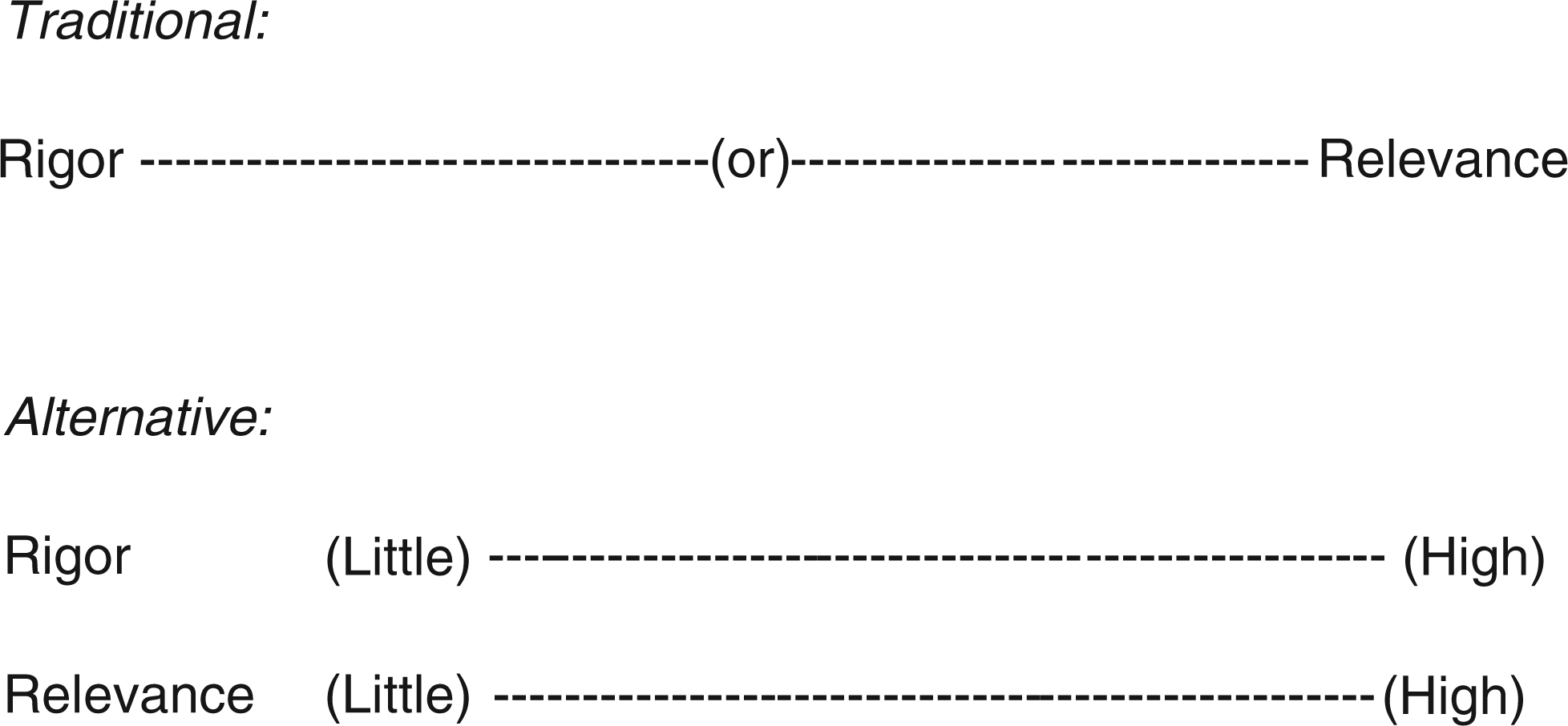
If rigor and relevance are seen as two separate and disconnected variables, high expectations on rigor can be matched with a high degree of relevance. This is the dream situation in conventional social science, but the lack of sustained field engagement and the devotion to theoretical grounding of research questions often create irrelevant research. In AR, relevance is by definition high (working on local pertinent questions) and accordingly the essential challenge will be to transform the deep experiences to data for a scientific reflection process. High relevance cannot be obfuscated by a dull and missing precision in rigorous analytical work.
Another challenge in writing up action research projects is that the work is the collaborative knowledge generation with problem owners. No mono-dimensional disciplinary perspective can be argued as sufficient for practical problem solving (Levin et al., 1997). Action research needs to come up with a solution to multidisciplinarity that credits or includes local partners. This lead will not be continued in this article.
Many different strands of conceptualizations of AR coexist (see Reason & Bradbury, 2001, 2008). In this article, AR is seen as a strategy that aims at solving pertinent problems where problem owners and engaged researchers learn together and reflect in the same co-generative process (Greenwood & Levin, 1998, 2007). Because AR faces real-life problems in a holistic situation, the knowledge generated through the research process depends on the problems at stake. Accordingly, the research focus (which might be different from the initial pertinent problem) emerges through the researcher’s involvement. High relevance emerges simply because the actual research focus originates from what Dewey (1938/1991) named ‘an undetermined real life situation that is made determined (understood or explained) through (active manipulation) research activity’. The problem at stake is what matters for the involved stakeholders. This is of course a genuine strength of AR.
How can this high degree of relevance be paralleled by high rigor? How can AR contribute to the scientific body of social science knowledge?
Integrity in action research: In action and in reflection
The essence of research is to produce new knowledge applying accepted scientific methods. It is already argued that there is not one singular way of research in social science. Opposing and often conflicting paradigms are part of everyday life and action researchers have to navigate these unruly waters. This does not indicate that every fair lead is navigable. Each professional ‘tribe’ (Becher & Trowler, 2001) has its conventions, rules and ways of interpreting and creating theory. Action researchers have to comply with relevant practices, norms and values in order to be able to contribute to the general body of knowledge.
The general cornerstone in scientific work is what Barnett (2003) names the ideology of reason. Academic practice is to be able to argue for (reasoned) research findings, as well as participate in the international scientific discourse with the capability of advocating reasoned positions. Reasoned arguments are essential in producing scientific knowledge. Other forms of knowledge such as tacit (Polanyi, 1966/1983) and ‘Knowing how’ (Ryle, 1949/1984) are important in everyone’s lives, but these categories of knowledge are separate from the scientific body of knowledge. Ryle’s canonical book (1949/1984), The concept of mind, clearly makes this point. He argues strongly for the existence and importance of ‘knowing how’ as one specific form of knowledge. Interesting in itself is that the discussion of ‘knowing how’ is made in a reasoned and argumentative way which illustrates the connectedness between transparent reason and ‘knowing how’. Ryle forwards a philosophical discourse to defend the perspective that there are forms of knowledge (e.g. ‘knowing how’) that are constituted and directs practice differently from scientific knowledge. Tacit knowledge and ‘know how’ are un-questionably important in everyday life (and of course in running AR projects) and are always entangled with social change activity for solving pertinent local problems. On the other hand, these forms of knowledge guide actions that subsequently produce data for scientific inquiry. Dewey (1903/1976, p. 305) argues: … there is no difference between the methods of science and those of the plain man. The difference is the greater control by science of the statement of the problem, and of the selection and use of relevant material, both sensible and conceptual.
Thus, scientific inquiry is only one among many other forms for creating knowledge. It is preferable in some contexts, while it has limited applicability under other conditions. This debate will not be continued here, except with the obvious point that research is grounded in scientific methods. If the aspiration of AR is to contribute to the general body of scientific knowledge, the meaning construction process used must comply with scientific procedures.
These arguments lead to a perspective that the essential elements of the scientific method are basically a transparent and argumentative way of reasoning, building on empirical evidence. The scientific way of making sense of a particular phenomenon is grounded in having constructed something identified as data that is considered necessary to answer the question in focus through applying a methodology both for generating data and for analyzing data (see e.g. Bryman, 2008; Cresswell, 2003; Silverman, 2010). Accordingly, the research question(s) will be framed both on experiences from the field and from reviewing the relevant scientific literature. The initiation point is concrete experiences that are interpreted and made sense of as a scientific question relevant to being researched. These questions will subsequently lead to construction of data and analyzed through applying accepted methods. Finally, the data are analyzed in order to argue for new scientific insights.
If the ambition of AR is to make an imprint on international scientific discourse, AR has to comply with the scientific standards for knowledge construction. The consequence is that action researchers will have to serve two masters (both Janus faces) at the same time. This argument could also be turned around to become a demand of conventional social scientists, to mandate that their ‘scientific findings’ should be tested in praxis as a fundamental prerequisite for claiming acceptable rigor.
The commitment to work together with local problem owners in a participative way aiming at solving pertinent problems is the fundamental basis for AR (Greenwood & Levin, 1998, 2007). This grounding of the research activity in local problem solving is what legitimizes the whole AR endeavor. The fundamental pledge to cooperation in solving local pertinent problems is certainly not unproblematic. The action researcher would always be what Greenwood and Levin (1998, 2007) call the ‘friendly outsider’. The ‘ownership’ of the pertinent problem belongs to the local participants and their roles and obligations are linked to the local organization or community, whereas the AR professional has an externally defined role. Even with insider research (Coghlan & Brannick, 2005), the insider AR responsible actor holds a separate role from other insiders, both because her or she is running the AR process and as a consequence of being responsible for producing scientific texts.
One obvious pitfall is that the action researcher can be absorbed in the local culture and politics in such a way that the role as a researcher disappears from the consciousness. He or she could accordingly become an activist. It is a fake understanding of the role for the AR person to see herself or himself as a native or as an insider AR, not understanding that being in charge of the AR process distinguishes the researcher from partners in the organization. It would always be possible for the external AR person to retreat from the field and retract to the professional affiliation in another social setting whereas the researcher can abandon the researcher role and become an internal activist.
The role as a friendly outsider is not disadvantageous, because it identifies the role as institutionally separated from local actors. The factual separation between locals and researchers is important because it clarifies responsibilities and ownership of the pertinent problem. In conceptualizing the co-generative model for AR, Greenwood and Levin (1998, 2007) argue that this separation in roles is important both for giving legitimacy to research and securing that actions are decided and run by the participants. Other models of AR will have a different take on the relationship between researcher and participants, but these configurations are not considered in this article.
In the co-generative model it will always be the obligation and duty of the problem owners to work on solving the ‘problem’, whereas the AR person commitment is to facilitate the learning and developing activities that are aimed at finding solutions to the question in focus. This implies that the AR person is responsible for advocating the action research strategy for the local work. The separation between the roles of the action researcher and the local actors is vital, even when doing insider research modeled in the light of Coghlan and Brannick (2006). In situations where the AR process is successful in terms of having trained participants to become researchers, the locals will still have to step out of their roles as problem owners and walk the road of research if what they do should count as AR.
The action researcher’s integrity emerges from handling the practical, political and disciplinary activities needed to develop pertinent solutions to the issues at stake. The integrity of the AR person is grounded in ethical, moral and professional principles that are inherent in the conduct of AR. This seems immediately to be self-evident, but taking a closer look at textbooks or handbooks in the field of action research, the ethical, moral and professional code of conduct is barely mentioned. The essential texts in the field have basically left these issues out (see for example, Carr & Kemmis, 1986; Coghlan & Brannick, 2005; Greenwood & Levin, 2007; Reason & Bradbury, 2008; Stringer, 1999). Ethical issues and professional standards are mentioned in all these books, but nowhere is it developed as a full-fledged discussion. A special issue of journal Action Research (Vol. 4, No. 1) from 2006 on ethics in AR represents an important exception in having a broad approach to ethical issues (Brydon Miller, Greenwood, & Eikeland, 2006). This debate will hopefully continue in AR journals.
My position is that action researchers must uphold their integrity as professional actors in relating properly to local participants and to capture the role as a social scientist. The knowledge of, and the ability to, enact these principles have to be learned, practiced and internalized in the higher education program for the prospective action researchers. It is not automatic. This is a formation process (‘Bildung’) characterized by creating standards for ethical conduct and proper practice integrated in substantive professional education. These are virtues that cannot be taught in the conventional way, but are the essential by-products of all training and teaching in higher education. ‘Bildung’, on the other hand, is a contested concept with many different interpretations. For example, a commission with members from all Norwegian universities with the mandate ‘Knowledge and ‘‘Bildung’’ for a new century’ could not agree whether on what was essential in ‘Bildung’ or what it would mean for future higher education. The understanding of formation (‘Bildung’) used is this article is very much in line with Prange’s (2004, pp. 507–508) conceptual discussion: Educating someone is a social process, an activity that can be observed whereas you do not see the learning process. It is invisible and strictly individual … It is this radical individuality of the learning process that limits its objective observation and evaluation. We can measure results in terms of observation, but represents only part of what is relevant to the learner. This is where Bildung comes in. It marks the difference between what is offered on the side of education and the receiving of learning. It is an indication of what is indeterminate and beyond planning, monitoring and evaluating the education process as a whole … Bildung is a quality of reception rather than construction. It evolves, it is not produced by well established methods.
‘Bildung’ reflects a way of being where professional knowledge, ethical standards and practical conduct stand up to humanistic values. The essential claims to integrity in AR have to be created through the formation process of the action researcher. ‘Bildung’ as a concept is an inheritance from higher education in Germany in the latter part of the 19th century. The Humboldtian University ideal advocated the freedom to teach whatever the professors found right and the students had the freedom to attend the lectures they found meaningful and the teaching should be research based. Equally important was the expectation that students through their educational process should behold the virtues of ‘Bildung’. These qualities were usually understood as being a knower of classical literature, skilled in philosophy, a capable participant in academic discourses, and finally showing ethical and humanistic conduct.
In AR, as in all other higher education, ‘Bildung’ is created in the educational program that supports professional knowledge development, the ability to participate in academic discourses, proper conduct as a friendly outsider, beholding an ethical and moral stand, and holding political perspectives on democracy and social justice. The formation of an action researcher can be seen as a complex process involving both the ability to ‘live’ the field and to critically reflect and analyze experiences (data) from the deep engagement and involvement in local transformation processes. In addition to the academic virtues engraved in ‘Bildung’, the action researcher must also hold the virtue of empathic and political involvement. Training in the practical and field related aspects of AR, which also enhances the ‘Bildung’, will not be discussed in this article because the perspective is on the academic production of AR academic texts. Some of the educational aspects of training AR practitioners have been dealt with in a special issue Action Research (Levin & Martin, 2007) and by Levin and Greenwood (2011). These texts can be a dissertation, a book or an article for a journal.
Academic integrity in action research: Taking research seriously
Many books have been published on writing a dissertation in the social sciences (see for example, Hart, Doing your Masters dissertation, 2005, or Doing a literature review, 1998). This is an interesting paradox simply because training in social science automatically should prepare the ground for skills in how to write a dissertation. It is important to identify and understand the interplay between the writing process and the research process (Becker, 1986). Zissner (1988, p. 49) builds a strong argument for the writing process as a mode of learning: Writing is a tool that enables people in every discipline to wrestle with facts and ideas. It is a physical activity unlike reading. Writing requires us to operate some kind of mechanism – pencil, pen, typewriter, word processor – for getting the thoughts on paper.
Howard and Barton take an even stronger position: ‘Because discursive writing is a form of reasoning, the best laid plans will fail if awkwardly expressed … So, the more you know about reasoning and writing strait, the more you have to write with’ (1986, p. 65).
Howard and Barton (1986) also make an interesting distinction between reasoning for discovery and reasoning for presentation. An awareness of these two separate modes is certainly important for writing scientific texts. The challenge is first to write for discovery and subsequently create a text for presentation. The initial phase is to write to explicate the first and immediate understanding of a phenomenon. This writing is then followed by a sequence of rewrites until thoughts and perspectives communicate a clear understanding. Finally, it would be time to communicate to an audience the insights that were generated in the writing for discovery. This writing aims at making the new understanding clear to potential readers.
Herr and Anderson’s 2005 book contributes a hands-on discussion on how to write up action research for the academic purpose of a dissertation. In Coghlan and Brannick (2005), a chapter is devoted to ‘Writing your action research dissertation’. The authors claim ‘There are well-established conventions on writing an action research dissertation which are found in such action research manuals’ (p. 124). The authors then continue with what they identify as a typical structure of a dissertation. It is amazing that this structure is summarized in seven bullet-points that could actually be cut out of almost any conventional textbook on social science research. This illustrates the point that writing an action research thesis is to engage in the scientific debate in social science. Therefore, it is necessary to comply with rules and regulations that are associated with the actual discipline. Accordingly, the action research is subject to the same demands and scrutiny as any other social science dissertation. The difference is that an action research publication is developed from deep political and emotional engagement in the field. No other social science research strategy can offer the same in-depth experience. The profound challenge is to utilize the experiential potential offered through the deep engagement, and at the same time be able to function as a critical and reflective researcher.
An alternative position could be to emphasize that the genuine characteristics of an AR project would also demand a genuine AR structure necessary to give a fair treatment of insights gained. The trade-off is whether to create a text that meets international standards or opt for the autopoietic AR thesis. The experience of advising some 40 PhDs at my own university is that there, for example, have been no possible grounds for AR PhDs unless they comply with international standards.
Another challenge of integrity relates to how the involved and engaged action researcher can create a critical distance to experiences from the field activity that would enable writing texts for the scientific community. The action researcher is confronted with the task of avoiding ‘degenerating’ the research activity to conventional social science, just by building the research on conventional and explicit data and thus leaving out the experiences and sense-making that resulted from the deep political and emotional involvement. If this turns out to be the result, action research has failed. How is it then possible to bypass this obstacle? The integrity of the research must secure that ‘findings’ documented in the text are not merely stories told by the researcher, but are a transparent text from which the reader can distinguish data in the broadest sense, including analysis of these data and how it is reasoned, in order to frame arguments for new insights.
In other words, a scientific text from an AR project must be able to withstand the scrutiny of a critical reader without relenting to excuses like ‘trust me – I have been there’. It is important at this stage to be reminded that the legitimacy of AR is grounded on practical problem solving in a local and holistic situation. Learning from this process is shared at first, and second, reflected upon jointly by problem owners and researchers (see the co-generative learning model described in Elden & Levin, 1991; Greenwood & Levin, 1998, 2007). This represents the immediate and important mutual learning. The scientific reflection process would be the next step taken by the researchers in order to develop and communicate research findings to the broader scientific audience. These reflections need to meet the standard of scientific rigor and the researcher must be able to take a step back from the involvement and critically analyze what he or she has participated in. Core value in this process is to seek the best possible understanding of the actual phenomenon, taking the role as a researcher. The implication is to step out of the political and emotional engagement in order to shape a reflective research-based process, and at the same time not to exclude those experiences from this meaning construction. How can the researcher shape her or his activity so that the integrity of research is upheld?
Essential factors in the practice of research
Creating a necessary distance between the involvement in a change process and the accompanying reflexive process that aims at explaining the phenomenon, is the essence of building integrity in the research activity in AR. The ‘Bildung’ of action researchers is what should both have prepared them for the field engagement and for the analytical reflexivity needed to produce scientific texts. More concretely, these demands boil down to a set of factors for the practice of AR that builds integrity in AR research.
Integrity of research implies utilizing the factors that in conventional language are warrants for rigor, and it is vitally important for action researchers to document those warrants for credible research. In order to meet these demands and to build integrity of research, five main factors stand out: research partners; awareness of own biases; standardized methods; alternative explanations; and trustworthiness. Each of these factors will be discussed more in detail in the following subsections.
Research partnering
Action research is demanding because it is expected to contribute both to practical problem solving and to the general body of research-based knowledge. Frequently, action researchers in the midst of the concrete engagement will be confronted with making decisions important for the practical problem solving and at the same time collecting data needed for the research activity. The researchers can seldom return to their own institution to think and reflect before making a decision. Working together with a colleague is definitely valuable, simply because the partners have the opportunity to interpret and discuss solutions before decisions are made. In addition, the partners will share many experiences from the field. The value of such collegial discussions can hardly be overestimated. Another important argument for partnering is that in a more reflexive mode, the partners would be able to confront individual perceptions and interpretations in order to make sense of experiences. Two people sense more than one, and awareness can have a different focus between research partners, as one for example might be on-stage running learning processes, while the other would be the off-stage observer.
Partnering can, on the other hand, have a potential downside because a possible striving for consensus may undermine a brilliant individual observation and experience. This problem is discussed more broadly in Reinharz (1993). The partners in the research process should be aware of such difficulties, because the benefits might outweigh the disadvantages.
Researcher’s bias
As all individuals, researchers have their biases. Everyone proclaims values and political preferences that guide perception of the world and direct actions. This will, of course, also be a valid argument for researchers. Researchers will not be more objective than any other person in society, but professionally in the perspective of the research process, it is necessary to cope with these ‘distortions’ in a systematic way. One methodological option is for researchers prior to embarking on the research to explicate what they see as important issues and potential findings. One way to do this can, for example, be to write a possible conclusion before the research starts, to explicitly make up one’s mind related to stakeholders interests and strategies, to think through who is powerful, and what would accordingly be obstacles for the problem solving process. These are only examples of obvious biased issues. Every research context needs an investigation by the researchers of issues that are subject to her or his bias and accordingly should be made explicit. The function of this list of biases is that they serve as controlling exclamation marks that should signal awareness to the researcher when actions are taken or issues are analyzed.
Standardized methods
In AR, all social science methods can be used either quantitatively or qualitatively as long as the researchers are aware of limitations and possibilities in claims made for the applied methods. Construction of data has to follow standard procedures and the analysis of the data must be aligned to accepted procedures. Of special importance are methods that are suited for analyzing complex and unstructured data because a structured analysis may create standardized procedures for interpreting data. One such method is grounded theory, developed by Glaser and Strauss (1967). It is remarkable that these two researchers (one positivist and the other constructivist) could unite in developing grounded theory. Later they split to move in their own directions following different paths, but this does not reduce the workability of grounded theory simply because the core perspective is the structured analytical scheme. An updated discussion of grounded theory is found in Charmaz (2006), Corbin and Strauss (2008) and Dey (1999). Bob Dick (2007) discussed in a powerful way the relationship between grounded theory and AR and this article is a good point of departure for seeing the importance of standardized methods.
Alternative explanations
Developing alternative explanations is a formula for creating a critical distance for the researcher. The idea behind this approach is to be able to come up with more than one model for explanation, simply by forcing oneself to think alternatively. Finding alternative explanations is a creative process and should continue as long as new models for explanation emerge. It is always a limited number that are generated and once again it is important to control for biases. Strong predispositions from researchers may shade out many possible explanatory models.
The next step is then to figure out which ones are the less likely based on a systematic analysis of available data. This process continues until the most promising explanation ends up as the victorious model. On paper this seems in principle to be a pretty straightforward strategy, but it demands both creativity and stamina as it requires quite a lot of hard work. In fact, not much of social science research can brag about having tested out different models of explanation. One reason for this is that many of the research topics are quite complex and often it is seen as sufficient to come up with one possible model for explanation. Still, developing alternative explanation models greatly improve the quality of research. A special case of alternative explanations is contrafactual analysis. The idea with a contrafactual analysis is to identify what it would take to disconfirm the research findings and subsequently apply the data for such an analysis.
Trustworthiness
The previous four factors can be seen as arguments for creating reliable and valid conclusions in research. They are that of course, but the main argument for partnering, awareness of one’s own biases, standardized methods, and alternative explanations is that those factors applied to action research shape the necessary integrity of the research that together builds rigor. Finally, the findings from AR must be subject to the scrutiny of reliability and validity. In line with Lincoln and Guba (1985; Guba & Lincoln, 1989), reliability and validity are concepts restricted by the conventional positivistic usage, and I choose Guba and Lincoln’s conceptualization simply because trustworthiness covers the action research ground much better. It is also obvious that all action research should forward arguments for trustworthiness.
Conclusion
Publishing action research is to take the AR ‘research’ claims as a serious issue. This seems to be an unnecessary demand to practitioners from an academic tribe that names themselves researchers, but that is not the case. All too little of action research activity can brag about having contributed much to the international scientific discourse.
This article argues that for AR to become scientifically accepted two essential challenges have to be dealt with. The primary face of academic integrity is that the researcher has to be live through situations where emotional and political engagement is a prerequisite for doing action research. The second face of academic integrity is engraved in the analytical process that creates a distance for the researcher to the actions, emotional involvement and political strategizing that he or she had been so deeply engaged in.
The virtues needed for handling the two faces of academic integrity have to be part of the ‘Bildung’ that emerges from education in action research. This formation process should aim at managing both training in substantial issues and in becoming a friendly outsider responsible for creating learning opportunities that could enhance local problem solving. How to shape the ‘Bildung’ is not a straightforward process. Much work needs to be done in this field. Perspectives on AR education were the theme for a special issue of Action Research in 2007 entitled ‘The praxis of educating action researchers’ (Levin & Martin, 2007). This represents only a beginning and should be the point of departure for how to make action research a major contributor to the international debate in social science.
Footnotes
Acknowledgements
I have received important and valuable critique and constructive comments from Davydd J. Greenwood and Ann W. Martin. A special thanks to Bob Dick for an important critical discourse based on a draft of the article. Their comments have contributed to improving the article as it has been my responsibility to make the most out of these comments.
