



Abstract
What is the purpose of knowledge? Is it an end product only, or a means for action for change? Who is expected to take action – the researcher, research subjects, both, or some unknown others who may come across the knowledge produced? The larger question then is: is it health research, or research for health, equity and development? This article raises these concerns in context of a study conducted in Pakistan entitled Women’s Empowerment in Muslim Contexts (WEMC). This article argues that participatory action research (PAR) provides a bridge to the separation of knowledge and action. It proposes, especially, in resource poor countries, combining health research with Paolo Freire’s view of participation and change; and sees action by research participants as an outcome of the development of their critical consciousness.
Keywords
Introduction to the project: Women’s Empowerment in Muslim Contexts (WEMC)
In 2005 a group of women representing seven institutions came together to develop the proposal of the WEMC project. Four countries (Iran, Pakistan, China, and Indonesia) were to be involved, and two cross-border sites were also included (Indonesian migrant women in Hong Kong and Afghan refugees in Iran returning to Afghanistan). This research consortium was led by an institution from the South (City University, Hong Kong) (WEMC, 2008). Work officially began on 1 July 2006 and ended on 30 June 2010 (a year before it was officially supposed to end). 1 The five partners of the research consortium were of diverse backgrounds. There were sociologists, critical ethnographers, lawyers and public health professionals. This was also a mix of activists and academics. There were a set of research questions that each lead researcher interpreted according to their own expertise and commitments. For example, the activists in Iran, under the mentorship of the lead researchers based in a Canadian university intertwined focus on health volunteers and campaigns against stoning to death. At Aga Khan University, participatory action research (PAR) was the approach taken to answer the research questions. There was a Consortium Advisory Committee (CAG) that met the research consortium annually and responded to the progress of the Consortium. Findings from this multi-country initiative were to be organized into three books. This ultimate deliverable was to be worked upon in the last year of the project, but as it was terminated a year early 2 it could not be met.
Universe of the problem
The central thrust of the article is to examine the relationship between knowledge as end product, and the processes of knowledge production by analyzing the part of the WEMC conducted in Pakistan. The relationship is examined in the context of women and the knowledge they produce about their life and its vicissitudes. The article interrogates research and its purpose, and the place of participatory action research (PAR) as the primary research approach that bridges the gap between knowledge and practice. It also examines if action research be challenged for betraying knowledge when it favors action to research? Legitimacy for action will be argued by invoking the notion of relevance of research and ethics as a parameter to establish relevance. Relationship between research and research subjects will also be examined. 3 The article seeks to problematize the issue by asking: is it fair to undertake research for knowledge instead of research for informed action? Role of ethics is invoked in the context of knowledge production, its processes and its purpose. These concerns, it is being assumed, can also be entertained for many community-based researchers in public health.
Freire’s concept of participation and change (1970) is used as the conceptual underpinning of participatory action research (PAR) as the bridge between knowledge and action. 4 If research is to be necessarily linked with action for change, the processes of knowledge production are brought into focus, which includes the query: what research method/s allow for maintaining a necessary link between research and action? In WEMC action was interpreted as action by women, the research-partners. This article accepts the position well illustrated by Council on Health Research for Development (COHRED, 1990) that research is for health, equity and development.
The field wherein the relationship between knowledge and action is being explored, that of WEMC in Pakistan, is small but being small does not invalidate its significance, for analysis can be of an individual person, her life and struggle, or of a family or community. The field that provides the matter for analysis in this article is geographically small (two urban poor sites encompassing eight groups of women; one village with illiterate women; and one group of young rural, educated women working with poor agricultural workers). Both urban and rural sites are in Sindh, a province of Pakistan where political instability, lack of accountability of those in power, and general lawlessness prevails. 5 PAR initiated in these sites was part of a larger research consortium: Women’s Empowerment in Muslim Contexts, gender poverty, and democratization from the inside out. 6 This research was introduced in four Asian countries, one of them being Pakistan. The research team in Pakistan adopted PAR as its approach. Eleven tools were used to facilitate women to analyze their lives (Aziz, Shams, & Khan, 2011) 7 and the effect of this process on the women participants was documented. Participation of research subjects was interpreted as optimizing women (research subjects) involvement/participation in the inquiry initiated with them, and this allowed for the research approach to evolve, instead of rushing to consolidate the findings yielded by the use of the tools and techniques. This approach helped to build the four-step model of PAR that demonstrated how research and action could be kept together (Aziz et al., 2011). The central thrust of this approach was to protect the rights of the research subjects to benefit from the research processes initiated, and to accommodate women’s questions and concerns in the process of inquiry initiated with them.
Once the sites for interaction with women were identified (Table 1), the following two steps were taken as part of inviting women to participate in the project: informal meetings were held with the gatekeepers (mainly male groups and opinion leaders) informing them of the ‘what’ and ‘why’ of the project. This cleared the way for direct interactions with women. This step in the rural site included linking women’s empowerment project with the earlier work on community-based equity analysis that had just concluded. The argument presented was: if village women are to take forward issues of inequities in their village/s, they would need to be ‘empowered’.
Field teams started talking with women by going to their homes, or meeting them in any facility available in the site. In these meetings women were informed of the ‘what’ and ‘why’ of the project. Characterization of groups.

Both these steps were also part of the ethical clearance that was taken from the Ethics Review Committee of the implementing institution. 8
The field team spent nearly six months in the field with women. After the initial interaction, contact with women continued.
9
A camaraderie was established as women went through the five levels of experiences:
Interactions around the use of 11 participatory tools. Meetings where data from the field was taken back to the women for its validations, and for facilitating women to set priorities for the issues they would like to take forward. Advocacy training for women who volunteered to take forward their priorities to a public forum in their own neighborhood. Public forum where women presented their priorities to local leaders (elected as well as government officials). Meetings with women to discuss how they planned to take forward their issues through the organizations that had been made as the project moved towards its end.
Interactions with women followed the participatory principles of creating and maintaining an environment whereby women could freely express their thoughts and feelings. How the women participated in the process can be seen from two perspectives. On the one hand, the field workers captured their perception of women’s participation in their reflexive notes during the process of field work, and on the other hand, during a workshop organized on reflexivity towards the end of the project period. In both instances they found the women to participate freely as the participatory tools used during the interactions optimized their involvement.
10
Aurton ki soch mai tabdeeli nazar aai. Ab woh apne masile per mardo se baat karti hain aur unke mard bhi unki baat suntay hain.
[A change could be seen in the thinking of women. Now they discuss their issues with men and their men also listen to them.] (Grp 7, Venn diagram, p. 86)
On the other hand, women’s feedback was taken every day at the end of interactions with them. These were documented and a file on feedback was made in the data-management system of the project.
Knowledge generation and action: Some preliminary thoughts
Research generates knowledge which often is not linked to practice, or suspends action or makes action a secondary activity. In health research this issue is raised by asking: is it health research or research for health? 11 The Bamako call to action: research for health (The Lancet, 2008), echoes this sentiment clearly. 12 In other words, the question to be faced squarely is: is knowledge the end-goal of research and action a byproduct? Or, can action by research-partners (women in the case of WEMC) could be accommodated as a legitimate part of research, and captured as a research outcome?
In resource poor countries this issue becomes more critical especially when vulnerable groups are the source of data that are shaped into knowledge and knowledge products like papers. Where there is knowledge there are researchers (knowledge producers) and knowledge users (those who read research findings, and/or receive it through dissemination seminars) (Figure 1). Researchers sometimes appear more comfortable in verbal deliberations over knowledge produced with possible knowledge users, than in retaining partnership with those who were the knowledge-bearers in the first place (the research subjects who were the source of knowledge the researchers gather and shape). When the focus thus shifts to knowledge products, the vulnerable groups who were the reason for knowledge making, and concern for action/s for this group becomes peripheral. The assumption that interventions are not the responsibility of the researchers only, as they seek to influence others for action instead of taking action themselves is challenged when research subjects are placed as equal partners of research. In the latter case, responsibility for action is not to be appropriated by the researchers, not to be abandoned by the researcher, but seen as a joint responsibility of the two – researchers and research-partners (women in the case of WEMC). In other words, the pathway of change is stipulated by the vulnerable group/s themselves (Freire, 1970). Research thus becomes the pedagogy of the research-partners.
Conventional research/knowledge generation process.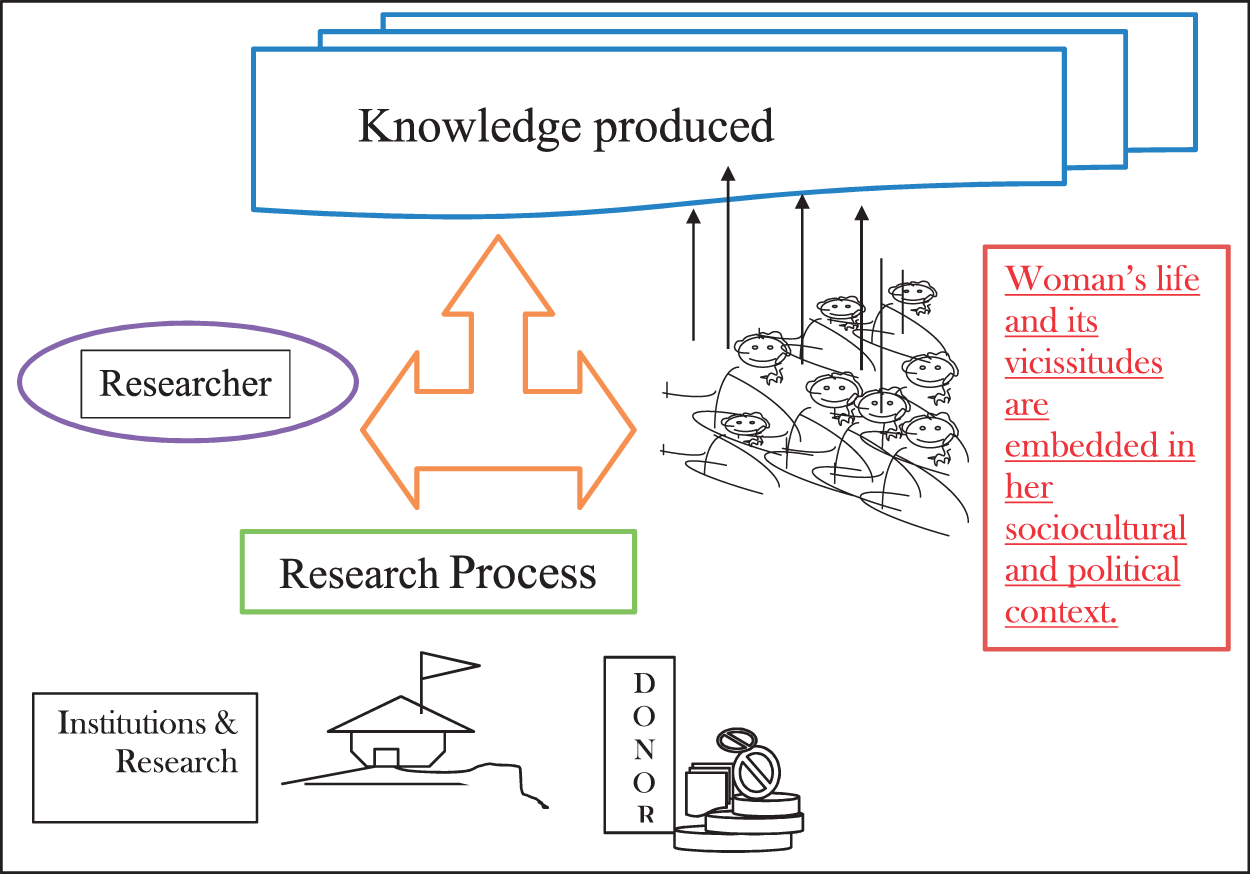
In WEMC it was assumed that knowledge and practice are two sides of the same coin. The research team was aware that knowledge is often found to abide in a realm divorced from practice, while practice continues unabated, defying the theoretical understanding generated after its analysis.
In some knowledge areas, like natural sciences (including physics), knowledge produced may not have any direct bearing on its practical use and human behavior. There are, however, sciences that are directly concerned with human well-being and their research is guided by this concern for action. For example, medical and health sciences (including psychology) search for knowledge that could benefit human beings through transformation of knowledge into products and procedures. Women or gender studies could also face this challenge especially when subordination of women becomes the research concern, but action for overcoming subordination becomes a secondary issue.
WEMC research framework was clearly positioned on the importance of contexts of women’s lives – that women’s lives and their vicissitudes are embedded in the socio-cultural and political contexts of their living. The research teams knew that knowledge is located also within the women who were the research-partners, and were conscious of the role of researcher’s self in knowledge-production. They were conscious that the purpose of research cannot be knowledge qua knowledge. This was not a new issue. History was on their side. Marx was concerned about the purpose of understanding when he declared that philosophers wanted to understand the world, but we shall change the world. Aristotle too appears to be directing his attention to the realm of practice in his writings on virtue and justice. In the opening section of Nichomachean ethics (n.d.), Aristotle says: ‘… the present inquiry does not aim at theoretical knowledge like the others … we must examine the nature of actions, namely how we ought to do them’ (Aristotle, Book II, Section II).
While many philosophers, sociologists, and historians have theorized about the world and its people, many have pursued knowledge so that they could make a difference to the lives of people. This is also true for most medical and health researchers. They search knowledge for betterment of life. How this inquiry is shaped is linked to their epistemological stance, which often establishes a distinction between the experts who know (the researcher), and the ordinary people who are labeled ‘ignorant’ (ignorant of what ails them). However, with advances in qualitative research this distinction has blurred considerably. Qualitative research has emphasized the importance of experience and interpretation of experience by those who themselves experience (Clifford & Marcus, 1986; Willis, 2006). In studies involving human subjects (whether as individuals, or groups) there is a concern and respect for the experience of the disenfranchised and marginalized – whether they are the poor, the disabled, or women. This recognition, especially in case of social theory, has changed the conditions in which it was produced (Lemert, 2010). As Lemert (2010) puts it, this condition has disturbed the original balance of trade between lay and expert social theorists. The so-called ‘lay’ is now right at the center of the source of knowledge generation, which was earlier the legitimate prerogative of professional theorists. Furthermore, it is not only that the disenfranchised and the marginalized are the equal source of knowledge creation, but they also negotiate meanings and co-construct reality with the professional theorists (Chambers, 2007b; Hull & Saxon, 2009).
Is advancement of knowledge enough?
The distinction between knowledge/understanding and action for change has acquired certain intensity for a great deal of knowledge when it is generated from external funding, and a great deal of action for change is felt by many researchers. Researchers who contest donor’s urge for knowledge strive to balance the two goals, but pressure on researcher prevails. This was best exemplified when the donor of WEMC asked for papers that were analytical and also showed policy impact. One partner of the research consortium forwarded an analytical paper that had no policy impact, and a pamphlet that triggered a movement of immigrant workers that brought change in rules that governed them. The role of researcher’s self thus becomes important as well as complex, difficult and risky, as they struggle to meet the requirements of the donor as well as honor the dignity of research subjects by supporting their desire to bring change in their lives. This becomes intense especially when the research subjects are poor women, and the research team gives priority to action rather than be satisfied with knowledge products.
Psychologists probably have studied human behavior the most, all striving to explain how it is determined (Fernald, 2007). Debates over biological and social determinants of behavior continue to date (Giddens, 2001). For women, too, this debate raged for some time as many insisted that women’s temperament and role in society were rooted in their biology (Whitehead, 1979). Feminists, as researchers or activists, have focused on women’s issues and unveiled the hidden dynamics that recreated and maintained their subordination (Bulbeck, 2000). A tremendous amount of knowledge has been generated and has influenced global agenda for women and development. Theoretical understanding of women’s equality with men, or to consider women as equal citizens, has galvanized women into action, but overall change continues to lag behind. There still exists today a UN Committee on the Status of Women (CSW, 2012), and four world conferences on women have taken place. 13 The monitoring of international commitment, especially by women activists around the world, is ample proof that much of what needs to change has not changed. Women constitute the only group in the world whose subordination is still a global issue: perhaps environment and poverty are the only other global concerns, but are less contested than issues pertaining to women.
The theoretical understanding and debate over the difference between gender and sex (between gender as social construct, and women’s biology and her body as the justification of what she must do and cannot do), have not been able to change the lives of women. 14 Marx’s differentiation between understanding and changing the world can be invoked in the case of women and the suffering peculiar to them (Ronald, 2003). Given their position and situation in life (their practical and strategic interests as Molyneux, 1985, p. 241, has identified this distinction) becomes most critical when funds for research on women come face to face with the plight of women.
While understanding of women’s plight deepens, a battle still rages with the misogynic mind set and misogynistic practices that prevail in most developing countries (Gilmore, 2001). Whereas theoretical understanding may inform women activists, understanding by itself is not known to bring change. For example, studies repeatedly show how women and men know the importance of contraception yet do not practice family planning. People know their rights, and even the poorest and the most powerless would know what harms them is not right, yet they are unable to change the conditions of their life (Page & Czuba, 1999). This justifies one to say that knowledge is not enough.
The tussle between knowledge production and knowledge for change is resolved in action research with its emphasis on action and linking it to research (Reason & Bradbury, 2001, p. 29; (Whitelaw, Beattie, Balogh, & Watson, 2003). Who are the actors and how and where action takes place are important considerations for action researcher (Chambers, 2007b). Who is to be the primary actor is a grave challenge, for action may take place but leave the research-subjects as passive beneficiaries (Chambers, 1997a). These concerns point to the need of reflecting on the notion of change and actors for change. Is change to be ushered by policy-makers (as many researchers believe), or by those whose behavior is to change? Or, as many in public health believe, is it the responsibility of the individual to do what is good for them? Or, as some believe, will collective action bring the change in the structures that influence human behavior (Muñoz, n.d.)?
Participatory action research (PAR): The forerunner of/for social change
PAR by its very nomenclature must face the challenge of clarifying the meaning of change underlying its enterprises and also take a position on who would be the primary and secondary actors in the change envisaged (Bargal, 2006). This can be vindicated by the concerns of the pioneer of PAR, Kurt Lewin associated with the group dynamics movement (Neilsen, 2006). He was of the view that social science should be directly interested and involved in social problems of the day (Lewin, 1948). He can be seen as part of the critical research paradigm which is driven by the reality of injustice and is critical of all that is unjust (Kemmis & McTaggart, 1988). Hence, PAR goes beyond the need to understand, and strives for action to bring change. How change is to take place, and who would be the key actors needs to be argued when change is conceptualized.
A clear answer to the above debate is provided by Paolo Freire’s (1970) work with his emphasis on the oppressed. From his work has emerged a long tradition of participatory training that enable people to become conscious of their oppression and of the structures of oppression operating over them so that action could be taken for change. The social transformation that Freire (1970) envisaged, of course, did not proliferate through the use of participatory approaches in engaging the poor and oppressed. Analysis of the outcome of participatory approaches in ushering larger social change is not warranted here. Suffice it to say, PAR carries within it this concern for change. Whether it is to be local, more akin to adjustments at micro-level, or larger structural change is a matter that need not be dealt with here. The issue for PAR is to squarely see how it relates change as an integral part of its enterprise.
At least two typologies of action research are mentioned. One mentions three types of action research identified in one review of literature on action research (Whitelaw et al., 2003).
Technical action research. Practical or mutual-collaboration action research. Emancipatory participatory action research (Figure 2). Action research typologies.
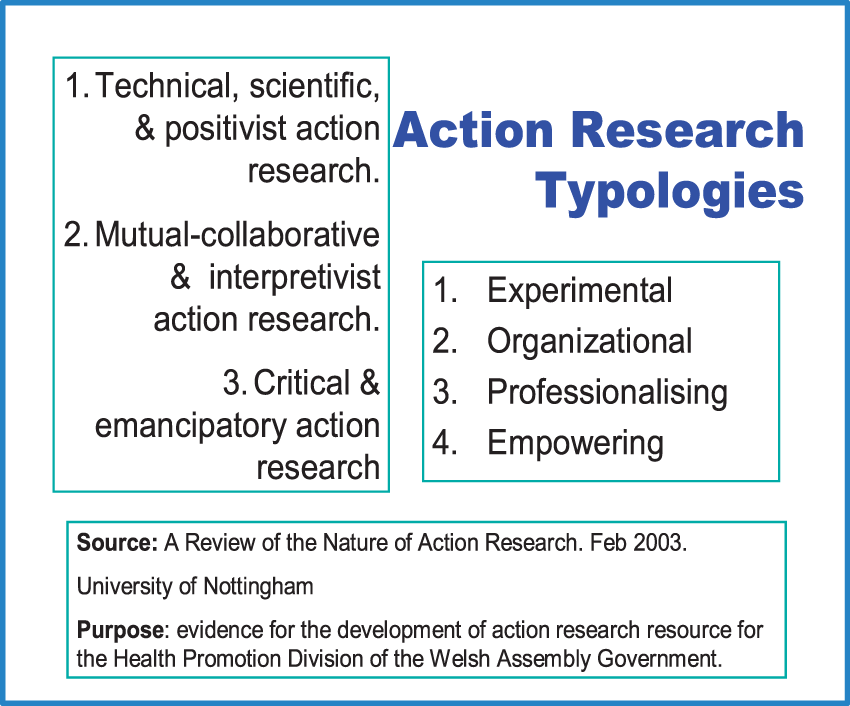
The second typology refers to four types. 15 The type common to both is the one where PAR is to be empowering. 16 It is also considered to be ambitious, which is no argument against it. It is easy to see that this type is rooted within the critical theory paradigm which is critical of all that which is exploitative for within exploitation injustice resides (Kincheloe & McLaren, 2002). This paradigm emerged with a sheer discontent from the conventional one which chiefly focus on a specific type of explanation of the social world (Scott & Marshall, 2005). In contrast, the critical theorists acknowledged that social theory and research in particular must concerned itself by critiquing and responding to the structures of power inherent in societies, by offering relevant entry points for action than merely providing explanation alone (Scott & Marshall, 2005). However, in the arena of action research, the challenge is, is research participatory action research only when it is emancipatory? (Tough question for the academia, but not for the activists perhaps.)
At least eight definitions of action research are available, and of them, one is most striking as it best answers the question on purpose of research – for knowledge, or for action. It also carries within it a position on how change is to occur (Whitelaw et al., 2003). Three characteristics are flagged: participatory character, democratic impulse, and social change (Whitelaw et al., 2003). The concept of participation has been a great riddle as many workers in many fields have struggled to define it, and develop typologies. Here it would suffice to say that Paolo Freire (1970) is still the best ideologue of its meaning and the participatory approaches and tools developed by his followers, and specially the development of the visual analysis of PRA (originally called participatory rural appraisal, and after it expanded beyond the rural arena, came to be known as participatory reflection and analysis) (Chambers, 1997a, 2007b).
Finally, ethics is the ultimate underpinning of research and PAR in particular. While legitimacy of research may be found in significance of knowledge, legitimacy of action is rooted in its immediate relevance to life and its conditions. If a choice is to be made between primacy of knowledge and action, then who is to be the arbiter? Would not life be the ultimate arbiter? When inequalities in life and inequities in health outcomes are rampant, to argue for primacy of knowledge would amount to accepting exploitation of research subject for knowledge. This matter is best sealed by the Helsinki Declaration: ‘In medical research involving human subjects, the well-being of the individual research subject must take precedence over all other interests.’ 17
Change, processes of change, and change agents
Sometimes an implicit understanding prevails on how change is to take place – is it to be ushered through actions of the researcher whether it be through dialoguing with the policy-makers or service providers. This is understandable where those responsible for the welfare of the deprived and disenfranchised are ready and willing to use research for better delivery of services. Research in developing countries faces a grave challenge because of the non-functionality of the mechanisms meant for the well-being of people, especially women. In such situations, the notion of change and how change will take place become formidable issues. This is the context which forces itself upon the utility of research that is carried out in the name of the people who are not getting a just share in their society. Research, in this way, tends to be colonization of the subject being studied and susceptible to power relations by reinventing its colonial legacy (Page & Czuba, 1999; Said, 2001). On the contrary, the researcher has to recognize the power of the context, and the context of power, within which research is being conducted, for the indifferent or hostile context creates a battle ground that is difficult to avoid if research is to be relevant to those whose plight inspired the research. And it is here the tussle between knowledge and action needs to be situated and recognized, and the meaning of change be argued.
The anticipated action by the vulnerable women themselves in the experience of WEMC in Sindh, Pakistan, presented a complex picture. On the one hand, the PAR approach did engage women in a process of reflection and analysis which released the ‘energy’ needed for women’s agency to come forth. But on the other actions were limited. For example, a woman during the process of the study, decided to enroll in training available in view of the impending elections: ‘elections are near. I have become a polling agent… initially my family did not allow me to do so, but after listening to you and getting information, I ultimately told myself that in any case I will participate’ (Grp 1, personal communication, 12 February 2008). A group of women in one site decided to petition the local authorities for establishing a girls’ school. In that petition it was precisely mentioned that ‘we [group of women] would like to request the honorable administrators to bring our requisitions to the higher officials and help us open a girls’ school in our town, and appoint a lady teacher from whom our girls could get basic education’ (Grp 9–10, personal communication, 5 November 2008). Another group demanded a room for special children in a community school: ‘… we need to have a separate room and a lady teacher for our disable children in the girls’ government school’ (Grp 1-4, personal communication, 25 August 2008). Another woman became very active in lobbying for water in her area. In discussion with local administrator she boldly inquired ‘when this issue will be resolved? When the fresh water will be available? We can see the work is in progress, but then again the water provided through tankers is also not reaching us, action must be taken on this too’ (Grp 5–6, personal communication, 1 September 2008). In two urban sites, women decided to form their organizations (Aziz et al., 2011, p. 317). A woman from one urban site stated in a discussion that ‘we have started our own organization known as ‘‘help-group’’, we hope that with God’s grace it will reach its destination’ (Grp 12, personal communication, 17 October 2009). These were sporadic actions and seemed to energize the women; collective action for pursuit of their identified needs was not forthcoming in the time available. A deeper level of understanding is needed for institutionalization of collective action.
WEMC Research Framework required tracking of women’s action. 18 The framework listed four ‘options of scales for women’s strategies for action’ (WEMC, 2008). WEMC AKU team interpreted these four options of scale as levels of action: individual action, collective action, becoming an organization, and actions leading to some institutionalization. The AKU team understood the fourth stage to embody the principles/rules that would ensure continuity of the issue for which they took action. For example, in one site women took collective action for access to public transport, however, this could not be turned into a rule or policy, and was thus not ‘institutionalized’. In the WEMC sites of Sindh, Pakistan, the urban and rural groups in Karachi reached the third level, whereby women formed their organizations and had also identified their priority areas for action. 19 However, a stalemate was reached as the two groups could not move forward, and the support needed from the research team was not forthcoming. The latter because the nature of finance allocation and monitoring did not provide the flexibility needed for pursuing this stage of action – the overall Research Consortium leaned more towards knowledge than action! Moreover, analysis of this stage in the trajectory of action, revealed an inner dynamic which, if it were to be addressed, would require another phase of action research. CBGT (cognitive behavior group therapy) was undertaken with the two groups of women that had formed their organizations for taking forward their aspirations. This study provided insight into the working of the two groups, and to work on these insights required funding that was not available for exploring how research and action could be woven into search for answers in this aspect of women’s lives. This dead-end is indicative of the challenge that PAR faces in light of some donors’ propensity to ask for knowledge productions within a precise time frame. They don’t seem to realize that maintaining the link between knowledge and action is not easy, and becomes more formidable when women are the vulnerable groups. Moreover, when knowledge as a deliverable product is required in a context where government is not responsive to the needs of the poor and vulnerable, then action for impact on policies and programs becomes a grind and ill affects the efforts of people striving for change in their lives. This reveals a grave lack of understanding that change could be viable only through long-term commitments, and that it is not practical to assume that knowledge produced would automatically lead to change. Understanding between researchers of the South 20 and donors from the North is perhaps the biggest challenge that ‘practitioners’ of action research face in taking forward their position that knowledge alone can be empty of benefit to the research subjects, especially when they are poor, vulnerable and marginalized, like the women of WEMC (here the issue is not benefit to the researchers coming from research institutes, but benefits to the research-partners that are poor and marginalized). And if justice is to prevail then knowledge and action need to complement each other.
Conclusion
This article demonstrated the struggle between knowledge and action within research and more specifically in PAR by taking women studies as its empirical context for analysis. It was argued that the concept of change and especially how it is conceptualized sets the overall value orientation of the agenda which it carries behind. It includes seminal questions to be addressed: who will going to change and how change will occur? Similarly, the issue related to participation and participatory nature of action research was teased out in relation to the concept of social change to shed light on the nature of PAR when it is performed. In this regard, it was discussed that from the time of its origin and to date, action research has traversed considerable ground and has been used in different ways. The oppressed are obviously the ones who needs change the most. It is the right of the oppressed to be central players in bringing change, for as primary stakeholders they are best placed to protect and sustain the non-oppressive structures that enable resistance to exploitation and also overcome it. This, of course, is a long-term goal which becomes the responsibility of all those committed to justice, and not merely knowledge about justice. Here, the role of institutions and donors becomes critical.
In developing countries where state structures are not pro-poor, and where democracy is at best thin, PAR can be stipulated as a normative approach, if justice is to prevail. Social change then is not a matter of luck or a patient waiting for it to descend on the marginalized and the disenfranchised majority. In countries like Pakistan, where women as one large group are the most oppressed and resources are limited, would it not be a luxury to do research that is not action research? Is it a luxury a researcher or a research institution can afford, and if so then at what social cost?
In countries where institutions have become weak and need to be revamped, who is to help them refurbish them so that they could lift themselves out of a state of ever sinking mediocrity, and to acquire a leadership role?
Donors, whether local, regional or international, have a role to play which can become clear if they were to ask themselves: is knowledge the primary goal of our being, or is it knowledge for action and change? The international inter-ministerial meeting in Bamako (2009) was entitled ‘Health Research for Equity and Development’. Perhaps herein lies a challenge for social sciences and women studies enterprises – what is the priority? Research for action or research for knowledge alone! We will conclude with this quote: ‘… nothing that exists by nature can form a habit contrary to its nature. For instance the stone which by nature moves downwards cannot be habituated to move upwards … Neither by nature, then, nor contrary to nature do the virtues arise in us; rather we are adapted by nature to receive them, and are made perfect by habit’ (Aristotle, Book II, Section I). And with the question: can PAR become a habit of institutions committed to knowledge and action?
Footnotes
Acknowledgements
This article is an output of the Research Programme Consortium on Women’s Empowerment in Muslim Contexts (WEMC), led by City University of Hong Kong. The Research Consortium was funded by UK Department for International Development (DFID) for four years (2006–2010). The Department of Community Health Sciences at the Aga Khan University housed WEMC (WEMC-AKU) as one of two consortium partners in Pakistan. Lead researcher of WEMC-AKU was Kausar S Khan, and Ayesha Aziz was the research coordinator. The field team consisted of: Aziza Burfat, Gharnata, Sultana Aziz, and Rafique Wassan.

Notes
Author biographies
Kausar S Khan is a student of philosophy and religious studies (Karachi University, & McMaster University, Canada). Has been working with Community Health Sciences (CHS) department, Aga Khan University for over 20 years. Teaching and research interests include: women's social status; participation and participatory approaches; gender, poverty, equity, bioethics, justice; social structures as determinants of practices; change, power, social transformation; and democratic processes. Has worked on community based projects involving urban and rural poor women. She has worked on building partnerships with NGOs and government sectors. Has affiliation with several civil society groups that focus on women's rights and human rights.
Sohail Amir Ali Bawani is a student of MS leading to PhD in Sociology in the Department of Sociology, University of Karachi. He works at the Division of Behavioral and Social Sciences, Department of Community Health Sciences, Aga Khan University. His teaching and research interests include social theories, social determinants of health, participatory approaches, social movements, gender, reflexivity, research paradigms and critical ethnography.
Ayesha Aziz is a Public Health professional with a background in medical sciences and strong interest in rights, reproductive health issues, health policy and management. Has experience of working with various small scale quantitative and qualitative research projects in Pakistan that have ranged from infectious diseases to women's rights and empowerment. Has ability to appreciate and adjust to contextual and cultural variations while treating differences of opinion with respect, patience and courage. Aims to strengthen the weak links between research, advocacy, policy making and implementation.