




Abstract
This paper addresses the call for more action-based narratives of grassroot resistance to runaway climate change. At a time when deep changes in society are needed in order to respond to climate change and related sustainability issues, there are calls for greater connectivity between science and society, and for more inclusive and disruptive forms of knowledge creation and engagement. The contention of this paper is that the forces and structures that create a disconnect between science and society must be ‘transgressed’. This paper introduces a concept of Transgressive Action Research as a methodological innovation that enables the co-creation of counter hegemonic pathways towards sustainability. Through the method of the Living Spiral Framework, fieldwork reflexions from the Colombian case study of the international T-Learning project were elicited, uncovering and explicating the transgressive learning qualities needed to respond to climate change. As part of a larger action–research project, this paper combines the arts with the social sciences, demonstrating how the concept of ‘Transgressive Action Research’ can enable co-researchers to engage in disruptive and transformative processes, meeting the need for more radical approaches to addressing the urgent challenges of climate change.
Keywords
Introduction
We are at a historical point in time where as a human race we are burning the ecological bridges which connect us to the life-sustaining veins of the earth (Crutzen, 2002; Rockström et al., 2009). With overwhelming scientific consensus that human-based actions are exacerbating climate change, and the daily reminders of hurricanes, floods, drought and soaring temperatures, it is the question of our time as to why the status quo remains so stubborn when it is based on such an unsustainable paradigm.
Part of the reason for this stubbornness or ‘maladaptive resilience’ (Lotz-Sisitka, Wals, Kronlid, & McGarry, 2015) is the contentious nature of the climate change debate, whereby various perspectives are saturated with deep-seated values and ingrained structures. Although most people recognise the increasing detrimental effects of climate disruptions, there are various structural barriers to realising change: strong economic interests that maintain the growth paradigm; poverty and inequality leading to social injustice; as well as the deeper western worldview which sees nature as separated from Man, and hence as a commodity to be exploited.
At the centre of this debate is the question of how to reconcile the seemingly mutually exclusive realms of the need for society to collectively move towards more sustainable solutions, and individual interests which do not (Amel, Manning, Scott, & Koger, 2017). On the one side, there are technical and policy-level approaches to transforming society at the collective scale (Rockström et al., 2017). On the other side, there are calls to work through ‘deliberative transformation’ at the personal level (O’Brien, 2012). There is also the tension between learning to adapt to inevitable climate changes, and longer term learning to transgress unsustainable worldviews and values so as to move towards more ecologically just and socially prosperous futures (Wals & Peters, 2018). The former leads to calls for adaptive capacity building and making communities more ‘resilient’ (Folke et al., 2002), while the latter calls for disruptive capacity building and making communities more agentic and activist (Chaves, Macintyre, Verschoor, & Wals, 2017b).
With the urgency of addressing climate change and its root causes remaining, there is a need to find ways to involve individuals and communities in meaningful forms of climate action. Given the contested nature of climate change responsiveness, the high levels of complexity and ambiguity surrounding climate change adaptation, meaningful engagement by the public becomes challenging. One way of addressing this is through communicating the bigger picture of climate change through personalised stories (Rapley, de Meyer, & Carney, 2014), whereby local experiences and narratives are connected to foster the systemic change needed for sustainability transformations. Connecting local practices with wider paradigmatic changes fits in well with the call for new understandings between knowledge and action and the associated need for new approaches to research (Liverman, Rockström, Visbek, & Leemans, 2013).
A field of research which addresses the knowledge–action gap is action–research, which in broadly speaking terms includes scholarship–practice with a focus on multi-stakeholder engagement and a change agenda (Bradbury, 2015). Action research is centered upon the simultaneous development of thinking and acting through continuous ‘reflexive’ spiralling, moving towards a new state that is more desirable than the one before, according to the criteria established by those involved (Titchen & Manley, 2006). Action research can open up more inclusive communicative spaces among communities of practices which, in the context of sustainability, need to break through the historically rooted, paternalistic and unequal relationship among communities and, indeed, species, in order to generate change (Bodorkós & Pataki, 2009). It is argued that it is by moving beyond, and by interacting in between, the boundaries of different communities of practices, that actionable knowledge for reaching sustainability outcomes can emerge (Dewulf, Craps, Bouwen, Abril, & Zhingri, 2005).
Taking the above characteristics of action research into consideration, this study contends that unsustainable values and norms must be disrupted and even ‘transgressed’ for alternative worldviews and practices to emerge. Doing so is especially important in the realm of science which, even though it is suffering from a the decline in public trust, remains a powerful actor necessary for socioecological transformations. Critical in action research, as well as in the emerging field of learning for sustainability, is the notion of reflexivity which can be described as a continuous alertness and willingness to think, rethink, adapt, abolish and to learn (Wals, 2007a). Since climate change solutions are highly contextual and temporary, as a result of widely different and changing sociocultural and geophysical circumstances, the search for viable and just interventions inevitably requires such reflexivity.
The overall purpose of this paper then is to connect action research to the emerging stream of reflexive and disruptive ‘transgressive learning’, putting forward the case for an approach of transgressive action research (TAR). The questions we are trying to answer are: What are the key characteristics of TAR? And what are the key qualities needed for TAR co-researchers? This paper presents fieldwork reflections from the Colombian case study of the international multi-case study project called ‘Transgressive Social Learning for Social-Ecological Sustainability in Times of Climate Change’ (acronym T-Learning). Within the T-Learning project, the Colombian case study discussed in this paper focuses on exploring narratives of learning-based change in the framework of climate change, through Transformation labs (T-Labs). The first section of the paper weaves the strands of transgressive learning theory with Participatory Action Research (PAR), making the case for TAR as a contribution to the field of action research, presented in a table. The second section explains how the TAR methodology was established in the Colombian case study through involving co-researchers employing T-Labs in their own initiatives; the third section is based on reflections from co-researchers on what it entails to be a co-researcher in transgressive research, triggered through employing the method of the Living Spiral Framework (Macintyre, Chaves, & McGarry, 2018). The fourth section presents an analysis of co-researcher narratives, based on thematic coding, whereby a table is presented of co-researcher qualities needed in TAR. The fifth section discusses these qualities in light of TAR, concluding with how TAR can help address climate change challenges.
Section 1. Transgressive Action Research
Beyond the basic science of human-induced climate change, increasing importance is being placed on the role of learning in addressing climate change (IPCC, 2014). Learning in relation to climate change comes in many forms, from science and policy oriented learning, towards learning more focused on organisation and social transformation (Macintyre, Lotz-Sisitka, Wals, Vogel, & Tassone, 2018). Since climate change is considered a wicked problem that requires the breaking with stubborn routines forms of learning that are more reflexive, critical and transformative are seen as particularly promising (Wals & Peters, 2018).
The T-learning Transformative Knowledge Network, funded by the International Science Council, has the objective of researching the emergence and qualities of ‘transgressive’ learning processes and their role in contributing to sustainability transformations at the food–water–energy–climate–social justice nexus. Transgressive learning can be characterised as a form of transformative learning (see Mezirow, 1997) in that it involves the introduction of, or exposure, to disruptive events that can trigger transformations in firmly grounded beliefs, values and points of reference. Transgressive learning specifically addresses the disruption of structural hegemonies of power by exploring types of radical learning which have the potential to transgress ingrained or normalised norms of unsustainability (Chaves et al., 2017b; Lotz-Sisitka et al., 2016, 2015; Macintyre & Chaves, 2017; Peters & Wals, 2016). Bringing these different characteristics together, and recognising the difficulty of generating definitions which various people can identify with, the T-Learning team has co-defined T-Learning as a regenerative, conflictive and hopeful process which involves diversity and drives changes in stubborn cultural practices and identities for sustainability, and triggers change for sustainability in times of (dis)comfort at different levels, scales and in spaces (James & Macintyre, 2018). Transgressive learning is also strongly related to social learning (see Wals, 2007b) in that it emphasises the importance of co-learning, relationships and the roles of diversity and flexibility in responding to challenges and disturbances.
An important consideration in transgressive learning is acknowledging that transformations towards sustainability do not come about easily because of lock-in mechanisms and path-dependencies which maintain, for instance, poverty and social injustices. Radical innovations tend to first occur in the margins of the mainstream in so-called niches where people dare to experiment Geels (2010). The Colombian case study that is central to this paper can be considered such a niche. PAR is used as a guide to explore this niche, which has a strong tradition in Latin America through the work of researchers like Fals-Borda (1987, 2001) and Streck (2014). Fals-Borda (2001) emphasises the added participatory involvement of the researcher in PAR in what he describes as ‘praxis-inspired commitment’ whereby the researcher goes through a process of decolonisation from the dominant expert-based institutional logic, and instead assists intellectual and political movements for people’s self-reliance and empowerment. PAR challenges the positivistic approach to science based on knowable truths, control and authority and rejects a neutral stance to research, highlighting the subjectivity and relationship between researcher and subject (Tolman & Brydon-Miller, 2001). The notion of decolonisation from the dominant expert-based institutional logic can be seen as disruptive which makes PAR compatible with the transformative and transgressive learning approach introduced earlier.
Due to its inclusive stance to multiple stakeholder perspectives, PAR is a challenging approach to research which requires great sensitivity by the research coordinator in forming a real and meaningful collaboration, as well as time and organisational commitment. As Klocker (2015) notes, PAR can be a very emotional experience, putting a lot of responsibility on the PAR team leader, with Maguire (1993) pointing out the challenges in terms of workload and funding. A strong tension in PAR is also the conceptual adjective participatory. Alejandro Leal (2007) notes how the concept of participation emerged as a form of radical social transformation in the face of neoliberalist capitalism, but how the concept has been co-opted by institutions deeply entrenched in the status quo, resulting in the word becoming a buzzword used when working with different actors, but of whose deeper philosophical meaning has been diluted. Although the PAR methodology is sensitive to the complex relationships between researcher and subject, such as stakeholder versus researcher needs (Mackenzie, Tan, Hoverman, & Baldwin, 2012), there are deep structural inequalities which can be glossed over through the use of the concept participation. So as to be a counter-hegemonic methodology of and for the margins of society, Jordan (2003) suggests PAR practitioners draw on other critical methodologies thus forging alliances with other research communities.
Taking up this challenge, this paper brings together the two strands of PAR and transgressive learning to put forward the concept of Transgressive Action Research (TAR). The deeper meaning of transgression – both to go against and to move beyond – implies exploring the less certain, changing and intangible forms of knowledge and power relations. Earlier work has demonstrated how creating ‘niche’ spaces for encounters between diverse actors can create environments for transgressive learning, whereby disruptions caused by the encounters of difference have the potential to change the way we understand and shape the world around us (Chaves et al., 2017b). The concept of transgression adds to action research the quality of moving towards the boundaries of what is commonly accepted and understood, being open to the unexplainable and unknown. We can thereby define TAR as a shared commitment to fundamentally disrupting conventional onto-epistemologies through action-based research, decolonising our ways of engaging with the world through embodied experiences of encountering the unknown and unknowable.
In TAR, knowledge is generated through reflections of embodied experiences by co-researchers, based on day-to-day practices, with a special emphasis on the co-researcher being critically aware of their dual roles of community member and researcher. Similar to PAR, the TAR approach involves an iterative journey of reflection and action by researchers, which engages in understanding why things are the way they are (current state), what keeps things from changing (maladaptive resilience), and how things should be (more desirable state). Peters and Wals (2013) refer to this process as phronesis but at its core is connects with Kurt Lewin’s original work on action research (Lewin, 1946). Rather than being an orderly, cyclical process of action–reflection–action–reflection, however, TAR involves a spiralling process of learning-based change, which recognises that we are simultaneously researching transformation while undergoing transformation ourselves (see Figure 1 below for a comparison of PAR and TAR). As has been represented in earlier transformative research (Titchen & Manley, 2006) the spiral metaphor captures the reflexive learning journey of the researcher, where TAR emphasises the need to move beyond boundaries, opening up to the inexplicable and unknown. As a means of embodying these changes, a defining aspect of TAR is that one has to live the transformation to understand it, and the need to explore how to ‘transgress’ comfortable paradigms of how we understand the world, acknowledging the hidden nature of much knowledge.

Key characteristics for Participatory Action Research (PAR) and and Transgressive Action Research (TAR).
Section 2. Setting up the TAR methodology in the Colombian case study
A defining characteristic of this investigation has been the close collaboration between the authors of this paper. The first author, in his present capacity as lead researcher, began collaborating with co-authors two, three and four in 2012 while researching an organisation of sustainability initiatives called CASA Colombia (see Chaves, 2016). Through a PAR methodology with an emphasis on reflexive/action learning loops, this research involved itinerant processes of triple loop learning (Chaves, Macintyre, Riano, Calero, & Wals, 2015), participant methods of exploring visions and practices of sustainability in CASA initiatives (Chaves, Macintyre, Verschoor, & Wals, 2017a) and reflective writing through auto-ethnographic research into CASA network gatherings (see Chaves et al., 2017b). Through this collaboration, trust and shared purpose developed to the point where the lead author of this paper invited the before mentioned co-authors to join the T-Learning team as co-researchers (not research subjects as before) to investigate the transformations taking place in their own initiatives within the framework of the T-Learning project. Co-authors five and six are outside scholars who have reflected on the work, and contributed to the writing in the final stages of this process.
Codefined definition of a T-Lab
One of the important contexts of the T-Learning project has been T-labs (Transformation Laboratories), which bring together diverse actors working at the nexus of socioecological challenges. Emerging from the area of social innovation (see Westley et al., 2015), T-Labs have been used in academic arenas such the Resilience 2017 conference (www.resilience2017.org), as well as the transformations conference, 2017 (www.transformations2017.org). T-Labs form an integral part of the T-Learning project as spaces and processes of action and learning-based transformation, and form an integral part of the TAR approach. T-Labs are necessarily context-based and thrive on innovative design, planning and facilitation. Because of the strong organic process, however, it was necessary to co-define what T-Labs are in the Colombian T-Learning case study. Through a dragon-dreaming exercise of collaborative definition making (Croft, 2014), we reflected on what different T-Learning terms mean, coming up with our own co-defined definitions. The following is a co-definition of a T-Lab: “T-Labs are pedagogical spaces and processes of restoration and potentialisation of sociocultural tissues in territories. They are developed in living, diverse and intercultural learning spaces giving new reference points and regenerative tools” (see Macintyre, 2017 for more information on this definition process). The following is a brief explanation of each of the three T-Labs processes, located in different areas in Colombia, described through the voices of the respective co-researchers/co-authors. The lead author of this paper has translated the accounts from Spanish into English, and edited the interviews to fit the structure of this paper.
Tatiana Monroy Pardo, co-researcher, Ecovillage Aldeafeliz: T-Lab Cusmuy
As an educator and co-founder of the ecovillage Aldeafeliz, I have been organising and facilitating T-Labs in the ceremonial house of our community called the Cusmuy. Representing the uterus of the Earth, the Cusmuy brings together human and non-human worlds through a methodology of dialogo de saberes (knowledge dialogues). Various T-labs have brought together ecovillage residents, neighbours, representatives from the municipality of San Francisco, Cundinamarca and Indigenous elders to generate dialogos de saberes around the issues of water in the municipality and region (Monroy, 2017a). Our goal was to generate a conversation between the different stakeholders, with further T-labs working towards influencing public policies on water (Monroy, 2018). A strong focus has been placed on experiential learning, with T-Lab activities including the reconstruction of the Cusmuy based on Indigenous construction techniques, olla comun (the communal pot) where participants prepare food together, as well as mambeos which are ceremonial conversations around the fire with indigenous elders (Monroy, 2017b). T-Labs are a way for participants to experience in a tangible way the connection to the territory – a bridge between the city and the traditional/ancestral.
David Coral, co-researcher, Corporación Nuh Jay: T-Lab Como canto tu alma (how your soul sings)
As a social innovator and co-creator of the Corporacion Nuh Jay, my role in the T-Learning project has been to investigate how the methodology of Como canta tu alma works as a transformative agent in different spaces. This involves combining ancestral methodologies with social innovation and art. An example of this was the T-Lab with the network of campesino women in Pasto, based on the diálogo de saberes, where women could find themselves from another perspective through song and movement, then reflect at a deeper level on what the role of a woman is. This promotes the feminine qualities of women, not from the perspective of resistance but from connection with one’s own history, territory and purpose, in company with other women (Villareal, 2017a). Another T-Lab that took place was Tinku Riway Yuyai, which brought together indigenous elders from different traditions, as well as participants from civil society, around the theme of water to discuss how to bridge old and new visions for taking care of the earth (Villareal, 2017b). Through employing the social technologies inherent in song and dance, our goal through the T-Labs is to contribute to transforming beliefs and practices towards new paradigms of existence.
Margarita Zethelius, co-researcher, Alianzas para la Abundancia, Las Islas del Rosario
As a biologist working in the area of resource management and rural development, my goal in the T-Learning project has been to connect natural systems with the realities of local communities in the Caribbean region of Colombia. I live and work in Las Islas del Rosario, with one of my roles being the representative of the Global Ecovillage Movement (GEN). Las Islas del Rosario is an archipelago of islands inside a natural park system, renowned for their corals and marine ecosystems. The main islands also contain an afro Colombian population, who after many years of resistance, have managed to gain recognition as a native population with territorial rights. Within this context, I have set up a community-based training center for peace building and conservation called UBUNTU, where two T-Labs were carried out: The first T-Lab brought together important actors in the Caribbean to explore means of supporting local communities to improve their quality of life in tough socioecological conditions (Zethelius, 2017). The second T-Lab was part of the program we are running called Sustainable Settlements for Peace, aimed at giving individual and communities tools and knowledge for implementing sustainable systems in their local context (Zethelius, 2018). An important aspect of both T-Labs has been including ancestral rituals with social tools such as non-violent communication, alongside practical courses in agroecology.
Section 3. Method and application: The Living Spiral Framework
Having presented the TAR methodology in the first section, and the context of the T-Labs in the second section, the present section will introduce the Living Spiral framework as a method to explore the experiences of the co-researchers engaged in TAR, within the context of climate change. These experiences will be presented by means of drawings and stories written by the co-researchers. The arts-based Living Spiral Framework is a written and visual guide for researching stories of transformation (Macintyre, Chaves, et al., 2018). The guide employs the ecological model of the spiral, in the form of a generic plant, to identify transformative moments and processes, as well as the more transgressive barriers, active absences and invisible processes (see Figure 2). With the TAR focus on spiralling processes of transformation, this framework was seen as useful for critically engaging with the strengths and challenges of working as co-researchers in transformative environments, as well as providing inspiration and structure for reflexive thinking.

Model of the living spiral. Developed by Martha Chaves, Dylan McGarry, Heila Lotz-Sisitka and Gibson Mphepo during the T-Learning workshop in New Delhi, India, November 2016.

Living spiral representation by Tatiana Monroy.

Living spiral representation by David Coral.
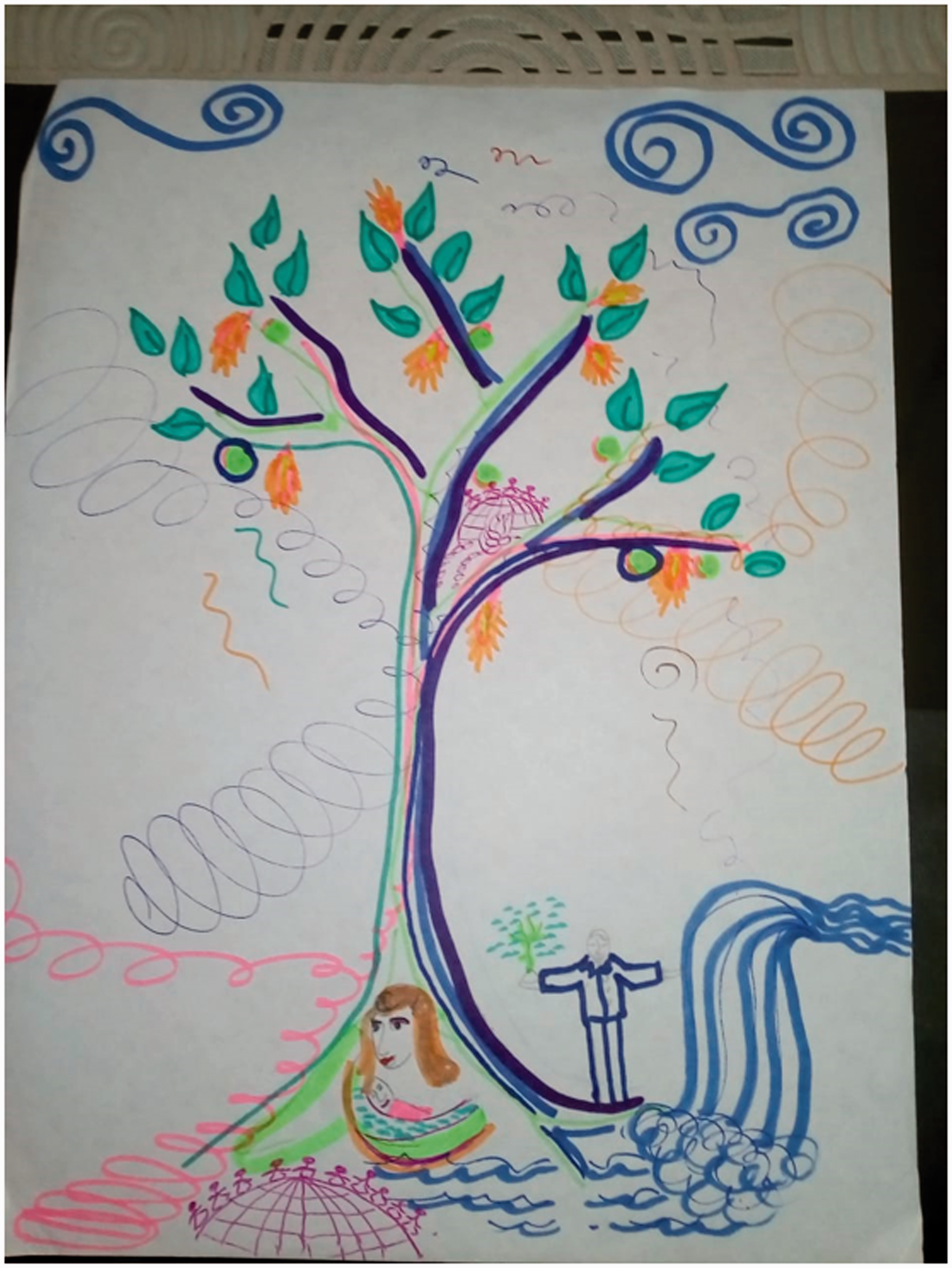
Living spiral representation by Margarita Zethelius.
By following the Living Spiral framework exercises, each co-researcher has reflected on experiences in their respective TAR processes, based on three semi-structured interview questions: (1) what are the qualities necessary for a co-researcher in TAR? (2) How did these qualities manifest themselves in the facilitated T-Labs? and (3) What is the role of these qualities in the learning needed to address climate change? (see Appendix 1 for original questions in Spanish). Consequently, each co-researcher wrote down their personal stories of transformation accompanied by a personalised representation of the living spiral model, which they then presented to each other in the form of answering the above questions. These stories and visual representations are presented below. Please note that the narrative reflections below make up a part of a greater set of Living Spiral exercise data, and as such represent a moment in time within a larger action–research project.
Co-researcher living spiral representations
Tatiana Monroy Pardo, Ecovillage Aldeafeliz: T-Lab Cusmuy
The banana plant has become an emblem of the territory I live in, and I wanted to be inspired by a local plant to understand my role as a co-researcher in my territory (see Figure 3 above). The banana has a form of reproduction below the earth, which is quite different than plants which reproduce through seeds. Shoots leave the earth, turn into stems, develop a flower which gives fruit, and then the stem dies, while new shoots emerge from the ground. I connect this constant natural cycle for the importance for the researcher of allowing research processes to die, so as to give birth to new ideas and insights. I experienced this very strongly in the first T-Lab I co-organised and facilitated – Canto al agua (Sing to the water). Taking place in the Cusmuy of Aldeafeliz, we invited different stakeholder in the region to converse the threats and opportunities of caring for the water of our territory through the dialogo de saberes methodology. Representatives from the municipality were present, as well as our campesino (peasant) neighbours, other neo-rural people in the area, as well as residents of Aldeafeliz. As a facilitator, one of the things I had to let die was the categories I had made in my mind over the years of my campesino neighbours being the good guys, and the local municipality the bad guys. This prejudice had to die for us to be able to sit down at the same table and recognise each others’ strengths and weaknesses. The municipality had a very clear position on quantifiable actions that they had carried out, such as number of trees planted to protect natural springs, and the number of farm visits. This was surprising to me because in my mind they were not taking action to protect the water of the territory. The campesinos, on the other hand, explained how they did not have numbers and figures to support their actions, but how they had been holding neighbourhood assemblies to discuss problems with water, and participating in mingas (collective work parties) to plant trees close to springs. As a researcher I was forced to remove my filters to generate the possibility of dialogue between different actors, which turned out to be a rich process whereby both the peasant farmers and the local municipality were able to recognise each others’ work, as well as a common feeling of abandonment: the campesinos felt abandoned by the municipality, and the latter felt abandoned by higher government structures.
Continuing with the banana plant metaphor it is important to note the ability for the plant to sustain reproduction through strong healthy stems and leaves to absorb oxygen. This maturity of the plant to withstand insects and adverse weather I connect to the very important quality of the co-researcher ability to see into the depth of themselves and the context they are studying so as to understand the different transformative processes happening around them. The co-researcher needs to be well grounded to appreciate the profound and deep, the invisible processes around them, dealing with often confusing and frustrating processes. I have seen the development of this quality in myself while reflecting on the process which continued in the second T-Lab diálogos municipales para la paz, whereby the municipality invited actors in the region to come together to explore collaborative work. We accepted the invitation and brought all our methodological tools such as the olla comunitario, as well as social technologies such as working groups, to help the municipality carry out the workshop in the town of San Francisco. A municipal representative turned up for an official handshake and to have his photo taken, then left, leaving the rest of us talking, and all agreeing, on what we wanted, but without the municipality present to make the project happen. I later found out that the idea to create a space for local crafts and artisans in the town had been given to the local transport industry. At this point I came up against a huge barrier, in which I had to develop the quality of dealing with frustration and acknowledging the limits of my research-based action. I took distance to the collaboration with the municipality, and instead focussed my energy on working with interested parties within the setting of the community I lived in, Aldeafeliz.
David Coral: T-Lab Como canto tu alma (how your soul sings)
The San Pedro cactus is the plant I identify with in my territory in southern Colombia. As a representation of the Living Spiral model (see Figure 4 above), it is very interesting as it is a shoot at the same time as it is a stem, takes a very long time to reproduce, and whose leaves are spines, a means to maintain moisture as well as to protect itself. Connecting the San Pedro drawing to the T-Labs I have facilitated, I think it is very important to highlight the middle of the plant, the primordial seed which is the start of everything, surrounded by the chakana, an old symbol of Indigenous cultures of the Andes representing all life – policial organisation, economic, social spiritual. Working with Indigenous ideas and customs has taught me a researcher quality essential to working with different cultures: Appreciate and develop the skills to translate ideas between worlds that often do not understand each other.
This quality was highlighted in the MinkaYaku T-Lab, during which I experienced an Indigenous elder saying that it is through dancing and singing that the climate is organised. At a deep level I connected with this insight – in ancient dances and songs of tradition, in which we dance for hours and days, we learn awareness of caring for the other and for oneself. The purpose of ancient dances has to do with connecting with the natural cycles of the territory we inhabit and astrological phenomena, such as sowing, harvesting and equinox solstices. However, I could see that there were many participants present who did not understand this concept of climate change. A westerner may understand humanity as increasingly disorganised because of the changing climate. I helped to explain to some participants that the elders see it the other way around. From an ancestral understanding, the world is disorganised climatically speaking because the climate inside of people are disorganised. I also see my researcher qualities of curiosity and a personal connection to the topic of dance and song as fundamental to by ability to move between these different worlds.
One of the barriers I have faced in my work for Nuh Jay is my lack of formal titles and the constant struggle to articulate what I do with formal institutions who expect certain workshop designs and results. This can be seen on the top left of the San Pedro plant where one of the shoots has rotted. Such experiences, however, provide fertiliser for other processes to develop. These experiences have taught me that a co-researcher quality is the importance of lowering the Gods from their pedestals, moving away from the ideas that the expert ‘knows’, and is there to help the vulnerable. This has to do with rejecting the idea of the objective observer, and instead allowing the heart of the co-researcher to be transformed.
A concrete example of this was the T-Lab working with circulos de mujeres (women circles) which was part of a set of workshops including campesino women, government representatives, NGOs, civil society and myself as part of Nuh Jay facilitating discussions on gender and environment. Rather than simply giving a workshop as ‘experts’, we went and met the campesino women before the workshop, as well as the municipal representative, asking questions about what they wanted and expected. Based on these conversations we designed the workshop around an olla comunitaria, appreciating that around collective food preparation important conversations would take place. This complicated the logistics and the budget for the workshop as it is usual to subcontract food preparation, and it was complicated to explain these conversations as concrete results to the funders of the workshops. But for us it was a means to include the women into the design of the workshop, and give them voice to the processes they were going through.
Margarita Zethelius, co-researcher, Alianzas para la Abundancia, Las Islas del Rosario
I chose the tree as my spiral representation – a tree from the Colombian Andes where I was born (see Figure 5 above). Sustaining this tree is life-giving water and the relationship with my mother. At the bottom of the picture is also a drawing of a Temazcal (indigenous sweat lodge) which for me has been a way of connecting more profoundly with who I am; not only where I am from, but uniting me with different places and people around the world in a matrix – what some people call Mother Earth.
Having worked many years with grassroots communities and sustainability networks, always wanting to change the world, one of the qualities I believe important for a co-researcher is to be flexible, accepting that there is no perfect model, and to see everything that happens is an opportunity for growth, for analysis. If as a researcher one does not have the ability to be flexible, to respond to an invitation to see things in a different way, then it is very difficult to move past one’s own mental barriers. This appreciates that perfection is not necessary, things can be good enough for now, accepting that we learn in different levels and dimensions. Nothing is completely objective, everything is subjective, everything depends on the moment that is changing, to see change without being afraid, the confidence to know that you are doing things from the heart – that one is part of something greater than oneself. One of the ways I incorporate this quality into my research is flexible agenda making. For example, in the first T-Lab there were many people with different backgrounds present. The agenda was not permanent, with each activity being written on a piece of paper which could be moved to a different time slot. This may seem like a simple tool, but it prevents agendas from being too fixed, with a design that allows content to respond to a constantly changing context, and where the process itself can suggest a change in perspective. For example, one of the methods planned was a pagamento (offering to Mother Earth) which is usually held in the morning. However, the elder Mamo Juan said it should take place in the evening (when it is dark), so we decided to light a flame which remained lit for the whole workshop and contributed to a sense of continuity during the workshop.
Working with people of different backgrounds and educational levels, I also feel that the ability to listen actively, not just from the intellect, where the concept is coming from, but also try to listen to the reality of that person, practising empathy, without pretending to understand their world. I have given many workshops and shared so many stories that sometimes I assume that people know what I know. During the second T-Lab we were working with members of communities from around the Caribbean, and I was using the word ‘holistic’ to describe the approach the Global Ecovillage Network uses to understand sustainability. Realising that there were participants who did not understand what the word meant, I decided to stop the presentation. I asked everyone to come together in a circle, hold hands, and then asked what people felt. This activity was simple, but very powerful, and was a different way of learning together, understanding what 'holistic' meant in a more experiential fashion.
Finally, a very important co-researcher quality is the capacity to document and systematise information and results. This is something we struggle with Latin America, and the global south in general. Perhaps it is that we capture things in a different way, orally, through stories, which I valorise, but it is very important to be able to speak a common language with those outside of our environments. In terms of the Living Spiral metaphor, this documentation of experiences represents the seeds which can be sown in other places, in other contexts, where the water of life can activate them and lead to new points of reference for society.
Section 4 – Analysis and results
The above narratives were examined by means of thematic analysis (Boyatzis, 1998), with the intent to distill qualities that characterise co-researchers engagement in TAR. The full text of the three narratives was inductively coded in order to identify patterns and related themes describing qualities of TAR co-researchers. As a means to limiting the effects of projection in coding the above narratives – imposing our own values and worldviews onto the data (Boyatzis, 1998) – and thus ensuring reliability, the coding was carried out in three rounds by three authors, namely the lead author and the last two co-authors. First, two of the coders independently encoded the text and identified emerging themes. Minor divergences in results were resolved through discussion among the two coders. A third coder then proceeded with coding the narratives using the generated themes as a starting point. This process did not lead to new insights, other than a more nuanced understanding of the already generated themes. Based on this analysis, TAR co-researcher qualities are distilled and presented in Figure 6.
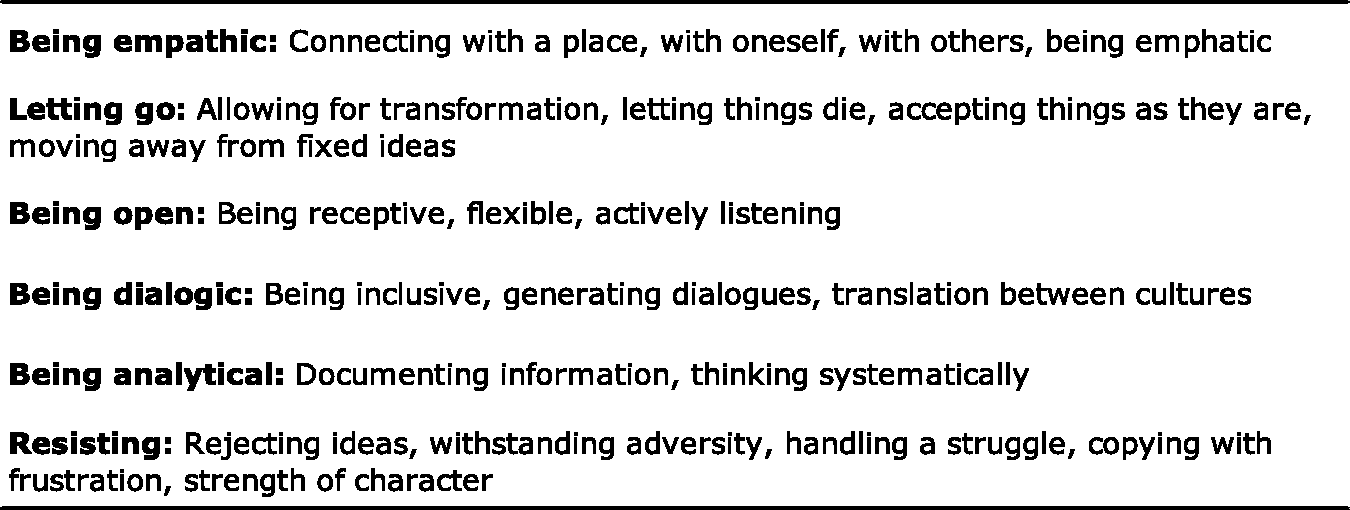
Qualities of co-researchers in Transgressive Action Research.
The results of this analysis demonstrate six qualities co-researchers consider important in TAR research. The first three qualities highlight the importance of care and emotions. In her narrative, Tatiana notes the importance of neighbouring peasants and municipality representatives being empathic with the struggles of the other, leading to a recognition of the important role each actor was carrying out in the community. Such empathy is facilitated by the quality of being open, whereby Margarita notes the importance of being flexible when facilitating community processes, embracing unforeseen events as opportunities for growth and analysis. This relates to what David notes as the importance of allowing the heart of the co-researcher to be transformed, highlighting the quality of letting go to fixed ideas such as that the 'expert' knows, or that academic titles are needed for facilitating community processes.
Qualities 4 and 5 relate to more cognitive elements. As T-Labs are inherently spaces for encounters between different people and ideas, quality four being dialogical is demonstrated by Tatiana noting the importance of peasants and municipal representatives sitting down at the same table to talk, while David tells of including the voices of the women in the design of the T-Lab. Quality five being analytical is demonstrated by Margarita noting the importance of the researcher capacity to document and systematise information and results, as well as the acknowledgement by Tatiana, through analysing her research process, of the limits to her research-based action.
Quality six resisting represents a break from the previous qualities, demonstrating the more aggressive associations to TAR. This is demonstrated in both David and Margarita rejecting the notion of objectivity, and Tatiana resisting the filters she had placed on her relations between peasant neighbours and the municipality. The more emotional aspect of withstanding adversity also clearly comes out in Tatiana’s narrative as she deals with her frustration in realising the limits to her researcher role, as the social fabric with the municipality unravels.
Despite the clearly delineated qualities in Figure 6, a closer look reveals how co-researcher narratives share a common fundamental quality: the ability to navigate and balance opposing states of being. Tatiana, for example, must balance letting go of her personal prejudices while coping with the frustration and confusion of not being able to articulate a meaningful relationship with the municipality. Margarita must harmonise the openness and flexibility of working with different forms of understanding by participants, and the need to systematise the information and results of the T-Labs for evaluation purposes. Finally, David is balancing being emphatic – translating ideas between different cultures – with a strong quality of resisting dominant forms of expert-based knowledge, and institutional norms.
Section 5: Discussion
What has become clear during this introspective journey is that TAR implies not only engaging into a cyclical journey of reflection and action – as typical in (Participatory) action research – but also requires a fundamental quality of the researcher to transcend dualities, for example, letting go while resisting, being strong while being tender, and doing things from the heart while being systematic. This spiralling reflection process, appreciating the transformation taking place in the researcher, connects well with the idea of emergence in social learning (Wals, 2007b, p. 13), which also emphasises the iterative nature of such learning and recognises the inevitability and even desirability of indeterminacy. Such learning is also associated with the possibility of expansive learning (Engeström, 2001), when researchers can come together in collaborative envisioning and a deliberate collective change efforts, as witnessed through the T-Labs.
In terms of climate change (in)action, this raises questions about what to do if these qualities are lacking within individuals or within the collective of researchers. Can such qualities be developed and, if so how?
A shared voice which comes through in this paper is that change must start with the individual – through a form of deliberate transformation (O’Brien, 2012). In the words of David: to address climate change in the physical sense, there is need to change our ‘internal climate’ towards a more connected and coherent relationship with nature's cycles. An important means of generating such change is through experiencing other perspectives and even realities, through which T-Labs provide an important safe space for experimentation which allows for transgressive learning and disruptive capacity building.
To conclude, we can understand TAR as an emergent strand of action research and PAR. Although TAR and PAR obviously do overlap, what seems to set TAR apart is its rootedness in existential challenges, the recognition of confining structures and forces that impede transformation, and a commonly perceived need to transgress those forces and structures through a continuous spiralling process of action and reflection. The qualities a TAR participant needs to fully participate in this process can partly result from learning within the TAR community, as these qualities are often present in some of the participants. However, they also might simply be missing or lacking, in which case a more formalised or organised form of capacity-building might be needed where relative outsiders might join in and engage the group in the specific development of certain qualities or capacities. A T-Lab is a useful context for such learning, where is it important to employ specific tools and methods appropriate for a particular context. In the Colombian T-Labs such methods have been dialogues de saberes (knowledge dialogues), and pagamentos (offerings to Mother Earth), while there are a range of other methods and resources which may be relevant in other contexts, such as the multi-stakeholder partnership guide (Brouwer, Woodhill, Hemmati, & Verhoosel, 2016), and the SUSPLACE arts-based methods for transformation (Grenni, Moriggi, Pisters, & de Vrieze, 2018). Finally, it is important for more research to be conducted into TAR like forms of action research, which in the context of climate change can contribute with inspiring and empirically grounded narratives in action-based change, as well new insights into identifying, analysing, and promoting counter hegemonic pathways towards sustainability.
Footnotes
Declaration of conflicting interests
The author(s) declared no potential conflicts of interest with respect to the research, authorship, and/or publication of this article.
Funding
The author(s) disclosed receipt of the following financial support for the research, authorship, and/or publication of this article: This research is funded by the International Science Council as part of the T-learning Knowledge Network.