




Abstract
This article reflects on a youth-led action research process on climate change adaptation carried out in Cuba between 2013 and 2015. The research explored the question: ‘How are Cuban youth engaging with climate change adaptation challenges and what can we learn from it?’. The objectives of the research were to understand young people's attitudes towards climate change and environmental work while connecting a youth network in Cuba and encourage collaboration. This article contributes to PAR with a rich description of a research process in which the group of co-researchers was able to collectively shift their awareness of and personal relationship with nature. Proposing a conversation between Heron and Reason's extended epistemology (1997) and Scharmer's TheoryU (2016, 2018), I argue that experiential knowledge in climate change and environmental work looks like entering an intimate state of co-presencing with the aliveness of the earth. Second of all, the research contributes to the literature on youth participation highlighting that in Cuba there is a gap between the political will and attention towards climate change adaptation, which is remarkable, and young people's ability to meaningfully take leadership in such efforts.
The action research presented in this paper unfolded in Cuba, working with a team of 10 young people across the cities of Havana, Santa Clara, and Santiago de Cuba. Our research explored the question: ‘How are Cuban youth engaging with climate change adaptation challenges and what can we learn from it?’. The objectives of the research were to understand young people's attitudes towards climate change and environmental work while encouraging collaboration by creating a network of young people committed to the environment across the country.
One hot afternoon in Havana saw myself and two co-researchers interviewing Carmen Cabrera, a Cuban pionier of permaculture. She explained: ‘When the sun hits the pavement, it creates more heat; when it gets absorbed by the earth, the energy transforms into something new…’ (Cabrera, 2014). I was mesmerised when she shared her learning working with permaculture: I have realised that I am like an ant, I am like a bird. I am neither unique nor better nor more valuable; I am nothing more and nothing less than any other part of nature. (ibid)
This article unpacks the learning from a youth-led action research process on climate change adaptation. Our work was a collaboration between Recrear and the Caribbean Youth Environment Network (CYEN) between 2013 and 2015. Recrear (www.recrearinternational.org), an NGO I co-founded, is a Canadian charity dedicated to promoting active youth engagement by carrying out participatory youth-led research. It designs and implements programs utilising participatory and creative techniques. These are intended to provide space and tools for youth to articulate their needs and build a vision for their community’s development. The CYEN is a non-profit, civil society, charitable body that focuses its resources on empowering young people and their communities to develop programmes/actions to address socio-economic and environmental issues.
As the coordinator of the research, I used the special issue deadline as a pretext to reflect on and discuss what I think were some of the strengths and shortcomings of the work we did in Cuba. I ground the reflections in my learning, making references to experiences shared by the co-researchers and research participants when appropriate. This article contributes to PAR with a rich description of a research process in which the group of co-researchers was able to collectively shift their awareness of and personal relationship with nature.
Here, I discuss two main findings of the research. First of all, the co-researchers collectively realised that to increase resilience and improve climate change adaptation practices we must consciously recognise ourselves as part of nature. We learned to ground our environmental work in the experiential search for harmony and belongingness with nature. For us, it was a powerful starting point for articulating more sustainable futures. Connecting this findings with the PAR literature, I explain how experiential knowing, intended as ‘knowing by acquaintance, by meeting, and by felt participation in the presence of what is there’ (Heron & Reason, 1997, p. 277), can then motivate climate change adaptation practices.
In this paper, I experiment with bringing two action research models together, the work of Heron and Reason's extended epistemology (1997) and Scharmer's TheoryU (2016, 2018). I argue that experiential knowledge in climate change and environmental work looks like entering an intimate state of co-presencing with the aliveness of the earth. I suggest that an experiential search for harmony and belongingness with nature can be a starting point for articulating more sustainable futures.
Additionally, and more pragmatically, our research contributes to the literature on youth-participation towards climate change adaptation. We highlight that in Cuba, as in so many places around the globe, there is a remarkable gap between political will and collaborative action in response to desired changes. We see it as important that young people's leadership is supported by those with more formal authority as it creates a new generation of positive responders who can serve society.
The paper proceeds by introducing the research context as well as the methodology. I then provide a brief overview of the relevant conceptual models and use them to narrate the experience that unfolded. I highlight the personal and collective shifts within the participatory action research projects, which continue to empower those involved. I conclude with lessons learned for future youth leadership.
Research context and methodology
Researching youth engagement with climate change adaptation in Cuba
My first windows into Cuba's youth sector were the stories of Handy Acosta, a passionate young environmentalist. The first time I encountered Handy, he drew on a notebook a detailed map and proceeded to describe the characteristics of each mile of Havana: from the old city to El Vedado, to Playas del Este. For a year, Handy and I lived two doors away from each other at the Sauvé House, in Montreal, where we were in residence for a leadership Fellowship. This project therefore was the product of a beautiful friendship.
I was particularly struck by Handy’s passion for nature and the way he understood the urgency of working with climate change issues in Cuba. I had felt disconnected from environmental issues and I was personally interested in carrying out research that I understood as critical in our time. Handy made me curious about Cuba’s political and economic system: was there really a difference in the way Cubans engaged with nature based on their unique (politically isolated) circumstance? Cuba is a complex, misunderstood, paradoxical, polarised and, to many, a polarising country. Coming from a Western, neoliberal culture, I expected that researching in Cuba would generate many strong emotions and impressions.
Handy and I designed a program to apply Recrear's participatory action research methodology to reinvigorating youth leadership in environmental work in Cuba. After an exploratory visit in May 2013, in January 2014, we landed a small fund from the UN-Habitat to implement our research. We were first of all interested in learning about Cuba's climate change adaptation practices. As an island country, Cuba is particularly vulnerable to climate change which is causing both natural disasters and the loss of biodiversity (Alonso & Clark, 2015; Cabello et al., 2012). It is exposed to hurricanes, tropical storms, tropical depressions, intense rainfall, floods, and droughts (Guzmán, 2014). In the last decade, hurricanes have increased in frequency due to climate change (Dim & Stefan, 2012) and they threaten the biodiversity in Cuba: they cause habitat loss, deforestation, and the destruction of coral reefs (Goulart, Galán, Nelson, & Soares-Filho, 2018).
The Cuban government has been proactive towards environmental protection and climate change adaptation. The World Wildlife Fund recognised Cuba as possessing one of the smallest ecological footprints while maintaining high human development (Cabello et al., 2012). Cuba has managed better than its neighbours to prevent deaths from natural disasters such as hurricanes and has put considerable efforts in disaster risk reduction (Guzmán, 2014). It has also invested in planned biodiversity, reforestation, and increased the country's territorial and marine protected areas. In short, Cuba's approach to sustainable development is considered exemplary (Cabello et al., 2012; Goulart et al., 2018; Milanés, 2014; Osmel, Georgina, & Onelia Edyn, 2017; Stone, 2018).
This active posture towards climate change and environmental protection have roots in Cuba's history. During the Spanish colonisation, and throughout the 1900s, Cuba was dependent on sugarcane and tobacco monocultures (Goulart et al., 2018). The Cuba Revolution, in 1959, brought some environmental friendly policies such as the Forest Regrowth Law. During the Cold War, Cuba aligned with the Soviet Block – the alliance brought along growing agricultural industrialization (ibid). Meanwhile, the revolutionary government invested in conservation science. With the end of the Cold War, Cuba found itself isolated from the US and lacking the protection of the Soviet Union. This lead to a food security crisis, a fall in the GDP, and grave resource scarcity, including fertilizers and pesticides. In this period, referred to as the ‘special period', Cubans responded to food scarcity with a range of bottom-up initiatives and the spreading of sustainable urban agriculture and cooperative farming (Koont, 2009; Lanegran, 2012).
We knew that young adults in Cuba had grown up with an impressive environmental consciousness (Alberto Torres, Mavel Moré, & Noevia Torres, 2014; Milanés, 2014) and we expected to find an engine of Cuban youth committed and ready to apply their environmental consciousness to take bold steps. Our objective was to learn from such experiences and to create a space for research participants to learn from each other. While we did find that the socialist political system encouraged participation with climate change issues, we also found that power was highly centralised within the public sector and young people had a weak access to independent civil society spaces. This limited their full and meaningful participation.
Methodology
To engage with the question: ‘How are Cuban youth engaging with climate change adaptation challenges and what can we learn from and support it?’ our research brought together a team of 10 young leaders across the country to carry out activities over seven months. The main themes that we explored included:
Youth attitude towards climate change issues; Youth participation and leadership in climate change issues; Best practices (grassroots) on climate change adaptation in Cuba.
My two colleagues and I recruited the co-research team with rich and varied backgrounds including a journalist, a philosopher, an engineer, and a biologist. The intention was to allow the research team to take active ownership of the process, build their leadership and engagement, and, most importantly, learn from each other.
The relationship between the three foreign researchers and the local research team was an interesting intercultural experience. We acted as a mirror to each other. Our participation meant that the team of local co-researchers was challenged to explain Cuba to non-Cubans. Some of the researchers reflected towards the end of the process that our curiosity towards Cuba helped them perceive their reality and bearings with fresh eyes. In this way, it was a developmental learning process allowing those involved to be simultaneously subjects and objects of their own inquiry. The intercultural differences between us were very stark, and the mutual learning all the more impressive. We managed to develop a beautiful friendship. As one of the Cuban researchers admitted in a sharing session: when we interact with yumas (a term common in Cuba to refer to North Americans and more generally foreigners) we generally try to think “how can I exploit them?” This time it was different because we were able to build trust and friendship.
The workshops were designed to both learn about youth's relationship with climate change adaptation work and to provide an opportunity for critical exploration and engagement on the subject. The Cuban team supported the logistics involved in organising the research workshops; they took care of mobilising their networks and recruiting 25 young people that would be as representative as possible of youth in their cities. For each group, we made sure to maintain a gender balance. We also decided to recruit participants based on their level of engagement with environmental work: a third of the participants considered themselves leaders in environmental work, a third had some knowledge, but not extensive experience, and a third was disengaged entirely from environment-related issues. The composition of each group made it so that, very organically, knowledge and perspectives transferred between the participants.
Following the workshops, we organised another week-long retreat at Teatro de los Elementos. Given that transportation within Cuba was costly, coming together for another week was a unique opportunity to deepen the connection between co-researchers, build a common culture within the team, and discuss their preliminary findings. Following the ‘reflection' week, the co-researchers coordinated within their local teams to carry out a two-month research internship (receiving a small stipend for this period). During the internship, the three teams carried out semi-structured interviews in their community (the co-researchers designed a template to take notes during the interviews – see Appendix 1) to learn from experts and community leaders and, importantly, to build a strong local network. Finally, in July 2014, all co-researchers came together once more to discuss our findings and prepare the final publication. The published work on this research is available on Recrear’s website:
Conceptual model: TheoryU and extended epistemologies: Deepening climate change knowledge
TheoryU is a framework developed by Otto Scharmer and his colleagues at the Presencing Institute; it is designed to facilitate the emergence of individual and collective highest future possibilities. Scharmer (2016, 2018) suggests we must expand our awareness from ‘ego to eco’ so that we can see ourselves from the eyes of others and from the whole: this is, Scharmer contends, one of the main challenges to overcome for a more sustainable future. TheoryU represents an invitation to go beyond the surface of how reality appears, suggesting that the manifestation of reality emerged out of specific structures, which are grounded in deeper paradigms of thought. According to Scharmer (2017), what lies below paradigms of thought is the source of the current reality. Scharmer argues that such a source needs to be attended to, in order for reality to transform.
To understand the framework shown in Figure 1, it may be helpful to imagine the U as a geological structure with an individual sitting on the left side of the U. Reaching to the future, represented by the right side of the U, would require an impossible jump. Looking forward, one sees an abyss. The framework suggests that to reach the right side of the U, one's highest future possibility, one must venture all the way down, to then hike up the other side of the U.

TheoryU (Scharmer, 2017).
Scharmer refers to the state one finds oneself while first on the left side of the U as downloading. In this position, individuals tend to understand reality through their mental framework. For this reason, they are not able to see the new but tend to repeat old patterns of thought. In order to start hiking down the U, the first step is to suspend judgement enough to allow a view of reality with fresh eyes. Redirecting attention towards the new reality that one is now able to see, further down in the U the challenge is to let go of the old patterns of thought.
This hike within our reality cannot be done theoretically. Getting to our most profound assumption and beliefs about the world, and letting them go, is an action research exercise: in the process, we can develop a renewed awareness of the engagement with, and positioning towards, our unique lived reality. The deepening into the U requires a complete openness. To release ourselves from a space of downloading, we must open our mind. Then to go from seeing to sensing, it is the heart that needs to open. Finally, presencing requires a last opening: that of our will.
This experience of attending to what is, allows us to arrive at the bottom of the U, in a state called presencing, a world formed by merging the terms presence and sensing. Presencing one can ‘act from the emerging whole’ (Scharmer, 2008, p. 58). In this state, there is a release of expectation of what might arise: presencing is a state of deep connection with the source of the highest possible future.
Presencing connects with the creativity necessary to bring forward new visions. The crystallising of such a vision and its actualisation will lead to a space of co-creation. Scharmer refers to a way to listening out of a state of presencing as generative listening – a listening that releases the ‘emerging field of future possibility’ (Scharmer, 2008, p. 54). It is this quality of listening that I experienced in Carmen's living room. Prototyping follows crystallising, the experimenting with new structures. Prototyping can then evolve into performing, which is the fruition and the embodiment of new practices and collective infrastructure.
I suggest here that TheoryU mirrors Heron and Reason's extended epistemologies framework and that together both frameworks provide valuable insights into the process involved with the participatory paradigm. Heron and Reason (1997) suggest that we know in at least four different ways and that knowing should not be confused with mentalism or cognitive processes alone. Knowledge can be:
Experiential: knowing through direct experience; Presentational: knowing through artistic expression; Propositional: conceptual knowing; Practical: knowing through doing (Heron & Reason, 1997; Kelp, 2014).
Heron and Reason represent the different types of knowledge through a pyramid, where experiential knowing represents the foundation, and practical knowledge is at the top. They furthermore encourage critical subjectivity, utilising self-reflective attention to bring different ways of knowing in aware relation (Heron & Reason, 1997).
TheoryU and the extended epistemology framework augment each other as shown in Figure 2.
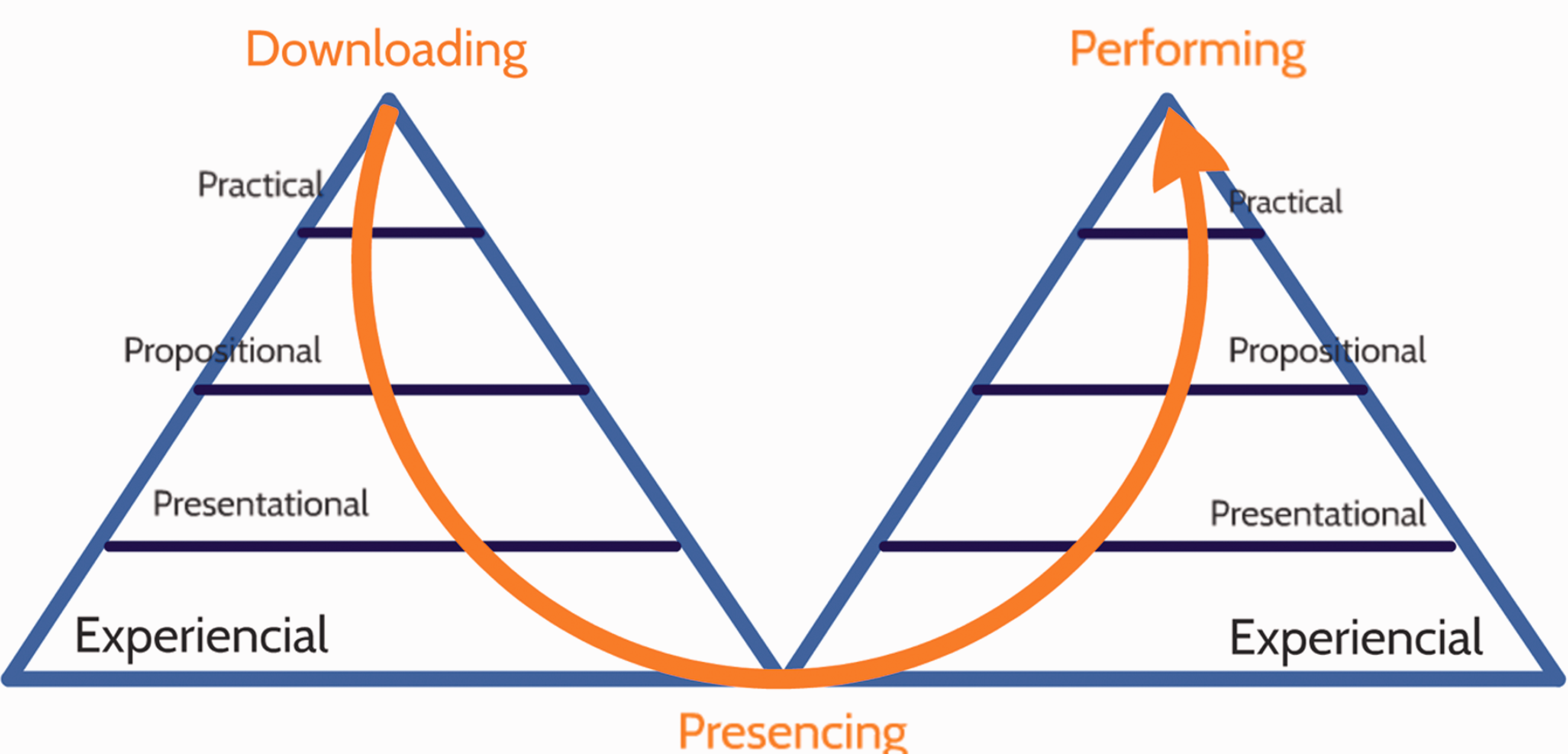
Integration of Heron and Reason's (1997) extended epistemology and Scharmer's (2016) TheoryU.
Figure 2 shows how on the left side of the U one might leverage a specific practical knowledge reflecting a state of downloading. Diving into the U, we explore with different ways of knowing. Presencing mirrors experiential knowing described as: ‘feeling and imagining the presence of some energy, entity, person, place, process, or thing’ (Heron & Reason, 1997, p. 280–281). On the right side of the U, one will integrate different ways of knowing, leading to new practical knowledge.
According to Scharmer's framework, prototyping is the enactment of the newly emerging knowledge into new structures – prototyping recalls Heron and Reason's practical knowing: it is a way of learning by doing. Scharmer (2016) explains that, while moving down the U the challenge is opening, the process of climbing up the U is one of reintegration of the heart, head, and hands so that new realities can take place. In the context of Heron and Reason's extended epistemology framework, this might look like using experiential knowing to ground other forms of knowing so to engage with reality through critical subjectivity.
TheoryU thus offers a sense of movement and dynamics to Heron and Reason's extended epistemology framework showing how the integration of different type of knowledge might lead to new ways of acting in the world. This dynamism augments our work as action researchers as we can:
Utilise TheoryU as a conceptual tool to describe action research processes; Consider that different types of knowledge might become more useful or relevant depending on which research phase we are in (stakeholder identification, data collection or sharing results, etc.); Recognise/pay attention to moments of presencing reflecting on the quality of letting go and letting come of knowledge necessary to move from experiential knowing to other types of knowledge.
The research experience
Downloading
The young people we met in Cuba regularly expressed that Cuba is an island with low levels of industrialisation and an anomalous socialist system, within a predominantly capitalist world. While Cuba contributes to low CO2 emissions, it is very much vulnerable to the consequences of climate change. These two pictures, done by our research participants when asked to draw a map of the world, capture this position.
Figure 3 describes the contaminated world, with other parts of the world emitting gases, while Cuba is green. Figure 4, as its author explained, depicts the world as an unhealthy obese person, getting weaker, nauseated and more ill with each passing day:

‘The contaminated world’.

‘I eat the world’.

‘Putting a good face to the weather’ by Roberto Castillo Boza, 2014.
Although the ‘man world' is getting bigger and sicker, he continues with his unhealthy lifestyle. If the ‘man world' really wants to feel better and live longer, he himself is the only one who has the power to change his habits.
Environmental concerns aside, some of the participants complained about the low levels of economic growth in Cuba and wished that Cuba's economy could be more dynamic. Being able to support themselves financially was a great concern for our participants. One of the structured debate we had in Havana focused around the question: ‘Is more economic growth in Cuba going to be good for the environment?’. Some argued that more economic development would allow for better technology and therefore reduced emissions; others argued that more economic development would bring environmental degradation.
The young Cubans we worked with were polarised about their relationship to their economic system and willing to engage in conversations around how different systems facilitate or hinder climate change. They were highly educated, able to engage in debates around climate change, and able to express their opinion in conceptual and creative ways. It was easy for the participants, the research team, and for myself to view climate change as a geopolitical issue. Despite the power of these debates, however, they felt like dead-ends, as if participants had talked about these issues extensively, and were saying in between the lines ‘Yeah, I know that already’ – a type of listening and attitude that typifies what Scharmer refers to as downloading (2008).
Seeing with fresh eyes
Cuba disoriented me, I lacked the coordinates to navigate the environment: this forced me to keep a sense of alertness and to be aware of the uniqueness of my experience. I recall one visit to a permaculture farm in which the permaculturist who was hosting us asked one of the co-researchers, who was an environmental activist, what she knew about the marabou plant. She responded that it was a weed that threatens the agriculture in Cuba. The permaculturist kept probing, what else do you know about it? She replied that the weed is tough to get rid of.
At this point, the permaculturist exclaimed that this was wrong: the marabou is central to the Cuban ecosystem. Because of its deep roots, it helps to reintroduce nitrogen and prevent soil erosion, it is food for many animals, it fertilises the soil, and its wood is used for cooking and heating. The marabou ‘is integrated into a natural system that relies precisely upon the interconnectedness and interdependence between the elements: the specific combination and variety of vegetation, animal life, soil, water, and climate conditions’, he explained. ‘If you remove the marabou, you completely disturb this natural balance and disrupt the biological cycle’.
At this point, the researcher asked why is it that the marabou had such a bad reputation. He explained that this was connected to Cuba's history. The production of sugarcane happened in Cuba on a large scale. When this production was abandoned, fields were left infertile and the soil deficient in nutrients. The marabou invaded those empty fields. ‘The dominant view is that the marabou prevents people from using these lands and making them arable. Ironically enough, the weed has helped to rejuvenate the land and biodiversity’, he continued. In short, the marabou is there precisely because there is no farming. Here our interviewer paused then reflected: The challenge is to realise that everything in nature has a role, even when it seems ‘bad'. The challenge is to grow food sustainably in a way that will maintain and reinforce this natural ecosystem. We should design systems accounting for and reinforcing the interconnection between all of these elements involved in a particular ecosystem. What I am saying is that we need to be creative – and make the most of the marabou. (Recrear, 2014)
Sensing from the field
Scharmer (2016) talks about the experience of sensing from the field as one that goes along with the opening of the heart. Thinking back at our research in Cuba, I can pinpoint a specific first moment in which I witnessed the sensing of something that was beyond an intellectual understanding. It was the fourth workshop in Havana, the treasure hunt. We hosted the first three workshops in a classroom. For the last one, we all ventured in the outskirts of the city, to a permaculture farm.
The morning of the workshop, there was a mix of excitement and grumpiness within the group – some people were concerned about ruining their shoes because it had rained the night before. We organised the group in different teams; the hunt invited participants to run around, get to know the environment, learn about different trees, map their city, and do a photography exercise. Throughout the day, it is evident that something had shifted. The group was bursting with enthusiasm: the treasure hunt had managed to invite the participants to rediscover their surroundings as a child would.
When we sat together afterwards to debrief the experience, individuals took turns sharing their little ‘aha' moments. Several participants, commented on the importance of talking about climate change while creating a relationship between young people and nature. Roberto, one of the research participants from Havana and a talented local painter, put words to it: ‘you defend what you feel’, he said. This statement got traction in the discussion. It resonated and created a moment of connection, which recalls the listening that Scharmer calls empathic listening. Participants were able to recognise that working on a farm, felt very different from working in a classroom. It was not an abstract concept. It was as if the natural environment acted as a kinder, more sensitive host to our conversations. We saw a similar experience repeat in all three of the treasure hunts.
Presencing
Teatro de los Elementos, the theatre group who helped train our team of core researchers, connects people to nature by using a range of theatre methodologies, originally developed by Augusto Boal and inspired also by Paolo Freire. The natural environment at the farm of Teatro de los Elementos is luscious and green: we held workshops in an open-air theatre stage with cows, birds, dogs, and frogs all around. The farm hosted moments of presencing for the team. The co-researchers, mostly coming from urban contexts, were recognising how being in contact with nature was deepening our reflections and making us feel good. One of the researchers from Santiago de Cuba explained how she felt at the farm: ‘When I come here, I enter a bubble. Everything is so interesting: the scenery, the atmosphere, the sound of the wind. You step outside the real world’ (Recrear, 2016).
Laritza, one of the co-researchers from Havana, wrote a reflection piece sharing a moment of presencing. She shared the story, as part of her internship, of a little old man nicknamed Chinito who took care of the garden of her university dorm. The story starts like this: ‘Near my dorm, there is a little garden. (…). Absorbed in my own world, I barely even noticed.’
Laritza started noticing the garden because Chinito got sick. Chinito was attached to the garden because it reminded him of his hometown, and made him feel close to nature. His sadness not being able to care for the garden anymore made Laritza realise that ‘there are people that have a much more powerful relationship with nature than I do’.
Because of this reflection, and because of her affection for Chinito, she started spending more time in the garden. She described her experience: Suddenly, everything around me completely changed. I surrounded myself with all types of medicinal and aromatic plants. I even learned about a banana tree that started waving at me a little branch full of fruit that nobody could touch without the consent from the guardians of the garden. (…). Chinito proudly explained to me everything that, being lost in my daily hustle, I had never come close enough to see. I was lost between the smells of oregano, linden, and mint. I discovered that some of these spices are used to make the food we eat every day in the cafeteria. (…). I believe that now, this garden will never go unnoticed to me. Maybe I will not take care of it every day, but I will start giving it a little bit of my time, even if just to say hi. (Laritza, 2014)
Crystallising
Roberto, who coined the sentence ‘you defend what you feel', crystallised his experience through a painting. Following our workshop series in Havana, he wanted to paint something that would help people ‘feel' the environment. He called it ‘Putting a good face to the weather’ (Figure 5).
It portrays a family trying to ignore a dystopian environment from the coziness of their sofa. He wanted to portray how we can block off the magnitude of environmental degradation precisely because we are in denial, unsensitised to the power of the changing climate.
We had learned that those who were most committed to environmental issues had a very personal relationship with nature. Young Cubans had a particularly well-rounded awareness of climate change challenges. Most of the young people we worked with were educated, prepared, and critical. Meanwhile, most of them were unable to see themselves as active actors in environmental protection.
Based on our research, this is because the perception of a slow, complex bureaucracy deterred, limited, scared: it blinded youth leadership. The drawing in Figure 6 is an example of how the young people we worked with perceived their interaction with bureaucracy. This drawing depicts a young person stepping into a public office to present a proposal to clean the river. Behind the public officer, they depicted the iconic picture of Fidel Castro; on the wall (behind the young person standing), hangs a poster promoting the ‘commitment to voluntary work’. To the young person's proposal, the public officer responds: ‘put it in the pile’ while indicating the overflowing box on the right labelled ‘environmental projects, year 2000’.
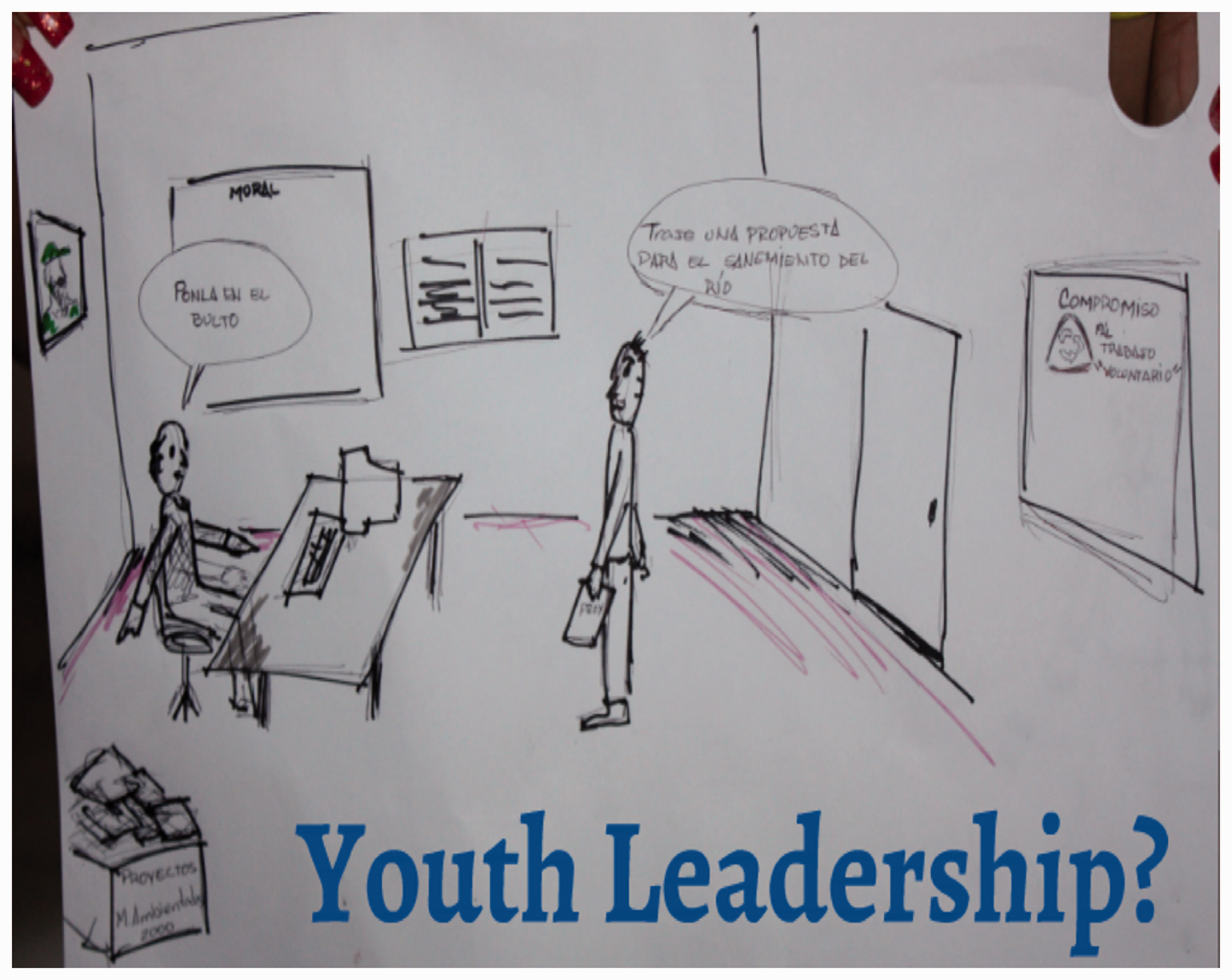
Drawing from reflection exercise on youth leadership, Santa Clara.
Because of this shared perception, the internship was intended as an opportunity to overcome one of the biggest inhibitors to youth leadership in the space of climate change adaptation: the widespread perception that young people cannot take leadership. During the internship, the local researchers worked in teams researching their cities, deepening their connection and friendships. They had the chance to interview people, build a network, and start a dialogue with people with different knowledge and experiences in community development and environmental issues. The simple act of interviewing experts was a way to step up and become more confident and visible.
Prototyping
I reflected that the project ended before the U was completed; we were not able to witness the different prototypes. Several conditions prevented the research from maturing to its full potential. First of all, we had budgeted some funding to facilitate an evaluation/final reflection workshop to bring co-researchers together a few months after the end of the research. Instead, there was a delay with the UN-Habitat funding (a year and a half delay!), and we were unable to follow up to the research properly. In the meanwhile, the research team had become too scattered, and internal transportation within Cuba too expensive, for co-researchers to coordinate more collective work. Another obstacle to the collaboration of our team was that communication with Cuba from abroad remained limited and expensive. For these reasons, it was hard for us to get a full picture of how the research echoed in participants' lives following the process.
Despite the limited scope of the project, the research did manifest in some prototypes. For example:
We profiled the story of one of the participants in the research who told us in an interview how the research had moved him to take the initiative and organise himself with some friends to clean the local river. In a different vein, one of the co-researchers in Havana decided to start an initiative to support the LGBTQ community in Cuba. While this initiative was not related to climate change work, our colleague did say that the experience of action researching as a process of engagement with depth and action, gave him the motivation to take on more leadership and believe that he could start something independently.
Discussion
The experience of presencing the earth
Heron and Reason (1997) suggest that knowledge is grounded in the experiential, much like Scharmer’s concept of presencing. Heron and Reason explain that experiential knowing ‘articulates reality through inner resonance with what there is’ (1997, p. 28). Scharmer argues that the blind spot of leadership is ‘the place from which our attention and intention originates’ (2016, p. 27). The two concepts highlight two complementary dimensions that I observed in the research in Cuba.
The concept of experiential knowledge suggests that ‘the very process of perceiving is also a meeting, a transaction, with what there is’ (Heron and Reason, 1997, p. 278). In ancient Greek, the term experience expressed with ἐμπειρία (empeirìa), composed of ἐν, ἦν (in, within) and πεῖρα (evidence) meaning that with experience one can experiment the inside of reality. Similarly, the term empirical comes from the Greek word embiria, which means experience: this recalls Heron and Reason (1997, pp. 280–281) understanding of experiential knowing which ‘means direct encounter, face-to-face meetings: feeling and imagining the presence of some energy, entity, person, place, process, or thing’.
Complementarily, the concept of presencing suggests that one might have to be more intentional to engage with experiential knowing: the ability to be with the experience depends, in Scharmer's phrasing, on the quality of our awareness. Both concepts, in my analysis, are inviting to more attentiveness and encourage to activate our will so to perceive a type of knowledge that is beyond the surface of reality. Both suggest that transformative knowledge will emerge out of an embodied personal journey.
In the context of this research, it appeared to me that the experiential knowledge involved the sensing of the aliveness of nature. Throughout the research, we learned that those who were most committed to climate change work had a very personal relationship with the Earth: they could feel its pulse, they rejoiced when in contact with nature.
Youth-leadership in Cuba
Cuba was a fascinating setting to understand why participation is intrinsically valuable; Young leaders lacked the confidence to believe they could actively contribute and transform their societies. The Cuban government has an undeniably strong commitment to the environment, both in policy and within their education system. We found a gap between the Cuban youth's potential in the environmental sphere and examples of youth leadership. This is not to say that Cuba lacks critical youth-led projects, but we found that the Cuban government's commitment to the environment was not matched by a dynamic youth leadership sector.
There seemed to be little political will to empower young people as independent social change agents. Young people experience structural barriers (such as fear of change and bureaucracy) to actualise personal and collective moments of presencing into prototyping. Whether real or perceived, young people's inability to creatively contribute to their community stagnates their energy and limits their full potential from manifesting. Working with young people in Cuba reminded me that creative energy gives movement to a system, it enables our full participation with reality. This is a concept that is well understood within participatory action research literature. Heron and Reason (1997, p. 278) suggest that ‘to experience anything is to participate in it, and to participate is both to mould and to encounter’.
During the time, we carried out the research, we found that young people were struggling to participate actively in environmental work, to mould such work. The reasons are multiple: many young people were disillusioned with the political system, and most of the young people we worked with were preoccupied with earning a decent living (and felt frustrated that being a professional paid so little). Many young people felt that their participation could only be limited to the formal system. Most importantly, it seemed that within Cuba's system young people were not being recognised as sources of innovation and new ideas: we found very deep ‘adultism', the marginalisation of youth knowledge because of age (Bettencourt, 2018).
Reflections and lessons learned
To go from crystallising to prototyping
This project was successful in generating a space for collective reflections and knowledge sharing. We learned about the power of inviting different types of young people to share experiences in nature and discuss their relationship to their environment. We recognised and appreciated the value of being exposed to people more sensitive and sensible about the earth. A key lesson learned, useful also in future research, is to be more intentional about going from the crystallising to the prototyping phase. To do so, securing access to key stakeholders, and social change agents, is critical. In reflecting on Bradbury’s and AR+ Associates (2017, p. 11) ‘basic recipe for action research,’ we see we could have more adequately completed a stakeholder mapping at the close much as we had in the initial design phase. This mapping helps us ask together who needs to be involved to socially proliferate the impact of what we are learning. This helps the empowering dynamic of sharing the work to the next stage of stakeholder engagement.
Upon reflection, in this research, we did not secure the right institutional alliances and access to help the youth-leaders to prototype their knowledge. Given that structures, status-quo and existing circumstances make authentic youth-participation hard to manifest, more institutional presence in the research could have improved the impact of our work. More generally, I think that more scrutiny should go into understanding what it takes to go from crystallising to prototyping. In fact, in translating new knowledge into practical knowledge, leaders often interact with constraining structures. What else can we learn about the type of skills and attitudes needed to do the jump to prototyping?
Inter-generational research
Scharmer suggests that we should move from ‘ego to eco’ or ‘me to we’ to think about transformation more holistically. It seems to me that in Cuba it would be essential to improve the feedback loop across the generations, young and old. The exercise of interviewing knowledgeable people from the community that local researchers carried out during the internship was valuable in order to open the space of conversation across generations. Yet, if I were to replicate the process, I would integrate a more robust intergenerational component to the research. Youth participatory action research can be an instrument for transcending adultism (Bettencourt, 2018). More generative listening across generations could allow for the presencing needed to prepare the ground for prototyping collaboratively with gatekeepers.
The value of presencing the earth in environmental work
In this paper, I suggested that climate change adaptation work can benefit from other ways of knowing. While in this paper I contribute to the literature narrating a youth-led PAR process in which the group collectively arrived at this realisation, this idea builds on a strong tradition. For example, is worth noting the contribution of indigenous Cosmo visions in Latin America (such as buen vivir – see e.g. Quijano, 2012) and the work of other action researchers such as Joanna Macy (see e.g. Bradbury, 2003).
Contributing to this tradition, as part of our research outcomes, and during the conversations with our partners, we discussed the importance of grounding environmental education within a genuine and ingenious relationship with nature. We argued there is little value in engaging with climate change solely through propositional knowing. I argue that such co-presencing with nature should be invited and encouraged as valid knowledge that can strengthen the educational efforts of climate change adaptation.
Our research suggests that a commitment to grassroots climate change adaptation work is linked to ‘the source from which people act’ (Scharmer, 2016). In the case of our research, this source manifested as an experiential awareness of nature's liveliness. What conceptual and practical knowledge could emerge in the field of climate change adaptation from the realisation that the Earth is not an unconscious rock, and that we are, just like the birds and the ants, part of a whole living cosmos?
Footnotes
Acknowledgements
This paper reflected on a project lead by Recrear with the support of the Caribbean Youth Environment Network (CYEN). I'd like to thank Handy Acosta and Carmen Cabrera for their inspiration and their guidance navigating Cuba's ecosystem. I also acknowledge the influential work of the talented Cuban painter Roberto Castillo Boza, whose work appears in this paper. This paper reflects the collective work of a team of 10 Cuban researchers, all of which have invested time, energy, and care in the research. Special thanks to Jim Sumberg, Kirsten Williams, Handy Acosta, and Khuyen Bui Gia for their valuable feedback on this paper. We welcome and invite your comments and reactions at our action research community’s interactive ARJ blog housed at AR+ 
Declaration of conflicting interests
The author(s) declared no potential conflicts of interest with respect to the research, authorship, and/or publication of this article.
Funding
The author(s) disclosed receipt of the following financial support for the research, authorship, and/or publication of this article: The research was funded by the UN-Habitat Youth Fund.