



Abstract
Background
Deep brain stimulation is approved for treating refractory obsessive-compulsive disorder in adults under the US Food and Drug Administration Humanitarian Device Exemption, and studies have shown its efficacy in reducing symptom severity and improving quality of life. While similar deep brain stimulation treatment is available for pediatric patients with dystonia, it is not yet available for pediatric patients with obsessive-compulsive disorder, although soon could be. The prospect of growing indications for pediatric deep brain stimulation raises several ethical concerns relating to bodily integrity, the ability to offer informed assent, and the role pediatric patients play in the decision-making process.
Objective
The aim of this study is to solicit and assess the views of stakeholders (children, parents, clinicians) on pediatric assent, autonomy, and bodily integrity in the context of potential pediatric deep brain stimulation for obsessive-compulsive disorder.
Methods
Semi-structured interviews were conducted with pediatric obsessive-compulsive disorder patients (n = 21), caregivers of pediatric obsessive-compulsive disorder patients aged 14–18 (n = 19), and clinicians with experience treating refractory obsessive-compulsive disorder (n = 25). Interviews were transcribed and coded in MAXQDA 2018 and 2020 software and processed for thematic content analysis to isolate and compare specific themes.
Results
A majority of respondents (74%, 48/65) across all three stakeholder groups voiced that the decision-making process should be collaborative and involve everyone (clinicians: 84% or 21/25, caregivers 71% or 15/21, and patients 63% or 12/19). We identified a split between respondents’ views on who should have the final say in the event of disagreement (38% or 25/65 favored the patient versus 35% or 23/65 favoring caregivers). A split between respondents also emerged concerning the maturity relevant for deep brain stimulation decision-making, with 45% (29/65) favoring developmental maturity (age/physiological development) and 45% (29/65) favoring decisional maturity (capacity to understand and weigh information). A majority of clinicians indicated that they would not move forward with deep brain stimulation without securing patient assent (80% or 20/25), with some stating the only exception is if patient quality of life was very poor and/or they lacked insight. Both caregivers and patients expressed a significant respect for the patient's right to bodily integrity, with 67% of caregivers (14/21) and 68% of patients (13/19) justifying patient involvement in decision-making specifically with reference to infringements of bodily integrity.
Conclusion
Our findings demonstrate that despite broad agreement across stakeholders that the decision-making process for pediatric deep brain stimulation for obsessive-compulsive disorder should be collaborative and somehow involve pediatric patients, there is disagreement about what this process entails and what factors determine patient involvement in the process. However, there is agreement that children have a right to bodily and brain integrity, which should only be infringed upon in rare circumstances.
Keywords
Introduction
Deep brain stimulation (DBS) is a form of neuromodulation where leads are surgically inserted into the brain to provide targeted electrical stimulation for symptom relief. DBS was first used in the US for treating essential tremor and the tremors resulting from Parkinson's disease (PD) after clinicians found that electrical stimulation to particular areas of the brain could produce effects similar to lesion/ablation therapy but which could be modulated. 1 Following developments since the 1980s in stimulation, devices, and targeting, DBS has been used to treat a variety of both movement and psychiatric conditions, 2 including essential tremor and PD,3,4 epilepsy, adult and pediatric (≥18) dystonia,5–7 Tourette syndrome (TS),8,9 and adult obsessive-compulsive disorder (OCD).10–13
Researchers continue to investigate the viability of DBS for treating other conditions, such as major depressive disorder and Alzheimer's disorder.1,2 Additionally, recent studies have begun to research whether pediatric patients with conditions treated with DBS in adults (e.g. pediatric TS or pediatric OCD) may safely benefit from early DBS intervention. This research is complicated by distinct state and federal regulations pertaining to when a minor may legally consent to a given medical treatment; for example, age for medical consent ranges 14–18 in the European Union depending on the country, and some US states recognize the common-law doctrine of the “mature minor” (typically ≥14).14–16 Where pediatric patients are not legally permitted to provide informed consent for medical treatment, their involvement in medical decision-making raises ethical and logistical questions about the relationship between autonomy and consent as well as the extent (and role of) of a child's right to bodily integrity.
In 2009, the US FDA approved DBS for adult OCD under the Humanitarian Device Exemption (#HO50003 09M-0090) (HDE), making OCD the first psychiatric disorder to receive some form of FDA approval for DBS treatment. 17 In the US, HDE approval does not require evidence that DBS for OCD is effective. While DBS is offered to pediatric patients with refractory dystonia under the FDA's HDE (#H020007 03M-0157), it is not yet approved for refractory OCD in pediatric patients. 18 Presently, it is estimated that there are over 100,000 cases of pediatric refractory OCD in the US alone.19,20 DBS for refractory OCD in adult patients has demonstrated efficacy of long term reduction in symptoms.10–12,21 These results, paired with the efficacy of DBS for refractory dystonia in pediatric patients, suggest that DBS may be effective in treating refractory OCD in pediatric patients.5,6
This paper shares and analyzes the views of US stakeholders (pediatric patients, caregivers, and clinicians) on pediatric assent, autonomy, and bodily integrity in the context of prospective pediatric DBS (pDBS) for OCD. Previous studies have investigated the ways in which these concepts (assent, autonomy, and bodily integrity) impact medical decision-making regarding pDBS for non-OCD conditions; this is the first to focus on a primarily psychiatric condition. 22 Existing work on pDBS for OCD has been limited to the perspectives of caregivers of children with OCD and clinicians who treat pediatric OCD on the use of pDBS; this is the first to analyze the views of youth diagnosed with OCD and to compare them with the perspectives of these other stakeholders.23,24
Salient ethical dimensions of pDBS decision-making
Certain ethical dimensions of medical decision-making become more salient when treating pediatric patients or are not present when treating adult patients with DBS. Below we briefly discuss how some of these dimensions have been addressed in previous research.
The first such dimension made salient by pDBS for OCD concerns the
Directing our attention to the pediatric patient's right to bodily integrity leads to the second dimension made salient by pDBS for OCD, which concerns the core practice of securing
The confluence of these two ethical dimensions (bodily integrity and the importance of consent/assent) lead directly to a third, viz.
Finally, we must note that pediatric decision-making is highly heterogenous and depends significantly on both a pediatric patient's age as well as their relative maturity and the nature of the decision being made. The level of involvement for a 7-year-old is much different from that of an adolescent or teenager, and this is especially true given the seriousness of neuromodulation as a treatment. While the patient respondents for our study fall within the adolescent category by age, all the respondents were asked about DBS for patients ≤18 generally. In the discussion, we consider how the relative age (e.g. young child versus late adolescent) impacts our conclusions.
Methods
Participants and procedures
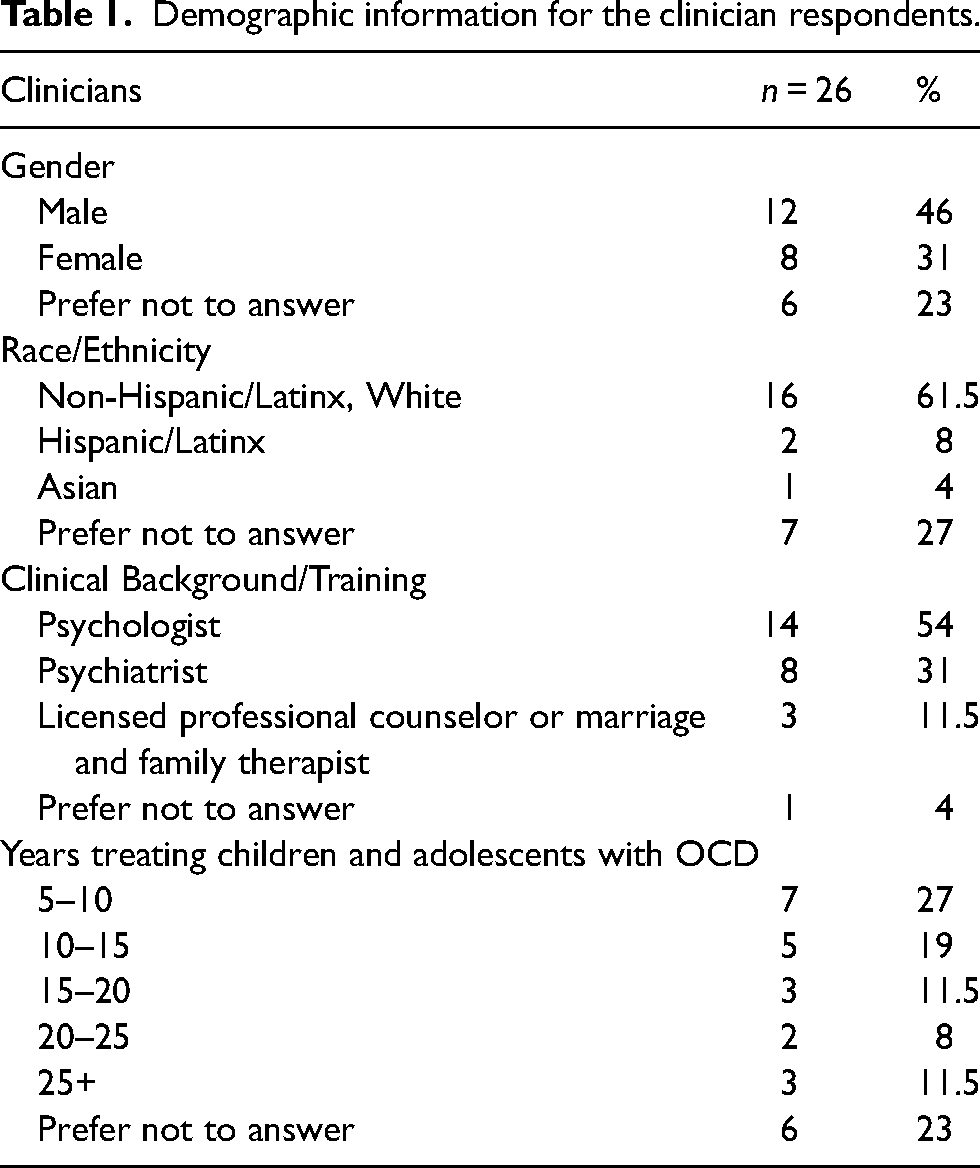
Semi-structured interviews were conducted with US-based clinicians (n = 25) with experience treating pediatric OCD, as well as pediatric patients aged 14–18 (n = 19) and caregivers of patients (n = 21) with OCD to understand stakeholder perspectives on informed consent and decision-making about pDBS. An interview guide was developed based on issues raised in the clinical and ethics literature and through discussions with DBS and movement disorders experts. A draft of the guide was reviewed by an advisory team and piloted with a psychologist specializing in refractory OCD in children and adults, resulting in minor changes for improved clarity. The study was approved by the Institutional Review Board at Baylor College of Medicine (approval number: H-45996). Interviews were conducted via phone or Zoom, lasting an average of 50 min. Table 1 includes demographic information for the clinician respondents; table 2 contains demographic information for caregiver respondents; table 3 includes demographic information for patient respondents. Note that one patient, one caregiver, and one clinician were excluded from analysis, but their demographic information has been included below.
Demographic information for the clinician respondents.
Demographic information for the caregiver respondents.

Demographic information for the patient respondents.

Data analysis
Interviews were audio-recorded, transcribed verbatim, and analyzed using MAXQDA 2018 and 2020 qualitative data analysis software. Team members (led by a qualitative methods expert and medical anthropologist) developed a shared codebook to identify thematic patterns in caregivers’, clinicians’, and patients’ responses to questions about their views on potential pDBS treatment. Team members independently coded transcripts to ensure inter-coder reliability in application of the codebook. We then iteratively abstracted the coded information and identified thematic patterns across interviews utilizing thematic content analysis, calculated final theme and sub-theme frequencies, and completed primary data analysis.
Ethics approval obtained
This study was approved by the Institutional Review Board for Human Subject Research for Baylor College of Medicine and Affiliated Hospitals (approval #H-45996).
Results
Collaboration in decision-making
A majority of all respondents (74% or 48/65) indicated that the decision-making process for DBS should be
This focus on shared decision-making was frequently echoed. An example of this included a clinician raising the need for a diverse group involved in the decision-making process: “Multiple people are very involved in the decision. And I think what's important is having people who have the background, the medical knowledge, the OCD knowledge, and then balancing that with what the parents understand, who's educating the parents, who's educating the child, and having everyone sort of come to the table and really having quite a frank discussion as a group about it,” (C25).
Some clinician respondents (44% or 11/25) expressed that one goal of collaborating with a pediatric patient on treatment decision is to ensure that the patient primarily was informed about the treatment, trajectory, and risks of DBS. As one clinician said, “But I think the biggest thing is trying to educate and really […] being able to communicate ideas in a way that whoever you're speaking to can understand and make sense to them, and that's going to be different for adolescents and kids than it's going to be for adults, and I think finding a way to make sure that you're explaining in a way that they actually understand what you're talking about” (C21).
Several clinicians gave more detail and described a tiered collaboration approach, which begins with one-on-one meetings with patients and caregivers separately before integrating them into a group discussion: “Okay. I think I'd start with the parents. I'd at least sort of put out the feelers with the parents before broaching it with the teen, because I think it can be overwhelming, or it can seem a little frightening that, “Oh my gosh, is something so wrong with me I need to have brain surgery?” Correct? So, I would use the parents, assuming they're supportive, motivated and on board parents. I would use them as the first screen to see how they think about it, and then to gauge how they think their teen would feel about it. Then if they think it's okay, then I would engage the teen in the process,” (C18).
Final decider for DBS treatment
Favoring a collaborative decision-making process does not necessarily mean that no one party has more of a say, or has the final say, in whether to engage with DBS treatment. The respondents differed in their perspectives of who should have the
Among caregivers in particular, 62% voiced that the caregivers should have the ultimate decision about DBS treatment (13/21). This contrasts the sentiment expressed by over a third of the respondents (38% or 25/65), who said the patient should have the final say in conflicts. On this, one patient said: “I wouldn't want my parents to make decisions for me […] because I'm the one who is going to have to live with it. So I guess, just being present in what the doctor has to say and being educated on what it's going to do. I would want to know everything about it if it's going to be in my brain,” (PT15). Among patients in particular, 47% (9/19) expressed that patients should have the ultimate decision about DBS.
Bodily integrity of pediatric patients
A recurring theme across the respondents was the consideration of the pediatric patient's right to bodily integrity as a reason to secure their assent and involve them in the decision-making process (31/65 respondents or 48%). This value was most strongly represented among caregivers (67% or 14/21) followed by patients (68% or 13/19). One caregiver said: “If I just took her to the hospital to get brain surgery, she would never trust me again, or she would probably run away. […] It's her body. She's almost 15. I don't sneak vegetables into her food. I wouldn't sneak an electrode or whatever into her brain,” (CG13).
Compare this to what one patient had to say about their involvement and their bodily integrity: “Oh, I'd be so involved. Because I get, parental consent and stuff. Say if, I don't know, if I wanted plastic surgery for something I would have to say yes and my parents would have to say yes too. But for brain surgery, I would be the one saying yes. My parents don't get to make that decision for me. That is my choice,” (PT16).
Generally, with respect to bodily integrity, the respondents did not distinguish between interference with the body or the brain and would often use them interchangeably.
Securing patient assent
Clinicians in particular (88% or 22/25) voiced that pediatric patient assent would be necessary for them to suggest moving forward with DBS. One clinician said: “You have to make sure they have a good informed assent. They're adolescents, so they legally can't consent, but a good informed assent where they understand all of the potential risks and the potential benefits, and that those are not glossed over. I know in a lot of medical settings, I've had family who are in hospitals, and procedures and things like that, a lot of times, the risks are a little bit glossed over, especially in front of kids,” (C03).
Several clinician respondents indicated there was only a narrow set of disparate circumstances under which they would consider pDBS without patient assent, nearly all of which concern either:
the patient lacking insight into their OCD (“Okay, it would depend on … clinically, it would depend on the amount of insight the child has. If I truly believed that DBS would help the kid, because they can't see it because of the OCD, yes. I would have no problem with that. No problem whatsoever. I wouldn't like it. But I wouldn't have a problem with it,” (C26)); having extremely low quality of life due to symptoms (“So, I think only in the case where it was determined perhaps that the person wasn't competent to make their own decisions in terms of caring for themselves, so maybe if someone were on an inpatient unit and it was determined that they didn't have the capacity to take care of themselves, like in terms of because their OCD was so impairing, maybe in that case, I could see a case being made for moving forward, even if the individual didn't, if the kid didn't assent,” (C16)); having symptoms that are prohibitive of securing assent (“So if they have health-related OCD symptoms and it's like, no, if you touch me I'm going to die of brain crabs or something, then yeah, that weighs very differently in my mind than my OCD sucks and it's making my life miserable but I know who I am and I have some real objections to what this is going to do, what this is going to be like,” (C08)).
Maturity of patient—developmental versus decisional
A split was seen in stakeholder conceptualization of patient preparedness to be involved in the decision-making process for DBS. The views were chiefly divided between the respondents who prioritize the patient's
Developmental maturity—the patient's level of biological or physiological development—was viewed by 45% of the respondents (29/65) as being crucial for moving forward with pDBS for OCD. A meaningful number of respondents (18/65 or 28%) articulated a loose continuum of development and participation, where pediatric patient involvement in the decision-making process is minimal for young children but more involved for adolescents and teens. Similarly, a meaningful number of respondents (17/65 or 26%) specifically indicated that they would want to wait until the patient was at least 18 years old before receiving DBS due to brain development. Consider what one clinician said about brain development and maturity: “I think the strongest [consideration] of all is the developing brain and the degree that DBS may have consequences for brain development that are hard to predict before getting to either age of adult level consent or to a point where we're confident that all the brain regions involved are fully developed. I think that's probably the most compelling argument that I would have for waiting until 18 or over,” (C13).
Decisional maturity—the patient's preparedness to understand and weigh various considerations for and against treatment—was viewed by 45% (29/65) of the respondents as being more important for decision-making than biological age, including half of clinicians and over half of caregivers (13/25 and 12/21, respectively). One clinician underscored that understanding and decisional maturity are what truly matter for assent: “It's actually about the true meaning of consent, it's about everybody understanding what can happen if we do. What can happen if we don’t? The kid could be 15 and get it or somebody can be 26 and not get it. It's a lot more complicated than that. I really hate the 18-year-old cut off thing because it's so black and white,” (C26).
Comparing this similar sentiment echoed by a caregiver that decisional maturity is highly variable and particular to the individual: “Oh, I don't worry about the legal consent. To me, it's the mental capacity. So I don't think age matters […] I feel like just like some kids are ready to drive, or vote, or drink at certain ages, not just because they're state mandated, some are ready before others. Some never are,” (CG15). On this view, it is more important to assess patient maturity on a case-by-case basis rather than use of age-cutoffs, since some patients may be more “decisionally mature” at a younger age than others.
As that caregiver noted, this view of decisional maturity can cut both ways; consider that a minority of the respondents favoring decisional maturity (24% or 7/29) voiced that, because decisional maturity is decoupled from age, there is no guarantee that 18-year-old patients (who are legally able to decide on DBS for themselves) have the requisite maturity. As one caregiver said, “Even if they're the legal age of consent they're still not mature enough to know. I mean, just because you're 18 or whatever does not mean that you have the information you need to make the right decision,” (CG12).
Discussion
Our findings highlight conceptual and ethical issues raised by the prospect of pDBS for refractory OCD and provide empirical support for some existing analyses involving
One aspect of pDBS decision-making generally that must be addressed first is: why not wait until the patient is older if we are concerned about either interfering with brain development and/or guaranteeing informed consent is obtained from the patient? The answer to this question depends on the complex interplay of several factors; different conditions have different ages of onset, available treatment alternatives (with variable efficacy), and progressions such that delaying DBS for one condition may be more harmful than for another. For example, the mean age of onset for Gilles Tourette Syndrome (GTS) is 7 years,22,37 whereas the average age of onset for OCD is 19.5 years with 50% experiencing adolescent onset of symptoms (around age 10).38,39 Further complicating this, pDBS is predominantly appropriate for refractory conditions, which are resistant to standard treatment. For an adult to be eligible for DBS for OCD, they must have tried cognitive behavioral therapy and multiple medications without relief.11,40,41 What is worse is that OCD often takes comparatively longer to diagnose than other conditions treatable with DBS (the average time to treatment after onset of OCD symptoms is 11 years). 39
As Farah Focquaert notes, some conditions may remit on their own (e.g. approximately 75% of children diagnosed with GTS remit by the time of brain maturation) 8 while others, such as dystonia, 6 remain the same or worsen over time. If a patient receives pDBS for a condition the symptoms of which would have otherwise resolved (or become subclinical) without intervention, resulting harm or disadvantage to the patient from pDBS would represent a wronging of the patient. 35 Conversely, the costs of delaying pDBS until the age of legal consent differ dramatically from one condition to another. As Munoz et al. note, the severity of pediatric dystonia can cause pain and physical distortions, which at best interfere significantly with activities of daily living and at worst are life-threatening. 42 Comparatively, while severe pediatric OCD can drastically interfere with daily life and is extremely distressing, it is not life-threatening. Furthermore, a recent analysis of clinician perspectives on pDBS candidacy for dystonia indicated that young age/early intervention is a primary candidacy consideration. 43 This dovetails with research suggesting that pediatric and adult DBS interventions early in the onset of symptoms are more effective and have better outcomes than treatment that occurs later.5,7,44–46 And so, while the costs of delaying DBS for OCD are less dire than for conditions like dystonia, early treatment can have a significant impact on the trajectory of the illness.
A central theme emerging from the data concerned
There is an asymmetry built into the decision-making relationship privileging the caregiver; while it is possible to move forward with DBS with only caregiver consent, it is not possible to move forward with DBS with only the patient's autonomous authorization (assent). Guardians have the legal authority to give effective consent on behalf of pediatric patients and the ethical obligation to act as fiduciaries, choosing treatment courses that are in the best interest of the patient who cannot give effective consent. 49 Challenges arise when the caregiver and patient disagree about DBS, including the degree to which caregiver interests and values influence the patient's interest in, or commitment to, DBS therapy. For example, caregivers may be motivated to press for DBS treatment without having thoroughly tried less invasive treatment options if they are overwhelmed with patient symptoms and their impact on the family. Developing decisional aids geared toward shared decision-making in pediatric contexts should help standardize these conversations and provide a blueprint for comparable care across institutions. b
A second central issue raised by pDBS and our findings concerns the right to
There are different conceptions of the right to bodily integrity that could inform whether specific actions constitute an impermissible infringement of this right. One conception of this right casts infringements as resulting from any “serious” bodily intervention while others, for example, Mazer's recent view, emphasize that interventions may not even infringe upon the patient's bodily integrity if they are in the patient's best interest. 27 On this first conception, DBS invades bodily integrity and infringes on that right because it requires the implantation of both a device and leads to deep brain regions and is thus a “serious” bodily intervention in the strict sense, especially when compared to the current leading treatments for OCD: pharmacotherapy and cognitive behavioral therapy. On Mazor's view of the right to bodily integrity, decisions made by a fiduciary (even those that are “serious” bodily interventions) are not even infringements when they are in the pediatric patient's best interest, meaning in some cases pDBS without patient assent would not infringe their rights. Patients and caregiver responses in our study align closer with the “serious encroachment” view than Mazor's view given their general hesitancy to treat patients without their assent qua autonomous authorization.
Interestingly, clinicians and caregivers said they would only move forward with DBS without patient assent if either the patient's quality of life was abysmal and/or the patient lacks insight into the severity of their OCD. This may signal conditions under which caregivers and clinicians view DBS absent assent as sometimes being a justified infringement, although, these conditions have disparate justifications. c
Questions about the boundaries of bodily integrity are fundamental to our current investigation because pediatric patients are still in the process of psychological, neurological, and physiological development, unlike adult DBS patients.51,52 As lead site mapping in the brain for OCD becomes better understood and more reliable, the risks of adverse effect on pediatric patients will hopefully abate. It is currently unclear when DBS treatment will be in the best interests of pediatric patients given the above concerns, so we cannot say definitively that the caregiver's choice to pursue DBS absent assent would be justified.
These two issues—that of assent and the right to bodily integrity—coalesce into a third: the
Forming a set of best practices for decision-making in these contexts, perhaps involving a decision aid, will go a long way toward helping standardize these treatment conversations, providing suggested guidelines for DBS centers around the world to rely upon and further refine over time as the volume of pDBS increases and new treatment targets are identified. These questions become even more pressing when we compare increased interest in DBS for pediatric patients for a variety of conditions alongside the relative lack of pediatric neuroethics research on pDBS: there are presently 82 clinical trials in the US for DBS where pediatric patients are eligible for enrollment, and an increasing number of studies focusing on pDBS for both movement and psychiatric disorders.4,6,8,53,54
Conclusion
Refractory OCD is a debilitating illness that impacts tens of thousands of people across the world, and presently it is the only psychiatric illness to receive an FDA HDE in the US for DBS treatment in adults. Current data shows adult DBS for OCD to be effective at reducing symptom severity, but novel ethical issues arise with the use of DBS in pediatric OCD patients. Our study has pinpointed that these issues surround when and how to secure patient assent and to balance this against caregiver informed consent, the potential for DBS to disrupt ordinary brain development in these patients given its nature, and the question of how to organize a collaborative decision-making framework that respects not just the authority of parents to decide for their children but also the role children play in agreeing to (and understanding) their own care and their right to bodily integrity. Since DBS is continually being researched for new treatment applications, and as DBS use across the world increases, setting shared guidelines surrounding collaborative decision-making for DBS helps provide blueprints for DBS centers not currently treating pediatric patients but will soon may, and may also inform future discussions about DBS for adults who lack capacity.55,56
Footnotes
Declaration of conflicting interests
Dr. Storch reports receiving research funding to his institution from the Ream Foundation, International OCD Foundation, and NIH. He is a consultant for Brainsway and Biohaven Pharmaceuticals. He owns stock less than $5000 in NView. He receives book royalties from Elsevier, Wiley, Oxford, American Psychological Association, Guildford, Springer, Routledge, and Jessica Kingsley.
Funding
The authors disclosed receipt of the following financial support for the research, authorship, and/or publication of this article: This work was supported by the National Institute of Mental Health (grant number 1RF1MH121371-01).
