



Abstract
The advancement in information and communication technology and its application in teaching and learning tools have taken learning to a higher level. Innovations in information and communication technology and its deployment in teaching and learning aid adult learning through the distance education mode. Accra Learning Centre hosts the biggest student population pursuing degree programmes through the distance education mode in Ghana. Simple descriptive statistics were adopted to help build a case for using the qualitative data. A descriptive narrative design was employed for conducting the study which tilts towards the qualitative case study approach to investigate the meanings and experiences adult learners have had when using the Sakai Learning Management System platform. In-depth interviews and focus group discussions were used to collect data from 50 adult learners who participated in the study. Most (80%) of the learners indicated that they faced difficulties, including accessing computers, course materials online, weak link, poor network interface and connectivity, as well as power fluctuations when they started learning with the Sakai Learning Management System, which changed with time. The information and communication technology platform created greater access to self-learning. The study concludes that the information and communication technology laboratories should be refurbished – and equipped with new computer accessories – for an increased access to the Sakai Learning Management System.
Keywords
Introduction
Globally, learning by distance has taken higher education to a new dimension (Chao, DeRocco, & Flynn, 2007). There has been an expansion in information and communication technology (ICT; Radford, 2011). This growth in technology is changing the nature of teaching and learning in higher education institutions (HEIs). Hence, many single mode universities have become dual mode universities, serving many students, including non-traditional students. Adult learners can now learn at their own pace and in any learning settings, be it classroom, workplace or community.
Hybridisation or blended learning is becoming the order of the day as learning is heavily powered by ICT as teaching and learning tools. Ciroma (2014) asserts that education is now easily available through ICT, giving rise to and much premium on electronic learning (eLearning). Archer and Garrison (2010) note that distance education (DE) originated in a social justice context, as a way to provide access to learning opportunities to those unable to access the usual face-to-face settings because of distance, time, physical handicaps or other barriers. Allen and Seaman (2017) assert that the proportion of the higher education student population taking advantage of DE courses has increased in each of the last three years in the United States of America (USA). It stood at 25.9% in 2012, at 27.1% in 2013 and at 28.3% in 2014 in the USA. The public institutions in the USA admit the largest portion (67.8%) of DE students (Allen & Seaman, 2014, 2017).
It is not surprising that almost all the public-funded universities, including some private universities in Ghana, have adapted ICT to power DE rolled out in the universities in Ghana. In the case of University of Ghana, Badu-Nyarko (1997) observed that limited infrastructural facilities, campus pressure and lecturer fatigue have led to the provision of DE to interested students. Some universities in Ghana, which have gone on dual mode and rolling out DE, are using Moodle teaching and learning tools, as an interactive process. The University of Ghana, however, has adapted the Sakai Learning Management System (LMS) since 2013, to roll out DE which commenced in 2007. Sakai, a version of LMS, is a play on the word chef and refers to the
The Accra Learning Centre (ALC) is the biggest of the 12 University of Ghana Learning Centres (UGLCs), hosting over 80% of all the DE students of the University of Ghana. The state-of-the-art computer laboratories, video-conferencing rooms, smart classrooms, discussion rooms and presentation practising rooms help adult learners learn. Adult learners combine tutorials face-to-face on weekends with online learning through the Sakai LMS platform. PowerPoint slides and video-recordings of the contents of courses taught by lecturers are recorded and uploaded on the Sakai LMS platform. The Sakai LMS is a learning platform with numerous tools and processes used essentially to manage teaching and learning. Adult learners access the learning materials and upload them either on their personal laptops and iPads, or access the learning materials through Sakai LMS from the state-of-the-art computer laboratories at ALC, and learn at any time convenient to them, and at their own pace.
Students also undertake interim assessment (IA) online on the Sakai LMS platform. This approach largely helps in building up adult learners’ digital skills. The technological innovation which has long been a hallmark of academic research is now changing the way that universities teach, and students learn (The Economist Intelligence Unit, 2008). Aiding adult learners to develop lifelong learning skills in today’s fast changing globalised world, in terms of access and dissemination of information, is a laudable strategy to be implemented by the universities in Ghana, including the University of Ghana. ICT teaching and learning tools seek to offer adult opportunity to learners engage in learning, working and earning at the same time. After all, one critical skill that increasingly matters in finding and keeping a job is the ability to keep learning. The question then is: What have been the experiences of the adult learners so far as they go about learning using the Sakai LMS platform in learning? This study seeks to find out adult learners’ experiences in using the Sakai LMS for learning in the past five years. It establishes that whilst there are benefits of using this platform to learn, it is equally important to find out the challenges learners encounter in using the Sakai LMS. The researcher attempts to proffer measures to improve on adult learners’ usage of the Sakai LMS in their studies.
Statement of the problem
The ICT teaching and learning tools and devices are evolving, and thus improve access to learning by adult learners today. According to the United Nations Educational, Scientific and Cultural Organisation (UNESCO, 2015), learning has become more informal, personal and ubiquitous. This is so because of the advancement of ICT teaching and learning tools and devices being used in today’s learning settings, particularly in the HEIs. Perhaps, it is on that basis that one must partially side with Carlsen, Holmberg, Neghina, and Owusu-Boampong (2016) that ‘today teaching and learning technologies or tools hold the key to turning today’s digital divide into digital dividends, [thus], bringing equitable and quality education to all’ (p. 7). However, digital dividend would only be realised when large population in the developing south, including Ghana, actively and willingly participate in lifelong learning through the DE mode.
This, perhaps, partly explains the reasons why the University of Ghana adapted the Sakai LMS platform to aid many students, including non-traditional learners, to access education and learn at their own pace, through the DE mode. The ALC is the biggest of UGLCs, hosting over 80% of the DE students (Biney, 2018). The ALC has state-of-the-art computer laboratories, discussion rooms, smart classrooms, presentation rooms and video-conferencing rooms. Indeed, the biggest of the computer laboratories at ALC can host 75 students at a time, and the other laboratory has a seating capacity of 50 students at a time. Although the facility is described as a state-of-the-art computer laboratory, the computers installed are woefully inadequate considering the number of students it serves. The centre has over 7000 students, making it extremely difficult for students to access the Sakai LMS platform for learning. Although the students have been grouped to use the Sakai LMS platform to undertake their IA, the computer laboratories are too small to accommodate them.
Indeed, no one can doubt the importance of using improved ICT teaching and learning tools in learning endeavours in particular. It enables learners learn at their own convenience, pace, rate and wherever they want to learn. Students can learn on wheels, i.e. even as the students travel by buses, they can learn using their iPads and laptops, and still feel connected to their educational institutions. To Carlsen et al. (2016), technologies can create nearness through interaction and dialogue. Education is now brought to the doorsteps of people, by courtesy of technological tools adapted in DE. The benefits derived from ICT teaching and learning tools notwithstanding, there are number of difficulties associated with the ICT tools. The Internet connection reliability and speed, according to Carlsen et al. (2016) vary, (even) across Europe, and the same can be said in Ghana.
The student numbers at ALC keep increasing from 860 in 2007 to over 6000 in 2018. The student numbers at the Centre currently stands at 7365 in the first quarter of 2019. However, the unreliability of electricity or power makes accessibility to the Internet and network connections a major challenge. Inadequate computers and lack of retooling and refurbishment of computer laboratories negatively influence access and utilisation of the state-of-the-art computer laboratories at ALC. This, perhaps, reflected in seeming challenges with the effective utilisation of the state-of-the-art learning facilities to secure better learning for adult learners in the ALC. This is evidenced by increasing failure and resit of courses by adult learners in three successive years – 793 in 2015; 906 in 2016 and 810 in 2017. In the light of this disposition, the question asked is: What experiences have adult learners had by using the Sakai LMS in learning at ALC? The study on which this paper is based also identified coping strategies adult learners could adopt to address difficulties that they faced in using Sakai LMS for learning at ALC. In summary, the study seeks to ascertain the experiences garnered so far by adult learners as they go about learning using the Sakai LMS platform at the ALC. It also investigates the challenges adult learners encounter in using the Sakai LMS at the Centre, and finally, suggests measures to address the identified challenges in using the Sakai LMS at the Centre.
The main objective of the study is to ascertain experiences adult learners have had as they use Sakai LMS in their studies, and the coping strategies they adopted to surmount the challenges faced. On the basis of the major issue raised, the specific objectives of this study are to:
establish benefits derived by adult learners using Sakai LMS in their studies; isolate challenges faced as adult learners using Sakai LMS in their studies; suggest strategies adult learners could adopt to improve upon using Sakai LMS.
Literature review
The use of technology in DE
This study’s theoretical framework was derived from the use of technology in DE. The Sakai LMS platform was the ICT investigated in the study – as discussed by Atwell and Hughes (2010) and Carlsen et al. (2016). In fact, according to Hylen (2015), there is an increased use of ICTs in adult learning. This, to Hylen, is mainly due to three reasons: ICT has the capacity to enhance learning; it can widen access to learning opportunities; and while using ICT in adult education, the learner also acquires digital skills which are pivotal for living and working in today’s society. This significant observation is further corroborated by Keillor and Littlefield (2012) and King (2017) that adults are self-directed learners, and one of the most empowering ways in which we can assist adult learners is to put the learning tools into their hands, and in this case, technology helps us to do that. Daniel (2010) reveals that: Using the technology of distance education you achieve wider access, higher quality and lower cost all at the same time. This is a revolution – it has never happened before. This is what educational technology can achieve if used properly. (p. 2) To optimise learners' experience and the efficacy of learning outcomes, instructors need to consider how technology can offer approaches better suited to adult learning. Critical considerations about the potential influence of technology on educational design and implementation may provide teachers in higher education settings with the opportunity to modify their approaches to teaching and learning in novel ways. (p. 1)
Increasingly, most jobs today require ICT-specific skills, and indeed, a significant numbers require high level skills. Technologies are being used by learners of all ages, and are rapidly becoming faster, cheaper, mobile, integrated and more powerful. In fact, a growing majority of people are online today, and also active. The reality today, however, is that the 21st century education integrates technologies (Ministerial Council on Education, Employment, Training and Youth Affairs (MCEETYA), 2005). Education, to the researcher, not only integrates technologies as observed by MCEETYA (2005), but also engages students in ways not previously possible. It does this by not only creating new learning and teaching possibilities, but also enhancing achievement and extending interactions to both community members and global communities as well. No wonder, there are also a number of LMSs being used by a number of universities globally, to promote the DE mode of delivery of teaching and learning. These include Moodle, ILIAS, Open Elms and SkyPrep. Indeed, one of such software with a number of interactive tools, making teaching and learning much more flexible to adult learners, in particular, is the Sakai LMS platform. But the question to ask is: what exactly is Sakai LMS?
Benefits adult learners derive from using Sakai LMS
To Atwell and Hughes (2010) an LMS (such as Sakai) is a software tool, typically web-based which helps to plan and deliver learning events, and to ‘manage’ learners by keeping track of their progress and their performance across a range of learning activities. Indeed, the Sakai LMS platform does exactly what Atwell and Hughes (2010) indicated. In fact, the Sakai LMS provides a flexible and features a rich environment for teaching, learning, researching and other collaboration. This is because the adult learners undertake assignments, IA and a number of exercises, including sending of mails through the email tool, have a chat among themselves and respond or participate in scenarios uploaded on the forum tool by course examiners. Scoring or marking, grading and statistics tools which are part of tools of Sakai LMS are used in scoring and grading students’ exercises and IAs.
Through these interactive tools, either the examiners or lecturers can ascertain how learners understand the contents of the learning materials or resources uploaded by lecturers or examiners based probably on the results or outcomes of learners’ participation in the exercise or IA. On the other hand, the adult learners can appreciate how far they are faring or performing in the courses they are reading. In fact, the Sakai LMS platform is able to inform both adult learners and lecturers or examiners regarding their input provided so far, and whether they should undertake the necessary adjustment where necessary, to successfully promote meaningful learning amongst adult learners. All these are made possible because of the interaction lecturers and adult learners are able to make amongst themselves on the Sakai (LM) platform. This Sakai LMS platform, with its numerous interactive tools, including course syllabus, assignments, resources, exercises, forum, chatroom, email, wikis, podcast, statistics, poll, grading, SMS, MMS and many other communication tools incorporated onto the platform, has been extremely helpful in teaching and learning in HEIs. This elaborate and simplified approach to making teaching and learning more accessible and interactive is not only a good approach to teaching and learning in HEIs, but provides adult learners the opportunity to combine work to learning and earning. Thus, adult learners are now able to learn, work and earn at the same time. Video-conferencing and smart classrooms equally make teaching and learning much active, real and interactive as well.
These technologies have opened up opportunities for excellent presentations of subject matter, for easy access to dictionaries and encyclopaedia, including opportunities to implement pedagogical theories with high relevance for quality DE (Carlsen et al., 2016). These technologies can also sufficiently create proximity through interaction and dialogue. In fact, the Sakai LMS teaching and learning tools can be found at the ALC state-of-the-art computer laboratories. To Carlsen et al. (2016), these technological tools for teaching and learning can support contact between students and faculty, exchange and cooperation among them, and the feedback systems. They also provide learning techniques, individualization and different ways of learning. These benefits notwithstanding, these significant opportunities can only become possible when the ICT teaching and learning tools, including the Sakai LMS tools are available, affordable and handled by competent digital users.
Challenges related to ICT teaching and learning tools
There are a number of challenges adult learners encounter in using ICT teaching and learning tools, such as that of the Sakai LMS platform, in their studies. After all, adult learners, mostly aged 25 and above are distinct population, and who often bring rich personal and employment experiences to the classroom, may struggle to support multiple roles and responsibilities above and beyond those of traditional learners, and can require significant adjustment in terms of their learning styles, needs and abilities (Baptista, 2013; Ross-Gordon, 2011). The Sakai LMS platform is not built to capture individual differences and learning styles and needs, as well as abilities of adult learners. What matters here is that the adult learners endeavour to acquire the requisite hands-on experiences, and improve upon the usage of the Sakai LMS tools so as to excel not only in academic work, but become relevant also in the world of work.
Added to this is the issue of inadequate training and orientation of both students and lecturers on the use of new technologies. This difficulty constitutes another challenge to effective learning on the Sakai LMS platform. This, perhaps, is in line with Fernando’s (2018) observation that to bridge the gap of distance, there is a need for new forms of technology-supported learning and an effective distance learning programme. However, new technology alone is not sufficient. He added that one of the main disadvantages of distance learning is the absence of social interaction among students who are enrolled in study programmes. This, perhaps, made University of Ghana to adopt the dual mode approach to DE in Ghana, whereby, adult learners meet their tutors over the weekends for tutorials then spend some time on the Sakai LMS platform, undertake assignments, respond to forum scenarios, visit the chatroom and take part in discussions.
That notwithstanding, the Internet connection reliability and speed is a challenge to many HEIs, and that equally affect access to resources by adult learners in the learning centres in Ghana. Living in cities (in a developing country like Ghana) guarantees access to DE, learning, as well as good computer knowledge and access (Carlsen et al., 2016). A study by Carlsen et al. (2016) further revealed that there are difficulties with computers and network connections as far as engaging adult learners in DE are concerned. Inadequacy of computers and their accessories as well as lack of retooling and refurbishment of the computer laboratories are major challenges confronting adult learners and learning centres. This observation had earlier been corroborated by Archer and Garrison (2010). They are of the view that the unavailability of computers and infrastructure in underdeveloped countries is hampering adult learning online. They indicated that online DE, which they described as ‘Generation 3’ type, requires access to technology and infrastructure. They cited Daniel, Kanwar, and Uvalic-Tumbic’s (2006) report that the proportion of people online was only 4% in India, 1% in Africa and 0.1% in Bangladesh. They indicated that, at present, DE in these countries, although serving many millions of learners, is necessarily dominated by Generation 1 provision. How can this problem be addressed in Ghana? They suggested that this situation may change rapidly if those countries (including Ghana) are able to ‘leapfrog’ generations of technological infrastructure and move straight into wireless digital infrastructure. There are, however, some measures or strategies to be put in place to help improve adult learners’ use of the Sakai LMS platform.
Strategies to improve the use of Sakai LMS platform
The Sakai LMS platform has been experimented for the past five years by the Department of Distance Education in its DE programme, coordinated by UGLCs. ALC is the biggest in terms of adult learners’ population. These units are under the supervision of School of Continuing and Distance Education (SCDE). As observed by Archer and Garrison (2010), computers and their accessories are to be provided in sufficient quantities to be accessible to adult learners to use them in learning. This is significant to the extent that the student body at ALC keeps increasing from over 4000 students at the Centre in 2017/2018 academic year to over 6000 adult learners in 2018/2019 academic year. The two laboratories, seating 75 and 50 students, respectively, at a point in time are inadequate. Some of the computers installed are also malfunctioning, with no facility to maintain them. Procuring new computers, retooling and refurbishing the computer laboratories is one sure way of enticing the adult learners to continue to use, benefit and acquire digital skills in employing the Sakai LMS platform for learning.
Regular orientation and training of adult learners on the use of the Sakai LMS platform should also be placed high on the calendar of DE. Flores (2017) observes that an increased level of preparation the learner has invested will directly affect the students’ comfort level with distance learning technology such as online learning systems employed by HEIs. It is true that some form of orientation is organised for adult learners on the application of the Sakai LMS in their studies, but to be impactful on learning, the orientation exercise should start early, and the duration should be extended. This is one approach of building the confidence level of adult learners in accessing and using the Sakai LMS platform. This is important because it helps learners to acquire experience with the use of the Sakai LMS platform. In any case, Archer and Garrison (2010) assert that adult education experience is a purposeful learning experience, and Brookfield (1987) opines that the nature of this experience is associated with critical thinking, a hallmark of adult and higher education. This is probably because learning in DE is grounded in collaborative constructivist principles.
Encouragement, motivation and infusion of flexibility in learning should be made an integral part of facilitating DE and learning online. Hylen (2015) opines that one of the most commonly reported effects of the introduction of computers or tablet PCs in schools is that it increases students' motivation and engagement. Adult learners have huge responsibility not only at home, but also at workplace and with the community, and until they are encouraged when difficulties arise, they would be tempted to withdraw from utilising the Sakai LMS platform for learning. It means that regular motivation should be fostered in adult learners through regular orientation for them. This is significant because motivation is the foundation of learning. The engine to motivation, however, is the interest and desire of learners. Every effort has to be made to get learners become interested in using the Sakai LMS in learning. It also means that learners are not necessarily compelled to learn, but allowed to learn at their own pace. This is important because, flexibility is the watchword of adult education.
Methods
Adult learners at ALC formed the population for this study. The study adopted a descriptive qualitative case study approach to ascertain adult learners’ experiences so far gathered from using the Sakai LMS in their studies at ALC. Qualitative design was chosen primarily to collect in-depth information from adult learners on experiences in terms of benefits and challenges garnered so far in using the Sakai LMS and how to continuously apply themselves to the platform to address challenges they face in their learning. This study is necessary because as adult learners are encouraged and motivated to learn through face-to-face and online methods, they gradually build digital skills and capacities not only for themselves, but also for the workplace productivity and the overall development of the country. Descriptive and interpretive qualitative case study research approaches were adopted at every stage throughout the study. However, a simple descriptive statistics data analysis was adopted to help build the case using the qualitative data.
Purposive sampling procedures were sought in selecting the sample for the study. Purposive sampling procedures were adopted by the investigator simply to discover, understand and gain a deeper insight into the experiences so far garnered by adult learners in using Sakai LMS for learning. Purposively, the study was conducted at ALC where adult learners pursue their degree programmes through the DE mode. Having discussed with adult learners at ALC about my intention and content of the study, a target population of 350 adult learners at the learning centre at the time, voluntarily expressed their willingness to participate in the study.
However, the researcher selected a sample size of 50, having reached a saturated point during the interview. I observed that the pattern of responses gathered were similar; hence, I came to the conclusion that I could learn much from the participants. This is because of the fact that I find the topic under study as an information-rich case for an in-depth study. The reason really is that the SCDE introduced the DE blended learning type following the installation of the software, the Sakai LMS platform, ensuring that the adult learners did engage in online learning as part of the programmes pursued. Adult learners not only undertake their IAs on the platform, but they also access their learning resources, assignments, emails and announcements they require from the Sakai LMS platform, making learning truly interactive.
An in-depth interview and a focused group interview with 50 adult learners formed the main source of information for the study. The participants for the focus group discussions were selected in such a way that they did not take part in the in-depth interview. Five male and female adult learners pursuing their degree programmes at ALC were purposively selected to participate in the focus group discussions. The researcher served as the moderator in the focus group discussion sessions. Two research assistants were recruited and trained to record the proceedings and keep watch of time of the proceedings. Two hours each were spent in organising two rounds of focus group discussions for participants in the study. The researcher was interested in learning a great deal about adult learners’ experiences in using the Sakai LMS at ALC. The questions posed to the adult learners were entirely open-ended types. All interviews were informal and conversational in nature, which made it much possible for the researcher to inquire, probe and provoke the respondents further during their response call for follow-up interrogation. This approach made it possible for the researcher and adult learners to co-construct the narrative. This position taken by the researcher and respondents helped avoid the ethical problems associated with revealing details more than the participants cared to have revealed.
The questions were grouped into three sections based on the three specific objectives raised. Section 1 was on: Benefits adult learners derive from learning through the Sakai LMS platform. The respondents were asked some of the following questions: Were there any benefits derived from using the Sakai for learning? If yes, tell me. Would you say the benefits impact positively on your academic performance? Section 2 was focussed on challenges which frustrate effective learning using the Sakai LMS platform; thus, adult learners were asked: Do you have plans to explore other learning platforms apart from Sakai LMS? What challenges do you presently face on using Sakai LMS platform for learning? Section 3 was on strategies to address challenges fraught with using the Sakai LMS platform. Adult learners were posed questions, including: What practical approaches to be taken to refurbish and retool computer laboratories? What institutions should do in refurbishing the computer laboratories? And finally, what supports would help you learn using the Sakai LMS? Descriptive and interpretive narrative case study analyses were performed on the data following the steps recommended by Chilisa and Preece (2005) and Creswell (2012, 2013). The results of the study are presented next.
Results and discussion
This section of the paper is divided into three main sections. Both in-depth interview and focus group discussions were the instruments used to collect data from the participants. The first section is on the benefits of adult learners using the Sakai LMS for learning. This is followed by the challenges adult learners encountered using the Sakai LMS platform, and finally, strategies to be adopted to address challenges facing adult learners in using the Sakai LMS.
As to the number of years the participants have used the Sakai LMS platform, half (50%) indicated using the Sakai LMS platform for two years. However, 24% and 20% have used the Sakai LMS platform for one and three years, respectively. Just 6% of the participants have used the platform for four years. This result demonstrates that adult learners in their early years on DE programmes are motivated more to acquire the skills in using the Sakai LMS platform than their colleagues in the later parts of their programmes. As the majority of the participants (50%) have used the learning platform for two years, this suggests that the participants are better positioned to share the experiences garnered in using the Sakai LMS platform.
Benefits adult learners derived from using Sakai LMS for learning
On whether the Sakai LMS platform is beneficial to participants’ studies, the majority (80%) responded in the affirmative. When participants were asked to list the benefits derived from the learning platform, they listed some of the beneficial areas, including easy access to results and information, learning materials/resources, taking IA online at their own convenience, increased and effective online interactions/conversations, and clarifications of difficult areas of the course with their lecturers/examiners, and tutors. Sharing of information, engagement in group discussions, research and learning on wheels using tools such as forum, chatroom and others were some of the benefits mentioned. This is what I describe as ‘smart learning’; because an attempt is made to bring learning to the doorsteps of potential adult learners, saving time, and helping in building learners’ digital literacy skills.
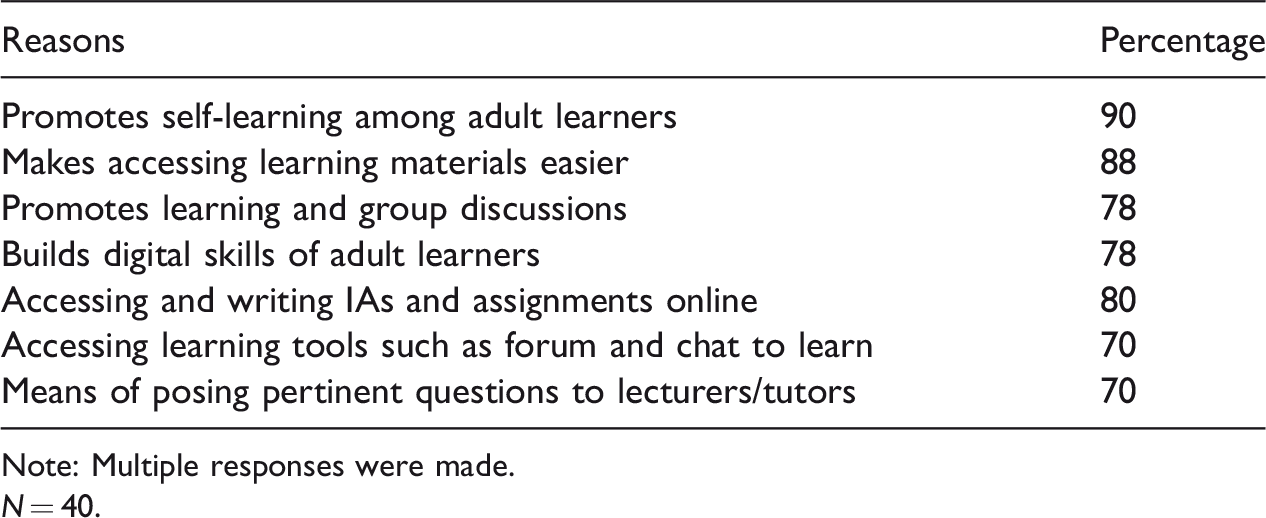
Eight participants, four males and four females, participated in the focus group discussions. Interaction I had with the participants revealed that they have used the Sakai LMS platforms variously, some four, three, two and less than a year depending on the number of years spent on the programmes they are pursuing. The participants admitted finding the platform useful and beneficial in their studies, including accessing learning/course materials easily and saving time as well. When participants were asked whether they will continue to use the Sakai LMS platform in their studies, the majority (80%) of the participants responded ‘yes’. The reasons given by the participants for the continuous use of the Sakai LMS are presented in Table 1.
Reasons for the continuous use of Sakai LMS for learning.
Note: Multiple responses were made.
N = 40.
In fact, it is not surprising to learn that the majority of the participants stressed on self-learning (90%) as the key benefit derived from learning with the Sakai LMS platform by the DE mode of learning. Self-learning is today massively promoted by the ICT teaching and learning tools and software, including the Sakai LMS platform. UNESCO (2015) opines that relevant competencies are developed through self-learning. Hence, today’s adult learners’ competencies, be it in classroom, workplace or community could be developed through relentless and regular learning with the Sakai LMS platform.
Participants further emphasised on the other benefits they derived from the use of the Sakai LMS platform, including easy accessing of learning materials (88%) and writing of IAs and assignments online (80%). Many other benefits gained from the use of Sakai LMS platform are vividly captured in Table 1.
Some of the participants also expressed the benefits derived from the Sakai LMS platform in these apt ways: ‘I will continue to use this learning platform because I have become used to it, though it was difficult using it from the start due to inexperience in usage’ (p. 1). Yes, I will continue to use the Sakai LMS platform because it gives me the opportunity to chat with colleagues students. I download my notes and course materials from the Sakai LMS platform, and above all, writes my interim assessments (IAs) online the learning platform. (p. 2) ‘I can go on the Sakai LMS platform to get information from the lecturers/examiners, and also engage in group discussions.’ (p. 3). ‘I have gained experience on how to retrieve information from the learning tools, including resources and assignments tools. Indeed, learning with the Sakai LMS platform has become more exciting.’ (p. 4). The participants engaged in the focus group discussions revealed that, even at home, they can access learning/course materials, access information, assignments and deadlines, and send completed work back to examiners anywhere at any time provided that you have access to a computer connected to an Internet facility or a smartphone with Internet facility. Key words which kept recurring from participants’ responses on the reasons why they will continue to use the Sakai LMS include: ‘Easy, fast and convenient, saves time, accessibility, and skilful.’
Challenges adult learners faced using Sakai LMS for learning
On whether participants encountered problems using the Sakai LMS in their studies, they responded in the affirmative. Network issues or failures and late uploading of course materials came up frequently. They indicated that it is sometimes difficult to access course materials online, either because the network freezes, weak link or poor connectivity or interface, slow or power fluctuations. They admitted, however, that some of the problems emanated from their end because, they get too busy at workplace, hardly finding time to actively engage with their course examiners and tutors online.
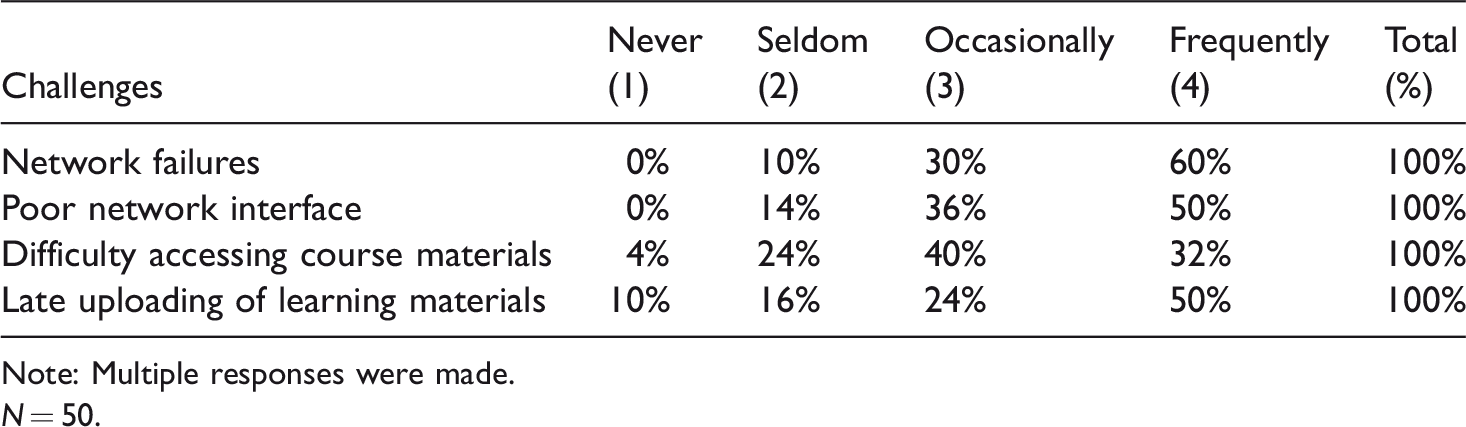
Participants were asked to categorise the seriousness of challenges faced, from lower level of 1 to higher level of 4, in using the Sakai LMS platform. Table 2 presents the results provided by the participants.
Categorising the challenges faced by adult learners while using Sakai LMS.
Note: Multiple responses were made.
N = 50.
Interaction the researcher had with the focus group discussants brought to light that network failures/problems/challenges (60%) as a result of weak link of Internet facility revealed by participants in the interview were frequent. This finding is supported by Carlsen et al. (2016) that lack of connection to the Internet still seems to exclude adult learners from DE. Indeed, difficulties with network connections, as observed by Carlsen et al. (2016) is one of the major perceived barriers to access higher education as an adult learner. This problem is an obvious one as stated by the participants, especially, at ALC. To the participants, sometimes, it becomes difficult to send or access/receive learning materials in the face of network failures.
Poor network interface (50%) and late uploading of learning materials (50%) were also found as other challenges frequently faced by adult learners learning with the Sakai LMS platform. The participants engaged in the focus group discussions revealed that sometimes, some of the questions uploaded online to contend with were incomplete, not properly organised and also not well thought out. Some of the participants expressed as follows: ‘Some of the learning materials are uploaded late, and that in itself is not helping us in our independent studies’. ‘Sometimes the lecturers will come online to have discussions with us, and when you log in, the system will tell you not available. This is very disturbing problem which confronts us often’. ‘Network issues which confront us are too legion and common, especially when we are taking test and quizzes online’.
The late upload of learning materials was equally revealed by the participants interviewed (50%). The focus group discussants added that some of the learning/course materials are not reviewed regularly to meet the changing times and indicated that the interface was not smooth, in the sense that there is no opportunity for self-correction. Thus, as soon as one presses the send key, it is sent and there is no room for correction. This problem, I think, is one of the challenges technologies sometimes pose to the users. However, Parkay (2013) observes that, as experiential learners, today’s young adults who learn by discovery would have to sufficiently read through their work well before sending it. Learners are informed beforehand that messages once sent cannot be retrieved (Floyd, 2014).
When participants were asked as to whether the problems identified have an effect on their learning, they responded in unison. They added that, it sometimes affects their performance in IA, especially when the network freezes or slows down. One participant expressed: ‘Sometimes, I encounter difficulties sending a completed work during the IAs sessions. Sometimes, too, it becomes difficult for me to self-correct my work once I pressed on the sent key’ (p. 5).
This observation made was amply supported by the participants in the focus group discussions. The participants admitted that this challenge, in particular, largely affects their final grades in the IAs. But as social-media-savvy learners, and young adults for that matter, one would have thought that the participants would have taken the trouble to go over their completed work to effect every correction before pressing the send key, but in this situation, the reverse was witnessed.
Strategies to improve the use of Sakai LMS platform
As to the strategies for ensuring a smooth running of the Sakai LMS platform, the participants provided various strategies, including stronger signal network, and a stable and reliable Internet facility. When participants were asked to rank the strategies to improve on the usage of the Sakai LMS platform, a number of ideas and strategies were provided as presented in Table 3.
Ranking strategies to improve usage of the Sakai LMS platform.

Note: Multiple responses were provided.
N = 50.
As shown in Table 3, the participants were of the view that the SCDE should look for stronger signal network (90%) in powering the Sakai LMS platform. They also said that if the system could be configured to have a smooth interface (88%) in usage, it will aid them to self-correct themselves whenever they make mistakes, especially during the IA sessions. Thus, they (88%) called for flexibility of the system to ease usage. This finding confirms Carlsen et al.’s (2016) assertion that DE is to provide flexible learning opportunities. If the Sakai LMS platform usage is made flexible, it will largely aid adult learners’ learning endeavours, and this is what SCDE is to be seen doing. This is one good way some of the participants summarised the strategies to be adopted to improve the usage of the Sakai LMS platform: The system needs to be updated again and again, because a lot of students continue to use the same network. I think there is too much pressure on the system so, therefore, the necessary arrangement has to be made to improve upon the Sakai LMS platform usage. (p. 6) ‘Upgrade the systems, make all information available, and send notifications’ (p. 7). ‘Upload all study materials before the commencement of the semester. Constantly be checking and maintaining the system during off and peak time (12 pm–4 pm) to help minimise sudden unavailability of the Sakai LMS platform’ (p. 8).
The name of the game is about stable Internet connectivity, to ensure smooth running of the DE programme at the Learning Centres. The upgrading of the system (as mentioned by 86% of the participants) every month to enable the participants undertake exercises anywhere would not be a bad strategy at all. This is one apt way a participant in the interview sessions put it: ‘The Sakai LMS platform should be developed in such a way that it allows students to write their IAs from any part of the country, Ghana’ (p. 5).
This strategy when adhered to by the School, to the participants, would make all the notifications, assignments and course materials easily accessible to them at the right time. This suggestion seems laudable because King (2017) opines that adult learning is the key to success in conquering the relentless wave of change. Moreover, the personnel, especially, the technical staff at the computer laboratories should be approachable and easily accessible to the adult learners to afford them the opportunity to use the Sakai LMS platform. This observation ties in well with Keillor and Littlefield’s (2012) assertion that adult learners’ readiness to learn also depends on organisers and technical people of a learning programme creating a culture of empathy, respect, approachability and authenticity. This, to the researcher, is critical in adult learning because adult learners are group of people from diverse backgrounds, with huge responsibilities, and must be respected so as to receive their attention in the learning settings.
During the interactions with the participants in the focus group discussions, they intimated that improved interface of the Sakai LMS platform and extension of IA time from one hour to one and half hours would help them in their IAs. This suggestion, they indicated, is borne out of the frequent freezing of the Sakai LMS platform, so as to enable them make up the lost time when they would be waiting for the system to boot or switch on.
Implications for adult education
The phase of teaching and learning, especially in the HEIs, is evolving following the advancement in ICT teaching and learning tools. This changing trend has implications for adult learning, especially learning by DE mode. Zawacki-Richter and Qayyum (2019) assert that since the mid-1990s, the digital transformation has changed the face of open and DE as we had known it. They added that in 1999, Alan Tait observed that ‘the secret garden of open and distance learning has become public, and many institutions are moving from single conventional mode activity to dual mode activity’ (p. 141) and Kearsley (1998) also claimed that ‘distance education has become mainstream’ (p. 1). Xiao (2018) adds that in the last 20 years DE has moved from the fringes into the centre of mainstream education provision.
It can be perceived from the assertions that the massive progress made, and being made in ICT teaching and learning tools, would continue to change the ways we teach and learn. Hence, the SCDE as a Coordinating Unit of University of Ghana DE programme has to be abreast with this progress and the related challenges and map up the appropriate strategies to address the difficulties facing adult learners on DE mode of learning. This preparation is important because in today’s digital age, preparing adult learners to utilise technology such as the Sakai LMS for learning in a non-threatening context such as ALC, possesses huge potential in aiding them to succeed in their lifelong learning drive. This could serve as one of the best approaches of fostering positive attitudes in adult learners towards technology usage and learning.
Indeed, many single mode universities in Ghana, including University of Ghana, have become dual mode universities to increase the human capital based in Ghana. The major route, however, to undertake this important work is by the DE mode of learning using the digital teaching and platform such as the Sakai LMS platform. This is significant because King (2017) has made us understand that ‘adult learning has become essential in the digital age, yet it seems to be one of the best kept secret’ (p. 15). King adds that it is very hard to succeed in the digital age without the foundational skills of technology use, self-discipline, time management, organisation, confidence, exploration and global citizenry. In this context, then, all the needs and concerns of adult learners, especially with the use of the Sakai LMS platform, have to be addressed by SCDE to enable them learn seamlessly and achieve their academic goals. When this is done, Adult Education then would no longer remain marginalised and be a ‘poor cousin’ of general or compulsory education as observed by Findsen (2014), but would be placed at the centre and mainstream of education.
As the adult learners have indicated how beneficial the Sakai LMS platform has been to them, every effort has to be made by the SCDE and the Learning Centres to keep the state-of-the-art learning technology in good shape to entice adult learners to continue to use it in their studies. That also means that the Internet connectivity and intermittent provision of power/electricity situation are addressed permanently through the effective maintenance of the installed generating sets in the Learning Centres. Since Adult Education is today perceived in lifelong learning perspective, the School and Learning Centres should regularly put in place programmes of re-orientation for adult learners on the effective usage of the Sakai LMS platform to acquire all the relevant digital literacy skills for relevance not only at learning centres, but also at workplaces and for communities.
Limitations of the study
The researcher faced some limitations in the course of the study; although the study is of a descriptive interpretivist qualitative case study type, it is restricted to ALC, University of Ghana. For this very reason, the findings of this important study cannot be generalised. Moreover, the software, the Sakai LMS platform used to power DE at the University of Ghana, is different from the software used by other Universities in Ghana to power the DE mode of tutoring and learning. There was difficulty, even as probing questions were posed to participants, to ascertain some important information to enrich the findings of the study. This is because, the researcher observed that the participants, along the line of the interviewing, were reticent in coming up with the full experiences they have had in using the Sakai LMS platform. It is the view of researcher that if the participant had fully opened up to the questions, the findings of the study would have been much richer and thicker than the present report.
Conclusions
The paper attempts to examine the adult learners’ experiences of using Sakai LMS at the learning centres in Ghana. The study essentially sought to understand how adult learners are benefited by using Sakai LMS for their learning. It also solicited the challenges faced by adult learners in using Sakai LMS and suggested strategies adult learners could adopt to improve utilising the Sakai LMS platform. The findings indicate that adult learners use the Sakai LMS platform for their studies, in spite of having initial challenges in the usage due to inexperience. They again added that they were benefited by using the Sakai LMS platform because of its easy access to course/learning materials, increased interaction with course examiners, tutors and colleagues. It also facilitated independent learning and research.
The participants however indicated that the usage of the Sakai LMS platform is fraught with challenges, including weak and poor Internet connectivity, intermittent power/electricity, and poor interface of the Sakai LMS platform. The findings require that the management of SCDE and coordinators of UGLCs regularly orient adult learners to continuously use the platform for learning. Indeed, successive use of the Sakai LMS platform would help adult learners progress to become digitally literate in their lifelong, life wide and life deep learning drive.
In conclusion, the researcher is of the firm view that today’s global information age – powered by improved teaching and learning technological tools, including the Sakai LMS platform – has made learning become ubiquitous, and could be done anywhere, anytime at the learner’s own pace and convenience. Therefore, if the ICT laboratories are refurbished and installed with new computer accessories, it will afford adult learners to have an increased access to the Sakai LMS platform for learning. Hence, the continuous usage of Sakai LMS platform by adult learners could serve as an appropriate platform to develop their self-directed learning skills, so as to become more useful and relevant in today’s competitive work environment.
Footnotes
Declaration of conflicting interests
The author(s) declared no potential conflicts of interest with respect to the research, authorship, and/or publication of this article.
Funding
The author(s) received no financial support for the research, authorship, and/or publication of this article.
