



Abstract
Computational design affords agency: the ability to orchestrate the material, spatial, and technical architectural system. In this specific case, it occurs through enhanced, authored means to facilitate making and performance—typically driven by concerns of structural optimization, material use, and responsivity to environmental factors—of an atmospheric rather than social nature. At issue is the positioning of this particular manner of agency solely with the architect auteur. This abruptly halts—at the moment in which fabrication commences—the ability to amend, redefine, or newly introduce fundamentally transformational constituents and their interrelationships and, most importantly, to explore the possibility for extraordinary outcomes. When the architecture becomes a functional, social, and cultural entity, in the hands of the idealized abled-bodied user, agency—especially for one of an otherly body or mind—is long gone. Even an empathetic auteur may not be able to access the motivations of the differently-abled body and neuro-divergent mind, effectively locking the constraints of the design process, which creates an exclusionary system to those beyond the purview of said auteur. It can therefore be deduced that the mechanisms or authors of a conventional computational design process cannot eradicate the exclusionary reality of an architectural system. Agency is critical, yet a more expansive terminology for agent and agency is needed. The burden to conceive of capacities that will always be highly temporal, social, unpredictable, and purposefully unknown must be shifted far from the scope of the traditional directors of the architectural system. Agency, and who it is conferred upon, must function in a manner that dissolves the distinctions between the design, the action of designing, the author of design, and those subjected to it.
Keywords
Introduction
The comprehension of architecture commonly takes place through a shared understanding of key symbols. These cues, disseminated in the field of architecture through standardized curricula, are discerned through collective cultural experiences. Within both architectural pedagogy and practice, the field of computational design specializes on the interrogation of materiality and the machines of manufacture to generate architectural function and expression. However, in tailoring the systems of architecture this way, two problematic conditions arise. First, the outcome of the study between material behavior and calibrated fabrication is a system that has no projection beyond its very processes of formation. Second, when assessing external pressures as input to generating the architectural system, the quantification of such architectural performance explicitly states and caps its functionality. While the freedom afforded by computational design might imply an abstraction of use, its very methodology, often obsessively celebrated as the primary motivation, locks it in the same bindings of cultural architectural symbols: We’ve constrained literacy and intellectual thought to a particularized “domain of symbols”—to a particularized way of thinking, communicating, understanding, and arranging. And in doing this constraining, we exclude.
1
Empathy demands an ability to relate. Yet, this is problematic when one’s projection of their own knowledge does not map onto another. Empathy is local and situational not global and innate. There is no a priori foundation for empathy when someone has trodden alternative paths of culture and education. How can empathy serve as a bridge when there is no ability, nor should there be, to place one’s reality onto another? This is a key factor in the thinking of and processes for architectures that largely privilege the neurotypical and able-bodied over the neuro-divergent and differently-abled. The presence of a series of steps at an entryway may not mean much for one individual but may symbolize an impedance or even an insurmountable barrier for another. This only scratches the surface as it narrowly views shared access through the lens of physical ability—ignoring situations of cognitive, behavioral, emotional, social, and physiological difference. Computational design is emblematic of this issue in assuming the necessary constituents and conditions can be explicitly encoded as part of an a priori collection of processes: Disability creates theories of embodiment more complex than the ideology of ability allows, and these many embodiments are each crucial to the understanding of humanity and its variations, whether physical, mental, social, or historical . . . Constructions are built with certain social bodies in mind, and when a different body appears, the lack of fit reveals the ideology of ability controlling the space.
2
What computational design does afford is agency: the ability to orchestrate the architectural system. In this specific case, it occurs through enhanced, authored means to facilitate making and performance—typically driven by concerns of structural optimization, material use and responsivity to environmental factors—of an atmospheric rather than social nature. At issue is the positioning of this particular agency solely with the architect auteur. This abruptly halts—at the moment in which fabrication commences—the ability to amend, redefine, or newly introduce fundamentally transformational constituents and their interrelationships and, most importantly, to explore the possibility for extraordinary outcomes. When the architecture becomes a functional, social, and cultural entity, in the hands of the idealized abled-bodied user, agency—especially for one of an otherly body or mind—is long gone.
Even an empathetic auteur may not be able to access the motivations of the differently-abled body and neuro-divergent mind. This effectively locks the constraints of the design process, creating an exclusionary system to those beyond the purview of said auteur. It can therefore be deduced that the mechanisms or authors of a conventional computational design process cannot eradicate the exclusionary reality of an architectural system. Agency is critical, yet a more expansive terminology for agent and agency is needed. The burden to conceive of capacities that will always be highly temporal, social, unpredictable, and purposefully unknown must be shifted far from the scope of the traditional directors of the architectural system. Agency, and who it is conferred upon, must function in a manner that dissolves the distinctions between the design, the action of designing, the author of design, and those subjected to it: The social body is the standard—presupposed but invisible—until a nonstandard body makes an appearance. Then the standard becomes immediately apparent, as the inflexible structures of furniture, rooms, and streets reveal their intolerance for anyone unlike the people for whom they were built.
2
Computational design of “n” agency
The relevance of the tenets of computational design must be questioned. The challenge is in both approach and purpose—how one conceives of a design space that integrates material, fabrication, and performance, and how the purpose of the outcome is defined as an effective architectural system. How are these principles and procedures adapted, augmented, or discarded in order for disability and the differently-abled bodymind to function as an autonomous self-organizing, intentional agent?
Of first concern is to identify the ableism that exists in design practice, which produces the symbolism that marks disability—doing so as a binary to ability. Computational design does not explicitly subscribe to architecture as a kit of symbols. It produces architectural form through its material-first approach. Although, the traditional symbols that implicate disability may not emerge through this approach, the narrowly defined concern of materiality is largely ignorant of any specificity let alone being responsive to differentiation of bodyminds.
Second, to recognize this social form of differentiation is to embrace unknowingness as a constant. This sits uncomfortably within the taut frameworks of the conventionally authored computational design processes, whose primary intent is to unravel complexity, as a means to decipher and ultimately control initially mysterious relationships of material and environment. Such a narrow view is similarly held by the ego that would prescribe an abled vision to a differently-abled existence. As a result, the imbalance between (1) the specificity of architectural form, (2) the unknowingness of its adaptability, and (3) the specificity of individual motivations, abled, differently-abled, or otherwise, can only be resolved within the architectural system. To resolve unknowingness is to simply shift the ascription of purpose—one layer of design agency—onto an otherly character and their own expertise.
Finally, if the material-first architectural system can shift the point at which its social functionality emerges, then its symbolism can be more readily understood as a tool for shaping communication. As opposed to simply accommodating an otherly presence—which constitutes the low-hanging fruit of empathy—another layer of agency facilitates an equitable exchange between bodymind and architecture for generating a specific novel contribution. The biggest challenge for the computational process is to accommodate placeholders—positioning variables that lie between a certain level of material organization and a specific instance of spatial description. For this is a malleable architecture still computed by its material logics but transformable via n number of agents and their otherly motivations (Figure 1). To respect these motivations is to not predict or expect, but to simply allow them to be part of a creative and generative computational framework.

SensoryPlayscape installation at Taubman College of Architecture and Urban Planning, Ann Arbor, Michigan, April 2018 (Photo by Sean Ahlquist – University of Michigan).
The differently-abled body in architectural space
. . . [when asked] if people in wheelchairs could drag themselves up the [hiking] trail, why could they not drag themselves up the steps into the hut? Gravink [leading a group of hikers in wheelchairs and on crutches] responded, “Why bother putting steps on the hut at all? Why not drag yourself in through the window?” . . . It is taken for granted that nondisabled people may choose when to be able bodied.
2
Tobin Siebers uses the above anecdote to illustrate the fine distinction between the body’s relationships to technology—in this case, a ramp or a set of stairs—and the social constructs that determine abled versus disabled in reference to those technologies. 2 One is still deemed “abled,” in this example, though still requiring stairs as a means for access. Qualifying the stair and the ramp as technologies that are designed to augment movement offers an opportunity to contest the notion of the preferred body—a symbol achieved by “number and averaging rather than individualism” such as with Le Corbusier’s Modulor—which leaves no parameters for those in the margins other than being generically bundled as outliers.
Rhetorical theory emerged as an interest in “language and how it functioned—at a microlevel to create or dispel misunderstandings, to adapt arguments to particular audiences, to create the possibility for reason in society, and to understand systems of discourse that implicitly structure societies.”
3
Its framework binds (1) the agent and their available agency, (2) an audience and their projected social constraints, (3) the communication and symbols of a particular urgency or situation, and (4) the cultural context in which it plays out.
3
In Thomas Rickert’s Ambient Rhetoric, he argues the theories of communication must “diffuse outward to include the material environment, thing (including the technological), our own embodiment, and a complex understanding of ecological relationality as participating in rhetorical practices.”
4
The construction and expression of agency is as much environmental as it is interpersonal exchange: . . . we have to understand the way in which this ensemble of elements [being emergent from and wedded to the world] is given so as to affect or transform how we inhabit that space. The individuation of each element takes its bearing from the larger whole. Yet each finds it place within that whole, there is sense in fittingness stemming from this
Symbols forming exclusion
“To be welcomed is to be positioned as the one who is not at home.”
5
An ecology that influences human agency speaks directly toward inclusion—equalizing opportunities across ranges of ability, physical and cognitive. Often, concepts for inclusion are muddied by the demarcation between those who need welcoming and those who are doing the welcoming. In “welcoming,” those with agency provide the mechanisms by which they believe “welcoming” can best take place. In this logic, as Margaret Price indicates the problematic nature of this hierarchy: “representations of diversity (or inclusivity) can be folded into existing institutional norms without changing the institutions themselves.” 6 The actions of those being welcomed are regurgitative as opposed to generative.
Inclusion, as an architectural and social concept about space, resonates within the processes of design. But a rhetoric that is unfettered by the translation of the abled standard can only emerge when the differently-abled body-mind can forge its own position and perspective. The most minimal of standards for accessibility—the handicap ramp—is symbolized in the explicit blue signage, the angles of surfaces, and positioning of railings. In a social context, these are signifiers where an occupant of this object, who is within an assistive device, is characterized as being physically disabled. But what of the parent with a baby in a stroller who will occupy this same space? Nobody assumes a condition of disability when they are using the handicap ramp. Yet equally to either party, a set of stairs states exclusion in terms of basic access. The ramp’s institutionalized symbolism projects discrimination between the abled and the disabled body. Alternatively by respecting individual motivations, there is the capacity to discern a common goal for access.
At the same time, there is a realization that access is of both a physical and social nature, whose social ramifications are only discernable on a longer timetable than the snapshot of the handicap ramp affords. Extending beyond the default implication of the ramp as a characterization of physical ability, the experiences in public environments with my daughter, who has autism spectrum disorder and is non-verbal, exemplify the problematic miscommunication of these symbols, formed to distinguish abled from disabled, in a social context. My 10-year-old daughter utilizes an assistive stroller, though not being classified as physically disabled despite having challenges with muscle tone and endurance. For her purposes, the stroller—a piece of technology—is utilized as a security blanket to combat complexities that arise in public, social settings, and the ensuing social anxiety and stress. From her perspective, it serves as a manner of movement that is predictable in pace, and in knowing that, it affords a certain physical buffer or dimensional offset from the occupants and activities of the environment around her. As perceived by others, it signifies a caution that tempers one’s approach and, thus, helps to soften the chaos of an environment where unpredictability can be quickly overwhelming.
In this anecdote, the stroller takes on a critical shift from being relevant as means for physical access to being an interpersonal agent as part of an attempt to enable social inclusion. The wheelchair on the ramp globally communicates access to something beyond it. The stroller, to my daughter, only becomes relevant in a far more specific scenario. The success of the stroller, as a tool for social agency, is only judged in the context of others and its facilitation of a social response. The function of the stroller is activated only in the moments of reciprocation. Unlike the handicap access ramp, the activation and layers of communication emanating to and from the stroller do not guarantee a specific, predictable, or successful outcome. As a material system, its symbolism speaks nothing of social agency, and its efficacy is entrenched in an other’s ability to respond to my daughter’s orchestration of the stroller as part of a complex, temporal spatial system.
The conflict to address arises from the novel manner in which a symbol often construed for disability can be used to facilitate social opportunity (Figure 2). The assistive stroller has only little to do with physical ability. Rather, it is necessary for an individual who struggles against the conventions of social function via her neurological differences. The stroller is part of an intricate and specialized language authored by my daughter, yet largely foreign—if not counter-productive—to the people in which she is trying to communicate and socialize. Further confusion ensues when she leaves the stroller and exhibits physical ability with ease. Is the caution shown toward a child, who requires special accommodation based on physiological needs, revoked when she jumps from the stroller? If we deny the stroller and suggest a manner of function that is more “neurotypical” and socially expected, then we effectively eliminate part of her vocabulary.

Self-portrait by artist Neil Marcus, emblematic of the creative struggle to “occupy disability.” 7
Premise for spaces of computational design
The stroller provides an example of Rickert’s ambient rhetoric where the discourse is only meaningful once enmeshed within the material world. There is the unfortunate symbolism of the stroller that competes against the intended discourse, but the ingenious nature of its multifaceted function, as it is concocted by my daughter, is still revealed through different moments and metered degrees of social reciprocation.
Communication is, thus, born of interaction between material, technology, and social agency. But there is often a perception of fixedness in the architectural systems that shape environment. Human agency is the variable that adapts to a discreet physical world. Variation in meanings and discourse are levied by the subject’s interpretation of environmental factors, ones that are largely deemed immutable. But, Rickert asks: “to what extent can we discuss materiality prior to meaning or symbolicity?”
4
To allow the stroller to best function, its symbolism as a signifier of physical disability should be withheld, and the occupant, my daughter, be ceded the agency to indicate its true projection of meaning as social mediator. This potential toward allowing agency to operate in a self-organizing fashion without a priori influence or expectation does exist within the framework of computational design: If we accept that disability is an emergent phenomenon (essentially unpredictable), one that materializes through the intra-actions of people, attitudes, histories, objects, and other ambient features of a space, how do we design for disabled bodyminds?
6
Agency is often seen as an attribute of the design. But agency is performative, and more appropriately aligns with the process of design and as a capacity of the design-er. The degree of performativity is best rated by the exhaustiveness of technical tools—analytical, experimental, algorithmic, generative, procedural, or otherwise. Enacting that agency is often termed form-finding. Form-finding is a state of equilibrium only realized from the feedback between a set of individual conditions. Yet, problematically, this orchestration of a set of material conditions is an agency afforded solely to the designer and their motivations for a highly intentional expression of architectural form. Despite these explicit material intentions, there are unintended consequences as the “object, whatever we design it to do, it always exceeds such assignments” which is what Rickert refers to as “blowback.” Where the material intentions are to create nothing but “blowback,” then the assistive stroller, for instance, thrives as a technology for social mediation. In such a situation, there is a clear performative agency on behalf of an agent that is not the designer: The center of a discourse can be fluid. Fluidity comes after we understand how we are the center of our own experiences. Being aware of this allows us to become comfortable in spaces where we are not the center but acknowledge that we have a relationship to it.
8
An instance of agency, among many possibilities, can be described as the self-motivated effort to explore and attain a situational equilibrium. This still encompasses the designer’s goal to pursue the more conventional description of stasis purely as a material organization. But it also enables n number of design agents to be active in the material organization and have authorship over the “blowback.” Margaret Price elaborates such agency as “an enactment, something that arises through various cuts in matter and spacetime.” 6 Thus, two individuals may be positioned within the same physical space, but their inhabitation, via their own construction and conception of agency, can be vastly different. Blowback then becomes communication as it unfurls meaning in a highly temporal and inter-relational manner, dismissing the stereotypical fixedness of the imposed environment. A process for computing instances of a material organization is synonymous if not indistinguishable from processes of spatial and social conditions that emerge from within. The goal of the architectural system is to participate in the action of agency, while the individual agent constructs a particular outcome through such agency.
Interstitial conditions
J Scott Turner describes one of the key components of evolutionary developmental biology and the “design” of living things as the Bernard machine—“an agent of homeostasis that builds a new environment and imposes homeostasis on it.” 9 As an example, Turner describes how the cells producing connective tissue across sharks, gorillas, and humans are generally similar. It is the environment, but more importantly, the strains caused by movement through specific environments that dictate how the connective tissue will uniquely form, organize, degenerate, and remodel in each species. There is a requirement for a terrain, but the Bernard machine need not be pre-programmed with knowledge of any particular terrain. Healing a broken bone requires the application of mechanical forces that the specific terrain will provoke to signal and localize calcium formation as well as orient the generation of new bone tissue in response to the imposed stresses. The Bernard Machine exemplifies the placeholder—generalizable biological processes that require a specific environmental input in order to activate. In addition, a subsequent on-going mediation takes place to maintain an effective level of equilibrium, as both placeholder and environmental input continue to fluctuate in response to each other. The Bernard machine responds to shifting environmental conditions without needing the memory of any particular goal.
To shift computational design, away from its typical internally housed goal-directedness, requires the placeholder—what will be referred to as interstitial conditions. This interjects a set of internally “designed” mechanisms whose activation occurs under external inputs and creates the opportunity for an initially unknown equilibrium to be discovered. While this may appear synonymous with the paradigm of form-finding, the use of the term interstitial is critical. It is a set of material-dependent processes sitting strategically in between multiple agencies of design and forming a larger matrix of processes. The greater scope enables a reciprocal agency between the design and all its participants. This establishes a capacity to respect that “disability is an emergent phenomenon” and view moments of equilibrium as discoveries that are instances of a design. The interstitial conditions are the confluence of the architect-designer’s agency of algorithms and machines of manufacture, and the socio-spatial-designer’s agency imposing the bodymind as a transformative, communicative organism (Figure 3).
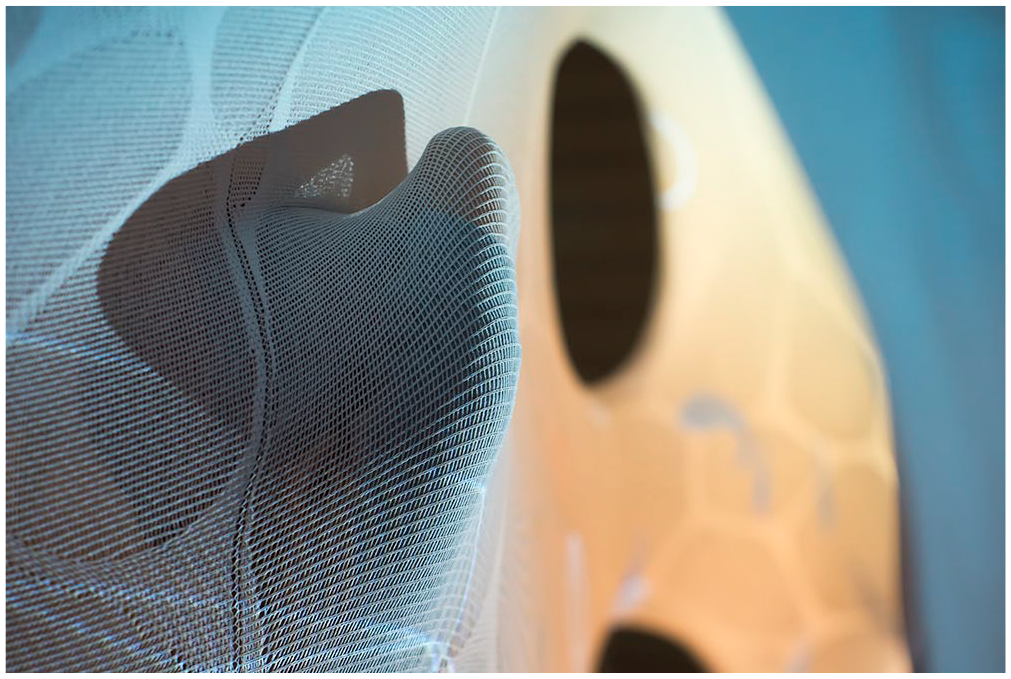
Textile-hybrid SensoryPlayscape field study, Columbus, Indiana, April 2019 (Photo by Sean Ahlquist – University of Michigan).
Materiality of otherly motivations
The design goal is nearly always underspecified and the “controller” is no longer the authoritarian apparatus which this purely technical name commonly brings to mind. In contrast the controller is an odd mixture of catalyst, crutch, memory and arbiter. These, I believe, are the dispositions a designer should bring to bear upon his work (when he professionally plays the part of a controller) and these are the qualities he should embed in the systems (control systems) which he designs.
10
Cybernetic theory—in simple terms, the mutual compatibility of man and machine within a continuous feedback loop—runs akin to the Bernard machine as a theory for self-organizing and self-correcting systems. The Bernard machine is concerned mainly with physiology. Cybernetics, however, operates in the realm of psychology and philosophy, redefining communication from behavioral learning through stimulus/response to the “mechanistic language of input/output,” following on the model of Ludwig von Bertalanffy’s General System Theory. 11
The work of Gordon Pask, a British cybertician, provides a material view of cybernetics that integrates with, rather than distinguishes from, the physiological regulation of the Bernard machine. A tinkerer constructing electronic devices to express cybernetic theory as a practice of art, architecture, and theater, Pask’s relevance is his desire to envision the man–machine relationship as a dialogue for constructing new knowledge, as opposed to the more de-humanized view of machines exerting knowledge. This is best expressed in Pask’s Musicolour device. Designed for the theatrical stage, sonic frequencies of a musical performance are converted into electrical impulses used to drive lighting displays. Of importance is the device’s ability to recognize patterns. Upon hitting a threshold for the number of occurrences of a particular pattern, the system would become “bored.” Over time, the subsequent visual output would be increasingly deadened in order to counteract, if not communicate, the degree of repetition of the particular patterns of sound. The parameters of the interstitial conditions were “designed to vary unpredictably in time, and thus to be [initially] opaque and inscrutable to the musical performer.” 12
Like an architecture defined as performative, Musicolour requires an environmental input to continually activate, construct, and reshape environment. How this differs—acting as a hybrid of the Bernard and cybernetic machines—is the collective integration of (1) an expertise and (2) the necessity for exploration which (3) becomes a new condition that is neither exclusively architectural nor musical. It is only over time that the performative nature of environment shifts from a state of initial exploration, of how the device responds to the actions of the conductor and orchestra—to a position of understanding and control. Pask softens the term control, envisioning it more appropriately as an effort of coming to terms with the feedback device.
What is valuable in Pask’s prototype is the individualized relationship between the conductor of the soundscape and the shifts between exploration and composed expression of a material environment. As this takes place on an indeterminate timeline and with the interstitial variable for becoming “bored,” the repetitive fixity, that is, prediction, of the material environment is prevented. One cannot form expectations, therefore cannot carry a history of a goal-oriented nature. This helps to advance the concept of performative, not only as a reflexive condition—things acting upon each other with the ability to express indeterminate patterns—but also as an engine for constructing new knowledge as a hybrid of dissimilar motivations. This requires a delicate balance between a closer examination of the agency that activates the material device, and avoidance of a predictive logic so as to generalize said agency (Figure 4).
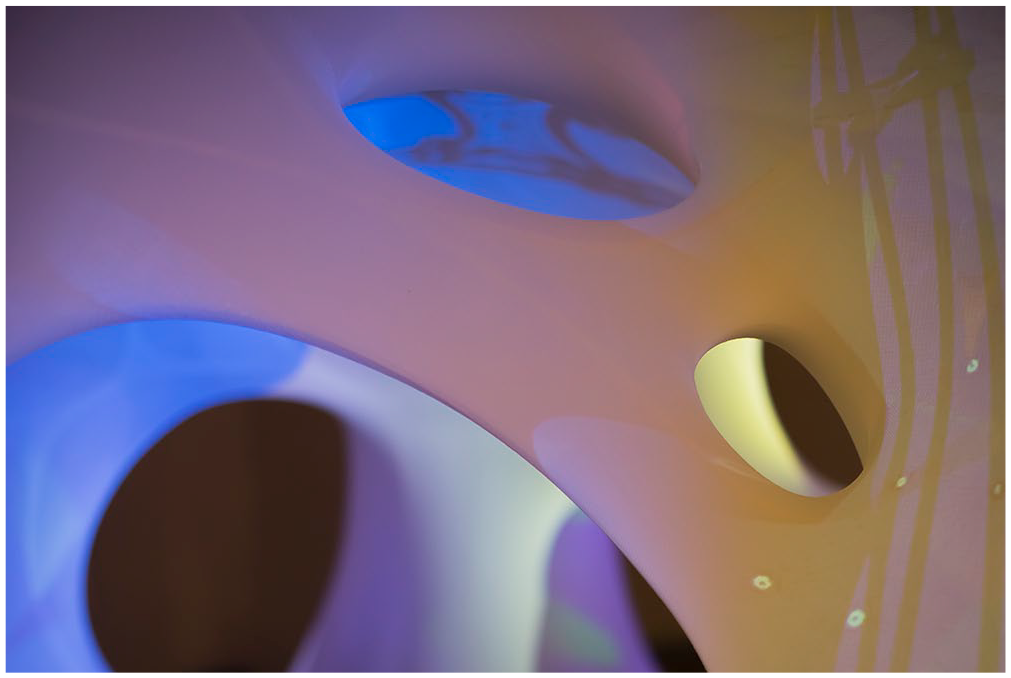
Textile-hybrid SensoryPlayscape installation, TechTwilight exhibition at the HandsOn museum, Ann Arbor, Michigan, November 2019 (Photo by Sean Ahlquist – University of Michigan).
Bi-directional expansion of computational design
In Systems Generating Systems, Christopher Alexander outlines the translation of Bertalanffy’s General System Theory into a design context. In particular, he separates the system as a whole—as an individual viewpoint on a holistic behavior—from the generating system—as a kits of parts and combinatory rules. 13 The distinction is critical as examining only the individual contents of the generating system will fail to elicit any understanding of how the system as a whole behaves. To decipher the relationship of parts, associations, and behavior, Alexander positions the designer as both the constructor of content and rules and the observer of emergent behaviors.
This provides a valuable framework to discern the relationship between affects and underlying rule-sets, enabling the fundamental process by which form-finding takes place. Yet, design necessitates a will to magnify or mute particular behaviors of the system given other programmatic or contextual constraints. This is another example of a design agency that exacerbates a self-satisfying circular logic. Equilibrium only occurs through the explicit calibrations set by the designer’s motivations, ones formed by their interpretations of the system as a whole. This can be extrapolated from Alexander’s example centered on a candle’s flame as “generated by chemical processes which are the same as those processes which then maintain the system’s equilibrium and make up the interacting parts, when we view the flame as a holistic system.”
13
The flame is positioned as an isolated equilibrium in what is an incredibly complex set of atmospheric and chemical processes. To eradicate the designer-centric viewpoint of flame as the sole behavior of concern is to expand the dual logic of Alexander’s approach. Of the generating system: to consider the physical actions along with behavioral motivations for ignition and dousing of the flame. Of the system as a whole: to consider the qualities of the illumination emanating from the flame, in its degrees of flickering as it responds to inconsistencies in the surrounding atmosphere, and its transformation of the socio-spatial condition: In place of the homeostat’s finite number of states, the human part of a Musicolour performance could explore the space of performative possibilities of the machine in a truly open-ended fashion, and the only criterion of stability was itself a locally emergent one, not given in advance; it was just whatever pleased the performer and the audience on some occasion.
12
Andrew Pickering, an author in the field of science and technology studies, cites Musicolour as a “decentered joint performance of the human and the nonhuman” that exemplifies the performative idiom for science.
12
When folding the role of human agency into the performative idiom, science intertwines the effects of knowledge with the processes for constructing knowledge. Pickering calls this the dance of agency: In shifting the focus from system equilibrium to celebrating the “dance of agency,” edification—the traverse of agents through countless disruptions, states and reconfigurations—blankets process, mechanism and the design itself. Any perturbation is an action of design sparking an array of observational effects, and the choice of a particular station—point—a motivation—to observe and meter specific effects in preparation for a response.
14
Returning to the language of computational design, the “traverse of agents” is an expansion of design space. The two axes of a virtual design space are traditionally demarcated by (1) a set of geometric primitives imposed upon by (2) a set of transformational constraints—often of a material, manufacturing, spatial, or environmental nature. Using D’Arcy Thompson’s analogy of the glass-blower: the design space of glass-forming is bounded by the shape of a simple tube and the application of unequal heating and cooling. 15 A particular set of geometric manipulations on a single tube defines a design instance within the matrix of possibilities. But, instead of the process being performative in the generation of a single instance, in examples such as Musicolour, the entire design space is performative. Process is not truncated at the derivation of one instance. This is a critical position for computational design to overcome a bounded design space and enable recognition of “disability as an emergent phenomenon.” Design space becomes democratized through shifting it from virtual to real.
Pickering offers a technical framework for the performative design space, staging an ability to expand autonomously, un-scripted by the traditional design-auteur, through individual agency. He refers to this framework as modeling—the open-ended activity of venturing through a design space with no advance determination of a destination. 16 Scientific knowledge is acquired for both the generating system and system as a whole, by moving from one instance to the next through an evolving design space.
Initially, a bridgehead is constructed which “tentatively fixes a vector of cultural extension to be explored.” This step of bridging is staged as an activity to unfurl a succeeding condition. Unlike the conventional design space, this means there is no one iteration in isolation. It is a staging with context that leads to a new iteration. As the new iteration is formed, a transcription takes place to impose the prior rules that existed at the moment of the bridgehead—arguably, a guess that drives initial exploration. Leading into a new iteration, an effort called filling takes place where new methods are improvised in response to the lack of “clear guidance from the base model.” This now encapsulates what computational design both does and does not do. Transcription is the “forced move” of embedded, fixed, and computed rules, while filling is the unencumbered move that explores interstitial conditions and sets the stage for a new bridgehead. 14
Statistician George EP Box’s tentative theory reframes modeling as the construction of knowledge through stages of “information gain” and “uncertainty reduction.” In the discrepancies from an initial exploration arises a new iteration and so continues the spiral for “unfolding new realizations.” Indicative of the shift from the representative to the performative idiom, the traverse of design space is not “by the undirected accumulation of practical facts, . . . but rather by a motivation iterating between theory and practice.” 17 This defines the indeterminacy of the boundaries of the design space, which is critical in activating unknown agencies a means to bring new realizations of the system as a whole to the fore.
Forming socio-spatial rhetoric
. . . we perceive actively, in engaged iterative feedback loops, with the environment. We often act in order to cognize and calibrate further action, based on the perception of our actions in the world. The schisms between logic and the natural world and logic of the engineered world reveal the Cartesianism inherent in the separation of materiality and abstraction—assumptions that, though commonplace, are fundamentally false. They have (and have had) broad and problematic ramifications when applied to human practices, particularly in the discussion of arts and cultural practices.
11
For individuals with autism spectrum disorder, environment can have a fluctuating influence. Often, the “medicalized” view sees only the debilitating impact of environment—subsequently classifying an entire population as “vulnerable.” Yet when considering the differential susceptibility hypothesis, sensitivity is not confined to only the negative effects of environment (Figure 6). In this instance, hyper-awareness may be a more appropriate term than vulnerability. Particular environmental factors may, of course, spur negative behavioral effects. However, these effects operate on a sliding scale, where other environmental conditions can provide exceptional behavioral influence and ultimately enhance or reinforce developmental outcomes (Figure 5). 18

Textile-hybrid SensoryPlayscape field study, Columbus, Indiana, April 2019 (Photo by Sean Ahlquist – University of Michigan).
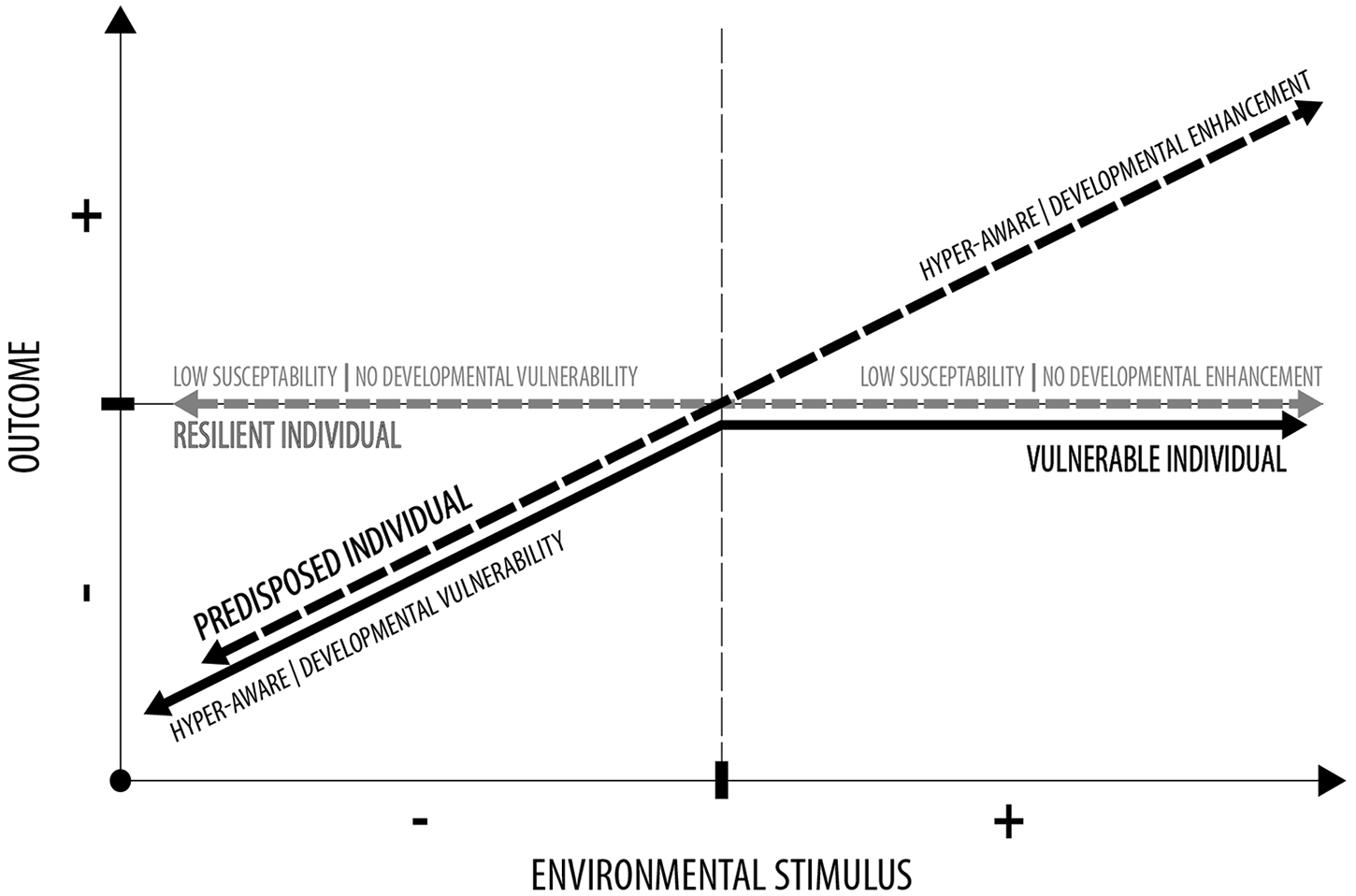
Differential susceptibility hypothesis showing the spectrum of behavioral influence for individual with predispositions to environmental effects, based on research of Ellis et al. 18
The common response to seeing environment only through the lens of an individual’s incompatibility is to mute—to sanitize and desensitize points of perceived over-stimulation. But, are we to generically assume an individual’s ideal performance results from a level of sensorial stimulation that is close to null—as opposed to attentiveness that is piqued by their environs? Differential susceptibility indicates that there is no link between intensity of stimulus and quality of outcome. Grand sensation does not predict intense overload. To mute, then, is to narrow the requisite variety by which environment can be trained toward the stimuli, of whatever intensity, that sits within an individual’s beneficial spectrum of sensation. Therefore, the critical factor is gradation. To offer a diversity of variants that address a diverse population requires a distinct individualized control to magnify desired parameters while muting detrimental ones. Predispositions are not only of concern for harm. They also exist as sources of preference, motivation, and as an expression of creativity: A behaving artwork is an agentic system that changes its nature and/or its expression in real time due to changes in its environment . . . It is artifact and pseudo-organism.
11
But gradation is not a simple slider. If we define agency as the ability to grade the nuances of environment, then this action becomes communication as part of a social activity. Where gradation accesses all means of verbal, physiological, and ad hoc situational communication, then environment plays the performative role that we are seeking the material system to provoke. Simon Penny juxtaposes the cultures of computation, via cybernetics and Pask for example, and art practices to form an understanding of “embodied art and cultural practices that recognize materially, socially and spatially situated intelligences.”
19
The key to embodiment—as a mutual construction of mind, body, and world—are forms of interaction that inherently cede (and seed) agency. For interaction to have this capacity, Penny offers the criteria for “(agent-like) behavior on both sides . . . [where] the design of sophisticated behavior necessarily precedes the design of interaction”: [T]he sequential organization of action is not formulaic outcome of abstract planning, but rather is an improvised, ad hoc accomplishment, a moment-by-moment response to immediate needs and the setting in which it takes place. The organization of action emerges within the frame of the action itself.
20
The critical part of this computational process is the step of filling. To what degree is a socio-material agency afforded in order to overcome whatever disparity arises? How does an architectural system, so often confined by a discreet collection of components both virtual and real and pre-assignment of function, adapt to the degree by which meaning and usage is mutable? For architecture and computational design to claim empathy, the discipline must be aware that this shortcoming is a consequence of process. A framework, where a design is the continuous activation of process, would define empathy as a measure of the ability to resolve the disparity between the motivations of social actors and transformability of material structure and spatial expression. As filling suggests, the material component requires the capacity to reshape its purpose, just as the social actor forms new trajectories of a multi-axial design space. The degree of performativity can be measured in the capacity to accomplish adaptation toward the unknown and precarious—in socio-material, spatial, and temporal relationships, which in cybernetic terms speaks to the Law of Requisite Variety. (As defined by the homeostatic machines of W Ross Ashby, this concept states that an adaptive system must contain as many combinatory possibilities so as to satisfy the wealth of inputs in the environment which it is positioned). 21
Parameters of socio-material sensation
Culture evolved out of natural opportunities. The cultural environment, however, is often divided into two parts, “material” culture and “non-material” culture. This is a seriously misleading distinction . . . Symbols [language and art, e.g.] are to be taken profoundly different from things [tools and shelter, e.g.]. But let us be clear about this. There have to be modes of stimulation, or ways of conveying information, for any individual to perceive anything, however abstract . . . All knowledge rests on sensitivity.
22
The most effective computational design methods are precise yet broad. They access material relationships across all scales and hierarchies, orchestrated with their associated non-standardized means of fabrication and assembly. From fiber make-up and chemical composition to articulation of a structured surface, this enables a greater number of architectural concepts, or requisite variety, to arise from a combination of willful and emergent material organizations (Figure 7). It is through this intensification of a material-centric view of computational design that a capacity to eschew architectural symbolism exists. This requires disrupting the preconceived expectations of material expression, form and purpose, in order for architectural meaning to more readily arise within the performative design space.

Pilot study of textile-hybrid SensoryPlayscape at the THINKERY children’s museum, Austin, Texas, June–December 2017 (Photo by Sean Ahlquist – University of Michigan).
Often, the orchestration of fabrication is applied to the manipulation of pre-manufactured materials (sheet materials, e.g.) or known compositions (concrete, e.g.). It follows the “kit of parts” approach through which non-standardized components—from materials of known commodity—and architectural assemblies emerge. The concern, though, is the baggage that such a priori material knowledge may encumber both expression and performativity. The initial bridgehead will quell the agency needed to shape the spatial system and unbiased social input required for in-situ reciprocal exploration: The tactual properties of our surroundings do not chatter at us like their colors, they remain mute until we make them speak.
23
Penny asserts that “perception is cognition, and that perception itself is an exercise of intelligence.” 19 Perception in terms of architectures via computational design would speak of surfaces, more specifically, the surfacing that washes across form and spatial descriptions. These qualities are inarguably a fixation of computation design. The articulation of surface detail is lauded as an explicit expression of the machinery through which materiality is born or manipulated. Despite the inherent condition implied by the tinkering with surface quality—tactility is largely ignored as anything but an ancillary fact as opposed to an inherent variable to be revealed through the computational design process. But when tactility—a property discerned through human agency—is submerged in the performative design space, materiality born of variable tactility becomes an architecture of true interaction. In Simon’s terms, it necessitates agency on both sides—the agency of material properties and the interventions that exercise such properties—as the only course to perceive and discern meaning from an otherwise unknown set of conditions and parties (Figure 8).
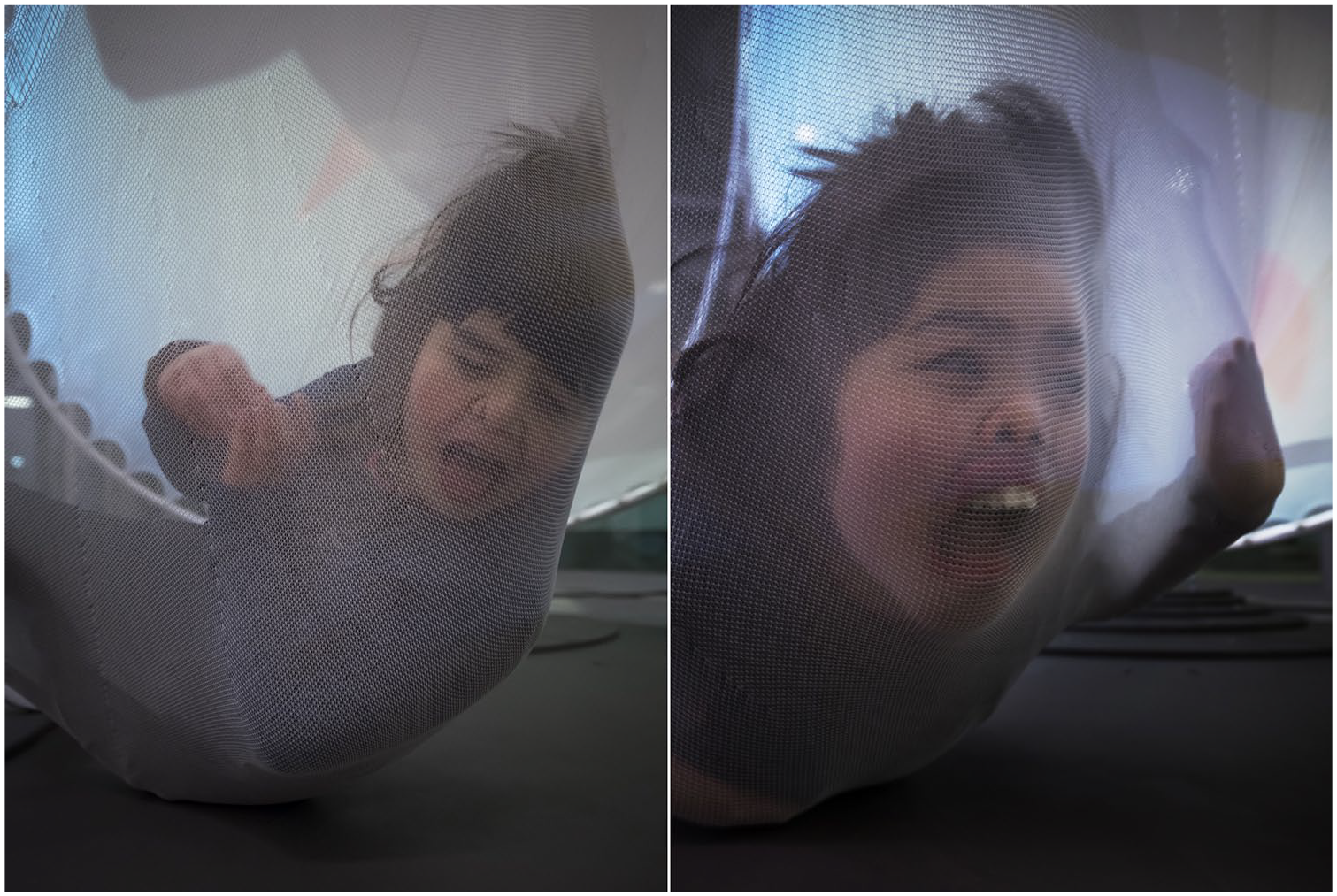
SensoryPlayscape installation at Taubman College of Architecture and Urban Planning, Ann Arbor, Michigan, April 2018 (Photo by Sean Ahlquist – University of Michigan).
David Katz in the early 1900s shaped psychological phenomenology as a discipline reliant on both theory and experiment to explain that “every part of (the human) process must be understood ultimately in terms of the total person.”
24
While contemporaries sought classification, Katz sought association: The classical psychologist was content to order colors in terms of hue, brightness, and saturation; Katz saw them also varying in mode of appearance, pronouncedness, insistence, transparency, inherence, and stability. Classical psychology was busily mapping the patterns of pressure, pain, warm, and cold spots on the skin, and searching for receptors; Katz went further, and explored the active process of “touching” (tasten), discovering here, too, modes of appearance, properties of organization, and unsuspected kinds of sensitivity.
24
Katz provides an example through which touch and environment become performative. Starting with a matchbox encased in cotton swabbing, a fluid shifting between senses of perception takes place to construct knowledge of the object’s properties. Tactually, an initial weight helps to form an understanding that something lies within the cotton mass, where the visual sense provides no such knowledge. As touch further engages, the shroud of swabbing effectively disappears from the tactual realm and the boundaries of the matchbox emerge. Katz uses this example to define volume touch—where perception can only be formed through action and through the compilation of multi-modal sensory data.
Expanding the performative nature of this scenario, beyond Katz’s detailing of volume touch, provides a valuable instance for distorting the perception of function and perverting expectations. A reverberation of sensation would be discerned in the rattling of the box—decoding the existence of matches within. Yet, the foreignness in juxtaposing these specific materials questions whether the expectation for being able to light a match is valid. To use the strike-surface would be to further explore the material system’s performative design space—setting a new vector regarding the otherly condition of igniting both match and cotton swabbing simultaneously. The pace of sliding the match along the strike-surface equates to the filling condition. This newly unencumbered move is necessary to discover the sliding match’s association with the cotton swabbing and their related possibility for ignition: In speaking, painting, sculpting, and writing, the human animal learned to make sources of stimulation for his fellows, and to stimulate himself in doing so.
22
James J Gibson, an American psychologist, shaped ecological psychology as a study of the interconnectedness of sensory feedback “as eyes on the head of the shoulders of the body” that is in active exchange with environment. 25 He challenged the oversimplification of the Latin meaning of stimulus—“a goad or sting—which implies, first, that a stimulus is imposed on a passive organism and, second, that it comes from the outside.” When thinking of how tactility becomes performative within the computational design space, Gibson provides a critical distinction between the actions that seek sensation and the processes that gather data about sensation.
We are concerned most with what Gibson defines as obtained stimulation. In contrast, imposed stimulation happens to the passive individual whose sensory organs are piqued by an external input. Obtained stimulation, however, is “produced by his own action or in the course of action . . . by moving the organs of the body that are called ‘motor’ and by moving the organs of the body that are called ‘sensory’.” 22 The motoric action of striking the match is registered internally in the distension of muscles via the movement of limbs and joints. The external sensation of heat is registered by the proximity to cutaneous neurotransmitters, seeking to discern the behavior of ignition of the match and cotton materials. This gives rise to a definition for sensorial agency—the capacity to enhance, exclude, orient, and adjust stimulation of the sensory organs in constructing a description of environment that includes the “attentive action and reactions” of the interactional participant.
Socio-sensorial architectures
[A]ll impressions on the hard-soft dimension owe their existence to successive stimulation. Resting the touch organ really motionless on an object precludes any sure judgement as to whether it is hard or soft . . . where the spatial-temporal pattern of excitation of the pressure and muscle sense organs is crucial for the development of the experience of elasticity.
23
To Katz, elasticity necessitates “successive stimulation” and fits within a phenomenon of touch that “exist(s) only by the grace of motion.”
23
It is certainly within the purview of computationally driven fabrication to scrutinize the hard–soft condition. The subtraction or addition of material has immediate ramifications to texture and subsequently commands at least a one-way interaction. As movement of the motor and sensory organs discerns surficial qualities, rather than exploring the binary of hard–soft, subtractive–additive, a material system that exists along the spectrum of in-between can capture true interactivity. Where materiality is an agent of elastic behavior, it unlocks a requisite variety for (1) socio-material interaction as provocations to discern the exact nuances of existing between hard and soft and (2) resultantly spur the production of tentative cases for its interpretation and function: In speaking, painting, sculpting, and writing, the human animal learned to make sources of stimulation for his fellows, and to stimulate himself in doing so.
22
This is the foundation for exploring the hypothesis outlined in this article—proffering sensorial agency for neurologically diverse individuals through elastic material systems. Countering the often fixed symbolic nature of architecture, a mutable spatial material system allows instances within the performative design space to become communications about specific environmental states and how they offer a range of piqued, creative and socio-spatial human behaviors. Such a socially driven reinvention of materiality, beyond the symbolism defined by an abled-bodied curriculum and practice, unlocks a “materialization of disability” (R. Adams, personal communication, December 4, 2019). Architecture is equally an engine to communicate new realizations of itself, via the agency of an otherly character, and a source of new designerly knowledge. At this moment, creativity is extended beyond the hands of the traditional auteur.
This paradigm for interactional architecture and performative design space is studied through the medium of the textile. In Gottfried Semper’s “principle of dress,” the textile exemplifies a “relationship of materials, tectonics, and ornament and the partnership of technology and cultural practice in the development of architectural form.” 26 This is thoroughly at play in positioning the textile as a mediator between cultures of architectural definition and the diverse bodymind. At once, the textile is a precisely structured surface—a tensile envelope—and transformable interface—a deformable, spatial canvas of interactive projections. This juxtaposition sets the performative design space as a void which is populated through explorations that answer the following question—how does the nature of space affect movement and how does movement transform the meaning of space?
As part of our pilot study with children on the autism spectrum, movement was measured by sampling bodily interactions with the textile interface and locating each interaction within the landscape of the entire installation. 27 The degree of agency proffered is cited in the ability of a single region to be effectively reprogrammed—engaged through different scales of sensory exploration and by different children. This is noted particularly in “Region 4” in Figure 9, whereby sampling across 20 children at three different educational sites, the full spectrum of physiological interactions is showcased. In the two instances highlighted below, sensorial activity ranges from cutaneous and proprioceptive tactile interactions—as a more granular exploration of surface (top-right)—to the practice of kinesthetic vestibular movement—as an exploration of volumetric qualities (bottom-right).
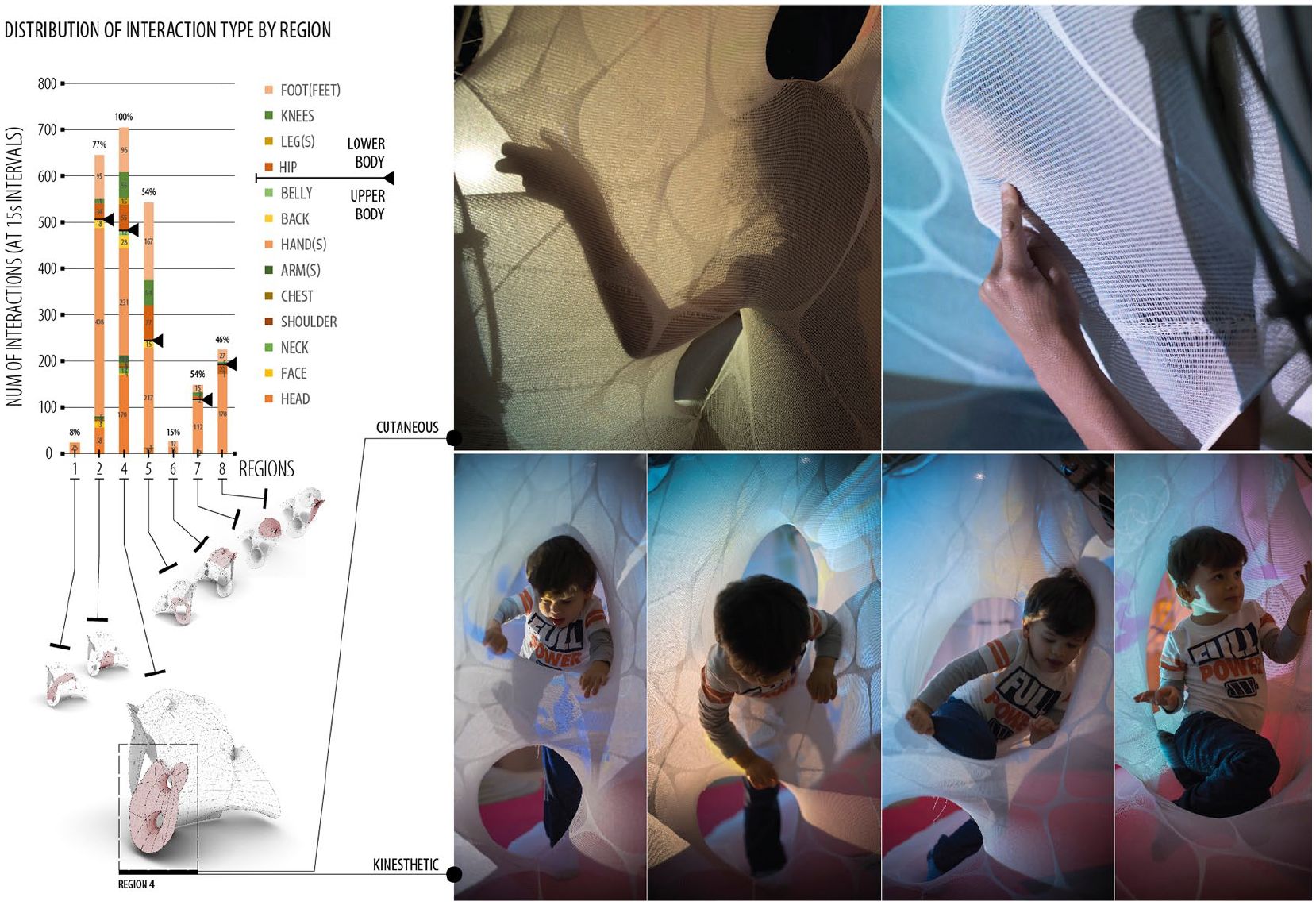
Textile-hybrid SensoryPlayscape field study—measuring instances of tactile interactions by region of the interactive environment, Columbus, Indiana, April 2019.
This study intends to position the performative design space within the preferential domain of the environmental-susceptibility matrix described previously in Figure 6. As this domain is hypothesized as means toward improving developmental capacity, it is then the consequence of sensorial agency that becomes of interest. For the child engaged in tactile, social play—evidenced additionally in the eye contact gleaned in Figure 5—in subsequent classroom activities the child exhibited a noticeable reduction in distractibility. While anecdotal, it was described as a consequence of an “itch” that had been well satiated.
This provokes a discussion of inclusion around proximity. Among the moments of sensorial agency, the perversion of form and materiality—a knitted textile as something to clothe becoming a surface of unknown spatial and tactile mutability—inclusion is tendered by erasing expectations. The degree of unconventionality and expanse of variability sap the capacity to preconceive function. This extinguishes any ability to stratify between abled and disabled or typical and atypical. Only in performative action does function emerge. When considering a larger domain—in the classroom well outside the bounds of the sensorial intervention—inclusion involves the ramifications of such an agential moment, in the degree that it radiates beyond the boundaries of its source. The generative action—a novel expression of social and spatial intentions—provides the capacity to manage the biases of a conventional, normative and immutable architecture.
Why computational design shouldn’t get a pass?
Autism is classified as a spectrum disorder. This is due to the significant diversity of symptoms that make up a neurological and developmental disorder which influences communication skills, socialization, interests, and behaviors.
28
It stands as an example to consider whether an individual should be identified as dis- or differently-abled. Margaret Yergeau recognizes how dis-ability emerges when both “scholars and lay publics alike represent autism as an involuntary condition” and subsequently dismisses aberrant behavior as meaningless and without clear motivations.
1
But, to recognize an individual with autism as differently-abled requires challenging this “medicalized” view, and in Yergeau’s terms deeming these actions as “underrepresented forms of communication.” It can be argued that such actions form a context-specific language that communicates something, even though often only recognized because of its aberration from a “norm.” If judged on its own terms then this instance of a spatial linguistic intelligence marks a new equilibrium: There might or might not be meaning; there might or might not be symbolic linguistic formation or representational intent; but there are rhetorical effects, there is invention at work, there is rhetoricity. In the words of Lennard Davis, there is a
Performative design space enabling forms of language
Disability theorists often invoke accessible design as proof that built environments and societies materialize disability oppression and that disability is not inherently biological or physiological.
30
A pointed effort has been made to mine the tenets of computational design for the arguments surrounding an architectural approach that challenges a medicalized view of disability. This is to suggest that, first, the means to examine the outwardly ramifications, of the material-centric products of computational design, do exist within an agent-driven system-oriented process. In addition, once integrating human agency as a social component of spatial tectonics, the next examination is of architecture’s culpability in reinforcing disability as a generalized, institutionalized counterpoint to abled-ness. To not address the balance of differentiation and equality between abled, disabled, and differently-abled is to ignore, if not magnify, each stereotype. To wrongly designate communities as “vulnerable” and apply concern solely to physical ability and its related assistive technologies ignores the creative capacity of cognitive diversity.
If empathy is to be a characteristic of the designer or a property of the design, finding points of relatability is not a viable course of action. Within one’s effort to relate is the recognition of the very distinctions which one is trying to respect. Yet, by becoming “relatable” is to temper the magnitude of such distinctions. Agency, however, best supports individual expression and communication.
To foster agency means constructing awareness. Note the critical distinction in identifying the action by which awareness is attained, rather than signifying agency or empathy as an inherent trait. Awareness, in this context, is isolated to situation and its social participants. To form awareness is to realize (1) a necessary lack of knowledge, to avoid the influence of drawing “relationships,” (2) the search for understanding necessitates resiliency as forming knowledge is an effort of trial and error, and (3) moments of understanding can only be defined collectively. In computational terms, an architecture that respects the individual nature of ability, of body and mind, is the real manifestation of a virtual design space.
Footnotes
Acknowledgements
The work published in this article was accomplished with the help of a highly interdisciplinary team including textile engineering by Tracey Weisman and Yingying Zeng, structural engineering by Prof. Evgueni Filipov and Maria Redoutey, fabrication by Ruxin Xie and Allison Booth and kinesthetic assessment by Larken Marra.
Declaration of conflicting interests
The author(s) declared no potential conflicts of interest with respect to the research, authorship, and/or publication of this article.
Funding
The author(s) disclosed receipt of the following financial support for the research, authorship, and/or publication of this article: The research published in this article was supported by funding from the Taubman College of Architecture and Urban Planning at the University of Michigan and Exhibit Columbus.
