



Abstract
This article describes generative algorithms and Digital Fabrication techniques with organic materials to create complex 3D objects for industrial design, sculpture, and architecture. Experimental artistic production using these algorithms concluded with a solution based on programmable meshes, which use identifiers to control the topological characteristics of vertices during the modeling process. On the other hand, the hybridization of analog and digital techniques was explored through fabrication. Comparing artistic production and hybrid techniques with generative AI, we will discuss topics of Computational Creativity in art, industrial design, and architecture. The programmable meshes solution, combined with hybrid fabrication processes, enables an incredible variety of complex forms, stimulates artistic creativity, and provides flexible feedback to bypass some Digital Fabrication issues. Our findings also elucidate the importance of original technology development and cultural identity in fostering creative and culturally inclusive technologies for art and education.
Keywords
Introduction
Creativity is a key issue in the arts, design, and architecture, and it is of the greatest concern for educational reform. Indeed, research on Computational Creativity and generative design technologies is saturated by AI and Machine Learning discourses. The power of these technologies is astounding, but their social effects are debatable, even if already palpable in all cultural industries and education. For example, these can be seen in the increasing inattention to the humanities, traditional craftsmanship and analog processes.
In the first place, creativity is difficult to define, handle and measure1-3 and is highly questioned in postmodern art, 4 since its aesthetic meaning and aura are affected by overproduction, media saturation, and the disruptive effect of digital media, 5 especially generative AI.
Secondly, the conflict between real, virtual, analog, digital, qualitative, and quantitative domains generates biases towards STEM (Science, Technology, Engineering and Mathematics) disciplines and the deprecation of critical thinking or traditional skills like drawing and crafting.
Thirdly, AI models, criteria and algorithms are encapsulated into black boxes, and influenced by Anglocentric Computational Thinking biases and the interests of internet corporations; these rarely consider the importance of local traditions for sustainable development. 6 Contrary to common perceptions, digital media and AI are efficient assets of digital colonization.7,8 Evidence of this can be found in the increased digital divide and in the lack of proprietary software and original digital know-how in Latin America.
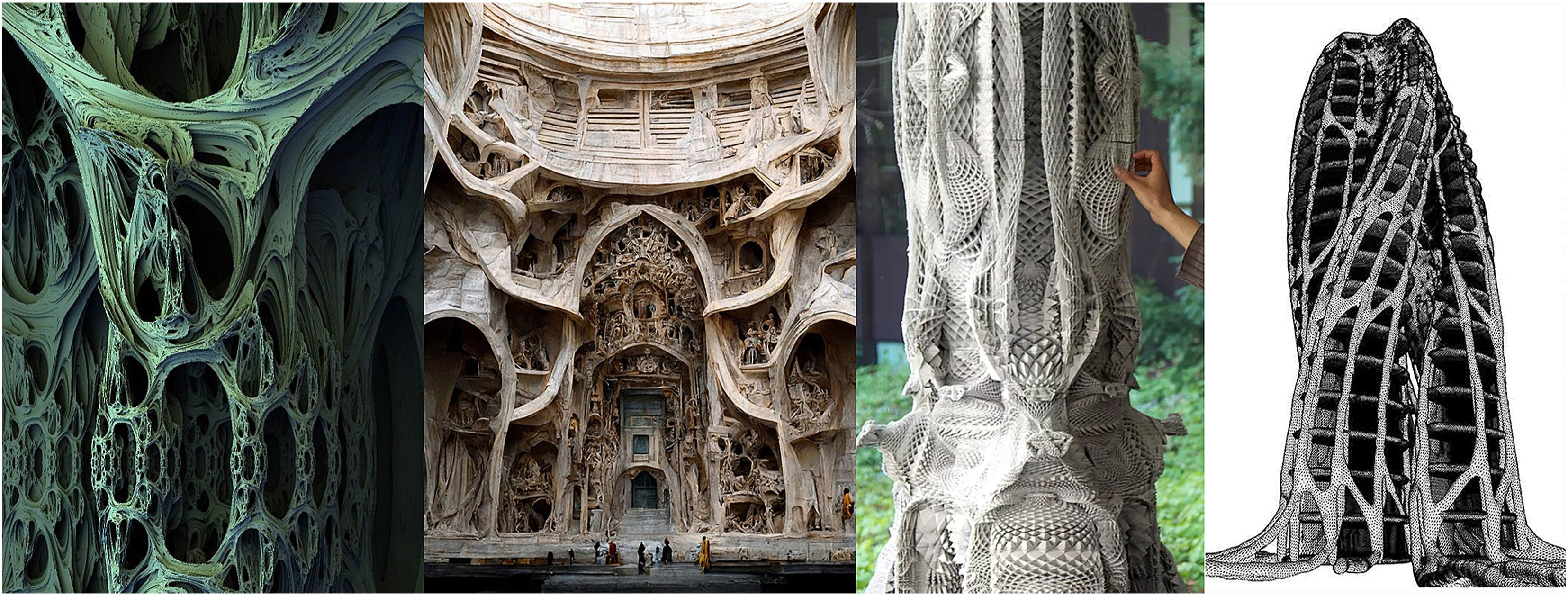
Finally, the limits of AI and algorithms in generative art (fractals, artificial life, etc.,) should be considered, where “originality” is just a difference between random values interpolations (Figure 1). AI, not surprisingly, leaves small room for users’ creativity.
2
Considering all this, our first goal is to explore and test more creative resources for artists and industrial designers, developing new generative algorithms, analog and digital hybrid artistic processes, and alternative digital development methods. We also seek to suggest some critical insights about Computational Thinking, Computational Creativity, and digital culture in general.
This paper is the result of an interdisciplinary art-based research project financed by Pontifical Catholic University of Peru – PUCP in 2021–2023, undertaken by an interdisciplinary research group composed of sculptors, industrial designers and engineers at the Art & Design and Engineering Departments, as well as a programmer and digital artist from the Design Department of the Peruvian University of Applied Sciences – UPC. From an aesthetic and epistemological perspective, the validation13,14 of art-based research will be sustained by its heuristic potential, with evidence to be found in artistic production and diffusion.
The matter is structured as follows: we will begin by analyzing issues of Computational Creativity and generative AI procedures and foundations. Then, we will describe the opportunities and challenges posed by cultural traditions and ethno-computation for inclusive digital development and for a critical approach to Computational Creativity and AI. This will be followed by an explanation of algorithms and L-Systems implementations to create complex 3D meshes for Digital Fabrication. Finally, we will delve into the hybridization of analog and digital experimental artistic processes and fabrication solutions.
Background
In this section, we will explain the concepts and topics behind our research.
Computational creativity and generative AI limitations
In the literature on the subject, Computational Creativity and generative AI issues were found that should be reexamined to evaluate their meaning and effects. Considering the latest research in neurosciences, psychology 15 and linguistics, creativity is still considered a system of complex processes that can’t be computationally and quantitatively defined.3,16,17 Researchers 18 have pointed out the intrinsic limitations of AI: black box problems, 19 biases and the epistemological limits of databases and selection criteria.20,21
We suggest complex and qualitative approaches to avoid the drawbacks and limitations of Computational Creativity and generative AI. To minimize black box problems, we will recover the concepts of meta-medium 22 and Aesthetic Computing. 23 It follows that we must then address the two-culture problem 24 : Preserve humanities, manual skills, and analog processes.
The meta-medium paradigm and meta-creativity
If, as Kay pointed out, 18 the essence of the digital medium is that of meta-medium, then the product of a digital medium is a new digital medium, thus creativity evolves into meta-creativity. The meta-medium concept means that software is, at the same time, medium and object: In fact, software is a medium that can generate other software. A programming language can be used as a medium to program another programming language or applications that are a creative medium themselves. Costa 25 pointed out the difference between Benjamin’s technical reproducibility and digital producibility. The latter reproduces the creative process, not just the formal properties of the artwork. Thus, meta-creativity means that the meta-medium’s task is to foster the final users’ creativity.
Aesthetic computing
In the scope of meta-medium, the idea of programming as art begins, in the Knuth sense of crafting skills, 27 because the artistic value is found in the generative process components, like software. Aesthetic Computing 23 in this case means that beauty and creativity can be found in the heuristics and the coherence between technical and linguistic properties of codes and interfaces as well as in their literary qualities.
Neocolonization, pre-Columbian art and ethno-computation
Artists and designers in developing countries are colonized by technologies of the developed world. 28 To reduce the digital divide and neocolonization processes, the development of original technologies and algorithms should be considered. 29 Research of Pre-Columbian artifacts have confirmed the mastery of algorithmic and natural computation by ancient cultures. 30
From the ethno-computation point of view, regarding traditional artifacts, vernacular epistemologies, practices, and designs that challenge Western computation, we considered the generative potential of quipus (Figure 2), the ancient Inca recording devices made of colored threads knotted in different ways, described by the 18th century Neapolitan alchemist Di Sangro.
31
Left: Di Sangro’s quipus layout. Middle: The vertical quipus knots, L-systems interface using the quipus metaphor: The axiom corresponds to the quipus horizontal string and the knots’ hierarchy defines when to trigger the rule during substitution.
26

L-systems
The potential of L-Systems to simulate natural and artificial forms is well known32,33 and can be recommended for their simplicity, creative power34,35 and for their capability to simulate local artistic traditions and technological assets, 36 intuitively and without black boxes.29,37 L-Systems also provide a friendly approach to Computational Creativity, without the steep learning curve of traditional programming and coding. Nevertheless, available applications are rigid, and interfaces unfriendly. Building on previous research, 34 to overcome these limitations and facilitate the implementation of ethno and natural computation, improvements to L-Systems’ dictionary, rule sets, and substitution algorithms were developed during the project.
Hypothesis
We believe that the benefits of computers, software and coding are weakened by technocentrism, 38 and possibly can even be counterproductive for creative Computational Thinking development, since they can generate confusion between concepts, tools and media. 39 A part of this complex problem is to find out how to improve the development of creative and inclusive digital technologies.
The first part of our hypothesis is that the combination of generative software, hybrid Digital Fabrication processes and ethno-computation is a workable solution and a starting point for future research.
Secondly, we pose that basic research is essential because sharing code and libraries can sometimes lead to copy and paste, rather than fostering genuine creativity. Analog techniques and sustainable materials also provide a fertile soil where creative Computational Thinking can flourish. These interdisciplinary resources offer original creative solutions and valuable assets for educational strategies and foster inclusive and culturally sustainable digital development.
Finally, to respond to artistic, design and educational technical challenges, we propose generative L-Systems algorithms because they can be developed by hand and with simple analog tools available even where advanced computing hardware is not accessible.
Methodology
The research methodologies expanded the art-based research framework, and consisted of: 1) Literature review in the field of Computational Creativity, generative AI, generative architecture and design, and shape grammars algorithms such as L-Systems; 2) Analysis of pre-Columbian art and ethno-computation; 3) Development of experimental generative algorithms and L-Systems software using object-oriented and incremental programming paradigms, and the hybrid artistic methodology as feedback; 4) This hybrid artistic methodology can be summarized as follows: Discovery, classification, collection, record and image processing, using photography, frottage, and direct printings of natural organic and inorganic complex forms, known as bio-inputs (Figure 3). Bio-inputs. Top left: Sea wave foam, dry milk stain, mushroom spore print. Bottom: Wood eaten by termites and Termitography, frottage on paper.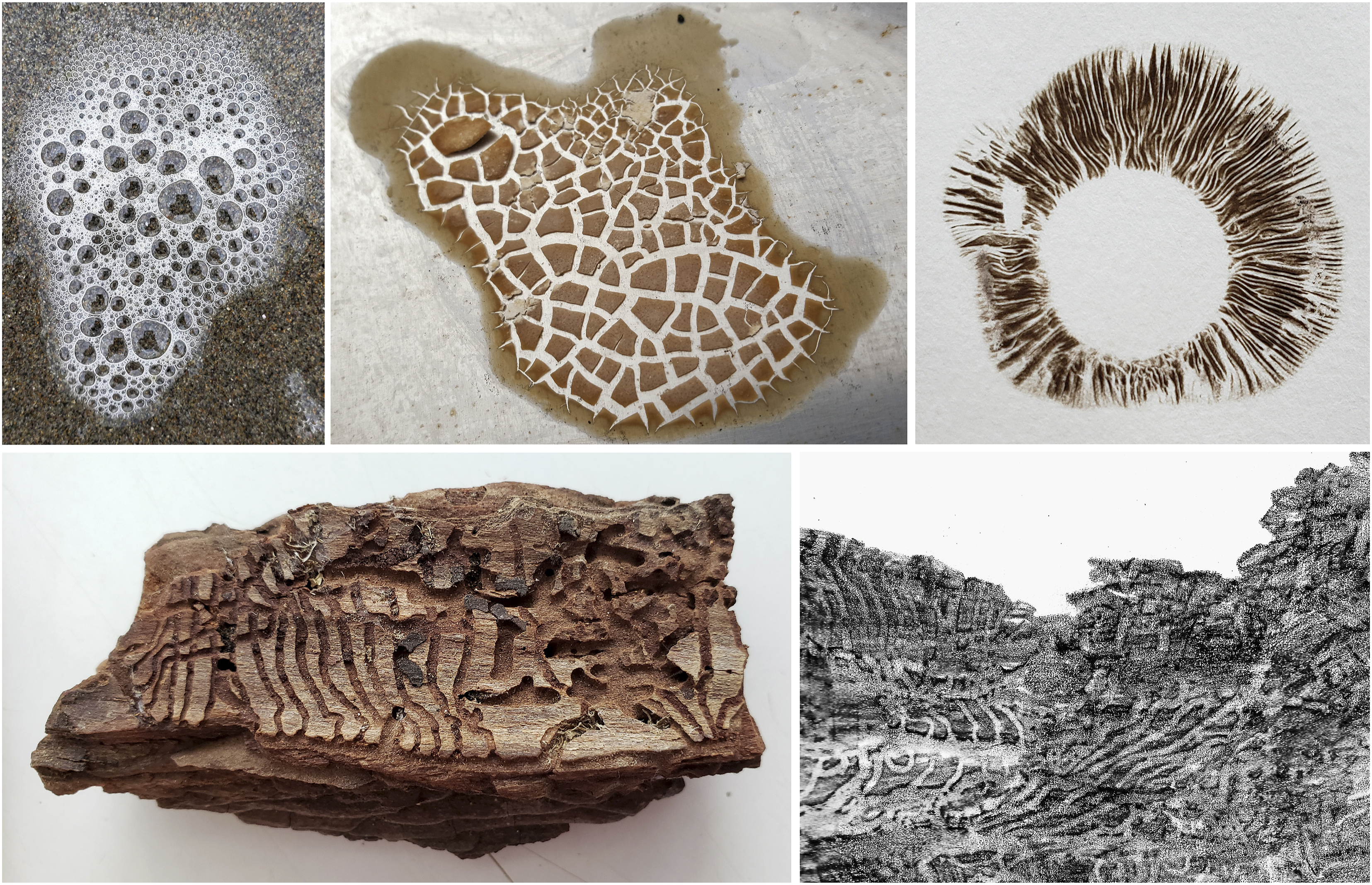
To replicate these natural processes by technological means, the team experimented with the production of a family of objects with natural materials such as wood, biomaterials and PLA, and the combination of generative design, 3D printing, CNC router and Kuka robotic arm machining, with analog tools and handmade drawing, carving, modelling and manual sculpture techniques (Figure 4). Tools and machines workflow: Software, digital prints and finished 3D objects and sculptures.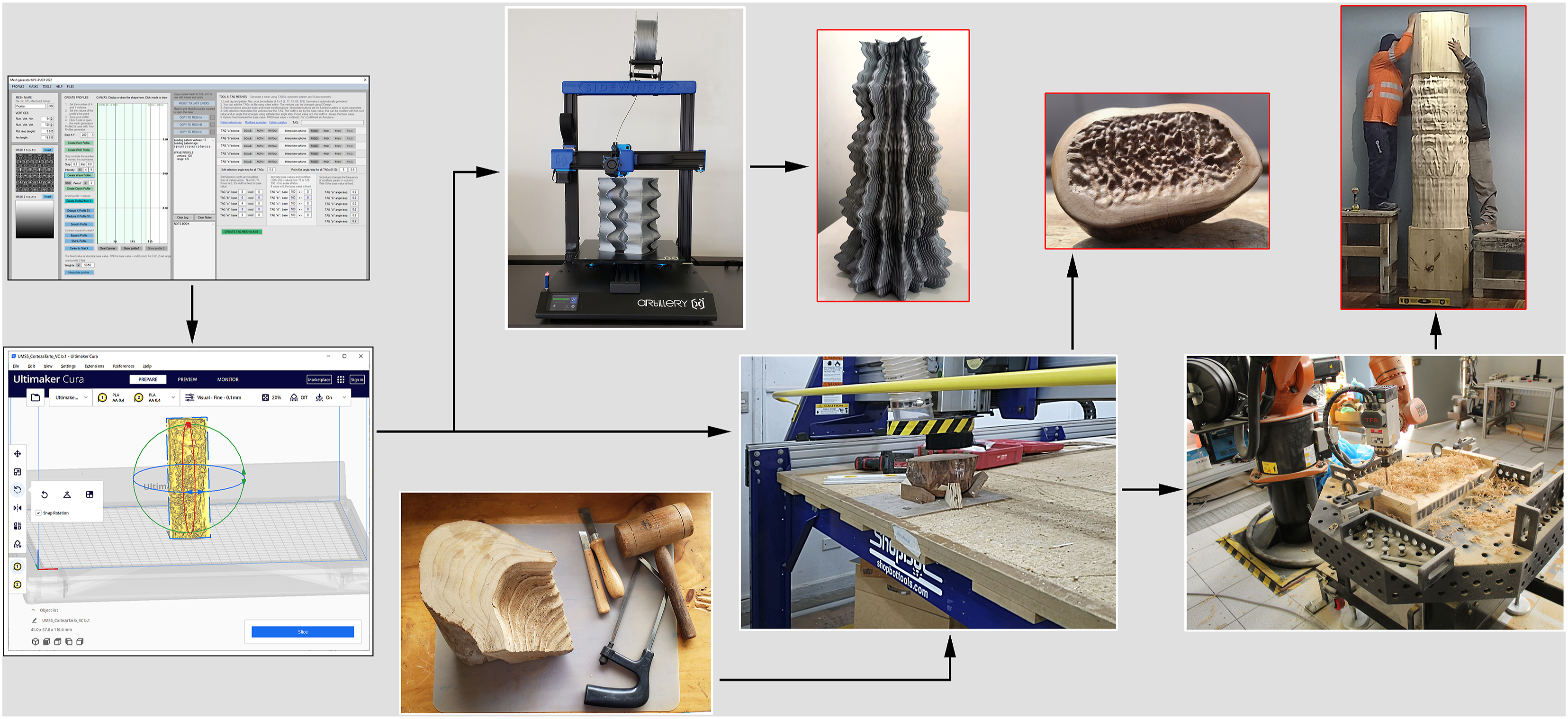
Artistic programming methods
When programmers are artists, software development becomes uncontrolled and a lot less linear than it should be. Programming requires careful organization and precise workflows, but the artistic approach introduces improvisation and serendipity, which can quickly lead to bugs, undesired effects, laborious and slow development. The solution was to start experimenting with code through trial-and-error procedures, updating the code in real time and frequently rewriting the entire application and the user interface design.
The case study
The trays, bowls and containers commissioned by the world-famous Central restaurant of Lima (Figure 10) proposed a challenge to the project’s methodologies, as Chef Virgilio Martinez demanded a deep respect of their commitment for a unique gastronomic and cultural experience that values natural inputs, local traditional knowledge, cultural diversity and territorial understanding. This commission tested our generative algorithms to match the formal properties of Peruvian ecosystems, traditional artifacts and manual technologies.
Literature review
In this section we will review topics that are particularly relevant, especially when digital tools are used in learning contexts.
Computational creativity and generative AI limitations
To begin with, as Sloman 40 pointed out, “a computer does nothing unless it is programmed”. Even in the case of the most sophisticated Deep Learning algorithms, intelligence or learning are just metaphors to describe numerical methods, but do not match real intelligence, knowledge or creativity, a conclusion admitted by specialists such as Boden 41 ; these belong to the programmer, as clarified by Searle’s Chinese Room case. 42 The biggest drawback is the lack of serendipity and creative triggers that randomness and errors provide, which, as Boden observed, play a fundamental role in the development of art, science, and technology. But only matter generates truly unexpected events that are susceptible to errors, and computation is never wrong per se: Thus, errors are of the programmer or the engineer, and only human beings can boost creativity through them.
On the other hand, even the best computers can’t process everything, and the biggest databases are collections of discrete samples of reality, a limit of computing that Wolfram, following the frame problem of Dennett, 43 used to define computational irreducibility. 44
The black box problem: Comparing AI and original technology research
The literature points out18,21 the limitations and biases of data science, quantitative methods, and algorithms. Biases exist in any technology, since there are no neutral technologies, they are always cultural products. The problem is that in AI and digital media purposes, biases and knowledge hidden in black boxes are not accessible, with the obvious exception of open-source software, which is the result of original technological research.
On the contrary, while the use of libraries, ready-to-use solutions, processes available in internet or recipes concocted with AI contributions certainly speeds up production, it also generates creative constraints and shows why authorship cannot be delegated solely to the artist. 13
Original technology research is also paramount in the broader cultural domain, to defend cultural identity 8 and correct commercial or AI modelling solutions’ hidden ideological biases. 20 Every single line of code or artistic experience contains significant knowledge that will unfold completely when all the pieces are put together in specific contexts, 45 something impossible for AI to achieve.
L-systems and generative art algorithms
L-Systems grammars and codes are transparent, and more intelligible when compared to AI algorithms, 46 whose deep computational processes are puzzling even for their creators. The difficulties of generative design with substitution processes can be reduced with better interface design and coding style, helping artists, designers and educators to exploit their creative and aesthetic properties. 32
We must also mention the limits of some algorithms used in Computational Creativity and Generative Art solutions. Fractals, Recursive Substitution Systems, Reaction-diffusion Systems or Artificial Life formulae often end up with very similar results (Figure 1), where “originality” is just a difference between parameters or random value interpolations. 2 Repetition also happens sharing libraries, macros or functions, a common practice between Processing, Grasshopper, Unity, Digital Audio Workstations VST programmers, and game engines that include AI or generative techniques with an often poor theoretical basis.
Cultural identity, creativity, and basic research
Peruvian philosopher Mariategui 47 argued that cultural identity is a fundamental asset of creativity; even in the digital case, it is important to point out that only original research offers firsthand combinations of specific and unique references and materials. However, cultural identity assets, such as quipus, should not be considered mere visual metaphors to embellish interfaces or artistic installations. As previously explained, cultural traditions, embedded in algorithms and functions supported by appropriate data structures, contribute to digital development with concrete solutions.
The patterns of ropes, knots and colors found in quipus indicate a true Computational Thinking that inspired di Sangro’s ante litteram Generative Grammar theory to use them as a linguistic code. 31
Results and findings
The solutions about Computational Creativity, Generative Art and Parametric Design described in papers show that L-Systems have unexplored potential.34,39 In this section, our main technological results and conceptual findings will be described: the final version of MeshGenerator software, L-Systems algorithm improvements, the programmable meshes algorithm, artistic and Digital Fabrication solutions, and finally conceptual and qualitative outcomes.
MeshGenerator software architecture
MeshGenerator, developed during the research, is a generative software written in C#, used to create complex 3D meshes for sculpture, industrial design, and architecture. Its algorithms, based on natural processes, self-similarity and ethno-computation, will be discussed after the L-Systems section.
MeshGenerator is structured in four modules: 2D shape design, modelling, editing and postproduction. The advantages of this modular architecture correspond to the requirements of artistic programming freedom. In fact, these modules’ code and interfaces can be edited separately without affecting the entire application. Taking into account open-source philosophy, they were considered independently as texts and revisited in the literary sense in order to be easily interpreted and edited by other users.
MeshGenerator’s workflow consists of four steps (Figure 5): 1) Upload of environmental data gathered using physical computing or any kind of values stored in lookup tables, that will be used to modify the modelling functions (including L-Systems) and behaviors; 2) creation of the mesh using these functions in any possible order; 3) 3D editing of the mesh with generative upgrades of 3D transformations like translations, rotations, or morphing; and 4) postproduction and remix of the meshes to generate the final model, using three-dimensional image processing filters and effects like compression, equalization and fades. Note that every step is checked and enabled by its predecessor, correcting, for instance, the incompatibility between meshes’ geometric properties. To smooth out the learning curve of experimental software, the interface displays tips and examples without the need of help menus, checks which buttons will be enabled, alerts the user about geometric inconsistencies, and updates the parameters accordingly. MeshGenerator’s workflow runs from left to right. The left panels provide I/O services to import data, L-systems’ grammars and masks. In the second panel the user draws 2D profiles to generate 3D meshes. The third panel displays and compares data and parameters. The right panel, subdivided in subpanels, holds tools to edit, transform and remix the meshes.
L-systems new algorithms
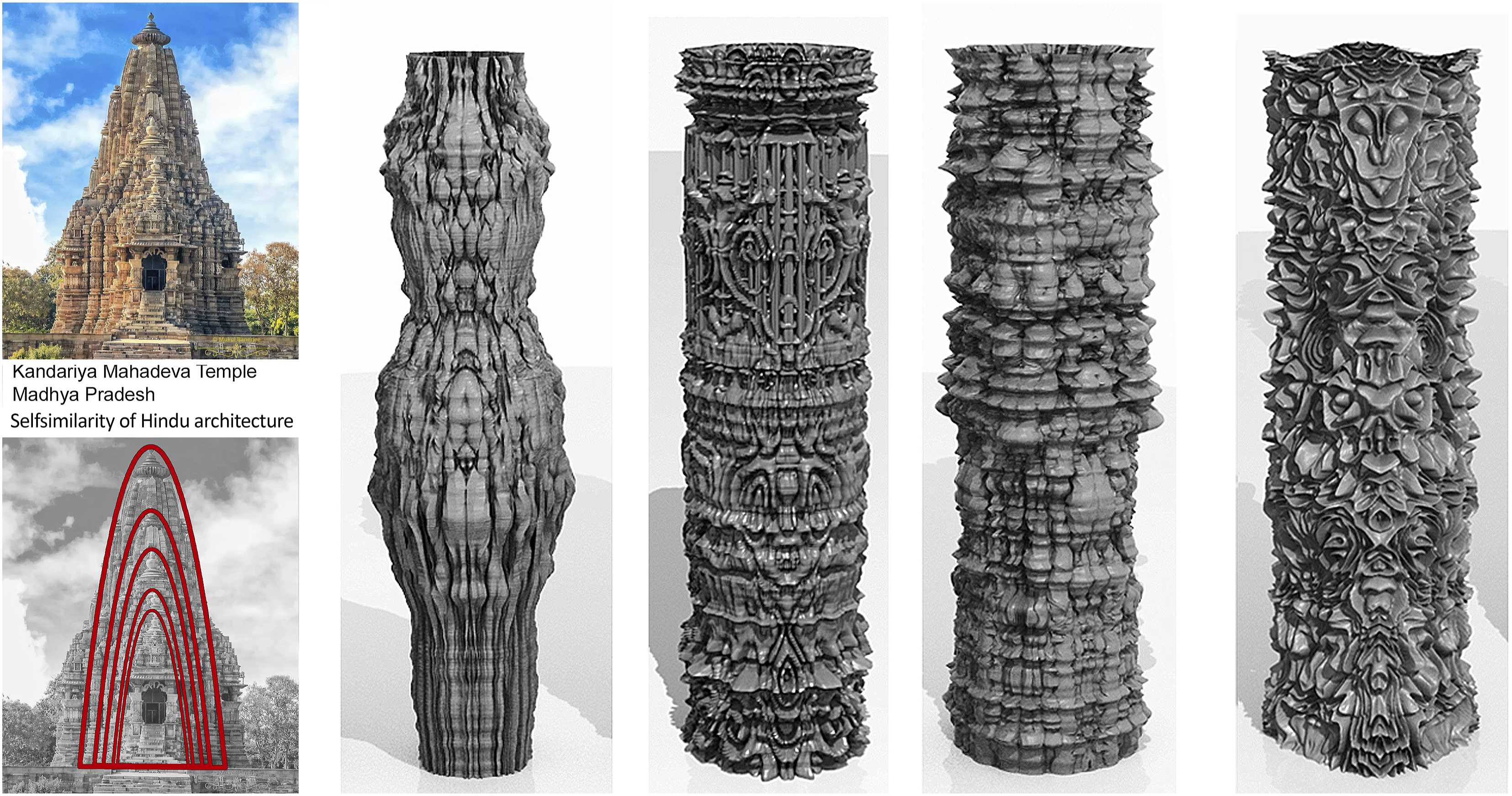
During the ethno-computation activities, quipus have provided us with an interface metaphor to improve the usability of the L-Systems application developed in the project (Figure 2). MeshGenerator development and 3D sculptures modelling showed that L-Systems are flexible enough to embed ethno-computation and traditional design principles.
Our contribution to L-Systems algorithms consists of macros, loops and conditional statement symbols that convert the linear substitution process into a sort of programming language. For instance, Figure 6 shows a design which is impossible to build with standard L-Systems, since these cannot provide a particular rule for every symbol of the columns and match the corresponding number of blocks and rotation degrees. Usage of “n” symbol for nested recursive substitution. “n” is updated reading the string from left to right. Like quipus, this logic can be adapted for different tasks.
26
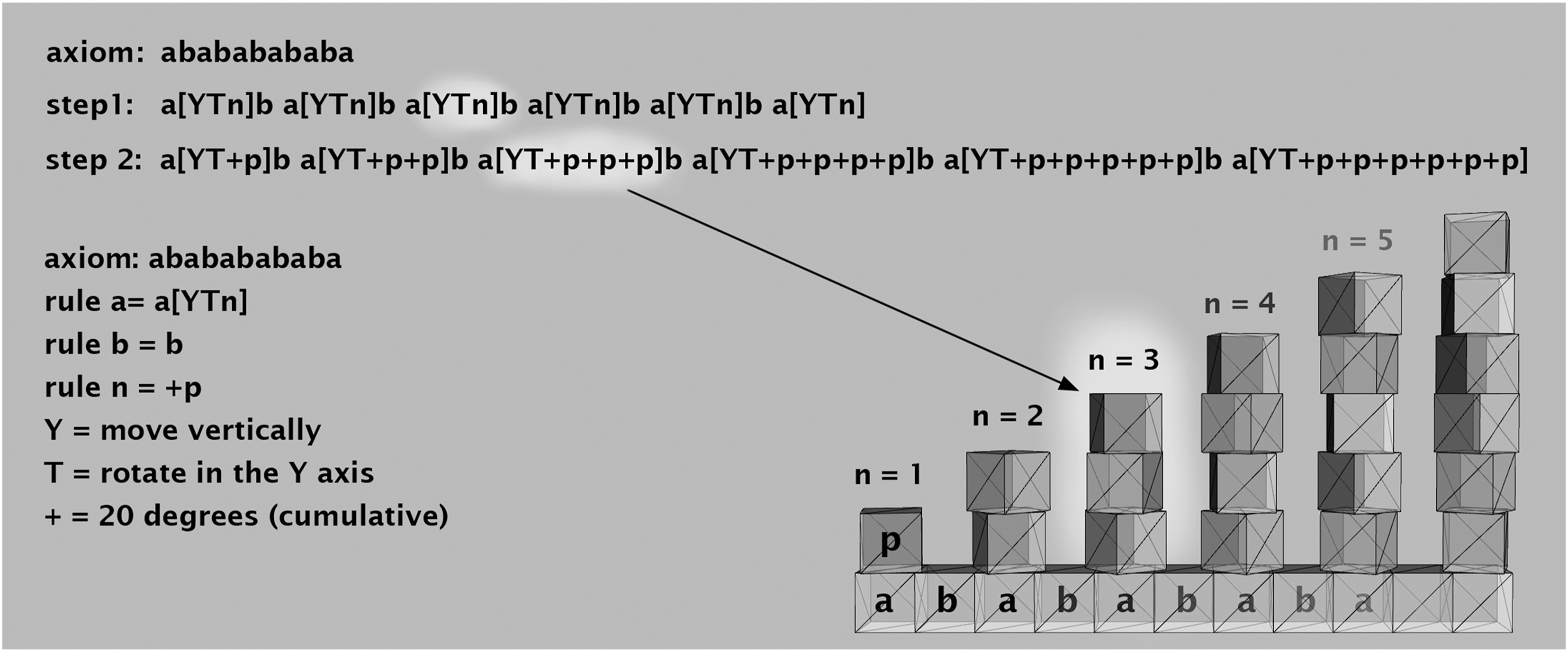
We solved these and similar difficulties with the programmable symbol “n” and its nested recursion capabilities, provided by sub-symbol “ñ”, whose behavior is controlled by checking how many times it occurs in the substitution process, its rule hierarchy and current substitution level. The “n” symbol sets the hierarchy of the columns in the row and their corresponding number of objects (Figure 6).
The right image of Figure 7 shows a complex construction of thousands of objects. The main rule adds layers of bricks, following the chakana’s (Andean cross) pattern and rotating every one of them along a spiral, while symbols “n” and “ñ” modify the size of the empty space between bricks, checking, simultaneously, the correspondence with the layer’s height, the chakana’s rotational degree and other parameters of the spiral. Pre-Columbian architecture and programmable L-Systems. Left: Detail of Pucllana mud brick temple, chakana, and spirals in the Cantalloc aqueduct. Center: Hand drawing of the algorithmic design process, L-Systems grammar to rotate the chakana, and L-Systems model with grammar matching the bricks’ amount, distances and length of the row, using the “n” symbol. Right: Brick tower implementing all these resources.
26

L-systems drawbacks and advantages
Generative grammars lingos like L-Systems cannot only be programmed easily and without previous experience; their algorithms can also be explored and developed by hand 18 using analog processes and materials. Improved L-Systems offer control and flexibility, behaving almost like a programming language that’s easier to understand, yet certainly difficult to develop properly.
MeshGenerator’s algorithms
This paragraph describes the programmable meshes algorithm that defines how to change vertices’ geometric properties during the modelling process.
Inspired by Cellular Automata’s rules and cells health or energy values (Figure 8), vertices define their topological properties, which 3D transformation to use, and their intensity or tolerance parameters by adding “TAGs” or identifiers that can be individually interpolated. The TAGs’ interpolation process is controlled by Cellular Automata’s algorithms, interactive parameters, L-Systems rules or reading values from data sets and images. Cellular automata cells born and die depending on the neighbors’ states. Starting from a random configuration, the pattern can evolve into unpredictable configurations.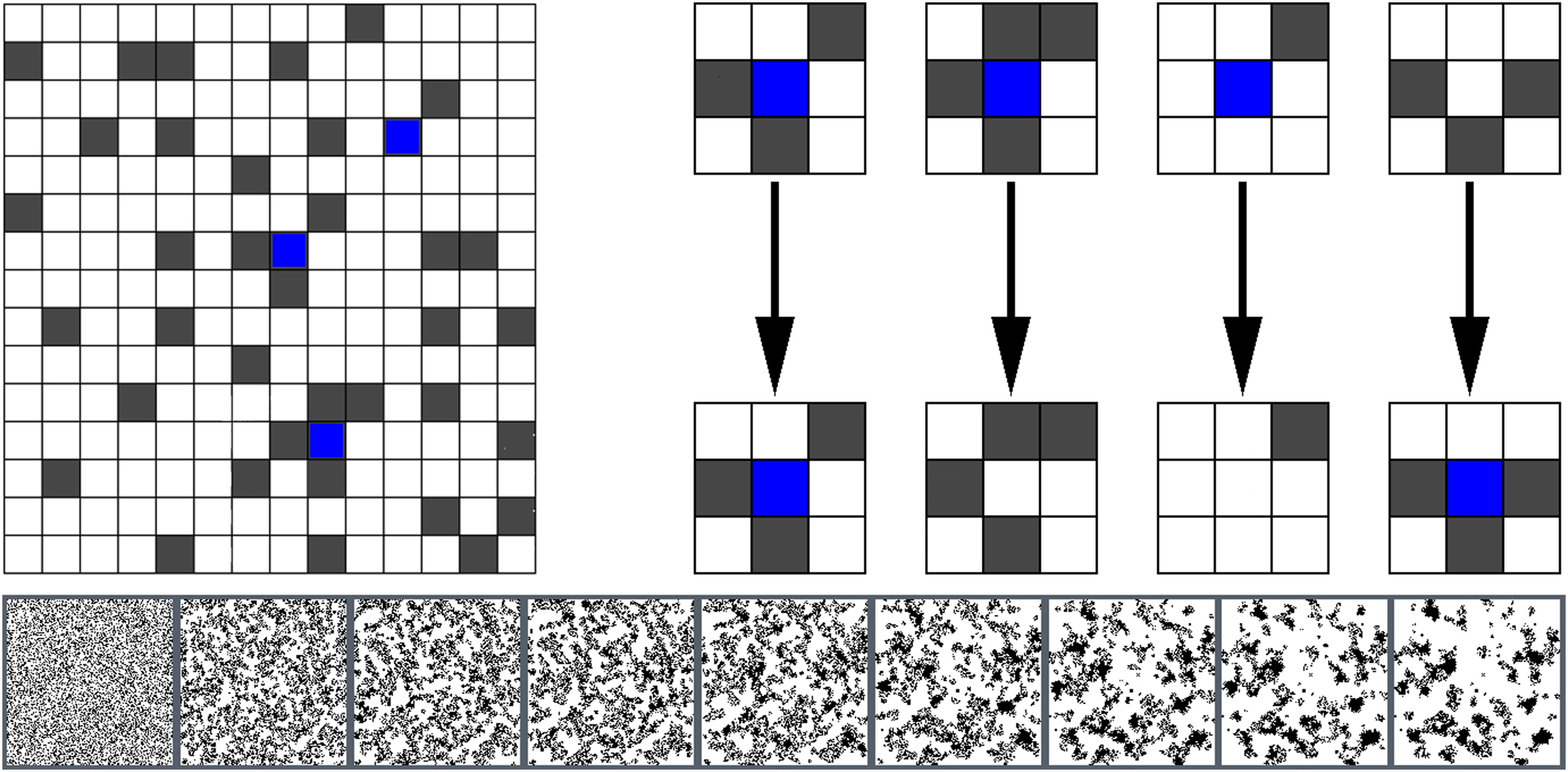
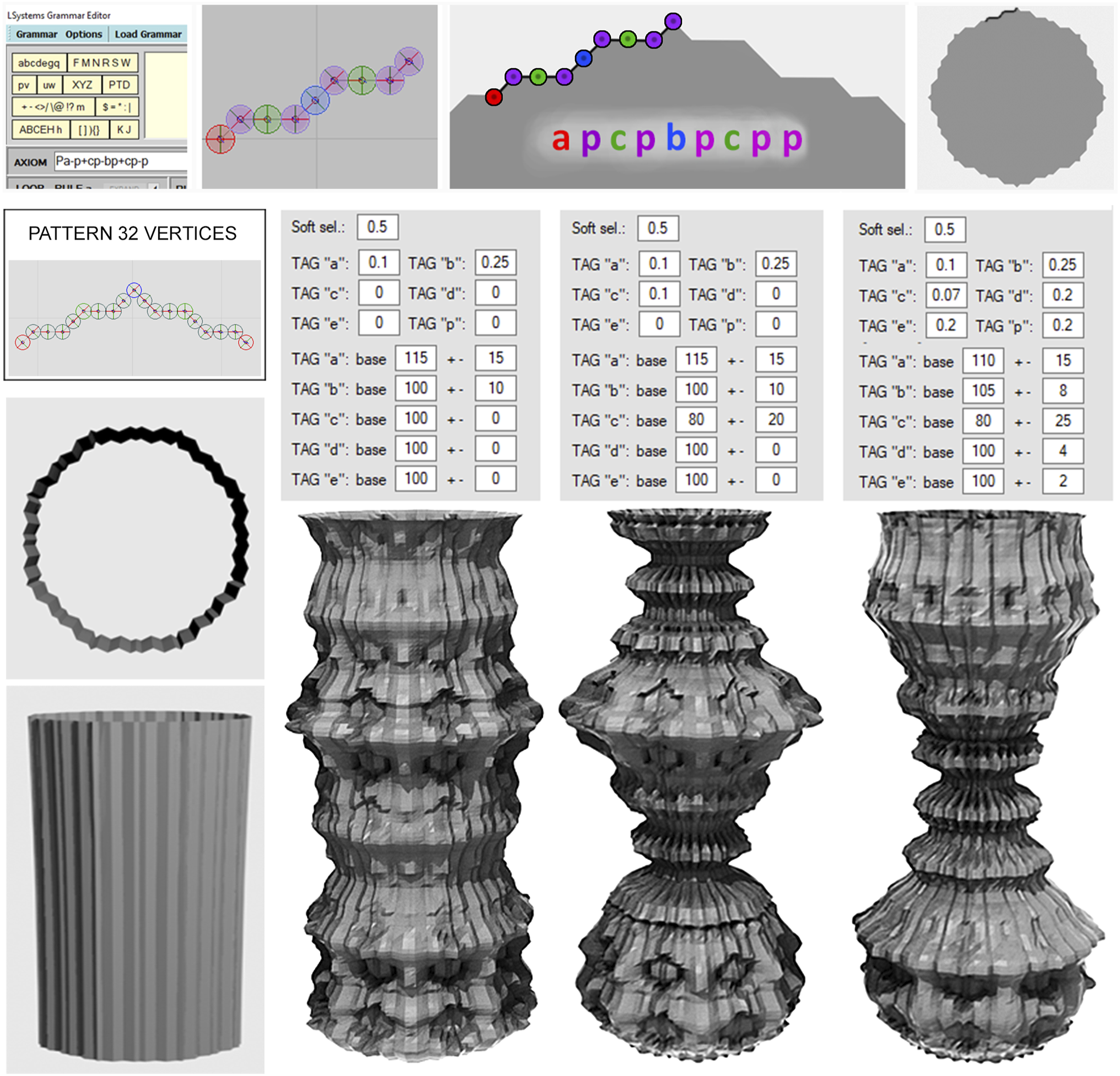
In the first step, the user creates a path of vertices and allocates their TAGs and transformation rules, which generates a closed shape, with optional 8 or 4 axis symmetry (Figure 9). TAGs pattern implementation. Left: 8 and 16 vertices patterns and TAG symbols. TAGs, represented with different colors, are programmable with independent rules. Right: construction of the horizontal section’s shape of the mesh; the section changes during the process accordingly to TAGs’ rules.
26

During the construction of the mesh, every vertex can be translated, scaled, or rotated, using its TAG data independently or in conjunction with other TAGs, considering its XZ position in the section and its height in the mesh.
The TAG’s rule set can also be processed, using an L-Systems substitution process embedded in the main function (Figure 10). This data can be saved and combined with other meshes with remix functions that receive TAGs as parameters. This allows for an incredible variety of complex forms and stimulates the user to experiment freely. Example of TAGs modeling process. Top: Pattern, TAGs and section. Bottom left: Simple mesh without TAGs processing. Bottom right: MeshGenerator’s palette to insert TAGs parameters and mesh programmed using TAGs’ translation, scaling and rotation values.
26
Programmable meshes drawbacks and advantages
Programmable meshes, bio-inputs, experimental materials and non-standard use of machines provide unpredictable possibilities for the creative subject. This is why they are so fascinating, but also likely to generate unexpected events and errors.
From the technical point of view of software as an artistic process, development has shed light on many geometric and topological problems raised by complex generative algorithms, that in the case of software generated meshes, could be geometrical problems like equivalence relation and one-to-one correspondence between points in two geometric figures (homomorphism) during a continuous transformation and face intersections that happen when vertices are heavily transformed or their positions too rough. The programmable TAG mesh solution minimizes these issues and facilitates compatibility with Digital Fabrication. In fact, TAGs help to analyze the topological data without performing tests that, when working with more than 8,000,000 polygons, can slow down the process, and also fix issues like the use of support material in the 3D printing process.
Hybrid artistic and digital fabrication
During the project’s artistic research, we experimented with new methodologies that combine analog and digital domains, searching for the smoothest workflow between handcraft, computational, natural and artificial processes. The specific artistic goal was to expand the Digital Fabrication’s creative possibilities and dismantle the traditional sequential process through an open-box proposal. This provides a framework for developing objects that are descendants -not representations-of the original reference.
The creative process was triggered by observing natural forms: cracked patterns (similar to Voronoi) of a milk stain dried on a surface, subtractive (tunnels) or additive (honeycombs) forms made by termites, ants, wasps, and bees. The bio-inputs technique involved collecting natural evidence thought photographs, drawings made with frottage or prints of fallen mushroom spores, named bio inputs (Figure 3). These processes were recreated computationally and mechanically and used as construction procedures
48
that confirm Sharma’s
49
hypothesis as they suggest more formal complexity than the rigid geometric logic of industrial parameterized manufacture (Figure 11). Wooden objects for Central restaurant.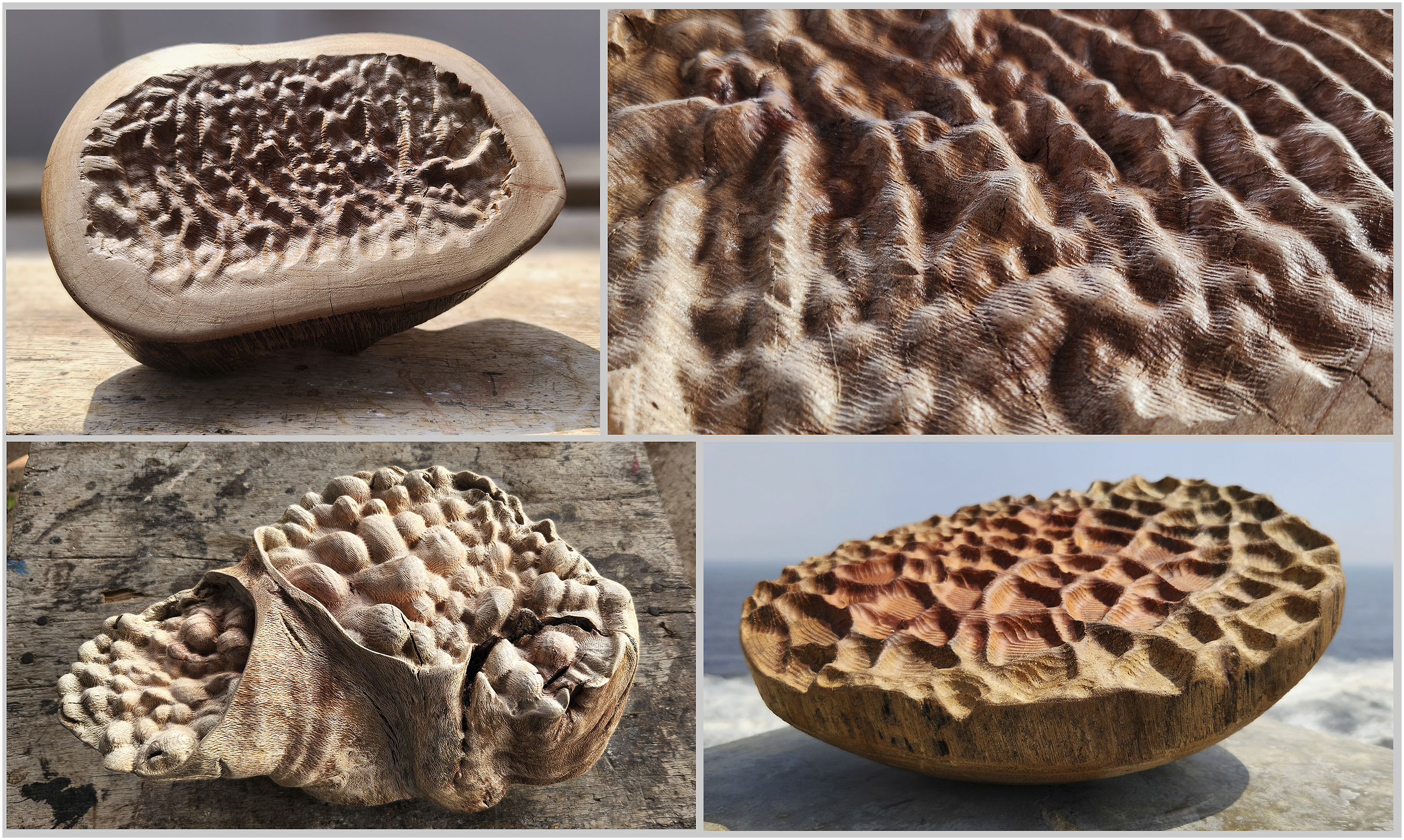
The commission by Central restaurant was an appropriate task to test the viability of the processes described above. After a usability validation process, Central’s positive feedback proved that the results matched coherently with the restaurant’s unique combination of gastronomic and cultural experiences (Figure 12). Hybrid fabrication object crafted for Central restaurant, with Peruvian ingredients, edible plants, natural dyes, and traditional weaving technologies collected by Central’s research team. Right: detail of the piece.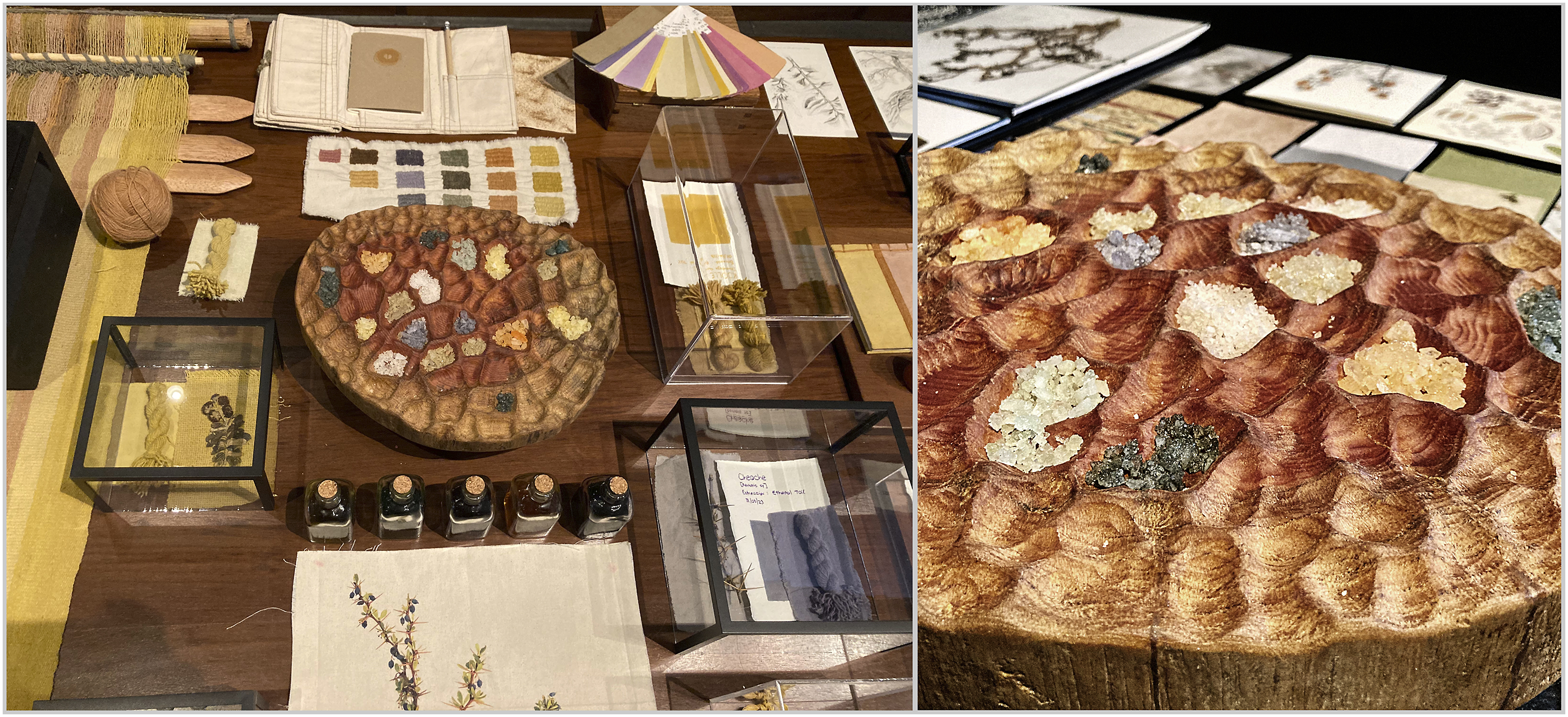
Hybrid methodology drawbacks and advantages
Regarding the challenges and opportunities of hybrid solutions for Computational Creativity, we experimented with different levels of unpredictability and emergence. When the focus is on the planning, the creative subject encodes experience, emotions, and knowledge in the decision-making and in the object’s final form. On the contrary, when the focus is on the manufacturing process, the path is less defined, open to serendipity, and difficult to repeat. Thus, we agree with Pallasmaa
50
that only human artistic sensibility can translate, by hand, this complexity into formal procedures capable to grasp its formal properties (Figure 13). Example of hybrid fabrication spin processes. From left to right: Freehand algorithmic drawing to experiment spin configurations, object printed with experimental analog extruder and biomaterials, handmade clay bowl made on potter’s wheel, 3D MeshGenerator model that simulates these analog processes.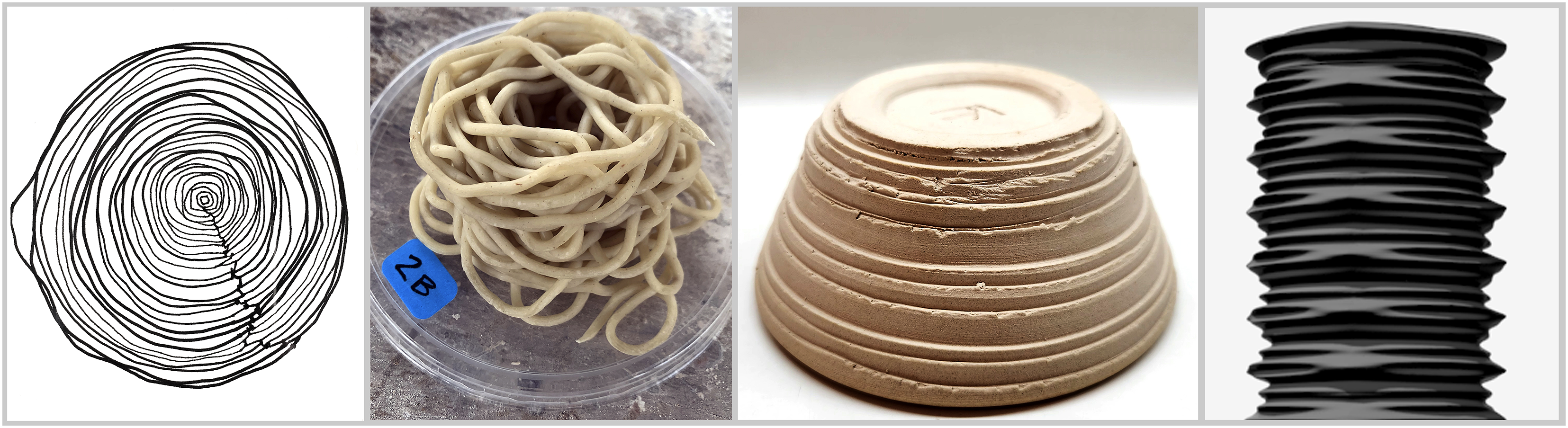
The artistic utilization of experimental materials, modified 3D printers, and the creative application of CNC routers and robotic arms has unearthed innovative possibilities and given rise to distinctive concepts and occurrences that remain beyond the reach of digital media. Additionally, artistic practice has demonstrated that complex generative forms move artists to improve their skills in 3D printing and robotic manufacture with organic materials.
Our artistic practices, based on the feedback between traditional analog art and experimental Digital Fabrication with organic materials, break with the usual sequence of sketching, prototyping, scaling, and crafting a piece of art or design. Moreover, these methods challenged the machines listed before in ways that they are not designed to work, for instance, by ignoring speed and efficiency priorities using inappropriate end of arm devices, exploring their flaws and technical limitations as resources for textures and other artistic effects.
Discussion
The research findings exposed some debatable issues and conceptual relationships between Computational Creativity, generative AI, digital divide and education. In the following lines, the relationship between these concepts will be discussed.
From the meta-creativity and meta-medium points of view, the computational and artistic results suggest that natural processes, cultural environments, ethno-computation (Figure 14) and hybrid artistic practices are more inspirational, transparent and more flexible to introduce digital media in educational environments. We found that complexity and creativity do not need complicated software solutions. On the contrary, simplicity is not the case with generative AI, unless artists are high-end mathematicians or computer scientists. MeshGenerator models that simulate different architectural and decorative styles. L-Systems help to interpret and implement their formal processes.
26
Regarding basic research, MeshGenerator development and the artistic practice demonstrated that full control over knowledge (analog and digital), which is often sacrificed by using AI lightly, is key to adding aesthetic value and originality to creative projects. Writing our own functions and giving up the cut and paste of software libraries requires a sort of “rediscovering the wheel” process that is necessary because accessing the basic components of technology allows substantial innovation.
Regarding the meta-medium, software is a cultural object with complex layers of meaning that thecnocentrism is not currently able to take advantage of. Software, as a text, is more than writing code; it includes interaction, coherence between ends and means, handling cultural biases, communication and knowledge.
To preserve momentum, the feedback between materiality and numeric languages must be translated to code in real-time, and contemporaneously with the artistic practice. This requires artists to combine traditional artistic handcrafts with new skills like programming, as well as disciplines such as computer science and the humanities.
Conclusions
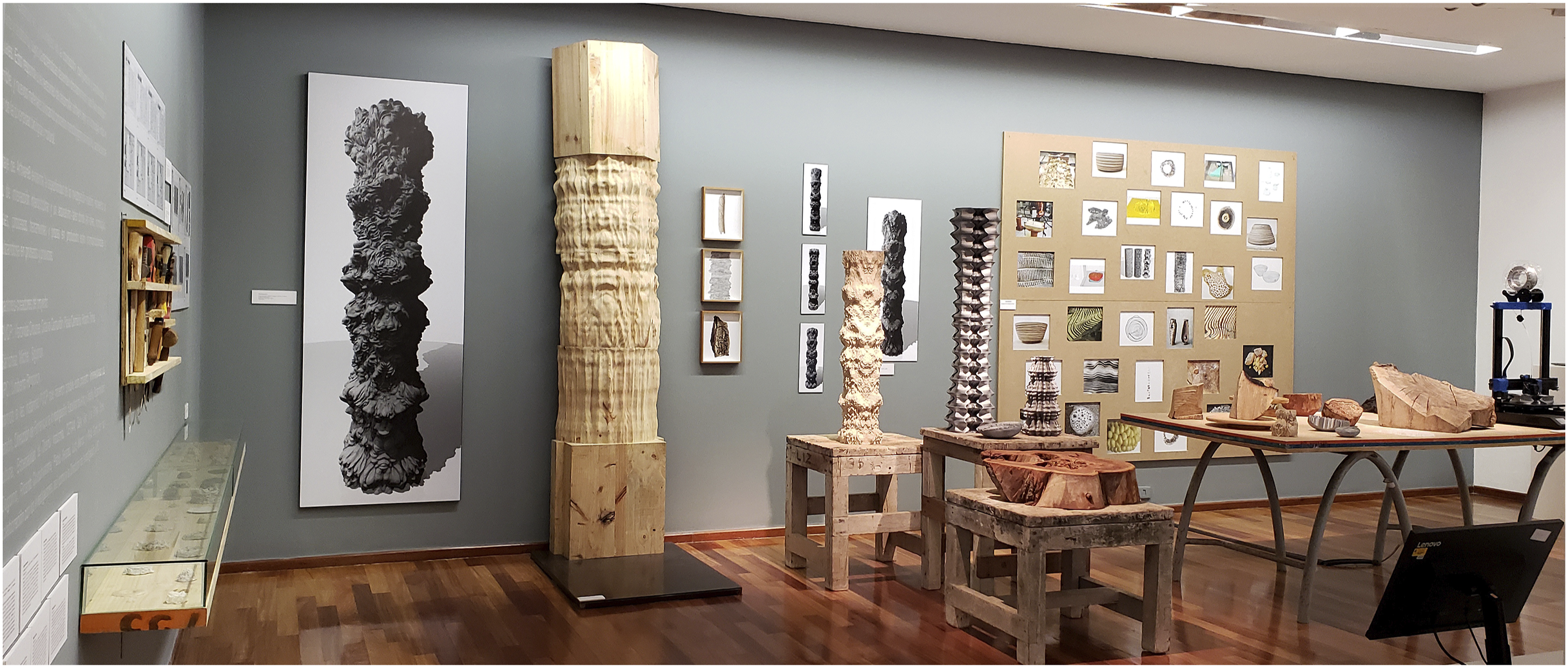
We will summarize the main concepts and findings exposed in this article and some ideas about future developments that could be paramount for the digital arts and related educational strategies. a) The experimental generative software and artistic production developed in the research proved that cultural traditions, traditional techniques, native artistic practices and ethno-computation, foster creative Computational Thinking effectively and help to correct the techno-centric bias that educational digital technologies enforce. This is accomplished only with basic research. b) The hybrid methodology of the project inverted the standard logic of technological procedures, allowing for combinations impossible to achieve with AI. As explained previously, computation is always predictable because it is programmed, even in the case of generative algorithms like Artificial Life. c) Speaking of basic research and innovation, the key factor here is not knowledge per se, but the intellectual network established in the real context of research development. This is very difficult to do with AI, whose databases are dispersed in global networks, or hidden in black boxes, with processes that can’t deal with the fact that real circumstances are computationally irreducible. d) Traditional technologies and ethno-computation devices are inherently material and handcrafted. On the other hand, the meta-medium concept implies that the educational goal is the development of an original digital application. From this perspective, generative software development needs much more from the humanities than the sciences, and more analog than digital skills. e) Regarding AI, Computational Creativity and original technology research, the feedback between software development, artistic practice and Digital Fabrication experiments exposed the importance of original (analog or digital) technology research. The truth of this lies in the fact that real innovation comes from the deep understanding and control of every layer of the process (Figure 15). f) In order to sustain the creative development of digital media, analog and manual methods widely used in the research proved to be more flexible than digital applications. The L-Systems research, that can be made by hand, proved to be in line with these requisites (Figures 13 and 14). Research results and artworks exhibited during the digital art biennial of Lima, John Harriman gallery, British cultural center, 2022-2023.
Further development
We may consider that the educational benefits of computers could appear only in the last step of the design process, and that the first step of creative digital tool development could not be digital, but analog. In this way machines, and especially AI, will possibly not interfere with the development of a creative and critical computational way of thinking.
This does not mean, however, that complex analog processes cannot be embedded into algorithms or translated into programming languages. The generative design methods and algorithms described in this article can be indefinitely developed and improved from the computational, aesthetic and educational point of view. Some digital humanities lines of research seem particularly important, considering generative AI challenges: developing interface designs and human-machine interaction strategies for creative purposes; exploring software as an artistic text that gathers technical and creative means, data, concepts and audiovisual resources. Finally, designing strategies and programs that foster the interdisciplinary formation of artists as inventors and scientists also needs to be taken into account.
Footnotes
Declaration of conflicting interests
The author(s) declared no potential conflicts of interest with respect to the research, authorship, and/or publication of this article.
Funding
The author(s) disclosed receipt of the following financial support for the research, authorship, and/or publication of this article: This work was supported by Pontificia Universidad Católica del Perú (CAP2021-F-0003).
