




Abstract
AI technologies have been widely explored in the architectural design process over the last decade. This paper addresses the limitations of the existing reviews on AI applications in the architectural design process, including a lack of focus on the design process, limited coverage of AI technologies, and under-exploration of human-AI interaction environments. The paper systematically reviews and comparatively analyses 63 articles filtered through 1138 publications from 8 databases. The findings include comparative analysis charts and tables of the different AI-enhanced design processes, the human-AI interaction environment, as well as their evaluation. They highlight the expectation that AI will function as a conversational design partner. Lastly, the paper presents a novel framework for the AI-enhanced conversational architectural design process.
Keywords
Introduction
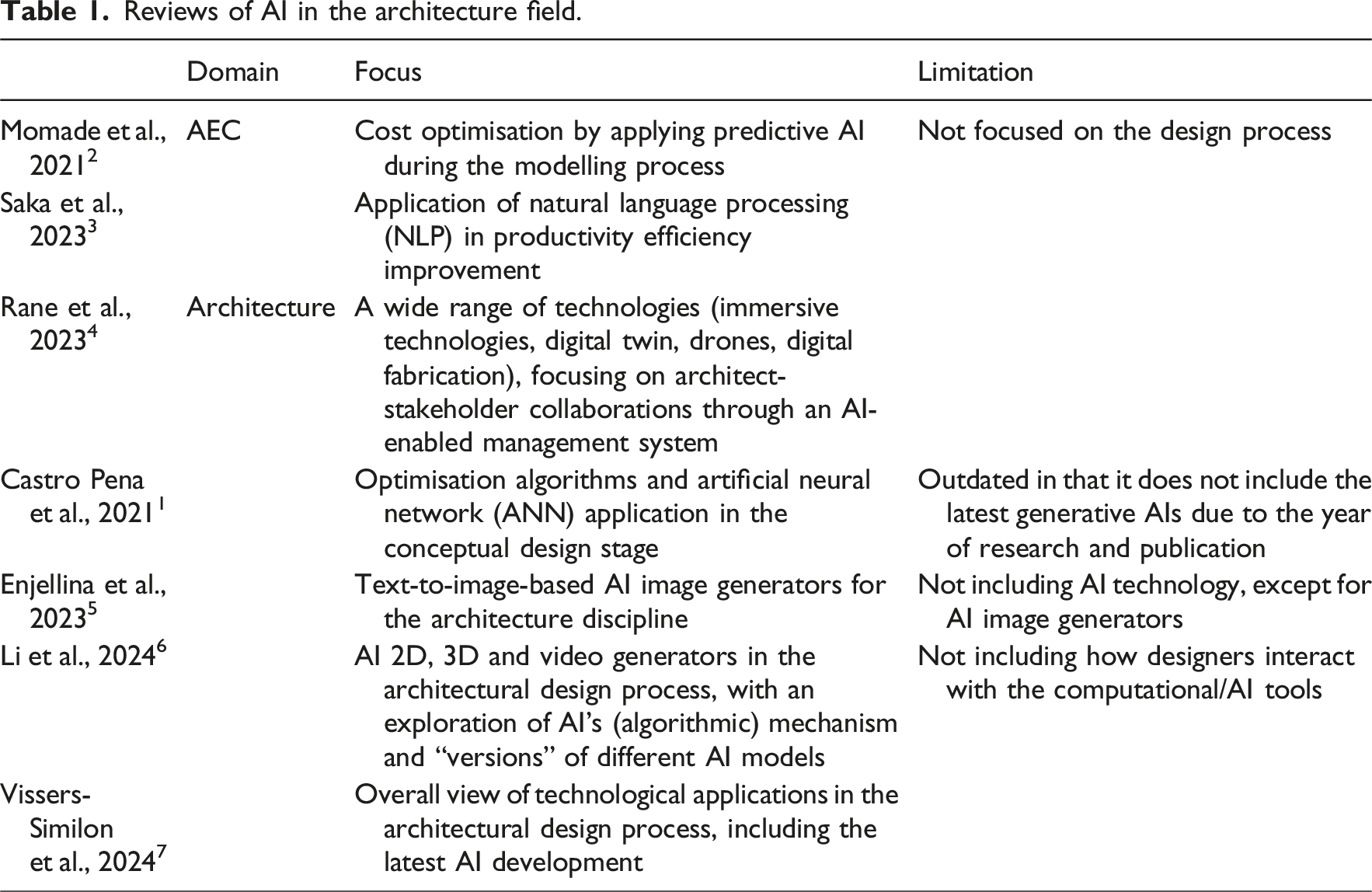
Artificial Intelligence (AI) tools are widely explored in the architectural design process, especially in the conceptual design process. 1 There are existing systematic reviews of AI applications in the architecture field. Three observations are observed, including (1) a lack of design process focus, (2) limited or outdated coverage of AI technologies and (3) little focus on human-AI interaction.
While systematic reviews exist on AI applications across Architecture, Engineering, and Construction (AEC), a notable gap remains in examining its role within the architectural design process. Momade et al. 2 conducted a systematic review of AI applications in the AEC industry, offering researchers and practitioners a comprehensive understanding of AI’s role. However, their studies prioritised cost optimisation through predictive AI during modelling, paying limited attention to design-related applications. Furthermore, their broad AEC scope does not align with this study, which centres on architectural design processes. Similarly, Saka et al. 3 emphasised conversational AI and natural language processing (NLP) within the AEC industry. As their review targeted industry-wide productivity and efficiency improvements rather than architectural design, it also falls outside the scope of this review. Rane et al. 4 examined leading-edge technologies for architectural design, covering innovations such as immersive technologies (VR, AR), digital twins, drones, and digital fabrication. While that study emphasised collaboration, it focused on architect-stakeholder collaboration via AI-enabled management systems rather than AI applications directly within the design process.
Furthermore, existing systematic reviews address AI in the architectural design process, yet they focus on a restricted set of tools and often outdated technologies. Castro Pena et al. 1 examined the role of AI in the conceptual design phase of architecture, concentrating on optimisation algorithms with some mention of artificial neural networks (ANNs). However, the study is outdated, as it does not reflect the significant advancements in generative AI, which have become prominent since 2021 and offer a more substantial influence on the design process. Also, Enjellina et al. 5 review of text-to-image AI generators and their application in the architectural field, examining their influences, challenges and future potential. The study maintained a narrow scope by exclusively addressing text-to-image AI, omitting other AIs being discussed in other reviews, such as large language models and regression models.
Reviews of AI in the architecture field.
Therefore, the overarching research question in this study is: How can AI be used in the architectural design process? Consequently, this systematic review focuses on three aspects: (1) AI application in the early-stage architectural design processes, (2) human-AI interaction environments (code-based environment, software, web application, etc.), and (3) evaluation of the designer-AI interaction. It is noted that for the first aspect, AI refers to a broad spectrum from regression-based, convolutional neural network (CNN)/generative adversarial network (GAN)-based to Recurrent Neural Network (RNN)/transformer-based systems, not limited to generative AIs such as image generators or chatbots.
For the third aspect, the term “evaluation” is considered in two dimensions. Firstly, it refers to what is being evaluated, which can include (a) AI performance (e.g. AI prediction accuracy or AI operation efficiency), (b) the quality and diversity of design outputs generated with AI, and (c) the human-AI design process itself, including designers’ experience and observed design behaviours. Second, it refers to how evaluation is conducted, ranging from efficiency-focused metrics, through demonstration-based case studies, to workshop experimentation (case studies) that combine demonstration with quantitative measures (e.g. surveys, counts of usable AI outputs or success rates, etc.) and qualitative methods (e.g. observations and interviews, etc.). This paper takes the approach of answering the following sub-questions: (1) How can we utilise AI technology in the conversational architectural design process? (2) Through which interaction environments do designers interact with AI during the design process? (3) How have existing studies evaluated the applications of AI in architectural design?
Findings include a comparative analysis chart evaluating AI technologies and applications in the architectural design process and the human-AI interaction environments. Then, key principles for the AI-enhanced architectural design process are summarised for future research and design development.
Methodology
The systematic review method is composed of four phases: (1) Searching articles, (2) Filtering articles, (3) Comparative analysis and categorisation of articles and (4) Evaluation in charts and tables (Figure 1). Flowchart of the systematic review method.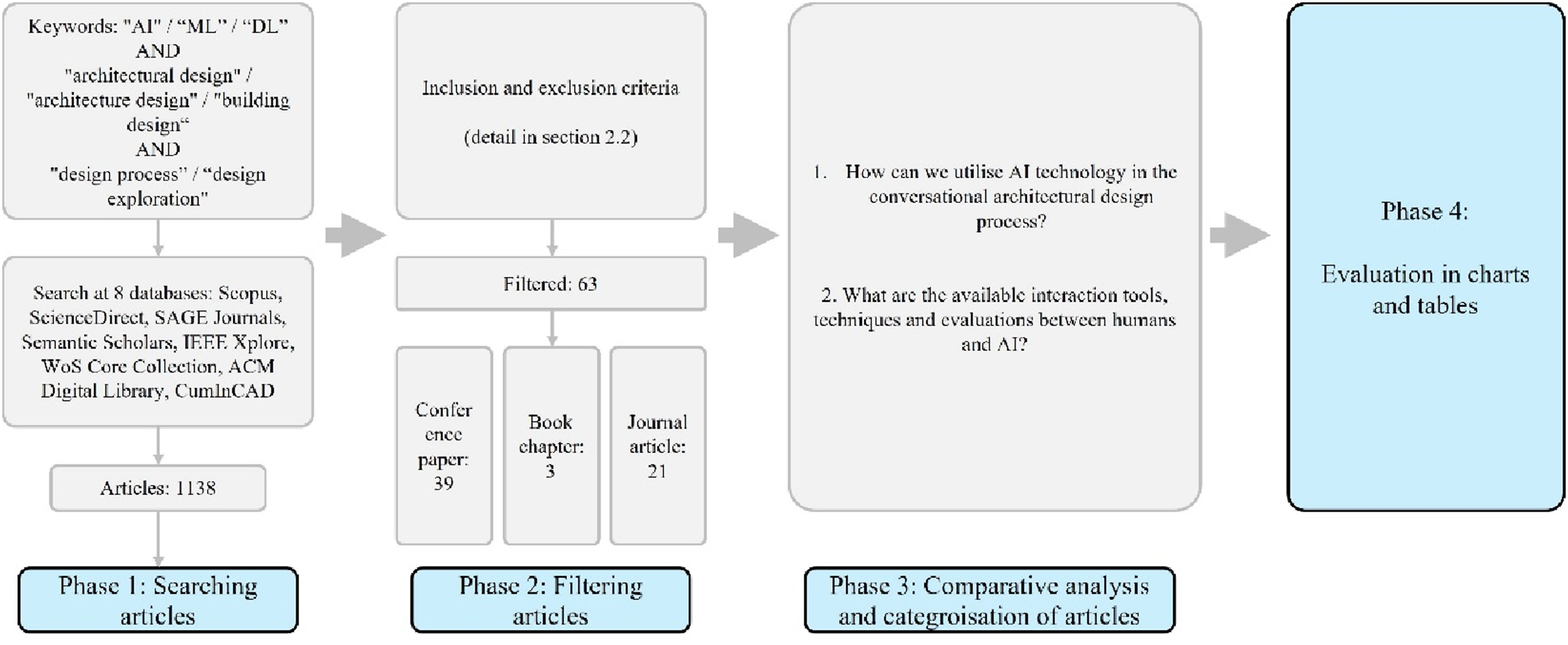
Phase 1: Searching articles through the database
Search procedure performed in databases.

The search results included 1138 academic publications, including 164 publications in Scopus, 22 publications in ScienceDirect, 58 articles in SAGE Journals, 10 publications in Semantic Scholar, 60 publications in IEEE Xplore, 28 publications in Web of Science Core Collection, 725 publications in ACM Digital Library and 71 conference papers in CumInCAD.
Phase 2: Filtering articles
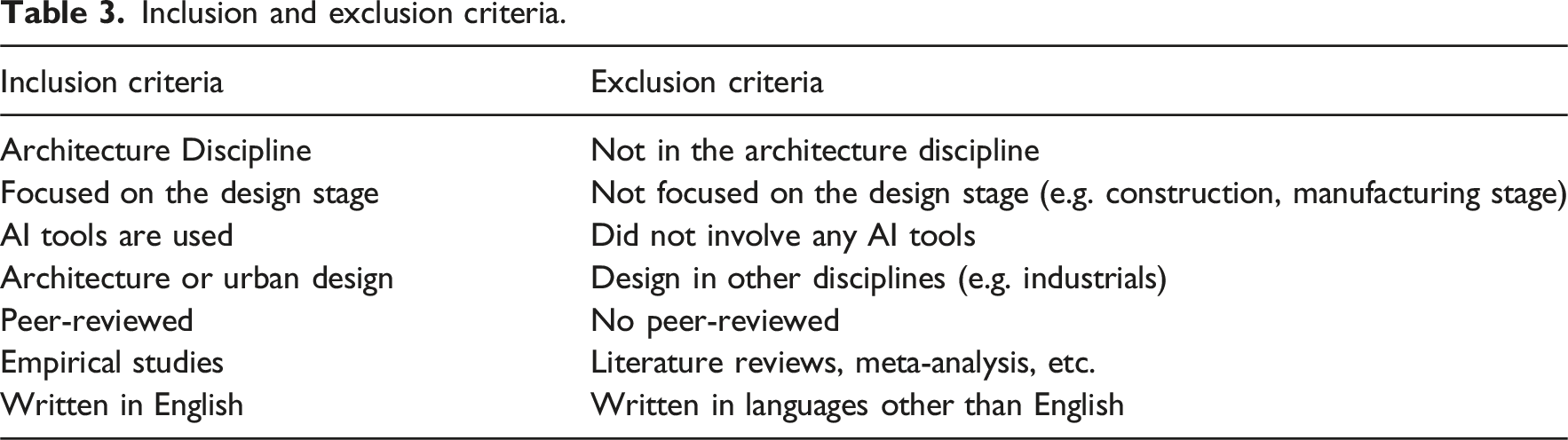
The literature selection process is summarised in Figure 2. A total of 1138 studies were searched in the initial search. After removing 39 duplicates, 1099 studies remained. After excluding non-article records (abstracts, books, and proceedings), 756 studies remained. After filtering based on the inclusion and exclusion criteria displayed in Table 3 based on the abstract reading, 70 studies were included. Then, after reading the full papers, 60 studies were chosen. During the review process, snowball papers are included, making a total of six studies in the final synthesis. Literature selection process. Inclusion and exclusion criteria.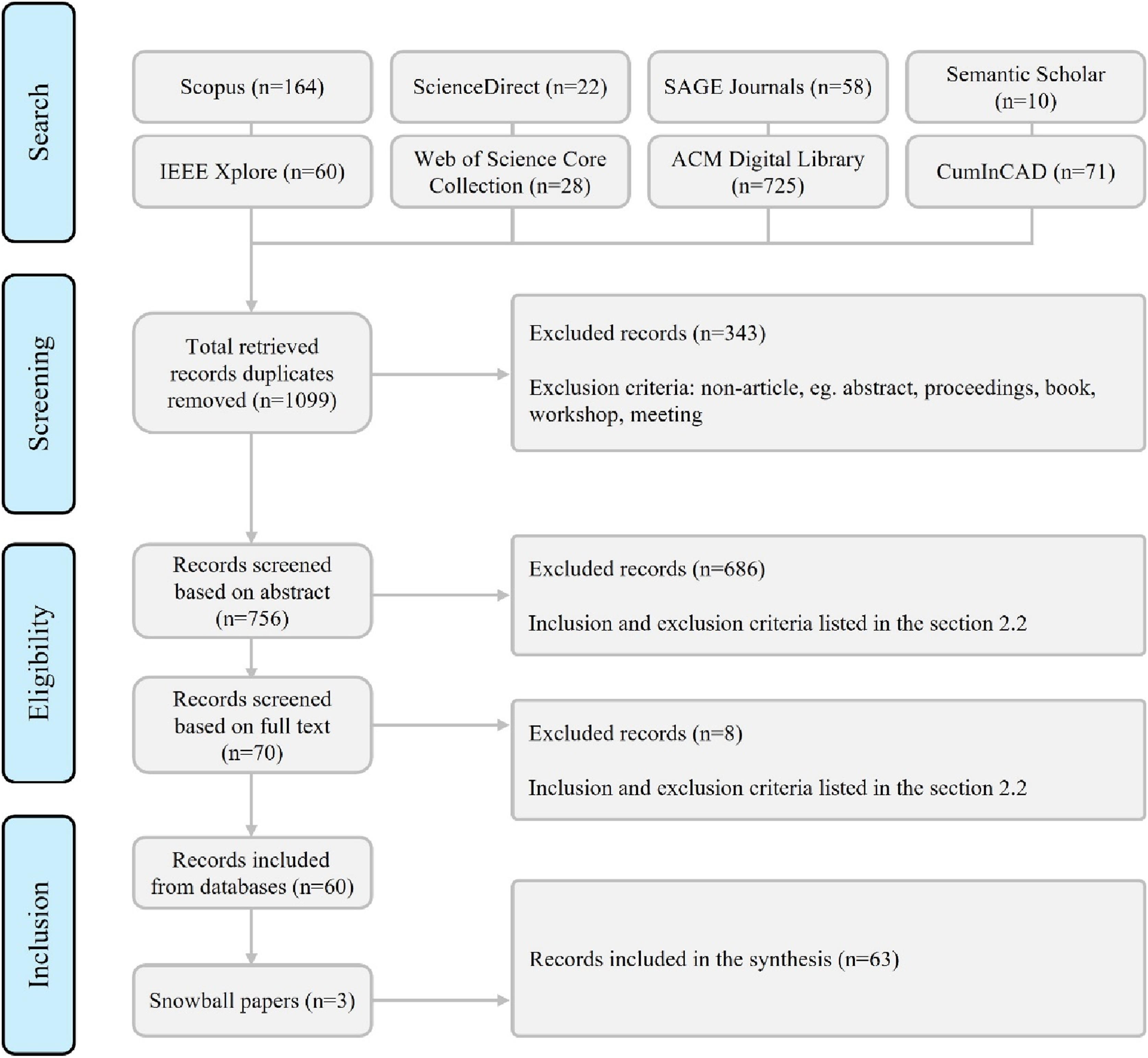
Phase 3: Comparative analysis and categorisation of articles
In Phase Three, comparative analysis and categorisations are conducted according to the three sub-research questions. First, articles are categorised and analysed based on three big categories of AIs and their application in the architectural design process, responding to the first sub-research questions. Then, for each category, analysis based on interaction environments of how humans and AI interact and how the data of the AI-integrated architectural design process is evaluated are comparatively analysed, responding to research questions 2 and 3, respectively.
Phase 4: Evaluation in charts and tables
In the final phase, the articles are evaluated in charts and tables. Based on the findings of phase four, an AI-enhanced architectural design framework for early-stage exploration is proposed.
Current status of the existing research
Distribution of articles according to the publication source
Number of articles published on respective data sources.
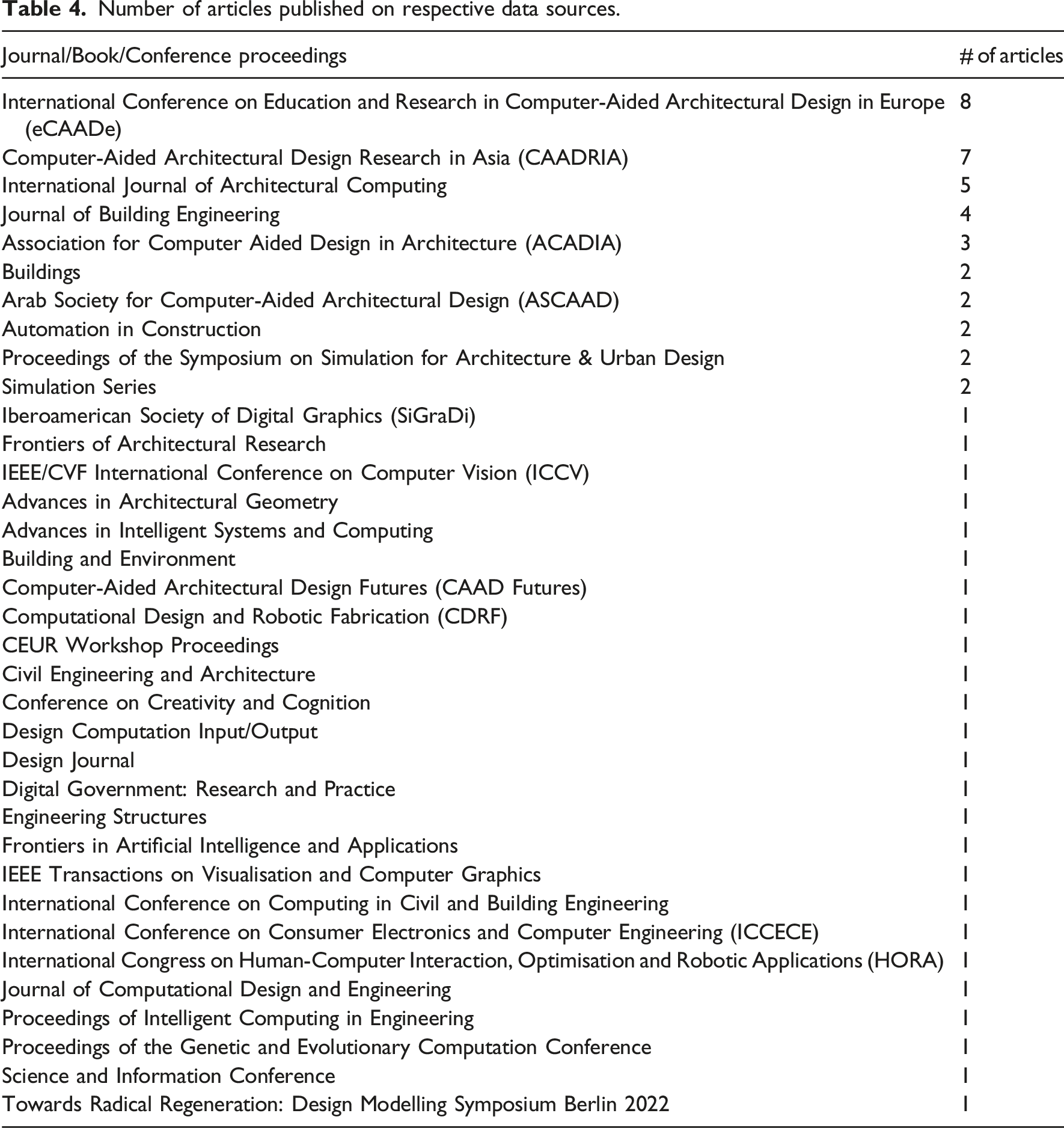
CumInCAD sibling associations (CAADRIA, eCAADe, ACADIA, ASCAAD, SiGraDi, CAAD Futures, and CDRF) contribute more than 35% of the publications. This indicates its importance and relevance in the field of computer-aided architectural design. The articles appear in a total of 36 different journals, books, or conference proceedings, reflecting the topic’s broad coverage across fields like architecture, design, human-computer interaction, engineering, and information science, displaying the potential for multi-disciplinary implications.
Distribution of articles according to publication year
All selected papers are published between 2014 and 2024 Figure 3. There is an increasing trend in the number of articles published over the years, especially after 2021, when generative AI tools have been advancing,
1
with an exception in 2022. The rising trend shows growing research interest and research relevance in this field. Chronological distribution of articles.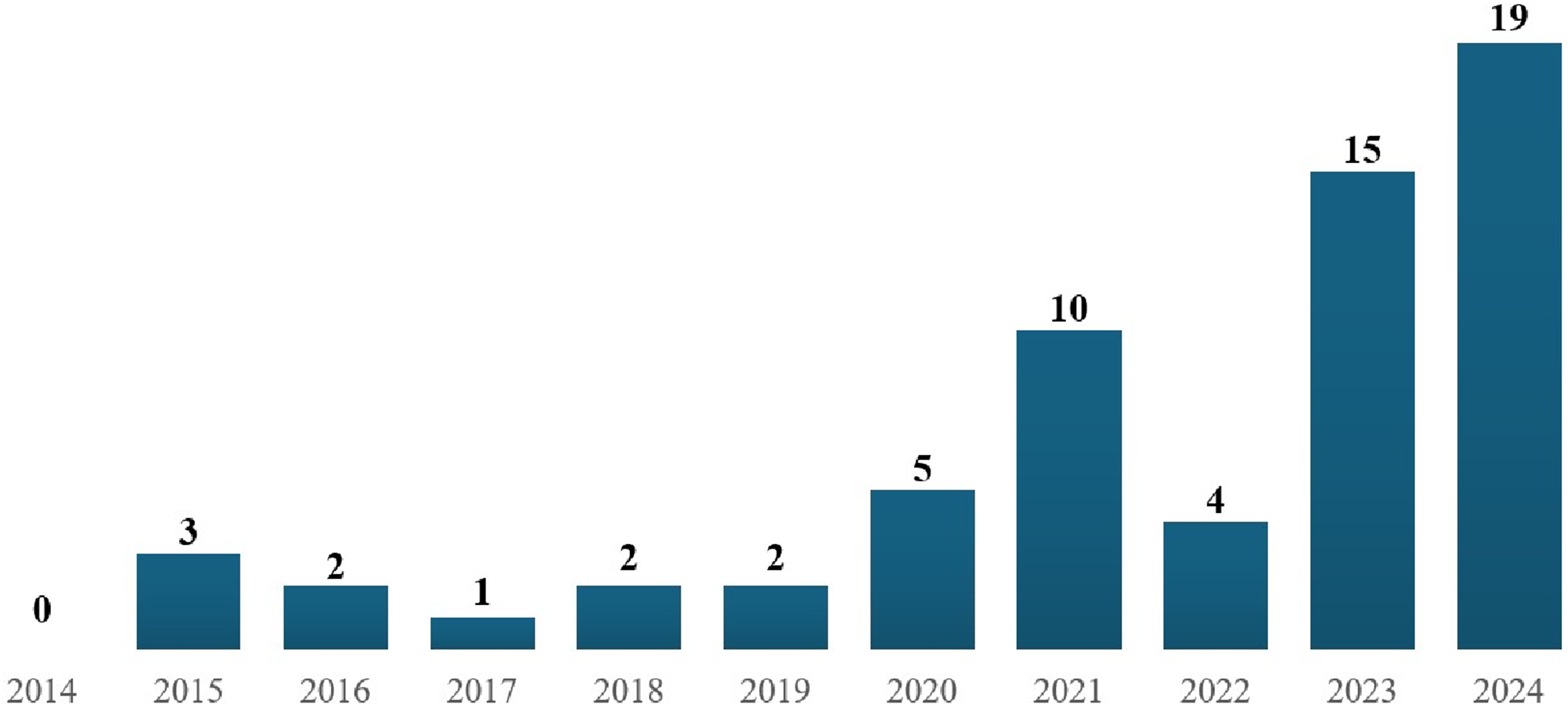
Analysis and categorisation
Since it is observed that the sudden trend is closely related to the development of AIs, the first emphasis is placed on the types of AI technologies and their respective applications. There are two categories: (1) regression-based, which refers to numeric prediction AIs, and (2) generative AIs. Generative AI can be subdivided into two main categories: convolutional neural network (CNN) or generative adversarial network (GAN)-based, which includes the early development of image recognition, image generation, such as Deepdream and Style Transfer; and transformer-based, which includes chatbots and more common image generations, such as Stable Diffusion and Midjourney. 8
This regression/convolutional neural network (CNN)/Recurrent Neural Network (RNN) categorisation is referenced to the syllabus established by computer scientist Andrew Ng, who set up the first machine learning course for Stanford University before 2021. The course was later published on the MOOC platform DeeplearningAI as free courses, titled “Machine Learning Specialisation” and “Deep Learning Specialisation”, which over 1.4 million people enrolled in at the time of Jan 2025.9,10
Regression-based AI
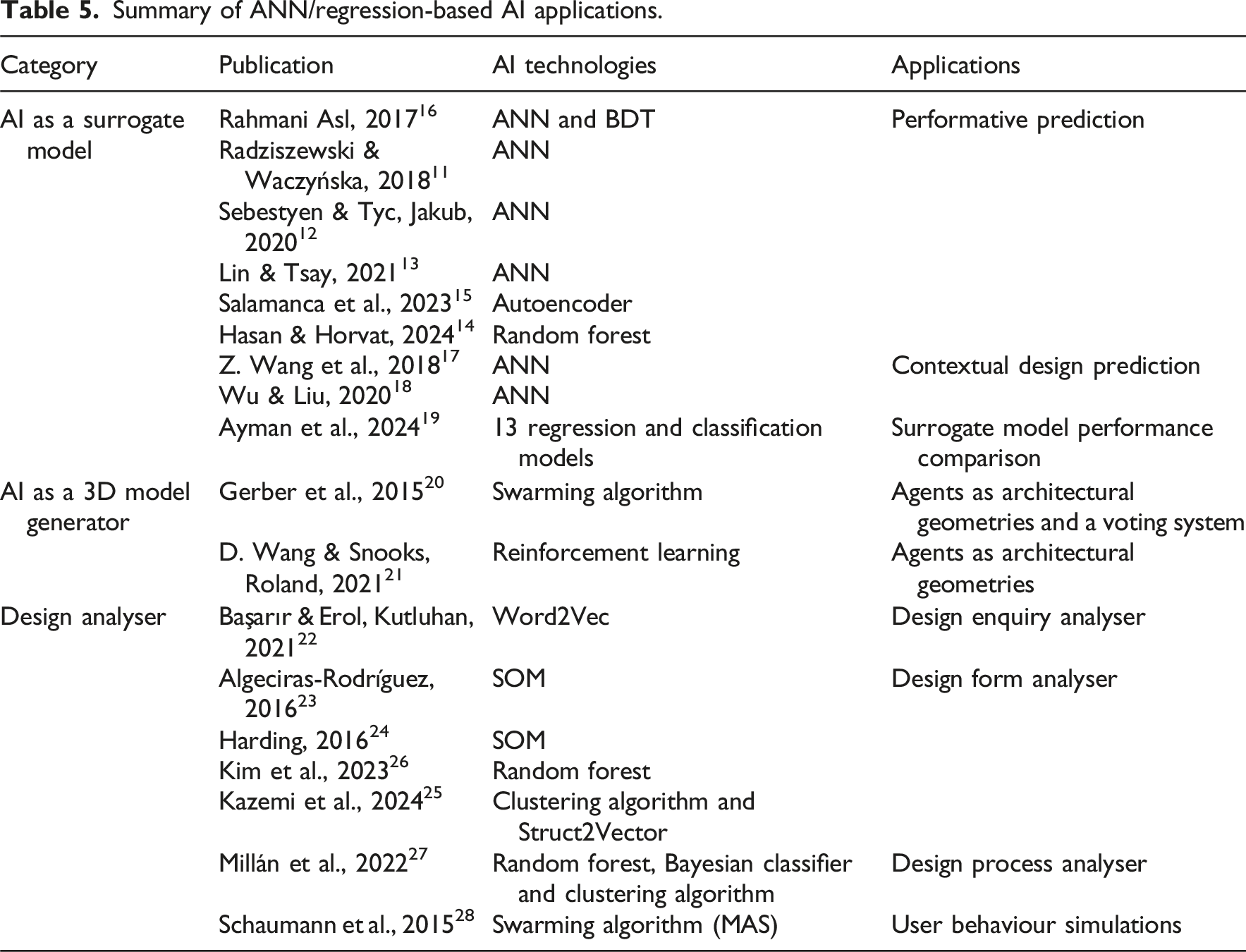
The first category consists of AIs trained for numerical prediction tasks, including methods such as artificial neural networks (ANNs), random forests, swarming algorithms. Their applications can be grouped into three main areas: (1) enhancing performative design efficiency, (2) generating 3D models and (3) supporting design analysis and evaluation.
The most common application was to use AI to train surrogate models for efficient or real-time simulation to enhance performative design efficiency. For example, in the massing model design stage, 11 Sebestyen & Tyc, Jakub 12 and Lin & Tsay 13 applied ANN as a surrogate model for more efficient daylight simulation for massing models for applying in the early-stage architectural design process. Hasan & Horvat 14 trained a random forest model to predict Solar Envelope’s Floor Space Index (FSI), and Salamanca et al. 15 trained an autoencoder as a surrogate model to quickly estimate the performance attributes for the generated massing models. Such a surrogate model approach was also applied in design aspects other than the massing model. For instance, Rahmani Asl 16 used ANN and Boosted Decision Tree (BDT) for rapid energy and daylight performance prediction for façade design. It was also explored in more site-specific, contextual design approaches. Wang et al. 17 applied ANN to suggest the pedestrian entrance location of a building site, and Wu & Liu 18 used ANN to analyse which parts of the site were good for public/private use by considering the distance from specific environmental features, specific zones and limited conditions. It showed that despite ANN being the main algorithm explored in massing model generations, other algorithms were used for more specific design feature predictions. In response to this phenomenon, in 2024, Ayman et al. 19 tested 13 different regression and classification models to compare the performances between different regression-based models. Its findings showed that Random Forest and XGBoost performed the best. Such efficient applications of the prediction model described above allow simulation to shift from a post-design evaluation tool to a real-time design tool.
The second application was to use AI as a 3D model generator. Gerber et al. 20 developed a multi-agent system (MAS) framework for integrated and performance-driven architectural design. It is composed of (1) two sets of MAS modular-based and particle-based, and (2) an AI-enhanced voting system. For the former application, a set of MAS is used to design light diffusion panel modules, while another set of agents is used to design façade porosity. For the latter application, an AI voting system is proposed to enhance the communication between two MAS. Similarly, D. Wang & Snooks, Roland 21 applied reinforcement learning with MAS, where agents serve as the design geometry (mesh-graph) themselves while evolving with design criteria (spatial coverage, topological performance, site response and hierarchical reward) as the reward for reinforcement learning.
Finally, AI was also used as a design analyser, which was explored to analyse design enquiry, design forms and design process, respectively. For example, Başarır & Erol, Kutluhan 22 used Word2Vec to process and translate textual descriptions of briefs as a design enquiry analyser. Algeciras-Rodríguez 23 and Harding 24 trained Self-Organising Map (SOM) models for analysing architectural features of the design models as an abstraction of visual information; as such, the information could be used for regeneration as 3D inspiration for future design. Similarly, Kazemi et al. 25 applied random forest for architectural and structural features detection and a decision tree for exploring the correlations between architectural and structural parameters, and Kim et al. 26 used a clustering algorithm and Struct2Vector to analyse design forms and typology for early stage design. Finally, Millán et al. 27 applied WEKA software (based on random forest and Bayesian classifier) and a clustering algorithm for the design process to help identify common problem-solving (function and spatial) design patterns. Finally, Schaumann et al. 28 applied a swarming algorithm to simulate human user behaviour, including individual and group activities.
Summary of ANN/regression-based AI applications.
Human-AI interaction environments
The review of the studies reveals that humans (both researchers and designers) primarily interacted with regression-based AIs through coding environments such as Python, Anaconda and MATLAB, as summarised in Figure 4. Although six studies did not specify the platforms used, from the AI model training and deployment descriptions and graphs in the publications, they were most probably trained and made inferences in code-based environments. There are five research studies that, after the AI models were trained in a coding environment, the application demonstrations were either conducted or claimed to be performed in architectural software. For example, five researchers deployed the trained models in Rhino and Grasshopper,11,15,17,19,24 while Rahmani Asl
16
deployed the trained model at Autodesk Dynamo Studio. Two of the MAS research projects were solely conducted within the software with user interfaces, took advantage of gaming development software such as Unity, and experiments were demonstrated using the immersive virtual environment
20
and 3D software such as Unity 3D and 3DS Max.
28
Environments of human and regression-based AI interaction from 2015 to 2024.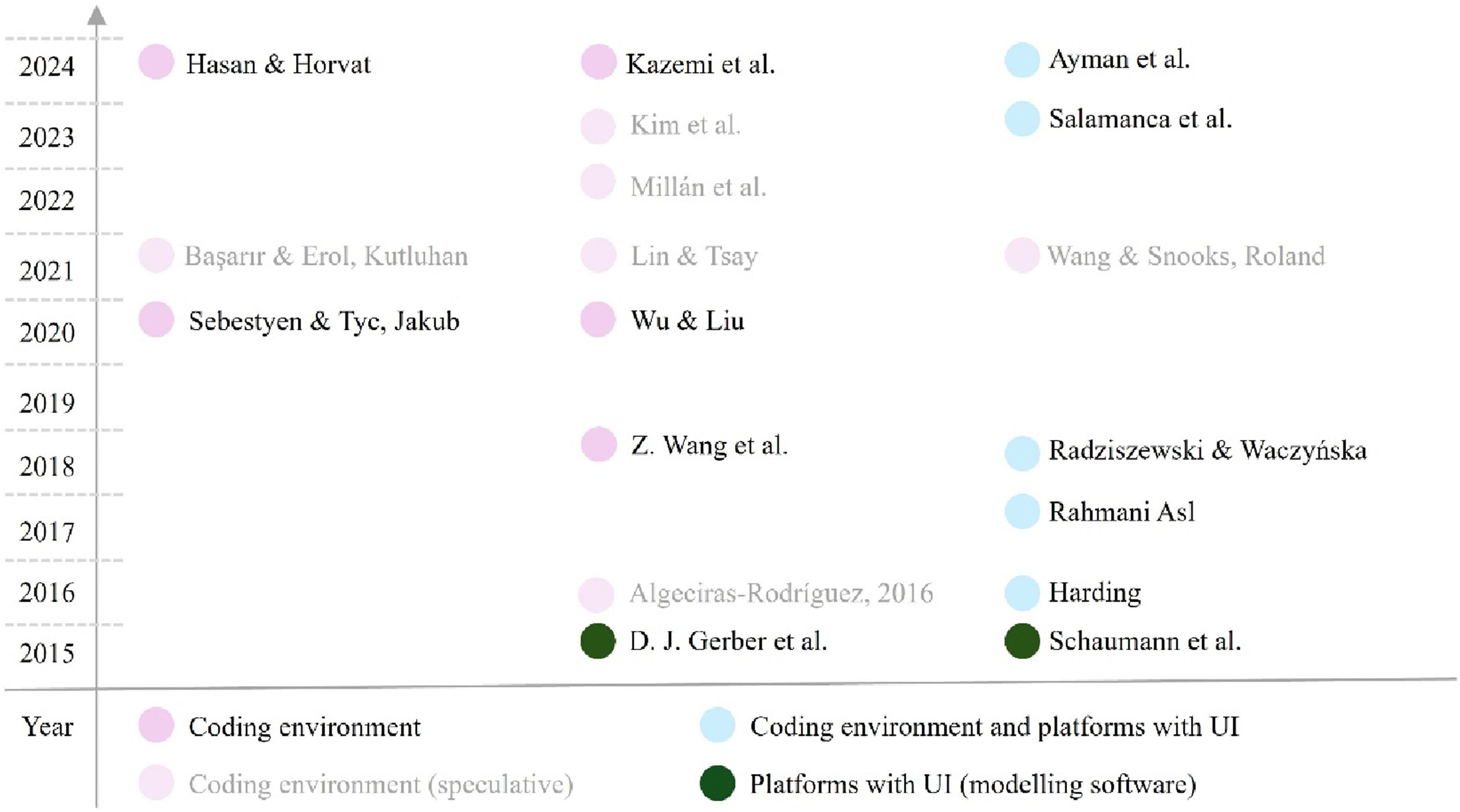
In summary, it remains inevitable for researchers to interact with regression-based AI models within coding environments, which require coding knowledge. However, there was no lack of attempts to transition the trained models into practice environments in which designers in the architecture discipline could interact more intuitively and lower the learning barrier.
Evaluation methods
For seven surrogate model efficiency-focused research papers, the AI model evaluation was based on comparing the trained AI model predictions to ground truths,14,18,25 simulation data 12 or similarities between the AI selection with students’ choices. Wang et al., 17 Radziszewski & Waczyńska 11 and Lin & Tsay 13 compared the trained surrogate model prediction time to traditional simulation methods. Three researchers took a step forward after evaluating the AI model accuracy; they demonstrated the applications and displayed images during the design process simulation.15,16,19 Seven of the 18 research papers focused on illustrating the AI application in the design process with images and verbal descriptions, emphasising the impact on the design process.20–24,26,28 Only one of the 18 researchers applied the AI model after the design process. Millán et al. 27 conducted a shelter design workshop with 52 designers; the design process images were collected and analysed using the trained AI model.
As a result, it is evident that although AI model training is crucial, most evaluation methods now prioritise demonstrating or observing how AI is used in the design process, rather than solely focusing on the efficiency or accuracy of the trained AI models.
Generative AIs (CNN/GAN-based)
Summary of CNN/GAN-based AI applications.
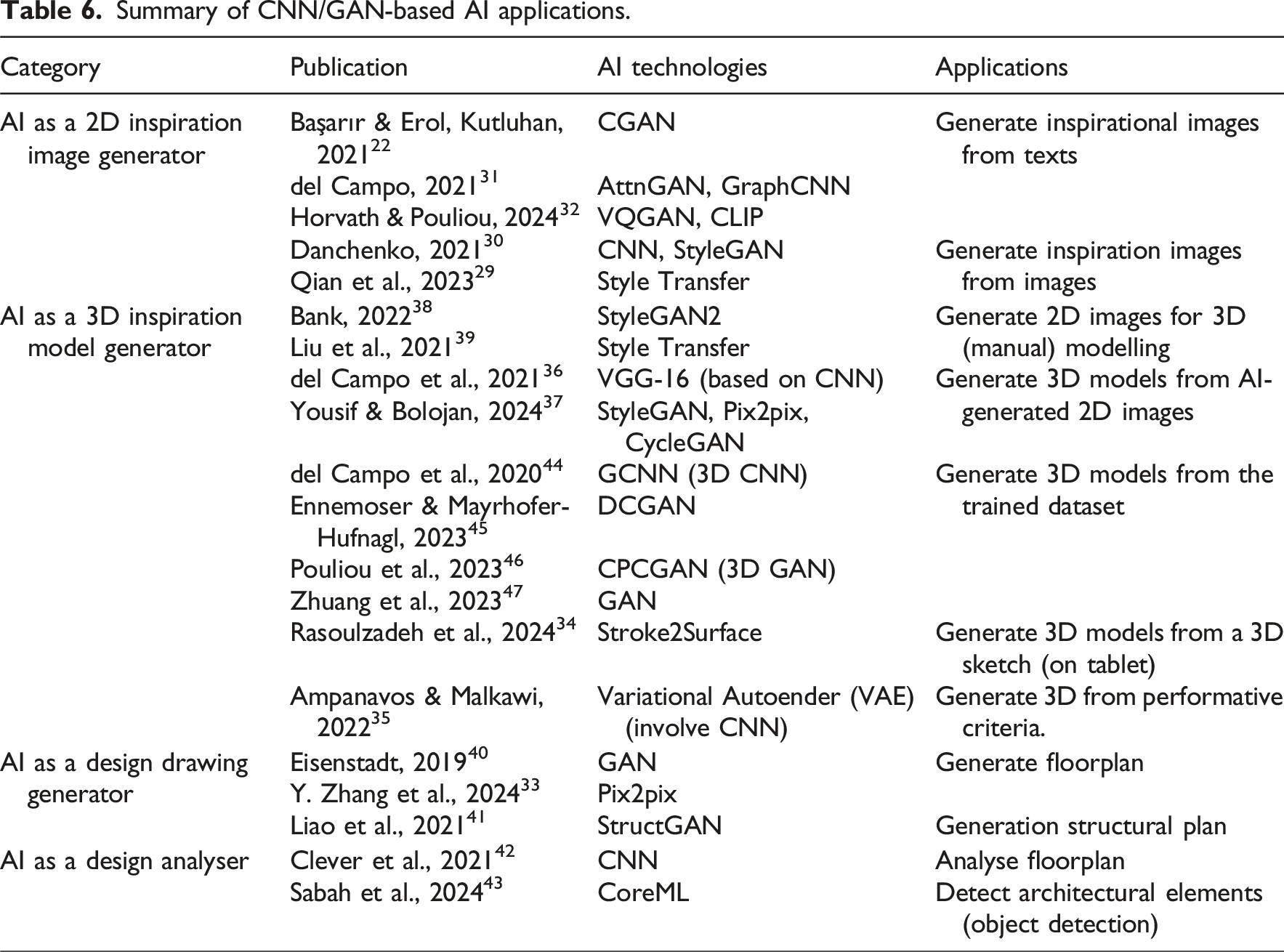
For 2D image generation, two researchers generated inspiration images from the image input. Qian et al. 29 generated sketches according to shape preferences using Style Transfer, which allows designers to provide a design image and a “style” image as a reference that the “style” would be mapped onto the original design image. Danchenko 30 used CNN to classify the clients’ intention by their selected precedent image from a dataset with about one thousand images prepared by the designer, then the designer used StyleGAN to generate three mood board images. In addition, three research processes used text descriptions as inputs to generate images. While their image generation was based on GAN, text processing had different approaches. del Campo 31 applied another GAN (AttnGAN) model to process the input texts while Başarır & Erol and Kutluhan 22 used Word2Vec, a regression-based AI, and Horvath & Pouliou 32 and Zhang et al. 33 used Recurrent Neural Network (RNN) and transformer-based AIs, which are introduced in the next category. Such observations show researchers’ awareness of connections between natural language and AI-enhanced design processes and display the potential to leverage the three types of AI technologies according to needs rather than finding the “best AI model” with the highest efficiency or prediction accuracy.
For 3D model generations, almost half of the 10 research proposals developed methodologies that generated 3D models from trained datasets, similar to regression-based AI approaches. The remaining six researchers explored 3D model generation from sketch, 34 performative criteria, 35 2D design images36,37 or proposed manual computational processing in 3D modelling software such as Rhinoceros and Grasshopper from a series of AI-generated 2D images.38,39 This shows a trend of merging AI generation into the common design workflow, rather than treating it as a standalone AI application.
Despite GAN and CNN being novel technologies in generating 2D images or 3D models, there were researchers leveraging the generative properties of the AI models to generate architectural information, such as floor plans33,40 or structural plans, 41 instead of pixelated inspiration images. Others utilised GAN’s and CNN’s image recognition capability for floorplan analysis 42 and architectural elements detection. 43
As observed from Table 6, research projects on CNN/GAN-based AI applications in the architectural design process were conducted between 2019 and 2024; 75% of them focused on the generation of inspiration 2D images or 3D models. Three of the twenty used AIs to generate design drawings such as floorplan and structural plan, and two studies focused on image-recognition capability to act as design analysers. Special attention is placed on several studies that integrated regression-based or RNN/transformer-based AIs to support the image processing functions of CNN/GAN-based AIs as a holistic workflow. This raises awareness of potential integrative application of different AIs rather than targeting the “best AI” with the highest speed or accuracy.
Human-AI interaction environments
In this section, the studies reveal various environments which researchers and designers interacted with CNN/GAN-based AIs, as summarised in Figure 5. Environments of human and CNN/GAN-based AI interaction from 2019 to 2024.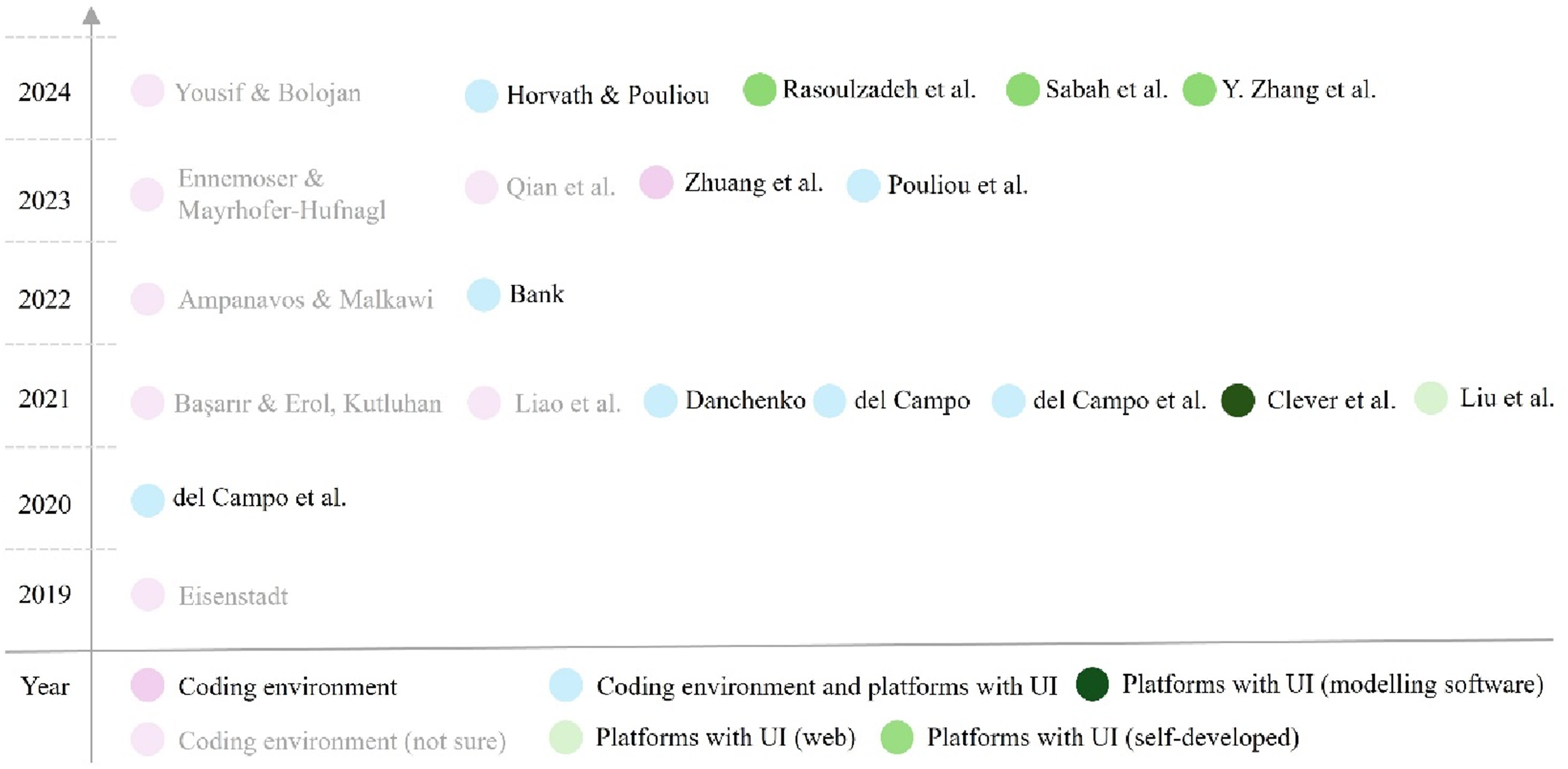
More than half of the AI application demonstrations were conducted on platforms with UI, showing a significant increase compared to regression-based research projects (Figure 4), where most studies were performed within code-based environments.
For example, the 3D model generation and post-processing were performed in 3D modelling software, including Rhinoceros and Grasshopper, 31 Zbrush, 36 Maya 44 and Revit Dynamo. 46 On the other hand, although 2D image generation AI models were trained in code-based environments, several researchers deployed the trained image-generation models onto user-friendly web-based platforms such as RunwayML.30,38 This allowed researchers to test the models more efficiently and enabled participants to interact with the systems intuitively without engaging with the underlying code. Similarly, one-fourth of the studies were performed solely on UI-equipped applications, especially in 2024, with more focus on the design applications, which include 3D modelling software such as Revit Dynamo, 42 web applications, 39 a self-developed application on the website, 33 smartphone 43 and a VR device. 34
Notably, two of the eight studies conducted primarily in code-based environments incorporated natural language processing (NLP), allowing researchers and designers to interact with the AI systems with minimal coding. 22 This suggests that NLP can ease the cognitive load associated with programming in ill-defined, design-oriented research scenarios 22 by enabling a smoother switch between hard-coding and natural-language–based AI tool preparation and application. 32
To conclude, CNN/GAN-based AI research projects conducted between 2019 and 2024 displayed an increasing trend of expanding human-AI interactions from the primarily code-based environment to NLP or existing platforms with UI or even self-developed applications. This trend shows the importance of lowering the learning barrier for researchers, designers and users to interact with AI technologies with a minimum learning curve.
Evaluation methods
Only four research evaluations were solely based on AI model accuracy, comparing the AI predictions to ground truths,42,47 the engineer’s solution, 41 performance efficiency. 35 Qian et al., and Zhang et al.29,33 took an additional step by demonstrating the visual outputs after testing the AI model accuracy, and one of them performed additional ablation studies and surveys for users’ feedback. 34 This demonstrated the effort to transition the technical research of AI training methodology to real-world design implications. Two researchers who developed their own AI platform focused on demonstrating the use of the platform and displaying visual outputs as a proof of concept.22,45
The majority (fourteen of the twenty remaining research papers) placed the focus on demonstrating the AI-enhanced design process as a proof-of-concept. For example, del Campo 31 and Horvath & Pouliou 32 demonstrated the proposed workflows in competition entries. Eisenstadt, 40 Liu et al. 39 Del Campo et al. 36 and Sabah et al., 43 demonstrated the workflow by presenting process images visually and describing them verbally. Pouliou et al. 46 took a step further than presenting the AI-enhanced design outputs to 34 practitioners for opinions, and Danchenko 30 reflected and iterated an improved human-AI design framework after observing the demonstration results.
More importantly, some researchers involved external parties to validate the workflows. For instance, Bank 38 tested the proposed framework in a course for a semester with 60 students for a house design, followed by observation of three different selected students’ approaches. Yousif & Bolojan 37 held a workshop for 24 students, divided into six groups, followed by applying entropy measurement of the linkography created from design process observations.
Generative AIs (RNN/transformer-based)
RNN/transformer model is responsible for encoding and decoding data sequences, and allows receiving and outputting sequences containing text, audio, and images.48,49 Therefore, RNN/transformer-based AI models allow multi-modal applications such as Stable Diffusion, which allows text-to-image generation and image-to-image generation, or Generative Pretrained Transformers (GPT), which allows verbal discussion with image attachment. Please note that in this article, GPT refers to the AI model architecture, which is not limited to ChatGPT, which is one of the many examples of AI applications based on the GPT architecture.
Summary of RNN/transformer-based AI applications.
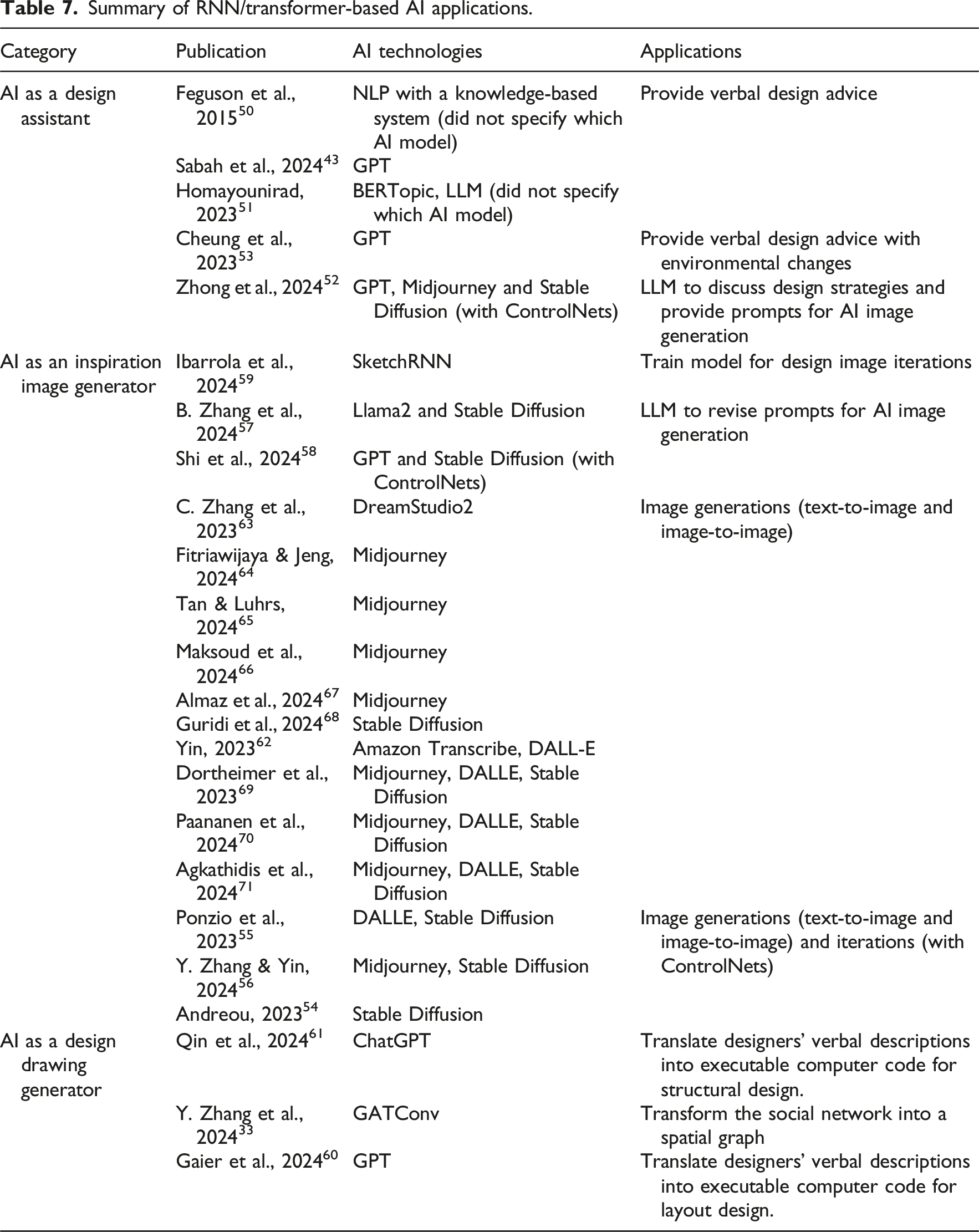
The majority of the transformer-based research papers (fifteen of 23) are categorised under the second application: AI as an inspiration image generator. Thirteen research projects used one or more AI models for text-to-image and image-to-image generation, such as Midjourney, DALLE and Stable Diffusion, to produce inspirational design images. Three studies incorporated an additional step by applying Stable Diffusion with the ControlNet plugin, which enables image generation while preserving selected features of the designer’s design image (e.g. edge detection), ensuring that the output follows the geometry of the massing model.54–56 B. Zhang et al. 57 and Shi et al. 58 also used LLM, including Llama and GPT, to refine prompts for image generation with the mentioned tools. Despite the mentioned AI tools being pre-trained for immediate use, Ibarrola et al. 59 trained a SketchRNN model for specific early-stage design sketch use.
Finally, AI was also applied as a design drawing generator. For example, Gaier et al. 60 and Qin et al. 61 used GPT to translate designers’ verbal descriptions into executable computer code for structural design and layout design drawings, respectively; and Y. Zhang et al. 33 used GATConv to transform the social network to a spatial graph, as a reference for floorplan design.
As observed on Table 7, with one exception of a research project in 2015, all RNN/transformer-based research papers were published between 2023 and 2024, potentially due to the rise of pre-trained LLM and AI image generators, allowing immediate use after 2022. Combinational applications among LLM and different AI image generators are observed, especially five research papers that used AI as a design assistant, allowing LLM to discuss and provide explicit design advice, which gradually transformed the role of AI from a prediction/generation tool to an evaluation and discussion design partner. It is worth noting that several researchers proposed how the AI application could be streamlined as part of 3D design modelling 55 or parametric design workflow. 62 It is speculated that due to the user-friendliness of pre-trained LLM and AI image generators, there was less cognitive load for the researchers; therefore, they could focus more on the AI’s implications in the design process.
Human-AI interaction environments
The interaction environments with RNN/transformer-based AIs, which were focused between 2023 and 2024, with one exception in 2015, was summarised in Figure 6. Seventeen of the 20 research studies were performed on platforms with UI, which showed a prominent increase compared to regression-based (Figure 4) or CNN/GAN-based AIs (Figure 5). Three studies integrated the AI application into 3D modelling software, such as the Revit plugin
50
and part of the Grasshopper script in Rhinoceros.53,71 Four researchers developed their platforms for users’ intuitive applications, such as web applications33,57,62 and drawing platforms.
59
Eleven studies were conducted on existing web applications, including Midjourney, ChatGPT, Stable Diffusion, DALL-E, and DreamStudio. Only the remaining three studies were conducted in code-based environments, which involved the training or deployment of AI models that were not pre-trained, such as GPT or Stable Diffusion. Environments of human and CNN/GAN-based AI interaction from 2019 to 2024.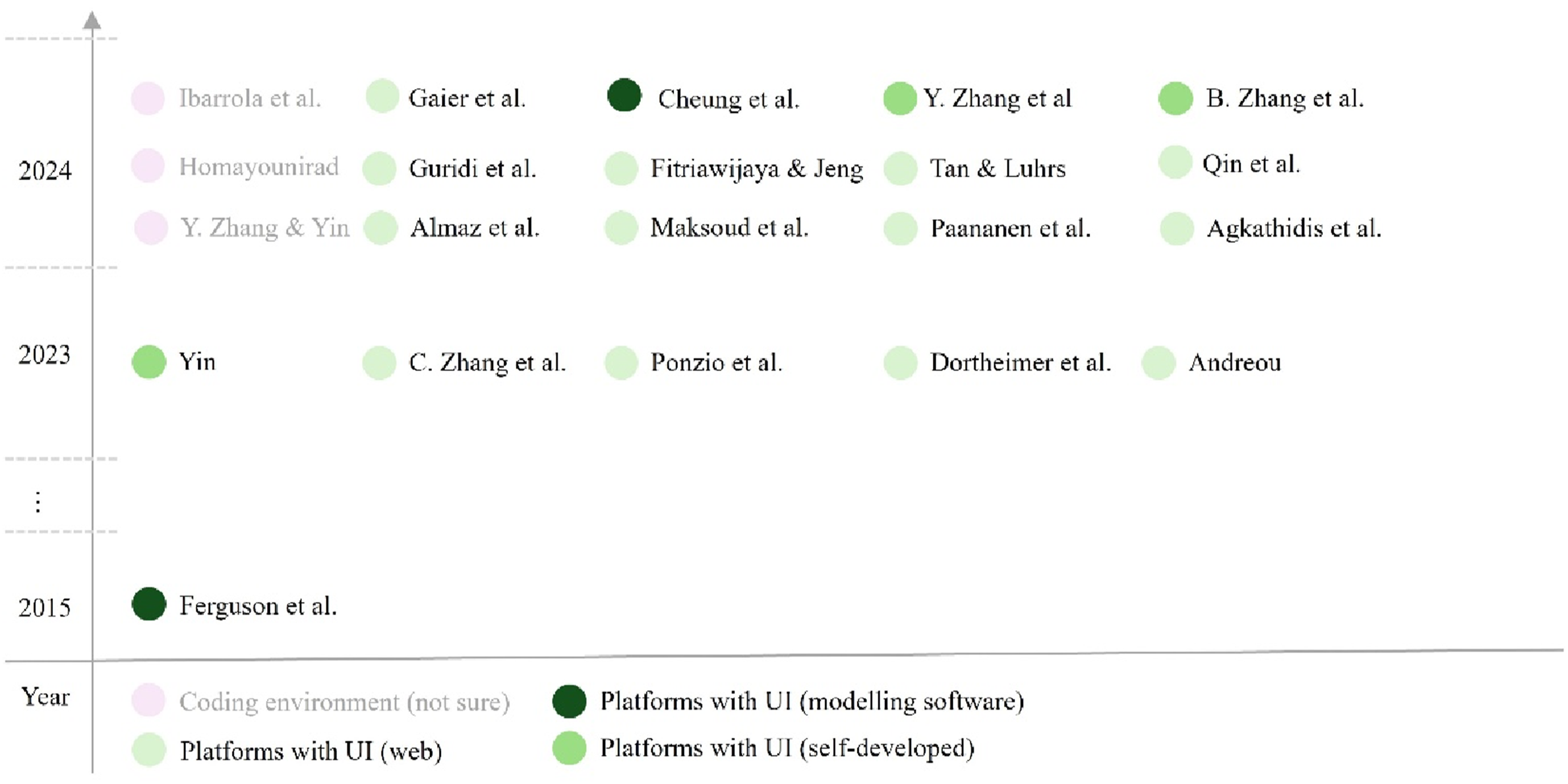
In conclusion, it is observed that for RNN/transformer-based AIs, the human-AI interaction environments are mostly UI-based, which allow immediate and intuitive applications for experimentation by researchers and designers. The observed trend of embedding necessary AIs into self-developed platforms, including web applications and portable devices (e.g., tablets), continued in 2024.
Evaluation methods
Only one study was evaluated based on AI model accuracy. Y. Zhang & Yin 56 described an accuracy evaluation method for the trained LoAR model, followed by observing designers’ image generations. Instead of accuracy, efficiency comparisons were made between the proposed AI workflow efficiency and the traditional methods.50,61 Most research focused on demonstrating the proposed AI-enhanced workflow. Nine researchers presented the design process image visually and described verbally.8,52,55,60,62,64,65,67,68 Some studies went beyond demonstrations by involving participants to test with the AI systems. For instance, B. Zhang et al. 57 shared the developed web application for 2 months, and one thousand seven hundred sessions were recorded. C. Zhang et al. 63 evaluated further with a qualitative evaluation. After they tested the proposed workflow with eleven architecture graduate students with a median work experience of 2 years, they conducted interviews for designers’ feedback and analysis together with observational data collected during the design task.
Several researchers included quantitative evaluations after demonstration and observation. For example, Homayounirad 51 counted usable outputs from the experiment participants. Agkathidis et al. conducted surveys with 18 student participants who used AI tools in the proposed framework for a semester in a design studio. 71 They compared the marks of their design projects with those of studios that did not apply the AI-enhanced framework. Dortheimer et al.’s69 data collection included screen recording during the participants’ design processes, then the percentage of different AI tools usage and the percentage of successful image generation rate were measured. Maksoud et al. 66 first listed design enquiry criteria, then evaluated scores by measuring the success rate of the AI image generations against the criteria. On the other hand, Andreou 54 generated a new design model by referencing AI-generated images, and then compared the energy performance of the original design with the AI-informed version. Alternatively, Ibarrola et al. 59 evaluated the 12 participants’ design results based on “output diversity”. Finally, Paananen et al. conducted three design sessions where five to six students worked on the same design task individually for about one and a half hours. They then evaluated using a preset Creativity Support Index (CSI). 70
In conclusion, with three exceptions of research evaluation based on AI accuracy or efficiency compared to traditional design workflows, the remaining 17 research papers focused on design process demonstration and observations, including six applied quantitative measures based on the design process and design outputs. Overall, it shows a significant shift from accuracy-based to design process observation and design output-based evaluation, compared to regression-based and CNN/GAN-based AI applications.
Findings
Findings are presented according to the three research questions introduced in the Introduction Section. The following sub-sections first synthesises how different AI technologies are applied in early-stage architectural design processes (response to RQ1), and focuses on the designer-AI interaction environments (response to RQ2). Then, it analyses how AI-enhanced design processes and design outputs are evaluated (response to RQ3), followed by a proposed framework for future research on the AI-enhanced conversational architectural design process.
AI as a conversational, agentic design partner
This section responds to the first question, “How do we utilise AI technology in the conversational architectural design process?”. From the reviewed studies, it is concluded in Figure 7 that the three types of AI technologies support six design applications, including (1) surrogate model, (2) design analysis, (3) image generation, (4) model generation, (5) design drawing generation and (6) design assistant. Due to its real-time processing capability, ANN/regression-based AIs were mainly used as surrogate models to allow traditional post-design performance simulation to become part of the design process. They were also explored for design analysis due to their numeric prediction attributes. Despite CNN/GAN-based AIs being explored for design analysis and design drawing generators due to their image processing capability, they were primarily used for inspiration images and model generations. Also, the combined applications of different AI tools as a workflow became more common, rather than experimenting to find the “best AI”. This phenomenon was even more dominant for RNN/transformer-based AIs due to their multimodal data processing and the rise of user-friendly AI chatbots and image generation applications such as ChatGPT and Stable Diffusion. AI technology categories and applications.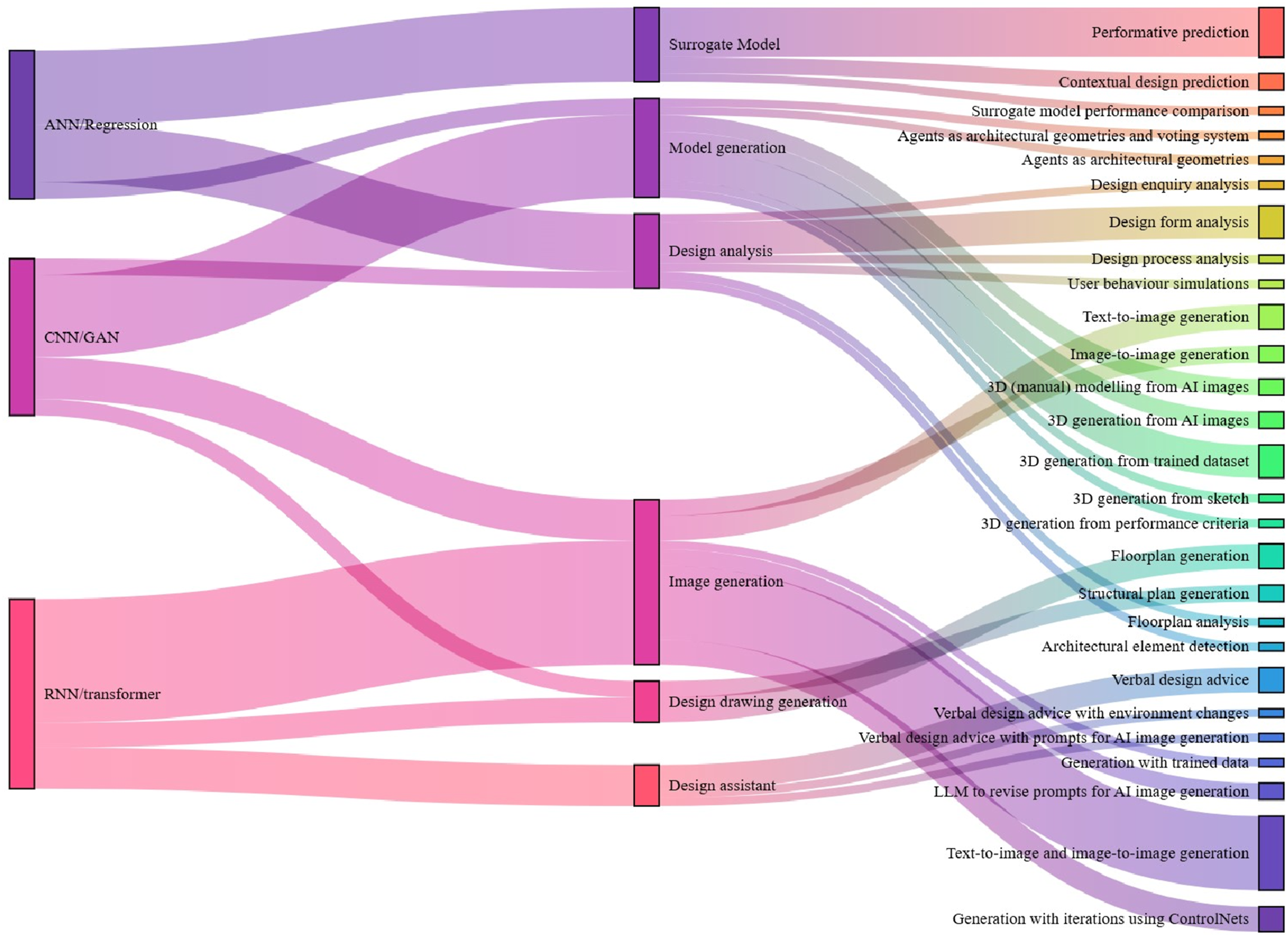
It is noteworthy that since the RNN/transformer-based AIs were explored, five research projects explored AI as a “design assistant” that the AI could have iterative, multimodal dialogues with designers. These studies described the role of AI as a “design partner”, referencing Gordon Pask’s Conversation Theory, rather than a passive question-answering machine, 53 a “mediator”, which “provides an informed choice from acceptable options”, 54 and a “negotiation and coordinator”. 20 They also identified designers and AI agents as a collaborative “deliberative assistant system” 51 for “human-machine collaboration” 38 and the human-AI interaction targeted “novelty over quality (high resolution)”. 59 All the mentioned descriptions involved a mutual learning process between designers and AI, aiming to reach an agreement, which can be concluded as “conversational” properties, as coined by Gordon Pask. 53 To achieve such a vision, the agentic AI technique, which enables AI to plan how to respond and use tools strategically, is a potential candidate,37,61 leveraging the attention mechanism within the transformer-based AIs, such as LLMs. 60 However, it is underexplored in empirical research at the moment.
Intuitive and collaborative platforms for stakeholders
This section responds to the second research question, “Through which interaction environments do designers interact with AI during the design process?” The trend of interaction environment used for human-AI interaction is shown in Figure 7.
Despite the fact that coding environments are inevitable for training specialised AI models, there is a steady trend of using platforms with UI for AI model deployments. With the emergence of pre-trained AI chatbots and image-generation tools such as ChatGPT and Midjourney, an increasing number of studies have shifted from code-based experimentation to using user-friendly, web-based applications since 2023. Similarly, the number of studies performed on self-developed applications, such as web or tablet applications, for intuitive experimentation increased with similar patterns. The observed trend indicates that researchers are increasingly prioritising user acceptance and usability in AI studies and experiments. For AI training stages, where working within coding environment is unavoidable, Ayman et al. stated the potential improvement by integrating LLM to enhance code-intensive processes. 19 For research projects with code-based AI deployment, the potential integrations in BIM 30 or 3D modelling software were demonstrated. 11
From a technical perspective, Horvath & Pouliou stated the importance of awareness of the switch between coding language and application (natural) language of the AI design process, which reinforced the importance of exploring agentic AIs, where LLM could act as a “controller” within the research and design process, 32 echoed Gaier et al.’s and Qin et al.’s studies that translates verbal descriptions into executable computer code for design actions.60,61
Finally, the evidence suggests that user-friendly platforms foster inclusive participation in design process experiments, involving designers, 62 consultants51,62 and potential end-users. 33 Although this inclusivity enhances the real-world implications, it remains underexplored in the presented studies. Accordingly, there is a pressing need to develop and examine intuitive and collaborative AI-enhanced design processes.
Design process and output-based evaluation
This section responds to the third question, “How have existing studies evaluated the applications of AI in architectural design?”. The trend of evaluation methods is shown in Figure 8. Echoing the human-AI interaction environment trend, where more platforms with UI were applied for design experimentations, there is a prominent shift of AI-enhanced design process evaluation focus from AI prediction accuracy evaluation to demonstration and observation. Since 2021, the number of studies conducting workshops, followed by post-workshop quantitative and qualitative analysis, has increased drastically. The trend of human-AI interaction environments.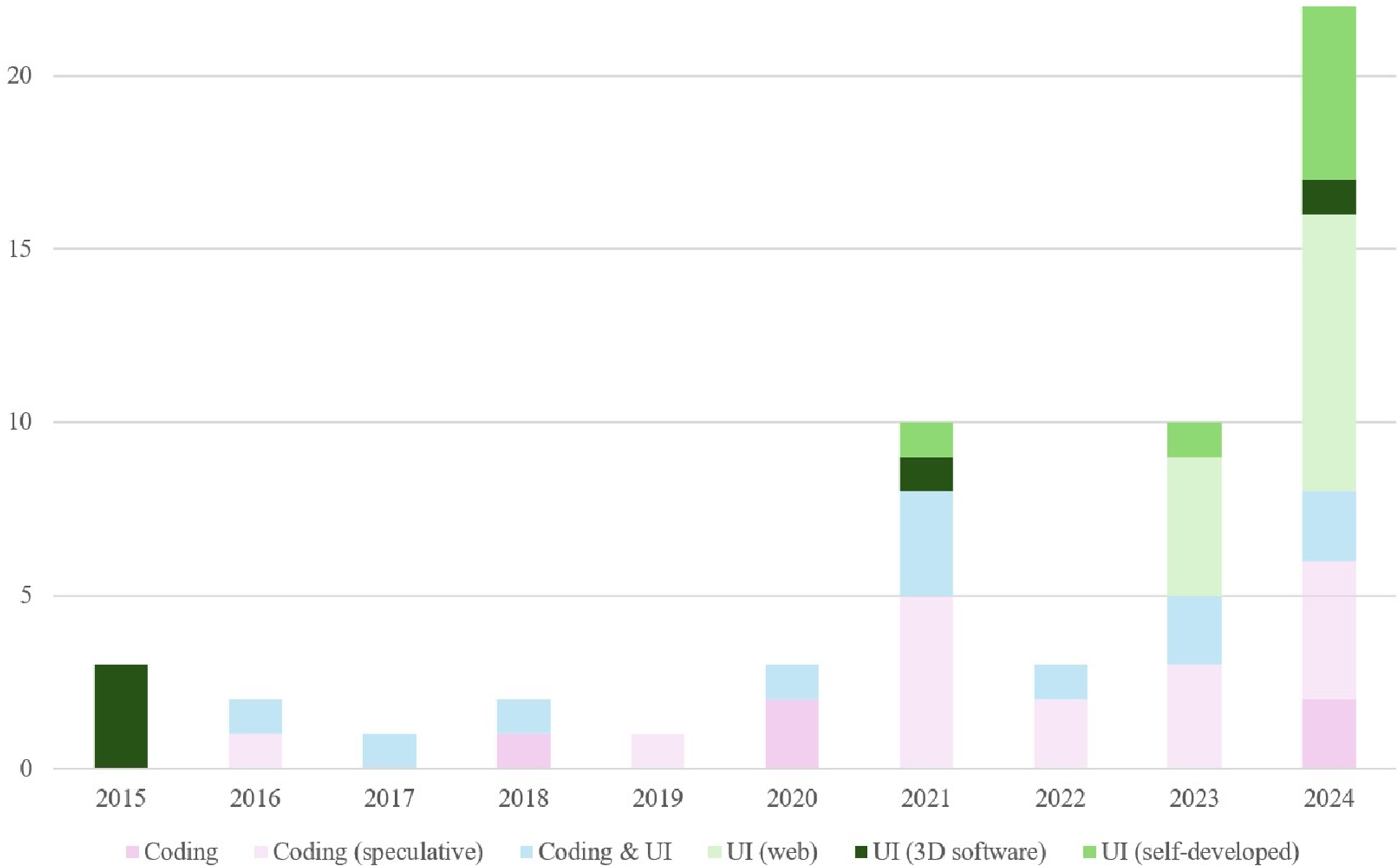
Therefore, instead of evaluating the proposed AI technologies themselves, the evaluation focuses on the design process framework and design outputs. Rather than aiming for AI prediction accuracy, Dortheimer et al.
69
stated the proposed AI shall be “reducing creative fixation” and “better understanding human intent”, and quantitative evaluation based on design outputs, such as measuring “output diversity”
59
and Creativity Support Index (CSI)
70
were presented. Other quantitative methods included designers’ surveys by scoring the design experience
63
and measurements of the usable rate of AI outputs.51,66,69 Extending to the aspect of design thinking, researchers also evaluated AI-enhanced design processes by analysing different modes of human-AI design collaboration according to design process observations, such as convergent or divergent design thinking (Figure 9).55,65 Human-AI design evaluation trend.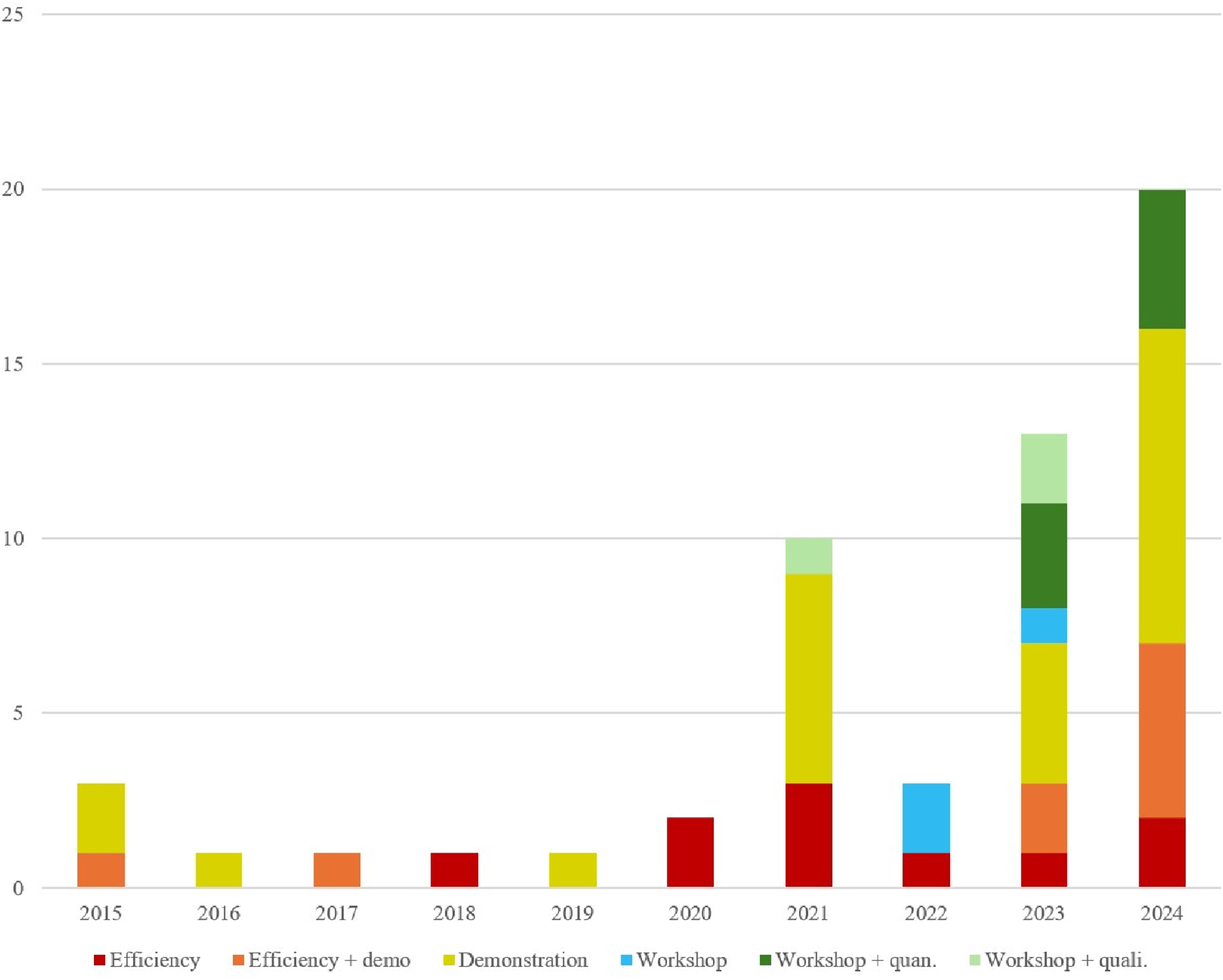
Key principles for an AI-enhanced architectural design process
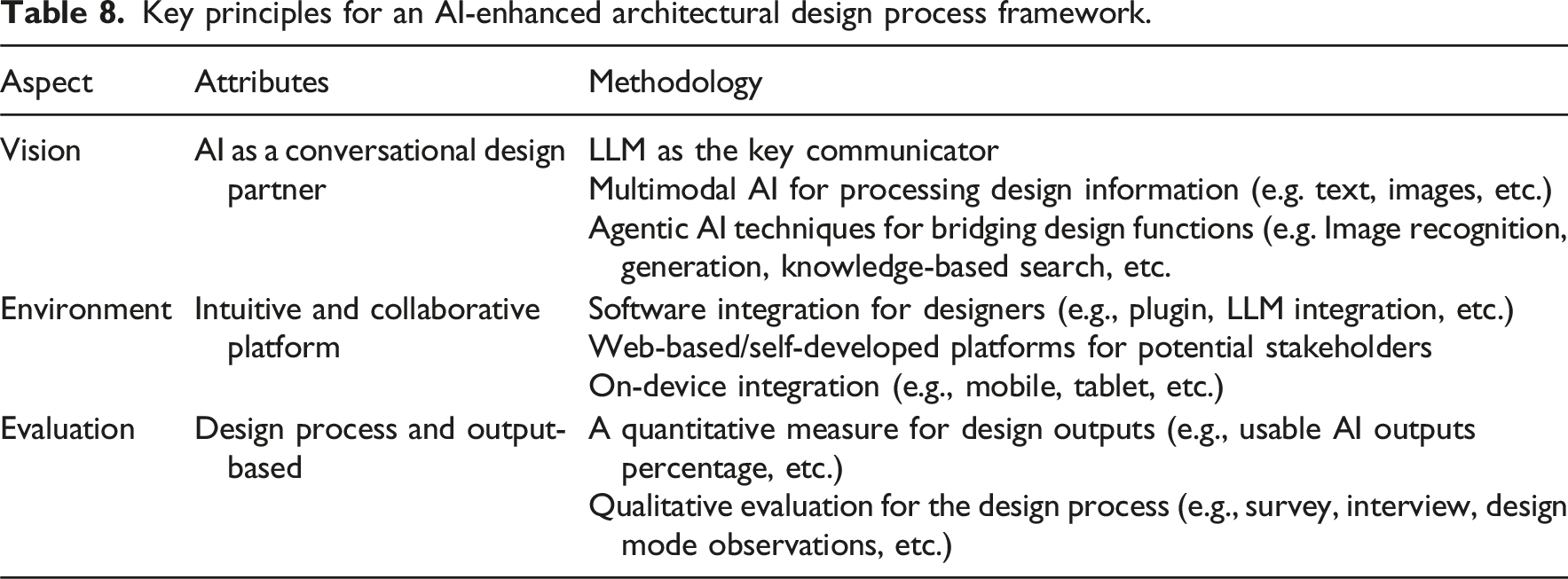
After analysing the research papers above, key principles for an AI-enhanced architectural design process framework are concluded in three aspects: (1) Vision, (2) Environment and (3) Evaluation.
It is envisioned that AI acts as a conversational design partner that allows a continuous and iterative design discussion with the designers, whereas LLM acts as the key communicator with the designers due to its natural language processing capabilities, which enables immediate communication with users with no technical barrier. Multimodal AI is advised to be integrated into architectural design processes, such as image recognition for design analysis and image generation for design iterations. To enhance the human-AI iterative dialogues, agentic AI techniques shall be investigated, which extend AI’s capabilities from providing specific functions to being flexible to adapt to different design enquiries and scenarios.
The human-AI interaction environment shall be developed on an intuitive, collaborative platform that minimises the learning curve for users to navigate the platform. For one designer scenario, AI can be integrated into the specific 3D modelling software for seamless communication and model iteration within the modelling environment. For multiple designers’ or stakeholders’ collaboration, AI applications can be deployed on web-based or self-developed platforms, such as a group messaging environment, which minimises the cognitive load for users to navigate the interface. For more participatory design scenarios, such as community planning projects, on-device integration, such as mobile or tablet applications, could be easily accessible to the public.
Key principles for an AI-enhanced architectural design process framework.
Proposed framework for a conversational AI-enhanced architectural design process
According to the findings above, a framework for a conversational AI-enhanced architectural design process is proposed (Figure 10). It is envisioned that AI is positioned as a conversational design partner by leveraging the intuitive human-AI communication capability of LLM and the multi-functional adaptivity of a multimodal, multi-agent system. The environment for interaction between designers and the AI systems is primarily in group chat environments, in either instant messaging platforms such as WeChat or Discord, or web-based applications, which minimise the designers’ learning curve. To validate the proposed framework, conducting design workshops with small groups of designers is advised. To evaluate and improve the proposed system, a hybrid evaluation method is proposed. Quantitative methods include pre-workshop and post-workshop surveys and counts of usable human-AI interactions, while qualitative measures include semi-structured interviews to assess designers’ feedback. Proposed AI-enhanced conversational architectural design process evaluation framework.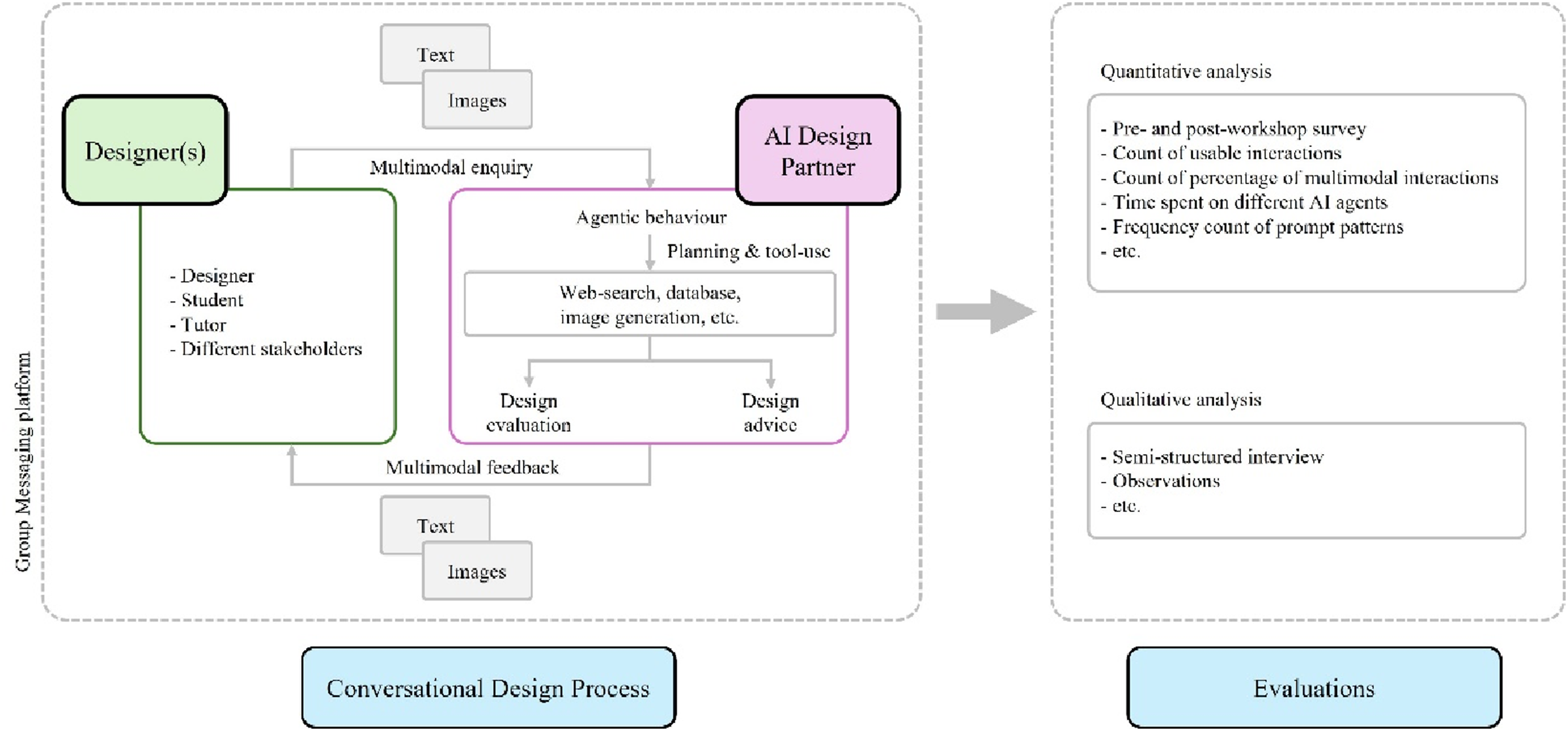
Discussion and limitations
This systematic review addresses the limitations of current reviews in the field of AI-enhanced architectural design process, where they lack design process focus, exclusive coverage of AI technologies and under-exploration of the environments for human-AI interaction. This proposed key principle for an AI-enhanced architectural design framework highlights the vision of AI as a conversational design partner, facilitating iterative discussions with designers through natural language processing. Integrating multimodal AI, including image recognition and generation, is recommended for design analysis and iterations. Agentic AI techniques should be explored to enhance flexibility in responding to diverse design inquiries. The interaction environment should be an intuitive, collaborative platform to reduce the learning curve. In single-designer scenarios, AI can be embedded in specific 3D modelling software for seamless communication. For collaborative efforts among multiple designers, web-based platforms or group messaging environments are ideal. Community planning initiatives could utilise accessible mobile or tablet applications. For evaluation, quantitative methods, such as tracking usable AI output percentages, can provide insights for improvement. Qualitative methods like surveys and interviews can capture detailed feedback on the design process and outputs.
Implications to research, design practice and education
Amidst the rapid emergence of AI technologies, this study provides an overview of their applications in the architectural design process. The identified key principles offer guidance for researchers to develop AI-enhanced design frameworks and tools. Positioned as an efficient “cookbook” for researchers, this work clarifies the suitability of ANN-based AIs for training surrogate models that generate immediate performative predictions. It further advocates for integrating AI within 3D modelling software, where LLMs facilitate intuitive, natural language-based communication between designers and AI systems. For evaluation, on top of the accuracy comparison between the AI prediction and simulation results, the researcher could analyse the conversational history between the designer and the AI bot and prepare a post-workshop survey and interview for designers’ feedback as a holistic evaluation framework. Similarly, the evaluation methods could benefit architectural design education. Since it is becoming more common for architecture courses to experiment with integration with AI tools, tutors could prepare a collaborative design discussion room where tutors and students can converse with AI bots in a group messaging environment. The AI bot could be equipped with a knowledge base about the design brief. Evaluation could be focused on assessing divergent and convergent thinking based on the design process throughout different stages of the design project. These two examples demonstrate the potential implications of the key principles in current situations, avoiding cognitive overload for researchers and tutors to prepare for an AI-enhanced architectural design process framework with the exploding development of AI technologies.
Design process and output-based evaluation
Although the study provides an overall view of the AI-enhanced architectural design process, several limitations exist. Since AI technology is developing rapidly, the latest AI applications in the architecture field might be neglected in this study. Although the proposed principles primarily focus on the mode of the human-AI collaborative design process, revolutionised AI applications might impact the discussed principles. For instance, ChatGPT and Midjourney caused a dominant shift in AI-enhanced design processes since 2021. Also, ethical issues such as data bias, potential copyright and plagiarism are not explored. They are crucial to be taken into consideration before real-world practice implementation. Future research studies could be conducted by carefully considering the ethical challenges, followed by applying the proposed principles for an empirical study with a developed multimodal, agentic AI tool for design collaboration.
Conclusion
This paper reports on a systematic review process that, from an initial pool of 1138 results from 8 databases between 2014 and 2024, resulted in an analysis of 63 papers. They are categorised into three categories according to the types of AI technologies, including regression-based, CNN/GAN-based and RNN/transformer-based. Each category is further studied according to three aspects: (1) AI applications in the design process, (2) the environment of human-AI interaction, and (3) design process evaluation. After discussing the trends and limitations of the current research, three key principles for the AI-enhanced architectural design process are established. The role of AI in architectural design is anticipated to be that of a conversational design partner. The ways in which humans and AI interact should be collaborative and intuitive, with evaluations focused on the design process and its outcomes. Then, a novel, comprehensive framework for a conversational AI-enhanced design process is proposed, including vision, human-AI interaction environments and evaluation methods. Finally, the research implications are discussed alongside the identified limitations and future research opportunities.
Footnotes

Funding
The authors disclosed receipt of the following financial support for the research, authorship, and/or publication of this article: This work was supported by the Xi’an Jiaotong-Liverpool University under XJTLU Postgraduate Research Scholarship (PGRSB211206).
Declaration of conflicting interests
The author(s) declared no potential conflicts of interest with respect to the research, authorship, and/or publication of this article.
Data Availability Statement
Data sharing is not applicable to this article as no new data were created or analysed in this study.