




Abstract
The ideational power framework developed by Carstensen and Schmidt has sought to make explicit the manner in which ideas can exert an influence over policy outcomes. However, one key feature of this theoretical framework has not yet been adequately conceptualised: the communicative process through which policy entrepreneurs convey their ideas to the general public. This article focuses on one specific form of communicative discourse as a means of generating widespread public support for a given policy proposal: public discourse via the media – be it print, broadcast or social media. We argue that the ideational power literature should recognise the media as a powerful entity in its own right rather than merely depicting the media as an implement for political communication. We contend that the ideational power framework could usefully incorporate a characterisation of the media that has recently emerged from political communications research: the hybrid media system. In order to illustrate how the communicative process inherent in ideational power can be understood in terms of a hybrid media system, we undertake a comparative review of two empirical studies which assess political discourse during the 2016 US presidential election from the perspectives of ideational power and hybrid media systems.
Introduction
The role of ideas – that is, causal beliefs about economic, social and political phenomena – in influencing policymaking and political change has garnered an increasing amount of attention over the last two decades in research emanating from the fields of political economy, public policy and political science. In the course of these related strands of research, ideational processes have been found to be influential in the setting of policy agendas, in shaping the content of reform proposals and in underpinning reform imperatives. 1 Building on this ideational scholarship, the emergence of the concept of ideational power offers an opportunity to make explicit the means through which ideas exert this influence over policy outcomes. A notable contribution to the ideational power literature has come in the form of the Carstensen and Schmidt (2016) ideational power framework, in which ideational power is categorised in three ways: as a process of persuasion based on ideational content (power through ideas); a coercive power as actors seek to control which ideas enter into public debate (power over ideas); and an institutionalised power, as certain embedded ideas serve to structure subsequent thinking (power in ideas). Carstensen and Schmidt (2016: 322) define the exercising of ideational power as involving ‘actors seeking to influence the normative and cognitive beliefs of others by promoting their own ideas at the expense of others’. Carstensen and Schmidt’s analytical framework has subsequently been utilised in empirical studies spanning a range of political and socioeconomic themes, including the adoption of climate policy in the United Kingdom (Gillard, 2016), the development of neoliberalism in the United States and United Kingdom from the Reagan and Thatcher era until the financial crisis of 2007 (Widmaier, 2016), the evolution of British macroeconomic policymaking since 1990 (Carstensen and Matthijs, 2018), the governance legitimacy of EU institutions during the Eurozone debt crisis which came to the fore in 2010 (Carstensen and Schmidt, 2018), and asymmetric power relations within the EU’s Economic and Monetary Union (Maris and Sklias, 2020).
Carstensen and Schmidt’s framework recognises that the concept of ideational power requires both an ideational content and a communicative process of discourse through which an idea is promoted. However, this article contends that the communicative aspect of ideational power has yet to be fully conceptualised within Carstensen and Schmidt’s framework, rendering their framework ill-equipped to explain how the communicative process itself can potentially facilitate distortion or manipulation of a given idea or policy proposal. Given that the ideational power framework seeks to explain eventual policy outcomes in terms of an initial ideational input, it is of crucial importance to understand how the medium of political communication and public discourse leaves the ideational process susceptible to potential manipulation.
The extent to which the communicative medium can be exploited in order to manipulate public discourse on political issues has come under intense scrutiny in recent years. For example, the investigation by the US Senate Select Committee on Intelligence into the extent of Russian interference in the 2016 US elections has detailed how one Russian organisation (Internet Research Agency) instigated a ‘sweeping and sustained social influence operation consisting of various coordinated disinformation tactics aimed directly at US citizens, designed to exert political influence and exacerbate social divisions in US culture’.
2
Similar investigative committees have been established in Canada and Britain, while France and Germany have introduced legislation to curb the publication of harmful content on social media platforms.
3
Indeed, a recent report published by the British House of Commons neatly captures the distinction between older forms of propaganda and online disinformation campaigns: ‘We have always experienced propaganda and politically-aligned bias, which purports to be news, but this activity has taken on new forms and has been hugely magnified by information technology and the ubiquity of social media’.
4
Political manipulation via new media platforms has become a pervasive phenomenon. As noted by EU DisinfoLab – a Brussels-based non-governmental organisation which investigates disinformation campaigns – disinformation spread via social media can have a polarising effect on political discourse:
this new content market doesn’t proportionally correspond to the political market, with content not being equally produced and distributed by all communities. On one hand, users favour extreme content, which tends to be more shareable, and therefore is promoted by platform algorithms, creating a vicious circle. On the other hand, people tend not to share opinions on controversial topics that they agree with, which translates into non-extreme points of view being heavily underrepresented (EU DisinfoLab, 2019).
5
Given the central role of communicative discourse within the ideational power concept, we contend that a rigorous characterisation of the communicative process is a prerequisite for any comprehensive theoretical framework of ideational power. As alluded to above, this article focuses on one specific form of communicative discourse as a means for generating widespread public support for a given policy proposal: public discourse via the media – be it print, broadcast or social media. As Schmidt (2015: 181) notes, the media plays a particularly important role in facilitating the ideational process, as it is ‘often key to framing the terms of the communicative discourse, creating narratives, arguments, and images that become interpretations of a given set of events’. While the discursive institutionalism literature has recently begun to explore the role of rhetorical strategies on the part of the policy entrepreneur (Schmidt, 2017), this literature has focused on the discursive actor’s media usage rather than on the media as an entity in its own right. However, merely acknowledging a given political actor’s adept use of social media platforms or the resources dedicated by a campaign team to analysing vast electoral databases does not necessarily yield a full understanding of the complex interaction between political ideas and the mass media.
Our article addresses this shortcoming within the ideational power framework of Carstensen and Schmidt (2016). We argue that the lack of an explicit characterisation of the communication process within the framework prevents the framework from fully explaining ideational influences on policy outcomes, as it overlooks how ideas can be impacted upon or altered during the communicative process. We propose to address this shortcoming by embracing a more comprehensive characterisation of the media, which has recently emerged from the research field of political communications: the hybrid media system (Chadwick, 2013, 2017). 6
Via this hybrid media system characterisation, Chadwick (2013, 2017) sets out a representation of how political communication takes place via a combination of old and new technologies, genres, norms, behaviours and organisational forms (media logics). These old and new media logics come together in hybrid form within one aggregate set of interactions, that is, old and new media logics co-exist with one another as they simultaneously compete and co-operate with one another in an often chaotic manner. Within this hybrid media system characterisation, media and politics are seen as reflexively connected fields. Power that can be wielded by those who create, tap into and steer information flows to suit their own purposes – and it is also possible to modify, enable and disable the power of others. Indeed, as Chadwick notes:
political communication has now entered a new, more complex, and unsettled era, in which power has become more relational, fragmented, plural, and dispersed. The hybrid media system exhibits not only chaos, non-linearity, and disintegration, but also surprising new patterns of integration (Chadwick, 2017: 290).
In order to illustrate how the communicative process inherent in ideational power can be made explicit in terms of a hybrid media system, we set out a comparative review of two recent empirical studies: Schmidt (2017) on discursive strategies in the 2016 US presidential election and Chadwick (2017) on political communication during the same US presidential election. Given that Vivian Schmidt and Andrew Chadwick have been instrumental in formulating the ideational power framework and hybrid media system characterization, respectively, a comparative review of their approaches to analysing public discourse in the same political context offers a valuable insight into how a fuller characterisation of the media could enhance the ideational power framework.
Ideational Power and the Role of the Media
Discourse, in the form of communicative interaction around intersubjective beliefs, is central to the concept of ideational power. Ideational power can be situated within the overarching analytical frame of discursive institutionalism, an approach which seeks to explain political and social realities via the substantive content of ideas and discourse in an institutional context (Schmidt, 2008, 2010, 2011). We begin by briefly setting out how the ideational power framework of Carstensen and Schmidt (2016) emerged from discursive institutionalist understandings of the role that ideas play in bringing about institutional change and shaping policy outcomes.
Discursive institutionalism has emerged as part of a wave of ideational scholarship that since the 1990s has gained increasing prominence in studies of the impact of institutions on political outcomes. This ‘ideational turn’ sought to understand how institutions themselves change over time and how institutional change impacts upon the political process (Campbell, 1998; Checkel et al., 2016). The established neo-institutionalist approaches within political science at that time – rational choice institutionalism, which focusses on rational actors pursuing incentive-based preferences within an institutional setting; historical institutionalism, which characterises the development of institutions in terms of path-dependence; and sociological institutionalism, which focuses on social agents acting in accordance with socially constituted and culturally framed rules and norms within institutions – turned to ideational concepts as a means to ‘endogenize’ institutional change within their given frameworks rather than explaining institutional change exogenously in terms of changes in rationalist incentives, historical paths or cultural frames (Blyth, 2016; Schmidt, 2008). 7
Discursive institutionalism subsequently crystalized this ‘ideational turn’ into a distinct explanation of institutional change which brings together ideas, discourse and institutional context. As Schmidt notes, discursive institutionalism seeks to:
explain the politics of change, whether this means the role of ideas in constituting political action, the power of persuasion in political debate, the centrality of deliberation for democratic legitimation, the (re) construction of political interests and values, or the dynamics of change in history and culture (Schmidt, 2010: 2).
The novel contribution of discursive institutionalism is that it emphasises the role of ‘sentient agents’: policy actors who articulate ideas in policy construction and engage in the communicative discourse of political legitimization (Schmidt, 2015). As Widmaier (2016) notes, discursive institutional analysis is well suited to engaging with the phenomenon of institutional change as it explores not only the role of ideas in shaping institutional arrangements but also those ideational tensions which disrupt existing institutional arrangements and bring about political change. However, potential shortcomings of discursive institutionalism have also been acknowledged. Schmidt (2010) cautions against focusing exclusively on ideas at the expense of rationalist interests arising from power and structure, as well as noting that non-ideational institutional features may affect the ways in which ideas are expressed and discourse conveyed. Discursive institutionalists address the former by focusing their research agenda on ‘showing empirically how, when, where, and why ideas and discourse matter for institutional change, and when they do not’ (Schmidt, 2010: 21). However, as discussed below, the latter issue – the impact of non-ideational features on the manner in which ideas are expressed and discourse conveyed – has not yet been fully addressed within discursive institutionalism and is particularly problematic in the context of the ideational power framework.
As noted in the previous section, Carstensen and Schmidt (2016) set out an explicit analytical framework that distinguishes ideational power from existing conceptualisations of power. Moving beyond the general claim that ideas matter in policymaking, Carstensen and Schmidt contend that one significant way in which ideas matter is through a political actor’s promotion of certain ideas at the expense of the ideas of others. Specifically, they propose a classification of ideational power based on three attributes: power through ideas, the capacity of actors to persuade other actors to accept and adopt their views through reason and argument; power over ideas, in which certain actors have the capacity to define and rule over the meaning of an established body of ideas, thereby resisting the inclusion of alternative ideas into the policymaking arena; and power in ideas, in which ideas themselves become socially embedded in public discourse and exert a popular authority in structuring thought at the expense of other ideas. As noted in the previous section, Carstensen and Schmidt’s ideational power framework has been operationalised in a range of recent empirical studies. However, the framework has also been subject to critique by Blyth (2016), who acknowledges the usefulness of the framework but notes that analysis based on such a framework may inadvertently oversimplify the concept of power and restrict the role of ideas within its tripartite (‘through-over-in’) classification.
The ideational power framework encompasses both the content of ideas and the interactive process of discourse. By content of ideas, Carstensen and Schmidt refer to form of ideas (e.g. ideas as a frame of reference, a discursive struggle for control, collective memory, discursive practices), types of ideas (e.g. cognitive ideas, arguments predicated on rational interests and necessity which seek to guide and justify political actions, normative ideas, shared views on appropriate standards of behaviour or desirable actions) and levels of ideas (from specific policy prescriptions to general principles and implicit philosophical values). The interactive process of discourse then infuses the underlying idea with the capacity to exert influence across individuals and groups. Carstensen and Schmidt distinguish between co-ordinative policy construction – discourse between actors involved in the policymaking process, such as government officials, policy consultants, technical experts, lobbyists, and business and union leaders – and communicative policy legitimization, which involves policymakers engaging with the general public in an attempt to form or shape public opinion and gain support for a given policy proposal.
It is within this process of communicative policy legitimization that the media becomes a crucial conduit for discourse. Schmidt (2017) points to the importance of the media in framing the context of policy discourse and forging the narratives that form the basis from which competing interpretations of events are constructed. While other forms of public dialogue – such as policy forums or public meetings assembled by interest groups or social movements – also feed into this process of policy legitimization, the media provides a particularly powerful and pervasive forum through which policy proposals can be discussed and contested.
Schmidt (2017) focuses on the manner in which the ideational entrepreneur uses the media: how political actors deploy rhetorical strategies as they seek to translate ideas – via discourse – into action. As discussed further in the section ‘Ideational power, the hybrid media system and the 2016 US presidential election’, Schmidt recognises that conflict between the established mainstream media and new social media outlets has now become a prominent feature of political discourse, as emergent political actors utilise new media as a vehicle for disrupting conventional politics and reshaping the political landscape. However, charactering the media solely from the perspective of the policy entrepreneur does not adequately capture either the complex attributes of the media as an entity or the potential for power to be exerted via interaction between the spheres of media and politics. As set out below, recent research emanating from the political communications literature has sought to characterise the media as a powerful system in its own right rather than merely a tool to be used by political actors.
The Hybrid Media System and Political Communication
The hybrid media system characterisation can be situated within the broader debate regarding a paradigm change in the mediatization of politics, from the traditional mass media era to a networked participatory media environment. 8 Within this debate, the function of traditional media institutions has been depicted as primarily one of managing asymmetrical information flows: transmitting information and arguments from those in power to the general public and constructing ‘public representations of the opinions and desires of this audience for both the powerbrokers and the audience itself’ (Kunelius and Reunanen, 2016: 370). However, the digital media environment which has emerged in recent decades has dispelled this notion of media as a one-way flow of content from those in power to the general public and has highlighted the social, interactive and communal nature of media communication (Baym, 2017). Rather than focussing exclusively on the originator or producer of media content, understandings of this new media landscape must now recognise the role of subsequent propagators of content and the diverse propagation chains through which altered versions of the original content can be further disseminated (Giglietto et al., 2019).
In his characterisation of a hybrid media system, Chadwick (2013, 2017) depicts political communication as taking place via a combination of old and new media logics. The media logics concept, developed by Altheide and Snow (1979), seeks to understand ‘how the assumptions, norms, and visible artefacts of the media, such as templates, formats, genres, narratives, and tropes have come to penetrate other areas of social, economic, cultural, and political life’ (Chadwick, 2017: 23). 9 Chadwick (2013: 19) contends that these media logics not only determine attributes and actions within the media industry, but that ‘media logics come to shape the practices of those working outside the media field, and over time the boundaries between media and non-media become highly porous’. Through the constant interactions of media elites, political elites and the public, a shared understanding and expectation has emerged as to what constitutes publicly valued information and communication. Aware of this, those who seek to influence public discourse internalise the norms of a shared media culture and devise communications strategies that resonate with its underlying media logics. Chadwick argues that the media logics concept provides a useful lens through which to view the power of the media itself and power relations involving the media and non-media actors. 10
In characterising media as being hybrid in form, Chadwick explicitly eschews competing characterisations such as a convergent media system. 11 This emphasis on hybridity captures both the chaos and disintegration caused as new and old media logics clash, but also unanticipated patterns of order and integration. 12 According to Chadwick, simultaneous competition and co-operation of new and old media logics within the reflectively communicative fields of media and politics creates the opportunity to exert power. Power is wielded by those who create, tap and steer information flows to suit their goals and in ways that modify, enable and disable the power of others, across and between a range of older and newer media logics. The term system is also invoked by Chadwick (2013) with a particular connation in mind: not in terms of a rigid fixed regime, but rather as an aggregate of diverse social interactions, which can be characterised by inherent complexity, instability, unpredictability and chaotic periods of change.
The hybrid media system characterisation is predicated on a relational conceptualisation of power. According to Chadwick (2013: 4), ‘actors in this system are articulated by complex and ever-evolving relationships based upon the adaptation and interdependence and simultaneous concentrations and diffusions of power’. Influenced by actor-network theory, the relationships within the system are not merely those between social actors but also the relationship between social actors and the technologies that enable or constrain agency within sociotechnical systems. Chadwick (2013: 208) contends that power in a hybrid media system can be understood as ‘the use of resources, of varying kinds, that in any given context of dependence and interdependence enable individuals and collectives to pursue their values and interests both with and within different but interrelated media’.
Chadwick’s conceptualisation of power within the hybrid media system, and how the hybrid media system can be reconciled with Carstensen and Schmidt’s through-over-in conceptualisation of ideational power, is worth considering in further detail. As noted above, the hybrid media system has been characterised by Chadwick as having an agency of its own as information is created, transmitted and distorted in the course of media and political interaction. Drawing on the work of Lukes (1974), Chadwick speaks of a ‘power of practice’ exercised by interrelated actors from the fields of media and politics as they engage with the hybrid media system via a set of evolving media logics. However, recent governmental inquiries and reports have repeatedly highlighted the role of structural, and indeed hegemonic, aspects of the media system in enabling concerted disinformation campaigns. The report published in 2018 by the Canadian Standing Committee on Access to Information, Privacy and Ethics titled ‘Democracy under threat: risks and solutions in the era of disinformation and data monopoly’ – focussing on the breach of personal data involving Cambridge Analytica and Facebook – investigated not only the use of data platforms for data harvesting and spreading disinformation but also the problems arising from the self-regulation of data monopolies, the monetization of data platforms, and the generation by Artificial Intelligence (AI) of individualised synthetic media or fake content. Indeed, recommendations from the Canadian report include obligations being placed on social media platforms regarding the labelling of content produced algorithmically (e.g. by ‘bots’), the removal of inauthentic and fraudulent accounts, and the auditing of content-producing algorithms. 13
The findings of a recent report published by the British House of Commons echoes these sentiments, speaking of the excessive market power exercised by powerful technology companies. The report was particularly scathing of Facebook’s practice of selling access to users’ data through its advertising tools and engaging in comprehensive reciprocal data-sharing arrangements with major app developers who run their businesses through the Facebook platform. 14 The structural issues arising from both self-regulation by data monopolies and business models predicated on monetization of data and ‘click-bait’ content, as well as hegemonic issues evidenced by the AI and algorithms being capable of synthetically generating socially accepted modes and templates of digital communication, suggest that an agency-based ‘power-of-practice’ characterisation may not cover all the facets of power exerted by the hybrid media system.
We contend that a tripartite power categorisation in keeping with that of the ideational power framework may be usefully extended to understandings of the hybrid media system. Specifically, the operationalisation by Widmaier (2016) of the power through-over-in ideas categorization as rhetorical power, epistemic power and structural power offers a means of capturing those facets of hybrid media system power outline above. Widmaier – in his study of UK and US economic policy from the late 1970s onwards – sets out how, in practice, policymakers’ actions can be analysed in terms of this power through-over-in ideas tripartite: power through ideas as a rhetorical power based on persuasive discourse; power over ideas as an epistemic power in which a technocracy consolidates one set of ideas to the exclusion of others; and power in ideas as a structural power that involves policymakers having a predisposition to an embedded set of ideas.
Widmaier’s mapping of the theoretical through-over-in categorisation into an applied rhetorical-epistemic-structural power categorisation provides a means through which the ideational power framework can be extended beyond ideational analysis. As illustrated in Figure 1, we argue that the concept of power within the hybrid media system can be characterised in terms of a similar categorisation: a rhetorical power as media engages in communicative public discourse; an epistemic power as dominant media platforms consolidate their control over data and technical knowledge within the social media sphere; and a structural power as emerging media templates and affectations become socially accepted media logics.
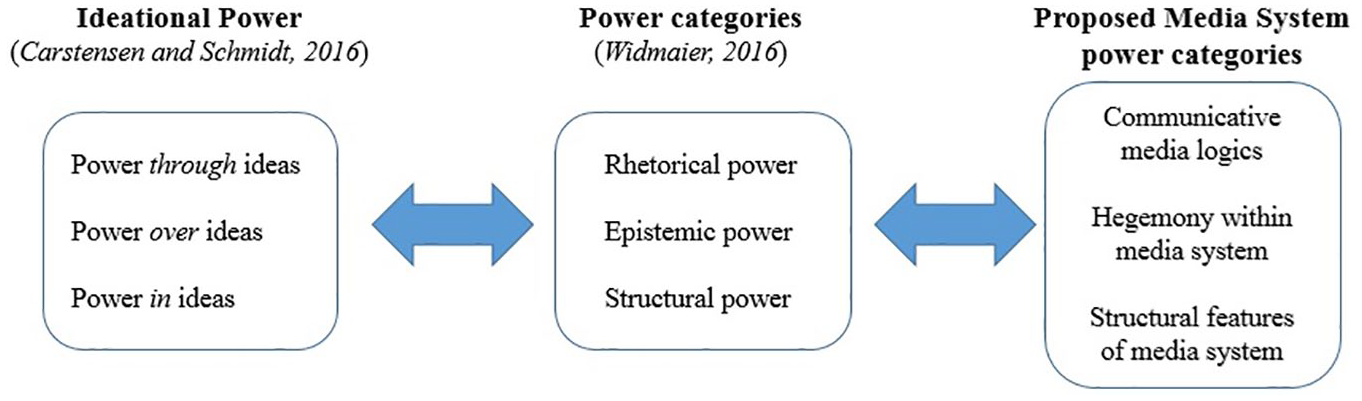
Power Categories in Ideational Power Framework and Hybrid Media System.
Ideational Power, the Hybrid Media System and the 2016 US Presidential Election
We now contrast how Schmidt (2017) and Chadwick (2017) analyse, via lens of ideational power and hybrid media systems, respectively, the forms of political communication implemented by the Trump campaign in the 2016 US presidential election. While the former tends to focus on the policy entrepreneur as communicator, the latter emphasises the reflexive interaction between media and political actors.
The 2016 US Election Campaign and Discursive Strategies
Schmidt (2017) applies the ideational power framework to the Trump campaign’s success in the 2016 US presidential election in order to understand the dynamics of discourse and the role of rhetorical strategies in the process of political communication. Seeking to establish discursive institutionalism as an appropriate analytical framework within the field of political science, Schmidt (2017: 249) argues that analysis of the dynamics of policy change must look beyond economic, social and political factors: these factors need to be augmented with ‘a contextualised analysis of the substantive content of agents’ ideas and their interactive processes of discourse’. Schmidt begins by arguing that a particular set of ‘ideational root causes’ can be regarded as underpinning Donald Trump’s successful US presidential election campaign: the prominence of neoliberal economic ideas in recent decades and their attendant socioeconomic problems of inequality and insecurity; a cultural backlash against liberal socio-political ideas that promoted the cosmopolitan and multicultural political and social values; and the rise of political distrust as a by-product of neoliberal ideas and their consequences. Schmidt then considers the discursive dynamics through which political actors have used their ideas and discourse in policy co-ordination and political communication, both in terms of the dissemination of ideas and the persuasiveness of political actors. Schmidt (2017: 260) does, of course, acknowledge the role of a changing media landscape in influencing the effectiveness of political communication: ‘for communication itself, moreover, language, rhetorical strategies and other communicative devices, such as emotion or empathy, also need to be considered, as do the changing mechanisms of the media of communication’. However, as detailed below, Schmidt seeks to understand how the policy entrepreneur uses or exploits those changing mechanisms of the media of communication rather than setting out a full characterisation of the media as an entity in its own right.
In keeping with discursive institutionalism’s focus on the role of the ‘sentient agent’ in the generation of ideational power, Schmidt’s exploration of discursive dynamics centres around the policy entrepreneur and his or her supporters. In terms of rhetorical strategies utilised by the Trump campaign in the 2016 US election, Schmidt points to the use of deliberate verbal provocation and exaggeration as a marked change in the language of politics. Such rhetorical devices served to denigrate expert opinion and mainstream media, challenge traditional mainstream political discourse and reframe policy debates. Schmidt points to Trump’s own speech patterns – replete with incomplete sentences, repetition and rhetorical signifiers such as ‘believe me’ and ‘many people say’ – as operating as unconscious cogitative mechanisms aimed at reinforcing the listener’s acceptance of a given message. When discussing rhetorical strategies, Schmidt considers not only the direct persuasiveness of a message’s content but also linguistic and psychological devices that resonate subconsciously with the target audience.
Schmidt then considers the manner in which rhetorical strategies are deployed, as actors seek to translate ideas – via discourse – into action. Here again, Schmidt (2017: 249) focuses the manner in which the ideational entrepreneur uses the media, noting that anti-establishment politicians have ‘reshaped the political landscape by framing the debates in new ways while using new and old media to their advantage as they upend conventional politics’. Acknowledging the impact of ‘rapid, radical change in the means and transmission mechanisms of communication’ in facilitating ideational change and making it increasingly ‘difficult for the elite to control communication and thereby to maintain power over ideas and discourse’ (Schmidt, 2017: 263), Schmidt points to the oft-cited example of Twitter usage in the Trump 2016 campaign. Schmidt recognises the interplay between old and new media, noting that social media platforms such as Twitter have:
provided ideational leaders who master the art with tremendous power through ideas to reach their followers with unprecedented immediacy, at the same time that the impact of their tweets is amplified massively by traditional news media reporting on the tweets and social media resending them (Schmidt, 2017: 264).
The Hybrid Media System and the Trump Campaign
In contrast to this ideational entrepreneur perspective on the discursive process, the hybrid media system characterisation developed by Chadwick (2013, 2017) offers a comprehensive representation of the interplay between media and politics and the relational power generated by this interaction. The emphasis here is not on how politicians use media but rather on how politics and media interact. Within this wider context, usage of established or emerging media formats is merely one facet of an overarching media-political interaction. In their studies of the 2016 US presidential election, both Chadwick and Schmidt acknowledge the Trump campaign’s specific media strategies. However, Chadwick’s hybrid media framework situates these media strategies within a broader understanding of the media–politics nexus. The framework identifies the manner in which media actors used their involvement in the Trump campaign as an unprecedented testing ground for refining emergent media logics. It also points to the negative impact of dysfunctional elements of the hybrid media system on the democratic process as a whole, above and beyond purposeful strategy on the part of individual political actors.
In terms of the Trump campaign’s initial presence within the media system, Chadwick argues that Donald Trump pre-mediated his political persona via a broad assemblage of broadcasting media and social media. 15 For example, Donald Trump’s role in The Apprentice reality television series constructed an authoritative image, showcased Donald Trump’s status symbols, and promoted a moral code in which successful competitive strategies were predicated on individualism and incivility. As for the Trump campaign’s engagement with the media during the 2016 campaign, Chadwick argues that the campaign both exploited and reconfigured the nexus between digital media, television and physical events such as political rallies. Chadwick (2017: 255) contends that greater social media presence ‘enables a candidate to exert greater agency in the broader media system than his or her opponents’ via media-systemic advantages of recognition, credibility and momentum. These media-systemic advantages were of particular significance in the case of Donald Trump as he sought to convert pre-existing celebrity capital into political capital. In particular, Trump’s aggressive tweeting patterns – often expressed in informal language, though not engaging in direct conversation with other Twitter users – gained him journalistic media coverage which brought him to prominence early in the Republican primaries.
The Interaction of Communicative Media Power with Epistemic and Structural Power
In tandem with social media platforms, the transitional nature of the hybrid media system has brought to the fore an additional media logic for political communication: large-scale data analysis. As Chadwick notes, the potential for combining vast quantities of behavioural information from public voter records, marketing databases and digital media engagement in order to mobilise segments of the electorate has shifted power within campaign teams from broadcast marketing expertise to digital media expertise. Furthermore, large-scale election campaigns, such as the 2016 US Presidential Election, provide social media companies with an opportunity to refine their suite of tools for tailoring political advertising to user preferences and embedding them in the online news feeds of specific user groups. Chadwick (2017: 268) points to Facebook’s decision in 2014 to open up its Application Programming Interface (API) to consumer data companies as an ‘excellent example of how seemingly obscure technical changes in social media platforms can send ricochets through political communications practices’. The combination of Facebook accounts with additional personalised data sources enhanced email-to-Facebook matching rates and provided the data necessary to fully exploit the Facebook ‘Lookalike Audiences’ feature, which identifies Facebook users with similar preferences and attributes to an existing user group. Chadwick (2017: 267–268) documents how the Trump campaign’s digital strategy made extensive use of Facebook advertising as a means to tailor online campaign advertising to the profiles of those who sign up to campaign email lists and identify additional ‘look alike’ Facebook users with similar profiles to Trump supporters. However, these media logics emerged within a wider hybrid media system and some emergent media logics, such as data intensive techniques which combine psychometric data and large-scale experimental testing of personalised adverts, may only have been in their infancy during the 2016 US Election campaign.
Beyond the Trump campaign’s purposeful media strategies, the hybrid media system itself can been seen to have developed specific features as a result of ongoing interaction between the spheres of media and politics. From the hybridity of old and new media logics, Chadwick points to the emergence of a dysfunctional element of this hybridity that may contribute to the erosion of democratic norms. Examples of this phenomenon during the 2016 US election, as documented by the US Senate Select Committee on Intelligence, include the co-option by social media platforms of recognisable media templates and graphics in order to generate what has become known as ‘fake news’; the role of click-bait revenue models within social media in prioritising user traffic at the expense of integrity of content; the emergence of technologically enabled automated social media software interventions (‘bots’) which sought to influence social media perceptions of political events, such as televised presidential debates; and, of course, politically motivated hacking and the unauthorised leaking of politically sensitive electronic documents. The emergence of these dysfunctional aspects of media-political interaction warrants consideration within the context of an overarching hybrid media system rather than merely in terms of strategic media usage on the part of political campaign teams.
Conclusion
Given that the concept of ideational power has been advanced by its proponents as an explanatory factor capable of shaping policy outcomes and eventual political change, interrogating both the applicability and limitations of ideational power as a theoretical framework has implications for broader understandings of political dynamics and socioeconomic development. By highlighting the need to fully understand the role of the media in the ideational power story, this article offers a timely contribution to such an interrogation. This article argues that a comprehensive characterisation of the interplay between the media and the ideational process has yet to be integrated into the ideational power framework. As outlined above, we contend that an understanding of political communication in terms of a hybrid media system offers a means through which to address this oversight.
The ideational power analytical framework, developed and subsequently applied by Vivian Schmidt in contexts such as the 2016 US election, provides a means for exploring how politicians have been able to use their persuasive power through ideas in order to harness public discontent for their own electoral advantage. By challenging experts’ power over ideas, such politicians have sought to supplant the deep-rooted power in ideas epitomised by a neoliberal worldview. Schmidt recognises the need to understand both the underlying ideational sources of political change as well as the dynamics of the public discourse of entrepreneurial agents:
the examination of the discursive dynamics of policy co-ordination and political communication calls attention to agents’ rhetorical strategies, the circulation of ideas in discursive communities, and the role of ideational leaders along with that of the public and the media in a post-truth era (Schmidt, 2017: 248).
However, such a focus on how political actors use the media does not adequately acknowledge the media as an entity in its own right. Rather than providing a partial view of the media from the perspective of the policy entrepreneur, the hybrid media system characterisation presents the media as a complex aggregation of media-political interactions via an emergent set of media logics.
By failing to explicitly acknowledge that ideas can be impacted upon or altered as they are communicated via this hybrid media system, the ideational power framework cannot fully explain how ideational influences shape policy outcomes. This omission is all the more problematic given the scale and reach of disinformation campaigns and ‘fake news’ in recent years as it has sought to manipulate public discourse on political issues. As Chadwick (2017: 289) cautions: ‘nobody should pretend that these behaviours are equally distributed; it is primarily political activists and the politically interested who are able to make the difference with newer media and/or inventive combinations of older and newer media’. An explicit acknowledgement of the far-reaching impact of the communicative process on ideational elements would greatly enhance the ideational power framework’s ability to fully assess how ideas shape policy outcomes in the digital era.
Footnotes
Declaration of conflicting interests
The author(s) declared no potential conflicts of interest with respect to the research, authorship and/or publication of this article.
Funding
The author(s) received no financial support for the research, authorship and/or publication of this article.
