




Abstract
Social adjustment to college can be challenging, and social networking sites (SNSs) may ease the process. SNSs as an adjustment tool may be particularly useful for those who have relatively limited social support in their proximal environments, such as first-generation college students. This study explored how first-generation and continuing students used Facebook and Instagram, and how their usage was related to college social adjustment. Survey data from 251 undergraduates (Mage = 19.55; 33% first generation) showed that first-generation students engaged in less Facebook interaction with on-campus friends than continuing students. For both groups, SNS interaction with on-campus friends was related to better social adjustment. Continuing students’ Instagram interaction with family was also related to better adjustment. In contrast, first-generation students’ Instagram interaction with off-campus friends and Instagram broadcasting were both related to poor adjustment. In conclusion, the two groups used SNSs in similar manners, but the implications of SNS use for college adjustment varied by students’ first-generation status.
Social adjustment to college is defined as successful integration into the college social environment, establishment of a support system, and effective management of the social demands in the college setting (Baker & Siryk, 1989; Gerdes & Mallinckrodt, 1994). Social adjustment is associated with persistence in an institution (Braxton et al., 2014; Gerdes & Mallinckrodt, 1994; Gray, Vitak, Easton, & Ellison, 2013). Conceptually, close constructs, such as social integration in college (Tinto, 1975) and sense of belonging (Hausmann, Schofield, & Woods, 2007), also relate to stronger intentions to persist or lower probability to drop out.
To facilitate college students’ social adjustment (and thus retention), it is important that students identify their niche in the college community and then increase psychosocial engagement in college-related activities (Braxton et al., 2014). While the process of social adjustment is effortful for college students in general (Ellison, Wohn, Khan, & Fewins-Bliss, 2012; Thomas, Briggs, Hart, & Kerrigan, 2017), it can be particularly arduous for first-generation college students, whose parents do not have a college degree, due to their relatively limited access to social capital (Wohn, Ellison, Khan, Fewins-Bliss, & Gray, 2013).
In the digital age, social networking sites (SNSs) may facilitate social adjustment by providing a convenient platform to build new connections and maintain existing relationships. While researchers have noticed the social affordances of SNSs and started exploring the roles of SNSs in college adjustment (e.g., Gray et al., 2013; Yang & Brown, 2013, 2015), many existing studies face two limitations. First, although the implications of communication technologies vary by online activity and interactant (Burke & Kraut, 2016; Kraut & Burke, 2015), few scholars have simultaneously studied multiple SNS activities and interactants in relation to college adaptation. Second, in most research, the sample is treated as a homogeneous whole without examining how SNS use may function differently for first-generation versus continuing college students. 1
Using the activity-audience framework (Burke & Kraut, 2016; Kraut & Burke, 2015), I compared first-generation and continuing college students’ use of Facebook and Instagram and explored the associations between Facebook and Instagram use and social adjustment to college. These two SNSs were selected because they were among the most popular among youth (Pew Research Center, 2019). The goal of the study was to bridge the aforementioned gaps and clarify how social media use would associate with first-generation and continuing students’ college experience.
The Activity-Audience Framework and Social Adjustment to College
Kraut and Burke (2015) reviewed the associations between Internet use and users’ well-being and concluded that Internet effects are contingent upon online activities performed and audience/interactants encountered. An important implication of Kraut and Burke’s work is that scholars should move beyond studying overall amount or intensity of technology use, because technology use may be both beneficial and detrimental, depending on what activities or interactants are involved. Later on, Yang and colleagues referred to Kraut and Burke’s work as the activity-audience framework and applied it to SNS research (Yang, 2016; Yang & Lee, 2018; Yang & Robinson, 2018). Through their work, it has become clear that different SNS activities and interactants indeed have different implications for users’ psychosocial well-being and social adjustment in college.
Yang and colleagues (Yang, 2016; Yang & Lee, 2018; Yang & Robinson, 2018) provided a useful categorization involving three types of SNS activities. Directed interaction refers to the activities in which specific communication partners are involved (e.g., commenting on a friend’s post, sending an SNS message to a specific friend or friends). Information broadcasting entails actively sharing and posting information on one’s own SNS page, but it targets a general audience rather than specific friends, and it is not necessarily interactive. Content consumption refers to browsing SNS pages without producing new content and is considered a passive activity.
These activities vary in how they associate with social adjustment in college and well-being. Most researchers have reported positive associations between directed interaction and college social adjustment. For instance, using Facebook to interact with others is related to better social adjustment and lower loneliness among college students (Yang & Brown, 2013). The positive association persists even when the interaction is academics-based: Using Facebook for academic collaboration is related to higher bonding social capital, which in turn contributes to better social adjustment to college (Gray et al., 2013). Such online interaction appears to have the potential to create a learning community that promotes both academic and social integration, which, according to Tinto (1997), can increase student retention. On the other hand, the implications of the other two types of activities are less conclusive. Some researchers suggest that information broadcasting and content consumption can facilitate adjustment by helping college students become known to new peers and glean useful information (Ellison et al., 2012; Thomas et al., 2017), but others caution that these activities are related to higher loneliness and poorer social adjustment to college (Burke, Marlow, & Lento, 2010; Yang & Brown, 2013), likely because these activities can displace the time for meaningful interaction.
Because information broadcasting is still communicative in nature (e.g., a status update communicates with the audience what the profile owner is up to), it is sometimes collapsed with directed interaction as one type of activity. Yang and Lee (2018) found that whether information broadcasting and directed interaction would be differentiated depended on the nature of the social media platform. According to results of their factor analysis, directed interaction and information broadcasting emerged as different activities for Instagram, a predominantly image-based platform, but such differentiation was not found for Facebook. In their Facebook activity scale, items of directed interaction and information broadcasting loaded on the same factor, labeled as communication. Their findings revealed the complexity of categorizing SNS activities and suggested the importance of studying multiple SNSs to capture a wider range of SNS practices and their implications.
Regarding interactants, three groups are particularly important in the context of college adaptation: on-campus peers, off-campus peers, and family. According to the literature of college adjustment, interaction with and support from on-campus peers and family both associate with better college adjustment (Buote et al., 2007; Mounts, Valentiner, Anderson, & Boswell, 2006; Swenson, Nordstrom, & Hiester, 2008), and SNS literature resonates with these findings (Yang & Lee, 2018). On-campus friends may facilitate the process of finding one’s niche on campus, which motivates students to be psychosocially engaged in their college life and thus increase the likelihood of being socially integrated in the college community (Braxton et al., 2014). Interaction with family may serve as a channel for receiving emotional support from parents and family members, which fosters college students’ individuation when they are away from home (Radmacher & Azmitia, 2016). On the other hand, SNS interaction with off-campus friends can be a mixed blessing. It not only provides students with emotional support (Ranney & Troop-Gordon, 2012) but can also distract students from socialization with same-institution peers (Yang & Lee, 2018). The distraction effect can lead to lower psychosocial investment in campus life and thus poor social adjustment (Braxton et al., 2014).
First-Generation College Students
First-generation college students refer to the students whose parents do not have a college degree. Although first-generation students are concerned about financial security (Pratt, Harwood, Cavazos, & Ditzfeld, 2019), and some experience marginality in school (Stuber, 2011), they resiliently turn challenges into motivations (Stuber, 2011). These students are motivated to succeed in school and in their future careers (Tate et al., 2015). They have positive self-concepts, seeing themselves as being “motivated, appreciative of opportunities, self-reliant, and adaptable” (Tate et al., 2015, p. 305). In her study of White, working-class, first-generation students, Stuber (2011) also found that about half of the participants showed good integration into the campus life.
Despite the positive characteristics observed among first-generation students, the group shows a higher rate of attrition. According to a report by the National Center for Educational Statistics (Cataldi, Bennett, & Chen, 2018), among a cohort of the 2003 to 2004 first-time beginning postsecondary students, a total of 75% remained enrolled (either at the original school or a different one) or had received a credential in 2006; the rate dropped to 67% among first-generation students. 2 While college adjustment and completion can be a challenge for students in general (Arnett, 2015; Ellison et al., 2012), it seems particularly relevant for first-generation students.
Retention/attrition can be a result of multiple factors, such as the student-school cultural fit, financial concerns, and academic integration (Arnett, 2015; Pratt et al., 2019; Tinto, 1975). For first-generation students, the higher attrition rate may be further attributed to the challenges associated with the relatively limited access to social capital and social support. Compared with continuing students, first-generation students disclose less college experience to family, friends from home, and friends at school (Barry, Hudley, Kelly, & Cho, 2009). They report receiving less advice and information from parents, and they have low confidence that their parents would understand them, especially when the issues are related to college (Jenkins, Belanger, Connally, Boals, & Durón, 2011; Sy, Fong, Carter, Boehme, & Alpert, 2011; Wohn et al., 2013). Whereas research findings have been inconsistent in whether first-generation students receive less instrumental and emotional support from friends, compared with continuing students (e.g., Jenkins et al., 2011; Wohn et al., 2013), first-generation students do have fewer close friends who value education (Wohn et al., 2013). In other words, in their proximal environment, first-generation students have fewer contacts who have the knowledge of navigating college.
In the digital age, SNSs can make it easier for underprivileged youth to reach a larger network outside of their immediate social network to receive college-related information and construct a college student identity (Brown, Wohn, & Ellison, 2016; Morioka, Ellison, & Brown, 2016). Given first-generation students’ limited access to social capital, SNSs may play a different role in these students’ college experience. Indeed, between first-generation and continuing students in high school, SNS use is more important in the former’s confidence in applying for and succeeding in college, likely because of the access to social support afforded by the platform (Wohn et al., 2013). It is curious, under the activity-audience framework, whether and how first-generation and continuing students would use SNSs differently when they officially start the college career, and how the relationships between SNS use and college social adjustment may vary by one’s first-generation status.
Current Study
Through this study, I aimed to answer two questions. First, how would first-generation and continuing college students use SNSs differently (in terms of activities and interactants)? On the one hand, because first-generation students rely on SNSs more to receive support and information (Wohn et al., 2013), they may more frequently engage in various SNS activities and interact with different groups of interactants. On the other hand, because one’s SNS activities and networks are largely a reflection of her/his offline life (boyd, 2014
3
), first-generation students, who are typically less socially active with family and friends (Barry et al., 2009; Jenkins et al., 2011; Sy et al., 2011; Wohn et al., 2013), may also be less active on SNSs. The following research question was thus proposed: RQ1: How would first-generation and continuing college students use SNSs differently? RQ2a: How would SNS activities and interactants associate with college social adjustment for first-generation college students? RQ2b: How would SNS activities and interactants associate with college social adjustment for continuing college students?
Method
Participants
I e-mailed research information to all freshmen at a state university in the southern United States and announced the information in courses involving students of different grade levels across departments to ensure sample diversity. A total of 251 students provided informed consent and completed an anonymous online survey through Qualtrics (age M = 19.55, SD = 1.46; 58.6% freshman, 20.7% sophomore, 13.5% junior, and 7.2% senior and above). Participants received research credits or a small amount of monetary incentive for their participation. Compared with the university undergraduate population, female (73%) was overrepresented but the racial/ethnic distribution was similar (58% White and 34% Black).
Measures
Background information
Participants reported their age, gender, year in college, race/ethnicity, living arrangement (on-campus versus off-campus), and whether at least one of their parents had a college degree. Participants were identified as first-generation college students when neither parents had a college degree. Participants also reported the number of contacts they had on Facebook and the number of followers (people who followed them) and followees (people they followed) they had on Instagram. To increase accuracy of the report, participants were instructed to check their SNS pages before providing the numbers.
SNS activities
Individuals approach different social media in different manners, and different social media have different implications (Yang & Lee, 2018). Thus, Facebook and Instagram use (activities and interactants) were measured and analyzed separately. We used Yang and Lee’s (2018) 5-point Likert scale (1 = Never, 5 = A lot). The Facebook scale involved two subscales: Facebook communication (e.g., “comment on or reply to others’ posts,” “post something that is not directed to specific people,” 11 items; composite reliability = .98) and Facebook browsing (e.g., “browse newsfeed without leaving comments,” 3 items; composite reliability = .90). The Instagram scale included three subscales: Instagram directed interaction (e.g., “comment on or reply to others’ posts,” 2 items; composite reliability = .80), Instagram broadcasting (“post something that is not directed to specific people,” 2 items; composite reliability = .70), and Instagram browsing (e.g., “browse the homepage/news feed without leaving comments,” 2 items; composite reliability = .82). Item scores were averaged to form scale scores.
SNS interactants
On a 5-point Likert scale (1 = Never, 5 = A lot), participants responded to a series of single-item questions, measuring the frequency of using SNSs to interact with friends who attended the same university, friends who did not attend the same university, and family. Participants responded to these questions twice, once by considering their Facebook use and the other Instagram use.
Social adjustment
Six items from the social adjustment subscale of the Student Adaptation to College Questionnaire (SACQ; Baker & Siryk, 1989) were used. Participants responded on a 5-point Likert scale (1 = Not at all, 5 = Very Well; α = .86). Sample items included “I’m very involved with college social activities” and “I’m meeting people and making friends.” Higher average scores reflected better adjustment.
Results
Among the 251 students, 82 (33%) were first-generation college students. A total of 198 (79%) were active Facebook users, and 208 (83%) were active Instagram users (i.e., using Facebook/Instagram at least a few times a week). Students’ average score of social adjustment was 3.56 (SD = .90), but first-generation students (M = 3.21, SD = .92) scored lower than continuing students (M = 3.73, SD = .84): t(249) = –4.43, p < .001, d = –.60. On average, the participants had 860.02 (SD = 744.46) Facebook friends, 716.44 (SD = 920.16) Instagram followers, and 643.72 (SD = 798.37) Instagram followees. These numbers did not differ by the first-generation status (ps = .56–.92). Descriptive statistics and correlations of SNS activities of the overall sample are presented in Table 1.
Descriptive Statistics and Correlations of SNS Activity Scales of the Overall Sample.
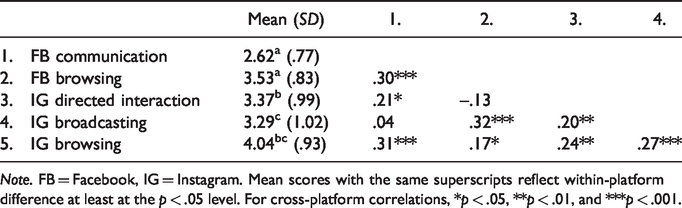
Note. FB = Facebook, IG = Instagram. Mean scores with the same superscripts reflect within-platform difference at least at the p < .05 level. For cross-platform correlations, *p < .05, **p < .01, and ***p < .001.
First-Generation and Continuing College Students’ SNS Use
Independent t tests were performed to examine whether first-generation and continuing students differed in their SNS use (Table 2). First-generation students used Facebook to interact with on-campus friends less often than continuing students: t(196) = –2.33, p = .02, d = –.35. Although the difference of Instagram broadcasting did not reach the significance level, t(206) = 1.53, p = .13, d = .24, its effect size was above the threshold of a small effect (Cohen, 1988). Given the relatively small sample size of the first-generation group, the effect size should be more meaningful than the significance level per se. Thus, first-generation students may have engaged in Instagram broadcasting more frequently than continuing students. Other differences were not significant and had small effect sizes.
SNS Use Among First-Generation and Continuing Students.
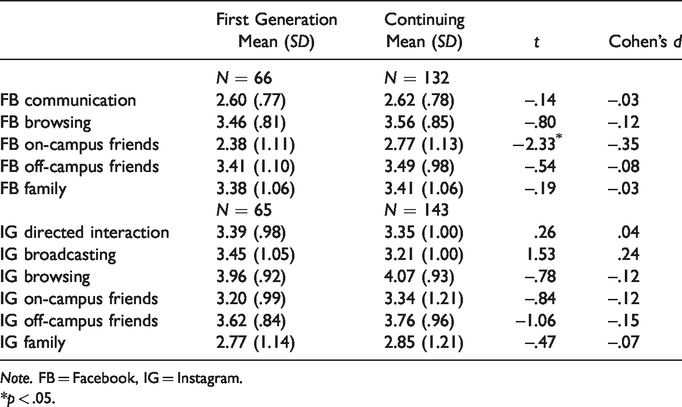
Note. FB = Facebook, IG = Instagram.
*p < .05.
SNS Use and College Social Adjustment
Four regression models were tested: One Facebook and one Instagram models were conducted with the first-generation sample, and the same procedures were repeated for the continuing sample. In the Facebook models, college social adjustment was regressed on the control variables (gender, year in college, race/ethnicity, living arrangement, and number of Facebook friends), Facebook activities, and Facebook interactants. In the Instagram models, the Facebook-related variables were replaced with the Instagram-related variables. It was necessary to control for number of SNS friends/followers/followees because a larger SNS network may suggest a larger pool of contacts students could reach out to and seek support from.
For first-generation college students, college social adjustment was not related to any independent variables in the Facebook model, but it was positively associated with using Instagram to interact with on-campus friends (β = .32, p = .04). On the other hand, using Instagram to interact with off-campus friends (β = –.38, p = .02) and Instagram broadcasting (β = –.40, p = .003) were both related to poorer social adjustment for first-generation students. No other independent or control variables had significant relationships with social adjustment (see Table 3).
Results of College Social Adjustment Regressed on SNS Use.
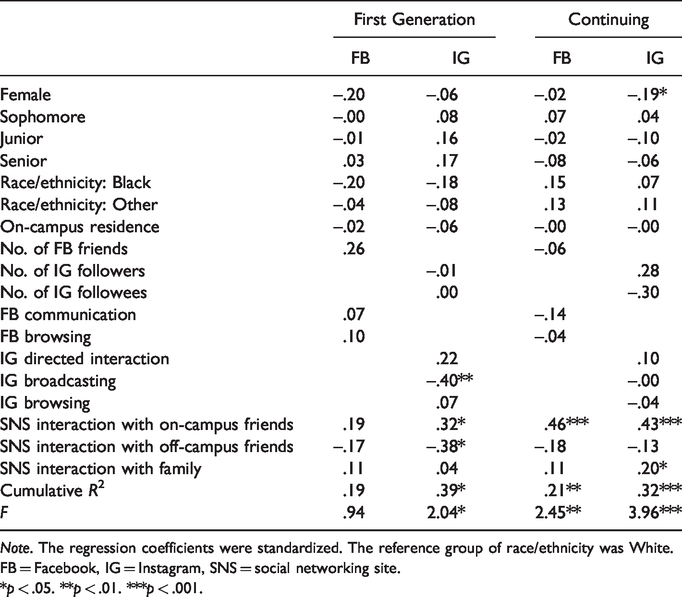
Note. The regression coefficients were standardized. The reference group of race/ethnicity was White. FB = Facebook, IG = Instagram, SNS = social networking site.
*p < .05. **p < .01. ***p < .001.
For continuing students, using Facebook (β = .46, p < .001) and Instagram (β = .43, p < .001) to interact with on-campus friends was related to better social adjustment. Using Instagram to interact with family was also related to better social adjustment (β = .20, p = .02). None of the SNS activities in these two models were associated with students’ social adjustment in college, and online interaction with off-campus friends also had a null effect in both models. One control variable was significant in the Instagram model—female students reported poorer social adjustment (β = –.19, p = .01; see Table 3).
Discussion
SNS Use Among First-Generation and Continuing College Students
Results of this study showed that the two groups of students used Facebook and Instagram in similar ways, except that first-generation students less frequently used Facebook to interact with on-campus friends, compared with continuing students. Although the two groups’ difference in Instagram broadcasting was not statistically significant, the possibility of first-generation students engaging in more Instagram broadcasting still deserved attention given the effect size. The high level of similarity between the two groups is consistent with Wohn et al.’s (2013) findings, where the authors compared four variables related to Facebook and social media use between first-generation and continuing high school students and found only one significant difference.
The most intuitive explanation for first-generation students’ less frequent Facebook interaction with on-campus friends was probably that they were less engaged in college social activities. After all, individuals’ online network and activities tend to reflect their offline lives (boyd, 2014). However, if social disengagement had been the major reason, first-generation students’ Instagram interaction with on-campus friends should have been lower than continuing students’ as well, but this difference was not identified. A more plausible explanation, then, may be related to the evolving role of Facebook in family communication and first-generation students’ attitudes toward family. In recent years, as more adults join Facebook, friending parents and interacting with them on Facebook has become common among youth (Child & Westermann, 2013). Whereas college students in general are skillful in navigating Facebook as a collapsed context involving both family adults and peers (Yang, 2018), the navigation may be more challenging for first-generation students. Culturally, first-generation students consider it important to prioritize others’ needs; being the first one going to college, enjoying the opportunities unavailable to their family, and pursuing one’s own dream can generate an internal conflict known as family achievement guilt (Covarrubias & Fryberg, 2015). When students interact with on-campus friends on Facebook, at least some interaction will be semi-public (e.g., commenting on each other’s posts), and the interaction may involve rich college references; first-generation students may not want these updates to appear on their newsfeed and be seen by their family because such updates will highlight the discrepancies between their family and themselves. Thus, first-generation students may have limited interaction with on-campus friends on Facebook in order to downplay the discrepancies that can trigger their family achievement guilt.
Although the difference was not statistically significant, given the effect size, one should not dismiss the possibility that first-generation students may have engaged in more frequent Instagram broadcasting than continuing students. The former discloses less college experience to family and friends (Barry et al., 2009), which may be a result of guilt toward family (Covarrubias & Fryberg, 2015) and the perception that their friends did not share their interests and values (Wohn et al., 2013). Facing the challenge of confiding to specific associates, first-generation students may have taken Instagram broadcasting, an activity that does not directly involve other people, as an alternative route for support seeking and self-expression. For instance, students unfamiliar with post-secondary institutions benefit from knowledgeable translators who can help them contextualize and decode college-related information (Brown et al., 2016). By broadcasting questions on Instagram, first-generation students may wish to receive timely responses from an unspecified pool of knowledgeable translators. Instagram broadcasting of college-related posts may also reflect first-generation students’ efforts in claiming their identity as a college student (Morioka et al., 2016).
SNS Use and College Social Adjustment
Overall, SNS activities played a less central role than SNS interactants in relation to college social adjustment for both first-generation and continuing students. Only one activity, Instagram broadcasting, was associated with poorer social adjustment and only for first-generation students. According to research involving general samples, a broadcasting activity, status updating, is related to both positive and negative psychosocial outcomes (e.g., Deters & Mehl, 2012; Yang & Brown, 2013), which may explain the nonsignificant finding among the continuing students. On the other hand, underresourced youth often seek support through the SNS broadcasting activity (Brown et al., 2016; Morioka et al., 2016), but the effort may not always lead to the support they are seeking. The similarities between one’s online and offline networks (boyd, 2014) suggest that first-generation students’ Instagram network may be composed of followers and followees whose college experience is also limited. Thus, first-generation students’ Instagram broadcasting may not induce the resonance and feedback they desire. There may be a cyclical process: First-generation students may rely on Instagram broadcasting to compensate for poor social adjustment, and yet, lack of desired response from the network members can enhance the sense of alienation.
SNS interaction with on-campus friends was consistently related to better social adjustment to college for both first-generation and continuing students. The finding is consistent with that of the research sampling college students in general (Yang & Brown, 2015; Yang & Lee, 2018). Online interaction with peers in the same institution may help college students, first-generation or otherwise, perceive more communal potential in the institution and thus facilitate social adjustment by increasing students’ psychosocial engagement in campus activities (Braxton et al., 2014). Alternatively, because there is a great overlap between one’s online and offline networks and activities (boyd, 2014), the positive association may also suggest that students who are socially adjusted have translated their offline campus network to their online network and engage in more online interaction with on-campus peers via the sites.
Instagram interaction with family was associated with better social adjustment but only for continuing students. Through such online interaction, continuing students and their parents and family members may reinforce each other’s views of college education and share life updates, which can lead to students’ perception of being supported by the family (Radmacher & Azmitia, 2016; Yang, 2018); perceived support from family has been found to be a positive correlate of healthy individuation (Radmacher & Azmitia, 2016) and college adjustment (Mounts et al., 2006). The same association was not found for first-generation students. First-generation students’ family members may be less familiar with the college system and thus do not have as much advice to share. In addition, first-generation students are less likely to talk about their college experience with their family (Barry et al., 2009), and the same pattern may be reproduced online, leading to a null association between online interaction with family and social adjustment to college.
On the other hand, Instagram interaction with off-campus friends was related to poor social adjustment but only for first-generation students. The nonsignificant association among continuing students is in line with the research findings involving college students in general (Yang & Brown, 2015). High school students whose parents do not have a college degree report that their friends value education less and are less interested in continuing education past high school (Wohn et al., 2013). Thus, whereas continuing students’ off-campus friends may be college students in other institutions, first-generation students’ off-campus friends may pursue a different path. Instagram interaction with these friends, then, would provide little help to first-generation students’ college adjustment and may even take up the time and energy that could otherwise be used for campus activities. Indeed, some first-generation students feel marginalized on campus and thus disengage from campus events (Stuber, 2011). They may be driven by the motive of social compensation (McKenna & Bargh, 2000; Ranney & Troop-Gordon, 2012) and turn to online interaction with off-campus friends to fulfill their social needs. However, this interaction could reduce students’ psychological investment in campus life and thus further hinder social adjustment (Braxton et al., 2014).
Year in college was not associated with students’ social adjustment in college. Although it was not part of my hypothesis, the null association warrants a comment because the finding may be surprising to some readers. Given that the transition from high school to college typically interrupts one’s social network and that freshmen need to rebuild connections in the new environment, one might expect freshmen to report lower social adjustment in college. The counterintuitive finding may suggest that in the digital age, as social media allow freshmen to more effectively manage and reorganize their social network, this difference has been eliminated or minimized; see a similar finding of lack of difference in freshmen’s identity development during the college transition and a discussion of the role played by social media in Yang and Brown (2016). It is also important to note that the data were collected in the spring semester; freshmen had spent more than a semester in college by the time they were surveyed, which may be another reason why the difference between freshmen and upper level students was not noticeable.
Limitations and Future Directions
Several limitations should be considered when interpreting the results. First, because the data were collected at a single time point, the causal direction is not warranted. In the Discussion section, the findings were explained by considering different possibilities of causal directions, but it would require longitudinal data to confirm the directionality. Second, the sample size of first-generation group was relatively small, which may reduce the power of the analyses. This is a common challenge for studies investigating minority groups. I took into account the effect sizes in addition to the p values, with the hope of compensating for the limitation, but more studies on minority groups with larger samples are still needed to identify significant differences or associations that could have been disguised in this study due to the small sample. Third, this study focused on the social aspect of college adjustment, and thus I did not include variables related to students’ academic integration or performance. In order to gain a comprehensive picture of how social media relate to students’ overall adjustment in college, those variables should be considered in future studies. One more limitation is the lack of information on participants’ offline activities and social network. It would have been interesting to see how their online and offline lives matched up if the data had been collected.
Informed by the results of the study, I would also propose the following directions for future research. Given the importance of online interaction with on-campus friends, as shown in this study, an important variable for future researchers to consider is the number or percentage of students’ SNS friends who go to the same institution with them. Indeed, a higher number of Facebook friends being fellow students in the same university is related to better social adjustment to college (Gray et al., 2013). This variable may also moderate the observed relationship between Instagram broadcasting and social adjustment for first-generation students such that the negative association would disappear for those whose SNS friends are mostly on-campus peers. Furthermore, it would be worthwhile to compare first-generation and continuing students’ off-campus contacts on SNSs and investigate whether they really differ in the information and support they provide. Finally, social media users produce a variety of content in their posts. Users take advantage of the platforms by posting questions, requesting information, or asking for assistance from their social media network (Ellison, Gray, Lampe, & Fiore, 2014). The platforms also serve as a convenient channel for identity construction and negotiation. For instance, college students frequently post college references on their social media during the transition to college (Yang, 2018); the postings can be viewed as a claim for one’s identity (Morioka et al., 2016; Thomas et al., 2017). Would posts aiming at receiving information versus claiming an identity serve different functions in college students’ adjustment? This is a question worth exploring in future research.
Implications and Conclusion
As one of the few studies of first-generation students’ social media use in relation to their college experience, this research has important theoretical implications for first-generation students’ adjustment and thus retention. While scholars have examined the role of social media in disadvantaged high school students’ preparation for college career (Brown et al., 2016; Wohn et al., 2013) and underresourced college students’ identity work (Morioka et al., 2016), this study expands the literature by directly examining the relationships between SNS use and college social adjustment among first-generation and continuing students. Interestingly, the findings showed that SNS use can be a double-edged sword in students’ adjustment, depending on patterns of use and students’ first-generation status. Social adjustment plays a central role in various college retention models (e.g., Braxton et al., 2014; Tinto, 1975, 1997), and yet relatively little is known about the opportunities and challenges brought by social media, especially to underprivileged youth. This study provides preliminary findings to bridge the gap and identifies the activity-audience framework (Burke & Kraut, 2016; Kraut & Burke, 2015) as a promising way of studying college adjustment and retention in the digital age.
On the whole, first-generation and continuing students only showed a slight difference in their SNS use patterns, but social media usage had differential implications for their social adjustment to college. The findings provide practical implications for working with both first-generation and continuing college students. For both groups of students, in addition to advising them to participate in offline campus events, faculty and staff may also encourage students to add offline fellow students to their SNSs. It will allow students to remain connected and receive resources and support even when they do not see these friends face to face. This approach may be particularly useful to keep students informed when they have to live off-campus with their family due to financial concerns (see, e.g., Stuber, 2011). In other words, by serving as a tool that increases students’ psychosocial engagement in college (Braxton et al., 2014), SNS interaction with on-campus friends has the potential to improve student retention. It is important to note that I am not advocating for SNS interaction to displace face-to-face peer interaction; rather, I would encourage students to use SNSs to supplement face-to-face interaction with friends from the same institution.
For first-generation students, it might be helpful to discuss how broadcasting on SNSs and online interaction with off-campus friends may influence their campus social lives. It would be important to understand why and what these students broadcast on their social media pages, and help them understand that some posts, such as the ones that allow others to learn broad and deep information about them and the ones that reflect a positive and authentic image, would be more effective in receiving positive feedback from the social media audience (Yang & Brown, 2016). In addition, although faculty and staff should be empathetic of first-generation students’ desire for interacting with off-campus friends when they feel alienated on campus, they should inform students of how this type of interaction can further disengage them from the campus life. While online communication with friends who are not around can indeed provide emotional support to those whose face-to-face friendship quality is low (Ranney & Troop-Gordon, 2012), students should not become overly dependent on these connections; they still need to build new connections on campus in order to be well adjusted in college (Swenson et al., 2008).
For continuing students, faculty and staff can encourage them to interact with family members via SNSs. In recent years, college students and their parents take advantage of social media to maintain frequent interaction that used to be uncommon before the prevalence of communication technologies (Child & Westermann, 2013; Yang, 2018). Despite the concern that frequent parent–child interaction would hinder emerging adults’ autonomy development (Hofer & Moore, 2010), it appears that staying connected with family via SNSs is actually adaptive for continuing students.
In sum, social media are playing a central part in young people’s lives and have important implications for their development and adjustment, especially in the college setting. As findings on overall usage among general users have been accumulating, more studies of specific use patterns (especially interactants) on different social media platforms among minority users are needed to further expand our understanding of young people’s college experience in the digital age.
Footnotes
Declaration of Conflicting Interests
The author declared no potential conflicts of interest with respect to the research, authorship, and/or publication of this article.
Funding
The author(s) disclosed receipt of the following financial support for the research, authorship, and/or publication of this article: The study was supported by Oklahoma State University and University of Memphis.
