




Abstract
This article draws on a five-year mixed methods study and focuses on the way staff tailor support within a comprehensive college transition program to meet the needs of low-income, first-generation, and racially minoritized students by adapting programmatic offerings and requirements to fit students’ multifaceted needs. The study also identifies the way tailoring reduces cognitive load for students because the tailored interventions are embedded within a single program, rather than having students visit dozens of offices trying to piece together the support they need. The program created an approach to tailoring student support that draws on the best of predictive analytics and case management simultaneously while also being non-deficit and asset-based. Our study contributes to the literature by identifying the value of tailoring approaches to address students’ multiple needs and identities.
Campuses have not succeeded in helping low-income, first-generation, and racially minoritized college students persist and graduate (Cahalan et al., 2018). About 25% of undergraduates in the United States are both low-income and first-generation college students, and their six-year graduation rate at four-year institutions is only 41%, compared to 73% for students who are neither low-income nor first-generation (Cahalan et al., 2018). The graduation gap between students from the highest and lowest income quartiles has increased substantially since the 1990s (Cox, 2016). Additionally, the current 17 percentage point gap in college degree attainment rates between Black and White students is about the same as it was in 1990s, while the gap between Latinx and White students has increased, even as the number of Black and Latinx matriculants has grown (Cox, 2016; Fry, 2011).
In response to these disparities, many initiatives and services have been developed to promote the success of the aforementioned student groups. Most of these initiatives and services focus on a single student population and aspect of identity (e.g., racially minoritized or first-generation college students), however, students have multiple identities as well as multiple assets and needs (Bailey & Dynarski, 2011). When support services only target a single aspect of identity, students may have to spend considerable time and energy traveling from place to place on campus to access support related to various aspects of their identities, or they may fail to receive the support services they need in order to cope with the specific challenges that they face (Purnell & Blank, 2004). Moreover, identity-based centers and student support services often focus on celebrating student identities and addressing the social challenges associated with being in a marginalized group, rather than also focusing on academic challenges and support as well—thus, they do not truly offer the holistic support these students need to successfully complete college (Pendakur & Harper, 2016).
Numerous aspects of identity—race/ethnicity, class, first-generation status, as well as their family situations, jobs, personality, health, life experiences, aspirations and many other factors—influence how students find services and opportunities on campus as well as the challenges they face during college. Traditionally marginalized groups are also more likely to have multiple marginalized identities (e.g., racially minoritized students are more likely to be low-income than White students) and to face accompanying compounded challenges such as lower levels of academic preparation, multiple obligations outside of school, parenting, attending college part time and working full time. This multitude of factors together put these students at increased risk of leaving college without a degree (Engle & Tinto, 2008). Whether they overcome the challenges, draw on their assets, and succeed in reaching their academic goals may be heavily influenced by the extent to which the college staff and faculty help them negotiate the specific, and multifaceted, challenges that their unique situations present.
Because college students are complex individuals who face a unique set of challenges and opportunities, it is reasonable to hypothesize that tailoring support to the unique needs of each student and their intersectional identities may make support more effective in promoting students’ success. Developing an understanding of how professionals can adapt programming to meet the needs of individuals has already helped healthcare, social work, and K-12 schools develop practices for tailoring systematically, resulting in improved outcomes (Rapp, 1998). To date, there are virtually no empirically-based higher education models that describe what tailoring programming to meet diverse, intersectional students’ needs looks like.
This article draws on a large scale mixed-methods study of the Thompson Scholars Learning Community (TSLC), a well-developed comprehensive transition program. We specifically focus on the tailored programming developed by TSLC program staff to meet the needs of low-income, first-generation, and racially minoritized students (who we term “at-promise” in this article), not only by directing students to particular services offered by the program and the larger campus community, but also by adapting programmatic offerings and requirements to fit students’ needs. Our paper outlines a new approach that we call “tailoring” that draws on key facets of case management, predictive analytics, and intersectional identity supports. It is important to note that this is a large-scale program serving thousands of students, not a small boutique program, so the implications of being able to tailor the student experience in such a large program is noteworthy. Quantitative findings from the overall study show that the program increased key psychosocial outcomes (such a sense of belonging, mattering, validation, career self-efficacy), persistence, and success for program participants (Cole et al., 2020; Kezar, Hypolite, & Kitchen, 2020; Melguizo et al., 2020). In order to better understand how and why the program achieves these outcomes, qualitative researchers, as part of the broader explanatory mixed methods research project, explored key aspects of the program linked to students’ success. One of the key findings that emerged was the value of tailoring the program support to students’ unique and multidimensional needs. Here, we explore this emergent finding through the following research question: What does tailoring look like to meet diverse college students’ multiple needs?
Literature Review
The literature review is divided into two sections. First, we review research on students’ multiple or intersectional identities, how their multiple identities relate to students’ cognitive load in college, and then suggest why a change in higher education’s approach to support is needed to reduce students’ cognitive load and promote their success. Second, we review our conceptual frameworks, including the concept of case management that individualizes support and cognitive load theory which suggests why case management approaches are needed, and we review key practices in the case management and wraparound services literature.
College Students’ Multiple/Intersectional Identities and Cognitive Load
While each student is a unique individual, students from at-promise backgrounds often face specific challenges in their transitions to and persistence through college, above and beyond those faced by other undergraduates (Cataldi et al., 2018). In their study of college men, Harper et al. (2011) assert that in order to be educationally effective and produce positive change in students, it is essential that undergraduate programs consider the complex individuality of students. Brown et al. (2002) also point out the complexity of many parts of the college experience, and they argue for methods that can more effectively capture that complexity. Recognizing students’ unique identities does not mean that student support professionals can or should ignore trends or patterns in student experiences, but rather that they should recognize that students inhabit many identities at any given time, and that each of these identities interacts with the others in ways that can create both risk factors (Corrigan, 2003; Engle & Tinto, 2008) and protective factors (Hartley, 2011) as students move through college.
Several descriptive studies of college students’ experiences describe how negotiating the college landscape where different functional offices and services target specific parts of their complex identities can impose significant burdens on students cognitively, and in terms of time and energy (Harper et al., 2011; Purnell & Blank, 2004). Harper et al. (2011), for example, describe the experience of an undergraduate student who has to travel to different groups in different parts of his university to access support based on his gender, racial identities, sexual orientation, religious identity, and extracurricular interests and who does not find support in navigating the intersections between these aspects of his identity. As Harper et al. (2011) remark, “this is a lot for a 20-year-old to navigate by himself” (p. 45), even without having to manage the additional challenges associated with being a low-income student. The cognitive load imposed by searching for and accessing services related to various identity support needs can add to the cognitive load imposed by other aspects of navigating the university environment, which can in turn lead to cognitive overload. For instance, scholars have suggested that the process of registering for classes alone can lead to cognitive overload for many students. Scott-Clayton (2011) describes how college students often become overwhelmed and make suboptimal choices about which classes they need to take in order to make progress toward their goals when faced with incomplete information from multiple relevant sources, such as course catalogues, schedules and program descriptions, which are all located in different places. Add to this the need to seek out multiple other forms of support related to students’ identity-related needs, and one can see how one’s cognitive capacity could quickly become overloaded.
Studies of campus mental health services document myriad struggles that college students face and provide evidence that college students of all socioeconomic statuses often report feeling overwhelmed, an active state that is associated with cognitive overload (Cook, 2007; Gloria & Castellanos, 2012; Kitzrow, 2003). This can lead to students drifting from office to office, looking for support with minimal guidance, as Mowbray and colleagues (2006) found in their study of students accessing mental health services on college campuses. When students are referred to off-campus service providers, the cognitive load that comes from planning and scheduling office visits is increased and compounded by the risk that off-campus providers may not be equipped to deal with the specific needs of college students, which increases the need for students to advocate for themselves when stressed (Mowbray et al., 2006).
Case Management and Wraparound Services
Research on case-management and wraparound services in social work, healthcare, special education, and other fields has found that when people face multiple, overlapping challenges, it is often more effective to adapt supportive programming to their individual needs through coordinating and curating existing programming and/or creating new programming to fit a specific need (Eber et al., 2002). Though there are a variety of case management models, case management is generally defined as a process that involves professionals assisting clients in assessing what kinds of services they need, finding and coordinating services that may be provided by a variety of individuals and organizations, assessing the extent to which services are helping the client make progress toward their goals, and adjusting service provision as necessary. Wraparound services, also known as Intensive Case Management, are a team-based care coordination strategy designed to support individuals with complex behavioral needs and their families (Coldiron et al., 2017). Like some other models of case management, wraparound support advocates for involving stakeholders in the process of creating a unique plan for each individual that draws on both varying supports, as well as individual’s strengths, in order to meet all of their individual needs (Suter & Bruns, 2009). While used primarily in other fields like healthcare, and increasingly in K-12, studies of the effectiveness of case management programs, including wraparound support, have found significant benefits for a variety of outcomes (Eber & Nelson, 1997). Recently, some universities have started to use case management approaches adapted from these fields to meet the complex needs of students. For example, the University of South Florida has implemented a customized case-management model for supporting students who are at risk of dropping out that has led to improved graduation rates (“Applying a Healthcare Model,” 2019). More generally, the strategy of university “care teams” that bring together the expertise of members of the campus to problem solve the unique and multifaceted needs of students is becoming increasingly popular (Mangan & Schmalz, 2019).
The aforementioned case management approaches are based on research from cognitive load theory. According to cognitive load theory, people’s mental bandwidth is limited, and when it is overwhelmed by any combination of task demands—acute distractions and chronic distractions—people’s ability to perform cognitive tasks of all types diminishes. Cognitive load theory asserts that working memory—a person’s cognitive capacity to control their attention and hold multiple things in mind at the same time—is limited, and if a task requires too much cognitive capacity, learning and other forms of reasoning suffer (De Jong, 2009; Engle, 2002). Whatever combination of intrinsic, germane, and extraneous cognitive load causes it, cognitive overload occurs when a task requires more cognitive capacity than a person has available (De Jong, 2009). Cognitive overload can have a variety of negative effects on people’s cognitive processing and well-being. For example, cognitive overload can result in reduced cognitive processing speed, as well as a tendency to transfer mental resources away from the complex tasks that impose the overload (Fox et al., 2007). One could see how students with complex backgrounds and multiple needs navigating complicated college environments not set up with their success in mind could lead to cognitive overload, and negatively impact their ability to succeed.
There are several key practices identified in the case management and wraparound services literature. First, support should be individual or client centered. Philosophically, this involves placing the individual and their environment at the center, rather than program goals, cost containment, or other concerns that routinely drive service provision (Fraser et al., 2018; Rapp, 1998). Second, effective case management involves assessing clients’ strengths, needs, and potential natural supports in all relevant life domains (Fraser et al., 2018; Shepard-Tew & Creamer, 1998). Third, effective case management entails developing a clear and flexible plan for connecting a client with services (Fraser et al., 2018). Fourth, effective case management practices involve reviewing the individual’s progress with a professional team on a regular basis and revising the plan as necessary (Rapp, 1998). Fifth, ideal case management practice involves supporting clients whenever they need support and for as long as they need support. One key part of this is providing clients with continuous access to support, either through an individual case manager being “on call” or through sharing “on call” responsibility with a team of case managers (Fraser et al., 2018; Rapp, 1998).
Methodology
Data are drawn from a broader, longitudinal, mixed-methods research project that examines whether, how, and why the TSLC comprehensive college transition program develops traditional academic short- and long-term outcomes, such as retention and GPA, and explores a multitude of psychosocial outcomes (e.g., mattering, career self-efficacy, belonging) among the low-income, first-generation, and racially minoritized college students served by the program (Cole, Kitchen, & Kezar, 2019). The larger mixed methods study includes longitudinal surveys conducted with two cohorts of TSLC participants for four years, TSLC student focus groups, longitudinal one-on-one interviews with program participants, and case study data collection (e.g., program observations, interviews with instructors and staff in the program, and stakeholder interviews). The qualitative case study data were used in this study to help explore the tailored programming that TSLC staff developed to meet students’ multi-faceted needs.
Case Study
A case study of the programs was conducted to describe the program and how it functioned, rather than hypothesis testing (Creswell, 2007). The aim of the current study is to examine what program tailoring in the higher education sphere looks like. The goal of the case study was to identify program staff perspectives on tailoring programming to meet the needs of complex students with multiple identities and experiences within a comprehensive student support program.
Site Selection
There are several reasons why the TSLC program is a strong site for this study of program tailoring: (a) the program encompasses a wide variety of supports across many domains (e.g., academic tutoring, mental health, social programming) that give staff a broad range of services to work with in tailoring the program experience for each student; (b) the TSLC staff members partner with other functional units around the university (e.g., counseling services), which further broadens the range of services and expertise they have available; (c) each student has a primary TSLC staff member who is their point of contact and who knows their strengths and challenges well enough to be able to tailor the program elements to meet their unique needs; and, (d) staff have the authority to tailor the program to meet students’ unique needs. We explored staff members’ tailoring practices at the three University of Nebraska campuses at which the TSLC program operates: University of Nebraska, Kearney (UNK), University of Nebraska, Omaha (UNO) and University of Nebraska, Lincoln (UNL). We chose to include all three campuses, both to expand the range of staff members whose perspectives could be included, and to be able to examine similarities and differences in staff tailoring approaches across campuses with different student demographics and institutional contexts.
In terms of how the program works as it relates to case management, each student is assigned a primary point of contact (POC) that allows a ready, consistent connection for students to access information, support, and encouragement. Students regularly meet with their POC, facilitating the development of a relationship between students and their POC over time. Staff members are socialized to provide validating experiences for students and support that emphasizes the building of relationships. Staff proactively reach out to students, initiating contact regularly to check on students. The staff provide students both academic and interpersonal support and are empowered to tailor program offerings to meet the multifaceted needs of individual students.
Data Collection and Sources
A descriptive case study involves collecting data from multiple sources, including interviews, observations, documents, and audiovisual material to arrive at a detailed, rich, “thick description” of the case (Creswell, 2007). The larger case study drew upon (a) interviews with TSLC staff, including program directors, program staff, advisors, faculty/course instructors, and campus stakeholders; (b) over 600 hours of observations of program activities conducted on-site at each of the three universities; (c) document analysis of annual reports from the program at each of the three campuses; and, (d) longitudinal student interviews with 83 program participants (totaling over 900 interviews). Staff and stakeholder interviews and program observations were the primary sources of data for the current analysis (for further information about design and analysis, see Hallett et al., 2020).
Student, Staff, and Stakeholder Sample and Interviews
Formal interviews were conducted with program staff, stakeholders, and students who participated in the program. Each program has multiple staff including a program director, advisors, support staff, faculty coordinator, and peer mentors that were interviewed. Campus stakeholders are individuals from offices with whom the program partners, including areas such as counseling, multicultural affairs, career services, housing, and learning disabilities offices. Because program tailoring often depends on expertise from other offices, we thought it was important to explore the interviews with these stakeholders to understand tailoring and provide context for staff interviews. In addition to formal interviews, researchers conducted periodic informal interviews with program staff to fill in gaps and these interviews were also used to understand this process.
For staff and stakeholders, similar interview protocols were developed across the three campuses in order to facilitate the collection of comparable data (Bartlett & Vavrus, 2017). Protocols for interviews with program staff were designed to explore the historical development of the program, the explicit and implicit goals of the various program interventions, and each staff member’s roles and experiences with students in the program. The protocols for campus stakeholders focused on their partnership with the TSLC program, working relationship, and observations of how the TSLC program worked. We worked with the program directors to identify individuals whom they partnered with across campus. Student interview protocols were developed to ask students about their experiences in, and perceptions of, TSLC and its various programming activities.
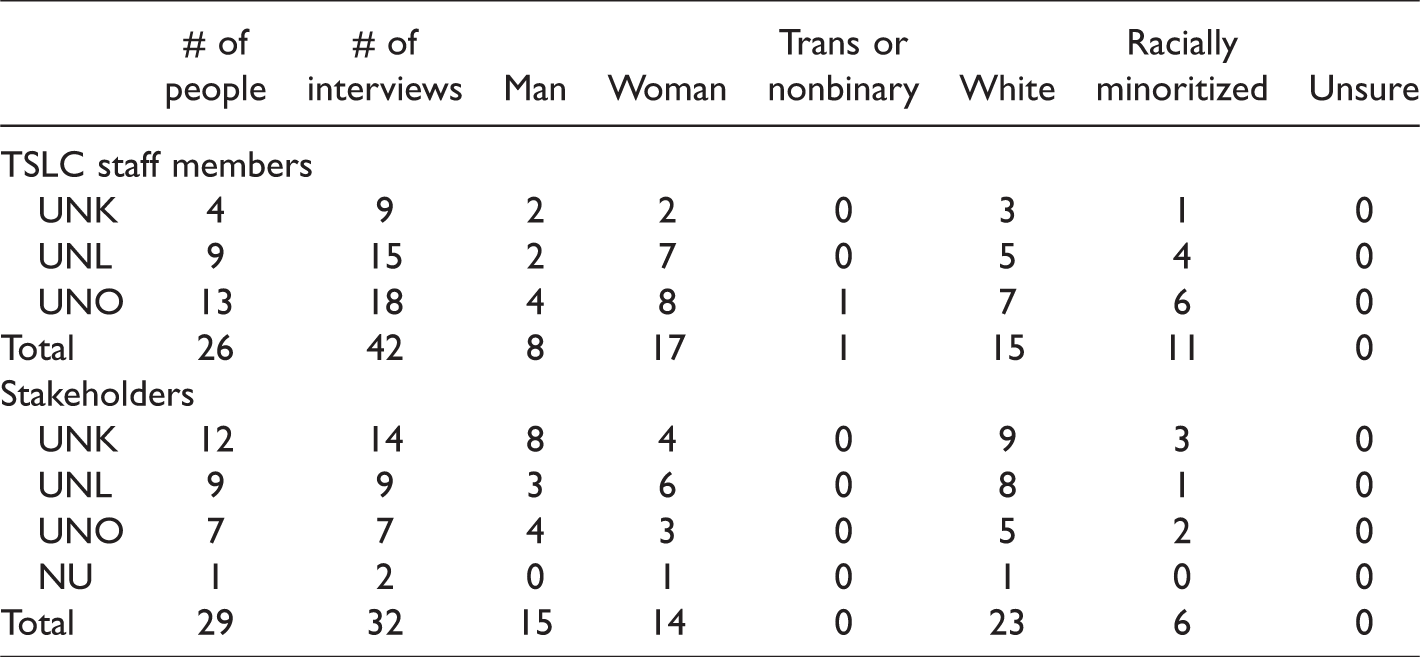
Interviews were professionally transcribed. Staff and stakeholders are referred to generically to protect anonymity because there are few people in various positions and even assigning a pseudonym would reflect gender or sex of a staff member, which could violate confidentiality. Students who participated in the program were assigned pseudonyms. In total, 42 interview transcripts with 26 TSLC professional staff members across the three campuses were reviewed and 29 campus stakeholders were interviewed across the three campuses. See the Appendix for the participant sample. Finally, longitudinal, one-on-one interviews with students who participated in the program were reviewed (N = 83), with over 900 interviews conducted over 4 years. Students were recruited to represent a diverse cross-section of program participants by race/ethnicity, sex/gender, hometowns, etc. Student interviews were incorporated to provide a perspective about the experience of the tailored programming and its effect on their cognitive load. Other articles from the project explore other aspects of students’ experience in depth—these data were used here selectively.
Observations
One member of the research team was assigned to each of the three campuses participating in our study. The research team members conducted observations of program-related activities over a four-year period, initially visiting multiple times each semester, and then reducing the number of visits per semester after relationships were built and data collection began to reach a level of saturation. Given that each researcher was entering an existing community, they were initially passive observers (Spradley, 2016) in each setting. Over the four years of data collection, however, researchers established relationships with staff, instructors and students in the programs; researchers eventually became more active participants in the settings they were observing.
The researchers selected events to observe intentionally, identifying events that had similar foci across the three campuses (e.g., advising sessions, orientation, shared academic courses, major and career programming). This strategy resulted in data that were directly comparable across institutions (Bartlett & Vavrus, 2017). Field notes documented the content of events and discussions, students’ responses to content, and interactions between students, staff, and faculty. For this article, we analyzed the observations looking for ways that staff tailored the program to meet the needs of students. This allowed us to develop an understanding of the extent to which, and the ways in which, staff are explicit about tailoring as part of their role in the program.
Program Documents
The program at each of the three campuses produces an annual program report. The annual program report describes the goals, purpose, and intent of each of program activities over the course of the two year program, and describes their internal assessments of the impact of program activities on students. Annual program reports from 2008–2019 were reviewed for additional context to situate our findings and for a description of the purpose of program activities. These data sources are labeled by their respective campus (e.g., UNK Annual Report).
Data Analysis and Trustworthiness
We used deductive and inductive thematic analysis (Boyatzis, 1998). Observation notes, program documents, and interview transcripts were read and reread to identify major trends in the process that staff use for tailoring the program. In analyzing the interviews, we were particularly looking for descriptions of actions that staff members have taken to tailor the program for individual students as well as the ways that they think about tailoring for groups. A case study document that integrates the staff and stakeholder interviews and observations was created for each campus. We then conducted a cross-case analysis of all three campuses.
We focused on several steps for analysis following Boyatzis (1998). First, we analyzed the staff data to understand “inductively” their experiences of tailoring the program for students. We used inductive analysis in order to capture themes that emerge from the data that we did not anticipate or that were not suggested by previous literature. Second, we deductively explored the data through the lens of the case management theoretical constructs. Third, we explored similarities and differences in staff tailoring strategies across the three campuses but found a very similar process across institutional context and different students served.
Researchers utilized multiple approaches to promote trustworthiness including prolonged engagement for four years with each TSLC program, enhancing the credibility of the data (Merriam, 2009). The study used multiple forms of data and triangulated multiple interviews, observations, and documents. We conducted member checking with multiple groups of participants and stakeholders. The process of member-checking involved sharing initial insights to get feedback. Lastly, we had a large team of 7 qualitative researchers who have different backgrounds and gathered differing data for the project. We leveraged the size of our team to review and challenge how we were individually making sense of the data.
Findings
Our findings identified a unique phenomenon, different from a case management approach where each individual student has the program support individualized for them. Instead, we identified how program staff worked to understand individual student needs while simultaneously exploring if these needs reflected a broader trend among the students they served in the program. Staff then explored and developed modifications within the overall program for groups of students to address their multiple needs and complex identities. Dozens of programmatic services were tailored as a result of these explorations of individual student needs. The examples of tailoring range from supporting students with learning disabilities, to mental health needs, to undocumented students, to refugee and immigrant students, to undecided majors versus decided, to academically less prepared, to honors, to racially minoritized students, to students changing majors, to first-generation, to commuter students, to transfer students, and to financially insecure students. UNK tailored to 7 multidimensional student needs, and UNO and UNL tailored to 8 multidimensional student needs. Our findings demonstrate how a single program can reduce complexity of accessing services and support for students’ multifaceted needs by providing tailored services that would have otherwise required students to try to seek out and access multiple offices.
Additionally, we identify principles for tailoring that result in an approach that is not deficit-oriented, which has sometimes happened historically in efforts to create supplemental support programs. These principles are noted in parentheses in the findings: asset-based, student centered, and holistic. The programs took an asset-based approach to explore how to build upon the students’ various forms of capital they brought with them to campus. When providing support and encouragement, the programs took a holistic approach that included considering both academic and interpersonal aspects of the students’ experiences. And, the programs used a student-centered approach that involved considering how individual student experiences could be used to inform the development of future programming to support subgroups of students with similar identities and experiences. Being holistic and student-centered also enabled the programs to consider how to support students’ multiple and intersecting identities. The overarching goal of tailoring was to reduce students’ cognitive load in order to empower the students to fully engage with and benefit from the educational process.
In the findings section, we review three different examples of these scaled tailoring efforts: (a) Preventative Education Retention System (PERSYST) Program, (b) Differentiated Career and Major Programming, and, (c) Accessible Mental Health Support. We demarcate the tailoring principles in italics in order to highlight how they were used. What is unique about these efforts is that it varies from techniques currently utilized by campuses that have multiple, separate offices providing support to their diverse student bodies with multiple identities and needs. Instead, all services and programming are coordinated within a single program. This results in reducing complexity of accessing support and reduces cognitive load for students. We highlight data from students in the program to demonstrate this impact. While we highlight specific examples, findings draw upon observations and staff and stakeholder interviews from all three campuses.
PERSYST Program
The PERSYST program is an example of the tailoring that occurs at the group level. TSLC staff members noticed that each year they had a small group of students who were not adequately supported and who ended up on academic probation. Staff noticed this issue seemed to be related to students who came in with low ACT scores, among students who worked many hours, and among students who were parents (student centered). Staff worked together to determine whether the success barriers faced by these students represented a broader pattern among the students in the program that could be a basis for developing scaled interventions and opportunities tailored to the needs of a subset of students within the program. A staff member describes their research work/needs assessment that resulted in the development of the PERSYST program: I created an Excel spreadsheet that would track what students had attended events, maybe what demographic information we have on students, and put it into one master file. And, as I was doing that and then … color-coding to show who dropped out, I was noticing some patterns … Being a parent significantly contributed to lower GPAs or dropout. We started looking at ACT scores as a big component and then high school percentile rank as a big component because those were fairly standardized and something that we could try to apply to all students. And, from there, we said, “Well, if we know these students are at risk, I want to be able to help them.”
In the PERSYST program, a subset of students within the overall program is proactively identified on the basis of factors associated with retention and student success identified by the staff in their analysis, such as low ACT scores and high school ranking. Then staff reach out to students to inform them of the opportunity to participate in the PERSYST program. Staff take an asset-based approach to informing students that they will be participating in the PERSYST program, with one staff member reflecting on their approach to informing students they will be in PERSYST: [I say] “You're being enrolled in this additional program,” and try to put a really positive spin on it to not make the students feel that they're lacking in some kind of way 'cause that was one of my really big ethical concerns with even doing this kind of program, so to speak, is I was afraid that it would just kill a student's self-confidence before they even started. (asset-based)
As a result of being enrolled in the tailoring PERSYST program, students participate in more frequent meetings with the program staff, have their grades more closely monitored, have more frequent check-ins about how things are going for the student personally, and they complete additional proctored study hours over the course of the first two semesters of college (holistic). The PERSYST program approach also enabled students who benefit from this particular kind of support to identify each other and bond, allowing them to provide an additional layer of interpersonal support to each other (holistic). A staff member talks about how the tailoring creates these meaningful support subgroups: “second semester, we watched the cohort [of PERSYST participants] bond” and this tailored program provided this additional benefit for the groups it was created for.
The tailored approach to support offered through the PERSYST program differs from traditional predictive analytics strategies now used on campuses in that the aforementioned analytic data is only used by staff marginally upfront to help identify a subset of students who may need some additional support to realize their potential for success. This tailored intervention relies on staff understanding the group and individual needs to monitor issues they encounter such as performance anxiety, time management, multitasking and boundary setting—information gathered from past work with students who fit this profile, but also gathered through proactive, on-going meetings with the individual students to understand their unique circumstances and needs (student centered).
To ensure that the tailoring offered through PERSYST is working, the program performs on-going informal and formal assessments of their efforts. For instance, a staff member notes they will check in with students during on-going meetings, asking: “What's new in your life? How's your family? How's classes?” Kinda talk [to] them as a holistic person.” The program tracks students to see whether the intervention is working to provide adequate academic support to students (e.g., monitoring GPA), ask students monthly about whether the supports they are receiving are enough or if they need additional support (student centered), and also attend to students’ person wellbeing (holistic). The program also has students do a formal evaluation survey at the end of each year to see how students respond to the additional support (source: UNK Annual Report 2017–2018). These various points of calibration allow the staff to ensure that the general intervention is meeting every student’s multiple needs and that it is working for the group as well (student centered).
Reduction in Cognitive Load
The PERSYST program reduced students’ cognitive load by tailoring and coordinating additional support for students that was responsive to their needs based on factors that have been, from their analysis and needs assessment, historically associated with additional barriers to their retention and success (e.g., low ACT scores). These services are more concentrated at the beginning of students’ college experience with the goal to scaffold the support given to students over time. This approach reduces students’ cognitive load because it shifts the onus for supporting students on to the educators, rather than relying on students to monitor their success by themselves and to seek out multiple offices and support services on their own when they need it. This is critical because many students, particularly the first-generation students served by this program, may simply be unaware of the myriad support services available for them in college. For instance, one participant in PERSYST, Bethany, commented: PERSYST is just to make sure that I am on top of my studies, make sure that I am actually going to class – just stuff like that. If there are any problems, [staff] would obviously email me and just say, “Come on in. We'll check your grades. We'll talk about what's going on. Is there anything that's going on?” … So, just to make sure that I'm doing well and transitioning well.
Differentiated Major and Career Programming
The TSLC’s major and career programming is another example of tailoring. After several years running the program, staff recognized that students were experiencing challenges (i.e., retention, academic performance) related to inadequate access to major and career support in college—particularly in the second year (field notes, January 26, 2017). Upon noticing this trend, staff set out to develop tailored major and career exploration opportunities and preparation activities for students in the program. They considered the diversity of students’ major/career needs in developing the tailored programming. One staff member reflected, “we know some students come in with more experience than others; maybe because of the professions their family members have or access to education their family members have … Their social capital may be different” (asset-based). She went on to say, “And so our hope is that [students] know every one of them is important, that every one of their [career] goals is important and that we want to pour into that area of their life so that they really feel [supported]” (student centered). Staff recognized the multiple identities and characteristics of students, with some who came from first generation backgrounds with limited career exploration opportunities, and some students who had many pre-college work related experiences or parents with college degrees that helped inform their choice of major and career—and they wanted to factor that in to their design of tailored major/career support.
The program created a set of major and career activities to address inadequate major and career support for students to help address issues related to retention and academic success (source: UNK Annual Report, 2017–2018). All students participate in a set of activities related to major and career preparation, however, there is also a set of tailored activities that the program developed to serve students’ different developmental needs, identities, and past experiences in relation to major and career (asset-based). Based on an assessment that students complete, students are put into two different tailored major/career support tracks depending on whether they are exploring a major and career path, or whether they have decided on a major and career path (observation, January 8, 2017).
In students’ second year, the program holds an orientation that includes major and career activities divided up by what track students are in, and students receive further instructions and major and career support tailored to their track needs going forward (observation, January 8, 2017). During the orientation, for students on the decided track, staff review the tailored major/career activities for the semester, students listen to a presentation from the campus career services office representative about the services they offer, and they hear a presentation about preparing for success at an on campus career fair (observation, January 8, 2017). They are also given recommendations for preparing answers to common questions they may ask, or be asked, when speaking with potential employers at the career fair, and they are engaged in a discussion about appropriate dress and behavior for the career fair. As part of this orientation, decided students are also given opportunities to listen to and ask questions of program alumni regarding their major and career path experiences in the program and in college to expose them to successful role models who are relatable and were in the program themselves, and to receive personal advice for successfully pursuing their major/career goals (holistic).
Students in the exploring track also have program staff review major/career opportunities for the semester (observation, January 8, 2017). The majority of the orientation is spent on completing a career exploration workbook to provide students with structured opportunities to explore career options and get additional guidance and support about what kind of major and career paths may be suitable for their individual values, interests, and what students see as their role in society and purpose in life (student centered and holistic). Students are asked several probing questions about what major/career options they’ve considered, factors that matter to them in choosing a career, and factors that have made them hesitant to commit to a major/career path. Students, through the program, then schedule one-on-one meetings with a career advising consultant the program partnered with to go over their workbooks and major/career options to receive further guidance later in the semester. This is done with the intent of helping students narrow their major/career choices and to develop appropriate plans. A staff member notes that the career consultant who meets with exploring students also “[helps] students connect and network and say oh, that’s what we do. So, I need to develop these interpersonal skills” (holistic), skills they will need to be successful in their major and career paths.
Program staff and the career consultant do check ins with students over the course of the semester to gauge student progress and major/career development, and at times providing additional tailored support to those who need it (observation, January 8, 2017). For example, connecting a decided track student to an internship to get more hands-on experience, or having an exploring student interview faculty in the fields they are considering majoring in. The program also administers formal assessment surveys to students in each respective track to evaluate students’ perceived utility of the respective opportunities in each tailored track in helping them reach their major and career goals and access major and career support that is appropriate for them (source: UNK Annual Report, 2017–2018).
Reduction in Cognitive Load
Students reported that the program tailored to meet their unique set of needs helped reduce their cognitive load with regard to figuring out the steps and process of exploring and/or preparing for one’s major/career. For instance, Becky reflects on her experience participating in the major/career programming: And that’s one of the best things … the TSLC program was preparing us for the things that you don't really think about. And we’re so [lucky] compared to like the rest of the campus. Because I’ve a friend [who is a] junior and she is like, “Crap. I have to get an actual resume together. It’s not just a job where I can just interview … Like I have to actually turn in a really good resume and I have nothing to go [with].” I was like, “Well, I have four drafts of a resume that I tweak [in the program] and like the one I started with.” And then I just create more and it’s so nice because all I have to do now is just figure out what job I’m applying for and then I can just bake it in like – oh, it's so nice.”
Accessible Mental Health Support
Another example of tailored support is program staff recognizing that increasing access to mental health services on campus could help some students achieve their academic goals. Staff identified that students’ needs varied, including test anxiety, assessment for disability services, and psychological counseling related to trauma. Without addressing these underlying issues, the students often ended up on probation before being academically dismissed by the university within the first two years of enrollment. As one staff member explained, “many of the students went to counseling were able to go from being on academic probation to two semesters later being on the dean’s list.”
During the program’s required mid-semester meetings with students, the TSLC staff members considered all aspects of each student’s experiences (e.g., academic, social, financial, familial, and personal) when assessing both assets and challenges that influenced their retention in college (holistic). A staff member also noted that “[The faculty coordinator] was hearing from faculty members about how students were having a difficult time engaging with their anxiety and depression, and really thoughtful and creative students were struggling because mental health reasons.” The program staff avoided assuming that students needed a specific resource based upon their identities or background (asset-based). Instead, they built relationships with each student and then considered the resources available when an issue emerged (student centered). The campus health center provided access to counselors and psychologists for limited use as part of the student fees. While these general offerings were available, some subgroups of students had a difficult time accessing those supports.
Conversations during staff meetings allowed them to see a pattern, “for counseling and psychological services, we knew we had need.” One of the stakeholders who helped develop the support system commented, “a bigger part had to do with the [program’s] vision that they want to support students ‘by any means necessary,’ and mental health support is part of the process.” One of the campus stakeholders commented how “the students are really tied to the [TSLC] staff. When the staff refer the [TSLC] students, the students trust their advice. The counseling and psychological services office uses their level of trust to bring the students into the office and begin a conversation. This trusting relationship is really important and encourages more students to seek support.”
In order to receive the TSLC scholarship, the student had to be from a low-income background. Many students feared utilizing the health services because of the potential costs. The TSLC program provided general information for all students to address this concern. However, certain subgroups had additional barriers limiting their access to mental health support (student centered – multiple identities). The students’ backgrounds and identities (e.g., racially minoritized students, students with disabilities, students from rural communities, and students who experienced significant trauma) framed how the program tailored the support. In order to help students access mental health services, the staff had to identify who needed support and how to help those subgroups of students feel comfortable in taking advantage of the resource (student centered). A staff member explained how recommending mental health services to a high achieving student can be a sensitive topic, “it’s terrifying for someone who's been successful enough, gets to college and then all of a sudden someone's saying, ‘You know, you might have a learning disability.’ That can’t be just like, ‘go deal with that.’” Also, the racially minoritized students from urban areas had different experiences than White students from rural areas (student centered – multiple identities). The program staff had to be culturally sensitive when engaging in conversations and developing supports related to their mental health. Another staff member explained, [students from rural areas] do not go to counseling, they would rather quit school than go to counseling, so the fact that we got quite a lot of them to go has been a huge difference, but it has started with that first meeting not being at the counseling center, the partnership with the counseling services to come [to our building] has been enormous in terms of getting people to talk to them for the first time, and then maybe going over to the counseling center … counseling centers are way more willing than people would know to allot that time.
The staff members believed these students had academic potential and could be retained until graduation (asset-based), if given resources related to their specific needs (student centered). However, they had to tailor how they introduced the idea of mental health support to students as well as collaborating with campus partners to develop strategies that reduced the stigma that some subgroups of students associated with counseling. Another staff member explained the importance of destigmatizing mental health support, one of the things I try to tell students to make them feel like it’s a nonissue and everyone has challenges on campus is like you walk around campus and you see everyone looks great, everyone looks lovely, everyone seems like they’re doing well and succeeding. The reality is the number of students that actually finish college is pretty low. Like the percentage of students that actually get out with a degree you don’t see the students who don’t finish. You don’t see retention walking around on campus. You also don’t see university students struggle with anxiety, depression, mental health issues or any of that. That stuff, it’s all stuff inside but tons of students do – So I just try to tell students that to kind of help them recognize that there’s nothing wrong with needing help. There’s nothing wrong with asking for a little bit of support. And most students are struggling.
Reduction in Cognitive Load
Students discussed how accessing counseling enabled them to more fully engage with their academic coursework. Luis, a Latino from a small town in Nebraska, experienced significant depression and self-harming behaviors that negatively influenced his ability to focus on his classes and establish relationships with instructors and peers. During the second semester of college, a TSLC staff member noticed that his grades were dropping during the program’s mid-semester meeting. The staff member recognized that his needs would best be served by a trained professional. Luis explained, “Talking to someone definitely makes a difference, it’s just—because I really don’t like to talk to anybody else about it … I always am really emotional, so if I even start to think about—like, it doesn’t even have to be that it’s bothering me.” Over the three years of data collection, Luis consistently mentioned how counseling played an important role in his experiences in college. Although Luis ended up on probation for two semesters, counseling served as an important resource that enabled him to remain enrolled until graduation. When asked if he would have pursued counseling without the recommendation from a TSLC staff member, Luis responded, “God no.”
Discussion
Dr. Tim White, Chancellor of the California State University System, describes how supporting diverse students’ success is a dynamic and complex process (Kezar, 2015). He notes the importance of looking at data to have a broad understanding of students’ backgrounds, experiences, and needs. However, he also emphasized that data collection alone is insufficient to serve today’s diverse students and provides an incomplete picture of students’ multiple needs. To illustrate his point, White provided the example of going to the doctor for the purposes of assessing his heart problems. The doctor said that the data and tests painted a particular picture, but that in his discussions with White (as a patient), he obtained additional information that made him consider a different course of action than the data alone would have led him to pursue. In turn, a tailored heart treatment for White emerged. White noted that, like his experience with the doctor, educators in higher education need to be driven by both data, and also by understanding the lived experience and stories of students in order to craft effective strategies to support student success. White noted that the key challenge for higher education leaders in this era is identifying tailored approaches for students that can work at scale.
Our study was able to identify an intervention for today’s diverse and multidimensional students that creates tailored approaches at scale, meeting the challenge set out by White. Our research findings indicate that staff best serve students’ multiple needs and reduce their cognitive load when they work at two levels simultaneously: interacting with students to understand their multiple individual needs, while exploring how some of the needs they have identified might be shared among larger groups of students. Then after identifying that these needs are broader and thus amenable to allocating resources, they create interventions tuned and calibrated to address these multi-faceted student needs or concerns at scale.
The program created an approach to tailoring student support that draws on the best of predictive analytics and case management simultaneously. The predictive analytics approaches that look for trends among students is a part of what is documented within the TSLC programmatic approach (Ekowo & Palmer, 2016)—using data to help proactively identify student issues and areas where the program may need to be tailored to address student needs more fully. However, the predictive analytics approach alone is unable to identify the multifaceted types of needs among students. The group tailoring approach documented in this article goes further than predictive analytics, employing a much more exact and fine-tuned system for developing tailored interventions to support students’ needs individually, but also at a scaled level. Similarly, the TSLC program approach differs from the individual case management and care team approaches that are highly intensive and focused exclusively on addressing the needs of an individual student, by instead identifying a group tailoring approach that is scalable. This study shows the benefits of case management as an approach to academic student support that avoids having multiple, disconnected offices and offers large scale individualized support. There are certainly ways that the examples provided here could be used by case management and care teams to take the lessons they are learning from individual students and to scale those into broader changes by tailoring for groups of students with similar experiences. In this article, we documented an approach that is an important avenue for tailored interventions that have the potential to meet the needs of today’s diverse and multidimensional students at scale. We have chosen to use the term “tailored” support rather than case management as this is often interpreted only to be associated with the more individualized support that is not easy to offer at scale. As noted throughout the discussion, tailoring combines several techniques – predictive analytics, case management, intersectional support – to develop a wholly new type of service. Tailoring is also distinguishable from some of the negative deficit-oriented connotations of case management, which we describe further below.
The study also identifies the way that comprehensive college transition programs can connect multiple services and resources and reduce cognitive load for students because the tailored interventions are embedded within a single program, rather than having students visit dozens of offices trying to piece together the support they need. The program curates and brings together all of the resources for students under one student support umbrella. Given the many programs that exist on college campuses to support students with multiple needs, one may wonder what is new about the approach described in our study. What we underscore is that offices and services tend to be spread out and disconnected, making it more challenging for students to access support for their multiple needs. As a result, many fewer students are served given the complexity of trying to piece together all the individual supports into a more comprehensive system of support. Additionally, these offices have not calibrated their services to the students and the interventions are often not fine-tuned enough.
The program we studied was attentive to students’ multiple identities, which is often missing from identity-based programs and interventions focused on singular aspects of one’s identity and related support needs, or that do not provide holistic forms of support (Pendakur & Harper, 2016). Also, identity-based programs focus largely on race, gender or sexual orientation and often leave out critical aspects of students’ background that are also shaping their experience like work, parenting, or poverty. The tailoring approach that we document is less cognitively challenging for students to access multiple supports for their various needs and provides more finetuned support that is calibrated to students’ diverse needs. Furthermore, many support systems aimed at students from diverse backgrounds are identity and social in focus, far fewer are academic in focus. In contrast, the TSLC program is holistic, addressing students' social and academic needs simultaneously.
Our study contributes to the literature by identifying the value of case management approaches to initiate the process of tailoring to students’ multiple needs and identities—staff developed close relationships with students and understood them as whole people and were student centered, often referred to in the literature as client centered (Fraser et al., 2018; Rapp, 1998). The tailoring principles such as being holistic and student-centered are very similar to the philosophy adopted by case management approaches. The student-centered approach to tailoring support allowed program staff an opportunity to understand the complex needs of students with multiple overlapping identities. Consequently, the program staff were able to use this information to develop interventions, that were then re-calibrated and checked to ensure they were meeting the needs of students over time.
The findings also identify tailoring principles that ensured an approach that overcomes challenges of previous approaches to supplemental programs through its emphasis on being asset based, seeing opportunities to build in support that meets students where they are, rather than viewing students’ multiple needs and identities as burdens or problems (Harper et al., 2011; Purnell & Blank, 2004). Thus, we also add to the literature on case management by identifying how approaches can be asset-based and opportunity oriented rather than deficit framed with “clients” or students having problems that need to be addressed (Fraser et al., 2018). The TSLC program’s perspective on tailoring is that students do not have deficits, rather that institutions are failing to adequately support students’ multiple needs and identities, putting the responsibility on the institution and not the student to create a solution. Our study highlights the importance of institutions proactively supporting students before they face challenges. Documenting a way that institutions can provide interventions in asset-based ways that feels supportive to students and reduces their cognitive load and leads to increased success is an important contribution to the literature.
Future research is needed to explore the cost effectiveness of various models of tailoring. Our study did not provide a cost benefit analysis, and it will be important for policymakers to have a better understanding of the costs associated with the tailoring model we described. Additionally, while this model was scaled across thousands of students in a very large comprehensive college transition program, it is important to investigate whether this same tailoring model works across entire institutions, or if the approach needs modifications to be scaled effectively at the institutional level. In conclusion, campus leaders need more approaches and tools for addressing the complex needs of today’s students with multiple needs, assets, and identities. We hope that this research provides a much-needed strategy for doing so, and inspires more programmatic efforts and research in this area.
Footnotes
Appendix: Participant Demographics
| # of people | # of interviews | Man | Woman | Trans or nonbinary | White | Racially minoritized | Unsure | |
|---|---|---|---|---|---|---|---|---|
| TSLC staff members | ||||||||
| UNK | 4 | 9 | 2 | 2 | 0 | 3 | 1 | 0 |
| UNL | 9 | 15 | 2 | 7 | 0 | 5 | 4 | 0 |
| UNO | 13 | 18 | 4 | 8 | 1 | 7 | 6 | 0 |
| Total | 26 | 42 | 8 | 17 | 1 | 15 | 11 | 0 |
| Stakeholders | ||||||||
| UNK | 12 | 14 | 8 | 4 | 0 | 9 | 3 | 0 |
| UNL | 9 | 9 | 3 | 6 | 0 | 8 | 1 | 0 |
| UNO | 7 | 7 | 4 | 3 | 0 | 5 | 2 | 0 |
| NU | 1 | 2 | 0 | 1 | 0 | 1 | 0 | 0 |
| Total | 29 | 32 | 15 | 14 | 0 | 23 | 6 | 0 |
Declaration of Conflicting Interests
The author(s) declared no potential conflicts of interest with respect to the research, authorship, and/or publication of this article.
Funding
The author(s) disclosed receipt of the following financial support for the research, authorship, and/or publication of this article: This study was funded by the Susan T. Buffett Foundation.
