




Abstract
While there has been increased investigation of the enrollment patterns and access to college for first-generation college students (FGCS), less is understood about how FGCS learn and utilize vital information to persist with limited familial knowledge about college success. In this paper we utilize focus group data of 62 diverse FGCS to create a typology of how students utilize information to succeed in college. Using theory from sociology and information sciences we categorize the sources FGCS learn from and how information is utilized. Our findings indicate that FGCS develop complex ways of finding information even with minimal support and those information sources that are most helpful are often connected to pre-existing and informal relationships. We conclude by offering implications for future research on FGCS student success and opportunities for administrators to incorporate information-finding and relationship-building concepts into student success practice.
Introduction
Although transitioning into higher education is a unique developmental moment for undergraduates, it can be especially challenging for first-generation college students (FGCS) 1 who may be entering institutions where unique campus cultural knowledge is required for success. Organizational outcomes of retention and graduation rates are lower for FGCS than their continuing-generation peers (Cataldi et al., 2018; Fry, 2021), potentially due to a lack of support structures for FGCS (McNair et al., 2016). In fact, in a nationally representative, longitudinal study of FGCS college attainment collected eight years after high school graduation, only 23% of FGCS earned a bachelor's degree compared to 55% of continuing generation students (Longwell-Grice, 2021). The differential outcomes of FGCS can be explained by numerous factors but are most often related to the ability to navigate university experiences based on limited higher education knowledge accumulation from home contexts (Cataldi et al., 2018; Longwell-Grice, 2021).
As Longwell Grice (2021) reports, FGCS disproportionately attend community colleges (55% compared to 28% of continuing generation students) and for-profit colleges (16% compared to 5% continuing generation students) - which on average have lower student outcomes. Even at the highly selective institutions, FGCS do not graduate at the same pace as their continuing generation peers (St. John et al., 2011). Not only do FGCS have differential outcomes, but they also often feel less supported and do not have access to as many college experiences as their counterparts (Benson & Lee, 2020; Jack, 2019; Pascarella et al., 2004). In particular, FGCS are less likely to reach out to academic advisors or other support staff for essential resources and information because they are: 1) unaware of resources, 2) insecure about their lack of cultural knowledge, or 3) do not want to impose on staff (Deutschlander, 2019; Jack, 2019; Lareau, 2015). However, advisors and support staff can make a significant difference in FGCS outcomes (Bassett, 2020; McCallen & Jonson, 2020; Museus & Ravello, 2010; Tobolowsky et al., 2020; Young-Jones, et al., 2013).
While research on FGCS often problematizes students for differential experiences and outcomes, we seek to add to a growing body of literature that critically interrogates organizational policies and practices that create collegiate contexts for differential outcomes. This study approaches student success from an organizational perspective where the unit of analysis is the institutional contribution to student success rather than the individual student. This anti-deficit approach (Hands, 2020) describes institutions as being “student-ready” rather than problematizing the student to be “college-ready” (McNair et al., 2016). In order to center the institution with responsibility for student success, this study seeks to understand, from the lived experiences of FGCS: How do FGCS learn about and utilize campus resources for social and academic success?
Literature Review
As the conceptual frameworks for this study, we use a broader concept of “information finding” to describe the two concepts of information gathering and information seeking from the field of information sciences. To understand how FGCS learn and utilize information, it is also essential to examine not just how information is found, but also the sociocultural contexts of relationships from which it came (Talja, 1997). Williamson (2005) describes how the human ecological environment (i.e., the social networks and organizational structures one has access to and interacts with) significantly influences the availability of information to draw from. In this section we review the literature on how FGCS find and utilize information based on the relationship of the information source using our three conceptual frameworks: 1) information gathering, 2) information seeking, 3) cold, warm, and hot information source relationships.
Information Gathering
Information gathering involves the accumulation of information, over time, through new life experiences (McKenzie, 2003). From matriculation to graduation, the amount of information needed to succeed in college can be overwhelming, As FGCS find information, they utilize heuristics and strategy based on the relationship to the source of information to determine whether to trust or utilize a resource (Head, 2013; Head & Eisenberg, 2009). Savolainen (1995; 2010) describes the information people gather as a habitualized process through which individuals monitor everyday life matters that are most closely related to their cultural, emotional, cognitive, and situational needs (Savolainen, 1995, 2010). Individuals and media such as print or online news, social media posts, television shows, phone applications for weather updates are all examples of sources that people may monitor to accumulate information about a variety of topics over time. Using Bourdieu (1984) idea of habitus, Savolainen (1995) found that social class distinctions impacted the types and sources of information participants were exposed to and learned from. Similarly, this can be true that FGCS may have less everyday exposure to information about college success than their continuing generation peers. For example, Agosto and Hughes-Hassell (2005) study shows that pre-college students rely on friends, family, and Internet browsing to accumulate information on academic assistance, deadlines, social life, and health matters.
Information that students choose to utilize or reject is often related to their social identities, networks, and experiences. For example, Perez (2017) interviewed Latino college students with high academic aspirations and found that they gathered information to create a culturally appropriate definition of academic success and subsequent strategies to achieve newly formed goals. Students had to gather information about academic success through sources of information supplementary to their university experiences because most university-related information provided was opaque or not culturally relevant. In another example, immigrant students gather information largely from friend groups to better learn American customs, English fluency, and college success (Koo, 2012). Students accumulated information from multiple sources including parents, high school teachers, and Internet sources while parental guidance met most of students’ socio-affective needs (Koo, 2012).
In these examples, students gathered information from multiple sources and networks to understand complex tasks such as language acquisition, acculturation, and academic and social college success. FGCS especially rely on familiar information sources to gather and accumulate information. While FGCS come with a whole toolkit of navigational capital necessary to access higher education, FGCS often gather less information about college success than their continuing-generation peers due to their habitus constructed from their ecology of sociocultural resources (Williamson, 2005).
Information Seeking
Unlike information gathering, information seeking is the direct cognitive action of finding a specific answer to a specific query (Head & Eisenberg, 2009; Savolainen, 2010). When seeking information, students have a specific problem, goal, or task (e.g., finding a financial aid form to complete) and use tools and sources to address their query or issue (Savolainen, 2010). Many students utilize websites and search engines to seek information on a myriad of inquiries related to their academic, personal, and professional lives (Escoffery et al., 2005; Head & Eisenberg, 2009). For example, students often use the Internet to seek information related to their health such as provider information, sexual health, diet and nutrition, or illness and disease (Escoffery et al., 2005).
FGCS also utilize collegiate informational networks (e.g., faculty, staff, peers) to learn how to be successful in college (Almeida et al., 2021). And according to Almeida et al.'s study of a sample of FGCS from a private institution, peer networks were accessed more and were seen as more useful to seek information. Similarly, Torres et al. (2006) found that Latinx students rely more heavily on peers than university faculty and staff to seek information about college success. Head and Eisenberg (2009) specifically examined the differences between how undergraduate and graduate students seek academic research-related information. They found that graduate students utilize their more developed academic relationships to search for research information than undergraduates that just relied on search engines due to their depth in academic knowledge. This study suggests that students can make more efficient decisions with a depth of academic support networks.
Information seeking in college is made more efficient by quality gathering from prior information about college success. Often, institutions and other entities have provided targeted programs to assist FGCS in gaining access to higher education (e.g., Gear Up, Upward Bound), yet there are fewer programs for retention and success (Brinkman et al., 2013; Gable, 2021). So, it is essential for policymakers not to just provide more information about college success, but also think about what access students have to information through their established relationships and networks.
Information Source Relationships
To better understand how information sources influence resource utilization, we draw upon scholarship from sociology of education. Ball and Vincent (1998) found that high school students utilized information from informal and familiar sources like parents more so than from formal and less familiar sources of information (e.g., teachers) to learn about college access. Similarly, Holland (2020) found that social embeddedness distinguished how easily information was accessed and utilized by FGCS, and source relationships directly impacted whether students utilize or doubt information (Ball & Vincent, 1998; Koo, 2012).
Ball and Vincent (1998) created the typology of hot and cold information source relationships to easily understand how formality and familiarity are coupled in networked relationships. Cold information sources are described as official information that is often more general, designed to be utilized by a broad public audience, and can be delivered through formal organizational representatives or written communication such as manuals, websites, etc. However, hot information sources are familiar, informal, and are more trusted sources such as family and friends (Ball & Vincent, 1998; Pascarella et al., 2004). Later, Slack et al. (2014) used the hot and cold concepts to add warm relationships that were developed through formal channels (i.e., university staff) but had a more familiar rapport with students.
Understanding the relationship to information sources is particularly important for the study of FGCS who may not have many “hot” information sources that are knowledgeable about college success, so they must rely on formal relationships from university advisors, peer leaders, etc. (Slack et al., 2014). These types of warm sources (e.g., orientation leaders, academic advisors) are particularly relevant for the study of FGCS because they supplement limited knowledge from families and friends concerning college success.
Methods
We applied a constructivist “small story” narrative inquiry methodological approach through participant episodic stories to understand how FGCS learned and utilized campus resources (Bamberg & Georgakopoulou, 2008; Tuominen & Savolainen, 1997). The episodic interview is a form of “small story” narrative inquiry whereby participants recount specific social situations or “episodes” that are “linked to concrete situations and circumstances” (Flick, 2018, p. 287). We used a semi-structured episodic interview protocol to capture narrative stories of specific situations, contexts, and experiences related to our research questions of resource utilization (Flick, 2018). Soliciting stories of episodes allows for everyday routines and interactions to be interpreted and analyzed for more general themes and theoretical understanding (Flick, 2000). For example, we asked participants “Can you describe a time when a university-affiliated person, office, or resource was helpful to your success?” From these episodic stories, the focus group facilitator probed to uncover the origin of how students found and utilized a resource.
We chose focus group data collection methods for a few methodological reasons. First, focus groups are an efficient method of collecting qualitative data from large samples (Bhattacharya, 2017), especially from historically marginalized populations (Kidd & Parshall, 2000). We captured a significant amount of diverse student perspectives that increased the trustworthiness of our data. In addition, focus group studies provide researchers the ability to capture embedded comparative perspectives that arise from focus group participant interactions that would not otherwise be captured through individual interviews (Hall, 2020). Wilkinson (1999) describes the creation of a shared community amongst participants with marginalized identities as generative for both research purposes and creating counter spaces that are not often initiated outside of the study environment. Lastly, focus groups are a helpful way to collect data on “topics people could talk about to each other in their everyday lives—but don't” (Macnaghten & Meyers, 2004, p. 65). The stories of student interactions with offices on campuses or specific processes are something that can be discussed informally but made salient through more direct questioning and group reflection.
Procedure
Participants for this study came from one site institution that is a large, public research-intensive institution located in the Midwest. The undergraduate student body is composed of ∼15% FGCS, ∼30% students of Color, and ∼20% Pell Grant recipients. In order to participate, students had to meet the qualifications of the institution's definition of being a first-generation college student (i.e., domestic students that do not have a parent or guardian who has graduated with a four-year degree). All FGCS (3,938) were sent an email in early February 2020 soliciting their participation in the virtual focus group study. The solicitation netted a sample of 62 participants in 17 focus groups that were demographically similar to the FGCS population of the site institution (see Table 1). Each focus group was delineated by class level or transfer status to create groups that would have had similar years of exposure to campus resources. Due to the timing at the beginning of the COVID-19 pandemic, all the focus groups were conducted virtually through video conferencing software.
Sample Characteristics.

To better facilitate the focus groups, each participant completed a brief survey about resources they accessed, positive and negative experiences with campus resources, and demographic information to complement the administrative data. The additional contextual information helped the focus group facilitator probe questions or catalyze interaction. Each hour and fifteen-minute focus group was facilitated by the primary researcher and a majority were attended by a second researcher that served as a technological support.
Analysis
The analytic procedure for this small story narrative study (Bamberg & Gergakopoulou, 2008) incorporated numerous steps to ensure rigor and trustworthiness. First, all small stories in the 17 transcripts were inductively coded line-by-line by the primary researcher (Charmaz, 2014). Then each transcript was additionally coded by one of three secondary researchers. After each transcript was coded twice, the two researchers engaged in dialogue and reflection to reconcile differences in inductive codes (Merriam & Tisdell, 2016). Next, as a research team, we engaged in axial coding processes where we grouped codes into larger order themes (Charmaz, 2014). The larger order themes were then deductively applied to the information finding and source relationship conceptual frameworks to create the Matrix of Student Success Information. The conceptual frameworks were used as analytical lenses to view patterns and relationships between the inductively created themes as well as deductively sort data and themes into the information typology matrix.
Researcher reflection was also enhanced by openly discussing how personal social identities, experiences, and positionality influenced our understanding of codes and analysis (Adler & Adler, 1987; Saldaña, 2021). The group of researchers that were involved in the data collection and analytic processes comprised of a diversity of social identities including, but not limited to: first-generation and continuing-generation college students, different races and ethnicities, gay and straight sexual orientation identities, and a spectrum of gender identities and expressions. Through our intrapersonal reflections and interpersonal dialogue, we discussed and shared ways our positionalities and identities inherently influenced our analysis and representation of data (Merriam & Tisdell, 2016). We focused particularly on patterns of how multiple and intersectional identities of participants were present in themes.
Limitations
As with any study, this research had limitations. First, the data collected was from a single institution that has specific cultural and organizational norms. In particular, the institution is a well-resourced institution with multiple financial, human, and organizational resources of support for students. These results may be less transferable to institutions that are not well-resourced for student success. This did, however, make for an interesting case of how students navigate multiple bureaucracies and support systems that may overlap and compete. Second, there may have been some FGCS that did not participate due to the structure of the study. Because of the institution's definition of being first-generation, international students and potentially undocumented students may not have received an invitation because of institutional data limitations. In addition, the virtual nature of the study could have been prohibitive for participation from those who do not have access to high-speed internet. Lastly, analyzing focus group data is difficult to track patterns from individual identities because consensus and agreement can be difficult to discern from focus group interactions. Even with the limitations of this project, this study makes significant contributions to the study of how information influences FGCS student success.
Results
We share the results of our study using an information typology (see Table 2) that combines the two conceptual frameworks: information finding type (seeking or gathering) and information source relationship (based on Slack et al. (2014) cold, warm, and hot typology). Using these two conceptual frames, we placed corresponding analytic themes with their respective typologies. We propose that these typologies can be used by researchers and practitioners to conceptualize the messaging, communication, and information FGCS receive and utilize for their academic and social success.
Matrix of Student Success Information.
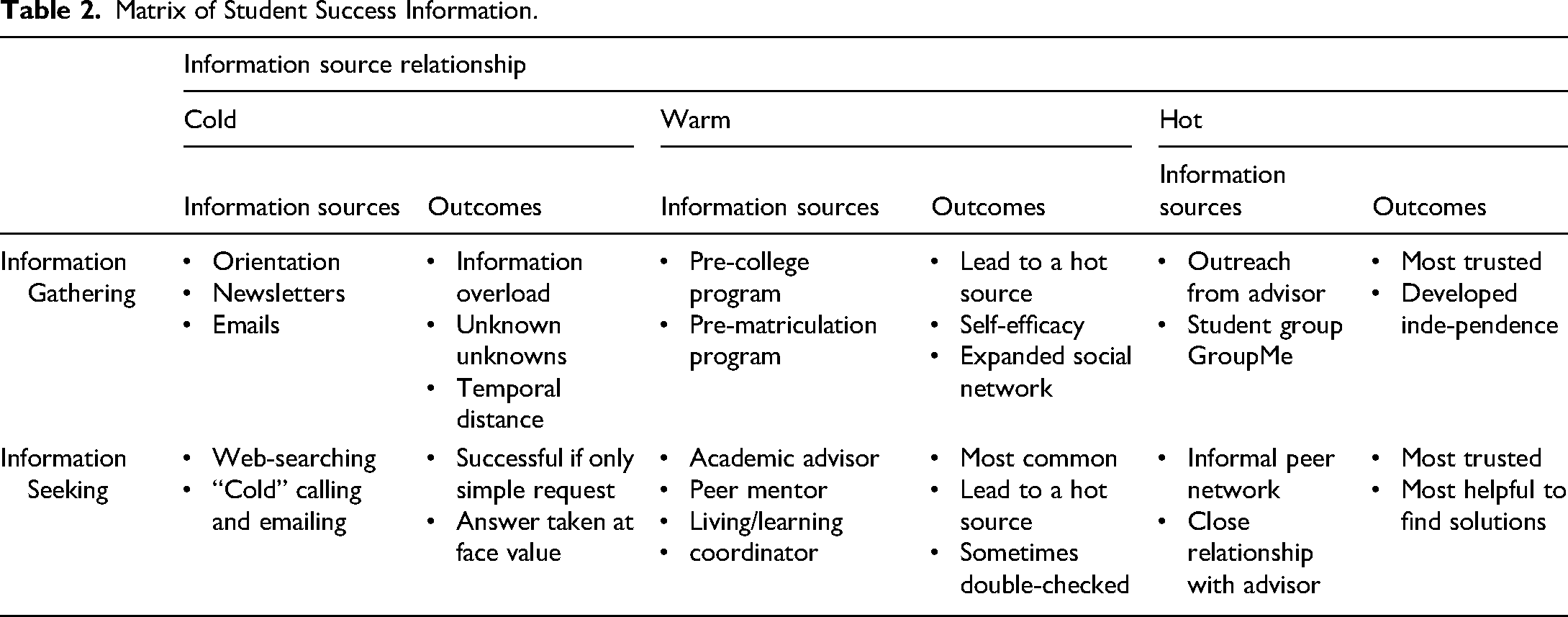
Cold Sources
Cold Information Gathering
Cold information sources are institution-based, formal, and typically designed to serve a wide student audience, such as an academic registrar's FAQ website or general financial aid assistance email. Participants described passively gathering information from sources designed for the general undergraduate population through first-year or transfer orientation and weekly newsletters and targeted emails. Students recalled that these sources were sometimes helpful for gaining initial awareness of campus-wide student success resources such as knowing about the existence of the writing center.
Still, these sources were not as useful for troubleshooting issues, as they left too many “unknown unknowns.” For example, while a student may have heard about opportunities for additional academic tutoring at orientation, they remained unaware of the steps required to access such resources—a crucial omission given that FGCS are known to be less likely to seek additional help from faculty and staff (Jack, 2019; Lareau, 2015). We observed that this phenomenon was compounded with temporal distance; in general, participants had difficulties recalling cold sources of information the longer time passed between when they were gathered and when the focus groups were facilitated. In other words, when participants gathered information from cold sources if recalled, it was usually introductory, surface-level knowledge about a specific topic.
Additionally, participants mentioned being overloaded with formal, general information, especially during the first few months before and after matriculating at the site institution. Students often shared stories of attending jam-packed orientation days and receiving several emails from various offices. This overload made it difficult for FGCS to decipher what information was pertinent to retain. For example, one first-year Latina student said, I don't remember anything from orientation. Orientation was really fast-paced. It was three days packed full of different things, and they gave us a lot of different resources and pamphlets, but I don't remember any of it. I probably tossed all those fliers away.
However, information overload should not be viewed as solely resulting from information deluge. Students conceptualized overload as being related to time and place, as identified by Savolainen (1995; 2010), overload also occurred when a student's circumstances or experiences dictated a certain piece of information as irrelevant. Like Head (2013) and Head and Eisenberg (2009), we observed that several upper-level students had developed information overload strategies, including some designed to retain irrelevant information for later use. When asked how she might transfer course credits taken elsewhere, one third-year Middle Eastern/North African woman student noted, I know definitely [the business school] has sent…in those weekly newsletters they’ve said multiple times, ‘This is how to conduct a transfer,’ as part of the newsletter. So, I would just save those emails in case I need to transfer and yeah, I think they linked you to this sheet that you need…
In summary, because cold sources of gathering information are (a) formal and institutional, (b) often aimed at a wide audience, and therefore (c) not specifically tailored to an individual student's needs, FGCS students are at a particular disadvantage when gathering information from cold sources.
Cold Information Seeking
All students reported some level of cold information seeking, where participants sought information from a formal, university-based source, usually in the form of searching for the needed information online or calling/emailing an office on campus. As noted by previous researchers, students sought most cold information online (Escoffery et al., 2005; Head & Eisenberg, 2009; Gabridge et al., 2005). For example, one third-year White woman student even contrasted searching websites for information with orientation: I remember…orientation, and I was also witness to the barrage of emails. I think a lot of the resources that I’m still aware of and the things that helped me transition, I learned about on an as-needed basis. I was like, ‘Oh, I wonder if there's something like this that exists?’ …. I think I learned a lot about more resources just on my own than a formal introduction to them.
However, Internet searches and cold-calling offices throughout campus usually did not prove successful. Many students described situations where—unless they had a named contact—their questions to general customer service lines went unanswered or were confusing. Additionally, cold sources provided standardized information that was frequently (a) not unique to the student, (b) did not answer their specific query, and/or (c) provided difficult to understand, bureaucratic language. As one first-year Black man student noted, So I actually took classes last summer, or throughout high school, and I was really excited for them to transfer and then none of them did. So, at the beginning of this year, I was constantly calling the office of Undergraduate Admissions and I was like, ‘Where [are] my credits?’ They sent me to this website where I eventually could [find out]
While not all of the cold information seeking situations were negative, numerous students received wrong information from outdated websites or had unsatisfying interactions with staff. Therefore, these results lead us to critically examine the effectiveness of cold resources in student success for FGCS. Still, cold sources are often successful sources of information if the question is simple and not unique to the student, like due dates or locations of online forms. In situations where offices give out standardized advice instead of providing more personalized guidance, students were left with either minimal, inappropriate, or unhelpful information.
Warm Sources
Warm Information Gathering
Warm sources of information occupy a middle ground of formality within the collegiate environment: although the primary relationship is still formal and through the institution, these relationships also have a more familiar rapport (Slack et al., 2014). Participants frequently cited warm sources of information as academic advisors and pre-college programs because they served as personalized introductions to campus and enabled students to expand social networks and build self-efficacy for academic and social success. It was especially important for students of Color and Science, Technology, Engineering, and Mathematics (STEM) students who were often not met with many role models of people in their intended academic major.
Students credited both pre-matriculation and pre-college programs with introducing them to staff and peers that were helpful to navigate the institution's bureaucratic structures and many resources. These programs were especially cited for making high school students, who had limited knowledge of college, feel more comfortable with the previously foreign idea of college. One third-year Latino student cited multiple programs: My junior year of high school I did [a student-run pre-college program]…I found out about [a science living learning community] so I actually started a semester early. I did [a Latinx student organization's orientation], so I did all these early learnings about [the site institution's] programs. I also lived here for a whole semester my junior year, a whole summer, doing research…I think I was privileged in that sense because not everyone has those opportunities, so I don't know. That made my transition very smooth I guess in terms of I know all of these people from all these different affiliations…
Likewise, students that mentioned these programs usually included people that helped them learn how to accomplish specific tasks during their transition to college, such as planning course schedules and utilizing campus learning resources. Specifically, a fourth-year Black woman student said: Yeah, for me, I did [a pre-college summer bridge program] before my freshman year, so that was the best transition I could have ever asked for…they also taught us about [the campus writing center], they were always helping us with [how to register for classes], things like that.
Overall, the students who attended either pre-college programs in high school or pre-matriculation summer programs before their first year appreciated the additional social capital and self-efficacy it gave them before starting their college career.
Warm Information Seeking
Warm sources of information seeking are the most common within our sample. Participants turned to peer mentors and living-learning coordinators for specific answers to their social and academic success-related questions. For example, one fourth-year Asian man student mentioned that he received lower grades than he was used for a particular course. After he approached the professor for advice, she pointed him towards tutoring resources on campus: I had no idea at that moment about the, like, the learning center or the tutoring, where they offer free resources about like…even apart from just the practice exam. They have study groups and stuff like that, but I didn't know any of those. Then I learned about those. Then I started using those. It made it easier.
Overall, when students needed to solve a problem, like transferring in courses from another institution, the most common source of information seeking was from academic advisors. As in other studies (Tobolowsky et al., 2020), students benefited from the availability and knowledge of student services staff members are formal, yet familiar sources. These sources were often the most common to seek information from because they were seen as content experts, but also had a more familiar relationship with individual students because of their proximity in age and the collegiate experience. Even though students most often went to warm sources to seek information, there were quite a few participants that mentioned double-checking these sources at least a few times before completely trusting the information they received.
Hot Sources
Hot Information Gathering
Students were most likely to trust and use information gathered from hot sources; the sources with which they had strong familiar and informal relationships, especially those they considered peers and/or those with shared identities. Many students mentioned a variety of supportive communities that fostered “hot” relationships. For example, several participants recalled their peer networks formed in living-learning communities, including one first-year White woman who felt her peers were “like a family” as she described them: …a lot of us are in the same classes, so I’ve got at least five people in almost all of my classes that I already knew because we’re all going towards the same general careers, as well. So, coming into the school knowing 95 other people and having become very close with a good portion of them, as well.
Participants developed trust with hot resources faster often because of shared cultural values and social identities (Perez, 2017; Torres et al., 2006). For example, a Latinx student organization on campus maintains a GroupMe text chain where students can ask each other questions and advice about college life and academic success. One first-year Latina student noted that, There's actually some people [on the group chat] who question a lot. So, if someone says a statement, they’ll be like, ‘Link?’ Or they’ll ask for links and specific things, so that's really helpful, too. Just in general, we also have undergraduate advisors in that group chat, so they’ll verify things, or they’ll be the ones sending out links to information.
Viewing in real-time, the exchange of questions, answers, and proactive advice allows students to gather the information that they may not have even known was available or thought to seek out. This is the type of “unknown unknowns” that were not as helpful to decipher from cold information gathering sources. And because this information was mostly shared by informal and familiar peers that encouraged checks for accuracy, this became one of the most valued and trusted resources for the Latinx students that were involved with the Latinx organization. It's also important to recognize that sharing similar racial identities and experiences in college was not only a bridge for social interaction but also academic success information for Latinx FGCS (Beard, 2021; Santa-Ramirez, 2021).
Our study confirms other studies (e.g., Almeida et al., 2021) that indicate FGCS look to informal and familiar peer communities for mutual support. While many of these peer relationships were facilitated through formal organizational programs like learning communities or student organizations, peer relationships quickly became “hot.” These interpersonal relationships were important because they were able to provide each other with the information to successfully navigate collegiate and academic success.
Hot Information Seeking
Hot sources of seeking information were the most helpful and trusted sources for FGCS to find solutions to problems. Some participants noted that they formed trusting relationships with advisors that became more personal and more informal, yet still professional. Regardless, students spoke of multiple situations where hot sources of information, through their helpful advice, became more useful than official offices on campus. For example, a fourth-year Middle East/North African woman student shared a story about when her computer broke during her sophomore year. She was able to manipulate her financial aid package for a one-term purchase of an essential tool such as a computer. But she mentioned, These are things we just don't know. You have to really dig and find. So many students after I experienced this, I found out that they needed new computers and students were struggling to get computers, and it's like you can't survive in this place without a computer…. Again, if I didn't have [student group advisor] to connect me to somebody that he knew in financial aid to be like this exists for students, then I would not have known. And that would’ve been a disaster.
Academic advisors became hot sources of information seeking when they (a) encouraged the student to approach them with any question at any time, (b) provided useful unknown information, and (c) promoted a student's self-efficacy in both academics and campus navigation. When asked about her most trusted source of information on campus, one first-year White woman said, I would say, my academic advisor. I’m from [another state] so coming here I knew zero people, no one came [from] my school. I was just put into this big university … I literally just knew my academic advisor. I have meetings with him at least twice a month and sometimes I’ll just pop in or whatever and I don't even know. But I see him more as a friend and stuff. Someone who I could just talk to…He's also a mentor, which is really helpful because I struggled with some of my courses last semester because I just didn't realize wow, I need actually to work for good grades and stuff. So, he just gave me confidence…
Students increased their social capital and sociocultural ecology by developing more familiar relationships with peers, mentors, and advisors that provided them with invaluable information (Williamson, 2005). Unfortunately, some participants did not describe having a “hot” source on campus that they could ask questions to - and often these were the students that were not satisfied or were frustrated with their college experience and often had trouble navigating processes.
Discussion
Based on our results we found that students utilized a range of resources from websites, formal programs, a range of staff advisors, and personal friends to be successful in college. This type of resource utilization speaks to the innovative and resilient nature FGCS often must have to succeed in college. Even though students mentioned a myriad of resources and experiences that were helpful for their academic and social success, not all resources have an equal impact. The more familiar a resource became, the more they were trusted, utilized, and re-utilized. Using theory and concepts from information sciences helped create a typology based on how students found information and where the information came from. The information typology has broad implications for practitioners looking to improve practice and increase student success, along with researchers examining the ways information influences student experiences and success. In this section, we offer implications for practitioners to consider based on the new typology, while also providing opportunities for future research that are needed to more fully understand how FGCS utilize information for their academic and social success.
Implications for Practice
Policymakers and practitioners cannot truly achieve college student learning, retention, and completion without ensuring FGCS success. We offer ways practitioners and policymakers can use the typology to improve information finding and utilization for FGCS. First, the typologies can be used by practitioners and university leaders to conduct audits of specific offices, services, and resources. For example, a financial aid office, which is a vital resource for FGCS, should offer several mediums for students to find information. While it may seem sufficient to have a website of information or front-line staff available to answer questions, according to our study, that was often not enough for FGCS to successfully seek information and find solutions. A financial aid office should offer numerous opportunities for students to utilize not just “cold” information sources but “warm” and “hot” sources as well. Partnering with living/learning communities, student identity offices (e.g., resource centers for students of Color, LGBTQ students, disabled students, undocumented students, women students, veteran students), and academic program communities would be beneficial to utilize their established social networks and embedded relationships to provide more personalized information to student sub-populations. Our research indicates it is not enough just to have correct and accessible information, but the relationship with the information source matters.
It is not always feasible for university staff to build “warm” or “hot” relationships with students due to financial and human resources. And unfortunately, the institutions that support the most FGCS are often the institutions that are doing so with the least resources. With this in mind, we offer two ideas that could be helpful for institutions that must be increasingly efficient with human and financial resources. The first is to ensure the “cold” resources (e.g., websites, pamphlets, handbooks) are accessible to FGCS. An innovative example of how to do this comes from Rutgers University - Newark (RU-N). RU-N employs FGCS, as ultimate users of information, to provide critical feedback to university offices to improve communications (J. Gunkel & B. Leipold, personal communication, September 8, 2021). The FGCS feedback providers can alert staff when unclear jargon is used, processes are outdated, or there is missing information virtual to individual student success. This type of student service design requires administrators to design services that are efficient and effective for the student user, not just for the organization. Student services that provide cold sources of information should be redesigned to efficiently reach FGCS.
Lastly, even with minimal resources, university leaders could create a culture where relationships with students, for their success, are valued and encouraged at all levels of the organization. Theorizing how bureaucracies, like universities, could be more relational, Gittell and Douglass (2012) describe a reciprocal and caring way of conceptualizing the interaction between a service provider (i.e., university staff) and a service recipient (i.e., student) as relational coproduction. Relational coproduction “involves reciprocal interrelating between workers and customers regarding what is to be done and how best to do it” and is “characterized by high levels of shared goals, shared knowledge, and mutual respect” (p. 716).
Due to the human resource-intensive nature of relational coproduction, it can be difficult to provide “warm” and “hot” relationships with students, but even through short interactions over the phone, at a front desk, or via email, high quality connections can be built in short interactions. The term high quality connections (HQC) comes from positive organizational scholarship and is defined as “short-term, dyadic, positive interactions” (Stephens et al., 2011). HQC quality is determined by the mutuality of the exchange, vitality of connection, feeling cared for. The strength of these short interactions can create positive outcomes like enriching identity (Roberts, 2007) and feeling a sense of attachment to an organization (Ragins & Verbos, 2007). While HQC has mostly been used to describe collegial interactions, it can be applied in this context where student-staff relationships are important to the success of FGCS. If university staff who interact with FGCS approached each interpersonal interaction by centering mutuality, vitality, and care, FGCS would likely be able to access and utilize essential resources more efficiently and effectively.
Implications for Future Research
This study provides a novel typological examination and categorization of the way FGCS learn and utilize information for their academic and social success. To understand this phenomenon, we utilized theory and research from information sciences. The proliferation of communications students receive from recruitment to matriculation can be astounding; for FGCS the deluge of information can be overwhelming. While information sciences utilize theory and methodologies to understand the importance and efficacy of communication mediums for different purposes, higher education research is less developed in this area of inquiry, even though information finding and management is an integral factor in student success. For participants in the study, some of them found helpful and sometimes essential information nestled in weekly newsletters from their college or tucked away in an email from their advisor. Others found advice through their student organization GroupMe chat. While we introduce and categorize these different sources of information we do not know enough about their efficacy. For example, is financial aid information better communicated through a newsletter or peer chat? Are important advising dates better delivered through posters or email? While in practice students experience multiple types of communication from multiple sources about multiple subjects, more research is needed to know exactly how best to deliver information to FGCS about important deadlines or financial aid opportunities. The scholarly field of higher education would benefit greatly from the increased application of information sciences theory, methods, and scholarship to better understand individual and organizational behaviors as well as to inform future research on the everyday practices that have a profound impact on FGCS success.
Our study utilized theories about finding information for student success and how information utilization is related to its source. While there are a few studies in the higher education literature that explicitly examine ways students find information from trusted sources (e.g., Torres et al., 2006), there needs to be further research to understand how university staff can be trusted and utilized by FGCS. For example, participants mostly mentioned academic advisors as being a “warm” resource that was familiar, yet still structurally created from the university even though some academic advisors were purely “cold” and utilized for general information transactions. What is less clear is how advisors or university staff can move from “cold” or “warm” to the most trusted of sources, “hot.” The mechanisms in which a university resource is trusted or often utilized would be an important conceptual linkage to understand how FGCS learn about and utilize campus resources.
Conclusion: A Rising Tide Lifts All Boats
If more FGCS can be retained through graduation, the benefits will likely permeate to other student sub-populations (e.g., students of Color, low-income students, undocumented students). We want to encourage researchers to investigate further the efficacy of new programming and critically interrogate the quality and accessibility of training, development, and accountability of staff to provide necessary support, service, and everyday interactions to students. College requires a complex set of academic and social skills along with enough financial resources and cultural capital from students. What our research indicates is that the answer to FGCS may not be more support services or programs, but a more relational organizational culture that expects staff to build trusting relationships with students through even the smallest of interactions, so college success requires less cultural and navigational capital from students.
Footnotes
Acknowledgments
We want to thank Amrita Das for her literature review assistance and contribution to the research process.
Declaration of Conflicting Interests
The author(s) declared no potential conflicts of interest with respect to the research, authorship, and/or publication of this article.
Funding
The author(s) received no financial support for the research, authorship and/or publication of this article.
