




Abstract
Under settled First Amendment doctrine, true threats and incitement to violence fall clearly outside the protection of the United States Constitution. However, the line between violent speech and protected political hyperbole is exceedingly blurry, especially in high-conflict protest environments. This study complements doctrinal analysis with an ethnographic field study of abortion clinic protests in the Southern United States to test assumptions about speech, harm, and political discourse. It recommends that courts modify the analytical frameworks for true threats and incitement to better capture the layers of social and historical context that create social and rhetorical meaning amid political conflict.
Chief Justice Earl Warren’s tenure on the Supreme Court marked a notable period of expanded First Amendment protection for incendiary political expression. In 1969, the final year of Justice Warren’s service, the Court set the modern framework for protecting violent political speech. 1 The court abandoned the maxim that speech loses protection when it presents a “clear and present danger” of “substantive evils” that the government is entitled to prevent. 2 In its place, twin doctrines emerged that focused on identifying unprotected true threats and illegal incitement.
The true threats doctrine, articulated in Watts v. United States, 3 and the incitement doctrine, announced in Brandenburg v. Ohio, 4 distinguish between illegal calls for violence and protected expression that uses violent rhetoric to communicate political invective. The doctrines have come to define the limits of protected ideological and political discourse in the U.S. system of free expression as they guide courts in categorizing speech based on its value and whether it seriously threatens violence or calls for imminent, lawless action that is likely to occur. 5 How courts frame and analyze the context surrounding threats and incitement is enormously consequential for free speech in the United States, especially in the public sphere where rancorous political debate is inextricably bound to America’s ongoing free speech experiment.
Context is central to making meaning, and therefore crucial to free speech doctrine. 6 The Court recognized this truth in Watts, emphasizing that the First Amendment requires courts to consider a statement’s full context to distinguish crude political hyperbole from an unprotected true threat. 7 Although the Court did not specifically define “true threats” at the time, it made clear that the First Amendment requires considering circumstances surrounding speech to determine its true meaning and effect. In the 2003 case Virginia v. Black, the Court reiterated the criticality of contextual analysis. Justice Sandra Day O’Connor admonished lawmakers not to “ignor[e] all of the contextual factors that are necessary to decide whether a particular [act] is intended to intimidate.” 8 Aside from explaining that true threats encompass “statements where the speaker means to communicate a serious expression of intent to commit an act of unlawful violence to a particular individual or group,” 9 the Court has never laid out a clear test for identifying and assessing the contextual factors courts must consider in true threats cases.
In Brandenburg, the Court affirmed the principle that the constitutional guarantees of free speech and free press do not permit the government to forbid or proscribe advocacy of the use of force or other illegal activity except where such advocacy is directed to inciting or producing imminent lawless action and is likely to produce such action.
10
The Brandenburg incitement test calls courts to assess context to determine whether speech is likely to cause listeners to engage in specific illegal conduct advocated by the speaker, thus distinguishing the speech from protected abstract ideological advocacy. 11
The decades since Watts and Brandenburg have been marked by confusion among lower courts about these important doctrinal and contextual matters. The confusion manifests in two key ways. First, regarding true threats, federal courts disagree over the standard of intent required to prove a true threat. Second, regarding incitement, federal courts reach wildly disparate conclusions regarding how imminent and likely a specified harm must be to hold a speaker liable for speech that potentially incites such harm. The result is a doctrinal muck that insufficiently addresses pressing free speech quandaries, involving high-conflict political speech and Internet-mediated communications.
The United States continues to reckon with rising tides of violent political extremism. Following the August 2017 Unite the Right Rally in Charlottesville, Virginia, which ended in anti-Nazi activist Heather D. Heyer’s death, several lawsuits (in preliminary stages as of this writing) alleged that the rally organizers, specifically White nationalists Richard Spencer, Jason Kessler, and Robert Ray, were legally responsible for a coordinated effort to threaten and incite violence against counter-protestors. 12
In 2018, the United States Court of Appeals for the Sixth Circuit dismissed a complaint alleging that President Donald J. Trump was responsible for inciting harm to protestors who were violently removed from a 2016 Trump campaign rally. In 2015—earlier, yet perhaps far more consequentially—the United States Supreme Court issued its long-awaited decision in Elonis v. United States, 13 a case commentators anticipated would clarify how the true threats doctrine applies to online speech and artistic expression. 14 Although it held that mere negligent communications are insufficient to sustain a true threats conviction, the Court failed to determine the level of intent required under the true threats doctrine to satisfy First Amendment safeguards. 15 It also failed to guide lower courts in analyzing the expressive context.
Together, these recent incidents underscore the significant role of the true threats and incitement doctrines in determining freedom of expression in high-conflict social settings where free speech is frequently tested. They also reveal important questions left unresolved by more than 45 years of jurisprudence. The central purpose of this monograph is to recommend ways courts could improve contextual analysis in true threats and incitement cases. My recommendations are based on in-depth analyses of pertinent case law and an 18-month ethnographic field study of abortion clinic protests I conducted from March 2015 through September 2016. During the study, I visited the clinic at least twice weekly (sometimes much more often), writing copious field notes and analytic “notes-on-notes” as I went, recording as much as participants allowed, and constantly comparing the field data with the ways that courts have articulated issues of harm, value, and free speech in relevant cases. The results, which address some implications for practitioners and scholars of political communication and social movements, highlight how speech-permissive the incitement doctrine has become and how speech-restrictive the true threats doctrine has become, even for overtly political expression. They also help explain how ongoing political conflicts fit within these legal structures.
These are not small matters. The chasm between activists’ understanding of their protest activities and the social knowledge enshrined in court decisions has tremendous influence over public discourse. This research can sensitize researchers to aspects of protestors’ humanity, identity, and expressive interests on the way to understanding how harms and expressive values are associated with political activism. The resulting recommendations are intended to help courts capture how speech functions amid seemingly constant conflict in modern democratic society.
High-Conflict Political Speech and the Context Conundrum
Violent political expression—for example, expression that relies on violent tropes, violent imagery, references to war, killing, and gore, or similar rhetorical devices—presents thorny constitutional issues. Violent rhetoric lies at the historical core of political expression in the United States. Thomas Jefferson asserted famously, “The tree of liberty must be refreshed from time to time with the blood of patriots and tyrants.”
16
Similarly, Dr. S. G. Perkins, a Union officer during Civil War, wrote, “I look to see those fair Southern homes, which have stood forth so brilliantly, sink amid blood and fire . . . To the hands of the North have been committed the sword and flame of avenging justice.”
17
And in a 2010 bid for a United States Senate seat, Republican candidate Sharron Angle laid out the case for violent resistance of government overreach: [The Second Amendment] is for when the government becomes tyrannical . . . but you know, if this Congress keeps going the way it is, people are really looking toward those Second Amendment remedies and saying, “My goodness what can we do to turn this country around?” And I’ll tell you the first thing we need to do is take Harry Reid out.
18
Violence, whether public and government-sanctioned or private vigilantism, is inextricable from American political progress and failure. 19
What distinguishes unlawful violent expression from these examples of protected political hyperbole or abstract advocacy is often the surrounding context. The scholarly literature on violent expression addresses three main issues related to the overarching issue of context and extends that discussion to the subjects of incitement and the related quasi-doctrine of hate speech. 20 The first issue is the level of intent the prosecution must prove to show that a defendant communicated true threats or illegal incitement. The second issue is how meaning is discerned from the context surrounding threatening language or language that incites violent conduct by others. The third issue is how the true threats and incitement doctrines apply in digital environments.
The Role of Intent in Identifying Unprotected Speech
Currently, circuit courts are split over whether the true threats doctrine requires assessing the speaker’s intent under an objective or a subjective standard. Under the objective test, a statement amounts to a true threat if a reasonable person would interpret language as an expression of intent to do harm to another. 21 Under the subjective test, a statement amounts to a true threat if it is both objectively threatening, and the speaker intended the statement to be understood by the recipient as a threat of harm.
The scholarly literature on the true threats doctrine is similarly split. Many scholars suggest that the Court in Black introduced a subjective intent requirement. 22 Skeptics maintain that Black requires nothing more than showing that the language is objectively threatening. 23 Yet, many scholars have reiterated that the Court provided no additional guidance in Elonis v. United States regarding the level of intent required to prove that the defendant made a true threat. 24
Unlike the true threats doctrine, the standard of intent in the incitement doctrine is fairly well settled. Language in Brandenburg v. Ohio suggests that unprotected incitement must be purposefully “directed at inciting or producing imminent lawless action.” 25 In addition, the Court affirmed in NAACP v. Claiborne Hardware, “[I]t is necessary to establish that the group itself possessed unlawful goals and that the individual held a specific intent to further those illegal aims.” 26 Incitement requires proof of the defendant’s specified illegal or violent aim, that the circumstances to achieve that aim were present and primed for activation, and that the defendant’s language be used to pursue the illegal result. Scholars and judges uniformly consider the incitement standard to require specific intent to cause others to engage in illegal conduct at the speaker’s knowing urging. 27
For both doctrines, the intent standard is important because if the speaker’s subjective interpretation of a message is relevant to the analysis, the speaker’s understanding of context becomes critical to identifying unprotected violent speech. However, the parameters and limits of contextual analysis in true threats and incitement cases have prompted significant scholarly debate.
The Role of Context in Political Threats and Incitement Cases
Context—the circumstances surrounding any particular act of communication—both constitutes and is constituted by meaning shared among social actors. When a fire and casualty agent says, “Nice house. It’d be a shame if something were to happen to it,” it means something dramatically different than when a mobster holding gasoline and matches utters the same words. Political grievances wrapped in violent tropes are no different. They rely heavily on nonverbal cues, and communicative practices gain social meaning over time. Constitutional and technology scholar Lawrence Lessig suggests that people create social meaning by synthesizing and sorting through meaning-laden actions, inactions, and symbols in a particular context. 28 In a widely cited article, Jordan Strauss suggested that social meaning is an important but underappreciated aspect of the true threats doctrine: “That the same words will have different meanings in different communities should not be lost on anyone, particularly a court evaluating an allegedly threatening communication.” 29 Meaning in the context of threats is inextricably tied to the cultural, historical, and political backgrounds of many relevant individuals and groups. 30
The incitement standard adds a layer of analytical complexity because it involves communications addressed directly to a listener, but harm to an unrelated third party. One issue peculiar to the incitement standard—and its relation to threats—is how First Amendment doctrine should apply to speech that uses incitement-style language, such as urging others to participate in illegal or violent acts, in a way that causes fears that are commonly associated with threats. 31 First Amendment scholar Lyrissa Lidsky cautioned that the emergence of violent advocacy in complex social media contexts has caused courts to expand the true threats doctrine and apply it to cases that traditionally would have been considered incitement. 32 Courts lack clear frameworks for dealing with incitement-style language that induces fear.
Scholars disagree over whether the First Amendment protects indirect, implicitly threatening statements imbedded in abstract calls for violence. 33 This is especially true in social environments where third-party intermediaries, such as participant speech distributors in Internet-mediated environments, affect how speech is interpreted and therefore whether it is likely to be considered harmful. 34 Media law scholar John Rothchild called courts to prioritize analysis of function over form in doctrinal analysis of harmful speech to account for how menacing speech actually functions in the relevant segment of society, particularly in public, mediated environments. 35 Context is critical not only to determining whether the speech is protected, but also to determining which legal framework should apply to allegedly harmful speech that involves digital media and often fails to fit squarely within the true threats or incitement framework. 36
Threats, Incitement, and Digital Media
The proliferation of harmful speech in Internet-mediated spaces, not to mention the platforms themselves, has caused an explosion of scholarly literature on Internet threats. 37 Dubbing the Internet a “game changer” for the true threats doctrine, constitutional scholar Eric Segall suggested that courts should be more sensitive to the pervasiveness of the medium in true threats cases. 38 Others have similarly argued that the media environment should be the focus of true threats analysis. 39 The particular communicative attributes of a mediated environment, such as its geographical reach or its propensity for “going viral,” affect the level of harm experienced by the targets of speech. 40
Legal scholars Nancy Leong and Joanne Morando raised a fundamental question of what it means to “communicate” a harmful message in a vast mediated environment. 41 They advocate distinguishing digital communication “to prevent the all-too-easy comparison to real-world . . . activities.” 42 Digital harms are different, they asserted, because of where and how the speech takes place; the medium matters just as much as the social context, historical context, or speaker’s identity. 43 Leong and Morando reinforce a key theme in the literature: law should better account for how speech facilitates harm without singling out an identifiable target. 44 Studying social context helps explain how threats are used to make ideological points and cause harms through public discourse.
The literature on incitement has also addressed issues of context in nontraditional media environments. Lidsky argued that Brandenburg’s imminence requirement fails to address the “incendiary capacity of social media.” 45 According to Lidsky, social media users can spur unlawful conduct over vast distances as if the communication is taking place in close proximity and in real time. 46 Lidsky emphasized that the incitement doctrine assumes (without support) that audiences to violent public advocacy are not inherently susceptible to violence. 47 Speakers who advocate violence are rarely held liable under the incitement doctrine because audiences almost always have time to deliberate and decide whether to act on the speaker’s urging. 48 Scholar Margot Kaminski, on the contrary, finds no empirical support that abstract, public Internet advocacy creates harms different in kind or degree from traditional advocacy. 49 Yet, some scholars maintain that online media environments foment harmful extremism and mob behavior that does not fit squarely within existing media-focused constitutional paradigms. 50
Although scholars have urged courts to jettison assumptions about prototypical public advocacy and reformulating doctrine to capture the social realities of speech and harm, no studies of true threats and incitement have supported these aims through empirical qualitative research. Instead, the doctrinal work reviewed to this point has left substantial blind spots that, if addressed, could have profound implications for determining when high-conflict public advocacy amounts to First Amendment protected discourse.
Blind Spots in Doctrinal Analysis and the Promise of Sociological Field Theory and Qualitative Methods for First Amendment Studies
The paucity of interdisciplinary methods in legal research has left an epistemic blind spot 51 regarding the relationship of context to free expression law. Although courts and scholars have clearly articulated the constitutional necessity of contextual analysis of speech in the political sphere, doctrinal research has been dominated by positivist-leaning frameworks. Positivist frameworks deemphasize the underlying social contexts that dictate the limits of free expression in high-conflict speech environments such as abortion-clinic protests. This section explains how post-Marxist social and organizational theories such as field theory are useful for understanding free expression as a mutually reinforcing doctrine and praxis.
Field Theory
Field theory focuses on how group action depends on social position, deeply ingrained social practices, and social actors’ access to useful resources.
52
It explains how social actors use routines to create institutions (fields), maintain institutional stability, or achieve social change.
53
Fields are interactive and contentious social environments in which social actors, classified as either incumbents or challengers,
54
strategically jockey for position in disputed spaces.
55
Sociologist Pierre Bourdieu posited that skillful social actors create “rules of the game” or conventional wisdom (what he called “doxa”) to exert force upon social challengers.
56
When normalized among participants in a social field, Bourdieu asserted, doxa affects social behavior and guides how field participants derive meaning from conflict.
57
According to communication scholars Tony Schirato and Jen Webb, social action reifies these rules: Subjects in and of a field are shaped, constrained and disposed towards thoughts and actions through their immersion in, and their incorporation of, the procedures, rituals, mechanisms, capital, explicit and implicit rules, and values of the field.
58
Relationships between context, routines, and rules in high-conflict speech environments are important because shared meanings (e.g., whether participants understand speech as harmful or valuable) are determined by how groups act according to context. 59 Ideological groups—whether aligned or competing—are bound together by shared meanings, assumptions, and characterizations of their social practices. 60 How participants in related fields of expression use ideologically motivated speech and action to exert control over—or do harm to—one another has direct implications for understanding law, movement politics, and sociohistorical realities of First Amendment doctrine. 61 Field theory frames explorations of how ideologies, meaning, and value manifest in deeply ingrained social practices that are vital to meaning-making. 62 Yet, the literature on free expression does not explicitly discuss the importance of social practice. Understanding social fields like abortion clinics is crucial to understanding conflict-laden speech. Likewise, the court opinions studied here are the results of structured, patterned legal training, protocol, and elite culture, and thus qualify as social fields. 63 The routine practices of social actors in volatile fields evince both how conflicting groups understand the context of speech in volatile social environments 64 and the importance of context to how participants navigate social structures to determine the core meanings of speech. 65
This study builds upon legal theorist Lawrence Friedman’s view that law “cannot be specifically marked off from the rest of the social world.” 66 Law sets formal rules for free expression in society, but it also shapes, channels, and restrains social action and uses of power. 67 Legal systems are important fields of social interaction, and legal norms are important tools for social actors. 68 Moreover, ideological expression can never be fully understood through objective legal tests or methodologies that rely heavily on self-report. Ideological meaning is not always clear. Cultural philosopher Slavoj Žižek cautioned that because the term ideology “can designate anything from a contemplative attitude . . . to an action-oriented set of beliefs,” 69 it is difficult to study apart from its social manifestations. When speech is menacing on its face, its ideological importance may be obscured, especially for outsiders such as judges. Even supposedly self-evident social meanings involve complex social practices that are tied to ideology in nonobvious ways. 70 Before drawing normative conclusions about First Amendment law, expression should be understood as a social phenomenon. Field theory contributes to that understanding by addressing the contextual factors that shape social interactions in sites such as high-conflict speech environments.
Contribution to Interdisciplinary Legal Scholarship
Doctrinal legal studies frequently reflect positivist epistemologies. The discipline aims to determine what the law is rather than investigate the social interactions impacted by laws. Positivists believe objective legal principles can be discovered by assessing and applying the internal logic of the common law, so they rarely investigate the structure and function of social environments. 71 Doctrinal scholars focus narrowly on precedent. 72 Interdisciplinary legal research, on the contrary, uses methodologies from disciplines such as sociology to critique law and address nondoctrinal social problems reified in legal structures. 73 For example, John Conley and William O’Barr used qualitative interviews and ethnographic participant observation to create typologies of litigation and adjudication styles in small-claims courts, thereby demonstrating a gap between the judicial and social understanding of the factfinding role of small-claims judges and showing how judicial routines affect small-claims outcomes. 74 Clark Cunningham similarly studied the lawyer–client relationship and the criminal justice process through the lenses of critical ethnography and critical race theory. 75
Only a small fraction of First Amendment legal research is interdisciplinary, 76 but it has made inroads; progressive and critical legal scholars value interdisciplinary legal scholarship that incorporates sociological methods. 77 Media law scholar Matt Bunker has argued that methodologically and theoretically diverse empirical approaches enhance First Amendment scholarship. 78 Interdisciplinary legal research should therefore pursue a balance between inductive and deductive methodologies. 79 This monograph bridges legal and sociological disciplines to explain how making sense of speech in high-conflict environments requires a well-developed understanding of social context.
Method
This study utilizes a mixed-method, interdisciplinary research strategy. 80 Through qualitative methods, it compares how participants in a high-conflict speech environment characterize the harms, values, and meaning surrounding the speech practices they encounter with how courts characterize salient harms, values, and meaning surrounding speech practices involved in true threats and incitement cases. 81
The materials analyzed include legal opinions issued in true threats and incitement cases, field notes collected during ethnographic observations at an abortion clinic, online content produced by prochoice and antiabortion activists, and transcripts of interviews with abortion clinic protestors, volunteer patient escorts, and others. Typically, legal analysis and ethnographic methods are used to pursue vastly different research purposes.
82
Legal analysis commonly focuses on explaining the nature of legal doctrine, examining doctrinal consistency, or explaining how the law applies to certain factual circumstances. Ethnographies explore structures and practices underlying social phenomena. In the tradition of interdisciplinary mixed-method research,
83
legal analysis and ethnographic fieldwork are used here as mutually informing and complementary. The social meaning embedded in the ethnographic data is just as important as the rules, principles, and tests judges articulate. As legal scholar Timothy Zick has argued, studying how courts use cultural and social knowledge to make sense of social behaviors such as speech is important: Courts need to remove the thumb from the constitutional scale. Fundamentally, how can we know whether the government is pursuing . . . a “non-speech” or an “anti-speech” interest if we remain wholly ignorant of the message, or “meaning effect,” that is intended? It is easy to conclude that no message is targeted where none is translated.
84
For example, Zick noted that in Barnes v. Glen Theater, 85 a case involving a First Amendment challenge to restrictions on nude dancing, the lower court judge “read” the striptease, “interpreted it, and translated it.” 86 That is, a court’s nondoctrinal knowledge shaped how the court derived meaning from actions not traditionally viewed as expressive. According to Lessig, understanding how courts use social context to construct meaning “may help us see that First Amendment law needs to incorporate social reality . . . and that changes in doctrine will follow this broader account.” 87
Legal Analysis of Cases
The legal analysis focuses on a subset of the voluminous true threats and incitement case law, 88 specifically 32 federal district, intermediate appellate, and Supreme Court cases that have applied the doctrines to speech in high-conflict environments. The cases involved allegedly harmful speech uttered publicly and amid ideological conflict with another party (i.e., an individual plaintiff or victim or a government actor). Eleven of the 32 cases apply the true threats or incitement doctrine to abortion clinic demonstrations.
The epistemic focus of the legal analysis conducted here differs from most traditional legal analyses, which often use deduction, analogy, and comparison to discern what the law is or how the law should apply to a particular set of facts. 89 This study focuses on how judges view the context surrounding high-conflict expression and its place in a democratic society built on a cornerstone of free expression. These are separate concerns from how courts articulate explicit doctrinal principles. 90 Doctrine can remain relatively consistent even as judges’ characterizations of context change in patterned ways. Therefore, getting close to judges’ discussions of context warrants explanation prior to addressing doctrinal implications. 91
Ethnographic Fieldwork
High-conflict abortion clinic demonstrations are ideal for examining how social actors characterize harm, value, speech practices, and meaning, which are all important issues of context implicated in the law of true threats and incitement. Political communication scholar Laura Meadows has observed, “[E]thnography can help scholars reconcile normative theory with the realities on the ground, highlighting the disconnections between theory and practice” and developing nuanced understandings. 92 However, legal researchers rarely use ethnographic methods. 93 This study of context surrounding allegedly harmful expression is an “empirical inquiry of a contemporary phenomenon in its real life context” that attempts to determine why decisions are made, why actions are taken, what practices are used by groups, and what decisions and practices reveal about this segment of society. 94 It comprises many cases that include significant unique events, participant accounts, or separate social sites that relate to the overarching case 95 and the development of theory. 96 Each protest observed and each interview in this study of high-conflict abortion advocacy amounts to a nested case of how speakers characterize context in high-conflict speech environments.
Field Observation and Focused Ethnography
The ethnographic methods used here align with sociologists Howard Becker and Blanche Geer’s position that ethnographic observations produce the “most complete form of sociological datum” because they put the observer directly into events as they take place. 97 In the decades since Becker and Geer’s groundbreaking work, ethnography has become a gold-standard approach to studying ideologically grounded social groups. 98 The participants studied here—volunteer patient escorts, antiabortion demonstrators, prochoice counter-demonstrators, passersby, and law enforcement officers—fit this broad characterization. 99 I observed how participants engaged in expressive activities, responded to the speech practices of other groups, and interacted with allies and adversaries. To counter researcher bias, 100 my analysis drew on insights from the research participants, particularly group leaders. 101 I capitalized on their expertise about the site. 102
Although most of the ethnographic data were collected from my observations and interactions with participants during demonstrations, I often relied on key informants to explain events, which presented analytical challenges and opportunities uncommon in doctrinal legal analysis. Cleavages between groups involved in the abortion debate often lead to hostilities that threatened to undermine my ability to gain and maintain access into the subcultures of abortion clinic activism. Participants’ views on abortion were as divergent as they were deeply held. Maintaining access to the field site required cultivating and maintaining relationships with informants along a complex ideological spectrum. 103 I consulted two key informants, a prochoice clinic patient escort and an antiabortion evangelical street preacher, throughout fieldwork. However, their accounts alone were not enough to corroborate the findings or understand participant accounts. Therefore, I used focused ethnography, a method that uses intensive, short-term data collection and analysis of a range of texts and materials, 104 to examine how demonstrators’ online interactions and behaviors shaped their characterizations of context and social meaning.
Focused ethnography
Abortion clinic activists dedicate substantial time and effort to physical demonstrations at clinics, but a great deal of advocacy work and social interaction also takes place online through publicly accessible websites, YouTube channels, and quasi-public Facebook groups. These online fields are crucial extensions of the physical field site. Focused ethnography examines how online fields constitute and affect physical fields and vice versa. 105
Focused ethnography is ideal for studying hybrid online-offline, or multisited environments, in which the same participants interact in physical and online spaces. It capitalizes on the public availability of multimedia texts to better document and enrich the understanding of the physical site and its online extensions. 106 Antiabortion advocates often post recordings of clinic events online. The recordings and online interactions therefore constitute important aspects of the social context at the clinic and may help explain how protestors make sense of harms, values, speech practices, and social meaning. 107
Interviews
Postcritical ethnographic standards admonish ethnographers to treat interviews as partner work and to resist substituting their interpretations of events for those of research participants. 108 In interviews about conflicts at the abortion clinic and online, I encouraged participants to reflect on and discuss their experiences and important events in the most authentic terms they could. 109 I interviewed more than 20 participants in some capacity, although only nine agreed to recorded interviews. The interviews were sequenced and tailored according to the preliminary findings, which helped me identify important interview subjects and craft provisional themes. 110 The ultimate goal was to reach thematic “saturation” to generate authentic accounts of social phenomena at the clinic. 111 Deviations in the interview data were reconciled by corroborating accounts from interview subjects and other data (e.g., YouTube videos and public Internet posts analyzed through focused ethnography). 112
Coding the Ethnographic Materials
Field data were analyzed using grounded theory principles. 113 In the grounded theory tradition, codes (words and phrases that summarize the meaning and significance of segments of data) are applied to the data inductively. 114 The hypothesis-generation phase of research does not occur until the researcher has immersed themselves in the data. Grounded theory analysis moves through iterative focused coding stages. During initial coding, the researcher analyzes data inductively to capture salient data points, applying codes to the data line by line. During focused coding, initial codes and newly acquired data are synthesized to create conceptual codes related to potentially applicable theory. Sociologist Kathy Charmaz explained that initial coding creates the “bones of [the] analysis” while focused coding sorts, synthesizes, and integrates the assemblages of produced and coded data. 115 Grounded qualitative work emphasizes data immersion, constant comparison, and open-ended analysis in which the researcher moves flexibly between field, the literature, and the data to refine the findings and to identify conspicuous unexpected results or patterned absences. 116
Although abortion clinic advocacy is not a perfect analytical proxy for all high-conflict speech environments, and this study’s findings are not representative in any statistical sense, the ethnographic work here is valuable for showing how participants in high-conflict protest settings depend on context to make sense of potentially harmful, ideologically motivated speech. Particular historical, political, religious, and social factors surrounding the local and national abortion debate shape the unique ideological substance of this site and likely affected participants’ interactions and view. Researchers may be in the field, researchers are rarely of the field they study. 117 Given my outsider status, I see the world differently than the participants who helped me conduct the field study.
Similarly, no method can unassailably explain psychological, behavioral, or emotional factors that cause people to act as they do. This is a limitation of all studies built on participants’ self-reported experiences or a researcher’s interpretation of ethnographic findings through an outsider lens. But these are truths in any case, legal or otherwise. Although the findings may not support a dramatic shift or reconceptualization of doctrine, they support the position that courts can and should acknowledge how social values and harms manifest in ways not often considered by jurists.
The data include materials as open and publicly accessible as Web content and as granular and personal as participants’ facial expressions, body language, emotional affect, and personal idiosyncrasies. However, they were always filtered through my incomplete and context-dependent understanding. The data constitute one plausible account of how context governs the relationship between free speech and harm in a high-conflict speech environment. What became evident as the study matured was that the importance of social relationships and historical context in high-conflict speech environments has been woefully absent in the law of harmful speech, with potentially serious ramifications for the future of free expression and knowledge of the public political sphere.
Context in True Threats, Incitement, and Abortion Clinic Advocacy Cases
For the purposes of distinguishing protected political expression from criminal speech, context is everything. 118 This is especially true given that criminal threats statutes, especially laws that punish threats against political figures, allow for lengthy prison sentences. However, lower courts have struggled to distill clear frameworks for contextual analysis from the landmark Watts and Brandenburg decisions. 119 Many courts simply state, without explanation, that allegedly harmful speech must be understood according to its “entire factual context.” 120 Although courts rarely identified contextual factors explicitly, courts often emphasized certain aspects of context in important, patterned ways through thematic references to key harms, core expressive values, salient speech practices, and the perceived meanings of speech alleged to be true threats or illegal incitement.
Courts addressed social and historical context—often simultaneously—in almost every true threats and incitement case studied. 121 For the purposes of this study, social context refers to relationships between speakers, listeners, and targets involved directly and contemporaneously with an allegedly harmful speech act. Historical context refers to past events and circumstances whether or not they relate specifically to parties in a case (although they often do). The more directly and thoroughly courts acknowledged and scrutinized sociohistorical context, the more likely they were to articulate relationships between the harms, values, speech practices, and meanings associated with speech in high-conflict environments. Courts that used this approach were likely to render more speech-protective decisions, while courts that shirked thorough sociohistorical contextual analysis weighed heavily the literal meaning of allegedly harmful speech, typically finding that the speech amounted to illegal threats or incitement.
These conclusions rest on four key findings. First, courts generally tended to frame sociohistorical context broadly in true threats cases, often focusing on whether the climate in which the speech was uttered rendered the speech more or less threatening. In incitement cases, courts framed sociohistorical context narrowly, focused on whether the speech at issue closely resembled previous speech that was followed by serious harm.
Second, sociohistorical contextual analysis was particularly evident in cases involving speech that referenced political violence (e.g., cross burnings that preceded lynchings and antiabortion advocacy that preceded the murders of abortion-providing physicians). In such cases, factors such as the medium of expression or its public–private nature (crucial factors in ordinary true threats and incitement cases, respectively) were analyzed superficially. Although courts’ analytical methods were not clearly outcome determinative, 122 courts often fractured over sociohistorical meaning and reached dramatically different interpretative conclusions regarding meaning. Judges articulated purportedly objective relationships between speech-produced harm and First Amendment value through subjective interpretations of sociohistorical context.
Third, courts tended to emphasize different contextual factors in true threats and incitement cases. In true threats cases, courts regularly emphasized the medium used to communicate the alleged threat, the extent to which the speaker claimed to control the threatened harm, and the extent to which the speech was plainly threatening or included a disclaimer that might blunt the threat. In incitement cases, courts regularly emphasized the public nature of the speech and the extent to which similar speech was followed by violence.
Fourth, across all types of cases, courts did not closely examine physical context or temporal context to interpret allegedly harmful speech. The speaker’s physical proximity to the target was rarely relevant. Temporal context was relevant in incitement cases, but interpreted narrowly. References to imminence were brief and conclusory. 123 When courts examined evidence of whether speech was directed at producing imminent harm, they framed the analysis in terms of the likelihood of harm (a separate prong of the incitement test), not in terms of temporality. Given the high-conflict nature of the speech at issue, the minimal importance of physical and temporal context was surprising.
The following discussion tracks how contextual analysis has developed in the Supreme Court’s true threats and incitement cases since the late 1960s with a focus on how lower courts characterize the context surrounding the harms, values, speech practices, and meanings of allegedly harmful speech. Despite the emphasis courts have placed on speech’s entire factual context, courts rarely consider all of the contextual factors necessary 124 to decide whether allegedly harmful speech should be protected under the First Amendment in all cases. Although the Supreme Court’s true threats and incitement decisions have increasingly emphasized the medium of expression and audience response, the Court has adopted no clear analytical framework for contextual analysis. Its approach to context surrounding threats and incitement remains fluid, which has trickled down to lower courts. Specifically, courts’ failure to consider nuanced sociohistorical context creates considerable uncertainty for groups that occupy high-conflict environments, and for whom the true threats and incitement doctrines take on real-world importance. The following sections provide the groundwork for understanding how lower courts have worked out these guidelines for themselves and sometimes departed from the Court’s emphasis on medium and audience.
Context in True Threats Cases From Watts to Elonis
The underlying facts in Watts were undisputed. At a 1966 anti-war rally during the height of America’s military involvement in Vietnam, a young activist named Robert Watts allegedly threatened the life of President Lyndon B. Johnson. Watts said as follows: They always holler at us to get an education. And now I have already received my draft classification as 1-A and I have got to report for my physical this Monday coming. I am not going. If they ever make me carry a rifle the first man I want to get in my sights is L.B.J.
125
The Court decided that “taken in context” the statement amounted to nothing more than “a very crude offensive method of stating a political opposition to the President.” 126 In this passing reference to context, the Court briefly highlighted three facts about Watts’s speech—it was conditional, it was made at a political rally, and the audience laughed in response—that distinguished the speech from unprotected true threats. 127 Many lower courts have used these factors as a test for distinguishing true threats from protected political hyperbole. 128 In cases analyzed here, however, courts did not uniformly address the Watts factors. Instead, courts cited Watts for two broad propositions: first, an alleged threat must be considered in its entire factual context and not rely solely on plain language to determine its meaning, and second, it must be interpreted “against the background of a profound national commitment to the principle that debate on public issues should be uninhibited, robust, and wide-open.” 129
When the Supreme Court revisited Watts in the 2003 cross-burning case Virginia v. Black, it seemingly affirmed the broad approach to contextual analysis used in Watts. 130 Unlike the Court in Watts, Justice O’Connor did not lay out the contextual factors she had in mind when she admonished courts to assess “all of the contextual factors that are necessary to decide whether a particular cross burning is intended to intimidate.” 131 However, she suggested that the historical purpose of cross burning, the public memory of cross burning, and the physical location of the burning cross were significant. 132
In 2015, the Court had another opportunity to address contextual analysis in the true threats doctrine in Elonis v. United States.
133
Anthony Elonis was convicted in federal court for threatening his estranged wife and law enforcement officers in a series of Facebook posts.
134
Elonis argued that his posts were constitutionally protected artistic speech, specifically rap lyrics, and not true threats.
135
Elonis’s First Amendment argument called for the Court to consider the role of the medium and the audience in interpreting the alleged threats. Writing for the majority, Chief Justice Roberts did not address the meaning of the “taken in context” language from Watts. He stated instead that, to avoid unconstitutionally criminalizing threatening language uttered negligently, the prosecution must show a strong nexus between the context surrounding the statement
136
and the defendant’s understanding of that context. Elonis, like Watts and Black, offered no explicit framework for contextual analysis. However, Justice Samuel Alito, writing in dissent, addressed the contextual issues: But context matters. “Taken in context,” lyrics in songs that are performed for an audience or sold in recorded form [emphasis added] are unlikely to be interpreted as a real threat to a real person. Statements on social media [emphasis added] that are pointedly directed at their victims, by contrast, are much more likely to be taken seriously. To hold otherwise would grant a license to anyone who is clever enough to dress up a real threat in the guise of rap lyrics, a parody, or something similar.
137
Justice Alito emphasized several contextual factors the majority apparently ignored: the medium through which the alleged threat was communicated, the actual and intended audience, the target’s subjective fears, and the setting in which the speech was received. 138 Despite Justice Alito’s context-based argument for upholding the conviction, he too declined to propose a substitute framework for distinguishing threats from protected speech.
Collectively, the Court’s landmark true threats decisions have done little to clarify the doctrine or help lower courts understand how to assess context in true threats cases. 139 However, Justice O’Connor’s plurality opinion in Black and Justice Alito’s dissent in Elonis suggest that the members of the Court have emphasized audience interpretation and components of the medium, such as the speech’s setting and form. Lower courts retain tremendous flexibility when determining the relevance of contextual factors surrounding alleged threats. The same is true of the Court’s incitement jurisprudence.
Context in Incitement Cases: Brandenburg and Beyond
The incitement doctrine’s central principle is that the government may not “forbid or proscribe advocacy of the use of force or of law violation except where such advocacy is directed to inciting or producing imminent lawless action and is likely to incite or produce such action.”
140
Brandenburg involved the prosecution of a Ku Klux Klan leader from Hamilton County, Ohio, who allegedly violated Ohio’s criminal syndicalism statute when he gave the following speech at a rally: The Klan has more members in the State of Ohio than does any other organization. We’re not a revengent [sic] organization, but if our President, our Congress, our Supreme Court, continues to suppress the White, Caucasian race, it’s possible that there might have to be some revengeance [sic] taken.
141
Although the Court’s decision focused on the constitutionality of the law as written rather than applied to Clarence Brandenburg’s speech, Justice William O. Douglas (joined by free speech maverick Justice Hugo Black) addressed contextual matters in concluding that abstract advocacy of violence is fully protected. 142 According to Justice Douglas, the thin line between the expression of subversive belief and criminal incitement depends on whether the speech’s purported danger is corroborated by audience conduct. 143
The Supreme Court appeared to echo Justice Douglas’s emphasis on corroborating conduct in the 1973 case Hess v. Indiana. 144 The defendant, Gregory Hess, was convicted under Indiana’s disorderly conduct statute for yelling, “We’ll take the fucking street later,” as police urged a crowd to disperse during an anti-Vietnam War protest at Indiana University. 145 Citing Brandenburg, the Court noted that Hess’s language at worst amounted to advocacy of illegal action at some uncertain future time. 146 Prosecutors could not identify Hess’s audience or the illegal purpose to which Hess’s speech was directed, so the Court was unable to read Hess’s language as threatening or inciting, even in the emotionally heightened protest environment. 147
In the decades since Hess, the Supreme Court has applied Brandenburg to allegedly harmful or violent speech only 3 times, but each case has emphasized context. 148 In recent decisions, some Justices have focused on the extent to which audience and setting portend speech’s harmful impact in a particular environment. 149 For example, in the 2007 case Morse v. Frederick, the Court upheld the suspension of a high school student for allegedly advocating drug use at an off-campus school event. Justice Alito, in a concurring opinion joined by Justice Anthony Kennedy, found that special features of the school environment—students’ susceptibility to messages advocating drug use and their limited ability to consult with and be protected by parents—relax Brandenburg’s speech-protective framework. 150 Justice Stephen Breyer’s dissent said that the majority’s failure to understand the context of protest raised a “host of serious concerns”; focusing only on the audience, he argued, allows the state to use offended listeners as proxy agents for restricting disfavored views. 151
Although the Supreme Court has never clearly defined the contours of contextual analysis in its true threats and incitement jurisprudence, several of its landmark cases suggest that the analytical importance of medium and audience has increased over time. However, the likelihood that speech will be considered a true threat or illegal incitement is shaped by how courts interpret the social relationships and history associated with the speech and harm.
Social and Historical Context in True Threats and Incitement Cases
Every court decision analyzed here discussed social relationships and historical context, albeit to varying degrees, suggesting that analysis of social and historical context is ubiquitous in judicial decision-making. Courts seemingly treated the two aspects of context as a single, integrated factor, referred to herein as “socio-historical context.” For example, in Bible Believers v. Wayne County, 152 a 2015 case involving a violent, public dispute between evangelical Christian demonstrators and attendees at an Islamic cultural celebration, 153 the United States Court of Appeals for the Sixth Circuit considered social tensions between the festival-goers and the demonstrators as well as “the interspersed surges of ethnic, racial, and religious conflict that from time to time mar our national history.” 154 Sociohistorical context was the key analytical lens the court used to interpret the conflict as the byproduct of a quintessential exchange of ideas and find that the First Amendment protected Bible Believers’ speech. 155 Concurring in the judgment, Circuit Judge Danny Julian Boggs noted that sensitizing the court to social and historical context equips judges to better understand political and ideological dissent by unpopular minority groups. 156 Judge Boggs noted, for example, that the Bible Believers, like other White evangelicals, possessed profound and disproportionate power and representation in national politics, but constituted a hostile local minority in Dearborn, Michigan, which has America’s highest concentration of Muslim residents. 157 Sociohistorical context vested Bible Believers with a hybrid minority–majority identity and legitimized the broader purpose of their hostile speech in the First Amendment tradition of protected ideological exchange. 158
A similar pattern of sociohistorical reasoning characterized the Supreme Court’s 1982 NAACP v. Claiborne Hardware decision. 159 During a boycott of White-owned businesses in Claiborne County, Mississippi, National Association for the Advancement of Colored People’s (NAACP) Mississippi field secretary Charles Evers told a crowd of several hundred, “If we catch any of you going in any of them racist stores, we’re gonna break your damn neck.” 160 The Court drew on the history of NAACP boycotts and the persistent social tensions between the White businesses and Black patrons to identify the “dominant force of the [boycott] movement,” 161 and thus its protected status. The Court interpreted the alleged threats and incitement through the lens of a “massive and prolonged effort to change the social, political, and economic structure of a local environment.” 162 The primary meaning of Evers’s violent language was not to threaten, but to promote racial equity through civil disobedience. 163
Similarly, in United States v. Lee, a 1993 case in which Bruce Roy Lee burned a cross allegedly threatening and inciting violence against African American neighbors in his apartment complex, the United States Courts of Appeals for the Eighth Circuit considered both the historical usage and meaning of the burning cross and the social norms of the neighborhood in which the burning took place. 164 The majority found that the historically threatening nature of the burning cross outweighed evidence that both Black and White neighbors continued partying together immediately after the incident. 165 Unconvinced, the dissent considered the party strong evidence that the dominant outcome of the event was open debate and deliberation about racial friction in the complex and not illegal intimidation. 166 The court divided over the extent to which social relationships mitigated the harmful effects and dominant meaning of the burning cross.
Courts have drawn upon sociohistorical context to derive meaning and articulate harms associated with high-conflict speech even when the speech at issue never explicitly refers to historical events or social relationships. 167 As exemplified in Bible Believers, courts have taken judicial notice of salient historical events and contemporaneous social relationships, often without parsing any distinction between the two, to contextualize alleged threats and incitement.
In true threats cases, courts were generally more likely to consider a statement a true threat if it was uttered in or created a general atmosphere of intimidation, despite the presence of mitigating evidence. For example, in the 2010 case United States v. Jeffries, the United States District Court for the Eastern District of Tennessee found a true threat was communicated when it had the “reasonable tendency to create apprehension” or was repeated in a manner that built a threatening atmosphere among recipients, even when the threat was not conveyed to the purported target. 168 In Jeffries, the defendant had published a threatening music video that violently expressed his frustrations with the judge in his child custody case. 169 Franklin Jeffries originally published the video to YouTube and later in a public post to his Facebook friends. 170 Without communicating threats directly to the judge, Jeffries nevertheless impeded the judge’s official duties because the social media posts created a threatening atmosphere among other recipients. 171 The court’s emphasis on the impact of the threatening atmosphere on nontargeted listeners suggests that courts may conceptualize harm in terms of speech’s impact on social groups generally even if an alleged threat was not directly communicated to its subject.
In the 2014 case United States v. Castillo, 172 the United States Court of Appeals for the Eleventh Circuit similarly emphasized how the defendant’s tone, language, and repetition of threatening statements enhanced the threatening nature of the social media environment in which the threats were communicated. 173 Finding that Christopher Castillo communicated threats against President Barack Obama in comments he made below a picture of the President on Facebook, the court suggested that Castillo’s threatening statements created such a serious threatening atmosphere that Castillo’s contemporaneous nonthreatening statements in other Facebook conversations failed to mitigate the threats’ impact. 174 The courts in Castillo and Jeffries also assumed that menacing messages caused greater harms when distributed publicly. 175 For cases involving Internet speech, this places profound importance on audience interpretation and minimizes the importance of the speaker’s choices to engage with certain audiences or in online communities where menacing language is not considered transgressive. When courts look at social context and the nature and extent of a threat from the perspective of nontarget recipients, they minimize the analytical importance of speaker choice.
The environment in which speech is uttered (specifically whether the environment is consistently tense or violent) would seem significant in determining whether speech amounts to incitement. 176 However, courts rarely considered a statement illegal incitement unless the circumstances surrounding the speech clearly paralleled past events that causally linked speech to harmful lawless action. 177 Courts required such a high degree of likelihood of illegal activity that prosecutors rarely obtained an upheld conviction in an incitement case.
A 2015 case, American Freedom Defense Initiative v. Metropolitan Transit Authority of New York, 178 exemplifies this finding. American Freedom Defense Initiative (AFDI) involved a dispute between the New York City MTA (Metropolitan Transportation Authority) and AFDI, an anti-Islamic advocacy group, over whether the MTA was constitutionally permitted to refuse AFDI’s advertisements on grounds that the ads incited violence against Muslims. 179 The United States District Court for the Southern District of New York found that the advertisements were protected political speech under Brandenburg. 180 Similar advertisements displayed on buses in San Francisco and Chicago had not led to violence, leading the court to conclude that AFDI’s speech was not likely to produce illegal conduct. 181 To no avail, the government argued that the Islamophobic advertisements would take on special meaning in New York, given the city’s intimate experience with the September 11, 2001, terror attacks, and were more likely to incite violence against Muslims. 182 Without further explanation, the court stated that it could only consider the “actual circumstances surrounding expression.” 183 The court held that the government may not restrict speech based on “heightened ‘potential” that the speech will lead to violence. 184 Under AFDI’s interpretation of Brandenburg, the government must show a pattern of events that clearly indicates speech is capable of, directed toward, and has triggered illegal activity.
Although Brandenburg’s intent and likelihood prongs have been interpreted narrowly, United States v. Fullmer, 185 a 2009 decision by the United States Third Circuit Court of Appeals illustrates how courts can use evidence of social practices, group structure, and shared group speech practices to find that speech that does not urge imminent violence per se may still amount to incitement. Fullmer involved the prosecution of members of the animal rights group Stop Huntingdon Animal Cruelty (SHAC), which allegedly threatened and incited violence against workers at Huntingdon Life Sciences, a company that conducts pre-market consumer product tests on animals. 186
The Fullmer court’s scrutiny of SHAC’s organizational structure and its members’ routine practices suggested that group encouragement of “virtual” sit-ins incited illegal computer crimes and physical violence. 187 Information-sharing could amount to unprotected speech, the court explained, when it is integral to and intended to coordinate criminal activity: “Merely posting information about illegal acts that had already occurred does not run afoul of the Brandenburg standard.” 188 SHAC’s dissemination of “news” became illegal incitement when its members merged references to prior acts with informational “tools of the trade” required to carry out “electronic civil disobedience.” 189 Together, the online activism revealed a pattern of concerted action that led to real-life terrorism against Huntingdon Life Sciences even though SHAC’s actions lacked explicit language of coordination. SHAC’s group structure, shared knowledge and ideology, past violent acts, and contemporaneous speech patterns were key to satisfying Brandenburg’s intent and likelihood prongs with satisfactory causal certainty. 190 Sociohistorical context is crucial in incitement decisions, especially when courts use social relationships (including organizational structures) and narrow historical events to determine whether violence was the direct and proximate result of speech. This is especially true when defendants mutually understand the extent to which certain speech can spur illegal activity.
Courts’ analyses of sociohistorical context seem largely driven by questions of harm the true threats and incitement doctrines were meant to address. Because the true threats doctrine focuses on “protecting individuals from the fear of violence [and] the disruption that fear engenders,” 191 courts use sociohistorical context in true threats cases to determine whether speech creates or contributes to an atmosphere of fear, intimidation, and violence. 192 Conversely, in incitement cases, which require proof of intent, imminence, and likelihood, courts uphold restrictions on speech only when it is abundantly clear that speech-related harm has occurred or similar speech has caused harm under nearly identical sociohistorical circumstances. These standards place a premium on understanding the sociohistorical context surrounding movements inextricably tied to public acts of real and symbolic violence.
Sociohistorical Context in Racial Violence and Antiabortion Advocacy Cases
The importance of sociohistorical context and meaning-centric analysis was especially prominent in cases involving historically violent political movements. 193 When courts connected historical events to contemporaneous social issues and relationships, they seemed to articulate a fuller understanding of the harms, values, speech practices, and meanings associated with the high-conflict speech environment. Importantly, courts considered the unique social characteristics and value structures of speakers and listeners in cases that fell within histories of violence. Given the nexus between cross-burning and grievous racist violence, sociohistorical context was especially salient in the cross-burning cases Virginia v. Black 194 and United States v. Lee. 195 The courts in Black and Lee drew heavily on the community experience of harms, values, and meanings associated with cross burning.
Writing for the majority in Black, Justice O’Connor anchored the contextual analysis in the Reconstruction-Era Ku Klux Klan’s “reign of terror.” She traced the burning cross’s history, emphasizing its emergence as a symbol of White supremacist ideology and political identity that acquired both violent and nonviolent attributes during the Civil Rights Movement. 196 Justice O’Connor pointed out that while the dominant meaning of the burning cross is racially motivated disdain, it recalls the physical and psychological harms perpetrated by White supremacists against Blacks and summons feelings of shared identity among White supremacists. 197 The latter value lies at the core of the First Amendment. Her opinion recognizes that the First Amendment demands consideration of how groups imbued the burning cross with meaning as a marker of social group membership. For White supremacists, the burning cross denotes a nostalgic, ideological focal point of rallies; for those communicating threats, it is one of the strongest ways to prompt fear; for the targets of threats, it is the specter of imminent violence. 198 The burning cross communicates threats with “special force”; even when a particular cross burning fails to threaten violence specifically, the inflammatory act celebrates the Klan’s violent history. 199 After acknowledging the messages encoded into cross burning, however, Justice O’Connor traced the burning cross’s nonviolent uses among White supremacist groups: the symbol frequently adorned Klan newsletters and ritual cross burning often marked the climax of Klan gatherings. 200
Justice O’Connor’s historical analysis suggests that both the political and threatening functions of the burning cross remain equally salient, modulated by social experience. 201 It reveals a crucial thematic link between context, speech, harm, and meaning in the threats context: For a speech act to amount to a true threat, intimidation must be its dominant meaning and the dominant meaning must be intended by the speaker, received as the dominant meaning by the target, and understood by the public in light of history and contemporaneous social circumstances. Context crucially helps courts discern the dominant, shared meaning of speech that simultaneously communicates a threatening and political message. Justice O’Connor’s emphasis on the totality of context suggests that contextual analysis of high-conflict speech should consider as much sociohistorical context as possible so that courts can determine the extent to which a speech act’s dominant meaning is intended by the speaker and shared by participants in a high-conflict environment. Unearthing multiple meanings through sociohistorical analysis is crucial to promoting a speech-protective threats jurisprudence.
Yet, unalloyed freedom is not the only goal of harmful speech jurisprudence. Full sociohistorical contextual analysis also reveals the depth of harms experienced by members of targeted social groups. Justice Clarence Thomas’s dissent in Black demonstrates the harm-centric approach. Evoking Justice Oliver Wendell Holmes’s “familiar aphorism that ‘a page of history is worth a volume of logic,’” Justice Thomas generally agreed with Justice O’Connor’s historical analysis, acknowledging the burning cross’s various meanings at different historical moments among differing social groups. 202 However, his analysis of the statute and the sociohistorical evidence for its necessity was far more localized. Justice Thomas focused on the lingering impact of Klan violence among Black citizens, to wit: subjugation and suppression through lifetimes of persistent and episodic fear. 203 What political unity may have been achieved through cross burning is ancillary: “It strains credulity to suggest that a state legislature that adopted a litany of segregationist laws self-contradictorily intended to squelch the segregationist message.” 204 Creating an “atmosphere of terror” is the burning cross’s dominant trait. 205 Such reasoning suggests that harm-centric sociohistorical contextual analysis can restrict some otherwise protected speech acts under threats laws by focusing broadly on atmospheres of intimidation or treating some high-conflict speech practices as nonexpressive conduct.
Like Justice O’Connor’s opinion in Black, the court in United States v. Lee
206
focused on the shared and dominant meaning of the burning cross, the shared knowledge of historical events associated with the burning cross generally and the tenants’ contemporaneous experience with cross burning.
207
One White tenant whom Lee consulted before burning the cross suggested to Lee that burning a cross would “make a statement [to all Blacks] . . . to leave [White] kids alone” and associated the cross burning with Klan violence.
208
A Black tenant confirmed that the community interpreted the burning cross as intimidation despite not knowing Lee’s identity or intended message: Well it is a form of intimidation; the ku klux klan uses it for threats; promises of violence, and that sort of thing. From what I understand a lot of the cross burnings in the south [and elsewhere] during the civil rights movement preceded hangings and that sort of thing. Of course, being a black, that is what is [sic] calls to mind.
Although Lee did not verbalize an intent to threaten Black tenants, the court found ample proof of criminal intent in his knowledge of the Klan’s historical use of the burning cross preceding violent attacks. The racial friction in the apartment complex further contextualized collective knowledge of Klan violence and its psychological impact on the tenants. According to testimony, Black tenants re-lived historical accounts of Klan violence as they feared arson, kidnapping, and physical violence. 209 Lee and Black suggest that sociohistorical context is a crucial determinant of meaning and harm amid heightened conflict.
Antiabortion Advocacy Cases
Abortion clinic advocacy cases likewise emphasized how historical knowledge of antiabortion violence has colored the national abortion debate and filtered into the consciousness of individuals who demonstrate at or visit abortion clinics. Courts focused on sociohistorical context to understand speech practices commonly associated with antiabortion activism and its role in bringing antiabortion violence to a boiling point in the mid-1990s. 210 Sociohistorical context helped courts articulate the layers of meaning crucial to determining whether antiabortion speech amounted to ideological advocacy or unprotected threats or incitement. 211
Planned Parenthood v. American Coalition of Life Activists, 212 decided en banc by the Ninth Circuit in 2002, epitomizes how sociohistorical contextual analysis can shape courts’ assessments of meaning, harm, and value associated with speech. Planned Parenthood involved two forms of speech that abortion clinic managers and physicians alleged amounted to threats that violated the federal Freedom of Access to Clinic Entrances (FACE) Act: first, a series of “GUILTY” and “WANTED” posters circulated by the American Coalition of Life Activists (ACLA) that publicized personal information about abortion-providing physicians, and second, a “Nuremberg Files” website that published information about physicians, law enforcement officers, and prochoice activists, urging that they be tried for “crimes against humanity.” 213
The background of Planned Parenthood is rife with violence. When Operation Rescue, a pro-life group, began condemning antiabortion violence in the early 1990s, ACLA emerged as its violence-sanctioning offshoot. 214 ACLA created “WANTED” posters identifying abortion-providing physicians, who were subsequently threatened with harm, injured, or killed. 215 The Nuremberg Files site cataloged the violence using the following legend: “Black font (working); Greyed-out Name (wounded); Strikethrough (fatality).” 216 Writing for the majority, Judge Pamela Rymer argued that ACLA’s members knew the publications would torment physicians and intended that exact effect. 217 An undercurrent of violence characterized the defendants’ interactions with physicians.
The shared violent meaning of the speech in Planned Parenthood was critical to the court’s findings. ACLA’s members knew that the posters and website called militant pro-life activists to arms and that physicians understood the call. Defendant Andrew Burnett summarized the aim of ACLA’s speech: “If I were an abortionist, I would be afraid.” 218 Judge Rymer looked to the landmark Claiborne Hardware decision to distinguish protected, yet apparently violent, language from ACLA’s criminal threats. She pointed out that Claiborne Hardware involved group-specific “hyperbolic vernacular,” 219 meaning that the speeches lacked a single dominant, shared threatening meaning because many of the listeners interpreted the violent calls as political rhetoric. The “WANTED” posters and Nuremberg Files, conversely, developed a shared threatening meaning through years of antiabortion violence and ACLA’s pro-violence ideology. 220 Planned Parenthood suggests that First Amendment protection depends greatly on whether a particularly threatening or nonviolent meaning transcends group affiliation. The dissenting opinions in Planned Parenthood similarly illustrate how divergent readings of dominant meaning dictate the outcome of threats and incitement analysis.
Whereas the majority’s analysis focused on speech’s threatening meaning revealed through the history of antiabortion advocacy, dissenting Judges Alex Kozinski and Marsha Berzon suggested that sociohistorical context revealed that the “WANTED” posters and website had acquired divergent, equally dominant meanings among ACLA and the prochoice community, respectively.
221
According to Judge Kozinski, the harm attributed to ACLA’s speech was too “contingent and indirect”
222
to diminish its heightened First Amendment protection. Although the physicians subjectively interpreted ACLA’s speech as threats, a person familiar with the circumstances would not necessarily have interpreted the speech to unequivocally threaten harm to physicians.
223
Judge Kozinski stated as follows: [ACLA’s speech practices are] unquestionably of a political nature . . . in a format designed to convey a political viewpoint and achieve political goals. . . . This political agenda may not be to the liking of many people—political dissidents are often unpopular—but the speech, including the intimidating message, does not constitute a direct threat because there is no evidence other than the speech itself that the speakers intend to resort to physical violence if their threat is not heeded.
224
Judge Kozinski’s and Judge Berzon’s emphasis on ACLA’s political history laid a foundation upon which they articulated multiple audience-dependent meanings, some of which were assuredly protected. 225 According to Judge Kozinski, a crucial aspect of the speech in Planned Parenthood was that, like the protected political speech in Claiborne Hardware, it acquired a “chameleon-like character” that involved hyperbolic political vernacular with mere intimidating side effects. 226
Judge Berzon’s dissenting opinion in Planned Parenthood reflected the strongest value-oriented approach to allegedly threatening speech practices of any opinion analyzed here: “Keeping one’s eyes on the broader picture [of First Amendment values] is not always easy when people’s lives—in this case the lives of medical professionals—are being severely disrupted because they are performing constitutionally protected activities.” 227 Judge Berzon emphasized that ACLA’s speech amounted to core political expression because it attempted, albeit coarsely, to persuade the public regarding an ideological position. 228 Whereas Judge Kozinski clearly indicated that ACLA’s speech acquired equally forceful threatening and political meanings from the surrounding history and social relationships, Judge Berzon’s dissenting opinion suggested the dominant purpose of ACLA’s speech was to propose a “peaceful, legal . . . course of action.” 229 According to Judge Berzon, this expressive value strongly mitigated against finding that ACLA’s speech amounted to true threats, even though context made it more threatening. 230
Judge Berzon’s dissenting opinion reflects perhaps the broadest sociohistorical contextual framework in the cases and therefore the most speech-protective view of true threats or incitement. 231 In Judge Berzon’s view, evidence that ACLA’s speech obstructed physicians’ job responsibilities and access to clinics could not overcome the First Amendment value associated with protecting dissident speech, even when it espouses that violence is justifiable to prevent abortion. 232 Speech susceptible of both political and harmful meanings remains protected unless the government can show that the harmful meaning was intended by the speaker, understood by the listener, and therefore its dominant meaning. 233
True Threats: Additional Factors in Contextual Analysis
In addition to sociohistorical context, courts regularly emphasized three contextual factors: the medium, the connection between the speaker and the alleged harm, and the extent to which facially threatening speech—meaning speech that uses language whose ordinary meaning appears to connote violence—was accompanied by nonthreatening disclaimers or other nonthreatening behavior. While no single contextual factor dominated the analysis of any particular case, the aggregated cases suggest that the medium of expression is an important factor in contextual analysis in true threats cases, especially involving online threats.
The Medium of Expression
Medium analysis is a key point upon which courts fracture and First Amendment outcomes turn. Judges in true threats cases often disagreed over the extent to which the medium amplified or blunted the threatening nature of speech that included violent content. In a 2004 federal true threats case, Carmichael v. United States, the United States District Court for the Middle District of Alabama found that “speech that is broadcast to a broad audience is less likely to be a ‘true threat,’” which required dismissal of the government’s motion for an order that Carmichael take down an allegedly threatening website. 234 Seeking information in his underlying drug conspiracy case, Leon Carmichael published www.carmichaelcase.com on which he listed informants’ and officers’ names under the heading “WANTED.” 235 The prosecution asserted that the website threatened and harassed witnesses and officers. 236 Highlighting the presumptive protection granted to speech aimed at public audiences, the court found, “[T]o the extent that the government’s concern is that Carmichael’s website will be seen by a lot of people, that fact makes the site look less like a ‘true threat.’” 237
Similarly, in the 2015 case Bell v. Itawamba County School Board, a panel of the United States Court of Appeals for the Fifth Circuit suggested that threatening rap lyrics are less likely to amount to true threats when “broadcast publicly over the Internet and not conveyed privately or directly to the [threatened individuals].” 238 When high school student Taylor Bell learned that two teachers allegedly harassed female students, he publicized the allegations in a rap song that referenced assaulting the teachers. 239 Bell uploaded the song to Facebook, and the song eventually reached school officials, who suspended Bell. 240 When Bell’s family sued, the trial court found in favor of the school board, upholding his suspension. 241
On appeal, the majority in Bell, in an opinion written by Judge James L. Dennis, asserted that the medium was as important to the context as the alleged threats’ narrative rap form. 242 The court relied on Claiborne Hardware and suggested that Bell’s speech deserved the same heightened protection afforded to public protests because it amounted to quintessential one-to-many speech on a subject of public importance. 243 The court emphasized the various nonthreatening speech elements such as Bell’s own “musical ambitions” and the rhetorical hyperbolic conventions that typify rap. 244 The court recognized that distributing the song through social media opened the song to audiences who, using socially constructed rap-literate interpretive frames, would likely find the song nonthreatening.
The court’s findings were divisive. When the Fifth Circuit reconvened en banc, it reversed course, focusing its contextual analysis squarely on disruption in the school environment. Judge Barksdale found that alleged threats may be “directed to” a school environment when they are posted on social media platforms that connect students with one another, regardless of the speaker’s specific intent to communicate to other students: Students now have the ability to disseminate instantaneously and communicate widely from any location via the Internet. These communications, which may reference events occurring, or to occur, at school, or be about members of the school community, can likewise be accessed anywhere, by anyone, at any time. Although, under other circumstances, such communications might be protected speech under the First Amendment, off-campus threats, harassment, and intimidation directed at teachers create a tension between a student’s free-speech rights and a school official’s duty to maintain discipline and protect the school community.
245
The court’s disagreement over interpreting the medium in Bell suggests that judges reach dramatically different conclusions about the underlying meaning, reach, and impact of online communication.
Judge Barksdale’s position is no anomaly. In United States v. Jeffries, federal magistrate Judge C. Clifford Shirley, Jr., suggested that a threatening statement distributed through social media is more serious because it is more likely to reach its target. 246 Several days prior to a hearing in a child-custody case, Franklin Jeffries published a music video on YouTube that allegedly threatened the family court judge. 247 In the video, Jeffries points a finger at the camera and states, “This is for you, Judge,” before performing a 7-min song that violently lamented the abuses he purportedly suffered at the hands of the judicial system. 248 Judge Shirley found that posting a threatening video in public view rendered it more likely to threaten because it would “cause a reasonable person to believe that it could ultimately be communicated to [the target].” 249 The district court’s narrow medium analysis, affirmed on appeal by the Third Circuit, rejected the speech-protective presumptions of Claiborne Hardware and Bell regarding public protest. While those cases considered publicly accessible speech diffuse and inherently less harmful than speech communicated privately and directly, Jeffries equated wide distribution with greater harm. 250
Judges simply do not analyze Internet media uniformly. In United States v. Bagdasarian, a 2011 case that involved alleged threats against then-presidential-candidate Barack Obama, 251 the Ninth Circuit found that posting threatening content to a “non-violent discussion forum [such as Yahoo! Finance] would tend to blunt any perception that statements made there were serious expressions of intended violence.” 252 Writing in dissent, Judge Kim McLane Wardlaw vehemently disagreed: “That [Bagdasarian] posted on a financial message board does not diminish the nature of the threats; just as they would be no less diminished had he shouted them on the floor of the New York Stock Exchange.” 253
Under analogous facts, other judges consider threats enhanced when published on widely accessible media. 254 In the 2013 case United States v. Turner, the United States Court of Appeals for the Second Circuit split over whether the First Amendment protected public blog posts that advocated violence against federal judges. 255 After reciting grievances against three federal judges, Harold “Hal” Turner posted several blog entries calling for the “blood of tyrants” to “replenish the tree of liberty,” invoking Jefferson’s famous phrase. 256 Turner then published detailed information about the layout and security around the judges’ offices. His posts also referred to the murder of Judge Jane Lefkow’s husband and mother, which had occurred several years earlier, and suggested that the three judges deserved to similarly be “made an example of.” 257 Turner was convicted under a federal law that prohibits threatening a federal judge. 258
The majority noted in its contextual analysis: “The degree to which Turner’s statements were widely read and noted publicly was relevant to whether Turner intended for his threats to reach—and thus to intimidate [the judges].” 259 According to the majority, wide publication strengthened the bond between Turner and his White supremacist audience, which enhanced his speech’s threatening meaning. 260 This is where the majority and dissent disagreed in an important way. Dissenting, Judge Rosemary S. Pooler argued that if the court had properly considered the medium, it would have found that the incitement standard, not the true threats standard, was the proper lens through which to interpret the public political vitriol Turner expressed on his public website. 261 As Turner suggests, some judges consider the medium a crucial determinant of the harmful capacity of language, and more importantly, whether the speech-protective incitement standard or the less speech-protective true threats standard should apply when speech reflects both violence and political advocacy.
References to the Speaker
Although the true threats doctrine generally requires courts to determine whether speech causes reasonable fear that physical violence will be inflicted upon the target, the source of that fear is an important part of contextual analysis. 262 Courts focused on whether context indicates that the speaker or someone within the speaker’s control will cause the threatened harm. In eight of the 10 true threats cases analyzed, courts used speaker-centric analysis to determine whether the speaker referenced himself or whether the speaker’s background, personal attributes, or identity contributed to a threatening atmosphere or to the speech’s threatening meaning. 263
The Second Circuit’s decision in Turner exemplifies the speaker-centric contextual analysis conducted in most true threats cases. In Turner, the court emphasized that Turner’s threats were more serious because he created the impression that he controlled the means by which the targets would suffer harm. 264 The court highlighted Turner’s references to his own spheres of influence and connections with violent White supremacists, 265 which converted Turner’s abstract violent references to true threats by connecting his purported influence with threatened harms. 266 Broadly, this suggests that courts that adopt similar reasoning will focus on whether the speech leverages the speaker’s connections to social instrumentalities of violence.
Speaker-centric analysis appears to be a recent development in true threats cases. In the landmark true threats case Watts v. United States, the Court did not closely analyze how speaker identity affects context; the lower courts have conducted mainly audience-centric contextual analysis. 267 One plausible explanation for the Watts Court’s audience focus is that Watts’s speech, although ultimately considered protected hyperbole, intimated that he would do the harm. Another plausible explanation is that the harms associated with threats against the President are qualitatively distinct from harms associated with threats against average citizens. Threats against the President create harms regardless of their source or the speaker’s intentions. 268 Cases involving threats against the President focus on obstructions to the President’s official duties and not on psychological harm, coercion, and intimidation. Yet, as sociohistorical context has become more significant in true threats cases, especially cases involving menacing hybrid speech communicated online, the doctrine appears to have become more speaker-focused.
Courts have also found that a speaker’s approval of violence can give an otherwise abstract statement a truly threatening meaning when the statement has the “reasonable tendency to create apprehension that its originator will act according to its tenor” 269 or expresses the defendant’s willingness to accept responsibility for the harm. 270 The court’s assessment of the speaker matters a great deal. Courts seemed likely to find that speech amounts to abstract advocacy when it does not indicate that the speaker controls the would-be assailant or suggest causal connections between speech and the threatened harm. 271 These findings raise serious implications regarding how the true threats doctrine could evolve to address abstract language that places a target in serious fear of harm that is not necessarily controlled by the speaker.
Plain Language and Disclaimers
Courts rely heavily on language to determine whether a communication is plainly threatening. Although plain language is crucial in true threats analysis, however, threats need not be explicit or be “conveyed with the grammatical precision of an Oxford don”
272
to lose First Amendment protection: [R]igid adherence to the literal meaning of a communication without regard to its reasonable connotations derived from its ambience would render [threats statutes] powerless against the ingenuity of threateners who can instill in the victim’s mind as clear an apprehension of impending injury by an implied menace as by a literal threat.
273
True threats cases often involved language capable of multiple, equally plausible meanings. Judges often disputed an alleged threat’s linguistic plain meaning and frequently used contradictory speech practices or disclaimers to determine that speech was protected and not a true threat. Some courts treated disclaimers as strong antidotes to a threat’s harmful effects.
United States v. Carmichael,
274
discussed above, is the clearest example of a court weighing heavily such a disclaimer. Carmichael’s website named law enforcement officers and key witnesses involved in the case and included the following language and disclaimer: WANTED: Information on these Informants and Agents [followed by pictures of the individuals]. We will have photos and information on all of the courtroom participants . . . This website, or any posters and advertisements concerning the Carmichael Case, is definitely not an attempt to intimidate or harass any informants or agents, but is simply an attempt to seek information. The Carmichael Case will not be a “closed door” case.
275
The prosecution moved for a protective order requiring the defendant to take down the website, arguing that the reference to “informants” in the context of a criminal case amounted to a true threat against the witnesses and officers. 276 Witnesses and officers testified that after viewing the website, they feared they would be harmed or killed if they testified against Carmichael. 277 The district court found that the website’s threatening connotations were overcome by the disclaimer and therefore no reasonable person could consider the website a true threat. 278 “Context,” the court wrote, “can help explain the website’s meaning, but it is the website that is the focus of the court’s inquiry.” 279 The Ninth Circuit’s decision in United States v. Bagdasarian, discussed above, echoed this approach: “When our law punishes words, we must examine the surrounding circumstances to discern the significance of those words’ utterance, but must not distort or embellish their plain meaning so that the law may reach them.” 280 Strong emphasis on plain language may limit the importance of nonlinguistic context.
Bell v. Itawamba County School Board also addressed linguistic meaning to determine the efficacy of the speaker’s post hoc speech practices, which the majority found blunted otherwise literally threatening language. Although communicated in an artistic form, Taylor Bell’s original post explicitly referred to firearms and violence against teachers. 281 After the song was shared through social media, Bell uploaded a more polished video that explained the song’s inspiration and meaning. 282 In the second video, Bell recorded a monologue explaining that he used rap to communicate his “real life experience” and that the teachers’ reported misbehavior disturbed him so greatly that he felt he had to speak out. 283 Following analysis of the boast and braggadocio common in rap, the majority agreed that Bell’s clarifying video was strong evidence that the song did not amount to a true threat. 284
Writing in dissent, Judge Barksdale focused on the literal meaning of Bell’s song and dismissed the majority’s interpretation of Bell’s clarifying monologue and the socio-literary conventions of rap music. 285 He criticized the majority for “going to any extreme to avoid the obvious: that Bell threatened, intimidated, and harassed two teachers.” 286 Bell’s references to real life, Judge Barksdale reasoned, overshadowed other evidence that may have diminished the song’s facially threatening meaning. 287 Judge Barksdale concluded plainly: “‘[R]apping’ has nothing to do with this; a student who speaks the words Bell spoke, regardless of the manner of speech, threatens teachers.” 288 Ultimately, the Fifth Circuit, en banc, supported Judge Barksdale’s interpretation that Bell’s language was sufficiently threatening and disruptive to the school environment to warrant suspension. 289 The case reinforced the point, however, that plain meaning is rarely ever plain when speech involves complex social contexts such as hip-hop.
In the 2010 case United States v. White, the United States District Court for the Western District of Virginia conducted an especially narrow (and somewhat vexing) analysis of plain meaning. 290 Bill White, a renowned neo-Nazi White supremacist, had directed threatening messages to Richard Warman, a Canadian Jewish civil rights lawyer, through his political website, the Vanguard News Network. 291 For example, White posted an article that recounted a firebombing at the home of a Canadian Communist Party leader and appended the comment, “Good. Now someone go do it to Richard Warman.” 292 In another post titled, “Kill RW,” White called for Warman to be “drug [sic] out into the street and shot, after appropriate trial by a revolutionary tribunal.” 293 White also emailed Warman a message that stated that Canadian citizens ought to rise up against public officials and “put them to the sword.” 294 The court, granting White’s motion for acquittal, took White’s public statements—and that he included Warman’s home address among the calls for violence against Warman “because it makes him so mad”—at face value and found these diminished the statements’ capacity to threaten. 295
The court concluded without citing supporting evidence that White’s audience of like-minded individuals “would have treated these statements as ‘a kind of very crude offensive method of stating a political opposition’” to Warman. 296 Without conducting contextual analysis regarding the actual or likely audience, the court found that White’s nonthreatening meaning was plain to his audience. 297 “Though the tone of White’s postings could not be characterized as light-hearted jests,” the court wrote, “they are easily susceptible to characterization as mean-spirited ridicule and harassment, reminiscent of grade school bullying.” 298 While some individuals might perceive White’s comments as mere ridicule, the court’s emphasis on plain meaning provided no path for using context to reveal additional meaning or weigh the seriousness of White’s statements. 299 When courts rely heavily on plain meaning and disclaiming speech, their contextual analysis narrows considerably into an incomplete assessment of context.
In the 2006 case Fogel v. Grass Valley Police Department, 300 the United States District Court for the Eastern District of California candidly acknowledged the limits of plain meaning analysis and suggested that courts should use sociohistorical context to resolve close cases. Fogel arose after citizens complained that the following messages painted on the side of Matthew Fogel’s van amounted to terrorist threats: “I am a fucking suicide bomber communist terrorist! Pull me over! Please, I dare ya! Allah praise the Patriot Act . . . Fucking JIHAD on the First Amendment! P.S. W.O.M.D. on Board!” 301 Grass Valley police, concerned by references to Jihad and weapons of mass destruction, detained Fogel for questioning. 302 Fogel explained the political nature of his statements and painted over the words on his van, whereupon he was released without charge. 303 Fogel alleged that detention violated his First Amendment rights.
Unlike other courts discussed above, the court in Fogel did not prioritize literal meaning in its analysis. The court said Fogel’s words taken literally, stated a threat, but a quick examination of sociohistorical context raised disputed factual issues. 304 Given the references to the September 11 terrorist attacks, the political unrest surrounding the PATRIOT Act, and Fogel’s sworn statements, the court suggested that a fact-finder would be equally justified in finding that the statements amounted to political hyperbole. 305
Watts v. United States and its progeny require only that a court assess a threat in context, leaving judges to supply their own contextual parameters. The variation in characterizations of context reflected in the cases is therefore unsurprising. Sociohistorical context was the most salient factor in true threats cases. Courts also regularly addressed the medium and circumstances connecting the speaker to the harm. And yet, some courts remain laser-focused on syntax and linguistics. A lack of analytical consistency is a key feature in threats jurisprudence.
Incitement: Additional Factors in Contextual Analysis
In incitement cases, courts regularly considered the public or private nature of speech as well as whether speech matched a previous pattern of violence. The overarching theme in these cases is that courts consider violent speech protected when it is directed to the public, even in notably volatile high-conflict environments, so long as the speech does not closely resemble circumstances in which similar audiences acted on similar speech to commit violent acts.
Public Speech
The emphasis on public speech in incitement cases and the emphasis on the medium in true threats cases are distinct inquiries. In true threats cases, courts analyzed whether medium characteristics enhanced a threat’s capacity to harm. In incitement cases, courts treated speech’s public or private nature as evidence of the speaker’s intent. When violent speech is communicated to a small, identifiable group, it is more likely to be directed at producing harm than speech communicated broadly, regardless of the medium.
The 1982 Supreme Court decision in NAACP v. Claiborne Hardware, 306 discussed above, illustrates the importance of public speech in incitement cases. Recall that in Claiborne Hardware, a group of White-owned businesses claimed they suffered economic damages after an illegal NAACP boycott. 307 Although the boycott was protected activity, the merchants argued that the NAACP affected the boycott through illegal threats of force and incitement of violence against boycott violators. Cautioning that judges should exercise “extreme care” when determining whether to impose liability on public speech, 308 the Court found that Charles Evers’s public references to violence were too integral to the NAACP’s political position to support legal liability. 309 One important implication of Claiborne Hardware is the Court’s indication that public speech facilitates opportunities for viewpoint persuasion and discourse in ways that private speech does not. 310 Other courts similarly reasoned that violent speech in public gatherings is inherently social and deserves strong First Amendment protection. 311
In the 1993 case United States v. McDermott, which involved a cross burning in a public park, the United States District Court for the Northern District of Iowa suggested that although public speech is presumably protected under Brandenburg and Claiborne Hardware, protections for violent public advocacy are not absolute. 312 Although public speech is commonly directed toward the body politic, the court reasoned that a fact finder is not required to presume that public speech is directed at no specific individual or group. 313 Violent public speech can effect constitutionally unprotected harms. In the 2010 case United States v. White, the United States Circuit Court of Appeals for the Seventh Circuit expressly challenged the presumptively high protection that public violent advocacy receives under the First Amendment, suggesting that the decision to communicate incitement to an open public is no more than the speaker defining and signifying his potential audience. 314 The defendant, Bill White, was charged with inciting violence after he posted personal information about a juror who voted to convict a White supremacist for soliciting the murder of a federal judge. 315 White’s motion to dismiss the indictment was granted, and the government appealed. 316 The appellate court overturned the dismissal, finding that further corroborating circumstances were required to determine White’s intent and the meanings that could be drawn from his public speech. 317 Although the Seventh Circuit attached no presumptive protection to the public nature of the speech, one overarching theme in the incitement case law appears to be that unless a defendant clearly aimed public speech at a particular audience, general calls for violence receive strong protection and correspondingly little additional contextual analysis. 318 Rarely, however, do courts indicate what evidence would show that public speech is sufficiently particularized to fall outside Brandenburg’s protective reach. 319
Patterned Speech and Violence
In incitement cases, courts occasionally analyzed whether a defendant’s speech resembled speech that was immediately followed by acts of violence, an inquiry that overlaps with sociohistorical contextual analysis save for one key difference. Court used sociohistorical context to understand the symbols and meanings built into allegedly harmful speech. When analyzing patterns of speech-induced violence, courts conducted strict comparative analysis of the defendant’s speech without necessarily considering the array of possible meanings. Courts seemed to emphasize patterned conduct. For example, in Claiborne Hardware, the Court found that although violence occurred during the campaign of boycotts, violence did not immediately follow Evers’s statement, “If we catch any of you going in any of them racist stores, we’re gonna break your damn neck.” 320 Even in the context of the occasionally violent boycotts, Evers’s speech did not fit the Court’s standard for patterned speech-produced violence. 321 Justice Stevens explained, “When such appeals do not incite lawless action, they must be regarded as protected speech.” 322 Justice Stevens’s reasoning suggests a slight, but important, modification of the Brandenburg standard because it focuses on the actual effects of speech rather than its likely effects. 323 Interpreted narrowly, Justice Stevens’s approach to incitement would protect speech so long as violence has not occurred. 324
Similarly, in United States v. White, the district court determined that the pattern of speech and violence in White’s speech did not suggest that the White supremacist audience of his Overthrow.com website would harm the jurors he targeted, 325 despite evidence that White supremacists frequently exact violence when their leaders publicly label targeted persons as “enemies of the White race.” 326 The court concluded, “Knowledge or belief that one’s speech, even speech advocating law breaking may cause others to act, does not remove the speech from the protection of the First Amendment.” 327 Notably, the court conducted no in-depth analysis of White supremacist groups or the Overthrow.com audience. 328 The court instead focused on the perhaps analogous, but certainly distinct, context of abortion clinic violence, a qualitatively different social phenomenon from the neo-Nazi White supremacist movement. For speech to qualify as unprotected incitement under Brandenburg, the court in White seemed to require evidence of a pattern of speech and violence that connected the particular speaker (White) and the particular audience (Overthrow.com) directly to a particular harm to a particular target (Juror A). The incitement standard remains a difficult prosecutorial hurdle to clear, unless evidence suggests that speech has caused its recipient to attempt or effect violence against a target. The incitement doctrine features extraordinarily speech-protective results.
Physical Proximity and Timing
Brandenburg’s emphasis on the imminence of harm and the true threats doctrine’s emphasis on protecting individuals from fear and the “disruption that fear engenders” 329 indicate that an essential inquiry in each doctrine is whether the alleged harm is certain enough to permit the government to curtail speech. It seems that the proximity between the speaker, the target, and the alleged harm as well as the timing of events should feature prominently in analysis of context and likely harms, but this is not true of incitement cases.
The parties’ physical proximity to one another can be an important factor in other harmful speech cases, however. For example, in the 2014 cyberstalking case Windsor v. Boushie, the Montana Supreme Court found that fear of bodily injury is not reasonable when the allegedly threatening speech occurs over great physical distance. 330 Analysis of physical proximity may reveal important aspects of the relationship between the speaker and the target and help courts assess likely harms. However, physical context was addressed explicitly in only two of the true threats cases and five of the incitement cases analyzed, and it did not play a significant role in analysis of harm. The clearest statement on physical context in the true threats cases emerged in Judge Pooler’s dissenting opinion in Turner: “In the world in which we live, speech has no geographical boundaries.” 331 According to Judge Pooler, harm no longer depends on physical proximity between the speaker and the target. 332 The Internet has rendered physical context superfluous.
Timing is another seemingly important contextual factor that was rarely emphasized in incitement cases even though Brandenburg states that the government may not criminalize advocacy of violence unless it intended and is likely to produce imminent lawless action or violence. 333 Courts have rarely found the imminence required for incitement. 334 Only four of the true threats cases and five of the incitement cases analyzed discuss temporal context. Courts seem to frame imminence as a question of causal certainty rather than temporal proximity.
In Bass, plaintiff Taneysha Bass yelled at a group, “Beat those cops’ asses,” during a spontaneous anti-police protest. 335 The crowd cheered, became agitated, and failed to disperse. 336 Police arrested Bass, who later filed a civil complaint against Chicago Police Department officers, alleging First Amendment violations. 337 The court focused on the character of Bass’s words, asking whether they amounted to the metaphorical “spark to tinder” that caused the unrest. 338 Focusing on the character of the speech rather than chronology of events, the court reiterated the incitement doctrine’s emphasis on First Amendment value: “Criticism of police action does not inherently imply resistance to it . . . [T]he government may not ‘assume that every expression of a provocative idea will incite a riot.’” 339
In the 1973 case United States v. Dellinger, the United States Court of Appeals for the Seventh Circuit interpreted imminent harm to mean “instantaneous and immediate” and “irremediable except by punishing the expression and thereby preventing the conduct—whether the expression is inseparably locked with action.”
340
The latter characterization focuses on causality rather than temporal proximity. The key inquiry is whether the situation, nature, and details of the riot contemplated at the time of [the riot’s first urging] . . . is sufficiently similar [to the alleged riot] so that it is reasonable to say the latter is the same as or the evolving product of the one intended.
341
Bass and Dellinger epitomize the substantial breathing space afforded under the incitement framework when courts conflate imminence in time with causality in fact.
Physical and Temporal Context in Abortion Clinic Access Cases
Physical context played a larger role in antiabortion advocacy cases than in non-abortion-related true threats and incitement cases, likely because such cases involved claims under the FACE Act, which prohibits physical obstruction to clinics. 342 Courts characterized protest tactics according to whether these physically obstructed a person protected under the FACE Act. 343 For example, in the 1997 case United States v. Scott, the United States District Court for the District of Connecticut asserted, “A nose to nose confrontation is hardly essential to the conveying of the protestors’ views and will, given their history of intimidation, be reasonably perceived by those seeking to enter the clinic as intimidating.” 344
Temporal context was not a key component in contextual analysis in abortion clinic speech cases except when the timing of allegedly threatening communications created threatening meaning in light of contemporaneous circumstances or historical events. The clearest analysis of temporal context involved a New York federal district court’s characterizations of a series of “WANTED” posters in the 2001 case New York ex rel Spitzer v. Kraeger. 345 Joseph and Sheri Kraeger stapled “WANTED” posters to telephone poles outside of an abortion clinic in Utica, New York, offering to pay US$100 for information on doctors who performed abortions at the clinic. 346 Shortly after an abortion-providing physician was murdered in Buffalo, New York, the Kraegers posted new posters that raised the reward amount to US$200. 347 The state secured a preliminary injunction and monetary damages against the Kraegers under the FACE Act. 348
Although the court acknowledged that the posters were published to seek information, the court suggested that temporal context illuminated the harms experienced by the clinic staff: “[The] timing of the second round of posters certainly reasonably increased the feelings of fear and intimidation on the part of staff at the Utica clinic.” 349 The Kraegers’s practice of surrounding the clinic with facially nonthreatening WANTED posters was interpreted as a threat of force based solely on timing. Had the posters not been published when they were, they would likely not have been qualified as true threats under the FACE Act. 350
Conclusion
Although courts addressed an array of contextual factors in true threats and incitement cases, social-historical contextual analysis was paramount in judicial decision-making. When courts addressed socio-historical context explicitly, they were more likely to clearly articulate relationships between the harms, values, speech practices, and meanings associated with speech in high-conflict environments and to analyze those relationships deeply. When courts in these cases did not conduct thorough sociohistorical contextual analysis, they focused on plain meaning and often found that speech amounted to threats or incitement. Deep sociohistorical contextual analysis promotes more speech-protective frameworks for analyzing allegedly harmful speech, particularly in cases involving political speech with a violent history, such as cross burning and antiabortion advocacy. In such cases, factors such as the medium of expression or speech’s public–private nature were analyzed especially closely when they informed the court’s understanding of social relationships and history.
Courts in true threats cases tended to frame sociohistorical context more broadly than courts in incitement cases, often considering the overall climate in which speech was uttered to determine whether speech was threatening. In incitement cases, courts focused narrowly on whether the speech at issue resembled previous instances in which similar speech was followed by serious harm. No court’s method of contextual analysis appeared to be more coherent or consistent than any other court’s method. When read alongside the ethnographic findings, however, these findings suggest that courts should establish analytical frameworks that aim to capture social, historical, and linguistic context especially as such context relates to a given medium of expression.
Ethnography of Free Speech and Harm
U.S. abortion clinics are the frontlines of constant, multi-sided ideological struggle among antiabortion demonstrators and prochoice advocates, patient escorts, and clinic workers. Abortion clinics, as quintessential high-conflict speech environments, persistently test the boundaries of free speech, raising serious questions regarding the proper legal standards for analyzing violent, yet ideologically motivated, expression. I used qualitative field methods to investigate the relationship between speech and harm at an abortion clinic (the “Women’s Clinic”) in the Southeastern United States. To protect participant privacy, I used pseudonyms for all relevant places, organizations, and people. The ethnography addresses how speakers, targets of allegedly harmful speech, and other recipients of potentially harmful speech (together “participants”) interpret speech in context.
I should emphasize here that while courts and legal scholars use precise legal terms to refer to categories of speech and resulting harms, the people I studied often used abstract language to refer to the speech-related harms they experienced. For example, courts conceptualize threats as serious expressions of intent to commit acts of violence against a particular target and incitement as clear language directed at producing imminent, illegal conduct or violence. Activists at the Women’s Clinic, however, have developed a vernacular for harms that may not have a legally recognized equivalent. Participants struggled to characterize specific harms and often used “threat” or “threatening” to characterize many kinds of transgressive speech. They considered expressive acts such as targeted surveillance and the sharing of personal information as harmful because of the discomfort such practices caused and because such practices portended harassment by unknown adversaries at some future time. To provide an authentic account of the data, terms such as threat, threatening, and harmful are used as participants used them and the meaning of such terms derived from qualitative analysis and confirmed by participants along the way.
Field Site Background
The Women’s Clinic is located in Pinedale, a medium-sized city in the Southeastern United States with a population of approximately 400,000. The clinic provides reproductive health care services such as emergency contraception, pregnancy tests, and prenatal ultrasound imaging, but it is primarily an abortion clinic. It provides pre-abortion consultation, abortifacients pharmaceuticals, surgical abortions, and post-abortion follow-up care.
The otherwise unremarkable physical characteristics of the Women’s Clinic are critical to understanding how conflict manifests among participants during protests. The clinic building is a split-level brick structure in a suburban mixed-use office park. The businesses in the office park front a one-way public roundabout that encircles a grassy median directly across from the clinic’s main entrance. Twenty to 30 adults can gather comfortably in the median under the cover of shade trees. Little on-premises parking is available for patients; a few marked spaces are squeezed tightly between the building and a small driveway that can fit another vehicle or two. The adjacent office buildings have large parking lots, the nearest of which is off limits to clinic visitors. On busy days, patients must walk about 50 yards along the public roundabout where demonstrators gather. Because there is no sidewalk in front of the clinic, City of Pinedale ordinances permit pedestrians to use an 8-foot-wide right-of-way on the clinic property. A line of six prickly holly bushes ostensibly marks the right-of-way, but its exact boundary is the subject of constant dispute. The public road, 8-foot right-of-way, and the other public spaces adjacent to the Women’s Clinic are the primary sites of conflict. Several groups make up the core social structure at the clinic. Below I introduce the groups and highlight key individual participants who routinely participate in expressive activities at the Women’s Clinic.
End Abortion Everywhere (EAE)
EAE is a national movement of self-described “abortion abolitionists” with a loosely organized presence in Pinedale. EAE maintains a robust website where supporters can learn about ongoing abortion abolition campaigns, explore EAE’s platform through crisply produced videos and testimonials, and purchase apparel in an online store. According to its website, EAE is rooted in “born-again” Protestant evangelism and inspired by the antislavery movements of the early American Christian church. In 2015, EAE’s founder told a journalist, “[EAE does not have] chapters, there are just adherents to abolitionism.” EAE affiliates in Pinedale similarly insist they have no formal organizational structure. In interviews, participants reiterated that they are part of no particular church or group, although they frequently carried EAE signs, wore EAE apparel, and distributed glossy leaflets and index cards (“drop cards”) bearing EAE’s logos.
Three men—Trent, Joe, and Doug—formed EAE’s nucleus at the Women’s Clinic Monday through Friday most weeks. Trent is a burly, imposing former Marine in his 50s or 60s who keeps a long (but not unkempt), salt-and-pepper beard. He dresses in denim dungarees, EAE t-shirts, and dark sunglasses even on cloudy days. Trent travels the country preaching a gospel-centered, antiabortion message at clinics, schools, and the homes of abortion-providing clinicians. Trent wears a GoPro camera to record videos from demonstrations that he posts on an “EAEPinedale” YouTube account. During fieldwork, Trent lived a commutable distance from Pinedale. He moved to Texas in 2016.
Joe and Doug, Trent’s primary support personnel, are also former military personnel. Joe is a tall man with glasses, facial hair, and clothing resembling Trent’s, except that he wears a vest equipped with many deep pockets resembling the vest of a photographer or fisherman. Doug is much younger than Trent and Joe, in his early 30s. Named the leader of EAEPinedale and Trent’s successor in 2016, Doug became more active preaching at the clinic during the week. Although Doug is a key figure, his and my active time in the field site rarely overlapped. Most of what I know of Doug, I learned through stories from volunteer patient escorts and videos of Doug’s preaching shared privately with me or posted to YouTube and EAE Pinedale’s Facebook group.
The street preachers
Three preachers—Sam, his wife Mattie, and Jack—preached outside the Women’s Clinic weekly. The street preachers visit college campuses and events like the state fair or athletic competitions across the Pinedale metropolitan area, following a tradition of “open-air ministry.” Sam and Mattie have been involved in open-air preaching at abortion clinics for decades, primarily in Florida where they began raising a family. Mattie identifies as a “sidewalk counselor.” Sam and Mattie, who are in their 60s and have several grandchildren, were more open to conversation than the EAE supporters when we first met. Sam, a former headmaster of a Christian secondary school, describes himself as a “thinker” who “respects education.” With reading glasses permanently tethered around his neck and gray bangs swooped across his face, Sam has a gentle, grandfatherly disposition. Mattie, his earthy counterpart, wears ankle-length homespun skirts and crotchet sweaters when it is cold. Her long white hair blows in the wind as she pulls a small shopping cart of leaflets, “blessing bags,” and a small electric amplifier. Although Mattie identifies as an “abolitionist who speaks for the little babies,” their marital team is dedicated more to evangelical ministry than abortion abolitionism. Thus, although their interests align with EAE’s and they preach alongside EAE’s key members, neither Sam nor Mattie identifies with EAE. In many ways, they eschew them.
Jack is a Christian evangelical in his late 30s who preaches regularly at the clinic and on college campuses, sometimes in tandem with Sam. During college at a public university a few hours away from Pinedale, which has been his home for years, Jack got involved in a Christian campus ministry and was “saved through belief in Christ.” He telecommutes in his job as a consultant, which allows him to preach at the clinic 1 to 2 days per week, and more as his schedule allows. Jack is witty and charming, befitting the archetype of a young, charismatic, nondenominational Christian preacher.
The Lifted Higher Church
The Lifted Higher Church is a predominantly Black, nondenominational Christian congregation in Pinedale. On Saturdays, members from Lifted Higher gather in front of the clinic for several hours to sing, pray, preach, and talk to patients. Typically, men stand in the public right-of-way, holding open Bibles and raising their voices to proclaim a Christian message toward the clinic. Women hold signs and pace along the roundabout, stopping occasionally to engage passersby. During fieldwork, two church deacons from Lifted Higher—Rashad and Laurence—were prominent in the church’s abortion clinic ministry. They talked to me but declined formal interviews.
Catholics
Catholic parishes in Pinedale conduct daily prayer-focused, antiabortion ministries. Each day the clinic operates, at least one Catholic parishioner stands in the median praying the rosary and asking God to end abortion. The vast majority of Catholic demonstrators focus on prayer and do not speak to other demonstrators or patients (see Figure 1). Only Alex, a hardened man in his late 60s with salt-and-pepper hair and seemingly permanent five-o’clock shadow, actively engaged in sidewalk counseling outside the clinic. Alex has been going to the Women’s Clinic, Planned Parenthood offices, and other abortion clinics for at least the last 12 years. He is well known among the antiabortion groups and prochoice escorts.
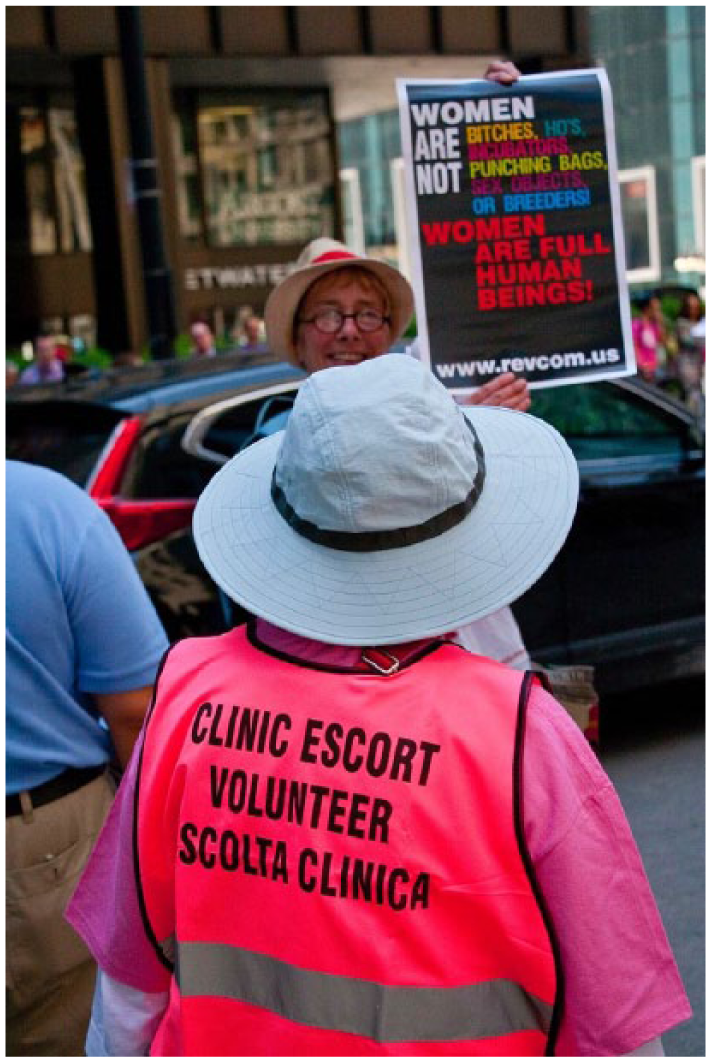
Patient escorts at Chicago, Illinois, protest against the Trump administration’s proposed “gag rule” to block federal funding to organizations that provide abortion counseling, referrals, or advocate for prochoice policies.
Patient escorts
The patient escorts are primarily women from a volunteer group called Pinedale For Choice. Called “Deathscorts” by the antiabortion groups, the escorts take shifts walking patients and their companions from the parking lot to the clinic during business hours. Although they have a nonengagement policy, escorts often act as “human buffers” between clinic visitors and the antiabortion groups they call “protestors” (see Figure 2). Kristine, the lead organizer for Pinedale For Choice, became a prochoice activist shortly after getting an abortion in 2010 and experiencing harassment during her appointments. She now works as the director of patient advocacy at the clinic and sets policy for Pinedale For Choice based on input from the National Abortion Federation, a prochoice organization headquartered in Washington, D.C. Four patient escorts—Kristine, Dana, Margaret, and Ruth—agreed to formal interviews. The collective social knowledge and routine practices of these participants established a context at the Women’s Clinic that was crucial to helping participants determine when heated ideological speech was potentially harmful or threatening.

A protestor holds a rosary at a March for life rally in Washington, D.C.
Salient Contextual Elements at the Women’s Clinic
Although participants at the Women’s Clinic did not articulate the relationship between speech and harm using “factors” or “tests” the way courts do, context was nevertheless critical to how they made sense of both mundane and extraordinary protest at the clinic and assessed the harms that arose. Three contextual elements were particularly salient in the conflict-ridden environment surrounding the Women’s Clinic. First, and most importantly, assessments of harm depended largely on the nature and strength of the social ties among participants. The more familiar participants were with their opposition, the less likely they were to classify speech as threatening or otherwise harmful, even when the speech included violent and thus potentially threatening language. Participants often perceived so-called “unknown” actors as potential threats but perceived “known” actors as harmless and nonthreatening.
Second, physical context was a critical determinant of threats at the clinic. Each group established its own territory within public spaces. Encroachments on claimed territory were interpreted as likely threats of some type of (not necessarily physical) harm, as acts of aggression, and as escalation of conflict. Conversely, participants showed little concern when their opposition remained in their own territory. During heightened conflict, groups were especially territorial and maintained rigid physical boundaries. The importance of physical context was mutually reinforced by issues of social context and known/unknown actors. Participants used physical context to identify others’ group affiliations, which affected their determinations of whether unknown actors were likely to present threats of harm.
Third, targeted use of electronic surveillance and social media was considered transgressive, especially when used by unknown actors. Participants focused on the extent to which opposition groups gathered personal information about—and levied personal attacks against—other participants. These practices contributed significantly to participants’ anxieties and thus to participants’ characterizations of speech as threatening future harm.
Social Context: How Participants Use Social Relationships to Interpret Harm
The environment surrounding the Women’s Clinic is surprisingly stable; most conflict there seems consistent and patterned. When the Pinedale police responded to harassment complaints made against several antiabortion demonstrators, Margaret, an experienced patient escort, explained to the police: You know, officers, this is the Bermuda Triangle of rights. Over here you’ve got the free speech rights of these protestors, then the patients’ right to privacy and then these tenants’ right to the quiet use and enjoyment of their property. I always say it’s like the Middle East out here. Peace isn’t just going to break out. It’s like the old Warner Brothers cartoon with the sheepdog and the wolf.
Margaret’s analogy to the Middle East suggests that conflict is a predictable attribute of clinic advocacy with no peaceful resolution in sight. Yet throughout the strife, participants develop extraordinarily strong bonds with other participants, even those with whom they remain ideologically opposed. For participants, knowledge of social relationships and activist norms was crucial to understanding the routine expressive practices of opposition groups and identifying so-called “known” and “unknown” actors. Participants were more likely to identify speech as threatening, and thus to experience fear or anxiety, when they lacked knowledge of the speaker’s social position and connections. An anonymous or unfamiliar speaker often appeared inherently threatening. By contrast, a well-known actor’s apparently violent rhetoric often seemed unobjectionable to key informants. Aggressive speech was rarely considered truly threatening by members of any group. Although participants often referred to abortion protesting’s violent history, such context only seemed to impact the way demonstrators developed uneasiness regarding the presence of unknown actors or potential “lone wolves.” Social context was by far the most important factor participants used to distinguish between threatening and nonthreatening speech, and cultivating social knowledge was critical to the interpretive process.
Cultivating Relationships and Establishing Group Identity
Antiabortion and prochoice activist groups at the Women’s Clinic are notably transient. During approximately 2 years of fieldwork, I witnessed more than a hundred (perhaps many more) men and women participate in clinic escorting, antiabortion advocacy, evangelical preaching, or demonstrative prayer, but only about a dozen people participated at the clinic consistently. Crowds of antiabortion activists ebbed and flowed around major sociopolitical events such as the 2016 presidential election and the semi-annual 40 Days for Life campaign. 351 Despite the high turnover at the clinic, core participants regularly formed deep and abiding bonds within their ideological groups and even with members of the opposition. These bonds led them to attach semiotic importance to group affiliation, intragroup authority, and social status when deciding how to respond to conflict.
Cultivating Relationships and Establishing Social Context
When a newcomer arrives at the clinic, participants expend considerable effort assessing the newcomer’s ideology and social connections. Experienced participants can determine newcomer’s advocacy bona fides, preexisting relationships, and consequently their level of possible authority in the clinic’s social structure. One example, observed the first few minutes of a clinic visit in February 2015 (just 1 month into fieldwork), exemplified how antiabortion group members positioned me in the clinic’s social structure. As my field notes illustrate, Brian, a Catholic demonstrator, attempted to locate me as a possible antiabortion activist through a simple, yet meaningful, question, “Are you here to pray?”: [Brian] walks over to me asks in a soft voice, almost a whisper, “Are you here to pray?” He extends his neck, tilts his chin up, and leans in my direction with his hands folded. I feel him welcoming me and tell him, “I’m a student at UNC observing clinic protests.” “Oh. OK,” Brian says. “So do you know anyone out here today?” He opens his shoulders. His face-up palm sweeps behind him toward the three other protesters [I would eventually learn the pejorative nature of the word protestors among anti-abortion groups] . . . and the patient escorts. I tell him I don’t know anyone. “Well you missed some provocation today,” Brian says. “They’re going to tell you one thing,” he says as he gestures with his chin in the direction of the three patient escorts, all wearing sunglasses and pink nylon vests.
When I told Brian that I did not recognize anyone, he explained the social divisions and the various sources of authority at the clinic. This was common practice whenever a newcomer arrived at the clinic, and it illustrates the importance of social pedagogy. Brian told me an anecdote about an earlier altercation and attempted to position clinic escorts as untrustworthy adversaries to convince me that a demonstrator’s account of the altercation was accurate: There were some fireworks. See, the Deathscorts like to start things sometimes. . . . You’re always going to get two stories out here. If you really want to know how bad the Deathscorts get, talk to Alex. He’s been coming here longer than any of us. More than 10 years.
My field notes show experienced EAE activists and street preachers explaining whom to trust at the clinic and how to act in the property’s vicinity to avoid complaints to the police—essentially a 5-min training. Sam introduced himself to a newcomer, Chris, who held a Bible and smiled in a way suggesting he wanted to meet others: “Oh yeah, Jack knows everyone around here,” Sam tells Chris, who’s leaning in with his ear tilted toward Sam, soaking it in. “That couple I was just talking to,” Sam continues, “If you can get them while they’re driving you have a much better chance of getting them to leave. Once they’re in there,” Sam points at the clinic, “there’s no helping them most of the time.” Chris nods in seeming agreement, rocking back and forth, his Bible clutched to his chest. “Do you know Mattie? Mattie is highly experienced out here too. This is an entirely Good Samaritan thing here that we’re doing,” Sam tells Chris . . . Sam starts teaching Chris where he can stand and what he can do when he comes to the clinic. “If you go past here,” Sam points to the eight-foot marker along the driveway, “the police will come.”
Ritual introductions were essential to creating social bonds and establishing a shared sense of structure and norms among like-minded activists. Through such routines, the relatively inexperienced learned to identify opposition groups’ common practices. The field data revealed that characterizations of speech as threatening or otherwise harmful were solidified by participants’ understanding of others’ group-specific conduct.
Group-Specific Speech Practices
Individuals’ engagement methods signified in-group and out-group status. Patient escort Kristine told me how she explained the three different groups, with their different styles of protests, to new volunteer escorts: You’re going to see one group doing a lot of evangelical preaching and that’s pretty much it. And that group is very hard-line and they’re going to be carrying ugly posters and they will not relent. That is EAE. And then you will see the Lifted Higher Church and that’s who is protesting the issue of abortion in the Black community and they will generally spend the entire time shouting and there is a lot of preaching and reading of Bible verses mixed in so it’s certainly a faith-based movement as well. And of course then you’ll see the Catholics. You don’t really have to worry about them too much. There are a few who will occasionally go and hide in the parking lot and approach patients when they park. But for the most part, that’s it.
Notes describe my interaction with Rashad, a young deacon from Lifted Higher Church: “We are not a church, per se,” Rashad said. “We are not people of faith. We are people of the faith. We are different than Jews, Muslims, Buddhists, and even these Christians.” Rashad points two fingers toward the prayerful Catholics and waves shakes his hand back and forth from the wrist dismissively. “They’re just these prayer warriors. They don’t do nothing really in the fight.”
And Graham, a street preacher, told me about how his “methodologies” of preaching: You have gifts and you make disciples in the way that you tell stories, use writing and language and represent truths about the world. You are making disciples. I’m making disciples. This place is making disciples. We don’t want to be associated with those Westboro Baptist guys, so we don’t use those signs and pick on people. Media portray a single type of open-air preacher now and the real version of open-air preaching has been lost. We’re trying to revive that tradition. We are not those “God Hates Fags” people. We need a sign that says, “Not Westboro Baptist Church.”
Participants differentiated between groups based on expressive routines. Divisions were rigidly observed; even ideologically aligned groups rarely intermingled. Group identity, signified through conduct during conflict, was an important tool for distinguishing between known and unknown actors. Occasionally, conflict arose between antiabortion groups over demonstration styles, which further illustrated the importance of group-specific practice. Alex told me the following: Things used to be pretty peaceful before EAE . . . I could talk to women and the escorts would just make sure they felt protected [but now] I can’t work like that. . . . Even though we believe the same thing, I’ve been ostracized by the fundamentalists. . . . People can tell who is associated with who. People can tell who’s EAE and who’s Catholic.
Interpreting Threats of Harm From Social Context: The Importance of Known Actors
Participants identified known and unknown actors by their routine speech practices. In annotated excerpts from the data, I documented Joe’s initiation into EAE and his rise into a leadership role over the course of a month. As with long-time EAE leader Trent, Joe’s engagement intensified over time. However, clinic escorts expressed fewer (not more) concerns regarding Joe as they got to know him, even as his speech became more aggressive: March 1, 2015: Joe’s Facebook profile from March 1, 2014, through February 2015 is scantly populated with political material. Between occasional screengrabs and shared links from Fox News programs and right-wing news websites such as WesternJournalism.com, Joe posts comments about gun rights and his belief that President Barack Obama is “at best an apostate Muslim” but probably a “secular humanist.” There are no mentions of abortion. There are no references to or engagement with EAE Pinedale or its individual members. March 18, 2015: It’s Joe’s first day at the clinic. He’s standing alongside . . . a couple of EAE members. Joe is hanging right on Trent’s hip, breaking away only to distribute drop cards to passersby. When an altercation breaks out with Margaret, he starts recording with his cell phone, hanging back several feet. March 28, 2015: [A verbal fight breaks out between Chandra, a patient companion, and men from Lifted Higher Church] Joe pulls out his cell phone and starts recording. He stands about 20 feet back, and then he speaks up saying, “God saw you. God is seeing you. And now YouTube is going to see you.” Chandra snaps at Joe, “There will be a law against you if you put me on YouTube!!! If you put me on YouTube, you gonna get dealt with!” Joe closes up his phone and walks down the hill, following a man who had just driven a patient to the clinic. Two patient escorts, Kim and Dana, whisper to each other and flank Joe all the way down the hill, with their cameras drawn out to record. April 10, 2015: “From your mouths out of the pit of hell!” Joe yells at Margaret. Turning to a patient companion, Joe says, “We stand here and speak out for those who cannot speak for themselves.” Joe is wearing a GoPro camera now. Trent hasn’t been to the clinic in the last few weeks. April 15, 2015: Joe leaves the front of the clinic to follow a man who just dropped off a patient. Kim says she thinks Joe went to his car to get something, but she’s not sure. “It’s not a big deal,” Kim says. When Joe comes back, Dana sidles over, smirks at Joe and jests, “So you’re back. Is this the time when we hear the hypocritical bullshit?” She giggles and Joe walks away, heading over to preach at the front of the clinic. August 2015: Joe changes his Facebook profile picture to a picture of the first day he preached at the clinic. Mattie and Trent comment on Joe’s picture with encouragement: “Love you bro! thank you for standing and braving the cold with me,” Trent says. “And he does it without glove or ear muffs! We love you, Joe!”
Joe gained power and respect in EAE Pinedale as he engaged more forcefully. He progressed from a quiet observer to a well-known active demonstrator. After Joe began visiting the clinic several times a week, patient escorts treated him relatively genially. Dana joked about “the hypocritical bullshit” with a degree of familiarity and comfort that was absent when patient escorts encountered new antiabortion demonstrators. Generally, strong social bonds seemed to mitigate the conflict of otherwise heated protests. Bitterly opposed activists even occasionally showed affection for one another. For example, Catholic demonstrator Alex and patient escort Dana shared a gentle, semi-private moment, talking during a March 21, 2015, demonstration behind a privacy fence separating the clinic from the neighboring parking lot: Dana says, “You know, Alex [a Catholic demonstrator] had a prayer said for me at the Vatican.” Alex shakes his head back and forth, smiles, chuckles drolly and speaks softly, “You know I don’t hate you, Dana.” “I know you don’t, sweetie,” Dana says. “But if they saw us,” [pointing to the Lifted Higher Church members in front of the clinic], “they wouldn’t be too happy!” “I know that,” laughs Alex. “I just pray that this stops, however it stops, it needs to stop.”
To be sure, patient escorts did not hold back in their biting characterizations of antiabortion demonstrations, calling “anti-choicers’ presence” “disgusting,” “misogynistic,” and “hateful.” Yet, antiabortion protest activities elicited little overtly negative reaction once they became ritualized according to established norms. For example, despite her professed distaste for various members of the Lifted Higher Church and Catholic groups, patient escort Dana acknowledged that the rhythmic attributes of protest made it less offensive: There is a cadence around the clinic property . . . a slightly calmer atmosphere. The Lifted Higher church echoes sing-songy refrains of “Choose life.” Female voices rise between scripture readings and exhortations directed at the clinic from the male preachers in front of the building. A mass is going on in the median. A “Byzantine” (Kim’s word) priest leads songs. Latin phrases sung in soft and haunting tones. “I actually think this is objectively beautiful,” Dana says to me, pointing at the women from Lifted Higher Church whose hands are folded as they pace along the roundabout. “I grew up around church. I can appreciate this.”
For Dana, patterned and scripted speech denoted a nonthreatening, predictable, and familiar anchoring context. Alex, a Catholic demonstrator, echoed Dana’s sentiments, suggesting that patterned speech maintained a sense of order and familiarity for actors at the clinic: People can tell who’s EAE and who’s Catholic. And that’s fine. And when this man [speaking of a demonstrator from Lifted Higher Church] crossed over and started recording a woman with the EAE people, that’s when all hell broke loose. It was truly chaotic.
A shared sense of order was significant for assessing conflict. During moments of fracture or abrupt shifts in the patterned social structure at the clinic, participants were much more likely to experience anxiety. During a March 3, 2015, interview, Kristine linked unpredictability with the anxiety many clinic escorts claimed to have experienced: I think the most difficult thing is the unpredictability of protestors. It is really hard to recruit and retain volunteers in this kind of environment . . . [People] like knowing what they’re walking into and with escorting you don’t know that. So every day is an unknown. And I think that scares a lot of people off. I can tell you I’ve been doing the volunteering for, geez, for five years at least. Every morning I drive to the clinic, my heart races when I’m about 5 miles away. I get that anxiety feeling. I get sick to my stomach . . . But I know that every morning I go there it’s an unknown. I don’t know what I’m walking into. I don’t know who’s gonna be there. I don’t know how bad they’re going to be that day.
As Kristine explained, the presence of unknown actors translated into general concerns of potential violence. Characterized this way, unknown actors were the primary source of fear among patient escorts: It can always get worse. And we have no guarantees or promises that we won’t get a more volatile group that might actually put their hands on us because it happens in other states and we hear about it.
When Doug, a relatively new EAE Pinedale member, took over for Trent in May 2016, many patient escorts interpreted Doug’s speech as threats of violence even though his rhetoric closely paralleled Trent’s familiar violent rhetoric. Field notes illustrate Doug’s conduct: In a video recorded on Ruth’s smart phone and shared with patient escorts, Doug speaks through a small plastic cone. His voice booms through the cone in deep, twangy Southern tones: “This killing place is populated by enemy forces. They are the enemy. The Bible says that the enemy will be killed. They deserve to die and they will die.” While references to death and murder are rare among Lifted Higher Church members and Catholics, Old Testament references are common among street preachers and EAE. Trent commonly says, “And He will say to thee, depart from me you worker of iniquity, for I never knew you,” (a reference to the Gospel of Matthew 7:23), “And you will be cursed by everlasting fire. Prepare for the devil and his angels.” (Matthew 25:41). A vernacular of death pervaded EAE’s and Trent’s speeches.
Nevertheless, patient escort Kristine argued that Doug was a serious threat: Doug and his brother . . . we have concerns over them, especially Doug. He’s escalating. It’s not like the typical stuff Trent would do. He is violent. He is a violence risk. I have a video of him making some very veiled threats that prompted me to contact our local FBI contacts. He basically went on a spew about how God is coming to kill us. He said that God will probably send one his messengers to kill us. . . . It was alarming.
Although Trent’s and Doug’s religious rhetoric were strikingly similar and seemingly scripted, the patterns were not self-evident to patient escorts. Doug’s speech was deemed “escalation,” a euphemism that participants on both sides used to describe threatening behavior. The key difference appeared to be that escorts knew Trent well, whereas they did not know Doug at all.
Ruth and Margaret explained thought processes common to escorts when assessing potential threats at the clinic. At their core, these patterned—and therefore thematically important—processes boil down to gauging danger by distinguishing between untrustworthy newcomers and bona fide protestors: It’s always a question. How serious do you take them? Some of them are dangerous. It feels strange because I feel less safe about [the people I don’t know]. If you can’t identify who they are. Anyone who is elderly that we don’t recognize is almost universally a Catholic. Those are the safe ones. Like the most they are going to do is stare and chant the rosary. But like anyone else, you ask, “Are they like EAE? Are they others?” They’re the unknown entities . . . when you see an unfamiliar face, I take a picture and text everyone with it. People ask, “Has anyone seen this person around before? Does anyone know them?” We try to understand where they fit within the landscape of our protestors.
Margaret affirmed that “the biggest red flag is a new face among the protestors.” Ruth, an experienced patient escort, similarly identified “newness” as a key indicator: Kristine showed me someone’s picture a couple of weeks ago, a new guy; he’s been coming around in the afternoons to bother patients when they leave. She and I had never seen this guy. He was throwing us some language that seemed like a warning sign. “Be frightened of me. Oh yeah, I’ve been got in trouble with other clinics before.” That’s like walking around and telling someone, “I just got out of prison for assault.”
When patient escorts identified “lone wolves”—individuals who deviated from group-specific behavioral patterns—they often labeled such persons as threats. For example, when a Catholic parishioner named Tom cut through the clinic property from the adjacent residential neighborhood to join a prayer vigil in the median, patient escorts sprang to action. They learned Tom’s name, took his picture, and threatened to call the police. One would have thought Tom committed a hell-worthy trespass. Patient escorts responded this way whenever an adversarial lone actor violated engagement norms.
Participants also emphasized the importance of unknown actors in their interactions with large groups such as Lifted Higher Church. Compared with the contingent of well-known EAE supporters, Lifted Higher Church members were especially transient and thus its collective activism felt amorphous. Kristine based a heightened sense of harm on Lifted Higher’s numbers and its individual members’ relative anonymity: The weekend I went out after the shoving incident, we had a significantly larger crowd. I guess that’s the Lifted Higher Church and it was a much larger, angrier presence. I noticed that a lot of the energy was being directed either at me or at the other escorts and it wasn’t so much about the patients anymore. We had a lot of people walking in close proximity to the escorts, so that was a big change with how aggressive and confrontational they’ve been. Really out of the ordinary. Just a big group where no one knew anybody and we had no power.
Several street preachers emphasized the value of order and regularity:
Ours is a God of order. All the chaos that comes from people not knowing what to do . . . That’s when you get the belittling, the beatings, the impediments like grabbing signs, cameras, pamphlets, other things or whatever. The Lifted Higher ones are responsible for a lot of that because they just don’t train. And other people come in and talk about how they’ve been in the military like, “I’ve seen people die and be killed before,” and that just throws everything off.
Yeah, we’ve come to expect the provoking animus, but most from the escorts. Not from these other people we don’t know.
When all these people aren’t out here en masse, it’s calmer and we can actually talk to people.
Themes of chaos and order pervaded participants’ characterizations of context. Participants often referred to the “good old days” when competing groups mutually understood—and observed—protest norms. These times were not without intergroup strife, but conflict was orderly and structured. During separate interviews, Alex, a Catholic demonstrator, and Kristine, a patient escort, explained the predictable rhythm of the “good old days”:
There was this time when I could just stand out here and hand out my tracts and talk to whoever I wanted. People knew who I was and I knew them and that was that. Those were the good old days. Before EAE showed up and you’d get all these people from all over coming to the clinic and causing trouble.
The good old days, the golden days in escorting was when we were just dealing with the Catholics before we knew how bad it could get. [Their] protest stance is that a few people gently and calmly call out to patients as they walk up. The bulk of it was standing in the traffic circle and just praying and singing and doing their little routine and leaving for the day. We knew exactly who was going to be approaching patients and we could station escorts where those people stood so there was always an escort available so that someone could provide assurance if someone wasn’t sure who this stranger was approaching them we could tell them.
It became clear that social ties between speaker and other participants was the primary contextual factor participants used to evaluate high-conflict speech. Literal plain meaning was rarely as important as the relationship between target and speaker. Margaret underscored how patterned, orderly engagement mitigated the sense of harm that accompanied escorting: We’re enemies, but we just clock in and clock out . . . Then we go out there and do our thing with EAE and they do their thing with us and we clock out and it’s over. Day in and day out.
Conflict with well-known actors constituted ordinary, nonthreatening activity. Despite the charged nature of such conflicts, participants rarely complained to law enforcement about verbal altercations. This finding was unexpected, but it suggests that patient escorts who were well acquainted with protestors had a high threshold for violent political rhetoric.
Historical Context
In addition to collective emphasis on social ties, participants were cognizant of the importance of historical context, especially antiabortion extremist violence. However, these characterizations of harm were embodied in abstract references to harm to the activist community rather than the personal harms many participants reported experiencing individually. Officer Torre, of the Pinedale police, once chastised Margaret, a patient escort, for getting into an altercation with Trent: “These places have a history of violence in our country. . . . Is that what you want?” Margaret replied, “If that’s what it takes.” This exemplifies participants’ awareness of historical context, which underscored dangers posed by unknown actors to clinic workers. For example, patient escorts and street preachers frequently suggested during interviews that prior acts of antiabortion violence, such as Dr. George Tiller’s murder, had sensitized participants to the possibility of violence at the Women’s Clinic:
I can’t promise you it will always be a safe environment and I know that’s scary to volunteers. And then when they know that there’s always that potential for harm, because we know that clinic volunteers have been attacked and have been shot at in the past . . . I think it can be very intimidating and scary to the volunteers and it’s just a stressful environment.
I’ve seen in the last few months things on social media where some of EAE will say this could lead to the next George Tiller. I recognize that it’s a reality that people could want to take matters into their own hands and become violent. And I can recognize that there is a sense of desperation.
Despite indications that participants internalized the violent history of antiabortion advocacy, no participant indicated that historical antiabortion violence changed the way they viewed the harms they experienced. They only considered the larger historical context of abortion clinic violence when so-called “lone wolves” engaged at the clinic. Violence at other clinics, which one might expect to be particularly salient among participants engaged on the frontlines, was not especially significant when participants were assessing high-conflict speech. History gave participants the language to discuss the possibility of violence, but it did not structure participants’ assessments of harm with the gravity of social context. Nor was it as crucial to everyday determinations of harm as disputes over physical spaces for protest.
Physical Space and Territorialism at the Women’s Clinic
Amid heightened conflict, activists routinely use physical boundaries to assess potentially threatening conduct. Although physical boundaries were the subject of a formal legal dispute only once during fieldwork, activists continuously disputed their limits. Field notes and a subsequent interview with Ruth, a patient escort, in November 2016 illustrate this significance of physical space: Larissa (from Lifted Higher) and Dana (a patient escort) are toeing either side of a crack in the pavement that marks the end of the public right of way . . . The line has legal significance. It is also [a source] of power for the escorts. . . . If Larissa steps over the crack, Dana or another escort will likely call the police. “Once we leave the driveway,” Ruth says, “we are in public space and there aren’t a lot of protections. . . . Once we leave the driveway . . . you have to think about your own protection as well as the patient’s.”
Because the shared observance of boundaries connotes safety, physical boundaries took on significant meaning in terms of the distinction between mere ideological expression and potential harm. This meaning-making occurred in two key ways. First, as with group-specific behaviors, participants used physical context to understand the clinic’s social structure and to understand actors’ propensity to threaten. Second, participants aggressively policed the boundaries they had developed through years of routine interactions. Encroachments on “occupied” territory were considered violations of mutually negotiated boundaries. Participants—particularly patient escorts—attempted to control physical spaces to limit harassment against escorts or patients. Territorial encroachments catalyzed conflict more than any other antiabortion activists’ practice and led participants to characterize seemingly benign expression as threatening.
Using Physical Context to Understand Participant Group Affiliation
Field notes frequently described groups gathering in specific spaces. The right-of-way and grassy median are ostensibly open to the public, but during demonstrations, these spaces were rigidly stratified by group. Monday through Friday, EAE occupied the public right-of-way in front of the clinic. On weekends, when EAE demonstrators rarely protested, these spaces belonged to the Lifted Higher Church. When both groups were present, EAE occupied the driveway, and Lifted Higher settled along an embankment of grass in front of the clinic and adjacent properties. The grassy median was the primary domain of Catholic groups.
Participants clustered on their preferred turf and rarely intermingled. Alex, an experienced Catholic sidewalk counselor, said he “doesn’t really get involved” with Lifted Higher Church ministers and massive group of congregants. “It takes a lot of courage to be over there [pointing to the assemblage of Lifted Higher members in front of the clinic],” Alex told me one Saturday morning, “and I really can’t deal with that right now.” When I asked Alex what he meant, he said, “When EAE and the Black church are there, there’s not room for me to do my work.” This suggests that sidewalk counseling requires freedom of movement that the evangelical groups had denied to Alex. If Alex wanted to demonstrate in front of the clinic, he would need either to modify his behavior or risk ridicule from EAE and Lifted Higher. Because other groups had overtaken his territory, Alex chose to focus on prayer. In the following weeks, Alex paced around the roundabout distributing flyers almost out of view of the clinic. He drastically reduced hands-on counseling and only visited the clinic when EAE members were absent. Alex’s experience illustrates the relationship between identity and rigid territorialism in the clinic space.
Interviews confirm this. Some patient escorts linked the grassy median (or “traffic circle”) with Catholic identity and its corresponding assumption of safety. For example, Ruth characterized demonstrators who appear to be Catholic—signaled by their prayer routines and their location—as especially nonthreatening and, in her word, “safe.” Ruth pointed out, “Anyone else not standing there with the Catholics, you know they are EAE, which is so off-putting.”
Patient escorts were mollified when antiabortion groups confined themselves to spaces associated with their group. Conversely, breakdowns in physical divisions between groups often led to conflict. Patient escorts’ anxieties increased when antiabortion groups occupied larger sections of the space surrounding the clinic, making it difficult for escorts to contact patients. Ruth said the following on November 14, 2016: As soon as there are more of them than us, they can plant themselves to try and get us to leave this circle which is problematic because they will hail down cars and they will try to talk to them. [Patients will] leave. . . . When I leave the driveway, Jack follows me . . . he regularly tells me I’m going to hell and that I murder babies . . . [H]e body-checked Kristine once. So do I think he would truly hurt me? No. But do I think he would like push the boundaries? Sure, absolutely.
At first, Ruth’s frustrations appeared tied to Pinedale for Choice’s struggle to prevent patients from interacting with demonstrators. However, Ruth suggested that considerable anxiety stemmed from having to vacate safe physical domains to reach patients in areas occupied by demonstrators who had intimidated escorts in the past.
Thus, participants spent considerable time policing boundaries to prevent conflict and reclaim group-specific territory. For example, when Tim, a “40 Days for Life” demonstrator, cut through the rear parking lot on clinic property to join a Catholic prayer group, he committed a serious breach of norms: Clinic escorts were astonished as Tim, who apparently knew no better . . . stroll[ed] through the clinic parking lot. Dana hurried over to the grassy median where Tim had begun to pray, took his picture and let out a disgusted “ugh!!!” Tim was contrite, and turned to Alex with his mouth agape. Alex quickly settled Tim, explaining, “The police can’t do anything until you’ve been officially trespassed, and that hasn’t happened yet. You’re fine.”
Boundary policing often led to conflict, however. The following excerpt details a heated confrontation on March 18, 2015, between Trent, the former leader of EAE Pinedale, and Margaret, a patient escort. What started as a standard verbal altercation gathered into a tense standoff along the dividing line between the public right-of-way and the clinic, from which Trent had been given a trespassing warning months earlier: Margaret: [says] “Back up, Trent, back the fuck up! You’re trespassing!” Margaret shakes two maracas in Trent’s face as he attempts to talk to a patient. “Back up, Trent,” Margaret continues yelling, her hand in front of his face. Margaret starts recording Trent with her cell phone, “The police are gonna see this, Trent, back the fuck up! I’m calling the police!” Trent backs up from the edge of the clinic driveway and into the roundabout. Mattie follows. The commotion blocks several cars. The roundabout is congested now . . . Jack pulls out his phone and starts recording Margaret yelling at Trent. Joe, who had been quietly distributing anti-abortion [drop cards], walks up and starts recording the crowd. From the grassy median, a woman from EAE (Stacy), starts recording the group in front of the clinic. Margaret, Trent, Joe, and Stacy are all looking down into their cell phones as Margaret continues to yell. [Margaret calls the police.] Everyone has a recording device pointed at a target, waiting for the police arrive.
The right-of-way had been strictly observed for years. Yet, even though the boundary was incontrovertible, participants looked to the officers for affirmation, which speaks to the role of structural power in maintaining speech freedom: Officer Torre walked up to Margaret and Trent, and quickly measured eight feet from the curb to mark the public right of way. Officer Torre turned toward Margaret, clicked his teeth, and curtly said to Trent, “You’re not in violation. You can go up to here,” pointing at one of the prickly bushes in front of the clinic. Trent pointed out the line to Mattie, who immediately settled her toe along a crack in the pavement, claiming every inch of legally entitled space.
Intense boundary enforcement by Pinedale for Choice, which first appeared hypersensitive given how groups monitored boundaries themselves, turned out to be a response to “drive by” counseling, which impedes clinic escort work and increases the number of unknown actors who undermine escorts’ control over clinic space. An episode reconstructed from field notes and an interview with Kristine illustrates the assertive boundary-policing strategies participants used to squelch perceived threats: [Kristine accuses a woman from Lifted Higher of harassing her.] I was kind of stressed to my emotional limit, because I was distressed that the cops weren’t there yet. [The woman walks toward the parking lot and Kristine follows her to take her picture.] I was distressed that this woman was maybe about to . . . completely get away with it. [Escorts have their cameras out. Ruth follows behind Kristine and the woman . . . “Stop taking my picture, pleeeaaaase,” the woman’s voice strains as she holds up a hand and turns her face. “Legally I can take your picture as many times as I want,” Kristine presses as she gets closer to the woman.] I was distressed that she was going to come and trespass again on another day. We had people come into the clinic, antis come and sit in our lobby and harass our patients. And I know that that’s a trend happening nationwide . . . I needed the police to send a message that their behavior was not okay. (Field notes, October 2016, and Interview with Kristine, December 2016)
Escorts did not target demonstrators impartially. They concentrated on individuals they perceived, based on their location, to belong to EAE or the Lifted Higher Church. They gravitated toward demonstrators clustered in front of the clinic, disregarding those gathered in the grassy median and the outskirts. Because of participants’ emphasis on physical context, boundary encroachments were flashpoints for conflict and enhanced surveillance of opposing groups. Surveillance practices, common as they were, escalated conflict, especially when the surveillance was targeted, intentional, and threatened to expose a subject’s personal information online.
Surveillance, Personal Information, and Harm
[Trent and Doug confront two clinic workers before their morning shift.]
Oh Emily, I have so missed you. I was praying for you while I was gone that you’d repent from the murder that you’re committing. And Amanda . . .
You know, I can see that you’re intelligent. I was just wondering how you find out all this information about us.
It’s called Facebook, Amanda. Facebook. I’ve been to [your husband’s workplace] and I know what he does. Your name is easy. Amanda Edwards! It’s called Facebook. That’s how we know.
Your pictures are beautiful of you and your family, they really are.
I’m sorry, but I don’t appreciate you screaming what my husband does.
Oh I’m sorry, but that’s gonna happen . . . It’s public knowledge. . . . You put your son in this beautiful private school, and I’m sure they all want to know what you do. (video posted to EAE Pinedale YouTube, January 2015)
Although participants rarely recounted explicit threats of violence, many explained during interviews that their opposition had subjected them to “personal attacks,” which clustered around times when opposition groups surveilled others and shared their personal information online without consent. While participants conceded that surveillance in public spaces at the clinic was neither illegal nor harmful per se, surveillance did lead to cumulative harmful effects that escalated conflict. Targeted surveillance and personal information-sharing disrupted participants’ lives in the same ways as clearly violent language or other transgressive behaviors.
The following section highlights distinctions participants drew between harmful targeted surveillance and harmless generalized recording as well as how they relate to formations of social context in networked society. With the exception of closely knit online social media communities that some participants enjoyed, online speech lacked the social and physical context necessary to mitigate harms. Clinic workers’ lives were altered by coercive surveillance and communication practices that opened the clinic to the gaze of the faceless online opposition.
Surveillance and Personal Information-Sharing Practices
Recording devices were ubiquitous at the Women’s Clinic. Many participants compulsively recorded events, no matter how mundane. Most used smart phones, but some EAE demonstrators strapped GoPro cameras to their chests to record a constant stream of point-of-view footage. Surveillance and personal information-sharing practices served myriad functions. For instance, constant recording created an evidentiary record that participants showed to Pinedale police responding to trespass complaints. Prochoice advocacy organizations instruct escorts that vigilant recording can minimize conflict and document violations of the FACE Act. Kristine explained why they do a lot of photographing and videotaping: Because I know that the more evidence you have, the easier it is to pursue some type of FACE Act protections. So that’s why I’ve encouraged the volunteers to, anytime you see something happening, pull your phone out . . . I let the [clinic] owner know that we take lots of pictures and the person from National Abortion Fund also told us it’d be a good idea . . .
“The constant recording and engagement,” has value as “self-preservation,” Kristine said. Jack, an active street preacher, affirmed that constant recording is second nature for participants to protect themselves: “When people threaten me, I try to turn on my video. I see the usefulness of it, and I think a lot of people use it primarily out of safety reasons.”
Surveillance was not merely defensive, however. Antiabortion activists surveilled their opposition to expose them to other antiabortion groups. EAE Pinedale shared videos on its public YouTube and Facebook accounts to fulfill its “Call Out” campaign. On EAE.com, its founder urged supporters to “call out” prochoice workers: The walls of our culture overflow with blood. . . . We will expose abortionists and other abortion staff online, and encourage Christians to reach out to them and call them to repent. We will also equip abolitionist societies with the knowledge and resources to expose their local child killers in their communities.
The video exemplifies the conjunctive use of surveillance and social media to focus on specific clinic workers. Trent and Doug reference only a fraction of the personal information they appear to have collected about the clinic workers. However, if the goals of the video are to expose the workers and to document EAE’s pleas for repentance, then the video falls short of those goals. The video serves other purposes in the relationship dynamics between EAE activists and prochoice workers. Although the video called EAE member to action, its dominant meaning among escorts was that these specific workers were being watched. This sort of targeted surveillance was qualitatively different from the routine, generalized recording participants engaged in without incident.
Distinguishing General Surveillance From Targeted Surveillance
Participants often swept their cameras back and forth to capture as much as possible. Such information-gathering behavior was as habitual as it was seemingly indispensable. It was an unobjectionable way to become familiar with the clinic environment and its constituent groups. Participants distinguished this socially acceptable information-gathering from targeted surveillance and personal information-sharing that constituted an inherently harmful act. Kristine said during an interview: I know other volunteers in other states that’s how they got into [recording] because their antis were filming them. . . . And I think for some people they just become unhealthily obsessed with the antis. . . . And I think part of it may be that the protestors seem so focused on our personal lives, but to me that’s not OK, so I’m not going to repay the favor. I’m not going to care about your personal life because that’s none of my business. I just want to know when you’re showing up at my clinic so I can notify the volunteers and maybe have some extra volunteers on site . . .
Becoming “unhealthily obsessed” with another’s personal life denotes a shift from sanctioned general surveillance to unwanted, intense, and aggressive targeted surveillance practices. Indeed, targeted surveillance escalated conflict between participants, disturbed them psychologically, and sometimes caused participants to stop escorting because they believed that surveillance would precede harassment. When surveillance crossed the line from generalized to targeted, its anxiety-producing effects were palpable. A member of Lifted Higher, whom Kristine described as a “newbie,” was subjected to targeted surveillance after she overstepped the property line during an October 22, 2016, protest: Kristine’s smart phone, its camera app open and recording, parries the woman’s hand as it attempts to block the [camera] . . . Ruth has started recording Kristine and the woman, who whimpers in tones that resemble a child being bullied, “What are you gonna do with my picture? You can’t put my picture on the Internet like that. That’s harassment. Stooooooop it.” . . . The woman walks to man who watched the entire exchange. “They can’t legally use my picture on the Internet like that, can they? They just can’t do that.” [The woman never returned to the clinic].
As they do most days, escorts and church members had been scanning the crowd with their smart phones in plain view. This posed no apparent problem. However, for the woman involved in the altercation with Kristine, the promise of broad exposure on the Internet, not the attention of counter-demonstrators and patient escorts, made her anxious. Similar reactions occurred when participants aimed cameras at others during conflicts. Alex, who was recorded dozens of times in the background of EAE and patient escort videos, often shielded his face and disengaged from sidewalk counseling the moment he noticed a smart phone pointed at him.
One reason that targeted surveillance seemed to produce anxiety and escalate conflict appeared to be that participants assumed the content would be posted on social media. Participants argued that targeting an individual and distributing personal information violated norms. However, such normative violations were hardly spontaneous. They were intentional and premeditated. Participants used targeted surveillance and information-sharing practices to achieve specific results through obstruction, torment, and intimidation.
The Goals of Surveillance and Information-Sharing
Prochoice and antiabortion activists both tried to change opposition behavior with surveillance. They wanted to gather evidence, to be sure. But more importantly, they wanted their opposition to see them recording. “We don’t do anything with the pictures,” Ruth explained, “but if I pull out my phone and it makes Mattie back up, then whatever.” The explicit goal of surveillance and personal information-sharing was to coerce others to cease protesting and leave the clinic. Two interview excerpts—one from an interview with Beth, the director of a state-wide, prochoice group, and the other from Paul, a clergyman at a local Catholic church—illustrate this:
One thing we’ve discussed is getting observers to come to the clinic and just watch and record so that volunteers don’t have to. We are thinking about using the tactics of abusers.
People should watch. I want to see more people though. We have to keep the numbers within permit, but can you imagine what would happen if you just had hundreds of people standing here watching and praying? Watching people as they go in. I bet more people would think twice about it.
Beth’s and Paul’s comments reflect a shared belief in the situation-altering power of public shame. Their comments suggest, as leading scholars on privacy and surveillance have noted, that targeted surveillance can create psychological turmoil in its object. This was especially true when surveillance was coupled with the dissemination of personal information.
Participants’ Focus on Personal Information
Alex explained on October 5, 2016, that groups such as EAE use personalized engagement to intentionally inflict psychological harm on others: “EAE, they find the most personal attribute or characteristic possible about somebody and they exploit it. We’re all sinners, but they attack.”
EAE engaged in this practice more frequently than any other group. They exchanged personal information about patient escorts in scripted ways and habitually briefed one another with personal information they had acquired about specific targets, as suggested by my field notes: A woman . . . approaches the clinic. She clutches her purse, her eyes seemingly boring into the pavement. Griffin, who supports EAE, turns to me and to Bill, another EAE supporter, and whispers quickly, “This woman is a nurse. Some kind of registered nurse. She’s trained to help these women kill their babies.” Bill responds with a quick, “Uh huh. Got it!” and walks up to the woman yelling, “Find another job, lady! You can do something else.”
In this brief exchange, Griffin gave Bill a small bit of personal information that Bill used to tailor a message to the nurse. These short exchanges demonstrate the smooth choreography activists use to share targets’ personal information on the fly.
Not all informational uses were so benign. Antiabortion demonstrators targeted escorts with surgical precision. During a verbal altercation with Margaret over the public right-of-way, Trent yelled toward EAE demonstrators and Catholic congregants that Margaret was a “former lawyer.” In a gravelly whisper, he continued, “For a lawyer, you’re a really bad one . . . who doesn’t know the law.” After Trent crossed onto clinic property, Margaret called the police. Trent then loudly repeated Margaret’s name and urged the assembled demonstrators to “find her on the Internet.” As Bill had in the encounter with the nurse, EAE supporter Joe stopped preaching and tailored his ridicule to Margaret’s occupation, calling her a “shameful failure of a lesser magistrate.” Other antiabortion activists followed suit. After a brief sabbatical from escorting, Margaret returned. Sam, a street preacher, gave a sermon focused (pointedly and purposefully) on law: “Lawyers make a living off of people who are depraved and evil,” Sam exclaimed in lofty tones, the word “evil” hanging in the air as he stood a few feet from Margaret. “The whole legal system is proof that men are slaves of sin. People here are hiding behind the law.” When I asked Sam whether he knew that Margaret was a former lawyer, Sam pulled his glasses from his nose, smirked and said, “I use what I’m given.”
The sermon had no antiabortion message. Instead, it focused on Margaret. Routines of information-sharing between aligned actors signaled how in-group members were expected to interact with out-groups. These routines contributed to stratification and division, often leading participants to escalate their engagement as they learned more personal information about a member of an opposition group.
A major conflict arose in August 2015, when Trent created an online image (participants called it a “meme”) that publicized personal information about Dana, a clinic escort. The meme depicted side-by-side image of Dana’s professional photograph and a candid photograph of Dana standing outside the clinic wearing the pink vest that identifies clinic escorts to patients. Text written in Dana’s mock first-person voice accompanied the pictures: Hello 5th graders and families! My name is Mrs. Dana, and I am very excited to have your child in my class and look forward to an amazing year of learning and growth. I love to bake and eat chocolate. I have made cakes and cupcakes for friends and their children. How did your child spend the summer vacation? I spent mine helping MURDER babies at The Women’s Clinic in Pinedale. Look forward to seeing you!
Trent shared the image with antiabortion groups online. Thereafter, Dana’s school coworkers were targeted with menacing phone calls from members of “abolitionist societies” and Dana suffered a cyber-attack on her work computer, although the culprit was never identified. She said the following during an interview on October 15, 2016: It was my very first day at school last year. And we were in our staff meeting and when I walked to the front office. And our secretary is like, “Damn Dana—school year just started and you are already causing trouble.” And I said, “What?” And she said, “Don’t you know?” I was clueless. She’s like, “So they’ve been calling the school and saying you have a murderer working for you, you should be ashamed.” They called my principal’s number and left messages. . . . So I got my phone and I posted in a secret group on Facebook for escorts across the country. I was like, “Oh my God. Somebody called my school and was harassing my secretary, Jesus Christ.”
Dana’s account epitomizes the anxiety-producing effects of widespread dissemination of personal information. Dana discussed during that interview the impact of the meme on her and her coworkers’ work environment when they were targeted by online mobs: Trent put it in public, so he shared it with everybody. And he shared it in Pinedale groups. It was posted to my school—my PTA’s Facebook page. Like they had to sit there for days, 24 hours a day and take stuff off until we finally got it locked down that nobody could leave reviews or comments anymore. Because it was just one comment after another about me. Like, “You have a murderer working in your school.” The day of open house a threat was put out, [EAE] posted when open house was at my school, the times and the address. And they put a call out to people to come stand outside the school. And hand out that poster that they wanted to do an awareness campaign. And wait for us to let them know that a murderer works among them . . . And there was a plain-clothes security guard outside my door. And there were four police officers in my school. [The principal] called every teacher in, and then told them what was going on . . . And so my whole school had to deal with that. They were scared. . . . And I would tell you, some weird things happened after that at school. My computer got erased and everything I had on it was lost. The tech person said someone did that on purpose.
Dana noticed increased personal attention at the clinic, particularly from street preachers, after national, left-leaning outlets reported the events: It was different before. [Jack] hadn’t gone that far. Like he would yell and stuff. Then when he found out who I was and what I do. Then he got really personal and videotaped me. “How about I send this in, look at this what your teacher does.” And he got really personal. And he—the more he got into the Trent way, the angrier he became.
Conflict often followed the gathering and exchanging of personal information online. The resulting influx of demonstrators negatively affected participants’ sense of order and safety. Participants’ intense reactions to targeted surveillance at the clinic and anxieties surrounding social media publicity suggest that online surveillance and information-sharing can be especially harmful. When participants’ personal information is shared online, it becomes divorced from crucial social context. The rules of interaction that participants have fashioned among themselves do not apply to online communities outside the control of core participants at the clinic.
Surveillance, Information-Sharing, and Coercion
Participants were less explicit when describing the harms associated with surveillance and information-sharing. They used vague terms (e.g., “anxiety,” “burnout,” “concern,” “disturbance,” and “creepiness”) to describe demonstrable psychological suffering. Thus, the phenomenology and degree of speech-related harms experienced by participants were not easy to identify or categorize legally. Their characterizations of harm did, however, cluster around the concept of coercion.
The coercive effects of targeted surveillance and personal information-sharing were most clearly seen in how participants modified their everyday activities. During interviews, three patient escorts expressed the anxiety and desperation caused by being subjected to opposition surveillance: I think I sent you the video where she came over to me and was getting in my face. And I’m staying there and I am trying to watch Kristine the whole time. . . . That was emotionally exhausting. I went home and I was cool. Because, again, Dana actually said to Alex, “Come on Alex. Like this is the only thing we got.” It’s the one thing we can guarantee patients. It’s like these fuckers can’t get in the door. So it’s just really—it was very weird and I guess it’s kind of like scary . . . what if they decide to organize around all of them doing this? (Ruth, November 14, 2016) I want to continue escorting, but if you need to take a break—like whatever we need to do to fix this so they don’t get much footage is what we have to do. (Kristine, December 14, 2016) They also try to make pictures of us, videos of us, and details about us and doctors available online. They want to make images of doctors available so that some other guy can come in and threaten or hurt them. We found them around back trying to get footage of the doctor. They know that’s the only way they can shut this place down. (Kristine, February 7, 2015)
Alex, a Catholic sidewalk counselor, similarly told me that he could not come to the site for a while after EAE and Lifted Higher Church members tried to get him on camera: I decided to just go to the Planned Parenthood and pray after that. I was trying to hand the woman a pamphlet and get her to go to the [crisis pregnancy center nearby] and there were all these cameras in my face and people yelling.
Specifically, Ruth’s account of Dana pleading with Alex to get the Lifted Higher Church to stop recording reflects how participants on both sides of the abortion debate considered targeted surveillance a threat while never objecting to EAE’s constant use of cameras. Participants often took extended “sabbaticals” from advocacy at the clinic after being targeted. Some participants left the clinic for good. When triggering surveillance events took place, divisions between groups sharpened, the clinic environment was set on edge, and individuals were much more likely to articulate harm. Yet, participants did not react this drastically following physical or verbal altercations, such as when Jack “body-checked” Kristine during a demonstration. On the contrary, groups often rallied around their members after physical or verbal attacks. Participants typically characterized ordinary conflicts as harmful, but with fleeting and minimally disruptive effects.
Although these surveillance strategies, at their core, deal with the exchange of information, their value to participants had little to do with ideas or discourse. For participants who conceptualized interactions at the clinic as “moments of life and death,” the primary purpose of the surveillance and information-sharing was to counteract opposition speech through obstruction and coercion. Read alongside the case law on true threats and incitement, this suggests that traditional free speech perspectives do not adequately address the most common harms experienced by participants in high-conflict environments or adequately consider the values they derive from social relationships in high-conflict environments. The gap between these two social fields warrants reform in the legal apparatus for defining threats and incitement as well as the theories of harm and value that frame doctrine.
Threats, Incitement, and Context: A Way Forward
If “uninhibited, robust, and wide-open” 352 debate is to mean anything in a constitutional democracy, legal doctrine must accurately reflect the mechanisms and terms by which debate takes place. In American political discourse, this inevitably involves deepening the judiciary’s collective understanding of contextual meaning-making, and specifically the relationship between free expression and violence in American history. Doctrine must be certain in its foundational principles, but flexible enough to account for how sociohistorical context develops at micro, meso, and macro levels depending on the speaker, listener, medium, and the interactions between them. The true threats and incitement doctrines, as presently constituted, have failed to fully capture how nuanced sociohistorical context can be, especially in high-conflict speech environments. The findings in this study illustrate a significant chasm between how courts and abortion issue activists conceptualize the nature, depth, and importance of social relationships and history when encountering harmful speech. Courts tend to view sociohistorical context through a macro-social lens of American political discourse. Activists, on the contrary, focus on relevant micro-social contexts. Because context is a critical ingredient in how speech’s value and its propensity to harm are determined legally and, therefore, what discourses are permitted in society, I propose several incremental modifications to the doctrinal aspects of contextual analysis.
Courts vary widely in how they assess context in true threats and incitement cases. At a minimum, courts should explicitly assess four key contextual factors that were analyzed in some combination in all cases and were critical to meaning-making at the Women’s Clinic. The factors are social context, historical context, the medium of expression, and linguistic context. In addition, courts should reconceptualize some of these factors, particularly social and historical context. Courts should recognize that these factors are not mutually exclusive; they are most useful when they are analyzed with and through one another. Although the proposed framework might not alter the outcome of previously decided cases, it would promote clearer and more efficient contextual analysis without sacrificing the flexibility or rigor required to establish meaningful free speech principles for distinguishing protected ideological exchange from serious expressions of situation-altering violence.
A Proposed Analytical Framework for True Threats and Incitement Cases
Although the well-established constitutional standards for true threats 353 and incitement 354 plainly emphasize the importance of full contextual analysis, the frameworks that courts use to analyze context are not sufficiently clear. Courts do not always consider the social context (including the subjective intent of speakers and the subjective experience of listeners) of a statement, its historical context, the medium of expression, and the statement’s linguistic context. If nothing else, incorporating this nonexhaustive list of contextual factors in all cases would equip courts to assess an array of potential harms and speech values arising from high-conflict speech. This is especially important in cases involving contentious social environments not universally understood by courts, such as hip-hop culture and abortion-clinic activism.
As Bell v. Itawamba County School Board 355 illustrates, differences in analytical frames applied to assessments of social context can impact legal outcomes. Some judges may assume that certain aspects of social context, like the norms of hip-hop culture discussed in Bell, are irrelevant while others find that culture should be examined for layers of social contextual meaning. 356 Failing to understand how speech functions in micro-social groups and in relevant sociohistorical contexts may lead courts to reach hasty, oversimplified historical explanations for why speech constitutes illegal threats or incitement. Additional emphasis on micro-social context could also help courts resolve an apparent problem in the incitement doctrine. Courts in incitement cases often require that illegal acts actually occurred before proscribing related speech. This represents a substantial departure from the central purpose of the incitement doctrine, which is to proscribe speech intended to produce violence whether or not violence actually occurs. Focusing on micro-social context would encourage courts to consider actual speech functions among relevant social actors.
To account for different modalities of protest in high-conflict environments, courts should incorporate both macro and micro analytical frames for social context and analyze historical context as a separate yet equally significant factor. In doing so, courts should especially consider the social relationships, and the subjective social knowledge of relevant actors. What this ultimately means is establishing doctrine that clearly considers the relationship between the intent of the speaker, the medium of communication, and the complexities of social meaning.
Modifying Social and Historical Contextual Analysis
Assessing social context is not too tall a task for courts. Courts often assess preexisting hostilities between ideological groups when determining whether ideologically motivated speech amounts to unprotected expression. 357 They weigh values and harms against broad contextual backdrops, and they give analytical weight to the history of speech or symbols, such as burning crosses. 358 They should continue doing so. However, courts’ dominant conceptualizations of sociohistorical context rarely focus on the micro-social environments surrounding allegedly harmful speech and the extent to which harms are mitigated or exacerbated by social relationships.
Courts have sometimes failed to consider glaringly obvious indicators of criminal intent harbored by terroristic speakers. The case United States v. White, like numerous other instances of domestic terror, represents a phenomenon known as “stochastic terrorism,” which involves the use of mass communication to incite individually unpredictable, but statistically probable, violence. 359 It is precisely the sort of rhetorical phenomenon not contemplated by the true threats doctrine and not reachable under the stringent, speech-protective incitement framework. Such rhetoric, for the moment, remains protected speech especially if it is motivated by religious or political ideology.
Participants at abortion clinic rallies understand how micro-level social interactions can make sense of what may look like instances of stochastic terrorism. They use the knowledge and relationships they form through many months of advocacy to determine whether speech is threatening or otherwise harmful. Salient political, social, and historical events are important to participants in the sense that they give participants a sense of purpose, but such events do not seem to help participants determine when speech amounts to a harmful act. In fact, except when specific events at the clinic closely resembled well-known serious acts of violence, 360 participants at the Women’s Clinic generally disregarded historical context when determining whether speech was threatening or harmful. Given how well participants understood the history of abortion clinic violence, it is surprising that history was not more important to daily life.
Instead of relying on an objective, audience-centric standard for ascertaining speech’s harmful effects, courts should analyze cases with the goal of understanding the substance of high-conflict environments and the people who engage in them. As legal scholar David Han has suggested, courts should resist the temptation to make normative assumptions about how “rational audiences” process speech and should focus on how particular audiences are likely to respond to particular speech when uttered by particular speakers, regardless of whether the threatened or urged harm occurs. 361 If courts more closely analyzed the ways specific communities process speech (which would mean explicitly addressing the micro-social environments of speakers, their associates, and relevant listeners), then courts could better articulate when speech is directed at producing harm and likely to cause harm, even if intervening circumstances prevent harm from manifesting in expected ways. Incorporating micro-social contextual analysis of multiple social perspectives would add rigor and clarity to contextual analysis in true threats and incitement cases.
The majority opinion in Planned Parenthood v. American Coalition of Life Activists 362 exemplifies how adopting a macro view of sociohistorical contextual analysis fails to explore the important social relationships and social meanings that micro-social analysis can unearth. However, the dissents in Planned Parenthood point to the need for a more nuanced analytical frame. Dissenting in Planned Parenthood, Judge Kozinski criticized the majority for citing “not a scintilla of evidence other than the posters themselves—that plaintiffs or someone associated with them would carry out the threatened harm.” 363 In addition, Judge Kozinski imputed a purely political motive to ACLA because the posters were unveiled at political rallies and conveyed political views. 364 Questions regarding political motives could have been resolved with more certainty if the court had better understood relationships between members of ACLA, clinic workers, and the groups’ constituents. Micro-social context was crucial to understanding how the WANTED posters were actually or likely to be interpreted by antiabortion activists who advocated violence against abortion clinic workers. 365
Many cases also suggest that historical context is essential to understanding dominant meaning. However, courts should resist imputing threatening intent or harms to speech merely because similar speech has caused harm in the past. The better course is to filter the understanding of history through a complete understanding of social relationships. The cross-burning case United States v. Lee illustrates how judges who emphasize broad historical context surrounding historically violent symbols can reach dramatically different decisions than judges who focus closely on communities. 366 Although “history can give meaning to the medium,” 367 courts should not rush to provide a historical explanation for harm or value without considering how individuals and groups process relevant historical events.
Courts should acknowledge that assessing relationships between speakers, targets, and audiences holistically is vital to understanding how speakers make meaning, both intended and shared. 368 In doing so, courts should consider the full network of actors and communication ecosystems that give allegedly harmful speech its weight. They should especially consider how social context reveals a speaker’s purpose. Courts must understand a speaker’s subjective intent and the dominant meanings of speech to fully understand context. Doing so would allow doctrine to capture social phenomena, such as the formation of “rules of engagement” and transgressions of those rules, which took on extraordinary importance at the Women’s Clinic. Incorporating a subjective intent requirement explicitly into harmful speech doctrine would provide more protection to fringe political groups whose ideas and expressive practices are presumed to be harmful, often without justification. As Bourdieu suggested, the objective meaning of social practices can only be understood through the subjective experiences of a particular social system’s members. 369 If courts fail to realize this, they will continue to rely on incomplete outsider interpretations—specifically, those of fact-finding judges and jurors—of high-conflict speech environments, which will distort their efforts to understand how relevant participants process speech. Courts should avoid frameworks that allow for such interpretive blind spots.
The subjective intent requirement must be grounded, however, in a thorough understanding of how technological mediators bear on communication amid conflict. Given the advent and ubiquity of social media platforms in activist movements, courts must understand how networked communications trigger social response. Specifically, courts should understand that a speaker’s choice of a medium alone does not signal any universal meaning or likelihood of harm. That, too, is socially constructed.
Medium of Expression
Networked online communication complicates the true threats and incitement doctrines, which evolved predominantly in the predigital age. In some cases, courts have adopted technologically deterministic conclusions without fully analyzing the medium. For example, the dissenting opinion in one decision in Bell v. Itawamba County School Board 370 and the majority opinion in United States v. Bagdasarian 371 demonstrate that some judges assume, without citing evidence, that a medium of communication alone can render a communication more or less threatening. Such assumptions imperil the free speech rights of groups whose symbols, lexicon, and cultural memetics judges often do not understand. Courts avoid the pitfalls of technological determinism especially when the stakes are as high as they are in a First Amendment case involving criminal penalties. Instead, they should consider the medium to be one important part of social context. Courts could instead consider how listeners access the medium, how they retrieve mediated messages, the deliberate steps a speaker must take to publish in a given medium, and whether the medium tends to facilitate direct one-to-one or broad one-to-many communication. By taking into account how social actors—for example, antiabortion activists, White supremacists, or amateur rappers—use networks, courts can better understand the expressive value of online speech. This is especially important if online platforms continue providing spaces for fringe groups, some of whom advocate violence, to organize advocacy efforts. 372
Linguistic Context
Courts routinely assess linguistic context, sometimes trying in vain to determine an allegedly harmful statement’s plain meaning. The ethnographic findings suggest that, except with clear and unequivocal threats, meaning is rarely plain. Violent language is made harmful by other contextual factors. Courts should scrutinize speech with the goal of isolating its shared, dominant meaning within specific social environments and avoid privileging their own interpretations of so-called plain meaning. To grasp speech’s dominant meaning among speakers and listeners in a given case, courts should assess how language, symbols, and their uses have evolved in specific social environments. Courts should consider multiple meanings, relevant vernacular, linguistic conventions, and symbols, especially in complex or high-conflict settings that have complex social structures and histories. Several courts in cross-burning cases conducted layered meaning analysis to assess evidence of the burning cross’s historical meaning, its contemporary meaning, and its meaning in the social environment in which it was “communicated.” These cases are suitable templates for analyzing linguistic and symbolic meaning.
If higher courts direct lower courts to consider (at a minimum) issues of social, historical, medium, and linguistic context, litigants will be more likely to introduce relevant evidence of each contextual factor at trial; this would strengthen records on appeal and lead to more cohesive doctrine. Decisions of trial courts that fail to consider such aspects of context would be subject to remand. This would incentivize courts to consider, as Justice O’Connor suggested in Virginia v. Black, 373 “all of the contextual factors” that distinguish protected speech from unprotected speech and to reveal the full array of harms and values that courts must weigh to determine whether speech is protected.
How the Proposed Framework Can Help Courts Better Conceptualize Harm
The proposed framework would help courts understand harms that do not fit in neat, narrow legal categories. The findings demonstrate that seemingly nonviolent speech practices, such as systematic targeted surveillance and sharing personal information, may amount to threatening acts because they are intended to threaten the subject and they succeed. Courts should expand the concept of redressable harm in true threats cases to encompass fear and obstruction caused by intentional and persistent courses of conduct.
In threats cases, courts focus on whether speech places the target in fear of physical injury. Some courts have expanded the harm frame to encompass obstruction that fear engenders. Two courts found that menacing speech can be proscribed if it is uttered in an inherently threatening atmosphere in a way that places the subject in reasonable apprehension of harm even if the speaker does not directly target the individual. Such rulings—which recognize proscribable harms not clearly articulated in the early true threats cases—support reconceptualizing harm.
Punishing unequivocal threats or incitement to commit imminent violence poses no significant constitutional problem. Such conduct simply falls outside the coverage of the First Amendment under every serious theoretical justification for protecting free speech. However, the harms articulated by participants at the Women’s Clinic were rarely caused by unequivocal violently threats or calls to others to commit violent acts. Participants tolerated a great deal of speech that outsiders, including courts, might consider sufficiently violent to fall outside the scope of First Amendment protection. No participant expressed fear that another identifiable participant would do them physical harm, nor did participants identify a time when an adversary explicitly urged others to commit an imminent act of violence against a participant or property. But participants experienced substantial fear and anxiety. We should acknowledge that harms are no less real simply because they are characterized vaguely by participants in high-conflict settings.
The “inherently threatening atmosphere” construct identified in some true threats cases could provide a useful frame for conceptualizing speech that is not violent per se but still facilitates real harm. 374 Menacing online speech may create atmospheres in which nonthreatening statements fail to mitigate fear and anxiety. 375 Threats communicated to no particular target are often taken just as seriously. 376 Abortion clinic activists similarly indicated that practices such as targeted surveillance and personal information-sharing escalated conflict to the point typically harmless behaviors were perceived and treated as threats. The field data and case law suggest that seemingly benign expressive acts can cause some of the same harms as clear and unequivocal threats. Likewise, participants’ social relationships and deep knowledge of their micro-social context can mitigate the sting of speech that appears presumptively harmful. The key to understanding these effects is context and preparing courts to account for these realities.
Some legal scholarship supports reconceptualizing speech-produced harm to include harms beyond fear of physical violence. Legal theorist C. Edwin Baker argued that First Amendment protection should not extend to speech that facilitates deprivation of personal liberty. 377 He argued that the First Amendment could not possibly protect “all the manifold activities, some of which cause violence and coercion, that further self-fulfillment or contribute to change.” 378 My fieldwork substantiates Baker’s assertion that First Amendment coverage should end when communication coercively deprives others of personal liberty. The ethnographic data, triangulated through analysis of online texts, suggest that targeted surveillance and personal information-sharing in high-conflict environments—as opposed to general surveillance of the field—constitute coercive acts. Participants often experienced psychological harm even when they did not fear physical violence. When an EAE demonstrator shared Dana’s personal information with online networks of antiabortion activists, many anonymous antiabortion activists engaged in harassing behaviors that had the aggregate effect of coercing Dana and her coworkers to modify their daily activities. Dana did not fear physical injury per se, but she experienced the obstruction that true threats jurisprudence contemplates as a basis for limiting speech. Concerns regarding the overbreadth of Baker’s coercion principle 379 could be tempered by requiring prosecutors to prove that the allegedly harmful speech amounted to an intentional and persistent course of conduct designed to place the victim in fear. 380 This additional requirement would allow courts to address speech that is harmful even when it does not instill fear of physical violence or meet the impossibly strict incitement standard.
Proponents of this standard, such as legal scholars Danielle Keats Citron and Mary Anne Franks, have argued compellingly that in online media environments, activities such as targeted surveillance and widespread personal information-sharing (commonly referred to “doxing”), 381 which at their core serve expressive functions, often place targets in persistent states of intense fear and anxiety, thus causing them to disengage socially. 382 Courts should accept the existence of these harms. Requiring evidence of an intentional, persistent course of conduct would acknowledge the importance of safeguarding personal liberty while safeguarding free speech through rigorous, evidence-based conceptualizations of harm.
How the Proposed Framework Can Help Courts Better Conceptualize Value
Courts recognize the constitutional necessity of protecting the free exchange of information and ideas, even those considered crude or caustic. 383 They typically take freedom of exchange to mean either two-way discourse on political or social ideas or unilateral critique of public officials. To a lesser extent, courts recognize value in protecting a group’s ability to express shared identity. 384 Activists interviewed for this study did not discuss traditional free speech values explicitly. However, analysis of their routines, rhetoric, and life histories indicated that their expressive practices contributed to their shared social connections. This is significant because it demonstrates the importance of expression as a means of pursuing social actualization. 385 This value and the process by which group members develop the collective identity and intellectual faculties that are crucial to social engagement 386 should guide doctrine. Freedom of speech necessarily includes the individual’s freedom to evolve intellectually and to express the deeply held beliefs that make up one’s authentic self. 387 The concept of social actualization extends the values promoted by self-realization to social groups that speech is not merely an individual exercise. 388
Strong social bonds were essential to advocacy at the Women’s Clinic. Expression was more robust when participants had strong social relationships with one another, which indicates the inherent value of expression’s social attributes. When experienced participants observed the routine “rules” of expression at the clinic, they engaged freely in routine expressive practices, which in turn strengthened their relationships and further established them as bona fide harmless actors. As these social relationships developed, participants’ speech was more robust and the harms that I expected to pervade clinic protests were effectively negated.
Yet, few courts or scholars have explicitly considered such social values in the context of the threats and incitement doctrines and they have rarely successfully considered the social structure underlying such exchanges or the harm-mitigating capacity of social relationships. 389 Courts’ understandings of such relationships are crucial, however, because social relationships can clarify a speaker’s purpose in engaging in high-conflict speech and the ways such speech is likely to be interpreted among relevant actors with whom the speaker associates. If courts uniformly considered the speaker’s subjective purpose in true threats cases, then understanding social relationships and social value would become crucial components of the doctrine. Understanding social actualization as a core speech value is also especially crucial in incitement cases, which typically involve allegedly harmful advocacy among like-minded listeners. The nature of the social relationships between speakers and listeners in such situations speaks directly to a defendant’s purpose, which has been an explicit component of the incitement doctrine since its inception.
If one key value of high-conflict speech is social actualization, as my ethnographic findings suggest, then courts should pay more attention to how groups develop intellectual and expressive faculties amid conflict. Doing otherwise misses a key component of context. These concepts are not new, having been discussed thoroughly in literature on the First Amendment freedom of association. 390 Although some courts have implicitly recognized their significance, expression’s social values have not been clearly embraced in doctrine. Under the proposed framework, courts should consider the expressive value of social relationships both to mitigate speech-related harm speech and to facilitate social actualization. By taking into account this nonexhaustive list of contextual factors grounded, albeit inconsistently, in the case law, and by taking into account the subjective experiences and intentions of participants in micro-social environments, courts could better assess high-conflict speech. This approach would ultimately improve courts’ decision-making processes by providing clarity and rigor to the process of contextual analysis without sacrificing flexibility or jeopardizing First Amendment safeguards.
Conclusion
The mantra “context is everything” has been widely repeated 391 but taken for granted in true threats and incitement cases. Courts often reiterate that allegedly harmful speech should be assessed in its full context, but courts have failed to articulate workable frameworks for that analysis. The disarray among lower courts results in doctrine that fails to fully capture the way speech functions in high-conflict environments. Given that speech in these environments frequently tests the fine boundary between protected ideological expression and proscribable harmful acts, courts should commit to clearer and more rigorous contextual analysis of, at a minimum, social, historical, medium, and linguistic context from all relevant perspectives.
Legal doctrine is a powerful determinant of the line between prosocial and antisocial behavior, meaning much is at stake when doctrine must evolve. Reconciling the true threats and incitement doctrines with the reality of violent political protest in America means building mechanisms for determining legal culpability for speech that straddles the line between abstract advocacy and intentional coordination of violence. It is also a necessary condition precedent to addressing the conundrum of hate speech in America. Hate speech is not a recognized legal category of speech or conduct. The concept of hate speech covers all manner of sins, from demeaning racial epithets (which are, practically speaking, constitutionally protected) to calls for discrete acts of racially motivated violence. Scholars who recommend proscribing hate speech often focus on how speech imposes coercive power on people who are marginalized on the basis of race, religion, sex, gender expression, or some component of their identity. 392 However, efforts to regulate hate speech on the basis of its harms often lack empirical support. This study illustrates how qualitative field methods can contribute empirical grounding to these concepts as free speech scholars work to understand speech and harm as social practices rather than mere legal constructs.
The 2017 Unite the Right rally in Charlottesville, Virginia, and various political clashes between far-right and anti-fascist groups since have shown that the true threats and incitement doctrines alone do not capture the ways speech and harm function in high-conflict settings. The doctrines betray an incomplete understanding of social values lying at the heart of such speech just as they betray an incomplete understanding of how seemingly benign speech may cause significant harm. Courts can begin to address these problems by improving existing frameworks for contextual analysis.
Issues of context are more important and complex than courts or scholars have realized. To adapt to changing social landscapes and media environments, the law of free expression must be capable of addressing the wide array of harms, values, meanings, and speech practices at play in the public political sphere. Courts can accomplish this by resisting the urge to classify speech according to its presumed plain meaning, instead committing to systematically investigating from multiple perspectives how speech actually functions. This monograph provides a set of organizing principles that courts can use to better understand the contextual complexities of allegedly harmful speech and its associated value structures. In these small modifications lies an extraordinary opportunity to bring free speech doctrine more in line with reality.
Footnotes
Acknowledgements
Special thanks to Dr. Cathy L. Packer, Dr. Sherryl Kleinman, Dr. R. Michael Hoefges, Dr. Victoria S. Ekstrand, Prof. Bill Marshall, and Dr. George W. Noblit for the invaluable advice, guidance, and counsel they provided throughout the research process. This research could not have been possible without the generous support of the family of Roy H. Park, Jr., the Triad Foundation, and everyone involved in the Roy H. Park Fellows program at the University of North Carolina at Chapel Hill. I am forever grateful for the opportunities you make possible for the MJ-School family. To the participants who welcomed me into your world, I am forever in your debt. I hope that a small portion of that debt has been paid through a faithful, though admittedly imperfect, account of your experiences.
Declaration of Conflicting Interests
The author(s) declared no potential conflicts of interest with respect to the research, authorship, and/or publication of this article.
Funding
The author(s) received no financial support for the research, authorship, and/or publication of this article.