




Abstract
The Problem
The learning organization is a term frequently used to reflect a set of ideas that have been around for some time—that is, successful adaptation to change and uncertainty is more likely to occur through the learning efforts of both individuals, and the organization as a whole. The term, however, has become a common phrase for describing a host of approaches to organizational development and activity occurring within organizations; however little space has been dedicated to the application of learning organization ideas and practices within military institutions. Given the diversity that exists within many large organizations, it is surprising how little attention has been given to the significance of learning in terms of hierarchy and rank within the learning organization discourse.
The Solution
Drawing on data collected from 1,061 respondents, this article compares and contrasts the learning cultures of a selection of headquarters and brigades within the Australian Army, and considers the extent to which their respective learning cultures align with those described as learning organizations. Results suggest that headquarter and brigade elements express similar learning behaviors to those found in learning organizations. However, respective learning cultures differ according to a variety of organizational factors including functional roles, leadership styles, and rank.
The Stakeholders
Human resource and organization developers working in military contexts will find this information particularly useful as well as scholars interested in investigating the learning culture.
Background
Senior leaders in the Australian Army expressed a desire to generate a learning culture that would promote greater agility and responsiveness, and devised several initiatives to achieve this. The initiatives have a common intent: to better prepare Army personnel to conduct successful operations so they can meet desired strategic goals. Universal themes associated with the initiatives include improving learning processes and outcomes across all levels of the organization, as well as having appropriate systems and processes in place to support timely knowledge capture, validation, and transfer. In short, the initiatives endeavor to transform Army’s structures, processes, and culture to achieve its aspirations to become a more adaptive organization.
Introduction
To remain competitive, organizations need to have a culture that encourages modification of daily practice in order to reflect new knowledge and insights generated from acquiring, transferring, and creating, knowledge (Garvin, 1993). Cultural considerations, whether military, organizational, or learning, are central to adaptation as they shape the ways in which innovation and change are approached and enacted. In this sense, adaptation and change are inextricably tied to culture, and inform the pace of organizational transformation. Similarly, learning, whether individual or organizational in character, is closely related to adaptation, as learning is an essential vehicle through which changes in behavior and adaptation can occur.
In this article, we explore the complex relationship between learning and culture by examining and comparing the learning cultures of two components of the Australian Army, namely, headquarters and brigades. We briefly review of the cultural conditions associated with learning organizations and military institutions. We then consider the results collected from a modified version of the Dimensions of Learning Organisation Questionnaire (DLOQ; Watkins & Marsick, 1997). We conclude by arguing that headquarters and brigades both exhibit learning behaviors associated with learning organizations. However, respective learning practices and cultures differ according to functional roles, leadership styles, as well as a variety of structural concerns, such as rank.
Organizational Learning Culture: Current Perspective
Cultures are comprised of systems of shared ideas about what is known (knowledge) as well as shared ideas of how things should or ought to be done through cultural norms and expectations (Schein, 1992). Consequently, the actions of group members are often taken to symbolize a social or geographical identity. However, culture not only influences the ways in which people think and feel, but also directs and regulates their actions. In this respect, cultural imperatives or (normative) “codes” influence societal ideas on what is acceptable or unacceptable behavior within a given community (Hall, 1997; Haralambos, Van Krieken, Smith, & Holborn, 1996, p. 5).
Learning Cultures in the Learning Organization
Learning organizations are usually identifiable through their ability to foster a high level of responsiveness and adaptivity to their external environment, using learning as a vehicle to enhance their capability to change and adapt (Senge, 2000). Learning not only occurs amongst individuals, but also within teams and the organization as a whole (Marsick & Watkins, 1996). In such organizations, learning is continuous in nature (Senge, 2000; Watkins & Marsick, 1993), occurring on the job (Örtenblad, 2004), during participation in formal training regimes, through informal interaction, as well as through the creation of learning climates conducive to experimentation and innovation (Goh & Richards, 1997). Learning organizations also foster generative learning (Senge, 2000), that is, they challenge existing assumptions that govern practice (in the process reframing knowledge through the synthesis of new insights), and have systems in place to support the free exchange and flow of knowledge (Garvin, 1993).
The direct and indirect impact of leadership on learning processes and outcomes (at individual and organizational levels) has been recognized as playing an integral part in creating learning organizations (Garvin, Edmondson, & Francesca, 2008; Gerras, 2002; Marsick & Watkins, 1996; Senge, 2000). Whether transformational (Bass, 1990), or otherwise, there is agreement in the literature that the role of leaders in learning organizations is to develop employees (both professionally and personally). Indeed, effective learning is dependent upon leaders’ abilities to create and sustain supportive environments where learning can occur. Supportive learning environments are those where people are not afraid to ask questions, admit to making mistakes, take risks, and are open to new or competing ideas (Garvin et al., 2008; Marsick & Watkins, 1999; Watkins & Marsick, 1993, 1996). Becoming a learning organization therefore supposes changes in roles of managers and leaders as the organization becomes more learning and learner oriented.
This highlights the extent to which becoming a learning organization is contingent upon the acceptance of attitudes, expectations, values, and practices which support learning within the organization by organizational members. The acceptance of these values and practices requires active leadership that communicates an understandable, goal relevant vision that translates into action (Scott, 2002). The interaction between leaders and subordinates creates and enacts a vision that is can be both a stimulant (to generate greater action) and a binding agent (to increase cohesion; Paroby & White, 2010; Thomas & Allen, 2006).
Military Cultures
Military institutions can be distinguished from other organizations by their reliance on explicit and overt hierarchy, their high level/standard of discipline, preferences for obedience and conformity governed by endogenic regulatory codes of conduct and justice regimes, and a respect for authority (Schmidtchen, 2005). All of these qualities that allow the military organization to function, perform necessary tasks, and maintain order within a highly contested and uncertain domain such as warfare (Schmidtchen, 2005, 2007). Military institutions also differ from other organizations in that they can be considered to be “total institutions.” Total institutions are places of work and residence where the vast majority of similarly situated members are separated (for the most part) from the rest of society for lengthy periods, and live a very contained and highly formalized and structured life (Goffman, 1961); Goffman explored how, upon entering total institutions, individual identities are stripped away and replaced by institutionally determined collective identities (Goffman, 1961).
The Australian Army culture encompasses notions of hierarchy, esprit de corps (a binding agent or ethos which creates cohesion and a sense of belonging), and professionalism. This culture is shaped by a variety of long-term factors that are difficult to demarcate, yet alone measure, such as the influence of the host society’s culture, technological advances and cycles of leadership. Given the degree of structural differentiation that can occur within large military organizations, based on occupational, hierarchical and functional concerns (Blau, 1970)—each with their own sets of roles, relationships, norms, and expectations—it is possible to view organizations such as Army as comprising of many cultures, or subcultures. This, in part, is also what makes culture so hard to change, and why changes are likely to occur over decades (Murray, 2002). Indeed, it can be argued that military cultures are traditionally renowned for favoring continuity when it comes to approaches to practice rather than change (Mahnken, 2006; Siegl, 2008).
Apart from a few notable exceptions such as Gerras (2002), Ibrahim and Othman (2006), Sullivan and Harper (1997), and Visser (2008), little space has been dedicated to the application of learning organization ideas and practices within military institutions. Indeed, given the diversity which exists within many large organizations, it is surprising how little attention has been given to the significance of learning with regards to variables such as gender, ethnicity, age, or rank for that matter, within the learning organization discourse.
Headquarter and Brigades
The headquarters (HQ) and brigade elements of Australian Army can be differentiated according to occupational, hierarchical, and functional concerns. The command structure of the Australian Army is hierarchical (Australian Army, 2012); brigades are subordinate to HQ, and are tasked through the chains of command in order to fulfill operational missions (see Figure 1). The headquarters have a strategic and command focus and are concerned with control of administrative resources and tasking brigades with their missions. With its strategic focus, the functioning of any headquarters is reliant upon sound technology and knowledge management principles to assist with the flow and dissemination of information.

Indicative organizational structure of Australian Army.
A brigade is a tactical military formation which consists of two infantry battalions, an armored regiment and an artillery regiment, as well as logistic and engineering units. Given its strong operations focus, the brigade commander is concerned with ensuring necessary tactical tasks are performed in order to fight the battle, along with ensuring resources are allocated to assist with the development and application of combat power.
While the brigades and headquarter elements of the Australian Army have their own sets of specific roles and function, command is the common thread which draws together tactical actions with strategic outcomes. Geographically, the HQ is in a central location, while the subordinate brigades are located across Australia. The brigades report to the HQ, and the command structure cascades throughout the brigade following hierarchy and rank. Our discussion now turns to the results of an examination of the learning cultures in both of these arenas.
Research Questions
RQ 1: What, if any, are the differences between headquarter and brigade learning cultures?
RQ 2: How are levels of learning organization culture shaped by the hierarchy and demographic profile (specifically, rank) and functional roles of brigades and headquarters respectively?
RQ 3: How does leadership behavior contribute to the differences in learning cultures in headquarters and brigade environments?
Method
Measurement: Development of the Army Learning Organisation Questionnaire (ALOQ)
The Army Learning Organisation Questionnaire (ALOQ) was developed from a modified version of the DLOQ (Watkins & Marsick, 1997), and the Organisational Learning Survey (OLS; Goh & Richards, 1997). The ALOQ went through a three phase piloting process. At each phase, the items were clarified in response to feedback to ensure the items were understood within the Army context.
Administration of the ALOQ
The ALOQ was administered to the Australian Army units, primarily in a classroom setting. Participants were selected as a representative sample of the Army (based on demographics) and by convenience. Informed consent was sought, participation was voluntary, and responses were anonymous and confidential. The completed questionnaires were scanned, and data transferred into SPSS for analysis.
The measure of internal consistency (Cronbach’s α) was used. All dimensions, except the dimension “innovation and experimentation,” were above the acceptable 0.70 level (see Table 1). This measure was originally at the 0.68 level, and with the subsequent removal of an item (so that this measure now incorporates 4 items), reached Cronbach’s α of 0.72 which was deemed acceptable.
ALOQ Reliability (Cronbach α) and Unit’s Mean Scores (SD).

Note: ALOQ = Army Learning Organisation Questionnaire. DLOQ = Dimensions of Learning Organisation Questionnaire. OLS = Organisational Learning Survey.
Respondents
The sample reported here comprises 1,061 respondents. Of these respondents 81% belonged to brigades (n = 862), with headquarter respondents accounting for 19% of the sample (n = 199). The sample population was primarily male (91%; n = 967) and half were aged 25 years or less (50%; n = 528). Slightly more than half (n = 554; 52%) of the sample had been in the military 4 years or less. More than half of the sample were at the rank of Private (n = 615; 59%), whereas 22% were Noncommissioned Officers (n = 234), and 18% were Commissioned Officers (n = 195). The sample reflects the relative proportion of personnel’s demographics in Army as measured in Defence Census (2011), therefore the aim of ensuring a representative sample of the target population was achieved.
Results
RQ 1: What, if any, are the differences between headquarter and brigade learning cultures?
A direct comparison of the ALOQ results between HQ and brigades show a similar pattern of learning cultures, with HQ achieving slightly higher results for all eleven dimensions (see Table 1 for units’ means and Figure 2). All of the results were within the midrange, demonstrating an overall healthy learning culture across the Australian Army. A one-way MANOVA indicated significant differences between the HQs and brigades on nine of the dimensions (see Table 2). Two measures did not differ significantly between the HQs and Brigades, “continuous learning” and “transfer of knowledge.”
Brigade versus HQ: ALOQ Measures (MANOVA).
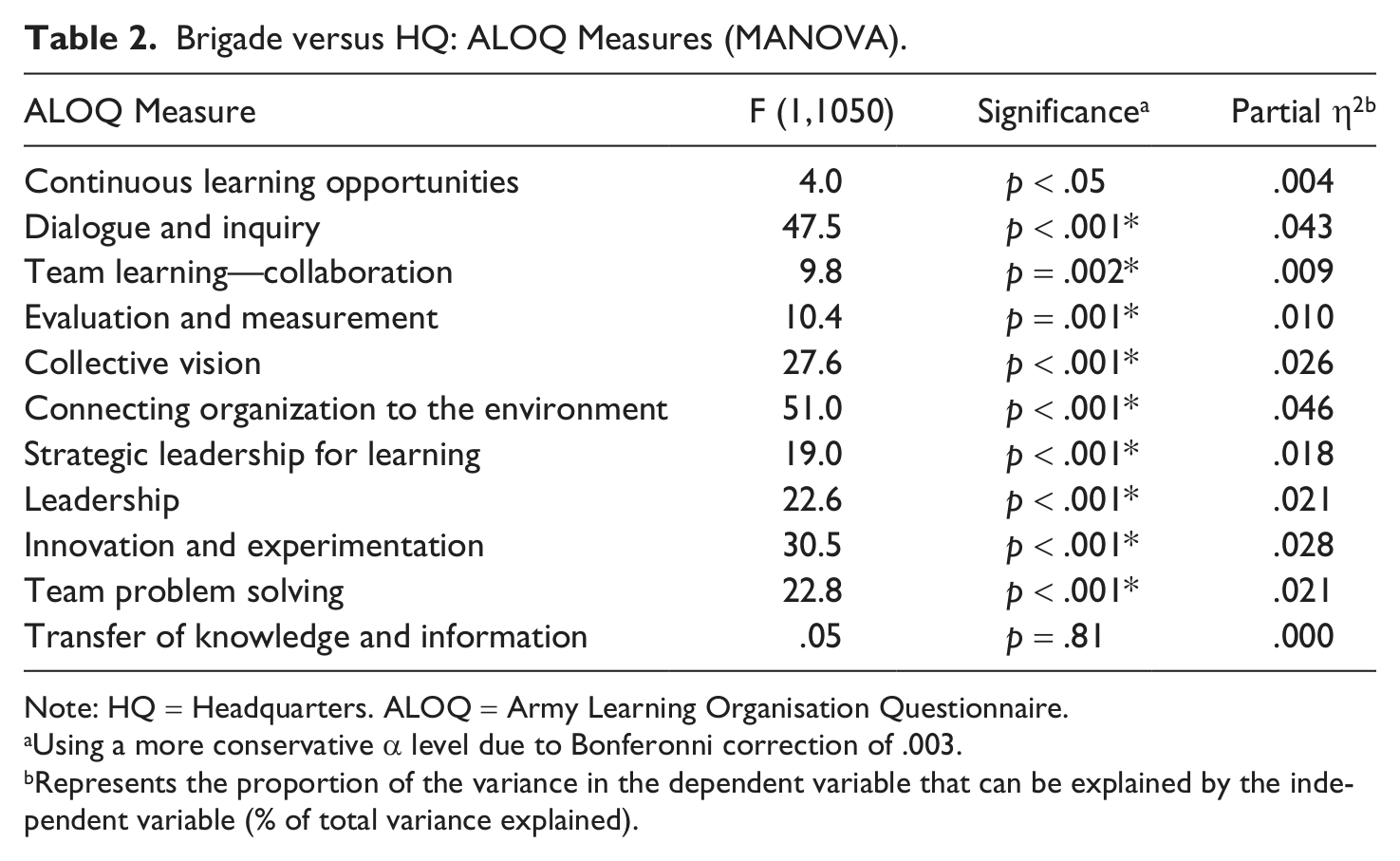
Note: HQ = Headquarters. ALOQ = Army Learning Organisation Questionnaire.
Using a more conservative α level due to Bonferonni correction of .003.
Represents the proportion of the variance in the dependent variable that can be explained by the independent variable (% of total variance explained).

ALOQ by HQ and brigade unit.
In order to investigate possible reasons for the differences observed between the HQ and brigades, their demographic profiles were compared using χ2 tests. It was found that the two organizational types differed significantly on several demographic factors. The HQ had a statistically significant greater proportion of officers, of older personnel, of women, and personnel who have worked in the military for longer.
RQ 2: How are levels of learning organization culture shaped by the hierarchy and demographic profile (specifically, rank) and functional roles of brigades and headquarters respectively?
In order to further examine the interactions between rank (using rank as a proxy indicator for hierarchy), unit type, and learning culture, we first investigated the effect of rank on dimensions of the ALOQ (see Figure 3).
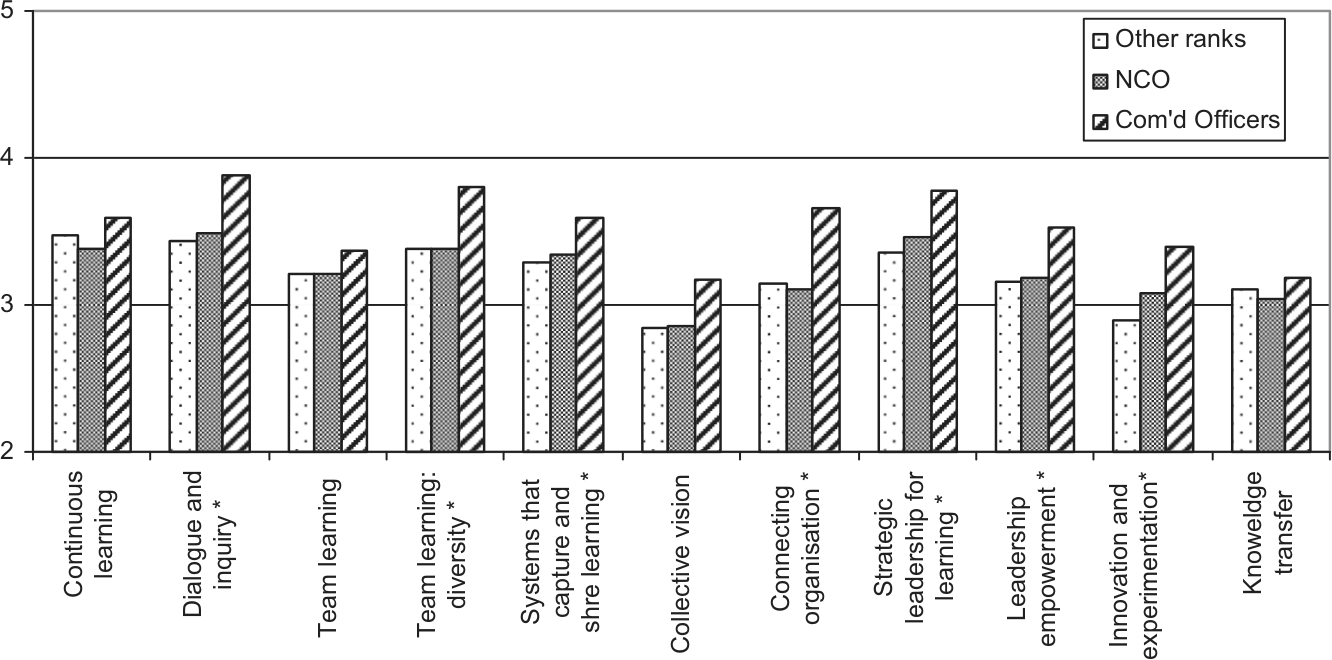
ALOQ by rank group.
To examine the relationship between rank and perceptions of learning culture, the ALOQ dimensions were compared across ranks (rank was grouped into three: “soldiers,” “noncommissioned officers,” and “commissioned officers”) using a one way between groups MANOVA (see Table 3). There is a statistically significant effect of rank upon personnel’s perceptions of ALOQ dimensions.1
Rank (Other ranks, NCO, and Com’d Off) by ALOQ Measures (MANOVA).
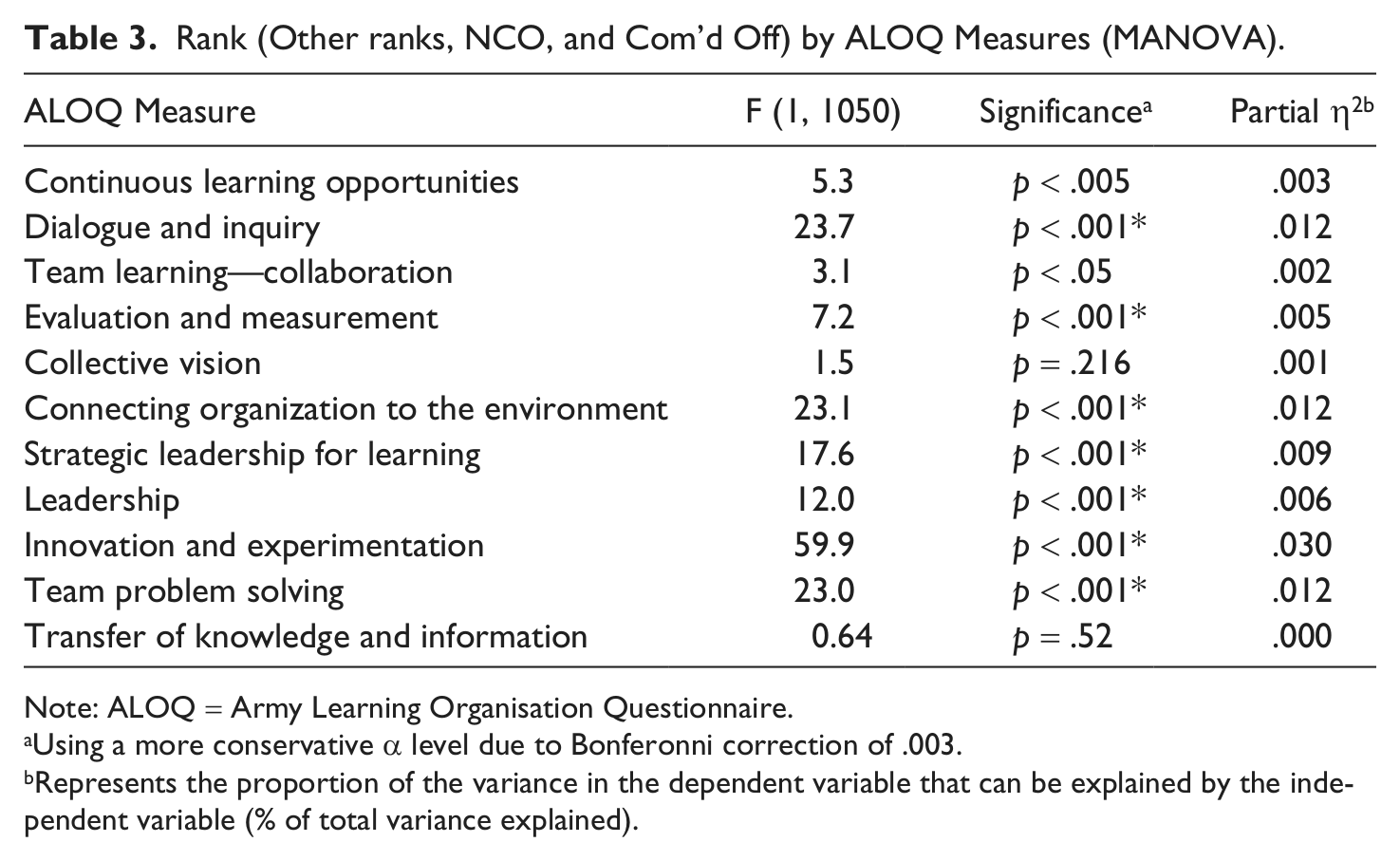
Note: ALOQ = Army Learning Organisation Questionnaire.
Using a more conservative α level due to Bonferonni correction of .003.
Represents the proportion of the variance in the dependent variable that can be explained by the independent variable (% of total variance explained).
There was a significant difference between the three rank groups, with commissioned officers rating ALOQ dimensions higher than other rank groups. The more conservative measure of significance (Pillai’s Trace = .12, F = 23.1, df(22), p > .001) was used. Seven of the dimensions reached significance, using a Bonferroni adjusted α level of 0.003. Whilst the effective impact on rank is significant, the total effect size is small to medium.
RQ 3: How does leadership behavior contribute to the differences in learning cultures in headquarters and brigade environments?
To further investigate the interaction between leadership, with organizational types, rank and the measures of learning organizations, we conducted a hierarchical multiple regression with leadership as the dependent variable, and two step regression with rank and organization at the first step, and the other ALOQ dimensions in the second step. In order to have a single dependent variable and given that the ALOQ has two measures of leadership, we created a single “leadership” score by combining the two leadership dimensions.2
The multiple regression assessed the degree to which the independent variables (the learning organization measures) predicted leadership whilst factoring for the influence of rank and organization type (see Table 4). Rank and organization type were entered at Step 1, explaining 2% of the variance of leadership. After entry of the other ALOQ measures, the total variance explained by the model as a whole was 77% (F = 307, df (11, 1031), p < .001). The other ALOQ measures accounted for 75% of the variance in leadership (R2 change = 0.749, F change (2,11), = 307, p < .001). The ALOQ measures significantly predicted leadership, over and above the influence of rank or organization.
Significant Predictors of Leadership (Hierarchical Regression Analysis).
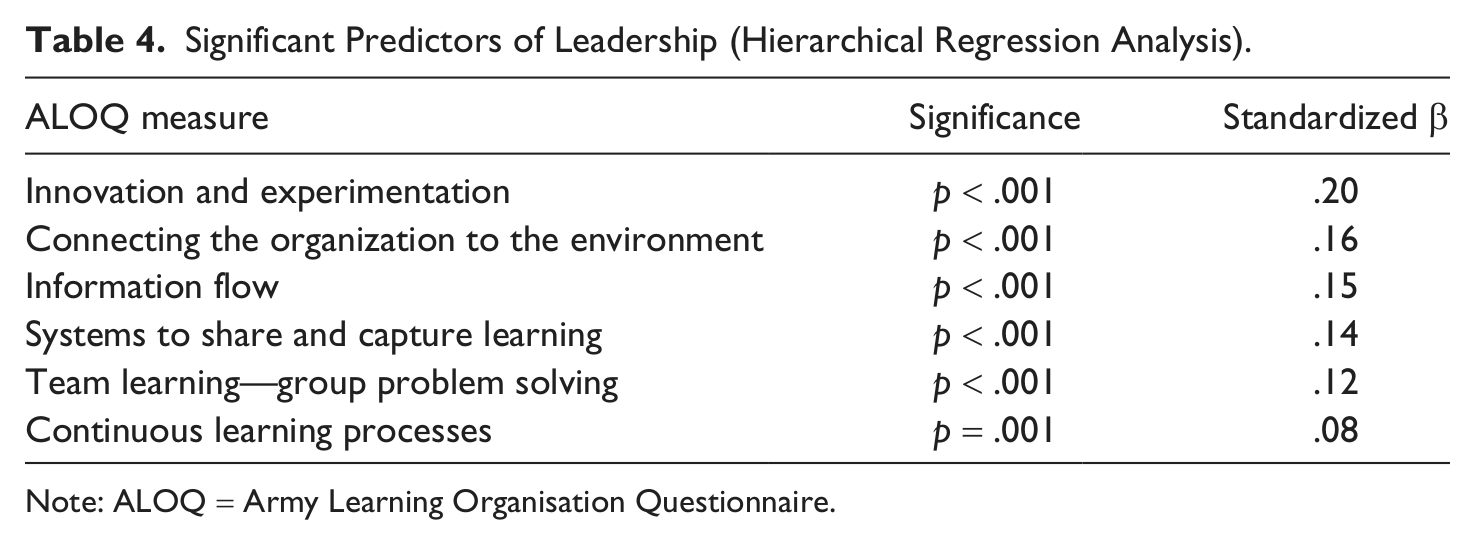
Note: ALOQ = Army Learning Organisation Questionnaire.
The results of the hierarchical multiple regression show that neither organizational type nor rank, directly, predicted leadership. The differences in leadership between the organizations appear to be mediated by the other learning culture measures such as “innovation and experimentation” measures.
Discussion
The results presented here challenge the notion of a universal or homogeneous learning culture within the Australian Army, highlighting the multiple learning cultures, and reflecting the differing functional and structural unit types across Army.
RQ 1: What, if any, are the differences between headquarter and brigade learning cultures?
While brigades and headquarters have a similar pattern with regard to the distribution of ALOQ dimensions, results reveal two distinct learning cultures operating within these two organizations. The differences in the structural and functional imperatives of HQs and the brigades were reflected in the differences in demographics including rank, age, gender, and occupation. There are significant interactions found between rank, unit type, and perceptions of learning culture within and across the units. In both instances, the characteristics of these learning cultures appear to be informed by functional requirements. The brigades’ learning is organized around task performance at the tactical level and therefore centered on the ability to access information and lessons. Finding time for learning in the tactical, high-tempo environment was a challenge.
Thus, learning within brigades was aligned with doing, as well as familiarization with processes and procedures required to fulfill work-related tasks. This strong focus on localized and immediate task performance may explain the apparent disconnect between the performance of day to day tasks and their relevance to the greater organizational vision. This contrasts to the learning found within the headquarters, which is characterized with greater levels of innovation and experimentation.
RQ 2: How are levels of learning organization culture shaped by the hierarchy and demographic profile (specifically, rank) and functional roles of brigades and headquarters respectively?
There was a statistically significant effect of rank upon their perceptions of organizational learning practices, demonstrating the impact of hierarchy on learning within the Australian Army. Rank appears to account for the majority of the differences in ALOQ dimensions between the brigades and HQs. However, that said, two dimensions (“collective vision” and “dialogue and inquiry”) were found to differ significantly, after accounting for the differences in ranks within the unit types. Reflecting on the role and function of the HQ, the learning culture within headquarters appears to be shaped by the strategic level considerations, with a more collaborative and facilitative culture identified. Learning was also facilitated through open dialogue and communication. This dialogue extended to regular opportunities for two-way communications, facilitated in part through the establishment of egalitarian rapport (treating members as equals regardless of rank).
RQ 3: How does leadership behavior contribute to the differences in learning cultures in headquarter and brigade environments?
Examining the interaction between leadership, with unit types, rank, and the dimensions of learning organizations, we found that, that the differences in ALOQ dimensions observed between the unit types was a reflection on the differing proportion of ranks within the organizational types. Higher-ranking personnel were more likely to note that innovation and experimentation was characteristic of their learning climate. Closer examination of related items reveal that notions of autonomy and agency appear to correspond with personnel’s rank and perceptions, with higher ranking personnel more likely to indicate that they can introduce new ideas into their workgroups, and have these new ideas treated seriously. Yet, despite the direct relationship between rank and perceptions of ALOQ dimensions, when examining the interactions within the ALOQ dimensions themselves, it was the other learning organization dimensions that significantly predicted leadership, over and above the influence either of rank or unit type.
Given the higher proportion of senior personnel within the headquarter environment, HQ personnel would be more inclined to view experimentation and innovation as being a feature of their practice, and part of their learning culture. This result reveals the interesting interplay between learning and expressions of power, empowerment, autonomy, and agency within the workplace. Results showed that leadership styles and behaviors are mediated by a variety of relational, procedural, and organizational factors, such as, knowledge management and related information sharing concerns, building collaborative relationships, and connectivity to wider environments. These results remind us that headquarters and brigades are part of a larger cultural landscape—a military institution—and as such, have their own particular subculture that reflects the structural, procedural, and demographic features within their unit type.
Implications for Practice
The results presented here remind us to be cognizant of the cultural diversity which exists within large organizations such as the Australian Army. Diversity is a source of strength for Army, allowing the organization to perform different tasks and meet a variety of functional requirements. “One sized” HR solutions or initiatives may not fit all of Army, nor any other large and diverse organizations. Given the differing levels of support to learning opportunities within HQs and brigades, issue for consideration is what and how learning experiences might be delivered, and to whom. Differing learning strategies and styles should be considered so all personnel have the learning opportunities they require, and ideally, that are supported within their particular work place.
Conclusion
This study found that, within a hierarchical organization such as a military institution, headquarters and brigades express learning behaviors that reflect their roles, functions, and demographic profile. Rank has a significant impact on how personnel perceive their units’ learning culture. Rank is not independent of unit function, and there is a complex interaction between rank, unit function, and perceived organizational learning culture. An important mediating factor in learning within HQs and brigades is the leadership, specifically, leaders who allow for questioning, develop agency and empower autonomy.
Footnotes
Declaration of Conflicting Interests
The author(s) declared no potential conflicts of interest with respect to the research, authorship, and/or publication of this article.
Funding
The author(s) received no financial support for the research, authorship, and/or publication of this article.