




Abstract
The Problem
Today’s organizations compete for top talent in a global marketplace. Employees seek work that is interesting and meaningful, where they can be engaged and continuously learning. While much is written about employee engagement, leaders need a model for structuring workplaces where employees can be passionate about their work and where there are opportunities for employees to learn and grow.
The Solution
This article contends that the time is right for developing workplaces that are humane, positive, and challenging. Drawing on the Organizational Intimacy (OI) framework and incorporating ideas from positive psychology, leaders can create positive environments by promoting a nurturing workplace, encouraging meaningful work, and fostering environments where employees love their work.
The Stakeholders
The primary stakeholders for this article are senior leaders and Human Resource and Organizational Development practitioners seeking to build humane and positive workplaces. In addition, HRD scholars studying frameworks that incorporate ideas from positive psychology will also find this article of interest.
Introduction
Contemporary human resource development (HRD) practitioners need to create positions that provide employees with continual learning, challenges, and rewards. In these first decades of the 21st century, organizations are faced with an escalating demand for talent while at the same time, a reduced supply of labor. To compete in a global marketplace, employees need to come to work excited and need workplaces where their excitement is met with interesting work, good support systems, and passionate leaders. The time is right to create working environments that are humane, positive, challenging, and rewarding.
Creating positive workplaces that capitalize on and develop the strengths of our employees is critical for organizations to be globally competitive. The postindustrial world has moved from a relatively stable environment where people stayed at the same job for a lifetime to an environment of constant and dynamic change. Peter Vaill used the metaphor of “permanent whitewater” to describe the turbulence that organizations and employees face in current times. Permanent whitewater creates an environment of continual newness that can only be resolved by continual learning in constantly changing conditions (Vaill, 1996). Thus, organizations must embrace change and learn continuously as a survival strategy to cope with ever-changing environments. The drivers of permanent whitewater (e.g., a global marketplace, shifting demographics, technological deskilling of the worker) require workplaces that are constantly evolving. Permanent whitewater means that in the near future, we may not know what kind of work we will be doing, what skills and abilities will be needed, or where we may be doing it.
In the industrial age, employees would go to a workplace, have a desk or work station, worked 8 hr, had a lunch break, and got a paycheck once or twice a month. The rules of postindustrial society have changed all of this. Organizations and those employed by them are playing catch-up in this era of uncertainty and massive change. One area that has lagged behind is how we hire, grow, and support our employees—our human capital. Without strong human capital, our organizations won’t survive the whitewater. This article looks at the need for more positive workplaces, better hiring practices, and what can be done to inspire, develop, and enhance the workforce using the Organizational Intimacy (OI) framework (Boverie & Kroth, 2001). The article also looks at the importance of the vital role leaders play in structuring more positive, humanistic organizations.
To begin, we start with the premise that we are all learning organisms and that our happiness at work is influenced by our ability to learn. We then describe the OI framework and its components to discuss how positive work practices can create passionate and engaged employees. Finally, we will look at some of the current findings about the role of leaders in promoting positive work environments.
Humans as Learning Organisms
It is our nature to learn and, deep down, we are all learners (Senge, 2006). Humans are literally learning organisms—from the cellular level to our complex thinking and feeling processes. Actually humans are social and learning organisms—learning from our experiences and from interacting with others. We rely on others for companionship, help, work, family, and friends. These are examples of the social needs and roles of our workforce. But there is a more critical role that needs further examination. We believe we are “learning organisms” and we are happiest when we are engaged in learning (Boverie & Kroth, 2001).
Educational psychologists have been writing, researching, and practicing to help humans to learn and perform better. But for the most part these efforts have looked at the realm of early learning—from infancy to school age children (e.g., Goddard, 2001; King, 1991). There have been those that have looked deeply at how adults learn, but what we teach and study is mostly how to learn better (e.g., Bransford, Brown, & Cocking, 2000; Dupeyrat & Mariné, 2005; Merriam & Clark, 2006). We take the stance that not only do we need to learn in better ways, but that we need to acknowledge that we are learning organisms—we are born equipped to learn, to understand, to seek, to fulfill ourselves (Boverie & Kroth, 2001).
Anthropologist Edward Hall says, “Humans are the learning organism par excellence. The drive to learn is as strong as the sexual drive—it begins earlier and lasts longer” (Senge, 2006, p. 14). It is important to begin to not just look at how to teach people to learn, but to recognize that learning is like breathing to humans. You have a conversation—you learn. You watch TV—you learn. You take a class—you learn. You eat a new kind of food—you learn. Every activity we engage in, including sleeping, is essential, is part of, and is an act of learning. Understanding that we are learning organisms can have a profound and beneficial impact on how people work, play, love, spend time, and live their lives. A trip to Italy is full of learning—new language, new sites, new history, and so on. A trip to Wal-Mart is also full of learning—new products, new faces, new ideas, and so on. Learning is happening constantly, but for most of us, we are unconscious of that fact.
Our backgrounds are in the world of software development, personnel and training management, military contracting, and teaching graduate students who enter the workforce into leadership positions. Some of our work was responsible for training hundreds of new and old employees on their jobs—from young, brand new, out of high school/college to re-training hundreds of other employees on new systems and services. We have also taught new undergraduates, but mainly we teach graduate students who are in mid-career for the most part. Every class we find the same “aha” from each and every student—they never really knew that (a) they are always learning, (b) there are many ways to approach learning, and (c) learning new and constructive ways of learning can help them in their work, family, and in the rest of their lives. It seems apparent that adults learn in many ways for many reasons. However, the workplace does not always appear to understand this need for adults to continually learn.
Workplace Learning
Our field is in a transition from an industrial era where employees were easily interchangeable, to an era where knowledge reigns supreme and people are the most important factor of work production, is not a new idea. Drucker (1959) introduced the term “knowledge worker” more than five decades ago. Driven by mobile capital, low cost transportation, and pervasive technology, work is no longer geographically bounded. Most organizations are in a world where they compete globally for sales, for workforce, and for ideas. In the global economy, ideas are the coin of the realm—and ideas are generated by people. Consequently, recognizing that employees are central to their global competitiveness, many organizations are creating cultures that support humanistic values and workplaces where employees are happy, motivated, and engaged. The “happy/productive worker thesis” (Wright & Cropanzano, 2007, p. 269) underpins the premise of these workplaces and is grounded in the positivist principles of Abraham Maslow, Carl Jung, and other predecessors.
From the perspective of the organization, employees are a valuable source of competitive advantage. That said—this is apparently not a universal belief. Pfeffer (1998) found that only half of the organizations believe that human resources really do matter. Half of this half gave little more than lip service to the ideas of building organizations that promote HRD. Moreover, only half of that half that believed that human resources are their most valuable asset and do something about it, that is, only one in eight organizations actually implement and stick with HRD policies and programs. Pfeffer shows that this residual one eighth are world-class organizations that show superior results in productivity, innovation, quality, customer satisfaction, and bottom-line profitability. Many of these firms are household names where people aspire to work. Companies like W.L. Gore, Southwest Airlines, Google, SAS, and Zappos build cultures where people are placed first. These are evidenced in their policies and actions on work−life balance, employee education, flex time, and self-directed teams. Indeed, for many years, Fortune Magazine has published an annual listing of Great Places to Work (GPTW) comprised of companies that predominantly practice humanist precepts.
Learning is an important part of employee development and engagement at these GPTW firms. At the core of the culture of the GPTW companies is the recognition that people are learning organisms, and that by nature, are curious and goal seeking. Learning impacts the organization in at least two ways. First, learning can lead to innovative ways of solving the complex problems of the organization. Second, learning from trying new things at work is an outcome that keeps work fresh and exciting. Numerous authors have noted the importance of engaging work and the human need for a sense of accomplishment (Burchell & Robin, 2011; Sirota, Mischkind, & Meltzer, 2005). Thus, learning is an outcome that may help in the retention of employees.
Research suggests that workplace learning not only improves the skills and abilities of employees—thereby elevating the human capital of the organization—but that learning also enhances their satisfaction with the job and their commitment to the firm (Rowden, 2002; Wang, Tolson, Chiang, & Huang, 2010). According to Evans, Hodkinson, Rainbird, and Unwin (2006), there are three basic approaches to workplace learning: learning for work, learning in work, and learning at work. While these teach us how to perform specific tasks and skills, they fail to prepare us for the permanent whitewater that Vaill describes. Learning about performance alone fails to ready us for the ill-structured problems of the global economy. To meet this challenge, organizations need to become learningful workplaces (Senge, 2006), places where learning and work are intertwined and integrated. In learningful workplaces, all are aware of our individual strengths and learning styles. In learningful workplaces, people know how to collaborate with others and how to learn from others.
We often ask our employees to change, learn, and become more productive, yet they are expected to do so in environments that don’t support learning and employee development. The past 10 years social science researchers have broken through thought barriers to better understand individual motivation, the need for continual learning, and the processes and environments to support that learning. The next sections look at the role of positive approaches to work and learning at work and how leadership practices can directly affect employees.
Positive Psychology at Work
Like all areas of science, the field of psychology has evolved over time. Traditionally training for psychologists was in large part entrenched in the pathology, dysfunctions, and faults of individuals and society. In other words, what was wrong with us versus what was right and instinctive to be human. Work with organizations was also influenced by what was wrong with employees, groups, and organizational structures. Early in this century, psychologists began turning the tide and wrote about the effects of being more positive. Early promoters were Seligman (2002), Csikszentmihalyi (1990), Boverie and Kroth (2001), and Luthans (2002), among others, who began to convince us that humans had positive core values and that they should be developed and celebrated. At the same time, our understanding of the work environment was changing. The world is now a mobile, 24/7 workplace, where the knowledge worker reigns over the worker bee.
The research on passionate work (Boverie & Kroth, 2001), which preceded and foreshadowed much of the work being conducted today concerning positive emotional work environments, found that there are three paths for individuals in organizations. One path is to become a continual learner who is able to take risks, who feels appreciated, and who feels his or her work is meaningful—and thus remains passionate about work. A second path is to find help when one is not motivated, usually from a co-worker or leader, to regain motivation. The last path we found is what we called, “passion extinction,” where one’s enthusiasm is unappreciated, or where one is in the wrong line of work, or is reluctant to take risks on his or her own behalf.
Working adults enjoy their work and work harder if they have learning challenges that keep them interested in what they are doing, which is important to self-determination. When work becomes routine, slow, and boring, they try to find other outlets to interest them. Leadership needs to understand this basic need to fulfill our desire to be continually learning. Organizations need to try to harness this latent learning passion that exists in everyone.
The most important requirement for creating supportive, passionate, and positive workplaces is for its leaders to be passionate and positive themselves. Trying to create a positive workplace without having positive leaders is like trying to start an engine without the fuel. Passionate leaders create an inspiring vision of the future, deeply understand the importance of what the organization does and how it affects customers and employees, and then finds ways to connect those to the feelings, hopes, and plans of the employees (Boverie & Kroth, 2001). The role of management at all levels is to lead, thus leadership must be acutely aware of the need of a positive environment to provide the best services and products their organizations supply.
Very often organizational change is unsuccessful because the employees know that although it might be good for the organization, but it is often at their expense. This is not to say that many change efforts are not necessary, but that the effect on moral is just as important as the effect on the bottom line. The basic building blocks of every organization are the people who work there—thus understanding them, their issues, their motivations is critically important for developing more positive workplaces. Constructing positive workplaces requires nothing short of providing a positive place to work, and working to the strengths of each employee—which relies on careful and thoughtful hiring practices. Organizations must hire people for their strengths, rather than to just fill slots. It also means that leaders must not only mind the bottom line, but they must be able to gauge their employees’ attitudes, needs, and most importantly, inspire their need to learn.
Continuous learning is a characteristic of humans. To what degree we exercise our ability to learn is primarily a function of our worldview, of what Dweck (2006) calls mindsets. The work on learning mindsets—conditioning individuals to enjoy learning rather than avoid it—as well as the emphasis on positive workplaces and the understanding that we, as humans, have a basic need for continual learning, provide an opportunity to look at the connection between helping employees learn and learning’s role in current organizational development and motivation. Dweck (2006) found that how people are “conditioned” to learn from early ages can directly affect how they approach learning in the workplace. If they are conditioned that they must make the best grade, be the best at competitions and such, they may end up with almost a fear of learning something new—because failing is unacceptable. Likewise if they are raised where learning is not conditional on being the best, but instead, of learning being seen as fun, a game, interesting . . . then they grow up to enjoy learning challenges. Hiring, coaching practices, and workgroup development in the workplace can “undo” some of the harm of being conditioned to always be the best, and individuals can be retrained to enjoy learning again.
Suffice it to say that the fixed mindset and those in the growth mindset still both engage in learning. The focus here is on the resultant outcomes. Certainly one can sit on the couch ingesting reruns of old TV shows and still learn something (e.g., a new way to change the channel, a new product via a commercial advertisement, that a tornado is coming toward your town), but this knowledge does little to advance the learner’s intentions. However, it is the growth mindset that allows for pursuit of one’s purposes and aspirations. Dweck (2006) calls attention to this purpose in the subtitle of her book, “Mindset: The New Psychology of Success.”
The field of workplace training tends to think of learning in the formal sense, where the concepts are taught in a different location than where we will actually use them. Vaill (1996) referred to this formal, decontextualized learning as institutionalized learning. In times of rapid change knowledge becomes more liquid, what we knew as true yesterday no longer holds today. As indicated previously, organizations need to build learningful environments and learningful mindsets.
If learning and happiness are natural states for humans, then why do so many people feel unhappy and unfulfilled at work? As learning organisms—we love to learn and are most happy when we are learning new things. Organizations need people’s energy, creativity, and talent, and people need jobs, income, and opportunities for learning and self-actualization. One problem with motivation and work is that often employees are in situations where they are not encouraged to continually grow and learn or are in situations that don’t provide these opportunities. These issues can be dealt with by careful hiring practices—hiring people with the right skills and attitudes, and by giving employees the right training at the right time. What we know now is that we need to hire to people’s strengths.
Viewing humans as learning organisms is a concept supported by the work of Csikszentmihalyi (1990). Flow is a state achieved when a person has sufficiently high challenge met with sufficiently high skills. Individuals who are in a state of flow are basically happy. Their attention is focused on a task that is absorbing, where negative thoughts do not exist. As soon as the work becomes boring, too easy, or too hard, the flow state is broken and dissatisfaction (e.g., boredom, anxiety, worry, apathy) can occur. Flow, then, is a state where one is engaged, learning, and happy. It follows that the task of leadership is to help our employees reach flow states of learning, as well as rewarding this state, and providing workspaces where flow can naturally occur.
Other concepts from studies in positive psychology can help us deal with motivational issues at work. Positive individuals have healthier relationships, more motivating work situations, and promising views of life in general. Most organizations are built on two flawed assumptions about people—each person must be competent in almost anything, and each person’s greatest room for growth, are in his or her areas of greatest weakness (Buckingham & Clifton, 2001). Given these assumptions, most organizations spend more money on training people once they are hired, than on selecting them properly in the first place, and on fixing skill deficits rather than leveraging strengths.
Social and Positive Psychological Capital
The concept of human capital, the value of our workforce, has become popular in the management and organization literature (Huselid, Beatty, & Becker, 2005). Human capital is now evolving into the areas of Psychological Capital (PsyCap) and even more recently is being talked about as Positive Psychological Capital (Avey, Luthans, & Youssef, 2010). This area of study looks at the issues of human capital, but takes it in the direction of positive psychology looking at such issues as who are our employees, and how do we develop them to their fullest capacity.
Avey et al.’s (2010) work examines the components that make up the positive psychological states for employees: high self-efficacy/confidence, high hope and positive attitudes, the ability to persevere, and dealing with problems in a positive manner. Their studies also indicate that high positive capacity helps employees deal with stress, maintain good attitudes, and increase their overall organizational climate.
PsyCap (Youssef & Luthans, 2007) is an outcome of the positive psychology movement. This work revolves around motivation and agency to accomplish organizational goals, increasing employee agency to develop positive self-talk and to develop “a capacity for hope” in employees. These “hopeful” employees are optimists who expect good things to happen to them, and they tend to approach problems in different ways. They are optimistic and are willing to put forth effort to create change.
Another important concept that Avey and his collaborators (2010) found is that employers and employees who are positive, also seem to have better adaption to changes, are more willing to take risks, and develop high levels of resilience. Resiliency is the actor that enables not only individual employees to recover from down times, but also enables whole organizations to weather changes in markets or downturns.
This work on psychological capital mirrors the results that were found in passionate employees (Boverie & Kroth, 2001). This study found that employees who are passionate about their work, felt that way because they were constantly learning—from mistakes as well as from other sources—which in turn helped them develop higher self-efficacy. Building self-efficacy is similar to a self-fulfilling prophecy. If you believe you can do it, you are more likely to do it and conversely, if you believe you can’t do something, you probably won’t even try. In our work, we found that employees, who are willing to take risks, learn; and when they learn, they develop self-efficacy. So risk-taking, learning, and self-efficacy all work together to better engage employees.
Thus, from a positivistic perspective, an additional opportunity for HRD comes from helping employees to grow their individual PsyCap. As described by Csikszentmihalyi (1990), an individual’s PsyCap is state-like rather than trait-like, and thus can change. PsyCap is comprised of four factors: Hope, Efficacy, Resistance, and Optimism (Youssef & Luthans, 2007). Through a combination of training and policy, HRD practitioners can help employees grow their PsyCap.
Learning, Efficacy, and the Importance of Employee Strengths
HRD professionals need to capitalize on the differences and individual strengths in our employees, rather than hoping/training that we can train individuals for the strengths needed in the workplace. Instead, HRD should capitalize on our employees’ strengths. Their strengths are probably much stronger and more enduring than their shortcomings. HRD executives would be well served by a paradigm shift that approaches organizational design in a holistic manner that nurtures talent and knowledge. The new paradigm must produce governance structures that limit unproductive complexity and new performance metrics that are better suited to an organizational culture where talent, rather than capital, is the scarce resource (Bryan & Joyce, 2007).
By further developing employees’ strengths, imagine the power each individual could have in solving organizational problems. And, as one gets better and better at what she or he does best, imagine the intrinsic motivation to keep improving—this is the epitome of the learning organism—joy and continual learning. But the conditions of many of our workplaces are still in need of making difficult changes—changes that involve the entire organization.
Using the tenets and framework of Positive Psychology, organizations can be enhanced, become psychologically healthy, and resilient in times of crisis. Salanova, Llorens, Cifre, and Martinez (2012) describe best practices using positive interventions, which also take in the employees’ points of view. They contend that Healthy and Resilient Organizations (HERO) can make systematic, planned, and proactive efforts to improve employees’ and organizational processes and outcomes.
Implications
What Employees Want from Work
If the most valuable assets of an organization are its employees, then what strategies can organizations use to attract and retain good employees? How can organizations meet the desires of employees for more flexible environments without compromising productivity? From 1994 to 2003, Sirota Consulting asked 2.54 million employees at 237 firms about what they want from work (Sirota et al., 2005). The data distilled to what the authors call their Three Factor Theory of Human Motivation in the Workplace and suggests that the majority of employees have goals in three areas: (a) equity, (b) achievement, and (c) camaraderie. Equity goals embody just treatment by employers and are similar to Hertzberg’s hygiene factors: company policies and administration and working conditions. The second and third factors described by Sirota et al. (2005) are aligned with Hertzberg’s satisfiers: achievement, recognition, responsibility, advancement, and learning. Achievement involves taking pride in one’s accomplishments by doing things that matter, being recognized for these accomplishments, and being proud of the employing organization (p. 15). Camaraderie goals are about having warm, interesting, and cooperative relationships in the workplace.
Of particular interest in discussing learning, meaning, and love of work are Sirota’s sources of the accomplishment goals. Sirota Consulting describes six sources that link to learning, meaning, and passion at work. The first source is the challenge of the work itself—does the job use an employee’s intelligence, knowledge, and skills? Second, directly tied to learning is the desire to acquire new skills. Third, employees want to believe they have the ability to perform and thus desire the training, direction, authority, and resources to perform well. Fourth, is the perception of the importance of the employee’s job—is this job meaningful to the organization, the customer, and to society? Fifth, does the employer recognize the work of the employees? This includes financial remuneration but also includes nonfinancial aspects as simple as hearing “thank you” from superiors. The sixth and final factor of importance to employees is the need to feel pride in the place where they are employed. Do the products have a positive impact on society, is the company successful, and are the organization’s leaders respected and ethical?
The components of camaraderie relate to our interests in learning, meaning, and love of work as well in that they relate to the need for positive social capital at work from a standpoint of providing a nurturing environment and in the recognition that much of the learning we now do at work is social and situated. This is the essence of positive HRD practice.
Components of OI
People are the building blocks of organizations and the success of an organization depends on the relationships between the needs of people and the needs of the organization (Boverie & Kroth, 2001). The model of Occupational Intimacy (OI) environments has three components—a nurturing workplace (NW), a place where work is meaningful (MW), and a place where people love their work (LW; Figure 1). When people are passionate about their work (LW + MW), and the organization provides a nurturing environment (NW), OI exists. OI is “the closeness passionate people feel to their work” (Boverie & Kroth, 2001, p. 71). Leaders can use the lessons of positive psychology to elevate OI as a vehicle for potentially improving workforce engagement and performance.
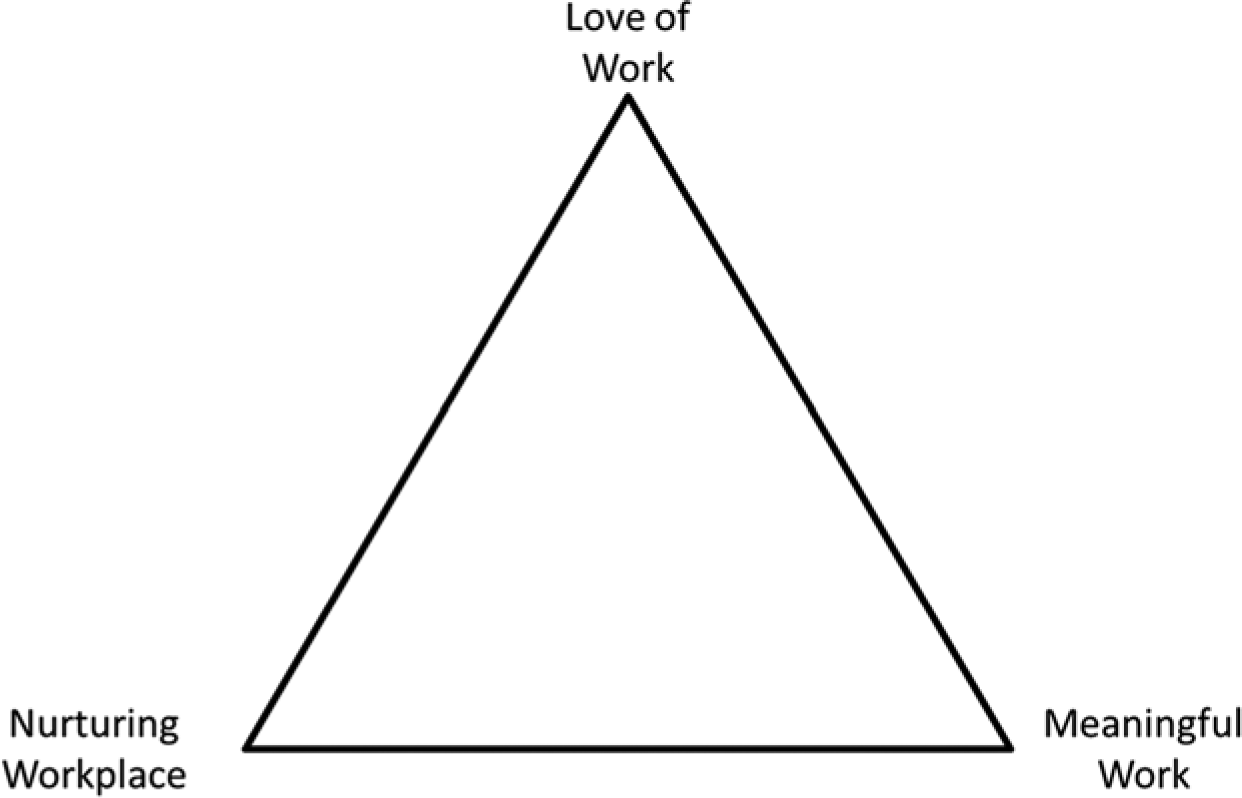
Components of OI.
Love of Work consists of enjoying the work you do, having constant challenges and learning experiences, knowing how to do your work, helping to impart knowledge to others, and being excited to do the work (Boverie & Kroth, 2001). Nurturing Workplace consists of having a caring workplace, caring about your co-workers, having respect for individuals, and compassion for the people who work with you. Helping an employee to find the appropriate level of challenge in work should result in an increased love of work (LW) and in making that work more meaningful (MW). To promote this, a nurturing work environment (NW) is required. The nurturing work environment might include HRD practices such as a development plan, mentoring or coaching, job rotation, and sufficient training so that that employee develops the skill sets to adequately meet the challenge (see Table 1).
Examples of OI (adapted from Boverie & Kroth, 2001).
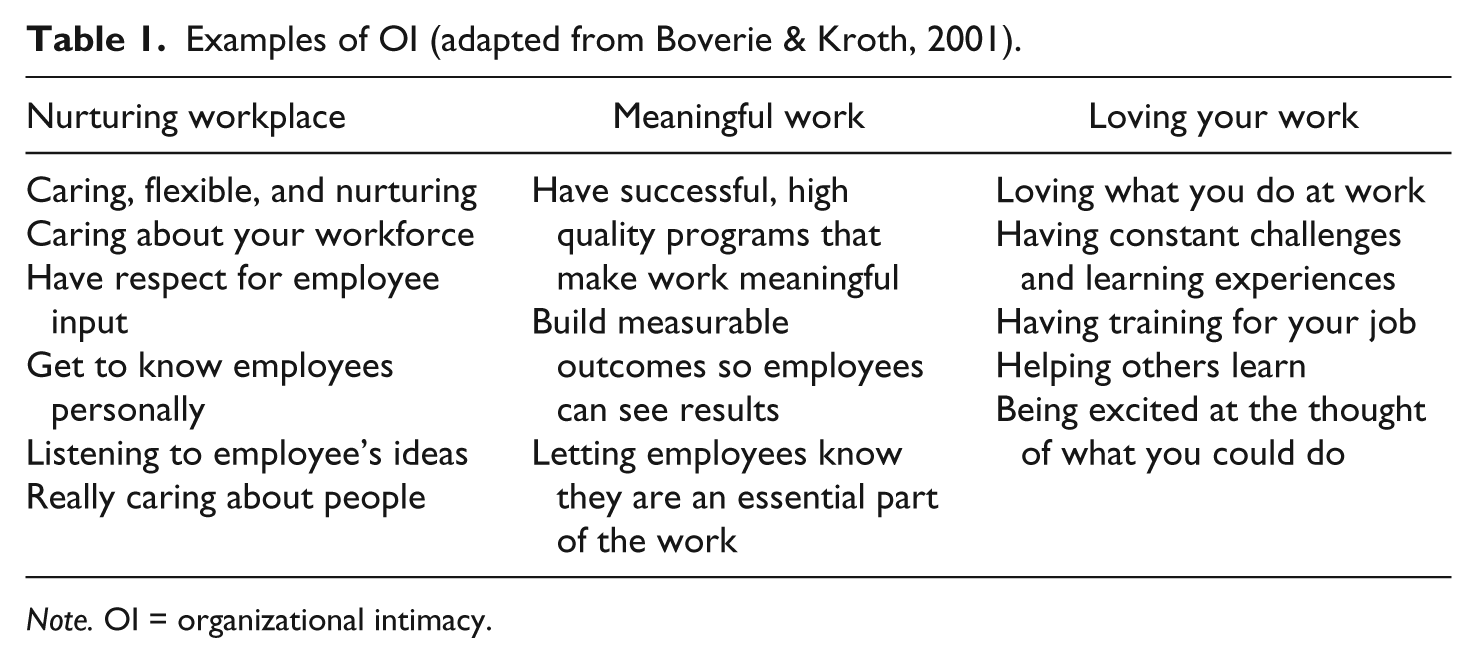
Note. OI = organizational intimacy.
To build nurturing work environments that support employee needs requires a commitment to policies and programs that grow the organizations’ human and social capital. Development programs focused on strengths rather than deficits can help create the love of work and the meaning associated with that work. By their nature, these programs focus on development. Social capital requires adjustments to culture, norms, and trust structures. The dictates of positive psychology can influence how we approach and build the social capital in the organization.
However, organizations need to show a balance in their approach to OI. As reported by Boverie and Kroth (2001), and shown in Figure 2, organizations that are nurturing (NW) and fun (LW) but where work has little meaning (MW) could be called Indulgent Environments. Indulgent environments are typified by places where there are predominantly low-level jobs that are stepping-stones to other, more meaningful occupations. Compelling Environments are found where there is high interest (LW) and high meaning (MW) but little nurturing (NW). Here, employees love what they do and want to continue this work but feel that the organization doesn’t really care about them. Occupations like artists, scientists, and college instructors often find themselves in Compelling Environments. Finally, where nurturing (NW) and meaningful work (MW) is high but there is little interest (LW), is labeled as an Affirming Environment. Examples of Affirming Environments might be schools, small departments within larger organizations, or secretarial or administrative work.
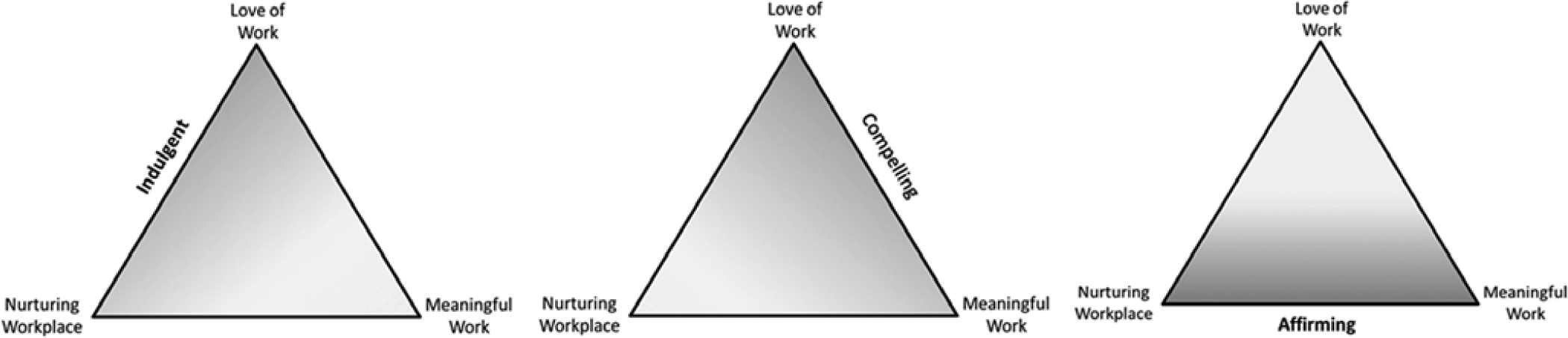
OI Environments.
Meaningful work means understanding how an individual is contributing to the larger effort. Employees want to make a difference and know that their actions are part of something important. Thus, leaders and managers must seek to share with employees the larger vision (shared vision). Many organizations, recognizing that the people who do the work, better understand the work, and thus should be more participative in engaging employees in planning. Allowing autonomous work is also a key strategy in elevating meaningfulness. Moreover, helping employees develop individual growth plans that drive toward the work, helps organizations meet their goals. Success also breeds increased confidence (efficacy).
Helping an employee to find the appropriate level of challenge in work should result in an increased love of work (LW) and in making that work more meaningful (MW). To promote this, a nurturing work environment (NW) is required. The nurturing work environment could include practices such as a development plan, mentoring or coaching, job rotation, and sufficient training so that the employee develops the skill sets to adequately meet the challenge.
In addition, people wish to be part of something they can be proud of and that holds meaning for them. Gen Y employees show interest in being part of companies that are more involved in issues outside the corporate boundaries. Thus, Social Corporate Responsibility (SCR) is becoming important as a nurturing strategy and a way to have more meaningful work. This assumes philosophically that organizations have a broader mission than just profit (McWilliams, Siegel, & Wright, 2006).
The Role of the Leader
To develop strong psychological capital—passionate and positive employees—and positive organizations, strong leadership, especially in HRD, is essential. There is a rich history of leadership theory. Leadership can be viewed as traits, influence over followers, and influence on organizational culture (Yukl, 1989). One stream of leadership research focuses on the relationship between the effects of leadership on individual and organizational outcomes such as job performance, unit performance, and profitability (e.g., Gerstner & Day, 1997; Yukl, 1989). Another stream of leadership research emphasizes the effect of leadership on human outcomes such as job satisfaction and turnover intention (Yukl, 1989). Leaders not only need to deliver strong performances, but also need to develop and care about their employees, which goes beyond retaining employees and keeping them satisfied. In the leadership literature, two types of leadership approaches fall into this category: transformation leadership and authentic leadership.
Transformational leaders are able to motivate employees to work for transcendental goals (Burns, 2003). Bass (1985) suggested transformational leadership consists of three components: charisma, intellectual stimulation, and individual consideration. These conceptualizations of leadership echo the positive psychology contentions that employees need to be self-actualized, as well as challenged.
Grant (2012) took a transformational leadership lens, suggesting that transformational leadership may not lead to performance and one of the issues is making the vision tangible. Thus, Grant introduced two constructs—beneficiary contacts and prosocial impact—and found moderating relationships between those two constructs on transformational leadership and performance. Grant’s argument highlights the needs of meaningfulness in the workplace. Employees want to find meaning in their workplace, which leads to their need to see results, which, in turn, often leads to personal gains such as bonuses, higher salaries, and/or stock options (Boverie & Kroth, 2001). As employees see their work creating benefits for others, the company performs better. This desire to be part of something larger is evidenced in slogans such as IBM’s “Building a Smarter Planet.”
Transformational leadership is not just about rhetoric. It is also about managerial actions. Grant (2012) found beneficiary contact, as an element that can be changed by the employers, effected the impact of transformational leadership on revenue. When employees have contact with the beneficiaries of the job (e.g., clients, customers, patients), the relationship between transformational leadership and followers’ performance is also strengthened. Hence, leadership is not just about inspiration and intellectual stimulation (Elkins & Keller, 2003; Judge & Piccolo, 2004). Leadership is about hiring the right people, creating the right climate, and making sure that employees feel they are making a difference, being treated fairly, and have opportunities for learning.
Authentic leadership is a relatively new concept (Gardner, Cogliser, Davis, & Dickens, 2011). Ilies, Morgeson, and Nahrgang (2005) identified three authentic leadership components: positive self-concept, personal integrity, and emotional intelligence. Various researchers draw from positive psychology and suggest that authentic leaders behave and are perceived by others as being aware of others’ perspectives, confident, hopeful, optimistic, resilient, transparent, and high in moral character (Avolio, Gardner, Walumbwa, Luthans, & May, 2004: Luthans & Avolio, 2003). The literature suggests that authentic leadership may have a relationship with positive organizational behaviors (Avolio et al., 2004; Gardner & Schermerhorn, 2004).
Although authentic leadership and transformational leadership literature provide some understanding of how leaders’ personal states and messages may influence employees, it is crucial to consider HRD leaders’ actions in understanding their influence on employees. Drawing from the concept of OI (Boverie & Kroth, 2001), HRD leaders should create a positive working environment by promoting a nurturing workplace, encouraging meaningful work, and fostering an environment where the employees love their work (see Figure 3).
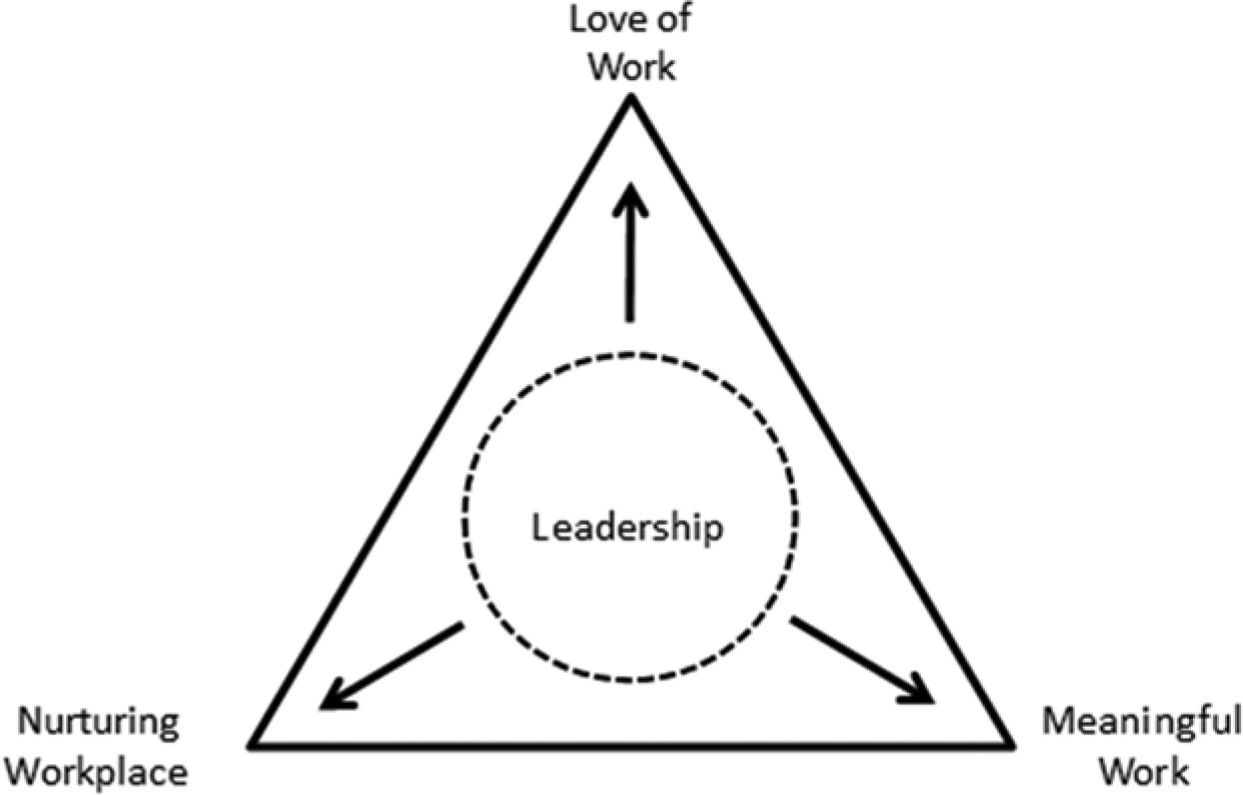
A framework of positive leadership.
Caring is a key component of a nurturing workplace (Boverie & Kroth, 2001). The concept of caring also fits Bhindi and Duignan’s (1997) understanding of authentic leadership when leaders have sensitivity to others’ feelings, aspirations, and needs. Leaders listen to employees and care about employees’ well-being, and also foster environments where employees are shown respect and care for each other. Authentic leaders value employees not as worker bees, but as real people. Authentic leaders are compassionate to the employees, and willing to feed and develop employees by providing learning opportunities (Boverie & Kroth, 2001).
Besides promoting a nurturing workplace, HRD leaders also need to encourage meaningful work for the employees. In large organizations, employees’ contributions can be invisible. Grant’s (2012) research on beneficiary contacts and prosocial impact highlights the importance of meaningfulness for the employees. Employees need to see that they are essential parts of the work and that they can make an impact (Boverie & Kroth, 2001). Both can be achieved through employees’ contacts with clients and customers, and/or by allowing employees to see the social impact of their work. Timely feedback and measurable components are also essential so that employees can see results and know how their work affects others.
Finally, employees in a positive working environment love their work. Their love of their work may come from the optimal level of challenges that they face every day. Csikszentmihalyi (1990) described the flow experience in understanding intrinsic motivation and he suggested the importance of challenge in flow experience. Positive leaders provide challenging, instead of mundane work, for their employees. Employees’ flow experiences can be maintained when the kind of work and level of workload are closely monitored.
Besides giving the “right” kind of work and “right” workload, one of the most important elements where leaders can influence the workplace is by hiring the right people—and hiring them to do work what they naturally love to do. Undoubtedly, extrinsic motivation such as a paycheck is important for employees. However, to keep employees intrinsically motivated, they need to perform tasks they enjoy. Positive leaders promote an intimate working environment that nurtures employees and fosters meaning, and where the employees love their work. The leader is ultimately the most responsible person for insuring that each employee knows his or her value to the organization and that employees are respected for the work they provide. Public announcements of successes, “Employee of the Month” recognition, organizational newsletters, and websites can be used to acknowledge individual and group achievements. If employees are not passionate, there is something wrong with the leadership.
HRD leaders need to construct workplaces where not only the environment and benefits are good, where tasks are challenging and interesting, and where employees know why they are important, but also where they have opportunities to learn and develop. Learning, taking risks, and the subsequent effect those actions have on employees and their self-efficacy is what keeps them working for you. It keeps them passionate and keeps the organization growing. Continuous learning and growth in employees, understanding how meaningful their contributions are, helps employees find fulfillment in their work (Boverie & Kroth, 2001).
Some organizations try to buy loyalty using a paycheck. However, a paycheck alone does not inspire commitment, and without that commitment there is no loyalty. Employees want to work in meaningful ways, they want to be inspired, and they want their work to be appreciated and important. Providing growth opportunities through learning, making sure each employee knows their value to the organization, and caring about their development can insure better organizational performance.
Summary
This article has drawn a line between the role of positive psychology to the necessity of creating better learning environments at work to match the changing economy and workforce. Although the concept of OI was introduced over 10 years ago, the components that impact OI—love of work, nurturing workplaces, and meaningful work—are still critical to developing great places to work. OI represents organizations that encourage constant learning, employee development, appreciation of employees’ strengths, and the critical importance of the role of a supportive leadership. Organizational HRD leaders that utilize the concepts of positive psychology have the chance of succeeding in this constantly changing environment.
Footnotes
Declaration of Conflicting Interests
The author(s) declared no potential conflicts of interest with respect to the research, authorship, and/or publication of this article.
Funding
The author(s) received no financial support for the research, authorship, and/or publication of this article.