



Abstract
This study provides a qualitative systematic review of social marketing tobacco cessation programs identify the extent to which seven major components of social marketing are used in social marketing programs targeting tobacco cessation and to classify them according to social marketing stream: downstream midstream or upstream. Sixteen databases were examined to identify studies reporting the use of social marketing to address cigarette smoking cessation. Fourteen empirical studies were classified. Only one of 14 interventions used all seven of the major components of social marketing. The review identified that downstream (n = 11) interventions remain the dominant focus in social marketing interventions targeting tobacco, despite calls for social marketers to move upstream during this time. The current review was restricted to studies that self-identified as social marketing and studies published in peer-reviewed journals in the English language which is limiting. This study included all empirical studies published from 2002 to January, 2016; however only using published studies may bias results. The results indicate that social marketing interventions targeting tobacco cessation can be successful even when some of seven distinguishing and mutually exclusive features of social marketing are applied. This article presents the first attempt to review the extent that social marketing principles are used in interventions targeting tobacco intake cessation and to classify social marketing interventions into social marketing streams.
Background
The health risks related to tobacco have been widely acknowledged and the damage caused by tobacco intake has been extensively discussed in the literature (Adhikari, Kahende, Malarcher, Pechacek, & Tong, 2009; Collins & Lapsley, 2008; Ezzati & Lopez, 2003; Mathers & Loncar, 2006). Tobacco use remains the single largest cause of preventable premature death and disease (World Health Organization, 2013) globally. While tobacco intake remains a global problem, considerable progress has been made in many developed nations. For example, in 2014 smoking prevalence in Australia was around 13% (Australian Institute of Health and Welfare, 2014); smoking has fallen from 12.1% in 2010 to 11% in California. It is important to note that, smoking prevalence varies considerably in the United States depending on the state, for example, it has fallen to levels as low as 11% in California and is over 20% in some tobacco producing states (Centers for Disease Control and Prevention, 2015). The fact smoking prevalence has fallen in some countries and jurisdictions, suggests much can be learned by drawing on recent behavior change attempts.
Considerable confusion surrounds the term social marketing and there are many instances where people claim to use social marketing when in fact the intervention draws from an alternate behavior change paradigm such as advertising, education or public health. Recent systematic reviews (Carins & Rundle-Thiele, 2014; Kubacki, Rundle-Thiele, Lahtinen, & Parkinson, 2015; Kubacki, Rundle-Thiele, Pang, & Buyucek, 2015) of studies self-identifying as social marketing indicate the distinguishing features of social marketing are not being employed to their full extent. Originally, an intervention was deemed to be social marketing if any one of the six major components of social marketing were evident (Andreasen, 2002) thus, behavior change interventions or education programs could easily have been incorrectly labeled as social marketing. Given the success of behavior change efforts in tobacco cessation programs, extending our understanding of the major components of social marketing use in this context represents an important undertaking.
Tobacco Reviews
A number of systematic literature reviews have been conducted previously on tobacco cessation and have covered a broad array of interventions and approaches including policy, commercial marketing, public health, and social marketing. Levy, Chaloupka, and Gitchell (2004), although not a systematic review, investigated the effect of tobacco control policies on smoking rates. Hammond (2011) tested health warning messages on tobacco products, and Moodie et al. (2012) studied the application of plain tobacco packaging. Niederdeppe, Kuang, Crock, and Skelton (2008) focused on a specific type of intervention and media campaigns and reviewed the literature about the effectiveness of media campaigns on promoting tobacco cessation among low socioeconomic status. Wakefield, Loken, and Hornik (2010) investigated the use of mass media campaigns to change health behavior. Systematic reviews have also examined the impact of point-of-sale tobacco promotion on smoking (Paynter & Edwards, 2009; Robertson, McGee, Marsh, & Hoek, 2014). Taken together, a considerable body of work exists examining the effectiveness of smoking cessation efforts.
Other studies have assessed tobacco cessation programs from a public health point of view (E. J. Sherman & Primack, 2009), and Stead, Gordon, Angus, and McDermott (2007) conducted a review into wider social marketing intervention programs to include alcohol, tobacco, and drugs. A total of 21 studies related to tobacco were included in the review which concluded social marketing is an effective approach in reducing tobacco consumption (Stead, Gordon, Angus, & McDermott, 2007). To date, reviews have not been undertaken to examine feature use in smoking cessation prevention efforts nor has the focus of efforts (e.g., downstream, midstream, and upstream) been examined previously.
Social Marketing Feature Use
Andreasen (2002) identified six mutually exclusive distinguishing characteristics of social marketing, namely, consumer research, a behavior change goal, segmentation and targeting, marketing mix, exchange, and competition. Recent work has identified that behavior change is more likely when more components of social marketing are used (Carins & Rundle-Thiele, 2014). Major components of social marketing use have been established in a variety of contexts including healthy eating (Carins & Rundle-Thiele, 2014), problem alcohol use (Kubacki, Rundle-Thiele, Pang, et al., 2015) and in programs targeting children in the context of obesity (Kubacki, Rundle-Thiele, Lahtinen, et al., 2015) in an effort to assist the social marketing research and practitioner community to understand application of each component of social marketing. While alternative frameworks for social marketing have recently been proposed (e.g., Robinson-Maynard, Meaton, & Lowry, 2013) features identified are not mutually exclusive, which is a condition for classification and theory development (Fern & Brown, 1984). For example, two National Social Marketing Center (NSMC) features (French & Blair Stevens, 2006), namely, insight and consumer focus are not mutually exclusive. This article extends on earlier reviews by adding an additional social marketing feature, namely theory. The inclusion of theory has also been identified as an important component for social marketing (Truong, 2014). Thus, this study proposes a social marketing framework that includes seven major components (see Table 1).
Seven Major Components of Social Marketing.
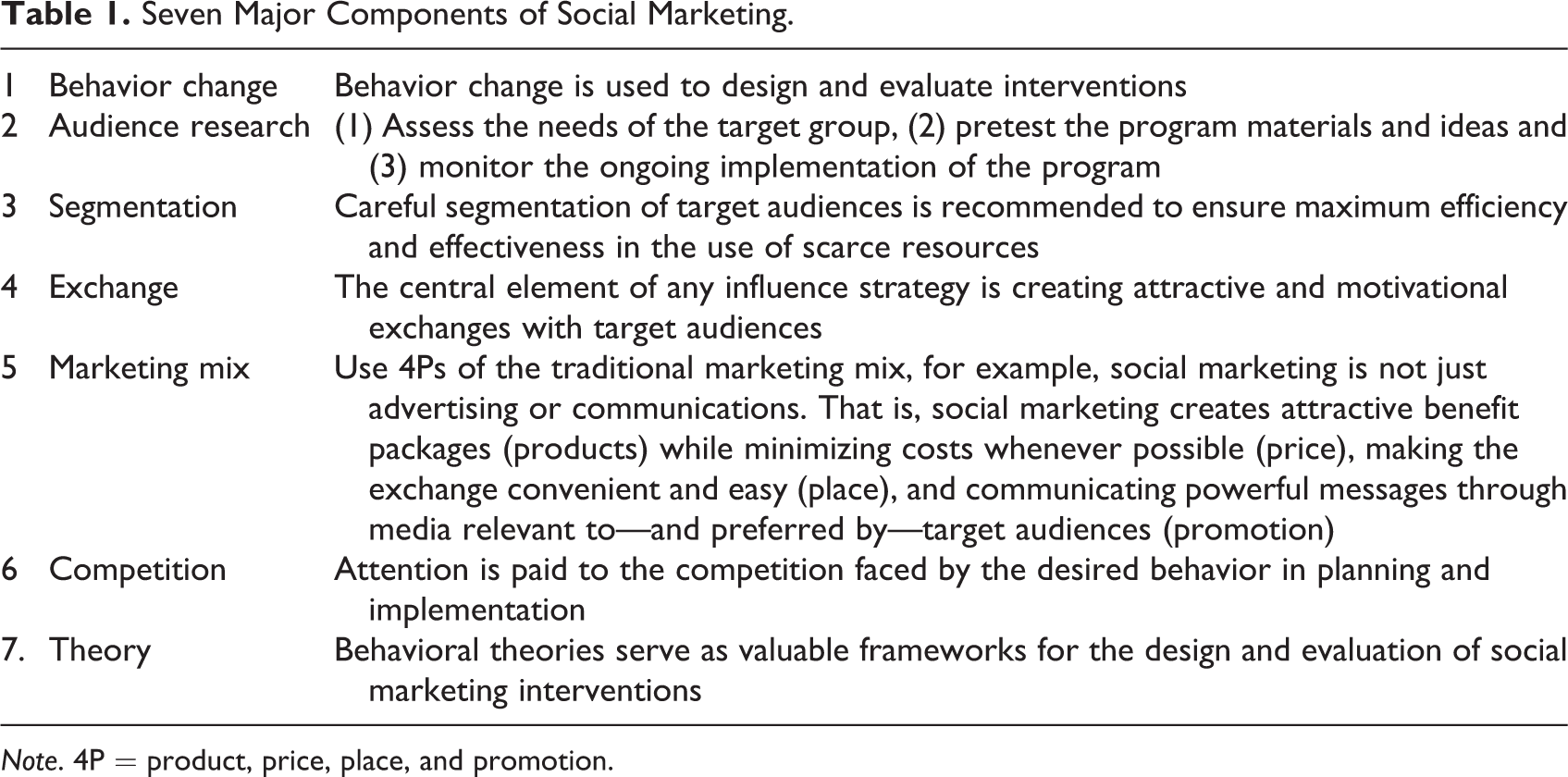
Note. 4P = product, price, place, and promotion.
Social Marketing Streams
Social marketing has three levels of influence—downstream, midstream, and upstream—and requires multiple stakeholders to work together across each of these levels to deliver a range of interventions (Brennan et al., 2016; Dibb, & Carrigan, 2013; Domegan et al., 2016; Hoek & Jones, 2011). Downstream social marketing programs typically focus on individuals directly (Wymer, 2011). Midstream social marketing efforts characteristically involve organizations and communities that play an important role in supporting desirable behaviors capturing social influences on the targeted individual (Andreasen, 2006; May, Previte, & Brennan, 2016). Upstream social marketing focuses on policy and regulatory change to achieve behavior change (Donovan & Henley, 2010), which may involve altering the built environment surrounding the individuals who are targeted for change. Domegan et al. (2016) and Brennan et al. (2016) argue that single domain social marketing, such as downstream, offers limited impact potential to effect behavior change given wider influences exerted on the individuals targeted for change (A. M. Kennedy, 2015). Thus, to achieve change a wider systems or ecological view (Brennan et al., 2016; Domegan et al., 2016), which considers the dynamic environments in which behavior occurs (Parkinson, Schuster, Russell-Bennett, & Rundle-Thiele, 2016) is posited to be beneficial. Therefore, the objectives of this systematic review are 2-fold. First, this article seeks to ascertain the extent to which tobacco cessation programs claiming to be using social marketing are actually doing so in terms of major components of social marketing. Few published social marketing studies have explicitly identified whether the focus of their effort was downstream, midstream, or upstream. Thus, a second objective of this review was to identify and classify interventions according to social marketing streams.
Method
Eligibility Criteria
The literature search aimed to identify self-claimed social marketing studies that empirically investigated the effect of different tobacco cessation programs on reducing tobacco consumption and was consistent with the procedures employed in Carins & Rundle-Thiele’s (2014), Kubacki, Rundle-Thiele, Pang, and Buyucek’s (2015), and Kubacki, Rundle-Thiele, Lahtinen, and Parkinson’s (2015) reviews. In order to be classified as social marketing, the study needed to explicitly mention the term social marketing to be included. The search included all studies published in the English language in peer-reviewed journals. Published studies were included as they were easily accessible and unpublished studies are difficult to locate. The time period for included studies was from 2002 (i.e., the year Andreasen’s framework was published) to January 2016.
Information Sources
The online search of bibliographic databases included the following databases: MEDLINE, CINHAL, PSYCINFO, Web of Science, Emerald, Business Source Complete, EconLit, Sociological Abstract, ERIC, IBSS, Proquest Central, Physical Education Index, SPORTDiscus, Inspec, ScienceDirect, and Taylor & Francis. The online search was concluded in January 2016.
Search
The search was carried out using the following key words and phrases: (smok* or cigarette or tobacco AND intervention* or randomized controlled trial or evaluation or trial or campaign* or program* or study or studies AND social marketing). In addition to the articles obtained from this online search, reference lists in included articles were searched to locate relevant articles.
Study Selection
The inclusion criteria focused on identifying empirical papers that investigated the effectiveness of social marketing campaigns targeting different groups to reduce tobacco consumption. Studies reporting different aspects of social phenomena other than tobacco cessation such as alcohol consumption, physical activities, and using condoms were excluded. In addition, reviews, conceptual- and method-focused papers, and papers studying tobacco cessation from a public health, social, or psychological standpoint were excluded.
Procedures
The online search was carried out. Search results with abstracts were transferred into endnotes, and duplicates were removed. Next, initial screening of the titles was conducted to exclude irrelevant articles, and the remaining papers were examined. Finally, the relevant articles and the articles they cited were reviewed. Accepted papers were classified according to intervention stream (see Table 2), and all interventions were evaluated with respect to seven major components of social marketing (see Table 1). The search process is clarified in Figure 1.
Testing Interventions (n = 14) Against Social Marketing Components.
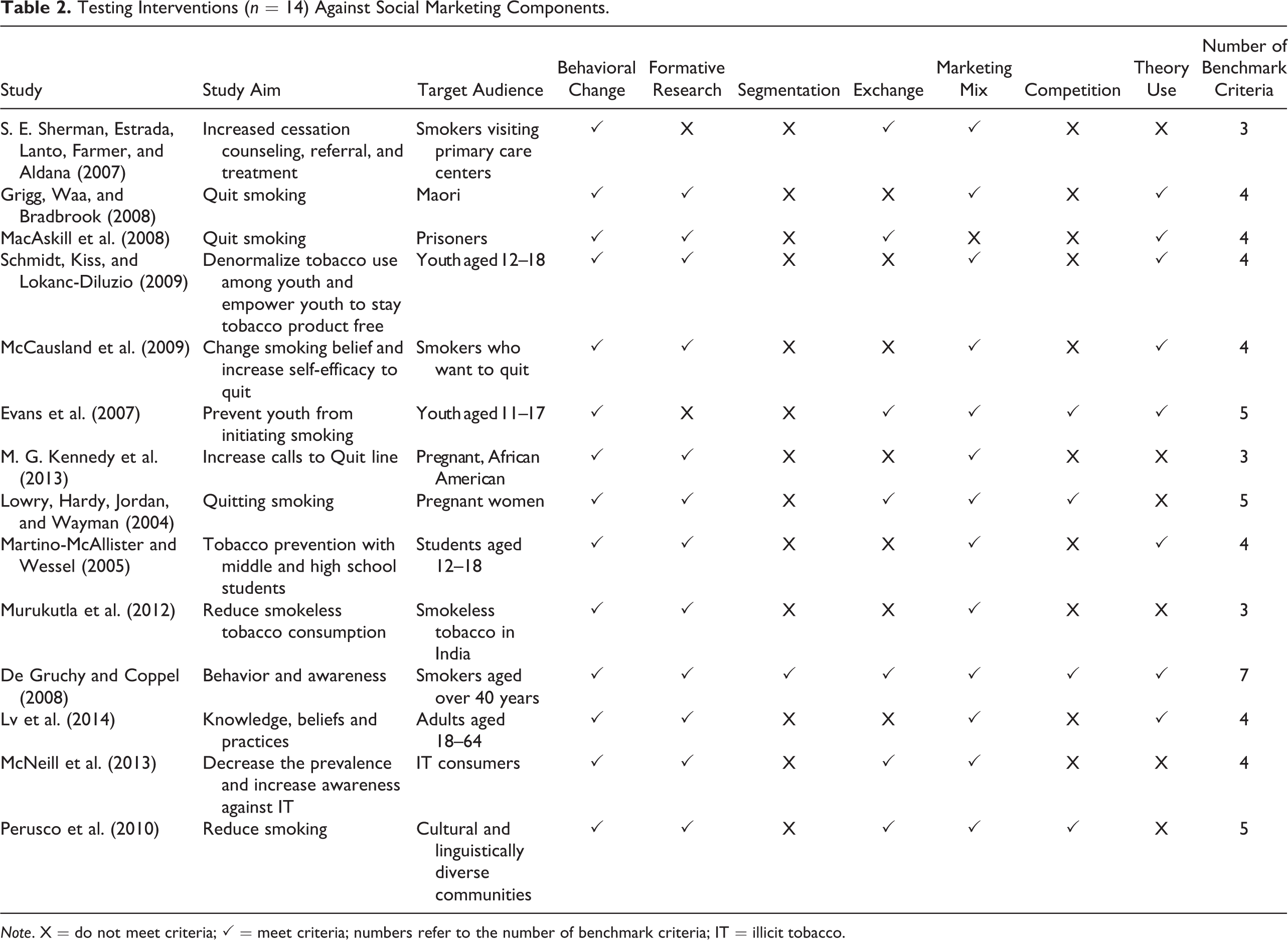
Note. X = do not meet criteria; ✓ = meet criteria; numbers refer to the number of benchmark criteria; IT = illicit tobacco.
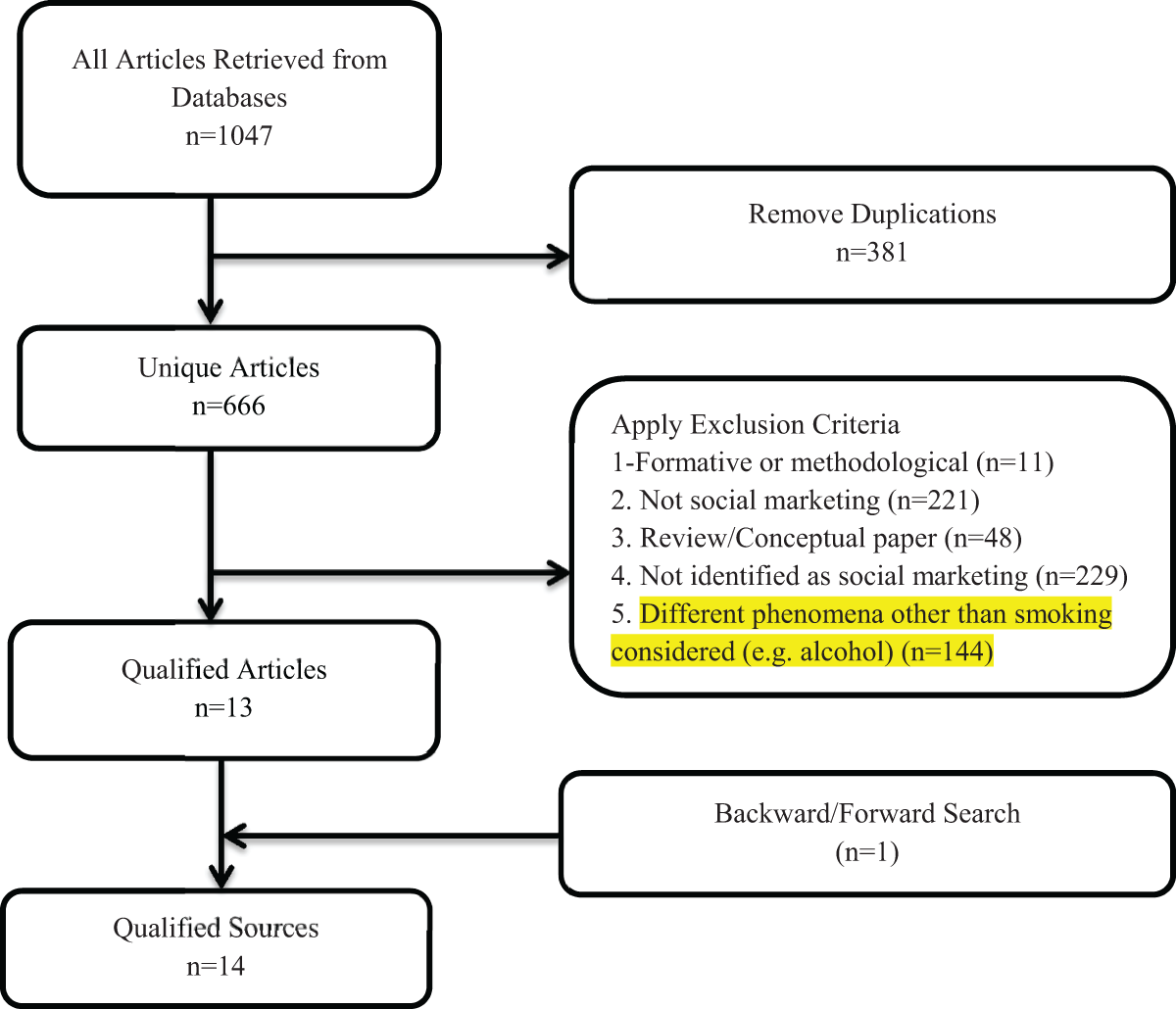
Systematic literature review flowchart.
Data Extraction
Two experienced social marketing researchers independently reviewed the titles and abstracts of the identified studies and determined if they met the inclusion criteria. Disagreements between reviewers were resolved by discussion and adjudication by a third senior social marketing researcher at each stage.
Results
A total of 1,047 articles were initially obtained from the search of 16 databases. The flowchart of included papers is outlined in Figure 1. A total of 14 studies were included in this review (see Figure 1).
Examination Against Seven Social Marketing Components
The actual interventions in these studies differed in content, target audience, follow-up periods, intensity, and settings. Table 2 shows the assessment of all studies against the seven major components of social marketing and the extent to which self-identified social marketing studies met the criteria. All studies (n = 14) reported behavior, awareness or intention change, and targeted a specific audience. The targeted audiences for these studies included adolescents, prisoners, pregnant women, adult smokers, and people belonging to culturally and linguistically diverse communities. Twelve studies conducted formative research and seven reported evidence of the concept of exchange. All studies produced interventions that used at least one marketing mix component and 13 studies reported using two or more marketing mix elements, 4 studies reported evidence of competition, and 3 studies reported evidence of the full marketing process of segmentation. On average, social marketing interventions seeking to influence smoking behavior used 4.2 of the seven major components of social marketing.
Behavior Change (Social Marketing Feature 1)
Behavior change is one of the distinguishing characteristics of social marketing (Andreasen, 2002; French & Blair-Stevens, 2006). The actual test of a social marketing intervention’s success is somewhat dependent upon the achievement of the desired behavioral change. Researchers and practitioners often aim to change intentions, attitudes, and awareness rather than the behavior targeted. Ten studies that measured smoking behavior change demonstrated a positive reduction in tobacco intake or a decrease in smoking initiation (De Gruchy & Coppel, 2008; Evans et al., 2007; Grigg, Waa, & Bradbrook, 2008; Lowry, Hardy, Jordan, & Wayman, 2004; Lv et al., 2014; MacAskill et al., 2008; Martino-McAllister & Wessel, 2005; McNeill et al., 2013; Murukutla et al., 2012; Perusco et al., 2010). Two papers considered behaviors related to the campaign aim, namely, measuring increases in tobacco cessation program referrals, counseling session attendance, and calls to Quit line and treatment sessions (M. G. Kennedy et al., 2013; S. E. Sherman, Estrada, Lanto, Farmer, & Aldana, 2007). The remaining studies focused on increasing awareness of antitobacco campaigns or changing smoking beliefs and increases in self-efficacy to quit (McCausland et al., 2009; Schmidt, Kiss, & Lokanc-Diluzio, 2009).
Audience Research (Social Marketing Feature 2)
Audience research enables the identification and understanding of target audience characteristics, interests, behaviors, and needs which influence their decisions and actions (Kelly et al., 2003). Audience research is integral in developing programs through provision of insights that can be used to improve existing programs (Stead et al., 2007). Eleven articles reported conducting audience research of which two studies conducted focus groups only (Lowry et al., 2004; Schmidt et al., 2009), four studies used a combination of focus groups and personal interviews (M. G. Kennedy et al., 2013; Martino-McAllister & Wessel, 2005; McCausland et al., 2009; Perusco et al., 2010), one study conducted interviews only (Grigg et al., 2008), and four studies pretested the intervention before implementation (De Gruchy & Coppel, 2008; Lv et al., 2014; MacAskill et al., 2008; Murukutla et al., 2012). McNeill et al. (2013) carried out two independent cross-sectional surveys at two points in time employing telephone number sampling and street interview. Two studies did not report use of audience research.
Segmentation (Social Marketing Feature 3)
Audience segmentation is a process in which a population is divided into different segments based on features that influence their responsiveness to marketing interventions (Bryant et al., 2001). Unlike traditional intervention strategies which focus on individuals with the greatest need, audience segmentation looks for the target of opportunity, or those most likely to adopt the behavior (G. Walsh, Hassan, Shiu, Andrews, & Hastings, 2010). Segmenting the audience by the attitudes or behaviors that are most relevant to the audience of interest is most appropriate rather than demographic characteristics (Maibach, Leiserowitz, Roser-Renouf, & Mertz, 2011). Therefore, segmenting the target population by identifying groups with similar smoking-related beliefs and behaviors and then designing interventions that best suit those segments is recommended. Only De Gruchy and Coppel (2008) segmented their target audience using the Stages of Change. Their primary target segments were in either the contemplation or preparation stages of change. Posters were developed for these two segments using people from the local area. Their secondary target segment was those in the action stage, and different information regarding a quit smoking support service was developed and provided for those in this segment.
Exchange (Social Marketing Feature 4)
The concept of exchange has been defined as the central element of social marketing, and it characterizes social marketing. In commercial marketing, exchange refers to a strategy proposed to attract and motivate the audience by offering “value” where perceived benefits exceed the perceived costs. Typically, price is involved in exchange in commercial marketing with a consumer incurring a financial cost to receive a good or service. In this study, exchange was classified when direct mention was made of what a consumer gives up to receive the social marketing offering (Lee & Kotler, 2011). Using exchange to motivate tobacco cessation was very limited with only seven studies reporting the use of motivation and/or direct inducements to change behavior. Three studies (MacAskill et al., 2008; Perusco et al., 2010; S. E. Sherman et al., 2007) offered nicotine supplements and nicotine replacement therapies, whereas Evans et al. (2007) referred to the benefits of a nonsmoking healthy lifestyle. Lowry, Hardy, Jordan, and Wayman (2004) offered community-based support. De Gruchy and Coppel (2008) considered “exchange” as financial savings, healthy life, and energy to spend time with children and grandchildren. McNeill et al. (2013) reported benefits from the exchange as improved health and safety for young smokers.
Employing a Marketing Mix (4Ps; Social Marketing Feature 5)
The marketing mix if viewed as the traditional commercial marketing 4Ps consists of product, price, place, and promotion. Product in a social marketing context refers to the behavioral offer made to the target audience (Parkinson et al., 2016). Product was found in nine studies, with the product element in five of these studies being a service including treatment sessions, phoning a hotline and/or crime stopper center using a Quit line or clinic service (De Gruchy & Coppel, 2008; Lowry et al., 2004; Lv et al., 2014; McNeill et al., 2013). Four studies (M. G. Kennedy et al., 2013; MacAskill et al., 2008; Perusco et al., 2010; S. E. Sherman et al., 2007) offered a physical tangible product, namely, nicotine supplements.
Price is the cost that the target audience will pay to adopt a targeted behavior (Lee & Kotler, 2011). Price can involve both monetary (direct) and nonmonetary costs (indirect). Nonmonetary costs can be temporal, psychological, emotional, cultural, practical, financial, or physical (Lee & Kotler, 2011). Price was found in eight studies, five considered price as financial savings and improvements in terms of healthy living (Evans et al., 2007; Grigg et al., 2008; MacAskill et al., 2008; Murukutla et al., 2012; Perusco et al., 2010) whereas two set price as maintaining baby’s health (M. G. Kennedy et al., 2013; Lowry et al., 2004) and McNeill et al. (2013) defined cost as avoiding risky behavior. Monetary pricing was absent in all 14 interventions.
The third element in the 4Ps, place, was identified in six papers. Place is where the target audience will perform the desired behavior, acquire any tangible goods, and receive any associated services (Kotler & Zaltman, 1971). Schmidt, Kiss, and Lokanc-Diluzio (2009) referred to the venues frequented by youth; MacAskill et al. (2008) applied their intervention at four prisons in England and Wales (Lowry et al., 2004; S. E. Sherman et al., 2007) identified place as a care center or clinic and Lv et al. (2014) mentioned four places: schools, workplace, community, and health centers.
Promotion refers to the persuasive communication efforts designed and delivered to inspire the target audience to action (Lee & Kotler, 2011). Promotion is used to highlight the desired behavior’s benefits, features, and to let the target audience know where (Lee & Kotler, 2011). Promotion was present in all studies included in this review and was demonstrated by different channels including TV, radio, posters, and warnings on cigarette packages.
Competition (Social Marketing Feature 6)
In social marketing, competition refers to other behaviors that compete with the desired behavior (Grier & Bryant, 2005). Competition enables social marketers to offer benefits which best distinguish desired behaviors from the competitors’ and develop a sustainable competitive advantage that maximizes their products’ attractiveness to consumers (Grier & Bryant, 2005). Evidence on the use of competition was lacking in the literature review, with only four studies addressing any form of competition. One study (Perusco et al., 2010) identified social interaction and acceptance by society as a barrier to quitting smoking and embarrassment to call a Quit line was also identified as a barrier (De Gruchy & Coppel, 2008; Lowry et al., 2004). Evans et al. (2007) revealed a cigarette brand when referring to competition for smoking behaviors. Finally, McNeill et al. (2013) stated competition as the extra money that needed to be paid to buy conventional tobacco.
Theory (Social Marketing Feature 7)
The use of theory in intervention design has long been argued to be important (Glanz & Bishop, 2010). Eight of the interventions included in this study were theoretically informed. A range of theories were used to inform the interventions including social norms (Martino-McAllister & Wessel, 2005; Schmidt et al., 2009), stages of change (De Gruchy & Coppel, 2008), socioecological model (Lv et al., 2014), theory of reasoned action (Grigg et al., 2008; McCausland et al., 2009), brand equity (Evans et al., 2007), and health belief model (MacAskill et al., 2008).
Targeted Streams
Tobacco cessation programs were categorized by their approach, namely, downstream, midstream, or upstream. The current study identified 11 papers that were downstream focused, one midstream focused, one upstream focused, while one intervention encompassed all three social marketing streams (see Table 3). Downstream interventions targeted individual smokers who are at risk of certain consequences related to their tobacco use. By targeting those individuals, interventions can bring direct benefits, including quit attempts or tobacco cessation. Four studies evaluated previous and current tobacco cessation campaigns targeting various groups of smokers in different regions using a variety of interventions, settings, and messages (Evans et al., 2007; Grigg et al., 2008; M. G. Kennedy et al., 2013; Murukutla et al., 2012). These articles found a positive influence on smoking with increases ind awareness of tobacco campaigns, intentions to quit, increases in knowledge about effects of smoking, and/or changes in actual smoking behavior reported.
Social Marketing Studies.

Note. CI = confidence interval; OR = odds ratio.
Studies also targeted different audiences, for example, Schmidt et al. (2009) designed a tobacco cessation campaign targeting adolescent smokers and reported an increase in the awareness of tobacco danger and empowerment for youth to stay tobacco free. MacAskill et al. (2008) developed a tobacco cessation campaign and implemented it in four UK prisons, and they reported a decrease in the number of smokers among prisoners. McCausland et al. (2009) developed EX, a social marketing campaign to prompt tobacco cessation finding that the campaign succeeded in increasing awareness on the harm of tobacco and lastly, De Gruchy and Coppel (2008) planned a campaign to change smoking behavior indicating a modest impact on smoking behavior. Two studies measured the influence of social marketing to attract smokers to seek quitting help. Lowry et al. (2004) encouraged pregnant African women to come forward for tobacco cessation support. Similarly, S. E. Sherman, Estrada, Lanto, Farmer, and Aldana (2007) established campaigns to increase tobacco cessation program referrals and increase attendance for counseling sessions. Martino-McAllister and Wessel (2005) tested a social norms approach for tobacco prevention with school and college students and demonstrated limited success in students identifying peer’s attitudes and behaviors regarding tobacco.
Upstream interventions seek to change professional, tobacco manufacturer, and policymaker behavior with a view to influence individual behavior by shaping the purchasing and consumption environment surrounding the individual targeted for change. In spite of the importance of upstream, this review found only one upstream-focused study (McNeill et al., 2013), using a novel partnership between health, marketing, and enforcement agencies in the north of England. This program led to a decrease in smoking prevalence and increased awareness of illicit tobacco (McNeill et al., 2013). Only one midstream social marketing study was evident. Perusco et al. (2010) developed a targeted intervention catering to culturally and linguistically diverse community needs positively influencing smokers’ behavior. Interestingly, one study (Lv et al., 2014) targeted all three streams together. This study employed a multilevel intervention that targeted individual, environment, and policy level with a setting that matched each segment, and the result was a significant decline in smoking practice. Table 2 outlines the classification of included studies based on their targeted stream and reports the type of intervention and outcome.
Discussion
The first objective of this article was to ascertain the extent to which tobacco cessation programs claiming to be using social marketing and targeting tobacco are actually doing so in terms of seven major components of social marketing. Previous reviews (e.g., Carins & Rundle-Thiele, 2014; Kubacki, Rundle-Thiele, Lahtinen, et al., 2015; Kubacki, Rundle-Thiele, Pang, et al., 2015;) have focused on six mutually exclusive social marketing components recommended by Andresean (2002). This article extends on previous social marketing reviews by examining social marketing tobacco cessation interventions, demonstrating on average 4.2 of 7 major components of social marketing are applied, which is higher than social marketing feature use in the Kubacki, Rundle-Thiele, Pang, et al. (2015) and Kubacki, Rundle-Thiele, Lahtinen, et al. (2015) reviews where use of 2.7 and 3.0 of 6 criteria were reported on average, respectively.
Use of segmentation, exchange, and competition was rarely reported. Too few social marketing interventions have developed differentiated, superior offerings that target customers would willingly pay for ensuring program sustainability. The lack of compelling exchange offerings that consumers would value is in contrast with claims of social marketing’s consumer myopia (Brennan et al. 2016). A failure to offer compelling alternatives that targeted consumers (e.g., smokers) value fails to create sustainable programs that can be delivered without government or other philanthropic funding support.
The role of theory in social marketing continues to be debated. Some scholars have called for theory to be considered as a key component of social marketing (French & Blair-Stevens, 2006). Social marketers apply theory to develop understanding of their target markets, to explain relationships between different factors that impact behavior, to narrow the focus of social marketing interventions, and to identify which questions to be asked (D. C. Walsh, Rudd, Moeykens, & Moloney, 1993). Over time reporting of theory use in social marketing remains limited (see Luca & Suggs, 2013; Truong, 2014). Limited theory use once again observed in this review.
The second objective of the current study was to identify and classify interventions based on social marketing stream. Despite calls for social marketers to move upstream (Wymer, 2011) an emphasis on the downstream was evident in interventions self-identifying as social marketing in the current review supporting Brennan et al.’s (2016) claim of consumer myopia in social marketing. Social marketing needs to extend practice beyond individual behavior change to ensure that targeted individuals are not stigmatized given our understanding of the influential role that the environment (social and built) exerts on individuals targeted for change.
Implications for Practice
Andreasen’s (2002) criteria are disputed and many other principles are offered (French & Blair-Stevens, 2005; iSMA, ESMA, & AASM, 2013; Robinson-Maynard et al., 2013). This study has provided an initial framework that includes seven major components of social marketing, all of which are mutually exclusive and can be classified, which is essential for building marketing theory Fern and Brown (1984). Only one study met all seven of the major components of social marketing, with the remaining studies ranging between two and five criteria. Recent evidence in a healthy eating context (see Carins & Rundle-Thiele, 2014) suggests that behavior change is more likely when more of the social marketing benchmark criteria are applied. Social marketers are encouraged to adopt more social marketing features.
Limitations and Future Research
This review included only studies which self-identified as social marketing interventions and was restricted to seven components of social marketing which could be classified. Inevitably, studies may have been missed or excluded as they did not self-identify as social marketing, even if the actual interventions presented in those studies had social marketing characteristics. Definitions and understandings of social marketing vary across authors and studies, therefore one may argue that studies included in this review may represent many different approaches to social marketing. Those are, however, philosophical debates which need to be explored in future research. The current review was restricted to studies that self-identified as social marketing programs and interventions or randomized-control trials and studies published in peer-reviewed journals in the English language which is limiting. For example, some excluded studies might meet some aspects of social marketing and may indeed be social marketing but have not self-identified as such. Other studies may offer evidence from evaluations that do not include randomization or did not refer to themselves as programs or interventions or use of control groups. All warrant consideration in future systematic literature reviews to extend our understanding beyond the narrow focus reported here.
In this study, seven major components of social marketing were identified in social marketing tobacco cessation interventions to extend our understanding of how social marketing has been applied previously. Further research could be undertaken to replicate the Carins and Rundle-Thiele (2014) study to understand whether behavior change is more likely when more of the seven features are applied. Additionally controlled field research designed is recommended to empirically examine whether the addition of components of social marketing increase behavioral change (see Rundle-Thiele, 2015), who outlines an agenda. While a meta-analysis would provide integrated results of the studies included, there was not consistent use of the same outcome measures (e.g., smoking) in the included studies. In the current study, different outcome measures were observed including beliefs, recall, and smoking behavior. The use of meta-analysis would permit an understanding of the factors leading to intervention effectiveness thus better informing future practice in social marketing. The current study was the first systematic literature review of social marketing interventions to classify streams. A research opportunity exists to consider whether mid or upstream efforts are (a) successful or effective, (b) have greater success or effectiveness, and (c) use fewer, the same, or more of the components when compared to downstream efforts which continue to dominate social marketing practice generally. This could be examined using methods outlined in Carins and Rundle-Thiele (2014). We recommend extending the sample to other issues to ensure insights gained are more generalizable to social marketing given the limited number of interventions self-identifying as social marketing in the current review.
Consideration of the full set of change interventions is recommended in future research to extend our understanding further. Additionally, a review of all behavior change efforts in the area of tobacco would extend our understanding of the extent that other behavior change disciplines have moved upstream. Finally, this study was restricted to 16 databases which may further limit the research base evaluated here. This systematic review revealed a lack of studies examining midstream and upstream social marketing, and this offers an opportunity for future research.
Footnotes
Declaration of Conflicting Interests
The author(s) declared no potential conflicts of interest with respect to the research, authorship, and/or publication of this article.
Funding
The author(s) received no financial support for the research, authorship, and/or publication of this article.