



Abstract
Social marketing, as an interdisciplinary approach, has been proved effective in improving individual and social life in multiple fields. One way to expand this growing field is to investigate and evaluate the current literature on principles and benchmark criteria of social marketing. Thus, the present study aims to evaluate social marketing interventions in the country of Iran with two main objectives: (a) examining the use of seven social marketing components used in interventions and (b) investigating the scope of intervention in three social marketing streams (i.e., downstream, midstream, upstream). Following standard review studies in this field, a primary search was conducted on 13 online databases (7 Persian and 6 English databases). Using relevant keywords, Persian and English articles published from 2002 to 2017 were extracted from national and international journals. A total of 497 records were obtained from the search, 5 of which met the criteria for entering this review study. Analyses of the findings indicated that most interventions in Iran lack the minimum social marketing criteria and merely focused on a downstream approach. By investigating social marketing interventions, this research extends understanding of the social marketing status in developing countries, specifically in Iran with a non-English language. While the findings provide empirical support for the previous framework of the seven benchmark criteria, it can be concluded that Iran is at an early stage in its development of using social marketing interventions. This study recommends the use of multiple methods for conducting formative research and considers midstream and upstream approaches.
Background
Over the past 50 years, social marketing has deeply influenced multiple fields such as consumption of alcohol, smoking, prevention of AIDS, and education (Kotler & Lee, 2009).This field primarily emerged in developing countries with the aim of addressing the complex barriers to achieving adequate public health (French et al., 2010) but faced challenges in both theoretical and applied fields. Theoretically, despite the attempts made by social marketing associations and centers and the numerous definitions presented, certain ambiguities still exist (Grier & Bryant, 2005; Lee & Kotler, 2015). Functionally, people claiming to use social marketing usually employ approaches which should, more accurately, be titled as other kinds of behavioral approaches such as social advertisements, education, or social media marketing.
Systematic literature reviews contribute to the necessary measurement of developments in a field of study and help identify methodological, theoretical, and topical trends (Truong, 2014; Williams & Plouffe, 2007). These literatures mostly focus on two issues: the effectiveness of social marketing interventions and the implementation rate of benchmark criteria in social marketing interventions.
Regarding the first issue, Alcalay and Bell (2001) evaluated the effectiveness of social marketing in dietary interventions and physical activity and concluded that although social marketing has been able to change certain behaviors, its overall effects are limited. In another study, Price (2001) investigated the impact of the programs designed to persuade the poor and vulnerable strata of society to use condoms. He understood that the designed programs had had flaws in overcoming social and regulatory limitations. Stead et al. (2006) also analyzed 54 studies with the aim of evaluating the effectiveness of different social marketing interventions and their impacts on behaviors. Although their reported results indicated that the interventions had been impactful, they underscored the problem of titling studies that lack the necessary criteria and accurate definitions of the approach as social marketing studies.
Regarding the second issue, that is the implementation rate of benchmark criteria in social marketing interventions, Carins and Rundle-Thiele (2014) analyzed 16 interventions to investigate Andreasen’s six criteria and the effectiveness of social marketing programs. Their results emphasized that the programs with more criteria were more impactful. Fujihira et al. (2015) evaluated the use of Andreasen’s six criteria in interventions focused on previous physical activities. They showed that none of the studies used six indicators completely. Four studies reported a positive impact, while segmentation and exchange were only used in three studies. Other systematic reviews have also been done on issues such as three streams (Almestahiri et al., 2017), stakeholder participation (Buyucek, Kubacki, Rundle-Thiele, & Pang, 2016) and segmentation in social marketing programs (Kubacki et al., 2017).
Review studies of social marketing interventions lack the main and distinct benchmark criteria and merely use one social marketing component (Kubacki et al., 2017). There is a lack of benchmark reviews of social marketing principles used in programs in developing countries in general (Smith, 2009) and in non-English languages in particular. This study was carried out to evaluate social marketing interventions in Iran with two main objectives: using seven social marketing components in these interventions and determining the scope of interventions in three social marketing streams. However, accomplishing the previous two goals helps clarify the status of social marketing in Iran.
Study Criteria
In this study, we sought to answer the following two questions: (1) How many of the seven social marketing components are used in social marketing interventions? (2) What is the focus of these interventions with regard to the three social marketing streams? A framework consisting of benchmark criteria and social marketing streams was employed to answer these questions.
Benchmark Criteria
Social marketing benchmark criteria offer a helpful guideline for specifying to what extent social marketing is employed within a change intervention (Andreasen, 2002), and what are the main factors determining the compliance of effective social marketing activities (French & Blair-Stevens, 2010). According to recent studies, using more social marketing components increases the likelihood of behavioral change (Carins & Rundle-Thiele, 2014).
Paying no attention to what distinguishes social marketing from other behavioral frameworks causes multiple problems related to titling the studies in this field as “social marketing.” Following the earlier work in the social marketing domain during the 1970s, academics in the 1980s and 1990s identified social marketing programs core elements as participant/consumer orientation (Andreasen, 1995; Craig Lefebvre & Flora, 1988), exchange (Leathar & Hastings, 1987; Lefebvre, 1997), and systematic planning approach (Andreasen, 1995). Later, Andreasen (2002) expanded these criteria and presented his own popular six components, including behavior change, exchange, segmentation and goal setting, audience research, marketing mix, and competition.
French and Blair-Stevens (2006) added the use of theory and perception of behavior stimuli to these six criteria. Research is still being conducted in this area, and the International Social Marketing Association, the European Social Marketing Association, and the Australian Association of Social Marketing’s proposals emanating from this work presented social marketing principles, concepts, and techniques hierarchy model (French & Russell-Bennett, 2015). The hierarchy model has only recently been proposed. Hence, there are only few studies associated with it.
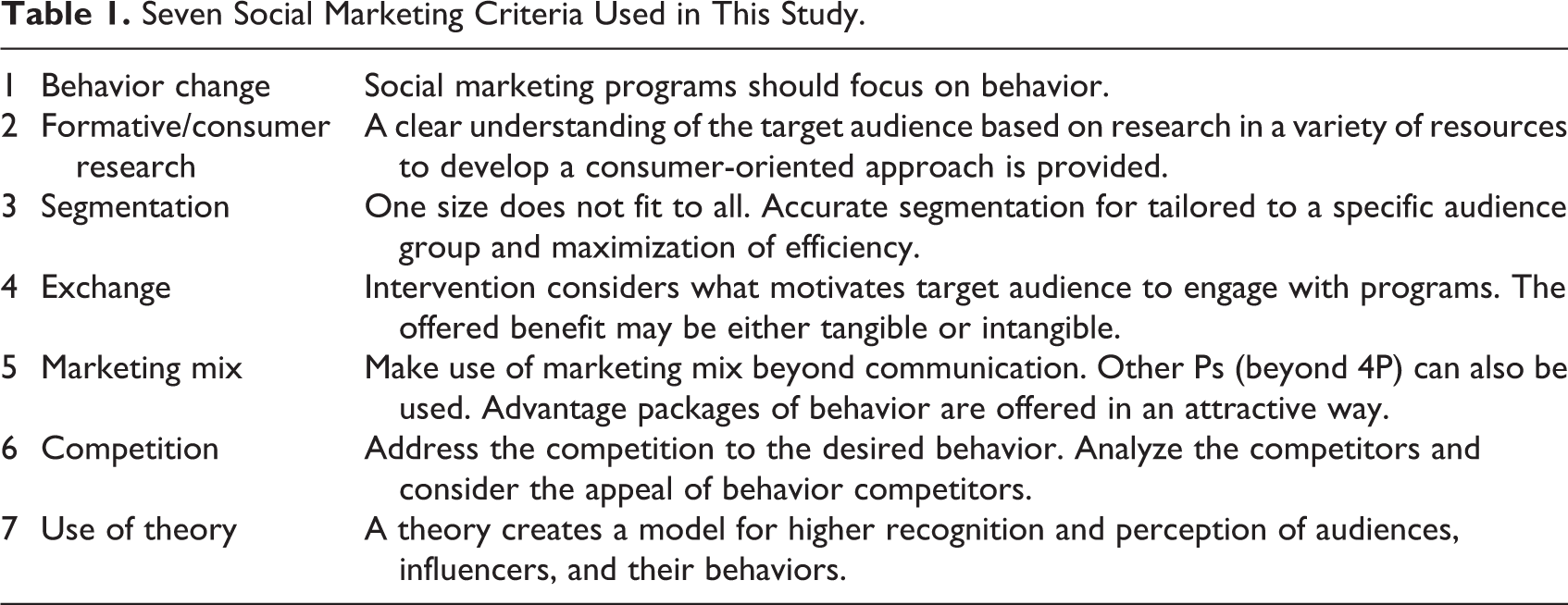
Although some researchers (e.g., see Stead et al., 2007) have emphasized Andreasen’s six criteria, in the present study, we use a framework that includes seven criteria provided by Almestahiri et al. (2017) that added “theory” to Andreasen’s six criteria. Theory as an important component of social marketing (Truong, 2014) and has been used as an additional benchmark criterion in multiple studies (e.g., see Almosa et al., 2017; Firestone et al., 2017; Luecking et al., 2017). This framework is shown in Table 1.
Seven Social Marketing Criteria Used in This Study.
Social Marketing Streams
By borrowing the up–down streams metaphor from public health (Donovan & Henley, 2010), and as a result of the critique of exclusive focus on individual behavior change (e.g., see Andreasen, 2006; Brennan et al., 2016), three levels of use and effectiveness are presented in social marketing: downstream, midstream, and upstream.
Downstream social marketing programs directly focus on consumers, forming a wide range of social marketing studies (Russell-Bennett et al., 2013). Midstream social marketing specifically includes organizations and groups with significant roles in supporting desirable behaviors and social impacts in the society, which mediates downstream and upstream approaches (French et al., 2017; Russell-Bennett et al., 2013).
Upstream social marketing also focuses on changes in policies and regulations concerning behavior change and may include structural changes in a society. To succeed in each of these levels, multiple stakeholders are required to implement interventions. To answer the second initial research question in this section, we specify to what extent social marketing programs in Iran cover these three approaches.
Method
Eligible Studies
With the aim of identifying eligible social marketing research, consistent with some current studies (Almestahiri et al., 2017; Carins & Rundle-Thiele, 2014; Kubacki, Rundle-Thiele, Pang, & Buyucek, 2015), only investigations that explicitly contain a “social marketing” keyword were studied. Moreover, to identify eligible interventions, those with a behavioral goal were studied, which one benchmark for differentiating social marketing studies from similar studies (Andreasen, 2006). Therefore, interventions lacking “behavior change” targeting were removed from the study. The present analysis includes works that are published by Iranian researchers in Persian and/or English from 2002 to the end of the first trimester of 2018.
Information Resources
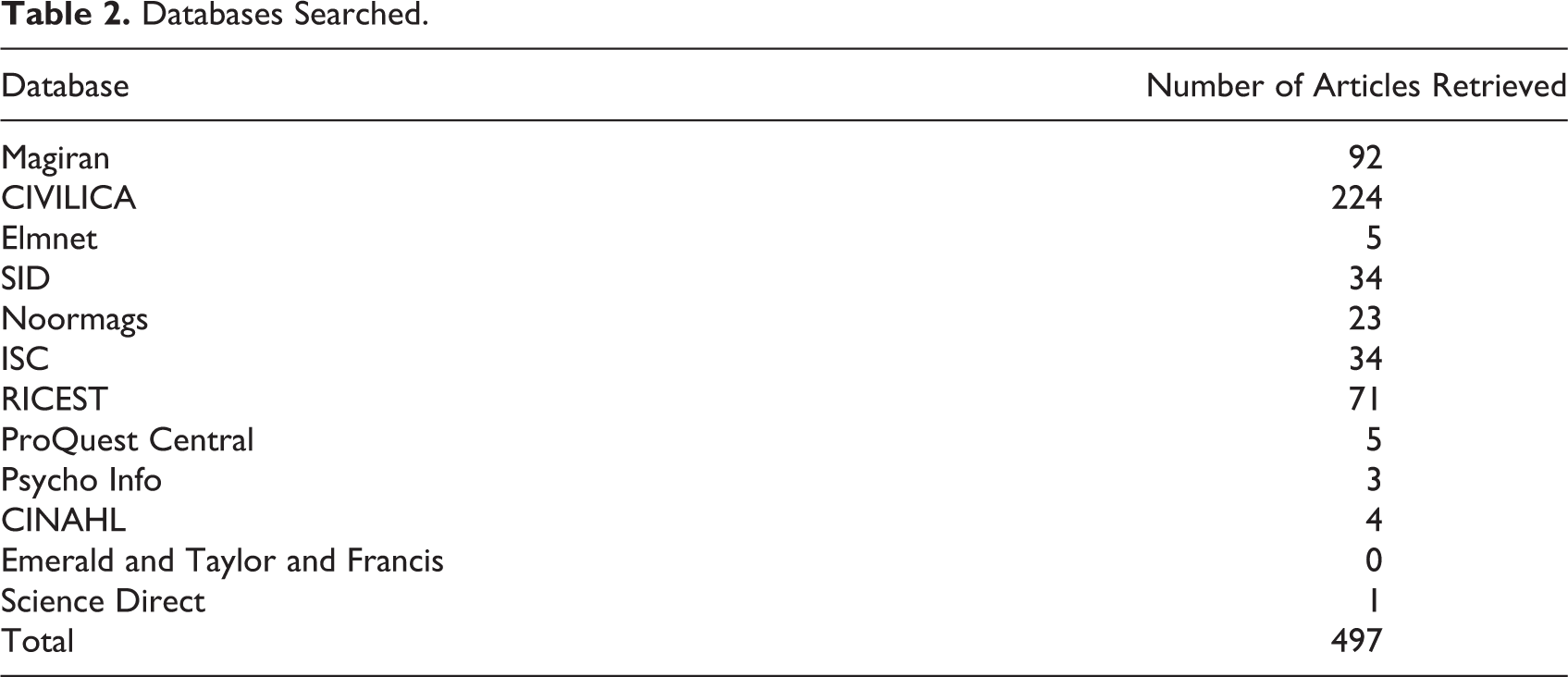
Due to the fact that these works were published in two different languages, the above-mentioned searches were conducted in both English and Persian. The following seven main online databases were searched for articles published in Persian: Information Bank of Iranian Journals (Magiran), Publisher of Iranian Journals and Conference Proceedings (CIVILICA), Persian Scientific Scholar (Elmnet), Scientific Information Database (SID), Noor Specialized Magazines Database (Noormags), Islamic World Science Citation (ISC), and Regional Information Center for Science and Technology (RICEST). For English, the following six online databases were used: ProQuest Central, Psycho Info, CINAHL, Emerald, ScienceDirect, and Taylor & Francis (Table 2). All searches were conducted on May 30, 2018.
Databases Searched.
Search Strategy
Due to the distantness of advanced search methods in different databases, the search in Persian language sources was done in the form of ab (semi-experimental study OR randomized controlled trial OR campaign OR program OR study) AND social marketing. In some cases, these keywords were searched separately, and the results were recorded. The search in English language databases was done in the form of ab (intervention OR randomized controlled trial OR evaluation OR campaign OR program OR study OR studies) AND ab (social marketing) AND loc (Iran). The search procedure is presented in Figure 1.
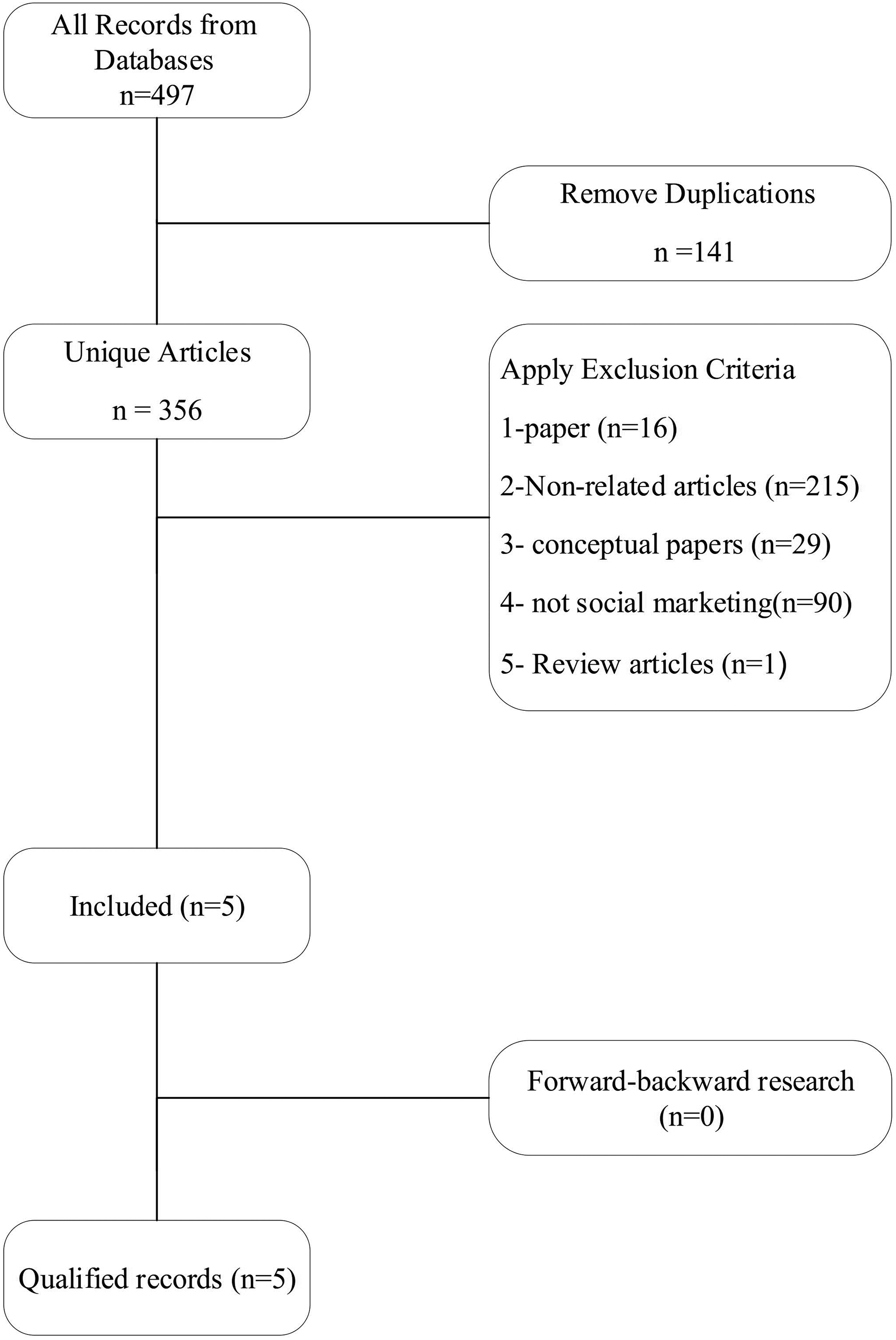
Systematic review flowchart.
Analysis Method
The results obtained from searching online databases were transformed into Endnote®, and duplicate and non-related studies (i.e., newspapers, conceptual papers, and magazines) were removed. Afterward, the remaining papers and their abstracts were transferred into Microsoft Office Word software and analyzed by a social marketing consultant (due to the incompatibility of EndNote with the Persian language). Some were identified as similar studies, such as social media marketing, green marketing, social advertising, socially responsible marketing, and so on, mistakenly referred to as social marketing. They were, thus, removed.
The ultimate goal of social marketing should be to change people’s behavior, not just to inform them of, or educate them on social problems (Donovan & Henley, 2010). Therefore, a prerequisite of being marked as a social marketing study was the focus on “behavior change.” Studies lacking this characteristic were excluded. For instance, Soltani and Mehranfar (2016) measured the impact of social marketing mix on adolescent intent with regard to preventing substance use. In another study, Kazemi and Nezhad Shokouhi (2014) showed that only the attitude toward behavior of green purchasing underwent changes.
Hodhodinezhad et al. (2016) also tried to determine the effect of social marketing techniques on the knowledge and attitude of students and faculty members of Isfahan University of Medical Sciences to the Medical Librarianship Services. They claimed the average knowledge and attitude of the target population increased significantly following social marketing intervention. Eventually, five studies were selected based on the seven benchmark criteria and three social marketing streams.
Information Extraction
Primarily, titles and abstracts of the papers were analyzed so as to determine their eligibility for entering the study. In the next phase, each study was evaluated with respect to its social marketing criteria and the type of social marketing stream.
Results
A total of 497 records were obtained from the search. After the removal of duplicates and the application of exclusion criteria, a total of five empirical studies remained. These five papers were analyzed to determine their social marketing components and streams focus. The specified interventions were different regarding their contents, target communities, duration, and degree of success. In the following parts, the status of each criterion in these studies is explained.
Behavior Change: Behavior change, as the frontline of this framework, is the distinctive feature of social marketing compared with similar approaches such as communication and education campaigns (Andreasen, 2002). In the five analyzed studies, four studies reported real changes and one reported only significant changes (Shams et al., 2016). The range of improved behaviors includes wearing a seat belt and driving between the lines (Majdzadeh et al., 2011), reduced consumption of fast foods (Fatehi Panah et al., 2015), increased mammography (Shams et al., 2014), and using helmets and masks (Shams & Shamsi, 2013).
Formative/Audience Research: All frameworks in the literature that introduce guidelines on the use of social marketing in practice refer to the importance of audience research in this field (Carins et al., 2016; Domegan & Hastings, 2017b; Kubacki & Rundle-Thiele, 2017). According to Andreasen (2002), formative research is highly conducive in the success of social marketing programs, by facilitating the behavior perception of consumers and environmental influencers.
The domain of methods utilized in formative research is currently expanding to include not only survey and focused group but also mixed-method due to the ecological and multilevel viewpoint of social marketing toward behaviors (Brennan et al., 2016). This is consistent with the results of this study. Current studies are geared toward survey and focused groups. All the five selected papers in this study were conducted using a survey. Three studies reported the use of focused groups (Majdzadeh et al., 2011; Shams et al., 2014; Shams & Shamsi, 2013), one reported the use of an in-depth interview (Shams et al., 2016), and the last one reported the use of qualitative observations (Majdzadeh et al., 2011).
Segmentation: Segmentation is a known concept in commercial marketing which refers to the division of consumers into homogenous units with common traits with the aim of providing for their needs most optimally. Segmentation seeks to create accurate, correct, strong, and significant perception from the subsets of a society (French, 2017). The purpose of segmentation in social marketing is to design interventions tailored to each sector of the target community with more influence on behaviors. Following calls for empirical research to advance theory and practice (Dibb & Carrigan, 2011), multiple methods have been introduced in this area (e.g., see Dietrich, 2017).
Social marketing programs have often used rudimentary strategies to segment the target audiences (Newton et al., 2013). In this study, two of the selected interventions merely reported did apply partial segmentation in their studies. In one study (Shams et al., 2016), the authors used rudimentary segmentation and considered primigravidae who were 3–4 months pregnant as the target segment. In another study (Majdzadeh et al., 2011), the segmentation was carried out according to the following criteria: group size, driving time throughout the day, availability, and their potential impact on Tehran’s driving accidents. Based on the report issued by the local traffic police, the largest number of accidents occurred in Lanes 4 and 6, and the final segment of the intervention included 280 people for each intervention and control group for the two named lanes.
Exchange: This core concept differentiates between commercial marketing and education (Takahashi, 2009). With regard to behavior change and social marketing, exchange occurs when the person receives something in return for accepting the proposed behavior in the intervention (Stead et al., 2007). If the suggestion was of no value to the individual, there will be no possibility for success. In the current review, only two studies were found to consider the concept of exchange implicitly. In their study, Majdzadeh et al. (2011) regarded being known as a “model driver” as an exchange. Another study (Shams & Shamsi, 2013) regarded being free, more comfortable and convenient as the benefits of an exchange.
Social Marketing Mix: This concept is used in social marketing to facilitate changes based on traditional 4Ps (product, price, place, and promotion) in commercial marketing. Despite the widespread criticism pointed at this framework (French & Gordon, 2015; Gordon, 2012; Peattie & Peattie, 2003; Tapp & Spotswood, 2013), it is still widely used in social marketing interventions as a dominant stream in the space of social marketing mix. Consistent with previous literature reviews (e.g., see Carins & Rundle-Thiele, 2014), if evidence of at least two of the 4Ps is reported in an intervention, it is classified as using a marketing mix. All, except for one, of the extracted studies reported the use of social marketing mix (Fatehi Panah et al., 2015).
For example, Shams and Shamsi (2013) aimed to increase the use of safety tools and safety equipment (product) in the workplace and reduce the costs of this measure by providing the tools and equipment in a lower cost (price(, more comfortable and convenient way compared with the previous equipment provided by the employer. To promote the intervention among employees, they used a sticker on all products, containing a memorable message “For my family, I take care of myself” (promotion).
In another study, Shams et al. (2014) performed a mammogram (product), providing a transportation vehicle from a village to a hospital (place) in the city; they considered a guide during the mammography, posted the test results to the referrals’ homes (price), and conducted face-to-face counseling by the village health community, as well as informative pamphlets that described mammography (promotion) as a social marketing mix. In another study (Shams et al., 2016), the social marketing mix included training courses (product/service) organized by doctors and midwives (distribution channels) in health centers (places), and programs promoted through free telephone counseling (promotion).
Competition: Competition refers to all behaviors/products or services that target audiences prefer compared to the desired behavior, as well as organizations and individuals who try to counter the behavior we intend to promote (Lee & Kotler, 2015). Commercial marketing is a part of the social context and one of the main competitors of social marketing (e.g., the fast food industry). This theme, as the dark side of marketing, forms the core body of critical marketing dialogue (Domegan & Hastings, 2017a).
Although competition is an important benchmark criterion (French & Gordon, 2015; Hastings, 2003; Rundle-Thiele, 2015) and underpins one of the four defining orientations of social marketing (Hastings & Domegan, 2017), systematic reviews indicate that competition in social marketing has not been studied extensively and thoroughly (Almestahiri et al., 2017; Kubacki, Rundle-Thiele, Pang, & Buyucek, 2015). McDermott et al. (2005) emphasize the increased awareness and perception of competition for the minimization or removal of its impacts on social marketing programs. In the five studies mentioned above, there were two interventions that reported competitive behaviors. In one study (Shams et al., 2016), Cesarean has been reported as a competitive behavior due to less stress, worry, and anxiety. Another study (Majdzadeh et al., 2011) reported “audience belief in the use of coercion instead of social marketing” as a competitive element.
Theory: In scientific language, theory refers to a structured system of concepts that can explain a set of evidence and can be used in the prediction of future evidence (Brennan et al., 2014). In social marketing, theories are used to create a model for a higher recognition and perception of audiences, influencers, and their behaviors in the context of social change (Brennan et al., 2014). This concept is introduced as a benchmark criterion in National Social Marketing Center (French & Blair-Stevens, 2006).
The importance of theory in social marketing interventions is high, hence its consideration as the starting point for any social marketing activity. Recently, the most comprehensive classification of behavior change theories used in social marketing has been presented by Brennan, et al. (2014). In our evaluation, one of the studies used a trans-theoretical model (Majdzadeh et al., 2011), another employed the theory of planned behavior (Shams et al., 2016), and one made use of the health belief model (Shams et al., 2014). The other two reported no theories (Fatehi Panah et al., 2015; Shams et al., 2014).
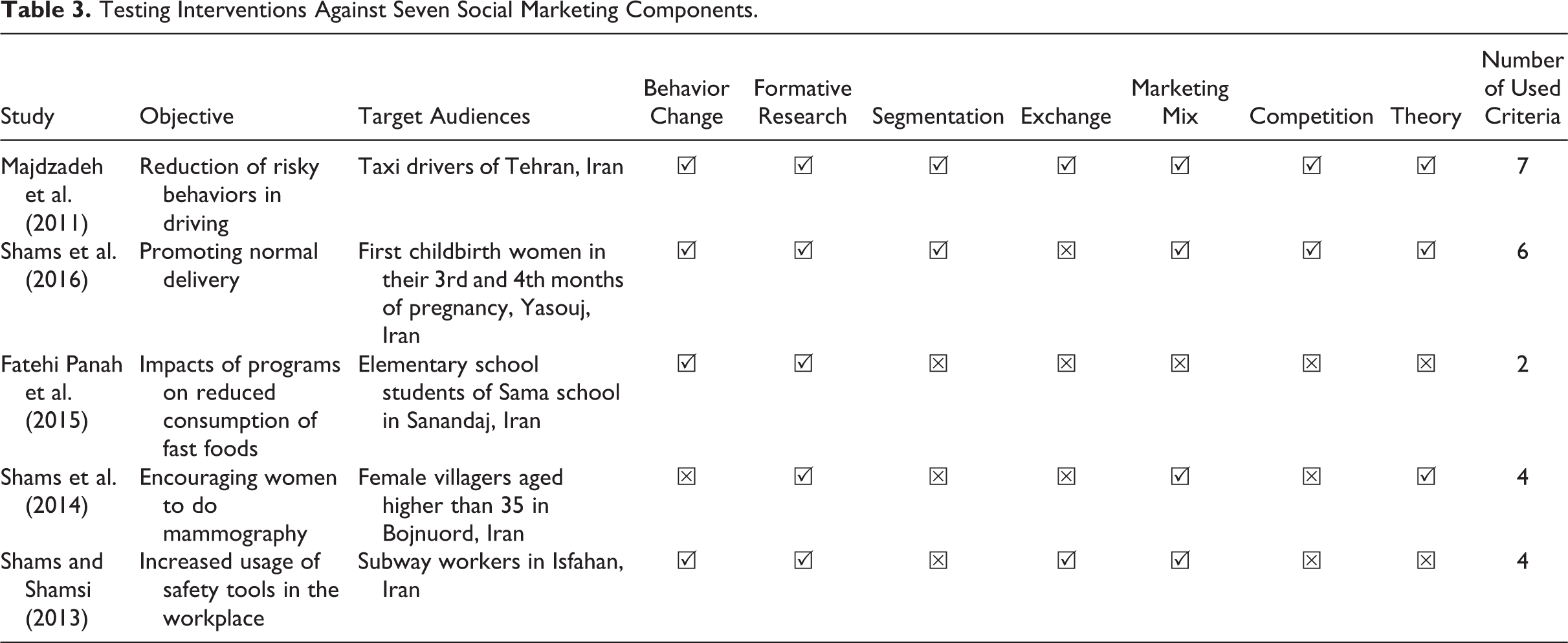
Table 3 shows the evaluation of these studies based on their use of social marketing criteria. All five studies reported behavior change, intention, and awareness. Audiences of the interventions include taxi drivers, elementary school students, workers of subway stations, pregnant women, and female villagers.
Testing Interventions Against Seven Social Marketing Components.
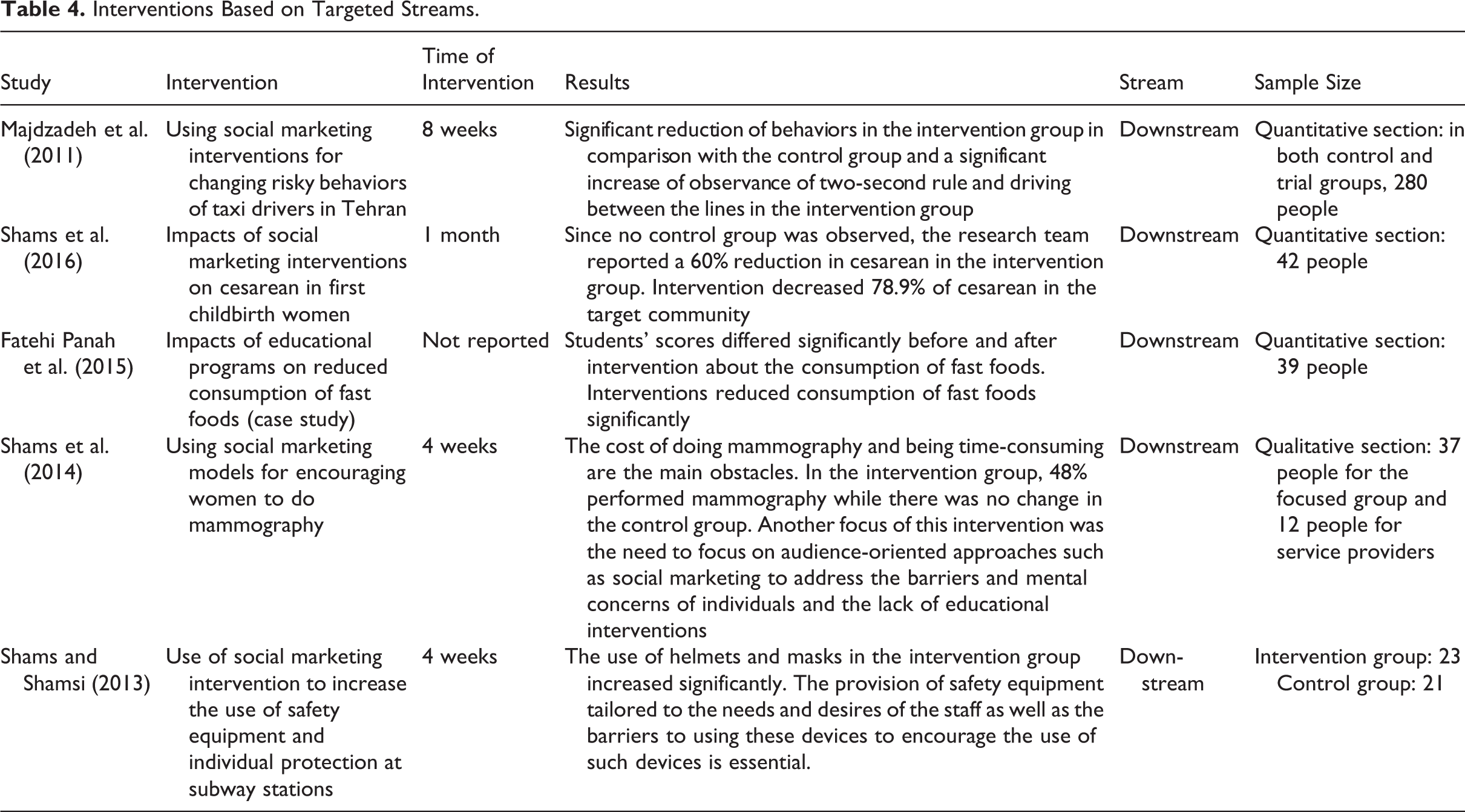
Targeted Streams: Despite the formulation of three social marketing streams at the beginning of the fifth decade of the genesis of social marketing (Russell-Bennett et al., 2013), few studies have evaluated interventions based on these three streams (Almestahiri et al., 2017). All five identified studies used downstream social marketing. One of the studies (Majdzadeh et al., 2011) reported improved behaviors of the two-second rule, wearing a seat belt, and the increased possibility of avoiding risky behaviors. The second study reported mothers’ inclination to have a cesarean section in order to give birth to their first child (Shams et al., 2016), the third study reported reduced consumption of fast foods among the youth (Fatehi Panah et al., 2015), and the remaining two studies revealed the inclination of women toward mammography (Shams et al., 2014) and increased use of safety tools among workers of subway stations (Shams & Shamsi, 2013). The analyses of these studies reveal the positive impacts of intervention programs on the attitudes, awareness, and behavior of the studied populations. The studied areas were schools, public transportation, and health centers, and young men and women (see Table 4).
Interventions Based on Targeted Streams.
Discussion and Conclusion
This study was conducted to clarify the status of social marketing interventions in Iran through assessing the use of social marketing components with a focus on interventions. The average number of criteria used for this purpose was found to be 4.6 of 7, which is higher than most other studies (Kubacki, Rundle-Thiele, Lahtinen, & Parkinson, 2015; Kubacki, Rundle-Thiele, Pang, & Buyucek, 2015). However, according to some scholars (e.g., see McDermott et al., 2005), at least six criteria are necessary for a study to be considered as social marketing. Therefore, since only two interventions made use of all six benchmark criteria, it can be concluded that Iran is at an early stage in its development of using social marketing interventions and now is a prime time to learn from what other leading countries have done in this area. Applying seven social marketing benchmark criteria offers additional insight to researchers and practitioners for planning campaigns to increase and sustain behavior change in their interventions.
Based on the second objective, despite the call for social marketers to focus beyond the narrower confines of individual behavior (Wallack et al., 1993) and move upstream (Andreasen, 2006; Wymer, 2011), interventions evidently focused on the downstream in the current review, which is consistent with more traditional definitions of social marketing.
Analysis of Persian research since 2002 indicates a shortage of scientific resources in this area and a lack of consensus among Iranian experts as to title social marketing studies as such. This resulted in the exclusion of many research from the current systematic review along with the following reasons: Firstly, as in most other countries (Truong, 2014), social marketing in Iran has become widespread in mostly public health, which is what Tapp and Spotswood (2013) refer to as part-time marketers, meaning that the scholars have mostly entered this field from areas other than marketing. In the present literature, 11 of the 15 (73%) authors had expertise in public health, and only 1 researcher (less than 1%) specialized in the field of marketing. Surprisingly, in three of the five studies (60%), the same person was identified as a corresponding author.
As a second reason, based on our search in the National Library and Archives of I.R. Iran, only four books on social marketing have been translated into Persian so far, which is a sign of the undesirable social marketing situation in Iran. Thirdly, developing countries represent a unique context for social marketing. The lack of basic education, the brain drain of trained professionals, and the political instability further compound the problems (French et al., 2010). The fourth reason is the political challenges existing between Iran and the West, rendering it difficult to cooperate with successful institutions in this field (such as United States Agency for International Development(USAID)) and domestic-related organizations. The findings provide empirical support for the previous framework of a seven benchmark criteria. We also extended to literature by analysis of Iranian studies, which is conducive to increasing the publicity and development of social marketing.
Limitations and Further Research
This systematic review was faced with certain limitations. Firstly, this research merely reviewed English and Persian papers published in scientific periodicals. Therefore, books, theses, and governmental reports were not included. The second limitation was the lack of a defined standard in the searching engines of online Persian databases, which undermines an accurate identification of related studies. Despite the advanced search in online English and Persian databases, some studies may be neglected.
Another limitation is that certain studies may not use this term in their study title, in spite of the use of social marketing in practice, a point which is also ignored in this literature review. A significant limitation of this study is the few interventions that were identified and reviewed, a problem that is mentioned as a result of some situations in the previous section. We can consider this study as a starting point for the development of social marketing in Iran.
In general, it is suggested that future research analyzes foreign studies, which are published in languages other than English, specifically in developing countries, based on the recommendation of Almosa et al. (2017). Regarding social marketers in Iran, since the current study identified narrow methodological focus in audiences research with the dominant use of surveys and focus groups, and based on certain scholars (e.g., see Kubacki, Rundle-Thiele, Pang, & Buyucek, 2015; Lincoln & Lincoln, 2005), we further recommend the application of multiple research methods to provide an in-depth understanding of the target audience. The next recommendation is to analyze interventions that, despite the use of social marketing, do not use the term in their title and were missed in this study. More books and resources in Persian are to be translated as to remedy the weakness mentioned in the Discussion section. Furthermore, there have been calls for Iranian social marketers to consider what can be done to modify environmental or social influences, commonly termed “moving midstream and upstream.” Finally recommended is the use of other systematic review techniques for a better analysis of social marketing interventions, such as meta-analysis and narrative systematic review (Domegan & Hastings, 2017b).
Footnotes
Declaration of Conflicting Interests
The author(s) declared no potential conflicts of interest with respect to the research, authorship, and/or publication of this article.
Funding
The author(s) received no financial support for the research, authorship, and/or publication of this article.
