



Abstract
Background:
The present paper focuses on compulsive buying, outlining the need to tackle this phenomenon using a social marketing approach, for the wellbeing of the affected individuals, their families and contacts, and for the health of our society at large.
Focus of the Article:
This conceptual development article is centered on behavior change and social marketing strategies that can address compulsive buying.
Research Questions:
How can social marketers help in curbing compulsive buying? What conceptual components and practical guidelines can be used in marketing programs for addressing compulsive shopping?
Program Design/Approach:
The platform developed herein outlines segmentation, targeting, product, price, place and promotional strategies recommended based on theoretical elements across disciplines.
Importance to the Social Marketing Field:
To date, compulsive buying has largely been ignored in the social marketing field, despite its relevance and prevalence. This paper provides a framework that can be employed in developing social marketing programs.
Method:
The proposed platform was created by bridging the literatures on compulsive buying and social marketing, identifying useful theoretical elements (e.g., the potential of the Thranstheoretical model), adapting and customizing these elements to provide actionable insights for intervention programs. The toolkit used for tackling other addictions was taken into account and integrated into the current development.
Future Research:
This paper offers an initial framework for social marketing efforts aimed at compulsive buying. It hopes to inspire significantly more work in this area to explore the potential of other theories and approaches to foster behavioral change for the better.
Certain addictive behaviors such as alcohol consumption, excessive gambling or substance abuse are being tackled by social marketing (e.g., Suragh et al., 2013) and can also be constrained through legislative and enforcement measures. However, other issues that create problems for individual and societal welfare such as compulsive buying are more insidious and cannot really be regulated through legislation or policy. Consequently, compulsive buying is in dire need of social marketing attention. Social marketing may be one of the few avenues (if not the only) to effectively and broadly confront this problem, a problem with serious consequences for the affected people, their families and social networks, as well as society at large.
The terms “compulsive buying,” “compulsive shopping,” or “pathological buying” have been used interchangeably to refer to this class of behaviors (Maraz et al., 2016), and the colloquial term “shopaholics” is often employed in public media to designate compulsive buyers (Solomon et al., 2017). Compulsive buying behavior is characterized by a chronic lack of restriction for repeated and excessive purchasing of items, a maladaptive preoccupation with shopping, the generation of significant distress by the buying preoccupations which interfere with social, marital or workplace functioning, and result in severe financial problems (e.g., Maraz et al., 2016).
In order to tackle compulsive buying, this paper adapts the social marketing (SM) toolkit used for other addictions and customizes it, by bridging theoretical elements from various streams of literature (e.g. psychology, sociology, financial management and general business, psychopathology and health sciences). It is surprising that to date the world of social marketing has largely ignored compulsive buying, despite the relevance and prevalence of this phenomenon.
Compulsive buying is estimated to affect between 6% and 7% of the U.S. population (Müller et al., 2015), and between 5% and 10% of people in West-European countries such as U.K and Germany (Neuner et al., 2005). Some countries do not necessarily report prevalence rates, but research studies conducted in Pakistan (Islam et al., 2017), Israel (Shoham & Makovec Brenčič, 2003), China (Li et al., 2009), South Korea (Park & Burns, 2005), Canada (Hassay & Smith, 1996), Greece (Grougiou et al., 2015), Italy (Villella et al., 2011), Austria and Denmark (Raab et al., 2012) clearly emphasize that the compulsive buying disorder is widespread across cultures. Importantly, when defined in a milder and less clinical sense as problem-buying, and bundled with impulsive buying in the general class of uncontrolled buying of unneeded objects, it is estimated that compulsive buying affects more than 50 million citizens in the USA alone (Islam et al., 2017).
Conceptual Background and Development
To understand how the social marketing approach could be used to address compulsive buying, first the four Ps of the social marketing mix (Product, Price, Place and Promotion) will be defined and developed in this specific context. Then, the process of applying the social marketing mix customized for the different target segments will be illustrated, relying on behavioral change theory and on practical guidelines from research dealing with addictions.
The Social Marketing Mix for Compulsive Buying Interventions
“Product”
The product in social marketing includes “core,” “actual,” and “augmented” elements; as Wood (2008) indicates, the “core” product comprises the benefits of the behavioral change, which represents the “actual product” or “social proposition.” In our context, the core product benefit is a life free from compulsive buying, which can be attained through the actual product (recommendation) of learning about compulsive shopping and adopting positive behaviors related to personal purchases.
To assist in the process of behavior change, the augmented product can include books or online/offline materials with information on compulsive buying, self-assessment tools, budgeting tools, phone numbers to reach help lines or therapists in the area, companion shopping services, and even rehab centers.
“Price”
When taken to the extreme, shopping can be a harmful and destructive activity with grim outcomes that are often underestimated (e.g., Maraz et al., 2016). Among the negative consequences for the compulsive buyer are large financial debts, the inability to meet necessary payments, harsh criticism from acquaintances and the immediate social network, divorces and failed relationships, legal and/or criminal problems related to procuring funds to sustain the buying addiction, as well as an overwhelming sense of guilt and unease. Compulsive buyers are ashamed of their spending behavior, and the associated lying and interpersonal conflicts (Müller et al., 2015), which can result in suicides or deaths.
Given these negative consequences, it is important to understand the allure of compulsive buying. Marketing research has long indicated that consumers are trying to make rational purchasing decisions and optimally deploy their resources in line with normative economic theory, but they do not always succeed due to a variety of personal limitations and context effects (e.g., Swait, Popa & Wang, 2016). Why would shoppers buy compulsively? A number of reasons can be identified in the existing literature. For instance, buying provides psychological comfort (Rick et al., 2014). Often compulsive buyers are confronting negative events that they cannot control in their life; shopping offers them a sense of control, as they can solely dictate and make decisions regarding what items to purchase or where to do their shopping. Furthermore, the act of buying offers them an emotional boost, as they experience positive feelings when purchasing items and they perceive shopping to be exciting (e.g., Ridgeway et al., 2008). These positive emotions can also be related to perceptual stimuli in the retail environment. The sounds, the lights, the smells, the colors, the whole sensory experience of the shopping atmosphere is attractive to many compulsive buyers, who are trying to re-create that experience as frequently as possible (Workman & Paper, 2010). Moreover, buying offers a boost to their self-esteem, as compulsive buyers believe that they gain the attention and approval of retail employees or other shoppers from the store when purchasing items (e.g., Biolcati, 2017). For all these reasons compulsive buyers prefer to continue their behavior rather than trying to embrace healthy shopping habits. Understanding the lure of buying means understanding the perceived costs required for switching to healthy shopping habits once problem-behavior has set in or, in the case of individuals on the path to positive change, the costs of keeping healthy shopping habits. The costs of behavioral changes for the better represent the “
The price identified so far is largely a psychological price for the individual. Other costs could include the time, effort and financial price required to start or to continue the personal path toward responsible buying. For instance, a clinical compulsive buyer might not find time to schedule therapy sessions or might consider the monetary costs of undergoing treatment.
“Place”
In commercial marketing, “place” designates the distribution channels responsible for where and how consumers can get the product or service. This is still true in the case of the augmented product for compulsive buying programs. However, in the case of the core and actual social marketing product centered on behavior change rather than physical goods, the identification of “place” refers to where the behavior is available to the target audience: this “helps to determine where to expose the target audience to the program’s message or to put systems in place that facilitate adopting the [desirable] behavior” (Weinrich, 2011, p. 17). Research indicates that compulsive buyers most commonly experience buying urges at home, but they also feel the desire to buy in stores, in malls, at work, and while driving (Klein, 2014). All these places can and should be in the attention of social marketers, starting with the most prominent places where compulsive buying occurs: the offline/online retail environment. In the same way that programs designed to curb problem drinking are using liquor stores, bars and restaurants to encourage moderation in alcohol consumption, compulsive buying programs can partner with responsible merchants (and/or work with public policy decision makers that have the authority to regulate offline/online retailers) to encourage healthy shopping. If the SM program focuses on consumers reaching out for professional treatment or getting screened, target audiences must have easy access to therapy services and the trained professionals must be prepared to do what the social marketing program says they will do (Weinrich, 2011). Online websites focused on offering consumers useful information and tools can be considered another “place” where targets are supported to perform the desired behavior; this place to deliver self-help interventions can be available at any time and is particularly suitable to those who wouldn’t be able to access other types of treatment due to geographical, psychological, or cost barriers (Levit et al., 2016).
“Promotion”
The promotion element can be employed to raise awareness about the problem, inform consumers of their options and motivate them to adopt the desirable behavior (Wood, 2008). The promotional approach may entail emotional appeals that intimately connect audiences to the topic, include powerful testimonials about compulsive buying, and play a synergistic role in bringing to life other elements of the campaign. For example, promotion can address the real and perceived costs of behavioral change (the “price” element of the 4Ps) or offer information on the augmented social product. The specific promotional techniques used in the compulsive buying program will be customized depending on the overall strategy selected, the goals of each campaign and the choice of target audiences. These considerations are discussed next.
Customizing the Social Marketing Strategy to Address Compulsive Buying
Figure 1 outlines possible social marketing approaches for facilitating the desirable behavior depending on target segments’ situation and level of risk regarding compulsive buying. As a target person moves along the spectrum of risk from healthy shoppers to compulsive buyers, different interventions will be necessary for effectively fostering healthy behavior. This type of strategic social marketing thinking was initially used by the Department of Health in England for combating lung disease (French & Blair-Stevens, 2007). The approach was hereby adapted and customized for the compulsive buying context.
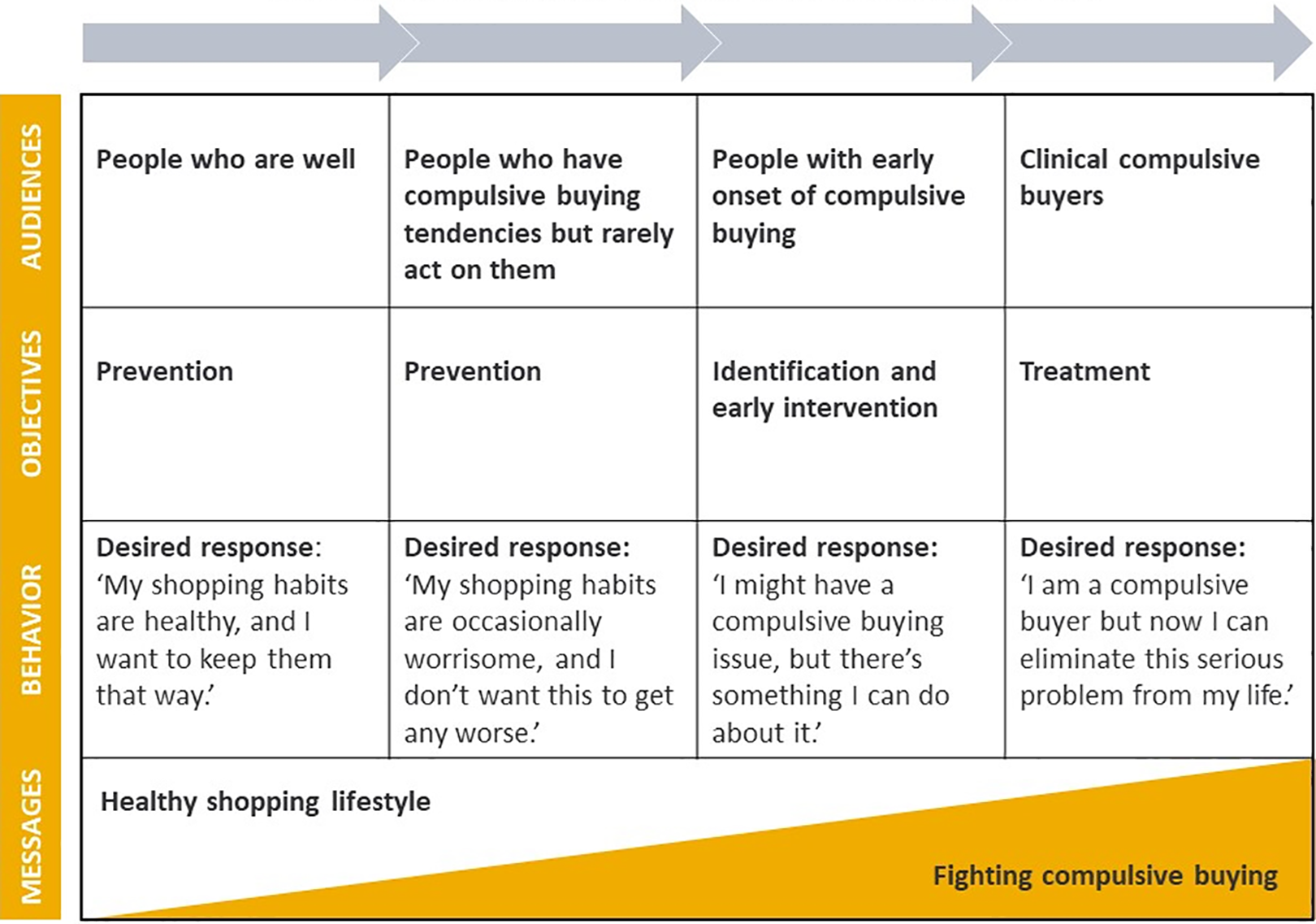
Customizing the social marketing benchmark criteria and strategy (French and Blair-stevens, 2007) to address compulsive buying.
It is important to distinguish between prevention-focused and treatment-focused SM programs, which are aimed at audience segments based on their particular diagnostic or health assessment. The appraisal of target audiences is examined below.
Target Market Identification and Segmentation
To assess the degree to which an individual has compulsive buying tendencies, a variety of screening instruments are employed by marketing researchers, psychologists and psychotherapists. The most widely used screening tool is the Compulsive Buying Scale (Faber & O’Guinn, 1992), with seven items that reflect typical aspects of compulsive buying such as lack of self-regulatory control, irrational use of credit cards, distress at the thought of others’ knowledge of the excessive spending pattern, tension when not shopping, and the use of shopping and buying to feel better. Other screening instruments include an adapted and modified version of the Compulsive Buying Scale developed by D’Astous (1990), the six-item Compulsive Buying Scale developed by Ridgeway et al. (2008), the Questionnaire about Buying Behaviour (Maraz et al., 2016; QABB), the Yale-Brown Obsessive Compulsive Scale-Shopping Version (YBOCS-Monahan et al., 1996), the impulse control disorders section of the Structured Clinical Interview (SCID) that includes specific questions for Compulsive Buying (First et al., 1997), and the Minnesota Impulsive Disorders Interview (MIDI; Christenson et al., 1994) that assesses compulsive buying among other self-regulation disorders. Some of these instruments are available either freely or at a minor cost to the public, so that anyone could fill out the questionnaire and test themselves on the compulsive buying score, seeing how safe or symptomatic they might be. The score calculation and the interpretation of the compulsive buying results might require the assistance of a specialist, particularly in those cases where an average score (i.e., not too high, not too low) is obtained. That said, any (self-)testing might be better then nothing in order to identify the onset or early stages of the problem, considering the warning of Müller et al. (2015) that usually the realization of a compulsive buying case occurs very late, after the individual accumulates large debts, legal problems, conflicts with family members, and other adverse consequences of the inappropriate spending behavior. It is also important to mention that an individual’s screening should be done not just once, but repeatedly over time, because compulsive buying tendencies are impacted by external events and life situations.
When it comes to people who already have a compulsive buying problem—whether they realize and acknowledge it or not—SM programs can segment target audiences based on their stage of awareness and readiness for behavioral change. The possible application of the Stages of Change Model (or the broader framework it is a part of, the Transtheoretical Model—e.g. Prochaska & DiClemente, 1983) to compulsive buying interventions is presented below.
Using the in Transtheoretical Model Compulsive Buying Interventions
The platform proposed in this paper follows the example of Levit et al. (2016), who argue that in order to be successful SM campaigns should be developed with an understanding of the target audience needs, designing persuasive approaches based on research insights and proven theoretical foundations. The Transtheoretical Model (Prochaska & DiClemente, 1983) has been reliably applied to and studied with various social marketing problems, including smoking cessation, HIV prevention, depression, domestic violence, and child abuse (e.g., Cismaru et al., 2008; Norcross et al., 2011). It is hereby posited that its usefulness can extend to compulsive buying programs.
The Transtheoretical Model pinpoints five stages that people go through on their way to change: precontemplation, contemplation, preparation, action, and maintenance. In each stage, certain social marketing approaches are more effective (Weinrich, 2011). As illustrated in Figure 2 and elaborated below, SM efforts aimed at curbing compulsive buying should be tailored to the situation of each target audience.
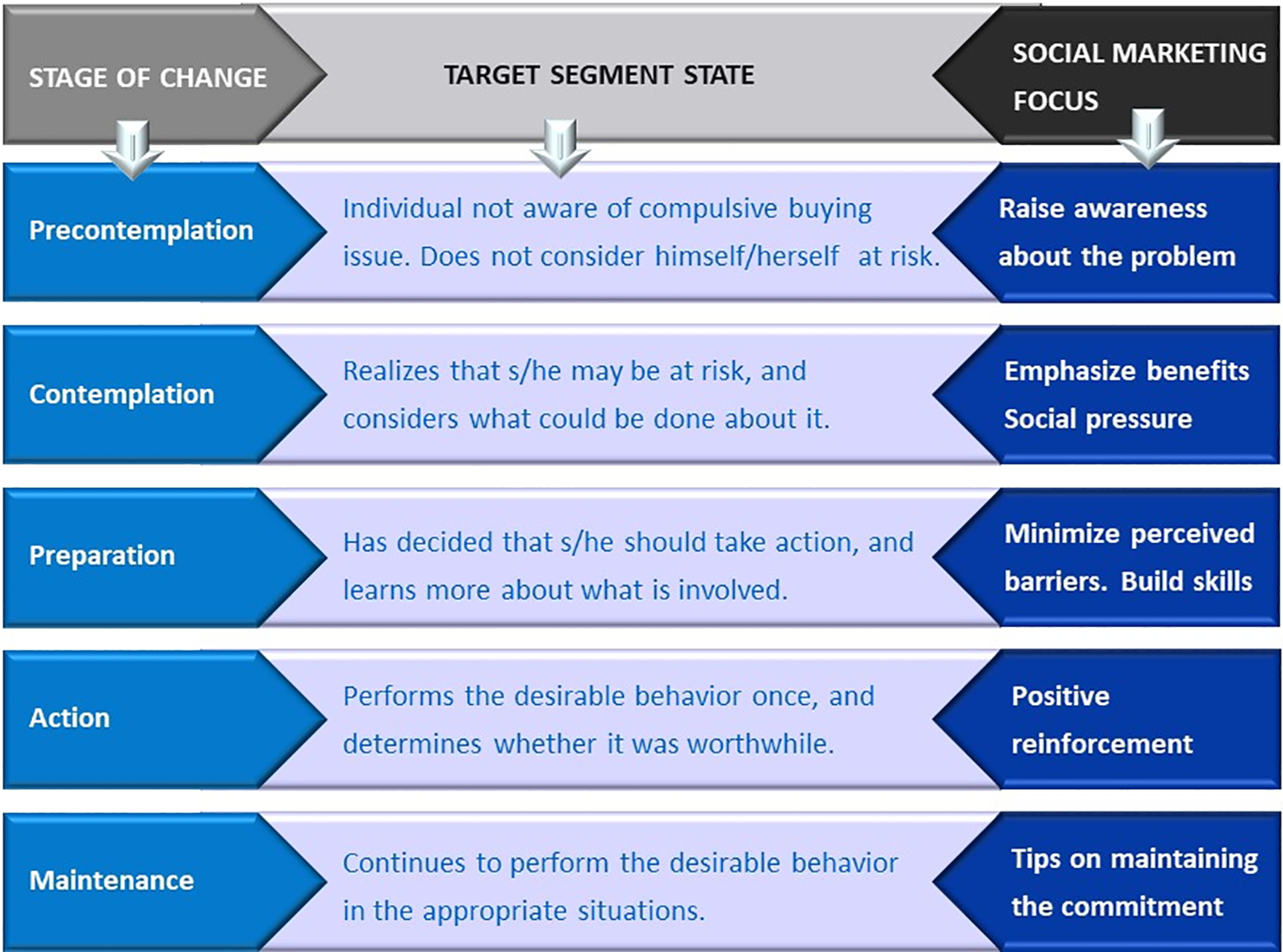
Developing social marketing programs to address compulsive buying based on the transtheoretical model (Prochaska et al., 1994; Weinrich, 2011).
Precontemplation stage
When the individual is not aware of the compulsive buying problem and does not consider himself/herself at risk, the SM program should focus on consciousness raising. This can be achieved through tools and information highlighting the definition, causes and consequences of compulsive shopping. Because precontemplators are not aware of the short- and long-term consequences of their behavior, promotional messages can be geared toward increasing the perceived severity of the problem and perceived personal vulnerability. Promotional materials must be sufficiently dramatic to attract attention and affectively move people. Examples of how life without compulsive buying can look like, and strong negative images paired with the undesirable behavior may be included in promotion. At this stage the provision of self-assessment tools and checklists of symptoms can also help people become more aware of their actions, triggers, and environmental cues that contribute to the undesirable behavior (Levit et al., 2016).
Contemplation stage
When the individual realizes that s/he may be at risk and begins to consider whether to do something about it, the SM program should focus on the positive benefits (Weinrich, 2011) of healthy shopping habits. Clear gains for self and others should be stressed. Messages may center on prompting self-re-evaluation through healthy role models and raising consciousness of oneself as a positive or negative role model for others. Increasing the perceived social pressure for behavior change is also helpful at this stage, including broader policy efforts to alter the norms and the mass-media discourse surrounding shopping behavior. Presently, cultural influences favoring overspending and emphasizing material possessions, along with daily reinforcements by advertisers, are creating a fertile ground for compulsive buying to flourish. The social environment can be sensitized to this problem and gradually moved toward a more responsible outlook. Changing norms and helping consumers internalize healthy beliefs about spending habits is particularly important nowadays when compulsive buyers are able to shop in the privacy of their own homes via e-commerce, catalogs, and television, shielding themselves from negative social judgments by others (Workman & Paper, 2010).
Preparation stage
For individuals who have decided that they should take action and learn more about what is involved, the barriers to change loom large in their consciousness and should be addressed by SM programs. The perceived costs of changing must decrease, otherwise target audiences may remain rooted in the so-called “behavioral procrastination”; “competition” to successful change is what the individuals will have to give up, including the effort of changing a lifestyle (Levit et al., 2016). Promotional messages could aim to encourage hope and show that help is possible. Furthermore, SM programs should focus on building skills for compulsive buyers to be able to get out of their situation. Self-efficacy pertains to one’s ability and level of confidence that they can perform the necessary tasks to accomplish a goal (Prochaska & DiClemente, 1983). Compulsive buyers must reach the conclusion that they have the capability to successfully change if they set their minds to it. This self-efficacy does not exclude reliance on external entities for help. Quite the opposite: supportive relationships are a critical element in the Transtheoretical Model, as the change process relies on caring, trust, openness and acceptance from others who can support self-changers and remind them of their commitment. Compulsive buyers must feel that they have strong partners in the people and organizations designed to help them and keep them on the right track. Also, compulsive shoppers could even be encouraged to partner with trustworthy persons in their own family or social network to tackle the spending problem together, at least in the initial period of change. For example, they could enlist the help of a friend to accompany them in shopping trips and ensure that their purchases are consistent with a desirable pattern. Family members could be engaged in the creation of an action plan that is feasible for the lifestyle of the entire household and more conducive to successful change.
Action stage
When individuals start implementing the action plan made in the previous phase, the SM program should be centered on positive reinforcement to make behavioral change a regular part of their life. Reinforcement management entails rewarding oneself or receiving rewards from others for making changes (Levit et al., 2016). SM messages can praise compulsive shoppers for their success, encourage them to acknowledge the benefits of change and to accept social recognition. The Transtheoretical Model emphasizes stimulus control as the process of restructuring one’s environment to avoid potential triggers or stimuli that elicit problem behavior. This environmental adaptation to avoid high-risk cues should be a focal point of SM programs in the action stage, along with encouraging changers to recognize warning signs of relapse and understand appropriate responses to slipping.
Maintenance stage
As the individual strives to engage in healthy shopping habits, the SM program should provide tips and tools for maintaining the commitment, such as assistance with goal setting and overcoming potential barriers (Weinrich, 2011). Knowing that many people go through relapse before attaining sustainable change, the SM program should prompt compulsive buyers to consider slips as a temporary, natural part of the change process. Target audiences should be encouraged to actively pursue their new routines, keep away from vulnerable situations, and learn from mistakes, including what could be done differently next time to avoid setbacks.
Discussion and Conclusion
The inner life of a compulsive buyer reveals that their “purchase brings a momentary euphoria–much like a gambler feels as he places his bet. […] When the compulsive shopper shops, endorphins are released and there is an adrenaline rush –shopping is exciting! Naturally, you want to feel the rush again. This behavior can spiral dramatically into an abyss of […] distress” (Klein, 2014). Compulsive buyers report a release of tension or gratification after buying, followed by feelings of guilt, anger, or indifference; they sometimes confess that they never even removed the purchases from their packaging or they returned purchases and disposed of the items (Klein, 2014). From the above descriptions it is understandable why compulsive buying has been labeled a behavioral addiction akin to phenomena such as binge eating (Biolcati, 2017; Davenport et al., 2012). While other addictions have received generous attention in the social marketing domain, little to nothing has been studied in this area regarding compulsive buying.
Currently, across the world, awareness campaigns geared toward preventing or curbing compulsive buying have minor visibility. In North America a few organizations and some televised programs are indirectly dealing with compulsive shopping by focusing on one of its consequences, economic debt. For example, Consumer Credit Counseling Services (CCCS), and Debtors Anonymous (DA, an organization similar to Alcoholics Anonymous) offer guidance and action plans to assist consumers in becoming debt-free or improving their financial situation. In many countries, despite the documented existence of a substantial segment of compulsive buyers, there are no programs or campaigns to deal with this issue.
To assist social marketers in developing effective programs, a conceptual platform was hereby provided, following key SM principles. Four elements in particular are shaping the backbone of the proposed framework: behavior change, audience research, segmentation and consideration of the 4 Ps. The platform is rooted in the compulsive buying literature across disciplines and uses proven theory (e.g. the Transtheoretical Model) as a basis for the recommended SM tactics.
The work of social marketers is not expected to be a light one. Challenging existing norms and the mirage of shopping is an uphill battle, especially as many compulsive buyers are not yet aware of their problem or are trying to ignore it. Social marketing campaigns must point out that the danger of compulsive shopping is not exclusive to rich consumers or to individuals in the developed countries. Research shows that compulsive buyers are usually people with average or below-average income levels (and typically lower income in the USA; Müller et al., 2015) who will use any and all financial means at their disposal, or even end up engaging in unlawful behavior, to support their habit. This disregard for financial consequences and the willingness to sink to the lowest levels to nurture one’s compulsion is akin to the financial whirlpool observed in other addictions like illegal drug use or compulsive gambling. People facing such downward spirals end up losing not just their hard-earned money, but also their lifestyle, their relationships, and often their lives. Social marketers around the globe have the opportunity and the responsibility to curb this problem before it wreaks havoc, using strategically planned campaigns for best results. Hopefully the current study will provide the impetus and basic platform to embark on the quest of facing compulsive shopping head-on.
While this paper offers an initial framework, it hopes to inspire significantly more exploration of the potential of other social marketing approaches to foster behavioral change for the better in the world of compulsive buying.
Footnotes
Acknowledgments
The author would like to thank her former and current students in the Master of Science in Marketing program at the University of Saskatchewan for their inspiring interest and work in compulsive buying research from a social marketing perspective. They kept the motivation for this paper alive and reminded their professor of the important role we can all play in fighting addictions one small step at a time.
Declaration of Conflicting Interests
The author(s) declared no potential conflicts of interest with respect to the research, authorship, and/or publication of this article.
Funding
The author(s) received no financial support for the research, authorship, and/or publication of this article.
