



Abstract
Objectives:
Aging is a rising phenomenon globally and elder abuse is becoming increasingly recognized as a health and social problem. This review aimed to identify the prevalence of elder abuse in community settings, and discuss issues regarding measurement tools and strategies to measure elderly abuse by systematically reviewing all community-based studies conducted worldwide.
Method:
Articles on elder abuse from 1990 to 2011 were reviewed. A total of 1,832 articles referring to elders residing at home either in their own or at relatives' houses were searched via CINAHL and MEDLINE electronic databases, in addition to a hand search of the latest articles in geriatric textbooks and screening references, choosing a total of 26 articles for review.
Results:
Highest prevalence was reported in developed countries, with Spain having 44.6% overall prevalence of suspicion of abuse and developing countries exhibiting lower estimates, from 13.5% to 28.8%. Physical abuse was among the least encountered, with psychological abuse and financial exploitation being the most common types of maltreatment reported. To date, there is no single gold standard test to ascertain abuse, with numerous tools and different methods employed in various studies, coupled with varying definitions of thresholds for age.
Conclusion:
Current evidences show that elder abuse is a common problem in both developed and developing countries. It is important that social, health care, and legal systems take these findings into consideration in screening for abuse or reforming existing services to protect the health and welfare of the elderly.
Introduction
With the increase in aging population globally, the occurrence of elder abuse is on the rise (Esther, Shahrul, & Low, 2006; Gorbien & Eisenstein, 2005; Wang, Lin, & Lee, 2006). Elder abuse first came to light in the 1970s in the United Kingdom where the term granny battering was coined, but the United States was the pioneer to lead the way in studies conducted on elder abuse and neglect (Aravanis et al., 1993).
This review highlights the prevalence of elder abuse as well as how it is measured or quantified in different societies and cultures. Factors possibly linked to the outcome of elder abuse are thus indirectly studied. Elder abuse, or mistreatment, has been known to occur in various settings, such as home or long-term care institutions, perpetrated by caregivers who are usually close family members or staff of nursing homes. Sometimes, self-neglect occurs, whereby the elder is both the perpetrator and the victim (Buri, Daly, Hartz, & Jogerst, 2006; Christie et al., 2009; Garre-Olmo et al., 2009; Gorbien & Eisenstein, 2005; Ogg & Bennett, 1992; Oh, Kim, Martins, & Kim, 2006; Pillemer & Finkelhor, 1988; Wang, 2005; E. C. W. Yan & Tang, 2004).
Consequences of elder abuse may be indirect, ranging from increased health care costs of caring for elders, lesser productivity of family members who stay at home to take care of the elders under their care, or increased stress levels and perception of burden of caregivers, which may in itself lead to abuse (Fulmer & Hernandez, 2000; Gorbien & Eisenstein, 2005; Pérez-Rojo, Izal, Montorio, & Penhale, 2008; Wang et al., 2006). Immediate consequences to the elder range from feelings of anger, disappointment, grief, aggressively responding to the abuse themselves, being scared, sustaining bruises, losing considerable finances or property, trying to prevent further abuse, and sustaining more psychological distress (Comijs, Pot, Smit, Bouter, & Jonker, 1998; E. Yan & Tang, 2001).
The World Health Organization uses the definition developed by Action on Elder Abuse in the United Kingdom and adopted by the International Network for the Prevention of Elder Abuse: “Elder abuse is a single or repeated act, or lack of appropriate action, occurring within any relationship where there is an expectation of trust which causes harm or distress to an older person,” and is generally divided into the following five categories: physical abuse—infliction of pain or injury, physical coercion, or physical or drug-induced restraint; psychological or emotional abuse—infliction of mental anguish; financial or material abuse—illegal or improper exploitation or use of funds or resources of the older person; sexual abuse—nonconsensual sexual contact of any kind with the older person; and neglect—refusal or failure to fulfill a caregiving obligation, which may or may not involve a conscious and intentional attempt to inflict physical or emotional distress on the older person (Krug, Dahlberg, Mercy, Zwi, & Lozano, 2002).
Most of the existing researches have focused on developed countries with established health systems. This review shall attempt to present a broader range of expertise on elders susceptible to abuse who live with their families. It aims to identify the prevalence of elder abuse in the community through various measurement tools by examining prevalence estimates reliability as well as the use of various measurement tools, and provide possible explanations in view of the variance across prevalence estimates, methodology, and tools used.
Method
Search Strategy
Of the 1,833 articles obtained via an initial search of MEDLINE and Cumulative Index to Nursing and Allied health databases, ultimately 26 were reviewed after stringent screening of titles and abstracts, with additional hand search via the library and screening references (see Figure 1). The inclusion criteria were primary research articles from year 1990 to 2011 describing elders aged 60 years and above residing on their own or at relatives’ homes. Reviews, articles not in the English language, editorials, seminars, reports, drug abuse, intimate partner violence, long-term care, dementia, substance abuse, child abuse, suicide, depression, mental illness, caregiver abuse, and hospital-based studies were excluded. Full-text articles retrieved were further assessed based on quality and relevancy, with cross-referencing wherever necessary. Study design, sample size, response rate, period of study, elder definition, abuse definition, prevalence of various types of abuse, and the measurement tool used to obtain the prevalence were compared. Studies of community-dwelling elders were chosen to reflect the bulk of the elder population in mainstream society.

Search strategy flowchart.
Data Extraction
R.S. performed an electronic as well as hand search to obtain relevant articles, besides expert contact wherever necessary. In addition, R.S. screened relevant titles and abstracts before reading and evaluating studies using a standardized evaluation form presented in Table 1. An independent assessment on study quality was made by Canada World Youth and any discrepancies were discussed, consulting NNH only if both disagreed. The involvement of three researchers helped to reduce the risk of selection bias. Selection of participants and sampling methods was considered when rating the quality of the chosen studies (see Table 2).
Results and Findings From Selected Elder Abuse Studies.
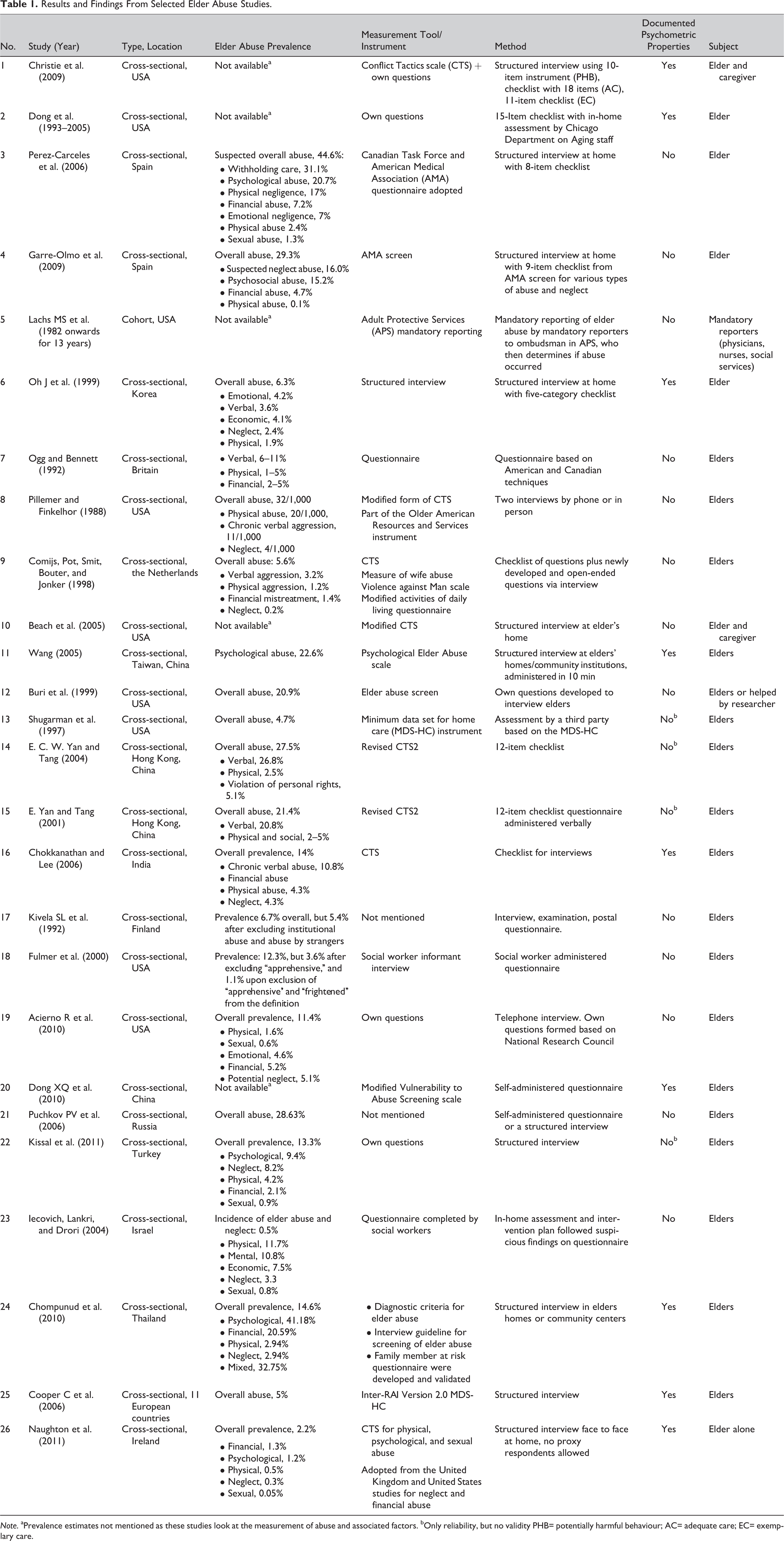
Note. aPrevalence estimates not mentioned as these studies look at the measurement of abuse and associated factors. bOnly reliability, but no validity PHB= potentially harmful behaviour; AC= adequate care; EC= exemplary care.
Quality Scoring of Studies.
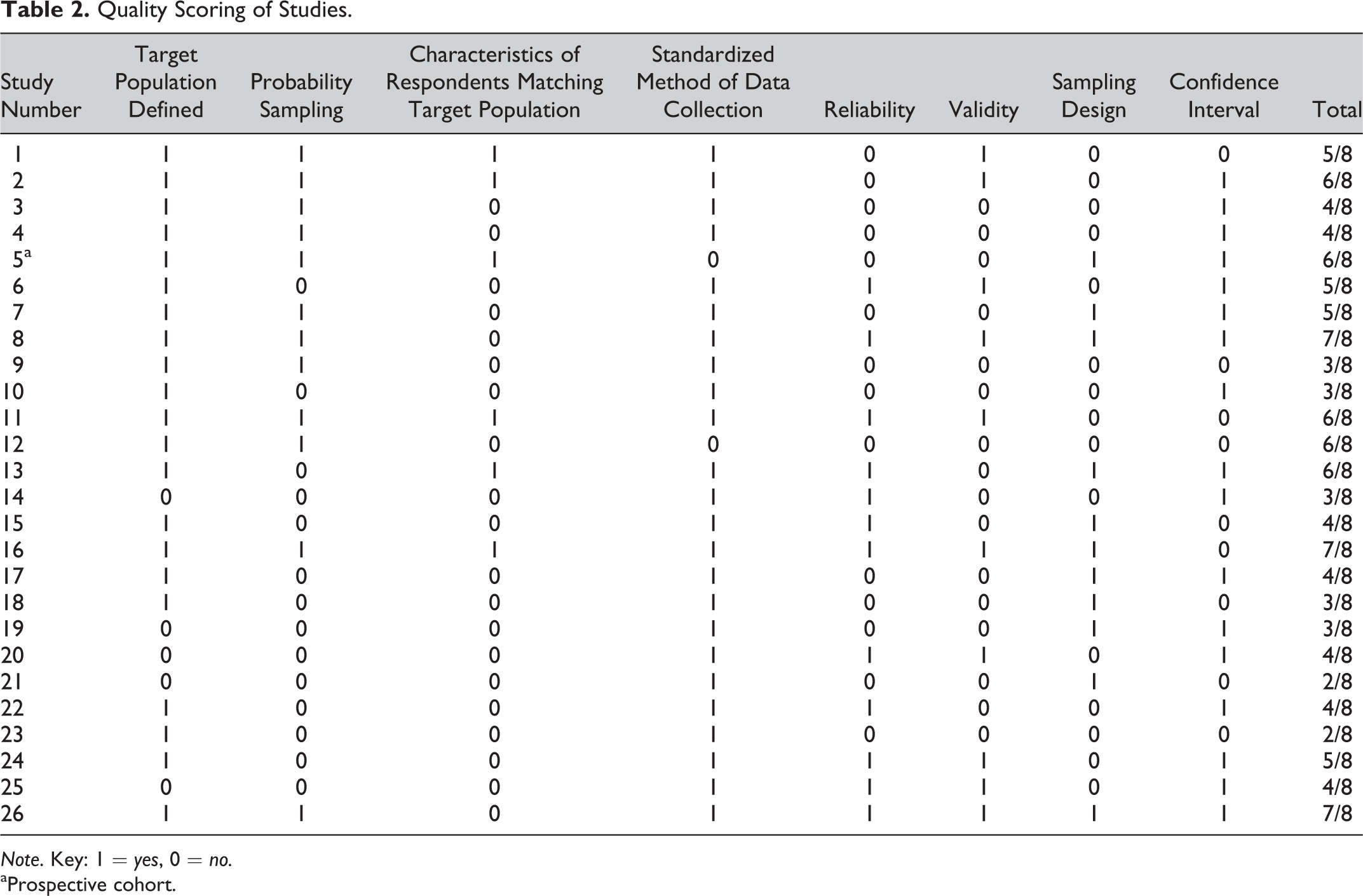
Note. Key: 1 = yes, 0 = no.
aProspective cohort.
Quality of Findings
Quality of articles was appraised based on principles found in Evidence-Based Mental Health (Boyle, 1998; see Table 3). Many studies were found to lack rigorous study methodology, compromising on reliability and validity, and not detailing sampling methods. Generalizability of findings to entire communities or populations were also lacking, with five studies not having target populations defined, and only seven studies having examined subjects’ characteristics matching the target populations. Numerical estimates were lacking in half of the chosen studies, leaving the reader to analyze the results themselves.
Evidence-Based Table Showing Prevalence of Elder Abuse.
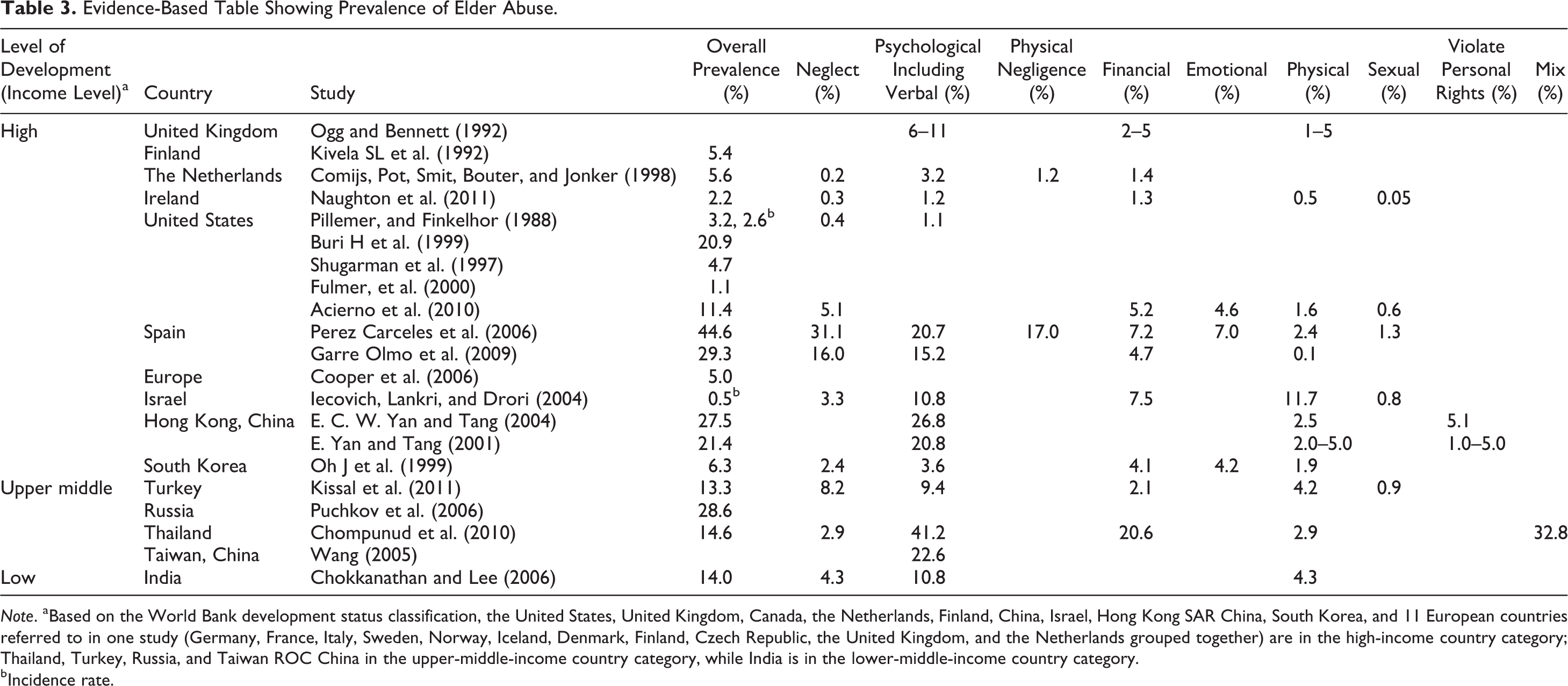
Note. aBased on the World Bank development status classification, the United States, United Kingdom, Canada, the Netherlands, Finland, China, Israel, Hong Kong SAR China, South Korea, and 11 European countries referred to in one study (Germany, France, Italy, Sweden, Norway, Iceland, Denmark, Finland, Czech Republic, the United Kingdom, and the Netherlands grouped together) are in the high-income country category; Thailand, Turkey, Russia, and Taiwan ROC China in the upper-middle-income country category, while India is in the lower-middle-income country category.
bIncidence rate.
Results
Prevalence and Limitations by Definition Results from Table 3 show that the overall prevalence of elder abuse ranges between extremes of 1.1% (Fulmer et al., 2000) in the United States and 44.6% in Spain (Pérez-Cárceles et al., 2008). It appears to be higher among older subgroups of elders and female elders. Subtypes of Abuse It appears that psychological abuse is most prevalent, accounting from 1.1% of elder abuse in the United States to 41.18% in Thailand, followed by neglect from 0.2% in the Netherlands to 31.1% in Spain, financial abuse from 1.3% in Ireland to 20.59% in Thailand, and physical abuse from 0.1% in Spain to 11.7% in Israel. Sexual abuse is the least commonly encountered, ranging from 0.6% in the United States to 1.3% in Spain. Development Status
Table 3 presents evidence-based prevalence of elder abuse by countries’ economic level of development. Countries belonging to high-income groups generally have a lower prevalence, with the exception of Spain, than upper-middle- or lower-middle-income group countries. The Northern American continent appears to have the lowest prevalence of overall elder abuse, while Asia has the higher range, most being in the 20th percentile, along with Europe, where a vast range could be observed, from 5% in Finland and the Netherlands to more than 40% in Spain (Garre-Olmo et al., 2009; Pérez-Cárceles et al., 2008). Measurement Strategy Prevalence estimates vary with different instruments used to screen for elder abuse and study methodology. A proper screening tool for elder abuse would help avoid underestimating it, especially with the lack of awareness on abuse. Various tools exist, but neither they have good reliability and validity nor may be the best chosen measure for a particular society. Only 9 studies used instruments with documented psychometric properties, while 17 did not. Of the former, the overall prevalence of abuse was between 5% and 22.6%, with a wider range of 1–44.6% in the latter group (see Table 2).
The most commonly used tool is the revised Conflict Tactics scale (CTS2) by Straus, Hamby, Boney-McCoy, and Sugarman (1996), the original form of which appeared in 1979 (Straus, 1979) and has been used in 6 of the 26 studies reviewed. Studies using this tool had good validity and reliability of results, with prevalence ranging from 3.2% in the United States to 27.5% in Hong Kong. Furthermore, there appears to be no difference in outcomes of abuse according to the method of recruitment of subjects. Prevalence estimates differ according to the tool used to evaluate abuse but not the method through which subjects were recruited in terms of sampling from the community or health care settings. Abuse estimates vary between 0.5% and 29.3% for elders recruited from the community setting itself and estimates of 1.1–28.6% among those recruited from health care settings.
Discussion
This review suggests that the experience of elder abuse is not uncommon in many cultures. It appears that psychological abuse is the most common form of elder abuse encountered. This suggests that the most obvious type of abuse may not be identified depending solely on a regular physical examination or medical checkup. Psychological abuse appears to be much more prevalent in Asian countries. Across all subtypes of abuse, higher prevalence is reported among females and among older age groups. This is not unexpected as females tend to live longer and are more likely to be dependent on their caregivers or children.
The range of figures in this review was large, and could possibly be attributed to methodological differences in various studies such as self-report measures, lack of a standardized, uniform diagnostic criteria, and lack of a confirmatory test to identify elder abuse. Coupled with this is a nonuniform definition of elder abuse, with some studies using the terms elder abuse, potential elder abuse, and elder mistreatment. In particular, we found that several studies classified emotional abuse and psychological abuse as a separate category of abuse. However, in other studies, this was not a separate entity but combined as psychological or verbal abuse. Such discrepancies could lead to large variation in psychological abuse estimates. Definitions of “elder” itself may also vary, with the cutoff being set at 60 years, 65 years, or even more. Other factors influencing abuse include cohabitation of elder with caregiver, social support available to the elder, cognitive and physical decline of the elder, and dependency on the caregiver, while caregiver depression and stress in itself could predispose elderly to abuse (Chokkanathan & Lee, 2006; Chompunud et al., 2010; Iecovich, Lankri, & Drori, 2004; Oh et al., 2006; Pérez-Cárceles et al., 2008; Pillemer & Finkelhor, 1988).
The exact reasons why elder abuse appears to be higher in Asian regions than in Europe or America remain unclear. However, it may be postulated that traditional Asian families are hierarchical in nature, where authority and structure in the family is defined by position, which is in turn determined by age and gender. Family harmony and equilibrium are valued; thus, maintaining this hierarchy ensures this balance is preserved. Chinese society has been viewed as a gerontocracy because of their overall respect and reverence of the elderly (Flanagan, 2005). This brings in the concept of filial piety which conforms to the hierarchical and patriarchal structure of Asian and Chinese cultures.
This then leads to the expectation that children are to live with and provide for elders later on in life. It is not a choice but rather a responsibility they are expected to fulfill, as East Asian cultures have traditionally assigned the role of caregiver to adult children. This is especially true in a society dominated by patriarchal lines where filial piety is dominant, as seen in Chinese cultures which is influenced by Confucian traditions (E. Yan, So-Kum, & Yeung, 2002). However, when adult children are forced to live up to these ingrained responsibilities or obligations, the burden felt may cause them to turn around and abuse elders instead, to relieve some of their tension and stress. This is especially so when family size is getting smaller and the responsibilities of caring for elderly are shared among fewer children.
With shrinking family size, increasing urbanization and modernization, living apart is considered normal. This cultural shift where less emphasis is on filial piety may mean that elders are more prone to neglect. Among those who do live together, sometimes caregivers’ sense of filial piety is translated into caring or providing for elders needs on a daily basis. This may lead to shifts in the hierarchical structure within the family where power to make decisions is no longer vested within elders, such that elders may feel that decision making is being taken away from them, stripping them of their autonomy (Cheng & Chan, 2006). This could be reflected in the higher psychological abuse estimates among Asian regions.
Various means of implementing studies were found in this review, with some researchers relying entirely on elders to fill up questionnaires or answer themselves either in person or over the telephone. For researcher-administered questionnaires, the level of competence of researchers may vary, as some were conducted by paramedical staff and some by physicians. This may have influenced the prevalence estimates.
Limitations of Review
The design of most studies is cross-sectional in nature, limiting causality between exposure factors and outcome of abuse. Lack of standardized criteria for abuse and elder age cutoff, besides differences in methods of assessment impede comparison and application of knowledge. Only English language articles were sought from two databases; however, these are commonly used databases.
Conclusion
Implications for Practice
With the aging global population, elder abuse is on the rise, as seen in prevalence estimates from various regions, which have identified this problem. Psychological abuse and financial exploitation top the list of abuse suffered by elders, especially in the home setting. Consequences of elder abuse vary depending on the extent and severity of the problem. Standardized screening tools are therefore important to tackle this growing problem, as different measurement or screening strategies impede meaningful comparisons to be made between countries. Standardized tools would mean that we could learn from each other’s experience and knowledge. In trying to detect abuse, barriers to elder abuse detection should be thought of, such as the lack of willingness of older persons to label behaviors as abusive or abusive stereotypes which are often normalized through the media that may interfere with older persons ability to recognize abuse.
Implications for Research
Future research potential exists on the prevalence and factors associated with elder abuse, and, in the context of abuse, on detailed studies on each type of abuse, that is, emotional, verbal, financial, neglect, or physical abuse. This may be further studied from the point of the elder as well as the caregiver, or a dyadic approach. Caregiver characteristics such as financial or emotional dependence on the elder, presence of physical or mental illness and substance abuse should be considered as well. Elder abuse appears to be higher in Asian regions than in Europe or America, indicating there is a serious problem here and more potential for research, especially in terms of cultural ideologies that may influence abuse perceptions and outcomes.
Footnotes
Declaration of Conflicting Interests
The author(s) declared no potential conflicts of interest with respect to the research, authorship, and/or publication of this article.
Funding
The author(s) disclosed receipt of the following financial support for the research, authorship, and/or publication of this article: This work was supported by the University Malaya/Ministry of Higher Education (UM/MOHE) High Impact Research Grant E 000010-20001 and the UMRG Grant RG397/12 HTM.