



Abstract
Many sexual violence survivors do not label their experiences as rape but instead use more benign labels, such as “bad sex” or “miscommunication.” A meta-analysis was conducted to estimate the mean prevalence of unacknowledged rape and to inform our understanding of methodological factors that influence the detection of this phenomenon. Studies were identified using PsycINFO, PubMED, and PILOTS and were required to report the percentage of unacknowledged rape that had occurred since the age of 14 among female survivors. Moderator variables included mean participant age, recruitment source, rape definition, and unacknowledged rape definition. Twenty-eight studies (30 independent samples) containing 5,917 female rape survivors met the inclusion criteria. Based on a random effects model, the overall weighted mean percentage of unacknowledged rape was 60.4% (95% confidence interval [55.0%, 65.6%]). There was a large amount of heterogeneity, Q(29) = 445.11, p < .001, and inconsistency (I2 = 93.5%) among included studies. The prevalence was significantly higher among college student participants compared to noncollege participants. The findings supported that over half of all female rape survivors do not acknowledge that they have been raped. The results suggest that screening tools should use behaviorally descriptive items about sexual contact, rather than using terms such as “rape.”
Sexual violence has been a topic of great concern for many decades, but recently, it has been thrust into the spotlight as a global public health concern (World Health Organization, 2007). A driving force for the call to action is the wide range of psychological and physical effects of rape, including anxiety, depression, self-blame, loss of trust, substance use, suicidal thoughts, sleep disturbance, sexually transmitted infections, and sexual dysfunction (Boudreaux, Kilpatrick, Resnick, Best, & Saunders, 1998; Breslau et al., 1998; Kessler, Sonnega, Bromet, Hughes, & Nelson, 1995; Krug, Dahlberg, Mercy, Zwi, & Lozano, 2002; Mechanic, 2004). These consequences are particularly troubling when considered in the context of the prevalence of rape, with estimates suggesting that one in seven women in the United States will experience rape during her lifetime based on behaviorally descriptive assessment items (Kilpatrick, Edmunds, & Seymour, 1992; Testa, VanZile-Tamsen, Livingston, & Koss, 2004; Tjaden & Thoennes, 2000). The reported prevalence of rape is approximately 1 in 11 among girls under the age of 18, 1 in 33 among adult men, and 1 in 50 among boys under the age of 18 (Tjaden & Thoennes, 2000). Because of the higher reported prevalence of rape among adult women, the present meta-analysis focused on adult female survivors of rape.
As stated by Berliner (1992, p. 121), “Numbers are central to developing a societal response to a social problem. Establishing the frequency of a problem has everything to do with how seriously it is taken.” Consequently, our ability to detect rape and establish accurate prevalence rates affects policy changes and resource allocation. Therefore, the main aim of the present meta-analysis was to obtain an overall estimate of the prevalence of unacknowledged rape across all relevant studies in the literature. This is of great importance because a number of studies have demonstrated that a large percentage of women who report incidences that would meet the range of legal definitions of rape do not label their experiences as rape (Bondurant, 2001; Kahn, Jackson, Kully, Badger, & Halvorsen, 2003; Littleton, Radecki Breitkopf, & Berenson, 2008). In these situations, survivors often label the incidents as a “miscommunication” or “bad sex” (Littleton, Axsom, Radecki Breitkopf, & Berenson, 2006; Littleton et al., 2008). This is called unacknowledged rape (Koss, 1989).
The exact prevalence of unacknowledged rape is difficult to determine due to challenges related to measurement and definitions. To measure unacknowledged rape, participants often complete a self-report instrument containing behavioral descriptions of sexual incidents (e.g., “a man put his penis into my vagina without my consent”; Sexual Experiences Survey; Koss et al., 2007). The participants are then asked “have you ever been raped?” or asked to choose a label for the sexual incident from a list of descriptors (e.g., rape, miscommunication). Unacknowledged rape occurs when participants endorse an incident that satisfies the researcher’s definition of rape but do not affirm that they have been raped or select the rape label.
Research suggests that unacknowledged rape is quite common, with most estimates revealing prevalence rates between 40% and 70% of women (Littleton et al., 2008). Unacknowledged rape is of importance because survivors who do not label their victimizations as rape are unlikely to report the crimes to authorities, pursue mental health services, seek medical treatment, participate in research, or communicate to people in their lives that they have been victimized (Littleton, Axsom, et al., 2006; Resnick, Guille, McCauley, & Kilpatrick, 2011). Furthermore, our awareness and understanding of rape may be biased because we are not capturing a key subset of the affected population.
Prior studies have examined a range of factors that may impact the rate of unacknowledged rape, such as the perpetrator–victim relationship and the amount of force used during the incident (Bondurant, 2001; Kahn et al., 2003). We decided to focus on methodological considerations, such as measurement and sampling, which may influence the detection of unacknowledged rape. This decision was made because the main goal of the present meta-analysis was to inform researchers within this area of the literature.
Prior evidence has suggested that studies tend to find lower prevalence rates of unacknowledged rape when they use more restrictive definitions of rape and measures of victimization (Littleton, Rhatigan, & Axsom, 2007) and provide participants with more options to label their sexual experiences (Botta & Pinree, 1997). Additionally, studies that include older participants (Littleton, Axsom, & Grills-Taquechel, 2009) or use community recruitment tend to find lower prevalence rates (e.g., 40–60%; Conoscenti & McNally, 2006; Koss, Figueredo, Bell, Tharan, & Tromp, 1996) than studies that use younger and/or college participants (e.g., 50–90%; Bondurant, 2001; Donde, 2009; Harned, 2002; Layman-Guadalupe, 1996). The available evidence suggests that participant and measurement factors impact the prevalence of unacknowledged rape detected in samples, which is particularly significant because the majority of prior studies have suffered from significant methodological limitations (e.g., cross-sectional design; Littleton et al., 2007). Most notably, there is a clear gap in the literature due to the lack of longitudinal data, which would better capture the survivors’ conceptualization of the event, both immediately following the assault and long term.
Based on prior research, it was hypothesized that more restrictive definitions of rape and measures of victimization, studies that provide participants with more options to label their sexual experiences, community recruitment, and older participant age, would be associated with lower prevalence rates of unacknowledged rape.
Method
Procedure
A computerized database search was completed using PsycINFO, PubMED, and PILOTS. Keywords were hidden rape OR unacknowledged rape OR [rape AND label]. The search yielded 111 unique citations for review. The primary coder (L.C.W.) examined the abstracts to determine whether the studies met the criteria. If a decision could not be made based on the abstract, then the primary coder examined the full text. During the review process, the primary coder identified 14 additional studies from citations that were not yielded in the original search. As a reliability check, a second coder (K.E.M.) independently reviewed 70 randomly selected articles. The two coders had 100% agreement on decisions.
To be included, the studies were required to examine rape, which was defined as unwanted sexual experiences obtained through force, threat of force, or incapacitation of the victim. The present meta-analysis focused on female survivors and events that occurred since the age of 14. These gender and age specifications were selected because they are consistent with the Sexual Experiences Survey (Koss et al., 2007; Koss & Gidycz, 1985; Koss, Gidycz, & Wisniewski, 1987; Koss & Oros, 1982), a commonly used measure (Koss et al., 2007). In addition, the studies were required to report the percentage of unacknowledged rape survivors. Unacknowledged rape survivors were defined as women who reported experiencing an event that satisfied the researchers’ definition of rape, but did not label the event as such. The studies also had to present original empirical data (i.e., not a literature review). If multiple studies used the same or overlapping samples, then one of the articles was randomly selected and included. The following articles were selected and the duplicate samples are listed in parentheses: Harned, 2002 (Harned, 2005); Koss and Gidycz, 1985 (Levine-MacCombie & Koss, 1986); Littleton, 2006 (Littleton, Axsom, et al., 2006); Littleton and Henderson, 2009 (Littleton, Axsom, et al., 2009); Peterson and Muehlenhard, 2007 (Peterson & Muehlenhard, 2011); Pitts and Schwartz, 1993 (Pitts & Schwartz, 1997).
Of the 125 identified studies, 28 studies met the inclusion criteria for the meta-analysis, with 30 independent samples. The studies contained 5,917 female survivors of rape according to the researchers’ definitions who provided complete data about their rape acknowledgment status, with an average of 197.23 participants per study (SD = 197.19). See Figure 1 for a flow diagram of the search procedures and inclusion decisions.
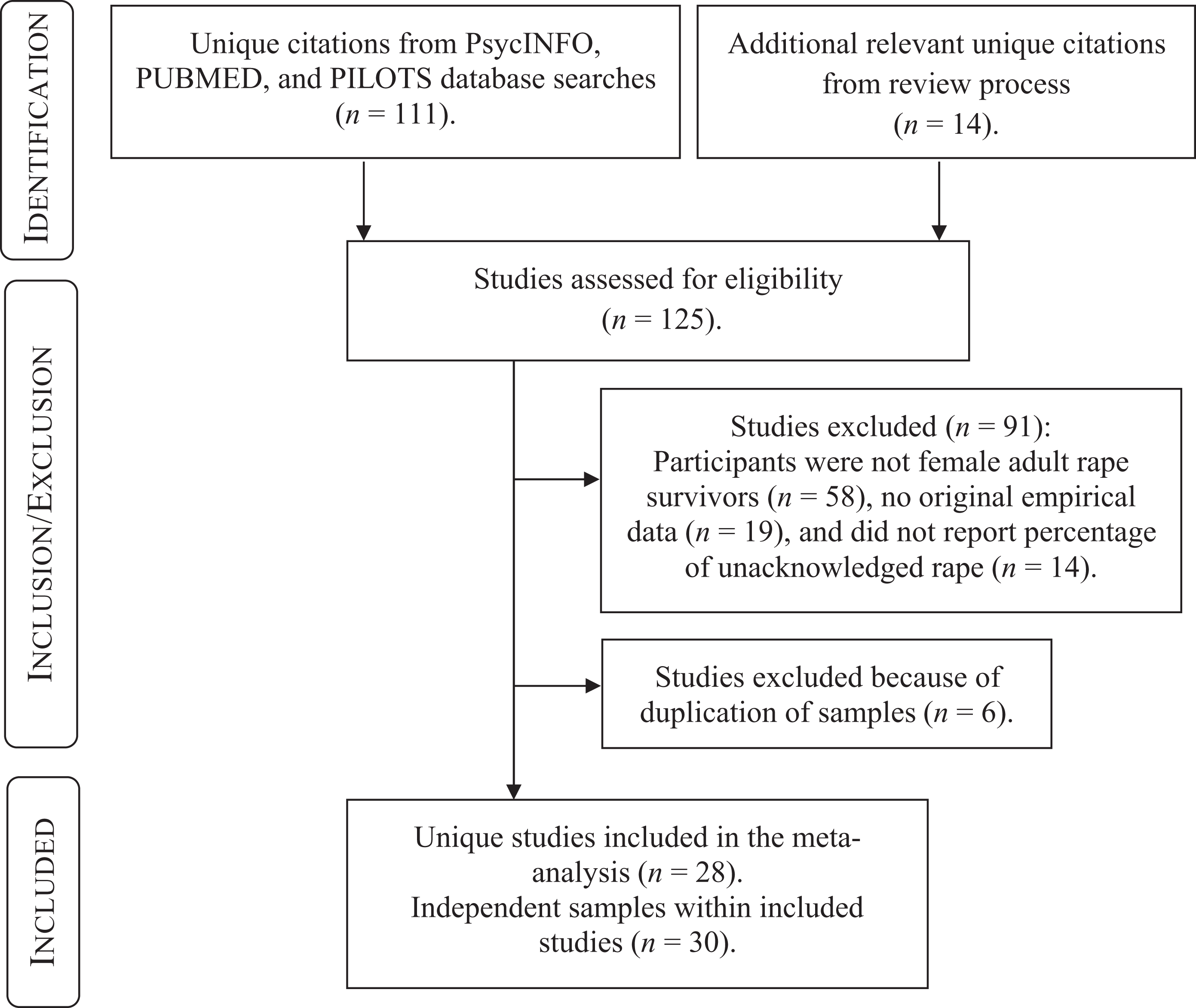
Flow diagram of the study selection process.
Data Analysis
The analyses were conducted using Comprehensive Meta-Analysis Version 2 (Borenstein, Hedges, Higgins, & Rothstein, 2011) and followed the analytic procedure outlined by Borenstein, Hedges, Higgins, and Rothstein (2009). All analyses were conducted as two-tailed tests, with a statistical significance threshold of .05. Prevalence rates were calculated from the sample size (i.e., number of rape survivors in each study who had complete data for acknowledgment status) and events (i.e., number of unacknowledged rape survivors). A random effects model was used because this approach is recommended when studies use varying methodologies (e.g., different types of participants, measures, study designs; Schmidt, Oh, & Hayes, 2009). The reported results consist of the prevalence rates and 95% confidence intervals (CI) for each input study, the weighted mean prevalence and mean 95% CI, I 2 (i.e., measure of inconsistency among included studies; Higgins, Thompson, Deeks, & Altman, 2003) and Cochran’s Q (i.e., degree of homogeneity among input studies). Publication bias was examined using rank correlation (Begg & Mazumdar, 1994) and Egger regression (Egger, Davey Smith, Schneider, & Minder, 1997) tests.
Moderator analyses were used to test factors that may influence the prevalence of unacknowledged rape (See Tables 1 and 2). Mean participant age was examined as a continuous moderator. Recruitment source, rape definition, and unacknowledged rape definition were examined as categorical moderators. Recruitment source was categorized as (1) college student participants or (2) noncollege participants. Sapanski (2011) included both college and community recruitment, but was classified as noncollege participants because the majority of the participants were obtained from community recruitment. Rape definition was categorized as (1) a restrictive definition (e.g., penetrative sex or vaginal, oral, or anal intercourse) or (2) a broader definition (e.g., unwanted sexual contact, sexual intercourse). Unacknowledged rape was categorized as (1) participants were asked whether they have ever been raped with the response options of “yes” or “no,” or (2) participants were asked to label their sexual experiences from a list of options (e.g., rape, miscommunication). If a study used another measure of unacknowledged rape, then it was not included in the moderator analysis. The researchers had originally planned to examine victimization measure as a moderator variable; however, as can been seen in Table 1, many of the studies modified an existing measure or created their own measure. Therefore, it was not possible to categorize the measures in any meaningful way and therefore this moderator variable was not examined. Moderator analyses were conducted using mixed effects models.
Characteristics of Studies Included in a Meta-Analysis of the Prevalence of Unacknowledged Rape.

Note. SES = Sexual Experiences Survey; Rape definition: 1 = specific to penetrative sex, or vaginal, oral or anal intercourse, 2 = broader definition; Unacknowledged rape definition: 1 = asked participants whether they have ever been raped, 2 = asked participants to label their experience.
Sample Characteristics, Prevalence (prev) Rates, and 95% Confidence Intervals (CIs) for a Meta-Analysis of the Prevalence of Unacknowledged Rape.

Note. Q(29) = 445.11, p < .001, I 2 = 93.5%. — indicates mean age of the overall sample not reported. Moderator variable of recruitment coded as 1 = college, 2 = noncollege.
Results
The prevalence rates of unacknowledged rape among rape survivors across studies ranged from 27.6% to 88.2% (See Table 2). The mean prevalence of unacknowledged rape across studies was 60.4% (95% CI [55.0%, 65.6%]; See Figure 2 for the forest plot). There was significant heterogeneity, Q(29) = 445.11, p < .001, and a large amount of inconsistency, I 2 = 93.5%, among the included studies. Sensitivity analysis examined what the pooled effect size would be without each study in the analysis. The exclusion of any input study resulted in a very small change in the mean prevalence rate (mean prevalence ranging from 59.1% to 61.6%); and therefore, it was determined that no single study was the primary determinant of the mean prevalence rate. The rank correlation (τ = −0.067, p = .605) and the regression (intercept = 0.811, p = .632) tests both suggested that publication bias did not impact the meta-analysis.

Forest plot of prevalence rates (prev) and 95% confidence intervals (CI) for input studies.
The results showed a nonsignificant linear effect for participant mean age (B = −0.015, SE = 0.024, p = .538). However, 10 studies did not report mean participant age. The results demonstrated a significant between-class effect for recruitment source, Q b(1) = 7.542, p = .006, with a mean prevalence rate of 62.7% for college student participants (k = 25) and 50.0% for noncollege participants (k = 5). The between-class effect for rape definition was not statistically significant, Q b(1) = 1.460, p = .227, with a mean prevalence rate of 56.3% for restrictive rape definitions (k = 11) and 62.8% for broad rape definitions (k = 19). The between-class effect for unacknowledged rape definition was not statistically significant, Q b(1) = 0.904, p = .342, with a mean prevalence rate of 56.5% for studies that asked participants whether they have ever been raped with the response options of “yes” or “no” (k = 8) and 63.0% for studies that had participants label their experience from a list of options (k = 13). Nine studies used another method to assess unacknowledged rape, such as asking whether specific incidents were rape.
Discussion
Across the 28 studies (30 independent samples) containing 5,917 female rape survivors, more than half of the survivors (60.4%) did not acknowledge that they had been raped, despite the fact that their experiences could be defined as rape. This suggests that unacknowledged rape among survivors is a common occurrence and highlights the need to better understand this phenomena and its potential impact on research, clinical intervention, policy reform, and advocacy work.
The consequences of unacknowledged rape are difficult to identify because acknowledgment status is closely linked to other factors that may better account for survivor adjustment, such as assault characteristics. For example, Layman, Gidycz, and Lynn (1996) and Littleton, Axsom, Radecki Breitkopf, and Berenson, (2006) found that acknowledged rape was associated with greater posttraumatic stress symptomatology than unacknowledged rape. However, because acknowledged rape is more common after violent assaults, it is difficult to determine whether the increase in posttraumatic stress symptoms was a result of the violent nature of the rape, victim acknowledgment status, or both. Conversely, many studies have found that acknowledged survivors report fewer adjustment difficulties (e.g., Botta & Pingree, 1997) or have found no influence of acknowledgment status on survivor outcomes (e.g., McMullin & White, 2006). Overall, studies examining acknowledgment status as a predictor of survivor outcome have yielded mixed findings. To fully understand the impact of acknowledgment status on long-term psychosocial outcomes, more longitudinal evidence is necessary because the majority of prior studies have been cross-sectional (Littleton et al., 2007).
In terms of methodological influences, recruitment source was significantly related to prevalence rates, with significantly more college participants qualifying as unacknowledged rape survivors than noncollege participants. It is possible that this finding relates to the process of victimization conceptualization. Researchers (e.g., Botta & Pingree, 1997; Harned, 2002) have suggested that acknowledgment status gradually develops, and many women who may initially be categorized as unacknowledged survivors develop into acknowledged survivors with time. Because the college samples captured younger participants, and women between 16 and 24 years old are at higher risk of victimization than older women (Myhill & Allen, 2002), it is likely that these participants’ victimization experiences were more recent and therefore their conceptualizations less developed. It should be noted that the participant age moderator was nonsignificant, but this is possibly due to the limitations discussed subsequently. The influence of recruitment source is particularly important because the majority of prior research on unacknowledged rape has been conducted with college student participants (Littleton et al., 2007) and given the recent attention on sexual assault on college campuses (Office of the Press Secretary, 2014).
The prevalence rate of unacknowledged rape did not significantly differ as a function of participant mean age, rape definition, or measurement of unacknowledged rape. However, because of missing data, homogeneity among values, and uneven class sizes, these results should be interpreted with caution. For example, one third of the samples did not report mean participant age and 17 of the remaining 20 samples reported mean participant ages between 18 to 22 years old. Only 21 of the 30 samples used a definition of unacknowledged rape that could be classified based on the designated categories. Additionally, approximately twice as many studies used a broad definition of rape (k = 19) as studies that used more restrictive definitions of rape (k = 11). Therefore, the impact of these methodological characteristics is inconclusive based on the available data.
Numerous implications are supported by the results presented here, including issues related to the justice system. The high prevalence of unacknowledged rape suggests that some available empirical evidence related to rape may be biased toward acknowledged rape survivors and may not necessarily represent all rape survivors. For example, the Uniform Crime Reports, which is published annually by the Federal Bureau of Investigation, documents crimes that have been reported to law enforcement agencies. Although this large-scale report is often cited as a good indicator of national crime rates, it likely does not accurately reflect the prevalence of rape because unacknowledged rape survivors typically do not report their experiences to police (Botta & Pingree, 1997). It is feasible that agencies that use nonbehavioral measures of victimization exclude over half of the rape survivor population. Not only are data collection procedures potentially influenced by rape acknowledgment, but more individual processes may also be impacted, such as the interactions between the justice system and survivors. For example, the manner in which police officers question survivors may impact the rate at which the survivors label the victimization incident as rape. Due to the high prevalence of unacknowledged rape, all agencies are encouraged to use behavioral measures of rape that ask survivors to respond to a series of potential experiences and do not include the words “rape” or “sexual assault.” Clinically, unacknowledged rape creates a challenge for clinicians. If rape survivors do not acknowledge that they have been raped, it does not necessarily indicate that they are not experiencing difficulties as a result of their victimization experiences. For example, a survivor may not label the event as rape because they blame themselves for the victimization and self-blame may contribute to symptoms of depression or anxiety. Many clinicians use self-report checklists, such as the Life Events Checklist, to assess for the presence of stressors or trauma; however, these instruments typically include the words “rape” or “sexual assault.” Therefore, a clinician may be unaware that a patient has a history of rape and that the victimization is contributing to the patients’ presenting problem. Additionally, unacknowledged rape survivors may be less likely to access mental health services. Therefore, it is possible that unacknowledged survivors are underrepresented in treatment outcome studies and our understanding of the effectiveness of and issues related to clinical intervention following rape may not reflect all survivors. If a patient does not identify an incident as rape, they still may have experienced an event that could be considered rape and may be experiencing subsequent symptomatology. Clinicians who suspect that a patient may have a history of rape are encouraged to use behavioral measures, such as the Sexual Experiences Survey Short Form Victimization (Koss et al., 2007), during intake to attempt to detect the presence of prior traumas that may impact treatment.
An awareness of unacknowledged rape should also influence policy decisions, such as the current conversation about monitoring and preventing sexual assault on college campuses. A recent report suggested that many colleges continue to use measurement methods that lack empirical support to monitor rates of sexual assault on their campuses (“The First Report of the White House Task Force to Protect Students From Sexual Assault,” 2014). In response, the White House Task Force has released a toolkit that contains measures based on behaviorally descriptive items. As discussed in the report from the White House Task Force, the first step to policy reform is to accurately identify and assess the problem, which includes capturing unacknowledged rape when conducting an assessment of the prevalence of sexual assault. In light of the current national dialogue about sexual assault, it is important to note that the identification of rape is based on whether or not the incident satisfies the definition of rape and is not based on the survivor’s conceptualization of the event as rape. There are many reasons a survivor may or may not label an incident as rape, such as being in a romantic relationship with the perpetrator, but this should not detract from the fact that the individual was victimized and the event should be considered a rape.
In terms of limitations that may impact the interpretation of the present findings, we chose to focus solely on studies that examined rape in female survivors that had occurred since the age of 14. Therefore, the mean rate of unacknowledged rape demonstrated here may not generalize to male survivors, or survivors of childhood abuse or other forms of victimization. Additionally, the majority of the identified studies were conducted with college students. As such, the generalizability to other recruitment sources may be restricted. However, it is important to note that several studies included here used community recruitment and the rate of unacknowledged rape was still found to be high.
Overall, the results presented here suggest that unacknowledged rape is extremely common and many women who have experienced events that qualify as rape do not label the incidents as such. This finding has important implications because it suggests that our awareness of the scope of the problem may underestimate its true occurrence rate, depending on the type of measurement. This impacts policy reform, allocations of mental health services, survivors’ perceptions of their experiences, and society’s attitudes toward survivors. Furthermore, it is feasible that our knowledge base of prevention strategies, risk and protective factors associated with survivor outcomes, and treatment efficiency are biased toward women who acknowledge their experiences as rape. There is great need to expand our understanding of unacknowledged rape to more diverse samples and more varied methodologies. Most notably, the longitudinal process involved in acknowledgment is unclear, such as the steps individuals go through to conceptualize the incidents, factors that impact the trajectory of this process, and how labeling relates to psychosocial functioning.
Footnotes
Declaration of Conflicting Interests
The author(s) declared no potential conflicts of interest with respect to the research, authorship, and/or publication of this article.
Funding
The author(s) disclosed receipt of the following financial support for the research, authorship, and/or publication of this article: This research received no specific grant from any funding agency in the public, commercial, or not-for-profit sectors.