



Abstract
Adolescent girls are at an increased risk of sexual violence, abuse, exploitation, and forced or early marriage across humanitarian contexts. In the past few years, prominent initiatives, organizations, and working groups have started to highlight the targeted needs and issues facing adolescent girls and have developed programmatic responses such as safe spaces for adolescent girls to protect and empower girls and reduce their vulnerabilities to violence or exploitation. A systematic review of academic and grey literature was conducted in September 2015 to examine the evidence base for programming that seeks to reduce violence against adolescent girls in humanitarian contexts. The authors used a Boolean search procedure to find and review 5830 records from academic journal databases, resource-hosting websites and relevant organizational websites. The inclusion criteria left us with three adolescent girl program evaluations from humanitarian settings to examine, all of which were pre/post-test evaluations that looked at changes in indicators such as social assets, self-esteem, decision making, livelihood skills and financial assets, gender norms, and feelings of safety. While these three evaluations showed promising results, overall, this systematic review demonstrates a significant gap in currently available rigorous research. Evidence is urgently needed to guide programming decisions to ensure that the emerging programs provide the level and depth of protection that adolescent girls need in humanitarian settings.
There is a close link between displacement and increased risk of violence against women and girls across humanitarian contexts (Hynes & Lopes Cardozo, 2000; Inter-Agency Standing Committee, 2005). Adolescent girls are particularly at risk of sexual violence, abuse and exploitation, and forced or early marriage, given the lack of options available to them and the choices of their families (Paik, 2012; Schulte & Rizvi, 2012; Spencer, 2015; United Nations High Commissioner for Refugees [UNHCR], 2011; UNICEF, 2014). Weakened institutions and community protection mechanisms, financial instability, limited economic opportunities, and separation from family members leave girls vulnerable to this abuse (Schulte & Rizvi, 2012; UNHCR, 2011; van de Gaag, 2013).
Adolescent girls in humanitarian settings rarely have access to sufficient social, educational, and financial assets to support their development and help navigate the challenges they face, or to medical information and attention, including sexual and reproductive health and protection services (Robles, Katz, & Rastogi, 2014). Their lack of social status due to their age and gender can make them invisible in emergencies; relief agencies and humanitarian responders overlook girls’ needs in assessments due to challenges in accessing this often isolated and marginalized population (Lemmon, 2014).
Limited attention by the humanitarian community to adolescent girls’ vulnerabilities and needs has historically led to inadequate resources and programming tailored specifically for this unique population (Inter-Agency Standing Committee, 2006; Mazurana, Benelli, Gupta, & Walker, 2011; van de Gaag, 2013). This has begun to shift in the past few years: prominent initiatives, organizations, and working groups have started to highlight the targeted needs and issues facing adolescent girls. As a result, donors are increasing funding and attention toward adolescent girls to both develop and test programming for those who are most at risk.
The evidence on the empowerment of adolescent girls in development contexts is growing (Alam, Baez, & Del Carpio, 2011; Arends-Kuenning & Amin, 2000; Bandiera et al., 2012; Ellsberg et al., 2015; Erulkar & Muthengi, 2009). Although there are promising practices and program models that could be used in emergencies and conflict areas such as safe spaces dedicated to adolescent girls, much of successful adolescent girl programming has not been taken to scale or applied to humanitarian settings. Many resources available to the girls in nonemergency contexts are limited in humanitarian settings. The additional challenge of working in emergency settings where services are scarce, families are strained, and parents heavily rely on their girls for household responsibilities makes it an important testing ground for such programming and an essential environment in which to adapt and contextualize existing interventions.
Despite the increasing attention toward and provision of interventions to protect and empower adolescent girls in emergencies, there is a lack of evidence whether these interventions have the intended effects (Hossain, Zimmerman, & Watts, 2014; Spangaro et al., 2013). The aim of this systematic review is to identify and synthesize the evidence from evaluations of programs that sought to address the vulnerabilities that adolescent girls face in emergencies, build up their assets, empower them, and ultimately protect them from violence and abuse. A summary of knowledge on the effectiveness of different approaches should assist humanitarian agencies with the selection of interventions and identify or address gaps in knowledge or programming that need to be supported in the future.
Method
Search Strategy
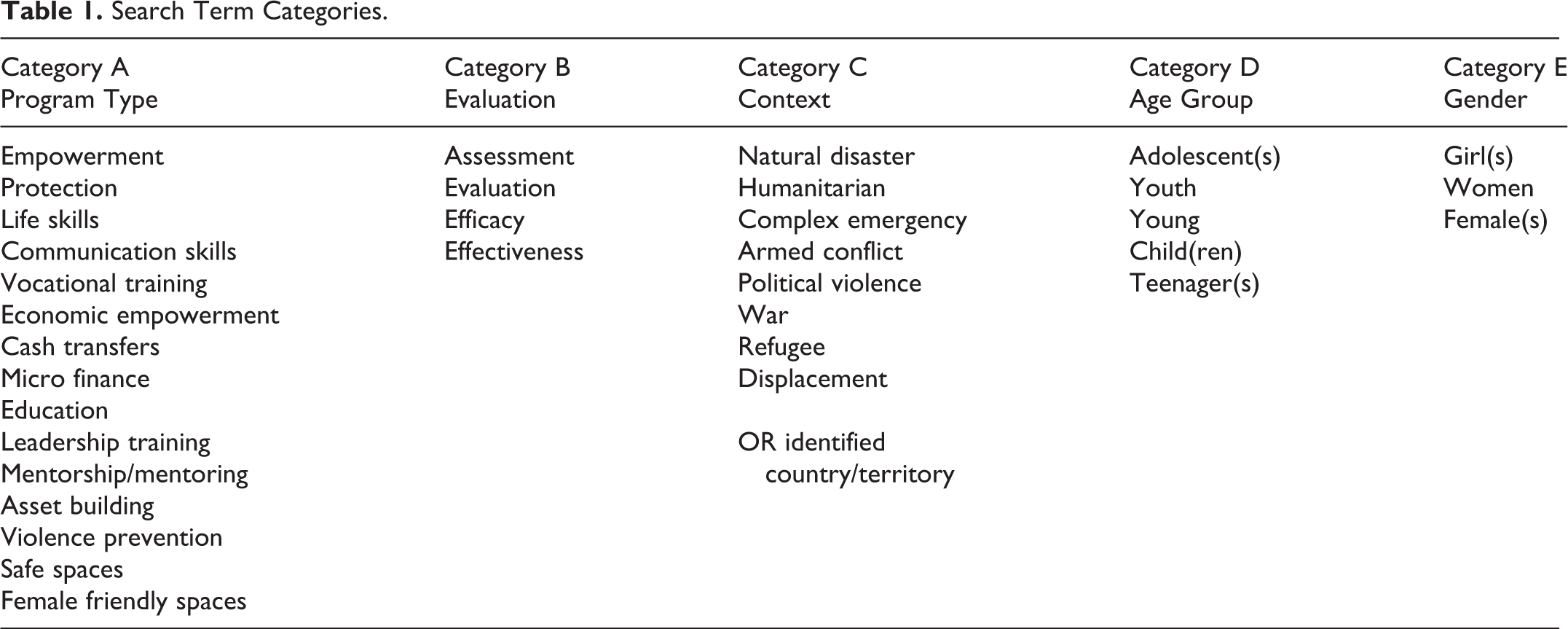
A systematic review of academic and gray literature was conducted in accordance with PRISMA guidelines that focused on programming for adolescent girls in humanitarian contexts (Moher, Liberati, Tetzlaff, Altman, & The PRISMA Group, 2009). A Boolean search procedure was undertaken based on key words for five categories: program type, evaluation, humanitarian context, adolescents, and females (Table 1). To capture a broad range of interventions, we sought guidance from humanitarian practitioners for key words and phrases to describe potential program types for adolescent girls (Category A). To comprehensively capture reports in humanitarian settings, we searched first with key words and phrases, then with a list of affected countries under the setting category (Category C). We compiled the list of countries/territories affected by armed conflict or a large natural disaster between 1994 and 2015 using data from the International Peace Research Institute (Pettersson & Wallensteen, 2015).
Search Term Categories.
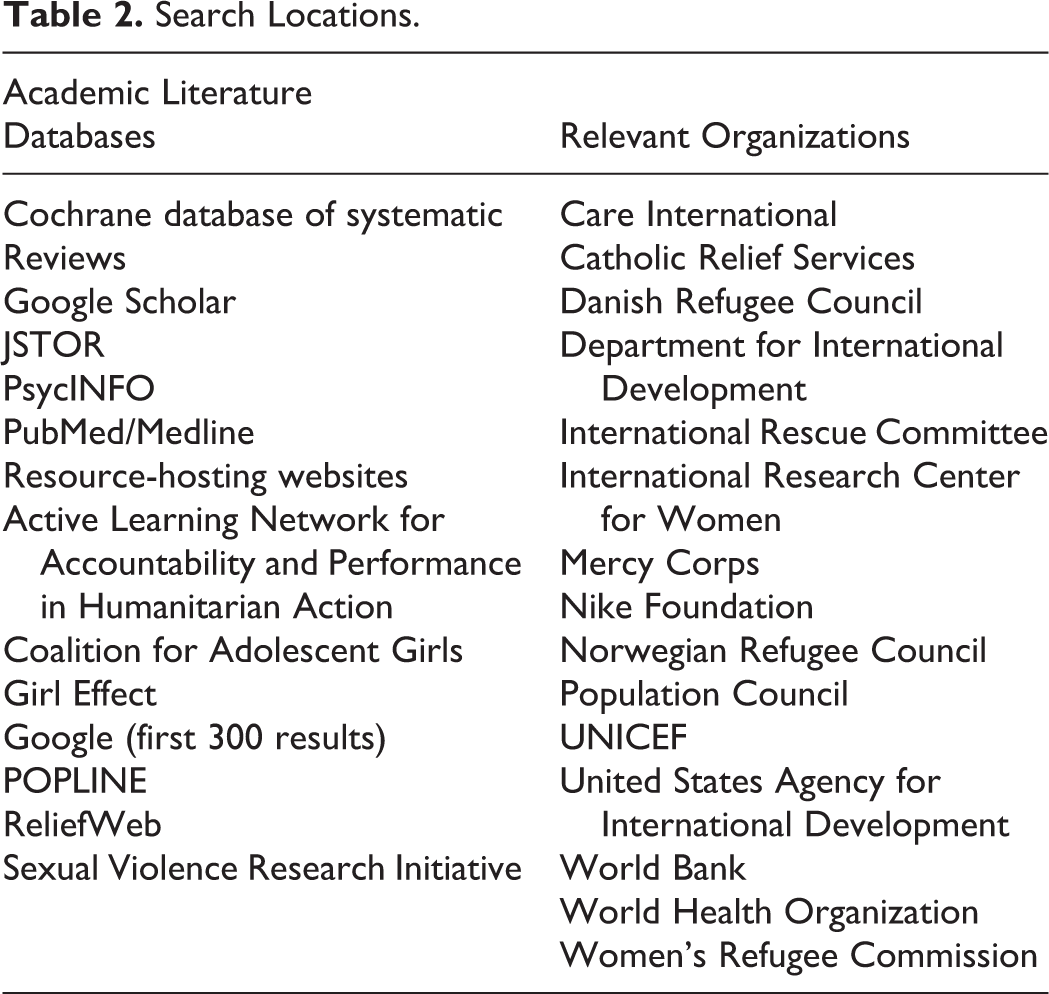
For academic literature, we searched Google Scholar and four databases of academic journals. For gray literature, websites of organizations known to provide services and programs to women and girls in humanitarian settings and websites hosting resources for humanitarian organizations were examined for reports and articles. Google search was additionally used to find nonindexed gray literature (first 300 results reviewed). Last, we sought input from key authors and field practitioners and we reviewed reference lists of relevant reviews and evaluation studies. In total, we searched of 27 web-based academic databases, organization websites, and resource-hosting websites between September 1 and 17, 2015 (Table 2).
Search Locations.
Document Review
We limited results to those that occurring after 1994. All relevant materials were considered, although articles and reports not written in English were excluded. Once potential articles, reports, and presentations were identified by our search procedures, titles, abstracts, and/or summaries were examined to see whether to determine they addressed this review’s key components. After this, we undertook a full resource review of remaining search results. We included resources if they presented quantitative assessment or evaluation results of programming (a) in humanitarian settings; (b) for females, aged 10–19; and (c) targeting any of the following outcomes: empowerment, agency, choice, violence reduction, psychosocial health, delayed marriage, risky sexual behavior reduction, or delayed childbearing. We examined programs for both sexes if there were any components uniquely delivered for girls, or if the evaluation disaggregated results by gender. We also examined programs that targeted a broader group of women and girls if there were any components for adolescents and if the evaluation disaggregated results by age. Articles missing one or more of these components were excluded.
Findings
Following our search criteria, we reviewed 5,830 records from academic journal databases, resource-hosting websites, and relevant organizational websites, out of which we assessed 46 full-text articles, reports, or presentations for eligibility. Our inclusion and exclusion criteria left us with three adolescent girl program evaluations from humanitarian settings to examine: 0 from the academic literature, 2 from the gray literature, and 1 from requesting project documents from practitioners (Figure 1). Two of these were midterm evaluations, and one was a final project evaluation. Most papers were excluded because they detailed interventions that took place in nonemergency or displacement settings, did not report an evaluation component to the description of the intervention, or did not report any quantitative data. Findings are presented in Table 3.
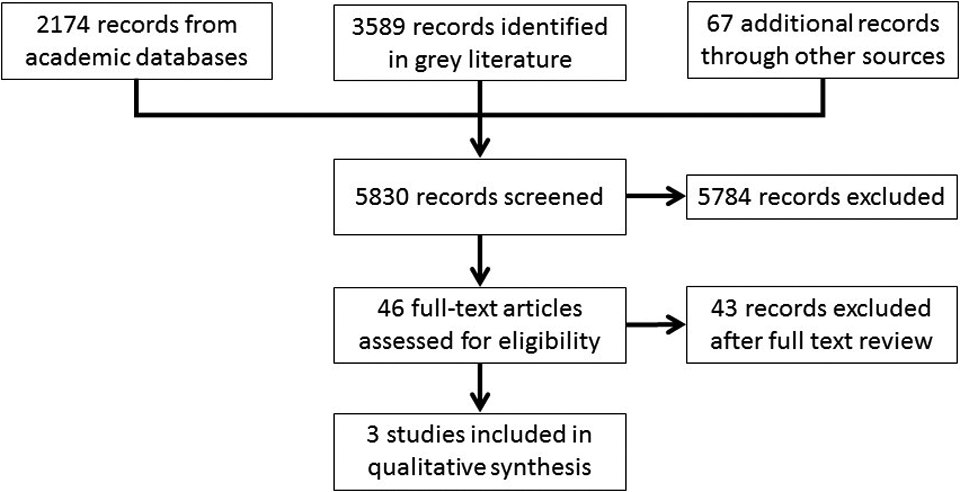
Flowchart of systematic review.
Overview of Included Studies.
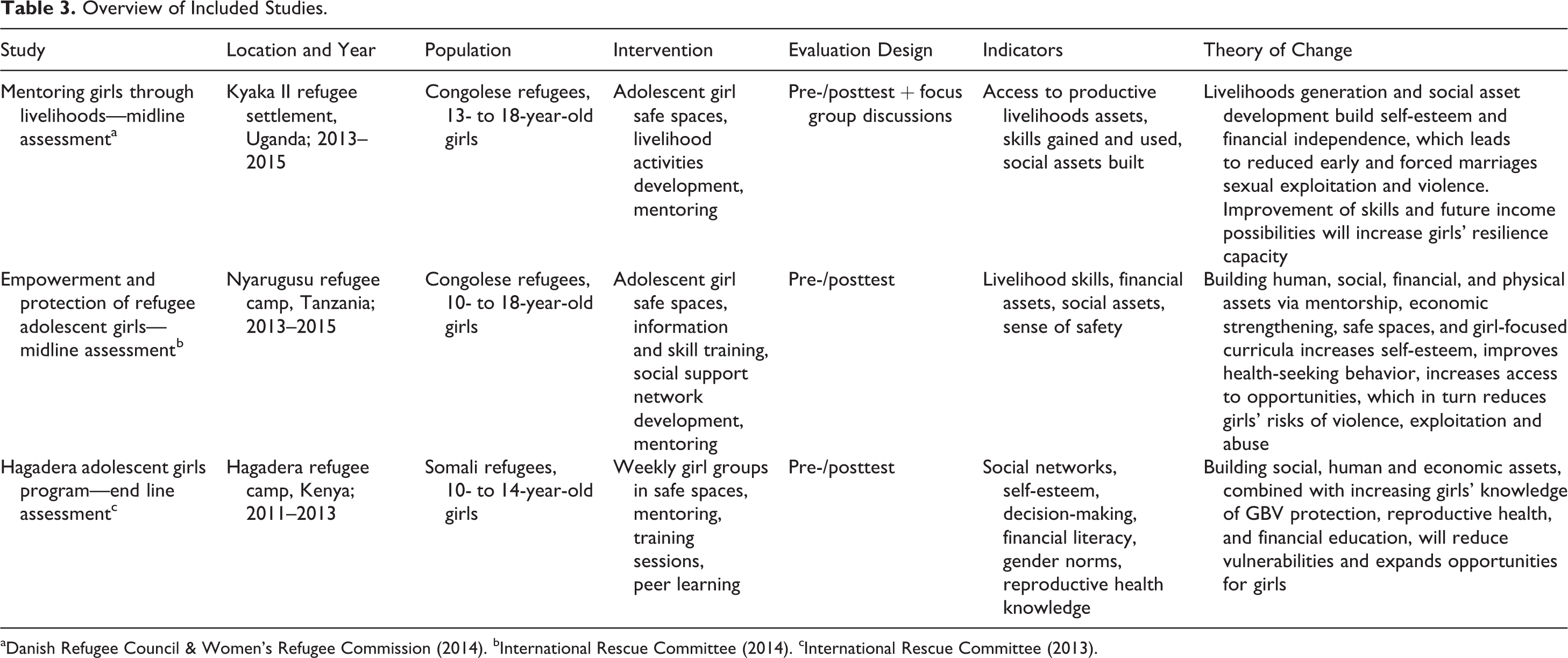
The three program evaluations took place with Congolese refugees in Tanzania and Uganda and Somali refugees in Kenya. All three evaluations were pre-/posttests without a comparison group.
The first evaluation is a midline assessment, 11 months into project implementation, of an adolescent girls project in Uganda that is part of a larger livelihoods intervention (Danish Refugee Council & Women’s Refugee Commission, 2014). The project provides safe spaces for adolescent girl to support livelihood activities, coupled with a mentoring model where adolescent girls are learning from older women who have received skills training and have improved the levels of empowerment. The objectives are to provide adolescent girls with access to productive livelihood assets and increase girls’ capacity for self-protection, in turn minimizing exposure to the threats they face. The midline assessment included a quantitative survey of 58 participants on asset development and financial empowerment and focused group discussions on the girls’ priorities for project continuation and current effects of the project activities and interviews with parents, trainers, and mentors to learn more about the changes seen in the participating girls. For the girls who remained involved in the project through midline, the assessment showed promising increases in the level of engagement in productive livelihood activities, financial savings and borrowing options, social assets, self-esteem, and preparedness to avoid and/or respond to harassment. However, one third of beneficiaries had stopped participating by midline: the main reasons included marriage and lack of parental support. This high attrition rate highlights a major challenge in providing adequate programming and support to adolescent girls and to evaluating targeted programs.
The second evaluation is also a midline assessment of an adolescent girls-focused project, in Tanzania, centered around safe spaces (International Rescue Committee, 2014). The project objectives are to increase adolescent girls’ financial and social assets and strengthen community-based protection mechanisms to better protect and empower girls. The midline evaluation took place 9 months after baseline and used a quantitative survey of a sample of 189 adolescent girl participants to measure the impact of the project on livelihoods skills, financial assets, access to safety nets, and sense of safety. This project showed promising positive increases in participants saving money, building social assets, creating plans to avoid harassment, and having improved self-esteem, but no change or decreases in girls tracking finances, or having financial assets such as options for borrowing money. As such, this evaluation provides mixed findings of project success at this point in time.
The third evaluation is an end line assessment of a program in Kenya focusing on reducing vulnerabilities and expanding opportunities for adolescent girls by increasing their social and financial assets (International Rescue Committee, 2013). As above, this program also employed safe spaces and also held weekly girl groups, mentor meetings, parent/guardian meetings, and training sessions on topics including gender based violence (GBV) prevention, reproductive health, and financial literacy. The posttest, an asset monitoring tool questionnaire, was given 11 months after the pretest. Two hundred girls participated in the evaluation. The posttest showed large increases in the percentage of girls with social assets, such as female friends, mentor, and/or safe places to spend time, increased power in decision-making, increased financial literacy, and more progressive views on gender norms and reproductive health. There were no increases in self-esteem questions; however, this is because the pretest yielded very high endorsements (97–100%), so there was little room for improvement. There were some questions within the evaluation team about the validity of some indicators, and whether poor understanding of questions or high levels of social desirability by the participants led to inaccurate data.
Discussion
Overall, this systematic review found only three programmatic evaluations at the time of search that examined girl-specific empowerment or violence reduction programming in humanitarian settings. All three study designs for the evaluations were pre-/posttests, reflecting the nascent stage of adolescent girl programming humanitarian settings. These nonexperimental designs are generally of poor quality from a causal inference perspective. However, they can be appropriate, particularly if complemented with other methodologies, including contextual analysis, participatory research methods, or other rapid pilot testing or iterative designs (e.g., continuous quality improvement models), as these can be warranted to fully articulate programmatic theories of change and to maximize program implementation before moving toward large-scale impact evaluations. Ultimately, however, rigorous evidence is lacking to understand best practices to protect and empower adolescent girls in such settings, which is similar to findings from other reviews that have examined programming to prevent and respond to violence against adult women in humanitarian settings (Spangaro et al., 2013; Tol et al., 2013).
While it is difficult to discern trends in the literature given the limited amount of available evidence, the programs identified in the review used similar theories of change and strategies, including particular emphasis on creating safe spaces, teaching livelihood skills and financial literacy, building up social assets, and conducting self-esteem building activities. These programs have the potential to inform and improve our understanding and support to adolescent girls, living in certain contexts. Future program evaluations should incorporate qualitative and quantitative methodologies to examine these potential pathways of change to determine which factors are most salient in humanitarian settings to empower adolescent girls and/or reduce their vulnerability to violence. Further, while programs detail activities and programmatic theories of change, explicit articulation of the behavioral or social change theory in programming development should also be undertaken given the nascent stage of research and programming (McCauley, Falb, & Silverman, 2010). Potential theoretical approaches that are implicitly driving existing programs include the ecological model, social cognitive theory, youth development theory, and specifically, the impact of trauma and toxic stress on adolescent development. Additional attention to the scientific theories underlying programmatic theories of change will aid in driving research questions and will assist in identifying potential gaps for future programming.
Given the limited body of evidence for adolescent specific girl programming in humanitarian settings, there are many outstanding research questions including (1) What contributing factors, such as displacement or lack of economic opportunities in humanitarian settings, drive violence against adolescent girls? (2) How can group-based programming be delivered to account for the heterogeneity of girls (i.e., married girls, girls with disabilities, girls of different ages and backgrounds) to increase effectiveness, relevance, and retention? (3) What are the most effective strategies to engage and retain adolescent girls in programming? (4) What is the incremental effectiveness of different program components such as economic-based empowerment strategies (i.e., cash transfers) or social empowerment strategies (i.e., community mobilization)? and (5) What is the impact of engagement with parents and caregivers, boys, and the community in increasing safety for girls? Similar areas for future research have been identified by a recent systematic review on preventing child marriage, including how to incorporate innovative strategies for social change into traditional programming (Lee-Rife, Malhotra, Warner, & McGonagle Glinski, 2012). While building the evidence base to answer these research questions, it is important to examine how to best conduct research with adolescent girls that is rigorous, ethical, and inclusive of girls’ voices.
This systematic review demonstrates a lack of currently available rigorous evidence to guide programming that seeks to protect and empower adolescent girls and reduce their vulnerabilities to violence or exploitation. However, current impact evaluations are currently being undertaken in part due to growing investments by the donor community, such as the UK Department for International Development and the World Bank. Research partnerships are also growing between implementing organizations and academic partners to address these glaring gaps in knowledge. For instance, the International Rescue Committee, a humanitarian aid organization, is currently implementing four randomized controlled trials in Liberia, the Democratic Republic of Congo, and Ethiopia that examine the effectiveness of adolescent girl programming (Falb et al., 2016). The World Bank is leading the Adolescent Girl Initiative, which involves impact evaluations of adolescent girl-focused programming to boost employment and assets in girls in eight low-income countries including South Sudan, Haiti, and Afghanistan (World Bank Group, 2015). In addition, the Women’s Refugee Commission is undertaking the assessments of adolescent girl programming in displacement camps in Tanzania, Uganda, and Ethiopia within the 3-year global advocacy project “Protecting and Empowering Displaced Adolescent Girls” (Paik, 2014).
Additional funding and political investments must be made to improve the knowledge base around adolescent girls in humanitarian settings and ultimately improve and scale-up effective programming. Although rigorous evidence must be generated through the implementation of impact evaluations, it is critical for these approaches to incorporate ensure that the voices of adolescent girls remain at the forefront of programming and research in settings affected by armed conflict or natural disaster.
Footnotes
Acknowledgment
The authors would like to acknowledge Abigail Erikson and Jeannie Annan in their helpful conceptualization of the article.
Declaration of Conflicting Interests
The author(s) declared no potential conflicts of interest with respect to the research, authorship, and/or publication of this article.
Funding
The author(s) received no financial support for the research, authorship, and/or publication of this article.