



Abstract
There are calls for sexual violence prevention to be more comprehensive and align with a socio-ecological approach. However, there is lack of models with specificity on how to engage additional stakeholders. Whole School Approach (WSA) frameworks have been used to address health promotion and bullying prevention and can be a useful model for guiding campus sexual violence prevention work. WSA models situate violence as a community issue and one where all community members have a role to play in prevention. Rather than focusing on addressing individual behavior, WSA frameworks address the role of the larger school environment in serving as a protective factor against violence, abuse, and harassment. A review of the literature on WSA frameworks in other disciplines reveals a number of potential ways to translate key elements of WSA models to the field of campus sexual violence prevention. In particular, mechanisms can be applied to expand the role of students, faculty, staff, parents/significant adults, institutional leadership, and the larger community.
Campus sexual violence is a major public health and human rights issue, with recent reports indicating that approximately 20% of women and 6% of men experience victimization while attending college (Cantor et al., 2015; Krebs et al., 2016). Over recent decades, institutions of higher education have developed a number of prevention efforts to address campus sexual assault and have helped to move the field forward (Banyard, 2014; McMahon et al., 2018). However, these efforts often focus heavily on changing individual student attitudes, beliefs, and knowledge related to sexual assault (Vladutiu, Martin, & Macy, 2011). Increasingly, there are calls for sexual assault prevention efforts to span multiple levels beyond just the individual and to work toward changing campus culture (Dills, Fowler, & Payne, 2016; McMahon, Wood, Cusano, & Macri, 2019) with the goal of more transformational, sustainable change rooted in a social justice lens (Harris & Linder, 2017; Hong, 2017; Sisneros & Rivera, 2018).
The need to expand sexual violence prevention efforts on college campuses, and more generally in communities, is based on the evolving understanding that sexual violence does not occur because of individual actions alone but also because of risk factors for perpetration and victimization at the peer, family, community, and societal levels (Casey & Lindhorst, 2009; Dills et al., 2016). As such, there are multiple opportunities for prevention to occur at these socio-ecological levels (Casey & Linhorst, 2009; Dahlberg & Krug, 2002; Dills et al., 2016). As noted by Sisneros and Rivera (2018), true “transformative institutional change” on college campuses that address these multiple root causes of sexual violence needs to involve key stakeholders that influence education, resources, and support (p. 96). In addition, there needs to be acknowledgment that the root causes of sexual violence are deeply interconnected with other forms of oppression and exclusion on campus such as racism and homophobia, and thus prevention efforts cannot occur in silos (Harris & Linder, 2017). A number of socio-ecologically and social justice–based models have been put forth to help guide the expansion of efforts to address campus sexual violence that include calls for more comprehensive, collaborative, and ongoing prevention efforts (e.g., Dills et al., 2016; Harris & Linder, 2018; Hoffman, 2016; Hong, 2017).
These models are helpful in providing a conceptual map for developing comprehensive approaches to prevention on college campuses. A key tenet across these models is a call for engaging various audiences and key stakeholders. However, the actual mechanisms for expanding efforts are often unclear, particularly with how to engage others beyond students. Calls for “comprehensive approaches” can seem far too general and out of reach for offices with few resources staffed by professionals tasked with both responding to and preventing assaults (Sisneros & Rivera, 2018). We need ways to bring more stakeholders and community members to the table so that comprehensive efforts do not fall on only one office or staff person and truly cut across all sectors of the college campus so that there is shared responsibility and the “embedding” of prevention work rather than just the “overlay” of these efforts (Hong, 2017, p. 32).
The Whole School Approach (WSA) can build upon existing frameworks and assist with adding specificity to more comprehensive models for addressing campus sexual assault through a socio-ecological lens, especially through providing guidance on how to engage multiple stakeholders who may not be already involved or invested in the work. The WSA can be viewed both as a framework that conceptualizes violence as a community issue and as a set of specific processes that can lead to positive change when the entire community is engaged (Wellbeing@school, 2012). The WSA has been used globally to address health promotion in elementary and secondary schools and has more recently been applied to address multiple forms of violence in schools such as bullying, harassment, sexual violence, and intimate partner violence (United Nations Girls Education Initiative [UNGEI], 2018). The underlying premise of the WSA is that violence and aggression are complex, systematic, and rooted in multiple levels, and thus one type of intervention is inadequate; therefore, schools adopting the WSA typically employ multiple strategies to address violence concurrently. In this way, it is consistent with the widely used social-ecological model of violence prevention. Adopting a WSA framework goes a step further. It means that all members of the school community have a role to play in addressing violence, even those that may not directly have a vested interest in prevention and provides some guidance about how that engagement can happen. WSA models call for these efforts to be coordinated, action oriented, and ongoing (Cowie & Jennifer, 2007; Futures Without Violence, n.d.). Rather than focusing exclusively on changing individual behaviors, whole school models use a social-contextual approach to understand how the various systems and factors within a school environment can facilitate or prevent violence and aggression (Espelage, Polanin, & Low, 2014). The WSA can also be viewed as a strengths-based framework, where rather than merely addressing problematic behaviors, the goal is to foster social–emotional development, build empathy, increase prosocial action, and build strong relationships among those who are part of the school system (Cowie & Jennifer, 2007; Espelage & Swearer, 2004). The WSA has been only minimally applied to campus sexual violence, and thus, this article draws from the larger WSA literature and explores the ways in which WSA examples can inform the more specific expansion of prevention efforts on college campuses by defining and envisioning multiple levels of engagement.
WSA Models
WSA models for addressing violence are rooted in long-standing public health frameworks that use an ecological approach to health, including the world health organization (Stewart-Brown, 2006). Throughout the years, WSA models have been used to inform strategies to address a number of issues impacting schools and more recently, to various types of violence prevention in middle and high schools given that more individual focused, and even classroom-based techniques fall short of prevention goals (Chan, Hollingsworth, Espelage, & Mitchell, 2016; Taylor, Stein, Mumford, & Woods, 2013).
Bullying prevention often uses WSA principles (conceptualizing it as a school community problem and not just focused on the bully–victim dyad; Espelage & Swearer, 2004; Olweus, 1994; Richard, Schneider, & Mallet, 2012; Sivaraman, Nye, & Bowes, 2018; Smith, Schenider, Smith, & Ananiadou, 2004). Using a socio-ecological lens, multiple components are addressed including other students, teachers, staff, administration, family relationships, classroom settings, and school climate (Espelage & Swearer, 2004, 2010; Smith et al., 2004). Rather than approaching students as potential bullies or victims, WSAs recognize the role of school context, including institutional-level factors such as policies, interactions between teachers and students, and perceptions of the general school atmosphere (Espelage & Swearer, 2010). Programs using this model work to build empathy and caring among students (Espelage, Mebane, & Adams, 2004) and strengthen relationships within the school, with parents and families, and with the larger community (Cowie & Jennifer, 2007; Morse & Allensworth, 2015). A number of studies have indicated that bullying prevention programs that involve the whole school are more effective than focusing only on the aggressor (e.g., Fonagy et al., 2009; Richard et al., 2012; Storer, Casey, & Herrenkohl, 2017).
In addition to bullying, the application of WSA principles to gender-based violence is emerging. Recent work by Storer, Casey, and Herrenkohl (2017) demonstrated that there are a number of school-level influences on whether high school students would intervene as prosocial bystanders in teen dating violence (TDV) situations, including the presence of strong and trusting relationships with teachers, perceiving that school staff possesses the expertise to handle TDV, and perceptions of effective school policies on TDV. Putting WSA into practice, Taylor, Stein, Mumford, and Woods (2013) took prevention out of the classroom and increased school staff at student identified hot spots in school buildings, redrafted school policies to increase accountability of perpetrators and resources for victims, and instituted school wide information campaigns to raise awareness about prevention.
The WSA has only been minimally applied to the issue of campus sexual violence. For example, Sisneros and Rivera (2018) provide a case study of a campus-wide effort at Colorado State University that demonstrates elements of a WSA including the engagement of key stakeholders and partners across campus including senior leaders, faculty, staff, students, and parents/families. The initiative rests on several tenets including collaboration, fostering commitment from senior leadership, providing continuous education and messaging, and conducting ongoing assessment. Beres, Treharne, and Stojanov (2019) recently also published a case study of their program at the University of Otago in New Zealand which used a whole campus approach. Their model was designed to engage all members of the university; address support, policy, prevention, and reporting; and to do so in a way that was coordinated, evidence-based, and guided by shared principles (Beres et al., 2019). The current article builds upon these examples and the socio-ecological frameworks (e.g., Dills et al., 2016; Hoffman, 2016) and draws from the larger WSA literature by further defining and exploring how to engage these levels in campus sexual violence prevention.
Multiple Levels of Engagement
One of the distinguishing hallmarks of the WSA is the importance of engaging the multiple levels of the school’s social ecology, as reflected in the Sisneros and Rivera’s (2018) and Beres et al.’s (2019) case studies, including students, faculty, staff, parents, and senior leadership, as well as the larger community in ways that are connected to a school’s mission.
Students
Other fields using a WSA have placed students at its core, recognizing that they are not only the recipients of programs and services but should be engaged as partners and critical contributors (Morse & Allensworth, 2015). Those programs that include students in engaged ways may have better outcomes (Griebler, Rojatz, Simovska, & Forster, 2014). WSA models employ strategies to engage students that move beyond a tokenistic level and encourage genuine participation where students have influence over decisions and activities rather than simply taking part in them (Storer et al., 2017). Youth can be engaged as critical contributors by inviting them to design and deliver the prevention materials themselves or to participate in curriculum development meetings (Edwards, Jones, Mitchell, Hagler, & Roberts, 2016). Other methods involve engaging peers as active bystanders, which empowers them to intervene proactively when they witness bullying or dating violence (Coker, Bush, Brancato, Clear, & Recktenwald, 2019; Espelage & Swearer, 2004; Storer et al., 2017).
Applied to the issue of campus sexual violence, the student component is the most well-developed area of the WSA thus far. For example, there is extensive research demonstrating that training students to serve as active bystanders that help to interrupt and disrupt situations involving sexual or dating violence is a key component to addressing these issues on college campuses (Banyard, 2015). Evaluation of bystander intervention programs has demonstrated a number of positive outcomes including an increase in students’ willingness to intervene in prosocial ways and to a lesser, yet significant extent, an increase in actual prosocial bystander behaviors (Jouriles, Krauss, Vu, Banyard, & McDonald, 2018; Katz & DuBois, 2013). There is also preliminary evidence that bystander approaches address social- and community-level norms around peers’ acceptance of sexual violence (Gidycz, Orchowski, & Berkowitz, 2011). In fact, recent research by Coker et al. (2016, 2017) indicates that those high schools, colleges, and universities that have bystander programs present have lower rates of sexual violence victimization and perpetration. What is more, students’ perceptions that they have influence on their campus are related to greater bystander intervention (Banyard, Rizzo, Bencosme, Cares, & Moynihan, 2018).
Another way that institutions of higher education have engaged students in efforts to address sexual violence is through peer education, both within formal programming and within informal social networks (Banyard, Moynihan, & Plante, 2007; Coker et al., 2015; Langhinrichsen-Rohling, Foubert, Brasfield, Hill, & Shelley-Tremblay, 2011; Moynihan et al., 2015). Some programs are intentionally training “popular opinion leaders” or other student leaders on campuses to receive bystander training precisely because they already hold high status on campus and can use that status to model prosocial behavior for their peers (Coker et al., 2019). Hong (2017) suggests that for more meaningful change, peer health leaders be embedded in already existing social groups on campus.
Although there is a strong body of literature on the role of students in addressing campus sexual violence, WSA models encourage exploration of potential student roles beyond prosocial bystanders and peer educators. Indeed, many of the high profile cases and attention to campus sexual assault over the past decade has been a result of student voices and activism (Krause, Miedema, Woofter, & Yount, 2017). WSA models would suggest developing a better connection between universities and student activists, finding ways to elevate their voices and include them in decision-making as stakeholders, researchers, and consultants (Maxwell, Chase, Warwick, & Aggleton, 2010; Toshalis & Nakkula, 2012). Further work is needed to explore how students can be more active in curriculum building, program creation, educational outreach, event planning, policy-making, and research (Krause et al., 2017). For example, one study of high schools found that school personnel benefited from attending prevention programming that was focused on students (Edwards et al., 2019). Building these interrelationships has rarely been explicated in prevention discussions.
In particular, if WSAs are aimed at being inclusive of the entire campus community, it is essential to seek opportunities for the engagement of students from a wide variety of backgrounds, including those from sexual and racial/ethnic minority groups, students with disabilities, and other underrepresented groups (Beres et al., 2019; Coulter & Rankin, 2017; Dills et al., 2016). Sexual violence prevention efforts have been critiqued for their exclusion of these groups, with a call for more intersectional approaches that use a social justice lens that acknowledges the interlocking nature of various forms of oppression (racism, homophobia, sexism, etc.; Harris & Linder, 2017; Hong, 2017). This should also include incorporating students from all levels of university study, from undergraduate to graduate, domestic, and international (e.g., Bonistall Postel, 2017). In the University of Otago model, a campus-wide meeting was held during the planning stages of their initiatives to gather input from students from various backgrounds (Beres et al., 2019). At Rutgers University, over 30 focus groups were conducted with students to gather their perspectives on the university’s efforts and included groups for those students who may not be well represented in surveys and/or who are historically minoritized (e.g., those who identified as Lesbian, Gay, Bisexual, Transgender, or Queer+ and students of color) as well as graduate students, international students, and commuter students (vawc.rutgers.edu).
Teachers, Faculty, and Staff
In addition to the central positioning of students in WSA frameworks, the role of teachers, faculty, and staff has been described as a critical piece of comprehensive approaches within the framework (e.g., Storer et al., 2017; Sun & Stewart, 2007). These individuals not only provide models for students, but they may also provide resources and support, intervene in incidences of sexual violence, and can help shape the larger classroom and school environment (e.g., UNGEI, 2018). Most of the research on the role of faculty, staff, and teachers comes from middle and secondary schools but can potentially be translated to the issue of campus sexual violence.
The literature on bullying consistently emphasizes the important role of teachers and school personnel in comprehensive approaches to addressing bullying both in terms of the attitudes they model and the norms they convey and by their physical behaviors. In fact, Espelage, Polanin, and Low (2014) found that across 36 middle schools, a greater commitment to addressing bullying expressed by staff and teachers was associated with less bullying, fighting, and peer victimization. Teacher and staff involvement in addressing bullying can manifest in a number of ways including their ability to intervene in situations where bullying occurs, given their daily interaction with students (Doll, Song, & Siemers, 2004; Yoon & Bauman, 2014). In addition, teacher presence at student identified “hot spots” for dating violence was more effective in reducing violence than more individualized classroom instruction for students (Taylor et al., 2013). The general trust that is developed between students and teachers also serves as a protective factor against bullying (Richard et al., 2012), and students perceive staff attitudes about issues like bullying and perceptions that staff do not approve of bullying and believe it should be stopped is associated with more positive student behavior. Staff training is also a key component of the WSA and it seems positively received by teachers (Edwards et al., 2019). Beyond training teachers as effective bystanders, teachers are also interested in effectively teaching about gender-based violence, as well as creating a safe space for students to discuss these issues (Bhana, 2015; Ollis, 2014).
The role of teachers, or faculty, has received only limited attention in the arena of campus sexual violence, despite calls for greater involvement of faculty from federal entities (e.g., Office on Violence Against Women, Department of Justice, 2017) and scholars, who have noted that faculty and staff have an important role to play by modeling behavior, reinforcing messaging, and including information about sexual violence within the curriculum (Banyard, 2015; Graham, Mennicke, Rizo, Wood, & Mengo, 2018; Hurtado, 2018; Sisneros & Rivera, 2018).
Of the limited attention granted to the role of faculty and staff in addressing campus sexual violence, much has focused on the issue of serving as “responsible employees” under Title IX, which currently requires reporting incidents of sexual assault and is focused on response, not prevention. In addition to their roles as mandated reporters, however, there are other ways that faculty and staff may be involved in sexual violence work that has not yet been explored. Sisneros and Rivera (2018) discuss the importance of providing training to faculty to explore the many ways that they can be involved in addressing sexual violence, including information about resources on their syllabi, establishing appropriate boundaries between students and teaching assistants, and letting students determine whom to partner with on group projects. For example, Humboldt State University provides web-based resources for faculty including a “syllabus statement” to raise awareness about sexual violence resources on campus (https://www2.humboldt.edu/titleix/sites/default/files/Syllabus%20Statement%20revised%20(3).pdf). The American College Health Association’s (2008) tool kit on sexual violence prevention includes a call for faculty to incorporate messages about healthy sexuality and sexual violence prevention into all levels of the curricula. Indeed, many campuses are now using “Don’t cancel that class” initiatives that invite faculty who will miss a class to replace the time with a schedule workshop on topics that include sexual violence prevention (https://offices.depaul.edu/student-affairs/about/for-faculty-staff/Documents/Dont_Cancel_That_Class_Flyer.pdf). There are also numerous opportunities for interactions between students and faculty and staff outside of the classroom, from admissions to academic advising to student activities to student affairs, which could incorporate prevention activities (Banyard, Moynihan, & Crossman, 2009). For example, the American Association of University Women offers an “Ending Campus Sexual Assault” tool kit with suggestions for faculty and staff involvement, which include encouraging educational and prevention programming on campus, bringing experts on the topic to campus, participating in faculty and staff training opportunities, and organizing or participating in awareness raising events (Lam, 2014). Innovative approaches to engaging faculty and staff have appeared in the literature as well. For example, Katz and DuBois (2013) described an effort to bring faculty, staff, and students together on one campus with a “Teach In” program which provided a forum to discuss campus sexual violence and generate ideas for taking action. Hundreds of ideas were suggested, and participants expressed overwhelmingly positive feedback about the collaborative program. Such programs also have the benefit of desiloing the academic and student affairs sides of the academy. In their commentary, Graham, Mennicke, Rizo, Wood, and Mengo (2018) outline opportunities to engage faculty and staff in this work through research (e.g., participating in campus climate survey administration), teaching (e.g., including content on sexual and dating violence in the curricula), and service (e.g., participating on campus committees or engaging in policy work). At the University of Colorado, faculty members are provided with a pencil pouch at the beginning of the year that includes tips for how they can be involved in addressing sexual violence, including suggested language for their syllabi on their role as mandated reporters, information about the impact of sexual violence on academic outcomes, and resource and referral information (Sisneros & Rivera, 2018).
Moreover, engaging campus staff is an important yet underexplored avenue for creating campus “communities of care” that influence the norms and actions on campus (Monahan-Kreishman & Ingarfield, 2018). Student affairs professionals have the opportunity to incorporate activities related to sexual violence and healthy relationships by partnering with student organizations to provide educational programs and events that build community, reflect a commitment to social justice and inclusion, and provide spaces for students to address prevention (Barone, Wolgemuth, & Linder, 2007; Landreman & Williamsen, 2018). It is particularly important for those staff working on campus on other forms of exclusion (e.g., racism, homophobia) to connect with those engaging in sexual violence prevention to collaborate to provide more intersectional approaches to the work (Hong, 2017). There are also staff who serve as significant adult mentors in the lives of students such as academic advisors, coaches, internship directors, and employers. There is evidence that coaches, for example, can have a significant impact on setting expectations for appropriate student behavior (Kroshus, Paskus, & Bell, 2018). In addition, there are ways that staff that may not be as obviously connected to developing educational opportunities for students can still have an influence. Staff from departments such as facilities, dining, recreation, libraries, student centers, and elsewhere observe day-to-day interactions among students, where they may have opportunities to intervene when they witness certain behaviors. They also have the potential to provide information, resources, and positive messaging by hanging posters, bathroom stall flyers, and brochures.
There is a continued need to find ways to bridge work between faculty, staff, and administration on these issues so that there is a unified approach (Sisneros & Rivera, 2018). Indeed, that is a hallmark of a WSA, that these efforts be intentionally integrated rather than scattered and siloed. Such integration allows for more mutually reinforcing messaging and the exposure to multiple dose messaging that is a cornerstone of effective prevention efforts. Engaging faculty and staff has the potential to help diffuse prevention messages across campus and thus decrease the single reliance on campus victim service offices who are often charged with delivering prevention and education while also often providing crisis intervention and supporting survivors. In order to increase faculty and staff engagement, specific trauma-informed sexual violence training may be required as well as guidance about self-care (Finley & Levenson, 2018). In addition, various types of support may be needed to encourage their involvement, such as providing protected time as well as credit or recognition for this type of work (Graham et al., 2018).
Institutional Leadership
In addition to the role of teachers, faculty, and staff, it is clear that the role of the school’s administration is critical in WSA models (Orpinas & Horne, 2009; Sisneros & Rivera, 2018). School leaders set the tone for the community, helping to shape the school ethos and climate, creating and implementing policies, and providing direction for students, staff, and families. Engaged and effective school leadership is a key element of the WSA in a number of models (e.g., Our Watch Respectful Relationships Toolkit, n.d.; UNGEI, 2018). While school leadership is critical in conceptual models, there is less empirical research available about what their specific role in whole school and socio-ecological approaches to student well-being looks like. Here again, WSA approaches for addressing other problems are relevant. In high schools, principals who were engaged, inspiring, and effective leaders emerged as a consistent theme in low-violence schools through their influence on the mission, philosophy, and awareness of issues in the school (Astor, Benbenishty, & Estrada, 2009; Li, Chen, Chen, & Chen, 2017; Meyer, 2008).
There have been a number of calls for college administration to play a visible role in addressing campus sexual violence. For example, under the Obama Administration, the White House Task Force (WHTF) to Protect Students from Sexual Assault (2014) issued a guide for university and college presidents, chancellors, and senior administrators on preventing and addressing campus sexual misconduct (The White House, 2017). Actual research on the role of administrators in addressing campus sexual violence is almost nonexistent. One study by Sulkowski (2011) found that college students’ trust in campus authorities was a significant factor in predicting whether they were willing to report a peer who threatened to commit an act of violence. Banyard (2011) and McMahon (2015) suggest that attitudes and behaviors of community leaders may be an important area for bystander intervention within the context of sexual violence but present this conceptually not empirically. While the need for institutional leadership appears clear, there are a number of barriers to achieving this. Some leaders may be on board with openly discussing sexual violence, but others may be hesitant due to a number of institutional concerns such as reputation and subsequent enrollment, litigation by students who believe they were treated unfairly, or the issue of resource allocation or lack of their own knowledge about the issues (Levine, 2018). McMahon et al. (2018) suggest that these concerns be addressed openly and head on at the beginning of the planning process. Sisneros and Rivera (2018) describe “coaching up,” whereby those individual working directly with survivors (such as counselors and advocates) can help educate senior leaders to better understand the issue and impact on students. This includes ensuring that senior leaders are equipped with data, anecdotes, and language/talking points to accurately communicate about the issues to students and the greater campus community. Faculty involved in research can make sure that studies like campus climate surveys include key measures of variables that are central to a campus’ mission like academic persistence and intent to continue at the institution, variables that are central to the concerns of administrators. Once senior leaders have an understanding of the topic, they are better able to create, support, and sustain needed services, procedures, and policies (Sisneros & Rivera, 2018). In addition, bringing marketing, communications, and admission representatives to the table to discuss the messaging around the initiatives can help address institutional concerns. For example, framing an institutional commitment to addressing sexual violence as a form of leadership can be viewed as a way of demonstrating institutional strength. In her work, Freyd talks about moving from “institutional betrayal” (a perception that the institutions has failed to prevent or respond in supportive ways to sexual violence) to “institutional courage” by engaging (Freyd, 2018). Hong (2017) cautions that without institutional ownership that includes necessary resources as well as multiple champions, this type of comprehensive approach will not be sustained. This work should also attend to what campuses are doing well, helping to message strengths as well as challenges.
Involving administration is an area that needs further conceptual and empirical work on college campuses. This can include determining how visible and vocal key campus leaders are in addressing campus sexual violence (e.g., through communication with the campus community, attending events), monitoring the weight of the administration’s commitment to the issue (e.g., determining what types of human and monetary resources are allocated to address campus sexual violence, whether the issue is included as a priority in strategic plans and visionary statements), examining the content of policies (e.g., are there clearly articulated policies in place, is there training provided to members of the campus community?), and exploring whether the leaders are perceived as supportive by members of the campus community.
Parents/Significant Adults
WSAs emphasize the role of parents as an integrated arm of prevention. In health education research, parents are an integral part of a framework to promote health in school, with ongoing links between parents and the wider community to ensure their views and opinions are heard (Thomas & Aggleton, 2016). In several studies parent and school connectedness, including improvements in parent–child communication and resources provided by the school to encourage help seeking, buffered adolescents from the impact of violence exposure on violent behavior and demonstrated the protective mechanisms parents have on violence prevention (Lester et al., 2017).
Focused specifically on campus sexual violence, research is limited, despite the fact that groups such as the CDC have explicitly named them as needing to be engaged in prevention (Dills et al., 2016). As opposed to high school students, college students are legal adults, and especially in the United States, many are living away from home and far away from close parental monitoring. While federal laws prohibit much communication with parents about specific individual students and their experiences on campuses, these regulations do not prohibit broader outreach and education to coach parents into being prevention partners. Yet, parental communication, especially in the age of cell phones, is easy for college students. While in some cases parental involvement can be negative, literature on health behaviors indicate it can be an important variable in reducing problems like sexual risk behaviors and promoting sexual health among late adolescents and emerging adults. At the high school level, one of the most well-known dating violence prevention curriculum, safe dates, has been expanded to including training for parents with some success (Foshee et al., 2012, 2016). Indeed, parents of college students often express their concern about sexual assault on college campuses (Vaughan, Limas, McKean Blackwell, Klann, & Robbins, 2017). In response, some campuses are engaging parents directly. For example, Testa, Hoffman, Livingston, and Turrisi (2010) provided parents of incoming first-year college women with a handout about alcohol and sexual assault and some discussion points for them to potentially raise with their college bound daughters. In a randomized control trial, daughters of parents who received the information reported lower rates of sexual assault during their first semester on campus than the control group in part because of better parent communication (Testa, Hoffman, Livingston, & Turrisi, 2010). To date, this is the only study of a parent engagement–focused prevention strategy for college students that we could identify and thus further work is needed. For example, while the Testa et al.’s (2010) study focused on providing information to daughters, there is a need to provide prevention messaging to sons as well. Materials on how to talk to sons and daughters could be put on the increasing number of parent information portals that universities have. They can be included in packets sent home along with enrollment and financial aid forms. Sisneros and Rivera (2018) described communicating with parents about sexual violence prevention through a family website, during student orientation, resource fairs, and newsletters. Evaluation will determine the most effective strategies for engaging parents, caregivers/significant adults, and families.
Community Partnerships
Focusing on individual behaviors and beliefs alone is not enough to prevent violence, and it is recognized that initiatives using the WSA model cannot accomplish their goals without community support both within the campus community and with the wider community (e.g., local rape crisis centers, domestic violence agencies youth-serving agencies, faith-based organizations, and other community organizations; Maxwell et al., 2010; Morse & Allensworth, 2015). Despite the importance of these partnerships, there is evidence that this is an underdeveloped area for implementation. In Langford et al.’s (2014) Cochrane review of 67 studies using the Health Promoting Schools (HPS) framework for improving the health and well-being of students, they found that engaging communities was the least addressed domain in the studies of primary, middle, and high schools.
In the field of campus sexual violence prevention, there is more literature available on addressing the community within the campus than outside the campus. For example, Potter, Stapleton, and Moynihan (2008) have published a number of studies indicating the effectiveness of social norms marketing across campus as a form of prevention. Other scholars have highlighted the importance of a sense of community on campus and perceptions of having influence in the community in promoting a sense of responsibility and caring for one another (Banyard, Edwards, & Siebold, 2017; Banyard et al., 2018; Edwards, Mattingly, Dixon, & Banyard, 2014). Consideration of both the informational and physical environment on campuses have been raised as issues that need further exploration as well (McMahon, 2015), which is consistent with WSA frameworks in fields such as bullying and violence prevention in high schools that emphasize the importance of identifying “hot spots” where victimization may occur, as well as considering the presence of monitors (both human and mechanical) to limit opportunities for aggression and promoting positive behavioral expectations through messaging (Astor, Meyer, & Pitner, 2001; Taylor et al., 2013). The underlying principles of considering environmental design may be useful for campuses to consider, yet adaptations will be needed to account for differences between primary/secondary schools and college campuses, such as campus geography, expectations for faculty versus teachers, developmental stages, and level of autonomy and realistic resources for physical capital improvements.
The need to engage with communities beyond the campus to address sexual assault has been advocated on a conceptual level (e.g., American College Health Association, n.d.; Centers for Disease Control and Prevention [CDC], 2014; WHTF to Protect Students from Sexual Assault, 2014), but there is a lack of descriptive work or empirical findings. In addition, most of the work on the involvement of community-based organizations relates to response and not prevention. For example, there is abundant evidence that students tend neither to report to campus offices nor to seek assistance on campus (Sabina & Ho, 2014), so providing options for off-campus services is crucial. Through their study, Javorka and Campbell (2019) demonstrate a need for collaborative models between campus- and community-based advocates. In addition to response, specialized organizations such as rape crisis centers often have expertise that can assist with strengthening school’s prevention efforts through training for teachers, staff, and students and implementing prevention initiatives. It is also important for prevention messages to be reinforced in both schools as well as the places where community members live and socialize in order to reflect a truly socio-ecological approach (CDC, 2014).
In addition to partnerships with key external community stakeholders such as rape crisis centers, there is value in collaborating with local businesses as well. For students at many universities, socializing occurs off campus at bars and clubs where sexual violence and aggression is likely to occur, often with impunity (see Graham, Wells, Bernards, & Dennison, 2010; Powers & Leili, 2016). A number of initiatives have been introduced to train bar staff in how to serve as effective bystanders in intervening to prevent sexual violence such as the “safer bars” intervention (Graham, Bernards, Osgood, Homel, & Purcell, 2005). In addition, building relationships with local residents can help create a stronger sense of community, which is a protective factor against sexual violence. Residents of local municipalities may have opportunities to witness situations where they can intervene and/or can collaborate in prevention and awareness events such as Take Back the Night.
Despite the potential significance of campus and community partnerships, there is little known about their implementation and effectiveness, and a call for further research in this area has been issued (McMahon et al., 2018). This can be challenging due to a number of factors such as competing community/campus priorities, limited resources, territorial issues, distrust by community members, and more (Levine, 2018). Ultimately, evaluation is needed to determine the effectiveness of community collaboration on responding to and preventing campus sexual assault (McMahon et al., 2018).
Pulling It All Together: Implementation and Integration
Evaluation of WSA in other fields indicates that implementation of schoolwide, comprehensive approaches face numerous challenges (Goldberg et al., 2018). Planning, infrastructure, capacity, and buy-in are needed for success, yet are often missing (Goldberg et al., 2018). Thus, these factors need to be carefully considered prior to adopting a WSA to campus sexual violence. An important starting place is developing a team to guide efforts as a key factor to success identified across WSA models is collaboration—throughout the process—including designing, implementing, and evaluating initiatives. This insures that a key component of WSA, and one that differentiates it from the broader social-ecological model, is actualized—that the cross-level efforts are integrated and coordinated (e.g., Hunt, Barrios, Telljohann, & Mazyck, 2015; Lewallen, Hunt, Potts-Datema, Zaza, & Giles, 2015). For example, in order to plan their WSA to campus sexual violence, The University of Otago Model utilized a collaborative approach between academic researchers and staff who worked on issues of sexual violence and then consulted with over 100 staff and students to gather for a full day to gather their input into the design of the initiative (Beres et al., 2019). The University of Colorado Model suggests a first step to introducing comprehensive initiative is identifying key stakeholders on campus and conducting an audit of existing relationships to determine how various individual perceive their roles and responsibilities, where gaps lie and how collaborations can be strengthened (Sisneros & Rivera, 2018).
The integration of efforts by different entities is a key component of WSA models. One way to work toward an integrated, collaborative approach is to use a Coordinated Campus and Community Response (CCR), which is a multidisciplinary group of stakeholders and community partners who meet regularly to assess, plan, and evaluate campus prevention and response efforts (Office of Violence Against Women [OVW], n.d.; WHTF to Protect Students from Sexual Assault, 2014). The OVW Campus Grant Program has put the formation of CCR Teams at the center of work that funded campuses must engage in to create culture change on campuses (Carlson, Quiason, Doan, & Mabachi, 2018; U.S. Department of Justice, 2019 OVW grantees form teams that include key partners on- and off-campus and that they work collaboratively for a holistic approach that includes not only response but prevention (U.S. Department of Justice, 2019). The Campus Program Solicitation is specific in that it requires that the response involves the entire campus, reflecting the wide variety of organizations that are involved in campus life, as well as the larger community in which the campus is located. Partnerships must consist of collaborative efforts between the campus and at least one local nonprofit or nongovernmental organization, and a criminal justice or civil legal agency (U.S. Department of Justice, 2019). As an example of how an OVW grantee has implemented this model, Humboldt University created a Sexual Assault Prevention Committee that is comprised of representatives from throughout the university as well as off-campus agencies whose charge it is to coordinate education and prevention programs and to advice the vice president for student affairs (https://senate.humboldt.edu/sexual-assault-prevention).
This work can potentially move beyond one campus as well. For example, Olomi, DePrince, and Gangno (2019) put forth a similar model to create a regional multidisciplinary team that included representation from campus, criminal justice systems, and community-based organizations to meet monthly to coordinate efforts. While this model focused mostly on responding to sexual violence, there are ways that this type of group may be able to introduce prevention as a part of its agenda as well. The authors noted that there were numerous benefits such as information-sharing and increased collaboration, yet also challenges such as turnover, buy-in, and finding ways to develop shared goals across different agencies (Olomi, DePrince, & Gangno, 2019).
There are a number of other challenges to consider with implementing WSA initiatives on a college campus. As with any new initiatives, there may be resistance to engaging in prevention, as faculty, staff, and administrators may already feel overwhelmed with the amount of work they have or view prevention not as part of their responsibility. Strategies shared to address this resistance shared by those working to implement WSA programs related to bullying include finding ways to educate members of the community about the problem by sharing data on the prevalence and impact of bullying with staff, teachers, and parents (Limber, 2004). On college campuses, this would mean providing information to the campus community and parents about the prevalence and impact of sexual violence. Campus climate surveys are conducted at many institutions of higher education, but the dissemination of findings can be expanded to the entire campus community as well as by creating more “accessible” forms of sharing data such as infographics. The data on these problems can be paired with ways that individuals can become involved in finding solutions. Highlighting the importance of integrating these other personnel may also create momentum to ensure that they are rewarded for work in this area in annual reviews and promotion considerations.
Another challenge to successful implementation is that there are still individuals who may be expressing beliefs that are skeptical of the issue, rape supportive, victim-blaming, or otherwise counter to the efforts to prevent sexual violence. One of the key ingredients identified by successful WSA efforts is to have consistent messages from all levels (Sisneros & Rivera, 2018). Beres et al. (2019) acknowledge that staff who either implicitly or explicitly express rape-supportive beliefs or fail to address sexual violence can undermine their larger campus efforts, and thus “education for all” is a tenet of the approach at the University of Otago, which includes a series of professional development programs for staff on how to appropriately respond to disclosures.
There still remains the issue that those engaged in the WSA, whether faculty, staff, institutional leaders, or parents and significant adults, can be the ones who are committing the offenses. While this is likely impossible to avoid, it speaks to the need for true whole campus approaches to include clear policies that lay out expectations for faculty and staff behavior (Sisneros & Rivera, 2018), anonymous and confidential reporting options, grievance processes that are fair and transparent, and other best practices for responding to sexual violence.
Limitations and Next Steps
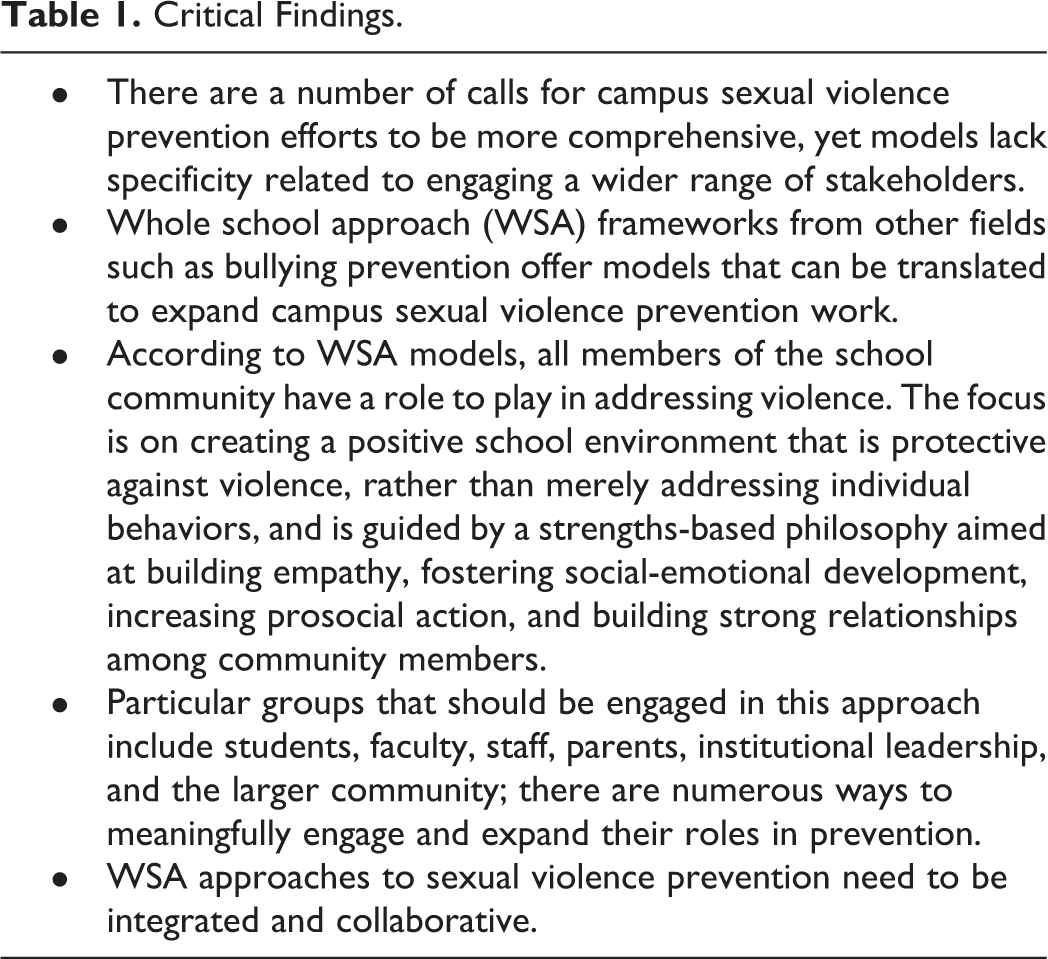
The current article focused on expanding the various levels of campus communities to be involved in addressing campus sexual violence (see Table 1). This is a critical next step for the field to consider in building more comprehensive, coordinated approaches to both response and prevention efforts. Further work is needed on the process of how to effectively engage these various partners for a sustained amount of time to implement meaningful change (see Table 2 for implications for research, policy and practice). Culling specific examples of successful mechanisms for engaging in this work is needed, as is evaluation. Many of WSA examples, such as bullying, take place in primary or secondary schools, and it is not yet clear if and how strategies can be adapted to be successful on college campuses, where the geography, developmental stage, and level of autonomy are quite different. In addition, college campuses vary in potentially important ways such as location (rural versus urban), commuter versus residential populations, the presence of not of athletics and Greek systems, and other variables. Work is needed to determine how WSA models can be adapted to fit these various settings.
Critical Findings.
Implications for Practice, Policy, and Research.
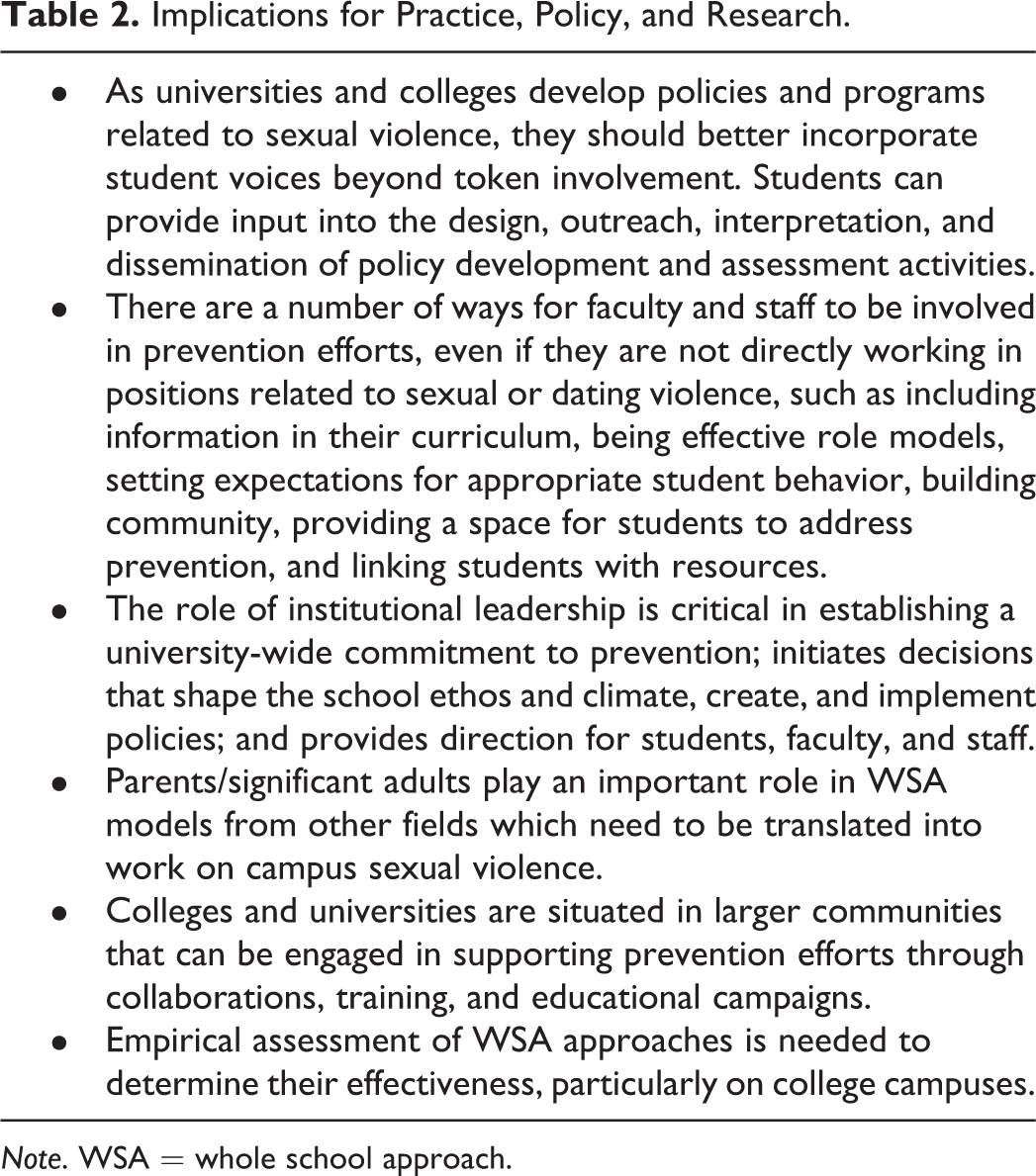
Note. WSA = whole school approach.
In addition, the inclusion of additional partners is just one more step in creating whole school responses to sexual violence. Other critical components of WSA models involve the development of school wide norms, a school ethos, and curricula that reflect the values of the institution (Thomas & Aggleton, 2016). Future efforts to translate WSA frameworks to the context of campus sexual violence can explore the mechanisms by which engaging multiple partners can influence these key outcomes. It will be essential to also determine other factors that may facilitate or inhibit WSAs, including the level of institutional commitment and readiness to change; resources (financial and human capital); and local, state, or even federal policies; and political and social contexts.
Additionally, while sexual violence served as the focus of this article, other forms of violence and harassment on campus need to be addressed. Ideally, comprehensive approaches to campus sexual assault would also include avenues to partner with those working on related issues such as dating violence and alcohol use, homophobia, racism, and other forms of discrimination, and develop interdisciplinary, integrated, and intersectional approaches to address these issues (Harris & Linder, 2017). Next steps of comprehensive approaches need to also address the experiences of faculty and staff in addition to students—not just in their role in serving students but also their own experiences with sexual violence. Increasingly, institutions of higher education are administering campus climate surveys not only to students but also to faculty and staff.
Lastly, while WSAs conceptually offer promise, there is a need for further empirical action to assess effectiveness. Currently, there exist few evaluations and those that are available provide mixed findings. For example, Langford et al. (2014) conducted a review of 67 trials of schools using the HPS framework to achieve a variety of outcomes (e.g., physical activity, smoking, bullying, and nutrition) and found mixed results. The authors cite a number of methodological challenges and suggest more rigorous assessments in the future. To date, there is no known evaluation of comprehensive, WSAs to campus sexual violence. This would be an important next step, especially if able to correlate the approach with key outcomes such as students’ perceptions of the campus and experiences of victimization and perpetration.
Footnotes
Declaration of Conflicting Interests
The author(s) declared no potential conflicts of interest with respect to the research, authorship, and/or publication of this article.
Funding
The author(s) received no financial support for the research, authorship, and/or publication of this article.
