



Abstract
The significant role of the community in the lives of children and youth at-risk has become increasingly clear to social work academics and professionals over the last three decades. Alongside the more traditional individual and family responses, community interventions have been designed to catalyze change in the environment of children and youth at-risk and supply holistic and sustainable responses to their needs. Ten such community intervention programs were identified from the United States, Australia, Canada, and Israel. Most employed the community development model, focused on developing leadership and social capital (improving community networking) and advancing coordination between the organizations and sectors in the field of risk among children and youth. The diverse programs reviewed focused both on at-risk children and youth in general or specifically on child abuse and neglect. The programs originated from different health, education, and welfare disciplines and sponsoring authorities. The majority were funded originally by private foundations; however, government involvement was significant, particularly in the adoption and support of initiatives after their development. The current analysis of the programs refers to core issues that arose from the review: professional orientation, main target unit, main initiator, and research and evaluation. Analysis of program characteristics enables identifying relevant aspects of these programs for use by policy, governmental, and nonprofit sector stakeholders seeking to develop similar programs. Conclusions and recommendations to advance the field are suggested considering the current context of government cuts in welfare funds.
Keywords
Over the years, the majority of intervention and prevention efforts in the area of children and youth at-risk has focused on the treatment of children and families (Mikton & Butchart, 2009). Yet, in the last two decades, the importance of the community and neighborhood context and its influence upon the health and welfare of children has become increasingly clear (Sampson et al., 2002). A growing body of research reports that negative structural variables such as low socioeconomic status and population turnover increase crime levels and harm the well-being of children (e.g., Coulton et al., 1999, 2007; Sampson, 2003), whereas constructive community aspects such as social involvement and social capital can affect these indices positively (e.g., Morenoff et al., 2001; Raudenbush & Sampson, 1999). Interventions at the community level have been developed to address these diverse health and welfare issues (Corsaro & McGarrell, 2010; Lu et al., 2012; Sampson, 2003). Negative forces in the community are also likely to influence well-intentioned parents; hence, community development can become a locus of support for parental functioning. Public funds, therefore, can be more effectively invested using strategies that try to affect the community level, especially as those might harness other community resources (such as volunteers, philanthropy, private business, and so on) to the usually limited (and shrinking) resources of the social welfare systems.
Historically, the field of prevention of risks in children’s lives focused on identifying risk factors and intervening according to needs at the individual and family level. Since the 1970s, the role of the community in preventing child abuse has merited increasing attention. Community programs have demonstrated potential for improving the lives of individuals, strengthening families, and decreasing tension between parents, residents, and service providers (Sampson et al., 2002). In comparison to findings focused on the individual alone, a holistic approach that takes into account, together with individual and developmental aspects, environmental and community factors, is expected to bring sustainable change in child protection. Barry (1994) claimed that theory and practice demonstrated that the individual–community relationship exists in central pathways; hence, strengthening neighborhoods is essential, particularly for low-income families with low mobility and few connections outside their neighborhood.
Over the years, focus on the community and neighborhood has heightened, particularly in communities whose populations have multiple needs and are resource poor (Molnar et al., 2016). In 1993, the National Academy of Sciences recognized the direct, mutual relationship between the individual and the community in the context of abuse (National Research Council, 1993). Since the early 1990s, many American foundations, led by the Annie E. Casey Foundation, supported community initiatives in poor neighborhoods throughout the United States (Kubisch et al., 2011).
Children and youth both are affected by neighborhood conditions. Poverty, for example, affects children across the age spectrum in poor quality housing, food scarcity, and inadequate public resources. In a study of children and youth in urban U.S. neighborhoods, similar macrostructural factors including poverty rates, demographics, and proximity to other high poverty neighborhoods were found to contribute to a range of child and youth outcomes, including child maltreatment, high school dropout, and teen childbearing (Coulton et al., 1995). At the same time, there are accumulating findings regarding the benefits community-building process have on youth positive development, well-being, and resiliency (Brennan, 2008).
In this review, we selected and analyzed 10 community programs designed to respond to the needs of children and youth at-risk. It should be noted that initially, this review was written for the Israeli Ministry of Labor, Social Affairs, and Social Services to guide police planning; hence, we used the accepted definition in Israel for children at-risk: “Children up to the age of 18 who live in family and environmental conditions that endanger them, resulting in a compromised ability to realize the following rights under the covenant of the rights of the child: physical existence, health and development, belonging to a family, learning and acquiring skills, mental health and welfare, social belonging and participation, protection against dangerous behavior from others and from themselves” (Schmid, 2006). The definition for the current review brings together the contexts of both child abuse and neglect, as well as other potential risks such as risk behaviors (i.e., delinquency, addictions). While these contexts in many cases are regarded as distinct, both contexts present risks for children and youth and in many cases have are strongly correlated (e.g., Fergusson et al., 1997; Smith and Thornberry, 1995; Wilson and Widom, 2010). For this reason, we believe it can be useful to adopt this definition in this review. Accordingly, please note that when we refer to children at-risk, we refer also to risk for child abuse and neglect.
The aim of this study was to analyze prevention and intervention programs for children and youth at-risk which are implemented and involve a change at the community level. The study intends to broaden the current limited knowledge base that will allow the development of more informed and improved interventions and policy in the area of children and youth at-risk. The literature review will provide the context of community programs as a preventive intervention.
Literature Review
The majority of community programs emphasize mutual connections existing among the behavior of the individual or family and the broader contexts of the neighborhood, community, and culture, connections that are supported by a number of central theories such as the ecological systems theory (Bronfenbrenner, 1979, 2005), person-in-environment theory (Hare, 2004; Konart, 2002), and also related to other theories including social capital theory (Putnam, 1995), and social disorganization and collective efficacy theory (Sampson, 2003; Shaw & Mckay, 1969). These theories provide the framework and rational for the development of interventions at the community level, and why we would expect a change at the community level will be associated with outcomes at the individual level.
Research on the influence of neighborhoods on the development of children and the support of parents has expanded over the past two decades. Neighborhood environments have been reported to influence behavior and outcomes of families and children, either promoting the health and welfare of children or putting them at physical, psychological, and developmental risk, depending upon their composition and quality (Daro & Dodge, 2009). Community influence on the level of risk for children and youth was apparent in the significant differences found in the rates of abuse, neglect, and violence in neighborhoods that have similar structural characteristics such as low socioeconomic status or high concentration of immigrants (Finkelhor et al., 2010; Sampson et al., 1997). Researchers explain these differences in rates of risk, by pointing to the quality of the social relationships and social capital in the neighborhoods, in other words, to the community character and resources (Coulton et al., 1999; Molnar et al., 2003; Sampson, 2003).
Several studies continued the pioneering work of Garbarino and Sherman (1980) that first demonstrated the potential effect of a neighborhood’s social characteristics on rates of abuse and neglect. Neighborhoods with similar demographic characteristics had very different rates of abuse and neglect (Garbarino & Kostelny, 1992; Molnar et al., 2003; Molnar et al., 2016), which held true after controlling for the neighborhoods’ structural characteristics (Coulton et al., 1995, 1999; Freisthler & Maguire-Jack, 2015). These findings point to the possible effect neighborhoods’ social characteristics might have in buffering some of the effect structural characteristics have on children and youth potential risks.
Accordingly, more recently neighborhood social cohesion was found to be a protective factor for some acts of neglect (Maguire-Jack & Showalter, 2016). In another study with mothers, positive perceptions of community social control were found to be related to lower physical assault and high community involvement was found to be associated with lower psychological aggression (Kim & Maguire-Jack, 2015). Earlier studies have found greater collective efficacy was correlated with lower rates of violence, even for neighborhoods with more complex structural characteristics such as high poverty rates (Morenoff et al., 2001; Sampson, et al., 1997).
A model proposed by Coulton and colleagues (2007) suggests social processes in neighborhoods are likely to influence the level of risk to children because they mediate between structural characteristics and levels of risk, among other reasons. They claim that high social organization and collective efficacy in neighborhoods is a predictor for greater support of families and encouragement of social and behavioral norms that lead to fewer occurrences of child abuse. In contrast, lower levels of social control reduce social solidarity and social ties between neighbors, as well as collective efficacy and the capability of neighbors to share information about and monitor situations of risk to children. Hence, theory and research indicate clearly on the importance of the community in the lives of families and children and that getting parents involved in their communities can improve the environment in which children and families develop, decrease risks for children and youth, and promote healthy and positive parenting and environment in general (Kim & Maguire-Jack, 2015; Maguire-Jack & Showalter, 2016). Thus, it is clear that community intervention has the potential to help families whose children are at-risk and to foster safer and more positive environments for them.
As research in the field develops, the demand for community interventions to reduce risk for children and youth increases (Molnar et al., 2016; Sampson, 2003; U.S. National Research Council, 1993). Community interventions come in a variety of models and practices such as development of social capital, community development, services planning, and community organizing (Auspos, 2012; Rothman, 2007; Weil & Gamble, 2005). Community development strategy (Rothman, 2007) assumes that change comes from empowering residents, empowerment through which residents acquire knowledge and develop skills to understand their situation and work together to overcome their challenges. According to Rothman’s model, development of social capital is a strategy that contributes to creating relations and social networks between individuals and elements in the community. Its positive outcomes are creating norms of mutual assistance, cooperation, and trust among community members and developing a feeling of personal and collective responsibility. Furthermore, some community intervention strategies are also anchored in the model of services planning (Rothman, 2007), which seeks to develop and improve the quality of available services, to bring them to be accessible and suitable to meet the local needs of community members.
Study Method
In order to advance the scarce literature regarding community interventions for children and youth at-risk, this study had three main aims: To identify and review 10 such programs as defined by the criteria bellow. To point on core issues that rise from the programs’ review. To suggest implication for practice, policy, and research.
Internet Search
The program search included two parts: a web search using keywords and screening of content. The search included not only academic published studies but also unpublished reports and program descriptions. Thus, we used a general online search, using Google search as our primary search engine and not Google scholar. We used the following combination of keywords in English and Hebrew: “community organizing,” “community development,” “youth at-risk,” “children at-risk,” “child abuse and neglect,” and “child maltreatment.”
Content Screen
We identified programs that met three main criteria: (1) the intervention targets were children at-risk (as defined above); (2) the intervention had an explicit and broad use of community development strategy (Rothman, 2007) and an interest in implementing change at the community level (though in many cases other methods were used too); and (3) the intervention had documentation which was published online or in academic publications. Programs were not included in the review if they were too small scaled or had only negligible actual community involvement.
Expert Verification
After identifying an initial list of eight programs meeting the criteria, the list was sent to six colleagues from various countries (United States, England, and Australia) in fields related to communities and children and youth at-risk to ask whether they could identify any other relevant programs. The expert consultants identified two more programs. A list of the ten final programs and short dissipation is brought in Table 1.
Ten Community Intervention Programs for Children and Youth At-Risk.
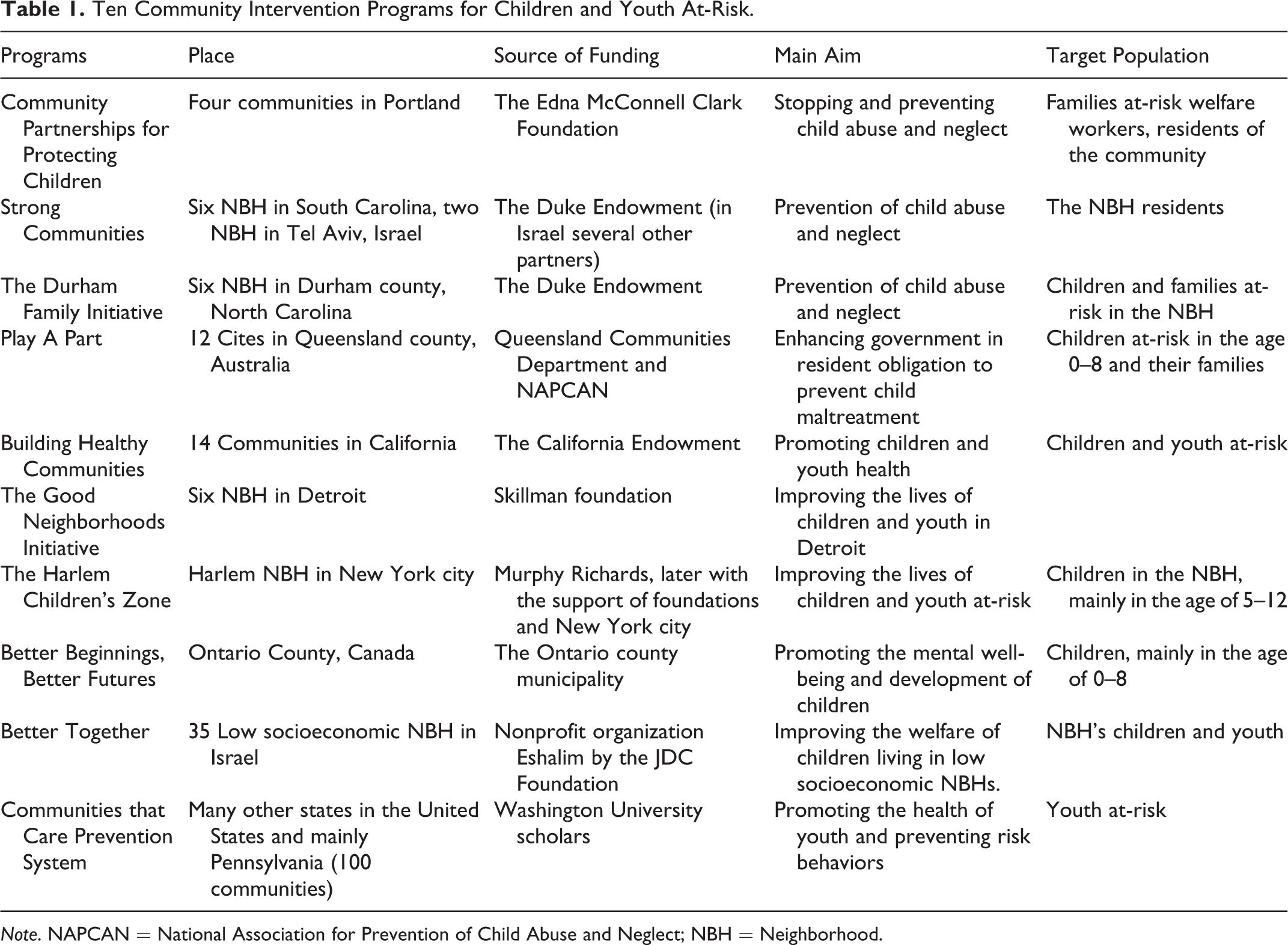
Note. NAPCAN = National Association for Prevention of Child Abuse and Neglect; NBH = Neighborhood.
Critical Findings.

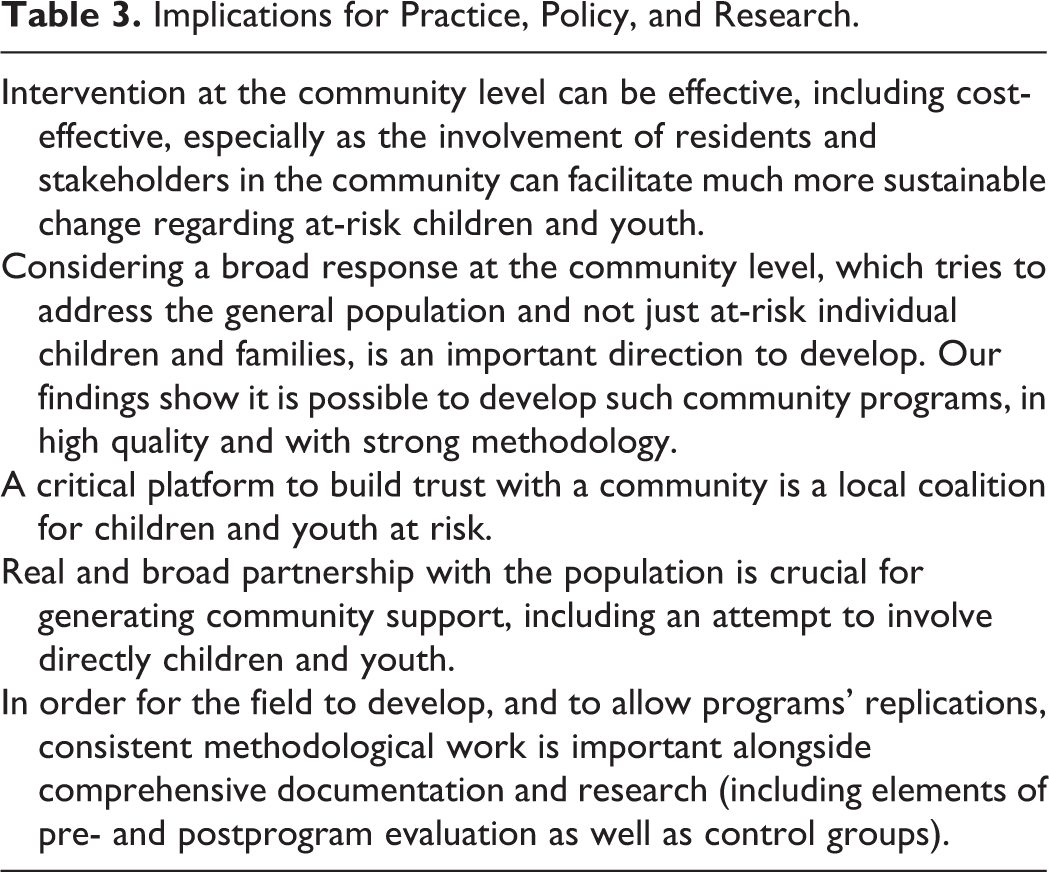
Implications for Practice, Policy, and Research.
For each program, we gathered information on organizations’ websites, reports, and academic articles. It should be noted the quality and nature of the information available for each program varied considerably. A short summary for each program is below.
It should be emphasized the majority of initiatives defined in the literature as “community-based interventions” refer to various types of interventions mainly at the individual level which are conducted in the context of a community (e.g., parental support groups offered through schools, home visits by community volunteer). However, our interest in this review was to focus on interventions that include also an explicit aim to facilitate some level of community change. Accordingly, we did not include interventions devoid of a community strategy component. Thus, the review adds to the current literature by gathering a relatively large number of interventions compared to prior reviews (Daro & Dodge, 2009; Molner et al., 2016), using a broad definition of the term at-risk among children and youth, and focusing on the use of community development strategies. Accordingly, because the criteria were specific, we eventually could identify only a very limited number of programs.
Community Partnerships for Protecting Children (CPPC)
Program background
The Edna McConnell Clark Foundation initiated CPPC in Portland, OR, in 1995. For the first 8 years of the program, the foundation invested US$41 million in implementation and evaluation (Daro et al., 2005). The program operated for 12 years (The Center for Community Partnerships in Child Welfare, 2006).
CPPC focused on children who experienced or were at high risk of experiencing family abuse or neglect. The goal of the program was to provide a response to the gaps existing between prevention programs operating in the community to the child welfare system (Daro & Dodge, 2009). The program was intended to prevent abuse and neglect in the neighborhoods and communities at relatively high risk (The Center for Community Partnerships in Child Welfare, 2006).
Main elements of the intervention
The program included a few components, one was mentoring for families at-risk, while another was facilitating a process to encourage better relations and communication between the community and child protection systems, based on the assumption that this focus would foster better prevention of child abuse. The process included an individual intervention program that emphasized connecting individuals to the existing community responses while strengthening social networks between residents, developing local leadership, and establishing an organizational platform for children at-risk to support the cooperation of welfare department and informal community organizations. The theory grounding the project prioritized the welfare of the child, taking into account the child’s needs and desires in both the family and community frameworks (The Center for Community Partnerships in Child Welfare, 2006).
Program evaluation method
The Center for Children at Chapin Hall at the University of Chicago conducted a mixed-method program evaluation with the support of the initiating foundation. Between 2000 to 2004, the program’s influence on levels of child protection and other variables was evaluated. The evaluation included a survey with the participating families (before and after the intervention), tracking administrative data, and a survey with involved organizations, welfare workers, and community volunteers (Daro et al., 2005).
Intervention results
The families that participated in the mentoring program testified to an improvement in their parenting, a broader approach to essential support and resources and greater involvement in the process of personal decision-making (Daro et al., 2005). At the community level, the institutional workers who participated noted that the program improved organizational functioning and the level of cooperation between them and the grassroots community organizations, which enabled more effective resource use, processes, and cooperative decision-making with regard to everything connected to necessary community services (Daro & Dodge, 2009). The ongoing training of the child welfare workers improved their trust in the program and their job satisfaction, leading to greater employment stability. Similarly, improvement in relations and cooperation between the community and child welfare workers enhanced the image of the welfare workers in the eyes of the residents, increasing their access to community resources (Daro et al., 2005).
Strong Communities
Program background
Strong Communities was implemented in two centers, in the United States and Israel. In both centers, children at-risk and their communities were defined as the target group, and the program goals were to preserve the security of all children in the community and ensure their protection (Nehemiah & Levi, 2016). The Duke Endowment initiated the program in the United States in cooperation with Clemson University, budgeting about US$1,000,000 annually (Daro & Dodge, 2009). The program operated for 5 years, starting in 2002, in six communities in Greenville County, South Carolina. The Haruv Institute initiated the program in Israel in cooperation with the social work schools at Tel-Aviv University and Haifa University and the cities of Tel-Aviv and Haifa. The program ran for 3 years in a neighborhood of Tel-Aviv and began operating in a neighborhood in Haifa at 2017, where it is currently still running.
Main elements of the intervention
The essence of the intervention is to change community behavioral norms and empowerment of parental leadership (Mcleigh et al., 2015b). The central uniqueness of the initiative is its emphasis on change in the approach and expectations of residents with regard to collective and mutual responsibility for the welfare of the children. One of the program’s underlying assumptions is that once residents feel that all the neighborhood residents are helping one another, a demand will then arise for additional services and improving child welfare in the neighborhood (Mcleigh et al., 2015a; Mcleigh et al., 2015a; Nehemiah & Levi, 2016).
The intervention has four stages. The first stage is the dissemination of information on the program and its importance to community residents. The second stage involves development of social capital through the creation of networks of residents for the purpose of planning community activities, to increase involvement of parents and recruit community institutions and organizations. The third stage is the development of resources to assist families. In the fourth stage, community leadership is developed to promote the needs of the residents and the security of the community’s children (Mcleigh et al., 2015a, 2015b; Nehemiah & Levi, 2016).
Program evaluation method
Academic institutions involved with the program carried out the evaluation using a mixed-method approach. Several evaluations were conducted, including interviews with volunteers (Hashima & Melton, 2008; Haski-Leventhal et al., 2008) and surveys with a random sample of participating residents who were compared to a sample of nonparticipants at two time points (McDonell et al., 2015). Administrative data regarding rates of injuries and child abuse and neglect were also tracked and compared to other comparable area (Mcleigh et al., 2015a, 2015b). Results were published so far only for the intervention conducted in the United States.
Intervention results
Findings indicate a rise in the level of security of children at home and a rise in the level of parental involvement and parenting skill. Administrative data indicate a decrease in the number of injuries resulting from abuse and neglect and a lower rate of incidents of abuse under the age of 10 in comparison to data from an area where the program was not operating, though the effect was relatively low (McDonell et al., 2015). At the community level, there was a high level of involvement and community engagement. During the 5 years of operation, 125,000 residents were involved and over 500 volunteers from 200 churches, 186 businesses, and 77 community organizations. The volunteers supplied resources, leadership, and infrastructure for one or more of the project activities. The project promoted a feeling of collective efficacy, mutual assistance among residents, and reduced socioeconomic and social gaps.
The Durham Family Initiative
Program background
The Duke Endowment’s Child Abuse Prevention Initiative established the Durham Family Initiative in 2002 with an annual budget of about US$1million for each of the 6 years of operation. The program was implemented among families at high risk of neglect and abuse of children in six neighborhoods in Durham County, North Carolina. Its goal was to reduce the level of neglect and abuse of children in North Carolina by 50% over a decade (Daro et al., 2009; Dodge et al., 2004).
Main elements of the intervention program
The program was designed to aid children at-risk of abuse through a model for healthy development within the family, by strengthening security and protection in both the family and community frameworks (Fisher & Lerner, 2004). The underlying program assumption was that children at-risk live in distressed neighborhoods; hence, the initiative must focus both on the children and on their neighborhoods. The systemic interventions included every level in the child’s ecological system, though it did start originally with a focus on the individual level. As part of the intervention, families at-risk were located and were then connected to community resources. The parents received professional counseling and social support, and various neighborhood activities were conducted to promote connection between parents and mutual support network. Community leadership was developed to give response to issue regarding children and youth at-risk in the neighborhood.
Program evaluation method
The Chapin Hall Center at the University of Chicago conducted the evaluation using quantitative research that examined the effectiveness of the intervention program and its coping with challenges that arose, using a randomized survey of parents before and after implementation of the program, and analysis of the administrative data regarding rates of abuse and neglect, both in comparison to comparable counties that did not operate the program (Daro et al., 2009).
Intervention results
A total of 1,741 county families responded to the anonymous questionnaire. Upon comparison to a control county, the findings indicated an 11% reduction in the number of children who suffered abuse following the implementation of the program. According to welfare authority data, after 6 years of program operation, a reduction was found in comparison to other comparable counties, in the rates of abuse and neglect, recidivism of instances of abuse and neglect, and hospitalization of children (Daro et al., 2009; Daro & Dodge, 2009). Random surveys conducted with residents in six neighborhoods in comparison to parallel areas reported a decrease in parental tension and improvement in parental self-efficacy. However, no significant improvement was reported for parental rating of positive parent–child interaction or for evaluation of risk of abuse among community families. There was no reported change in interaction between residents in social solidarity or satisfaction with the neighborhood (Daro & Dodge, 2009).
Play a Part
Program background
The nonprofit National Association for Prevention of Child Abuse and Neglect (NAPCAN) initiated and implemented the program Play a Part. Beginning in 2007, the Queensland Department of Communities funded the program in 12 cities in Queensland State, Australia (Gwinner, 2013). The target group was children up to the age of 8 at risk of or who were neglected or abused. The program operated for 3 years, and its goal is to prevent child abuse and neglect (Gwinner, 2013; NAPCAN, 2014).
Main elements of the intervention
The essence of Play a Part is to create a broad community partnership to prevent child protection system needs to intervene with children and families. The underlying assumption is that the greater the individual awareness to the issue of child maltreatment and the more connected individuals within the community are to one another, the greater their ability to change their lives for the better and to reduce children’s risk. Accordingly, the program emphasizes giving voice to the children, community development, and community education. The program is grounded in the ecological approach, moving from the macrolevel (the community) to the microlevel (parent and child).
Program evaluation method
NAPCAN conducted the evaluation using qualitative research. Interviews and focus groups were conducted with stakeholders (governmental partners, service providers, welfare employees, parents, and children) and the staff guiding the program. Insights were gathered regarding program effectiveness and suggestions for improvement were raised. Reports and documents recording project advancement were collected from stakeholders (e.g., welfare services) and were released to the public (Gwinner, 2013).
Intervention results
The intervention strengthened protective factors known to be associated with lowering rates of abuse and neglect, such as improvement of social ties and positive development of children. Similarly, the intervention assisted in developing the capability of parents to cope with their children in situations of conflict. The ability of service providers and organizations in the community to identify system assets and decrease gaps between the existing and the required in the community increased. Formal and informal networks were developed that included children and youth in decision-making regarding diverse subjects that touch their lives, fostering leadership skills among the children and youth, and a rights-based agenda led by the community’s children with regard to prevention of abuse and neglect. Parents acquired skills to educate and empower their children (Gwinner, 2013).
Building Healthy Communities
Program background
The California Endowment, a private foundation, established Building Healthy Communities (BHC) in 2010, budgeted at US$1 billion for 10 years (The California Endowment, 2018). The program targets children and youth in 14 communities in the State of California (Preskill et al., 2013). Its goals are to raise awareness and knowledge about children’s health, support the healthy development of children, and improve the quality of life in their home and school environments.
Main elements of the intervention
The intervention is a comprehensive community intervention, which is an intensive strategy trying to address the needs of poor communities by intensive community-based organizing (Kubisch et al., 2011). This approach reflects the foundation’s perspective that society, environment, politics, and economic aspects all influence health and welfare. The foundation emphasized prevention and identified outcomes such as encouraging health insurance coverage for the entire population, support for healthy development of youth, improving the home and school environment, and change in services provided (Preskill et al., 2013).
Program evaluation method
The foundation conducted interviews and focus groups with program stakeholders and managers and the program operating team at various levels (Preskill et al., 2013). Other qualitative research was based on an evaluation of individuals and workers involved in the program at few specific communities as a case studies, garnered in interviews, focus groups, and by survey (see e.g., FSG, 2013a, 2013b).
Intervention results
The program aided in developing effective leadership that promoted the foundation’s vision for fostering good health and leadership among youth. Joint initiatives were established with stakeholders and nonprofit social organizations for increasing awareness and access to health services among both the general and youth populations. The program and its activities strengthened the relations between the neighborhood residents (Preskill et al., 2013).
The Good Neighborhoods Initiative
Program background
The Skillman Foundation initiated the Good Neighborhoods Initiative in 2007. The program ran for 10 years and was budgeted at US$100 million. The target population was children in six impoverished neighborhoods in Detroit, MI, and its goals were to promote education for health, security, and higher education and to prepare the children for matriculation exams (Burns et al., 2017; Gant et al., 2017).
Main elements of the intervention
The intervention focused on improving the lives of children and youth in Detroit, a city known for high poverty and unemployment rates in recent decades (Gant et al., 2017). The primary intervention goal was to encourage residents to take responsibility for advancing the security and education of the neighborhood’s children by recruiting the support of community members through various initiatives (such as counseling program for parents to guide decisions about their children’s education, project for making roads to schools safer).
Program evaluation method
The evaluation was carried out by the initiating foundation and Wayne State University, University of Chicago, and University of Michigan using a mixed-method approach. Administrative data were gathered from different governmental sources as well as neighborhood database (Data Driven Detroit, 2018); the foundation supported its establishment. Surveys at three time points were conducted with youth, parents, foundation staff, and relevant stakeholders (Burns et al., 2017).
Intervention results
In the neighborhoods participating in the program, the rate of youth finishing high school rose from 65% to 81%. In the same neighborhoods, from 2009 to 2016, the crime rate dropped by 40%, and there was a 47% drop in injury to youth. About 10% of the neighborhood residents were involved in some aspects of the program initiatives, and the number of children and youth participating in the initiative rose staidly along the years.
In the neighborhoods, community leadership networks were established that had the ability to influence local conditions for the benefit of the children. Sector-crossing coalitions were established with the goal of developing the city’s educational systems. There was an increase in the feeling of security in the community and in the willingness of children and youth to improve their academic achievements (Burns et al., 2017).
The Harlem Children’s Zone (HCZ)
Program background
In 1970, Richard Murphy, entrepreneur, established the initiative in the neighborhood of Harlem, New York City. From the 1990s onward, the program received funding from different philanthropic foundations (e.g., Edna McConnell Clark Foundation) and from the City of New York. In 1997, the program was officially declared HCZ, and by 1999, the budget reached about US$10 million and later US$20 million annually (The Bridgespan Group, 2004). The program has been operating for almost 50 years in different formats. The program goals are to respond to challenges in schools, to crime, to problems in the home, and to health problems of children in Harlem. The program target group is children of ages 5–12.
Main elements of the intervention
At the heart of the initiative is the attempt to turn the public schools in the neighborhood to community centers that provide solutions to the needs of the children every day of the week (HCZ, 2018). The program accompanies the children until they reach college (Dobbie & Fryer, 2010). The HCZ model is holistic, based on initiatives to build a community that is invested in improving educational outcomes, parenting skills, and the connection between technical, public, and legal services (Nicholas et al., 2005). The initiative is intended to change the reality of the neighborhood children’s lives, create more positive patterns of free-time use, and increase educational achievements, through different extracurricular activities and by encouraging young residents to become achievement-oriented and to develop leadership qualities (Dunn, 2010; The Bridgespan Group, 2004). Over the years, diverse programs have been developed under the HCZ, such as “Baby College” for young parents, which provided new parents information about nutrition, health, and optimal development for their children (Hanson, 2013).
Program evaluation method
Evaluation of the program was conducted by researchers at Harvard University using a quantitative methodology (Dobbie & Fryer, 2010) and focused on the educational achievements of students who participated using “The Iowa Tests of Basic Skills” (Hanson, 2013).
Intervention results
During the 1990s, over 13,000 children at 16 centers participated in the program. Findings reported a decrease in the academic gaps between Whites and African Americans (Dobbie & Fryer, 2010; The Bridgespan Group, 2004). In comparison to other schools, there was a significant improvement both in student academic achievements and in the rate of students who continued on to higher education (Hanson, 2013). The program gave school students significant help and ran quality extracurricular programs for them. The program leaders believe that the initiative helped youth distance themselves from crime and violence, yet the statistical data do not demonstrate noticeable decline (Dobbie & Fryer, 2010).
Better Beginnings, Better Futures (BBBF)
Program background
Three provincial ministries (Education, Health, and Social Services) in Ontario Province, Canada, established BBBF in 1980. About US$6 million (Canadian) was budgeted annually, and the program ran for 25 years (Peters et al., 2010) and is still ongoing. The program’s target population was 8-year-old children, and its goals were to promote their emotional well-being and prevent developmental problems through aid and community activities for their families (Pancer & Cameron, 1993).
Main elements of the intervention
The intervention was based upon a holistic ecological approach and universally applied. Accordingly, its components were intended to advance multilevels: the individual—an initiative promoting child development, the family—programs and initiatives promoting optimal family relationships, the community—initiatives that contributed to increased solidarity between residents and advanced joint activities of the residents for the benefit of the children (Worton et al., 2014).
Program evaluation method
Researchers at Wilfrid Laurier University evaluated the program with support from the Canadian National Council for the Prevention of Violence. A mixed-method evaluation was conducted with 600 children and their parents, who participated in the program, at three time points (age 9, 12, and 15). Researchers evaluating program impact on the children measured psychological, emotional, and social parameters; their functioning in school, the family, and community; and their satisfaction with their neighborhood. Among parents, researchers measured parental pressure, parenting, level of health, and level of involvement of the parents in advancing activities related to the initiative (Worton et al., 2014).
In another evaluation study, findings were collected from program participants 15 years later (401 participants aged 18–19) and compared to 225 children and their parents in two control communities (Pancer et al., 2013). A cost–benefit analysis of the program was also conducted measuring the level of governmental savings (Peters et al., 2016).
Intervention results
The program was found to improve the emotional well-being of the children and the parent–child relationship. The children who participated in the program functioned at a higher level and demonstrated fewer emotional and behavioral problems. The parents reported that they felt greater social support and greater belongingness and involvement in the community and expressed greater satisfaction in their relationship with their partner and family functioning. The emotional functioning of the parents improved; they were involved with fewer endangering behaviors and testified to lower levels of depression (Pancer et al., 2013; Peters et al., 2010).
At the community level, the residents formed groups for resolving community problems and were involved in the planning of community activities for the benefit of the children. Youth testified that they felt that their neighborhoods were safer. Results of the cost–benefit analysis demonstrated a US$912 (Canadian) savings at the age of 14–15 for each child who participated in the program, and when they reached age 18, the amount of savings for each participating family was US$6331 (Canadian; Pancer et al., 2013; Peters et al., 2010; Worton et al., 2014).
Better Together
Program background
In 2006, the Israeli nonprofit organization Ashalim initiated the program Better Together with the goal of improving the well-being of children living in low socioeconomic neighborhoods. The pilot began in four neighborhoods, expanded to 35, and now operates in 17 neighborhoods in 14 cities (Somech et al., 2018). Partners in the project implementation included The Ministry of Labor, Social Affairs and Social Services, the Community Work Service, the National Program for Children, and Youth at-Risk (360° program), as well as nonprofit organizations and private businesses (Somech et al., 2014).
Main elements of the intervention
The intervention’s strategies for change are grounded in community initiatives focused on a defined geographic area (a neighborhood). The intervention is based on creating a platform for advancing partnerships and recruiting resources from diverse sources in parallel to developing and strengthening community resources.
The neighborhood intervention is carried out by joint recruitment with community members of service providers, while relying on existing human and social capital, recruiting resources, and seeing the diverse needs and responses required. The intervention is planned to create a spectrum of activities throughout the day and available services (education, health, and welfare), while creating synergy among them (Somech et al., 2014).
Program evaluation method
From 2012, the Myers-JDC-Brookdale Institute has evaluated the program to measure program success and provide feedback for improvement. The evaluation was based on data from the Central Bureau of Statistics and administrative databases, in-depth interviews with field workers involved in the program activities, and surveys with parents and youth at two time points (Somech et al., 2018).
Intervention results
The program succeeded in laying an organizational foundation, to expand responses and increase the rate of their use, and to establish a network of active residents able to operate independently for the benefit of the community. In addition, the program increased the feeling of personal security and decreased resident reports of vandalism and disturbances, as well as school truancy and risk behaviors among junior high students. There was also an increase in neighborhood satisfaction and view of the neighborhood as a fitting place to rear children and an increase in the feeling that there was an address for problems relating to children. More residents of all ages were involved in the community and experienced a feeling of competency to influence neighborhood life. The program’s influence was also clear in the various measurements of residents who were not active in the community and did not take part in the program (Somech et al., 2018).
Communities That Care Prevention System
Program background
Researchers from Washington University established the initiative in the 1990s. The program operated for 3–5 years in many U.S. communities, particularly in Pennsylvania (in about 100 communities). The initial sum for implementing each program was US$15,000, and later, the budget was fixed according to the programs chosen by the community and funded by state offices (Feinberg et al., 2004). The target population was youth at-risk, and the program goals were to promote their health through prevention programs and treatment of issues of criminality, violence, and alcohol and drug use (Gloppen et al., 2012).
Main elements of the intervention program
The goal of Communities that Care Prevention System (Communities that Care) was to establish a local coalition to select, through a structured and educated process, programs for youth at-risk appropriate for the specific community (e.g., treatment of alcohol and drug addiction and prevention of violence). The coalition was then charged with accompanying the implementation of the chosen program and evaluation of its results (Gloppen et al., 2012). The initiative was officially recognized as evidence-based practice (EBP).
The intervention elements were divided into five stages (Shapiro et al., 2015): (1) recruiting community leaders and advancing initiative through increasing awareness and information about the initiative’s vision and goals; (2) active involvement of community leaders, establishment of a coalition to create a clear organizational structure, and define operational protocols to promote the initiative and ensconce the community vision; (3) mapping of the community by collection of information using surveys implemented by coalition members, understanding of the risks and possible solutions, research of existing intervention programs in the community, and understanding their weaknesses; (4) choosing a program to fill in the gaps in existing programs and development of a work plan with a budget and time line for every program stage, transfer of program principles to community leaders, and training of coalition members to promote the program vision; and (5) implementing the new program in the community, overseeing carrying out of objectives in the target communities, evaluating program results and its implementation in the community every 2 years.
Program evaluation method
Researchers from the University of Washington (Seattle) and the University of Pittsburgh conducted the evaluation, with support from the National Institute on Drug Abuse. “The Community Youth Development Study” used a mixed-method approach: 4,407 youth completed questionnaires every year from 2004 to 2014, and in-depth qualitative and quantitative interviews were conducted with local coalition members who examined the success rate of the program, functioning of the coalition, and principles implemented and method of implementation and sought resident responses to the initiative and their suggestions for improvement (Feinberg et al., 2004). Research also evaluated government savings as a result of the program (Catalano et al., 2012).
Intervention results
Over the years, the program helped reduce the risk of drug use by 49%, lowered the risk for antisocial behavior, and reduced smoking over the years (Hawkins et al., 2012; Oesterle et al., 2018; Rhew et al., 2016). In the research evaluating coalition functioning, it was reported that the level of preparedness of the community leadership was correlated with personnel changeover and internal rivalries and that the relationship of the coalition with outside factors was particularly important in instances when the coalition was dependent upon local resources (Feinberg, et al., 2004). One of the evaluation results reported savings in government spending that stemmed from the improvement in the situation of criminality, reduction in calls to law enforcement, and reduction in costs required for treatment of offenders or smokers among youth, such as the cost of treatment, counseling, and rehabilitation (Catalano et al., 2012).
Discussion of Core Issues
Core issues that arose from the programs review are critical to consider when funding or engaging in a community intervention program for children and youth at-risk. The following discussion will attempt to analyze these issues and present conclusions and recommendations for policy decision makers, professional practitioners, and academic researchers.
The Strategic Model
The community development model (Rothman, 2007) provides the theoretical basis for all community strategies in the programs reviewed. Processes of community developing vary in pace, nature, and content as they inevitably need to be adjusted to the specific locality. Yet all are intended intrinsically to promote the following results: a healthy, safe, and comfortable community; leaders who can implement appropriate social solutions for the community, recruit resources, and design unifying social messages; encouragement of active citizenship and involvement of local residents in decisions regarding their lives; and creating safe public spaces and coping effectively with complex social problems (such as domestic violence, crime, and drugs). Two strategies of community developing dominated all of the reviewed programs: developing and empowering local leadership, including residents’ involvement, and developing community networking, the social capacity to promote cooperation between organizations, services, and residents.
Professional Orientation
The programs were anchored in a variety of professional fields. Some were focused in welfare services, with preventing abuse and neglect as their main goals usually (CPPC, Strong Communities, Play a Part, and Durham Family Initiative, Better Together), others in promoting health (BHC, BBBF, and Communities that care), and others in education and improvement of academic achievement (e.g., HCZ and the Good Neighborhoods Initiative). The professional orientation can influence recruitment of residents and volunteers, appeal to broad target groups, and fundraising. The professional field also dictates, in many cases, the professional background of the staff and whether it would be social workers, educators, or health professionals.
From the initiatives described, it seems that in the more “normative” fields, such as health and education, it was less complicated to recruit volunteers and to get residents involvement, as they were viewed as less stigmatizing, making it easier to speak directly with community residents about the risk. However, it should also be emphasized that also in the context of welfare, it is possible to present a less stigmatizing and more normative perspective as was done in Strong Communities, for example, by focusing the conversation on keeping children safe rather than on abuse and neglect.
Target Population
Definitions of risk in the different intervention programs were inconsistent; sometimes described quite limitedly or vaguely. Nonetheless, in the interventions reviewed, it was possible to identify three main units of target populations at focus: individuals within the community—children, youth, and families at-risk; neighborhoods at-risk (usually low socioeconomic neighborhoods); and a general community; when broader population, then a neighborhood was considered as the program’s target. In some cases, these targets can be very close and overlap, and other programs might have two main targets, focusing on individuals but also trying to be involved in awareness raising and policy practice to affect the entire population (like Play a Part work at the national level).
The focus on individuals at-risk stood out in CPPC, The Durham Family Initiative, BHC, and Communities that Care. These programs had both preventative and rehabilitative aspects, as some of them took into account the fact that some of the participating children were already abused in the past or that some of the youth were currently involved in at-risk behaviors.
Among the programs that target neighborhoods, it should be noted that in a few (e.g., The Good Neighborhoods Initiative and HCZ) despite the official neighborhood definition, it is unclear how much in practice the initiatives worked broadly with the neighborhood population. This was not the case, with other programs that focused also on the third type of target population, the general community. Strong Communities and BBBF focused on much broader community circles including residents from various age groups. In these communities, an effort was made to raise awareness among the broader population, which was not necessarily in at-risk circles, regarding the risk to children in the community and their consequences, in order to get residents actively involved in the issue.
The Initiative Origin
There were three primary initiators of interventions: private, government, and academia. (1) Private foundations initiate the vast majority of interventions. For many years, particularly in the United States, private foundations have been dominant in funding comprehensive community initiatives (Kubisch et al., 2011). Seven of the 10 programs reviewed here were initiated by private foundations: Communities that Care, Strong Communities, The Durham Family Initiative, Building Healthier Communities, Good Neighborhoods Initiative, HCZ and Better Together. (2) Government offices were primarily initiator in programs outside of the United States. In BBBF, the initiator was the Ministry for the Community and Social Services of Ontario Province, Canada, and to the best of our understanding, the ministry also operated the program. The Queensland State, Australia Ministry for Communities supported from the beginning Play a Part, and the program was operated by the nonprofit organization NAPCAN. CPPC operated on the initiative and with the support of the Centers for Disease Control and Prevention of the U.S. Department of Health and Human Services. (3) Academia initiated some of the interventions, as in the case of Communities that Care and Strong Communities. Given the great variety of initiatives, no clear connection arises between the initiating body and the character or results of the initiative, though this is still an important context that might shape and influence the program critically. It is important to note that local government authorities supported and funded the continued implementation of many of the interventions initiated by other agents.
Conclusions: Implications for Practice, Policy, and Research
While community-based interventions have received increased attention, programs that explicitly include community development and community change related to children and youth at-risk have been limited. Nevertheless, the programs identified in this review have several implications.
Implications for Practice
Community-based programs that address the general population, as reflected in this review, are a promising direction. The collective responsibility approach in programs such as Strong Communities, for example, involved tens of thousands of residents in community action for children at-risk. This approach also helps avoid stigma and promotes recruiting important stakeholders from the broader population.
The review also demonstrated the importance of designing an intervention that is appropriate for the specific community. In the field of children and youth at-risk, there is significant variability in the situations and needs of different communities, whether from the aspect of the type of problems that concern the population or cultural differences. It is crucial to adjust the intervention according to specific community needs, as well as the nature of existing leadership and social capital; otherwise, the intervention might be jeopardized as the community’s trust is at stake. A critical platform to build this trust is a local coalition for children and youth at-risk. These coalitions were most explicit in Communities that Care and were also apparent in other programs such as CPPC and Better Together. They can be the source of local organizing for integration, prevention, and coping with children and youth at-risk at the level of the specific community, including relating to services and interventions currently existing in the community.
Coalitions are related to the important issue of residents’ involvement. In this context, it should be noted that while the majority of initiatives included activities to involve residents, they were carried out at different levels and scope. An attempt for real and broad partnership is crucial for generating community support, for success of the initiative, and for preventing concentration of too much power in the hands of professionals. Service Users Involvement (SUI) in the social work context has grown in scope since the 1990s. In some countries, SUI is considered to be a key aim in every intervention, based on the value of self-determination (Davies et al., 2014).
Another dilemma in this context is whether the partnership includes the central target population, children and youth, or only adults and parents. Typically, community work calls for a full partnership with the target population. Group and community interventions directly with youth are an important strategy that can be very effective (e.g., YES, Youth Empowerment Strategies in Brennan, 2008; Wilson et al., 2008). In the last two decades, scholars have called for full partnership with children, even at young ages, with regard to all aspects related to their lives including citizenship involvement, active involvement in research, and more (Prout & James, 2005; Qvortrup, 2002). It is both possible and important to encourage involvement of and partnership with children and youth, particularly since they are typically the direct target population. In our review, we found such an attempt in Play a Part.
Implications for Policy
In light of the general trend of welfare services worldwide, to develop responses for all target populations in the community framework, in parallel to the processes of resource reduction in the welfare state, the urgency and importance of developing quality community responses to prevent various social problem, and protect children at-risk, in particular, is clear. This kind of intervention can be very cost-effective, especially as the involvement of residents and stakeholders in the community can facilitate a much more sustainable change regarding at-risk children than is possible in other more individualized interventions.
Analysis of the different programs in this review indicates that it is possible to develop good community responses with clear impact. However, there is still a considerable distance to cross in order that such responses become more widespread and accessible. This goal requires a change in perspective among policy makers as well as in the expectations of residents and their willingness to become actively involved in their communities, out of an ideology of solidarity and mutual assistance.
Implications for Research
The programs were accompanied by varying levels of research evaluation. The simplest evaluation was conducted through interviewing those involved in the program, sometimes only program operators and sometimes community residents as well. Other evaluations included surveying using questionnaires distributed to youth, parents, or residents who participated in the program. Surveys are an established research method for understanding intervention results. At the same time, it should be recognized that programs’ evaluations varied in their research designs as well as the level of sophistication, for example, whether the survey included both pre-and postintervention surveys. Overall, some level of significant changes were identified in almost all programs, except for Play A Part, BHC, and Better Together, which did not include statistical evaluations.
The more limited evaluations took on measurement only at the end of the program. The more comprehensive evaluations included a survey at the beginning and the conclusion of the intervention. In a few cases, follow-up evaluation was conducted with the target population at a number of points in time. Long-term research enables examination of the extent to which change is preserved and the level of sustainability but is also very resource demanding.
Use of control samples is an additional important aspect, as was done in the Durham Community initiative, BBBF, CPPC, and Strong Communities. To maximize an exact and valid process, control groups should be identified at an early stage of the evaluation process and, if possible, selection of the intervention community and control group should be random. In some cases, when evaluating change at the community level also, a more general comparable population was used (e.g., in Strong Communities). These steps can assist in coping with one of the central dilemmas in evaluating community interventions, the “attribution problem,” the ability to relate the results measured directly to the intervention (Kubisch et al., 2011).
Another important evaluation tool, used in most of the programs, was tracking administrative statistics, their analysis, and examination of changes in the relevant variables such as rates of reported abuse and neglect, crime rates among youth, school attrition rates, and more. It is important to take into account that in order to see the influence of this type of data, an ongoing rigorous process is required including long-term intervention.
In this context, it is also important to attend to the issue of databases. In the last few decades, data collection is increasingly done on the neighborhood level. Neighborhood databanks were established in Detroit in the framework of the Good Neighborhoods initiative (Data Driven Detroit, 2018), and they have existed for a number of years in cities such as Chicago and Cleveland (Coulton et al., 1999; Sampson & Raudenbush, 2004). Since in the majority of cases the intervention is carried out at the neighborhood level, it is important to establish this type of database, and technological developments make it easier today.
Measuring the budgetary savings that the programs achieved, as a result of preventing different risk behaviors that would have occurred without the intervention, is tremendously important (e.g., the cost of health services for damage from injuries, smoking or drug use, use of jails due to higher crime rates). Two programs presented in the review that took cost–benefit analyses were BBBF and Communities that Care. This method requires professional economic knowledge and reliable data on the costs of different services and is critical for the ability to present a tangible intervention-based contribution to catch the interest of policy makers.
The final aspect raised here is the identity of the evaluator. One cannot ignore the fact that evaluation executed by outside evaluators (e.g., academics or research centers connected with academic institutions) should usually be considered more reliable. Generally, it seems there was a greater chance of seeing discussion of negative and unsuccessful aspects of the program in outside evaluations (e.g., CPPC), whereas in-house evaluations, particularly if based only on interviews with staff, were largely positive.
Limitations and Directions for Future Research
The review had some limitations that need to be considered. A basic limitation, but consistent with much of the literature on child maltreatment, is the database in which we could search, including the languages we could access. While this is not unique to the current article, we encourage the field to develop ways of capturing and disseminating community engagement in serving maltreated and at-risk youth. We also encourage the development of international collaborations that allow the field to draw inferences from a wider range of the human experience than usually available (e.g., Heinrich et al., 2010).
We chose to cover all 10 of the programs that were eligible for inclusion, which made it more challenging to describe each in depth. However, many programs together can afford a broader picture with alternatives for further replication or improvement of current programs. As was mentioned in the beginning, many community interventions are not documented in published documents, so it is possible there is important work being done which was not included. Furthermore, we could only access data in English and Hebrew. Another complexity was that community work terminology tends to vary across the programs, making it elusive to firmly identify the community organizing process that was actually implemented. It is possible in some interventions it was an extensive community-building process, while in others, it was just in the level of gathering primarily organization representatives.
Finally, in order for the field of such community interventions for children and youth to develop, consistent methodological work is important alongside comprehensive documentation and research (including elements of pre- and postprogram evaluation as well as control groups). Planning and budgeting for evaluation should be done at the initial stages of the intervention in order to enable a valid picture of the intervention results. Published detailed descriptions with robust evaluations will support the possibility of replication in other communities. As we have seen in the review, EBP evaluation in the context of community interventions is rare (only one program in our review used it, Communities that Care). One interesting and more practical direction to explore in order to promote thorough evaluation in this field can be complementary methods for summarizing evidence (Barth et al., 2012), such as the Common Element Approach (Chorpita et al., 2005) used in the mental health context, which tries to identify generic components in the specific interventions level and associate them with outcomes across the literature. Here, we focused only more generally on the structural aspects of the programs and did not go deeper into the specific intervention’s components. While the limited published data in this field and limited RCTs conducted might pose some challenges, this is an important direction to explore.
Footnotes
Acknowledgments
We would like to thank the Israeli Ministry of Labor, Social Affairs, and Social Services that supported the writing of the original more extensive review, in Hebrew, that this article is based on.
Declaration of Conflicting Interests
The author(s) declared no potential conflicts of interest with respect to the research, authorship, and/or publication of this article.
Funding
The author(s) received no financial support for the research, authorship, and/or publication of this article.
